


Product Monograph - Zaditor (Novartis Pharmaceuticals Canada)
SUMMARY PRODUCT INFORMATION
Route of Administration | Dosage Form / Strength | Clinically Relevant Nonmedicinal Ingredients |
| Topical (instillation) | Ophthalmic Solution 0.025% as ketotifen | Multi dose container: Preservative benzalkonium chloride 0.01% For a complete listing see Dosage Forms, Composition and Packaging section. |
INDICATIONS AND CLINICAL USE
ZADITOR* (ketotifen fumarate ophthalmic solution) is indicated for:
$ treatment of allergic conjunctivitis.
CONTRAINDICATIONS
$ Patients who are hypersensitive to this drug or to any ingredient in the formulation or component of the container. For a complete listing, see the Dosage Forms, Composition and Packaging section of the product monograph.
WARNINGS AND PRECAUTIONS
General
For topical use only. Not for injection or oral use.
Multi Dose Container: As with all ophthalmic preparations containing benzalkonium chloride, patients are advised not to instill ZADITOR* (ketotifen fumarate ophthalmic solution) while wearing soft (hydrophilic) contact lenses. Wearers of soft contact lenses should be instructed to remove lenses prior to instillation of drops and to wait at least ten minutes after instilling ZADITOR™ before they insert their contact lenses.
To prevent contaminating the dropper tip and solution, care should be taken not to touch the eyelids or surrounding areas with the dropper tip of the bottle. Keep the bottle tightly closed when not in use.
Special Populations
Pregnant Women: There are no clinical trials on the use of ZADITOR* (ketotifen fumarate ophthalmic solution) in pregnant or nursing women, therefore, ZADITOR* should not be used during pregnancy, except if the benefit justifies the potential risk to the foetus.
Pediatrics (> 3 years of age): ZADITOR* is indicated for use in pediatric patients over the age of 3 years.
ADVERSE REACTIONS
Adverse Drug Reaction Overview
In controlled clinical studies with ZADITOR* (ketotifen fumarate ophthalmic solution), conjunctival injection was the most common ocular adverse reaction related to therapy, with a reported incidence of 7.0%. Headache was the most common non-ocular adverse reaction related to therapy, with a reported incidence of 1.5%. The occurrence of these side effects were generally mild and did not result in discontinuation or interruption of trial medication.
The following ocular adverse reactions related to therapy were reported at an incidence of less than 3%.
Itching, dry eyes, burning or stinging, eyelid disorder and discharge.
DRUG INTERACTIONS
Overview
If ZADITOR* (ketotifen fumarate ophthalmic solution) is used concomitantly with other eye medications, patients should be advised to wait at least 5 minutes between the medications.
DOSAGE AND ADMINISTRATION
Dosing Considerations
Single dose containers:
$ The contents remain sterile until the original closure is broken. $ Single dose containers must be discarded after use.
- After opening a blister, any unused single-dose containers should be discarded after 4 weeks unless they have been stored in the outer carton, in which case they should be discarded after 3 months.
Recommended Dose and Dosage Adjustment
The recommended dose is one drop in the affected eye(s) every 8 to 12 hours.
OVERDOSAGE
Oral ingestion of the contents of a 5 mL bottle would be equivalent to 1.25 mg of ketotifen fumarate. Clinical results have shown no serious signs or symptoms after the ingestion of up to 20 mg of ketotifen fumarate.
ACTION AND CLINICAL PHARMACOLOGY
Mechanism of Action
Ketotifen is a fast acting non-competitive histamine antagonist (H1-receptor). In addition, ketotifen inhibits the release of mediators from mast cells involved in hypersensitivity reactions. Decreased chemotaxis and activation of eosinophils has also been demonstrated. Additionally, ketotifen attenuates the effects of PAF and inhibits cAMP phosphodiesterase.
In human conjunctival allergen challenge studies, ZADITOR* (ketotifen fumarate ophthalmic solution) was significantly more effective than placebo in preventing ocular itching and redness associated with allergic conjunctivitis. The effect was seen within minutes after administration and lasted up to 12 hours.
Pharmacodynamics
In human conjunctival allergen challenge studies, ZADITOR* was significantly more effective than placebo in preventing ocular itching and redness associated with allergic conjunctivitis. The effect was seen within minutes after administration and lasted up to 12 hours.
In a placebo-controlled clinical study designed to evaluate safety, ZADITOR*, administered four times a day for 6 weeks, was shown to be safe and well-tolerated in subjects aged 3 years and older.
STORAGE AND STABILITY
Multi dose containers: Store between 4°C and 25°C.
Single dose containers: Store between 4°C and 25°C. After opening a blister, unused single dose containers may be stored for 4 weeks. Single dose containers may be stored outside the blister in the outer carton for 3 months.
DOSAGE FORMS, COMPOSITION AND PACKAGING
Multi dose containers : Each mL of ZADITOR* (ketotifen fumarate ophthalmic solution) contains:
Active: 0.345 mg ketotifen fumarate equivalent to 0.25 mg ketotifen. Preservative: benzalkonium chloride 0.01%
Inactives: glycerol, hydrochloric acid/sodium hydroxide and purified water.
Single dose containers : Each mL of ZADITOR*(ketotifen fumarate ophthalmic solution) contains:
Active: 0.345 mg ketotifen fumarate equivalent to 0.25 mg ketotifen. Inactives: glycerol, sodium hydroxide and water for injection.
Packaging :
Multi dose containers: ZADITOR* is available in multi dose in white plastic bottles with controlled dropper tips containing 5 mL of clear solution.
Single dose containers: ZADITOR* is available in preservative-free single dose, transparent containers containing 0.4 mL of clear solution. Blocks of 5 single dose containers are each packed in a blister. Carton boxes of 30 single dose containers are available.
PART II: SCIENTIFIC INFORMATION
PHARMACEUTICAL INFORMATION
Drug Substance
Proper name: Ketotifen fumarate
Chemical name: 4,9-Dihydro-4-(1-methyl-4-piperidylidene)-
10Hbenzo[4,5]cyclohepta[1,2-b] thiophen-10-one fumarate
Molecular formula: C19H19NOS + C4H4O4
Molecular Weight: 425.50
Structural formula:
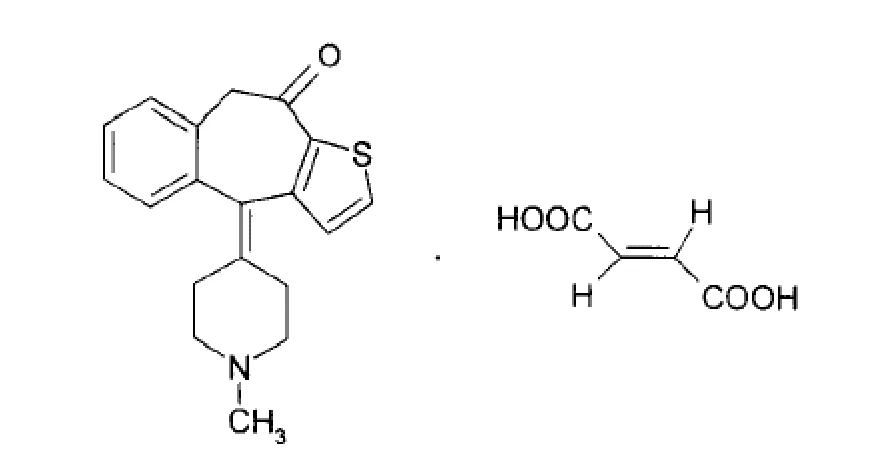
Physicochemical properties:
Description: Fine crystalline, white to yellowish or brown-tinged yellowish powder
Solubility: In the form of the hydrogen fumarate, it is soluble in water. pH: The pH of a 1.2% solution in water is 3.6 pKa Value Ka I = 8.43 ± 0.11
Estimated with ketotifen base by linear extrapolation with values from 5 different mixtures in ethanol/water.
Melting Point: Ketotifen hydrogen fumarate melts with decomposition at about
190ºC. Ketotifen hydrogen fumarate with 2.5 H20 melts at approximately 130ºC.
DETAILED PHARMACOLOGY
Pharmacodynamics
Ketotifen is a benzocycloheptathiophene derivative. Based upon animal pharmacology studies, it exerts anti-anaphylactic and antihistaminic activities, mainly through inhibition of the release of chemical mediators such as histamine and leukotrienes from sensitized mast cells. It also inhibits platelet activating factor (PAF)-induced acute bronchoconstrictor response, airway hyperresponsiveness and accumulation of eosinophils in the airways as well as antigen-induced degranulation of eosinophils in allergic subjects. In addition, ketotifen exhibits a powerful and sustained non-competitive H1-receptor blocking activity distinctly dissociated from its antianaphylactic properties.
The efficacy of ophthalmic solutions of ketotifen fumarate was evaluated by a method utilizing dye leakage in the conjunctiva and/or eyeball following intravenous Evans blue dye. The procedure was originally described as an indicator of accelerated permeability in IgE-mediated conjunctivitis in rats. Ketotifen suppressed dye leakage dose dependently in a model system in which allergic-like effects were induced in the eyes of rats by the single instillation of compound 48/80, which induces the release of histamine and other inflammatory/allergy mediators from mast cells leading to ocular edema. Topical ketotifen ophthalmic solution also resulted in dose-dependent inhibition of vascular permeability in passive anaphylactic IgE-mediated conjunctivitis in rats and guinea pigs. These positive effects on IgE-mediated conjunctivitis in rats were also supported by an improved histopathological picture.
Pharmacokinetics
After topical single or repeated administrations of 50 mL drops of approximately 10 mg/mL in albino rabbits, the highest levels of radioactivity were found in the cornea, the conjunctiva, the sclera and the iris, soon after drug administration. In these structures, the experimental Tmax was 15 minutes, and levels decreased rapidly thereafter. In a whole body autoradiography study in male albino rats, it was shown that the instilled test substance migrated from around the eyes to the nasal and oral cavities via the lacrimal ducts, then to the digestive tract. Tissue migration, other than to the ocular tissues, following ocular instillation, does not differ fundamentally from the distribution following oral administration. .
The urinary excretion rate was 9.8% after ocular instillation. This rate was found quite similar to urinary excretion rates after oral (10.5%) or intravenous (13.0%) administrations. In addition, the fecal excretion rate after ocular instillation (83.3%) was not significantly different than the rate after oral (94.0%) or intravenous (82.9%) administration.
After a single topical administration, the highest AUCs were found in the cornea, then the conjunctiva, the iris and the anterior sclera. Levels of ketotifen were 5-14 fold higher in most tissues 6 hours after multiple topical administrations as compared to the levels after a single administration (except from the plasma and aqueous humor, where a 2-fold rise was observed). The kinetics in blood and plasma after ocular instillation were similar. The half-life was approximately 1.5 hours, while the AUC was 0.3-0.4 mg·hr/mL, and the mean residence time in the body was approximately 3 hours. The mean level was found as low as 0.1-0.2 mg/mL during the steady state with administration at 24-hour intervals.
Clinical Pharmacology
In human conjunctival allergen challenge studies, ZADITOR* (ketotifen fumarate ophthalmic solution) was significantly more effective than placebo in preventing ocular itching and redness associated with allergic conjunctivitis. The effect was seen within minutes after administration and lasted up to 12 hours.
In a placebo-controlled clinical study designed to evaluate safety, ZADITOR*, administered four times a day for 6 weeks, was shown to be safe and well-tolerated in subjects aged 3 years and older.
TOXICOLOGY
The acute toxicity of ketotifen fumarate has been investigated in mice, rats and rabbits. Oral LD50 values were 165, mg/kg, 360 mg/kg and 790 mg/kg in mice, rats and rabbits, respectively. Subchronic and chronic oral toxicity studies in rats and dogs demonstrated that the liver was a target organ for ketotifen fumarate toxicity. In general, toxicity was observed only after long-term administration of ketotifen fumarate at doses up to 700 times those required to obtain antiallergic and anti-histaminic effects.
In a 4-week ocular toxicity study in rabbits, ketotifen fumarate concentrations of up to 0.267% were classified as practically nonirritating, while 1.104% was considered minimally irritating. In a 13-week ocular study in rabbits, ketotifen fumarate at a concentration of 0.069% was classified as practically nonirritating, while concentrations of 0.276% to 1.104% were classified as minimally irritating. In both studies, histopathological and ultrastructural evaluations revealed no abnormalities in ocular tissue.
A chronic toxicity study was conducted with ketotifen fumarate in albino and pigmented rabbits. Administration of ketotifen fumarate ophthalmic solution 0.025% BID or QID had no effects on mortality, clinical signs, body weight, food consumption, ophthalmoscopic examinations, hematology, clinical chemistry, and urinalysis. No treatment-related findings were observed in gross and histopathological examinations of the tissues and organs particularly on the eye and adnexa.
Carcinogenesis: Ketotifen fumarate demonstrated no carcinogenic effects in lifetime studies in mice and rats at dietary doses more than 70,000 times and 59,000 times the maximum recommended ocular human use level of 0.0012 mg/kg/day for a 50 kg adult respectively.
Mutagenesis: No mutagenic potential was observed when ketotifen fumarate was tested in a battery of in vitro tests including: a bacterial mutation (Ames) test, a bacterial reverse mutation (Ames) test, a mammalian chromosome aberration test and a mutagenicity test in V79 Chinese hamster cells or in the following in vivo tests: a mouse dominant lethal test, a mouse micronucleus test and a Chinese hamster chromosome aberration test on bone marrow cells.
Reproduction and Teratology: There was no evidence of impaired fertility or reproductive capability in studies with ketotifen fumarate in male rats at 8,330 times and in female rats at 41,000 times the maximum recommended ocular human use level. Teratology and peri- and post-natal studies have been conducted with ketotifen fumarate in rats and rabbits. At 80,000 times and 37,000 times the maximum recommended ocular human use level, ketotifen fumarate was shown not to be teratogenic in rats and rabbits respectively and no effects on peri/post-natal development were observed in rats at 37,000 times the maximum recommended ocular human use level.
REFERENCES
- 1.
Abelson MB, Chambers WA and Smith LM. Conjunctival Allergen Challenge – A
Clinical approach to Studying Allergic Conjunctivitis. Arch Opthamol 1990; 108:84-88.
- 2.
Abelson MB, McGarr PJ and Richard KP. Antiallergic Therapies in Textbook of Ocular
Pharmacology. Ed. TJ Zimmerman et al. Lippincott-Raven Publishers, Philadelphia; 1997:609-633.
- 3.
Ishizaki M et al. Long-Term Use of Ketotifen Ophthalmic Solution in the Treatment of
Allergic Conjunctivitis and Vernal Conjunctivitis. Progress in Medicine 1989; 9(5):1625- 1634.
- 4.
Mikuni I et al. Evaluation of Ketotifen Ophthalmic Solution in Efficacy and Safety on
Allergic Conjunctivitis and Vernal Conjunctivitis - Result on Multiclinic Open Trial. Rinsho Iyaku (J Clin Ther Med) 1988; 4(12):2371-2383.
- 5.
Mikuni I et al. Clinical Effect of Ketotifen Ophthalmic Solution on Allergic
Conjunctivitis and Vernal Conjunctivitis - Multicenter Double Blind Study in Comparison with Sodium Cromoglycate Ophthalmic Solution. Clin Eval 1989; 17(2):275-297.