


Product Monograph - Act Olopatadine 0.1%
SUMMARY PRODUCT INFORMATION
Route of Administration | Dosage Form / Strength | Nonmedicinal ingredients |
Topical Ophthalmic | Ophthalmic Solution 0.1 (w/v) olopatadine (as olopatadine hydrochloride) | Preservative: benzalkonium chloride Inactive ingredients: dibasic sodium phosphate anhydrous, sodium chloride, water for injection, hydrochloric acid and/or sodium hydroxide (to adjust pH) |
INDICATIONS AND CLINICAL USE
ACT OLOPATADINE 0.1% (olopatadine hydrochloride) ophthalmic solution is indicated for the treatment of allergic conjunctivitis.
Geriatrics: No overall difference in safety has been observed between elderly and other adult patients.
Pediatrics (3 – 16 years of age): Olopatadine hydrochloride ophthalmic solution, 0.1% administered three times a day for six weeks was shown to be safe and well-tolerated in subjects who were ages 3 years and older.
CONTRAINDICATIONS
Patients who are hypersensitive to this drug or to any ingredient in the formulation or component of the container. For a complete listing, see Dosage Forms, Composition and Packaging section of the product monograph.
WARNINGS AND PRECAUTIONS
General
For topical ocular use only. Not for injection or oral use.
As with any eye drop, to prevent contamination of the dropper tip and solution, care should be taken not to touch the eyelids or surrounding areas with the dropper tip of the bottle. Keep bottle tightly closed when not in use.
Patients should be advised not to wear contact lenses if their eye(s) are red.
The preservative in ACT OLOPATADINE 0.1%, benzalkonium chloride, may cause eye irritation and is known to discolour soft contact lenses. Contact with soft contact lenses should be avoided. Patients must be instructed to remove contact lenses prior to application of ACT OLOPATADINE 0.1%, and wait at least 15 minutes before they insert their contact lenses.
If using other eye drops, patients should wait at least 5 minutes between putting in ACT OLOPATADINE 0.1% and the other drops. Eye ointments should be applied last.
Driving and Using Machinery
Olopatadine is a non-sedating anti-histamine. Temporary blurred vision or other visual disturbances, after the use of ACT OLOPATADINE 0.1%, may affect the ability to drive or use machines. If blurred vision occurs after instillation, patients must wait until vision clears before driving or using machinery.
Carcinogenesis and Mutagenesis:
Please refer to animal data in TOXICOLOGY section.
Sexual Function/Reproduction
Studies have not been performed to evaluate the effect of topical ocular administration of olopatadine on human fertility. Olopatadine administered to male and female rats at oral doses of 62,500 times the maximum recommended ocular human use level resulted in a slight decrease in the fertility index and reduced implantation rate; no effects on reproductive function were observed at doses of 7,800 times the maximum recommended ocular human use level.
Special Populations
Pregnant Women:
There are no adequate and well controlled studies in pregnant women. Studies in animals with olopatadine have shown reproductive toxicity following systemic administration considered sufficiently in excess of the maximum human exposure. Olopatadine was found not to be teratogenic in rats and rabbits at oral doses >90,000 and >60,000 times the maximum recommended ocular human use level, respectively. Because animal studies are not always predictive of human responses, this drug should be used in pregnant women only if the potential benefit to the mother justifies the potential risk to the embryo or fetus.
Nursing Women:
Olopatadine has been identified in the milk of nursing rats following oral administration. Rat pups of mothers administered olopatadine orally at greater than 625 times (but not at 312 times) the maximum recommended ocular human use level demonstrated reduced body weight gain during the nursing period. It is not known whether topical ocular administration could result in sufficient systemic absorption to produce detectable quantities in human breast milk. Nevertheless, caution should be exercised when ACT OLOPATADINE 0.1% is administered to a nursing mother.
Geriatrics:
No overall difference in safety has been observed between elderly and other adult patients.
Pediatrics (3 - 16 years of age): The safety and effectiveness of olopatadine hydrochloride have been established in pediatric patients between 3 and 16 years of age.
ADVERSE REACTIONS
Adverse Drug Reaction Overview
In clinical studies of olopatadine hydrochloride ophthalmic solution, 0.1%, ocular and nonocular adverse reactions related to therapy were reported at an incidence below 1%.
Clinical Trial Adverse Drug Reactions
Because clinical trials are conducted under very specific conditions, the adverse drug reaction rates observed in the clinical trials may not reflect the rates observed in practice and should also not be compared to the rates in the clinical trials of another drug. Adverse drug reaction information from clinical trials is useful for identifying drug related adverse events and for approximating rates.
Less Common Clinical Trial Adverse Drug Reactions
Ocular: ocular discomfort (including mild transient burning or stinging and foreign body sensation), eye pruritus, ocular hyperemia, superficial keratitis, eyelid edema, dry eye, eyelid dryness, eyelid spasm, photophobia.
Nonocular: asthenia, headache, dysgeusia.
Post-Market Adverse Drug Reactions
Approximately 30.5 million units of olopatadine hydrochloride ophthalmic solution, 0.1% have been sold in 69 countries. The reporting rate of all reaction terms reported between 01 January 1997 and 31 December 2004 was 0.004% and no single reaction term occurred with a reporting rate greater than 0.0007%.
There were no new major findings bearing on the established overall safety profile of olopatadine hydrochloride ophthalmic solution, 0.1%.
Adverse drug reactions identified from post-marketing experience that have not been reported previously in the above-mentioned clinical trials with olopatadine hydrochloride ophthalmic solution, 0.1% include: dizziness, eye pain, eye discharge, eyelid margin crusting, vision blurred, punctate keratitis, keratitis, erythema of eyelid, nasal dryness, dry mouth, dermatitis contact, fatigue, hypersensitivity, lacrimation increased and nausea.
DRUG INTERACTIONS
No clinical interaction studies have been conducted with olopatadine hydrochloride 0.1% ophthalmic solution. In vitro studies have shown that olopatadine does not inhibit metabolic
reactions which involve cytochrome P-450 isoenzymes (1A2, 2C8, 2C9, 2C19, 2D6, 2E1 and 3A4. Olopatadine is moderately bound to plasma proteins (approximately 55%). These results indicate that olopatadine is unlikely to result in interactions with other concomitantly administered medications. Due to the low systemic exposure following topical ocular dosing, it is unlikely that olopatadine hydrochloride 0.1% ophthalmic solution would interfere with immediate hypersensitivity skin testing.
Interactions with other drugs, food, herbal products or laboratory tests have not been established.
DOSAGE AND ADMINISTRATION
Recommended Dose and Dosage Adjustment
The recommended dose is one to two drops in each affected eye twice daily. No dosage adjustment is required in hepatic or renal impairment.
Missed Dose
If a dose is missed, a single drop should be taken as soon as possible before reverting to regular routine. Do not use a double dose to make up for the one missed.
OVERDOSAGE
| For management of suspected drug overdose, consult your regional poison control centre. |
A topical overdosage may be flushed from the eye(s) with warm tap water.
ACTION AND CLINICAL PHARMACOLOGY
Mechanism of Action
Olopatadine, a structural analog of doxepin, is a non-steroidal, non-sedating, topically effective anti-allergic molecule that exerts its effects through multiple distinct mechanisms of action. Olopatadine is a mast cell stabilizer and a potent, selective histamine H1 antagonist (9,11) that inhibits the in vivo type 1 immediate hypersensitivity reaction (12). Olopatadine inhibits the release of mast cell inflammatory mediators [i.e., histamine, tryptase, prostaglandin D2 and TNFα (4,9,11,12)] as demonstrated in in vitro studies and confirmed in patients (7). Olopatadine is also an inhibitor of pro-inflammatory cytokine secretion from human conjunctival epithelial cells (13).
Pharmacodynamics
Effects on cardiac repolarization (QTc):
In two placebo-controlled, two-way crossover cardiac repolarization studies, no signal of QT interval prolongation was observed relative to placebo following twice daily 5 mg oral doses for 2.5 days in 102 healthy volunteers, or following twice daily 20 mg oral doses for 13.5 days in 32 healthy volunteers. In addition, no evidence of QT interval prolongation was observed, relative to placebo, in 429 perennial allergic rhinitis patients given olopatadine hydrochloride Nasal
Spray, 665 micrograms twice daily for up to 1 year.
Pharmacokinetics
Following topical ocular administration in man, olopatadine was shown to have low systemic exposure. Two studies in normal volunteers (totalling 24 subjects) dosed bilaterally with olopatadine 0.15% ophthalmic solution once every 12 hours for 2 weeks demonstrated plasma concentrations to be generally below the quantitation limit of the assay (<0.5 ng/mL). The half-life in plasma was 7-14 hours, and elimination was predominantly through renal excretion. Approximately 60-70% of the dose was recovered in the urine as parent drug.
Special Populations and Conditions:
Pediatrics: Olopatadine 0.1% ophthalmic solution administered three times a day for six weeks was shown to be safe and well tolerated in subjects who were 3 years and older.
Geriatrics: No overall differences in safety and effectiveness have been observed between elderly and other adult patients.
Gender: No specific pharmacokinetic study examining the effect of gender was conducted
Race: No specific pharmacokinetic study examining the effect of race was conducted.
Hepatic Insufficiency: No specific pharmacokinetic study examining the effect of hepatic impairment was conducted. Since metabolism of olopatadine is a minor route of elimination, no adjustment of the dosing regimen of olopatadine hydrochloride ophthalmic solution, 0.1% is warranted in patients with hepatic impairment.
Renal insufficiency: The mean plasma Cmax values for olopatadine following single intranasal doses of olopatadine hydrochloride nasal spray 0.6% (665 μg/spray) were not markedly different between healthy subjects (18.1 ng/mL) and patients with mild, moderate and severe renal impairment (range: 15.5 to 21.6 ng/mL). Plasma AUC was 2.5-fold higher in patients with severe impairment (creatinine clearance <30 mL/min/1.73m2). Predicted peak steady-state plasma concentrations of olopatadine in patients with renal impairment following administration of olopatadine hydrochloride ophthalmic solution 0.1% are at least 10-fold lower than those observed following administration of olopatadine nasal spray 0.6%, and approximately 300-fold lower than those observed following the safe and well-tolerated administration of 20 mg oral doses for 13.5 days. These findings indicate that no adjustment of the dosing regimen of ACT OLOPATADINE 0.1% ophthalmic solution is warranted in patients with renal impairment.
STORAGE AND STABILITY
Store at 4oC to 25oC. Once opened, bottles should be stored at 4-25°C. Discard unused portion 28 days after opening.
DOSAGE FORMS, COMPOSITION AND PACKAGING
ACT OLOPATADINE 0.1% ophthalmic solution is a clear, colourless liquid (eye drops) available in a 5 mL low density polyethylene (LDPE) white bottle, with a natural LDPE nozzle and a white high density polyethylene (HDPE) screw cap. Packaged in a carton. The nozzle dispenses about 28mg (0.28mL) of liquid per drop.
Each mL of ACT OLOPATADINE 0.1% ophthalmic solution contains:
Active: 1.11 mg olopatadine hydrochloride (equivalent to 1 mg olopatadine)
Preservative: benzalkonium chloride 0.10 mg (0.01%).
Inactives: sodium chloride, dibasic sodium phosĥate anhydrous, hydrochloric acid/sodium hydroxide (to adjust pH) and water for injection.
ACT OLOPATADINE 0.1% has a pH of approximately 7 and an osmolality of 260-320 mOsmol/kg.
PART II: SCIENTIFIC INFORMATION
PHARMACEUTICAL INFORMATION
Drug Substance
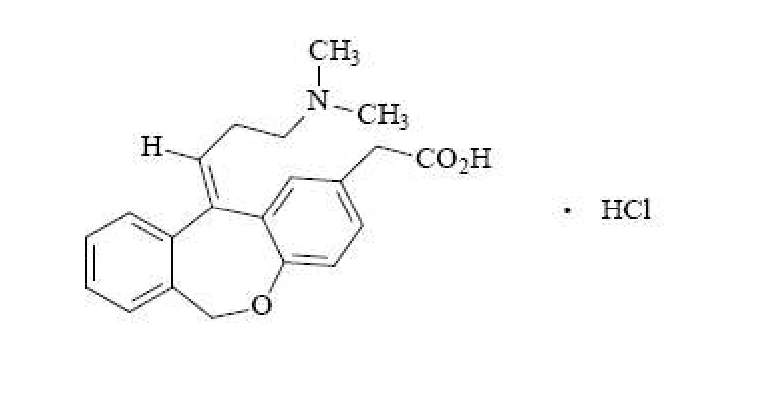
Proper name: olopatadine hydrochloride
Chemical names:
Dibenz[b,e]oxepin-2-acetic acid, 11-[-3-(dimethylamino)propylidene-6,11-dihydro, hydrochloride, (z)-
11-[(Z)-3-(Dimethylamino) propylidene]-6,11-dihydrodibenz[b,e]oxepin-2-acetic acid, hydrochloride
Molecular formula and molecular mass: C21H23NO3 • HCl; 373.88 (337.412 = Base) Structural formula:
Description: White to off-white crystalline powder
Solubility: Soluble in methanol
pH
(1% w/v aqueous solution): 2.51
CLINICAL TRIALS
Study demographics and trial design
Table 1: Summary of trial design and patient demographics for clinical trials
| Study # | Trial design | Dosage, route of administration and duration | Study subjects (n=number) | Mean age (Range) | Gender |
| C-94-10 | Randomized, double-masked, placebo-controlled, parallel group | Placebo, 0.01%, 0.05%, 0.1% and 0.15%; one ophthalmic drop 27 min., 6 h and 8 h prior to allergen challenge; 5 weeks | n = 98 | 37 yrs (18 – 64) | 49 M 49 F |
| C-94-58 | Triple-masked, placebo controlled, randomized contralateral eye comparison study | Placebo, 0.05% and 0.1%; topical ocular administration; 4 weeks | n = 60 | 46 yrs (18-72) | 29 M 31 F |
| C-94-39 | Triple masked, placebo controlled, randomized, contralateral eye comparison study | Placebo, 0.05% and 0.1%; topical ocular administration; 4 weeks | n = 120 | 39 yrs (18-80) | 40 M 80 F |
Study results
Table 2: Clinical trial study results
| Primary Endpoints | Associated value and statistical significance for Placebo or active control |
C-94-10 Onset of action and duration of action for itching and redness | Comparison between the four (4) olopatadine concentrations revealed a non linear dose relationship. All four (4) concentrations were statistically significant from placebo, however results showed the 0.1% olopatadine concentration to be most effective in reducing ocular itching and redness. At 3, 10 and 20 minutes, olopatadine 0.1% showed a mean point score reduction (range 0-4) in ocular itching compared to placebo of -1.72, -1.68 and -1.28 (p≤0.05), and a -2.72, -3.48 and -2.78 point score reduction (range 0-12) in ocular redness* compared to placebo (p≤0.05) when instilled 27 minutes prior to the conjunctival allergen challenge. Olopatadine 0.1% demonstrated a 6 hour duration of action when instilled 6 hours before the conjunctival allergen challenge. Results show a mean point score reduction (range 0-4) of -1.46, -1.70 and -1.07 in ocular itching compared to placebo (p≤0.05) at 3, 10 and 20 minutes following |
| Primary Endpoints | Associated value and statistical significance for Placebo or active control |
the allergen challenge. Similarly ocular redness* scores showed a mean -1.52, -1.76 and -1.33 point score reduction (range 0-12) compared to placebo (p≤0.05) at 3, 10 and 20 minutes following the allergen challenge. Olopatadine 0.1% when instilled 8 hours before the conjunctival allergen challenge shows a mean point score reduction (range 0-4) of -1.48, -1.62 and -0.92 in ocular itching compared to placebo (p≤0.05) at 3, 10 and 20 minutes following the onset-of-action challenge. Similarly ocular redness* scores showed a mean -1.58, -1.78 and -1.42 point score reduction (range 0-12) compared to placebo (p≤0.05) at 3, 10 and 20 minutes following the onset-of-action challenge. | |
C-94-58 Onset of action and duration of action for itching and redness | Olopatadine 0.1% was statistically superior to placebo in preventing ocular itching and redness within 3 minutes of the onset of action challenge. This difference from placebo persisted at the 8 hour duration of action challenge. At 3, 10 and 20 minutes post challenge, Olopatadine 0.1% showed a mean point score reduction (range 0-4) in ocular itching compared to placebo of -0.88, -1.19 and -1.07 (p≤0.05) and a -1.60, -1.69 and -1.38 point score reduction (range 0-12) in ocular redness* compared to placebo (p≤0.05) when one drop was instilled 27 minutes prior to the conjunctival allergen challenge. Olopatadine 0.1% when instilled 8 hours before the conjunctival allergen challenge showed a mean point score reduction (range 0-4) of -0.37, -0.58 and -0.75 in ocular itching compared to placebo (p≤0.05) at 3, 10 and 20 minutes following the conjunctival allergen challenge. Ocular redness* scores showed a mean -0.13, -0.52 and -0.45 point score reduction (range 0-12) compared to placebo at 3, 10 and 20 minutes following the conjunctival allergen challenge. |
C-94-39 Onset of action and duration of action for itching and redness | Olopatadine 0.1% was statistically superior to placebo in preventing ocular itching and redness within 3 minutes of the onset of action challenge. This difference from placebo persisted at the 8 hour duration of action challenge. At 3, 10 and 20 minutes post challenge, Olopatadine 0.1% showed a mean point score reduction (range 0-4) in ocular itching compared to placebo of -1.25, -1.77 and -1.24 (p≤0.05) and a -2.18, -2.62 and -1.90 point score reduction (range 0-12) in ocular redness* compared to placebo (p≤0.05), when one drop was instilled 27 minutes prior to the conjunctival allergen challenge. Olopatadine 0.1% when instilled 8 hours before the conjunctival allergen challenge showed a mean point score reduction (range 0-4) of -1.14, -1.29 |
| Primary Endpoints | Associated value and statistical significance for Placebo or active control |
| and -1.06 in ocular itching compared to placebo (p≤0.05) at 3, 10 and 20 minutes following the onset-of-action challenge. Ocular redness* scores showed a mean -1.47, -1.23 and -0.87 point score reduction (range 0-12) compared to placebo (p≤0.05) at 3, 10 and 20 minutes following conjunctival allergen challenge. |
* Ocular redness was calculated as the sum of the ciliary redness (range 0-4), conjunctival redness (range (0-4) and episcleral redness (range 0-4) scores
In well controlled clinical studies, olopatadine hydrochloride ophthalmic solution, 0.1% produced significantly less ocular discomfort (burning and stinging) compared to Acular® (ketorolac tromethamine) 0.5% Sterile Ophthalmic Solution and LivostinTM 0.05% (levocabastine hydrochloride ophthalmic suspension). Olopatadine hydrochloride ophthalmic solution, 0.1% also had significantly less effects on visual clarity relative to both Acular® (ketorolac tromethamine) 0.5% Sterile Ophthalmic Solution and LivostinTM 0.05% (levocabastine hydrochloride ophthalmic suspension).
DETAILED PHARMACOLOGY
Olopatadine is an anti-allergic agent that exerts its effects through multiple distinct mechanisms of action. Olopatadine is a mast cell stabilizer and a potent, selective histamine H1 antagonist (10) that inhibits the in vivo type 1 immediate hypersensitivity reaction. In vitro studies have demonstrated the ability of olopatadine to stabilize human conjunctival mast cells and inhibit immunologically-stimulated release of histamine. In addition, olopatadine inhibits the release of other mast cell inflammatory mediators [i.e., histamine, tryptase, prostaglandin D2 and TNFα (4,9,11,12)] as demonstrated in in vitro studies. Olopatadine is a selective histamine H1 receptor antagonist in vitro and in vivo as demonstrated by its ability to inhibit histamine binding and histamine-stimulated vascular permeability in the conjunctiva following topical ocular administration (11). Olopatadine is also an inhibitor of pro-inflammatory cytokine secretion from human conjunctival epithelial cells (13). Decreased chemotaxis and inhibition of eosinophil activation has also been reported (6,8). Olopatadine is devoid of effects on alpha-adrenergic, dopamine, muscarinic type 1 and 2, and serotonin receptors.
Human Pharmacodynamics
Olopatadine had no observed effect on heart rate, cardiac conduction (PR and QRS interval duration), cardiac repolarization (QT duration) or wave form morphology relative to placebo in 2 double-masked, placebo-controlled, 2-way crossover studies of 102 subjects given 5 mg oral doses of olopatadine every 12 hours for 2.5 days and 32 subjects given 20 mg oral doses twice-daily for 13.5 days (C-00-23 and C-02-54). No clinically relevant or statistically significant changes in mean QTcF (determined to be the most appropriate heart correction formula for both study populations) at steady-state from baseline were observed in either study. A categorical analysis of QTc (<30 ms, 30 ms-60ms or >60 ms) showed no statistically significant differences between olopatadine and placebo in both studies. An analysis of the maximal change from baseline in QTcF showed the difference was higher for placebo than for olopatadine.
Human Pharmacokinetics
Following topical ocular administration in man, olopatadine was shown to have low systemic exposure. Two studies in normal volunteers (totalling 24 subjects) dosed bilaterally with olopatadine 0.15% ophthalmic solution, once every 12 hours for 2 weeks, demonstrated plasma concentrations to be generally below the quantitation limit of the assay (<0.5 ng/mL). Samples in which olopatadine was quantifiable were typically found within 2 hours of dosing and ranged from 0.5 to 1.3 ng/mL. These plasma concentrations were greater than 300 fold below those observed with a well-tolerated 20 mg oral multiple-dose regimen. In oral studies, olopatadine was found to be well absorbed. The half-life in plasma was 7-14 hours, and elimination was predominantly through renal excretion. Approximately 60-70% of the dose was recovered in the urine as parent drug. Two metabolites, the mono-desmethyl and the N-oxide, were detected at low concentrations in the urine.
TOXICOLOGY
The acute toxicity of olopatadine hydrochloride has been investigated in mice, rats and dogs. Mice and rats demonstrated that olopatadine hydrochloride was not an acute toxicity hazard with oral LD50 values greater than 1150 mg/kg and 3870 mg/kg for mice and rats, respectively.
Subchronic and chronic oral toxicity studies in rats and dogs demonstrated that the liver and kidney were target organs for olopatadine hydrochloride toxicity. In rats, ophthalmology and hematology parameters were unaffected following chronic administration of olopatadine hydrochloride. In chronic dog studies, ophthalmology, hematology, blood chemistry and organ weight parameters were unaffected by olopatadine hydrochloride administration.
A one-month topical ocular study was conducted with 0.1% (4 times a day) or 0.2% olopatadine hydrochloride (4 and 5 times a day) ophthalmic solution in New Zealand White (NZW) rabbits. No signs of pharmacotoxicity were observed. Slit lamp and indirect ocular evaluations and pachymetry revealed no treatment-related findings. Clinical pathology data and histopathology were unremarkable.
Chronic topical ocular studies were conducted with olopatadine hydrochloride in rabbits and monkeys. Administration of olopatadine hydrochloride at concentrations of 0.1, 0.5 and 1.0% QID to NZW rabbits elicited no signs of pharmacotoxiciity. No treatment-related findings were observed during slit lamp and indirect ocular evaluations and pachymetry measurements. Clinical pathology data and histopathology were unremarkable. Similar findings were observed following six months of topical ocular administration of olopatadine hydrochloride at concentrations of 0.1, 0.2 and 0.5% QID to cynomolgus monkeys.
Antigenicity: Olopatadine hydrochloride was demonstrated to have a low potential for antigenicity when tested in mice and guinea pigs or in an in vitro passive hemagglutination test.
REFERENCES
- 1. Abelson MB, Schaefer K. Conjunctivitis of allergic origin. Immunologic mechanisms and current approaches to therapy. Survey of Ophthalmology 38: 115-132, 1993
- 2. Allansmith MR, Ross R. Ocular allergy. Clinical Allergy 18: 1-13, 1988
- 3.
Allansmith MR, Ross R. Ocular allergy and mast cell stabilizers. Survey of
Ophthalmology 30: 226-244, 1986
- 4. Cook EB, Stahl JL, Barney NP, Graziano FM. Olopatadine inhibits TNFα release from human conjunctival mast cells. Ann Allergy Asthma Immunol. 84: 504-508, 2000
- 5.
Friedlander MH. Conjunctival provocative tests: a model of human ocular allergy. Trans
Am Ophthalmologic Soc 577-597, 1989
- 6.
Ikemura T, Manabe H, Sasaki Y, Ishu H, Onuma K, Miki I, Kase H, Sato S, Kitamura S,
Ohmori K. KW-4679, an anti-allergic drug inhibits the production of inflammatory lipids in human polymorphonuclear leukocytes and guinea pig eosinophils. Int Arch Allergy Immunol 110: 57-63, 1996
- 7. Leonardi A, Abelson MB. Double-masked, randomized, placebo-controlled clinical study of the mast cell-stabilizing effects of treatment with olopatadine in the conjunctival allergen challenge model in humans, Clin. Ther 25: 2539-52, 2003
- 8. Ohmori K, Ishi H, Sasaki Y, Ikemura T, Manabe H, Kitamura S. Effects of KW-4679, a new orally active antiallergic drug, on antigen induced bronchial hyperresponsiveness, airway inflammation and immediate and late asthmatic responses in guinea pigs. Int. Arch Allergy Immunol 110: 64-72, 1996
- 9. Sharif NA, Xu SX, Miller ST, Gamache DA, Yanni JM. Characterization of the ocular antiallergic and antihistaminic effects of olopatadine (AL-4943A), a novel drug for treating ocular allergic diseases. JPET 278: 1252-1261, 1996
- 10. Sharif NA, Xu SX, Yanni JM. Olopatadine (AL-4943A): Ligand binding and functional studies on a novel, long acting H1-selective histamine antagonist and antiallergic agent for use in allergic conjunctivitis. J Ocular Pharmacol 12: 401-407, 1996
- 11. Weimer LK, Gamache DA, Yanni JM. Histamine-stimulated cytokine secretions from human conjunctival epithelial cells: Inhibition by histamine H1 antagonists. Int Arch Allergy Immunol 115:288-293, 1998
- 12.
Yanni JM, Stephens DJ, Miller ST, Weimer LK, Graff G, Parnell D, Lang LS, Spellman
JM, Brady MT, Gamache DA. The in vitro and in vivo ocular pharmacology of olopatadine (Al-4943A), an effective anti-allergic/antihistaminic agent. J Ocular Pharmacol Ther 12: 389-400, 1996.
- 13. Yanni JM, Miller ST, Gamache DA, Spellman JM, Xu SX, Sharif NA. Comparative effects of topical anti-allergy drugs on human conjunctival mast cells. Ann Allergy Asthma Immunol 79: 541-545, 1997
- 14. Yanni JM, Weimer LK, Sharif NA Xu SX, Gamache DA, Spellman JM. Inhibition of histamine-induced human conjunctival epithelial cell responses by ocular allergy drugs. Arch Ophthalmol 117:643-647, 1999
- 15.
Product Monograph for PATANOL® (olopatadine hydrochloride ophthalmic solution
0.1% w/v). Alcon Canada Inc. Submission Control No.: 211652. Date of Revision: March 2, 2018.