


Product Monograph - Alomide
SUMMARY PRODUCT INFORMATION
| Route of Administration | Dosage Form / Strength | Nonmedicinal Ingredients |
| Topical ophthalmic | Ophthalmic solution/ Lodoxamide 0.1% w/v (as lodoxamide tromethamine) | Benzalkonium chloride (as preservative), mannitol, hydroxylpropyl methylcellulose, sodium citrate, tyloxapol, citric acid, edetate disodium, sodium hydroxide and/or hydrochloric acid (to adjust pH) and purified water. |
INDICATIONS AND CLINICAL USE
ALOMIDE* (lodoxamide ophthalmic solution) is indicated for the treatment of the ocular signs and symptoms associated with:
- Vernal keratoconjunctivitis.
- Giant papillary conjunctivitis.
- Allergic/atopic conjunctivitis.
Pediatrics (< 4 years of age):
The safety and effectiveness of ALOMIDE* in pediatric patients < 4 years of age have not been established.
CONTRAINDICATIONS
ALOMIDE* is contraindicated in:
- Patients who are hypersensitive to this drug or to any ingredient in the formulation or component of the container. For a complete listing, see the Dosage Forms, Composition and Packaging section of the product monograph.
WARNINGS AND PRECAUTIONS
Ophthalmologic
Instillation of eye drops may initially cause discomfort or transient burning or stinging (see ADVERSE REACTIONS). Should any of these symptoms persist, the patient should be advised to contact the prescribing physician.
ALOMIDE* contains the preservative benzalkonium chloride, which may cause eye irritation. Benzalkonium is known to discolour soft contact lenses. As with all ophthalmic medications containing benzalkonium chloride, patients should be advised to remove their contact lenses before instilling ALOMIDE* as benzalkonium accumulates in contact lenses and its subsequent release may possibly irritate the cornea. Patients should be advised to wait at least 15 minutes before reinserting the lenses.
Temporary blurred vision or other visual disturbances may affect the ability to drive or use machines. If blurred vision occurs at instillation, the patient must wait until the vision clears before driving or using machinery.
Sexual Function/Reproduction
There is no data available on the effect of lodoxamide on fertility in humans.
Special Populations
Pregnancy: Reproduction studies with lodoxamide tromethamine administered orally to rats and rabbits have not shown any effects of the product on fertility or reproductive performance, or any evidence of embryotoxicity or pre- and post-natal toxicity. However, there are no adequate and well controlled studies in pregnant women. Since animal reproductive studies are not always predictive of human response, ALOMIDE* should be used during pregnancy only if clearly needed.
Nursing Women: It is not known whether lodoxamide is excreted in human milk. There is insufficient information on the excretion of lodoxamide in animal milk. A risk to the suckling child cannot be excluded. Caution should be exercised when ALOMIDE* is given to a nursing mother.
Pediatrics (< 4 years of age): The safety and effectiveness of ALOMIDE* in pediatric patients
< 4 years of age have not been established.
ADVERSE REACTIONS
Adverse Drug Reaction Overview
ALOMIDE* has been generally well tolerated. In controlled clinical studies, the most common side effect reported was mild and transient discomfort upon instillation (8.7% of patients) expressed as burning, stinging, itching or tearing.
Post-Market Adverse Drug Reactions
Adverse reactions identified in subsequent clinical trials are listed below.
Eye disorders: anterior chamber cell, asthenopia, blepharitis, corneal abrasion, corneal deposits, corneal epithelium defect, corneal erosion, corneal scar, dry eye, eye discharge, eye edema, eye pain, eye pruritus, keratitis, ocular hyperemia, vision blurred, visual impairment;
Gastrointestinal disorders: abdominal discomfort, nausea;
General disorders and administration site conditions: feeling hot;
Immune system disorders: drug hypersensitivity;
Nervous system disorders: dizziness, dysgeusia, headache, somnolence;
Respiratory, thoracic and mediastinal disorders: nasal dryness, sneezing;
Skin and subcutaneous tissue disorders: eyelid exfoliation, rash.
Adverse reactions identified via spontaneous reporting are listed below. Frequencies cannot be estimated from the data.
Cardiac disorders: palpitations.
DOSAGE AND ADMINISTRATION
Recommended Dose
The dose for adults and children ≥ 4 years of age is 1 or 2 drops in each eye 4 times a day at regular intervals.
Patients should be advised that the effect of therapy with ALOMIDE* is dependent upon its administration at regular intervals, as directed.
Improvements in signs and symptoms in response to therapy with ALOMIDE* (decreased discomfort, itching, foreign body sensation, photophobia, acute ocular pain, tearing, discharge, erythema/swelling, bulbar conjunctivae, limbus, epithelial disease, ptosis) are usually evident within a few days, but longer treatment for up to 4 weeks is sometimes required. Once symptomatic improvement has been established, therapy should be continued for as long as needed to sustain improvement.
Missed Dose
If a dose is missed, a single drop should be applied as soon as possible before reverting to the regular routine. Do not use a double dose to make up for the one missed.
Administration
Patients should be instructed to avoid contamination of the dropper tip.
After the cap is removed, if the tamper evident snap collar is loose, instruct patients to remove it before using the product.
OVERDOSAGE
Overdosage in the use of topical ophthalmic preparations is a remote possibility. Discontinue medication when heavy or protracted use is suspected.
In case of accidental ingestion of doses of 1.0 mg to 10.0 mg of lodoxamide, the following side effects may occur: feeling of warmth, flushing, nausea, vomiting, diaphoresis and abdominal cramping. Transient elevations of systolic and diastolic blood pressure have been noted with doses of 3.0 mg and 10.0 mg of oral lodoxamide, but they resolve spontaneously after a short time. Other possible adverse events after an oral overdose are headache, dizziness, fatigue and loose stools.
If accidentally ingested, efforts to decrease further absorption may be appropriate.
| For management of a suspected drug overdose, contact your regional Poison Control Centre. |
ACTION AND CLINICAL PHARMACOLOGY
Pharmacodynamics
Lodoxamide, a mast cell stabilizer, inhibits the in vivo type I immediate hypersensitivity reaction in animals and man. Allergen-induced bronchospasm and reduced pulmonary function in monkeys are prevented with lodoxamide treatment. A cutaneous vascular permeability increase associated with reagin or IgE and antigen mediated reactions in rats, monkeys and humans is inhibited with lodoxamide therapy. A similar vascular reaction in the palpebral conjunctiva of rats has been inhibited with topical ocular administration of lodoxamide. Therefore, it is anticipated that lodoxamide will be useful in the treatment of ocular diseases where type I immediate hypersensitivity plays a major role in the pathogenesis.
In vitro studies have demonstrated the ability of lodoxamide to stabilize mast cells and prevent the antigen specific induced release of histamine. In addition, lodoxamide prevents the release or other mast cell inflammatory mediators (i.e. SRS-A, slow reacting substances of anaphylaxis, also known as the peptido-leukotrienes) and appears to inhibit eosinophil chemotaxis. Lodoxamide inhibits histamine release in vitro by preventing the movement of calcium into the mast cell after stimulation.
Lodoxamide has no instrinsic vasoconstrictor, antihistamine, cyclooxygenase inhibition or other anti-inflammatory activity.
Pharmacokinetics
The disposition of 14C-lodoxamide was studied in six healthy adult volunteers receiving a 3 mg (50 µCi) oral dose of lodoxamide. Urinary excretion was the major route of elimination. The elimination half-life of 14C-lodoxamide was 8.5 hours in urine. In a study conducted in 12 healthy adult volunteers, topical administration of ALOMIDE*, 1 drop in each eye 4 times per day for 10 days, did not result in any measurable lodoxamide plasma levels at a detection limit of 2.5 ng/mL.
STORAGE AND STABILITY
Store at room temperature (15oC – 25oC). Keep out of the reach and sight of children.
DOSAGE FORMS, COMPOSITION AND PACKAGING
ALOMIDE* is a sterile, isotonic solution containing:
Medicinal ingredient: lodoxamide 0.1% w/v (as 0.178% w/v lodoxamide tromethamine) Preservative : benzalkonium chloride 0.007% w/v
Non-medicinal ingredients: mannitol, hydroxypropyl methylcellulose, sodium citrate, tyloxapol, citric acid, edetate disodium, sodium hydroxide and/or hydrochloric acid (to adjust pH) and purified water.
ALOMIDE* is supplied in natural plastic ophthalmic DROPTAINER* dispensers containing 10 mL.
Tamper evidence is provided by a closure with an extended skirt that locks to the bottle finish on application and breaks away from the closure on opening.
PART II: SCIENTIFIC INFORMATION
PHARMACEUTICAL INFORMATION
Drug Substance
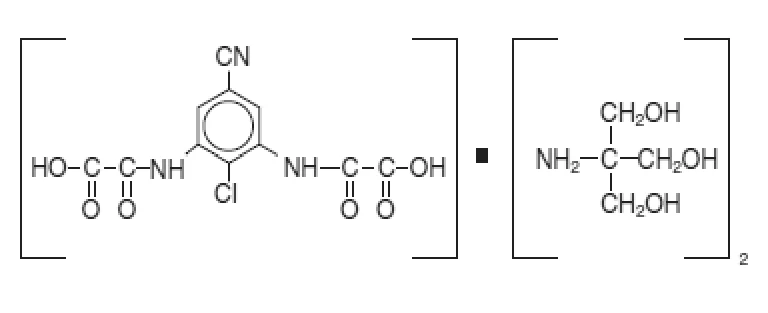
Proper name: lodoxamide tromethamine
Chemical name: N, N’-(2-chloro-5-cyano-m-phenylene) dioxamic acid tromethamine salt.
Molecular formula and molecular mass: C19H28ClN5O12; 553.91
Structural formula:
Physicochemical properties: White to off-white powder or crystals
CLINICAL TRIALS
In a multi-centre double-masked study (9 centres), 0.1% lodoxamide was more effective than 2% sodium cromoglycate in the treatment of the signs and symptoms of conjunctivitides of an allergic nature (vernal, giant papillary, atopic/allergic types). Ocular signs and symptoms were generally controlled in 14 to 21 days of therapy (q.i.d. dosing), and improvement continued with further therapy. Based upon physician and patient judgments, a therapeutic effect was observed within seven days of the initiation of treatment. In a similar single centre study, 0.1% lodoxamide was judged more effective than 2% sodium cromoglycate, but the difference was not statistically significant.
TOXICOLOGY
Acute Toxicity
| Species/Route | LD50 (mg/kg) | Signs of Toxicity |
| Mouse, i.p. | 4,000 – 5,000 | Depression, laboured breathing, partially closed eyes |
| Mouse, i.p. | 3634 | Depression, prostration, coma |
| Mouse, p.o. | > 5,000 | None |
| Rat, p.o. | > 4,000 | None |
| Rat, p.o. | > 5,000 | None |
| Rat, i.p. | 5,019 | Altered gait, thirstiness, prostration, coma |
| Rat, i.p. | > 5,000 | Slight amount of blood tinged abdominal fluid |
Chronic Toxicity
Species/Route Duration | Daily Dose (mg/kg) | Signs of Toxicity |
Mouse, p.o. 14 days | 0, 500, 1600, 5000 | None |
Dog, p.o. One month | 10, 30, 100 | None |
Mouse, p.o. 3 months | 0, 500, 1600, 5000 | None |
Rat, p.o. 1, 3 months | 10, 30, 100 | Decreases in erythrocyte parameters in females |
Rat, p.o. 1 year | 10, 30, 100 | Dose related decrease in body weights in males; small renal calculi (relationship questionable) |
Monkey, p.o. 1 year | 10, 30, 100 | No overt effects |
Rat, p.o. 2 year (carcinogenicity) | 10, 30, 100 | Comparable to controls |
Mutagenicity
| Test System | Result |
| Ames (Salmonella) (3 strains) with and without activation | Negative up to 2,000 µg/plate |
| Ames (Salmonella) (2 additional strains) with and without metabolic activation | Negative 250-2000 µg/plate |
Reproduction and Teratology
| Species/Route | Dosage (mg/kg/day) | Findings |
| Rat, p.o. Segment 1 | 30 – Male 10, 30 – Female | No adverse effects |
| Rat, p.o. Segment 1 | 10, 30, 100 | Possible decrease in proportion of litter surviving |
| Rat, p.o. Segment 2 | 10, 30 | No adverse effects |
| Rat, p.o. Segment 2 | 10, 30, 100 | Not teratogenic |
| Rat, p.o. Segment 3 | 10, 30 | No adverse effects |
| Rat, p.o. Segment 3 | 10, 30, 100 | No adverse effects |
| Rabbit, p.o. Segment 2 | 10, 30, 100 | No adverse effects |
| Rabbit, p.o. Segment 2 | 10, 30 | No adverse effects |
Ocular Studies
| Species | Dosage (mg/kg) | Signs of Toxicity |
Rabbit Ocular irritation 14 days | 0.1%, 1% Both eyes BID | Reddening of eyelids; comparable to control |
Rabbit Ocular irritation Every 30 minutes for 12 doses (1 day) | 0.25%, 0.5%, 1% Right eye | Minimal to moderate conjunctival congestion and discharge; minimal fluorescein staining; comparable to controls |
Rabbit Ocular irritation 1, 3 months | With HPMC – 0.25%, 0.5%, 1%; Without HMPC – 0.5% Right eye QID | Minimal to moderate conjunctival congestion and discharge; sporadic and transient instances of superficial corneal epithelium; irregularities (not dose related) in product and vehicle with HMPC |
Monkey Ocular irritation 3 months | 0.25%, 0.5%, 1% Right eye QID | None |
HPMC = hydroxypropyl methylcellulose
REFERENCES
- 1. Allansmith M and Ross RN. Ocular allergy and mast cell stabilizers. Survey of Ophthalmol 1986. 30:229-244.
- 2. Fahy GT, Easty DL, Collum LMT, Benedict-Smith A, Hillery M, Parsons DG. Randomised double-masked trial of lodoxamide and sodium cromoglycate in allergic eye disease. A multicientre study. Eur J Ophthalmol 1992. 2:144-149.
- 3. Johnson, HG. New antiallergy drugs - the lodoxamides. TRENDS PHARMACOL SCI 1(12):343-5 (1980).
- 4. Santos CI, Huang AJ, Abelson MB, Foster S, Friedlander M, McCulley JP. Efficacy of lodoxamide 0.1% ophthalmic solution in resolving corneal epitheliopathy associated with vernal keratoconjunctivitis. Am J Ophthalmol 1994; 117:488-497.