


Product Monograph - Livostin Eye Drops
INDICATIONS AND CLINICAL USE
LIVOSTIN* (levocabastine hydrochloride) eye drops are indicated in the symptomatic management of seasonal allergic conjunctivitis.
CONTRAINDICATIONS
LIVOSTIN* (levocabastine hydrochloride) eye drops are contraindicated in patients with hypersensitivity to any of the ingredients.
WARNINGS
Use in Children
Levocabastine is not recommended for use in children under the age of 12 years except on the advice of a physician. Clinical experience in children under 5 years of age is limited with ocular levocabastine.
PRECAUTIONS
As with all ophthalmic preparations containing benzalkonium chloride, patients are advised not to wear soft
(hydrophilic) contact lenses while under treatment with LIVOSTIN (levocabastine hydrochloride) eye drops.
Use in Pregnancy and Lactation
There are no clinical trials on the use of LIVOSTIN* (levocabastine hydrochloride) eye drops in pregnant or nursing women, therefore, LIVOSTIN* eye drops should not be used during pregnancy, except if the potential benefit justifies the potential risk to the foetus.
Use in Elderly
The safety and efficacy of topical levocabastine has not been established in patients greater than 65 years of age.
ADVERSE REACTIONS
The most frequent side effect encountered with LIVOSTIN (levocabastine hydrochloride) eye drops is eye irritation. Most side effects are transient and rarely necessitate discontinuation of therapy.
See Table 1.
Table 1: Incidence of the most frequent+ adverse experiences in patients treated with LIVOSTIN eye drops or placebo eye drops.
INCIDENCE (%)
ORGAN SYSTEM LIVOSTIN* PLACEBO
Eye Drops Eye Drops
(n=599) (n=215)
Ocular 19.9 18.6
eye irritation 16.4 15.8
dry conjunctiva <1.0 0.0
The others (blurred vision, eye discharge, eyelid oedema, eye pain and abnormal lacrimation) were <1.0% for both the LIVOSTIN* and PLACEBO groups.
Central Nervous System 6.0 9.3
headache 3.5 4.2
somnolence 2.0 5.1
insomnia <1.0 0.0
Respiratory System 4.2 5.1
coughing 1.0 1.4
epistaxis 1.0 <1.0
nasal congestion <1.0 0.0
rhinorrhoea <1.0 1.4
The others (nasal irritation, itchy throat, pharyngitis and dyspnoea) were <1.0% for both the LIVOSTIN* and PLACEBO groups.
Other
tiredness 2.0 1.4
dry mouth 1.0 4.2
fever <1.0 0.0
rash <1.0 0.0
generalized pruritus <1.0 <1.0
pruritus <1.0 0.0
nausea <1.0 0.0
+ Reported more than once in the LIVOSTIN group.
Post-Market Adverse Drug Reaction
The following events have been reported in association with LIVOSTIN (levocabastine hydrochloride)
eye drops use in worldwide post-marketing experience: keratitis
SYMPTOMS AND TREATMENT OF OVERDOSAGE
There has been no experience with overdosage of LIVOSTIN* (levocabastine hydrochloride) eye drops. Treatment should include general supportive measures.
DOSAGE AND ADMINISTRATION
Adults and children (12 to 65 years old): the usual dose is 1 drop (15mcg) of LIVOSTIN*
(levocabastine hydrochloride) eye drops instilled in each eye, 2 times daily. The dose may be increased to 1 drop 3 to 4 times daily.
It is not useful to continue the treatment for more than 3 days if no improvement is seen. There are no clinical studies to support continuous treatment durations of greater than 16 weeks.
As LIVOSTIN* eye drops are available as a microsuspension, the bottle should be shaken before each application. LIVOSTIN* eye drops should be used within one month of the first opening of the bottle. Patients should be instructed to take appropriate measures to avoid contamination.
PHARMACEUTICAL INFORMATION
Drug Substance
Trade Name: LIVOSTIN*
Proper Name: levocabastine hydrochloride
Chemical Name: (-)-[3s-[1(cis),3α,4ί]]-1-[4-cyano-4-(4-fluorophenyl)cyclohexyl]-3-methyl-4- phenyl-4-piperidinecarboxylic acid monohydrochloride
Chemical Structure: 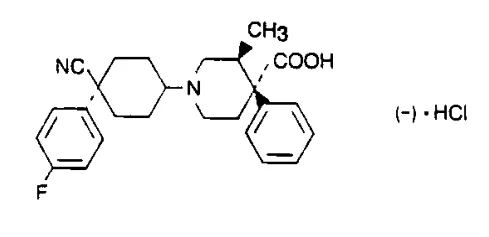
Molecular Formula: C26H29FN2O2.HCl
Molecular Weight: 456.99
Description: Levocabastine hydrochloride is a white to almost white powder with a melting temperature of > 300°C, a pKa1 of 3.1 and a pKa2 of 9.7. It is freely soluble in dimethylsulfoxide; soluble in N,N-dimethylformamide and methanol; slightly soluble in propylene glycol, polyethylene glycol and ethanol; in aqueous medium the solubility is a function of pH, with minimum solubility at pH 4.1 to
9.8. The log-partition coefficient (n-octanol/aqueous buffer at pH 8.0) is 1.82.
Composition
LIVOSTIN* eye drops are available as a sterile ophthalmic microsuspension (pH 6-8). Each mL contains levocabastine hydrochloride (equivalent to 0.5 mg levocabastine) as active ingredient;
benzalkonium chloride 0.15 mg as preservative; and propylene glycol, polysorbate 80, disodium phosphate, monosodium phosphate, disodium edetate, hypromellose and water as inactive excipients.
Stability and Storage Recommendations
LIVOSTIN* eye drops should be stored between 15 and 30 °C.
LIVOSTIN* must be kept out of the reach and sight of children.
AVAILABILITY OF DOSAGE FORM
PrLIVOSTIN*(levocabastine hydrochloride) eye drops are available in 10 and 15 mL plastic bottles containing 5 and 10 mL of white microsuspension respectively.
PHARMACOLOGY
Pharmacodynamics
LIVOSTIN* (levocabastine hydrochloride) is a structurally novel histamine H1-antagonist.
All in vivo studies, as well as studies on isolated tissues and on receptors, point to a single action responsible for the antiallergic activity of levocabastine: fast and tight high affinity binding to H1-receptors.
In Vivo:
In rats, guinea pigs and dogs, levocabastine, administered systemically, was a potent inhibitor of histamine effects known to be mediated by H1 receptors (see Table 2). Levocabastine had a fast onset of action (within one hour) and remained active for about 24 hours, at doses below 0.010 mg/kg.
Table 2: Activity of Levocabastine in Various Models of Allergic Reactions
Active Dose or
Animal Test Concentration
Guinea pigs Histamine-induced lethality ED50 (p.o.)
0.0009 mg/kg
Guinea pigs Histamine-induced dyspnoea ED50 (p.o.)
reaction 0.005 mg/kg
Guinea pigs Histamine-induced ED50 (i.v.)
bronchoconstriction 0.005 mg/kg
Rats Compound 48/80 lethality ED50 (p.o.)
0.0020 mg/kg
Dogs Ascaris allergen skin ED50 (p.o.)
reaction 0.0035 mg/kg
Topical - eyes
Guinea pigs Conjunctival inflammation topically
-ocular administration of 0.2 - 5.0 mcg
histamine
Guinea pigs Allergen-induced topically
conjunctivitis 5 - 12.5 mcg
The mode of action of levocabastine appears to be remarkably selective as it is devoid of protection against dyspnoea reactions induced by aerosolized serotonin and acetylcholine at a dose 500 times the effective dose for histamine aerosols.
In rats, single oral doses up to 160 mg/kg showed no interference with neurotransmission (mediated by acetylcholine, serotonin, dopamine or GABA), no change in normal body functions (such as food consumption and locomotor activity), and in a series of responses (such as inflammatory and cardiovascular responses). The most pronounced activity found was induction of palpebral ptosis at 65.1 mg/kg (46,500 times the antiallergic dose).
At 6.36 mg/kg of levocabastine, apomorphine-induced emesis was antagonized in dogs and peripheral dopamine antagonism (exemplified by increased prolactin levels in female mice) was found upon repeated administration of high toxicological doses (12.9 and 52 mg/kg).
In dogs, doses of 0.16 mg/kg orally and 0.5 mg/kg i.v. of levocabastine had no significant effect on sleep-wakefulness patterns, nor on cardiac, haemodynamic, or respiratory parameters. Similarly in anaesthetized dogs, cumulative doses up to 0.50 mg/kg had no cardiac or haemodynamic effect.
In Vitro:
A high level of selectivity with levocabastine was found in vitro, in biochemical studies (neurotransmitter receptor and uptake) and experiments on isolated tissues where the observations were extended to
β-adrenergic and peptide interactions and to interference with myogenic activity.
Levocabastine inhibited almost equipotently the contractile activity of guinea pig trachea (ED50 of 0.0081 mg/L) and ileum (ED50 of 0.0316 mg/L) induced by histamine. At a concentration of 10-5 M, levocabastine did not induce histamine release nor did it inhibit antigen-induced histamine release from rat peritoneal mast cells. Receptor binding experiments showed that levocabastine strongly (Ki=4.2 nM, with 240 minutes incubation time) interfered with the binding of 3H-pyrilamine to the guinea pig cerebellum. Levocabastine was also found to occupy histamine H1-receptors in the lungs at very low doses.
Levocabastine was devoid of effect in tests which measure interference with microsomal enzymes. Its potential for drug interaction appears to be extremely low.
Pharmacokinetics
A comparison of the pharmacokinetic parameters of levocabastine in male rats, rabbits, dogs and man was carried out following a single intravenous administration (Table 3). The apparent volume of distribution
(Vdss) and the fraction of drug not bound (fu) by plasma proteins were very similar in rats, dogs, rabbits and man. The plasma clearance, though, in humans was four to six times lower than in the 3 animal species.
As a consequence, the elimination half-life was longer in humans (35-40 hours as compared to 6 hours in rats, 10 hours in rabbits and 12 hours in dogs). Also the AUC values and the steady-state plasma levels, when normalized for the dose, were larger in humans than in the animal species. In man, the pharmacokinetics, following single intravenous administration of 0.2 mg levocabastine, could be described by a 2-compartment open model although the contribution of the distribution phase was only 1.2% of the total plasma concentration-time curve.
Table 3: Comparison of pharmacokinetic parameters of levocabastine in male rats, rabbits, dogs and man after single intravenous administration
| PARAMETER | RAT | RABBIT | DOG | MAN |
Dose (mg/kg) t1/2α(h) t1/2β(h) Clt (mL.h-1.kg-1) Vc (1.kg-1) Vdss (1.kg-1) Vdβ (1.kg-1) AUC-0-∞ (ng.mL-1.h) AUC-0-∞ normalized to 0.1 mg/kg fu (%) | 0.1 0.36 6.0 162 0.92 1.36 1.40 670 670 46.5 | 0.1 1.72 10.1 163 1.02 1.73 2.35 624 624 53.2 | 0.2 0.96 12.2 111 1.24 1.83 1.95 1836 918 52.8 | 0.0027 0.59 32.9 25.1 0.60 1.13 1.15 115 4259 55.3 |
Following single oral administration, levocabastine was well absorbed in all species studied, and the bioavailability was complete in humans and dogs. Following a single oral administration of 0.5, 1 and 2 mg levocabastine to healthy volunteers, there was rapid and complete absorption with a Tmax of 2 hours and the absolute bioavailability of 101-120%.
On repeated administration, steady-state was reached within 2-6 days in rats and dogs and within 7 days in humans. Average steady-state levels of levocabastine increased proportionally with the dose after intravenous administration in rats and dogs (0.05 to 0.2 mg/kg) and after oral administration in rats and mice
(2.5 to 40 mg/kg) and in dogs (5 to 20 mg/kg). In man, the plasma concentrations following chronic ocular application of levocabastine are linear and predictable from single-dose data. The levocabastine absorption through the conjunctival sac, and the systemic disposition in terms of distribution and elimination are not altered during repeated dosing.
Levocabastine was rapidly and fairly evenly distributed to the various tissues. In rats, levels in most tissues were similar to 4 times higher than the corresponding plasma levels. The lowest levels (3 to 8 times lower than plasma) occurred in the brain and the highest in the liver (6 times higher than in plasma). After oral administration in rats, there was a remarkable uptake in the lacrimal glands. In pregnant rats, there was a rapid equilibrium between the maternal and foetal tissues and body fluids after intravenous and oral administration. The maternal and foetal radioactivity consisted exclusively of unchanged levocabastine at all time points and disappeared from maternal and foetal tissues with the same half-life as from plasma.
After a single oral dose of 3H-levocabastine, plasma radioactivity was almost exclusively due to the parent drug in all animal species studied as well as in man. The metabolism of levocabastine in man was very similar to that in rabbits and dogs; the ester glucuronidation and subsequent deglucuronidation were the only metabolic pathways that could be detected in these species. A metabolism and excretion study in man indicated that about 70% of an oral dose of levocabastine was excreted in the urine as unchanged drug.
The acylglucuronide of levocabastine was the main metabolite in the urine, representing about 10%
of the dose. In all species tested, unchanged levocabastine was the main component of the urinary and faecal excretion.
After oral administration of 3H-levocabastine, the radioactivity was excreted rapidly (73-83% of the dose within 24 hours) in most animal species studied. At 96 hours after oral dosing, the excretion was almost complete in mice, rabbits, dogs and female rats, but not in male rats, due to a more extensive enterohepatic circulation of metabolites. In rabbits, mice and male rats, the fractions of the radioactivity excreted in the urine were similar to those in the faeces. In female rats, there was a predominant excretion in the urine, whereas in dogs the excretion in the faeces was more than twice that in urine. In man the excretion was slower than in the animal species and amounted to 54% in the urine and 12% in the faeces within four days.
After a six-month chronic instillation of a levocabastine eye drop formulation in male and female rabbits at
0.05 mg four or eight times daily (0.2 or 0.4 mg/day) steady-state plasma concentrations amounted on average to 8.7 + 3.4 for the four times and 21.7 + 18.1 ng/mL for the eight times dose regimen.
Levocabastine concentrations in the anterior chamber fluid of the treated eye were about 2-4 times higher than the corresponding plasma levels and concentrations were proportional to the instilled amount of drug.
The effects of renal insufficiency on the pharmacokinetics of orally administered levocabastine were examined in non-dialysis patients and patients undergoing regular haemodialysis. In relation to healthy volunteers, these patients demonstrated impaired oral absorption of levocabastine, reduced urinary excretion of the unchanged drug, and a prolonged half-life (from 36 hours to 95 hours). Although a 6-hour haemodialysis procedure starting 4 hours post-dosing eliminated 10% of the oral dose, the terminal half-life and the total area under the plasma concentration-time curve did not differ significantly between the haemodialysis and the non-haemodialysis patients.
In humans, the plasma protein binding of levocabastine was pH-dependent and averaged 54.7 + 1.6% at plasma concentrations of 10 ng/mL. The plasma protein binding increased with pH resulting in 40%
at pH 7.0, 55% at pH 7.4 and 67% at pH 7.8. Albumin was the main binding plasma protein for levocabastine in human plasma.
In vitro analysis of the plasma protein binding of levocabastine showed no alteration by imipramine, propranolol, diphenylhydantoin, diazepam, cimetidine, indomethacin and ketoconazole. In the presence of high concentrations of sulfamethazine, tolbutamide and warfarin, the unbound fraction of levocabastine increased slightly, however, these changes were minor and not clinically relevant for a drug which is 55% bound. At a high levocabastine concentration of 50 ng/mL, there was no change in the plasma protein binding of imipramine (89.1 ± 1.4%), propranolol (85.3 ± 1.2%), diphenylhydantoin (85.5 ± 1.2%), warfarin
(97.3 ± 0.3%), ketoconazole (98.3 + 0.1%) and diazepam (98.5 + 0.1%).
As the systemic availability of levocabastine is low after therapeutically active ocular doses, no specific drug interaction studies were performed for this route of administration.
In addition to the subjective assessments performed during clinical trials, the possible central effects of levocabastine eye drops were investigated in specially-designed psychoperformance studies. After ocular administration, no CNS effects were detected under acute or steady state conditions.
TOXICOLOGY
Acute Toxicity
Only in the dogs was there sufficient mortality to permit calculation of LD50 (Table 4). No large differences between sexes or species were observed. At very high dose levels after oral administration (1,280 mg/kg)
effects were mainly of CNS nature, such as peripheral ptosis, sedation and transient decrease in activity. A dermal application of 2 g/kg (the maximally applicable dose) did not result in any adverse effects in rabbits.
No specific drug-related effects were noted at necropsy in any animal species.
Table 4: Single dose toxicity studies of levocabastine
| Animals | Route of Administration | Formulation | No. Animals | LD50 14 days |
| Single dose pilot toxicity studies: | ||||
| mouse | oral | suspension 0.5 mg/mL | 10 M 10 F | > 25 mg/kg |
| i.v. | solution 0.5 mg/mL | 10 M 10 F | >0.5 mg/mouse | |
| i.v. | solution 2.5 mg/mL | 5 M 5 F | >2.5 mg/mouse | |
| rat | oral | suspension 0.5 mg/mL | 10 M 10 F | > 22 mg/kg |
| i.v. | solution 0.5 mg/mL | 10 M 10 F | > 2 mg/rat | |
| i.v. | solution 2.5 mg/mL | 5 M 5 F | > 10 mg/rat | |
| dog | oral | suspension 0.5 mg/mL | 2 M 2 F | > 4.5 mg/kg |
| i.v. | solution 0.5 mg/mL | 4 M 4 F | > 25 mg/dog | |
| i.v. | solution 2.5 mg/mL | 2 M 2 F | >125 mg/dog | |
| Single dose toxicity studies: | ||||
| mouse | oral | suspension 0.5 mg/mL | 10 M 10 F | > 2560 mg/kg |
| rat | oral | suspension 0.5 mg/mL | 10 M 10 F | > 2560 mg/kg |
| rabbit | abraded skin | crystalline powder | 5 M 5 F | > 2 g/kg |
| unabraded skin | crystalline powder | 5 M 5 F | > 2 g/kg | |
| dog | oral | suspension 0.5 mg/mL | 4 M 4 F | ≈ 2560 mg/kg |
Chronic Toxicity
Table 5 summarizes the chronic toxicity studies carried out in various animal species. Following oral administration in Wistar rats, 10 mg/kg was found to be non-toxic in the 3-month study and 2.5 mg/kg in the
6-month study, whereas following intravenous administration the non-toxic doses were 0.05 and 0.10 mg/kg.
In Beagle dogs, 5 mg/kg was non-toxic in the 3-month and the 12-month studies and 20 mg/kg was non-toxic in the 3-month study only. Following intravenous administration, 0.05, 0.1 and 0.20 mg/kg were non-toxic in Beagle dogs.
Clinical signs of CNS type (ptosis, pilo-erection) and the death of 2 males were seen in rats dosed at 160 mg/kg/day (approximately 66,000 x maximum ocular human use level) (Table 5). CNS effects (decreased general activity) also occurred in dogs dosed at 80 mg/kg (approximately 33,000 x maximum ocular human use level) for 12 months, and to a lesser extent at 20 mg/kg (approximately 8,300 x maximum ocular human use level). No specific drug related ophthalmic abnormalities were found in any study. The oral administration of levocabastine reduced body weight in rats at 10 mg/kg (in the 6-month study only), 40 and
160 mg/kg/day and in dogs at 20 and 80 mg/kg/day in the 12-month study.
Some haematological changes were observed, but they were all within or at the borderline of the normal range. In the 12-month dog study, dosing at 80 mg/kg and to a lesser extent at 20 mg/kg, resulted in increased haptoglobin and decreased cholesterol and albumin. Some other serum parameters (increase of alkaline phosphatase and inorganic phosphate) changed during the last part of this study, but the values were still within normal limits. No specific disturbances in the urine parameters were observed except for a decrease of pH (males) and creatinine and the presence of RBC and fatty epithelial cells in the sediment of rats dosed at 160 mg/kg. In most oral studies, a tendency to increased adrenal fat with a higher weight of adrenals was found. In rats, at the highest toxic dose level of 160 mg/kg, kidney changes, mammary gland stimulation (also observed at 40 mg/kg in the 3-month study), a more resting aspect of the genital tract in females and degeneration of testicular germinal epithelium in males were the most important
histological changes. In some dogs, decreased secretory activity of the prostate was found at 80 mg/kg (12-month study).
In the intravenous toxicity studies and the dermal study, no specific drug-related changes were observed except for slightly decreased body weight in male rats dosed at 0.20 mg/kg (80 x maximum ocular human use level).
Table 5: SUMMARY OF CHRONIC TOXICITY
| SPECIES | ROUTE OF ADMINISTRATION | NO. AND SEX OF ANIMALS/GROUP | DOSE (mg/100g feed) | DOSE (mg/kg)a male female | DURATION OF TREATMENT | OBSERVATIONS |
| Wistar Rats | Oral | 20 M 20 F | 10, 40, 160 | 9.0 10.0 36.0 41.1 145.1 172.7 | 3-Month | -at 10 mg/kg: no adverse effects; -at 40 and 160 mg/kg: decreased food consumption and body weight gain, mammary gland stimulation and increased adrenal fat in the zona glomerulosa and fasciculata; increase in urobilinogen (F); -at 160 mg/kg: increased segmented heterophils, decreased haematocrit, haemoglobin, RBC, lymphocytes, serum protein levels (within normal range); urinalysis: decrease of creatinine, pH (M); tissue changes: enlarged adrenals and ovaries (F)
-degeneration of testicular germinal epithelium and reduced spermatogenesis; -reduced cyclic activity in the genital tract (F); |
| i.v. | 20 M 20 F | 0.05, 0.10, 0.20 | 1-Month | -at 0.20 mg/kg decrease in food consumption and body weight gain in M. | ||
| Fisher Rats | Oral | 20 M 20 F | 2.5, 10, 40 | 1.6 2.3 6.4 9.0 27.0 38.8 | 6-Month | -2.5 mg/kg: decrease in body weight; -10mg/kg:decreased body weight,haematological changes (within normal range), increased weight of adrenals -40 mg/kg: same as for 10 mg/kg but more pronounced; waste of food increased in F. |
| Beagle Dogs | Oral | 3 M 3 F | 5, 20 and 80 | 3-Month | -no adverse effects at 5 and 20 mg/kg; -increased fat in adrenals and increased body weight gain at 80 mg/kg. | |
| 4 M 4 F | 5, 20 and 80 | 12-Month | -5 mg/kg: no adverse effects; -20 mg/kg: transient decrease in general activity; increased alkaline phosphatase in last 6 months (within normal range); increase liver weight and body weight; -80 mg/kg: same as 20 mg/kg and also: permanent decrease in general activity with decubitus; transient increase in both WBC and band neutrophils (within normal range); transient increase in inorganic phosphatase (within normal range); terminal increase in chloride; moderate increase in spleen, pancreas and adrenal weight;increased deposition of hepatocellular pigment; decreased secretory activity in the prostate of some dogs; |
a Mean daily dose expressed in mg/kg body weight calculated from food consumption and body weight.
Table 5: SUMMARY OF CHRONIC TOXICITY (cont'd)
| SPECIES | ROUTE OF ADMINISTRATION | NO. AND SEX OF ANIMALS/GROUP | DOSE (mg/kg) | DURATION OF TREATMENT | OBSERVATIONS |
| Beagle Dogs | i.v. | 4 M 4 F | 0.05, 0.10 and 0.20 | 1-Month | -no adverse effects were noted. |
New Zealand White Rabbits | Dermal | 5 M 5 F | 0.5 | 21-Days | -non-progressive irritation at the sites of administration. |
| Ocular | 5 M 5 F | 0.1 mL of a 0.5 mg/mL suspension; 4-8 times daily | 6-Month | -no ocular alterations nor systemic effects were noted. |
Carcinogenicity Studies
Levocabastine was orally administered to 3 groups of 50 male and 50 female albino Swiss mice at doses of
3.0, 12.1 and 49 mg/kg in males, and 3.2, 12.9 and 52 mg/kg in females daily for 20 months (Table 6).
Dosing of females at 12.9 and 52 mg/kg (5000 and 21,500 x maximum ocular human use level) resulted in a prolactin-mediated drug- and dose-related increase of pituitary gland hyperplasia and mammary gland stimulation associated with an increase of mammary gland adenocarcinoma and pituitary gland adenoma.
Levocabastine was administered to 3 groups of 50 male and 50 female SPF Wistar rats at doses of 1.5, 6.1 and 24 mg/kg in males and 2.0, 9.0 and 34 mg/kg in females daily for 24 months (Table 6). Overall mortality
(including controls) was approximately 50% in males and 40% in females. Toxicity was observed at all dose levels by altered body weight gain, and histopathological non-neoplastic changes in the high-dose males.
With regard to the incidence of neoplastic changes it can be concluded that levocabastine up to the highest tested dose level is not carcinogenic in rats.
Table 6: SUMMARY OF CARCINOGENICITY STUDIES
| SPECIES | ROUTE OF ADMINISTRATION | NO. AND SEX OF ANIMALS/GROUP | DOSE (mg/100g feed) | DOSE (mg/kg day)a | DURATION OF TREATMENT | OBSERVATIONS |
| Albino Swiss Mice | Oral-diet | 50 M 50 F | 2.5, 10 and 40 | 3.1, 12.0, and 40.0 3.2, 12.9, and 50.0 | 20-Month | -increased mortality of females at high dose; -dose related increased incidence of subcutaneous masses in mammary gland in females; -decrease in body weight in males at high dose; -dose related increased incidence of mammary gland stimulation, mammary gland tissue masses and swollen pituitary glands; -decreased incidence of swollen uteri; -increase of white blood cells in high dose. |
| SPF Wistar Rats | Oral-diet | 50 M 50 F | 2.5, 10 and 40 | 1.5, 6.1, and 24.0 2.0, 9.0, and 34.0 | 24-Month | -dose dependent decrease body weight in males; -increased body weight in females; -increased incidence of small and soft testes in high dose males; -increased incidence of mammary gland tissue masses in high dose females. |
a Mean daily dose expressed in mg/kg body weight calculated from food consumption and body weight.
Mutagenicity
The mutagenic potential of levocabastine has been evaluated in 4 test systems: Ames reverse mutation test with Salmonella typhimurium (with and without enzymatic activation), sex-linked recessive lethal test in
Drosophila melanogaster, a micronucleus test in rats and a dominant lethal test in male and female mice.
No mutagenic potential was demonstrated by levocabastine at doses up to 40 mg/kg in any of these tests.
Other Tests
Subchronic eye irritation study in rabbits:
Rabbits (5/group) received 0.1 mL of a 0.5 mg/mL suspension of levocabastine in the left eye conjunctival sac 4 to 8 times daily for 4 weeks. No ocular alterations due to the vehicle or the active compound were observed. Minimal conjunctival irritation was present in both levocabastine- and vehicle-treated eyes with no detected differences between the 4 and 8 times daily administration. Histologically, no drug- or treatment-related ocular changes were found.
Levocabastine suspension was also tested in a six-month eye toxicity study in rabbits. No eye alterations due to the test formulation nor any systemic effect were detected up to the highest dose tested, i.e. 0.4 mg/rabbit/day or 0.133 mg/kg body weight/day (55 x maximum ocular human use level).
During the pharmaceutical development of levocabastine suspension, the formulation was modified to improve preservative efficacy by increasing the concentration of the preservatives benzalkonium chloride/EDTA.
An eye-irritation study in 20 rabbits (10/group) was conducted with the new formulation. No ocular or systemic toxic effects were observed when levocabastine (0.5 mg/mL) was instilled in the left eye conjunctival sac at a dosage of 0.1 mL, 6 times/day (0.3 mg levocabastine/rabbit/day) for 4 weeks.
Likewise, no ocular or systemic toxic effects were observed for the vehicle which was furthermore, completely comparable to the saline-dosed contralateral eye.
Dermal sensitization in guinea pigs:
Levocabastine was classified as having "weak" potential to induce dermal sensitization since the sensitization rate was zero, as studied using the Magnusson maximization technique in guinea pigs.
REPRODUCTION AND TERATOGENICITY STUDIES
Segment I (fertility), II (embryotoxicity and teratogenicity) and III (peri-and postnatal) studies were conducted in rats (diet). Similarly Segment II studies using gavage were conducted in mice, rats and rabbits (Table 7).
In both Segment I and III studies, dose levels up to and including 20 mg/kg (8300 x maximum ocular human use level) were devoid of any effect on fertility or peri- and postnatal parameters.
In the mice Segment II study, dosing at 10 and 40 mg/kg (4100 and 16,500 x maximum ocular human use level) did not result in adverse effects, whereas at 160 mg/kg (66,000 x maximum ocular human use level)
embryonal resorptions and teratogenic effects were increased.
In the rat Segment II studies, dose levels up to and including 20 mg/kg showed no embryotoxicity or teratogenicity, whereas 40 mg/kg (diet and gavage) was slightly teratogenic. At 160 mg/kg, maternal toxicity, teratogenicity and increase of resorptions were present.
In the rabbit Segment II study, no embryotoxic or teratogenic effects were noted up to 20 mg/kg (8300 times the recommended eye drop dosage).
Table 7: SUMMARY OF REPRODUCTION AND TERATOGENICITY STUDIES
| SPECIES | ROUTE OF ADMINISTRATION | TYPE OF STUDY | DURATION OF STUDY | DOSE (mg/100g feed) | DOSE (mg/kg)a male female | OBSERVATIONS |
| Wistar Rats | Oral | Male and Female Fertility (Segment I) | 59 days before mating in 20 M rats/group; from 14 days prior to mating throughout gestation to 20 F rats/group | 0 5 10 20 | 4.7b 5.9b 9.0 13.4 18.2 28.2 | Body weight decreased in male rats dosed at 20 mg/kg; an increase in the weight and food consumption of female rats dosed at 10 and 20 mg/kg. No adverse effect on the fertility of male and female rats could be detected. |
| Cobs CD1 Mice | Oral | Embryotoxicity and Teratogenicity (Segment II) | from day 6 to 16 of pregnancy to 30 F mice/group | 0, 10, 40 and 160 | No maternal, embryonal or teratogenic effects at 10 and 40 mg/kg. At 160 mg/kg, maternal toxicity, increased embryonal resorptions and slight teratogenicity (open eyelids in 15/147 mice) were observed. | |
| Wistar Rats | Oral-via diet | Embryotoxicity and Teratogenicity (Segment II) | from day 6 to 15 of pregnancy to 20 F rats/group | 0 5 10 20 40 160 | 5.7 11.0-11.7c 23.8 45.0 143.1 | Up to 20 mg/kg, no adverse effects were noted. At 40 mg/kg, slight teratogenicity was noted (polydactyly in 13/209 foetuses). At 160 mg/kg, maternal toxicity, increased embryonal resorption and increased incidence of polydactyly (34/36) and brachygnathia (12/36). |
a Mean daily dose expressed in mg/kg body weight calculated from food consumption and body weight. b Daily doses during pre-cohabitation period. During post-mating period (for female rats only) the daily doses were 4.9, 9.8 and 19.3. c The results of two studies are combined, both studies had a 10 mg/kg group.
Table 7: SUMMARY OF REPRODUCTION AND TERATOGENICITY STUDIES (cont'd)
| SPECIES | ROUTE OF ADMINISTRATION | TYPE OF STUDY | DURATION OF STUDY | DOSE (mg/100g feed) | DOSE (mg/kg)a male female | OBSERVATIONS |
| Wistar Rats | Oral-gavage | Embryotoxicity and Teratogenicity (Segment II) | from day 6 to 15 of pregnancy to 24F rats/group | 0, 10, 40 and 160 | At 10 mg/kg, no adverse effects were seen. At 40 mg/kg, slight teratogenic effects (polydactyly in 3/237 foetuses) were noted. At 160 mg/kg, maternal toxicity, increased embryonal resorptions and teratogenicity (polydactyly in 22/22 foetuses) were observed. | |
New Zealand White Rabbits | Oral-gavage | Embryotoxicity and Teratogenicity (Segment II) | from day 6 to 18 of pregnancy to 15F rabbits/group | 0, 5, 10 and 20 | No adverse effects were noted on the progeny at any dose level. | |
| Wistar Rats | Oral | Peri- and Post-natal Toxicity (Segment III) | from day 16 of gestation through a 3-week lactation period in 20F/group | 0 5 10 20 | 5.6 10.7 21.7 | No adverse effects were noted at any of the administered doses. |
a Mean daily dose expressed in mg/kg body weight calculated from food consumption and body weight.
REFERENCES
- 1. Abelson, M.B., and Smith, L.M. Levocabastine: evaluation in the histamine and compound 48/80 models of ocular allergy in humans. Ophthalmology 1988; 95(11):1494-1497.
- 2. Arriaga, F. and Rombaut, N. Absence of central effects with levocabastine eye drops. Allergy 1990; 45:552-554.
- 3. Awouters, F., Vermeire, J., Smeyers, F., Vermote, P., Van Beck, R. and Niemegeers, C.J.E. Oral antiallergic activity in Ascaris hypersensitive dogs: a study of known antihistamines and of the new compounds ramastine (R 57959) and levocabastine (R 50 547). Drug Dev Res 1986; 8:95-102.
- 4. Bende, M. and Pipkorn, V. Topical levocabastine, a selective H1 antagonist, in seasonal allergic rhinoconjunctivitis. Allergy 1987; 42:512-515.
- 5. Feinberg, G. and Stokes, T.C. Application of histamine-induced conjunctivitis to the assessment of a topical antihistamine, levocabastine. Int Arch Allery Appl Immunol 1987; 82:537-538.
- 6. Heykants, J., Van Peer, A., Woestenborghs R., Geuens, I., Rombaut, N. and Vanden Bussche, G. Pharmacokinetics and bioavailability of levocabastine (R 50547) in man. Arch Int Pharmacodyn Ther 1985; 274(2):329-330.
- 7. Janssens, M.M.-L. and Vanden Bussche, G. Levocabastine: an effective topical treatment of allergic rhinoconjunctivitis. Clinical and Experimental Allergy 1991; 21(Suppl.2):29-36.
- 8. Pecoud, A., Zuber, P. and Kolly, M. Effect of a new selective H1 receptor antagonist (levocabastine) in a nasal and conjunctival provocation test. Int Arch Allergy Appl Immunol 1987; 82:541-543.
- 9. Pipkorn, V., Bende, M., Hedner, J. and Hedner, T. A double-blind evaluation of topical levocabastine, a new specific H1 antagonist in patients with allergic conjunctivitis. Allergy 1985; 40:491-496.
- 10. Rombaut, N., Bhatti, J.Z., Curran, S., Hindmarch I. Effect of topical administration of levocabastine on psychomotor and cognitive function. Annals of Allergy 1991; 67:75-79.
- 11. Stokbroekx, R.A., Luyckx, M.G.M., Willems, J.J.M., Janssen M., Bracke, J.O.M.M., Joosen, R.L.P. and Van Wauwe, J.P. Levocabastine (R 50 547): the prototype of a chemical series of compounds with specific H1-antihistaminic activity. Drug Dev Res 1986; 8:87-93.