


Product Monograph - Brukinsa
Recent Major Label Changes
| Section | Date |
|---|---|
| 7 Warnings and Precautions | 4/2026 |
| 4 Dosage and Administration, 4.2 Recommended Dose and Dose Adjustment | 12/2024 |
| 4 Dosage and Administration, 4.4 Administration | 12/2024 |
Table of Contents
Recent Major Label Changes .................................................................................................... 2
Table of Contents .................................................................................................................... 2
Part 1: Healthcare Professional Information ............................................................................ 5
- 1.
Indications ........................................................................................................................ 5
1.1. Pediatrics ................................................................................................................... 5
1.2. Geriatrics ................................................................................................................... 5
- 2. Contraindications ............................................................................................................. 5
- 3. Serious Warnings and Precautions Box ............................................................................. 5
- 4.
Dosage and Administration .............................................................................................. 5
4.1. Dosing Considerations ............................................................................................... 5
4.2. Recommended Dose and Dosage Adjustment .......................................................... 6
4.4. Administration ........................................................................................................... 8
4.5. Missed Dose .............................................................................................................. 8
- 5. Overdose .......................................................................................................................... 8
- 6. Dosage Forms, Strengths, Composition, and Packaging .................................................... 8
- 7.
Warnings and Precautions ................................................................................................ 9
General .................................................................................................................................. 9
Carcinogenesis and Genotoxicity ........................................................................................... 9
Cardiovascular ....................................................................................................................... 9
Driving and Operating Machinery ........................................................................................ 10
Hematologic ........................................................................................................................ 10
Hepatic/Biliary/Pancreatic ................................................................................................... 10
Immune ............................................................................................................................... 10
Monitoring and Laboratory Tests ........................................................................................ 11
Perioperative Considerations .............................................................................................. 11
Reproductive Health ............................................................................................................ 11
Respiratory .......................................................................................................................... 11
Vascular ............................................................................................................................... 11
7.1. Special Populations ................................................................................................. 12
7.1.1. Pregnancy ........................................................................................................ 12
7.1.2. Breastfeeding .................................................................................................. 12
7.1.3. Pediatrics ......................................................................................................... 12
7.1.4. Geriatrics ......................................................................................................... 12
- 8.
Adverse Reactions .......................................................................................................... 12
8.1. Adverse Reaction Overview ..................................................................................... 12
8.2. Clinical Trial Adverse Reactions ............................................................................... 13
8.3. Less Common Clinical Trial Adverse Reactions ........................................................ 26
8.4. Abnormal Laboratory Findings: Hematologic, Clinical Chemistry, and Other Quantitative Data ................................................................................................................ 27
8.5. Post-Market Adverse Reactions .............................................................................. 31
- 9.
Drug Interactions ............................................................................................................ 32
9.2. Drug Interactions Overview ..................................................................................... 32
9.3. Drug-Behaviour Interactions ................................................................................... 32
9.4. Drug-Drug Interactions ............................................................................................ 32
9.5. Drug-Food Interactions............................................................................................ 34
9.6. Drug-Herb Interactions ............................................................................................ 34
9.7. Drug-Laboratory Test Interactions .......................................................................... 34
- 10.
Clinical Pharmacology .................................................................................................... 34
10.1. Mechanism of Action ............................................................................................... 34
10.2. Pharmacodynamics ................................................................................................. 34
10.3. Pharmacokinetics .................................................................................................... 35
- 11. Storage, Stability, and Disposal ....................................................................................... 36
Part 2: Scientific Information ................................................................................................. 37
- 13. Pharmaceutical Information ........................................................................................... 37
- 14.
Clinical Trials ................................................................................................................... 37
14.1. Clinical Trials by Indication ...................................................................................... 37
14.2. Comparative Bioavailability Studies ........................................................................ 50
- 15. Non-Clinical Toxicology ................................................................................................... 51
Patient Medication Information ............................................................................................ 53
Part 1: Healthcare Professional Information
1. Indications
BRUKINSA (zanubrutinib) is indicated:
- for the treatment of adult patients with Waldenström’s macroglobulinemia (WM).
- for the treatment of adult patients with mantle cell lymphoma (MCL) who have received at least one prior therapy.
- for the treatment of adult patients with marginal zone lymphoma (MZL) who have received at least one prior anti-CD20-based therapy.
- for the treatment of adult patients with chronic lymphocytic leukemia (CLL).
- in combination with obinutuzumab for the treatment of adult patients with relapsed or refractory grade 1, 2 or 3a follicular lymphoma (FL) who have received at least 2 prior systemic therapies.
1.1. Pediatrics
Pediatrics (<18 years of age): No safety and efficacy data are available; therefore, Health Canada has not authorized an indication for pediatric use.
1.2. Geriatrics
Geriatrics (>65 years of age): No clinically relevant differences in safety or efficacy were observed between patients ≥65 years and those younger than 65 years. See 7 Warnings and Precautions, Special Populations.
2. Contraindications
BRUKINSA is contraindicated in patients who are hypersensitive to zanubrutinib or to any ingredient in the formulation, including any non-medicinal ingredient, or component of the container. For a complete listing, see Error! Reference source not found. Error! Reference source not found. section of the Product Monograph.
3. Serious Warnings and Precautions Box
- Treatment with BRUKINSA should be initiated and supervised by a Qualified Health Care Practitioner experienced in the use of anticancer therapies.
- Serious Haemorrhage: (see 7 Error! Reference source not found., Vascular).
4. Dosage and Administration
4.1. Dosing Considerations
Avoid concomitant use with strong CYP3A inducers (see Error! Reference source not found. Drug Interactions).
If a moderate CYP3A inducer must be co-administered, increase the dose of BRUKINSA and monitor closely for toxicity (see 4.2 Recommended Dose and Dosage Adjustment, Use with CYP3A Inhibitors or Inducers).
4.2. Recommended Dose and Dosage Adjustment
Recommended Dose
The recommended total daily oral dose of BRUKINSA is 320 mg.
BRUKINSA capsules may be taken as either 320 mg (four 80 mg capsules) once daily or 160 mg (two 80 mg capsules) twice daily.
BRUKINSA tablets may be taken as either 320 mg (two 160 mg tablets) once daily or as 160 mg (one 160 mg tablet) twice daily.
Treatment with BRUKINSA should continue until disease progression or unacceptable toxicity.
Follicular lymphoma
Patients with Follicular Lymphoma should take BRUKINSA in combination with obinutuzumab. Obinutuzumab should be administered as per the obinutuzumab product monograph. Responding patients may continue to receive maintenance obinutuzumab every 8 weeks for an additional 24 months.
There are no changes in dosage recommendations when BRUKINSA is taken in combination with obinutuzumab.
Treatment with BRUKINSA should be continued until disease progression or unacceptable toxicity even if the administration of obinutuzumab is delayed, interrupted, or discontinued.
Dosage Adjustment
Recommended dose modifications of BRUKINSA for Grade ≥ 3 adverse reactions are provided in Table 1.
Table 1: Recommended Dose Modification for Adverse Reaction
| Event | Adverse Reaction Occurrence | Dose Modification (Starting Dose: 160 mg twice daily) |
|---|---|---|
≥ Grade 3 non-hematological toxicities Grade 3 febrile neutropenia Grade 3 thrombocytopenia with significant bleeding Grade 4 neutropenia (lasting >10 consecutive days) Grade 4 thrombocytopenia (lasting > 10 consecutive days) | First | Interrupt BRUKINSA Once toxicity has resolved to ≤ Grade 1 or baseline: Resume at 160 mg twice daily or 320 mg once daily |
| Second | Interrupt BRUKINSA Once toxicity has resolved to ≤ Grade 1 or baseline: Resume at 80 mg twice daily or 160 mg once daily | |
| Third | Interrupt BRUKINSA Once toxicity has resolved to ≤ Grade 1 or baseline: Resume at 80 mg once daily | |
| Fourth | Discontinue BRUKINSA |
Asymptomatic lymphocytosis should not be regarded as an adverse reaction, and these patients should continue taking zanubrutinib.
Recommended dose modification for use with CYP3A inhibitors or inducers are provided in Table 2.
Table 2: Use with CYP3A Inhibitors or Inducers
| CYP3A | Co-administered Drug | Recommended Dose |
|---|---|---|
| Inhibition | Strong CYP3A inhibitor | 80 mg once daily Interrupt dose as recommended for adverse reactions |
| Moderate CYP3A inhibitor | 80 mg twice daily Modify dose as recommended for adverse reactions | |
| Induction | Strong CYP3A inducer | Avoid concomitant use; Consider alternative agents with less CYP3A induction |
| Moderate CYP3A inducer | Avoid concomitant use. If concomitant use cannot be avoided, increase Brukinsa dose to 320 mg twice daily. Monitor closely for toxicity. |
After discontinuation of a CYP3A inhibitor, resume previous dose of BRUKINSA.
Special Populations
Pediatrics (<18 years of age): Health Canada has not authorized an indication for pediatric use.
Geriatrics (≥65 years of age): No dose modification is necessary based on age (see 10 Action and Clinical Pharmacology).
Renal Impairment: No dosage modification is recommended in patients with mild to moderate renal impairment (CrCl ≥ 30 mL/min, estimated by Cockcroft-Gault). Monitor for BRUKINSA adverse reactions in patients with severe renal impairment (CrCl < 30 mL/min) or on dialysis.
Hepatic Impairment: No dose modification is recommended in patients with mild or moderate hepatic impairment.
The recommended dose of BRUKINSA for patients with severe hepatic impairment is 80 mg orally twice daily. The safety of BRUKINSA has not been evaluated in patients with severe hepatic impairment. Monitor closely for adverse reactions of BRUKINSA in patients with hepatic impairment.
4.4. Administration
BRUKINSA tablets or capsules should be swallowed whole with water. BRUKINSA can be taken with or without food. The capsule should not be chewed, dissolved, or opened. The tablets should not be chewed or crushed. The tablets can be split in half as prescribed by the Health Care provider.
BRUKINSA must not be taken with grapefruit juice, grapefruit and /or Seville oranges.
In patients with FL, BRUKINSA is used in combination with obinutuzumab, and should be taken prior to the obinutuzumab infusion. For information on the administration of obinutuzumab, consult the product monograph.
4.5. Missed Dose
If a dose of BRUKINSA is not taken at the scheduled time, it can be taken as soon as possible on the same day with a return to the normal schedule the following day.
In patients with FL, BRUKINSA is used in combination with obinutuzumab. For information on a missed dose of obinutuzumab, consult the product monograph
5. Overdose
There is no specific treatment for BRUKINSA overdose. For patients who experience overdose closely monitor and provide appropriate supportive treatment.
For the most recent information in the management of a suspected drug overdose, contact your regional poison control centre or Health Canada’s toll-free number, 1-844 POISON-X (1-844-764-7669).
- 6. Dosage Forms, Strengths, Composition, and Packaging
Table 3: Dosage Forms, Strengths, Composition.
| Route of Administration | Dosage Form / Strength/Composition | Non-medicinal Ingredients |
| Oral | Capsule / 80 mg | ammonium hydroxide (trace), colloidal silicon dioxide, croscarmellose sodium, dehydrated ethanol (trace), gelatin, iron oxide black (trace), isopropyl alcohol (trace), magnesium stearate, microcrystalline cellulose, n-butyl alcohol (trace), propylene glycol (trace), purified water (trace), shellac glaze in ethanol (trace), sodium lauryl sulphate, titanium dioxide. |
| Oral | Tablet /160 mg | colloidal silicon dioxide, croscarmellose sodium, brilliant blue FCF sodium salt (trace), hypromellose, indigotine (trace), lactose monohydrate, magnesium stearate, |
Description
BRUKINSA Capsules-Size 0 hard gelatin capsule with a white to off-white opaque body and cap, marked in black ink with ‘ZANU 80’.
BRUKINSA Tablets-Oval blue film-coated tablets, with letters “zanu ” debossed on one side and a score line in the middle on the other side.
Packaging
BRUKINSA Capsules -White high-density polyethylene (HDPE) plastic bottle, capped with a child-resistant polypropylene closure containing 120 capsules.
BRUKINSA Tablets - White high-density polyethylene (HDPE) bottles with polypropylene child resistant closures, with an induction heat seal liner, containing 60 tablets.
7. Warnings and Precautions
General
Please see the 3 Error! Reference source not found. at the beginning of Part I: Health Professional Information.
Carcinogenesis and Genotoxicity
Second Primary Malignancies
Serious and fatal second primary malignancies were reported in patients treated with BRUKINSA monotherapy including skin and other solid tumors. The most frequent second primary malignancy was non melanoma skin cancer (basal cell carcinoma, squamous cell carcinoma of skin), , reported in 8.2% of patients. Melanoma was reported in 1.2% of patients, and solid tumors were reported in 5.9% of patients . Advise patients to use sun protection and monitor patients for the development of second primary malignancies.
Cardiovascular
Patients with active, clinically significant cardiovascular disease, such as uncontrolled arrhythmia, class 3 or 4 congestive heart failure or recent myocardial infarction, were excluded from clinical trials of BRUKINSA.
Atrial Fibrillation and Flutter
Atrial fibrillation and atrial flutter have occurred in 4.6% of patients with hematological malignancies treated with BRUKINSA monotherapy. This risk may be increased in patients with cardiac risk factors,
| Route of Administration | Dosage Form / Strength/Composition | Non-medicinal Ingredients | |
| microcrystalline cellulose, povidone, sodium lauryl sulphate, titanium dioxide, triacetin | |||
hypertension, and acute infections. Grade 3 and above events were reported in 1.9% of patients. Monitor for signs and symptoms of atrial fibrillation and atrial flutter and manage as appropriate.
Driving and Operating Machinery
No specific studies have been conducted to evaluate the influence of BRUKINSA treatment on the ability to drive or operate heavy machinery. Fatigue, dizziness, and asthenia have been reported in some patients taking BRUKINSA and should be considered when assessing a patient’s ability to drive or operate machines.
Hematologic
Cytopenias
Grade 3 or 4 neutropenia (20%, including febrile neutropenia), thrombocytopenia (6.2%) and anaemia (5.7%) were reported in patients with hematologic malignancies treated with BRUKINSA monotherapy (see 8 Error! Reference source not found.). Monitor complete blood counts regularly during treatment (see Monitoring and Laboratory Tests). Reduce dose, interrupt or discontinue treatment as necessary (See Error! Reference source not found. Dosage and Administration) and treat using growth factors or transfusion as necessary.
Hepatic/Biliary/Pancreatic
Hepatotoxicity
Cases of hepatotoxicity, liver injury and hepatic failure, including fatal events, have been reported in clinical trials and post-market setting in patients treated with Bruton’s Tyrosine Kinase inhibitors.
Liver function status should be assessed before initiating treatment with BRUKINSA. For patients who develop abnormal liver tests after BRUKINSA, monitor more frequently for liver test abnormalities and clinical signs and symptoms of hepatic toxicity. If drug-induced liver injury (DILI) is suspected, withhold BRUKINSA. Upon confirmation of DILI, discontinue BRUKINSA. For other hepatic toxicities, follow BRUKINSA dose modification guidance as needed (see 4.2 Recommended Dose and Dosage Adjustment – Table 1).
Immune
Infections
Serious and fatal infections* (including bacterial, viral, or fungal) and opportunistic infections have occurred in patients with hematological malignancies treated with BRUKINSA monotherapy. Grade 3 or higher infections occurred in 26.1% of patients treated with BRUKINSA monotherapy with fatal infections occurring in 3.2% of patients. The most common Grade 3 or higher infection was pneumonia* (7.9%). Infections due to hepatitis B virus (HBV) or varicella zoster reactivation (herpes zoster) have occurred.
Monitor patients for signs and symptoms of infection and treat appropriately. Consider prophylaxis according to standard of care in patients who are at increased risk for infections.
*(grouped term including COVID-19 pneumonia)
Endocrine and Metabolism
Tumor Lysis Syndrome
Tumor lysis syndrome has been infrequently reported with BRUKINSA therapy, particularly in patients who were treated for CLL. Assess the relevant risk (e.g., high tumor burden or blood uric acid level) and take appropriate precautions. Monitor patients closely and treat as appropriate.
Monitoring and Laboratory Tests
- Monitor complete blood counts as per routine clinical practice.
Monitor for symptoms (e.g., palpitations, dizziness, syncope, chest pain, dyspnea) of
atrial fibrillation and atrial flutter and obtain an echocardiogram (ECG) as appropriate.
- Monitor patients for the appearance of skin cancers.
- Monitor patients for signs and symptoms of infection and treat as medically appropriate.
- Monitor patients for signs of bleeding.
Perioperative Considerations
Patients with major surgery within 4 weeks of the first dose of study drug were excluded from clinical trials with BRUKINSA. Consider the benefit-risk of withholding BRUKINSA for 3 to 7 days pre- and post-surgery depending upon the type of surgery and the risk of bleeding.
Reproductive Health
Fertility
No data on the effects of BRUKINSA on fertility in humans are available. When the effects of zanubrutinib were studied in rats at the highest dose tested, morphological abnormalities in sperm and increased post-implantation loss were noted. (see Error! Reference source not found. Non-Clinical Toxicology, Reproductive and Developmental Toxicity).
BRUKINSA can cause harm to the developing fetus and loss of pregnancy (See Error! Reference source not found. Pregnant Women). Advise women of the potential hazard to a fetus and to avoid becoming pregnant during treatment and for at least 1 week after the last dose of BRUKINSA. Pregnancy testing is recommended for females of reproductive potential prior to initiating BRUKINSA.
Advise men to avoid fathering a child while receiving BRUKINSA and for at least 3 months following the last dose of BRUKINSA.
Respiratory
Interstitial Lung Disease (ILD)
Cases of suspected ILD have occurred in 1.0% of patients with hematological malignancies treated with BRUKINSA monotherapy. However, none were confirmed by biopsy. Monitor patients for signs and symptoms of ILD. Advise patients to report promptly any new or worsening respiratory symptoms. If ILD is suspected, interrupt BRUKINSA and treat promptly and appropriately. If ILD is confirmed, discontinue BRUKINSA.
Vascular
Haemorrhage
Serious and fatal haemorrhagic events have occurred in patients with hematological malignancies treated with BRUKINSA monotherapy. Grade 3 or higher bleeding events, including intracranial and gastrointestinal haemorrhage, haematuria and haemothorax, have been reported in 4.6%% of patients treated with BRUKINSA monotherapy in clinical trials, including fatal events occurring in 0.3% of patients. Bleeding events of any grade, including purpura and petechiae, occurred in 50.6% of patients with hematological malignancies treated with BRUKINSA monotherapy.
BRUKINSA may increase the risk of haemorrhage in patients receiving antiplatelet or anticoagulant therapies. Patients were excluded from BRUKINSA studies if they had recent history of stroke or intracranial haemorrhage, or if they required warfarin or other vitamin K antagonists.
Patients should be monitored for signs of bleeding. Bleeding events should be managed with supportive measures, including transfusions, and specialized care as needed. Reduce dose, interrupt or discontinue treatment as necessary (See Error! Reference source not found. Dosage and Administration). For any intracranial haemorrhage, treatment should be discontinued.
7.1. Special Populations
7.1.1. Pregnancy
There are no adequate and well-controlled studies of BRUKINSA in pregnant women. Based on findings in animals, zanubrutinib may cause fetal harm when administered to pregnant women (see 16 Error! Reference source not found.). Women of child-bearing potential must use highly effective contraceptive measures while taking BRUKINSA and at least for one week after stopping treatment. Women who use hormonal methods of birth control must add a barrier method. If BRUKINSA is used during pregnancy or if the patient becomes pregnant while taking BRUKINSA, the patient should be apprised of the potential hazard to the fetus.
7.1.2. Breastfeeding
It is unknown if BRUKINSA is excreted in human milk. Because many drugs are excreted in human milk and because of the potential for serious adverse reactions from BRUKINSA in a breastfed child, advise lactating women not to breast-feed during treatment with BRUKINSA and for at least two weeks following the last dose.
7.1.3. Pediatrics
Pediatrics (<18 years of age): The safety and efficacy of BRUKINSA in children and adolescents aged less than 18 years have not been established; therefore, Health Canada has not authorized an indication for pediatric use.
7.1.4. Geriatrics
Of the 1550 patients in clinical trials of BRUKINSA, 61.3% were 65 years of age or older, and 22% were 75 years of age or older. No clinically relevant differences in safety or efficacy were observed between patients ≥65 years and those younger than 65 years.
8. Adverse Reactions
8.1. Adverse Reaction Overview
The overall safety profile is based on pooled data from 1550 patients with B-cell malignancies treated with BRUKINSA monotherapy in 9 clinical trials, including one Phase 1 clinical study (BGB-3111-1002), one Phase 1/2 clinical study (BGB-3111-AU-003), four Phase 2 studies (BGB-3111-205, BGB-3111-206, BGB-3111-210, BGB-3111-214), three Phase 3 clinical studies (BGB-3111-302, BGB -3111-304, BGB-3111-305), and BGB-3111-LTE1. Among 1550 patients receiving zanubrutinib, the median duration of exposure was 28.6 months. Among the patients, 81.0% patients were exposed to zanubrutinib for at least 1 year, 63.2% were exposed for at least 2 years, and 31.2% were exposed for at least 3 years.
The most common adverse reactions (≥ 10%, grouped terms) were upper respiratory tract infection*, bruising*, neutropenia*, hemorrhage/hematoma*, musculoskeletal pain*, rash*, pneumonia*, diarrhea, cough*, fatigue*, thrombocytopenia*, anemia *, hypertension*, constipation, urinary tract infection* and dizziness*.
Overall, 21.7% of patients experienced serious adverse reactions. The most frequently reported serious adverse reactions (≥ 1% grouped terms) were pneumonia*, including COVID-19 pneumonia (11.6%), hemorrhage/hematoma* (2.9%), neutropenia* (2.1%), and urinary tract infection* (1.8%), anemia* (1.5%).
Deaths due to adverse reactions were reported in 1.9% of patients. The most common treatment emergent adverse event leading to death was pneumonia (1.6%).
Of the 1550 patients treated with BRUKINSA, 59 (3.8%) patients discontinued treatment due to adverse reactions. The most frequent adverse reaction leading to treatment discontinuation (≥ 1%) was pneumonia* (1.9%). Adverse reactions leading to dose reduction occurred in 4.4% of patients. The most frequently reported adverse reactions (>0.5%) leading to dose reductions were neutropenia* (0.9%), diarrhoea (0.6%) and pneumonia* (0.6%). Dose interruptions due to adverse reactions occurred in 19.4% of patients. The most frequently reported adverse reactions leading to dose interruption (≥ 2%) were neutropenia* (5.9%), pneumonia* (5.9%), and haemorrhage/haematoma* (2.8%).
*grouped terms including multiple preferred terms.
8.2. Clinical Trial Adverse Reactions
Clinical trials are conducted under very specific conditions. Therefore, the frequencies of adverse reactions observed in the clinical trials may not reflect frequencies observed in clinical practice and should not be compared to frequencies reported in clinical trials of another drug.
Waldenström’s Macroglobulinemia (WM)
The safety of BRUKINSA was evaluated in relapsed/refractory (RR) or treatment-naïve WM patients with MYD88 mutation (MYD88MUT) in a Phase 3, randomized, open-label clinical trial, BGB-3111-302, that included 101 patients treated with BRUKINSA at a dose of 160 mg twice daily and 98 patients treated with ibrutinib (Cohort 1). Additionally, 28 patients with RR or treatment-naïve WM found to have MYD88 wildtype (MYD88WT) (N=26) or missing/inconclusive MYD88 status (N=2) were treated with BRUKINSA in a non-randomized exploratory arm (Cohort 2).
In Cohort 1, the median duration of treatment was 18.7 months in the BRUKINSA arm and 18.6 months in the ibrutinib arm. In Cohort 2, the median duration of treatment was 16.4 months.
Serious treatment-emergent adverse events occurred in 40% of patients in the BRUKINSA arm. The most frequent serious adverse events were febrile neutropenia, influenza, and neutropenia (3% each); and anaemia, basal cell carcinoma, lower respiratory tract infection, pleural effusion, pyrexia, sepsis, and thrombocytopenia (2% each).
Of the 101 patients randomized and treated with BRUKINSA, 4% patients discontinued due to adverse events. The events leading to discontinuation were cardiomegaly, neutropenia, plasma cell myeloma, and subdural haemorrhage (1% each). Adverse events leading to dose reduction occurred in 14% of patients. The most common adverse events leading to dose reduction were neutropenia (3%) and diarrhoea (2%).
Death due to adverse events within 30 days of last dose occurred in 1 (1%) patient. The adverse event leading to death was cardiomegaly.
Table 4 summarizes treatment emergent adverse events in patients randomized in Cohort 1 in BGB-3111-302.
Table 4: Treatment-Emergent Adverse Events Occurring in ≥ 10% (All Grades*) of Patients with WM in BRUKINSA or Ibrutinib Arm of Cohort 1 in BGB-3111-302 Trial
System Organ Class Adverse Event | BRUKINSA (N = 101) | Ibrutinib (N = 98) | ||
|---|---|---|---|---|
System Organ Class Adverse Event | BRUKINSA (N = 101) | Ibrutinib (N = 98) | ||
| All Grades* (%) | Grade 3 or Higher (%) | All Grades* (%) | Grade 3 or Higher (%) | |
| All Grades* (%) | Grade 3 or Higher (%) | All Grades* (%) | Grade 3 or Higher (%) | |
| Blood and lymphatic system disorders | ||||
| Neutropenia | 25 | 16 | 12 | 8 |
| Anaemia | 12 | 5 | 10 | 5 |
| Thrombocytopenia | 10 | 6 | 10 | 3 |
| Cardiac disorders | ||||
| Atrial fibrillation | 2 | 0 | 14 | 3 |
| Gastrointestinal disorders | ||||
| Diarrhoea | 21 | 3 | 32 | 1 |
| Constipation | 16 | 0 | 7 | 0 |
| Nausea | 15 | 0 | 13 | 1 |
| Vomiting | 9 | 0 | 13 | 1 |
| General disorders and administration site conditions | ||||
| Fatigue | 19 | 1 | 15 | 1 |
| Pyrexia | 13 | 2 | 12 | 2 |
| Peripheral edema | 9 | 0 | 19 | 0 |
| Infections and infestations | ||||
| Upper respiratory tract infection | 24 | 0 | 29 | 1 |
| Nasopharyngitis | 11 | 0 | 7 | 0 |
| Urinary tract infection | 10 | 0 | 10 | 2 |
| Pneumonia§ | 9 | 3 | 20 | 7 |
| Musculoskeletal and connective tissue disorders | ||||
| Musculoskeletal pain§ | 30 | 7 | 24 | 0 |
| Pain in extremity | 11 | 1 | 7 | 0 |
| Muscle spasms | 10 | 0 | 24 | 1 |
| Nervous system disorders | ||||
| Headache | 15 | 1 | 11 | 1 |
| Dizziness | 13 | 0 | 9 | 0 |
| Renal and urinary disorders | ||||
| Haematuria | 7 | 0 | 10 | 2 |
| Respiratory, thoracic and mediastinal disorders | ||||
| Dyspnea | 14 | 0 | 6 | 0 |
| Cough | 13 | 0 | 17 | 0 |
| Epistaxis | 13 | 0 | 19 | 0 |
| Skin and subcutaneous tissue disorders | ||||
| Rash§ | 18 | 0 | 21 | 0 |
| Bruising§ | 18 | 0 | 34 | 0 |
| Vascular disorders | ||||
| Haemorrhage§ | 21 | 5 | 24 | 4 |
| Hypertension | 11 | 6 | 16 | 11 |
* Grades were evaluated based on the National Cancer Institute Common Terminology Criteria for Adverse Events (NCI-CTCAE) version 4.03.
§ Includes multiple preferred terms:
Bruising includes all related terms containing bruise, bruising, contusion, ecchymosis.
Haemorrhage includes all related terms containing haemorrhage, haematoma.
Musculoskeletal pain includes musculoskeletal pain, musculoskeletal discomfort, myalgia, back pain, arthralgia, arthritis.
Pneumonia includes pneumonia, pneumonia fungal, pneumonia cryptococcal, pneumonia streptococcal, atypical pneumonia, lung infection, lower respiratory tract infection, lower respiratory tract infection bacterial, lower respiratory tract infection viral.
Rash includes all related terms containing rash.
The safety profile of BRUKINSA in patients with WM in the non-randomized Cohort 2 (MYD88WT or missing/inconclusive MYD88 status, N = 28) was generally consistent with the safety profile for BRUKINSA in Cohort 1.
Mantle Cell Lymphoma (MCL)
The safety of BRUKINSA was evaluated in 118 patients with MCL who received at least one prior therapy at a dose of 320 mg daily in two single-arm clinical trials, BGB-3111-206 and BGB-3111-AU-003. The median duration of treatment was 22.8 months.
Serious treatment-emergent adverse events occurred in 33.9% of patients. The most frequent (≥ 2% of patients) serious adverse events were lung infection (6.8%), pneumonia (4.2%), and anaemia (2.5%).
Of the 118 patients treated with BRUKINSA, 13.6% patients discontinued treatment due to adverse events. The most frequent adverse events leading to treatment discontinuation was pneumonia* (3.4%). Adverse events leading to dose reduction occurred in 3.4% of patients; these included hepatitis B, neutropenia, allergic dermatitis, and peripheral sensory neuropathy (in 1 patient each).
*grouped term
Death due to adverse events within 30 days of last dose occurred in 9 (7.6%) patients. The adverse events leading to death were road traffic accident, cerebral haemorrhage, cerebral infarction, congestive cardiac failure, pneumonia* (in 2 patients) and unknown reason (in 3 patients). *grouped terms
Table 5 summarizes treatment emergent adverse events in BGB-3111-206 and BGB-3111-AU-003.
Table 5: Treatment-Emergent Adverse Events Occurring in ≥ 10% (All Grades*) of Patients With Previously Treated MCL in BGB-3111-206 and BGB-3111-AU-003 Trials
System Organ Class Adverse Event | BRUKINSA (N = 118) | |
|---|---|---|
System Organ Class Adverse Event | BRUKINSA (N = 118) | |
| All Grades* (%) | Grade 3 or Higher (%) | |
| All Grades* (%) | Grade 3 or Higher (%) | |
| Blood and lymphatic system disorders | ||
| Neutrophil count decreased and neutropenia | 38 | 15 |
| Platelet count decreased and thrombocytopenia | 31 | 7 |
| White blood cell count decreased and leukopenia | 26 | 6 |
| Anaemia and hemoglobin decreased | 15 | 8 |
| Gastrointestinal disorders | ||
| Diarrhoea | 23 | 1 |
| Constipation | 14 | 1 |
| Infections and infestations | ||
| Upper respiratory tract infection§ | 37 | 0 |
| Pneumonia§ | 17 | 12 |
| Urinary tract infection | 13 | 1 |
| Investigations | ||
| Alanine aminotransferase increased | 12 | 1 |
| Metabolism and nutrition disorders | ||
| Hypokalemia | 14 | 2 |
| Musculoskeletal and connective tissue disorders | ||
| Musculoskeletal pain§ | 14 | 3 |
| Respiratory, thoracic and mediastinal disorders | ||
| Cough | 14 | 0 |
| Skin and subcutaneous tissue disorders | ||
| Rash§ | 37 | 0 |
| Bruising§ | 14 | 0 |
| Vascular disorders | ||
| Haemorrhage§ | 12 | 3 |
| Hypertension | 11 | 3 |
* Grades were evaluated based on the National Cancer Institute Common Terminology Criteria for Adverse Events (NCI-CTCAE) version 4.03.
§ Includes multiple preferred terms:
Bruising includes all related terms containing bruise, bruising, contusion, ecchymosis.
Haemorrhage includes all related terms containing haemorrhage, haematoma.
Musculoskeletal pain includes musculoskeletal pain, musculoskeletal discomfort, myalgia, back pain, arthralgia, arthritis.
Pneumonia includes pneumonia, pneumonia fungal, pneumonia cryptococcal, pneumonia streptococcal, atypical pneumonia, lung infection, lower respiratory tract infection, lower respiratory tract infection bacterial, lower respiratory tract infection viral.
Rash includes all related terms containing rash.
Upper respiratory tract infection includes PTs of upper respiratory tract infection and viral upper respiratory tract infection.
Marginal Zone Lymphoma (MZL)
The safety of BRUKINSA was evaluated in patients with RR marginal zone lymphoma in two open-label clinical trials, BGB-3111-214 (n=68) and BGB-3111-AU-003 (n=20) that included 88 patients treated with BRUKINSA at a dose of 160 mg twice daily. The median duration of treatment was 15 months.
Serious treatment-emergent adverse events were reported in 35 (40%) patients. The most frequent serious adverse events (≥ 2% of patients) were pyrexia (8%), pneumonia* (7%), influenza (2%), anaemia (2%), diarrhoea (2%), atrial fibrillation and flutter (2%) and fall (2%).
*(grouped term, including Covid-19 pneumonia)
Of the 88 patients with MZL treated with BRUKINSA, 5 (6%) patients discontinued treatment due to adverse event. The adverse events leading to treatment discontinuation included 2 cases of pneumonia (due to COVID-19 pneumonia), 1 case each of pyrexia, myocardial infarction and diarrhoea. Two (2%) patients had a dose reduction due to adverse events. Death due to adverse events within 30 days of last dose occurred in 3 (3%) patients. The adverse events leading to death were: COVID-19 pneumonia in 2 patients (2%) and myocardial infarction in 1 patient (1%).
Table 6 summarizes adverse events in patients in BGB-3111-214 and BGB-3111-AU-003.
Table 6: Treatment-Emergent Adverse Events Occurring in ≥ 10% (All Grades) of Patients with MZL treated with BRUKINSA in BGB-3111-214 and BGB-3111-AU-003 Trials
| Body System | BGB-3111-214 and BGB-3111-AU-003 | |
|---|---|---|
| Adverse Reaction | (N = 88) | |
| All Grades* (%) | Grade 3 or Higher (%) | |
| Blood and lymphatic system disorders | ||
| Neutropenia and Neutrophil count decreased | 17 | 13 |
| Thrombocytopenia and Platelet count decreased | 15 | 6 |
| Infections and infestations | ||
| Upper respiratory tract infection a | 17 | 1 |
| Pneumonia a | 10 | 8 |
| Gastrointestinal disorders | ||
| Diarrhoea | 25 | 3 |
| Constipation | 15 | 0 |
| Nausea | 13 | 0 |
| Abdominal pain | 10 | 0 |
| Musculoskeletal and connective tissue disorders | ||
| Musculoskeletal pain a | 24 | 1 |
| Skin and subcutaneous tissue disorders | ||
| Bruising a | 24 | 0 |
| Rash a | 16 | 0 |
| General disorders and administration site conditions | ||
| Pyrexia | 16 | 5 |
| Fatigue | 11 | 0 |
| Vascular disorders | ||
| Haemorrhage a | 10 | 0 |
* Grades were evaluated based on the National Cancer Institute Common Terminology Criteria for Adverse Events (NCI-CTCAE) version 4.03.
a Include multiple preferred terms. Bruising includes preferred terms (PTs): contusion, ecchymosis, Increased tendency to bruise, post procedural contusion.
Haemorrhage includes all related terms containing haemorrhage, haematoma.
Musculoskeletal pain includes musculoskeletal pain, musculoskeletal discomfort, myalgia, back pain, arthralgia
Pneumonia includes PTs: pneumonia, lower respiratory tract infection, COVID-19 pneumonia, organising pneumonia.
Rash includes all related terms containing rash.
Upper respiratory tract infection includes PTs of upper respiratory tract infection and viral upper respiratory tract infection.
Chronic Lymphocytic Leukemia (CLL)
SEQUOIA (BGB-3111-304)
The safety of BRUKINSA in patients with previously untreated CLL was evaluated in a randomized, multicenter, open-label, actively controlled Phase 3 trial (SEQUOIA; BGB-3111-304). Patients without del17p mutation (Cohort 1) were randomized to receive either BRUKINSA at a dose of 160 mg twice daily (n=240), or bendamustine plus rituximab (B + R) for 6 cycles (n = 227). Patients with del17p mutation (n=111) treated with BRUKINSA monotherapy were evaluated in a non-randomized single arm (Cohort 2) of the same trial.
Cohort 1
The median duration of exposure was 26 months in the BRUKINSA arm, and 6 months for each bendamustine and rituximab in the control arm.
Serious treatment-emergent adverse events (SAEs) occurred in 36% of patients in the BRUKINSA arm. The most frequent (≥1%) SAEs were COVID-19* (5.4%), pneumonia*(5.5%), second primary malignancy* (5.5%), haemorrhage/haematoma* (2.9%), and atrial fibrillation* (1.7%). Fatal adverse events occurred in 11 (4.6%) patients treated with BRUKINSA. Treatment-emergent adverse events leading to death (≥1%) were COVID-19* (2.1%) and second primary malignancy* (1.3%).
Treatment-emergent adverse events led to permanent discontinuation of BRUKINSA in 8% of patients, dose reduction in 8%, and dose interruption in 46%. Treatment-emergent adverse events leading to treatment discontinuation in more than one patient were second primary malignancies* (3.3%), and COVID-19* (2.1%).
Treatment-emergent adverse events leading to dose reduction in more than one patient were atrial fibrillation and musculoskeletal pain* (1.7% each), haemorrhage/haematoma* and bruising* (1.3% each), and neutropenia* and dizziness* (0.8% each).
*grouped terms including multiple preferred terms.
Table 7 summarizes treatment emergent adverse events in BGB-3111-304 (SEQUOIA) (Cohort 1).
Table 7: Treatment-Emergent Adverse Events Occurring in ≥ 10% (All Grades*) of Patients With Previously Untreated CLL in SEQUOIA (BGB-3111-304) (Cohort 1)
| SEQUOIA | ||||||||||||||
| SEQUOIA | ||||||||||||||
| SEQUOIA | ||||||||||||||
| Zanubrutinib (N=240) | Bendamustine/Rituximab (N=227) | |||||||||||||
| Zanubrutinib (N=240) | Bendamustine/Rituximab (N=227) | |||||||||||||
| Zanubrutinib (N=240) | Bendamustine/Rituximab (N=227) | |||||||||||||
| System Organ Class Preferred Term | All Grade % | ≥ Grade 3 % | All Grade % | ≥ Grade 3 % | ||||||||||
| System Organ Class Preferred Term | All Grade % | ≥ Grade 3 % | All Grade % | ≥ Grade 3 % | ||||||||||
| System Organ Class Preferred Term | All Grade % | ≥ Grade 3 % | All Grade % | ≥ Grade 3 % | ||||||||||
| Blood and lymphatic system disorders | ||||||||||||||
| Neutropenia a | 16 | 12 | 56 | 49 | ||||||||||
| Thrombocytopenia b | 5 | 2 | 17 | 8 | ||||||||||
| Anaemia c | 5 | 0.4 | 18 | 1 | ||||||||||
| Gastrointestinal disorders | ||||||||||||||
| Diarrhoea | 14 | 0.8 | 12 | 2 | ||||||||||
| Constipation | 10 | 0.4 | 18 | 0 | ||||||||||
| Nausea | 10 | 0 | 33 | 1 | ||||||||||
| Vomiting | 7 | 0 | 14 | 0.9 | ||||||||||
| General disorders and administration site conditions | ||||||||||||||
| Fatigue d | 14 | 1 | 21 | 2 | ||||||||||
| Pyrexia | 7 | 0 | 26 | 4 | ||||||||||
| Infections and infestations | ||||||||||||||
| Upper respiratory tract infection e | 27 | 1 | 14 | 0.9 | ||||||||||
| Pneumonia f | 12 | 5 | 8 | 4 | ||||||||||
| Injury, Poisoning and procedural complications | ||||||||||||||
| Infusion related reaction | 0.4 | 0 | 19 | 3 | ||||||||||
| Musculoskeletal and connective tissue disorders | ||||||||||||||
| Musculoskeletal pain g | 31 | 1 | 17 | 0.4 | ||||||||||
| Neoplasms benign, malignant and unspecified (incl cysts and polyps) | ||||||||||||||
| Second primary malignancies h | 13 | 7 | 1 | 0.4 | ||||||||||
| Nervous system disorders | ||||||||||||||
| Headache | 11 | 0 | 7 | 0 | ||||||||||
| Dizziness i | 11 | 0.8 | 5 | 0 | ||||||||||
| Respiratory, thoracic and mediastinal disorders | ||||||||||||||
| Cough j | 15 | 0 | 10 | 0 | ||||||||||
| Skin and subcutaneous tissue disorders | ||||||||||||||
| Bruising k | 30 | 0.4 | 3 | 0 | ||||||||||
| Rash l | 21 | 1 | 29 | 4 | ||||||||||
| Vascular disorders | ||||||||||||||
| Haemorrhage/Haematoma m | 25 | 3 | 4 | 0.4 | ||||||||||
| Hypertension n | 14 | 7 | 5 | 3 | ||||||||||
The following grouped terms represent the MedDRA PTs indicated:
a Neutropenia: neutropenia, neutrophil count decreased, febrile neutropenia, neutropenic sepsis
b Thrombocytopenia: thrombocytopenia, platelet count decreased
c Anaemia: anaemia, hemoglobin decreased
d Fatigue: fatigue, asthenia, lethargy
e Upper respiratory tract infection: upper respiratory tract infection, nasopharyngitis, sinusitis, rhinitis, chronic sinusitis, acute sinusitis, pharyngitis, tonsillitis
f Pneumonia: pneumonia, COVID-19 pneumonia, lower respiratory tract infection, lung infiltration, and related terms including specific types of infection
g Musculoskeletal pain: arthralgia, back pain, pain in extremity, myalgia, neck pain, spinal pain, musculoskeletal discomfort, bone pain, musculoskeletal pain
h Second primary malignancies: non-melanoma skin cancer, malignant solid tumors (including lung, renal, genitourinary, breast, ovarian, and rectal), and chronic myeloid leukemia
i Dizziness: dizziness, vertigo
j Cough: cough, productive cough
k Bruising: bruise, bruising, contusion, petechiae, purpura, or ecchymosis
l Rash: Rash, erythema, urticaria, dermatitis, and related terms
m Haemorrhage/haematoma: all terms containing haematoma, haemorrhage, haemorrhagic, and related terms indicative of bleeding
n Hypertension: hypertension, blood pressure increased, hypertensive crisis, essential hypertension
Cohort 2
The median duration of BRUKINSA treatment was 30 months.
Serious treatment-emergent adverse events (SAEs) occurred in 41% patients. The most frequent SAEs (≥5%) were pneumonia* (8.1%) and second primary malignancy* (7%). Fatal adverse events occurred in 3 (2.7%) patients.
Treatment-emergent adverse events led to permanent treatment discontinuation in 5%, dose reduction in 7% and dose interruption in 51% of patients. There was no treatment-emergent adverse event leading to any of these dose modifications in more than one patient each.
Table 8 summarizes treatment emergent adverse events in SEQUOIA (BGB-3111-304) (Cohort 2).
Table 8: Treatment-Emergent Adverse Events Occurring in ≥ 10% (All Grades*) of Patients With Previously Untreated CLL with 17p deletion in SEQUOIA (BGB-3111-304) (Cohort 2)
| SEQUOIA | |||
| BRUKINSA (N = 111) | |||
| System Organ Class Preferred Term | All Grades (%) | ≥ Grade 3 (%) | |
| Blood and lymphatic system disorders | |||
The following grouped terms represent the MedDRA PTs indicated:
a Neutropenia: neutropenia, neutrophil count decreased, febrile neutropenia
b Fatigue: fatigue, asthenia, lethargy
c Upper respiratory tract infection: upper respiratory tract infection, nasopharyngitis, sinusitis, pharyngitis, chronic sinusitis, pharyngitis, acute sinusitis, laryngitis viral, rhinitis, viral upper respiratory tract infection
d Pneumonia: pneumonia, COVID-19 pneumonia, lower respiratory tract infection, and related terms including specific types of infection
e Musculoskeletal pain: arthralgia, back pain, pain in extremity, neck pain, myalgia, musculoskeletal pain, bone pain f Second primary malignancy: non-melanoma skin cancer, malignant solid tumors (including bladder, lung, renal, breast, prostate, ovarian, pelvis, and ureter), and malignant melanoma
g Cough: cough, productive cough
h Bruising: all terms containing bruise, bruising, contusion, petechiae, purpura, or ecchymosis
i Rash: Rash, dermatitis, erythema, urticaria, toxic skin eruption, and related terms
| SEQUOIA | |||||||
| BRUKINSA (N = 111) | |||||||
| System Organ Class Preferred Term | All Grades (%) | ≥ Grade 3 (%) | |||||
| Neutropenia a | 19 | 16 | |||||
| Gastrointestinal disorders | |||||||
| Diarrhoea | 18 | 0.9 | |||||
| Nausea | 16 | 0 | |||||
| Constipation | 15 | 0 | |||||
| General disorders and administration site conditions | |||||||
| Fatigue b | 14 | 0.9 | |||||
| Infections and infestations | |||||||
| Upper respiratory tract infection c | 36 | 0 | |||||
| Pneumonia d | 20 | 9 | |||||
| Musculoskeletal and connective tissue disorders | |||||||
| Musculoskeletal pain e | 36 | 3 | |||||
| Neoplasms benign, malignant and unspecified (incl cysts and polyps) | |||||||
| Second primary malignancy f | 22 | 6 | |||||
| Nervous system disorders | |||||||
| Headache | 11 | 2 | |||||
| Respiratory, thoracic, and mediastinal disorders | |||||||
| Cough g | 17 | 0 | |||||
| Skin and subcutaneous tissue disorders | |||||||
| Bruising h | 31 | 0.9 | |||||
| Rash i | 26 | 0 | |||||
| Vascular disorders | |||||||
| Haemorrhage/Haematoma j | 28 | 5 | |||||
| Hypertension k | 11 | 5 | |||||
j Haemorrhage/haematoma: all terms containing haematoma, haemorrhage, haemorrhagic, and related terms indicative of bleeding
k Hypertension: hypertension, hypertensive crisis, blood pressure increased
ALPINE (BGB-3111-305)
The safety of BRUKINSA monotherapy was evaluated in patients with previously treated CLL in a randomized, multicenter, open-label, actively controlled Phase 3 trial (ALPINE [BGB-3111-305]). Enrolled patients were randomized to receive BRUKINSA monotherapy (n=324) or ibrutinib monotherapy (n=324) until disease progression or unacceptable toxicity.
The median durations of exposure were 14 months for BRUKINSA and 13 months for ibrutinib.
Serious treatment-emergent adverse events (SAEs) occurred in 22% of patients in the BRUKINSA arm. The most frequent serious adverse event was pneumonia* (4.9%). Fatal adverse events occurred in 4.0% of patients treated with BRUKINSA. Treatment-emergent adverse events leading to death (≥2 patients) were pneumonia* (1.5%), COVID-19* (0.9%), and malaise (0.6%).
Treatment-emergent adverse events led to permanent discontinuation of BRUKINSA in 7% and dose reduction in 7% of patients The leading causes of discontinuation in 2 or more patients were pneumonia* (1.2%) and COVID-19* (0.9%).
The leading causes of dose reduction in more than 1 patient were haemorrhage/haematoma* and hypertension* (1.2% each), and bruising*, neutropenia*, pneumonia*, muscle spasms, and atrial fibrillation (0.6% each).
Table 9 summarizes treatment emergent adverse events in ALPINE (BGB-3111-305)
Table 9: Treatment-Emergent Adverse Events Occurring in ≥ 10% (All Grades*) of Patients With Previously Treated CLL in ALPINE (BGB-3111-305)
| ALPINE | ||||||||||||||
| ALPINE | ||||||||||||||
| BRUKINSA (N = 324) | Ibrutinib (N = 324) | |||||||||||||
| BRUKINSA (N = 324) | Ibrutinib (N = 324) | |||||||||||||
| System Organ Class Preferred Term | All Grades (%) | ≥ Grade 3 % | All Grades (%) | ≥ Grade 3 % | ||||||||||
| Blood and lymphatic system disorders | ||||||||||||||
| Neutropenia a | 21 | 14 | 17 | 13 | ||||||||||
| Anaemia b | 12 | 2 | 15 | 3 | ||||||||||
| Thrombocytopenia c | 9 | 3 | 11 | 3 | ||||||||||
| Cardiac | ||||||||||||||
| Atrial Fibrillation/Flutter | 2 | 0.9 | 8 | 2 | ||||||||||
| Gastrointestinal disorders | ||||||||||||||
| Diarrhoea | 12 | 1 | 19 | 0.3 | ||||||||||
| General disorders and administration site conditions | ||||||||||||||
| Fatigue d | 11 | 0.3 | 11 | 0.3 | ||||||||||
| Infections and infestations | ||||||||||||||
| Upper respiratory tract infection e | 21 | 0.6 | 19 | 1 | ||||||||||
| Pneumonia f | 11 | 6 | 12 | 7 | ||||||||||
| Musculoskeletal and connective tissue disorders | ||||||||||||||
| Musculoskeletal pain g | 16 | 0 | 23 | 0.6 | ||||||||||
| Skin and subcutaneous tissue disorders | ||||||||||||||
| Bruising h | 20 | 0 | 14 | 0 | ||||||||||
| Rash i | 14 | 0.6 | 16 | 0.3 | ||||||||||
| Vascular disorders | ||||||||||||||
| Haemorrhage/Haematoma j | 18 | 0.9 | 19 | 2 | ||||||||||
| Hypertension k | 13 | 8 | 12 | 7 | ||||||||||
* Clinically significant pre-specified event that occurred <10% in either arm
The following grouped terms represent the MedDRA PTs indicated:
a Neutropenia: neutropenia, neutrophil count decreased, febrile neutropenia
b Anaemia: anaemia, haemoglobin decreased
c Thrombocytopenia: thrombocytopenia, platelet count decreased
d Fatigue: fatigue, asthenia, lethargy
e Upper respiratory tract infection: upper respiratory tract infection, sinusitis, pharyngitis, rhinitis, nasopharyngitis, tonsillitis, viral upper respiratory tract infection
f Pneumonia: Pneumonia, COVID-19 pneumonia, lower respiratory tract infection, lung infiltration, and related terms including specific types of infection
g Musculoskeletal pain: arthralgia, back pain, pain in extremity, myalgia, neck pain, musculoskeletal pain, spinal pain, bone pain, musculoskeletal discomfort
h Bruising: all terms containing bruise, bruising, contusion, petechiae, purpura, or ecchymosis
i Rash: Rash, erythema, urticaria, Dermatitis, and related terms
j Haemorrhage/haematoma: all terms containing haematoma, haemorrhage, haemorrhagic, and related terms indicative of bleeding
k Hypertension: hypertension, hypertensive crisis, blood pressure increased
Follicular Lymphoma (FL)
The safety of BRUKINSA was evaluated in patients with follicular lymphoma in an open-label phase 2 clinical trial, BGB-3111-212 (n=217), that included 143 patients treated with BRUKINSA at a dose of 160 mg twice daily plus obinutuzumab and 71 patients treated with obinutuzumab monotherapy. In both arms, obinutuzumab was given at a dose of 1,000 mg intravenously on days 1, 8, and 15 of cycle 1, then 1,000 mg on day 1 of cycles 2 to 6, then 1,000 mg every 8 weeks up to 20 doses. The median duration of treatment was 12.16 months in the BRUKINSA and obinutuzumab arm and 6.47 months in the obinutuzumab arm.
Serious treatment-emergent adverse events occurred in 15.4% of patients in the BRUKINSA and obinutuzumab arm. The most frequent (>1%) serious adverse events were pneumonia* (11.9%), thrombocytopenia*, and urinary tract infection*(1.4% each).
Of the 143 patients randomized and treated with BRUKINSA and obinutuzumab, 4.2% patients discontinued BRUKINSA due to adverse reactions. The events leading to discontinuation were pneumonia* (3.5%) and neutropenia* (0.7%). Adverse reactions leading to dose reduction occurred in 7% of patients. Adverse reactions leading to dose reduction were thrombocytopenia* (4.2%), neutropenia* (1.4%), and bruising*, diarrhea and hemorrhage /haematoma* (0.7% each).
Death due to adverse reactions within 30 days of last dose of BRUKINSA or 90 days from last dose of obinutuzumab occurred in 2 (1.4%) patients in the combination arm (zanubrutinib plus obinutuzumab).The adverse reaction leading to death in both patients was pneumonia*.
*grouped term including multiple preferred terms
Table 10 summarizes adverse events in patients in BGB-3111-212.
Table 10: Treatment-Emergent Adverse Events in ≥ 10% (All Grades) of Patients with FL in BRUKINSA + obinutuzumab or obinutuzumab in Trial BGB-3111-212.
| System Organ Class/Preferred Term* | BRUKINSA + Obinutuzumab (N = 143) | Obinutuzumab (N = 71) | ||
|---|---|---|---|---|
| System Organ Class/Preferred Term* | BRUKINSA + Obinutuzumab (N = 143) | Obinutuzumab (N = 71) | ||
| All Grades#%) | Grade 3 or Higher (%) | All Grades# (%) | Grade 3 or Higher (%) | |
| All Grades#%) | Grade 3 or Higher (%) | All Grades# (%) | Grade 3 or Higher (%) | |
| Blood and lymphatic system disorders | ||||
| Thrombocytopenia a | 36 | 15 | 24 | 7 |
| Neutropenia b | 30 | 25 | 28 | 23 |
| Anaemia | 11 | 5 | 10 | 6 |
| Infections and infestations | ||||
| Pneumonia c | 17 | 13 | 15 | 8 |
| Upper respiratory tract infection d | 16 | 2 | 10 | 0 |
| COVID-19 e | 13 | 9 | 11 | 6 |
| Gastrointestinal Disorders | ||||
| Diarrhoea | 18 | 3 | 17 | 1 |
| Constipation | 13 | 0 | 8 | 0 |
| Abdominal pain | 8 | 0 | 11 | 0 |
| Nausea | 9 | 0 | 14 | 0 |
| General disorders and administrative site conditions | ||||
| Fatigue f | 27 | 1 | 25 | 1 |
| Pyrexia | 13 | 0 | 20 | 0 |
| Skin and subcutaneous tissue disorders | ||||
| Bruising g | 14 | 0 | 3 | 0 |
| Rash h | 10 | 0 | 14 | 0 |
| Musculoskeletal and connective tissue disorders | ||||
| Musculoskeletal pain i | 22 | 3 | 21 | 1 |
| Respiratory, thoracic and mediastinal disorders | ||||
| Cough j | 13 | 0 | 14 | 0 |
| Dyspnea | 11 | 2 | 10 | 0 |
| Vascular disorder | ||||
| Haemorrhage/haematoma k | 17 | 0.7 | 10 | 1 |
*Grouped terms including multiple preferred terms
# Grades were evaluated based on the National Cancer Institute Common Terminology Criteria for Adverse Events (NCI-CTCAE) version 4.03.
a Thrombocytopenia: thrombocytopenia, platelet count decreased
b Neutropenia: neutropenia, neutrophil count decreased, febrile neutropenia.
c Pneumonia: Pneumonia, COVID-19 pneumonia, lower respiratory tract infection, and related terms including specific types of infection
d Upper respiratory tract infection: upper respiratory tract infection, pharyngitis, nasopharyngitis, sinusitis and related terms e COVID-19 COVID 19, COVID-19 pneumonia, SARS-CoV-2 test positive, post acute COVID-19 syndrome
f Fatigue: fatigue, asthenia, lethargy
g Bruising: all terms containing “bruise”, “bruising”, or “contusion”; petechiae, purpura, or ecchymosis
h Rash: Rash, erythema, urticaria, Dermatitis, and related terms
i Musculoskeletal pain: arthralgia, back pain, pain in extremity, neck pain, bone pain, musculoskeletal pain musculoskeletal discomfort, myalgia, spinal pain
j Cough: cough, productive cough .
k Haemorrhage/haematoma: all terms containing “haematoma”, “haemorrhage”, “haemorrhagic” and related terms indicative of bleeding
8.3. Less Common Clinical Trial Adverse Reactions
Less common adverse events regardless of causality reported in <10% patients treated with BRUKINSA included:
Cardiac disorders: angina pectoris, palpitations, sinus bradycardia.
Ear and labyrinth disorders: ear pain, tinnitus.
Eye disorders: dry eye.
Gastrointestinal disorders: abdominal distension, abdominal pain*, mouth ulceration, stomatitis, toothache.
General disorders and administration site conditions: chest pain*, chills, influenza like illness, oedema peripheral pain, peripheral swelling.
Infections and infestations: bronchitis, conjunctivitis, ear infections*, gingivitis, periodontitis, gastroenteritis, hepatitis B reactivation, herpes infections*, influenza, localized infection, skin infections* (includes cellulitis), urinary tract infection*.
Injury, poisoning and procedural complications: fall, skin laceration, limb injury.
Metabolism: tumor lysis syndrome
Musculoskeletal and connective tissue disorders: joint swelling, musculoskeletal chest pain.
Nervous system disorders: dizziness*, hypoaesthesia, paraesthesia, peripheral sensory neuropathy, syncope.
Psychiatric disorders: anxiety, depression, insomnia.
Renal and urinary disorders: acute kidney injury, pollakiuria, proteinuria, urinary retention.
Respiratory, thoracic, and mediastinal disorders: dyspnea, dyspnea exertional, haemoptysis, pleural effusion, oropharyngeal pain.
Skin and subcutaneous tissue disorders: actinic keratosis, pruritis, rash*, skin lesion.,
Vascular disorders: hypertension*, hypotension.
* includes multiple preferred terms with similar medical concepts.
8.4. Abnormal Laboratory Findings: Hematologic, Clinical Chemistry, and Other Quantitative Data
Clinical Trial Findings
Waldenström’s Macroglobulinemia (WM)
Hematologic and Chemistry laboratory abnormalities are shown below.
Table 11: Laboratory Abnormalities* (>10%) in Patients with WM in Cohort 1 of BGB-3111-302 Trial
| Laboratory Parameter | BRUKINSA (N = 101) | Ibrutinib (N = 98) | ||
|---|---|---|---|---|
| Laboratory Parameter | BRUKINSA (N = 101) | Ibrutinib (N = 98) | ||
| All Grades* (%) | Grade 3 or 4 (%) | All Grades* (%) | Grade 3 or 4 (%) | |
| All Grades* (%) | Grade 3 or 4 (%) | All Grades* (%) | Grade 3 or 4 (%) | |
| Haematologic laboratory abnormalities | ||||
| Haemoglobin decreased | 18 | 5 | 17 | 6 |
| Neutrophils decreased | 48 | 22 | 32 | 6 |
| Platelets decreased | 34 | 7 | 38 | 5 |
| Chemistry laboratory abnormalities | ||||
| Alanine aminotransferase increased | 13 | 1 | 12 | 2 |
| Aspartate aminotransferase increased | 11 | 0 | 18 | 2 |
| Bilirubin increased | 11 | 1 | 31 | 1 |
| Creatinine increased | 31 | 1 | 19 | 0 |
| Urate increased | 14 | 3 | 32 | 3 |
* Based on laboratory measurements. Grades were evaluated based on the National Cancer Institute Common Terminology Criteria for Adverse Events (NCI-CTCAE) version 4.03.
Mantle Cell Lymphoma (MCL)
Table 12: Selected Laboratory Abnormalities*(>10%) in Patients With MCL in BGB-3111-206 and BGB-3111-AU-003 Trials
| Laboratory Parameter | BRUKINSA (N = 118) | |
|---|---|---|
| Laboratory Parameter | BRUKINSA (N = 118) | |
| All Grades (%) | Grade 3 or 4 (%) | |
| All Grades (%) | Grade 3 or 4 (%) | |
| Haematologic laboratory abnormalities | ||
| Neutrophils decreased | 45 | 20 |
| Platelets decreased | 44 | 9 |
| Haemoglobin decreased | 30 | 6 |
| Lymphocytes increased | 41 | 16 |
| Chemistry laboratory abnormalities | ||
| Alanine aminotransferase increased | 30 | 1 |
| Bilirubin increased | 26 | 1 |
| Urate increased | 31 | 3 |
* Based on laboratory measurements (at least 1 severity grade higher than at baseline). Grades were evaluated based on the National Cancer Institute Common Terminology Criteria for Adverse Events (NCI-CTCAE) version 4.03.
Lymphocytosis
Upon initiation of BRUKINSA, a temporary increase in lymphocyte counts (defined as absolute lymphocyte count [ALC] increased ≥50% from baseline and a post baseline assessment ≥5 x 10⁹/L) occurred in 42%* (N=49/117) of patients in Study BGB-3111-206 and Study BGB-3111-AU-003. The median time to onset of lymphocytosis was 4 weeks and the median duration of lymphocytosis was 8 weeks.
*Percentage is based on the Number of patients with baseline and at least one postbaseline absolute lymphocyte count measurement
Marginal Zone Lymphoma (MZL)
Haematologic and Chemistry laboratory abnormalities are shown below.
Table 13: Select Laboratory Abnormalities* That Worsened from Baseline in >10% Patients with RR MZL in BGB-3111-214 and BGB-3111-AU-003 Trials
| Laboratory Parameter | BGB-3111-214 and BGB-3111-AU-003 | |
|---|---|---|
| (N = 88) | ||
All Grades (%) | Grade 3 or Higher (%) | |
| Haematologic laboratory abnormalities | ||
| Neutrophils decreased | 43 | 15 |
| Platelets decreased | 33 | 10 |
| Haemoglobin decreased | 26 | 6 |
| Chemistry laboratory abnormalities | ||
| Glucose increased | 26 | 1 |
| Alkaline phosphatase increased | 20 | 0 |
| Creatinine increased | 15 | 0 |
*Only low-directional hematological lab abnormalities worsened at least 1 severity grade higher than at baseline were included. Laboratory results were graded using CTCAE version 4.03
Chronic Lymphocytic Leukemia (CLL)
SEQUOIA (BGB-3111-304)
Table 14: Selected* Laboratory Abnormalities That Worsened from Baseline in >10% in Patients With CLL in SEQUOIA (BGB-3111-304)
| Laboratory Abnormality | Cohort 1 BRUKINSA (N = 240) | Cohort 1 BR (N = 227) | Cohort 2 BRUKINSA (N = 111) | |||
| All Grades (%) | Grade 3 or 4 (%) | All Grades (%) | Grade 3 or 4 (%) | All Grades (%) | Grade 3 or 4 (%) | |
| Haematologic Abnormalities | ||||||
| Haemoglobin decreased | 16 | 0.4 | 54 | 0.4 | 17 | 0 |
| Neutrophils decreased | 40 | 14 | 82 | 52 | 46 | 19 |
| Platelets decreased | 31 | 3 | 73 | 24 | 26 | 4 |
| Chemistry Abnormalities | ||||||
| Alanine Aminotransferase increased | 21 | 2 | 24 | 3 | 19 | 1 |
| Aspartate aminotransferase increased | 12 | 2 | 28 | 2 | 9 | 1 |
| Bilirubin Increased | 10 | 0.4 | 15 | 1 | 13 | 1 |
| Creatinine increased | 22 | 0.8 | 19 | 0.4 | 27 | 0.9 |
| Magnesium increased | 22 | 0 | 14 | 0.4 | 31 | 0 |
* Clinically relevant laboratory abnormalities are included. Excluding parameters indicative of general health, such as nutritional and hydration status or age-related renal function, commonly observed in elderly patients.
ALPINE (BGB-3111-305)
Table 15: Selected* Laboratory Abnormalities (≥ 10%) That Worsened from Baseline in Patients Who Received BRUKINSA in ALPINE (BGB-3111-305)
| BRUKINSA (N = 324) | Ibrutinib (N = 324) | ||||||||||||
| BRUKINSA (N = 324) | Ibrutinib (N = 324) | ||||||||||||
| Laboratory Abnormality | All Grades (%) | Grade 3 or 4 (%) | All Grades (%) | Grade 3 or 4 (%) | |||||||||
| Laboratory Abnormality | All Grades (%) | Grade 3 or 4 (%) | All Grades (%) | Grade 3 or 4 (%) | |||||||||
| Haematologic Abnormalities | |||||||||||||
| Haemoglobin decreased | 17 | 0.3 | 19 | 1 | |||||||||
| Neutrophils decreased | 40 | 11 | 28 | 13 | |||||||||
| Platelets decreased | 26 | 2 | 31 | 3 | |||||||||
| Chemistry Abnormalities | |||||||||||||
| Alanine aminotransferase increased | 11 | 0 | 9 | 1 | |||||||||
| Creatinine increased | 23 | 0 | 18 | 0 | |||||||||
| Phosphate decreased | 15 | 2 | 10 | 1 | |||||||||
* Clinically relevant laboratory abnormalities are included. Excluding parameters indicative of general health, such as nutritional and hydration status or age-related renal function, commonly observed in elderly patients.
Follicular Lymphoma (FL)
Table 16: Selected# Laboratory Abnormalities (>10%) in Patients with FL in BGB-3111-212 Trial
| Laboratory Parameter | BRUKINSA + Obinutuzumab (N=143) | Obinutuzumab (N=71) | ||
|---|---|---|---|---|
| All Grades* (%) | Grade 3 or 4 (%) | All Grades* (%) | Grade 3 or 4 (%) | |
| Hematologic laboratory abnormalities | ||||
| Hemoglobin decreased | 31 | 0.8 | 23 | 0 |
| Neutrophils decreased | 47 | 17 | 42 | 14 |
| Platelets decreased | 65 | 12 | 43 | 11 |
| Leucocytes decreased | 55 | 7 | 49 | 9 |
| Lymphocytes decreased | 30 | 12 | 51 | 25 |
| Chemistry laboratory abnormalities | ||||
| Alanine aminotransferase increased | 23 | 0 | 28 | 0 |
| Alkaline Phosphatase increase | 13 | 0 | 17 | 0 |
| Aspartate aminotransferase increased | 19 | 0 | 24 | 0 |
| Glucose increased∞ | 53 | 8 | 41 | 9 |
| Creatinine increased | 16 | 0 | 7 | 0 |
| Sodium decreased | 12 | 0.8 | 5 | 0 |
| Phosphate decreased | 21 | 0.8 | 14 | 0 |
# Clinically relevant laboratory abnormalities are included. Excluding parameters indicative of general health, such as nutritional and hydration status or age-related renal function, commonly observed in elderly patients.
* Based on laboratory measurements. Grades were evaluated based on the National Cancer Institute Common Terminology Criteria for Adverse Events (NCI-CTCAE) version 4.03
∞No fasting required, left at Patients discretion.
8.5. Post-Market Adverse Reactions
The following adverse reactions have been identified during post-approval use of BRUKINSA. Because these reactions are reported voluntarily from a population of uncertain size, it is not always possible to reliably estimate their frequency or establish a causal relationship to drug exposure.
Table 17 Post-market adverse reactions
| System Organ Class | Adverse Reaction |
|---|---|
| Hepatobiliary disorder | Drug-induced liver injury (see 7 Warnings and Precautions) |
9. Drug Interactions
9.2. Drug Interactions Overview
Zanubrutinib is primarily metabolized by CYP3A. Concomitant use of BRUKINSA with medicinal products that strongly or moderately inhibit CYP3A can increase zanubrutinib plasma concentrations, which may increase the risk of BRUKINSA toxicities.
Concomitant use of BRUKINSA with moderate or strong CYP3A inducers can decrease zanubrutinib plasma concentrations, which may reduce BRUKINSA efficacy
9.3. Drug-Behaviour Interactions
The interaction of BRUKINSA with individual behavioural risks (e.g. cigarette smoking, cannabis use, and/or alcohol consumption) has not been studied.
9.4. Drug-Drug Interactions
The drugs listed in Table 18 are based on either drug interaction studies, or potential interactions due to the expected magnitude and seriousness of the interaction.
Table 18: Established or Potential Drug-Drug Interactions
| Common Name | Source of Evidence | Effect | Clinical Comment |
|---|---|---|---|
| Common Name | Source of Evidence | Effect | Clinical Comment |
| Active substances that may increase zanubrutinib plasma concentrations | |||
| Strong CYP3A inhibitors (e.g., posaconazole, voriconazole, ketoconazole, itraconazole, clarithromycin, indinavir*, lopinavir, ritonavir, telaprevir*) | CT | Coadministration of itraconazole (200 mg once daily) increased zanubrutinib Cmax by 157% and AUC by 278% in heathy volunteers. Coadministration of voriconazole (200 mg twice a day) increased zanubrutinib Cmax by 229% and AUC by 230% in patients of B-cell lymphoma. Coadministration of clarithromycin (250 mg twice a day) increased zanubrutinib Cmax by 101% and AUC by 92% in patients of B-cell lymphoma | Reduce BRUKINSA dosage to 80 mg once daily when co-administered with strong CYP3A inhibitors (see Error! Reference source not found. Recommended Dose and Dosage Adjustment). |
| Moderate CYP3A inhibitors (e.g., erythromycin, ciprofloxacin, diltiazem, dronedarone, | CT | Coadministration of fluconazole once a day ) increased zanubrutinib Cmax by 81% and AUC by 88% in patients of B-cell lymphoma. Coadministration of diltiazem (180 mg once a day) increased | 80 mg twice daily. Modify dose as recommended for adverse reactions. (see Error! Reference source not found. |
| fluconazole, verapamil, aprepitant conivaptan*) | zanubrutinib Cmax by 62% and AUC by 62% in patients of B-cell lymphoma. | Recommended Dose and Dosage Adjustment). | |
| Active substances that may decrease zanubrutinib plasma concentrations | |||
| Strong CYP3A inducers (e.g., carbamazepine, phenytoin, rifampin) | CT | Co-administration of rifampin (600 mg once a day for 8 days) decreased zanubrutinib Cmax by 92% and AUC by 93% | Avoid concomitant use of BRUKINSA with strong CYP3A inducers. |
| Moderate CYP3A inducers (e.g., bosentan, efavirenz, etravirine, modafinil, nafcillin) | CT | Co-administration of rifabutin (300 mg once a day for 9 days) decreased zanubrutinib Cmax by 48% and AUC by 44% in heathy volunteers. | Avoid concomitant use. If concomitant use cannot be avoided, increase BRUKINSA dosage to 320 mg twice daily when co-administered with moderate CYP3A inducers (see Error! Reference source not found. Recommended Dose and Dosage Adjustment). |
CT = Clinical Trial; P = Predicted
*may not be available in Canada
Clinical Studies
Effects of Gastric Acid Reducing Agents on zanubrutinib: No clinically significant differences in zanubrutinib pharmacokinetics were observed when co-administered with gastric acid reducing agents (proton pump inhibitors, H2-receptor antagonists).
Effects of zanubrutinib on CYP3A Substrates: Co-administration of multiple doses of zanubrutinib decreased midazolam (CYP3A substrate) Cmax by 30% and AUC by 47%.
Effects of zanubrutinib on CYP2C19 Substrates: Co-administration of multiple doses of zanubrutinib decreased omeprazole (CYP2C19 substrate) Cmax by 20% and AUC by 36%.
Effects of zanubrutinib on Other CYP Substrates: No clinically significant differences were observed with warfarin (CYP2C9 substrate) pharmacokinetics or predicted with rosiglitazone (CYP2C8 substrate) pharmacokinetics when co-administered with zanubrutinib.
Effects of zanubrutinib on Transporter Systems: Co-administration of multiple doses of zanubrutinib increased digoxin (P-gp substrate) Cmax by 34% and AUC by 11%. No clinically significant differences in the pharmacokinetics of rosuvastatin (BCRP substrate) were observed when co-administered with zanubrutinib.
In Vitro Studies
Effects of zanubrutinib on CYP2B6 Substrates: In vitro, zanubrutinib is a weak inducer of CYP2B6.
Effects of Transporters on zanubrutinib: In vitro, zanubrutinib is likely to be a substrate of P-gp. Zanubrutinib is not a substrate or inhibitor of OAT1, OAT3, OCT2, OATP1B1, or OATP1B3.
9.5. Drug-Food Interactions
Avoid concomitant use with grapefruit, grapefruit juice and Seville oranges, as they contain inhibitors of CYP3A and may increase zanubrutinib plasma concentrations.
No clinically significant differences in zanubrutinib AUC or Cmax were observed following administration of a high-fat meal (approximately 1,000 calories with 50% of total caloric content from fat) in healthy subjects.
9.6. Drug-Herb Interactions
Avoid St. John’s wort which may unpredictably decrease zanubrutinib plasma concentrations.
9.7. Drug-Laboratory Test Interactions
Interactions with laboratory tests have not been established
10. Clinical Pharmacology
10.1. Mechanism of Action
Zanubrutinib is a potent and highly selective small-molecule inhibitor of BTK. Zanubrutinib forms a covalent bond with a cysteine residue in the BTK active site, leading to inhibition of BTK activity. BTK is a signaling molecule of the B-cell antigen receptor (BCR) and cytokine receptor pathways. In B-cells, BTK signaling results in activation of pathways necessary for B-cell proliferation, trafficking, chemotaxis, and adhesion.
In nonclinical studies, zanubrutinib inhibited malignant B-cell proliferation and reduced tumor growth.
10.2. Pharmacodynamics
BTK occupancy in peripheral blood mononuclear cells and lymph node biopsies
The median steady-state BTK occupancy in peripheral blood mononuclear cells was maintained at 100% over 24 hours at a total daily dose of 320 mg BRUKINSA in patients with B-cell malignancies. The median steady-state BTK occupancy in lymph nodes was 94% and 100% following the approved recommended dosage of 320 mg once daily, or 160 mg twice daily respectively.
Cardiac electrophysiology
At the approved recommended doses (320 mg once daily or 160 mg twice daily), there were no clinically relevant effects on the QTc interval. In a thorough QT study in healthy subjects, a single dose of 160mg or 480 mg zanubrutinib did not prolong the QT interval to any clinically relevant extent. The maximum plasma exposure of zanubrutinib in this study was close to the maximum plasma exposure observed in patients following the recommended dose of 320 mg once daily.
The effect of BRUKINSA on the QTc interval above the therapeutic exposure has not been evaluated.
10.3. Pharmacokinetics
The pharmacokinetics (PK) of zanubrutinib were studied in healthy subjects and patients with B-cell malignancies. Zanubrutinib maximum plasma concentration (Cmax) and area under the plasma drug concentration over time curve (AUC) increase proportionally over a dosage range from 40 mg to 320 mg (0.13 to 1 time the recommended total daily dose). Limited systemic accumulation of zanubrutinib was observed following repeated administration.
The geometric mean (%CV) zanubrutinib steady-state daily AUC is 2,099 (42%) ng·h/mL following a 160 mg twice daily dose and 1,917 (59%) ng·h/mL following a 320 mg once daily dose. The geometric mean (%CV) zanubrutinib steady-state Cmax is 299 (56%) ng/mL following a 160 mg twice daily dose and 533 (55%) ng/mL following a 320 mg once daily dose.
Absorption: The median Tmax of zanubrutinib is 2 hours.
Food effect
Capsules:
Administration of a 320 mg dose of BRUKINSA capsules following a low-fat meal resulted in increases in zanubrutinib AUCT and Cmax of 37% and 51%, respectively, relative to administration of a 320 mg dose of BRUKINSA capsules under fasted conditions.
Administration of a 320 mg dose of BRUKINSA capsules following a high-fat meal resulted in increases in zanubrutinib AUCT and Cmax of 17% and a 3%, respectively, relative to administration of a 320 mg dose of BRUKINSA capsules under fasted conditions.
Tablets:
Administration of a 160 mg dose of BRUKINSA tablets following a high-fat meal resulted in increases in zanubrutinib AUCT and Cmax of 18% and 47%, respectively, relative to administration of a 160 mg dose of BRUKINSA tablets under fasted conditions.
Administration of a 320 mg dose of BRUKINSA tablets following a high-fat meal resulted in increases in zanubrutinib AUCT and Cmax of 17% and 79%, respectively, relative to administration of a 320 mg dose of BRUKINSA tablets under fasted conditions.
Distribution: The geometric mean (%CV) apparent steady-state volume of distribution of zanubrutinib during the terminal phase (Vz/F) was 522 L (71%) following a 160 mg twice daily dose. The plasma protein binding of zanubrutinib is approximately 94% and the blood-to-plasma ratio is 0.7 to 0.8.
Metabolism: In vitro, zanubrutinib is primarily metabolized by cytochrome P450(CYP)3A.
Elimination: The mean half-life (t½) of zanubrutinib is approximately 2 to 4 hours following a single oral zanubrutinib dose of 160 mg or 320 mg. The geometric mean (%CV) apparent oral clearance (CL/F) of zanubrutinib during the terminal phase was 128 (61%) L/h.
Following a single radiolabeled zanubrutinib dose of 320 mg to healthy subjects, approximately 87% of the dose was recovered in feces (38% unchanged) and 8% in urine (less than 1% unchanged).
Special Populations and Conditions
Based on population PK analysis, age (19 to 90 years), sex, race (Caucasian, Asian, and others), and body weight (36 to 144 kg) did not have clinically meaningful effects on the PK of zanubrutinib.
Pediatrics: No pharmacokinetic studies were performed with zanubrutinib in patients under 18 years of age.
Hepatic Insufficiency: The total AUC of zanubrutinib increased by 11% in subjects with mild hepatic impairment (Child-Pugh class A), by 21% in subjects with moderate hepatic impairment (Child-Pugh class B), and by 60% in subjects with severe hepatic impairment (Child-Pugh class C) relative to subjects with normal liver function. The unbound AUC of zanubrutinib increased by 23% in subjects with mild hepatic impairment (Child-Pugh class A), by 43% in subjects with moderate hepatic impairment (Child-Pugh class B), and by 194% in subjects with severe hepatic impairment (Child-Pugh class C) relative to subjects with normal liver function.
Renal Insufficiency: Zanubrutinib undergoes minimal renal elimination. Based on population PK analysis, mild and moderate renal impairment (CrCl ≥ 30 mL/min as estimated by Cockcroft-Gault equation) had no influence on the exposure of zanubrutinib. Limited PK data is available in patients with severe renal impairment (CrCl < 30 mL/min) or in patients requiring dialysis.
- 11. Storage, Stability, and Disposal
Store BRUKINSA at room temperature, between 15°C-30°C, in the original bottle. Keep out of reach and sight of children.
Any unused medicinal product or waste material should be disposed of in accordance with local requirements.
Part 2: Scientific Information
13. Pharmaceutical Information
Drug Substance
Proper name: zanubrutinib
Chemical name: ((7S)-2-(4-phenoxyphenyl)-7-[1-(prop-2-enoyl) piperidin-4-yl]-4,5,6,7-tetrahydropyrazolo[1,5-a] pyrimidine-3-carboxamide)
Molecular formula and molecular mass: C27H29N5O3 and 471.55
Structural formula:
Physicochemical properties: Zanubrutinib is a crystalline white to off-white powder. The solubility of zanubrutinib is pH dependent, from very slightly soluble to practically insoluble in aqueous solutions.
14. Clinical Trials
14.1. Clinical Trials by Indication
Waldenström’s Macroglobulinemia (WM)
The safety and efficacy of BRUKINSA were evaluated in a randomized, open-label, multi-center study comparing BRUKINSA and ibrutinib in 201 patients with MYD88 mutated (MYD88MUT) WM (BGB-3111-302). In addition, a subset of WM patients found to have MYD88 wildtype (MYD88WT) by gene sequencing (N=26), or whose mutational status was missing or inconclusive (N=2), were enrolled in a third, non-randomized study arm (Table 19).
Table 19: Summary of Patient Demographics for Clinical Trials in Patients with WM
| Study # | Trial design | Dosage, route of administration and duration | Study subjects (n) | Mean age (Range) | Sex |
| BGB-3111-302 | (Cohort 1) Randomized (1:1), multi-center, open-label, Phase 3 Study (Cohort 2) | Arm A: BRUKINSA 160 mg orally twice daily Arm B: Ibrutinib 420 mg orally once daily Arm C: BRUKINSA 160 mg orally twice daily | 102 99 28 Total N = 229 | 70 (range 45 to 87) years 70 (range 38 to 90) years 72 (range 39 to 87) years | M: 68% F: 32% M: 66% F: 34% M: 50% F: 50% |
Eligible patients were at least 18 years of age with a clinical and definite histological diagnosis of relapsed/refractory (RR) WM or treatment-naïve and considered to be unsuitable for standard chemo-immunotherapy regimens. Patients had to meet at least one criterion for treatment according to consensus panel criteria from the Seventh International Workshop on Waldenström’s Macroglobulinemia (IWWM-7) and have measurable disease, as defined by a serum IgM level > 0.5 g/dl. Patients with MYD88 mutation (MYD88MUT) were assigned to Cohort 1 (N = 201) and were randomized 1:1 to receive either BRUKINSA 160 mg twice daily (Arm A) or ibrutinib 420 mg once daily (Arm B) until disease progression or unacceptable toxicity. Subjects found to have MYD88 wildtype (MYD88WT) by centrally confirmed gene sequencing (estimated to be present in approximately 10% of enrolled subjects), were enrolled to Cohort 2 (N = 26) and received BRUKINSA 160 mg twice daily on a third, non-randomized, study arm (Arm C). In addition, those subjects whose MYD88 mutational status was missing or inconclusive (N = 2) were assigned to Cohort 2, Arm C.
In Cohort 1, the median age was 70 years (range, 38 to 90 years), 28% were > 75 years (22% on the ibrutinib arm, 33% on the BRUKINSA arm), 67% were male, and 91% were Caucasian. At study entry, patients had an International Prognostic Scoring System (IPSS) high, derived using M-protein by serum protein electrophoresis (SPEP), as follows: 44% of patients in the ibrutinib arm and 46% of patients in the BRUKINSA arm. Ninety-four percent of patients had a baseline ECOG performance status of 0 or 1, and 6% had a baseline ECOG performance status of 2. The median time from initial diagnosis was 4.6 years. Overall, 74 (37%) patients had IgM levels ≥ 40 g/L. One-hundred-sixty-four patients (82%) had RR WM. The median number of prior therapies was 1 (range, 1 to 8), and median time from initial diagnosis was 5.6 years. Patient disposition and demographics of patients with RR WM in Cohort 1
BRUKINSA (zanubrutinib) Page
were generally similar between BRUKINSA and ibrutinib arms except pertaining to age. Compared with the ibrutinib treatment arm, the BRUKINSA treatment arm had a higher proportion of patients ≥ 75 years of age (32.5% versus 19.8%) and < 65 years of age (43.4% versus 32.1%).
In Cohort 2, the median age was 72 years (range, 39 to 87), 43% were > 75 years, 50% were male, and 96% were Caucasian. At study entry, 43% of the patients had an IPSS high (derived using M-protein by SPEP). Baseline ECOG performance status score was 0 or 1 in 86 % of patients and 14 % had a baseline ECOG performance status of 2. The median times from initial diagnosis was slightly shorter than in Cohort 1 (median 3.7 years versus 4.6 years). Eight (29%) patients in Cohort 2 had IgM levels ≥ 40 g/L. Twenty-three of the 28 patients (82%) in Cohort 2 had RR disease, with a median number of prior therapies of 1 (range, 1 to 5). Patient disposition and demographics of RR WM MYD88WT patients were similar to those of RR WM MYD88MUT patients in Cohort 1 except that RR WM MYD88WT patients had a median of 4.0 years from initial diagnosis which was shorter than the median of 5.6 years for RR WM MYD88MUT patients from Cohort 1.
The primary outcome measure was rate of Complete Response (CR) or Very Good Partial Response (VGPR), in RR MYD88MUT as assessed by Independent Review Committee (IRC) with adaptation of the response criteria updated at the Sixth IWWM. The secondary endpoints for Cohort 1 included major response rate (MRR), duration of response, rate of CR or VGPR assessed by investigator, and progression-free survival (PFS).
The primary efficacy analysis for patients with RR WM with MYD88 mutation (MYD88MUT), Cohort 1, was conducted at a median follow-up of 18.8 months in study BGB-3111-302 (ASPEN). As per IRC assessment, the primary study results failed to reach statistical significance in the RR Analysis Set (2-sided p = 0.12), thus the study did not meet the primary efficacy endpoint (Table 20). Consequently, all other endpoints are considered descriptive. Efficacy results, as assessed by Investigator, were consistent with the primary efficacy analysis.
Table 20: Efficacy Results Based on IRC in Patients with Waldenström’s Macroglobulinemia (Study BGB-3111-302; Cohort 1)
| Response Category | Treatment-naïve | Relapsed/Refractory | Overall (ITT) | ||||||||||||||
|---|---|---|---|---|---|---|---|---|---|---|---|---|---|---|---|---|---|
| BRUKINSA (N = 19) | Ibrutinib (N = 18) | BRUKINSA (N = 83) | Ibrutinib (N = 81) | BRUKINSA (N = 102) | Ibrutinib (N = 99) | ||||||||||||
| Best Overall Response per IRC, % | |||||||||||||||||
| CR | 0 | 0 | 0 | 0 | 0 | 0 | |||||||||||
| VGPR | 26 | 17 | 29 | 20 | 28 | 19 | |||||||||||
| PR | 47 | 50 | 49 | 61 | 49 | 59 | |||||||||||
| MR | 21 | 22 | 16 | 14 | 17 | 15 | |||||||||||
| SD | 0 | 6 | 4 | 3 | 3 | 3 | |||||||||||
| PD | 5 | 0 | 1 | 3 | 2 | 2 | |||||||||||
| VGPR or CR Rate, n (%) | 5 (26.3) | 3 (16.7) | 24 (28.9) | 16 (19.8) | 29 (28.4) | 19 (19.2) | |||||||||||
BRUKINSA (zanubrutinib) Page 41 of 61
| Response Category | Treatment-naïve | Relapsed/Refractory | Overall (ITT) | |||||||||||||
|---|---|---|---|---|---|---|---|---|---|---|---|---|---|---|---|---|
| BRUKINSA (N = 19) | Ibrutinib (N = 18) | BRUKINSA (N = 83) | Ibrutinib (N = 81) | BRUKINSA (N = 102) | Ibrutinib (N = 99) | |||||||||||
| 95% CI c | (9, 51) | (4, 41) | (20, 40) | (12, 30) | (20, 38) | (12, 28) | ||||||||||
| Risk difference, % d | - | 10.7 | 10.2 | |||||||||||||
| 95% CI | (-, -) | (-3, 24) | (-2, 22) | |||||||||||||
| p-value e | - | 0.12 | ||||||||||||||
Abbreviations: CR, complete response; IRT, Interactive Response Technology; ITT, intent to treat; MR, minor response; MRR, major response rate; NE, not evaluable; ORR, overall response rate; PD, progressive disease; PR, partial response; SD, stable disease; VGPR, very good partial response
Cohort 1 includes patients with activating mutations in MYD88.
Percentages are based on N.
a 95% CI is calculated using the Clopper-Pearson method.
b Mantel-Haenszel common risk difference with the 95% CI calculated using a normal approximation and Sato’s standard error stratified by the stratification factors per IRT (strata CXCR4 WT and unknown are combined) and age group (≤ 65 and > 65 years). Ibrutinib is the reference group.
c Based on Cochran-Mantel-Haenszel test stratified by the stratification factors per IRT (strata CXCR4 WT and unknown are combined) and age group (≤ 65 and > 65 years). The p-value is 2-sided.
MRRs were 78% (95%CI: 68, 87) and 80% (95%CI: 70, 88) in the BRUKINSA and ibrutinib arms of the primary efficacy set (RR WM MYD88MUT patients), respectively. MRRs for treatment naive patients were 74% (95% CI: 49, 91) and 67% (95% CI: 41, 87) in the BRUKINSA and the ibrutinib arms, respectively.
Median DoR of CR or VGPR and PFS were not reached in either arm of the primary efficacy set of RR MYD88MUT WM patients.
In the non-randomized exploratory subset of BRUKINSA-treated MYD88WT WM patients (Cohort 2), VGPR or CR rates as assessed by IRC were 20% (95% CI: 1, 72) for treatment-naïve patients (n=5) and 29% (95% CI: 11, 52), for RR patients (n=21). No CRs were observed.
Mantle Cell Lymphoma (MCL)
The safety and efficacy of BRUKINSA in patients with MCL were evaluated in an open-label, multi-center, single-arm Phase 2 study (BGB-3111-206) of 86 previously treated patients, and an open-label, dose escalation and expansion, global, multi-center, single arm Phase 1/2 study (BGB-3111-AU-003) of 32 previously treated patients (Table 21).
BRUKINSA (zanubrutinib) Page
Table 21: Summary of Patient Demographics for Clinical Trials in Patients With MCL Who Have Received at Least one Prior Therapy
| Study # | Trial design | Dosage, route of administration and duration | Study subjects (n) | Mean age (Range) | Sex |
BGB-3111-206 BGB-3111-AU-003 | Open-label, multi-center, single-arm Phase 2 Study Open-label, global, multi-center, dose escalation and expansion, single-arm Phase 1/2 Study | BRUKINSA 160 mg orally twice daily until disease progression or unacceptable toxicity BRUKINSA 320 mg orally once daily or 160 mg orally twice daily until disease progression or unacceptable toxicity | 86 32 | 60.5 (range 34 to 75) years 70.5 (range 42 to 86) years | M: 78% F: 22% M: 69% F: 31% |
In Study BGB-3111- 206, the median age of patients was 60.5 years (range 34 to 75), and the majority were male (77.9%). The median time since diagnosis was 2.5 years (range: 0.3, 8.5) and the median number of prior therapies was 2 (range 1 to 4). The most common prior regimens were CHOP-based (90.7%) followed by rituximab-based (74.4%). The study excluded patients with prior allogeneic hematopoietic stem cell transplant or prior exposure to a BTK inhibitor. The majority of patients had extranodal involvement (70.9%) and refractory disease (52.3%). Blastoid variant of MCL was present in 14% of patients. The MIPI score (which includes age, ECOG score, baseline lactate dehydrogenase, and WBC count) was intermediate in 29% and high risk in 13%.
Tumor response was according to the 2014 Lugano Classification, and the primary efficacy endpoint was overall response rate as assessed by an Independent Review Committee. Duration of response (DoR) was a secondary endpoint.
In Study BGB-3111-AU-003, the median age of patients was 70.5 years (range 42 to 86), and 37.5% of patients were ≥75 years old. The majority of patients were male (68.8%). The median time since diagnosis was 4.5 years (range: 0.3, 14.5) and the median number of prior therapies was 1 (range 1 to 4). The most common prior regimens were rituximab-based (93.8%) followed by CHOP-based regimen (59.4%). MCL patients who received prior treatment with a BTK inhibitor or who received allogeneic stem cell transplantation within 6 months prior to enrollment were excluded from this study. The majority of patients had extranodal involvement (78.1%), and 25% had refractory disease. The MIPI
BRUKINSA (zanubrutinib) Page 43 of 61
score (which includes age, ECOG score, baseline lactate dehydrogenase and WBC count) was intermediate in 40.6% and high risk in 31.3%.
Tumor response was according to the 2014 Lugano Classification, and the primary efficacy endpoint was overall response rate as assessed by an Independent Review Committee. PET scans were not required per protocol, and most responses were assessed using CT imaging. Duration of response (DoR) was a secondary endpoint.
For study BGB-3111-206 the efficacy analysis was conducted at a median follow-up of 18.5 months. At the time of analysis, 70% of patients remained on study. The independent review committee (IRC) assessed overall response rate (ORR) was 83.7% with a median duration of response (DoR) of 19.5 months (Table 22). The efficacy analysis was also conducted at a median follow-up of 24.8 months. At time of analysis, 66.3% of patients remained on study. The investigator assessed ORR was 83.7% (95% CI: 74.2, 90.8) with a CR rate of 77.9% and a PR rate of 5.8%. The median DoR was 24.9 months (95%CI: 23.1, NE).
For study BGB-3111-AU-003 the efficacy analysis was conducted at a median follow-up of 18.8 months. At time of analysis, 53.1% of patients remained on study. The IRC assessed ORR was 84.4% with a median DoR of 18.5 months (Table 22).
Table 22: Efficacy Results Based on IRC in MCL Patients Who Have Received At Least One Prior Therapy (Study BGB-3111-206, Study BGB-3111-AU-003)
Study BGB-3111-206 (N=86) | Study BGB-3111-AU-003 (N=32) | |
ORR, n (%) (95% CI) | 72 (83.7) (74.2, 90.8) | 27 (84.4) (67.2, 94.7) |
| CR | 59 (68.6) | 8 (25)a |
| PR | 13 (15.1) | 19 (59.4) |
| Median DoR in months (95% CI) | 19.5 (16.6, NE) | 18.5 (12.6, NE) |
ORR: overall response rate, CR: complete response, PR: partial response, DoR: duration of response, CI: confidence interval, NE: not estimable
a FDG-PET scans were not required for response assessment
Marginal Zone Lymphoma (MZL)
The efficacy of BRUKINSA was assessed in Study BGB-3111-214, a Phase 2 open-label, multicenter, single-arm trial of 68 previously treated patients with MZL who had received at least one prior anti-CD20-based therapy. Twenty-six (38.2%) patients had extranodal MZL, 26 (38.2%) had nodal MZL, 12 (17.6%) had splenic MZL, and 4 (6%) patients had unknown subtype. BRUKINSA was given orally at a dose of 160 mg twice daily until disease progression or unacceptable toxicity. The median age of patients was 70 years (range: 37 to 95), and 53% were male. The median time since initial diagnosis was 61.5 months (range: 2.0 to 353.6). The median number of prior treatments was 2 (range: 1 to 6). Twenty-two (32.4%) patients had refractory disease at study entry.
The efficacy of BRUKINSA was also assessed in BGB-3111-AU-003, an open-label, multicenter, single-arm trial that included 20 patients with previously treated MZL (45% having extranodal MZL, 25% nodal, 30% splenic). BRUKINSA was given orally at dosages of 160 mg twice daily or 320 mg once daily. The median age was 70 years (range: 52 to 85); 50% were male. The median number of prior systemic
BRUKINSA (zanubrutinib) Page
therapies was 2 (range: 1 to 5), with 20% having 3 or more lines of systemic therapy; 95% had prior rituximab-based chemotherapy.
In both studies, MZL patients who received prior treatment with a BTK inhibitor and those with known CNS involvement or transformation to aggressive lymphoma were excluded. The primary efficacy endpoint was overall response rate as assessed by an Independent Review Committee (IRC). Tumor response was assessed according to the 2014 Lugano Classification. The efficacy results by IRC are summarized below and presented in Table 23.
Table 23: Efficacy Results in Patients with MZL by Independent Review Committee
Study BGB-3111-214 (N=66) * | Study BGB-3111-AU-003 (N=20) | |
| ORR (95% CI) | 68% (55.6,79.1) | 80% (56.3, 94.2) |
| CR | 26% | 20% |
| PR | 42% | 60% |
| Median DoR in months (95% CI) | NE (NE, NE) | NE (8.4, NE) |
Abbreviations: ORR: overall response rate, CR: complete response, PR: partial response, DoR: duration of response, CI: confidence interval, NE: not estimable
*Two patients in BGB-3111-214 were not evaluable for efficacy due to central confirmation of MZL transformation to diffuse large B-cell lymphoma.
In BGB-3111-214, the median time to response was 2.8 months (range: 1.7 to 11.1 months). The overall response rates were 64%, 76%, 67%, and 50% for the MZL subtypes (extranodal, nodal, splenic, unknown subtype), respectively.
Chronic Lymphocytic Leukemia (CLL)
The efficacy of BRUKINSA in patients with CLL was evaluated in two randomized controlled trials.
Table 24: Summary of Patient Demographics for Clinical Trials in Patients with CLL
| Study # | Trial design | Dosage, route of administration and duration | Study subjects (n) | Mean age (Range) | Sex |
| Previously untreated CLL | |||||
SEQUOIA BGB-3111-304 | Cohort 1 Randomized (1:1), multi-centre, open-label, Phase 3 study | Arm A: BRUKINSA 160 mg orally twice daily until disease progression or unacceptable toxicity Arm B: | 241 238 | 69.4 (range: 35.0 to 87.0) years | M: 63.9% F: 36.1% M: 60.5% |
BRUKINSA (zanubrutinib) Page 45 of 61
| Study # | Trial design | Dosage, route of administration and duration | Study subjects (n) | Mean age (Range) | Sex |
| Bendamustine + rituximab (6 cycles)* | Total: 479 | 69.8 (range: 40.0 to 86.0) years | F: 39.5% | ||
Cohort 2 Multi-centre, single-arm cohort, in patients with centrally confirmed del(17p) | Arm C: BRUKINSA 160 mg orally twice daily | 111 | 69.8 (range: 40.0 to 86.0) years | M: 71.2% F: 28.8% | |
| Previously treated CLL | |||||
| ALPINE (BGB-3111-305) | Randomized (1:1), multi-centre, open-label, Phase 3 study | Arm A: BRUKINSA 160 mg orally twice daily until disease progression or unacceptable toxicity Arm B: Ibrutinib 420 mg orally once daily until disease progression or unacceptable toxicity | 207 208 Total: 415 | 66.2 (range: 35 to 90) years 67.1 (range: 36 to 89) years | M: 68.6% F: 31.4% M: 75.0% F: 25.0% |
*Bendamustine was administered intravenously at a dose of 90 mg/m2/day on the first 2 days of each cycle for 6 cycles. Rituximab was administered intravenously at a dose of 375 mg/m2 for Cycle 1 and a dose of 500 mg/m2 for Cycles 2 to 6.
SEQUOIA (BGB-3111-304)
The efficacy of BRUKINSA in patients with previously untreated CLL was evaluated in SEQUOIA. Patients 65 years of age or older or between 18 and 65 years of age and unsuitable for chemoimmunotherapy with fludarabine, cyclophosphamide and rituximab (FCR) were enrolled.
BRUKINSA (zanubrutinib) Page
In Cohort 1, randomization was stratified by age (< 65 years vs ≥ 65 years), Binet stage (C versus A or B), immunoglobulin variable region heavy chain (IGHV) mutational status (mutated vs unmutated), and geographic region (North America versus Europe versus Asia-Pacific).
Baseline demographics and disease characteristics in Cohort 1 were similar between treatment arms. In the BRUKINSA arm, the median age was 70.0 years, 81.0% of patients were ≥ 65 years old, 63.9% were male, 91.7% were white and 93.7% of patients had an ECOG PS of 0 or 1. There were 20 patients (8.3%) enrolled with a diagnosis of small lymphocytic lymphoma (SLL). The majority of patients were randomized at sites in Europe (72%). Fifty-two percent of patients had an unmutated IGHV gene and 29% had Binet Stage C disease.
The median duration of follow-up was 26.2 months (range: 0.0 to 42.2 months). Efficacy results are presented in Table . The Kaplan-Meier curves for PFS for both arms in Cohort 1 are shown in Figure 1.
Demographic and baseline characteristics were similar between the patients with del(17p) treated with Brukinsa (Cohort 2) and the patients without del(17p) treated with Brukinsa in Cohort 1. There were 43% patients from Asia Pacific region, excluding mainland China, in Cohort 2 (compared to 14% enrolled in Cohort 1). The median age was 69.8 years in Cohort 2 and had a slightly higher proportion of patients of 65-75 years (67 [60.9%] patients) compared to Cohort 1 (133 [52%] patients). Eleven patients (9.9%) in Cohort 2 had a diagnosis of SLL. Sixty percent of patients in Cohort 2 had an unmutated IGHV gene and 35% had Binet Stage C disease.
The median duration of follow-up for Cohort 2 was 30.5 months (range: 5.0 to 39.1).
The primary endpoint was progression-free survival (PFS) in Cohort 1 as assessed by independent central review committee (IRC) using the 2008 International Workshop for Chronic Lymphocytic Leukemia (IWCLL) guidelines for CLL and the Lugano criteria for SLL. Efficacy for Cohort 2 was based on overall response rate and duration of response as assessed by an IRC. Efficacy results for both cohorts are presented in Table .
Table 25: Efficacy Results in SEQUOIA (BGB-3111-304)
| Cohort 1 non-del(17p) | Cohort 2 del(17p) | ||||||||||||||
|---|---|---|---|---|---|---|---|---|---|---|---|---|---|---|---|
| Endpoint | BRUKINSA (N=241) | Bendamustine + Rituximab (N=238) | BRUKINSA N=110 | ||||||||||||
| Progression-free survival* | |||||||||||||||
| Number of Events n, (%) | 36 (14.9) | 71 (29.8) | 15 (13.6) | ||||||||||||
| Disease Progression n, (%) | 27 (11.2) | 59 (24.8) | 14 (12.7) | ||||||||||||
| Death n, (%) | 9 (3.7) | 12 (5.0) | 1 (0.9) | ||||||||||||
| Median (95% CI), months a | NE (NE, NE) | 33.7 (28.1, NE) | NE (NE, NE) | ||||||||||||
| HR (95% CI) b | 0.42 (0.28, 0.63) | N/A | |||||||||||||
| P value c | <.0001 | N/A | |||||||||||||
| Overall response rate* | |||||||||||||||
ORR* % 95% CI | 94.6% (91.0, 97.1) | 85.3% (80.1, 89.5) | 90.0% (82.8, 94.9) | ||||||||||||
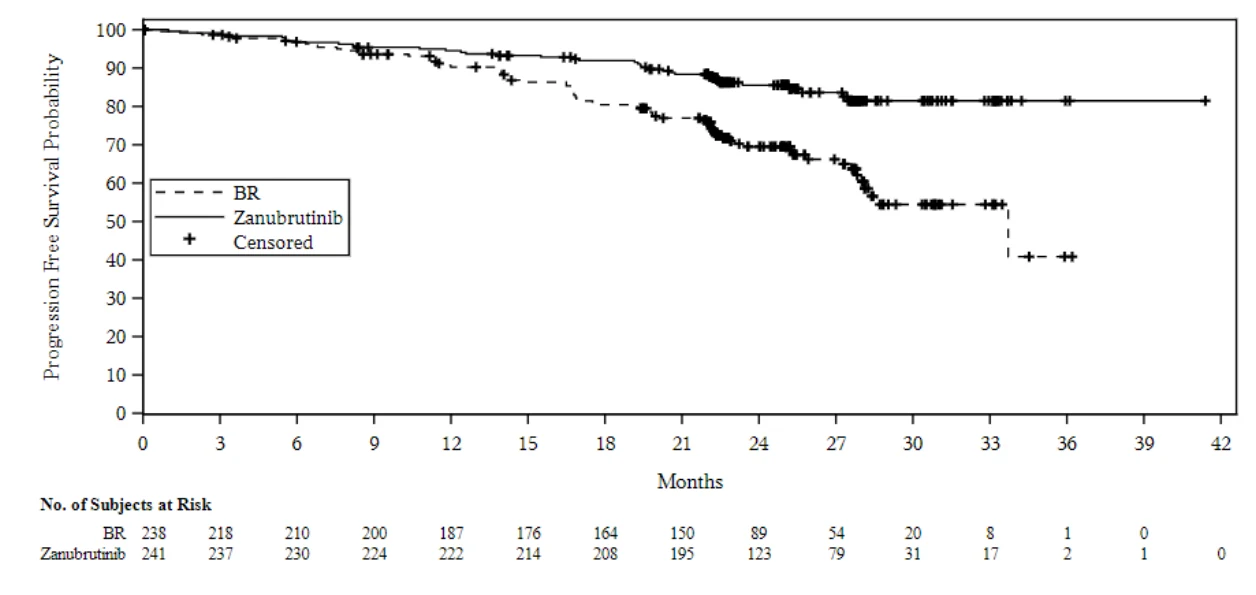
BRUKINSA (zanubrutinib) Page 47 of 61
| Cohort 1 non-del(17p) | Cohort 2 del(17p) | ||||||||
|---|---|---|---|---|---|---|---|---|---|
| Endpoint | BRUKINSA (N=241) | Bendamustine + Rituximab (N=238) | BRUKINSA N=110 | ||||||
| CRd | 6.6% | 15.1% | 6.4% | ||||||
| nPR | 1.2% | 5.9% | 1.8% | ||||||
| PR | 85.5% | 64.3% | 80.0% | ||||||
| PR-L | 1.2% | 0.0% | 1.8% | ||||||
| Duration of Response* | |||||||||
| Median DOR (95% CI), months | NE (NE, NE) | 30.6 (25.5, NE) | NE (NE, NE) | ||||||
Rate at 12 months, % (95% CI) | 96.0 (92.4, 97.9) | 90.8 (85.9, 94.1) | 94.9 (88.1, 97.8) | ||||||
CI= Confidence interval, CR= complete response, CRi=complete response with incomplete hematopoietic recovery, DOR= Duration of Response, HR= Hazard ratio, NE= not estimable, nPR=nodular partial response, ORR= overall response rate CR+CRi+nPR+PR+PR-L, PR= partial response., PR-L= partial response with lymphocytosis.
* Independent central review committee assessed. a Based on Kaplan-Meier estimation. b Based on a stratified Cox-regression model with bendamustine + rituximab as the reference group. c Based on a stratified log-rank test.
d CR =CR+CRi
Figure 1: Kaplan-Meier Plot of Progression-free Survival by Independent Central Review in Cohort 1
ALPINE (BGB-3111-305)
The efficacy of BRUKINSA in patients with relapsed or refractory CLL after at least 1 prior systemic therapy was evaluated in ALPINE.
BRUKINSA (zanubrutinib) Page
Randomization was stratified by age (< 65 years versus ≥ 65 years), geographic region (China versus non-China), refractory status (yes or no), and del(17p)/TP53 mutation status (present or absent). The efficacy evaluation for the primary efficacy endpoint was based on the pre-specified interim analysis of first 415 randomized patients. Of 415 patients, 207 were randomized to BRUKINSA monotherapy, 208 to ibrutinib monotherapy.
Baseline demographics and disease characteristics were similar between treatment arms. In the first 415 randomized patients, in the BRUKINSA arm, the median age was 67.0 years, 62.3% of patients were ≥ 65 years old, 81.2% were white and 98.1% of patients had an ECOG PS of 0 or 1. There were 7 patients (3.4%) with a diagnosis of SLL. Forty-one percent had Binet stage C or Ann Arbor stage III/IV disease, 71% had an unmutated IGHV gene, and 20% had 17p deletion or TP53 mutation. Patients had a median of one prior line of therapy (range: 1-6), 16% of patients had ≥3 prior lines of therapy, 80% had prior chemoimmunotherapy, and 1% had prior BCL2 inhibitor.
The primary efficacy endpoint was overall response rate (ORR; defined as partial response or better) as determined by investigator assessment using the 2008 IWCLL guidelines for CLL and the Lugano criteria for SLL. Key efficacy results for ALPINE by investigator analysis are shown in Table .
Table 26: Efficacy Results in ALPINE (BGB-3111-305)
BRUKINSA N=207 | Ibrutinib N=208 | ||||||||||||
|---|---|---|---|---|---|---|---|---|---|---|---|---|---|
| Overall response rate | |||||||||||||
ORR, n (%) (95% CI) | 162 (78.3) (72.0, 83.7) | 130 (62.5) (55.5, 69.1) | |||||||||||
| CR (CR+CRi), n (%) | 4 (1.9) | 3 (1.4) | |||||||||||
| nPR, n (%) | 1 (0.5) | 0 (0) | |||||||||||
| PR, n (%) | 157 (75.8) | 127 (61.1) | |||||||||||
| PR-L, n (%) a | 21 (10.1) | 39 (18.8) | |||||||||||
| Response ratio b (95% CI) | 1.25 (1.10, 1.41) | ||||||||||||
| Non-inferiority c | 1-sided p-value <0.0001 | ||||||||||||
| Superiority d | 2-sided p-value 0.0006 | ||||||||||||
| Time to Response | |||||||||||||
| n | 162 | 130 | |||||||||||
| Median (range), months | 5.59 (2.7, 14.1) | 5.65 (2.8, 16.7) | |||||||||||
| Duration of response | |||||||||||||
| Median DOR (95% CI) | NE (14.0, NE) | 16.6 (13.7, NE) | |||||||||||
| Rate at 12 months e, % (95% CI) | 89.8 (78.1, 95.4) | 77.9 (64.7, 86.7) | |||||||||||
CI=confidence interval, CR= complete response, CRi=complete response with incomplete hematopoietic recovery, DOR=duration of response, ORR=overall response rate= CR+CRi+nPR+PR, nPR=nodular partial response, PR= partial response.
a PR-L was not included in the definition of ORR in the primary efficacy analysis.
b Response ratio is the estimated ratio of the overall response rate of the BRUKINSA arm divided by that of the ibrutinib arm.
c Stratified test against a null response ratio of 0.8558.
BRUKINSA (zanubrutinib) Page 49 of 61
d Stratified Cochran-Mantel-Haenszel test.
e Kaplan-Meier estimate.
The overall response to BRUKINSA appeared to be consistent among subgroups examined, including patients with del(17p). Overall, there was similarity between the investigator analysis and the IRC assessments. At the interim analysis, the primary endpoint, Investigator assessed ORR, demonstrated non-inferiority (p<0.0001) and superiority (p=0.0006) of zanubrutinib over ibrutinib. The secondary endpoint, IRC assessed ORR, demonstrated non-inferiority (p<0.0001).
Follicular Lymphoma (FL)
The efficacy of BRUKINSA in patients with Follicular Lymphoma was evaluated in a phase 2 randomized controlled trial.
Table 27 Summary of Patient Demographics for Clinical Trials in Patients with FL
| Study # | Trial design | Dosage, route of administration and duration | Study subjects (n) | Mean age (Range) | Sex |
|---|---|---|---|---|---|
| ROSEWOOD (BGB-3111-212 | Randomized (2:1) Multi-centre, Open-Label Phase 2 , Study | Arm A Brukinsa 160 mg orally twice daily continuously plus 1000 mg obinutuzumab infusions on Days 1, 8 and 15 of cycle 1, Day 1 cycles 2-6 then every eight weeks for up to 24 months Arm B Obinutuzumab monotherapy 1000 mg obinutuzumab infusions on Days 1, 8 and 15 of cycle 1, Day 1 cycles 2-6 then every eight weeks for up to 24 months | Arm A n=145 Arm B N=72 | 62 (range: 31 to 88) years | M: 49.8% F: 50.2% |
BRUKINSA (zanubrutinib) Page
The efficacy of BRUKINSA in patients with Follicular Lymphoma (FL) was evaluated in a randomized controlled trial, ROSEWOOD (BGB-3111-212), a Phase 2, open-label, randomized study of BRUKINSA in combination with obinutuzumab versus obinutuzumab monotherapy in patients of at least 18 years of age with relapsed/refractory histologically confirmed diagnosis of B-cell FL (Grade 1, 2 or 3a) based on the World health Organization (WHO) 2008 classification of tumours of hematopoietic and lymphoid tissue; who had received at least two prior systemic therapies including an anti-CD20 antibody and an appropriate alkylator-based combination therapy. Patients (n=217) were randomized 2:1 to either BRUKINSA 160 mg orally twice daily in combination with obinutuzumab 1,000 mg intravenously (n=145)) or obinutuzumab alone (n=72), ).
Baseline demographics and disease characteristics were generally balanced between the BRUKINSA combination arm and the obinutuzumab monotherapy arm in the 217 randomized patients. The median age was 64 years (range: 31 to 88), 49.8% were male, and 64.1% White. Forty-seven percent of patients were ≥65 years old. Most (97.2%) of the patients had a baseline ECOG performance status of 0 or 1.
Most patients had a Follicular Lymphoma International Prognostic Index (FLIPI) risk of intermediate or high at baseline (172 patients [79.3%]) and were Ann Arbor Stage III or IV (179 patients [82.5%]). Eighty-eight patients (40.6%) had bulky disease (defined as >1 baseline target lesion measuring >5 cm diameter).
The median number of prior anticancer therapy was 3 lines (range: 2 to 11 lines). All 217 patients had received ≥2 prior lines of therapy that included rituximab therapy, and 59 of the 217 patients (27.2%) received >3 prior lines of therapy. Most patients had received prior cyclophosphamide (204 patients [94.0%]), prior anthracyclines (175 patients [80.6%]) and prior bendamustine (119 patients [54.8%]). All patients had received prior rituximab therapy and more than half of all patients (114 patients [52.5%]) were refractory to rituximab.
The median follow-up time was 20.2 months (range: 0.1 to 46.6 months) in the BRUKINSA combination arm and 20.4 months (range: 0.1 to 46.2 months) in the obinutuzumab monotherapy arm.
The primary efficacy endpoint was overall response rate (ORR), defined as partial response or complete response, as determined by blinded independent central review (BICR) using the 2014 Lugano Classification for NHL. Other evaluated endpoints included duration of response (DoR per BICR), progression free survival (PFS per BICR) and overall survival (OS).
Efficacy results are summarized in Table 28.
Table 28: Efficacy Results Per Blinded Independent Central Review (ITT)
| BRUKINSA + Obinutuzumab (N=145) n (%) | Obinutuzumab (N=72) n (%) | |
| Overall response rate | ||
| n (%) | 100 (69.0) | 33 (45.8) |
| (95% CI)a | (60.8, 76.4) | (34.0, 58.0) |
| CR | 57 (39.3) | 14 (19.4) |
BRUKINSA (zanubrutinib) Page 51 of 61
| BRUKINSA + Obinutuzumab (N=145) n (%) | Obinutuzumab (N=72) n (%) | ||||||||
| PR | 43 (29.7) | 19 (26.4) | |||||||
| Response Difference, % (95% CI)b | 22.7 (9.0, 36.5) | ||||||||
| 2-sided P-valuec | 0.0012 | ||||||||
| Duration of response (months) | |||||||||
| Median (95% CI)d | NE (25.3, NE) | 14.0 (9.2, 25.1) | |||||||
Overall Response Rate: CR + PR, CR: complete response, PR: partial response, DoR: duration of response, IRT: Interactive Response Technology, ITT: intent to treat, NE: not estimable.
a Estimated using the Clopper-Pearson method.
b Mantel-Haenszel common difference was estimated, along with its 95% CI constructed by a normal approximation and Sato's variance estimator, stratified by rituximab-refractory status, number of prior lines of therapy, and geographic region per IRT.
c Cochran-Mantel-Haenszel method stratified by rituximab-refractory status, number of prior lines of therapy, and geographic region per IRT.
d Medians estimated by Kaplan-Meier method; 95% CIs estimated by Brookmeyer and Crowley method.
The BICR determined ORR demonstrated superiority of the combination of BRUKINSA and obinutuzumab versus obinutuzumab monotherapy. A consistent ORR was observed across all analyzed subgroups favouring the combination arm compared to the obinutuzumab arm, including subgroups with high FLIPI score at screening, disease refractory to rituximab, and disease refractory to the most recent line of therapy.
The median DoR assessed by BICR was not reached in the BRUKINSA combination arm. The median duration of response in the obinutuzumab monotherapy arm, was 14 months.
The median PFS assessed by BICR in the combination arm was 28 months (95% CI: 16.1, NE) compared to 10.4 months (95% CI: 6.5, 13.8) in the obinutuzumab monotherapy arm.
At the time of analysis, OS data were immature, with approximately 23.5% of patients experiencing an event. With an estimated median follow up of 23 months, median survival was not reached in the combination arm and 35 months in the control arm.
Since the DoR, OS and PFS were not controlled for type 1 error, the data are considered descriptive.
14.2. Comparative Bioavailability Studies
A randomized, single-dose (160 mg), four-period fully-replicated, crossover comparative bioavailability study comparing BRUKINSA tablets (1 x 160 mg) and BRUKINSA capsules (2 x 80 mg) was conducted in healthy, adult male and female volunteers under fasting conditions. Comparative bioavailability data from the 57 subjects that were included in the statistical analysis are presented in the following table.
BRUKINSA (zanubrutinib) Page
SUMMARY TABLE OF THE COMPARATIVE BIOAVAILABILITY DATA
Zanubrutinib (1 x 160 mg tablet vs 2 x 80 mg capsule) Geometric Mean Arithmetic Mean (CV %) | ||||
| Parameter | Test1 | Reference2 | % Ratio of Geometric Means | 90% Confidence Interval |
AUCT (ng•h/mL) | 1240 1360 (38) | 1250 1350 (38) | 100.0 | 95.0 – 105.3 |
AUCI (ng•h/mL) | 1260 1380 (37) | 1290 1380 (37) | 98.6 | 93.8 – 103.5 |
Cmax (ng/mL) | 260 289 (44) | 215 235 (43) | 121.8 | 113.8 – 130.2 |
Tmax3 (h) | 2.00 (0.500 – 6.00) | 2.00 (0.500 – 6.00) | ||
T½4 (h) | 6.11 (63) | 7.43 (50) | ||
1 BRUKINSA (zanubrutinib) tablets, 160 mg (BeOne Medicines I GmbH)
2 BRUKINSA (zanubrutinib) capsules, 80 mg (BeOne Medicines I GmbH)
3 Expressed as the median (range) only
4 Expressed as the arithmetic mean (CV %) only
15. Non-Clinical Toxicology
General toxicology
The general toxicologic profiles of zanubrutinib were characterized via oral treatment in Sprague-Dawley rats for up to 6 months and in Beagle dogs for up to 9 months.
In the 6-month study, rats were dosed 30, 100 or 300 mg/kg/day for 182 days, or 1000 mg/kg/day for up to 8 days. The test article related mortality was only noted at the dose of 1000 mg/kg/day following 5-day treatment and the main toxicology findings was gastrointestinal tract toxicity associated with histopathologic changes. Test article related histopathologic changes were noted in pancreas, lung, and skeletal muscle most of which were fully or partially reversible. The NOAEL was considered to be 300 mg/kg/day, where the systemic exposure (AUC) was approximately 25 times in males and 42 times in females of the human exposure at the recommended dose.
BRUKINSA (zanubrutinib) Page 53 of 61
In the 9-month study, dogs were dosed 10, 30 or 100 mg/kg/day for 273 days. No mortality occurred throughout the study. The toxicology findings or changes were minimal or mild and resolved during recovery phase, including abnormal stool, conjunctiva hyperemia, lymphoid depletion or erythrophagocytosis in the gut-associated lymphoid tissues. The NOAEL was considered to be 100 mg/kg/day, where the systemic exposure (AUC) was approximately 20 times in males and 18 times in females of the human exposure at the recommended dose.
Genotoxicity
Zanubrutinib was not mutagenic in a bacterial mutagenicity (Ames) assay, was not clastogenic in a chromosome aberration assay in mammalian (CHO) cells, nor was it clastogenic in an in vivo bone marrow micronucleus assay in rats
Carcinogenicity
Carcinogenicity studies have not been conducted with zanubrutinib.
Reproductive and developmental toxicology
A combined male and female fertility and early embryonic development study was conducted in rats at oral zanubrutinib doses of 30 to 300 mg/kg/day. Male rats were dosed 4 weeks prior to mating and through mating and female rats were dosed 2 weeks prior to mating and to gestation day 7. No effect on male or female fertility was noted but at the high dose of 300 mg/kg day, morphological abnormalities in sperm and increased post-implantation loss were noted. The high dose of 300 mg/kg/day is approximately 9 times the human recommended dose, based on body surface area.
Embryo-fetal development toxicity studies were conducted in both rats and rabbits. Zanubrutinib was administered orally to pregnant rats during the period of organogenesis at doses of 30, 75, and 150 mg/kg/day. Malformations in the heart (2- or 3-chambered hearts) were noted at all dose levels (incidence between 0.3% and 1.5%) in the absence of maternal toxicity. The lowest dose of 30 mg/kg/day is approximately 5 times the exposure (AUC) in patients receiving the recommended dose.
Administration of zanubrutinib to pregnant rabbits during the period of organogenesis at 30, 70, and 150 mg/kg/day resulted in post-implantation loss at the highest dose. The dose of 150 mg/kg is approximately 33 times the exposure (AUC) in patients at the recommended dose and was associated with maternal toxicity.
In a pre- and post-natal developmental toxicity study in rats, zanubrutinib was administered orally at 30, 75, and 150 mg/kg/day from implantation through weaning. The offspring from the 75 mg/kg/day and 150 mg/kg/day groups had decreased body weights preweaning, and all dose groups had adverse ocular findings (e.g., cataract, protruding eye). The dose of 30 mg/kg/day is approximately 4 times the AUC in patients receiving the recommended dose.