


Patient Medication Information: uses, side effects, how to take - Cathejell
ABOUT THIS MEDICATION
What the Medication is Used for
Cathejell® is used to produce a temporary loss of feeling or numbness of the skin in adults and children 2 years of age and older, and can be used:
- Before certain types of examinations done by your doctor;
- To help relieve the pain from inflammation of the urinary bladder and the urethra.
What it Does
Cathejell® is a topical anesthetic that contains the drug lidocaine which produces a temporary loss of sensation or numbness on the area where it is applied. Cathejell® should start to work within 5 to 15 minutes after you apply it. The effect usually lasts 20 to 30 minutes.
When it Should Not be Used
Do not use Cathejell®:
- If you are allergic to lidocaine, any other "-caine" type anesthetics (e.g., bupivacaine, ropivacaine, mepivacaine) or any of the non-medicinal ingredients in the product (see Non-Medicinal Ingredients);
- If you have a blood disorder called methemoglobinemia;
- In infants (12 months of age or younger) who are taking medicines that may cause methemoglobinemia (see INTERACTIONS WITH THIS MEDICATION).
What the Medicinal Ingredient Is
Lidocaine hydrochloride.
Non-Medicinal Ingredients
Glycerol, hydrochloric acid, hydroxyethylcellulose, sodium hydroxide, and water for injection.
Tell your doctor if you think you may be sensitive to any of the above ingredients.
What Dosage Forms it Comes In
Cathejell® is available as a single use syringe containing 20 milligrams of lidocaine hydrochloride in each gram of jelly (2% w / w).
WARNINGS AND PRECAUTIONS
Before you use Cathejell®, tell your doctor or pharmacist:
- About all health problems you have now or have had in the past;
- About other medicines you take, including ones you can buy without a prescription;
- If you are taking other medicines such as drugs used to treat irregular heart activity (anti-arrhythmics);
- If you have ever had a bad, unusual, or allergic reaction to Cathejell® or any other medicines ending with “caine”;
- If you think you may be allergic or sensitive to any ingredients in Cathejell® (see above);
- If there is an infection, skin rash, cut or wound at or near the area you want to apply Cathejell®;
- If you have a skin condition that is severe or that covers a large area;
- If you have a severe heart, kidney, or liver disease (see PROPER USE OF THIS MEDICATION);
- If you have epilepsy (there is very low risk if used as per PROPER USE OF THIS MEDICATION);
- If you or someone in your family has been diagnosed with porphyria;
- If you are experiencing severe shock;
If you are pregnant, plan to become pregnant, or are breastfeeding;
- If you have a condition called glucose-6-phosphate dehydrogenase deficiency because you are at increased risk for methemoglobinemia.
Use in children: Younger children, especially those under the age of 3 months, are at greater risk for serious side effects than adults. You should:
- Tell your child’s doctor if you will be using Cathejell® in a child who is less than 2 years of age;
- Always follow the doctor’s instructions for using Cathejell®, especially in young children and infants;
- Be careful not to use more Cathejell® than instructed by your child’s doctor. Limit the dose and area of application, especially in infants less than 3 months of age;
- Monitor your child closely during and after you use Cathejell® on them.
Do not use Cathejell® on the genitals of children or infants.
INTERACTIONS WITH THIS MEDICATION
Tell your doctor or pharmacist about any other drugs you take, including:
- Drugs you can buy without a prescription;
- Anti-arrhythmic drugs for heart problems (e.g. mexiletine, amiodarone) (see PROPER USE OF THIS MEDICATION);
- Other anesthetics (see PROPER USE OF THIS MEDICATION);
- Propranolol for heart problems or cimetidine for gastrointestinal problems, if you are going to use high doses of Cathejell® for a long time;
- Fluvoxamine, for depression, if you are going to use high doses of Cathejell® for a long time.
- Other medicines which may cause methemoglobinemia, including: amino-amide, sulfonamides, acetanilid, aniline dyes, benzocaine (or other “-caine” type anesthetics), chloroquine, dapsone, naphthalene, nitrates or nitrites, nitrofurantoin, nitroglycerin, nitroprusside, pamaquine, para-aminosalicylic acid, phenacetin, phenobarbital, phenytoin, primaquine, quinine and acetaminophen.
Please inform your doctor/dentist/pharmacist if you are taking or have recently taken any other medicines, even those that can be bought without a prescription. Usage of such medicines at the same time may increase the risk of serious side effects.
PROPER USE OF THIS MEDICATION
When fully compressed, each 13.3 g syringe will express approximately 10 g (9.4 mL) of Cathejell® (200 mg of lidocaine hydrochloride). The amount expressed may vary with the technique used.
Usual Dose
If this medicine is recommended by your doctor, be sure to follow the directions for use that have been given. If you are treating yourself, such as for the treatment of pain caused by inflammation of the urethra or urinary bladder, or for self catheterization, follow the directions below and your doctor’s or pharmacist’s instructions for how to apply the jelly. Check with your doctor or pharmacist if you have any questions about your directions.
The following are general guidelines for the maximum amount of Cathejell® that should be used without a doctor’s advice. These guidelines apply only to otherwise healthy people. If you have a special skin or other condition that requires a doctor’s supervision; ask your doctor about the maximum amount of jelly that you should use.
Do not use more Cathejell®, more often, or for a longer period of time than either your doctor ordered or than these package directions suggest as this may cause unwanted side effects (see SIDE EFFECTS AND WHAT TO DO ABOUT THEM).
If possible, clean the affected area well before each application of jelly. Use the smallest amount of jelly needed to control your symptoms. Avoid contact with your eyes.
Conditions where dose adjustments may be required:
- Elderly patients;
- Acutely ill patients;
- Patients with severe liver disease;
- Patients with severe kidney disease;
- Patients also treated with other anesthetics or certain antiarrhythmic drugs (such as amiodarone or mexiletine).
Dose for Adults
The dose of the jelly depends on the application site. For oral use of Cathejell®, a dose of 20 g jelly (2 syringes) is usually safe. For use in the urethra (i.e., before insertion of urinary catheters or urinary procedures), 5 to 20 g jelly (½ to 2 syringes) is usually enough. A safe dose for use in the urethra and bladder is 40 g jelly (4 syringes).
No more than four doses should be given during a 24-hour period.
Dose for Children Under 12 Years of Age
Your child’s doctor will tell you how much Cathejell® to use and how often to use it. The dose will depend on your child’s:
- Age;
- Weight;
- Medical condition(s) and any medicines they are taking.
No more than 3 g of jelly per 10 kilograms of the child’s weight should be used per dose. For a 10 kg child, the dose should be no more than ⅓ of the syringe.
No more than four doses should be given during a 24-hour period.
For use in children under 2 years of age, consult a doctor.
If you have any questions about how to measure the above amounts, be sure to ask your pharmacist.
If you are treating yourself and your condition does not seem to improve within three to five days, check with your doctor about continuing to use Cathejell®.
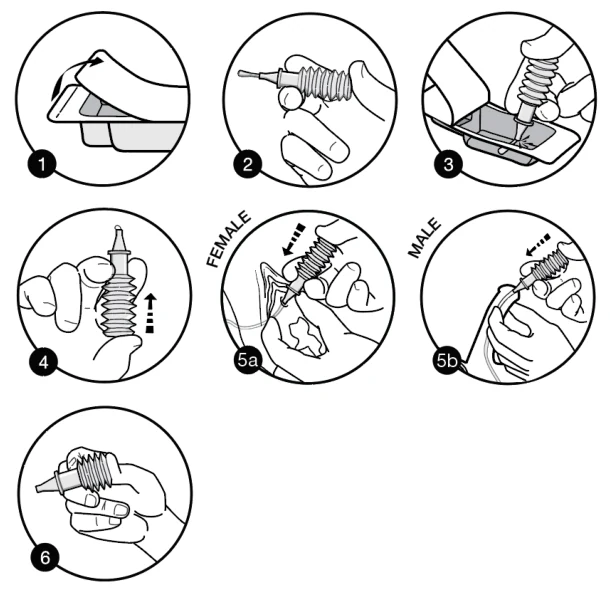
Instructions for Cathejell® Use
- 1. Peel off the paper cover from the transparent blister pack (see image 1).
- 2. Inspect mixture visually for clarity, particulate matter, precipitation, discolouration, and leakage prior to administration (see image 2).
- 3. Break off the applicator tip by using a vigorous downward stroke in the bottom of the sterile blister pack (see image 3).
- 4. Remove the applicator tip completely. Release one drop of jelly to coat the nozzle for easier insertion (see image 4).
- 5. Instill by applying slight but steady pressure to the collapsible syringe (see images 5a and 5b).
- 6. While removing the syringe, keep the syringe compressed to avoid suction of the instilled jelly (see image 6).
For further assistance, questions or concerns please contact BioSyent Pharma Inc. (cathejell@biosyent.com or 1.888.439.0013) or Pharmazeutische Fabrik MONTAVIT Ges.m.b.H. (pharma@montavit.com).
| SYMPTOMS AND TREATMENT OF OVERDOSAGE |
For management of suspected drug overdose, contact your regional Poison Control Centre.
Early signs of overdosage are numbness of the lips and around the mouth, light-headedness, dizziness, and sometimes blurred vision. In the event of a serious overdosage, trembling, seizures, or unconsciousness may occur. If the early signs of overdosage are noticed and no further Cathejell® is given, the risk of serious adverse effects occurring rapidly decreases. If you think you or anyone else is experiencing any of the above signs, telephone your doctor or go to the nearest hospital right away.
SIDE EFFECTS AND WHAT TO DO ABOUT THEM
Like any medication, Cathejell® may cause side effects in some people.
Avoid eating or chewing gum when Cathejell® is used in the mouth or throat since numbness in these areas may interfere with swallowing and could potentially cause choking. Numbness of the tongue or gums may also increase the danger of injury due to biting. Avoid exposure to extreme hot or cold temperatures (e.g. food, drink) until complete sensation has returned. Avoid contact with the eyes because numbness in the eyes may prevent you from noticing if you get something in your eye. With the recommended doses, Cathejell® has no effect on the ability to drive and use machines.
Medicines affect different people in different ways. Just because side effects have occurred in some patients, does not mean that you will get them. If any side effects bother you, or if you experience any unusual effects while you are using Cathejell®, stop using it and check with your doctor or pharmacist as soon as possible.
SERIOUS SIDE EFFECTS, HOW OFTEN THEY HAPPEN AND WHAT TO DO ABOUT THEM | |||
|---|---|---|---|
| SYMPTOM/EFFECT | Talk with your doctor or pharmacist | Stop taking drug and seek immediate emergency medical attention | |
Only if severe | In all cases | ||
COMMON Allergic reaction such as: redness, itching or swelling of your skin, hives, burning, stinging, or any other skin problems, swelling of the neck area, or any difficulty with breathing, not present before using this medicine | |||
RARE Overdose such as: drowsiness, numbness of your tongue, light-headedness, ringing in your ears, blurred vision, vomiting, dizziness, unusually slow heartbeat, fainting, nervousness, unusual sweating, trembling or seizures | |||
RARE Methemoglobinemia : brownish or bluish-grey skin especially around lips and nails, paleness, skin marbelling, shortness of breath, abnormally fast heartbeat, loss of consciousness | |||
This is not a complete list of side effects.
For any unexpected effects while taking Cathejell®, contact your doctor or pharmacist.
The above side effects are extremely rare, but can occur when too much Cathejell® is used at one time
 |
and when large amounts are used over a long period of time. Consult your doctor immediately if any of these symptoms appear.
HOW TO STORE IT
Keep Cathejell® well out of sight and reach of children when not in use.
Keep Cathejell® at room temperature. Do not keep Cathejell® in the bathroom medicine cabinet or other warm, moist places. Store in the original package.
Do not use Cathejell® after the expiry date marked on the package.
REPORTING SUSPECTED SIDE EFFECTS
You can report any suspected side effects associated with the use of health products to Health Canada by:
NOTE: Contact your health professional if you need information about how to manage your side effects. The Canada Vigilance Program does not provide medical advice. |
MORE INFORMATION
Important Note: This leaflet alerts you to some of the times you should call your doctor. Other situations which cannot be predicted may arise. Nothing about this leaflet should stop you from calling your doctor with any questions or concerns you have about using Cathejell®.
If you want more information about Cathejell®:
- Talk to your healthcare professional
- Find the full product monograph that is prepared for healthcare professionals and includes this Patient Medication Information by visiting the Health Canada websitehttps://health-products.canada.ca/dpd-bdpp/index-eng.jsp, the manufacturer's website www.Cathejell.ca, or by calling 1-888-439-0013.
Last revised: January 27, 2021
Imported and distributed in Canada by:
BioSyent Pharma Inc.
Mississauga, ON L5N 6M1
1.888.439.0013
DIN owner/manufactured by:
Pharmazeutische Fabrik MONTAVIT Ges.m.b.H. Absam, Austria6067
Cathejell® is a registered trademark of Pharmazeutische Fabrik MONTAVIT Ges.m.b.H. Absam, Austria 6067
https://www.canada.ca/fr/sante-canada.html