


Product Monograph - Cetrotide (Emd Serono, A Division of Emd Inc., Canada, 0.25 mg)
1 INDICATIONS
CETROTIDE® (cetrorelix for injection) is indicated for the prevention of premature ovulation in patients undergoing controlled ovarian stimulation.
2 CONTRAINDICATIONS
CETROTIDE (cetrorelix for injection) is contraindicated under the following conditions:
- Hypersensitivity to cetrorelix acetate, extrinsic peptide hormones, mannitol, or any component of the container. For a complete listing, see Dosage Forms, Strengths, Composition and Packaging.
- Known hypersensitivity to GnRH or any other GnRH analogs.
- Known or suspected pregnancy, and lactation (see PRECAUTIONS).
- Moderate or severe impairment of hepatic or renal function.
3 DOSAGE AND ADMINISTRATION
3.1 Recommended Dose and Dosage Adjustment
Ovarian stimulation therapy with gonadotropins (FSH, hMG) is started on cycle Day 2 or 3. The dose of gonadotropins should be adjusted according to individual response. The response should be primarily based on the number and size of the developing follicles as evidenced by ultrasound. This may be more reliable than by the amount of circulating estradiol. CETROTIDE (cetrorelix for injection) may be administered subcutaneously once daily (0.25 mg dose) as part of the multiple dose protocol during the early- to mid-follicular phase.
CETROTIDE (cetrorelix for injection) 0.25 mg is administered on either stimulation day 5 (morning or evening) or day 6 (morning). It is administered once daily at the same time each day at 24 hour intervals and continued daily until the day of hCG administration.
When assessment by ultrasound shows a sufficient number of follicles of adequate size (≥17 mm in diameter), hCG is administered to induce ovulation and final maturation of the oocytes. No hCG should be administered if the ovaries show an excessive response to the treatment with gonadotropins to reduce the chance of developing ovarian hyperstimulation syndrome (OHSS).
3.2 Administration
The first administration of CETROTIDE (cetrorelix for injection) 0.25 mg should be performed under the supervision of a physician and under conditions where treatment of possible allergic/pseudo-allergic reactions (including life-threatening anaphylaxis) is immediately available. The subsequent injections may be self-administered after appropriate instructions by the doctor as long as the patient is made aware of the signs and symptoms that may indicate hypersensitivity, the consequences of such a reaction and the need for immediate medical intervention.
3.3 Reconstitution
Table 1 – Reconstitution
| Vial Size | Volume of Diluent to be Added to Vial | Approximate Available Volume | Nominal Concentration per mL |
| 2 mL | 1 mL | 1.1 mL | 0.25 mg |
The reconstituted product is to be administered subcutaneously. Use immediately after reconstitution.
As with all parenteral drug products, reconstituted solutions should be inspected visually for clarity, particulate matter, precipitate, discolouration and leakage prior to administration. Solution showing haziness, particulate matter, precipitate, discolouration or leakage should not be used. Discard unused portions.
3.4 Missed Dose
If you miss a dose of CETROTIDE (cetrorelix for injection) do not double dose. Discuss with your doctor when you should receive your next dose. Check with your doctor if you have any questions about this.
4 OVERDOSAGE
There have been isolated reports of overdosage with CETROTIDE (cetrorelix for injection) 0.25 mg in humans but no adverse events were reported. In addition, single doses up to 120 mg CETROTIDE (cetrorelix for injection) have been well tolerated in patients treated for other indications without signs of overdosage.
| For management of a suspected drug overdose, contact your regional poison control centre. |
5 DOSAGE FORMS, STRENGTHS, COMPOSITION AND PACKAGING
Table 2 – Dosage Form, Strength, Composition and Packaging
5.1 Composition
CETROTIDE (cetrorelix for injection) 0.25 mg is a sterile lyophilized powder intended for subcutaneous injection after reconstitution with Sterile Water for Injection, Ph.Eur./USP, that comes supplied in a 1.0 mL (for 0.25 mg vial) pre-filled syringe. Each vial of CETROTIDE (cetrorelix for injection) 0.25 mg (multiple dose regimen) contains 0.25 mg of cetrorelix as cetrorelix acetate and 54.80 mg of mannitol.
5.2 Dosage Forms and Packaging
CETROTIDE (cetrorelix for injection) is supplied in a sterile, lyophilized form in a single dose vial containing cetrorelix acetate.
CETROTIDE (cetrorelix for injection) 0.25 mg is available in a carton of one packaged tray. Each packaged tray contains: one glass vial containing 0.25 mg of cetrorelix base, one pre-filled glass syringe with 1 mL of Sterile Water for Injection, Ph.Eur./USP, one 20 gauge needle (yellow), one 27 gauge needle (grey), and two alcohol swabs. After reconstitution with the solvent provided, each mL of solution contains 0.25 mg cetrorelix (base).
The reconstituted product is to be administered by subcutaneous injection only.
CETROTIDE (cetrorelix for injection) does not contain latex.
6 WARNINGS AND PRECAUTIONS
General
CETROTIDE (cetrorelix for injection) should be prescribed by physicians who are experienced in fertility treatment. Before starting treatment with CETROTIDE (cetrorelix for injection), pregnancy must be excluded (see CONTRAINDICATIONS).
Prior to therapy with CETROTIDE (cetrorelix for injection), patients should be informed of the duration of treatment and monitoring procedures that will be required. The risk of possible adverse reactions should be discussed (see ADVERSE REACTIONS). CETROTIDE (cetrorelix for injection) should not be prescribed if a patient is pregnant. If CETROTIDE (cetrorelix for injection) is prescribed to patients for self-administration, information for proper use is given in the Patient Insert (see CONSUMER INFORMATION).
| Route of Administration | Dosage Form / Strength/Composition | Non-medicinal Ingredients |
| Subcutaneous | 0.25 mg cetrorelix (as cetrorelix acetate), Powder for Solution | Mannitol |
Carcinogenesis and Mutagenesis
Long-term carcinogenicity studies in animals have not been performed with cetrorelix acetate. Cetrorelix acetate was not genotoxic in vitro (Ames test, HPRT test, chromosome aberration test) or in vivo (chromosome aberration test, mouse micronucleus test). Cetrorelix acetate induced polyploidy in CHL-Chinese hamster lung fibroblasts, but not in V79-Chinese hamster lung fibroblasts, cultured peripheral human lymphocytes or in an in-vitro micronucleus test in the CHL-cell line.
Immune
Caution is advised in patients with hypersensitivity to GnRH analogs. These patients should be carefully monitored after the first injection, where treatment of possible allergic/pseudo-allergic reactions (including life-threatening anaphylaxis) is immediately available. Therefore, it is recommended that a physician supervises the first administration. Special care should be taken in women with signs and symptoms of active allergic conditions or known history of allergic predisposition. Treatment with CETROTIDE (cetrorelix for injection), is not advised in women with severe allergic conditions.
Efficacy and safety (immunogenicity and/or sensitization) have not been extensively evaluated in women undergoing multiple treatment cycles with CETROTIDE (cetrorelix for injection). However, hypersensitivity, antibody formation, and acute anaphylactic reaction have been reported with GnRH analogs. Therefore, special care should be taken upon using the drug in the same patient for more than one cycle.
Sexual Function/Reproduction
Congenital Anomalies:
The prevalence of congenital anomalies after the use of assisted reproductive technologies (ART) with or without GnRH antagonists may be slightly higher than after spontaneous conceptions although it is unclear whether this is related to factors inherent to the couple's infertility or the ART procedures.
Ovarian Hyperstimulation Syndrome (OHSS):
During or following ovarian stimulation an ovarian hyperstimulation syndrome (OHSS) can occur. This event must be considered as an intrinsic risk of the stimulation procedure with gonadotropins. Protocols combining gonadotropins and GnRH antagonist have been found to be correlated with a shorter duration of stimulation and of lower dose of gonadotropins, lower estradiol level. These findings may account for the reduction of the risk of OHSS, associated with the use of GnRH antagonists.
Impairment of Fertility
Treatment with 0.46 mg/kg cetrorelix acetate for 4 weeks resulted in complete infertility in female rats which was reversed 8 weeks after cessation of treatment.
6.1 Special Populations
6.1.1 Pregnant Women
CETROTIDE (cetrorelix for injection) is contraindicated in pregnant women.
When administered to rats for the first seven days of pregnancy, cetrorelix acetate did not affect the development of the implanted conceptus at doses up to 38 μg/kg (approximately 1 times the recommended human therapeutic dose based on body surface area). However, a dose of 139 μg/kg (approximately 4 times the human dose) resulted in a resorption rate and a post-implantation loss of 100%.
When administered from day 6 to near term to pregnant rats and rabbits, very early resorptions and total implantation losses were seen in rats at doses from 4.6 μg /kg (0.2 times the human dose) and in rabbits at doses from 6.8 μg /kg (0.4 times the human dose). In animals that maintained their pregnancy, there was no increase in the incidence of fetal abnormalities.
The fetal resorption observed in animals is a logical consequence of the alteration in hormonal levels effected by the antigonadotrophic properties of CETROTIDE (cetrorelix for injection), which could result in fetal loss in humans as well. Therefore, this drug should not be used in pregnant women.
6.1.2 Breast-feeding
It is not known whether CETROTIDE (cetrorelix for injection) is excreted in human milk. Because many drugs are excreted in human milk, and because the effects of CETROTIDE (cetrorelix for injection) on lactation and/or the breast-fed child have not been determined, CETROTIDE (cetrorelix for injection) is contraindicated for nursing mothers.
7 ADVERSE REACTIONS
7.1 Adverse Reaction Overview
The safety of CETROTIDE (cetrorelix for injection) in 949 patients undergoing controlled ovarian stimulation in clinical studies was evaluated. Women were between 19 and 40 years of age (mean: 32). 94.0 % of them were Caucasian. CETROTIDE (cetrorelix for injection) was given in doses ranging from 0.1 mg to 5 mg as either a single or multiple dose.
7.2 Clinical Trial Adverse Reactions
Because clinical trials are conducted under very specific conditions, the adverse reaction rates observed in the clinical trials may not reflect the rates observed in practice and should not be compared to the rates in the clinical trials of another drug. Adverse reaction information from clinical trials is useful for identifying drug-related adverse events and for approximating rates.
Table 3 – Adverse Events in Patients in Controlled Ovarian Stimulation Clinical Studies
Adverse Event (WHO preferred term) | CETROTIDE (cetrorelix for injection) N=949 % (n) |
Ovarian Hyperstimulation Syndrome Mild to Moderate (WHO grade I and II) Severe (WHO grade III) | 5.7 (54) 0.53 (5) |
| Nausea | 1.3 (12) |
| Headache | 1.1 (10) |
Table 3 shows systemic adverse events from the beginning of CETROTIDE (cetrorelix for injection) treatment until confirmation of pregnancy by ultrasound in CETROTIDE (cetrorelix for injection) treated subjects undergoing COS (Controlled Ovarian Stimulation).
Local site reactions (e.g. pain, redness, swelling pruritus, erythema, hematoma and/or irritation at the site of injection) have been commonly reported. Usually, they were of a transient nature and mild intensity. Uncommon cases of systematic allergic/pseudo-allergic reactions including life-threatening anaphylactoid reactions have been observed.
Two stillbirths were reported in Phase 3 studies of CETROTIDE (cetrorelix for injection).
Ovarian Hyperstimulation Syndrome (OHSS)
During or following controlled ovarian stimulation it is common for mild to moderate ovarian hyperstimulation syndrome (WHO grade I or II) to occur. This event must be considered as an intrinsic risk of the stimulation procedure with gonadotropins (refer to the relevant gonadotropin Product Monograph for warning symptoms etc.).
In this potentially serious medical event, the ovaries are massively enlarged, and intravascular fluid volume shifts into the peritoneal space, resulting in hypovolemia, oliguria, hemoconcentration, and massive ascites. The syndrome can usually be avoided by closely monitoring the patient and withholding the hCG if ovarian response becomes excessive.
Severe OHSS (WHO grade III) is uncommon.
Congenital Anomalies
Clinical follow-up studies of 316 newborns of women administered CETROTIDE (cetrorelix for injection) were reviewed. One infant of a set of twin neonates was found to have anencephaly at birth and died after four days. The other twin was normal. Developmental findings from ongoing baby follow-up included a child with a ventricular septal defect and another child with bilateral congenital glaucoma.
Four pregnancies that resulted in therapeutic abortion in Phase 2 and Phase 3 controlled ovarian stimulation studies had major anomalies (diaphragmatic hernia, trisomy 21, Klinefelter syndrome, polymalformation, and trisomy 18). In three of these four cases, intracytoplasmic sperm injection (ICSI) was the fertilization method employed; in the fourth case, in-vitro fertilization (IVF) was the method employed.
The minor congenital anomalies reported include: supernumerary nipple, bilateral strabismus, imperforate hymen, congenital nevi, hemangiomata, and QT syndrome.
The causal relationship between the reported anomalies and CETROTIDE (cetrorelix for injection) is unknown. Multiple factors, genetic and others (including, but not limited to ICSI, IVF, gonadotropins, and progesterone) make causal attribution difficult to study.
8 DRUG INTERACTIONS
8.1 Drug-Drug Interactions
No formal drug interaction studies have been performed with CETROTIDE (cetrorelix for injection). In clinical studies, no interaction between exogenous gonadotropins and CETROTIDE (cetrorelix for injection) was observed.
9 ACTION AND CLINICAL PHARMACOLOGY
9.1 Mechanism of Action
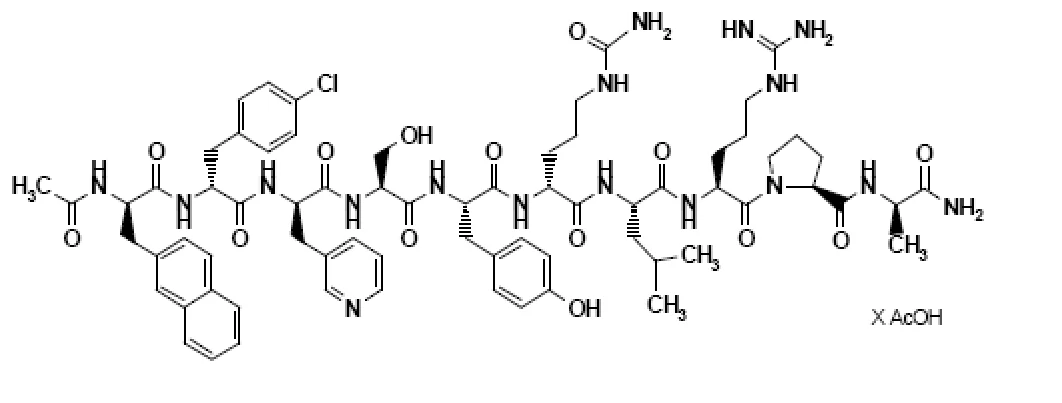
CETROTIDE (cetrorelix for injection) is a synthetic decapeptide with gonadotropin-releasing hormone (GnRH) antagonistic activity. Cetrorelix acetate is an analog of native GnRH with substitutions of amino acids at positions 1, 2, 3, 6, and 10. The molecular formula is Acetyl-D-3-(2´-naphtyl)-alanine-D-4-chlorophenylalanine-D-3-(3´-pyridyl)-alanine-L-serine-L-tyrosine-D-citruline-L-leucine-L-arginine-L-proline-D-alanine-amide, and the molecular weight is 1431.06, calculated as the anhydrous free base.
GnRH induces the production and release of luteinizing hormone (LH) and follicle stimulating hormone (FSH) from the gonadotrophic cells of the anterior pituitary. Due to a positive estradiol (E2) feedback at midcycle, GnRH liberation is enhanced resulting in an LH-surge. This LH-surge induces the ovulation of the dominant follicle, resumption of oocyte meiosis and subsequently luteinization as indicated by rising progesterone levels.
CETROTIDE (cetrorelix for injection) competes with natural GnRH for binding to membrane receptors on pituitary cells and thus controls the release of LH and FSH in a dose-dependent manner. The onset of LH suppression is approximately two hours with the 0.25 mg dose. This suppression is maintained by continuous treatment and there is a more pronounced effect on LH than on FSH. An initial release of endogenous gonadotropins has not been detected with CETROTIDE (cetrorelix for injection), which is consistent with an antagonist effect.
The effects of CETROTIDE (cetrorelix for injection) on LH and FSH are reversible after discontinuation of treatment. In women, CETROTIDE (cetrorelix for injection) delays the LH-surge, and consequently ovulation, in a dose-dependent fashion. FSH levels are not affected at the doses used during controlled ovarian stimulation. A dose of CETROTIDE (cetrorelix for injection) 0.25 mg every 24 hours has been shown to maintain the effect.
9.2 Pharmacodynamics
Human:
GnRH induces the production and release of luteinizing hormone (LH) and follicle stimulating hormone (FSH) from the gonadotrophic cells of the anterior pituitary. Due to a positive estradiol (E2) feedback at midcycle, GnRH liberation is enhanced resulting in an LH-surge. This LH-surge induces the ovulation of the dominant follicle, resumption of oocyte meiosis and subsequently luteinization as indicated by rising progesterone levels.
CETROTIDE (cetrorelix for injection) competes with natural GnRH for binding to membrane receptors on pituitary cells and thus controls the release of LH and FSH in a dose-dependent manner. The onset of LH suppression is approximately one hour with the 3 mg dose and two hours with the 0.25 mg dose. This suppression is maintained by continuous treatment and there is a more pronounced effect on LH than on FSH. An initial release of endogenous gonadotropins has not been detected with CETROTIDE (cetrorelix for injection), which is consistent with an antagonist effect.
The effects of CETROTIDE (cetrorelix for injection) on LH and FSH are reversible after discontinuation of treatment. In women, CETROTIDE (cetrorelix for injection) delays the LH-surge, and consequently ovulation, in a dose-dependent fashion. FSH levels are not affected at the doses used during controlled ovarian stimulation. Following a single 3 mg dose of CETROTIDE (cetrorelix for injection), duration of action of at least 4 days has been established. A dose of CETROTIDE (cetrorelix for injection) 0.25 mg every 24 hours has been shown to maintain the effect.
Animal:
The decapeptide Cetrorelix (cetrorelix acetate for injection) is characterised as a potent antagonist of LHRH in various in vitro and animal models. In the corresponding experiments it is shown that Cetrorelix binds competitively and with high affinity to pituitary LHRH-receptors and thereby induces a strong and dose dependent suppression of gonadotropin and subsequently sex-steroid secretion. Corresponding to this completely different mode of action as compared to LHRH-agonists, the hormone-suppression is induced within a few hours after the start of treatment with Cetrorelix and thus avoids the "flare-up effect". On the other hand, administration of an LHRH-agonist can override the suppressive effects of an antagonist, indicating the competitive binding of Cetrorelix to pituitary receptors.
Due to the hormone-withdrawal induced by sufficiently high doses, a cessation of reproductive function in female and male animals is observed, which is reversible after treatment termination. The pharmacological principle of hormone suppression is also demonstrated by the growth-inhibition and regression of hormone-sensitive tumors of different histological types. During prolonged daily therapy over a period of 16 weeks no escape from tumor growth inhibition was observed and after initial high dose treatment, a reduced maintenance dose was fully active. Due to the high stability of the Cetrorelix molecule as compared to natural LHRH, there is a prolonged elimination half-life of active compound after subcutaneous administration, which is a prerequisite for a prolonged duration of action. This assumption is supported by the fact that the main metabolite of Cetrorelix in rat bile has no pharmacological activity.
The presence of LHRH receptors was also demonstrated in a variety of benign and malignant tissues and therefore might form the basis for hormone-independent effects, although the concentration needed for such effects are far above those necessary for hormone suppression. Therefore, it is unlikely that Cetrorelix treatment, in doses sufficient to suppress the pituitary gonadotropins, has any relevant influence on the physiological function of other LHRH-receptor bearing cells. In addition, it was found that Cetrorelix has a high receptor-specificity, since it does not bind to other receptors of this receptor-family.
In safety pharmacological studies Cetrorelix showed a very favourable profile. In contrast to former antagonists, Cetrorelix did not exert histamine-related side effects. Neither anaphylactoid reactions, nor adverse effects on cardio-vascular, respiratory, CNS, renal, hepatic and gastro-intestinal functions were observed. Based on these findings Cetrorelix has a positive risk-benefit ratio with respect to its clinical use.
9.3 Pharmacokinetics
Human:
The pharmacokinetic parameters of single and multiple doses of CETROTIDE (cetrorelix for injection) in adult healthy female subjects are summarized in Table 4.
Table 4 – Summary of Pharmacokinetic parameters of CETROTIDE (cetrorelix for injection) following 3 mg single or 0.25 mg single and multiple (daily for 14 days) subcutaneous (sc) administration
Single dose 3 mg | Single dose 0.25 mg | Multiple dose 0.25 mg | ||||||||||
| No. of subjects | 12 | 12 | 12 | |||||||||
| tmax* [h] | 1.5 (0.5 – 2) | 1.0 (0.5 – 1.5) | 1.0 (0.5 – 2) | |||||||||
| t1/2* [h] | 62.8 (38.2 – 108) | 5.0 (2.4 – 48.8) | 20.6 (4.1 – 179.3) | |||||||||
| Cmax [ng/ml] | 28.5 (22.5 – 36.2) | 4.97 (4.17 – 5.92) | 6.42 (5.18 – 7.96) | |||||||||
| AUC [ng•h/ml] | 536 (451 – 636) | 31.4 (23.4 – 42.0) | 44.5 (36.7 – 54.2) | |||||||||
| CL† [ml/min•kg] | 1.28a | |||||||||||
| Vz† [l/kg] | 1.16a | |||||||||||
Geometric mean (95%CIln), †arithmetic mean, or * median (min-max) tmax Time to reach observed maximum plasma concentration t1/2 Elimination half-life Cmax Maximum plasma concentration; multiple dose Css, max AUC Area under the curve; single dose AUC0-inf, multiple dose AUCτ CL Total plasma clearance Vz Volume of distribution a Based on iv administration (n=6, separate study 0013) | ||||||||||||
Absorption: CETROTIDE (cetrorelix for injection) is rapidly absorbed following subcutaneous injection, maximal plasma concentrations being achieved approximately one to two hours after administration. The mean absolute bioavailability of CETROTIDE (cetrorelix for injection) following subcutaneous administration to healthy female subjects is 85%.
Distribution: The volume of distribution of CETROTIDE (cetrorelix for injection) following a single intravenous dose of 3 mg is about 1 L/kg. In vitro protein binding to human plasma is 86%.
CETROTIDE (cetrorelix for injection) concentrations in follicular fluid and plasma were similar on the day of oocyte pick-up in patients undergoing controlled ovarian stimulation. Following subcutaneous administration of CETROTIDE (cetrorelix for injection) 0.25 mg and 3 mg, plasma concentrations of cetrorelix were below or in the range of the lower limit of quantitation on the day of oocyte pick up and embryo transfer.
Metabolism: After subcutaneous administration of 10 mg CETROTIDE (cetrorelix for injection) to females and males, CETROTIDE (cetrorelix for injection) and small amounts of (1-9), (1-7), (1-6), and (1-4) peptides were found in bile samples over 24 hours.
In in vitro studies, CETROTIDE (cetrorelix for injection) was stable against phase I- and phase II-metabolism. CETROTIDE (cetrorelix for injection) was transformed by peptidases, and the (1-4) peptide was the predominant metabolite.
Excretion: Following subcutaneous administration of 10 mg cetrorelix to males and females, only unchanged cetrorelix was detected in urine. In 24 hours, cetrorelix and small amounts of the (1-9), (1-7), (1-6), and (1-4) peptides were found in bile samples. 2-4% of the dose was eliminated in the urine as unchanged cetrorelix, while 5-10% was eliminated as cetrorelix and the four metabolites in bile. Therefore, only 7-14% of the total dose was recovered as unchanged cetrorelix and metabolites in urine and bile up to 24 hours. The remaining portion of the dose may not have been recovered since bile and urine were not collected for a longer period of time.
Animal:
Absorption: Both differently radiolabelled peptides were absorbed rapidly and completely by rats and dogs following a single sc administration of 0.1 mg/kg. The absolute bioavailability following sc administration is about 100 % in rats and dogs and a dose proportionality can be observed with regard to AUC in a dose range of 0.02 to 0.5 mg/kg.
Distribution: Distribution of cetrorelix is rapid. Maximum [14C] tissue levels could be mostly measured in the first hours after administration. Target organs of the Arg-label as well as of the D-Phe-label are the organs of elimination and excretion (kidney, liver, intestine) and the organs containing LHRH binding sites (pituitary gland, ovaries, adrenals). Due to metabolisation the long terminal half lives (t1/2) of the Arg-label in plasma and organs did not reflect the behaviour of cetrorelix itself as proven by investigations with the D-Phe-label.
Metabolism: Metabolic investigations (in vivo) using the Arg-label show that the peptide is degraded by endo- or exopeptidases. The radiolabelled amino acid Arg is liberated and enters the metabolic pathways of the animal organism. This is the reason for the long t1/2 in plasma and organs, the excretion of radiolabelled urea in urine and the exhalation of [14C]CO2. Administering the D-Phe-label, peptide fragments were detectable in bile and feces of rats and dogs. In urine only parent compound was excreted.
Excretion: The excretion balance of the D-Phe-label is about 100 % when collecting samples cumulative in one pot. Fractionated sampling of urine and feces lead to some loss of radiolabel which is possibly due to observed unspecific binding of the peptide to vessel surfaces but despite this effect the excretion balance of the D-Phe-label is >90 %.
Special Populations and Conditions
There is no evidence of differences in pharmacokinetic parameters for CETROTIDE (cetrorelix for injection) between healthy subjects and patients undergoing controlled ovarian stimulation.
Pediatrics: Pharmacokinetic investigations have not been performed in children (see PRECAUTIONS).
Geriatrics: Pharmacokinetic investigations have not been performed in the elderly (see PRECAUTIONS).
Ethnic origin: Pharmacokinetic differences in different races have not been determined.
Hepatic Insufficiency: Pharmacokinetic investigations have not been performed in subjects with impaired liver function.
Renal Insufficiency: Pharmacokinetic investigations have not been performed in subjects with impaired renal function.
10 STORAGE, STABILITY AND DISPOSAL
Pharmacy/Clinic: Store at 2 - 8°C (in a refrigerator).
Patient: Store at 2 - 8°C (in a refrigerator). Storage at up to 30°C for a maximum of 3 months is allowed.
Do not freeze. Keep the container in the outer carton to protect it from light. Do not use the product after the expiry date indicated on the label.
The solution should be used immediately after preparation. Each vial and syringe should be used only once.
Store the medicine out of the reach of children.
11 SPECIAL HANDLING INSTRUCTIONS
Use the syringe and needles only once. Dispose of the syringe and needles immediately after use into your disposal container or puncture-proof container with a lid that fits firmly.
PART II: SCIENTIFIC INFORMATION
12 PHARMACEUTICAL INFORMATION
Drug Substance
Proper/Common name: Cetrorelix Acetate
Chemical name: GnRH Antagonist
Molecular formula: Ac-D-Nal-D-p-Cl-Phe-D-Pal-ser-Tyr-D-Cit-Leu-Arg-Pro-D-Ala-NH2
Molecular weight: 1431.06 g/mol (base); 1490.11 g/mol (monoacetate);
1519.58 g/mol (as base x 1.5 acetate)
Structural formula:
Physicochemical properties:
Physical form: white powder
Solubility:
| Water | 8 mg/ml |
| Water/Mannitol | 5 mg/ml |
| Acetic acid (30%) | 50 mg/ml |
| Sodium phosphate buffer pH 7.4 | 1 mg/ml |
| Dichloromethane | Insoluble (<0.5 mg/ml) |
Melting Point: 232.1 °C rsd = ± 0.69 % (n=6)
Polymorphism: amorphous (x-ray diffraction spectrum of cetrorelix acetate reference standard – evidence of chemical structure)
pH: 5.6 (0.1 % in water)
13 CLINICAL TRIALS
13.1 Trial Design and Study Demographics
Table 5 – Summary of patient demographics for clinical trials in the prevention of premature ovulation in patients undergoing controlled ovarian stimulation
| No. of Trials | Trial design | Dosage, route of administration and duration | Total Study subjects (n) | Mean age (Range) | Sex | ||||
| 2 | Phase 2 (dose-finding) | 3 mg, Single dose per treatment cycle, Subcutaneous | 732 | 32 years | Females | ||||
| 1 | Phase 3 | 3 mg, Single dose per treatment cycle, Subcutaneous | |||||||
| 2 | Phase 3 | 0.25 mg, Multiple dosing per treatment cycle, Subcutaneous | |||||||
Seven hundred thirty two (732) patients were treated with CETROTIDE (cetrorelix for injection) in five (two Phase 2 dose-finding and three Phase 3) clinical trials. The clinical trial population consisted of Caucasians (95.5%) and Black, Asian, Arabian and Others (4.5%). Women were between 19 and 40 years of age (mean: 32 years). The studies excluded subjects with polycystic ovary syndrome (PCOS), subjects with low or no ovarian reserve, and subjects with stage III-IV endometriosis.
Two dose regimens were investigated in these clinical trials, either a single dose per treatment cycle or multiple dosing. In the Phase 2 studies, a single dose of 3 mg was established as the minimal effective dose for the inhibition of premature LH surges with a protection period of at least 4 days. When CETROTIDE (cetrorelix for injection) is administered in a multidose regimen, 0.25 mg was established as the minimal effective dose. The extent and duration of LH-suppression is dose dependent.
In the Phase 3 program, efficacy of the single 3 mg dose regimen of CETROTIDE (cetrorelix for injection) and the multiple 0.25 mg dose regimen of CETROTIDE (cetrorelix for injection) was established separately in two adequate and well controlled clinical studies utilizing active comparators. A third non-comparative clinical study evaluated only the multiple 0.25 mg dose regimen of CETROTIDE (cetrorelix for injection). The ovarian stimulation treatment with recombinant FSH or human menopausal gonadotropin (hMG) was initiated on day 2 or 3 of a normal menstrual cycle. The dose of gonadotropins was administered according to the individual patient’s disposition and response.
In the single dose regimen study, CETROTIDE (cetrorelix for injection) 3 mg was administered on the day of controlled ovarian stimulation (COS) when adequate estradiol levels (400 pg/ml) were obtained, usually on day 7 (range day 5-12). If human chorionic gonadotropin (hCG) was not given within 4 days of the 3 mg dose of CETROTIDE (cetrorelix for injection), then 0.25 mg of CETROTIDE (cetrorelix for injection) was administered daily beginning 96 hours after the 3 mg injection until and including the day of hCG administration.
In the two multiple dose regimen studies, CETROTIDE (cetrorelix for injection) 0.25 mg was started on day 5 or 6 of COS. Both gonadotropins and CETROTIDE (cetrorelix for injection) were continued daily (multiple dose regimen) until the injection of hCG.
13.2 Study Results
In the two active comparative studies, results showed that on stimulation day 6/7 there were more small follicles in the CETROTIDE (cetrorelix for injection) patient group than in the comparator patient groups. This was reversed on the day of hCG administration, when the number of small (11-14 mm) follicles was generally lower in the CETROTIDE (cetrorelix for injection) than in the comparator groups. There was no or only a small difference with regard to the medium-size or large follicles (20 mm and over) on the day of hCG administration.
Levels of E2 increased continuously and a pronounced increase in E2 levels was seen the day before hCG administration in both groups [CETROTIDE (cetrorelix for injection) and comparator]. On the day of hCG administration, E2 levels were clearly higher and the increase was faster in the comparator groups than in the CETROTIDE (cetrorelix for injection) group. These higher E2 levels in the comparator groups correlate with a higher number of small follicles in this group.
The fertilization rate of CETROTIDE (cetrorelix for injection) treatment versus the comparator patient groups was also similar.
Oocyte pick-up (OPU) followed by in vitro fertilization (IVF) or intracytoplasmic sperm injection (ICSI) as well as embryo transfer (ET) were subsequently performed. The results for CETROTIDE (cetrorelix for injection) are summarized below in Table 6.
Table 6 – Results of Phase 3 Clinical Studies with CETROTIDE (cetrorelix for injection)
3 mg in a single dose (sd) regimen and 0.25 mg in a multiple dose (md) regimen
| Parameter | Cetrotide (cetrorelix for injection) 3 mg (sd, active comparative study) | Cetrotide (cetrorelix for injection) 0.25 mg (md, active comparative study) | Cetrotide (cetrorelix for injection) 0.25 mg (md, non-comparative study) |
|---|---|---|---|
| No. of subjects | 115 | 159 | 303 |
| hCG administered [%] | 98.3 | 96.2 | 96.0 |
| Oocyte pick-up [%] | 98.3 | 94.3 | 93.1 |
LH-surge [%] (LH ≥10 U/L and Pa ≥1 ng/mL)b | 0.0 | 1.9 | 1.0 |
| Serum E2 [pg/ml] at day hCGc,d | 1125 (470 – 2952) | 1064 (341 – 2531) | 1185 (311 – 3676) |
| Serum LH [U/L] at day hCGc,d | 1.0 (0.5 – 2.5) | 1.5 (0.5 – 7.6) | 1.1 (0.5 – 3.5) |
| No. of follicles ≥11 mm at day hCGe | 11.2 ± 5.5 | 10.8 ± 5.2 | 10.4 ± 4.5 |
No. of oocytes: IVFe ICSIe | 9.2 ± 5.2 10.0 ± 4.2 | 7.6 ± 4.3 10.1 ± 5.6 | 8.5 ± 5.1 9.3 ± 5.9 |
Fertilization rate: IVFe ICSIe | 0.48 ± 0.33 0.66 ± 0.29 | 0.62 ± 0.26 0.63 ± 0.29 | 0.60 ± 0.26 0.61 ± 0.25 |
| No. of embryos transferrede | 2.6 ± 0.9 | 2.1 ± 0.6 | 2.7 ± 1.0 |
| Clinical pregnancy rate [%] |
| per attempt | 22.6 | 20.8 | 19.8 |
| per subject with ET | 26.3 | 24.1 | 23.3 |
a Progesterone b Following initiation of CETROTIDE (cetrorelix for injection) therapy c Morning values d Median with 5th – 95th percentiles e Mean standard deviation |
In addition to IVF and ICSI, one pregnancy was obtained after intrauterine insemination. In the five Phase 2 and Phase 3 clinical trials, 184 pregnancies have been reported out of a total of 732 patients (including 21 pregnancies following the replacement of frozen-thawed embryos).
In the 3 mg regimen, 9 patients received an additional dose of 0.25 mg of CETROTIDE (cetrorelix for injection) and two other patients received two additional doses of 0.25 mg CETROTIDE (cetrorelix for injection). The median number of days of CETROTIDE (cetrorelix for injection) multiple dose treatment was 5 (range 1-15) in both studies.
Limited data are available in repeated administration of CETROTIDE (cetrorelix for injection) in the same patient (for multiple cycles). Accordingly, it is unknown whether the efficacy remains unchanged, or whether immunogenicity and/or sensitization has been developed with the use of CETROTIDE (cetrorelix for injection) in the same patient for more than one cycle.
14 NON-CLINICAL TOXICOLOGY
Cetrorelix as cetrorelix acetate is intended for subcutaneous injection for the control of endogenous gonadotropin secretion in the course of a fertility program in women (daily dose: 3-10 days 0.25 mg/d, approx. 0.004 mg/kg bw). Therefore preclinical toxicity studies using parenteral administration are useful for safety evaluations and prediction of potential organ toxicity. Cetrorelix acetate was injected freshly prepared in aqueous solution, mainly as 0.3 molar mannitol solution.
A variety of organ changes - directly or indirectly related with the pharmacodynamic effects - did not show progressive properties and were morphologically and/or functionally reversible after cessation of treatment.
The described findings were qualitatively similar in rodents and non-rodents.
No direct target organ toxicity was present in acute, subacute and chronic toxicity experiments in rats and dogs. In addition, no clinical signs of drug-related local intolerance after im, iv and sc (and intraarterial and paravenous) injections were observed in rabbits and dogs. A common reaction on deposition of foreign material is a slight local inflammation and/or the accumulation of macrophages/monocytes but these reactions are of temporary nature.
Cetrorelix acetate revealed no contact sensitizing properties.
No teratogenicity was detected in rats and rabbits, but early resorptions and dose-related increases of implantation losses were observed, as expected by the pharmacodynamic action of Cetrorelix. Hence, treatment during pregnancy is contraindicated. Cetrorelix had no influence on the early embryonic development and implantation (days 0-7 of pregnancy after sc injection to rats) up to the dose of 0.25 mg/day, as intended for the indication of controlled ovarian stimulation (COS) with repeated administration.
Recovery was also demonstrated from an atrophic state of reproductive organs after repeated administration to normal fertility and normal morphological structures.
Mutagenicity tests were unequivocally negative for genomutagenic and chromosomal aberration endpoints. A higher rate of polyploidy was only found in vitro at cytotoxic concentrations in one (CHL/IU) of three different cell types, showing karyotypical unstable characteristics. The result is not considered to be of any toxicological or practical relevance.
There are no objections from the toxicological point of view for the use of Cetrorelix acetate in the proposed short term and low dose treatment - daily 0.25 mg for a period of approx. 3 to 10 days - as directed.
15 REFERENCES
- 1. Duijkers I, Klipping C, Willemsen W, Krone D, Schneider E, Niebch G, Hermann R: Single and multiple dose pharmacokinetics and pharmacodynamics of the gonadotropin-releasing hormone antagonist Cetrorelix in healthy female volunteers. Hum Reprod 1998; 13(9): 2392-2398.
- 2. Sommer L, Zanger K, Dyong T, Dorn C, Luckhaus J, Diedrich K, Klingmüller D: Seven- day administration of the gonadotropin-releasing hormone antagonist Cetrorelix in normal cycling women. Eur J Endocrinol 1994; 131(3):280-285.
- 3. Leroy I, d’Acreont M, Brailly-Tabard S, Frydman R, de Mouzon J, Bouchard Ph.: A single injection of a gonadotropin-releasing hormone (GnRH) antagonist (Cetrorelix) postpones the luteinizing hormone (LH) surge: further evidence for the role of GnRH during the LH surge. Fertil Steril 1994; 62(3):461-467.
- 4. Diedrich K, Diedrich C, Santos E, Zoll C, Al-Hasani S, Reissmann T, Krebs D, Klingmüller D: Suppression of the endogenous luteinizing hormone surge by gonadotropn-releasing hormone Antagonist Cetrorelix during ovarian stimulation Hum Reprod 1994; 9(5):788-791
- 5. Felderbaum R, Reissmann T, Kupker W, Al-Hasani S, Bauer O, Schill T, Zoll C, Diedrich C, Diedrich, K: Hormone profiles under ovarian stimulation with Human Menopausal Gonadotropin (hMG) and concomitant administration of the Gonadotropin Releasing Hormone (GnRH)-antagonist Cetrorelix in different dosages. J Ass Reprod Gent 1996; 13 (3);216-22; Abstract on IXth World Congress on IVF and Alternate Assisted Reproduction, Vienna, 1995.
- 6. Reissmann T, Felberbaum R, Diedrich K, Engel J, Comaru-Schally A, Schally A,: Development and applications of luteinizing hormone-releasing hormone antagonists in the treatment of infertility: An overview. Hum Reprod 1995; 10(8):1974-1981.
- 7. Olivennes F, Fanchin R, Bouchard P, de Ziegler D, Taieb J, Selva J, Frydman R: The single or dual administration of the gonadotropin-releasing hormone antagonist Cetrorelix in an in vitro fertilization-embryo transfer program. Fertil Steril 1994; 62(3):468-476.
- 8. Albano C, Smitz J, Tournaye H, Riethmüller-Winzen H, Van Steirteghem A, Devroey P: Luteal phase and clinical outcome after human menopausal gonadotropin/gonadotropin releasing hormone antagonist treatment for ovarian stimulation in in-vitro fertilization/ intracytoplasmic sperm injection cycles. Hum Reprod 1999; 14(6):1426-1430.
- 9. Olivennes F, Belaisch-Allart J, Alvarez S, Bouchard P, Frydman R: A prospective randomized study comparing the use of HMG versus rec-FSH with the single dose GnRH antagonist (Cetrorelix) protocol in IVF-embryo transfer. Hum Reprod 1999; 14 (Abstract Book 1):61; Abstract O-111 of the 15th Annual Meeting of the ESHRE, Tours, France, June 26-30, 1999.
- 10. Olivennes F, Rongières C, Fanchin R, Frydman R: Perspectives de l’utilisation des Antagonistes du GnRH. Contracept Fertil sex 1998: 26 (3):187-188.
- 11. Ludwig M, Katalinic A, Diedrich K. Use of GnRH antagonists in ovarian stimulation for assisted reproduction technologies compared to the long protocol: meta-analysis. Arch Gynecology Obstetrics. 2001: 265(4): 175-182.