


Product Monograph - Cimzia
SUMMARY PRODUCT INFORMATION
| Route of Administration | Dosage Form / Strength | Clinically Relevant Nonmedicinal Ingredients* |
| Subcutaneous (SC) injection | Solution for injection in a single-use pre-filled syringe / 200 mg/mL | None |
| Solution for injection in a single-use pre-filled Autoinjector / 200 mg/mL | ||
* For a complete listing see Dosage Forms, Composition and Packaging section.
DESCRIPTION
CIMZIA (certolizumab pegol) is a recombinant, humanized antibody Fab' fragment, with specificity for human tumor necrosis factor alpha (TNFα). The Fab' fragment is manufactured in Escherichia coli and is subsequently purified and conjugated to polyethylene glycol (PEG).
INDICATIONS AND CLINICAL USE
Rheumatoid Arthritis (RA)
CIMZIA (certolizumab pegol) in combination with methotrexate (MTX) is indicated for:
- reducing signs and symptoms, inducing major clinical response, and reducing the progression of joint damage as assessed by X-ray, in adult patients with moderately to severely active rheumatoid arthritis (RA).
CIMZIA may be used alone for reducing signs and symptoms in adult patients with moderately to severely active rheumatoid arthritis (RA) who do not tolerate MTX.
Psoriatic Arthritis (PsA)
CIMZIA alone or in combination with methotrexate (MTX) is indicated for:
- reducing signs and symptoms and inhibiting the progression of structural damage as assessed by X-ray, in adult patients with moderately to severely active psoriatic arthritis (PsA) who have failed one or more disease-modifying anti-rheumatic drugs (DMARDs).
Ankylosing Spondylitis (AS)
CIMZIA is indicated for:
- reducing signs and symptoms in adult patients with active ankylosing spondylitis (AS) who have had an inadequate response to conventional therapy.
Non-radiographic axial spondyloarthritis (nr-axSpA)
CIMZIA is indicated for:
- The treatment of adults with severe active non-radiographic axial spondyloarthritis with objective signs of inflammation as indicated by elevated C-reactive protein (CRP) and / or magnetic resonance imaging (MRI) evidence who have had an inadequate response to, or are intolerant to nonsteroidal anti-inflammatory drugs (NSAIDs).
Plaque Psoriasis (PsO)
CIMZIA is indicated for:
- The treatment of adult patients with moderate to severe plaque psoriasis who are candidates for systemic therapy.
Geriatrics (≥ 65 years of age): Specific clinical studies have not been performed in elderly subjects (see WARNINGS AND PRECAUTIONS, Special Populations, Geriatrics).
Pediatrics (< 18 years of age): Safety and efficacy of CIMZIA in pediatric patients have not been established.
CONTRAINDICATIONS
Patients with known hypersensitivity to CIMZIA (certolizumab pegol) or any of its components. For a complete listing, see the DOSAGE FORMS, COMPOSITION AND
- PACKAGING section of the product monograph.
- Patients with active tuberculosis or other severe infections such as sepsis, abscesses and opportunistic infections (see WARNINGS AND PRECAUTIONS, Serious Infections).
- Patients with moderate to severe heart failure (NYHA Class III/IV) (see WARNINGS AND PRECAUTIONS, Heart Failure).
WARNINGS AND PRECAUTIONS
Serious Warnings and Precautions
SERIOUS INFECTIONS
SERIOUS INFECTIONS, SEPSIS, TUBERCULOSIS (INCLUDING MILIARY, DISSEMINATED AND EXTRAPULMONARY DISEASE), INVASIVE FUNGAL INFECTIONS (SUCH AS HISTOPLASMOSIS) AND OTHER OPPORTUNISTIC INFECTIONS, SOME OF WHICH HAVE BEEN FATAL, HAVE BEEN REPORTED IN PATIENTS RECEIVING TNF BLOCKING AGENTS INCLUDING CIMZIA (CERTOLIZUMAB PEGOL). MANY OF THE SERIOUS INFECTIONS REPORTED HAVE OCCURRED IN PATIENTS ON CONCOMITANT IMMUNOSUPPRESSIVE THERAPY THAT, IN ADDITION TO THEIR UNDERLYING DISEASE, COULD PREDISPOSE THEM TO INFECTIONS. CIMZIA SHOULD NOT BE GIVEN TO PATIENTS WITH A CLINICALLY IMPORTANT INFECTION, INCLUDING CHRONIC OR LOCALIZED INFECTIONS. PHYSICIANS SHOULD EXERCISE CAUTION WHEN CONSIDERING THE USE OF CIMZIA IN PATIENTS WITH A HISTORY OF RECURRING INFECTION. PATIENTS SHOULD BE MONITORED FOR SIGNS AND SYMPTOMS OF INFECTION WHILE ON AND AFTER TREATMENT WITH CIMZIA.
ANY NEW INFECTION THAT DEVELOPS WHILE ON CIMZIA, OR AFTER RECENT TREATMENT, SHOULD BE CLOSELY MONITORED. CIMZIA SHOULD BE DISCONTINUED IF A PATIENT DEVELOPS A SERIOUS INFECTION (see WARNINGS AND PRECAUTIONS, Serious Infections).
MALIGNANCY
LYMPHOMA AND OTHER MALIGNANCIES, SOME FATAL, HAVE BEEN REPORTED IN CHILDREN AND ADOLESCENT PATIENTS TREATED WITH TNF BLOCKERS, OF WHICH CIMZIA IS A MEMBER (see WARNINGS AND PRECAUTIONS, Malignancies). CIMZIA IS NOT INDICATED FOR USE IN PEDIATRIC PATIENTS.
Serious Infections
Serious and sometimes fatal infections due to bacterial, mycobacterial, invasive fungal, viral, parasitic or other opportunistic pathogens including tuberculosis (TB), histoplasmosis, aspergillosis, blastomycosis, candidiasis, coccidioidomycosis, legionellosis, listeriosis, nocardiosis and pneumocystosis have been reported in patients receiving TNF blocking agents. Patients have frequently presented with disseminated rather than localized disease and are often taking concomitant immunosuppressants that, in addition to their underlying disease, could predispose them to infections.
Treatment with CIMZIA should not be initiated in patients with an active infection, including clinically important localized infections. The risks and benefits of treatment should be considered prior to initiating therapy in patients:
- with chronic or recurrent infection
- who have been exposed to tuberculosis
- with a history of an opportunistic infection
- who have resided or traveled in areas of endemic tuberculosis or endemic mycoses, such as histoplasmosis, coccidioidomycosis, or blastomycosis
- with underlying conditions that may predispose them to infection
Patients must be monitored closely for signs and symptoms of serious infections before, during and after treatment with CIMZIA. Because the elimination of CIMZIA may take up to 5 months, monitoring should be continued throughout this period.
Patients with rheumatoid arthritis may not manifest typical symptoms of infection, including fever, due to their disease and concomitant drug therapies. Therefore, early detection of any infection, particularly atypical clinical presentations of a serious infection, is critical to minimize delays in diagnosis and initiation of treatment.
CIMZIA should be discontinued if a patient develops a serious infection or sepsis. A patient who develops a new infection during treatment with CIMZIA should be closely monitored, undergo a prompt and complete diagnostic workup appropriate for an immunocompromised patient, and appropriate antimicrobial therapy should be initiated.
For patients who reside or travel in regions where mycoses are endemic, invasive fungal infection should be suspected if they develop a serious systemic illness. Appropriate empiric antifungal therapy should be considered while a diagnostic workup is being performed. Antigen and antibody testing for histoplasmosis may be negative in some patients with active infection. When feasible, the decision to administer empiric antifungal therapy in these patients should be made in consultation with a physician with expertise in the diagnosis and treatment of invasive fungal infections and should take into account both the risk for severe fungal infection and risks of antifungal therapy.
Tuberculosis
Cases of reactivation of tuberculosis or new tuberculosis infections have been observed in patients receiving CIMZIA, including patients who have previously received treatment for latent or active tuberculosis. Before initiation of therapy with CIMZIA, all patients must be evaluated for both active and inactive (latent) tuberculosis infection. This evaluation should include a detailed medical history of tuberculosis or possible previous exposure to patients with active tuberculosis and previous and/or current immunosuppressive therapy. Appropriate screening tests, e.g. tuberculin skin test and chest X -ray, should be performed in all patients and interpreted in accordance with the current Canadian Tuberculosis Standards guidelines. Prescribers are reminded of the risk of false negative tuberculin skin test results, especially in patients who are severely ill or immunocompromised.
If active tuberculosis is diagnosed, CIMZIA therapy must not be initiated. If latent tuberculosis is diagnosed or suspected, appropriate anti-tuberculosis prophylaxis should be instituted in accordance with the current Canadian Tuberculosis Standards guidelines before starting treatment with CIMZIA. In this situation, the benefit/risk balance of therapy with CIMZIA should be very carefully considered. Despite previous or concomitant prophylactic treatment for tuberculosis, cases of active tuberculosis have occurred in patients treated with TNF-blockers including CIMZIA. Some patients who have been successfully treated for active tuberculosis have redeveloped tuberculosis while being treated with TNF-blockers including CIMZIA. Patients should be instructed to seek medical advice if signs/symptoms (e.g., persistent cough, wasting/weight loss, low grade fever) suggestive of a tuberculosis infection occur during or after initiation of therapy with CIMZIA (see ADVERSE REACTIONS, Adverse Drug Reaction Overview, Infections, Tuberculosis and Opportunistic Infections).
In completed and ongoing clinical trials including 5118 CIMZIA-treated patients, the overall rate of tuberculosis is approximately 0.61 per 100 patient-years. The majority of cases occurred in countries with high endemic rates of tuberculosis. Reports include cases of pulmonary and disseminated tuberculosis. Some cases of tuberculosis have been fatal.
Malignancies
In clinical studies with CIMZIA and other TNF blocking agents, more cases of malignancies have been observed among patients receiving active drug than in placebo patients.
In rheumatoid arthritis placebo-controlled and open-label studies combined, most observed malignancies included lung, breast and ovarian cancers, basal cell carcinoma, and lymphoma. Three cases of lymphoma were reported in patients treated with CIMZIA (1 case in the placebo-controlled studies and 2 in the open-label studies), corresponding to a rate of 0.09 (0.02-0.27)/100 patient-years among 2367 patients. This is approximately 2-fold higher than expected in the general population. Patients with RA, particularly those with highly active disease, are at a higher risk for the development of lymphoma. Malignancies other than lymphomas and non-melanoma skin cancers were observed at a rate (95% confidence interval) of 0.61 (0.37-
0.94)/100 patient-years among 2367 CIMZIA-treated patients and 0.41 (0.01-2.27)/100 patient-years among 647 placebo-treated patients. In controlled and open-label portions of psoriasis phase III clinical studies, malignancies (excluding non-melanoma skin cancer) were observed at an incidence rate (95% confidence interval) of 0.5 (0.2 - 1.0)/ 100 patient-years among 995 CIMZIA treated-patients.
The size of the control groups and limited duration of the controlled portions of the studies preclude the ability to draw firm conclusions but the possible risk for the development of lymphomas or other malignancies in patients treated with a TNF blocker cannot be excluded. The potential role of TNF blocking therapy in the development of malignancies is not known.
Rates in clinical trials for CIMZIA cannot be compared to rates for other TNF blockers and may not predict the rates observed in a broader patient population. Patients with rheumatoid arthritis, particularly those with highly active disease, are at a higher risk for development of lymphoma (see ADVERSE REACTIONS, Adverse Drug Reaction Overview, Malignancies).
Malignancies, some fatal, have been reported among children, adolescents, and young adults who received treatment with TNF blocking agents (initiation of therapy ≤ 18 years of age), of which CIMZIA is a member. Approximately half the cases were lymphomas, including Hodgkin’s and non-Hodgkin’s lymphomas. The other cases represented a variety of different malignancies and included rare malignancies usually associated with immunosuppression and malignancies that are not usually observed in children and adolescents. The malignancies occurred after a median of 30 months of therapy (range 1 to 84 months). Most of the patients were receiving concomitant immunosuppressants. These cases were reported post-marketing and are derived from a variety of sources including registries and spontaneous post-marketing reports.
Hepatosplenic T-cell Lymphoma
Postmarketing cases of hepatosplenic T-cell lymphoma (HSTCL), a rare type of T-cell lymphoma that has a very aggressive disease course and is usually fatal, have been reported in patients treated with TNF-blockers. The majority of reported TNF-blocker cases occurred in adolescent and young adult males with Crohn's disease or ulcerative colitis. Almost all of these patients had received treatment with the immunosuppressants azathioprine and/or 6-mercaptopurine concomitantly with a TNF-blocker at or prior to diagnosis.
Leukemia
Cases of acute and chronic leukemia have been reported in association with post-marketing TNF blocker use in RA and other indications. Even in the absence of TNF blocker therapy, patients with RA may be at higher risk (approximately 2-fold) than the general population for the development of leukemia.
Skin cancers
Melanoma and Merkel cell carcinoma have been reported in patients treated with TNF blockers including CIMZIA. Periodic skin examinations are recommended for all patients, particularly those with risk factors for skin cancer.
Heart Failure
Cases of worsening congestive heart failure (CHF) and new onset CHF have been reported with TNF blockers, including CIMZIA. CIMZIA has not been formally studied in patients with CHF; however, in clinical studies in patients with CHF with another TNF blocker, worsening CHF and increased mortality due to CHF were observed. Exercise caution in patients with heart failure and monitor them carefully (see ADVERSE REACTIONS, Adverse Drug Reaction Overview, Heart Failure). CIMZIA is contraindicated in moderate to severe heart failure (see CONTRAINDICATIONS).
Hepatitis B Virus Reactivation
Use of TNF blockers, including CIMZIA, has been associated with reactivation of Hepatitis B virus (HBV) in patients who are chronic carriers of this virus (i.e. surface antigen positive). In some instances, HBV reactivation occurring in conjunction with TNF blocker therapy has been fatal. The majority of these reports have occurred in patients concomitantly receiving other medications that suppress the immune system, which may also contribute to HBV reactivation.
Patients should be tested for HBV infection before initiating treatment with CIMZIA. For patients who test positive for HBV infection, consultation with a physician with expertise in the treatment of Hepatitis B is recommended. Adequate data are not available on the safety or efficacy of treating patients who are carriers of HBV with TNF blocker therapy, in conjunction with anti-viral therapy, to prevent HBV reactivation. Patients who are carriers of HBV and require treatment with TNF blockers should be closely monitored for clinical and laboratory signs of active HBV infection throughout therapy and for several months following termination of therapy. In patients who develop HBV reactivation, CIMZIA should be stopped and effective anti-viral therapy with appropriate supportive treatment should be initiated. The safety of resuming TNF blocker therapy after HBV reactivation is controlled is not known. In this situation, prescribers should exercise caution when considering resumption of CIMZIA therapy and monitor patients closely.
Hematological Reactions
Rare reports of pancytopenia, including aplastic anemia, have been reported with TNF blocking agents. Adverse events of the hematologic system, including medically significant cytopenia (e.g., leukopenia, pancytopenia, thrombocytopenia) have been infrequently reported with CIMZIA. The causal relationship of these reports to CIMZIA remains unclear. Prescribers should exercise caution in considering the use of CIMZIA in patients who have or have had significant hematologic abnormalities. All patients should be advised to seek immediate medical attention if they develop signs and symptoms suggestive of blood dyscrasias or infection (e.g., persistent fever, bruising, bleeding, pallor) while on CIMZIA. Discontinuation of CIMZIA therapy should be considered in patients with confirmed significant hematologic abnormalities.
Neurologic Reactions
Use of TNF blocking agents, of which CIMZIA is a member, has been associated with rare cases of new onset or exacerbation of clinical symptoms and/or radiographic evidence of central nervous system demyelinating disease, including multiple sclerosis, and with peripheral demyelinating disease, including Guillain-Barré syndrome. Prescribers should exercise caution in considering the use of CIMZIA in patients with pre-existing or recent-onset central or peripheral nervous system demyelinating disorders. Neurological disorders, including seizure disorder, optic neuritis, and peripheral neuropathy have been reported in patients treated with CIMZIA. Causal relationship to CIMZIA remains unclear.
Use with Other Biologic Medicines
The use of CIMZIA in combination with other biologic medicines has not been studied. An increased risk of serious infections has been seen in clinical studies of other TNF blocking agents used in combination with anakinra or abatacept, with no added benefit. Because of the nature of the adverse events seen with this combination therapy, similar toxicities may also result from the combination of CIMZIA and other biologic disease modifying anti-rheumatic drugs (DMARDs). Therefore, the use of CIMZIA in combination with other biologic DMARDs is not recommended (see DRUG INTERACTIONS).
Switching between Biologic DMARDs
When switching from one biologic DMARD to another, patients should continue to be monitored for signs of infection.
Surgery
There is limited safety experience with surgical procedures in patients treated with CIMZIA. The 14 day half-life of certolizumab pegol should be taken into consideration if a surgical procedure is planned. A patient who requires surgery while on CIMZIA should be closely monitored for infections, and appropriate actions should be taken.
Hypersensitivity
The following symptoms that could be compatible with hypersensitivity reactions have been reported rarely following CIMZIA administration to patients: angioedema, dyspnea, hypotension, rash, serum sickness, urticaria, dizziness, hot flushes, pulmonary burning sensation, and throat/uvula swelling. Some of these reactions occurred after the first administration of CIMZIA. If such reactions occur, discontinue further administration of CIMZIA and institute appropriate therapy. There are no data on the risks of using CIMZIA in patients who have experienced a severe hypersensitivity reaction towards another TNF blocker; in these patients caution is needed.
Latex Sensitivity
The needle shield inside the removable cap of the CIMZIA pre-filled syringe and pre-filled autoinjector contains 7 % of a derivative of natural rubber latex. The needle shield inside the removable cap does not come into direct contact with the patient or injection administrator. Nevertheless, a potential risk of hypersensitivity reactions cannot be completely excluded in latex-sensitive individuals (see DOSAGE FORMS, COMPOSITION AND PACKAGING).
Autoimmunity
Treatment with CIMZIA may result in the formation of autoantibodies. If a patient develops symptoms suggestive of a lupus-like syndrome following treatment with CIMZIA, treatment should be discontinued (see ADVERSE REACTIONS, Adverse Drug Reaction Overview, Autoantibodies).
Immunizations
Patients treated with CIMZIA may receive vaccinations, except for live or live-attenuated vaccines. No data are available on the response to live vaccinations or the secondary transmission of infection by live vaccines in patients receiving CIMZIA. Do not administer live or live-attenuated vaccines concurrently with CIMZIA.
In a placebo-controlled clinical trial of patients with rheumatoid arthritis, no difference was detected in antibody response between CIMZIA and placebo treatment groups when the pneumococcal polysaccharide vaccine and influenza vaccine were administered concurrently with CIMZIA. Similar proportions of patients developed protective levels of antibodies between CIMZIA and placebo treatment groups; however, patients receiving CIMZIA and concomitant methotrexate had a lower humoral response compared with patients receiving CIMZIA alone. The clinical significance of this is unknown. CIMZIA does not suppress the humoral immune response to the pneumococcal polysaccharide vaccine or influenza vaccine.
Immunosuppression
Since TNF mediates inflammation and modulates cellular immune responses, the possibility exists for TNF blocking agents, including CIMZIA, to affect host defenses against infections and malignancies. The impact of treatment with CIMZIA on the development and course of malignancies, as well as active and/or chronic infections, is not fully understood. The use of CIMZIA in patients with severe immunosuppression has not been formally evaluated (see ADVERSE REACTIONS, Adverse Drug Reaction Overview, Infections, Tuberculosis and Opportunistic Infections, Malignancies).
Laboratory Tests
Interference with certain coagulation assays has been detected in patients treated with CIMZIA. Certolizumab pegol may cause erroneously elevated activated partial thromboplastin time (aPTT) assay results in patients without coagulation abnormalities. There is no evidence that CIMZIA therapy has an effect on in vivo coagulation. After patients receive CIMZIA, careful attention should be used in selecting the type of method used to measure coagulation (see DRUG INTERACTIONS, Drug-Laboratory Interactions)
Carcinogenesis and Mutagenesis
Long-term animal studies of CIMZIA have not been conducted to assess its carcinogenic potential. Certolizumab pegol was not genotoxic in the Ames test, the human peripheral blood lymphocytes chromosomal aberration assay, or the mouse bone marrow micronucleus assay.
Special Populations
Pregnancy Exposure Registry:
There is a pregnancy exposure registry that monitors pregnancy outcomes in women exposed to CIMZIA during pregnancy. For more information, healthcare providers or patients can contact:
MotherToBaby Pregnancy Studies conducted by the Organization of Teratology Information Specialists (OTIS). The OTIS AutoImmune Diseases Study at 1-877-311-8972 or visit http://mothertobaby.org/pregnancy-studies/.
Women of Childbearing Potential and Pregnant Women:
An analysis was performed of more than 500 prospectively reported pregnancies with known outcome, the majority from post-marketing surveillance, and most of which were exposed to CIMZIA during the first trimester. Based on this analysis, the observed occurrence of major congenital malformations and miscarriages was no greater than the background occurrence of major congenital malformations and miscarriages in the general population. These data should be interpreted with caution due to limitations such as incomplete information and underreporting.
A clinical pharmacokinetic study in 16 women exposed to CIMZIA during the third trimester of pregnancy (see Part II, DETAILED PHARMACOLOGY, Special Populations and Conditions) has shown low or undetectable levels of certolizumab pegol in infants’ blood (LLoQ: 0.032 mcg/ml). CIMZIA should be used during pregnancy only if clearly needed.
All women of childbearing potential prescribed CIMZIA should have a discussion around contraception with their physician and adequate contraception should be advised. The elimination of certolizumab pegol may take up to 5 months, and should be considered in pre-pregnancy counselling.
Vaccination of Infants:
TNF blockers administered during pregnancy could affect normal immune responses in the newborn. The clinical significance of low levels of certolizumab pegol for infants exposed to CIMZIA in utero is unknown. In the clinical pharmacokinetic study (see Part II, DETAILED PHARMACOLOGY, Special Populations and Conditions), one infant had a measurable level of CIMZIA at birth, and no infants had measurable levels of CIMZIA at Week 4 and Week 8.
Therefore, the risk to infants exposed in utero to low levels of CIMZIA should be weighed against the benefits of administration of live or live attenuated vaccines.
Pre-Clinical Data:
Animal studies using a homologous murine antibody did not indicate reproductive toxicity (see Part II, TOXICOLOGY, Reproductive and Developmental Toxicity). In vitro studies indicated minimal or undetectable transfer of CIMZIA across the human placenta.
Nursing Women:
In a clinical pharmacokinetic study in 17 lactating women treated with CIMZIA, low levels of certolizumab pegol were observed in breast milk as compared to levels in the maternal system (see Part II, DETAILED PHARMACOLOGY, Special Populations and Conditions). In a separate clinical pharmacokinetic study, certolizumab pegol concentrations were not measurable in the plasma of 9 breastfed infants at 4 weeks post-partum (see Part II, DETAILED PHARMACOLOGY, Special Populations and Conditions). The use of CIMZIA may be considered during breastfeeding.
Pediatrics (< 18 years of age): Safety and efficacy of CIMZIA in pediatric patients have not been established.
Geriatrics (≥ 65 years of age): Specific clinical studies have not been performed in elderly subjects. Because there is a higher incidence of infections in the elderly population in general, caution should be used when treating the elderly.
ADVERSE REACTIONS
Adverse Drug Reaction Overview
The most serious adverse reactions were (see WARNINGS AND PRECAUTIONS):
- Serious infections
- Malignancies
- Heart failure
Rheumatoid Arthritis
The data described below reflect the exposure to CIMZIA (certolizumab pegol) in 2367 RA patients, including 2030 exposed for at least 6 months, 1663 exposed for at least one year and 282 for at least 2 years and 1774 in adequate and well-controlled studies. CIMZIA was studied primarily in placebo-controlled trials and in long-term follow-up studies. In placebo-controlled studies, the population had a median age of 53 years at entry; approximately 80% were female,
93% were Caucasian and all patients were suffering from active RA, with a median disease duration of 6.2 years. Most patients received the recommended dose of CIMZIA or higher.
The most commonly occurring adverse reactions, reported in a greater percentage of CIMZIA-treated patients in all placebo-controlled trials (difference ≥2%) were upper respiratory tract infections (17.6% for CIMZIA, 9.4% for placebo), lower respiratory tract and lung infections (5.6% for CIMZIA, 3.4% for placebo), musculoskeletal and connective tissue signs and symptoms (6.7% for CIMZIA, 4.2% for placebo), herpes viral infections (3.6% for CIMZIA, 1.2% for placebo), rashes, eruptions and exanthems (4.0% for CIMZIA, 1.3% for placebo), and vascular hypertensive disorders (5.1% for CIMZIA, 1.2% for placebo).
The percentage of patients who discontinued treatment due to adverse reactions during the phase III RA placebo-controlled studies were 5% for CIMZIA-treated patients and 2.5% for placebo-treated patients. The most common adverse reactions leading to discontinuation of CIMZIA were tuberculosis infections (0.5%); and pyrexia, urticaria, pneumonia, and rash (0.3%).
Deaths
In the placebo-controlled studies, 9 of 1774 patients (0.51%) who received CIMZIA at any dose, compared with 1 of 647 patients (0.15%) who received placebo, died. The most common causes leading to death in patients who received CIMZIA were cardiovascular events and/or infections. All cardiovascular deaths were in patients with pre-existing history of cardiovascular conditions.
In the combined placebo-controlled and open-label studies in patients with RA, 28 deaths occurred in patients who received CIMZIA over 3218.0 patient-years of exposure (1 death per 115 patient-years) and 1 death occurred in a placebo-treated patient over 224.9 patient-years of exposure (1 death per 225 patient-years). Cardiovascular (primarily in predisposed patients) and/or infectious events were the most common causes leading to death in patients who received CIMZIA.
Infections
The incidence of new cases of infections in placebo-controlled clinical studies in rheumatoid arthritis was 0.91 per patient-year for all CIMZIA-treated patients and 0.72 per patient-year for placebo-treated patients. The infections consisted primarily of upper respiratory tract infections, herpes infections, urinary tract infections, and lower respiratory tract infections.
In the placebo-controlled studies, there were more new cases of serious infection adverse reactions in the CIMZIA treatment groups, compared to the placebo groups (0.06 per patient-year for all CIMZIA doses vs. 0.02 per patient-year for placebo). Rates of serious infections in the 200 mg every other week dose group were 0.06 per patient-year and 0.04 in the 400 mg every 4 weeks dose group. Serious infections included tuberculosis, pneumonia, cellulitis, pyelonephritis, and erysipelas. In the placebo group, no serious infection occurred in more than one subject. There is no evidence of increased risk of infections with continued exposure over time (see WARNINGS AND PRECAUTIONS, Serious Warnings and Precautions).
Tuberculosis and Opportunistic Infections
In placebo-controlled and open-label rheumatoid arthritis studies, there were 36 cases of TB reported which occurred with CIMZIA treatment and none on placebo. The majority of cases occurred in countries with high endemic rates of TB. Reports include cases of miliary, lymphatic, peritoneal, as well as pulmonary TB. In rare cases, tuberculosis has been fatal. Rare cases of opportunistic infections have also been reported in these clinical trials (see WARNINGS AND PRECAUTIONS, Serious Warnings and Precautions, Serious Infections).
Malignancies
A total of 12 malignancies were identified during the placebo-controlled studies. Eleven patients (0.6%) among 1774 patients receiving CIMZIA and 1 patient (0.2%) among 647 patients receiving placebo experienced malignancies. In the controlled and uncontrolled studies, there were 30 malignancies among 2367 CIMZIA-treated patients.
Lymphoma
In rheumatoid arthritis placebo-controlled and open-label studies combined, 3 cases of lymphoma were reported in patients treated with CIMZIA (1 case in the placebo-controlled studies and 2 in the open-label studies), corresponding to a rate of 0.09 (0.02-0.27)/100 patient-years among 2367 patients. No lymphoma was reported among 647 placebo-treated patients.
Non-Lymphoma Malignancies
In the rheumatoid arthritis placebo-controlled studies, 8 patients (0.045%) treated with CIMZIA and 1 patient (0.2%) in the placebo group experienced malignancies other than lymphomas and non-melanoma skin cancers (NMSC).
In rheumatoid arthritis placebo-controlled and open-label studies combined, 20 malignancies other than lymphomas and non-melanoma skin cancers were observed at a rate (95% confidence interval) of 0.61 (0.37-0.94)/100 patient-years among 2367 CIMZIA-treated patients and 1 malignancy (bladder cancer) at a rate of 0.41 (0.01-2.27)/100 patient years among 647 placebo-treated patients. Observed malignancies included 1 endocrine, 5 gastrointestinal, 2 breast, 1 hepatobiliary, 7 reproductive, 2 renal and urinary tract, 1 respiratory tract and 1 metastases malignancies.
Non-Melanoma Skin Cancers
In the rheumatoid arthritis placebo-controlled studies, non-melanoma skin cancers occurred in 2 patients (0.1%) receiving CIMZIA and no patient in the placebo group. In the controlled and uncontrolled studies, there were a total of 5 (6 events) non-melanoma skin cancers reported (see WARNINGS AND PRECAUTIONS, Malignancies).
Cardiovascular Disorders
In the placebo-controlled studies, the percentage of patients with any event in the cardiac disorders System Organ Class (SOC) was 3.4% in the CIMZIA-treated group (1.60 events per 100 patient-years) and 2.0% in the placebo group (1.23 events per 100 patient-years). Sixteen patients in the CIMZIA-treated group (0.9%; 1.63 per 100 patient-years) versus 3 patients in the placebo group (0.5%; 1.69 per 100 patient-years) reported a serious event in the cardiac disorders SOC.
In the CIMZIA-treated group, the most common cardiovascular events at the high level term across SOCs, compared with placebo, were vascular hypertensive disorders (5.1% vs. 1.2%), rate and rhythm disorders (1.0% vs. 0.2%), ischaemic coronary artery disorders (0.7% vs. 0.3%), peripheral embolism and thrombosis (0.6% vs. 0), and supraventricular arrhythmias (0.6% vs. 0.5%). Four patients (0.2%) experienced cerebrovascular accidents (CVAs) and 4 patients (0.2%) experienced transient ischaemic attacks (TIAs) in the CIMZIA-treated group, compared with 1 patient (0.2%) who experienced a CVA in the placebo group. One patient, each, in the CIMZIA-treated and placebo groups experienced a pulmonary embolism. Three patients in the CIMZIA-treated group experienced hypertension events, including 2 vascular hypertension and 1 malignant hypertension events, compared with no patient in the placebo group.
Heart Failure
In placebo-controlled studies, 1 patient (0.1%) reported cardiac failure (0.11 per 100 patient-years) in the CIMZIA-treated patient group, compared to no patient in the placebo group. In the open-label rheumatoid arthritis studies, an additional 6 patients (0.3%) reported cardiac failure (where cardiac failure was the primary event), and of these, 3 died. All patients with cardiac failure events had other risk factors for cardiac disease.
The incidence rate per 100 patient years of cardiac failure in both placebo-controlled and open-label studies was 0.18 (see WARNINGS AND PRECAUTIONS, Heart Failure).
Hepatic
In placebo-controlled rheumatoid arthritis studies, the adverse events of ALT elevated occurred in 2.6% of CIMZIA-treated and 2.3% of placebo-treated patients, and AST elevated occurred in 1.9% of CIMZIA and placebo-treated patients. Hepatic adverse events occurred in 1.7% of CIMZIA-treated patients and 1.1% of placebo-treated patients. In placebo-controlled and open-label rheumatoid arthritis studies combined, the incidence of hepatic adverse events in CIMZIA-treated patients was 2.07 per 100 patient years, as compared to 2.87 per 100 patient years during the placebo-controlled rheumatoid arthritis studies.
Autoantibodies
In placebo-controlled rheumatoid arthritis studies, there was no clinically meaningful increase in ANA or double-stranded DNA conversion noted for CIMZIA-treated patients at any dose. For subjects who were ANA negative at baseline, 16.7% of those treated with CIMZIA developed positive ANA titers, compared with 12.0% of subjects in the placebo group. Taking into account the difference in exposure between the 2 groups, there is no increased risk of developing a positive ANA with CIMZIA treatment. In both placebo-controlled and long-term follow-up studies for rheumatoid arthritis there were 3 cases of lupus-like syndrome, including one patient who had manifestations of lupus prior to treatment with CIMZIA. There have been rare reports of other immune-mediated conditions; the causal relationship to CIMZIA is not known. The impact of long-term treatment with CIMZIA on the development of autoimmune diseases is unknown.
Immunogenicity
The overall percentage of patients with antibodies to CIMZIA detectable on at least one occasion was 7% in the phase III RA placebo-controlled trials. Approximately one third (3%) of these patients had antibodies with neutralizing activity in vitro. Patients treated with concomitant immunosuppressants (methotrexate) had a lower rate of antibody development than patients not taking immunosuppressants at baseline. Antibody formation was associated with lowered drug plasma concentration and reduced efficacy. No association was seen between antibody development and the development of adverse events.
The data reflect the percentage of patients whose test results were considered positive for antibodies to certolizumab pegol in an ELISA assay, and are highly dependent on the sensitivity and specificity of the assay. Additionally, the observed incidence of antibodies in an assay may be influenced by several factors including sample handling, timing of sample collection, concomitant medications, and underlying disease. For these reasons, comparison of the incidence of antibodies to certolizumab pegol with the incidence of antibodies to other TNF blocking agents is not appropriate.
Psoriatic Arthritis
CIMZIA has been studied in 409 patients with psoriatic arthritis (PsA) in a 24 Week double-blind placebo-controlled trial that included a follow-up CIMZIA dose-blind treatment period (Week 24 to 48) and an open label treatment period (Week 48 to 158). The safety profile for patients with PsA treated with CIMZIA was consistent to the safety profile seen in patients with RA and previous experience with CIMZIA, except that more patients in the PsA trial reported neutropenia, cellulitis, pneumonia and hepatic enzyme elevations (see Clinical Trial Adverse Drug Reactions, Table 3).
In addition, there were two deaths (cardiac arrest, sudden death) reported during the 24 Week double-blind treatment period. Four additional deaths (breast cancer, myocardial infarction, sepsis, lymphoma) occurred after patients completed the 24 Week double-blind treatment period (during the follow-up CIMZIA dose-blind or open label treatment periods). Three of the deaths (sepsis [laboratory tests revealed the presence of Klebsiella pneumoniae and Pseudomonas aeuriginosa], lymphoma, sudden death) were considered at least possibly related.
During the 24 Week double-blind treatment period, serious adverse events occurring more often in patients receiving CIMZIA were infections, including bronchopneumonia, herpes zoster, pneumonia, and bronchitis, pleurisy, hepatic enzyme increased, and cutaneous lupus erythematosus.
There were two malignancies (cervix carcinoma [CIMZIA treatment group], breast cancer [placebo treatment group]), reported during the 24 Week double-blind treatment period. Four additional malignancies (breast cancer [2 events], lymphoma, thyroid neoplasm) were reported after patients completed the 24 Week double-blind treatment period (during the follow-up CIMZIA dose-blind or open label treatment periods).
During the 24 Week double-blind treatment period, the incidence of treatment emergent adverse events leading to permanent withdrawal was 3% in the all CIMZIA treatment group and 1.5 % in the placebo group.
Through the 24 Week double-blind treatment period and follow-up CIMZIA dose-blind or open label treatment periods, females reported almost double the number of adverse events.
Immunogenicity
The overall percentage of patients with antibodies to CIMZIA detectable on at least one occasion up to Week 24 was 11.7% in the Phase III placebo-controlled trial in patients with psoriatic arthritis. Antibody formation was associated with lowered drug plasma concentration. The incidence of trial discontinuation due to treatment emergent adverse events was similar regardless of patient anti-CIMZIA antibody status. The incidence of serious adverse events was higher in patients with antibodies to CIMZIA compared with antibody negative patients (11.1% vs. 6.1% respectively). However, the number of patients with antibodies to CIMZIA in this trial was insufficient to make valid conclusions on the effects of the antibody formation on efficacy and safety.
Ankylosing Spondylitis
CIMZIA has been studied in 325 patients with axial spondyloarthritis of whom the majority had ankylosing spondylitis (AS) in a 24 Week double-blind placebo-controlled trial (AS-1) that included a follow-up CIMZIA dose-blind treatment period (Week 24 to 48) and an open-label treatment period (Week 48 to Week 158). The safety profile for patients in study AS-1 treated with CIMZIA was consistent with the safety profile in patients with RA and previous experience with CIMZIA except that more patients reported creatine phosphokinase (CPK) elevations. The CPK elevations were mostly mild to moderate, transient in nature and of unknown clinical significance with no cases leading to withdrawal.
No deaths were reported during the 24 Week double-blind treatment period nor after patients completed the 24 Week double-blind treatment period (during the follow-up CIMZIA dose-blind or open-label treatment periods).
During the 24 Week double-blind treatment period, serious adverse reactions occurring more often in patients receiving CIMZIA were infections, including appendicitis and esophageal candidiasis, retinal vein occlusion, and hypersensitivity.
There were no malignancies reported during the 24 Week double-blind treatment period. Two pulmonary nodules were reported during the follow-up CIMZIA dose-blind and open-label treatment periods. These non-neoplastic nodules were considered non-serious, unrelated to drug therapy and did not result in any change in drug therapy.
During the 24 Week double-blind treatment period, the incidence of treatment emergent adverse events leading to permanent withdrawal was 2.2% in the all CIMZIA treatment group and 1.9 % in the placebo group.
Immunogenicity
The overall percentage of patients with antibodies to CIMZIA detectable on at least one occasion up to Week 24 was 4.4% in study AS-1. 5.9% of the AS patients had antibodies to CIMZIA detectable on at least one occasion. Antibody formation was associated with lowered drug plasma concentration. However, the number of patients with antibodies to CIMZIA in this trial was insufficient to make valid conclusions on the effects of the antibody formation on efficacy and safety.
Non-radiographic Axial Spondyloarthritis
CIMZIA has been studied in 317 patients with non-radiographic axial spondyloarthritis with objective signs of inflammation as indicated by elevated C-reactive protein (CRP) and / or magnetic resonance imaging (MRI) evidence (nr-axSpA-1). The safety profile for patients with nr-axSpA treated with CIMZIA was similar to the safety profile seen in patients with AS and previous experience with CIMZIA.
Immunogenicity
A more sensitive and drug tolerant immunogenicity assay was used for the first time in the nr-axSpA-1 study. Ninety-seven percent (248/255) of patients were antibody positive to CIMZIA following treatment of up to 52 weeks. Of these patients, 31/248 (12.5%) had high titers of antibodies to CIMZIA (≥1024) that were associated with lowered drug plasma concentrations. However, no impact on efficacy was observed in nr-axSpA patients with high anti-CIMZIA antibody titers. Neutralizing antibodies against CIMZIA were reported in 54/248 (22%) of patients who were anti-CIMZIA antibody positive.
Plaque Psoriasis
CIMZIA has been studied in 1112 patients with moderate to severe plaque psoriasis in controlled and open label periods up to 18 months. The safety profile seen in trials involving patients with psoriasis was consistent with the safety profile seen in patients with RA (see Rheumatoid Arthritis section above). The safety profiles of CIMZIA 200 mg every other week and CIMZIA 400 mg every other week were generally similar, with few exceptions.
During controlled clinical trials through Week 16, the proportion of patients with serious adverse events was 5.3% for 400 mg CIMZIA every other week, 1.7% for 200 mg CIMZIA every other week, and 3.7 % for placebo. Serious adverse events that occurred during this period in more than 1 CIMZIA-treated patient and no placebo patients included gastroenteritis, contusion, and osteoarthritis.
During the 16-Week double-blind treatment period, the incidence of treatment emergent adverse events leading to permanent withdrawal was 1.5% in the all CIMZIA treatment group and 1.4% in the placebo group.
Infections
The incidence rate of serious infections was 0.02 per patient-year in psoriasis patients treated with CIMZIA. No serious infections were reported in the placebo-treated patients. There was no evidence of an increased incidence of infections with continued exposure over time (see WARNINGS AND PRECAUTIONS, Serious Warnings and Precautions).
Heart Failure
The incidence rate per 100 patient-years of heart failure in all patients treated with CIMZIA was 0.21 with no cases reported for placebo during the placebo-controlled studies (see WARNINGS AND PRECAUTIONS, Heart Failure).
Immunogenicity
In the Phase 3 placebo and active controlled studies, the percentages of patients who were positive for anti-certolizumab pegol antibodies on at least one occasion during treatment up to Week 48 were 8.3 % (22/265) and 19.2% (54/281) for the CIMZIA 400 mg every 2 weeks and CIMZIA 200 mg every 2 weeks respectively. All patients that had antibody-positive samples that were evaluable for neutralizing antibodies tested positive for neutralizing antibodies (n=27 in PS-1 and PS-2). Anti-certolizumab pegol antibody positivity was associated with lowered drug plasma concentration and reduced efficacy. There did not appear to be an association between the development of anti-certolizumab pegol antibodies and safety profile, but the number of patients with antibodies was insufficient to make valid conclusions.
Clinical Trial Adverse Drug Reactions
Because clinical trials are conducted under very specific conditions the adverse reaction rates observed in the clinical trials may not reflect the rates observed in practice and should not be compared to the rates in the clinical trials of another drug. Adverse drug reaction information from clinical trials is useful for identifying drug-related adverse events and for approximating rates.
Table 1 summarizes the adverse reactions reported at a rate of at least 1% in patients treated with CIMZIA 200 mg every other week compared to placebo, given concomitantly with methotrexate in the phase III RA placebo-controlled studies. Table 2 summarizes the adverse reactions reported at a rate of at least 1% in patients treated with CIMZIA 400 mg every 4 weeks, compared to placebo, given without concomitant methotrexate in the phase III RA placebo-controlled study. Table 3 summarizes the adverse reactions reported at a rate of at least 1% in patients treated with CIMZIA 200 mg every other week or 400 mg every 4 weeks and at a frequency higher than placebo in the phase III PsA placebo-controlled study. Table 4 summarizes the adverse reactions reported at a rate of at least 1% in patients treated with CIMZIA 200 mg every other week or 400 mg every 4 weeks and at a frequency higher than placebo in the phase III AS-1 placebo-controlled study. Table 5 summarizes the adverse reactions reported at a rate of at least 1% of patients treated with CIMZIA 200 mg every other week and at a frequency higher than placebo through week 52 in the phase III nr-axSpA placebo-controlled study. Table 6 summarizes the adverse reactions reported in at least 1% of patients treated with CIMZIA dosed every other week at 200 mg or 400 mg and at a frequency higher than placebo through week 16 in phase III plaque psoriasis trials (PS-1, PS-2, and PS-3).
Table 1: Adverse Reactions Reported by ≥1% of Patients Treated with
CIMZIA 200 mg Dosed Every Other Week during Phase III Rheumatoid Arthritis Placebo-Controlled Studies, with Concomitant Methotrexate
Primary System Organ Class Adverse Event (Preferred Term) | Placebo + MTX (N=324) n (%) | CIMZIA 200 mg EOW + MTX (N=640) n (%) |
|---|---|---|
| Blood and lymphatic system disorders Eosinophilia Leukopenia | 3 (0.9) 4 (1.2) | 17 (2.7) 8 (1.3) |
| Eye disorders Conjunctivitis | 1 (0.3) | 8(1.3) |
| Gastrointestinal disorders Abdominal pain Abdominal pain upper Diarrhoea Dyspepsia Gastritis Toothache Vomiting | 1 (0.3) 1 (0.3) 5 (1.5) 7 (2.2) 0 (0.0) 3 (0.9) 3 (0.9) | 8 (1.3) 11 (1.7) 10 (1.6) 15 (2.3) 9 (1.4) 10 (1.6) 11 (1.7) |
| General disorders and administration site conditions Fatigue Injection site discolouration Injection site erythema Injection site haematoma Injection site pain Injection site reaction Pyrexia | 7 (2.2) 0 (0.0) 0 (0.0) 0 (0.0) 0 (0.0) 0 (0.0) 6 (1.9) | 19 (3.0) 7 (1.1) 7 (1.1) 8 (1.3) 8 (1.3) 9 (1.4) 21 (3.3) |
Primary System Organ Class Adverse Event (Preferred Term) | Placebo + MTX (N=324) n (%) | CIMZIA 200 mg EOW + MTX (N=640) n (%) |
|---|---|---|
| Infections and infestations Bronchitis Bronchitis acute Herpes simplex Influenza Nasopharyngitis Pharyngitis Respiratory tract infection Respiratory tract infection viral Rhinitis Sinusitis Tonsillitis Upper respiratory tract infection Viral infection | 4 (1.2) 4 (1.2) 1 (0.3) 7 (2.2) 4 (1.2) 3 (0.9) 0 (0.0) 2 (0.6) 2 (0.6) 3 (0.9) 1 (0.3) 7 (2.2) 0 (0.0) | 9 (1.4) 19 (3.0) 16 (2.5) 18 (2.8) 29 (4.5) 20 (3.1) 15 (2.3) 10 (1.6) 13 (2.0) 14 (2.2) 7 (1.1) 35 (5.5) 9 (1.4) |
| Investigations Activated partial thromboplastin time prolonged Blood alkaline phosphatase increased Gamma-glutamyltransferase increased Hepatic enzyme increased | 2 (0.6) 0 (0.0) 3 (0.9) 6 (1.9) | 12 (1.9) 7 (1.1) 10 (1.6) 14 (2.2) |
| Musculoskeletal and connective tissue disorders Arthralgia Back pain Pain in extremity | 6 (1.9) 3 (0.9) 2 (0.6) | 16 (2.5) 23 (3.6) 8 (1.3) |
| Nervous system disorders Headache | 12 (3.7) | 31 (4.8) |
| Psychiatric disorders Anxiety | 2 (0.6) | 10 (1.6) |
| Respiratory, thoracic and mediastinal disorders Cough Pharyngolaryngeal pain | 2 (0.6) 0 (0.0) | 12 (1.9) 9 (1.4) |
| Skin and subcutaneous tissue disorders Rash | 2 (0.6) | 20 (3.1) |
| Vascular disorders Hypertension | 4 (1.2) | 31 (4.8) |
EOW = Every Other Week, MTX = Methotrexate
Table 2: Adverse Reactions Reported by ≥1% of Patients Treated with
CIMZIA 400 mg Dosed Every 4 Weeks during the Phase III Rheumatoid Arthritis Placebo-Controlled Study, without Concomitant Methotrexate
Primary System Organ Class Adverse Event (Preferred Term) | Placebo (N=109) n (%) | CIMZIA 400 mg E4W (N=111) n (%) |
|---|---|---|
| Gastrointestinal disorders Diarrhoea Dry mouth Gastritis | 3 (2.8) 0 (0.0) 0 (0.0) | 8 (7.2) 2 (1.8) 2 (1.8) |
General disorders and administration site conditions Chest pain Injection site rash Injection site reaction | 1 (0.9) 0 (0.0) 2 (1.8) | 3 (2.7) 2 (1.8) 3 (2.7) |
| Infections and infestations Influenza Sinusitis Upper respiratory tract infection | 0 (0.0) 4 (3.7) 6 (5.5) | 5 (4.5) 6 (5.4) 10 (9.0) |
| Injury, poisoning and procedural complications Arthropod bite | 0 (0.0) | 2 (1.8) |
Investigations Blood creatine phosphokinase increased Gamma-glutamyltransferase increased Haemoglobin decreased | 0 (0.0) 2 (1.8) 1 (0.9) | 4 (3.6) 3 (2.7) 2 (1.8) |
| Musculoskeletal and connective tissue disorders Muscle cramp Myalgia Osteoporosis Rheumatoid arthritis aggravated | 0 (0.0) 0 (0.0) 0 (0.0) 0 (0.0) | 3 (2.7) 2 (1.8) 2 (1.8) 2 (1.8) |
Nervous System Disorders Dizziness Headache | 1 (0.9) 9 (8.3) | 2 (1.8) 13 (11.7) |
| Psychiatric disorders Depression | 0 (0.0) | 3 (2.7) |
| Reproductive system and breast disorders Menometrorrhagia | 0 (0.0) | 2 (1.8) |
Respiratory, thoracic and mediastinal disorders Nasal congestion Nasopharyngitis Pharyngitis Respiratory tract congestion Sinus congestion | 1 (0.9) 4 (3.7) 1 (0.9) 0 (0.0) 1 (0.9) | 2 (1.8) 6 (5.4) 3 (2.7) 2 (1.8) 4 (3.6) |
| Skin and subcutaneous tissue disorders Hypotrichosis Pruritus | 0 (0.0) 0 (0.0) | 2 (1.8) 3 (2.7) |
E4W = Every 4 Weeks
Table 3: Adverse Reactions Reported by ≥1% of Patients Treated with CIMZIA 200 mg Dosed Every Other Week or 400 mg Dosed Every 4 Weeks and at a Frequency Higher than Placebo in the Phase III PsA Placebo-Controlled Study
Primary System Organ Class Adverse Event (Preferred Term) | Placebo (N=136) n (%) | CIMZIA 200 mg EOW (N=138) n (%) | CIMZIA 400 mg E4W (N=135) n (%) |
|---|---|---|---|
| Blood and lymphatic system disorders Neutropenia | 0 (0.0) | 0 (0.0) | 4 (3.0) |
| Gastrointestinal disorders Diarrhoea | 0 (0.0) | 0 (0.0) | 2 (1.5) |
General disorders and administration site conditions Fatigue Injection site erythema Injection site haematoma Injection site pain Injection site reaction | 1 (0.7) 0 (0.0) 0 (0.0) 2 (1.5) 1 (0.7) | 2 (1.4) 0 (0.0) 0 (0.0) 3 (2.2) 2 (1.4) | 2 (1.5) 2 (1.5) 3 (2.2) 1 (0.7) 4 (3.0) |
Infections and infestations Cellulitis Influenza Nasopharyngitis Pharyngitis Pneumonia Upper respiratory tract infection Vaginal infection | 0 (0.0) 1 (0.7) 3 (2.2) 0 (0.0) 0 (0.0) 3 (2.2) 0 (0.0) | 1 (0.7) 2 (1.4) 4 (2.9) 3 (2.2) 1 (0.7) 3 (2.2) 2 (1.4) | 2 (1.5) 2 (1.5) 2 (1.5) 2 (1.5) 2 (1.5) 4 (3.0) 0 (0.0) |
Investigations Alanine aminotransferase increased Aspartate aminotransferase increased Blood creatine phosphokinase increased Gamma-glutamyltransferase increased Hepatic enzyme increased | 2 (1.5) 1 (0.7) 1 (0.7) 1 (0.7) 1 (0.7) | 4 (2.9) 3 (2.2) 2 (1.4) 2 (1.4) 5 (3.6) | 3 (2.2) 1 (0.7) 1 (0.7) 1 (0.7) 1 (0.7) |
| Nervous system disorders Headache | 0 (0.0) | 3 (2.2) | 1 (0.7) |
EOW= Every Other Week, E4W= Every 4 Weeks
Table 4: Adverse Reactions Reported by ≥1% of Patients Treated with CIMZIA 200 mg Dosed Every Other Week or 400 mg Dosed Every 4 Weeks and at a Frequency Higher than Placebo in the Phase III AS-1 Placebo-Controlled Study
Primary System Organ Class Adverse Event (Preferred Term) | Placebo (N=107) n (%) | CIMZIA 200 mg EOW (N=111) n (%) | CIMZIA 400 mg E4W (N=107) n (%) |
|---|---|---|---|
Blood and lymphatic system disorders Neutropenia | 0 (0.0) | 2 (1.8) | 1 (0.9) |
| General disorders and administration site |
Primary System Organ Class Adverse Event (Preferred Term) | Placebo (N=107) n (%) | CIMZIA 200 mg EOW (N=111) n (%) | CIMZIA 400 mg E4W (N=107) n (%) |
|---|---|---|---|
| conditions Fatigue Injection site erythema Injection site haematoma | 0 (0.0) 0 (0.0) 0 (0.0) | 3 (2.7) 3 (2.7) 3 (2.7) | 1 (0.9) 3 (2.8) 0 (0.0) |
Immune system disorders Hypersensitivity | 0 (0.0) | 0 (0.0) | 2 (1.9) |
Infections and infestations Bronchitis Oral herpes Pharyngitis Nasopharyngitis Tonsillitis Upper respiratory tract infections | 0 (0.0) 0 (0.0) 0 (0.0) 0 (0.0) 0 (0.0) 1 (0.9) | 2 (1.8) 2 (1.8) 3 (2.7) 3 (2.7) 2 (1.8) 3 (2.7) | 0 (0.0) 1 (0.9) 1 (0.9) 4 (3.7) 0 (0.0) 3 (2.8) |
Investigations Alanine aminotransferase increased Aspartate aminotransferase increased Blood creatine phosphokinase increased | 0 (0.0) 0 (0.0) 0 (0.0) | 2 (1.8) 2 (1.8) 3 (2.7) | 0 (0.0) 0 (0.0) 2 (1.9) |
Metabolism and nutrition disorders Decreased appetite | 0 (0.0) | 2 (1.8) | 0 (0.0) |
| Nervous system disorders Headache | 2 (1.9) | 3 (2.7) | 0 (0.0) |
Psychiatric disorders Sleep disorder | 0 (0.0) | 0 (0.0) | 2 (1.9) |
Respiratory, thoracic and mediastinal disorders Cough | 0 (0.0) | 2 (1.8) | 0 (0.0) |
Skin and subcutaneous tissue disorders Dermatitis allergic Pruritus generalised | 0 (0.0) 1 (0.9) | 0 (0.0) 2 (1.8) | 2 (1.9) 0 (0.0) |
EOW= Every Other Week, E4W= Every 4 Weeks
Table 5: Adverse Reactions Reported by ≥1% of Patients Treated with CIMZIA 200 mg Dosed Every Other Week and at a Frequency Higher than Placebo Through Week 52 in the Phase III nr-axSpA Placebo-Controlled Study
Primary System Organ Class Adverse Event (Preferred Term) | Placebo (N=158) n (%) | CIMZIA 200 mg EOW (N=159) n (%) |
|---|---|---|
Blood and lymphatic system disorders Eosinophilia | 0 (0.0) | 2 (1.3) |
Ear and labyrinth disorders Vertigo | 1 (0.6) | 2 (1.3) |
Gastrointestinal disorders Abdominal pain Abdominal pain upper Constipation Irritable bowel syndrome Vomiting | 1(0.6) 0 (0.0) 1 (0.6) 0 (0.0) 0 (0.0) | 6 (3.8) 4 (2.5) 2 (1.3) 2 (1.3) 5 (3.1) |
Primary System Organ Class Adverse Event (Preferred Term) | Placebo (N=158) n (%) | CIMZIA 200 mg EOW (N=159) n (%) |
|---|---|---|
| Nausea | 2 (1.3) | 3 (1.9) |
General disorders and administrative site reactions Asthenia Pyrexia Injection site pain Injection site reaction | 0 (0) 2 (1.3) 1 (0.6) 0 (0) | 2 (1.3) 4 (2.5) 4 (2.5) 2 (1.3) |
Infections and infestations Conjunctivitis Fungal skin infection Oral herpes Herpes simplex Influenza Bronchitis Folliculitis Upper respiratory tract infections Nasopharyngitis Tonsillitis Rhinitis Pharyngitis Sinusitis Laryngitis Viral infection | 1 (0.6) 0 (0) 4 (2.5) 1 (0.6) 0 (0) 5 (3.2) 0 (0) 16 (10.1) 13 (8.2) 2 (1.3) 2 (1.3) 2 (1.3) 1 (0.6) 1 (0.6) 3 (1.9) | 6 (3.8) 2 (1.3) 6 (3.8) 3 (1.9) 4 (2.5) 8 (5.0) 2 (1.3) 30 (18.9) 21 (13.2) 7 (4.4) 6 (3.8) 5 (3.1) 6 (3.8) 3 (1.9) 4 (2.5) |
Injury, poisoning, and procedural complications Limb injury Contusion Laceration | 0 (0) 0 (0) 0 (0) | 4 (2.5) 3 (1.9) 2 (1.3) |
Investigations Alanine aminotransferase increased Aspartate aminotransferase increased Blood creatine phosphokinase increased | 3 (1.9) 1 (0.6) 4 (2.5) | 5 (3.1) 2 (1.3) 8 (5.0) |
Musculoskeletal and connective tissue disorders Spinal pain Bursitis Joint swelling Pain in extremity Musculoskeletal stiffness Groin pain | 0 (0) 0 (0) 0 (0) 0 (0) 1 (0.6) 0 (0) | 3 (1.9) 2 (1.3) 2 (1.3) 3 (1.9) 2 (1.3) 2 (1.3) |
Nervous system disorders Headache Sciatica Dizziness | 7 (4.4) 1 (0.6) 1 (0.6) | 11 (6.9) 2 (1.3) 2 (1.3) |
Psychiatric disorders Anxiety Depression | 1 (0.6) 1 (0.6) | 2 (1.3) 3 (1.9) |
Renal and urinary disorders Nephrolithiasis | 0 (0) | 2 (1.3) |
Respiratory, thoracic and mediastinal disorders Oropharyngeal pain | 2 (1.3) | 7 (4.4) |
Primary System Organ Class Adverse Event (Preferred Term) | Placebo (N=158) n (%) | CIMZIA 200 mg EOW (N=159) n (%) |
|---|---|---|
Skin and subcutaneous tissue disorders Hyperhidrosis Skin lesion Dermatitis Eczema Pruritus Psoriasis Rash | 0 (0) 0 (0) 1 (0.6) 0 (0) 2 (1.3) 1 (0.6) 1 (0.6) | 2 (1.3) 3 (1.9) 2 (1.3) 2 (1.3) 3 (1.9) 3 (1.9) 7 (4.4) |
Surgical and medical procedures Tooth extraction | 0 (0) | 2 (1.3) |
EOW= Every Other Week
Table 6: Adverse Reactions Reported by ≥1 % of Patients Treated with CIMZIA Dosed Every Other Week at 200 mg or 400 mg and at a Frequency Higher than Placebo Through Week 16 in Phase III Plaque Psoriasis Trials (PS-1, PS-2, and PS-3)
Primary System Organ Class Adverse Event (Preferred Term) | Placebo (N=157) n (%) | CIMZIA 200 mg EOW (N=350) n (%) | CIMZIA 400 mg EOW (N=342) n (%) |
|---|---|---|---|
| Gastrointestinal Disorders | |||
| Abdominal pain | 0 (0.0) | 2 (0.6) | 5 (1.5) |
| Dyspepsia | 1 (0.6) | 1 (0.3) | 4 (1.2) |
| Abdominal pain upper | 1 (0.6) | 4 (1.1) | 2 (0.6) |
| General Disorders and Administration Site Conditions | |||
| Fatigue | 3 (1.9) | 4 (1.1) | 8 (2.3) |
| Injection site reaction | 0 (0.0) | 4 (1.1) | 6 (1.8) |
| Edema peripheral | 0 (0.0) | 5 (1.4) | 2 (0.6) |
Immune System Disorders Seasonal allergy | 0 (0.0) | 4 (1.1) | 0 (0.0) |
| Infections and Infestations | |||
| Nasopharyngitis | 19 (12.1) | 42 (12.0) | 43 (12.6) |
| Viral upper respiratory tract infection | 1 (0.6) | 8 (2.3) | 8 (2.3) |
| Sinusitis | 2 (1.3) | 8 (2.3) | 3 (0.9) |
| Rhinitis | 0 (0.0) | 2 (0.6) | 8 (2.3) |
| Bronchitis | 1 (0.6) | 3 (0.9) | 7 (2.0) |
| Pharyngitis | 0 (0.0) | 6 (1.7) | 4 (1.2) |
| Urinary tract infection | 2 (1.3) | 4 (1.1) | 5 (1.5) |
| Oral herpes | 0 (0.0) | 3 (0.9) | 4 (1.2) |
| Influenza | 1 (0.6) | 1 (0.3) | 4 (1.2) |
| Injury, Poisoning and Procedural complications |
Primary System Organ Class Adverse Event (Preferred Term) | Placebo (N=157) n (%) | CIMZIA 200 mg EOW (N=350) n (%) | CIMZIA 400 mg EOW (N=342) n (%) |
|---|---|---|---|
| Contusion | 1 (0.6) | 0 (0.0) | 4 (1.2) |
| Investigations | |||
| Alanine aminotransferase increased | 0 (0.0) | 10 (2.9) | 3 (0.9) |
| Aspartate aminotransferase increased | 0 (0.0) | 8 (2.3) | 2 (0.6) |
| Blood creatine phosphokinase increased | 2 (1.3) | 2 (0.6) | 8 (2.3) |
| Transaminases increased | 0 (0.0) | 2 (0.6) | 4 (1.2) |
Nervous System Disorders Headache | 3 (1.9) | 10 (2.9) | 13 (3.8) |
| Respiratory, thoracis and mediastinal Disorders | |||
| Cough | 3 (1.9) | 4 (1.1) | 11 (3.2) |
| Oropharyngeal pain | 0 (0.0) | 4 (1.1) | 4 (1.2) |
Skin and Subcutaneous tissue disorders Alopecia | 0 (0.0) | 1 (0.3) | 5 (1.5) |
EOW= Every Other Week
Less Common Clinical Trial Adverse Drug Reactions (<1%)
Other infrequent adverse drug reactions occurring at an incidence of less than 1% in patients treated with CIMZIA in placebo-controlled and open label trials were:
Blood and lymphatic system disorders: anaemia, thrombocytopenia, neutropenia, lymphopenia, lymphadenopathy, thrombocytosis, pancytopenia, splenomegaly, erythrocytosis, white blood cell morphology abnormal
Cardiac disorders: cardiomyopathies (includes heart failure), ischemic coronary artery disorders (includes myocardial infarction, angina pectoris), arrhythmias (includes atrial fibrillation), palpitations, pericarditis, atrioventricular block, tachycardia
Ear and labyrinth disorders: hearing loss, tinnitus
Endocrine disorders: thyroid disorders
Eye disorders: eye and eyelid inflammation, visual disorder (includes decreased vision), lacrimation disorder, corneal erosion
Gastrointestinal disorders: ascites, gastrointestinal ulceration and perforation, gastrointestinal tract inflammation (any site), stomatitis, abdominal distension, oropharyngeal dryness, odynophagia, hypermotility, palatitis
General disorders and administration site conditions: chills, altered temperature perception, night sweats, flushing, face edema
Hepatobiliary disorders: hepatitis (includes hepatic enzyme increased), hepatopathy (includes cirrhosis), cholestasis, blood bilirubin increased, cholelithiasis
Immune system disorders: vasculitides, lupus erythematosus, drug hypersensitivity (including anaphylactic shock), autoantibody positive, allergic disorders, sarcoidosis, serum sickness, angioneurotic edema, panniculitis (includes erythema nodosum)
Infections and infestations: fungal infections (includes opportunistic), bacterial infections (including abscess and legionella), sepsis (includes multi-organ failure, septic shock)
Injury, poisoning and procedural complications: skin injuries, impaired healing
Investigations: blood uric acid increased
Metabolism and nutrition disorders: weight change, blood glucose changes, electrolyte imbalance, dyslipidemia, appetite disorders, hemosiderosis
Musculoskeletal, connective tissue and bone disorders: muscle disorders, neck pain
Neoplasms benign, malignant and unspecified (including cysts and polyps): solid organ tumor, benign tumor and cysts (includes skin papilloma), non-melanoma skin cancers, blood and lymphatic system malignancies (includes lymphoma and leukemia), gastrointestinal tumor, melanoma, precancerous lesions (includes oral leukoplakia, melanocytic nevus), merkel cell carcinoma*
Nervous system disorders: peripheral neuropathies, tremor, seizure, cranial nerve inflammation, impaired coordination or balance, multiple sclerosis*, Guillain-Barré syndrome*
Psychiatric disorders: suicide attempt, anxiety and mood disorders (includes associated symptoms), delirium, mental impairment
Renal and urinary disorders: renal impairment, blood in urine, bladder and urethral symptoms nephropathy (including nephritis)
Reproductive system and breast disorders: menstrual cycle and uterine bleeding disorders (includes amenorrhea), breast disorders, sexual dysfunction
Respiratory, thoracic and mediastinal disorders: pleural effusion (and related symptoms), asthma and related symptoms, interstitial lung disease, pneumonitis
Skin and subcutaneous tissue disorders: alopecia, new onset or worsening of psoriasis (includes palmoplantar pustular psoriasis) and related conditions, sweat gland disorder, skin ulcer, photosensitivity, acne, skin discolouration, dry skin, nail and nail bed disorders, skin exfoliation and desquamation, bullous conditions, hair texture disorder
Vascular disorders: hemorrhage or bleeding (any site), hypercoagulation (includes pulmonary embolism, thrombophlebitis), syncope, edema (includes peripheral, facial), ecchymoses (includes hematoma, petechiae) cerebrovascular accident, arteriosclerosis, Raynaud’s phenomenon, livedo reticularis, telangiectasia
*These events have been related to the class of TNF-blockers, but incidence with CIMZIA is not known.
Post-Market Adverse Drug Reactions
Additional adverse events have been identified during post-marketing use of CIMZIA. Because these events are reported voluntarily from a population of uncertain size, it is not always possible to reliably estimate their frequency or establish a causal relationship to CIMZIA exposure. These adverse events include, but are not limited to, the following (listed by system organ class):
Gastrointestinal disorders: intestinal obstruction
General disorders and administration site conditions: asthenia, fistula (any site)
Infections and Infestations: herpes viral infections (includes herpes zoster)
Nervous system disorders: sensory abnormalities
Pregnancy, puerperium and perinatal conditions: spontaneous miscarriage
Skin and subcutaneous tissue disorders: Stevens-Johnson syndrome*, erythema multiforme*, lichenoid reactions
Vascular disorders: hypotension
There have been very rare post-marketing reports of autoimmune hepatitis in patients treated with TNF blocking agents.
* The causal relationship with CIMZIA is not established but these events are known as class effect of TNF blocking agents.
DRUG INTERACTIONS
Overview
CIMZIA (certolizumab pegol) may be used alone or in combination with methotrexate (MTX). Co-administration of certolizumab pegol with methotrexate had no significant effect on the pharmacokinetics of methotrexate.
Drug-Drug Interactions
Use with Other Biologic Medicines: An increased risk of serious infections has been seen in clinical studies of other TNF blocking agents used in combination with anakinra or abatacept, with no added benefit. Because of the nature of the adverse events seen with this combination therapy, similar toxicities may also result from the combination of CIMZIA and other biologic DMARDs. Therefore, the use of CIMZIA in combination with other biologic DMARDs is not recommended (see WARNINGS AND PRECAUTIONS, Use with Other Biologic Medicines).
Live Vaccines: Live vaccines should not be given concurrently with CIMZIA (see WARNINGS AND PRECAUTIONS, Immunizations).
Drug-Food Interactions
CIMZIA is administered as a subcutaneous injection. Interactions with food are therefore not applicable.
Drug-Herb Interactions
Interactions with herbal products have not been established.
Drug-Laboratory Interactions
Interference with certain coagulation assays has been detected in patients treated with CIMZIA. Certolizumab pegol may cause erroneously elevated activated partial thromboplastin time (aPTT) assay results in patients without coagulation abnormalities. This effect has been observed with the PTT-Lupus Anticoagulant (LA) and Standard Target Activated Partial Thromboplastin time (STA-PTT) tests manufactured by Diagnostica Stago, and the HemosIL APTT-SP liquid and HemosIL lyophilized silica tests manufactured by Instrumentation Laboratory. Other aPTT assays may be affected as well. Interference with thrombin time (TT) and prothrombin time (PT) assays has not been observed. There is no evidence that CIMZIA therapy has an effect on in vivo coagulation (see WARNINGS AND PRECAUTIONS, Laboratory Tests).
Drug-Lifestyle Interactions
CIMZIA may have a minor influence on the ability to drive and use machines. Dizziness (including vertigo, vision disorder and fatigue) may occur following administration of CIMZIA.
DOSAGE AND ADMINISTRATION
Dosing Considerations
CIMZIA (certolizumab pegol) is intended for use under the guidance and supervision of a healthcare professional. A patient may self-inject CIMZIA if a physician determines that it is appropriate, and with medical follow-up, as necessary, after proper training in subcutaneous injection technique.
CIMZIA may be used alone or in combination with methotrexate (MTX). In the psoriatic arthritis and ankylosing spondylitis clinical study, oral corticosteroids, DMARDs (methotrexate, leflunomide, sulfasalazine, hydroxychloroquine) and non-steroidal anti-inflammatory drugs (NSAIDs) were permitted as concomitant therapy (see CLINICAL TRIALS, Psoriatic Arthritis, Study Demographics and Trial Design and CLINICAL TRIALS, Ankylosing Spondylitis, Study Demographics and Trial Design).
CIMZIA should not be used in combination with other biologic disease modifying anti-rheumatic drugs (DMARDs) or other TNF blocking agents.
Recommended Dose and Dosage Adjustment
Rheumatoid Arthritis, Psoriatic Arthritis, Ankylosing Spondylitis and Non-radiographic Axial Spondyloarthritis
Loading Dose
The recommended loading dose of CIMZIA for adult patients is 400 mg (given as 2 subcutaneous injections of 200 mg each) initially (Week 0) and at Weeks 2 and 4.
Maintenance Dose
Rheumatoid Arthritis
After the loading dose, the recommended maintenance dose of CIMZIA for adult patients with rheumatoid arthritis is 200 mg every 2 weeks. Alternatively, CIMZIA 400 mg every 4 weeks may be considered.
Psoriatic Arthritis
After the loading dose, the recommended maintenance dose of CIMZIA for adult patients with psoriatic arthritis is 200 mg every 2 weeks. Alternatively, CIMZIA 400 mg every 4 weeks may be considered (see CLINICAL TRIALS, Psoriatic Arthritis, Study Results).
Ankylosing Spondylitis
After the loading dose, the recommended maintenance dose of CIMZIA for adult patients with ankylosing spondylitis is 200 mg every 2 weeks or 400 mg every 4 weeks.
Non-radiographic Axial Spondyloarthritis
After the loading dose, the recommended maintenance dose of CIMZIA for adult patients with non-radiographic axial spondyloarthritis is 200 mg every 2 weeks or 400 mg every 4 weeks.
Plaque Psoriasis
The recommended dose of CIMZIA for adult patients with plaque psoriasis is 400 mg every 2 weeks. A dose of 400 mg initially (Week 0) and at Weeks 2 and 4 followed by 200 mg every 2 weeks may be considered (see CLINICAL TRIALS, Plaque Psoriasis, Study Results).
Missed Dose
Patients who miss a dose of CIMZIA should be advised as follows: if the next scheduled dose is within 1 week, patients should wait until the next scheduled dose. If the next scheduled dose is 1 week or longer away, patients should inject the missed dose as soon as they become aware of it, then follow with their next scheduled dose.
Administration
CIMZIA is administered by subcutaneous injection.
The solution in the pre-filled syringe or autoinjector should be carefully inspected visually for particulate matter and discoloration prior to administration. The solution should be a clear colorless to yellow liquid, essentially free from particulates and should not be used if cloudy or if foreign particulate matter is present. CIMZIA does not contain preservatives; therefore, unused portions of drug remaining after use should be discarded.
Patients using CIMZIA should be instructed to inject the full amount, which provides 200 mg of CIMZIA, according to the directions provided in the Consumer Information Leaflet.
Injection sites should be rotated and injections should not be given into areas where the skin is tender, bruised, red or hard. When a 400 mg dose is needed, each 200 mg injection should occur at separate sites in the thigh or abdomen.
OVERDOSAGE
Doses of up to 800 mg SC and 20 mg/kg intravenous (IV) have been administered to patients in clinical studies without evidence of dose-limiting toxicities. In cases of overdosage, it is recommended that patients are monitored closely for any signs and symptoms of adverse reactions or effects, and appropriate symptomatic treatment instituted immediately.
For management of a suspected drug overdose, contact your regional Poison Control Centre.
ACTION AND CLINICAL PHARMACOLOGY
Mechanism of Action
Certolizumab pegol has a high affinity for human TNFα and binds with a KD of 90pM. TNFα is a key pro-inflammatory cytokine with a central role in inflammatory processes. Certolizumab pegol selectively neutralizes TNFα (90% inhibitory concentration [IC90] of 4 ng/mL for inhibition of human TNFα in the in vitro L929 murine fibrosarcoma cytotoxicity assay) but does not neutralize lymphotoxin α (TNFβ).
Certolizumab pegol was shown to neutralize membrane associated and soluble human TNFα in a dose-dependent manner. Incubation of monocytes with certolizumab pegol resulted in a dose-dependent inhibition of lipopolysaccharide-induced TNFα and interleukin-1β production in human monocytes.
Certolizumab pegol does not contain a fragment crystallizable (Fc) region, which is normally present in a complete antibody, and therefore does not fix complement or cause antibody-dependent cell-mediated cytotoxicity. It does not induce apoptosis in vitro in human peripheral blood-derived monocytes or lymphocytes, or neutrophil degranulation.
Pharmacodynamics
Biological activities ascribed to TNFα include the up regulation of cellular adhesion molecules and chemokines, upregulation of major histocompatibility complex (MHC) class I and class II molecules, and direct leukocyte activation. TNFα stimulates the production of downstream inflammatory mediators, including interleukin-1, prostaglandins, platelet activating factor, and nitric oxide. Elevated levels of TNFα have been implicated in the pathology of rheumatoid arthritis, psoriatic arthritis, ankylosing spondylitis, non-radiographic axial spondyloarthritis and plaque psoriasis. CIMZIA (certolizumab pegol) binds to TNFα, inhibiting its role as a key mediator of the inflammation, disease progression, and joint destruction associated with these diseases.
Pharmacokinetics
A total of 126 healthy subjects received doses of up to 800 mg certolizumab pegol subcutaneously (SC) and up to 10 mg/kg intravenously (IV) in four pharmacokinetic studies. Data from these studies demonstrate that single IV and SC doses of certolizumab pegol have predictable dose-related plasma concentrations with a linear relationship between the dose administered and the maximum plasma concentration (Cmax), and the Area Under the certolizumab pegol plasma concentration versus time Curve (AUC). A mean Cmax of approximately 43 to 49 μg/mL occurred at Week 5 during the initial starting dose period using the recommended dose regimen for the treatment of patients with rheumatoid arthritis (400 mg SC at Weeks 0, 2 and 4 followed by 200 mg every other week).
Certolizumab pegol plasma concentrations were broadly dose-proportional and pharmacokinetics observed in patients with rheumatoid arthritis were consistent with those seen in healthy subjects.
Absorption: Following subcutaneous administration, peak plasma concentrations of certolizumab pegol were attained between 54 and 171 hours post-injection. Certolizumab pegol has a bioavailability (F) of approximately 80% (ranging from 76% to 88%) following SC administration compared to IV administration.
Distribution: The apparent volume of distribution (V/F) was estimated at 4.7 to 8.01 L in the RA population pharmacokinetic analysis and adult patients with plaque psoriasis.
Metabolism: PEGylation, the covalent attachment of PEG polymers to peptides, delays the metabolism and elimination of these entities from the circulation by a variety of mechanisms, including decreased renal clearance, proteolysis, and immunogenicity. Accordingly, certolizumab pegol is an antibody Fab' fragment conjugated with PEG in order to extend the terminal plasma elimination half-life (t1/2) of the Fab'. The metabolism of certolizumab pegol has not been studied in human subjects. Data from animals indicate that once cleaved from the Fab' fragment the PEG moiety is mainly excreted in urine without further metabolism.
Elimination: The terminal elimination phase half-life (t1/2) was approximately 14 days for all doses tested. The clearance following IV administration to healthy subjects ranged from 9.21 mL/h to 14.38 mL/h. The clearance following SC dosing was estimated as 21.0 mL/h in the RA population PK analysis, with an inter-subject variability of 30.8% (CV) and inter-occasion variability 22.0%. The clearance following SC dosing in patients with plaque psoriasis was 14 mL/h with an inter-subject variability of 22.2% (CV). As shown in population PK modeling, clearance and volume of distribution increased with body weight, leading to lower plasma concentrations of certolizumab pegol in heavier subjects.
The route of elimination of certolizumab pegol has not been studied in human subjects. Studies in animals indicate that the major route of elimination of the PEG component is via urinary excretion.
Special Populations and Conditions
Pediatrics (< 18 years of age): Certolizumab pegol has not been studied in pediatric patients.
Geriatrics (≥ 65 years of age): Specific clinical studies have not been performed in elderly subjects. No effect of age was observed in a population pharmacokinetic analysis in adult patients with plaque psoriasis.
Gender: Specific clinical studies have not been performed to assess the effect of gender on the pharmacokinetics of certolizumab pegol.
Race: Pharmacokinetic parameters in Japanese subjects were similar to those in Caucasian subjects following SC dosing at three dose levels in a biocomparability study.
Hepatic Impairment: Specific clinical studies have not been performed to assess the effect of hepatic impairment on the pharmacokinetics of certolizumab pegol.
Renal Impairment: Specific clinical studies have not been performed to assess the effect of renal impairment on the pharmacokinetics of certolizumab pegol. There are insufficient data to provide a dosing recommendation in moderate and severe renal impairment. The pharmacokinetics of the PEG (polyethylene glycol) fraction of certolizumab pegol is expected to be dependent on renal function but has not been assessed in renal impairment.
STORAGE AND STABILITY
Store CIMZIA (certolizumab pegol) at 2°C – 8°C (36°F – 46°F). Do not freeze. Protect from light. Do not use beyond the expiration date. Keep out of reach of children.
When necessary, CIMZIA may be stored at room temperature up to 25°C (77°F), for a single period of maximum 10 days with protection from light. At the end of this period CIMZIA must be used or discarded.
SPECIAL HANDLING INSTRUCTIONS
See Consumer Information Leaflet.
DOSAGE FORMS, COMPOSITION AND PACKAGING
CIMZIA (certolizumab pegol) is a sterile, preservative-free solution of certolizumab pegol for subcutaneous administration. CIMZIA is supplied as a single-use pre-filled glass syringe with a fixed 25 gauge ½ inch needle or single-use pre-filled autoinjector, each providing 200 mg (1.0 mL) of CIMZIA.
The solution of CIMZIA is clear and colourless to pale yellow and essentially free from particulates, with a pH of approximately 4.7. Each 1.0 mL of CIMZIA contains 200 mg of certolizumab pegol, 1.36 mg of sodium acetate, 7.31 mg sodium chloride, and Water for Injection, USP.
CIMZIA is dispensed in a carton containing two alcohol swabs and either two single use pre-filled syringes or two single-use pre-filled autoinjectors, each providing 200 mg (1.0 mL) of CIMZIA.
The needle shield inside the removable cap of the CIMZIA pre-filled syringe and pre-filled autoinjector is styrene butadiene rubber which contains 7% epoxyprene, a derivative of natural rubber latex (see WARNINGS AND PRECAUTIONS, Latex Sensitivity).
PART II: SCIENTIFIC INFORMATION
PHARMACEUTICAL INFORMATION
Drug Substance
Proper name: certolizumab pegol
Chemical name: gHTNF40 Fab’-40K PEG
Molecular formula and molecular mass: C2115H3252N556O673S16, 90.8 kDa
Structural formula:
Physicochemical properties: Certolizumab pegol is a recombinant, humanized antibody Fab' fragment, with specificity for human tumor necrosis factor alpha (TNFα). The Fab' fragment is manufactured in Escherichia coli and is subsequently purified and conjugated to polyethylene glycol (PEG) via a maleimide linker. The light chain is composed of 214 amino acid residues and the heavy chain is composed of 229 amino acid residues.
Product Characteristics
CIMZIA (certolizumab pegol) is a recombinant, humanized antibody Fab' fragment, with specificity for human tumor necrosis factor alpha (TNFα). The Fab' fragment is manufactured in Escherichia coli and is subsequently purified and conjugated to polyethylene glycol (PEG).
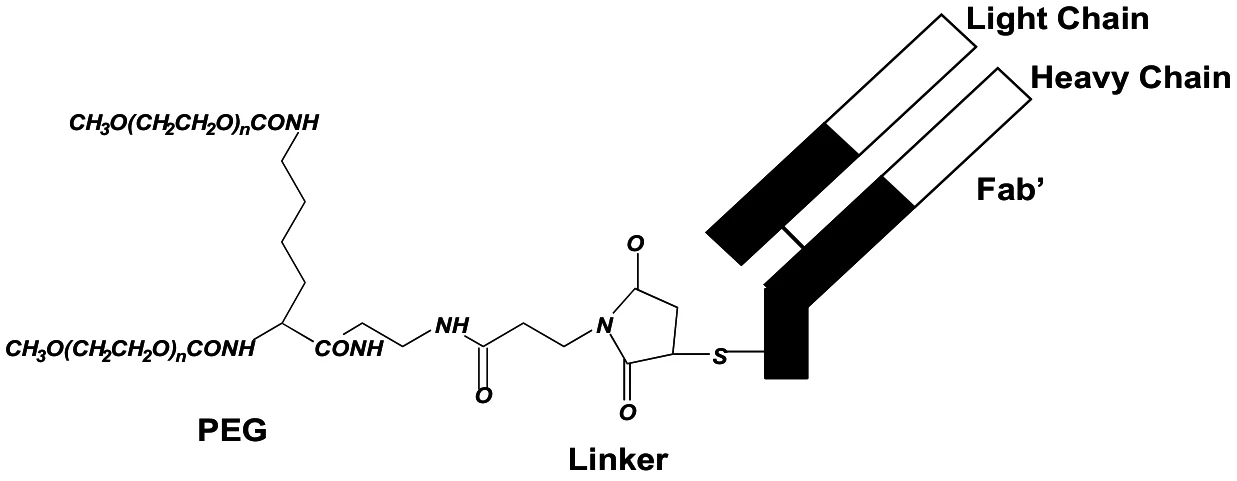
CLINICAL TRIALS
Rheumatoid Arthritis
Study Demographics and Trial Design
The efficacy and safety of CIMZIA (certolizumab pegol) were assessed in three randomized, placebo-controlled, double-blind studies (RA-I, RA-II, and RA-III) in patients ≥ 18 years of age with moderately to severely active rheumatoid arthritis (RA) diagnosed according to American College of Rheumatology (ACR) criteria. Patients had ≥ 9 swollen and tender joints and had active RA for at least 6 months prior to baseline. CIMZIA was administered subcutaneously in combination with methotrexate (MTX) at stable doses of at least 10 mg weekly in Studies RA-I and RA-II. CIMZIA was administered as monotherapy in Study RA-III.
Table 7: Summary of Patient Demographics for Clinical Trials in Patients with Rheumatoid Arthritis
| Study # | Trial Design and Duration | Dosage and Route of Administration | Study Subjects (N) | Mean Age (Range) | Gender (% Female) |
| Study RA-I (RAPID 1) | 52-week, multicentre, double-blind, multiple dose, parallel group, placebo-controlled study | CIMZIA 400 mg SC EOW + MTX | 390 | 52.4 (21-83) | 83.6 |
| CIMZIA 200 mg SC EOW(a) + MTX | 393 | 51.4 (19-81) | 82.4 | ||
| Placebo EOW + MTX | 199 | 52.2 (18-78) | 83.9 | ||
| Study RA-II (RAPID 2) | 24-week, multicentre, double-blind, multiple dose, parallel group, placebo-controlled study | CIMZIA 400 mg SC EOW + MTX | 246 | 51.9 (19-77) | 78.0 |
| CIMZIA 200 mg SC EOW(a) + MTX | 246 | 52.2 (22-81) | 83.7 | ||
| Placebo EOW + MTX | 127 | 51.5 (22-78) | 84.3 | ||
| Study RA-III (FAST4WARD) | 24-week, multicentre, double-blind, multiple dose, parallel group, placebo-controlled study | CIMZIA 400 mg SC E4W | 111 | 52.7 (21-80) | 78.4 |
| Placebo E4W | 109 | 54.9 (28-79) | 89.0 |
a Patients assigned to CIMZIA 200 mg SC EOW received starting doses of CIMZIA 400 mg SC at Weeks 0, 2, and 4, followed by CIMZIA 200 mg SC EOW for the remainder of the study.
Abbreviations: SC, subcutaneous; EOW, every other week; MTX, methotrexate; E4W, every 4 weeks.
Study RA-I and RA-II evaluated patients who had received MTX for at least 6 months prior to study medication, but still had an incomplete response to MTX alone. Patients received starting doses of 400 mg at Weeks 0, 2 and 4 (for both treatment arms) or placebo followed by either 200 mg or 400 mg of CIMZIA or placebo every other week, in combination with MTX for 52 weeks in Study RA-I and for 24 weeks in Study RA-II. Patients were evaluated for treatment of signs and symptoms of RA (measured by ACR 20 response) at Week 24 for both studies (RA-I and RA-II) and for inhibition of progression of structural damage (modified Total Sharp Score [mTSS]) at Week 52 (RA-I only). The open-label extension follow-up studies enrolled 846 patients from Study RA-I and 567 patients from Study RA-II, who received 400 mg of CIMZIA every other week.
Patients who had prior experience with anti-TNF therapies other than CIMZIA were not prohibited from participating in Study RA-I and RA-II.
Study RA-III (monotherapy) evaluated 220 patients receiving CIMZIA 400 mg or placebo every 4 weeks for 24 weeks, and who had discontinued all disease modifying anti-rheumatic drug (DMARD) use prior to receiving CIMZIA. Patients were evaluated for treatment of signs and symptoms of active RA with a primary endpoint of ACR 20 at Week 24. The open-label extension enrolled 186 patients from this study who received 400 mg of CIMZIA every 4 weeks.
Study Results
Clinical Response
The results of Study RA-I and RA-II were similar at Week 24. The percentage of patients treated every other week with CIMZIA 200 mg who achieved an ACR 20 response was statistically significantly greater than in the placebo group (p< 0.001) and in both studies, CIMZIA-treated patients achieved ACR 20, 50, and 70 responses faster and more often than placebo patients. Responses were seen irrespective of baseline MTX dose. Major clinical response (defined as achieving an ACR 70 response over a continuous 6 month period) in Study RA-I was greater in CIMZIA-treated patients than placebo patients. ACR response rates for the CIMZIA 200 mg every other week treatment groups were rapid and comparable in both studies RA-I and RA-II through Week 24.
In Study RA-III, patients receiving CIMZIA 400 mg every 4 weeks achieved significant ACR 20 responses. Rapid onset of clinical action was evident after the first injection with 37% of patients achieving an ACR 20 response by Week 1. ACR 50 responses were seen as early as Week 1 for CIMZIA-treated patients and maintained at all other time points through Week 24.
The results of Studies RA-I and RA-III are shown in Table 8.
Table 8: ACR Responses in Studies RA-I and RA-III (Percent of Patients)
Study RA-I Methotrexate (MTX) combination (24 and 52 weeks) | Study RA-III Monotherapy (24 weeks) | |||||||||||||
| Response | Placebo + MTX N=199 | CIMZIA (a) 200 mg every 2 weeks + MTX N=393 | CIMZIA (a) 200 mg + MTX – Placebo + MTX (95% CI) (d) | Placebo N=109 | CIMZIA (b) 400 mg every 4 weeks N=111 | CIMZIA (b) 400 mg – Placebo (95% CI) (d) | ||||||||
| ACR 20 | ||||||||||||||
| Week 24 | 14% | 59% | 45% (38%, 52%) | 9% | 46% | 36% (25%, 47%) | ||||||||
| Week 52 | 13% | 53% | 40% (33%, 47%) | N/A | N/A | |||||||||
| ACR 50 | ||||||||||||||
| Week 24 | 8% | 37% | 30% (24%, 36%) | 4% | 23% | 19% (10%, 28%) | ||||||||
| Week 52 | 8% | 38% | 30% (24%, 37%) | N/A | N/A | |||||||||
| ACR 70 | ||||||||||||||
| Week 24 | 3% | 21% | 18% (14%, 23%) | 0% | 6% | 6% (1%, 10%) | ||||||||
| Week 52 | 4% | 21% | 18% (13%, 22%) | N/A | N/A | |||||||||
| Major Clinical Response(c) | 1% | 13% | 12% (8%, 15%) | |||||||||||
(a) CIMZIA administered every 2 weeks preceded by a starting dose regimen of 400 mg at Weeks 0, 2, and 4
(b) CIMZIA administered every 4 weeks not preceded by a starting dose regimen
(c) Major clinical response is defined as achieving ACR 70 response over a continuous 6 month period
(d) 95% Confidence Intervals constructed using the large sample approximation to the Normal Distribution
The results of the components of ACR response criteria are shown in Table 9 for Studies RA-I and RA-III. ACR response rates and improvement in all components of ACR response were seen as early as Week 1 and maintained through to the end of each study. In studies RA-I, RA-II and RA-III, CIMZIA-treated patients reported pain relief, as assessed by the Patient Assessment of Arthritis Pain, as early as the first assessment at Week 1 (RA-I, RA-II and RA-III) through to the end of all three studies, demonstrating durability of the results.
Table 9: Components of ACR Response in Studies RA-I and RA-III
| Study RA-I | Study RA-III | |||||||||||||||||||||||||
| Parameter+ | Placebo + MTX N=199 | CIMZIA(a) 200 mg + MTX every 2 weeks N=393 | Placebo N=109 | CIMZIA(b) 400 mg every 4 weeks Monotherapy N=111 | ||||||||||||||||||||||
| Baseline | Week 24 | Baseline | Week 24 | Baseline | Week 24 | Baseline | Week 24 | |||||||||||||||||||
| Number of tender joints (0-68) | 28 | 27 | 29 | 9 | 28 (12.5) | 24 (15.4) | 30 (13.7) | 16 (15.8) | ||||||||||||||||||
| Number of swollen joints (0-66) | 20 | 19 | 20 | 4 | 20 (9.3) | 16 (12.5) | 21 (10.1) | 12 (11.2) | ||||||||||||||||||
| Physician global assessment(c) | 66 | 56 | 65 | 25 | 4 (0.6) | 3 (1.0) | 4 (0.7) | 3 (1.1) | ||||||||||||||||||
| Patient global assessment(c) | 67 | 60 | 64 | 32 | 3 (0.8) | 3 (1.0) | 3 (0.8) | 3 (1.0) | ||||||||||||||||||
| Pain(c)(d) | 65 | 60 | 65 | 32 | 55 (20.8) | 60 (26.7) | 58 (21.9) | 39 (29.6) | ||||||||||||||||||
| Disability index (HAQ)(e) | 1.75 | 1.63 | 1.75 | 1.00 | 1.55 (0.65) | 1.62 (0.68) | 1.43 (0.63) | 1.04 (0.74) | ||||||||||||||||||
| CRP (mg/L) | 16.0 | 14.0 | 16.0 | 4.0 | 11.3 | 13.5 | 11.6 | 6.4 | ||||||||||||||||||
(a) CIMZIA administered every 2 weeks preceded by a starting dose regimen of 400 mg at Weeks 0, 2 and 4
(b) CIMZIA administered every 4 weeks not preceded by a starting dose regimen
(c) Study RA-I - Visual Analog Scale: 0 = best, 100 = worst. Study RA-III - Five Point Scale: 1 = best, 5 = worst
(d) Patient Assessment of Arthritis Pain. Visual Analog Scale: 0=best, 100=worst
(e) Health Assessment Questionnaire Disability Index; 0 = best, 3 = worst, measures the patient’s ability to perform the following: dress/groom, arise, eat, walk, reach, grip, maintain hygiene, and maintain daily activity
All values are last observation carried forward.
+For Study RA-I, median is presented. For Study RA-III, mean (SD) is presented except for CRP which presents geometric mean.
Figure 1 shows ACR 20 response over 52 weeks in Study RA-I. Response rates for ACR 20 were seen as early as Week 1 for patients receiving CIMZIA. ACR 50 responses for patients receiving CIMZIA were achieved by Week 2. ACR 20 and 50 responses nearly always occurred within 12 weeks and were maintained through Week 52.
Figure 1: Study RA-I ACR 20 Response Over 52 Weeks*
The proportion of patients who achieved DAS28 (ESR) remission (DAS28<2.6) in Study RA-I was greater in the CIMZIA 200 mg treatment group compared with placebo at Week 24 and at Week 52, demonstrating that a greater percentage of patients receiving CIMZIA were able to achieve remission.
Radiographic Response
In Study RA-I, inhibition of progression of structural joint damage was assessed radiographically and expressed as change in modified Total Sharp Score (mTSS) and its components, the Erosion Score (ES) and Joint Space Narrowing (JSN) score, at Week 52, compared to baseline. The results are shown in Table 10. Significantly less radiographic progression (mTSS) and joint damage was observed with CIMZIA compared with placebo at Week 52. In the placebo group, 52% of patients experienced no radiographic progression (mTSS ≤0.0) at Week 52 compared to 69% in the CIMZIA 200 mg treatment group.
0
20
40
60
80
100
0
4
8
12
16
20
24
28
32
36
40
44
48
52
Pa t ie nt s ( %)
Weeks
Placebo + MTX (n=199)
CIMZIA 200 mg + MTX (n=393)
*The same patients may not have responded at each time point
Table 10: Radiographic Changes Over 12 months in Study RA-I
Placebo + MTX N=199 Mean (SD) | CIMZIA 200 mg + MTX N=393 Mean (SD) | CIMZIA 200 mg + MTX – Placebo + MTX Mean Difference | ||||
| Linear Extrapolation | ||||||
| mTSS | ||||||
| Week 52 | 2.8 (7.8) | 0.4 (5.7) | -2.4 | |||
| Erosion Score | ||||||
| Week 52 | 1.5 (4.3) | 0.1 (2.5) | -1.4 | |||
| JSN Score | ||||||
| Week 52 | 1.4 (5.0) | 0.4 (4.2) | -1.0 | |||
| Last Observation Carried Forward | ||||||
| mTSS | ||||||
| Week 52 | 1.1 (3.0) | 0.1 (3.2) | -1.0 | |||
| Erosion Score | ||||||
| Week 52 | 0.6 (1.8) | 0.0 (1.7) | -0.6 | |||
| JSN Score | ||||||
| Week 52 | 0.5 (1.8) | 0.2 (2.2) | -0.3 | |||
Missing data imputed using both linear extrapolation and Last Observation Carried Forward (LOCF) methodologies.
p-values were < 0.001 at Week 52 for both mTSS and erosion score and ≤0.01 for JSN (both methodologies).
An ANCOVA was fitted to the ranked change from baseline for each measure with region and treatment as factors and rank baseline as a covariate.
Physical Function and Health Related Quality of Life
In studies RA-I, RA-II, and RA-III, CIMZIA-treated patients reported significant improvements in the Health Assessment Questionnaire – Disability Index (HAQ-DI) and Fatigue Assessment Scale (FAS) compared to placebo. In all three studies, CIMZIA-treated patients reported significantly greater improvements in the SF-36 Physical and Mental Component Summaries (PCS and MCS) and all eight domains compared to placebo.
In studies RA-I and RA-II, CIMZIA-treated patients reported significant improvements in the Work Productivity Survey compared to placebo.
Psoriatic Arthritis
Study Demographics and Trial Design
The efficacy and safety of CIMZIA were assessed in a multicentre, randomized, double-blind, placebo-controlled study (PsA001) in 409 patients ≥18 years of age with adult-onset active psoriatic arthritis for at least 6 months as defined by the Classification Criteria for Psoriatic Arthritis (CASPAR) criteria. Patients had ≥ 3 swollen and tender joints and increased acute phase reactants. Patients also had active psoriatic skin lesions or a documented history of psoriasis and had failed 1 or more DMARDs. Previous treatment with one TNF-antagonist was allowed and 20% of patients had prior TNF-antagonist exposure. Patients receiving concomitant
NSAIDs and conventional DMARDs were 72.6% and 70.2% respectively, including 63.6% receiving concomitant methotrexate (MTX).
Table 11: Summary of Patient Demographics for Clinical Trial in Patients with Psoriatic Arthritis
| Study # | Trial Design and Duration | Dosage and Route of Administration | Study Subjects (N) | Mean Age (Range) | Gender (% Female) |
Study PsA001 (RAPID-PsA) | 24-week, multicentre, randomized, double-blind, parallel-group, placebo-controlled study | CIMZIA(a) 200 mg SC EOW | 138 | 48.2 (19-73) | 53.6 |
| CIMZIA(b) 400 mg SC E4W | 135 | 47.1 (22-70) | 54.1 | ||
| Placebo EOW | 136 | 47.3 (22-75) | 58.1 |
- (a) CIMZIA administered every 2 weeks preceded by a starting dose regimen of 400 mg at Weeks 0, 2 and 4
- (b) CIMZIA administered every 4 weeks preceded by a starting dose regimen of 400 mg at Weeks 0, 2 and 4
Abbreviations: SC, subcutaneous; EOW, every other week; E4W, every 4 weeks.
Patients received a starting dose regimen of CIMZIA 400 mg at Weeks 0, 2 and 4 (for both treatment arms) or placebo followed by either CIMZIA 200 mg every other week or CIMZIA 400 mg every 4 weeks or placebo every other week. The two primary endpoints were the percentage of patients achieving ACR20 response at Week 12 and change from baseline in modified Total Sharp Score (mTSS) at Week 24.
Study Results
Clinical Response
The percentage of CIMZIA-treated patients achieving ACR20, 50 and 70 responses in study PsA001 are shown in Table 12. CIMZIA-treated patients had a statistically significant higher ACR 20 response rate at Week 12 compared with placebo-treated patients (p<0.001). ACR20 responses observed in the CIMZIA-treated patients were similar in the patients receiving and not receiving concomitant DMARDs.
Table 12: ACR Responders in Study PsA001 (Percent of Patients)
| Response | Placebo N=136 | CIMZIA(a)200 mg every 2 weeks N=138 | CIMZIA(b) 400 mg every 4 weeks N=135 |
| ACR20 | |||
| Week 12 | 24% | 58%* | 52%* |
| Week 24 | 24% | 64% | 56% |
| ACR50 | |||
| Week 12 | 11% | 36% | 33% |
| Week 24 | 13% | 44% | 40% |
| ACR70 | |||
| Week 12 | 3% | 25% | 13% |
| Week 24 | 4% | 28% | 24% |
(a) CIMZIA administered every 2 weeks preceded by a starting dose regimen of 400 mg at Weeks 0, 2 and 4
(b) CIMZIA administered every 4 weeks preceded by a starting dose regimen of 400 mg at Weeks 0, 2 and 4
*p<0.001, CIMZIA vs placebo
Results are from the randomized set. Treatment Difference: CIMZIA 200 mg-placebo, CIMZIA 400 mg-placebo (and corresponding 95% CI and p-value) are estimated using a standard two-sided Wald asymptotic standard errors.
Note: Non-responder Imputation (NRI) is used.
Radiographic Response
In study PsA001, inhibition of progression of structural damage was assessed radiographically and expressed as the change in modified total Sharp score (mTSS) and its components, the Erosion Score (ES) and Joint Space Narrowing score (JSN) at Week 24, compared to baseline. The mTSS score was modified for psoriatic arthritis by addition of hand distal interphalangeal (DIP) joints.
Patients treated with CIMZIA 200 mg every other week demonstrated greater inhibition of radiographic progression compared with placebo-treated patients at Week 24 as measured by change from baseline in total modified mTSS Score (LS mean [±SE] score was 0.28 [±0.07] in the placebo group compared with 0.01 [±0.07] in the CIMZIA 200 mg every other week group. No statistically significant change was seen in patients treated with CIMZIA 400 mg every four weeks.
Physical Function and Health Related Quality of Life
In Study PsA001, CIMZIA-treated patients reported improvements in physical function as assessed by the Health Assessment Questionnaire –Disability Index (HAQ-DI), in pain as assessed by the Patient Assessment of Arthritis Pain (PAAP), and in tiredness (fatigue) as reported by the Fatigue Assessment Scale (FAS) at Week 24 as compared to placebo. CIMZIA-treated patients reported improvements in health-related quality of life as measured by the psoriatic arthritis QoL (PsAQoL), and in the SF-36 Physical and Mental Component Summaries at Week 24 as compared to placebo.
Ankylosing Spondylitis
Study Demographics and Trial Design
The efficacy and safety of CIMZIA were assessed in a multicentre, randomized, double-blind, placebo-controlled study (AS-1) in 325 patients ≥18 years of age with adult-onset active axial spondyloarthritis for at least 3 months. The majority of patients in the study had active ankylosing spondylitis (AS).
Patients had active disease as defined by the Bath Ankylosing Spondylitis Disease Activity Index (BASDAI) ≥ 4, and spinal pain ≥ 4 on a 0 to 10 Numerical Rating Scale (NRS). Patients must have been intolerant to or had an inadequate response to at least one NSAID. Overall 20% of patients had prior exposure to TNF-blockers.
Table 13: Summary of Ankylosing Spondylitis Patient Demographics for Clinical Trial
| Study # | Trial Design and Duration | Dosage and Route of Administration | Study Subjects (N) | Mean Age (Range) | Gender (% Female) |
| Study AS-1 | 24-week, multicentre, randomized, double-blind, parallel-group, placebo-controlled study | CIMZIA(a) 200 mg SC EOW | 65 | 41.0 (24-64) | 27.7 |
| CIMZIA(b) 400 mg SC E4W | 56 | 41.9 (19-66) | 26.8 | ||
| Placebo EOW | 57 | 41.6 (21-68) | 28.1 |
- (a) CIMZIA administered every 2 weeks preceded by a starting dose regimen of 400 mg at Weeks 0, 2 and 4
- (b) CIMZIA administered every 4 weeks preceded by a starting dose regimen of 400 mg at Weeks 0, 2 and 4
Abbreviations: SC, subcutaneous; EOW, every other week; E4W, every 4 weeks.
Patients were treated with a starting dose regimen of CIMZIA 400 mg at Weeks 0, 2 and 4 (for both treatment arms) or placebo followed by either 200 mg of CIMZIA every other week or 400 mg of CIMZIA every 4 weeks or placebo. 91% of patients received concomitant NSAIDs, 17.5% received concomitant methotrexate (MTX), and 17.4% received concomitant corticosteroids. The primary efficacy variable was the ASAS20 response at Week 12.
Study Results
Clinical Response
In study AS-1, at Week 12, ASAS20 responses were achieved by 57% of AS patients receiving CIMZIA 200 mg every other week and 64% of AS patients receiving CIMZIA 400 mg every 4 weeks as compared to 37% of patients receiving placebo (p=0.026 and p=0.003, respectively). At
Weeks 12 and 24, the percentage of AS subjects with an ASAS40 response was greater in the CIMZIA-treated groups compared to placebo. Responses were similar in patients receiving CIMZIA 200 mg every other week or CIMZIA 400 mg every 4 weeks (Table 14).
Table 14: ASAS Responses in AS Patients at Week 12 and Week 24 in Study AS-1 (Proportion of Patients)
| Parameters | Placebo N=57 | CIMZIA(a) 200 mg every 2 weeks N=65 | CIMZIA(b) 400 mg every 4 weeks N=56 |
| ASAS 20(d,e) | |||
| Week 12 | 37% | 57%* | 64%** |
| Week 24 | 33% | 68% | 70% |
| ASAS 40 (d, f) | |||
| Week 12 | 19% | 40% | 50% |
| Week 24 | 16% | 47% | 59% |
(a) CIMZIA administered every 2 weeks preceded by a starting dose regimen of 400 mg at Weeks 0, 2 and 4
(b) CIMZIA administered every 4 weeks preceded by a starting dose regimen of 400 mg at Weeks 0, 2 and 4
(d) Treatment difference: CIMZIA 200-placebo, CIMZIA 400-placebo (and corresponding 95% CI and p-value) are estimated using a standard two-sided Wald asymptotic test. Non-responder imputation (NRI) is used.
(e) Results are from the randomized set
(f) Results are from the full analysis set
*p=0.026, CIMZIA vs placebo
**p=0.003, CIMZIA vs placebo
The results of the components of the ASAS response criteria are shown in Table 15.
Table 15: Components of the ASAS Response Criteria in AS Patients in study AS-1
| Parameters | Placebo N=57 | CIMZIA(a) 200 mg every 2 weeks N=65 | CIMZIA(b) 400 mg every 4 weeks N=56 | |||||||
| Baseline | Week 12 | Week 24 | Baseline | Week 12 | Week 24 | Baseline | Week 12 | Week 24 | ||
| ASAS20 response criteria | ||||||||||
| -Global Assessment [PtGADA](c, d) | 6.89 | 5.63 | 5.98 | 7.31 | 4.22 | 3.85 | 6.77 | 3.79 | 3.55 | |
| -Pain [Total spinal pain](c, e) | 7.30 | 5.79 | 5.91 | 7.00 | 4.31 | 4.06 | 6.91 | 4.00 | 3.41 | |
| -Function [BASFI](c, f) | 5.98 | 5.23 | 5.12 | 5.61 | 3.80 | 3.27 | 5.65 | 3.75 | 3.31 | |
| -Inflammation [BASDAI mean of Q5/6](c, g) | 6.71 | 5.54 | 5.36 | 6.70 | 3.78 | 3.91 | 6.38 | 3.38 | 2.92 | |
(a) CIMZIA administered every 2 weeks preceded by a starting dose regimen of 400 mg at Weeks 0, 2 and 4
(b) CIMZIA administered every 4 weeks preceded by a starting dose regimen of 400 mg at Weeks 0, 2 and 4
(c) ANCOVA model with treatment, region, modified NY criteria (Y/N) and prior TNF-blocker exposure (Y/N) as factors and Baseline score as covariate. Note: Last observation carried forward (LOCF) is used.
(d) PtGADA, NRS where 0 = not active and 10 = very active
(e) Total spinal pain NRS where 0=no pain and 10=most severe pain
(f) BASFI NRS where 0= easy and 10= impossible
(g) BASDAI Q5 is an NRS where 0= none and 10 is very severe; BASDAI Q 6 is an NRS where 0=0hrs and 10= 2 or more hrs
All values presented represent the mean in the full analysis set
CIMIZA-treated patients showed improvement compared with placebo-treated patients in additional key secondary measures of efficacy including change from baseline in Bath Ankylosing Spondylitis Functional Index (BASFI) at Weeks 12 and 24, change from baseline in BASDAI at Weeks 12 and 24, and change in Bath Ankylosing Spondylitis Metrology Index (BASMI) at Weeks 12 and 24.
The percentage of AS patients achieving ASAS20 responses by visit for study AS-1 is shown in Figure 2. Among patients receiving CIMZIA, ASAS20 responses were seen within one to two weeks after initiation of therapy.
Figure 2: Study AS-1: ASAS20 Response Over 24 weeks in AS patients*
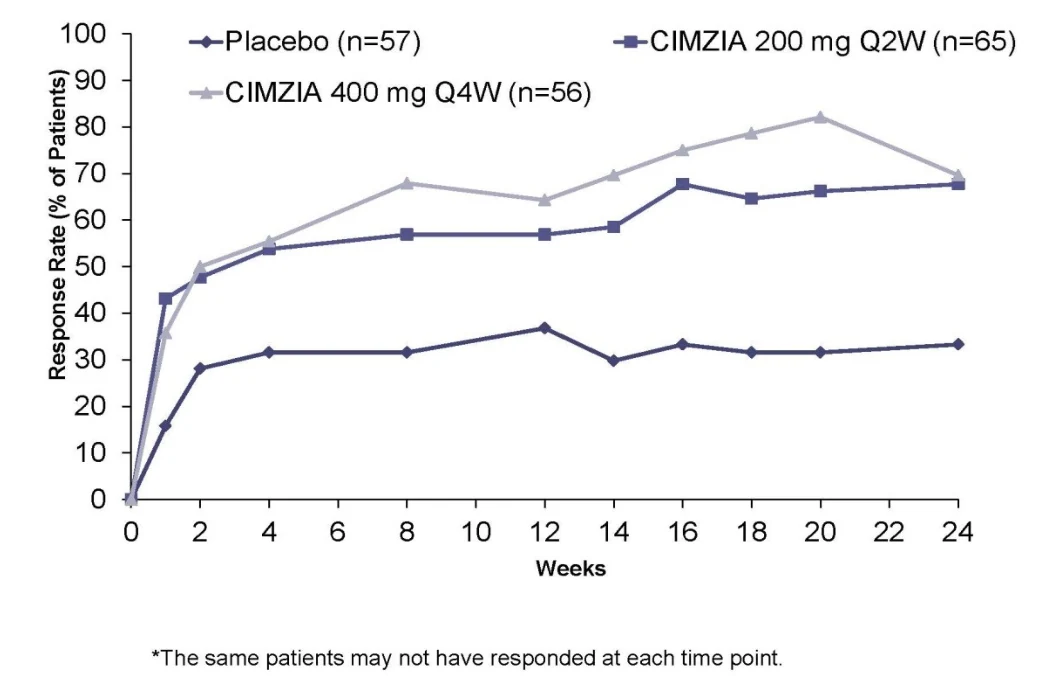
Physical Function and Health Related Quality of Life
In Study AS-1, CIMZIA-treated AS patients reported improvements in physical function as assessed by the BASFI and in pain as assessed by the Total and Nocturnal Back Pain NRS scales as compared to placebo. CIMZIA-treated AS patients reported improvements in tiredness (fatigue) as reported by the BASDAI-fatigue item and in health-related quality of life as measured by the ankylosing spondylitis QOL (ASQoL) and the SF-36 Physical Component Summaries as compared to placebo.
Non-radiographic Axial Spondyloarthritis
Study Demographics and Trial Design
The efficacy and safety of CIMZIA were assessed in a multicenter, randomized, double-blind, placebo-controlled study (nr-axSpA-1) in 317 subjects ≥18 years of age with adult-onset active non-radiographic axial spondyloarthritis (nr-axSpA) and back pain for at least 12 months. Patients must have had objective signs of inflammation indicated by C-reactive protein (CRP) levels above the upper limit of normal and/or sacroiliitis on magnetic resonance imaging (MRI), but without definitive radiographic evidence of structural damage on sacroiliac joints.
Patients had active disease as defined by the Bath Ankylosing Spondylitis Disease Activity Index
(BASDAI) ≥4, and spinal pain ≥4 on a 0 to 10 Numerical Rating Scale (NRS). Patients must have been intolerant to or had an inadequate response to at least two NSAIDs.
Table 16: Summary of Non-radiographic Axial Spondyloarthritis Patient Demographics for Clinical Trial nr-axSpA-1
| Study # | Trial Design and Duration | Dosage and Route of Administration | Study Subjects (N) | Mean Age | Gender (% Female) |
| Study nr-axSpA-1 | 52-week, multicentre, randomized, double-blind, placebo-controlled study | CIMZIA(a) 200 mg SC EOW | 159 | 37.3 | 50.9 |
| Placebo EOW | 158 | 37.4 | 51.9 |
(a)CIMZIA administered every 2 weeks preceded by a loading dose of 400 mg at Weeks 0, 2 and 4
Abbreviations: SC, subcutaneous; EOW, every other week
In addition to their standard care treatment, eligible subjects were randomized in a 1:1 ratio to CIMZIA administered at the dose of 400 mg at Weeks 0, 2, and 4 followed by 200 mg every two weeks (Q2W) starting at Week 6 up to and including Week 50 or placebo. Randomization was stratified by region and MRI/CRP classification. Utilization and dose adjustment of concomitant medications (including NSAIDs, DMARDs, corticosteroids, opioids) were permitted at any time. Patients were allowed to transition to use of open label CIMZIA at any time at the discretion of the investigator. However, no patients transitioned before Week 12.
The primary endpoint was the proportion of patients achieving an Ankylosing Spondylitis Disease Activity Score-Major Improvement (ASDAS-MI) response at Week 52. The ASDAS is a composite weighted score that assesses disease activity, including patient-reported outcomes and CRP levels. A major improvement in ASDAS-MI is achieved by an improvement (reduction) from baseline of ≥2.0 in the ASDAS and/or reaching the lowest possible ASDAS value.
Study Results
Clinical Response
In study nr-axSpA-1, a greater proportion of nr-axSpA patients treated with CIMZIA had an ASDAS-MI response compared to patients treated with placebo at Week 52. At both Weeks 12 and 52, the percentage of nr-axSpA subjects with an ASAS40 response was greater in the CIMZIA-treated group compared to placebo (Table 17).
Table 17: Clinical Responses in nr-axSpA Patients at Weeks 12 and 52 in Study nr-axSpA-1
| Parameters | Placebo N=158(b) | CIMZIA(a) 200 mg every 2 weeks N=159(b) | CIMZIA 200 mg vs placebo Risk Difference (95% CI)(c) |
| ASDAS-MI | |||
| Week 52 | 7.0% | 47.2% | 37.2% (25.0%, 49.4%)* |
| ASAS-40 | |||
| Week 12 | 11.4% | 47.8% | 35.8% (23.8%, 47.7%)* |
| Week 52 | 15.8% | 56.5% | 40.3% (26.8%, 53.7%)* |
- (a) CIMZIA administered every 2 weeks preceded by a loading dose of 400 mg at Weeks 0, 2 and 4
- (b) All percentages reflect the proportion of patients who were responders and remained in the study and on randomized treatment in the full analysis set. Patients who initiated open-label CIMZIA, or discontinued randomized treatment and remained in the study, or were missing Week 52 visit data were imputed as non-responders.
(c) Risk differences are based on logistic regression models with factors for treatment, region, and MRI/CRP classification. The Type I error was controlled for multiplicity using a fixed sequence testing procedure. Each testing followed a pre-defined order at a 2-sided significance level of 0.05.
*p-value<0.001, CIMZIA vs placebo
The percent of nr-axSpA patients achieving ASDAS-MI response by visit for Study nr-axSpA-1 is shown in Figure 3.
Figure 3: Study nr-axSpA-1: ASDAS-MI Response over 52 Weeks
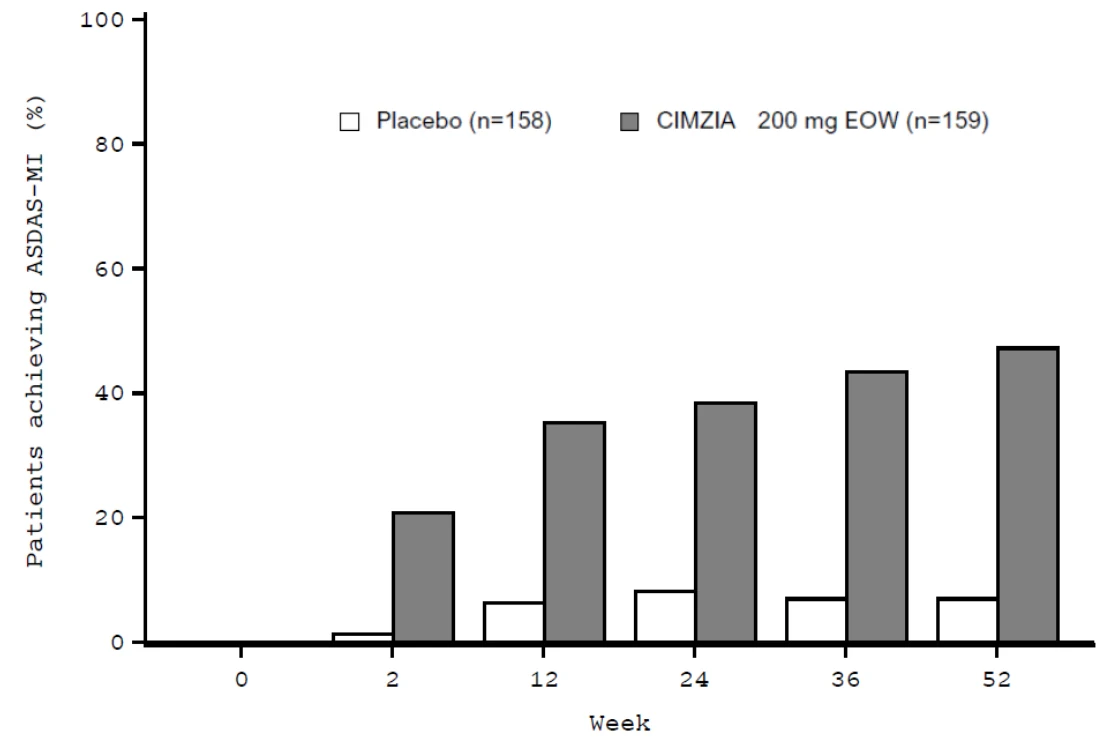
Abbreviation: EOW, every other week.
The results of the components of ASDAS-MI and ASAS40 response criteria are shown in Table 18.
Table 18: Components of the ASDAS-MI and ASAS Response Criteria and Other Measures of Disease Activity in nr-axSpA Patients at Baseline and at Weeks 12 and 52 in Study nr-axSpA-1
Placebo N=158 | CIMZIA(a) 200 mg every 2 weeks N=159 | ||||||||||||
|---|---|---|---|---|---|---|---|---|---|---|---|---|---|
Baseline mean (SD) | Week 12 mean (SD) | Week 52 mean (SD) | Baseline mean (SD) | Week 12 mean (SD) | Week 52 mean (SD) | ||||||||
| Total spinal pain (0-10) | 6.9 (1.8) | 6.1 (2.3) | 5.8 (2.6) | 7.0 (1.9) | 4.0 (2.6) | 3.3 (2.6) | |||||||
| Patient Global Assessment of Disease Activity (0-10) | 6.7 (2.0) | 5.9 (2.4) | 5.7 (2.7) | 6.8 (1.9) | 3.9 (2.6) | 3.3 (2.7) | |||||||
| CRP (mg/L) | 15.8 (17.7) | 14.6 (23.9) | 12.9 (21.8) | 15.8 (17.8) | 6.6 (15.0) | 6.0 (14.0) | |||||||
| BASDAI (0-10)(b) | 6.8 (1.3) | 5.7 (2.1) | 5.5 (2.3) | 6.9 (1.4) | 3.9 (2.2) | 3.3 (2.5) | |||||||
| Back pain | 7.4 (1.3) | 6.2 (2.1) | 5.8 (2.4) | 7.4 (1.4) | 4.2 (2.5) | 3.5 (2.7) | |||||||
Placebo N=158 | CIMZIA(a) 200 mg every 2 weeks N=159 |
|---|
Baseline mean (SD) | Week 12 mean (SD) | Week 52 mean (SD) | Baseline mean (SD) | Week 12 mean (SD) | Week 52 mean (SD) | |
|---|---|---|---|---|---|---|
| Peripheral pain and swelling | 6.2 (2.2) | 5.3 (2.5) | 5.2 (2.6) | 6.3 (2.3) | 3.7 (2.5) | 3.1 (2.6) |
| Inflammation(c) | 6.7 (1.8) | 5.5 (2.4) | 5.2 (2.6) | 6.9 (1.8) | 3.6 (2.4) | 2.9 (2.4) |
| BASFI (0-10)(d) | 5.4 (2.2) | 4.9 (2.5) | 4.7 (2.6) | 5.4 (2.1) | 3.2 (2.3) | 2.7 (2.4) |
| BASMI(e) | 2.8 (1.4) | 2.7 (1.4) | 2.8 (1.4) | 3.0 (1.3) | 2.6 (1.4) | 2.4 (1.4) |
- (a) CIMZIA administered every 2 weeks preceded by a loading dose of 400 mg at Weeks 0, 2 and 4
- (b) BASDAI is Bath Ankylosing Spondylitis Disease Activity Index
- (c) The average of BASDAI question 5 and 6 concerning morning stiffness intensity and duration.
- (d) BASFI is Bath Ankylosing Spondylitis Functional Index
- (e) BASMI is Bath Ankylosing Spondylitis Metrology Index
Note: Last observation on double-blind treatment carried forward was used for each component
Objective signs of inflammation were assessed by MRI at Week 12 and expressed as change from baseline in SPARCC (Spondyloarthritis Research Consortium of Canada) score for sacroiliac joints. At Week 12, the mean change in the SPARCC score was - 4.3 in the CIMZIA-treated patients and 0.3 in placebo-treated patients.
Other Health Related Outcomes
In Study nr-axSpA-1, the mean change from baseline to Week 52 in the Ankylosing Spondylitis Quality of Life Questionnaire (ASQoL) score was -6.5 in patients treated with CIMZIA, and -3.4 in placebo-treated patients.
Plaque Psoriasis
Study Demographics and Trial Design
The efficacy and safety of CIMZIA were assessed in two placebo-controlled studies (PS-1 and PS-2) and one placebo-and active-controlled study (PS-3) that enrolled a total of 1020 patients ≥18 years of age with moderate to severe chronic plaque psoriasis for at least 6 months. Patients had a Psoriasis Area and Severity Index (PASI) score ≥ 12, body surface area (BSA) involvement of ≥ 10%, Physician Global Assessment (PGA) of ≥ 3 on a 5-category scale, and were candidates for systemic therapy and/or phototherapy and/or chemophototherapy. Treatment success of “clear” (0) or “almost clear” (1) consisted of no signs of psoriasis or normal to pink coloration of lesions, no thickening of the plaque, and none to minimal focal scaling. The efficacy of CIMZIA was evaluated versus etanercept in the PS-3 study.
Table 19: Summary of Patient Demographics for Clinical Trials in Patients with Plaque Psoriasis
| Study # | Trial Design and Duration | Dosage and Route of Administration | Study Subjects (N) | Mean Age (Range) | Gender (% Female) |
| Study PS-1 (CIMPASI-1) | 16-week, multicentre, randomized, double-blind, parallel-group, study followed by a dose-blind period through 48 weeksb | CIMZIA 200 mg SC EOW(a) | 95 | 44.5 (21-76) | 29.5 |
| CIMZIA 400 mg SC EOW | 88 | 43.6 (21-65) | 31.8 | ||
| Placebo EOW | 51 | 47.9 (21-71) | 31.4 | ||
| Study PS-2 (CIMPASI-2) | 16-week, multicentre, randomized, double-blind, parallel-group, study followed by a dose-blind period through 48 weeksb | CIMZIA 200 mg SC EOW(a) | 91 | 46.7 (20-75) | 36.3 |
| CIMZIA 400 mg SC EOW | 87 | 46.4 (21-72) | 50.6 | ||
| Placebo EOW | 49 | 43.3 (20-73) | 46.9 | ||
| Study PS-3 (CIMPACT) | 16-week, double-blind, parallel-group, randomized, placebo- and active-controlled, multicenter study with a double-blind, placebo-controlled maintenance period through 48 weeks.c | CIMZIA 200 mg SC EOW(a) | 165 | 46.7 (19-80) | 31.5 |
| CIMZIA 400 mg SC EOW | 167 | 45.4 (18-75) | 35.9 | ||
| Etanercept SC bi-weekly at a cumulative weekly dose of 100mgc | 170 | 44.6 (18-78) | 25.3 | ||
| Placebo EOW | 57 | 46.5 (20-69) | 40.4 |
a Patients assigned to CIMZIA 200 mg SC EOW received starting doses of CIMZIA 400 mg SC at Weeks 0, 2, and 4, followed by CIMZIA 200 mg SC EOW for the remainder of the study.
b Treatment allocation from Weeks 16 to 48 depended on PASI response at Week 16. See individual trial descriptions below for more information.
c Patients that received etanercept were not blinded to treatment allocation and received only 12 weeks of treatment. See description of PS-3 below for more information.
Abbreviations: SC, subcutaneous; EOW, every other week.
In studies PS-1 and PS-2 the co-primary efficacy endpoints were the proportion of patients achieving PASI 75 and PGA “clear” or “almost clear” (with at least a 2-point reduction from baseline) at Week 16. In the PS-3 study, the primary efficacy endpoint was the proportion of patients achieving PASI 75 at Week 12. PASI 75 and PGA at Week 16 were key secondary endpoints. PASI 90 at Week 16 was a key secondary endpoint in all 3 studies.
Studies PS-1 and PS-2 evaluated 234 patients and 227 patients respectively. In both studies patients were randomized to receive placebo or CIMZIA 200 mg every 2 weeks (following a loading dose of CIMZIA 400 mg at Weeks 0, 2 and 4) or CIMZIA 400 mg every 2 weeks. At week 16, patients randomized to CIMZIA who achieved a PASI 50 response continued to receive CIMZIA up to Week 48 at the same randomized dose. Patients originally randomized to placebo that achieved a PASI 50 response but not a PASI 75 response at Week 16 received CIMZIA 200 mg every 2 weeks (with a loading dose of CIMZIA 400 mg at Weeks 16, 18, and 20). Patients with an inadequate response at Week 16 (PASI 50 non-responders) were eligible to receive CIMZIA 400 mg every 2 weeks in an open label manner.
The PS-3 study evaluated 559 patients. Patients were randomized to receive placebo, or CIMZIA 200 mg every 2 weeks (following a loading dose of CIMZIA 400 mg at Weeks 0, 2 and 4), or CIMZIA 400 mg every 2 weeks up to Week 16, or etanercept 50 mg twice weekly, up to Week 12. Patients originally randomized to CIMZIA who achieved a PASI 75 response at Week 16 were re-randomized based on their original dosing schedule. Patients on CIMZIA 200 mg every 2 weeks were re-randomized to CIMZIA 200 mg every 2 weeks, CIMZIA 400 mg every 4 weeks or placebo. Patients on CIMZIA 400 mg every 2 weeks were re-randomized to CIMZIA 400 mg every 2 weeks, CIMZIA 200 mg every 2 weeks, or placebo. Patients that achieved PASI 75 at Week 16 were evaluated in a double-blind placebo-controlled manner through Week 48. All patients who did not achieve a PASI 75 response at Week 16 entered an open label escape arm and received CIMZIA 400 mg every 2 weeks.
Across the three trials (n=850), subjects were a mean of 45.7 years with 7.2% of patients ≥65 years of age. Subjects were 63.9% male, 94.0% white and 2.2% black. Mean weight was 91.1 kg and mean BMI was 30.6.
Of the 850 patients randomized to receive placebo or CIMZIA in the placebo-controlled studies, there were 29% of patients that were naïve to prior systemic therapy for the treatment of psoriasis, 70% that were naïve to prior biologic therapy for psoriasis, and 47% that had received prior phototherapy or chemophototherapy. Of the 850 patients, 14% had received at least one TNF-antagonist, 13% had received an anti-IL-17, and 5% had received an anti-IL 12/ 23. Patients who had previously failed to respond to a biologic treatment (primary treatment failure), or who had previously taken more than 2 other biologic treatments for psoriasis or psoriatic arthritis were excluded from enrollment in the trials. Trial PS-3 excluded subjects that had previously used etanercept. Eighteen percent of patients reported a history of psoriatic arthritis at baseline. The mean PASI score at baseline was 20 and ranged from 12 to 69. The baseline PGA score ranged from moderate (70%) to severe (30%). Mean baseline BSA was 25% and ranged from 10% to 96%.
Study Results
Of the 850 patients randomized to receive placebo or CIMZIA in the placebo-controlled studies, 4.1% discontinued in the first 16 weeks of the trial.
Clinical Response
The key results of Studies PS-1 and PS-2 are presented in Table 20.
Table 20: Clinical Response in Studies PS-1 and PS-2 at Week 16
| PS-1 | |||||||||||||||
Placebo N=51 (%) | CIMZIAa) 200 mg Q2W N=95 Treatment Difference versus Placebo [95% CI] | CIMZIA 400 mg Q2W N=88 Treatment Difference versus Placebo [95% CI] | |||||||||||||
PGA clear or almost clearb) Responder Rate (%) Odds ratio vs PBO [95% CI] P-value | 4.1 | 46.8 20.321 [3.744, 110.301] p< 0.0001 | 57.4 31.082 [5.686, 169.899] p< 0.0001 | ||||||||||||
PASI 75 Responder Rate (%) Odds ratio vs PBO [95% CI] P-value | 5.9 | 66.5 31.675 [7.586, 132.257] p< 0.0001 | 75.2 48.262 [11.274, 206.606] p< 0.0001 | ||||||||||||
PASI 90 Responder Rate (%) Odds ratio vs PBO [95% CI] P-value | 0 | 35.8 39.7 [6.8,NC] p< 0.0001 | 43.2 53.9 [9.2, NC] p< 0.0001 | ||||||||||||
Change from baseline in DLQI, mean (SD) P-value | -3.3 (6.9) | -8.9 (8.5) p< 0.0001 | -9.6 (6.5) p< 0.0001 | ||||||||||||
| PS-2 | |||||||||||||||
Placebo N=49 (%) | CIMZIA a) 200 mg Q2W N=91 | CIMZIA 400 mg Q2W N=87 | |||||||||||||
PGA clear or almost clearb) Responder Rate (%) Odds ratio vs PBO [95% CI] P-value | 1.6% | 62.9 101.8 [9.459, 1095.639] p< 0.0001 | 69.3 135.334 [12.404, 1476.549] p< 0.0001 | ||||||||||||
PASI 75 Responder Rate (%) Odds ratio vs PBO [95% CI] | 10.9% | 77.6 28.445 (8.862, 91.304) p< 0.0001 | 80.3 33.328 (10.162, 109.299) p< 0.0001 | ||||||||||||
| P-value | |||
PASI 90 Responder Rate (%) Odds ratio vs PBO [95% CI] P-value | 3.8% | 50.5 25.6 [4.6, 141.9] p<0.0001 | 53.7 29.0 [5.2, 162.1] p<0.0001 |
Change from baseline in DLQI, mean (SD) P-value | -2.9 (6.6) | -11.1 (7.8) p< 0.0001 | -10.0 (7.6) p< 0.0001 |
- a) CIMZIA 200 mg administered every 2 weeks preceded by a loading dose of 400 mg at Week 0, 2, 4.
- b) PGA 5 category scale. Treatment success of “clear” (0) or “almost clear”(1) consisted of no signs of psoriasis or normal to pink coloration of lesions, no thickening of the plaque, and none to minimal focal scaling.
Missing data were imputed using non-responder imputation. Estimates of responder rate, odds ratios, confidence intervals, and p-values are based on a logistic regression model.
Mean (SD) Dermatology Life Quality Index (DLQI) change from Baseline values are the unadjusted values. P-values for DLQI based on the model-adjusted estimates (not presented) using an ANCOVA model. Missing data were imputed using LOCF.
Results are from the Randomized Set.
NC= not calculated
The key results of Study PS-3 are presented in Table 21.
Table 21: Clinical Response in Study PS-3 at Week 12 and Week 16
Placebo N=57 (%) | CIMZIAa) 200 mg Q2W N=165 Treatment Difference versus Placebo | CIMZIA 400 mg Q2W N=167 Treatment Difference versus Placebo | |||||||||||
|---|---|---|---|---|---|---|---|---|---|---|---|---|---|
| Week 12 | |||||||||||||
PASI 75 Responder Rate (%) Odds ratio vs PBO [95% CI] P-value | 4.8 | 59.8 29.333 [8.786, 97.930] p< 0.0001 | 65.7 37.821 [11.296, 126.633] p< 0.0001 | ||||||||||
PASI 90 Responder Rate (%) Odds ratio vs PBO [95% CI] P-value | 0 | 30.3 33.7 [7.4, NC] p< 0.0001 | 33.5 38.7 [8.5, NC] p< 0.0001 | ||||||||||
PGA clear or almost clear b) Responder Rate (%) Odds ratio vs PBO [95% CI] P-value | 1.5 | 39.0 41.0 [5.5, 304.1] p< 0.0003 | 49.8 63.7 [8.6, 472.0] p< 0.0001 | ||||||||||
| Week 16 | |||||||||||||
| PASI 75 | 3.5 | 67.1 | 74.1 | ||||||||||
Placebo N=57 (%) | CIMZIAa) 200 mg Q2W N=165 Treatment Difference versus Placebo | CIMZIA 400 mg Q2W N=167 Treatment Difference versus Placebo | |||||||
|---|---|---|---|---|---|---|---|---|---|
Responder Rate (%) Odds ratio vs PBO [95% CI] P-value | 56.7 [13.3, 241.5] p <0.0001 | 79.3 [18.5, 339.6] p <0.0001 | |||||||
PASI 90 Responder Rate (%) Odds ratio vs PBO [95% CI] P-value | 0 | 38.8 49.0 [10.8, NC] p <0.0001 | 48.5 72.1 [15.9, NC] p <0.0001 | ||||||
PGA clear or almost clear b) Responder Rate (%) Odds ratio vs PBO [95% CI] P-value | 3.9 | 48.8 229.0 [6.8, 123.2] p <0.0001 | 59.0 43.9 [10.3, 186.8] p <0.0001 | ||||||
- a) CIMZIA 200 mg administered every 2 weeks preceded by a loading dose of 400 mg at Week 0, 2, 4.
- b) PGA 5 catergory scale. Treatment success of “clear” (0) or “almost clear”(1) consisted of no signs of psoriasis or normal to pink coloration of lesions, no thickening of the plaque, and none to minimal focal scaling.
Missing data were imputed using non-responder imputation. Estimates of responder rate, odds ratios, confidence intervals, and p-values are based on a logistic regression model
NC= not calculated
Results are from the Randomized Set.
In the PS-3 study, at Week 12, the CIMZIA 400 mg every 2 weeks dosing schedule demonstrated superiority against entanercept 50 mg twice weekly in PASI 75 response rate (66.7% and 53.3% respectively, p<0.05). The CIMZIA 200 mg every 2 weeks dosing schedule demonstrated non-inferiority against entanercept 50 mg twice weekly in PASI 75 response rate (61.3%, difference between etanercept and CIMZIA 200 mg every 2 weeks was 8.0%, 95% CI -2.9, 18.9) based on a pre-specified non-inferiority margin of 10%.
In all 3 studies, the PASI 75 and PGA clear or almost clear response rate were significantly greater for CIMZIA compared to placebo starting at Week 4.
Both doses of CIMZIA demonstrated efficacy compared to placebo regardless of age, gender, body weight, BMI, psoriasis disease duration, previous treatment with systemic therapies and previous treatment with biologics. However, attenuated efficacy was observed in patients that developed anti-certolizumab pegol antibodies or who had higher body weight (≥90 kg).
At Week 48, CIMZIA-treated patients reported improvements from baseline in nail psoriasis as measured by the Modified Nail Psoriasis Severity Index (mNAPSI).
Maintenance of Response
In an integrated analysis of Studies PS-1 and PS-2, among patients who were PASI 75 responders at Week 16 and who received CIMZIA 400 mg every 2 weeks in the maintenance period, 88.6% of patients maintained their PASI 75 response at Week 48. Among patients who were PGA clear or almost clear at Week 16 and who received CIMZIA 400 mg every 2 weeks in the maintenance period, 58.3% maintained their PGA response at Week 48. In the PS-3 study, among PASI 75 responders at Week 16 who initially received CIMZIA 400 mg every 2 weeks and were re-randomized to 400 mg every 2 weeks, PASI 75 response at Week 48 was maintained by 98.0% of subjects. Non-responder imputation was used for missing data.
Quality of Life / Patient Reported Outcomes
In the PS-1 and PS-2 studies, CIMZIA-treated patients reported significant improvement from baseline compared to placebo in skin condition-related quality of life as measured by the DLQI from Week 2 through Week 16 and an increasingly larger proportion of patients treated with CIMZIA achieved a DLQI 0 or 1 as compared with placebo. This proportion was maintained through Week 48 though no comparison to placebo was available at that time point.
DETAILED PHARMACOLOGY
Pharmacodynamics
Certolizumab pegol shows a high affinity to human TNFα and in vitro potency for soluble and membrane TNFα. Owing to the species specificity of certolizumab pegol (primates being the only responsive species), in vivo pharmacodynamic activity was demonstrated by showing inhibition of responses elicited by human TNFα. Mechanistically oriented studies suggested that the key factor contributing towards the mode of action of certolizumab pegol in RA is likely to be neutralization of soluble and membrane TNF-mediated effects, without any associated killing of TNF expressing cells. In addition, certolizumab pegol has the potential to block cytokine production from cells. In contrast to other anti-TNF agents, certolizumab pegol did not increase the proportion of apoptotic T lymphocytes or monocytes, cause neutrophil degranulation or cell death and did not activate antibody-dependent cell cytotoxicity and complement-mediated cytotoxicity.
Pharmacokinetics
PEGylation of the Fab' fragment (to produce certolizumab pegol) resulted in an extended absorption phase from the subcutaneous space and a slow elimination from the circulation, compared to the non-PEGylated Fab'. These disposition characteristics allowed for once a week dosing in repeat-dose studies in the cynomolgus monkey. Such studies showed certolizumab pegol to be well tolerated with no findings of toxicological significance. Observations of dose-related macrophage vacuolation in some tissues and a slow clearance of the vacuoles, was a consistent finding without any deleterious effects, which supports the contention that such findings are unlikely to be of toxicological significance. The histiocytic vacuolation is consistent with published findings following administration of PEGylated drugs and is considered to reflect phagocytic uptake by cells as part of the physiological processing of high molecular weight polyethylene glycols.
Special Populations and Conditions
Pregnant Women and Infants: In a multicenter, non-interventional study, 16 women were enrolled who were taking CIMZIA at a maintenance dose of 200 mg every 2 weeks or 400 mg every 4 weeks during pregnancy. The last dose of CIMZIA was given on average 11 days prior to delivery (range 1-27 days). Certolizumab pegol plasma concentrations were measured in samples from the mothers and infants using a specific and sensitive assay with a Lower Limit of Quantification (LLOQ) of 0.032 mcg/ml. Certolizumab pegol plasma concentrations measured in the mothers at delivery (range: 4.96 – 49.4 mcg/ml) were consistent with the observed plasma concentrations in non-pregnant women (see Part I: ACTION AND CLINICAL PHARMACOLOGY). Certolizumab pegol plasma concentrations in 14 infants at birth were Below the Limit of Quantification (BLQ) in 13 of 14 samples; one sample was measurable at 0.042 mcg/ml with an infant/mother plasma ratio at birth of 0.09%. At Week 4 and Week 8, all infant blood concentrations of certolizumab pegol were BLQ.
Nursing Women: A multicenter observational clinical study assessed breast milk samples from 17 lactating women treated with CIMZIA. Samples were obtained from breast milk in women who were at least 6 weeks post-partum and had received at least 3 consecutive doses of CIMZIA 200 mg every 2 weeks or 400 mg every 4 weeks, pre-injection (Day 0 of the sampling period, CIMZIA dosing day) then on Days 2, 4, 6, 8, 10, 12 and 14 (for CIMZIA 200 mg every 2 weeks dosing; pre-injection) and on or about Day 28 (for CIMZIA 400 mg every 4 weeks dosing; pre-injection). The concentration of CIMZIA was below the limit of quantification (BLQ, <0.032 mcg/ml) in 77 (56%) of the 137 breast milk samples. The concentration of certolizumab pegol ranged from BLQ to a maximum of 0.0758 mcg/ml. The median estimated average daily infant dose (ADID), which represents an average amount of CIMZIA that the infant may potentially consume daily over the dosing interval, was 0.0035 mg/kg/day (range: 0 - 0.0104 mg/kg/day). From a safety perspective, the 17 infants in the study experienced clinical events similar to those occurring in a general population of similar age.
In a separate study, plasma certolizumab pegol levels were assessed 4 weeks after birth in 9 infants who were exclusively or non-exclusively breastfed by mothers taking CIMZIA. The amount of certolizumab pegol measured was BLQ in all infant plasma samples.
Concentration of CIMZIA in colostrum and early breast milk has not been assessed. There are no data on the effects on milk production.
TOXICOLOGY
Acute Toxicity
A single-dose toxicity study was conducted in cynomolgus monkeys at dose levels of 50, 100 or 400 mg/kg administered by intravenous infusion (with a 28-day observation period). Dose levels up to 400 mg/kg were well tolerated and without overt toxicity. The no observed adverse effect level (NOAEL) was 400 mg/kg.
Repeat Dose Toxicity
Repeat-dose toxicity studies were conducted in cynomolgus monkeys.
In a 28 day study, four weekly intravenous infusions of 0, 50, 100 or 400 mg/kg (with a 28-day treatment-free period) were administered. Certolizumab pegol was well tolerated at all dose levels, with no treatment-related signs of overt toxicity. There was a dose-related increase in activated partial thromboplastin time (aPTT) in all treated groups but this was not associated with any abnormal bleeding events in the animals. The main systemic finding in 100 mg/kg and 400 mg/kg animals of both sexes was histiocyte (macrophage) vacuolation. After the 28-day treatment-free period, histiocyte vacuolation was still evident, but to a lesser extent, suggesting a partial recovery. These findings were not accompanied by any adverse morphological changes and do not appear to have had any adverse effects on the general health and well-being of the animals. The NOAEL was considered to be 400 mg/kg. This represented 280-fold the monthly dose in man at the maximum recommended human dose (and 200-fold the exposure based on AUC).
In a combined 13/26-week study, weekly subcutaneous injections of 10 or 100 mg/kg for either 13 or 26 weeks (each dosing period followed by 13 week treatment-free period) were administered. There were no treatment-related macroscopic changes at necropsy. Microscopically, foamy macrophages were reported in animals treated at 100 mg/kg for either 13 or 26 weeks in various organs. These changes were not completely resolved following 13 weeks treatment-free. No vacuolation was seen at 10 mg/kg. No additional morphological changes were associated with the vacuolation in any tissues. Certolizumab pegol was well tolerated at both dose levels and not associated with any changes considered to be of toxicological significance.
In a 52-week study, weekly subcutaneous injections of 50 or 100 mg/kg for 52 weeks were administered (followed by a 26 week treatment-free period). Certolizumab pegol was well tolerated throughout the study and during the treatment-free period, with no signs of local or systemic toxicity and with no adverse effects of treatment on bodyweights, ocular structures, clinical chemistry or hematology, including lymphocyte counts and subset numbers. There was no evidence of any proliferative, inflammatory or degenerative changes. Treatment with certolizumab pegol at 50 or 100 mg/kg resulted in up to 30% increases in aPTT during the treatment period however prothrombin times were unaffected, indicating the finding is of unlikely toxicological significance, particularly in the absence of adverse bleeding events. Whilst the mechanism underlying this increase is not fully understood, it has been shown that the ex vivo addition of certolizumab pegol to monkey plasma resulted in increased aPTT times, suggesting such findings may be partly due to assay interference by certolizumab pegol. Histological findings were restricted to histiocytic/macrophage vacuolation, principally of the hemolymphoreticular system. Vacuolation was present in several organs of animals receiving 100 mg/kg. In animals receiving certolizumab pegol at 50 mg/kg/week, vacuolation was present at a reduced incidence and in a limited number of organs when compared to the high dose level. Following a 26 week treatment-free period, vacuolation was still present, although there were reductions in the incidence or severity of the vacuolation compared to that observed at the end of 52 weeks of treatment. The 100 mg/kg/week dose used in the long term safety studies represents approximately 90-fold the exposure based on AUC0-t estimates for a 70 kg rheumatoid arthritis patient at the recommended human dose (200 mg every 2 weeks).
Carcinogenicity
No conventional carcinogenicity testing was performed with certolizumab pegol.
Mutagenicity
Certolizumab pegol demonstrated no evidence of mutagenicity, clastogenicity or aneugenicity, using a standard battery of in vitro and in vivo genotoxicity tests.
Reproductive and Developmental Toxicity
Since certolizumab pegol does not cross-react with mouse or rat TNFα, reproductive studies were performed in rats using a rodent anti-murine TNFα PEGylated Fab' fragment (cTN3 PF) similar to certolizumab pegol. No adverse effects on reproductive functions were noted in any of the studies at dose levels up to 100 mg/kg twice weekly, the highest dose tested.
Pre-clinical data suggest that active placental transfer of IgGs is mediated by the Fc part of an antibody binding to the neonatal Fc receptor (FcRn). Certolizumab pegol consists of just the Fab part of an antibody and does not contain an Fc part. In reproduction studies in rats cTN3 γ1 (a surrogate full antibody to certolizumab including an Fc part) was transferred to the fetus during gestation. However, there was little or no measurable transfer of cTN3 PF (which lacks the Fc region) to the fetus when compared to maternal plasma concentrations, indicating that the Fc portion of the antibody appears to be an important factor for placental transfer.
Fetal plasma samples showed limited concentrations (< 0.3% of maternal values) and the transfer into milk was no more than 10% of maternal plasma concentrations. In addition, there were no detectable plasma concentrations of cTN3 PF in nursing pups during lactation.
REFERENCES
- 1. Arnett FC, Edworthy SM, Bloch DA, et al. The American Rheumatism Association 1987 revised criteria for the classification of rheumatoid arthritis. Arthritis Rheum1988; 31:315-324.
- 2. Canadian Tuberculosis Standards. 6th Edition. 2007. Joint project of Tuberculosis Prevention and Control, Public Health Agency of Canada, and the Canadian Lung Association/Canadian Thoracic Society.
- 3. Keystone E, van der Heijde D, Mason D Jr, et al. Certolizumab Pegol Plus Methotrexate Is Significantly More Effective Than Placebo Plus Methotrexate in Active Rheumatoid Arthritis Findings of a Fifty-Two–Week, Phase III, Multicenter, Randomized, Double-Blind, Placebo-Controlled, Parallel-Group Study. Arthritis Rheum 2008; 58:3319-3329.
- 4. Smolen J, Landewe R, Mease P, et al. Efficacy and safety of certolizumab pegol plus methotrexate in active rheumatoid arthritis: the RAPID 2 study. A randomised controlled trial. Ann Rheum Dis. 2009; 68(6):797-804.
- 5. Fleischmann R, Vencovsky J, van Vollenhoven RF, et al. Efficacy and safety of certolizumab pegol monotherapy every 4 weeks in patients with rheumatoid arthritis failing previous disease-modifying antirheumatic therapy: the FAST4WARD study. Ann Rheum Dis. 2009; 68:805–811.
- 6. Mease PJ, Fleischmann R, Deodhar AA, et al. Effect of certolizumab pegol on signs and symptoms in patients with psoriatic arthritis: 24 week results of a phase 3 double blind randomized placebo-controlled study (RAPID-PsA). Ann Rheum Dis. 2013; 0:1-8.
- 7. Landewe R, Braun J, Deodhar A, et al. Efficacy of certolizumab pegol on signs and symptoms of axial spondyloarthritis including ankylosing spondylitis: 24-week results of a double blind randomised placebo-controlled Phase 3 study. Ann Rheum Dis. 2013; 0:1-9.
- 8. Gottlieb AB, Blauvelt A, Thaçi D, Leonardi CL, Poulin Y, Drew J, Peterson L, Arendt C, Burge D, Reich K, Certolizumab Pegol for the Treatment of Chronic Plaque Psoriasis: Results through 48 Weeks from Two Phase 3, Multicenter, Randomized, Double-Blinded, Placebo-Controlled Studies (CIMPASI-1 and CIMPASI-2), Journal of the American Academy of Dermatology 2018; 04.012
- 9.
Lebwohl M, Blauvelt A, Paul C, Sofen H, Węgłowska J, Piguet V, Burge
D, Rolleri R, Drew J, Peterson L, Augustin M, Certolizumab Pegol for the Treatment of Chronic Plaque Psoriasis: Results Through 48 Weeks of a Phase 3, Multicenter, Randomized, Double-Blinded, Etanercept- and Placebo-Controlled Study (CIMPACT), Journal of the American Academy of Dermatology 2018; 04.013.
- 10. Mariette X, Förger F, Abraham B, Flynn AD, Moltó A, Flipo RM, van Tubergen A, Shaughnessy L, Simpson J, Teil M, Helmer E, Wang M, Chakravarty EF. Lack of placental transfer of certolizumab pegol during pregnancy: results from CRIB, a prospective, postmarketing, pharmacokinetic study. Ann Rheum Dis 2017; 0:1–6.
- 11. Clowse MEB, Förger F, Hwang C, Thorp J, Dolhain RJEM, van Tubergen A, Shaughnessy L, Simpson J, Teil M, Toublanc N, Wang M, Hale TW. Minimal to no transfer of certolizumab pegol into breast milk: results from CRADLE, a prospective, postmarketing, multicentre, pharmacokinetic study. Ann Rheum Dis 2017; 0:1–7.
- 12. Deodhar A, Gensler LS, Kay J, Maksymowych WP, Haroon N, Landevé R, Rudwaleit M, Hall S, Bauer L, Hoepken B, de Peyrecave N, Kilgallen B and van der Heijde D. A Fifty-Two-Week, Randomized, Placebo-Controlled Trial of Certolizumab Pegol in Nonradiographic Axial Spodyloarthritis. Arthritis Rheumatol 2019; 71(7): 1101-1111.