


Patient Medication Information: uses, side effects, how to take - Corifact 250
What Corifact is used for:
Corifact 250 / Corifact 1250 (Factor XIII Concentrate, Human) commonly known as Corifact is an injectable medicine used for routine prophylactic treatment and peri-operative management of surgical bleeding in adults and pediatric patients with congenital Factor XIII (FXIII) deficiency.
How Corifact works:
Corifact is a coagulation FXIII concentrate made from human plasma and has important functions in hemostasis (stopping of bleeding).
The ingredients in Corifact are:
Medicinal ingredient(s): Coagulation FXIII concentrate
Non-medicinal ingredients: Glucose monohydrate, human albumin and sodium chloride
For a full listing of non-medicinal ingredients, see 6 Dosage Forms, Strengths, Composition, and Packaging.
Corifact comes in the following dosage form(s):
Corifact is supplied as a white lyophilized powder in a single use injection vial along with a suitable volume of Sterile Water for Injection (diluent) for reconstitution. It is available in following 2 formats:
- 250 IU format: The kit for this format contains one product vial containing 250 IU of lyophilized Factor XIII, one diluent vial (4 mL) and one Mix2Vial® filter transfer device.
- 1250 IU format: The kit for this format contains one product vial containing 1250 IU of lyophilized Factor XIII, one diluent vial (20 mL) and one Mix2Vial® filter transfer device.
Do not use Corifact if:
- You have experienced hypersensitivity reactions, including anaphylactic or severe systemic reaction to human plasma-derived products or to any ingredient of Corifact.
To help avoid side effects and ensure proper use, talk to your healthcare professional before you take Corifact. Talk about any health conditions or problems you may have, including if you:
Are pregnant or planning to become pregnant. It has not been established if Corifact can harm your unborn baby. The safety and effectiveness in labor and delivery have not been established.
- Are breastfeeding. It has not been established if Corifact passes into your milk.
- Have past experience of severe allergic reactions or other reactions with products used to treat your condition or if you have experienced allergic reactions to this drug or its ingredients or components of the container.
Your healthcare provider will consider carefully the benefit of treatment with Corifact compared with the risk of these possible complications.
Other warnings you should know about:
- Because Corifact is made from human plasma, the risk of transmitting infectious agents cannot be totally excluded. This also applies to unknown or emerging viruses and other pathogens.
Tell your healthcare professional about all the medicines you take, including any drugs, vitamins, minerals, natural supplements or alternative medicines.
The following may interact with Corifact:
- To date, no relevant interactions are known.
- Corifact must not be mixed with other medicinal products, diluents, or solvents except those mentioned in the “How to take Corifact” section.
How to take Corifact:
Corifact is administered into your vein (intravenous injection). Before infusing, Corifact is dissolved using Sterile Water for Injection (diluent) provided in the package.
Administration:
Corifact should be reconstituted according to the instructions below. The reconstituted solution should be administered aseptically by slow intravenous injection at a rate not exceeding 4 mL per minute. Corifact must not be mixed with other medicinal products. It must be administered aseptically through a separate infusion line. Care should be taken that no blood enters the syringe with product.
Preparation and Reconstitution:
- Prepare and reconstitute using aseptic techniques.
- Do not use Corifact beyond the expiration date on the vial label and carton.
- Perform a visual inspection of the reconstituted solution. Make sure it is colorless to slightly yellowish, slightly opalescent, and free from visible particles.
The procedures below are provided as general guidelines for the preparation and reconstitution of Corifact.
| 1 | Bring the Corifact vial and diluent vial to room temperature. | |
| 2 | Place the Corifact vial, diluent vial and Mix2Vial® transfer set on a flat surface. | |
| 3 | Remove Corifact vial and diluent vial flip caps and wipe the stoppers with an antiseptic. Allow to dry prior to opening the Mix2Vial® transfer set package. | |
| 4 | Open the Mix2Vial® transfer set package by peeling away the lid (Fig. 1). To maintain sterility, leave the Mix2Vial® transfer set in its clear outer package. |  Fig. 1 |
| 5 | Place the diluent vial on an even flat surface and hold the vial tightly. Grip the Mix2Vial® transfer set keeping it in the clear package and push the plastic spike of the blue end of the Mix2Vial® transfer set firmly through the center of the diluent vial stopper (Fig. 2). | 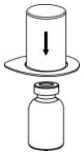 Fig. 2 |
| 6 | While holding the diluent vial, carefully remove the outer package from the Mix2Vial® transfer set. Make sure to pull off only the clear package, not the Mix2Vial® transfer set (Fig. 3). | 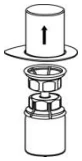 Fig. 3 |
| 7 | Place the Corifact vial on an even flat surface and hold the vial tight. Invert the diluent vial with the Mix2Vial® transfer set attached to it and push the plastic spike of the clear end of the Mix2Vial® firmly through the center of the stopper of the Corifact vial (Fig. 4). The diluent will transfer into the Corifact vial automatically. | 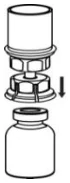 Fig. 4 |
| 8 | With the diluent and Corifact vial still attached to the Mix2Vial® transfer set, gently swirl the Corifact vial to ensure that the Corifact is fully dissolved (Fig. 5). Do not shake the vial. | 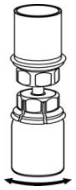 Fig. 5 |
| 9 | With one hand, grip the clear end of the Mix2Vial® transfer set and with the other hand grip the blue end of the Mix2Vial® transfer set, and unscrew counterclockwise the set into two pieces. (Fig. 6). | 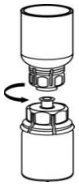 Fig. 6 |
| 10 | Draw air into an empty, sterile syringe. With the Corifact vial upright, screw the syringe to the Mix2Vial® transfer set. Inject air into the Corifact vial. While keeping the syringe plunger pressed, invert the Corifact vial and draw the solution into the syringe by pulling the plunger back slowly. (Fig. 7). | 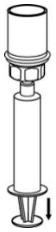 Fig. 7 |
| 11 | Once the solution has been transferred into the syringe, firmly grip the barrel of the syringe (keeping the plunger facing down) and unscrew the syringe counterclockwise from the Mix2Vial® transfer set Fig. 8). Attach the syringe to an infusion set or another suitable administration set. | 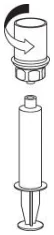 Fig. 8 |
| 12 | If patient is to receive more than one vial, the contents of multiple vials may be pooled into a single syringe. Use a separate unused Mix2Vial® transfer set for each product vial. | |
| 13 | Corifact is for single use only. Contains no preservatives. The product must be used within 3 hours after reconstitution. Do not refrigerate or freeze the reconstituted solution. Discard partially used vials. | |
Usual dose:
Your healthcare provider will prescribe the dose that you receive.
Overdose:
No cases of overdose have been reported.
If you think you, or a person you are caring for, have taken too much Corifact, contact a healthcare professional, hospital emergency department, regional poison control centre or Health Canada’s toll-free number, 1-844 POISON-X (1-844-764-7669) immediately, even if there are no signs or symptoms.
Missed dose:
Maintain a regular Corifact treatment schedule of dosing every 28 days. If a scheduled Corifact treatment is missed, another treatment should be administered as soon as possible.
Possible side effects from using Corifact:
These are not all the possible side effects you may have when taking Corifact. If you experience any side effects not listed here, tell your healthcare professional.
Tell your healthcare provider right away if you have any of the following symptoms after using Corifact:
- Shortness of breath
- Rash
- Pruritus (itching)
- Erythema (redness of the skin)
- Fainting/dizziness
- Chest pain
- Signs of a blood clot including pain, swelling, warmth, redness, or a lump in your legs or arms
Other possible side effects may include:
- Chills/rise in temperature
- Arthralgia (joint pain)
- Headache
- Increase in liver enzymes
- Breakthrough bleeding and pain resulting from formation of antibodies against Corifact
If you have a troublesome symptom or side effect that is not listed here or becomes bad enough to interfere with your daily activities, tell your healthcare professional.
Reporting side effects
You can report any suspected side effects associated with the use of health products to Health Canada by:
- Visiting the Web page on Adverse Reaction Reporting (canada.ca/drug-device-reporting) for information on how to report online, by mail or by fax; or
- Calling toll-free at 1-866-234-2345.
NOTE: Contact your healthcare professional if you need information about how to manage your side effects. The Canada Vigilance Program does not provide medical advice.
We recommend that CSL Behring Canada, Inc. be copied when reporting suspected side effects, at the following address:
AdverseReporting@CSLBehring.com
Storage:
When stored refrigerated (+2°C to +8°C), Corifact is stable for the period indicated by the expiration date on the carton and vial label (up to 36 months). Keep Corifact in its original carton until ready to use. Do not freeze. Protect from light.
Keep out of reach and sight of children.
If you want more information about Corifact:
- Talk to your healthcare professional
- Find the full product monograph that is prepared for healthcare professionals and includes the Patient Medication Information by visiting the Health Canada Drug Product Database website (https://www.canada.ca/en/health-canada/services/drugs-health-products/drug-products/drug-product-database.html); the manufacturer’s website (www.cslbehring.ca); or by calling 1-866-773-7721.
Date of Revision: 2025-08-15