


Patient Medication Information: uses, side effects, how to take - Humate-P
What is Humate-P® used for?
- Humate-P® is a medication used to treat adults with classical hemophilia (hemophilia-A).
- Humate-P® is also used to treat adults and children with Von Willebrand disease (VWD).
How does Humate-P® work?
Hemophilia A is a hereditary disorder of blood coagulation associated with a deficiency of the antihemophilic factor VIII (Factor VIII) activity. It can result in bleeding into joints, muscles or internal organs.
Von Willebrand disease (VWD) is caused by abnormalities of the von Willebrand Factor (VWF), a protein found in blood that supports platelet adhesion to the walls of blood vessels and allows blood vessels to stop bleeding and eventually to coagulate.
Humate-P® is a combination of two proteins found in human blood: Antihemophilic Factor (FVIII) and von Willebrand Factor (VWF). Both of these factors are useful for your body to have an adequate response to bleeding. The administration of Humate-P® results in an increased level of these factors in the plasma.
Serious Warnings and Precautions
- Serious thromboembolic events have been reported in patients with von Willebrand disease who are treated with coagulation factor replacement therapy. Before using Humate-P®, talk to your health professional to identify any known risk factor.
- Because this product is made from human plasma, a certain risk of virus transmission, such as hepatitis and HIV, or other infectious agents is present. This risk has been reduced by verifying if the donors of the plasma used to manufacture Humate-P® had prior exposure to certain viruses, by testing for the presence of certain current viral infections and by inactivating and/or removing certain viruses during the fabrication process of the drug product.
What are the ingredients in Humate-P®?
Medicinal ingredients
- Humate-P® is a combination of two proteins found in human blood: Antihemophilic Factor (FVIII) and von Willebrand Factor (VWF).
Non-medicinal ingredients:
- The non-active ingredients in the dried powder are albumin, glycine, sodium chloride and sodium citrate.
Humate-P® comes in the following dosage forms:
Humate-P® is an injectable medication that is given by intravenous infusion (injected in a vein). It is available in single dose vials as a dried, pasteurized powder. International unit activity of Factor VIII (IU FVIII) and VWF (IU VWF) is stated on the carton and label of each vial.
Do not use Humate-P® if:
- You experienced in the past a severe allergic reaction to it, immune globulins or any ingredient in the formulation.
To help avoid side effects and ensure proper use, talk to your healthcare professional before you take Humate-P®. Talk about any health conditions or problems you may have, including if:
You are pregnant or you are breast feeding;
- Your blood type is A, B or AB;
- You are currently treated with any products derived from human blood or plasma, in which case you should be appropriately vaccinated.
Other warnings you should know about:
Do not use Humate-P® for the treatment of other coagulation factor deficiencies, such as factors II, VII, IX and X.
Tell your healthcare professional about all the medicines you take, including any drugs, vitamins, minerals, natural supplements or alternative medicines.
The following may interact with Humate-P®:
- Even if there are no known interactions between Humate-P® and other products (drug, food, herb), you should tell your health professional if you are using any other medication or natural products. You should also advise your health professional before laboratory test.
How to take Humate-P®:
| A | RECONSTIUTION | |||
|---|---|---|---|---|
| 1 | Before infusion, ensure that Humate-P® and diluent vial are at room temperature. | |||
| 2 | Remove the Humate-P® and diluent vial flip caps to expose central portions of the rubber stoppers. | |||
| 3 | Wipe the rubber stoppers with an antiseptic solution such as an alcohol swab and allow to dry prior to opening the Mix2Vial® package. | |||
| 4 | Open the Mix2Vial® package by peeling away the lid (Fig. 1). To maintain sterility, leave the Mix2Vial® in the clear outer packaging. Place the diluent vial on an even surface and hold the vial tight. Grip the Mix2Vial® together with the clear packaging and firmly snap the blue end onto the diluent stopper (Fig. 2). | 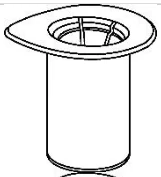 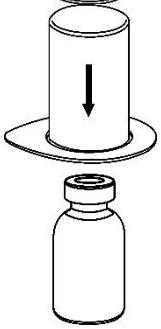 Figure 1 Figure 2 | ||
| 5 | While holding onto the diluent vial, carefully remove the clear outer packaging from the Mix2Vial® set. Make sure that you only pull up the clear outer packaging and not the Mix2Vial® set (Fig. 3). | 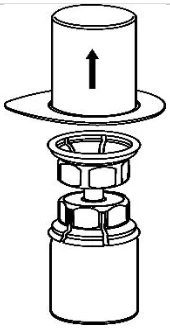 Figure 3 | ||
| 6 | With the product vial firmly on a surface, invert the diluent vial with set attached and firmly snap the transparent adapter onto the product vial stopper (Fig. 4). The diluent will automatically transfer into the product vial. | 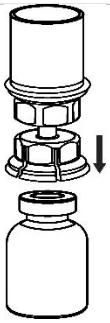 Figure 4 | ||
| 7 | With the diluent and product vial still attached, gently swirl the product vial to ensure the product is fully dissolved (Fig. 5). Do not shake vial. | 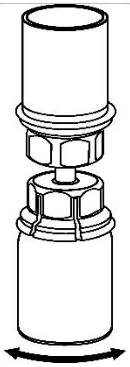 Figure 5 | ||
| 8 | With one hand grasp the product-side of the Mix2Vial® set and with the other hand grasp the blue diluent-side of the Mix2Vial® set and unscrew the set into two pieces (Fig. 6). | 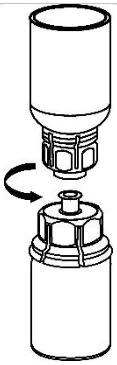 Figure 6 | ||
| 9 | Draw air into an empty, sterile syringe. While the product vial is upright, screw the syringe to the Mix2Vial® set. Inject air into the product vial. While keeping the syringe plunger pressed, invert the system upside down and draw the concentrate into the syringe by pulling the plunger back slowly (Fig. 7). | 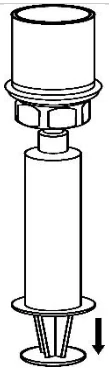 Figure 7 | ||
| 10 | Now that the concentrate has been transferred into the syringe, firmly grasp the barrel of the syringe (keeping the syringe plunger facing down) and unscrew the syringe from the Mix2Vial® (Fig. 8). Attach the syringe to a venipuncture set. | 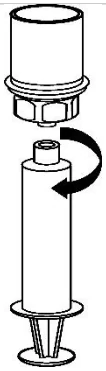 Figure 8 | ||
| 11 | If the same patient is to receive concentrate from more than one vial, the contents of two vials may be drawn into the same syringe through a separate unused Mix2Vial® set before attaching the vein needle. | |||
| 12 | The solution should be clear or slightly opalescent. After filtering/withdrawal the reconstituted product should be inspected visually for particulate matter and discoloration prior to administration. Even if the directions for use for the reconstitution procedure are precisely followed, it is not uncommon for a few flakes or particles to remain. The filter included in the Mix2Vial® device removes those particles completely. Filtration does not influence dosage calculations. Do not use visibly cloudy solutions or solutions still containing flakes or particles after filtration. | |||
Do not refrigerate after reconstitution. To assure product sterility, Humate-P® should be administered within three hours after reconstitution.
Usual dose:
The amount of von Willebrand factor and factor VIII you need and the duration of treatment will depend on several factors, such as your body weight, the severity of your disease, the site and intensity of the bleeding or the need to prevent bleeding during an operation or investigation.
If you have been prescribed Humate-P® to use at home, your doctor will make sure that you are shown how to inject it and how much to use.
Overdose:
No symptoms of overdose with Antihemophilic Factor/von Willebrand Factor Complex, (Human), Humate-P® are known so far.
If you think you, or a person you are caring for, have taken too much Humate-P®, contact a healthcare professional, hospital emergency department, or regional poison control centre immediately, even if there are no symptoms.
Missed Dose:
Proceed with your next dose immediately and continue at regular intervals as advised by your healthcare professional. Do not take a double dose to make up for a forgotten dose.
What are possible side effects from using Humate-P®?
These are not all the possible side effects you may have when taking Humate-P®. If you experience any side effects not listed here, tell your healthcare professional.
Humate-P® is usually tolerated without reaction. Some unwanted side effects are chills, hot flushes, abnormal sensations such as numbness or burning.
Talk to your healthcare professional immediately if you think you have any of the following reactions:
- skin rash, tightness in the chest or itching
- pain in the legs or extremities
- swelling
- unusual bleedings
- abdominal pain
If you have a troublesome symptom or side effect that is not listed here or becomes bad enough to interfere with your daily activities, tell your healthcare professional.
Reporting Side Effects
You can report any suspected side effects associated with the use of health products to Health Canada by:
- Visiting the Web page on Adverse Reaction Reporting (https://www.canada.ca/en/health-canada/services/drugs-health-products/medeffect-canada.html) for information on how to report online, by mail or by fax; or
- Calling toll-free at 1-866-234-2345.
NOTE: Contact your health professional if you need information about how to manage your side effects. The Canada Vigilance Program does not provide medical advice.
We recommend that CSL Behring Canada be copied when reporting suspected side effects, at the following address:
AdverseReporting@CSLBehring.com
Storage:
Store in the refrigerator or at room temperature, at +2°C to +25°C, for the period indicated by the expiration date on its label. Avoid freezing, which may damage the diluent container.
Do not use the product after the expiration date. Keep the vial in its box during storage.
Humate-P® is supplied in single-use vials. It contains no preservatives, so any unused portion should be discarded immediately after injection.
Keep out of reach and sight of children.
If you want more information about Humate-P®:
- Talk to your healthcare professional
- Find the full product monograph that is prepared for healthcare professionals and includes this Patient Medication Information by visiting the Health Canada website: (https://www.canada.ca/en/health-canada/services/drugs-health-products/drug-products/drug-product-database.html; the manufacturer’s website (www.cslbehring.ca), or by calling 1-866-773-7721.