


Patient Medication Information: uses, side effects, how to take - Wilate
What is wilate® used for?
Hemophilia A
wilate® is used for the treatment and prophylaxis of bleeding in patients with hemophilia A (congenital or acquired FVIII deficiency) and for the prevention and treatment of bleeding in minor surgical procedures.
Controlled clinical trials to evaluate the safety and efficacy of wilate® in major surgeries are ongoing in hemophilia A patients. Therefore, limited data are presently available on which to evaluate or to base dosing recommendations. Thus, in the case of major surgical interventions, a precise monitoring of the substitution therapy by means of coagulation analysis (FVIII:C) is indispensable.
Von Willebrand Disease (VWD)
wilate® is used for the treatment and prevention of spontaneous and trauma-induced bleeds in all types of von Willebrand disease (VWD) in adult and pediatric patients where use of DDAVP (1-deamino-8-D-arginine vasopressin/desmopressin) treatment is ineffective or contra-indicated. Clinical data on controlling severe spontaneous bleeding are limited.
wilate® is used for the prevention and treatment of bleeding during and after surgical procedures.
How does wilate® work?
wilate® is a highly purified concentrate of active human von Willebrand factor (VWF) and coagulation factor VIII (FVIII).
Hemophilia A is a sex-linked hereditary disorder of blood coagulation due to decreased levels of FVIII and can result in profuse bleeding into joints, muscles or internal organs, either
Serious Warnings and Precautions
A general risk of all blood products is the risk of transmission of viruses from the blood of the donors to the final recipients of the blood or its products. This risk has been reduced by verifying if the donors of the plasma used to manufacture wilate® had prior exposure to certain viruses and by testing for the presence of certain viral infections. Further, wilate® manufacturing employs two independent steps of viral inactivation/removal and complies with the most rigid norms of viral safety in the European Union and Canada. However, like all blood products, the possibility for transmission of blood-borne viral agents like Parvovirus B19, and theoretically, the variant Creutzfeldt-Jakob disease (vCJD) agent cannot be excluded.
spontaneously or as a result of accidental or surgical trauma. With replacement therapy with wilate®, a complex of human VWF and FVIII, the plasma levels of FVIII are increased, thereby enabling a temporary correction of the factor deficiency and correction of the bleeding tendencies.
Patients suffering from VWD have a deficiency or abnormality of VWF. A reduction in functional VWF concentration in the bloodstream results in low FVIII activity and abnormal platelet function. The result is that the platelets cannot adhere to damaged blood vessel walls to stop bleeding and that the lack of FVIII can impair the coagulation process. This can result in excessive bleeding.
Administration of wilate® restores the plasma levels of VWF and FVIII to normal immediately.
What are the ingredients in wilate®?
Powder:
Medicinal ingredients: Human von Willebrand Factor (VWF) and human Coagulation Factor VIII (FVIII)
Non-medicinal ingredients: Calcium chloride, glycine, sodium chloride, sodium citrate and sucrose
Solvent:
Water for Injections with 0.1% Polysorbate 80
wilate® comes in the following dosage forms:
wilate® is a powder and solvent for solution for injection and comes in the following dosage forms:
One package of wilate® contains:
One powder vial (500 IU VWF/500 IU FVIII or 1000 IU VWF/1000 IU FVIII), a second vial containing the solvent (5 mL or 10 mL) and a transfer device (Nextaro®) with integrated filter.
Do not use wilate® if:
- you are allergic to any of the ingredients contained in wilate®
- you have experienced allergic reactions to wilate® in the past
There are insufficient data to recommend the use of wilate® in children with hemophilia A less than 12 years of age. There is no information on the use of wilate® in patients >65 years old.
To help avoid side effects and ensure proper use, talk to your healthcare professional before you take wilate®. Talk about any health conditions or problems you may have, including:
- Drugs made from human blood plasma, such as wilate® may transmit infections, including hepatitis. Before starting treatment with wilate®, if you have not been vaccinated against hepatitis A and B, discuss getting vaccinated with your doctor or pharmacist.
If you are pregnant or nursing. There is no information on wilate® administered to nursing or pregnant women. A pregnancy test is recommended before receiving wilate®.
- If you will be undergoing any scheduled surgical procedures.
- If you are allergic to the active substance or to any of the nonmedicinal ingredients.
Tell your healthcare professional about all the medicines you take, including any drugs, vitamins, minerals, natural supplements or alternative medicines.
The following may interact with wilate®:
There are no known drug interactions with wilate®.
How to take wilate®:
Usual dose:
As dosage and treatment duration depend on your clinical situation, the type and severity of your bleeding, and your VWF and/or FVIII:C levels, your physician will decide on your treatment on an individual basis.
Overdose:
No symptoms of overdose with human VWF or FVIII have been reported.
If you think you, or a person you are caring for, have taken too much wilate®, contact a healthcare professional, hospital emergency department or regional poison control centre immediately, even if there are no symptoms.
Missed Dose:
It is important to take the total daily dose prescribed to ensure you get maximum benefit. If you miss a dose, take the missed dose as soon as possible, and then continue as before. However, if a dose is skipped, do not double the next dose. Continue on with your normal dose on the regular schedule as prescribed by your doctor.
Administration:
wilate® is administered via intravenous infusion.
The powder should only be dissolved immediately prior to injection. Once reconstituted, the solution may be stored at room temperature for up to 4 hours. Nevertheless, to prevent contamination, it is recommended the solution be used immediately.
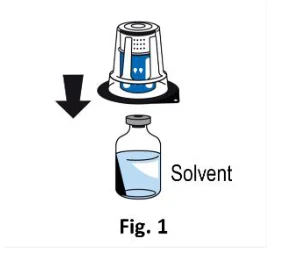
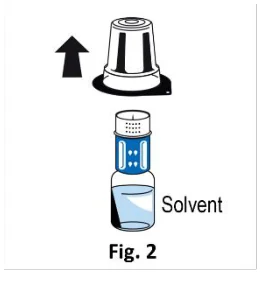
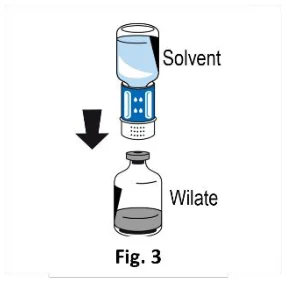
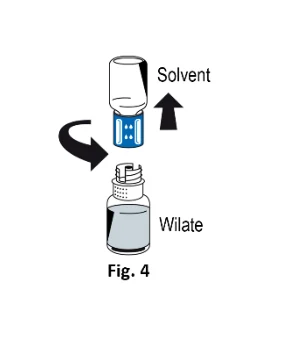
Instructions for Reconstitution:
 |
|
|---|---|
 |
|
Note: The transfer device must be attached to the solvent vial first and then to the lyophilized powder vial. Otherwise, loss of vacuum occurs, and transfer of the solvent does not take place. If solvent is not completely transferred to the lyophilized powder vial during this process, contact your Octapharma representative. | |
|
Instructions for Injection:
| As a precautionary measure, the patients pulse rate should be measured before and during the injection. If a marked increase in the pulse rate occurs the injection speed must be reduced or the administration must be interrupted. |
|---|
|
|
|
|
|
What are possible side effects from using wilate®?
These are not all the possible side effects you may have when taking wilate®. If you experience any side effects not listed here, tell your healthcare professional.
Allergic reactions such as hives, itching, tightness of the chest, wheezing, chills, flushing, headache, feeling unusually tired, drowsy or restless, feeling sick or vomiting, and tingling of the skin, can occur with wilate®. If these symptoms occur contact your doctor or pharmacist for advice before continuing treatment.
In rare cases, the allergic reactions are severe, known as shock or anaphylactic shock. This may include extreme difficulty breathing, or loss of consciousness. Urgent treatment is required and the emergency services should be called, for example 911.
 | |
|---|---|
 |
Patients with VWD or hemophilia A may develop neutralizing antibodies (inhibitors) to VWF or FVIII. If the expected VWF/FVIII activity plasma levels are not attained, or if bleeding is not controlled with an appropriate dose, an assay should be performed to determine if FVIII inhibitors are present. Sometimes, treatment with wilate® stops working due to the development of inhibitors. If you find that your usual treatment for bleeding is not working, you should contact your doctor as soon as possible. In some cases higher doses of wilate® or another VWF/factor VIII product are required, in other cases, alternative treatments may be prescribed by a doctor specializing in the treatment of hemophilia and or VWD.
If you have a troublesome symptom or side effect that is not listed here or becomes bad enough to interfere with your daily activities, tell your healthcare professional.
Reporting Side Effects
You can report any suspected side effects associated with the use of health products to Health Canada by:
NOTE: Contact your health professional if you need information about how to manage your side effects. The Canada Vigilance Program does not provide medical advice. |
Storage:
wilate® and solvent can be stored at between +2°C and +8°C until the indicated expiry date. Within this period wilate® and solvent may be stored for a single block of up to 6 months at room temperature (max. +25°C). If stored at room temperature (max. +25°C), wilate® must either be used within 6 months or discarded.
Protect from light. Do not freeze. The reconstituted solution should be used on one occasion only. Any solution remaining should be discarded.
If you want more information about wilate®:
- Talk to your healthcare professional
- Find the full product monograph that is prepared for healthcare professionals and includes this Patient Medication Information by visiting the Health Canada website: (https://www.canada.ca/en/health-canada/services/drugs-health-products/drug-products/drug-product-database.html; the manufacturer’s website http://www.octapharma.ca, or by calling 1-888-438-0488.