


Patient Medication Information: uses, side effects, how to take - Rixubis
What is RIXUBIS used for?
RIXUBIS is a medicine used to replace clotting factor (Factor IX) that is missing in people with hemophilia B. Hemophilia B is also called congenital factor IX deficiency or Christmas disease. Hemophilia B is an inherited bleeding disorder that prevents blood from clotting normally.
- RIXUBIS is used to prevent and control bleeding in adults and children with hemophilia B.
- Your healthcare provider may give you RIXUBIS when you have surgery.
- RIXUBIS can reduce the number of bleeding episodes when used regularly (prophylaxis).
How does RIXUBIS work?
RIXUBIS temporarily replaces the missing clotting factor IX that is needed for effective hemostasis.
What are the ingredients in RIXUBIS?
Medicinal ingredients: Recombinant Coagulation Factor IX (rFIX), Nonacog gamma
Non-medicinal ingredients: Calcium Chloride, L-Histidine, Mannitol, Polysorbate 80, Sodium Chloride, Sucrose
RIXUBIS comes in the following dosage forms:
RIXUBIS comes in five different dosage strengths 250 International Units (IU), 500 IU, 1000 IU, 2000 IU and 3000 IU.
The actual strength will be imprinted on the label and on the box. The five different strengths are color coded, as follows:
 | Dosage strength of approximately 250 International Units per vial |
| Dosage strength of approximately 500 International Units per vial | |
| Dosage strength of approximately 1000 International Units per vial | |
| Dosage strength of approximately 2000 International Units per vial | |
| Dosage strength of approximately 3000 International Units per vial |
Always check the actual dosage strength printed on the label to make sure you are using the strength prescribed by your healthcare provider. Always check the expiration date printed on the carton. Do not use the product after the expiration date printed on the carton and the vial.
Do not use RIXUBIS if you:
- are allergic to hamsters.
- are allergic to any ingredients in RIXUBIS.
Tell your healthcare provider if you are pregnant or breastfeeding because RIXUBIS may not be right for you.
To help avoid side effects and ensure proper use, talk to your healthcare professional before you take RIXUBIS. Talk about any health conditions or problems you may have, including if you:
- are pregnant or planning to become pregnant. It is not known if RIXUBIS may harm your unborn baby.
- are breast feeding or planning to breast feed. It is not known if RIXUBIS passes into your milk and if it can harm your baby.
- have or have had any medical problems.
- have any allergies, including allergies to hamsters.
- are at risk of developing blood clots.
- have liver disease.
- have recently had surgery or are planning to have surgery.
- have been told that you have inhibitors to factor IX (because RIXUBIS may not work for you).
Tell your healthcare professional about all the medicines you take, including any drugs, vitamins, minerals, natural supplements or alternative medicines.
The following medications may interact with RIXUBIS:
There are no known interactions of RIXUBIS with other medications.
How to take RIXUBIS:
For intravenous use only.
Do not attempt to do an infusion to yourself unless you have been taught how by your healthcare provider or hemophilia center.
See below for step-by-step instructions for reconstituting RIXUBIS.
Always follow the specific instructions given by your healthcare provider. The steps listed below are general guidelines for using RIXUBIS. If you are unsure of the procedures, please call your healthcare provider before using.
Dispose of all materials, including any leftover reconstituted RIXUBIS product, in an appropriate container.
- 1. Prepare a clean flat surface and gather all the materials you will need for the infusion. Check the expiration date, and let the vial with the RIXUBIS concentrate and the vial with the Sterile Water for Injection, USP (diluent) warm up to room temperature. Wash your hands and put on clean exam gloves. If infusing yourself at home, the use of gloves is optional.
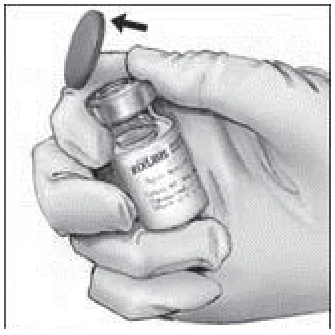
- 2. Remove caps from the RIXUBIS concentrate and diluent vials to expose the centers of the rubber stoppers.
- 3.
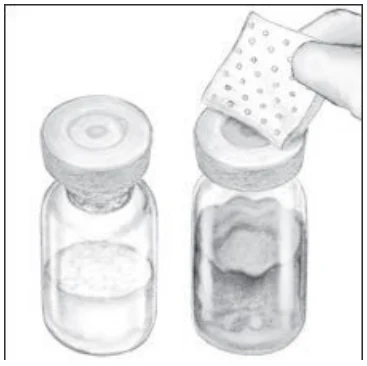
Disinfect the stoppers with an alcohol swab (or other suitable solution suggested by your healthcare provider or hemophilia center) by rubbing the stoppers firmly for several seconds and allow them to dry prior to use. Place the vials on a flat surface.
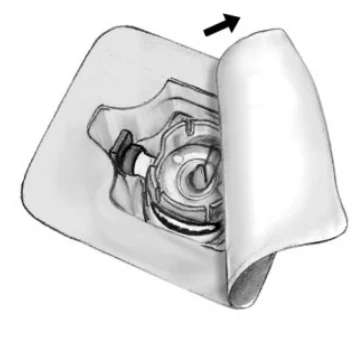
- 4. Open the BAXJECT II device package by peeling away the lid, without touching the inside of the package. Do not remove the BAXJECT II device from the package.
- 5. Turn the package with the BAXJECT II device upside down and place it over the top of the diluent vial. Fully insert the clear plastic spike of the device into the center of the diluent vial’s stopper by pushing straight down. Grip the package at its edge and lift it off the device. Be careful not to touch the white plastic spike. Do not remove the blue cap from the BAXJECT II device.
The diluent vial now has the BAXJECT II device connected to it and is ready to be connected to the RIXUBIS vial.
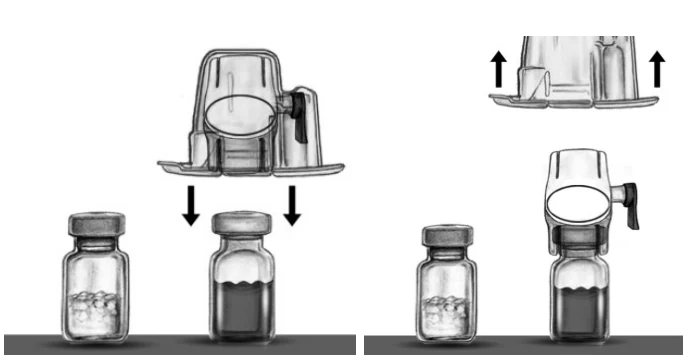
- 6. To connect the diluent vial to the RIXUBIS vial, turn the diluent vial over and place it on top of the vial containing RIXUBIS concentrate. Fully insert the white plastic spike into the RIXUBIS vial’s stopper by pushing straight down. Diluent will flow into the RIXUBIS vial. This should be done right away to keep the liquid free of germs.
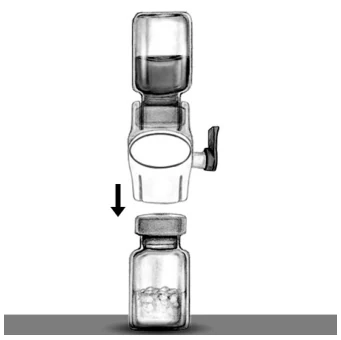
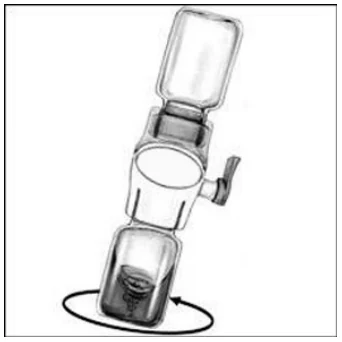
- 7. Swirl the connected vials gently and continuously until RIXUBIS is completely dissolved. Do not shake. The RIXUBIS solution should look clear and colorless. If not, do not use it and notify Takeda immediately.
- 8. Take off the blue cap from the BAXJECT II device and connect the syringe. Be careful to not inject air.
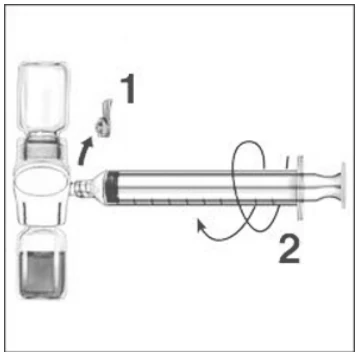
- 9. Turn over the connected vials so that the RIXUBIS vial is on top. Draw the RIXUBIS solution into the syringe by pulling back the plunger slowly. Disconnect the syringe from the vials. Attach the infusion needle to the syringe using a winged (butterfly) infusion set, if available. Point the needle up and remove any air bubbles by gently tapping the syringe with your finger and slowly and carefully pushing air out of the syringe and needle.
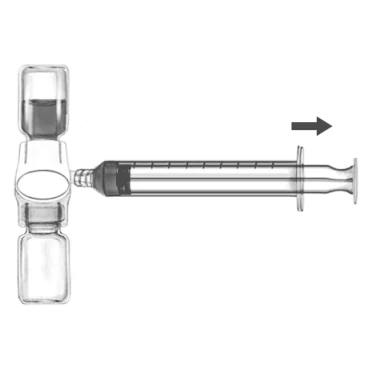
- 10. If you are using more than one vial of RIXUBIS, the contents of more than one vial may be drawn into the same syringe. Make sure you mix each vial of RIXUBIS with the Sterile Water for Injection, USP that is provided in the box (Following Steps 1-9). You will need a separate BAXJECT II device to mix each additional vial of RIXUBIS.
Apply a tourniquet and get the infusion site ready by wiping the skin well with an alcohol swab (or other suitable solution suggested by your healthcare provider or hemophilia center).
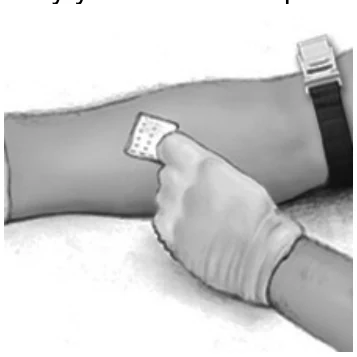
- 11. Insert the needle into the vein and remove the tourniquet. Slowly infuse RIXUBIS. Do not infuse any faster than 10 mL per minute.
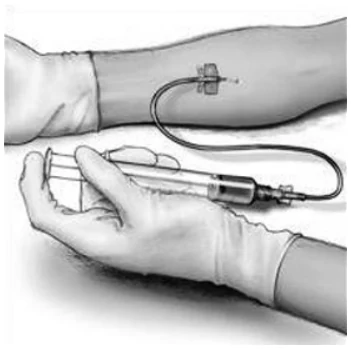
- 12.
Take the needle out of the vein and use sterile gauze to put pressure on the infusion site for several minutes.
Do not recap the needle. Place it with the used syringe in a hard-walled Sharps container for proper disposal.
Remove the peel-off label from the RIXUBIS vial and place it in your logbook. Clean any spilled blood with a freshly prepared mixture of 1 part bleach and 9 parts water, soap and water, or any household disinfecting solution.
- 13. Dispose of the used vials and BAXJECT II system in your hard-walled Sharps container without taking them apart. Do not dispose of these supplies in ordinary household trash.
Usual dose:
Your doctor will determine the dose of RIXUBIS you will receive.
The dose, duration and frequency of infusions you receive will be influenced by the severity of your factor IX deficiency, the location, extent of bleeding and age.
Call your healthcare provider right away if bleeding is not controlled after using RIXUBIS.
Your healthcare provider will prescribe the dose that you should take.
Your healthcare provider may need to take blood tests from time to time.
Talk to your healthcare provider before traveling. Plan to bring enough RIXUBIS for your treatment during this time.
Overdose:
No symptoms of overdose have been reported. As with other products of the same class, overdose may increase the risk for thrombotic and thromboembolic events (e.g., extensive blood clotting in multiple vessels, clotting in arteries or veins with examples in the leg and or lung vessels).
| If you think you, or a person you are caring for, have taken too much RIXUBIS, contact your healthcare professional, hospital emergency department or regional poison control centre immediately, even if there are no symptoms. |
Missed Dose:
If you miss a dose of this medicine, check with your doctor as soon as possible for instructions.
What are possible side effects from using RIXUBIS?
These are not all the possible side effects you may feel when using RIXUBIS. If you experience any side effects not listed here, contact your healthcare professional. You can ask your healthcare provider for information that is written for healthcare professionals.
Allergic reactions may occur with RIXUBIS. Call your doctor or get emergency treatment right away if you get a rash or hives, itching, tightness of the throat, chest pain or tightness, difficulty breathing, light headedness, dizziness, nausea or fainting.
Some common side effects of RIXUBIS were stomach flu like symptoms (such as nausea, vomiting and stomach pain), runny nose, sore throat, headache and diarrhea.
If you have a troublesome symptom or side effect that is not listed here or becomes bad enough to interfere with your daily activities, talk to your healthcare professional.
Reporting Side Effects
You can report any suspected side effects associated with the use of health products to Health Canada by:
NOTE: Contact your health professional if you need information about how to manage your side effects. The Canada Vigilance Program does not provide medical advice. |
Storage:
- Refrigerated temperature (2° to 8°C (35 to 46°F))) for 36 months or
- Room temperature not to exceed 30°C (86°F) for up to 36 months
- Do not freeze.
- Do not use beyond the expiration date printed on the carton or vial.
- Reconstituted product (after mixing dry product with wet diluent) must be used within 3 hours and cannot be stored or refrigerated. Discard any RIXUBIS left in the vial at the end of your infusion.
Keep out of reach and sight of children.
If you want more information about RIXUBIS:
- Talk to your healthcare professional
- Find the full product monograph that is prepared for healthcare professionals and includes this Patient Medication Information by visiting the Health Canada website: (https://www.canada.ca/en/health-canada/services/drugs-health-products/drug-products/drug-product-database.html ; the manufacturer's website www.takeda.com/en-ca/rixubispm, or by calling 1-800-268-2772.
Takeda Canada Inc.
22 Adelaide Street West, Suite 3800
Toronto Ontario M5H 4E3
Last Revised: March 12, 2021
RIXUBIS® and BAXJECT® II are registered trademarks of Baxalta Incorporated. TAKEDATM and the TAKEDA Logo® are trademarks of Takeda Pharmaceutical Company Limited, used under license.