


Patient Medication Information: uses, side effects, how to take - Feiba NF (Takeda Canada, 650 Unit)
What is FEIBA NF used for?
Anti-Inhibitor Coagulant Complex, FEIBA NF is indicated for the control of spontaneous bleeding episodes, to cover surgical interventions in haemophilia A and B patients with inhibitors and routine prophylaxis to prevent or reduce the frequency of bleeding episodes in adults and children older than 6 years of age with hemophilia A or B with inhibitors.
In addition, FEIBA NF may be used for treating non- haemophiliacs with acquired inhibitors to factors VIII, XI and XII in case of life-threatening haemorrhages. One case has been reported where FEIBA was effective in a patient with von Willebrand's disease with an inhibitor.
Clinical experience suggests that patients with a Factor VIII inhibitor titer of less than 5 B.U. may be successfully treated with Antihemophilic Factor. Patients with titers ranging between 5 and 10 B.U. may either be treated with Antihemophilic Factor or FEIBA NF. Cases with Factor VIII inhibitor titers greater than 10 B.U. have generally been refractory to treatment with Antihemophilic Factor.
Guidelines to First and Second Choice Treatment:
AICC = Anti-Inhibitor Coagulant Complex, FElBA NF
AHF = Antihemophilic Factor
| Clinical Situation | ||||
Patient’s Inhibitor Titer | Minor Bleeding | Major Bleeding | Surgery (Emergency) | |
less than 5 B.U. 5 to 10 B.U. | AHF AHF AICC | AHF AHF AICC | AHF AHF AICC | |
more than 10 B.U. | AICC | AICC | AICC | |
Inadequate response to treatment may result from an abnormal platelet count or impaired platelet function which were present before treatment with FEIBA NF.
Serious Warnings and Precautions
- Monitor patients receiving FEIBA for signs and symptoms of thromboembolic events.
- Thromboembolic events have been reported during post- marketing surveillance following infusion of FEIBA, particularly following the administration of high doses and/or in patients with thrombotic risk factors (see WARNINGS AND PRECAUTIONS AND ADVERSE EVENTS).
How does FEIBA NF work?
FEIBA NF is used for the treatment of hemorrhages in hemophilia A and B patients with inhibitors.
Furthermore, FEIBA NF can be used for the treatment of hemorrhages in non-hemophilic patients who have developed inhibitors to factors VIII, IX and XI.
FEIBA NF has been used in combination with factor VIII concentrate during ITI until eradication of inhibitors.
What are the ingredients in FEIBA NF?
Medicinal ingredients: Anti-Inhibitor Coagulant Complex
Non-medicinal ingredients: Sodium Chloride and Trisodium Citrate
FEIBA NF comes in the following dosage forms:
Anti-Inhibitor Coagulant Complex, FEIBA NF is supplied as freeze-dried powder, accompanied by a suitable volume of Sterile Water for Injection, E. P., and a Baxject II Hi-Flow device.
The number of FEIBA Units of Factor VIII inhibitor bypassing activity is stated on the label of each bottle (350-650 Units per 10 mL or 20 mL, 700-1300 Units per 20 mL, 1750 - 3250 Units per 50 mL).
Do not use FEIBA NF if:
- You are known to have a normal coagulation mechanism.
- You have hypersensitivity to the product.
- You have significant signs of disseminated intravascular coagulation (DIC) or fibrinolysis.
- You have a tentative or definite diagnosis of coronary heart disease.
- You have acute thrombosis and/or embolism (including myocardial infarction), the use of FEIBA NF is only indicated in life-threatening bleeding events.
To help avoid side effects and ensure proper use, talk to your healthcare professional before you take FEIBA NF.
Other warnings you should know about:
Anti-Inhibitor Coagulant Complex, FEIBA must be used only in patients with circulating inhibitors to one or more coagulation factors and should not be used for the treatment of bleeding episodes resulting from coagulation factor deficiencies. It should not be given to patients with significant signs of disseminated intravascular coagulation (DIC) or fibrinolysis.
FEIBA should be used with particular caution in patients at risk of DIC, arterial or venous thrombosis. At first signs or symptoms of Thromboembolic events, the infusion should be stopped immediately and appropriate diagnostic and therapeutic measures initiated.
Thromboembolic events, including disseminated intravascular coagulation (DIC), venous thrombosis, pulmonary embolism, myocardial infarction and stroke, have occurred in the course of treatment with FEIBA. Many of these events occurred with doses above 200 U/kg/day or in patients with other risk factors (including DIC, advanced atherosclerotic disease, crush injury or septicemia) for thromboembolic events (e.g. patients in the postoperative state or with liver disease, infection, inflammation, cancer, angina pectoris or myocardial infarction). Concomitant treatment with recombinant Factor VIIa may increase the risk of developing a thromboembolic event. The possible presence of such risk factors should always be considered in patients with congenital and acquired hemophilia.
FEIBA can precipitate allergic-type hypersensitivity reactions that have included urticaria, angioedema, gastrointestinal manifestations, bronchospasm and hypotension; these reactions can be severe and can be systemic (e.g., anaphylaxis with urticaria and angioedema, bronchospasm, and circulatory shock). Allergic Reactions should be treated with antihistamines and glucocorticoids. In the case of shock medical attention should be initiated as appropriate. Other infusion reactions, such as chills, pyrexia, and hypertension have also been reported.
At first signs or symptoms of an infusion/hypersensitivity reaction, FEIBA administration should be stopped and medical care initiated as appropriate.
Other symptoms of hypersensitivity to plasma-derived products include lethargy and restlessness.
Anamnestic response with rise in Factor VIII inhibitor titer have been observed in 20% of the cases. Clinical and published data suggests that the efficacy of FEIBA is not reduced.
Tell your healthcare professional about all the medicines you take, including any drugs, vitamins, minerals, natural supplements or alternative medicines.
The following may interact with FEIBA NF:
Please tell your doctor or pharmacist if you are taking or have recently taken any other medicines, including medicines obtained without a prescription.
No adequate and well-controlled studies of the combined or sequential use of FEIBA and recombinant Factor VIIa, antifibrinolytics, or emicizumab have been conducted.
The possibility of thromboembolic events should be considered when systemic antifibrinolytics such as tranexamic acid and aminocaproic acid are used during treatment with FEIBA. Therefore, antifibrinolytics should not be used for approximately 6 to 12 hours after the administration of FEIBA.
In cases of concomitant rFVIIa use, according to available in vitro data and clinical observations a potential drug interaction may occur (potentially resulting in adverse events such as a thromboembolic event.).
Clinical experience from an emicizumab clinical trial suggests that a potential drug interaction may exist with emicizumab when FEIBA was used as part of a treatment regimen for breakthrough bleeding.
As all other blood coagulation factors, FEIBA should not be mixed with other medicinal products prior to application since this might impair the efficacy and safety of the product.
How to take FEIBA NF:
Reconstitute the freeze-dried FEIBA powder with the enclosed solvent and administer the solution intravenously.
Always use FEIBA exactly as your doctor has instructed you. Please ask your doctor or pharmacist, if you are not entirely sure. Taking into consideration the severity of the blood coagulation disorder, the location and extent of the hemorrhage, and your general condition and response to the preparation, the doctor has determined the dose and dosage intervals required for you personally. Do not change the dosage established by your doctor and do not discontinue the application of the preparation independently.
Warm the product to room or body temperature prior to administration.
FEIBA is to be reconstituted only immediately before administration. The solution should then be used immediately (the preparation does not contain preservatives). Solutions, which are turbid or have deposits, are to be disposed of appropriately. Do not reuse opened containers. Do not use the product, if its sterile barrier system or its packaging is damaged or it shows any sign of deterioration.
Usual dose:
As a general guideline a dosage range of 50 to 100 FEIBA Units of FEIBA NF per kg of body weight is recommended. However, care should be taken to distinguish between the following indications, all of which have undergone careful clinical evaluation:
- Joint haemorrhages
- Mucous Membrane Bleeding
- Soft tissue haemorrhages
- Other severe haemorrhages
- Surgery
A single dose of 100 U/kg body weight and a daily dose of
200 U/kg body weight should not be exceeded.
For prevention of bleeding episodes, dose 85 ± 15 units per kg body weight (70 to 100 units per kg body weight) every other day (3 to 4 times weekly). Dose to be adjusted based on the patient’s clinical response.
Overdose:
Some of the reported thromboembolic events occurred with doses above 200 U/kg. If signs or symptoms of thromboembolic events are observed, the infusion should be stopped immediately and appropriate diagnostic and therapeutic measures initiated.
| If you think you have taken too much FEIBA NF contact your healthcare professional, hospital emergency department or regional poison control centre immediately, even if there are no symptoms. |
What are possible side effects from using FEIBA NF?
These are not all the possible side effects you may feel when taking FEIBA NF. If you experience any side effects not listed here, contact your healthcare professional.
After application of high doses (single infusion of beyond 100 U/kg of body weight, and daily doses of 200 U/kg bw) of Anti- Inhibitor Coagulant Complex, FEIBA NF, laboratory and/or clinical signs or DIC have occasionally been observed.
During an emicizumab clinical trial some patients who suffered from breakthrough bleeds were treated with FEIBA to control the bleeds, and a few of these patients developed thrombotic microangiopathy (TMA). TMA is a serious and potentially life-threatening condition. When people have this condition, the lining of the blood vessels can be damaged and blood clots may develop in small blood vessels. In some cases, this can cause damage to the kidneys and other organs. In case of breakthrough bleeds while on emicizumab prophylaxis, contact your hemophilia treater or Hemophilia Treatment Center immediately.
As with all human plasma products, any kind of allergic reaction may be seen, ranging from mild, short-term urticarial rashes to severe anaphylactoid reactions.
Administration of FEIBA NF should be discontinued immediately, if such signs appear. Allergic reactions should be treated with antihistamines and glucocorticoids. In the case of shock medical attention should be initiated as appropriate.
If you have a troublesome symptom or side effect that is not listed here or becomes bad enough to interfere with your daily activities, talk to your healthcare professional.
Reporting Side Effects
You can report any suspected side effects associated with the use of health products to Health Canada by:
NOTE: Contact your health professional if you need information about how to manage your side effects. The Canada Vigilance Program does not provide medical advice. |
Storage:
FEIBA NF can be stored refrigerated or at room temperature (between 2°C to +25°C) for the entire shelf-life of the product.
Avoid freezing, which may damage the diluent bottle.
FEIBA NF must not be used beyond the expiry date indicated on the label.
Keep out of reach and sight of children.
Reconstituted Solutions
Anti-Inhibition Coagulant Complex, FEIBA NF is to be reconstituted only immediately before administration. The solution should then be used promptly. Any unused solution must be discarded.
Instructions for Using FEIBA NF Instructions for use for BAXJECT II Hi-Flow:
Reconstitution of powder to prepare a solution for injections
Use aseptic technique throughout entire procedure.
- 1. Warm the unopened vial containing the solvent (Sterile Water for Injection, EP) to room temperature if necessary, e.g. using a sterile water bath for warming within several minutes (max. +37°C).
- 2. Remove the protective caps from the FEIBA vial and solvent vial and cleanse the rubber stoppers with germicidal solution of both and allow to dry. Place the vials on a flat surface.
- 3. Open the package of BAXJECT II Hi-Flow device by peeling away the paper lid without touching the inside (Fig. a). Do not remove the transfer device from the package.
- 4. Turn the package over and insert the clear plastic spike through the solvent stopper (Fig. b). Grip the package at its edge and pull the package off BAXJECT II Hi-Flow (Fig. c). Do not remove the blue cap from BAXJECT II Hi-Flow.
- 5. With the transfer device attached to the solvent vial, invert the system so that the solvent vial is on top of the device. Insert the purple plastic spike of BAXJECT II Hi-Flow through the FEIBA NF vial stopper. The vacuum will draw the solvent into the FEIBA vial (Fig. d).
- 6. Swirl gently until all the material is dissolved. Ensure that FEIBA is completely dissolved, otherwise active material will not pass through the device filter.
Fig. a Fig. b Fig. c Fig.d
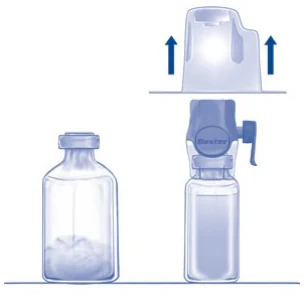
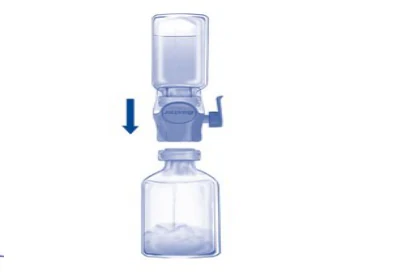
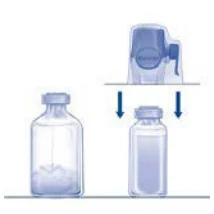
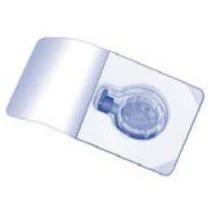
Injection/Infusion
Coagulation factors derived from human plasma may be adsorbed by the inner surfaces of certain types of injection/infusion devices. If this were to occur, it could result in failure of therapy. Therefore, only plastic injection/infusion devices should be used with FEIBA.
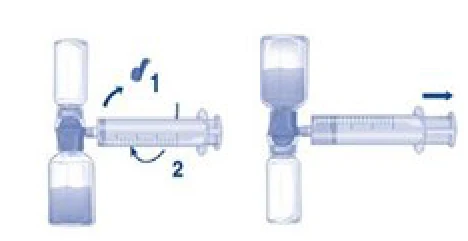
- 1. Remove the blue cap from BAXJECT II Hi-Flow. Take the syringe and connect it to BAXJECT II Hi-Flow (DO NOT DRAW AIR INTO THE SYRINGE) (Fig. e).
- 2. Invert the system (with FEIBA vial on top). Draw the FEIBA solution into the syringe by pulling the plunger back slowly (Fig. f).
- 3. Disconnect the syringe.
- 4.
Slowly inject the solution intravenously with a winged set for injection.
Fig. e Fig. f
Do not exceed an infusion rate of 2 U FEIBA/kg/Body Weight per minute. A syringe pump may be used to control the rate of administration.
Do not refrigerate after reconstitution!
After complete reconstitution of FEIBA NF its injection or infusion should be commenced as promptly as practicable, but must be completed within three hours following reconstitution.
If you want more information about FEIBA NF:
- Talk to your healthcare professional
- Find the full product monograph that is prepared for healthcare professionals and includes this Patient Medication Information by visiting the Health Canada website; the manufacturer’s website www.takeda.com/en-ca, or by calling 1-800-268-2772.
Takeda Canada Inc.
22 Adelaide Street West, Suite 3800
Toronto, Ontario M5H 4E3
Last Revised NOV 25, 2020
FEIBA® is a registered trademark of Baxalta Incorporated. Takeda® and the Takeda Logo are trademarks of Takeda Pharmaceutical Company Limited, used under license.