


Product Monograph - Donepezil (Ranbaxy Pharmaceuticals Canada)
SUMMARY PRODUCT INFORMATION
Route of Administration | Dosage Form / Strength | All Clinically Relevant Nonmedicinal Ingredients |
| oral | Tablets 5 mg and 10 mg | 5 mg: corn starch, hydroxypropyl cellulose, hypromellose, lactose monohydrate, magnesium stearate, microcrystalline cellulose, polyethylene glycol, sodium starch glycolate, talc, and titanium dioxide. 10 mg: corn starch, hydroxypropyl cellulose, hypromellose, iron oxide yellow, lactose monohydrate, magnesium stearate, microcrystalline cellulose, polyethylene glycol, sodium starch glycolate, talc, and titanium dioxide. |
INDICATIONS AND CLINICAL USE
DONEPEZIL (donepezil hydrochloride) is indicated for:
symptomatic treatment of patients with mild, moderate and severe dementia of the Alzheimer’s type.
Efficacy of donepezil hydrochloride in patients with mild to moderate Alzheimer’s disease was established in two 24-week and one 54-week placebo-controlled trials. Efficacy in patients with severe Alzheimer’s disease was established in two 24-week/6 month placebo-controlled trials.
DONEPEZIL tablets should only be prescribed by (or following consultation with) clinicians who are experienced in the diagnosis and management of Alzheimer’s disease.
CONTRAINDICATIONS
DONEPEZIL (donepezil hydrochloride) is contraindicated in patients with known hypersensitivity to donepezil hydrochloride or to piperidine derivatives.
WARNINGS AND PRECAUTIONS
Carcinogenesis and Mutagenesis
Refer to Product Monograph Part II: TOXICOLOGY - Carcinogenicity for discussion on animal data.
Cardiovascular
Because of their pharmacological action, cholinesterase inhibitors may have vagotonic effects on heart rate (eg, bradycardia). The potential for this action may be particularly important to patients with "sick sinus syndrome" or other supraventricular cardiac conduction conditions.
In clinical trials in Alzheimer’s disease, most patients with serious cardiovascular conditions were excluded. Patients such as those with controlled hypertension (DBP<95 mmHg), right bundle branch blockage, and pacemakers were included. Therefore, caution should be taken in treating patients with active coronary artery disease and congestive heart failure. Syncopal episodes have been reported in association with the use of donepezil hydrochloride. It is recommended that donepezil hydrochloride should not be used in patients with cardiac conduction abnormalities (except for right bundle branch block) including “sick sinus syndrome” and those with unexplained syncopal episodes.
Gastrointestinal
Through their primary action, cholinesterase inhibitors may be expected to increase gastric acid secretion due to increased cholinergic activity. Therefore, patients at increased risk for developing ulcers, eg, those with a history of ulcer disease or those receiving concurrent nonsteroidal anti-inflammatory drugs (NSAIDS) including high doses of acetylsalicylic acid (ASA), should be monitored for symptoms of active or occult gastrointestinal bleeding. Clinical studies of donepezil hydrochloride have shown no increase, relative to placebo in the incidence of either peptic ulcer disease or gastrointestinal bleeding (see ADVERSE REACTIONS section).
Donepezil hydrochloride, as a predictable consequence of its pharmacological properties, has been shown to produce, in controlled clinical trials in patients with Alzheimer's disease, diarrhea, nausea and vomiting. These effects, when they occur, appear more frequently with the 10-mg dose than with the 5-mg dose. In most cases, these effects have usually been mild and transient, sometimes lasting 1 to 3 weeks and have resolved during continued use of donepezil hydrochloride (see ADVERSE REACTIONS section). Treatment with the 5-mg/day dose for 4-6 weeks prior to increasing the dose to 10 mg/day is associated with a lower incidence of gastrointestinal intolerance.
Genitourinary
Although not observed in clinical trials of donepezil hydrochloride, cholinomimetics may cause bladder outflow obstruction.
Hepatic
There is limited information regarding the pharmacokinetics of donepezil hydrochloride in hepatically impaired Alzheimer disease patients (see ACTION AND CLINICAL PHARMACOLOGY - Pharmacokinetics section).
Close monitoring for adverse effects in patients with hepatic disease being treated with donepezil hydrochloride is therefore recommended.
Neurologic
Seizures: Some cases of seizures have been reported with the use of donepezil hydrochloride in clinical trials and from spontaneous Adverse Reaction reporting. Cholinomimetics can cause a reduction of seizure threshold, increasing the risk of seizures. However, seizure activity may also be a manifestation of Alzheimer’s disease. The risk/benefit of donepezil hydrochloride treatment for patients with a history of seizure disorder must therefore be carefully evaluated.
Donepezil hydrochloride has not been studied in patients with Parkinsonian features. The efficacy and safety of donepezil hydrochloride in these patients are unknown.
Peri-Operative Considerations
Anesthesia: Donepezil hydrochloride, as a cholinesterase inhibitor, is likely to exaggerate succinylcholine-type muscle relaxation during anesthesia.
Renal
There is limited information regarding the pharmacokinetics of donepezil hydrochloride in renally impaired Alzheimer disease patients (see Clinical Pharmacokinetics section).
Close monitoring for adverse effects in patients with renal disease being treated with donepezil hydrochloride is therefore recommended.
Respiratory
Because of their cholinomimetic action, cholinesterase inhibitors should be prescribed with care to patients with a history of asthma or obstructive pulmonary disease. Donepezil hydrochloride has not been studied in patients under treatment for these conditions and should therefore be used with particular caution in such patients.
Special Populations
Pregnant and Nursing Women: The safety of donepezil hydrochloride during pregnancy and lactation has not been established and therefore, it should not be used in women of childbearing potential or in nursing mothers unless, in the opinion of the physician, the potential benefits to the patient outweigh the possible hazards to the fetus or the infant.
Teratology studies conducted in pregnant rats at doses of up to 16 mg/kg/day and in pregnant rabbits at doses of up to 10 mg/kg/day did not disclose any evidence for a teratogenic potential of donepezil hydrochloride.
Pediatrics: There are no adequate and well-controlled trials to document the safety and efficacy of donepezil hydrochloride in any illness occurring in children. Therefore, donepezil hydrochloride is not recommended for use in children.
Geriatrics (≥ 65 years of age): In controlled clinical studies with 5 and 10 mg donepezil hydrochloride in patients with mild to moderate Alzheimer’s disease, there were 536 patients between the ages of 65 to 84, and 37 patients aged 85 years or older treated with donepezil hydrochloride. In controlled clinical trials of patients with severe Alzheimer’s disease there were 158 patients who were 74 years of age or less, 276 patients between the ages of 75 and 84, and 139 patients aged 85 years or older treated with donepezil hydrochloride. In Alzheimer’s disease patients, nausea, diarrhea, vomiting, insomnia, fatigue and anorexia increased with dose and age, and the incidence appeared to be greater in female patients. Since cholinesterase inhibitors as
well as Alzheimer’s disease can be associated with significant weight loss, caution is advised regarding the use of donepezil hydrochloride in low body weight elderly patients, especially in those ≥ 85 years old.
Use in Elderly Patients with Comorbid Disease: There is limited safety information for donepezil hydrochloride in patients with mild to moderate or severe Alzheimer’s disease and significant comorbidity. The use of donepezil hydrochloride in Alzheimer’s disease patients with chronic illnesses common among the geriatric population, should be considered only after careful risk/benefit assessment and include close monitoring for adverse events. Caution is advised regarding the use of donepezil hydrochloride doses above 5 mg in this patient population.
In severe Alzheimer’s disease, the possibility of comorbid vascular disease and risk factors for vascular adverse events and mortality should be considered.
Patients with vascular dementia:
Three clinical trials, each of 6 months duration, were conducted to evaluate the safety and efficacy of donepezil hydrochloride for the symptomatic treatment of individuals meeting the NINDS-AIREN criteria for probable or possible vascular dementia. The NINDS-AIREN criteria are designed to identify patients with dementia that appears to be due solely to vascular causes, and to exclude patients with Alzheimer’s disease. Donepezil hydrochloride was not shown to be an effective treatment for patients with vascular dementia in two of these clinical trials.
The safety profile from these controlled clinical trials in vascular dementia patients indicates that the rate of occurrence of treatment emergent adverse events overall was higher in vascular dementia patients (86%) than in Alzheimer's disease patients (75%). This was seen in both donepezil hydrochloride-treated subjects and placebo-treated subjects and may relate to the greater number of co-morbid medical conditions in the vascular dementia population.
In two of the clinical trials there was a higher rate of mortality among patients treated with donepezil hydrochloride, during double-blind treatment; this result was statistically significant for one of these two trials. For the three vascular dementia studies combined, the mortality rate in the donepezil hydrochloride group (1.7%, 25/1475) was numerically higher than in the placebo group (1.1%, 8/718), but this difference was not statistically significant.
These results are summarized as follows:
Mortality rates in donepezil hydrochloride vascular dementia clinical trials
| Study | Placebo | Donepezil Hydrochloride 5 mg | p-valuex | Donepezil Hydrochloride 10 mg | p-valuex |
| 307 | 3.5% (7/199) | 1.0% (2/198) | 0.17 | 2.4% (5/206) | 0.57 |
| 308 | 0.5% (1/193) | 1.9% (4/208) | 0.37 | 1.4% (3/215) | 0.62 |
| 319 | 0% (0/326) | 1.7% (11/648) | 0.02 | * | NA |
| Combined | 1.1% (8/718) | 1.7% (25/1475) | 0.35 |
*No 10 mg donepezil hydrochloride treatment arm in Study 319
x p-values are for 5 mg donepezil vs placebo and 10 mg donepezil vs placebo
The majority of deaths in patients taking either donepezil hydrochloride or placebo appear to have resulted from various vascular related causes, which may be expected in this elderly, fragile, population with co-morbid vascular disease. In the three combined vascular dementia
clinical trials there were similar proportions of patients with serious AEs in both treatment groups (approximately 15%), and similar proportions of patients with serious cardiovascular or cerebrovascular adverse events (non-fatal and fatal, approximately 8%). The proportion of patients who had a fatal cardiovascular or cerebrovascular adverse event was numerically higher in the donepezil hydrochloride group than in the placebo group, but this difference was not statistically significant across the three trials.
There is no evidence of an increase risk of mortality when donepezil hydrochloride is used in patients with mild to moderate Alzheimer’s disease.
ADVERSE REACTIONS
Adverse Drug Reaction Overview
Alzheimer’s disease:
Mild to Moderate Alzheimer’s Disease
A total of 747 patients with mild to moderate Alzheimer's disease were treated in controlled clinical studies with donepezil hydrochloride. Of these patients, 613 (82%) completed the studies. The mean duration of treatment for all donepezil hydrochloride groups was 132 days (range 1-356 days).
Adverse Events Leading to Discontinuation
The rates of discontinuation from controlled clinical trials of donepezil hydrochloride due to adverse events for the donepezil hydrochloride 5 mg/day treatment groups were comparable to those of placebo-treatment groups at approximately 5%. The rate of discontinuation of patients who received the 10-mg/day dose after only a 1 week initial treatment with 5 mg/day donepezil hydrochloride was higher at 13%.
The most common adverse events leading to discontinuation, defined as those occurring in at least 2% of patients and at twice the incidence seen in placebo patients, are shown in Table 1.
Table 1. Most Frequent Adverse Events in Patients with Mild to Moderate Alzheimer’s
Disease Leading to Withdrawal from Controlled Clinical Trials by Dose Group
| Dose Group | Placebo | 5 mg/day Donepezil Hydrochloride | 10 mg/day Donepezil Hydrochloride |
| Number of Patients Randomized | 355 | 350 | 315 |
| Events/% Discontinuing | |||
| Nausea | 1% | 1% | 3% |
| Diarrhea | 0% | <1% | 3% |
| Vomiting | <1% | <1% | 2% |
Most Frequent Adverse Clinical Events Seen in Association with the Use of Donepezil Hydrochloride
The most common adverse events, defined as those occurring at a frequency of at least 5% in patients receiving 10 mg/day and twice the placebo rate, are largely predicted by donepezil hydrochloride’s cholinomimetic effects. These include nausea, diarrhea, insomnia, vomiting, muscle cramp, fatigue and anorexia.
These adverse events were often of mild intensity and transient, resolving during continued donepezil hydrochloride treatment without the need for dose modification.
There is evidence to suggest that the frequency of these common adverse events may be affected by the duration of treatment with an initial 5-mg daily dose prior to increasing the dose to 10 mg/day. An open-label study was conducted with 269 patients who received placebo in the 15-and 30-week studies. These patients received a 5-mg/day dose for 6 weeks prior to initiating treatment with 10 mg/day. The rates of common adverse events were lower than those seen in controlled clinical trial patients who received 10 mg/day after only a 1 week initial treatment period with a 5-mg daily dose, and were comparable to the rates noted in patients treated only with 5 mg/day.
See Table 2 for a comparison of the most common adverse events following 1- and 6-week initial treatment periods with 5 mg/day donepezil hydrochloride.
Table 2. Comparison of Rates of Adverse Events in Patients with Mild to Moderate
Alzheimer’s Disease Treated with 10 mg/day after 1 and 6 Weeks of Initial Treatment with 5 mg/day
| No Initial treatment | 1-Week Initial treatment with 5 mg/day | 6-Week Initial treatment with 5 mg/day | ||
| Adverse Event | Placebo (N= 315) | 5 mg/day (N= 311) | 10 mg/day (N= 315) | 10 mg/day (N=269) |
| Nausea | 6% | 5% | 19% | 6% |
| Diarrhea | 5% | 8% | 15% | 9% |
| Insomnia | 6% | 6% | 14% | 6% |
| Fatigue | 3% | 4% | 8% | 3% |
| Vomiting | 3% | 3% | 8% | 5% |
| Muscle Cramps | 2% | 6% | 8% | 3% |
| Anorexia | 2% | 3% | 7% | 3% |
Clinical Trial Adverse Drug Reactions
The events cited reflect experience gained under closely monitored conditions of clinical trials in a highly selected patient population. In actual clinical practice or in other clinical trials, these frequency estimates may not apply, as the conditions of use, reporting behavior, and the kinds of patients treated may differ.
Table 3 lists treatment-emergent signs and symptoms (TESS) that were reported in at least 2% of patients from placebo-controlled clinical trials who received donepezil hydrochloride and for which the rate of occurrence was greater for donepezil hydrochloride than placebo-assigned patients. In general, adverse events occurred more frequently in female patients and with advancing age.
Table 3. Mild to Moderate Alzheimer’s Disease: Adverse Events Reported in Controlled
Clinical Trials in at Least 2% of Patients Receiving Donepezil Hydrochloride and at a Higher Frequency than Placebo-Treated Patients
| Placebo | Donepezil Hydrochloride | |
| Body System/Adverse Events | ||
| n = 355 | n = 747 | |
| Percent of Patients with any Adverse Event | 72 | 74 |
| Body as a Whole | ||
| Headache | 9 | 10 |
| Pain, various locations | 8 | 9 |
| Accident | 6 | 7 |
| Fatigue | 3 | 5 |
| Cardiovascular System | ||
| Syncope | 1 | 2 |
| Digestive System | ||
| Nausea | 6 | 11 |
| Diarrhea | 5 | 10 |
| Vomiting | 3 | 5 |
| Anorexia | 2 | 4 |
| Hemic and Lymphatic System | ||
| Ecchymosis | 3 | 4 |
| Metabolic and Nutritional | ||
| Weight Decrease | 1 | 3 |
| Musculoskeletal System | ||
| Muscle Cramps | 2 | 6 |
| Arthritis | 1 | 2 |
| Nervous System | ||
| Insomnia | 6 | 9 |
| Dizziness | 6 | 8 |
| Depression | <1 | 3 |
| Abnormal Dreams | 0 | 3 |
| Somnolence | <1 | 2 |
| Urogenital | ||
| Frequent Urination | 1 | 2 |
Other Adverse Events Observed During Clinical Trials in Mild to Moderate Alzheimer’s Disease
During the premarketing phase, donepezil hydrochloride has been administered to over 1700 individuals with mild to moderate Alzheimer’s disease for various lengths of time during clinical trials worldwide. Approximately 1200 patients have been treated for at least 3 months, and more than 1000 patients have been treated for at least 6 months. Controlled and uncontrolled trials in the United States included approximately 900 patients. In regards to the highest dose of 10 mg/day, this population includes 650 patients treated for 3 months, 475 patients treated for 6 months and 115 patients treated for over 1 year. The range of patient exposure is from 1 to 1214 days.
Treatment-emergent signs and symptoms that occurred during 3 placebo-controlled clinical trials and 2 open-label trials of patients with mild to moderate Alzheimer’s disease were recorded as adverse events by the clinical investigators using terminology of their own choosing. To provide an overall estimate of the proportion of individuals having similar types of events, the studies were integrated and the events were grouped into a smaller number of standardized categories using a modified COSTART dictionary and event frequencies were calculated across all studies. These categories are used in the listing below. The frequencies represent the proportion of 900 patients from these trials who experienced that event while receiving donepezil hydrochloride. All adverse events occurring at least twice are included. Adverse events already listed in Tables 2 and 3 are not repeated here (ie, events occurring at an incidence >2%). Also excluded are COSTART terms too general to be informative, or events less likely to be drug-caused. Events are classified by body system and listed as occurring in ≥1% and <2% of patients (ie, in 1/100 to 2/100 patients: frequent) or in <1% of patients (ie, in 1/100 to 1/1000 patients: infrequent). These adverse events are not necessarily related to donepezil hydrochloride treatment and in most cases were observed at a similar frequency in placebo-treated patients in the controlled studies.
Adverse Events Occurring in ≥1% and <2% or <1% of Patients Receiving Donepezil Hydrochloride:
Body as a Whole: (≥1% and <2%) influenza, chest pain, toothache; (<1%) fever, edema face, periorbital edema, hernia hiatal, abscess, cellulitis, chills, generalized coldness, head fullness, head pressure, listlessness.
Cardiovascular System: (≥1% and <2%) hypertension, vasodilation, atrial fibrillation, hot flashes, hypotension; (<1%) angina pectoris, postural hypotension, myocardial infarction, premature ventricular contraction, arrhythmia, AV Block (first degree), congestive heart failure, arteritis, bradycardia, peripheral vascular disease, supraventricular tachycardia, deep vein thromboses.
Digestive System: (≥1% and <2%) fecal incontinence, gastrointestinal bleeding, bloating, epigastric pain; (<1%) eructation, gingivitis, increased appetite, flatulence, periodontal abscess, cholelithiasis, diverticulitis, drooling, dry mouth, fever sore, gastritis, irritable colon, tongue edema, epigastric distress, gastroenteritis, increased transaminases, hemorrhoids, ileus, increased thirst, jaundice, melena, polydipsia, duodenal ulcer, stomach ulcer.
Endocrine System: (<1%) diabetes mellitus, goiter.
Hemic & Lymphatic System: (<1%) anemia, thrombocythemia, thrombocytopenia, eosinophilia, erythrocytopenia.
Nutritional Disorders: (≥1% and <2%) dehydration; (<1%) gout, hypokalemia, increased creatine kinase, hyperglycemia, weight increase, increased lactate dehydrogenase.
Musculoskeletal System: (≥1% and <2%) bone fracture; (<1%) muscle weakness, muscle fasciculation.
Nervous System: (≥1% and <2%) delusions, tremor, irritability, paresthesia, aggression, vertigo, ataxia, libido increased, restlessness, abnormal crying, nervousness, aphasia; (<1%) cerebrovascular accident, intracranial hemorrhage, transient ischemic attack, emotional lability, neuralgia, coldness (localized), muscle spasm, dysphoria, gait abnormality, hypertonia,
hypokinesia, neurodermatitis, numbness (localized), paranoia, dysarthria, dysphasia, hostility, decreased libido, melancholia, emotional withdrawal, nystagmus, pacing, seizures.
Respiratory System: (≥1% and <2%) dyspnea, sore throat, bronchitis; (<1%) epistaxis, postnasal drip, pneumonia, hyperventilation, pulmonary congestion, wheezing, hypoxia, pharyngitis, pleurisy, pulmonary collapse, sleep apnea, snoring.
Skin and Appendages: (≥1% and <2%) abrasion, pruritus, diaphoresis, urticaria; (<1%) dermatitis, erythema, skin discoloration, hyperkeratosis, alopecia, fungal dermatitis, herpes zoster, hirsutism, skin striae, night sweats, skin ulcer.
Special Senses: (≥1% and <2%) cataract, eye irritation, blurred vision; (<1%) dry eyes, glaucoma, earache, tinnitus, blepharitis, decreased hearing, retinal hemorrhage, otitis externa, otitis media, bad taste, conjunctival hemorrhage, ear buzzing, motion sickness, spots before eyes.
Urogenital System: (≥1% and <2%) urinary incontinence, nocturia; (< 1%) dysuria, hematuria, urinary urgency, metrorrhagia, cystitis, enuresis, prostate hypertrophy, pyelonephritis, inability to empty bladder, breast fibroadenosis, fibrocystic breast, mastitis, pyuria, renal failure, vaginitis.
Long-Term Safety
Patients were exposed to donepezil hydrochloride in 2 open-label extension mild to moderate Alzheimer’s disease studies (n = 885) of over 2 years. In 1 of the studies, 763 patients who previously completed 1 of 2 placebo-controlled studies of 15 or 30 weeks duration continued to receive donepezil hydrochloride and were evaluated for safety and neuropsychological evaluations for up to 152 weeks; the safety profile of donepezil hydrochloride in this extension study remained consistent with that observed in placebo-controlled trials. Following 1 and 2 years of treatment, 76% (n = 580) and 49% (n = 374) of these patients, respectively, were still receiving therapy (cumulative Weeks 48 and 108).
Severe Alzheimer’s Disease
A total of 573 patients with severe Alzheimer’s disease were treated in controlled clinical studies with donepezil hydrochloride. Of these patients, 441 (77%) completed the studies. The duration of double-blind treatment in all studies was 24 weeks. The mean duration of treatment for all donepezil hydrochloride groups was 148.4 days (range 1-231 days). The mean daily dose of donepezil hydrochloride was 7.5 mg/day.
In clinical trials of patients with severe Alzheimer’s disease, most patients with significant comorbid conditions were excluded. The use of donepezil hydrochloride in Alzheimer’s disease patients with chronic illnesses common among the geriatric population, should be considered only after careful risk/benefit assessment and should include close monitoring for adverse events.
Adverse Events Leading to Discontinuation
In controlled clinical trials in severe Alzheimer’s disease, the rate of discontinuation due to adverse events was 11.3% in patients treated with donepezil hydrochloride compared to 6.7% in the placebo group. The most common adverse events that led to discontinuation, more often in patients treated with donepezil hydrochloride than placebo, were diarrhea, nausea, vomiting, urinary tract infection, decreased appetite, and aggression. Each of these adverse events led to discontinuation of less than 2% of patients treated with donepezil hydrochloride.
Most Frequent Adverse Clinical Events Seen in Association with the Use of Donepezil Hydrochloride
The incidence profile for adverse events for severe Alzheimer’s disease was similar to that of mild to moderate Alzheimer’s disease (see Table 4).
The most common adverse events, defined as those occurring at a frequency of at least 5% in patients and twice the placebo rate, were vomiting, diarrhea, nausea, and aggression. Overall, the majority of adverse events were judged by the investigators to be mild or moderate in intensity.
Table 4 lists treatment-emergent signs and symptoms (TESS) that were reported in at least 2% of patients from placebo-controlled clinical trials who received donepezil hydrochloride and for which the rate of occurrence was greater for donepezil hydrochloride than placebo-assigned patients.
Table 4. Severe Alzheimer’s Disease: Adverse Events Reported in Controlled Clinical Trials in at
Least 2% of Patients Receiving Donepezil Hydrochloride and at a Higher Frequency than Placebo-Treated Patients
| Placebo | Donepezil Hydrochloride | |
| Body system/Adverse events | ||
| n=465 | n=573 | |
| Percent of Patients with Any Adverse Event | 74 | 81 |
| Gastrointestinal | ||
| Diarrhea | 4 | 10 |
| Vomiting | 4 | 8 |
| Nausea | 3 | 6 |
| Fecal incontinence | 1 | 2 |
| General | ||
| Pyrexia | 1 | 2 |
| Chest pain | 0 | 2 |
| Infections and infestations | ||
| Urinary tract infection | 7 | 8 |
| Nasopharyngitis | 6 | 8 |
| Pneumonia | 3 | 4 |
| Injury, poisoning, procedural complications | ||
| Fall | 9 | 10 |
| Contusion | 2 | 4 |
| Skin laceration | 1 | 2 |
| Investigations | ||
| Blood creatine phosphokinase increased | 1 | 2 |
| Metabolism and nutrition | ||
| Anorexia | 2 | 4 |
| Decreased appetite | 1 | 3 |
| Dehydration | 1 | 2 |
| Musculoskeletal and connective tissue | ||
| Back pain | 2 | 3 |
| Osteoarthritis | 1 | 2 |
| Nervous system | ||
| Headache | 3 | 5 |
| Somnolence | 0 | 2 |
| Psychiatric | ||
| Aggression | 2 | 5 |
| Insomnia | 3 | 4 |
| Restlessness | 2 | 3 |
| Hallucination | 1 | 2 |
| Confusional state | 1 | 2 |
| Renal and urinary | ||
| Urinary incontinence | 2 | 3 |
| Respiratory | ||
| Cough | 1 | 2 |
| Skin | ||
| Eczema | 1 | 2 |
| Vascular | ||
| Hypertension | 1 | 2 |
A frequency of 0 has been used when frequencies were <0.5%
Results from the controlled clinical trials indicate that the incidence of adverse events such as vomiting, urinary tract infection, urinary incontinence, pneumonia, falls, decreased appetite, aggression, restlessness, hallucination and confusion may be higher in donepezil hydrochloride and placebo-treated patients with severe Alzheimer’s disease than in patients with mild to moderate Alzheimer’s disease.
Other adverse events that occurred with an incidence of at least 2% in donepezil hydrochloride treated patients and at an equal or lower rate than in placebo treated patients included: abdominal pain, fatigue, gastroenteritis, excoriation, dizziness, anxiety and depression.
Long-term safety for severe Alzheimer’s disease
In Study 315, which was a 24 week, randomized, placebo controlled study in severe Alzheimer’s patients, at the end of double-blind treatment 229 patients entered open label donepezil hydrochloride treatment for up to an additional 12 weeks. Therefore, at the end of the open label phase, 111 patients had received up to 36 weeks of donepezil hydrochloride treatment and 118 patients had received up to 12 weeks of donepezil hydrochloride treatment.
The most commonly affected body systems, types and frequencies of adverse events reported during 12 weeks of open label donepezil hydrochloride treatment were similar to what was observed during 24 weeks of double-blind treatment.
Gastrointestinal adverse events (diarrhea, nausea, vomiting, anorexia) were reported at a higher frequency in patients who received up to12 weeks of donepezil hydrochloride treatment. Other adverse events reported at higher frequencies in the patients treated with donepezil hydrochloride for up to 12 weeks included infection, insomnia, pneumonia, fever, dizziness, hypertension, asthenia, tremor, pharyngitis, hallucinations, convulsions and cysts.
In patients treated with donepezil hydrochloride for up to 36 weeks, accidental injury, urinary incontinence and urinary tract infections were reported at higher frequencies.
Post-Market Adverse Drug Reactions
Voluntary reports of adverse events temporally associated with donepezil hydrochloride that have been received since market introduction that are not listed above, and that for which there is inadequate data to determine the causal relationship with the drug include the following: abdominal pain, agitation, cholecystitis, convulsions, electrocardiogram QT prolonged, heart block (all types), hemolytic anemia, hepatitis, hyponatremia, pancreatitis, rash, long QT syndrome, torsades de pointes, sudden cardiac death, sudden death, and ventricular tachychardia.
DRUG INTERACTIONS
Concomitant Use with Other Drugs
Use with Anticholinergics: Because of their mechanism of action, cholinesterase inhibitors have the potential to interfere with the activity of anticholinergic medications.
Use with Cholinomimetics and Other Cholinesterase Inhibitors: A synergistic effect may be expected when cholinesterase inhibitors are given concurrently with succinylcholine, similar neuromuscular blocking agents or cholinergic agonists such as bethanechol.
Use with Other Psychoactive Drugs: Few patients in controlled clinical trials received neuroleptics, antidepressants or anticonvulsants. There is thus limited information concerning the interaction of donepezil hydrochloride with these drugs.
Drug-Drug Interactions
Pharmacokinetic studies, limited to short-term, single-dose studies in young subjects evaluated the potential of donepezil hydrochloride for interaction with theophylline, cimetidine, warfarin and digoxin administration. No significant effects on the pharmacokinetics of these drugs were observed. Similar studies in elderly patients were not done.
Drugs Highly Bound to Plasma Proteins: Drug displacement studies have been performed in vitro between donepezil, a highly bound drug (96%) and other drugs such as furosemide, digoxin, and warfarin. Donepezil at concentrations of 0.3 - 10 µg/mL did not affect the binding of furosemide (5 µg/mL), digoxin (2 ng/mL) and warfarin (3 µg/mL) to human albumin. Similarly, the binding of donepezil to human albumin was not affected by furosemide, digoxin and warfarin.
Effect of Donepezil Hydrochloride on the Metabolism of Other Drugs: In vitro studies show a low rate of donepezil binding to CYP 3A4 and CYP 2D6 isoenzymes (mean Ki about 50-130 µM), which, given the therapeutic plasma concentrations of donepezil (164 nM), indicates little likelihood of interferences.
In a pharmacokinetic study involving 18 healthy volunteers, the administration of donepezil hydrochloride at a dose of 5 mg/day for 7 days had no clinically significant effect on the pharmacokinetics of ketoconazole. No other clinical trials have been conducted to investigate the effect of donepezil hydrochloride on the clearance of drugs metabolized by CYP 3A4 (eg, cisapride, terfenadine) or by CYP 2D6 (eg, imipramine).
It is not known whether donepezil hydrochloride has any potential for enzyme induction.
Effect of Other Drugs on the Metabolism of Donepezil Hydrochloride: Ketoconazole and quinidine, inhibitors of CYP450, 3A4 and 2D6, respectively, inhibit donepezil metabolism in vitro. In a pharmacokinetic study, 18 healthy volunteers received 5 mg/day donepezil hydrochloride together with 200 mg/day ketoconazole for 7 days. In these volunteers, mean donepezil plasma concentrations were increased by about 30%-36%.
Inducers of CYP 2D6 and CYP 3A4 (eg, phenytoin, carbamazepine, dexamethasone, rifampin and phenobarbital) could increase the rate of elimination of donepezil hydrochloride.
Pharmacokinetic studies demonstrated that the metabolism of donepezil hydrochloride is not significantly affected by concurrent administration of digoxin or cimetidine.
Drug-Food Interactions
Food does not have an influence on the rate and extent of donepezil hydrochloride absorption.
Drug-Herb Interactions
Interactions with herbal products have not been established.
Drug-Laboratory Interactions
Interactions with laboratory tests have not been established.
DOSAGE AND ADMINISTRATION
Dosing Considerations
DONEPEZIL (donepezil hydrochloride) should only be prescribed by (or following consultation with) clinicians who are experienced in the diagnosis and management of Alzheimer’s disease.
Special Populations:
The use of DONEPEZIL in Alzheimer’s disease patients with chronic illnesses common among the geriatric population, should be considered only after careful risk/benefit assessment and include close monitoring for adverse events. It is recommended that DONEPEZIL be used with caution in these patient populations. Adverse events are more common in individuals of low body weight, in patients ≥85 years old and in females.
Recommended Dose and Dosage Adjustment
Adults: The recommended initial dose of DONEPEZIL is 5 mg taken once daily. Therapy with the 5-mg dose should be maintained for 4-6 weeks before considering a dose increase, in order to avoid or decrease the incidence of the most common adverse reactions to the drug (see ADVERSE REACTIONS section) and to allow plasma levels to reach steady state. Based on clinical judgement, the 10-mg daily dose may be considered following 4-6 weeks of treatment at 5 mg/day. The maximum recommended dose is 10 mg taken once daily.
Following initiation of therapy or any dosage increase, patients should be closely monitored for adverse effects.
Special Populations:
Adverse events are more common in individuals of low body weight, in patients ≥85 years old and in females. In elderly women of low body weight, the dose should not exceed 5 mg/day.
In a population of cognitively-impaired individuals, safe use of this and all other medications may require supervision.
DONEPEZIL should be taken once daily in the morning or evening. It may be taken with or without food.
Administration
DONEPEZIL tablets should be swallowed whole with water.
OVERDOSAGE
For management of a suspected drug overdose, contact your regional Poison Control Centre immediately.
Symptoms: Overdosage with cholinesterase inhibitors can result in cholinergic crisis characterized by severe nausea, vomiting, salivation, sweating, bradycardia, hypotension, respiratory depression, collapse and convulsions. Increasing muscle weakness is a possibility and may result in death if respiratory muscles are involved.
Treatment: The elimination half-life of donepezil hydrochloride at recommended doses is approximately 70 hours, thus, in the case of overdose, it is anticipated that prolonged treatment
and monitoring of adverse and toxic reactions will be necessary. As in any case of overdose, general supportive measures should be utilized.
Tertiary anticholinergics such as atropine may be used as an antidote for donepezil hydrochloride overdosage. Intravenous atropine sulfate titrated to effect is recommended: an initial dose of 1.0 to 2.0 mg IV with subsequent doses based upon clinical response. Atypical responses in blood pressure and heart rate have been reported with other cholinomimetics when co-administered with quaternary anticholinergics such as glycopyrrolate. It is not known whether donepezil hydrochloride and/or its metabolites can be removed by dialysis (hemodialysis, peritoneal dialysis, or hemofiltration).
Dose-related signs of toxicity observed in animals included reduced spontaneous movement, prone position, staggering gait, lacrimation, clonic convulsions, depressed respiration, salivation, miosis, fasciculation, and lower body surface temperature.
ACTION AND CLINICAL PHARMACOLOGY
Mechanism of Action
DONEPEZIL (donepezil hydrochloride) is a piperidine-based, reversible inhibitor of the enzyme acetylcholinesterase (AChE).
A consistent pathological change in Alzheimer’s disease is the degeneration of cholinergic neuronal pathways that project from the basal forebrain to the cerebral cortex and hippocampus. The resulting hypofunction of the cholinergic systems is thought to account for some of the clinical manifestations of dementia. Donepezil is postulated to exert its therapeutic effect by enhancing cholinergic function. This is accomplished by increasing the concentration of acetylcholine (ACh) through reversible inhibition of its hydrolysis by AChE.
There is no evidence that donepezil alters the course of the underlying dementing process.
Pharmacokinetics
Absorption: Donepezil is well absorbed with a relative oral bioavailability of 100% and reaches peak plasma concentrations (Cmax) approximately 3 to 4 hours after dose administration. Plasma concentrations and area under the curve (AUC) were found to rise in proportion to the dose administered within the 1 to 10 mg dose range studied. The terminal disposition half-life (t1/2) is approximately 70 hours and the mean apparent plasma clearance (Cl/F) is 0.13L/hr/kg. Following multiple dose administration, donepezil accumulates in plasma by 4-7 fold and steady state is reached within 15 days. The minimum, maximum and steady-state plasma concentrations (C) and pharmacodynamic effect (E, percent inhibition of AChE in erythrocyte membranes) of donepezil hydrochloride in healthy adult male and female volunteers are given in Table 5.
Table 5. Plasma Concentrations and Pharmacodynamic Effect of Donepezil Hydrochloride at Steady-State (Mean ± S.D.)
| Dose (mg/day) | Cmin (ng/mL) | Cmax (ng/mL) | Css1 (ng/mL) | Emin % | Emax % | Ess2 % |
| 5 | 21.4 ± 3.8 | 34.1 ± 7.3 | 26.5 ± 3.9 | 62.2 ± 5.8 | 71.8 ± 4.3 | 65.3 ± 5.2 |
| 10 | 38.5 ± 8.6 | 60.5 ± 10.0 | 47.0 ± 8.2 | 74.7 ± 4.4 | 83.6 ± 1.9 | 77.8 ± 3.0 |
1 Css: Plasma concentration at steady state
2 Ess: Inhibition of erythrocyte membrane acetylcholinesterase at steady state
The range of inhibition of erythrocyte membrane AChE noted in Alzheimer’s disease patients in controlled clinical trials was 40 to 80% and 60 to 90% for the 5-mg/day and 10-mg/day doses, respectively.
Pharmacokinetic parameters from healthy adult male and female volunteers participating in a multiple-dose study where single daily doses of 5 mg or 10 mg of donepezil hydrochloride were administered each evening are summarized in Table 6. Treatment duration was 1 month. However, volunteers randomized to the 10 mg/day dose group initially received 5-mg daily doses of donepezil for 1 week before receiving the 10-mg daily dose for the next 3 weeks in order to avoid acute cholinergic effects.
Table 6. Pharmacokinetic Parameters of Donepezil Hydrochloride at Steady-State
(Mean ± S.D.)
| Dose (mg/day) | tmax (hr) | AUC0-24 (ng-hr/mL) | ClT/F (L/hr/kg) | Vz/F (L/kg) | t1/2 (hr) |
| 5 | 3.0 ± 1.4 | 634.8 ± 92.2 | 0.110 ± 0.02 | 11.8 ± 1.7 | 72.7 ± 10.6 |
| 10 | 3.9 ± 1.0 | 1127.8 ± 195.9 | 0.110 ± 0.02 | 11.6 ± 1.9 | 73.5 ± 11.8 |
tmax: Time to maximal plasma concentration
AUC0-24: Area under the plasma concentration versus time curve from 0 to 24 hours ClT/F: Mean apparent plasma clearance
Vz/F: Apparent volume of distribution
t1/2: Elimination half-life
Neither food nor time of dose administration (ie, morning versus evening dose) have an influence on the rate and extent of donepezil hydrochloride absorption.
The effect of achlorhydria on the absorption of donepezil hydrochloride is unknown.
Distribution: Donepezil hydrochloride is about 96% bound to human plasma proteins, mainly to albumins (~75%) and α1-acid glycoprotein (~21%) over the concentration range of 2 to 1000 ng/mL.
Metabolism/Excretion: Donepezil hydrochloride is extensively metabolized and is also excreted in the urine as parent drug. The rate of metabolism of donepezil hydrochloride is slow and does not appear to be saturable. There are 4 major metabolites – 2 of which are known to be active - and a number of minor metabolites, not all of which have been identified. Donepezil is metabolized by CYP 450 isoenzymes 2D6 and 3A4 and undergoes glucuronidation. Following administration of a single 5-mg dose of 14C-labelled donepezil hydrochloride, plasma radioactivity, expressed as a percent of the administered dose, was present primarily as
unchanged donepezil hydrochloride (53%), and as 6-O-desmethyl donepezil (11%) which has been reported to inhibit AChE to the same extent as donepezil in vitro and was found in plasma at concentrations equal to about 20% of donepezil. Approximately 57% of the total administered radioactivity was recovered from the urine and 15% was recovered from the feces (total recovery of 72%) over a period of 10 days. Approximately 28% of the labelled donepezil remained uncovered, with about 17% of the donepezil dose recovered in the urine as parent drug.
Special Populations and Conditions
Gender/Age: No formal pharmacokinetic study was conducted to examine age and gender related differences in the pharmacokinetic profile of donepezil. However, mean plasma donepezil concentrations measured during therapeutic drug monitoring of elderly male and female patients with Alzheimer’s disease are comparable to those observed in young healthy volunteers.
Race: No specific pharmacokinetic study was conducted to investigate the effects of race on the disposition of donepezil. However, retrospective pharmacokinetic analysis indicates that gender and race (Japanese and Caucasians) did not affect the clearance of donepezil.
Hepatic Insufficiency: In a study of 10 patients with stable alcoholic cirrhosis, the clearance of donepezil was decreased by 20% relative to 10 healthy age and sex matched subjects.
Renal Insufficiency: In a study of 4 patients with moderate to severe renal impairment (Clcr <22 mL/mln/1.73 m2) the clearance of donepezil did not differ from that of 4 age and sex matched healthy subjects.
STORAGE AND STABILITY
DONEPEZIL tablets should be stored at controlled room temperature, 15o C to 30o C. Keep away from moisture.
DOSAGE FORMS, COMPOSITION AND PACKAGING
DONEPEZIL tablets
DONEPEZIL (Donepezil Hydrochloride Tablets, USP) is supplied as white to off-white, circular, biconvex, film-coated tablets debossed with ‘RC25’ on one side and plain on the other side containing 5 mg of Donepezil Hydrochloride, USP; and as yellow coloured, circular, biconvex, film-coated tablets debossed with ‘RC26’ on one side and plain on the other side containing 10 mg of Donepezil Hydrochloride, USP.
Each 5 and 10 mg, film-coated tablet contains 5.00 and 10.00 mg of donepezil hydrochloride USP respectively, equivalent to 4.56 and 9.12 mg of donepezil free base. Inactive ingredients of 5 mg and 10 mg tablets are as follows:
5 mg: corn starch, hydroxypropyl cellulose, hypromellose, lactose monohydrate, magnesium stearate, microcrystalline cellulose, polyethylene glycol, sodium starch glycolate, talc, and titanium dioxide.
10 mg: corn starch, hydroxypropyl cellulose, hypromellose, iron oxide yellow, lactose monohydrate, magnesium stearate, microcrystalline cellulose, polyethylene glycol, sodium starch glycolate, talc, and titanium dioxide.
DONEPEZIL is available in high-density polyethylene (HDPE) bottles of 20 and 1000 tablets and in blister cartons of 30 tablets (3 strips of 10 tablets).
PART II: SCIENTIFIC INFORMATION
PHARMACEUTICAL INFORMATION
Drug Substance
Proper name: donepezil hydrochloride USP
Chemical name: (±)-2,3-dihydro-5,6-dimethoxy-2-[[1-(phenylmethyl)-4-piperidinyl]methyl] -1H-inden-1-one hydrochloride
Molecular formula: C24H29NO3.HCl
Molecular weight: 415.96 g/mol
Structural formula:
.HCl N H3CO
H3CO
O
Racemic mixture commonly referred to as E2020.
Physicochemical properties: Donepezil hydrochloride USP is a white to off-white crystalline powder.
Solubility: Soluble in chloroform, sparingly soluble in water, methanol and acetic acid.
CLINICAL TRIALS
Comparative Bioavailability Studies
A blinded, balanced, randomized, two-treatment, two-period, two-sequence, single-dose, crossover, bioequivalence study comparing DONEPEZIL 10 mg tablets [Ranbaxy Pharmaceuticals Canada Inc.] with Aricept 10 mg tablets [Pfizer Canada lnc.] in healthy, adult, male, human subjects under fasting conditions.
Twenty three (23) subjects completed both periods of the study but pharmacokinetic and statistical analysis was performed on nineteen (19) subjects, Four subjects were excluded from the pharmacokinetic and statistical analysis because these subjects experienced emesis within 2 times median Tmax Data from 19 subjects is given below;
SUMMARY TABLE OF THE COMPARATIVE BIOAVAILABILITY DATA
Donepezil (1x10 mg Tablets) From measured data Geometric Mean Arithmetic Mean (CV %) | ||||
| Parameter | Test* | Reference† | % Ratio of Geometric Means# | 90% Confidence Interval# |
AUC0-72 (ng-hr/mL) | 626.98 638.56 (15.6) | 635.31 646.93 (17.2) | 98.69 | 95.77 - 101.69 |
Cmax (ng/mL) | 26.91 28.39 (26.2) | 28.28 28.90 (22.1) | 95.13 | 86.11 – 105.10 |
| Tmax^ (h) | 2.00 (1.00 - 3.25) | 2.00 (1.33 - 3.25) | - | - |
Note: The duration of sampling employed in this study did not allow for an accurate estimation of AUCI and T1/2 parameters. These parameters are therefore not included in the above table.
*: DONEPEZIL 10 mg tablets (Ranbaxy Pharmaceuticals Canada Inc.)
†: ARICEPT® 10 mg tablets of Pfizer Canada Inc. (Purchased in Canada)
#: Calculation based on least squares estimates
^: Expressed as Median (Range) only
Donepezil hydrochloride has been studied in three Phase 3 trials in patients with mild to moderate Alzheimer’s disease, one Phase 3b trial in patients with moderate to severe Alzheimer’s disease, three Phase 3 trials in patients with severe Alzheimer’s disease, and three Phase 3 trials in patients with mild to moderate vascular dementia.
Mild to Moderate Alzheimer’s Disease:
24-Week Trials in Patients with Mild to Moderate Alzheimer’s Disease
Two 24-week studies were conducted in patients with mild to moderate Alzheimer's disease (diagnosed by DSM III-R and NINCDS criteria, Mini-Mental State Examination (MMSE) ≥10 and ≤26 as well as a Clinical Dementia Rating of 1 or 2) and provided efficacy and safety data for donepezil hydrochloride in this patient population. In these studies, the mean age of patients was 73 years with a range of 50 to 94 years. Approximately 60% of the patients were women and 40% were men. The racial distribution was as follows: white: 97%, black: 2% and other races: 1%.
The primary efficacy of treatment with donepezil hydrochloride was evaluated using a dual outcome assessment strategy. The ability of donepezil to improve cognitive performance was assessed with the cognitive sub-scale of the Alzheimer’s disease Assessment Scale (ADAS-cog), a widely used and well validated multi-item instrument which samples cognitive domains affected by the disease. The ability of donepezil hydrochloride to produce an overall clinical effect was assessed using the semi-structured CIBIC-Plus (Clinician’s Interview Based Impression of Change that required the use of caregiver information). The CIBIC-Plus evaluates 4 major areas of functioning: general, cognition, behavior and activities of daily living. Among the secondary measures of efficacy, the Clinical Dementia Rating Scale - Sum of the Boxes (CDR-SB) or the Interview for Deterioration in Daily Functioning in Dementia (IDDD) were used. The CDR-SB sums the ratings in each of 6 domains (“boxes”) of the CDR to provide a clinical measure of global functioning in patients. Information to rate each domain is obtained by semi-structured clinical interviews with both the patients and a caregiver. The IDDD questionnaire evaluates activities of daily living: self-care (eg, dressing) and complex tasks (eg, finding things).
The data below summarizes results from two 24-week trials and presents the 2 primary, and the secondary, outcome measures from the Intent-to-Treat population [ITT analysis, ie, all patients who were randomized to treatment, regardless of whether or not they were able to complete the study. For patients unable to complete the study, their last observation while on treatment was carried forward and used at endpoint (Week 24-LOCF)].
In each of the controlled clinical trials, in order to reduce the likelihood of cholinergic effects, the 10 mg/day treatment group received 5 mg/day for the first week prior to receiving their first 10-mg daily dose.
Study 302: A 24-Week Study
In this Phase 3 study, 473 patients were randomized to receive single daily doses of placebo, 5 mg/day or 10 mg/day of donepezil hydrochloride for 24 weeks of double-blind active treatment followed by a 6-week single-blind placebo washout period. Patients treated with donepezil hydrochloride showed significant improvement in ADAS-cog score from baseline, and when compared with placebo. The mean differences in the ADAS-cog change scores for donepezil hydrochloride-treated patients compared to the patients on placebo at Week 24–LOCF were (mean ± standard error) -2.50 ± 0.63 (p <0.0001) and -2.87 ± 0.63 (p <0.0001) units for the 5 mg/day and 10 mg/day treatments, respectively. Over the 24-week treatment period, 80% (5 mg) 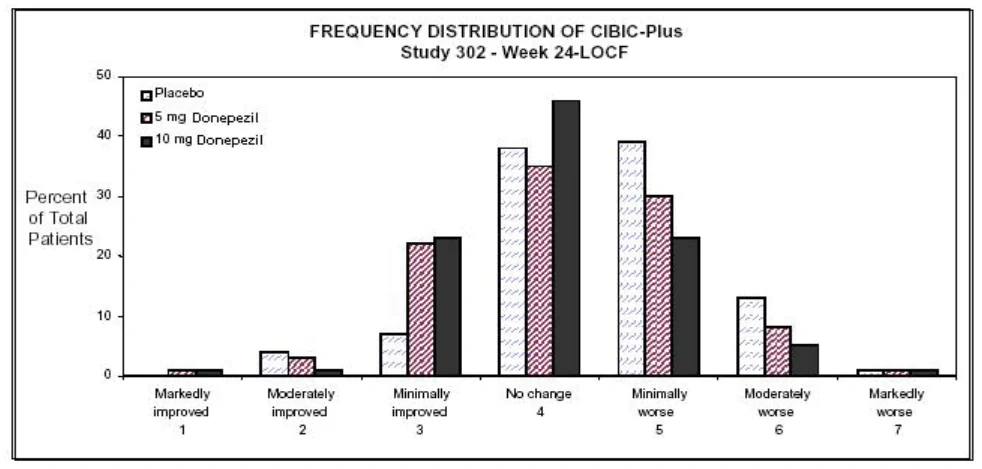
and 81% (10 mg) of donepezil hydrochloride-treated patients versus 58% placebo-treated patients showed an improvement or no evidence of deterioration (scores ≥0). A score ≥4 points in ADAS-cog was observed in 38% (5 mg) and 54% (10 mg) of donepezil-treated patients versus 27% for placebo. A ≥7 points improvement was observed in 15% (5 mg) and 25% (10 mg) of donepezil-treated patients versus 8% for placebo. The mean drug-placebo differences at Week 24-LOCF in CIBIC-Plus scores were 0.37 ± 0.12 (p <0.0047) and 0.47 ± 0.11 (p <0.0001) units for 5 and 10 mg/day of donepezil hydrochloride, respectively. Figure 1 represents the frequency distribution of CIBIC-Plus scores achieved at Week 24-LOCF by patients assigned to each of the 3 treatment groups.
Figure 1. Frequency Distribution of CIBIC-Plus Scores at Week 24-LOCF by Patients
Assigned to Each Treatment Group
For the CDR-SB, a secondary efficacy measure, significant drug-placebo differences were observed at Week 24-LOCF for both treatment groups [mean change from placebo: 5 mg = 0.59 ± 0.17 (p = 0.0008); 10 mg = 0.59 ± 0.17 (p = 0.0007)].
Study 304: A 24-Week Study
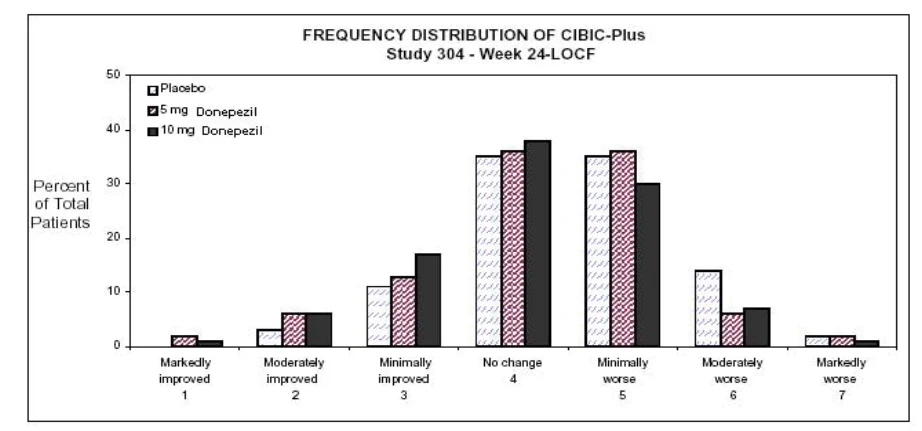
In this Phase 3 multinational study, 818 patients were randomly assigned to treatment with placebo, 5 or 10 mg/day of donepezil hydrochloride for 24 weeks followed by a 6-week, single-blind placebo washout. ADAS-Cog mean change scores for the donepezil hydrochloride-treated patients compared to the patients on placebo at Week 24-LOCF were (mean ± standard error) -1.55 ± 0.48 (p = 0.0021) and -3.01 ± 0.49 (p <0.0001) units for the 5 mg/day and 10 mg/day treatments, respectively. On the CIBIC-Plus, statistically significant mean changes scores were observed in both the donepezil hydrochloride 5 mg (0.27 ± 0.09; p = 0.0072) and 10 mg/day (0.39 ± 0.10; p = 0.0002) at Week 24-LOCF groups in comparison to the placebo-treated group. Figure 2 presents the frequency distribution of CIBIC-Plus scores achieved at Week 24–LOCF by patients assigned to each of the 3 treatment groups.
Figure 2. Frequency Distribution of CIBIC-Plus Scores Achieved at Week 24-LOCF by
Patients Assigned to Each of the 3 Treatment Groups
With respect to secondary efficacy measures, statistically significant differences over placebo were noted at Week 24-LOCF for both treatment groups in CDR-SB scores [mean change from placebo: 5 mg = 0.32 ± 0.14 (p <0.0033); 10 mg = 0.42 ± 0.14 (p <0.0344)] and for the 10 mg donepezil hydrochloride group over placebo in the IDDD-complex task measure (mean change from placebo: 2.15 ± 0.89 (p=0.0072).
Following 6 weeks of placebo washout, scores on the ADAS-cog and CIBIC-Plus for both the donepezil hydrochloride-treatment groups were indistinguishable from those patients who had received only placebo for 30 weeks. This suggests that the beneficial effects of donepezil hydrochloride abate over 6 weeks following discontinuation of treatment and therefore represents symptomatic benefits of treatments. There was no evidence of a rebound effect 6 weeks after abrupt discontinuation of therapy. This is in line with the pharmacokinetics of donepezil hydrochloride (ie, ~ 70 hour half-life) which preclude an abrupt reduction in drug plasma levels.
Overall, data from these controlled clinical trials showed that the beneficial symptomatic effects of donepezil hydrochloride versus placebo were more consistently apparent after 12 weeks of continuous treatment. Once treatment is discontinued, the effects of donepezil hydrochloride were shown to abate within 6 weeks of treatment discontinuation.
54-Week Trial in Patients with Mild to Moderate Alzheimer’s Disease
Time to Clinically-Evident Loss of Function
A double-blind, placebo-controlled, multicenter 1-year study was conducted in 432 patients with mild to moderate Alzheimer’s disease. The study assessed time to clinically-evident loss of function.
Patients were randomized to receive single daily doses of either donepezil hydrochloride (n = 214) or placebo (n = 217) for 54 weeks; treatment was initiated at 5 mg/day for 4 weeks, then maintained at 10 mg/day. The mean age of patients was 75 years with a range of 49 to 94 years. 74% of patients were >70 years. Approximately 95% of patients in both treatment groups took at least 1 concomitant medication during the study.
Functional capacities were evaluated using 2 scales: the Alzheimer’s Disease Functional Assessment and Change Scale (ADFACS) scale and the Clinical Dementia Rating (CDR). The ADFACS scale assesses basic activities of daily living (ADL), such as dressing, as well as instrumental ADLs (IADL), such as using the telephone. The CDR assesses cognition and ADLs. Patients were assessed at nine 6-week intervals, and were attrited from the study when any of the following 3 criteria were met: 1) decline in ability to perform 1 or more of the ADLs present at baseline; 2) decline in ability to perform 20% or more of IADLs present at baseline; 3) decline in CDR score. The primary outcome was the median time to “clinically-evident loss of function” for each arm (Kaplan-Meier Survival Function). The criteria provided a minimum threshold for consideration of withdrawal, with attrition ultimately left to clinical judgement.
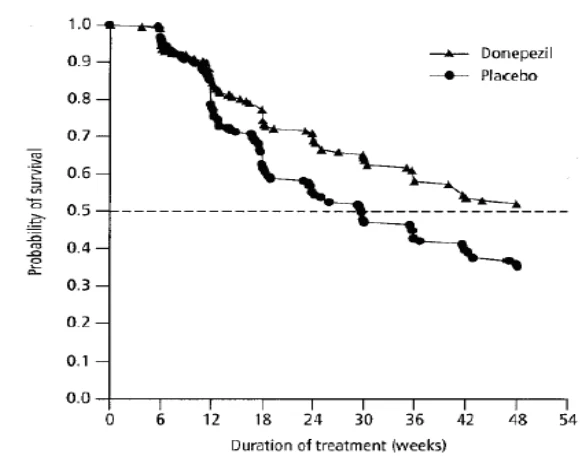
The proportion of patients attrited was significantly greater for the placebo arm (56%) in comparison to the donepezil hydrochloride arm (41%). The median time to loss of clinically-evident function in this 1-year study was significantly longer in the donepezil hydrochloride-treated patients (357 days) than in the placebo-treated patients (208 days).
Figure 3 below displays the survival curves for time to clinically-evident loss of function for both treatment groups. The vertical axis represents the probability of survival to functional decline (in other words, the proportion of individuals remaining in the study at various times following treatment initiation), and the horizontal axis indicates duration of treatment. The 2 survival curves were demonstrated to be significantly different by Wilcoxon and log rank tests, such that the overall risk of clinically-evident functional decline for patients treated with donepezil hydrochloride was approximately 62% of that of patients who received placebo (hazard ratio 0.62).
Figure 3. Survival Curves of Time to Clinically-Evident Loss of Function for Both
Treatment Groups
Study 324: A 24-Week Phase 3b Study in Patients with Moderate to Severe Alzheimer’s Disease
This 24-week, randomized, double-blind, placebo-controlled, multicentre study was conducted in 290 patients with moderate to severe Alzheimer's disease (MMSE ≥ 5 and ≤ 17; and a Functional Assessment Staging (FAST) score ≤ 6) who resided at home or in an intermediate care-assisted
living setting. For 70 % of the patients in this study, MMSE scores ranged from ≥ 10 to ≤ 17 and for 62% of patients FAST scores ranged from 4 to 5. According to standard definitions, the MMSE scores for moderate Alzheimer’s disease are ≥ 10 to ≤ 19 and the MMSE score for severe Alzheimer’s disease is ≤ 9. FAST scores for normal aging to moderate Alzheimer’s disease are < 6 and FAST scores for moderately severe to severe Alzheimer’s disease are ≥ 6.
Patients were randomized 1:1 to receive either a single daily dose of placebo or donepezil hydrochloride for 24 weeks. Patients received 5 mg/day for the first 4 weeks, after which the dose could be increased to 10 mg/day, according to clinical judgement.
The CIBIC-Plus score at the 24-week endpoint was the primary efficacy measure in this study, providing a clinical global assessment of change. For the total patient population, ranging from moderate to severe, statistically significant mean change scores were observed in the donepezil hydrochloride-treated patients in comparison to the placebo-treated patients (0.538 ± 0.117; p <0.00001).
Severe Alzheimer’s Disease
Three randomized, placebo-controlled 24-week/6 month studies were conducted in 893 patients with severe Alzheimer’s disease. In all 3 studies (Study 1017, Study 231, and Study 315) patients were diagnosed with severe Alzheimer’s disease according to NINCDS-ADRDA and DSM-IV criteria, MMSE range of 1-10 (Study 1017) or 1-12 (Study 315 and Study 231) and Functional Assessment Staging (FAST) score of 5-7c (Study 1017) or ≥ 6 (Study 231 and Study 315).
Study Outcome Measures:
The primary efficacy of treatment with donepezil hydrochloride was determined using a dual outcome assessment strategy (co-primary efficacy endpoints) that evaluated cognitive function in each of the three trials, and either clinician’s global assessment of change (Studies 315 and 231) or activities of daily living through caregiver-related evaluation (Study 1017). A statistically significant treatment difference showing superiority of donepezil hydrochloride over placebo (p=0.05) was required for each of the co-primary endpoints for the study outcome to be positive. Based on this criterion, Study 1017 and Study 231 were positive and Study 315 was negative.
The ability of donepezil hydrochloride to improve cognitive performance was assessed with the Severe Impairment Battery (SIB). The SIB is a validated and reliable, multi-item instrument that is sensitive to changes in cognitive function in patients with moderate to severe dementia. The SIB evaluates selective aspects of cognitive performance, including elements of memory, language, orientation, attention, praxis, visuospatial ability, construction, and social interaction. The SIB scoring range is from 0 to 100, with lower scores indicating greater cognitive impairment.
Clinician’s global assessment of change with donepezil hydrochloride treatment was evaluated using the Clinician’s Interview Based Impression of Change with caregiver input (CIBIC-Plus) in Study 315 and Study 231. The CIBIC-Plus evaluates 4 major areas of functioning: general, cognition, behavior and activities of daily living.
Activities of daily living were assessed using the Modified Alzheimer’s Disease Cooperative Study Activities of Daily Living Inventory for Severe Alzheimer’s Disease (ADCS-ADL-severe). Each ADL item is rated from the highest level of independent performance to complete 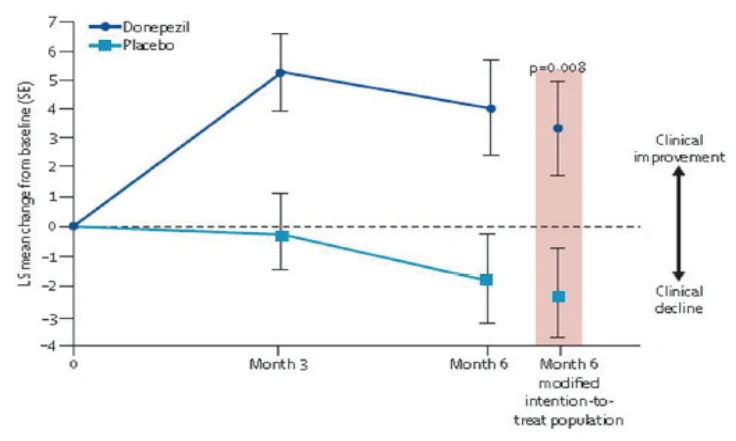
loss. The ADCS-ADL-severe is a subset of 19 items, including ratings of the patient’s ability to perform basic functions (eat, dress, bathe), complex activities (use the telephone, get around (or travel)), and other activities of daily living; it has been validated for the assessment of patients with moderate to severe dementia. The ADCS-ADL-severe has a scoring range of 0 to 54 with the lower scores indicating greater functional impairment.
Study 1017: A 24-Week Study in Patients with Severe Alzheimer’s Disease
This 6 month, randomized, double-blind, placebo-controlled study was conducted in 248 patients with severe Alzheimer’s a skilled nursing home.
Patients were randomized to receive either a single daily dose of donepezil hydrochloride or placebo for 24 weeks. For patients randomized to donepezil hydrochloride, treatment was initiated at 5 mg/day for 4 weeks, after which the dose was increased to 10 mg/day, based on clinical judgement. The mean age of patients was 84.9 years with a range of 59 to 99. Approximately 77.1% of patients were women and 22.9% were men. The racial distribution was Caucasian: 99.5% and unspecified races: 0.5%.
Co-primary endpoints for this study were the change from baseline to the Month 6 endpoint for the SIB and the ADCS-ADL-severe. Results are presented for the ITT-LOCF analysis.
At the end of the 6 month treatment period, 90.5% of the donepezil hydrochloride-treated patients were receiving the 10 mg dose.
Figure 4 shows the time course for the change from baseline in SIB score for the two treatment groups achieved across 6 months. At 6 months LOCF, the mean difference in the SIB change scores for donepezil hydrochloride-treated patients compared to placebo-treated patients was 5.7 units. Donepezil hydrochloride treatment was statistically superior to placebo (p=0.008).
Figure 4. Time Course of the Change from Baseline in SIB Score Across 24 Weeks
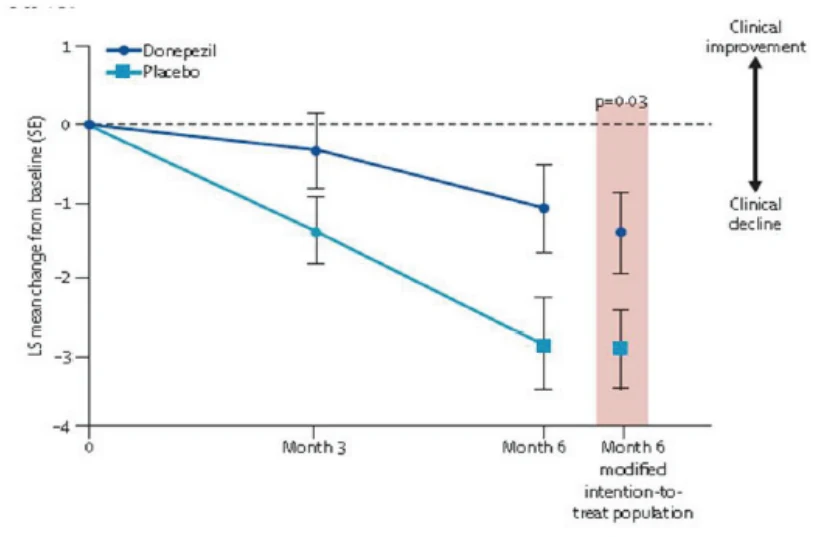
Figure 5 illustrates the time course for the change from baseline in ADCS-ADL-severe scores for patients in the two treatment groups over the 6 months of the study. Although both treatment groups showed a decline in activities of daily living at Week-24 LOCF, the mean difference in the ADCS-ADL-severe change scores for donepezil hydrochloride-treated patients compared to patients on placebo was 1.7 units. Donepezil hydrochloride treatment was statistically superior to placebo (p=0.029).
Figure 5. Time Course of the Change from Baseline in ADCS-ADL-severe Score
Across 24 Weeks
Study 231: A 24-Week Study in Patients with Severe Alzheimer’s Disease
This 24-week, randomized, double-blind, placebo-controlled study was conducted in 302 patients with severe Alzheimer’s disease and required patients to be hospital outpatients or patients attending hospitals via a nursing home. Patients were randomized to receive placebo, donepezil hydrochloride low dose or donepezil hydrochloride high dose. For the low dose, 3 mg/day were administered for the first 2 weeks, thereafter this was increased to 5 mg/day. For the high dose group, 3 mg/day were administered for the first 2 weeks, then 5 mg/day were administered for 4 weeks and from week 6 onwards, the dose was 10 mg/day. The mean age of patients was 78.2 years with a range of 53-98. The racial distribution was Asian: 100%.
Co-primary endpoints for this study were the change from baseline to the Week 24 endpoint on the SIB and the CIBIC-Plus assessment at the Week 24 endpoint. Results are presented for the ITT-LOCF analysis.
The mean difference in SIB change scores at week-24 LOCF for donepezil hydrochloride-treated patients compared to patients on placebo was 6.7 units in the donepezil hydrochloride 5 mg group and 8.9 units in the donepezil hydrochloride 10 mg group. Donepezil hydrochloride treatment was statistically superior to placebo (p<0.001).
On the CIBIC-Plus, the percentage of patients showing improvement or no change was greater for donepezil hydrochloride-treated patients than for patients treated on placebo, while the percentage of patients that worsened was greater for the patients treated on placebo. The difference in the distribution of the scores was statistically significant for the 10 mg group (p=0.003) but not for the 5 mg group (p=0.15).
Study 315: A 24-Week Study in Patients with Severe Alzheimer’s Disease
This 24-week randomized, double-blind, placebo-controlled study was conducted in 343 patients with severe Alzheimer’s disease who resided in the community or in an assisted care facility. For patients randomized to donepezil hydrochloride, treatment was initiated at 5 mg/day for 6 weeks,
after which the dose was increased to 10 mg/day, based on clinical judgement. The mean age of patients was 78.0 years with a range of 58-97. The racial distribution was Caucasian: 76.9%, black: 11.7%, Hispanic: 9.9%, and other races: 1.5%.
Co-primary endpoints for this study were the change from baseline to the Week 24 endpoint on the SIB and the CIBIC-Plus assessment at the Week 24 endpoint. Results are presented for the ITT-LOCF analysis.
At the end of the 24-week treatment period, 86% of the donepezil hydrochloride-treated patients were receiving the 10 mg dose.
The mean difference in SIB change scores at week-24 LOCF (5.3 units) indicated that donepezil hydrochloride treatment was statistically superior to placebo (p=0.0001).
On the CIBIC-Plus, the difference in the distribution of scores favored donepezil hydrochloride (i.e., a greater percentage of patients treated with donepezil hydrochloride had improvement or no change and a greater percentage of patients treated with placebo worsened), but the difference was not statistically significant.
DETAILED PHARMACOLOGY
PRECLINICAL STUDIES
Animal
Preclinical pharmacology studies indicate that donepezil hydrochloride is a reversible inhibitor of AChE in vitro exhibiting dose-dependent selectivity for AChE versus BuChE, and that it increases in vivo brain concentrations of ACh. In addition, donepezil hydrochloride was shown to improve the performance, in some learning and memory based tasks, of rodents with pharmacologically- or lesion-induced deficits in brain cholinergic function.
TOXICOLOGY
Acute Toxicity Mice and Rats:
| Acute Oral and IV Bolus Injection Studies in Mice and Rats** | |||
| Route | Species | Sex | LD50 (mg/kg) |
| Oral | Mice | M | 45.2 * |
| Oral | Mice | F | 48.1 * |
| Oral | Rats | M | 36.9 + |
| Oral | Rats | F | 32.6 + |
| IV Bolus | Mice | M | 3.7 * |
| IV Bolus | Mice | F | 4.8 * |
| IV Bolus | Rats | M | 8.0 + |
| IV Bolus | Rats | F | 7.6 + |
Comments: Following oral and IV dosing, deaths were recorded at 29.6 mg/kg and higher and 3.5 mg/kg and higher, respectively, in mice, and 28.9 mg/kg and higher and 7.7 mg/kg and higher, respectively, in rats. In mice, all deaths occurred within 30 minutes of oral or IV dosing.
The majority of deaths in rats occurred within the first 2 hours after oral administration, although a few were delayed for up to 3 days. The majority of deaths in rats after IV dosing occurred within 30 minutes, although a few were delayed for up to 2 hours. Toxic signs preceding deaths exhibited by both species were: reduced spontaneous movement, prone position, staggering gait, lacrimation (sometimes red in the rat), clonic convulsions, depressed respiration, and salivation. Toxic signs observed only in rats were: tremors, miosis, and lowered body surface temperature. These signs were also present in the surviving animals at higher doses, and with the exception of clonic convulsions in the rats, were also observed at a lower frequency and intensity in some animals from the lower dose groups. In the surviving mice, all visible toxic signs resolved within 24 hours after dose administration. In the surviving rats, these signs disappeared within 5 days following oral administration and generally disappeared within the first day after IV dosing, although in occasional survivors from the high-dose groups signs persisted for up to 3 days.
A significant brief reduction in body weight was noted in the mice during the first few days after dosing of 44.4 mg/kg and 4.6 mg/kg in the oral and IV groups, respectively. In rats, body weight was reduced in all oral administration groups, and in some groups given IV doses of 5.9 mg/kg and higher. Changes in food consumption tended to parallel changes in body weight in mice and rats.
At necropsy, petechial hemorrhages were observed in the lungs of all animals that died in both the oral and intravenous studies. These are consistent with hypoxia due to respiratory paralysis. Petechial hemorrhages were also observed in the glandular mucosa of the stomach in 1 mouse that died after administration of a 150-mg/kg oral dose and in orally-treated rats. Aside from the petechiae in the stomach, all the abnormalities observed are consistent with the known effects of ChE inhibitors. In animals that survived the observation period, no pathological changes were observed at necropsy.
Subacute Toxicity Mice:
| SPECIES | ROUTE | DOSE mg/kg/day | ANIMAL PER DOSE LEVEL | DURATION | FINDINGS |
| 2-Week Dietary Administration Study in Mice | |||||
| Crj:CD-1 | Oral Diet | 0 90 180 360 | 10/sex | 2 weeks | Administration of E2020 at doses of 90 and 180 mg/kg did not affect survival. All animals administered 360 mg/kg died before scheduled sacrifice: 2 males and 3 females in the first week, and all remaining animals in that dose group during the second week. Fasciculation was the only clinical sign noted before death. E2020 administration caused a dose-related and statistically significant depression of body weight at all doses tested. On Day 13, mean body weights in the 90 and 180 mg/kg groups, respectively, were 8% and 31% lower than controls in the males, and 4% and 22% lower than controls in the females. During Week 2, group mean food consumption in the males receiving 90 or 180 mg/kg was 6% and 37% lower than controls, respectively, and was 7% and 39% lower than controls in the females, respectively. Therefore, the depression of body weight was influenced by the decreased food consumption (which may have been due to poor palatability), and was not solely due to E2020 toxicity. At necropsy, no abnormalities related to E2020 administration were noted. No NOEL. LOEL = 90 mg/kg/day. |
| 13-Week Dietary Administration Toxicokinetic Study in Mice | |||||
| Crl:CD-1 (ICR) BR | Oral Diet | 0 15 30 60 90 | Main study 10/sex Satellite study 8/sex (controls) 36/sex | 13 weeks | E2020 did not affect survival. All abnormalities noted during daily cageside and weekly in-life physical examinations, and grossly at necropsy were incidental findings unrelated to E2020 administration. In males treated with 60 or 90 mg/kg there were statistically significant and dose-dependent increases in absolute and relative weights of the adrenals (organ-to-body and organ-to-brain). However, there was no microscopically detectable cause for the increase in adrenal weights. Statistical analysis of mean absolute body weights revealed significant decreases compared to controls in males treated with 30 mg/kg at Weeks 4 and 5; in males treated with 60 mg/kg at Weeks 2, 4 and 5; in males treated with 90 mg/kg at Weeks 2 through 4; and in females treated with 90 mg/kg at Weeks 2 and
NOEL > 30 mg/kg/day MTD > 90 mg/kg/day. |
Subacute Toxicity Rats:
| SPECIES | ROUTE | DOSE mg/kg/day | ANIMAL PER DOSE LEVEL | DURATION | FINDINGS |
| 13-Week Study in Rats | |||||
| Sprague- Dawley Rats | Oral Gavage | 0 10 20 0.3 1 3 | 20/sex 12/sex | 13 weeks | At the end of the 13-week period, 8 of 20 animals per sex from the control, 10 and 20 mg/kg groups were observed without treatment for an additional 5 weeks, and served as recovery groups. Deaths were recorded in 1 male and 3 females from the 20 mg/kg group and in 4 females from the 10 mg/kg group from Day 29 to Day 89. The deaths occurred immediately after dosing except for 1 animal which died 20 minutes postdose. Peripheral signs of cholinergic stimulation were recorded in animals receiving 3 mg/kg and higher. At 3 mg/kg, fasciculation was recorded in 3 rats on separate occasions during the first 8 days, and miosis was noted in 2 animals; these signs resolved within 24 hours of each dose administration. After the eighth day, peripheral signs were no longer present in this group, indicating adaptation to the effects of the drug. Fasciculation, hypoactivity, miosis, salivation and lacrimation were observed in the 10 or 20 mg/kg groups. Except for salivation in the 20 mg/kg group, all of these signs disappeared within 24 hours. In the 10 mg/kg group, miosis and fasciculation became less frequent with continued administration; salivation was more evident in the latter half of the treatment period. Hypoactivity was noted sporadically. No peripheral symptoms were present during the recovery period. Dose-related suppression of body weight gain was recorded in animals receiving 10 or 20 mg/kg. During recovery, body weight gains were greater in the treated animals compared to controls. Sodium excretion in the urine collected 4 to 23 hours postdose was lower in males of all dose groups, and potassium and chloride excretion also decreased in the males receiving 10 mg/kg. Sodium, potassium and chloride excretion were slightly reduced in females receiving 10 or 20 mg/kg. No effects on urinary electrolytes were found at the end of the recovery period. Macroscopic postmortem examinations: Moderate mucosal edema of the forestomach in males receiving 10 or 20 mg/kg. An increase in submaxillary gland weight was detected in both sexes receiving 10 or 20 mg/kg; this increase was not present at the end of the recovery period. (contd.) |
| SPECIES | ROUTE | DOSE mg/kg/day | ANIMAL PER DOSE LEVEL | DURATION | FINDINGS (contd.) |
Histopathologic studies: Hypertrophy of the pars intermedia of the pituitary in 7 of 21 animals in the 20 mg/kg group. Acinar cell hypertrophy of the submaxillary gland was recorded in animals receiving 3 mg/kg and higher. A moderate increase in forestomach submucosal edema was found in rats administered 10 or 20 mg/kg. At the end of recovery, no histopathologic changes were found in the pituitary or submaxillary glands; moderate edema of the forestomach was found in 2 rats receiving 10 mg/kg and 1 rat receiving 20 mg/kg. NOEL = 1 mg/kg/day. |
Subacute Toxicity Dogs:
| SPECIES | ROUTE | DOSE mg/kg/day | ANIMAL PER DOSE LEVEL | DURATION | FINDINGS |
| 13 Week Study in Dogs | |||||
Beagle Dogs (8 months) | Oral | 0 0.3 1 3 8 (reduced to 6 due to high mortality rate) | 3/sex/ group | 13 weeks | Five deaths were recorded in the 8 mg/kg group. One dog died 7 hours after the first dose and 4 others (including 1 dog killed in extremis) died 3 to 24 hours after the second dose. All these animals exhibited salivation, fasciculation, tremors and convulsions; these signs were evident within 1 hour of dosing except for the convulsions of 1 dog which developed 6 hours after dosing. Muddy or mucous stools were observed in 3 of the dogs from this group, and miosis in 1. From the animals that did not survive to scheduled sacrifice, blood chemistry was available only for the dog killed in extremis. Results showed increased levels of alkaline phosphatase, leucine aminopeptidase, gamma glutamyl transpeptidase, GPT (ALT), GOT (AST), CK, LDH, total bilirubin, urea nitrogen, and a decreased level of glucose. Most of these abnormalities were consistent with skeletal muscle damage secondary to fasciculation, tremors and convulsions. No significant histopathologic changes were noted in the liver. Slight calcium deposition in the papillae and slight necrosis of the distal tubular epithelium were the only notable histopathologic changes in the kidney. Microscopic examination showed subendocardial hemorrhage and myo-fibrillary degeneration in the left ventricular wall, papillary muscle and septum. These findings were due to acute hypoxia, ischemia from respiratory depression and/or catecholamine release caused by fasciculation, tremors and convulsions. Thus, the clinical signs and laboratory findings were consistent with excessive acetylcholinesterase inhibition as the cause of death. All remaining animals survived the full study period. Peripheral signs of tremors and fasciculation were observed at doses of 3 mg/kg and higher in these animals. The signs appeared shortly after dosing and resolved within 24 hours. Other signs observed included mucous stools, found sporadically in dogs treated with 3 mg/kg, and miosis was observed on 3 occasions during the first 7 days in 1 dog receiving 3 mg/kg. Incidence of these signs was greatly reduced by the third week of administration, suggesting adaptation to the peripheral effects of donepezil hydrochloride. Body weight and food consumption were unaffected. (contd.) |
| SPECIES | ROUTE | DOSE mg/kg/day | ANIMAL PER DOSE LEVEL | DURATION | FINDINGS (contd.) |
Ophthalmological examinations, electrocardiograms, hematological and blood chemical investigations and urinalysis showed no abnormalities attributable to donepezil hydrochloride. Drug metabolizing enzymes were also unaffected. There were no significant macroscopic findings at postmortem examination, and no microscopic abnormalities attributable to donepezil hydrochloride. Unlike the animals that died, no significant histopathologic abnormalities were observed in the hearts of dogs that survived the first two 8 mg/kg doses and were reassigned to receive 3 or 6 mg/kg for the remainder of the study. Aside from a few biochemical abnormalities encountered in the 1 female killed in extremis, all abnormal findings are consistent with expected effects of cholinesterase inhibitor treatment. The oral no-effect dose of donepezil hydrochloride was 1 mg/kg/day in dogs. |
Long Term Rats:
| SPECIES | ROUTE | DOSE mg/kg/day | ANIMAL PER DOSE LEVEL | DURATION | FINDINGS |
| 12-Month Study in Rats | |||||
Charles River CD7® Rats | Oral Gavage | 0 1.0 3.0 10 | 40/sex | 12 months | Mortality: Twenty males and 10 females died spontaneously or were killed by accident, or were sacrificed moribund. These deaths did not indicate a compound-related effect since the deaths were evenly distributed among the groups. Miosis was observed in all treated groups. The incidence of salivation was slightly higher in high-dose animals (10 mg/kg) in the first 30 weeks of dosing. Fasciculations were observed in high-dose females, but this effect was no longer apparent at the end of the 12-month dosing period. There was a treatment-related decrease in body weight in the high-dose group. In the 10 mg/kg group, beginning at Week 7 for males and Week 17 for females, mean body weights were lower than controls. The decrease at Week 53 was 11% for males and 15% for females. Based on this observation, the no-toxic-effect dose of donepezil hydrochloride in this study was 3.0 mg/kg/day. Urinalysis: Occasional effects on the diurnal pattern of electrolyte excretion were observed. However, 24-hour urinary electrolyte excretion at 6 and 12 months showed no evidence of drug effects. Histopathology: Gross postmortem examinations revealed no indication of treatment-related changes. There was a statistically significant increase in salivary gland weights in high-dose rats at Month 6 and 12, however, no changes were noted in salivary glands on histopathologic evaluation. There were differences between treated and controls in absolute organ and body weights and organ/body weight ratios, but these changes were consistent with body weight changes, and are not believed to be effects of cholinesterase inhibition. Based on the significant decrease in body weight in the high-dose group, the no-toxic-effect dose of donepezil hydrochloride administered orally for 12 months was 3.0 mg/kg/day in this study. |
Long Term Dogs:
| SPECIES | ROUTE | DOSE mg/kg/day | ANIMAL PER DOSE LEVEL | DURATION | FINDINGS |
| 12-Month Study in Beagle Dogs | |||||
| Beagle Dogs | Oral | 0 0.6 2.0 5.0 | 6/sex/ group | 2/sex for 6 months 4/sex for 12 months | Mortality: One control female died of non-treatment related causes on Day 11 of the study, all other animals survived until scheduled sacrifice. Treatment-related salivation was seen in all groups. Lacrimation (more common in males), tremors and/or hyperactivity (more common in females) were seen in the mid- and high-dose groups. Hyperactivity was also occasionally observed in the low-dose group. Food consumption in high-dose animals was significantly lower than controls during Week
Water consumption was lower in high-dose dogs than controls at the pretest evaluation and at all evaluation intervals during the study. In high-dose females, the differences in water consumption from controls were comparable during pretest and treatment. In high-dose males, water consumption during treatment was 39% to 46% lower than controls, as opposed to 21% lower during pretest, and the differences were statistically significant at Months 3 and 6, but not at Months 9 or 12. This suggests that 5.0 mg/kg/day doses of donepezil hydrochloride have an effect on water consumption in male dogs. Urinalysis: Urine volumes and total urine electrolyte values for mid- and high-dose male dogs and high-dose females were lower than controls at most of the evaluation intervals of the study, suggesting an effect of donepezil hydrochloride on urine volume and electrolytes. Histopathology: There were few hematologic and biochemistry parameters in the treatment groups that were statistically significantly different from control values. The differences seen were not consistently altered, were within the limits of normal variation, and were not considered to represent effects of donepezil hydrochloride administration. The no-toxic-effect dose in this study was 5.0 mg/kg/day. |
Mutagenicity:
| STUDY | TEST ORGANISM | DOSE | ROUTE | MAJOR FINDINGS |
Ames Test Modified Ames Test: | Salmonella typhimurium strains TA1535, TA1537, TA98 and TA100 E. Coli WP2/uvrA | up to 500 μmg/plate > 500 μg/plate | in vitro in vitro | No evidence of mutagenic activity. Not mutagenic, however suppressed growth of all bacterial strains. |
Clastogenic Potential Cytogenetic Assays: in vitro Chromosome Aberration Assay: | Chinese Hamster Lung (CHL) fibroblasts with and without metabolic activation | Non-activation: 3.1 - 50 μg/mL With activation: 11.3 - 270 μg/mL | in vitro in vitro | No chromosomal aberration produced. No chromosomal aberration produced up to and including 90 μg/mL. At concentrations of 180 and 270 μg/mL, incidence of chromosomal aberration increased in a dose-related manner in the presence of S-9 mix. In the absence of S-9 mix the incidence of chromosomal aberrations was increased at 180 μg/mL, but cell toxicity precluded evaluation at 270 μg/mL indicating that S-9 protected the cells. |
| Micronucleus Test: | Mice (Crj: -CD-1 ICR) | 2.5 mg/kg 5.0 mg/kg 10 mg/kg single or repeated (4 days) (based on study where 20 or 40 mg/kg caused death) | oral gavage | No evidence of clastogenicity in this in vivo model system. The incidences of cells with micronuclei in both the single and repeated dose groups were not significantly different from those of the vehicle control group. |
Carcinogenicity:
Full-life carcinogenicity studies of donepezil hydrochloride have been completed in mice and rats. No evidence of a tumorigenic effect was seen when donepezil hydrochloride was given in feed to mice for at least 88 weeks at doses up to 180 mg/kg/day, or to rats for at least 104 weeks at doses up to 30 mg/kg/day.
Reproduction and Teratology:
| SPECIES | ROUTE | DOSE mg/kg/day | ANIMAL PER DOSE LEVEL | DURATION | FINDINGS |
| Segment II Teratology and Reproduction Study in Rats | |||||
Rat (S1c:SD SPF) | Oral Gavage | 0 1 4 16 | 36F | 4 groups of mated females, 36 dams per group; doses from day 7-17 of gestation which correspond to the period of fetal organogenesis | Dams: At 4 and 16 mg/kg/day, 2 hours after dosing miosis, mean weight body weight gain and food consumption were significantly lower than controls. Following the 16-mg dose, fasciculations, lacrimation and salivation. Decreased placental weight; clinical signs ceased from Day 18 onwards; no mortality. Fetuses and Pups: At 16 mg/kg/day, live fetuses body weights were significantly lower than controls. No effect on survival or sex ratio of the fetuses. No evidence of teratogenic effect. However, ventricular septal defects were noted in the following number of pups per group: 1 (control group); 0 (1 mg/kg); 1 (4 mg/kg) and 5 (16 mg/kg). One stillborn pup from a dam who received 4 mg/kg donepezil showed several defects, including a ventricular septal defect. Effects on pups after drug exposure during the last third period of gestation or during the beginning of extra-uterine life were not evaluated. No effect dose: Maternal toxicity: 1 mg/kg/day Reproduction: 4 mg/kg/day dams 4 mg/kg/day fetuses >16 mg/kg/day pups |
| SPECIES | ROUTE | DOSE mg/kg/day | ANIMAL PER DOSE LEVEL | DURATION | FINDINGS |
| Segment II Teratology Study in Rabbits | |||||
| Japanese SPF white rabbits | Oral Gavage | 0 1 3 10 | 16F | 4 groups of 16 females per group; doses from day 6 – 18 of gestation which correspond to the period of fetal organogenesis | Dams: One dam in the 10 mg/kg/day group was sacrificed in extremis on Day 16 because of a dislocated lumbar vertebra. At 10 mg/kg/day, suppression of body weight gain followed by a significant increase in body weight gain from days 20-28, after cessation of drug. A significant decrease in food consumption was observed on Days 8 and 10. Treatment with donepezil hydrochloride had no effect on the number of corpora lutea, implantations, deaths or resorptions of fetuses, or on the number of live fetuses. No findings at necropsy attributable to study drug; no mortality. Fetuses: Donepezil hydrochloride had no effect on uterine survival, growth or development. No evidence of teratogenicity or embryotoxicity. In the 3 mg/kg/day group, incidence of fetuses in which a variant ateriole arose from the bifurcation site of the left common carotid artery and the brachiocephalic trunk was significantly higher than in the controls. In the 10 mg/kg/day group, the number of ossified sternebrae was significantly higher than controls, but no significant differences were noted between controls and any treated group in the numbers of ossified phalanges, or sacral or caudal vertebrae. No effect dose: Maternal toxicity: 3 mg/kg/day Reproduction: 10 mg/kg/day fetuses |
DEPENDENCE LIABILITY
7-Week Physical Dependence Study in Male Rats
Dependence liability of donepezil hydrochloride was examined in male rats and was compared to the liability of codeine, phenobarbital and vehicle (water).
Dosing in the E-2020-L group began at 6 mg/kg twice daily (BID) and increased each week by 3 mg/kg until the final dose of 18 mg/kg BID was reached. Donepezil hydrochloride-H animals were started at 10 mg/kg BID, and doses were increased by 4 mg/kg each week to a final dose of 26 mg/kg BID. Codeine was started at 10 mg/kg BID, and was increased by 10 mg/kg each week to a final dose of 50 mg/kg BID. Phenobarbital was started at 15 mg/kg BID and was increased by 15 mg/kg each week to a final dose of 75 mg/kg BID.
Results of the observation periods following dose cessation did not suggest any significant drug dependence liability for donepezil hydrochloride. Donepezil hydrochloride did not substitute for codeine or phenobarbital in rats dependent on those drugs. Under the conditions of this study, donepezil hydrochloride did not produce drug dependence.
There were no significant drug dependence liability as assessed by the primary dependence test, donepezil hydrochloride substitution test and naloxone test.
REFERENCES
- 1.
Birks J, Harvey R. Donepezil for dementia due to Alzheimer’s disease Cochrane Database
Syst Rev 2006;(1):CD01190.
- 2. Bryson M, Benfield P. Donepezil: New Drug Profile. Drugs and Aging 1997;10(3):234-9.
- 3. Burns A, Rossor M, Hecker J, et al. Donepezil in the treatment of Alzheimer’s disease - results from a multinational clinical trial. Dement Geriar Cogn Disord 1999; 10: 237- 44.
- 4. Burns A, Gauthier S, Perdomo C, et al. Donepezil provides long-term clinical benefits for patients with Alzheimer’s disease. Neurology 2000;247 Suppl 3:135 (P538).
- 5. Cummings JL, Katz IR, Tariot P, et al. Donepezil in the treatment of Alzheimer’s disease in a nursing home population. Neurology 1999;52 Suppl 2:PO6.012 (A481).
- 6. Davis KL, Mohs RC, Marin D, et al. Cholinergic markers in elderly patients with early signs of Alzheimer disease. JAMA 1999;281(15):1401-6.
- 7. Douglas RJ. The hippocampus and behavior. Psychol Bull 1967;67:416-42.
- 8. Doody RS, Geldmacher DS, Gordon B, et al. Open-label, multicenter, phase 3 extension study of the safety and efficacy of donepezil in patients with Alzheimer disease. Arch Neurol 2001;58:427-33.
- 9. Feldman H, Gauthier S, Hecker J, et al. A 24-week, randomized, double-blind study of donepezil in moderate to severe Alzheimer’s disease. Neurology 2001;57:613-20.
- 10. Feldman H, Gauthier S, Hecker J, et al. Efficacy of donepezil on maintenance of activities of daily living in patients with moderate to severe Alzheimer's disease and the effect on caregiver burden. JAGS 2003;51:737 44.
- 11. Galasko D. An integrated approach to the management of Alzheimer’s disease: assessing cognition, function and behaviour. Neurology 1999;5: S9-17.
- 12. Gauthier S, Feldman H, Hecker J, et al. Efficacy of donepezil on behavioral symptoms in patients with moderate to severe Alzheimer's disease. International Psychogeriatrics 2002;14(4);389 404.
- 13. Gauthier S, Feldman, Hecker J, et al. Functional, cognitive and behavioral effects of donepezil in patients with moderate Alzheimer's disease. Curr Med Res Opinion 2002;18(6);347 54.
- 14. Geldmacher DS, Provenzano G, McRae T, et al. Donepezil is associated with delayed nursing home placement in patients with Alzheimer's disease. JAGS 2003;51:937 44.
- 15. Johannsen P, Salmon E, Hampel H, et al. Assessing Therapeutic Efficacy in a progressive disease: A study of donepezil in Alzheimer’s disease. CNS Drugs 2006;20(4):311-25.
- 16.
Kalaria R. Similarities between Alzheimer's disease and vascular dementia. J Neurol Sci
2002; 203-204:29-34.
- 17. Lopez OL, Becker JT, Wisniewski, et al. Cholinesterase inhibitor treatment alters the natural history of alzheimer's disease. J Neurol Neurosurg Psychiatry 2002;72:310-14.
- 18. Matthews HP, Korbey J, Wilkinson DG, et al. Donepezil in Alzheimer's disease: eighteen month results from Southampton memory clinic. Int J Geriatr Psychiatry 2000;15:713-20.
- 19. McLendon BM, Doraiswamy, PM. Defining meaningful change in Alzheimer’s disease trials: The donepezil experience. J Geriatr Psychiatry Neurol 1999;12:39-48.
- 20. Mega MS, Masterman DM, O’Connor SM, et al. The spectrum of behavioral responses to cholinesterase inhibitor therapy in Alzheimer disease. Arch Neurol 1999;56(11):1388-93.
- 21. Mohs RC, Doody RS, Morris JC, et al. A 1-year placebo-controlled preservation of function survival study of donepezil in AD patients. Neurology 2001;57:481-8.
- 22.
Rogers SL, Friedhoff LT. The efficacy and safety of donepezil in patients with
Alzheimer’s disease: results of a US multicentre, randomized, double-blind, placebo-controlled trial. Dementia 1996;7:293-303.
- 23.
Rogers SL, Doody RS. Long-term efficacy and safety of donepezil in the treatment of
Alzheimer’s disease: An interim analysis of the results of a US multicentre open-label extension study. Eur Neuropsychopharmacol 1998;8:67-75.
- 24. Rogers SL, Doody RS, Pratt RD, et al. Long-term efficacy and safety of donepezil in the treatment of Alzheimer’s disease: Final analysis of a US multicentre open-label study. Eur Neuropsychopharmacol 2000;10:195-203.
- 25. Rogers SL, Doody RS, Mohs RC, et al. Donepezil improves cognition and global function in Alzheimer’s disease: A 15-week, double-blind, placebo-controlled study. Arch Int Med 1998;158:1020-31.
- 26. Rogers SL, Yamanishi Y, Yamatsu K. E2020 the pharmacology of a piperidine cholinesterase inhibitor (Advances in Alzheimer disease therapy). In: Becker R, Giocobini E, eds. Cholinergic basis for Alzheimer therapy. Boston: Birkhauser, 1991:314-20.
- 27. Rogers SL, Farlow MR, Doody RS, et al. A 24-week, double-blind, placebo-controlled trial of donepezil in patients with Alzheimer’s disease. Neur 1998;50:136-45.
- 28. Roman GC, Tatemichi TK, Erkinjuntti T, et al. Vascular dementia: diagnostic criteria for research studies – report of the NINDS-AIREN International Workshop. Neurology 1993;43:250-60.
- 29.
Rosen WG, Mohs RC, Davis K. A new rating scale for Alzheimer’s disease. Am J
Psychiatry 1984;141:1356-64.
- 30. Rosen WG, Terry R, Fuld PA, et al. Pathological verification of ischemic score in differentiation of dementias. Ann of Neurol 1980;7(5):486-88.
- 31. Standish TIM, Molloy, DW. Donepezil: A good first step in the treatment of Alzheimer’s disease. Today’s Therapeutic Trends 1998;16(4):325-40.
- 32.
Stern RG, Mohs RC, Davidson M, et al. A longitudinal study of Alzheimer's disease:
Measurement, rate, and predictors of cognitive deterioration. Am J Psychiatry 1994;151:390-6.
- 33. Tariot PN, Cummings JL, Katz IR, et al. A randomized, double-blind, placebo-controlled study of the efficacy and safety of donepezil in patients with Alzheimer’s disease in the nursing home setting. JAGS 2001;49:1590-99.
- 34. Winblad B, Engedal K, Soininen H, et al. A 1-year, randomized, placebo-controlled study of donepezil in patients with mild to moderate AD. Neurology 2001;57:489-95.
- 35. Winblad B, Kilander L, Eriksson S, et al. Donepezil in patients with severe Alzheimer's disease: double-blind, parallel-group, placebo-controlled study. Lancet 2006;367(9516):1057-65.
- 36.
Product Monograph for PrARICEPT® (donepezil hydrochloride) Tablets 5 mg and 10 mg,
Pfizer Canada Inc., Kirkland, Quebec. Submission Control No. 165061. Date of Revision: August 27, 2013.