


Patient Medication Information: uses, side effects, how to take - Eloctate
What is Eloctate used for?
- Eloctate is an injectable medicine that is used to help control and prevent bleeding in people with hemophilia A (congenital factor VIII deficiency).
How does Eloctate work?
- People with hemophilia A do not have enough natural coagulation factor VIII in their blood.
- Factor VIII is a protein produced naturally in the body. It helps the blood to form clots to stop bleeding.
- When your body does not produce enough coagulation factor VIII and you become injured, your blood will not form clots and you may bleed into and damage your muscles and joints.
- Eloctate is coagulation FVIII made using recombinant technology in a laboratory, which can be given by injection to help control and prevent bleeding in people with hemophilia A.
What are the ingredients in Eloctate?
Medicinal ingredients: Antihemophilic Factor (Recombinant BDD), Fc Fusion Protein
Non-medicinal ingredients: When reconstituted with provided diluent, the product contains sucrose, sodium chloride, L-Histidine, calcium chloride dihydrate, polysorbate 20.
Eloctate comes in the following dosage forms:
Eloctate comes as a powder in a vial. It must be reconstituted with the diluent (Sterile Water for Injection) supplied in the pre-filled syringe before use. Before reconstitution, Eloctate is available nominally in 250, 500, 750, 1000, 1500, 2000 and 3000 IU/vial.
Eloctate must be reconstituted (dissolved) before injection. After reconstitution, the actual activity level of the vial is printed in International Units on the vial and carton label. The product contains approximately 83, 167, 250, 333, 500, 667 or 1000 IU/mL, respectively.
Do not use Eloctate if:
- You are allergic to this drug or any ingredient listed above (nonmedicinal ingredients).
- The expiry date (printed on the vial) has passed. If you take this medicine after the expiry date has passed, it may not work well.
If you are not sure if you should use Eloctate, talk to your doctor.
To help avoid side effects and ensure proper use, talk to your healthcare professional before you take Eloctate. Talk about any health conditions or problems you may have, including if you:
Are pregnant or planning to become pregnant. It is not known if Eloctate may harm your unborn baby.
- Are breastfeeding. It is not known if Eloctate passes into the milk and if it can harm your baby.
- Have any allergies to this drug or its ingredients or components of the container (see Do not use Eloctate if).
Other warnings you should know about:
Allergic reactions may occur with Eloctate. Call your doctor or get emergency treatment right away if you have any of the following symptoms:
- Difficulty breathing
- Chest tightness
- Swelling of the face
- Rash
- Hives
Tell your healthcare professional about all the medicines you take, including any drugs, vitamins, minerals, natural supplements or alternative medicines.
The following may interact with Eloctate:
- There are no known interactions of Eloctate with other medications.
- Tell your doctor or pharmacist if you are taking any other medicines, including any you buy without a prescription, including natural health products.
How to take Eloctate:
The initial administration of Eloctate under proper medical supervision is recommended, where proper medical care for severe allergic reactions could be provided.
Usual dose:
Your doctor will prescribe the dose you should take. You should always follow the specific instructions given by your healthcare provider. The steps in the Preparing your dose for administration section are general guidelines for using Eloctate. If you are unsure of these procedures, please call your healthcare provider before using.
Overdose:
Talk to your doctor if you take too much Eloctate.
| If you think you, or a person you are caring for, have taken too much Eloctate, contact a healthcare professional, hospital emergency department, or regional poison control centre immediately, even if there are no symptoms. |
Missed Dose:
Talk to your doctor if you miss a dose.
Preparing your dose for administration:
Always wash your hands with soap and water before preparing the dose for administration.
Check the expiration date on the Eloctate package. Obtain a replacement package if the product has expired.
Use aseptic technique (clean and germ-free) and a flat work surface during the reconstitution procedure.
Use the diluent in the pre-filled syringe supplied in the package.
Actual factor VIII activity in International Units is stated on the label of each Eloctate carton and vial.
- 1. If refrigerated, allow the vial of Eloctate and pre-filled diluent syringe to reach room temperature before use.
- 2.
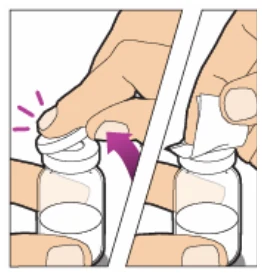
Remove the plastic cap from the Eloctate vial and wipe the rubber stopper of the vial with an alcohol wipe. Allow the rubber stopper to dry. After cleaning, do not touch the rubber stopper with your hand or allow it to touch any surface.
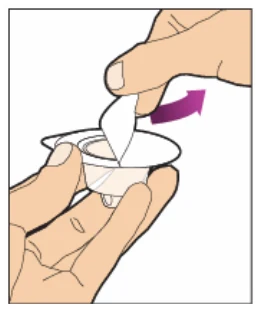
- 3. Completely remove the backing from the vial adapter package by peeling back the lid. Do not remove the vial adapter from the package or touch the inside of the package of the adapter.
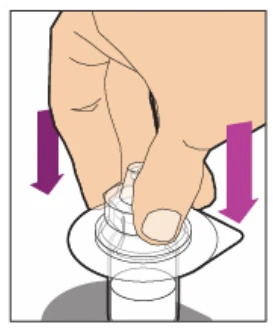
- 4. Keep the vial on a flat surface. Hold the vial adapter package with one hand and using the other hand, place the vial adapter over the vial. The spike should be placed directly above the centre of the rubber stopper. Push the vial adapter straight down until the adapter spike punctures the centre of the vial stopper and is fully inserted.
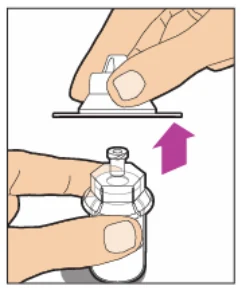
- 5. Lift the package cover away from the vial adapter and discard the cover.
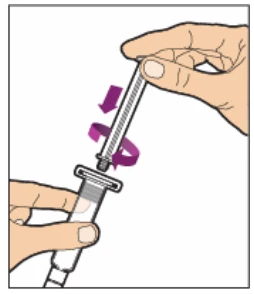
- 6. Hold the plunger rod at the circular disk. Place the tip of the plunger rod into the end of the syringe. Turn in a clockwise motion until it is securely attached. Only use the diluent syringe provided to reconstitute the drug product.
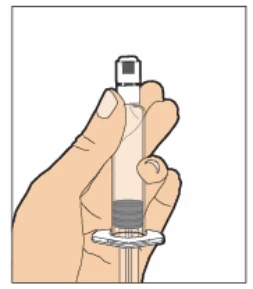
- 7. With one hand, hold the diluent syringe right under the cap, and with the cap pointing up. Make sure you are holding the diluent syringe by the ridged part directly under the cap. Do not use if the cap has been removed or is not securely attached.
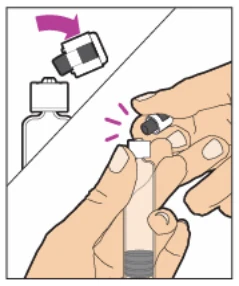
- 8. With your other hand, grasp the cap and bend it at a 90° angle until it snaps off. After the cap snaps off, you will see the glass tip of the syringe. Do not touch the glass tip of the syringe or inside of the cap.
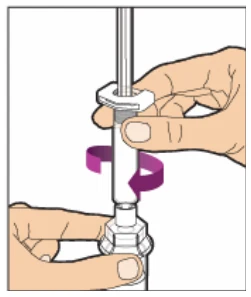
- 9. Be sure the vial is sitting on a flat surface. Insert the tip of the syringe into the adapter opening. Turn the syringe in a clockwise motion until it is securely attached to the adapter.
- 10. Slowly depress the plunger rod to inject all of the diluent into the vial. The plunger rod may rise slightly after this process. This is normal.
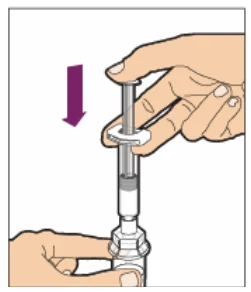
- 11. With the syringe still connected to the adapter, gently swirl the vial until the product is completely dissolved. The appearance of the solution should be clear to slightly opalescent and colorless. Do not shake. Do not use the reconstituted Eloctate if it contains visible particles or is cloudy.
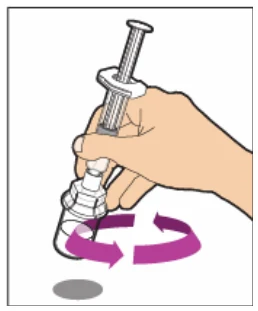
- 12. Make sure the plunger rod is completely depressed. Turn the vial upside-down. Slowly pull on the plunger rod to draw the solution into the syringe. Be careful not to pull the plunger rod completely out of the syringe.
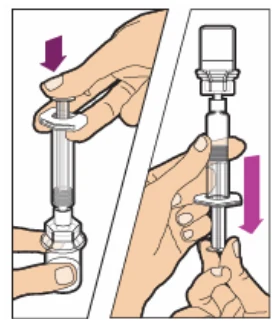
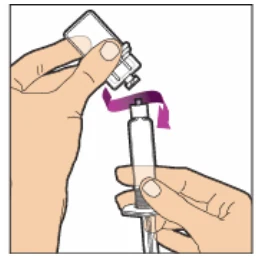
- 13. Gently unscrew the syringe from the vial adapter and dispose of the vial with the adapter still attached. Do not touch the syringe tip or the inside of the cap. Reconstituted Eloctate should be administered as soon as possible.
Pooling
If you are using two or more vials of Eloctate, you can follow these pooling steps. Be sure to leave the vial adapter attached to the vial, as you will need it for attaching a large luer lock syringe. Do not detach the diluent syringe or the large luer syringe until you are ready to attach the large luer lock syringe to the next vial (with vial adapter attached).
- 1. Remove the diluent syringe from the vial adapter by turning it counterclockwise until it is completely detached.
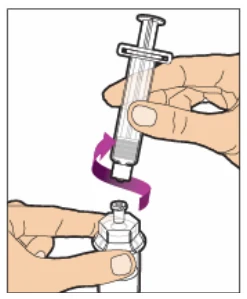
- 2. Attach a separate large luer lock syringe by turning clockwise until it is securely attached.
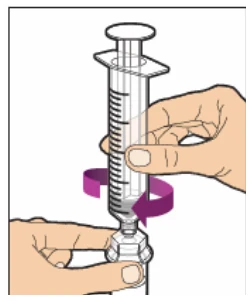
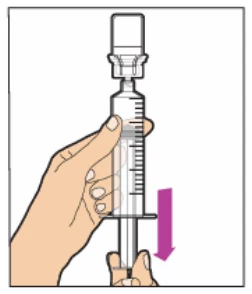
- 3. Slowly pull on the plunger rod to draw the solution into the syringe. Repeat this pooling procedure with each vial you will be using. Once you have pooled the required dose, proceed to administration using the large luer lock syringe.
Administration
For Intravenous Use only after Reconstitution
IMPORTANT: Contact your doctor or local hemophilia treatment centre if you experience any problems with this procedure.
Your doctor or hemophilia centre healthcare professional should instruct you on the proper way to self-inject the product. Please do not attempt to give yourself the injection unless you have been trained by your doctor or hemophilia centre healthcare professional.
Eloctate is administered by intravenous (IV) injection after reconstitution of the drug powder with the diluent.
Do not administer reconstituted Eloctate if it contains particulate matter, is discoloured, or is cloudy.
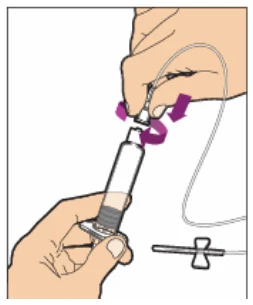
- 1. Attach the syringe to the connector end of the infusion set tubing by turning clockwise until it is securely attached. Do not administer reconstituted Eloctate in the same tubing or container with other medicinal products.
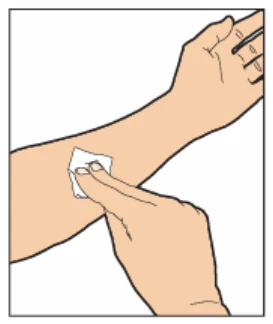
- 2. Apply a tourniquet and clean the skin area where you will perform the injection using an alcohol wipe.
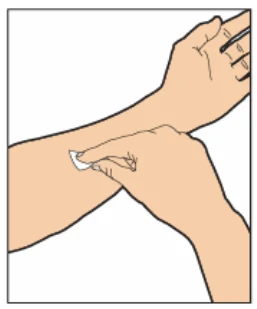
- 3. Depress the plunger until all air is removed from the syringe and Eloctate has reached the end of the infusion set tubing. Do not push Eloctate through the needle.
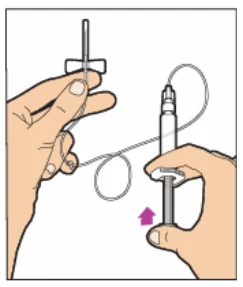
- 4. Remove the protective needle cover from the infusion set tubing. Insert the needle on the infusion set tubing into the vein. Remove the tourniquet. Always verify proper needle placement when performing intravenous administration.
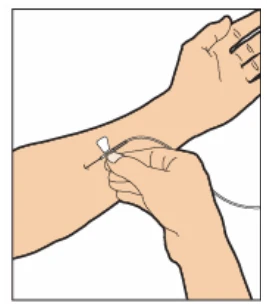
- 5. Slowly depress the plunger on the syringe to administer Eloctate. Eloctate should be injected intravenously over several minutes. The rate of administration should be determined by your comfort level. The small amount of drug product left in the infusion set will not affect treatment.
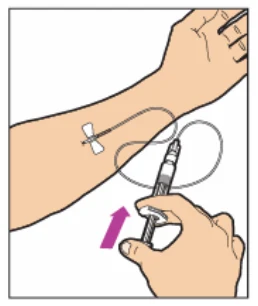
- 6. After infusing Eloctate, remove the infusion set and use a sterile gauze to put pressure on the infusion site for several minutes. Apply an adhesive bandage if necessary.
What are possible side effects from using Eloctate?
These are not all the possible side effects you may have when taking [Brand name]. If you experience any side effects not listed here, tell your healthcare professional.
These are not all the possible side effects you may feel when taking Eloctate. If you experience any side effects not listed here, contact your healthcare professional.
Allergic reactions may occur with Eloctate (see allergic reactions under To help avoid side effects and ensure proper use, talk to your healthcare professional before you take Eloctate).
Some common side effects of Eloctate are joint pain and general discomfort, muscle pain, headache and rash.
Your body can also make antibodies called ‘inhibitors’ against Eloctate. These inhibitors may stop Eloctate from working properly. Talk to your doctor right away if bleeding is not controlled after using Eloctate.
Talk to your doctor about any side effect that bothers you or that does not go away.
Serious side effects and what to do about them
| Symptom / effect | Stop taking Eloctate and call your doctor immediately |
|---|---|
| The following side effects could mean you are having an allergic reaction. | |
| Difficult breathing | √ |
| Chest tightness | √ |
| Swelling of the face, rash or hives. | √ |
If you have a troublesome symptom or side effect that is not listed here or becomes bad enough to interfere with your daily activities, tell your healthcare professional.
Reporting Side Effects
You can report any suspected side effects associated with the use of health products to Health Canada by:
NOTE: Contact your health professional if you need information about how to manage your side effects. The Canada Vigilance Program does not provide medical advice. |
Storage:
Keep the vials of Eloctate in the refrigerator at 2◦C to 8◦C.
You can keep the vials of Eloctate at room temperature at 15◦C to 30◦C for a single 6-month period.
Write the date that you take the product out of the refrigerator on the carton to help you remember. You must either use the product or dispose of it before the end of this 6-month period.
Do not freeze the product to avoid damaging the pre-filled diluent syringe.
Protect the Eloctate vials from light.
After reconstitution, you can keep the product at room temperature at 15◦C to 30◦C for six (6) hours. Protect the reconstituted product from direct sunlight. If you do not use the product within 6 hours, you must not use it. Do not use Eloctate if the reconstituted solution is not clear to slightly opalescent and colourless.
Throw away any unused Eloctate.
Do not use product or diluent after the expiry date that is shown on the label of the vial and the carton.
Keep out of reach and sight of children.
If you want more information about Eloctate:
- Talk to your healthcare professional
- Find the full product monograph that is prepared for healthcare professionals and includes this Patient Medication Information by visiting the Health Canada website: (https://www.canada.ca/en/health-canada/services/drugs-health-products/drug-products/drug-product-database.html; the manufacturer’s website www.sanofi.ca, or by calling 1-800-265-7927.