


Product Monograph - Enhertu
Recent Major Label Changes
| 1 Indications | 2026-08 |
|---|---|
| 4 Dosage and Administration, 4.1 Dosing Considerations | 2026-08 |
| 4 Dosage and Administration, 4.2 Recommended Dose and Dosage Adjustment | 2026-08 |
| 4 Dosage and Administration, 4.3 Reconstitution | 2025-10 |
| 7 Warnings and Precautions, Cardiovascular | 2026-09 |
| 7 Warnings and Precautions, Hematologic | 2026-09 |
| 7 Warnings and Precautions, Race | 2026-09 |
| 7 Warnings and Precautions, Respiratory | 2026-09 |
| 7 Warnings and Precautions, 7.1.4 Geriatrics | 2026-09 |
Table of Contents
Certain sections or subsections that are not applicable at the time of the preparation of the most recent authorized product monograph are not listed.
Recent Major Label Changes ..................................................................................................... 4
Table of Contents ........................................................................................................................ 4
Part 1: Healthcare Professional Information ............................................................................ 6
- 1.
Indications ............................................................................................................................ 6
1.1. Pediatrics .................................................................................................................... 7
1.2. Geriatrics ..................................................................................................................... 7
- 2. Contraindications ................................................................................................................ 7
- 3. Serious Warnings and Precautions Box ........................................................................... 7
- 4.
Dosage and Administration ................................................................................................ 7
4.1. Dosing Considerations ................................................................................................ 7
4.2. Recommended Dose and Dosage Adjustment ........................................................... 8
4.3. Reconstitution ........................................................................................................... 12
4.4. Administration ........................................................................................................... 13
4.5. Missed Dose ............................................................................................................. 13
- 5. Overdose ............................................................................................................................ 13
- 6. Dosage Forms, Strengths, Composition, and Packaging .............................................. 13
- 7.
Warnings and Precautions ............................................................................................... 14
Cardiovascular ..................................................................................................................... 14
Driving and Operating Machinery ........................................................................................ 14
Hematologic ......................................................................................................................... 14
Immune ................................................................................................................................ 15
Race .................................................................................................................................... 15
Reproductive Health ............................................................................................................ 15
Respiratory .......................................................................................................................... 16
7.1. Special Populations .................................................................................................. 16
Unclassified / Non classifié
7.1.1. Pregnancy ....................................................................................................... 16
7.1.2. Breastfeeding .................................................................................................. 17
7.1.3. Pediatrics ......................................................................................................... 17
7.1.4. Geriatrics ......................................................................................................... 17
- 8.
Adverse Reactions ............................................................................................................ 17
8.1. Adverse Reaction Overview ...................................................................................... 17
8.2. Clinical Trial Adverse Reactions ............................................................................... 18
8.3. Less Common Clinical Trial Adverse Reactions ....................................................... 43
8.4. Abnormal Laboratory Findings: Hematologic, Clinical Chemistry, and Other Quantitative Data ................................................................................................................. 45
- 9.
Drug Interactions ............................................................................................................... 52
9.4. Drug-Drug Interactions .............................................................................................. 52
9.5. Drug-Food Interactions ............................................................................................. 53
9.6. Drug-Herb Interactions .............................................................................................. 53
9.7. Drug-Laboratory Test Interactions ............................................................................ 53
- 10.
Clinical Pharmacology ...................................................................................................... 53
10.1. Mechanism of Action ............................................................................................. 53
10.2. Pharmacodynamics ............................................................................................... 53
10.3. Pharmacokinetics .................................................................................................. 53
10.4. Immunogenicity ..................................................................................................... 57
- 11. Storage, Stability, and Disposal ....................................................................................... 57
- 12. Special Handling Instructions .......................................................................................... 57
Part 2: Scientific Information ................................................................................................... 59
- 13. Pharmaceutical Information ............................................................................................. 59
- 14.
Clinical Trials ..................................................................................................................... 60
14.1. Clinical Trials by Indication .................................................................................... 60
HER2-Positive Breast Cancer After Neoadjuvant HER2-targeted treatment ...................... 60
HER2-Positive Breast Cancer After at Least One Prior Anti-HER2-based Regimen .......... 63
HER2-Positive Breast Cancer After Trastuzumab Emtansine ............................................. 66
HER2-Low and HER2-Ultralow Breast Cancer .................................................................... 70
Unresectable, Locally Advanced or Metastatic HER2-positive Gastric and Gastroesophageal Junction Cancer .................................................................................... 77
HER2-Positive (IHC 3+) Solid Tumours .............................................................................. 83
- 16. Non-Clinical Toxicology .................................................................................................... 87
Patient Medication Information ............................................................................................... 89
Unclassified / Non classifié
Part 1: Healthcare Professional Information
1. Indications
HER2-Positive Early Breast Cancer
ENHERTU (trastuzumab deruxtecan for injection) as monotherapy is indicated for the treatment of adult patients with high risk HER2-positive (IHC 3+ or ISH+) breast cancer who have residual invasive disease after neoadjuvant taxane-based chemotherapy and HER2-targeted treatment (trastuzumab-based treatment) (see 14 Clinical Trials).
HER2-Positive Metastatic Breast Cancer
ENHERTU as monotherapy is indicated for:
the treatment of adult patients with unresectable or metastatic human epidermal growth factor receptor 2 (HER2)-positive breast cancer who have received at least one prior anti-HER2-based regimen either
- in the metastatic setting, or
- in the neoadjuvant or adjuvant setting and developed disease recurrence during or within 6 months of completing neoadjuvant or adjuvant therapy.
- the treatment of adult patients with unresectable or metastatic HER2-positive breast cancer who have received prior treatment with trastuzumab emtansine (T-DM1).
HER2-Low and HER2-Ultralow Breast Cancer
ENHERTU as monotherapy is indicated for the treatment of adult patients with unresectable or metastatic:
- hormone receptor (HR)-positive, HER2-low (IHC 1+ or IHC 2+/ISH-) or HER2-ultralow (IHC 0 with membrane staining) breast cancer who have received at least one endocrine therapy in the metastatic setting and are not considered suitable for endocrine therapy as the next line of treatment.
HER2-low (IHC 1+ or IHC 2+/ISH-) breast cancer who have received at least one prior line of chemotherapy in the metastatic setting or developed disease recurrence during or within 6 months of completing adjuvant chemotherapy.
- Patients with hormone receptor positive (HR+) breast cancer should have received at least one and be no longer considered eligible for endocrine therapy.
HER2-Positive Gastric and Gastroesophageal Junction Cancer
ENHERTU as monotherapy is indicated for the treatment of adult patients with unresectable, locally advanced or metastatic HER2-positive gastric or gastroesophageal junction (GEJ) adenocarcinoma who have received a prior trastuzumab-based regimen.
HER2-Positive (IHC 3+) Solid Tumours
ENHERTU as monotherapy is indicated for the treatment of adult patients with unresectable or metastatic HER2-positive (IHC 3+) solid tumours who have received prior systemic treatment and have no satisfactory alternative treatment options.
Marketing authorization with conditions was based on confirmed objective response rate (ORR) and duration of response (DOR) from three single-arm studies (see 14 Clinical Trials). An improvement in survival has not yet been established.
Unclassified / Non classifié
1.1. Pediatrics
Pediatrics (<18 years of age): No data are available to Health Canada; therefore, Health Canada has not authorized an indication for pediatric use.
1.2. Geriatrics
Geriatrics (≥65 years of age): No clinically relevant differences in efficacy were observed between patients ≥65 years and those younger than 65 years. Evidence from clinical studies suggests the use in the geriatric population is associated with differences in safety. See 7.1.4 Geriatrics.
2. Contraindications
ENHERTU is contraindicated in patients who are hypersensitive to this drug or to any ingredient in the formulation, including any non-medicinal ingredient, or component of the container. For a complete listing, see 6 Dosage Forms, Strengths, Composition, and Packaging.
3. Serious Warnings and Precautions Box
|
|---|
4. Dosage and Administration
4.1. Dosing Considerations
There is a risk of medication errors between ENHERTU (trastuzumab deruxtecan) and trastuzumab or trastuzumab emtansine. In order to prevent medicinal product errors, it is important to check the vial labels to ensure that the medicinal product being prepared and administered is ENHERTU (trastuzumab deruxtecan) and not trastuzumab or trastuzumab emtansine.
HER2-Positive Breast Cancer
ENHERTU should only be used in patients with documented HER2-positive tumour status (immunohistochemistry [IHC] 3+ or in-situ hybridization [ISH] positive tumour status) (see 14 Clinical Trials).
HER2-Low or HER2-Ultralow Breast Cancer
ENHERTU should only be used in patients with documented HER2-low tumour status (IHC 1+ or IHC 2+ / ISH negative tumour status), or HER2-ultralow tumour status (IHC 0 with membrane staining (IHC >0<1+) tumour status) based on validated assays (see 14 Clinical Trials).
Unclassified / Non classifié
HER2-Positive Gastric and Gastroesophageal Junction Cancer
ENHERTU should only be used in patients with documented HER2-positive tumour status (see 14 Clinical Trials).
HER2-Positive (IHC 3+) Solid Tumours
ENHERTU should only be used in patients with documented HER2-positive (IHC 3+) tumour status (see 14 Clinical Trials).
Premedication
ENHERTU is emetogenic, which includes delayed nausea and/or vomiting (see 8 Adverse Reactions). Prior to each dose of ENHERTU, patients should be premedicated with a combination regimen of two or three medicinal products (e.g., dexamethasone with either a 5-HT3 receptor antagonist and/or an NK1 receptor antagonist, as well as other medicinal products as indicated) for prevention of chemotherapy-induced nausea and vomiting per institutional guidelines.
4.2. Recommended Dose and Dosage Adjustment
Recommended Dose
Table 1 – Recommended Dosage
| Indication | Recommended Dosage | Duration/ Timing of Treatment |
|---|---|---|
| Monotherapy | ||
| HER2-Positive high risk Early Breast Cancer – with Residual Disease Post-Neoadjuvant Treatment | 5.4 mg/kg given every 3 weeks (21-day cycle) as an intravenous infusion | 14 cycles unless disease recurrence or unacceptable toxicity |
| Metastatic HER2-positive, HER2-low, or HER2-ultralow Breast Cancer and Unresectable or Metastatic HER2-positive (IHC 3+) Solid Tumors | 5.4 mg/kg given every 3 weeks (21-day cycle) as an intravenous infusion | Until disease progression or unacceptable toxicity |
| Unresectable, Locally Advanced or Metastatic HER2-positive Gastric and Gastroesophageal Junction Cancer | 6.4 mg/kg given every 3 weeks (21-day cycle) as an intravenous infusion | Until disease progression or unacceptable toxicity |
Dosage Adjustment
Management of adverse reactions may require temporary interruption, dose reduction, or treatment discontinuation of ENHERTU per guidelines provided in Table 2 and Table 3.
ENHERTU dose should not be re-escalated after a dose reduction is made.
Unclassified / Non classifié
Table 2 – Dose Reduction Schedule
| Dose Reduction Schedule | Breast Cancer and IHC 3+ Solid Tumours | Gastric/GEJ Cancer |
|---|---|---|
| Recommended starting dose | 5.4 mg/kg | 6.4 mg/kg |
| First dose reduction | 4.4 mg/kg | 5.4 mg/kg |
| Second dose reduction | 3.2 mg/kg | 4.4 mg/kg |
| Requirement for further dose reduction | Discontinue treatment | Discontinue treatment |
Table 3 – Dose Modifications for Adverse Reactions
| Adverse Reaction | Severitya | Treatment Modification | ||
|---|---|---|---|---|
Interstitial Lung Disease (ILD)/Pneumonitis (for radiotherapy-related pneumonitis see below) | Asymptomatic ILD/Pneumonitis (Grade 1) | Interrupt ENHERTU until resolved to Grade 0, then:
| ||
| Symptomatic ILD/Pneumonitis (Grade 2 or greater) |
| |||
| Neutropenia | Grade 3 (less than 1.0-0.5 x 10⁹/L) |
| ||
| Grade 4 (less than 0.5 x 10⁹/L) |
| |||
Unclassified / Non classifié
| Adverse Reaction | Severitya | Treatment Modification | |||
|---|---|---|---|---|---|
| |||||
| Febrile Neutropenia | Absolute neutrophil count of less than 1 x 10⁹/L and temperature greater than 38.3°C or a sustained temperature of 38°C or greater for more than one hour. |
| |||
| Thrombocytopenia | Grade 3 (platelets less than 50 to 25 x 109/L) |
| |||
| Grade 4 (platelets less than 25 x 109/L) |
| ||||
| Left Ventricular Dysfunction (LVD) | Left Ventricular Ejection Fraction (LVEF) greater than 45% and absolute decrease from baseline is 10% to 20% |
| |||
| LVEF 40% to 45% | And absolute decrease from baseline is less than 10% |
| |||
| And absolute decrease from baseline is 10% to 20% |
| ||||
| LVEF less than 40% or absolute decrease from |
| ||||
Unclassified / Non classifié
| Adverse Reaction | Severitya | Treatment Modification | ||
|---|---|---|---|---|
| baseline is greater than 20% |
| |||
| Symptomatic congestive heart failure (CHF) |
| |||
| Dose Modifications for Radiotherapy-Related Pneumonitis in the Post-Neoadjuvant Early Breast Cancer Setting | ||||
Radiotherapy-Related Pneumonitis following sequential or concurrent adjuvant radiotherapy (RT) (relationship to RT should be confirmed. If drug-related ILD/Pneumonitis is suspected, see Interstitial Lung Disease (ILD)/Pneumonitis section above) | Grade 1 (asymptomatic) |
| ||
| Grade 2 (symptomatic) |
| |||
| Grade 3 or 4 (symptomatic, severe or life-threatening) |
| |||
a Toxicity grades are in accordance with National Cancer Institute Common Terminology Criteria for Adverse Events Version 5.0 (NCI-CTCAE v.5.0).
Special Populations
Pediatrics (<18 years of age): The safety and efficacy in children and adolescents below 18 years of age have not been established as there is no relevant use in the pediatric population.
Geriatrics (≥65 years of age): No dose adjustment of ENHERTU is required in patients aged 65 years or older.
Renal Impairment: No dose adjustment is required in patients with mild (creatinine clearance [CrCL] ≥60 and <90 mL/min) or moderate (CrCL ≥30 and <60 mL/min) renal impairment at baseline. A higher incidence of adverse events leading to dosage discontinuation (including ILD) has been observed in patients with moderate renal impairment. Patients with moderate renal impairment should be monitored carefully for adverse reactions including ILD/pneumonitis (see 7 Warnings and Precautions, Respiratory). Limited data are available in patients with severe renal impairment.
Hepatic Impairment: No dose adjustment is required in patients with mild (total bilirubin ≤ upper limit of normal [ULN] and any aspartate aminotransferase [AST] >ULN or total bilirubin >1 to 1.5 times ULN and any AST) hepatic impairment at baseline. There are limited data to make
Unclassified / Non classifié a recommendation on dose adjustment in patients with moderate (total bilirubin >1.5 to 3 times ULN and any AST) hepatic impairment, as there was a limited number of patients enrolled in the ENHERTU clinical trials. In patients with moderate hepatic impairment, due to potentially increased exposure, closely monitor for increased toxicities related to the topoisomerase inhibitor. No data are available in patients with severe (total bilirubin >3 times ULN and any AST) hepatic impairment.
4.3. Reconstitution
- ENHERTU does not contain preservative. Reconstitute immediately before dilution.
- More than one vial may be needed for a full dose. Calculate the dose (mg), the total volume of reconstituted ENHERTU solution required, and the number of vial(s) of ENHERTU needed.
- Reconstitute each 100 mg vial using a sterile syringe to slowly inject 5 mL of sterile water for injection into each vial to obtain a final concentration of 20 mg/mL.
- Swirl the vial gently until completely dissolved. Do not shake.
- If not used immediately, in-use storage times and conditions prior to use are the responsibility of the user and would normally not be longer than 24 hours at 2°C to 8°C.
- If reconstitution takes place in controlled and validated aseptic conditions, the reconstituted ENHERTU vials may be stored in a refrigerator at 2°C to 8°C for up to 48 hours from the time of reconstitution, protected from light. Do not freeze (see 11 Storage, Stability, and Disposal). Discard unused ENHERTU vials after 48 hours of refrigeration.
Table 4 – Reconstitution
| Vial Size | Volume of Diluent To Be Added to Vial | Approximate Available Volume | Concentration Per mL |
| 100 mg | 5 mL | 5 mL | 20 mg/mL |
Instructions for Dilution
Calculation to determine the volume of reconstituted ENHERTU (mL) to be further diluted:

- Withdraw the calculated amount from the vial(s) using a sterile syringe. Inspect the reconstituted solution for particulates and discolouration. The solution should be clear and colourless to light yellow. Do not use if visible particles are observed or if the solution is cloudy or discoloured.
- Dilute the calculated volume of reconstituted ENHERTU in an infusion bag containing 100 mL of 5% dextrose solution. Do NOT use sodium chloride solution. An infusion bag made of polyvinylchloride or polyolefin (copolymer of ethylene and polypropylene) is recommended.
- Gently invert the infusion bag to thoroughly mix the solution. Do not shake.
- Cover the infusion bag to protect from light.
If not used immediately, store at room temperature for up to 4 hours including preparation and infusion or in a refrigerator at 2°C to 8°C for up to 24 hours, protected from light. Do not
Unclassified / Non classifié
- freeze (see 11 Storage, Stability, and Disposal). Discard if storage time exceeds these limits.
- Discard any unused portion left in the vial.
4.4. Administration
Do not replace ENHERTU with trastuzumab or trastuzumab emtansine.
The initial dose should be administered as a 90-minute intravenous infusion. If the prior infusion was well tolerated, subsequent doses of ENHERTU may be administered as 30-minute infusions.
The infusion rate of ENHERTU should be slowed or interrupted if the patient develops infusion-related symptoms. ENHERTU should be permanently discontinued in case of severe infusion-related reactions.
ENHERTU is for intravenous use. It must be reconstituted and diluted by a healthcare professional and administered as an intravenous infusion. Administer ENHERTU as an intravenous infusion only with a 0.20 or 0.22 micron in line polyethersulfone (PES) or polysulfone (PS) filter. ENHERTU must NOT be administered as an intravenous push or bolus.
If the prepared infusion solution was stored refrigerated (2°C to 8°C), it is recommended that the solution be allowed to equilibrate to room temperature prior to administration protected from light.
Do not mix ENHERTU with other medicinal products or administer other medicinal products through the same intravenous line.
See 12 Special Handling Instructions for additional recommendations.
4.5. Missed Dose
If a planned dose is delayed or missed, it should be administered as soon as possible without waiting until the next planned cycle. The schedule of administration should be adjusted to maintain a 3-week interval between doses. The infusion should be administered at the dose and rate the patient tolerated in the most recent infusion.
5. Overdose
There is limited information on overdose with trastuzumab deruxtecan. In clinical studies, the highest dose administered was 8.0 mg/kg. Incidence of severe adverse events appeared higher in patients administered doses higher than the recommended dose. In the event of overdose, patients should be monitored, and appropriate supportive care should be given. There is no antidote for trastuzumab deruxtecan.
| For the most recent information in the management of a suspected drug overdose, contact your regional poison control centre or Health Canada’s toll-free number, 1-844 POISON-X (1-844-764-7669). |
|---|
- 6. Dosage Forms, Strengths, Composition, and Packaging
To help ensure the traceability of biologic products, healthcare professionals should record both the brand name and the non-proprietary (active ingredient) name as well as other product-specific identifiers such as the Drug Identification Number (DIN) and the batch/lot number of the product supplied.
Unclassified / Non classifié
Table 5 – Dosage Forms, Strengths, and Composition
7. Warnings and Precautions
Please see 3 Serious Warnings and Precautions Box.
Cardiovascular
Left Ventricular Dysfunction
Patients treated with ENHERTU may be at increased risk of developing left ventricular dysfunction (LVD). LVD has been observed with anti-HER2 therapies, including ENHERTU (see 8 Adverse Reactions).
Treatment with ENHERTU has not been studied in patients with a history of clinically significant cardiac disease or left ventricular ejection fraction (LVEF) less than 50% prior to initiation of treatment.
LVEF should be assessed prior to initiation of ENHERTU and at regular intervals during treatment as clinically indicated. LVEF decrease should be managed through treatment interruption. ENHERTU should be permanently discontinued if LVEF of less than 40% or absolute decrease from baseline of greater than 20% is confirmed. ENHERTU should be permanently discontinued in patients with symptomatic congestive heart failure (CHF) (see 4 Dosage and Administration, Table 3).
Driving and Operating Machinery
ENHERTU may impair the ability to drive and use machines as adverse reactions including fatigue, headache and dizziness have been reported. Exercise caution when driving or operating a vehicle or potentially dangerous machinery.
Hematologic
Anemia/Thrombocytopenia
In patients with gastric cancer treated with ENHERTU 6.4 mg/kg, anemia and thrombocytopenia requiring transfusion were reported in clinical studies (see 8 Adverse Reactions). Transfusions were primarily for anemia. Based on the severity of thrombocytopenia, ENHERTU may require dose interruption or reduction (see 4 Dosage and Administration, Table 3).
Neutropenia
Cases of neutropenia, including febrile neutropenia, were reported in clinical studies of ENHERTU.
Complete blood counts should be monitored prior to initiation of ENHERTU and prior to each dose, and as clinically indicated. Based on the severity of neutropenia, ENHERTU may require dose interruption or reduction (see 4 Dosage and Administration, Table 3).
| Route of Administration | Dosage Form/ Strength/Composition | Non-Medicinal Ingredients |
| Intravenous infusion | Powder for concentrate for solution for infusion/100 mg/vial | L-histidine, L-histidine hydrochloride monohydrate, polysorbate 80, sucrose |
Unclassified / Non classifié
Immune
Infusion-Related Reactions
Cases of infusion-related reactions (IRRs), including a serious case of hypersensitivity were reported in clinical studies of ENHERTU (see 8.3 Less Common Clinical Trial Adverse Reactions). ENHERTU has not been studied in patients with a history of severe hypersensitivity reactions to other monoclonal antibodies.
Patients should be monitored for IRRs. ENHERTU may require dose interruption or discontinuation, based on the severity of the IRR (see 4 Dosage and Administration).
Race
In clinical studies, no relevant differences in exposure or efficacy were observed between patients of different ethnic groups. The following differences in safety were noted in the Asian population: Asian patients (328 (60.1%) subjects in pool) with gastric cancer receiving ENHERTU 6.4 mg/kg had a higher incidence (≥10% difference) of neutropenia (61.9% vs. 36.2%), anaemia (61.6% vs. 41.7%), leukopenia (50.3% vs. 13.3%), and thrombocytopenia (47.3% vs. 17.9%) compared to non-Asian patients (218 (39.9%) subjects in pool). In Asian patients, 3.4% experienced a bleeding event within 14 days after onset of thrombocytopenia compared to 0.5% of non-Asian patients. A total of 73 (22.3%) of Asian patients received a transfusion within 28 days after onset of anemia or thrombocytopenia compared to 32 (14.7%) of non-Asian patients.
Asian patients (130 (41.8%) subjects in pool) with HER2-positive (IHC 3+) solid tumours receiving ENHERTU 5.4 mg/kg had a higher incidence (≥10% difference) of neutropenia (36.2% vs. 12.9%) and platelet count decreased (25.4% vs. 9.6%) compared to non-Asian patients (178 (58.2%) subjects in pool).
Asian patients (681 (39.1%) subjects in pool) with unresectable or metastatic breast cancer receiving ENHERTU 5.4 mg/kg had a higher incidence (≥10% difference) of neutropenia (44.5% vs. 30.5%), leukopenia (34.8% vs. 16.7%) and thrombocytopenia (30.8% vs. 18.5%) compared to White patients (878 (50.4%) subjects in pool).
Reproductive Health
Fertility
No fertility studies in women and men have been conducted with ENHERTU. Based on results from animal toxicity studies, ENHERTU may impair male reproductive function and fertility (see 16 Non-Clinical Toxicology).
Teratogenic Risk
ENHERTU can cause fetal harm when administered to a pregnant woman. Exposure to ENHERTU to a pregnant woman should be avoided (see 7.1.1 Pregnancy).
Pregnancy status of females of reproductive potential should be verified prior to initiation of ENHERTU (see 7.1 Special Populations).
Female patients of reproductive potential should be informed of the potential risks to the fetus. Female patients of reproductive potential should be advised to use effective contraception during treatment with ENHERTU and for at least 7 months following the last dose (see 7.1 Special Populations).
Unclassified / Non classifié
Male patients with female partners of reproductive potential should be advised to use effective contraception during treatment with ENHERTU and for at least 4 months following the last dose.
It is not known whether trastuzumab deruxtecan or its metabolites are found in seminal fluid. Before starting treatment, male patients should be advised to seek counseling on sperm storage. Male patients must not freeze or donate sperm throughout the treatment period, and for at least 4 months after the final dose of ENHERTU.
Respiratory
Interstitial Lung Disease/Pneumonitis
Cases of interstitial lung disease (ILD), and/or pneumonitis, have been reported with ENHERTU (see 8 Adverse Reactions). Fatal outcomes have been observed.
ILD was more frequently reported in patients with moderate renal impairment (CrCL ≥30 and <60 mL/min) at baseline (see 8 Adverse Reactions).
Patients should be advised to immediately report cough, dyspnea, fever, and/or any new or worsening respiratory symptoms. Patients should be monitored for signs and symptoms of ILD/pneumonitis. Evidence of ILD/pneumonitis should be promptly investigated. Patients with suspected ILD should be evaluated by radiographic imaging. Consultation with a pulmonologist should be considered. For asymptomatic (Grade 1) ILD/pneumonitis, consider corticosteroid treatment (e.g. >0.5 mg/kg/day prednisolone or equivalent). ENHERTU should be withheld until recovery to Grade 0 and may be resumed according to instructions in Table 3 (see 4 Dosage and Administration). For symptomatic ILD/pneumonitis (Grade 2 or greater), promptly initiate systemic corticosteroid treatment (e.g. ≥1 mg/kg/day prednisolone or equivalent) and continue for at least 14 days followed by gradual taper for at least 4 weeks. ENHERTU should be permanently discontinued in patients who are diagnosed with symptomatic (Grade 2 or greater) ILD/pneumonitis (see 4 Dosage and Administration). Patients with a history of ILD/pneumonitis or patients with moderate or severe renal impairment may be at increased risk of developing ILD/pneumonitis and should be monitored carefully (see 4 Dosage and Administration).
7.1. Special Populations
7.1.1. Pregnancy
ENHERTU can cause fetal harm when administered to a pregnant woman. There are no available data on the use of ENHERTU in pregnant women. However, in post marketing reports, use of trastuzumab, a HER2 receptor antagonist, during pregnancy resulted in cases of oligohydramnios manifesting as fatal pulmonary hypoplasia, skeletal abnormalities, and neonatal death. Based on findings in animals and its mechanism of action, the topoisomerase I inhibitor component of ENHERTU can also cause embryo fetal harm when administered to a pregnant woman (see 16 Non-Clinical Toxicology).
ENHERTU should not be administered to pregnant women and patients should be informed of the potential risks to the fetus before they become pregnant. If a patient becomes pregnant during treatment with ENHERTU or within 7 months following the last dose of ENHERTU, the patient must immediately contact her doctor and should be apprised of the possibility of harm to the fetus. See 7 Warnings and Precautions, Reproductive Health for recommendations on pregnancy test and contraception.
Unclassified / Non classifié
7.1.2. Breastfeeding
There are no data regarding the presence of ENHERTU in human milk. As human IgG is excreted in human milk, ENHERTU, a humanized IgG1 conjugated to deruxtecan (see 13 Pharmaceutical Information), may be excreted in human milk. Because of the potential for serious adverse reactions in breastfeeding infants, women should discontinue breastfeeding prior to initiating treatment with ENHERTU. Women may begin breastfeeding 7 months after concluding treatment.
7.1.3. Pediatrics
Pediatrics (< 18 years of age): No data are available to Health Canada; therefore, Health Canada has not authorized an indication for pediatric use.
7.1.4. Geriatrics
Of the 4146 patients in clinical studies across multiple tumour types treated with ENHERTU 5.4 mg/kg, 946 (22.8%) patients were 65 years or older and 186 (4.5%) patients were 75 years or older. No overall difference in efficacy within clinical trials was observed based on age. The incidence of Grade 3-4 adverse reactions observed in patients aged 65 years or older (46.1%) and younger patients (42.5%) was similar.
Of the 546 patients with gastric cancer, treated with ENHERTU 6.4 mg/kg, 45.8% were 65 years or older and 9.3% were 75 years or older. The incidence of Grade 3-4 adverse reactions observed in patients aged 65 years or older was 63.2% and in younger patients was 62.8%. The incidence of serious adverse reactions leading to drug interruptions in patients 65 years or older was 8.4% compared to 3.0% in younger patients. See 7 Warnings and Precautions, Respiratory.
Population pharmacokinetic analysis indicates that age does not have an effect on the parameters of population pharmacokinetics of trastuzumab deruxtecan.
8. Adverse Reactions
8.1. Adverse Reaction Overview
- Left Ventricular Dysfunction (see 7 Warnings and Precautions, Cardiovascular and 8.2 Clinical Trial Adverse Reactions, Select Adverse Reactions)
- Anemia/Thrombocytopenia (see 7 Warnings and Precautions, Hematologic and 8.2 Clinical Trial Adverse Reactions, Select Adverse Reactions)
- Neutropenia (see 7 Warnings and Precautions, Hematologic and 8.2 Clinical Trial Adverse Reactions, Select Adverse Reactions)
- Infusion-Related Reactions (see 7 Warnings and Precautions, Immune)
- Interstitial Lung Disease/Pneumonitis (see 7 Warnings and Precautions, Respiratory and 8.2 Clinical Trial Adverse Reactions, Select Adverse Reactions)
Of the 4146 patients in clinical studies across multiple tumour types (Study DS8201-A-J101, DESTINY-Breast01, DESTINY-Breast02, DESTINY-Breast03, DESTINY-Breast04, DESTINY-Breast05, DESTINY-Breast06, DESTINY-Breast07, DESTINY-Breast11 (monotherapy arm), DESTINY-Breast12, DESTINY-Lung01, DESTINY-Lung02, DESTINY-Lung03, DESTINY-Lung05, DESTINY-PanTumor01, DESTINY-PanTumor02, DESTINY-CRC02) treated with ENHERTU 5.4 mg/kg, the most common adverse reactions (frequency ≥20%) were nausea (70.5%), fatigue (55.5%), neutropenia (37.1%), vomiting (35.3%), anemia (33.0%), constipation (32.9%), alopecia (31.3%), diarrhea (28.5%), transaminases increased (27.9%),
Unclassified / Non classifié musculoskeletal pain (27.1%), decreased appetite (26.7%), leukopenia (23.3%), and thrombocytopenia (22.7%).
Of the 546 patients in clinical studies in gastric cancer (Study DS8201-A-J101, DESTINY-Gastric01, DESTINY-Gastric02, DESTINY-Gastric04 and DESTINY-Gastric06) treated with ENHERTU 6.4 mg/kg, the most common adverse reactions (frequency ≥20%) were nausea (57.1%), fatigue (54.4%), anemia (53.7%), neutropenia (51.6%), decreased appetite (46.2%), leukopenia (35.5%), thrombocytopenia (35.5%), diarrhea (31.5%), vomiting (30.6%), transaminases increased (27.1%), constipation (26.0%), and alopecia (21.1%).
8.2. Clinical Trial Adverse Reactions
Clinical trials are conducted under very specific conditions. Therefore, the frequencies of adverse reactions observed in the clinical trials may not reflect frequencies observed in clinical practice and should not be compared to frequencies reported in clinical trials of another drug.
HER2-Positive Early Breast Cancer
DESTINY-Breast05
The safety of ENHERTU was evaluated in DESTINY-Breast05 in 806 patients with HER2-positive breast cancer with residual invasive disease following neoadjuvant therapy who received at least one dose of ENHERTU 5.4 mg/kg. The median duration of treatment was 9.8 months (range 0.7 to 16.2) in the ENHERTU group and 9.7 months (range 0.5 to 16.6) in the trastuzumab emtansine group.
The most common adverse reactions (frequency ≥20%) in patients treated with 5.4 mg/kg ENHERTU were nausea, fatigue, neutropenia, leukopenia, constipation, vomiting, transaminase increased, anemia, thrombocytopenia, diarrhea, musculoskeletal pain, and decreased appetite. The most common serious adverse reactions (frequency ≥1%) were ILD/pneumonitis (2.6%), and thrombocytopenia (1.1%) in the ENHERTU arm. There were 2 (0.2%) patients with adverse reactions leading to death due to ILD/pneumonitis, and 1 patient (0.1%) with treatment-emergent adverse event leading to death due to respiratory tract infection.
Dose interruption due to adverse reactions occurred in 30.5% of patients treated with 5.4 mg/kg of ENHERTU. The most frequent adverse reactions (>2%) associated with dose interruptions were neutropenia (14.1%), leukopenia (6.2%), thrombocytopenia (3.6%), upper respiratory tract infection (3.1%), ILD (2.4%), fatigue (2.2%) and pyrexia (2.1%). Dose reduction occurred in 22.3% of patients treated with ENHERTU. The most frequent adverse reactions (>2%) associated with dose reduction were nausea (6.1%), fatigue (6.0%), neutropenia (4.0%) and thrombocytopenia (3.3%). Discontinuation of therapy due to an adverse reaction occurred in 8.7% of patients treated with ENHERTU. The most frequent adverse reaction (>2%) associated with permanent discontinuation was ILD (5.6%).
Among patients receiving sequential or concurrent adjuvant radiotherapy, radiation pneumonitis occurred in 31.4% of patients receiving ENHERTU 5.4 mg/kg (N=757) and 30.5% of patients receiving trastuzumab emtansine (T-DM1) 3.6 mg/kg (N=750), as reported by the investigator. Of these patients, serious radiation pneumonitis events occurred in 1.3% of patients receiving ENHERTU and 0.9% of patients receiving T-DM1. All cases in patients receiving ENHERTU and adjuvant radiotherapy were either Grade 1 (26.6%) or Grade 2 (4.9%). All cases in patients receiving T-DM1 and adjuvant radiotherapy were either Grade 1 (23.6%) or Grade 2 (6.9%).
Table 6 lists adverse reactions reported in the study.
Unclassified / Non classifié
Table 6 – Common Adverse Reactions (≥1% All Grades) reported in Patients Treated with ENHERTU in DESTINY-Breast05
| System Organ Class / Preferred Term | Trastuzumab deruxtecan 5.4 mg/kg N=806 | Trastuzumab emtansine 3.6 mg/kg N=801 | ||||||||||||
|---|---|---|---|---|---|---|---|---|---|---|---|---|---|---|
Any Grade n (%) | Grade 3-4 n (%) | Any Grade n (%) | Grade 3-4 n (%) | |||||||||||
| Blood and Lymphatic System Disorders | ||||||||||||||
| Neutropeniaa | 378 (47) | 189 (23) | 164 (20) | 36 (4) | ||||||||||
| Leukopeniab | 302 (37) | 96 (12) | 128 (16) | 16 (2) | ||||||||||
| Anemiac | 233 (29) | 23 (3) | 142 (18) | 17 (2) | ||||||||||
| Thrombocytopeniad | 213 (26) | 61 (8) | 535 (67) | 256 (32) | ||||||||||
| Lymphopeniae | 140 (17) | 77 (10) | 100 (12) | 31 (4) | ||||||||||
| Eye Disorders | ||||||||||||||
| Dry eye | 22 (3) | 0 (0) | 23 (3) | 0 (0) | ||||||||||
| Vision blurredf | 22 (3) | 0 (0) | 19 (2) | 0 (0) | ||||||||||
| Gastrointestinal Disorders | ||||||||||||||
| Nausea | 575 (71) | 36 (4) | 235 (30) | 1 (0.1) | ||||||||||
| Constipation | 258 (32) | 0 (0) | 130 (16) | 1 (0.1) | ||||||||||
| Vomiting | 250 (31) | 9 (1) | 72 (9) | 1 (0.1) | ||||||||||
| Diarrhea | 187 (23) | 10 (1) | 69 (9) | 3 (0.4) | ||||||||||
| Abdominal paing | 117 (15) | 2 (0.2) | 74 (9) | 1 (0.1) | ||||||||||
| Stomatitish | 72 (9) | 2 (0.2) | 44 (5) | 0 (0) | ||||||||||
| Dyspepsia | 63 (8) | 0 (0) | 32 (4) | 0 (0) | ||||||||||
| Gastritis | 20 (2) | 1 (0.1) | 10 (1) | 0 (0) | ||||||||||
| Abdominal distension | 14 (2) | 1 (0.1) | 20 (2) | 0 (0) | ||||||||||
| Flatulence | 12 (1) | 0 (0) | 4 (0.5) | 0 (0) | ||||||||||
| General Disorders and Administration Site Conditions | ||||||||||||||
| Fatiguei | 436 (54) | 51 (6) | 296 (37) | 8 (1) | ||||||||||
| Pyrexia | 82 (10) | 1 (0.1) | 97 (12) | 2 (0.2) | ||||||||||
| Hepatobiliary Disorders | ||||||||||||||
| Transaminases increasedj | 241 (30) | 12 (1) | 451 (56) | 55 (7) | ||||||||||
| Infections and Infestations | ||||||||||||||
| Upper respiratory tract infectionk | 146 (18) | 1 (0.1) | 133 (17) | 4 (0.5) | ||||||||||
| Investigations | ||||||||||||||
| Weight decreased | 94 (12) | 2 (0.2) | 53 (7) | 1 (0.1) | ||||||||||
| Blood alkaline phosphatase increased | 67 (8) | 0 (0) | 118 (15) | 0 (0) | ||||||||||
| Blood bilirubin increasedl | 30 (4) | 0 (0) | 84 (10) | 0 (0) | ||||||||||
| Blood creatinine increased | 21 (3) | 0 (0) | 19 (2) | 0 (0) | ||||||||||
| Metabolism and Nutrition Disorders | ||||||||||||||
| Decreased appetite | 161 (20) | 7 (0.9) | 80 (10) | 0 (0) | ||||||||||
| Hypokalemiam | 64 (8) | 12 (1) | 95 (12) | 11 (1) | ||||||||||
| Dehydration | 8 (1) | 2 (0.2) | 2 (0.2) | 0 (0) | ||||||||||
Unclassified / Non classifié
| Musculoskeletal and Connective Tissue Disorders | ||||||||
|---|---|---|---|---|---|---|---|---|
| Musculoskeletal painn | 187 (23) | 6 (0.7) | 254 (32) | 5 (0.6) | ||||
| Nervous System Disorders | ||||||||
| Headacheo | 127 (16) | 2 (0.2) | 167 (21) | 1 (0.1) | ||||
| Dizziness | 76 (9) | 2 (0.2) | 45 (6) | 0 (0) | ||||
| Dysgeusia | 30 (4) | 0 (0) | 22 (3) | 0 (0) | ||||
| Respiratory, Thoracic and Mediastinal Disorders | ||||||||
| Cough | 106 (13) | 0 (0) | 91 (11) | 0 (0) | ||||
| Interstitial lung diseasep | 77 (10) | 7 (0.9) | 13 (2) | 0 (0) | ||||
| Dyspnea | 36 (4) | 1 (0.1) | 32 (4) | 0 (0) | ||||
| Epistaxis | 31 (4) | 0 (0) | 96 (12) | 1 (0.1) | ||||
| Skin and Subcutaneous Tissue Disorders | ||||||||
| Alopecia | 125 (16) | 0 (0) | 10 (1) | 0 (0) | ||||
| Rashq | 43 (5) | 3 (0.4) | 58 (7) | 0 (0) | ||||
| Pruritus | 34 (4) | 1 (0.1) | 42 (5) | 0 (0) | ||||
| Skin hyperpigmentationr | 28 (3) | 0 (0) | 11 (1) | 0 (0) | ||||
a Grouped term of neutropenia includes PTs of neutropenia and neutrophil count decreased.
b Grouped term of leukopenia includes PTs of leukopenia and white blood cell count decreased.
c Grouped term of anemia includes PTs of anemia, hematocrit decreased, hemoglobin decreased and red blood cell count decreased.
d Grouped term of thrombocytopenia includes PTs of thrombocytopenia and platelet count decreased.
e Grouped term of lymphopenia includes PTs of lymphopenia and lymphocyte count decreased.
f Grouped term of vision blurred includes PTs of vision blurred and visual impairment.
g Grouped term of abdominal pain includes PTs of abdominal pain, abdominal discomfort, abdominal pain lower, abdominal pain upper and gastrointestinal pain.
h Grouped term of stomatitis includes PTs of stomatitis, aphthous ulcer, and mouth ulceration.
i Grouped term of fatigue includes PTs of fatigue, asthenia, malaise and lethargy.
j Grouped term of transaminases increased includes PTs of transaminases increased, alanine aminotransferase increased, aspartate aminotransferase increased, gamma-glutamyltransferase increased, hepatic function abnormal, hypertransaminasaemia, liver function test abnormal and liver function test increased.
k Grouped term of upper respiratory tract infection includes PTs of upper respiratory tract infection, influenza, influenza like illness, laryngitis, nasopharyngitis, pharyngitis, rhinitis and sinusitis.
l Grouped term of blood bilirubin increased includes PTs of blood bilirubin increased, bilirubin conjugated increased, blood bilirubin unconjugated increased and hyperbilirubinemia.
m Grouped term of hypokalemia includes PTs of hypokalemia and blood potassium decreased.
n Grouped term of musculoskeletal pain includes PTs of musculoskeletal pain, arthralgia, back pain, bone pain, limb discomfort, muscle spasms, musculoskeletal chest pain, myalgia, neck pain and pain in extremity.
o Grouped term of headache includes headache, migraine and sinus headache.
p Grouped term of interstitial lung disease includes PTs of interstitial lung disease, COVID-19 pneumonia, lung opacity, pneumocystis jirovecii pneumonia, pneumonia, pneumonitis, radiation fibrosis - lung and radiation pneumonitis. These events were adjudicated as ILD and related to the use of ENHERTU. For trastuzumab emtansine, grouped term of interstitial lung disease includes PTs of interstitial lung disease, pneumonitis, pulmonary radiation injury and radiation pneumonitis. Grade 1, Grade 2, Grade 3 and Grade 5 events were reported in 2.0%,6.5%, 0.9% and 0.2% of patients in the ENHERTU arm, respectively. No Grade 4 adjudicated drug-related ILD events were reported in either arm.
q Grouped term of rash includes PTs of rash, rash macular, rash maculo-papular, rash papular, rash pruritic and rash pustular.
Unclassified / Non classifié r Grouped term of skin hyperpigmentation PTs of skin hyperpigmentation, pigmentation disorder and skin discolouration.
HER2-Positive Metastatic Breast Cancer
DESTINY-Breast03
The safety of ENHERTU was evaluated in DESTINY-Breast03 in 257 patients with unresectable or metastatic HER2-positive breast cancer who received at least one dose of ENHERTU 5.4 mg/kg. The median duration of treatment was 14.3 months (range: 0.7 to 29.8) in the ENHERTU group and 6.9 months (range: 0.7 to 25.1) in the trastuzumab emtansine group.
The most common adverse reactions (frequency ≥20%) were nausea, fatigue, vomiting, neutropenia, alopecia, constipation, anemia, transaminases increased, musculoskeletal pain, leukopenia, decreased appetite, diarrhea, thrombocytopenia, headache, and abdominal pain. The most common serious adverse reactions (frequency >1%) were interstitial lung disease and vomiting. Fatalities due to adverse reactions occurred in 0.8% of patients including COVID-19 and sudden death (one patient each).
In DESTINY-Breast03, dose interruptions due to adverse reactions occurred in 34.2% of patients treated with ENHERTU. The most frequent adverse reactions (>2%) associated with dose interruption were neutropenia (16.7%), leukopenia (5.1%), thrombocytopenia (4.3), fatigue (4.3%), anemia (3.5%), nausea (3.1%) and interstitial lung disease (2.7%). Dose reductions occurred in 19.8% of patients treated with ENHERTU. The most frequent adverse reactions (>2%) associated with dose reduction were nausea (6.2%) neutropenia (3.5%) and fatigue (3.1%). Discontinuation of therapy due to an adverse reaction occurred in 10.5% of patients treated with ENHERTU. The most frequent adverse reaction (>2%) associated with permanent discontinuation was ILD (8.2%).
Table 7 lists adverse reactions reported in the study.
Table 7 – Common Adverse Reactions (≥1% All Grades) reported in Patients Treated with ENHERTU in DESTINY-Breast03
| System Organ Class / Preferred Term | Trastuzumab deruxtecan 5.4 mg/kg N=257 | Trastuzumab emtansine 3.6 mg/kg N=261 | |||||||||||||
|---|---|---|---|---|---|---|---|---|---|---|---|---|---|---|---|
Any Grade n (%) | Grade 3-4 n (%)** | Any Grade n (%) | Grade 3-4 n (%)** | ||||||||||||
| Blood and Lymphatic System Disorders | |||||||||||||||
| Neutropeniaa | 110 (43) | 49 (19) | 31 (12) | 8 (3) | |||||||||||
| Anemiab | 84 (33) | 19 (7) | 45 (17) | 15 (6) | |||||||||||
| Leukopeniac | 78 (30) | 17 (7) | 22 (8) | 1 (0.4) | |||||||||||
| Thrombocytopeniad | 66 (26) | 19 (7) | 139 (53) | 67 (26) | |||||||||||
| Lymphopeniae | 29 (11) | 10 (4) | 9 (3) | 3 (1) | |||||||||||
| Cardiac Disorders | |||||||||||||||
| Ejection fraction decrease | 6 (2) | 0 | 1 (0.4) | 0 | |||||||||||
| Eye Disorders | |||||||||||||||
| Vision blurred | 9 (4) | 0 | 3 (1) | 0 | |||||||||||
| Gastrointestinal Disorders | |||||||||||||||
| Nausea | 195 (76) | 17 (7) | 79 (30) | 1 (0.4) | |||||||||||
| Vomiting | 126 (49) | 4 (2) | 26 (10*) | 2 (0.8) | |||||||||||
| Constipation | 88 (34) | 0 | 51 (20) | 0 | |||||||||||
Unclassified / Non classifié
| System Organ Class / Preferred Term | Trastuzumab deruxtecan 5.4 mg/kg N=257 | Trastuzumab emtansine 3.6 mg/kg N=261 | ||||||||||||||
|---|---|---|---|---|---|---|---|---|---|---|---|---|---|---|---|---|
Any Grade n (%) | Grade 3-4 n (%)** | Any Grade n (%) | Grade 3-4 n (%)** | |||||||||||||
| Diarrhea | 75 (29) | 3 (1) | 18 (7) | 1 (0.4) | ||||||||||||
| Abdominal painf | 54 (21) | 2 (0.8) | 20 (8) | 1 (0.4) | ||||||||||||
| Stomatitisg | 51 (20) | 2 (0.8) | 14 (5) | 0 | ||||||||||||
| Dyspepsia | 29 (11) | 0 | 16 (6) | 0 | ||||||||||||
| General Disorders and Administration Site Conditions | ||||||||||||||||
| Fatigueh | 127 (49) | 15 (6) | 91 (35) | 2 (0.8) | ||||||||||||
| Hepatobiliary Disorders | ||||||||||||||||
| Transaminases increasedi | 81 (32) | 6 (2) | 121 (46) | 20 (8) | ||||||||||||
| Infections and Infestations | ||||||||||||||||
| Respiratory Infectionsj | 56 (22) | 2 (0.8) | 32 (12) | 3 (1) | ||||||||||||
| Injury, Poisoning and Procedural Complications | ||||||||||||||||
| Infusion-related reactionsk | 6 (2) | 0 | 7 (3.0) | 0 | ||||||||||||
| Investigations | ||||||||||||||||
| Weight decreased | 43 (17) | 3 (1) | 16 (6) | 1 (0.4) | ||||||||||||
| Blood alkaline phosphatase increased | 35 (14) | 1 (0.4) | 30 (11) | 0 | ||||||||||||
| Metabolism and Nutrition Disorders | ||||||||||||||||
| Decreased appetite | 75 (29) | 4 (2) | 44 (17) | 1 (0.4) | ||||||||||||
| Hypokalemial | 33 (13) | 9 (4) | 26 (10*) | 2 (0.8) | ||||||||||||
| Dehydration | 11 (4) | 1 (0.4) | 0 | 0 | ||||||||||||
| Musculoskeletal and Connective Tissue Disorders | ||||||||||||||||
| Musculoskeletal painm | 80 (31) | 3 (1) | 66 (25) | 1 (0.4) | ||||||||||||
| Nervous System Disorders | ||||||||||||||||
| Headachem | 56 (22) | 1 (0.4) | 42 (16) | 0 | ||||||||||||
| Peripheral neuropathyo | 33 (13) | 1 (0.4) | 37 (14) | 1 (0.4) | ||||||||||||
| Dizziness | 32 (12) | 1 (0.4) | 22 (8) | 0 | ||||||||||||
| Dysgeusia | 15 (6) | 0 | 8 (3) | 0 | ||||||||||||
| Respiratory, Thoracic and Mediastinal Disorders | ||||||||||||||||
| Epistaxis | 29 (11) | 0 | 42 (16) | 1 (0.4) | ||||||||||||
| Cough | 27 (11) | 1 (0.4) | 26 (10*) | 0 | ||||||||||||
| Interstitial lung diseasep | 27 (11) | 2 (0.8) | 5 (2) | 0 | ||||||||||||
| Dyspnea | 21 (8) | 1 (0.4) | 13 (5) | 0 | ||||||||||||
| Skin and Subcutaneous Tissue Disorders | ||||||||||||||||
| Alopecia | 95 (37) | 1 (0.4) | 8 (3) | 0 | ||||||||||||
| Pruritus | 21 (8) | 0 | 18 (7) | 1 (0.4) | ||||||||||||
| Rashq | 20 (8) | 0 | 27 (10) | 0 | ||||||||||||
| Skin hyperpigmentationr | 15 (6) | 0 | 0 | 0 | ||||||||||||
MedDRA = Medical Dictionary for Regulatory Activities; PT = preferred term
*Actual number prior to rounding = 9.96
**No Grade 5 adverse reactions were reported in either arm
a Grouped term of neutropenia includes PTs of neutropenia and neutrophil count decreased.
b Grouped term of anemia includes PTs of anemia, hemoglobin decreased and red blood cell count decreased.
c Grouped term of leukopenia includes PTs of leukopenia and white blood cell count decreased.
d Grouped term of thrombocytopenia includes PTs of thrombocytopenia and platelet count decreased.
Unclassified / Non classifié e Grouped term of lymphopenia includes PTs of lymphopenia and lymphocyte count decreased.
f Grouped term of abdominal pain includes PTs of abdominal pain, abdominal discomfort, abdominal pain lower, and abdominal pain upper.
g Grouped term of stomatitis includes PTs of stomatitis, aphthous ulcer, mouth ulceration, oral mucosa erosion, and oral mucosal eruption.
h Grouped term of fatigue includes PTs of fatigue, asthenia, malaise and lethargy.
i Grouped term of transaminases increased includes PTs of transaminases increased, aspartate aminotransferase increased, alanine aminotransferase increased, gamma-glutamyl transferase increased, liver function test abnormal, and hepatic function abnormal.
j Grouped term includes PTs of respiratory tract infection, lower and upper respiratory tract infection, pneumonia, influenza, influenza like illness, viral upper respiratory infection, bronchitis, and respiratory syncytial virus infection.
k Grouped term includes PTs of hypersensitivity, infusion-related reactions.
l Grouped term of hypokalemia includes PTs of hypokalemia and blood potassium decreased.
m Grouped term of musculoskeletal pain includes PTs of back pain, myalgia, pain in extremity, musculoskeletal pain, muscle spasms, bone pain, neck pain, musculoskeletal chest pain, and limb discomfort.
n Grouped term of headache includes headache and migraine.
o Grouped term includes PTs of neuropathy peripheral, peripheral sensory neuropathy, and paresthesia.
p Interstitial lung disease includes events that were adjudicated as ILD for ENHERTU: pneumonitis, interstitial lung disease, organizing pneumonia, pneumonia, and pulmonary mass. For trastuzumab emtansine: pneumonitis, interstitial lung disease, organizing pneumonia, and pulmonary embolism. Grade 1, Grade 2 and Grade 3 events were reported in 2.7%,7.0% and 0.8% of patients in the ENHERTU arm, respectively. No Grade 4 or Grade 5 adjudicated drug-related ILD events were reported in either arm.
q Grouped term of rash includes PTs of rash, rash pustular and rash maculo-papular.
r Grouped term of skin hyperpigmentation includes PTs of skin hyperpigmentation, skin discolouration, and pigmentation disorder.
DESTINY-Breast02
The safety of ENHERTU was evaluated in DESTINY-Breast02 in 404 patients with unresectable or metastatic HER2-positive breast cancer who received at least one dose of ENHERTU 5.4 mg/kg. The median duration of treatment was 11.3 months (range: 0.7 to 45.1) in the ENHERTU group and 4.6 months (range: 0.1 to 43.0) in the physician’s choice group.
The most common adverse reactions (frequency ≥20%) were nausea, fatigue, vomiting, alopecia, constipation, neutropenia, decreased appetite, anemia, diarrhea, musculoskeletal pain, transaminases increased, abdominal pain, thrombocytopenia, headache. Serious adverse reactions in >1% of patients who received ENHERTU were interstitial lung disease, vomiting, fatigue and nausea. Fatalities due to adverse events occurred in 2.5% of patients including 2 (0.5%) patients with fatal adverse reactions of ILD.
Dose interruptions due to adverse reactions occurred in 30.7% of patients treated with ENHERTU. The most frequent adverse reactions (>2%) associated with dose interruption were neutropenia (15.4%), anemia (6.2%), fatigue (5.0%), leukopenia (4.0%) and thrombocytopenia (2.5%). Dose reductions occurred in 21.8% of patients treated with ENHERTU. The most frequent adverse reactions (>2%) associated with dose reduction were fatigue (7.4%), nausea (5.7%), neutropenia (3.7%) and vomiting (2.5%). Discontinuation of therapy due to an adverse reaction occurred in 10.9% of patients treated with ENHERTU. The most frequent adverse reaction (>2%) associated with permanent discontinuation was ILD (8.7%).
Table 8 lists adverse reactions reported in the study.
Unclassified / Non classifié
Table 8 – Common Adverse Reactions (≥1% All Grades) reported in Patients Treated with ENHERTU in DESTINY-Breast02
| System Organ Class / Preferred Term | Trastuzumab deruxtecan 5.4 mg/kg N=404 | Treatment of physician’s choice N=195 | |||||||||||||
|---|---|---|---|---|---|---|---|---|---|---|---|---|---|---|---|
Any Grade n (%) | Grade 3-4 n (%) | Any Grade n (%) | Grade 3-4 n (%) | ||||||||||||
| Blood and Lymphatic System Disorders | |||||||||||||||
| Neutropeniaa | 137 (34) | 71 (18) | 23 (12) | 8 (4) | |||||||||||
| Anemiab | 118 (29) | 33 (8) | 27 (14) | 6 (3) | |||||||||||
| Thrombocytopeniac | 87 (22) | 8 (2) | 23 (12) | 4 (2) | |||||||||||
| Leukopeniad | 79 (20) | 27 (7) | 12 (6) | 0 | |||||||||||
| Lymphopeniae | 50 (12) | 19 (5) | 6 (3) | 2 (1) | |||||||||||
| Cardiac Disorders | |||||||||||||||
| Ejection fraction decrease | 17 (4) | 2 (0.5) | 1 (0.5) | 0 | |||||||||||
| Eye Disorders | |||||||||||||||
| Dry eye | 23 (6) | 1 (0.3) | 9 (5) | 0 | |||||||||||
| Vision blurredf | 12 (3) | 0 | 2 (1) | 0 | |||||||||||
| Gastrointestinal Disorders | |||||||||||||||
| Nausea | 293 (73) | 27 (7) | 73 (37) | 5 (3) | |||||||||||
| Vomiting | 152 (38) | 15 (4) | 25 (13) | 2 (1) | |||||||||||
| Constipation | 142 (35) | 1 (0.3) | 21 (11) | 1 (0.5) | |||||||||||
| Diarrhea | 109 (27) | 11 (3) | 105 (54) | 14 (7) | |||||||||||
| Abdominal paing | 88 (22) | 4 (1) | 39 (20) | 4 (2) | |||||||||||
| Dyspepsia | 48 (12) | 0 | 18 (9) | 0 | |||||||||||
| Stomatitish | 47 (12) | 4 (1) | 40 (21) | 2 (1) | |||||||||||
| General Disorders and Administration Site Conditions | |||||||||||||||
| Fatiguei | 249 (62) | 38 (9) | 72 (37) | 2 (1) | |||||||||||
| Hepatobiliary Disorders | |||||||||||||||
| Transaminases increasedj | 93 (23) | 10 (2) | 29 (15) | 3 (2) | |||||||||||
| Injury, poisoning and procedural complications | |||||||||||||||
| Infusion related reactionk | 5 (1) | 0 | 3 (2) | 0 | |||||||||||
| Investigations | |||||||||||||||
| Weight decreased | 71 (18) | 1 (0.3) | 7 (4) | 0 | |||||||||||
| Blood bilirubin increasedl | 31 (8) | 2 (0.5) | 25 (13) | 3 (2) | |||||||||||
| Blood alkaline phosphatase increased | 24 (6) | 1 (0.3) | 8 (4) | 0 | |||||||||||
| Blood creatinine increased | 8 (2) | 0 | 1 (0.5) | 0 | |||||||||||
| Metabolism and Nutrition Disorders | |||||||||||||||
| Decreased appetite | 125 (31) | 7 (2) | 35 (18) | 1 (0.5) | |||||||||||
| Hypokalemiam | 33 (8) | 12 (3) | 13 (7) | 5 (3) | |||||||||||
| Dehydration | 11 (3) | 3 (0.7) | 3 (2) | 1 (0.5) | |||||||||||
| Musculoskeletal and Connective Tissue Disorders | |||||||||||||||
| Musculoskeletal painn | 101 (25) | 3 (1) | 35 (18) | 1 (0.5) | |||||||||||
| Nervous System Disorders | |||||||||||||||
| Headacheo | 82 (20) | 1 (0.3) | 12 (6) | 0 | |||||||||||
| Dizziness | 33 (8) | 1 (0.3) | 13 (7) | 0 | |||||||||||
| Dysgeusia | 33 (8) | 0 | 12 (6) | 0 | |||||||||||
Unclassified / Non classifié
| System Organ Class / Preferred Term | Trastuzumab deruxtecan 5.4 mg/kg N=404 | Treatment of physician’s choice N=195 | ||||||||||
|---|---|---|---|---|---|---|---|---|---|---|---|---|
Any Grade n (%) | Grade 3-4 n (%) | Any Grade n (%) | Grade 3-4 n (%) | |||||||||
| Respiratory, Thoracic and Mediastinal Disorders | ||||||||||||
| Cough | 53 (13) | 0 | 20 (10) | 0 | ||||||||
| Interstitial lung diseasep | 42 (10) | 3 (0.7) | 1 (0.5) | 1 (0.5) | ||||||||
| Dyspnea | 34 (8) | 1 (0.3) | 32 (16) | 0 | ||||||||
| Epistaxis | 33 (8) | 0 | 8 (4) | 0 | ||||||||
| Skin and Subcutaneous Tissue Disorders | ||||||||||||
| Alopecia | 150 (37) | 1 (0.3) | 8 (4) | 0 | ||||||||
| Rashq | 34 (8) | 0 | 32 (16) | 0 | ||||||||
| Pruritus | 22 (6) | 0 | 8 (4) | 0 | ||||||||
| Skin hyperpigmentationr | 21 (5) | 0 | 8 (4) | 0 | ||||||||
CTCAE = Common Terminology Criteria for Adverse Events, version 5.0; MedDRA = Medical Dictionary for Regulatory Activities, version 25.0; PT = preferred term
a Grouped term of neutropenia includes PTs of neutropenia and neutrophil count decreased.
b Grouped term of anemia includes PTs of anemia, hemoglobin decreased and red blood cell count decreased.
c Grouped term of thrombocytopenia includes PTs of thrombocytopenia and platelet count decreased.
d Grouped term of leukopenia includes PTs of leukopenia and white blood cell count decreased.
e Grouped term of lymphopenia includes PTs of lymphopenia and lymphocyte count decreased.
f Grouped term of vision blurred includes PTs of Vision blurred and Visual impairment.
g Grouped term of abdominal pain includes PTs of abdominal pain, abdominal discomfort, gastrointestinal pain, abdominal pain lower, and abdominal pain upper.
h Grouped term of stomatitis includes PTs of stomatitis, aphthous ulcer and mouth ulceration.
i Grouped term of fatigue includes PTs of fatigue, asthenia, malaise, and lethargy
j Grouped term of transaminases increased includes PTs of transaminases increased, alanine aminotransferase increased, aspartate aminotransferase increased, gamma-glutamyl transferase increased, hepatic function abnormal, liver function test increased, and hypertransaminasemia.
k Grouped term of upper respiratory tract infection includes PTs of upper respiratory tract infection, influenza, influenza like illness, nasopharyngitis, pharyngitis, sinusitis, rhinitis, and laryngitis.
l Grouped term of blood bilirubin increased includes PTs of Blood bilirubin increased, Hyperbilirubinemia, Bilirubin conjugated increased, and Blood bilirubin unconjugated increased.
m Grouped term of hypokalemia includes PTs of hypokalemia and blood potassium decreased.
n Grouped term of musculoskeletal pain includes PTs of back pain, myalgia, pain in extremity, musculoskeletal pain, muscle spasms, bone pain, neck pain, musculoskeletal chest pain, and limb discomfort
o Grouped term of headache includes PTs of headache and migraine.
p Grouped term of interstitial lung disease includes events that were adjudicated as drug-related ILD: interstitial lung disease, pneumonitis, lung disorder, pneumonia, idiopathic interstitial pneumonia, pulmonary toxicity, acute interstitial pneumonia and organizing pneumonia.
q Group term of rash includes PTs of Rash, Rash pustular, Rash maculo-papular, Rash papular, Rash macular, and Rash pruritic.
r Group term of skin hyperpigmentation includes PTs of Skin hyperpigmentation, Skin discolouration, and Pigmentation disorder.
DESTINY-Breast01 and Study DS8201-A-J101
The safety of ENHERTU has been evaluated in a pooled analysis of 234 patients with unresectable or metastatic HER2-positive breast cancer who received at least one dose of ENHERTU 5.4 mg/kg in DESTINY-Breast01 and Study DS8201-A-J101 (see 14 Clinical Trials).
Unclassified / Non classifié
The median duration of treatment was 9.8 months (range: 0.7 to 37.1).
The most common adverse reactions (frequency ≥20%) were nausea, fatigue, vomiting, alopecia, constipation, decreased appetite, anemia, neutrophil count decreased, diarrhea, cough, leukopenia, headache and platelet count decreased (Table 9). Serious adverse reactions occurred in 20% of patients receiving ENHERTU. Serious adverse reactions in >1% of patients who received ENHERTU were interstitial lung disease, vomiting, nausea, and hypokalemia. Fatalities due to adverse events occurred in 5.1% of patients including interstitial lung disease (2.6%).
Dose interruptions due to adverse reactions occurred in 25% of patients treated with ENHERTU. The most frequent adverse reactions (>2%) associated with dose interruption were neutropenia (14.5%), anemia (3.4%), upper respiratory tract infection (3.0%), leukopenia (3.0%), interstitial lung disease (2.6%), thrombocytopenia (2.6%), and fatigue (2.1%). Dose reductions occurred in 15% of patients treated with ENHERTU. The most frequent adverse reactions (>2%) associated with dose reduction were fatigue (3.8%), nausea (3.4%), and neutropenia (3.4%). Discontinuation of therapy due to an adverse reaction occurred in 11% of patients treated with ENHERTU. The most frequent adverse reaction (>2%) associated with permanent discontinuation was interstitial lung disease (9.4%).
Table 9 lists adverse reactions, with incidences regardless of investigators assessment of causality, reported in this patient population.
Table 9 – Common Adverse Reactions (≥ 10% All Grades or ≥ 2% Grades 3 or 4) Reported in DESTINY-Breast01 and DS8201-A-J101
| System Organ Classa / Preferred Term | Trastuzumab deruxtecan 5.4 mg/kg N=234 | |
|---|---|---|
All Grades n (%) | Grades 3 or 4 n (%) | |
| Blood and Lymphatic System Disorders | ||
| Anemiab | 79 (34) | 21 (9) |
| Neutropeniac | 76 (32) | 44 (19) |
| Thrombocytopeniad | 54 (23) | 10 (4) |
| Leukopeniae | 48 (21) | 13 (6) |
| Lymphopeniaf | 26 (11) | 12 (5) |
| Eye disorders | ||
| Dry eye | 27 (12) | 1 (0.4) |
| Gastrointestinal Disorders | ||
| Nausea | 187 (80) | 16 (7) |
| Vomiting | 114 (49) | 10 (4) |
| Constipation | 84 (36) | 2 (0.9) |
| Diarrhea | 72 (31) | 6 (3) |
| Abdominal Paing | 46 (20) | 3 (1) |
| Stomatitish | 35 (15) | 2 (0.9) |
| Dyspepsia | 33 (14) | 0 |
| General Disorders and Administration Site Conditions | ||
| Fatiguei | 141 (60) | 15 (6) |
Unclassified / Non classifié
| System Organ Classa / Preferred Term | Trastuzumab deruxtecan 5.4 mg/kg N=234 | |
|---|---|---|
All Grades n (%) | Grades 3 or 4 n (%) | |
| Infections and infestations | ||
| Upper respiratory tract infectionsj | 43 (18) | 15 (6) |
| Investigations | ||
| Aspartate aminotransferase increased | 35 (15) | 2 (0.9) |
| Alanine aminotransferase increased | 25 (11) | 3 (1) |
| Nervous System Disorders | ||
| Headachek | 47 (20) | 0 |
| Dizziness | 25 (11) | 0 |
| Metabolism and Nutrition Disorders | ||
| Decreased appetite | 81 (35) | 3 (1) |
| Hypokalemia | 30 (13) | 8 (3) |
| Respiratory, Thoracic and Mediastinal Disorders | ||
| Cough | 50 (21) | 0 |
| Dyspnea | 34 (15) | 4 (2) |
| Epistaxis | 33 (14) | 0 |
| Interstitial lung diseasel | 32 (14) | 1 (0.4) |
| Skin and Subcutaneous Tissue Disorders | ||
| Alopecia | 108 (46) | 1 (0.4) |
| Rashm | 30 (13) | 1 (0.4) |
N=number of patients exposed; MedDRA = Medical Dictionary for Regulatory Activities; PT = preferred term.
a Based on MedDRA version 20.1; events were graded using NCI-CTCAE version 4.03.
b Grouped term of anemia includes PTs of anemia, hemoglobin decreased, red blood cell count decreased, and hematocrit decreased.
c Grouped term of neutropenia includes PTs of neutropenia and neutrophil count decreased.
d Grouped term of thrombocytopenia includes PTs of thrombocytopenia and platelet count decreased.
e Grouped term of leukopenia includes PTs of leukopenia and white blood cell count decreased.
f Grouped term of lymphopenia includes PTs of lymphopenia and lymphocyte count decreased.
g Grouped term of abdominal pain includes PTs of abdominal discomfort, gastrointestinal pain, abdominal pain, abdominal pain lower, and abdominal pain upper.
h Grouped term of stomatitis includes PTs of stomatitis, aphthous ulcer, mouth ulceration, oral mucosa erosion, and oral mucosal blistering.
i Grouped term of fatigue includes PTs of fatigue and asthenia.
j Upper respiratory tract infection (grouped term) includes PTs of upper respiratory tract infection, influenza, and influenza-like illness.
k Grouped term of headache includes PTs of headache, sinus headache, and migraine.
l. Interstitial lung disease includes events that were adjudicated as ILD: pneumonitis, interstitial lung disease, respiratory failure, organizing pneumonia, acute respiratory failure, lung infiltration, lymphangitis, and alveolitis; includes 6 (2.6%) fatal events.
m Grouped term of rash includes PTs of rash, rash pustular, and rash maculo-papular.
Unclassified / Non classifié
HER2-Low and HER2-Ultralow Breast Cancer
DESTINY-Breast04
The safety of ENHERTU was evaluated in DESTINY-Breast04 in 371 patients with unresectable or metastatic HER2-low (IHC 1+ or IHC 2+/ISH-) breast cancer who received at least one dose of ENHERTU 5.4 mg/kg. The median duration of treatment was 8.2 months (range: 0.2 to 33.3) in the ENHERTU group and 3.5 months (range: 0.3 to 17.6) in the chemotherapy group.
The most common adverse reactions (frequency ≥20%) were nausea, fatigue, vomiting, alopecia, anemia, constipation, neutropenia, transaminases increased, decreased appetite, diarrhea, musculoskeletal pain, thrombocytopenia, and leukopenia. The most common serious adverse reactions (frequency >1%) were ILD/pneumonitis, dyspnea, musculoskeletal pain, anemia, febrile neutropenia, nausea, pyrexia, and vomiting. There were 5 (1.3%) patients with adverse reactions leading to death, 3 attributed to ILD (0.8%) and 1 (0.3%) each for dyspnea and febrile neutropenia.
Dose interruptions due to adverse reactions occurred in 26% of patients treated with ENHERTU. The most frequent adverse reactions (>2%) associated with dose interruption were neutropenia (9.2%), fatigue (5.1%), anemia (4.6%), leukopenia (3.5%), ILD/pneumonitis (3.0%), transaminases increased (3.0%), and blood bilirubin increased (2.2%). Dose reductions occurred in 20% of patients treated with ENHERTU. The most frequent adverse reactions (>2%) associated with dose reduction were fatigue (4.6%), nausea (4.6%), thrombocytopenia (3.5%), and neutropenia (3.0%). Discontinuation of therapy due to an adverse reaction occurred in 11% of patients treated with ENHERTU. The most frequent adverse reaction (>2%) associated with permanent discontinuation was ILD/pneumonitis (8.4%).
Table 10 lists adverse reactions reported in the study.
Table 10 – Common Adverse Reactions (≥1% All Grades) Reported in Patients Treated with ENHERTU in DESTINY-Breast04
| System Organ Classa / Preferred Term | Trastuzumab deruxtecan 5.4 mg/kg N=371 | Chemotherapy N=172 | |||||||||||||
Any Grade n (%) | Grade 3-4 n (%) | Any Grade n (%) | Grade 3-4 n (%) | ||||||||||||
| Blood and Lymphatic System Disorders | |||||||||||||||
| Anemiab | 143 (39) | 38 (10) | 47 (27) | 9 (5) | |||||||||||
| Neutropeniac | 126 (34) | 52 (14) | 90 (52) | 71 (41) | |||||||||||
| Thrombocytopeniad | 95 (26) | 22 (6) | 16 (9) | 1 (0.6) | |||||||||||
| Leukopeniae | 89 (24) | 25 (7) | 56 (33) | 33 (19) | |||||||||||
| Lymphopeniaf | 32 (9) | 20 (5) | 13 (8) | 6 (3) | |||||||||||
| Febrile neutropenia | 4 (1) | 3 (0.8) | 6 (3) | 6 (3) | |||||||||||
| Cardiac Disorders | |||||||||||||||
| Ejection fraction decreased | 16 (4) | 1 (0.3) | 0 | 0 | |||||||||||
| Eye Disorders | |||||||||||||||
| Vision blurredg | 18 (5) | 0 | 5 (3) | 0 | |||||||||||
| Gastrointestinal Disorders | |||||||||||||||
| Nausea | 282 (76) | 17 (5) | 52 (30) | 0 | |||||||||||
| Vomiting | 150 (40) | 6 (2) | 23 (13) | 0 | |||||||||||
| Constipation | 126 (34) | 3 (0.8) | 38 (22) | 0 | |||||||||||
| Diarrhea | 100 (27) | 5 (1) | 38 (22) | 3 (2) | |||||||||||
| Abdominal painh | 65 (18) | 2 (0.5) | 23 (13) | 0 | |||||||||||
Unclassified / Non classifié
| System Organ Classa / Preferred Term | Trastuzumab deruxtecan 5.4 mg/kg N=371 | Chemotherapy N=172 | |||||||||||||
Any Grade n (%) | Grade 3-4 n (%) | Any Grade n (%) | Grade 3-4 n (%) | ||||||||||||
| Stomatitisi | 49 (13) | 1 (0.3) | 19 (11) | 1 (0.6) | |||||||||||
| Abdominal distension | 20 (5) | 0 | 5 (3) | 1 (0.6) | |||||||||||
| Gastritis | 10 (3) | 1 (0.3) | 1 (0.6) | 0 | |||||||||||
| Flatulence | 9 (2) | 0 | 0 | 0 | |||||||||||
| General Disorders and Administration Site Conditions | |||||||||||||||
| Fatiguej | 199 (54) | 32 (9) | 83 (48) | 8 (5) | |||||||||||
| Pyrexia | 46 (12) | 1 (0.3) | 22 (13) | 0 | |||||||||||
| Hepatobiliary Disorders | |||||||||||||||
| Transaminases increasedk | 120 (32) | 21 (6) | 54 (31) | 17 (10) | |||||||||||
| Infections and Infestations | |||||||||||||||
| Upper respiratory tract infectionl | 51 (14) | 1 (0.3) | 9 (5) | 0 | |||||||||||
| Investigations | |||||||||||||||
| Weight decreased | 60 (16) | 1 (0.3) | 14 (8) | 0 | |||||||||||
| Blood alkaline phosphatase increased | 36 (10) | 1 (0.3) | 5 (3) | 0 | |||||||||||
| Metabolism and Nutrition Disorders | |||||||||||||||
| Decreased appetite | 118 (32) | 9 (2) | 33 (19) | 2 (1) | |||||||||||
| Hypokalemiam | 41 (11) | 10 (3) | 13 (8) | 2 (1) | |||||||||||
| Dehydration | 7 (2) | 1 (0.3) | 2 (1) | 0 | |||||||||||
| Musculoskeletal and Connective Tissue Disorders | |||||||||||||||
| Musculoskeletal painn | 99 (27) | 5 (1) | 45 (26) | 0 | |||||||||||
| Nervous System Disorders | |||||||||||||||
| Headacheo | 55 (15) | 1 (0.3) | 11 (6) | 0 | |||||||||||
| Peripheral Neuropathyp | 50 (13) | 0 | 50 (29) | 9 (5) | |||||||||||
| Dizzinessq | 39 (11) | 2 (0.5) | 11 (6) | 0 | |||||||||||
| Dysgeusia | 37 (10) | 0 | 16 (9) | 1 (0.6) | |||||||||||
| Respiratory, Thoracic and Mediastinal Disorders | |||||||||||||||
| Interstitial lung diseaser | 45 (12) | 5 (1) | 1 (0.6) | 0 | |||||||||||
| Epistaxis | 39 (11) | 0 | 2 (1) | 0 | |||||||||||
| Dyspnea | 38 (10) | 5 (1) | 16 (9) | 2 (1) | |||||||||||
| Cough | 36 (10) | 0 | 14 (8) | 0 | |||||||||||
| Skin and Subcutaneous Tissue Disorders | |||||||||||||||
| Alopecia | 147 (40) | 0 | 57 (33) | 0 | |||||||||||
| Rashs | 40 (11) | 0 | 15 (9) | 1 (0.6) | |||||||||||
| Pruritus | 12 (3) | 1 (0.3) | 7 (4) | 0 | |||||||||||
| Skin hyperpigmentationt | 10 (3) | 0 | 1 (0.6) | 0 | |||||||||||
MedDRA = Medical Dictionary for Regulatory Activities, version 24.0; PT = preferred term
a National Cancer Institute Common Terminology Criteria for Adverse Events v.5.0 (NCI CTCAE v.5.0)
b Grouped term of anemia includes anemia, hemoglobin decreased, hematocrit decreased, and red blood cell count decreased.
c Grouped term of neutropenia includes neutropenia and neutrophil count decreased.
d Grouped term of thrombocytopenia includes thrombocytopenia and platelet count decreased.
e Grouped term of leukopenia includes leukopenia and white blood cell count decreased.
f Grouped term of lymphopenia includes lymphopenia and lymphocyte count decreased.
g Grouped term of vision blurred includes vision blurred and visual impairment.
Unclassified / Non classifié h Grouped term of abdominal pain includes PTs of abdominal pain, abdominal discomfort, gastrointestinal pain, abdominal pain lower, and abdominal pain upper.
i Grouped term of stomatitis includes stomatitis, aphthous ulcer, mouth ulceration, oral mucosa erosion, oral mucosal blistering, and oral mucosal eruption.
j Grouped term of fatigue includes fatigue, asthenia, malaise and lethargy.
k Grouped term of transaminases increased includes transaminases increased, aspartate aminotransferase increased, alanine aminotransferase increased, gamma-glutamyl transferase increased, liver function test abnormal, and hepatic function abnormal.
l Grouped term of upper respiratory tract infection includes upper respiratory tract infection, influenza, influenza like illness, nasopharyngitis, pharyngitis, sinusitis, and rhinitis.
m Grouped term of hypokalemia includes hypokalemia and blood potassium decreased.
n Grouped term of musculoskeletal pain includes back pain, myalgia, pain in extremity, musculoskeletal pain, muscle spasms, bone pain, neck pain, musculoskeletal chest pain, and limb discomfort.
o Grouped term of headache includes headache, migraine, and sinus headache.
p Group term of peripheral neuropathy includes neuropathy peripheral, peripheral sensory neuropathy, peripheral motor neuropathy, polyneuropathy, paresthesia, hypoesthesia, dysesthesia, and neuralgia.
q Grouped term of dizziness includes dizziness, dizziness postural and vertigo.
r Interstitial lung disease includes events that were adjudicated as ILD for ENHERTU: pneumonitis, interstitial lung disease, organizing pneumonia, pneumonia, and radiation pneumonitis. Grade 1, Grade 2 and Grade 3 events were reported in 3.5%, 6.5% and 1.3% of patients in the ENHERTU arm, respectively. No Grade 4 events were reported in the ENHERTU arm. Grade 5 adjudicated drug-related ILD events were in 0.8% of patients in the ENHERTU arm.
s Grouped term of rash includes rash, rash pustular, rash maculo-papular, rash papular, rash macular, and rash pruritic.
t Grouped term includes skin hyperpigmentation, skin discolouration, and pigmentation disorder.
DESTINY-Breast06
The safety of ENHERTU was evaluated in DESTINY-Breast06 in 434 patients with unresectable or metastatic HER2-low (IHC 1+ or IHC 2+/ISH-) or HER2-ultralow (IHC 0 with membrane staining) breast cancer who received at least one dose of ENHERTU 5.4 mg/kg. The median duration of treatment was 11.02 months (range: 0.4 to 39.6) in the ENHERTU group and 5.62 months (range: 0.1 to 35.9) in the chemotherapy group.
The most common adverse reactions (frequency ≥20%) in patients treated with ENHERTU were nausea, fatigue, alopecia, neutropenia, anemia, transaminases increased, diarrhea, vomiting, constipation, decreased appetite, leukopenia, COVID-19 and musculoskeletal pain. The most common serious adverse reactions (frequency >1%) were ILD, COVID-19, febrile neutropenia, hypokalemia. Three patients (0.7%) experienced fatal adverse reactions due to adjudicated drug-related interstitial lung disease (ILD). In addition, general physical health deterioration, neutropenic sepsis, and sepsis (0.2% each) were reported as drug-related fatal adverse reactions.
Dose interruptions due to adverse reactions occurred in 41.7% of patients treated with ENHERTU. The most frequent adverse reactions (>2%) associated with dose interruption were COVID-19 (15.4%), neutropenia (14.3%), upper respiratory tract infection (4.4%), anemia (3.5%), leukopenia (3.5%), pyrexia (2.8%), transaminases increased (2.8%), ILD (2.8%), fatigue (2.5%), and pneumonia (2.3%). Dose reductions occurred in 22.4% of patients treated with ENHERTU. The most frequent adverse reactions (>2%) associated with dose reduction were fatigue (5.8%), nausea (4.4%), neutropenia (3.2%), and thrombocytopenia (2.3%). Discontinuation of therapy due to an adverse reaction occurred in 9.4% of patients treated with
Unclassified / Non classifié
ENHERTU. The most frequent adverse reaction (>2%) associated with permanent discontinuation was ILD (6.5%).
Table 11 lists adverse reactions reported in the study.
Table 11 – Common Adverse Reactions (≥1% All Grades) Reported in Patients Treated with ENHERTU in DESTINY-Breast06
| System Organ Class / Preferred Term | Trastuzumab deruxtecan 5.4 mg/kg N=434 | Chemotherapy N=417 | ||||||||||||||
Any Grade n (%) | Grade 3-4 n (%) | Any Grade n (%) | Grade 3-4 n (%) | |||||||||||||
| Blood and Lymphatic System Disorders | ||||||||||||||||
| Neutropeniaj | 169 (39) | 96 (22) | 128 (31) | 71 (17) | ||||||||||||
| Anemiab | 162 (37) | 38 (9) | 110 (26) | 18 (4) | ||||||||||||
| Leukopeniag | 105 (24) | 31 (7) | 70 (17) | 25 (6) | ||||||||||||
| Thrombocytopeniam | 86 (20) | 20 (5) | 21 (5) | 1 (0.2) | ||||||||||||
| Lymphopeniah | 47 (11) | 14 (3) | 16 (4) | 2 (0.5) | ||||||||||||
| Febrile neutropenia | 5 (1) | 5 (1) | 5 (1) | 4 (1) | ||||||||||||
| Cardiac Disorders | ||||||||||||||||
| Ejection fraction decrease | 35 (8) | 3 (0.7) | 12 (3) | 1 (0.2) | ||||||||||||
| Eye Disorders | ||||||||||||||||
| Dry eye | 28 (6) | 0 | 18 (4) | 0 | ||||||||||||
| Vision blurredq | 23 (5) | 0 | 11 (3) | 0 | ||||||||||||
| Gastrointestinal Disorders | ||||||||||||||||
| Nausea | 303 (70) | 9 (2) | 126 (30) | 2 (0.5) | ||||||||||||
| Diarrhea | 148 (34) | 10 (2) | 114 (27) | 11 (3) | ||||||||||||
| Vomiting | 146 (34) | 6 (1) | 49 (12) | 1 (0.2) | ||||||||||||
| Constipation | 137 (32) | 3 (0.7) | 62 (15) | 2 (0.5) | ||||||||||||
| Abdominal paina | 86 (20) | 2 (0.5) | 58 (14) | 1 (0.2) | ||||||||||||
| Stomatitisl | 64 (15) | 0 | 46 (11) | 2 (0.5) | ||||||||||||
| Dyspepsia | 50 (12) | 0 | 20 (5) | 0 | ||||||||||||
| Abdominal distension | 21 (5) | 0 | 16 (4) | 1 (0.2) | ||||||||||||
| Flatulence | 10 (2) | 0 | 4 (1) | 0 | ||||||||||||
| General Disorders and Administration Site Conditions | ||||||||||||||||
| Fatigued | 229 (53) | 19 (4) | 166 (40) | 10 (2) | ||||||||||||
| Pyrexia | 52 (12) | 1 (0.2) | 30 (7) | 0 | ||||||||||||
| Edema peripheral | 36 (8) | 0 | 59 (14) | 1 (0.2) | ||||||||||||
| Hepatobiliary Disorders | ||||||||||||||||
| Transaminases increasedn | 159 (37) | 18 (4) | 63 (15) | 2 (0.5) | ||||||||||||
| Infections and Infestations | ||||||||||||||||
| COVID-19o | 113 (26) | 4 (0.9) | 54 (13) | 4 (1) | ||||||||||||
| Upper respiratory tract infectionp | 81 (19) | 0 | 39 (9) | 0 | ||||||||||||
| Pneumonia | 20 (5) | 1 (0.2) | 9 (2) | 3 (0.7) | ||||||||||||
| Injury, poisoning and procedural complications | ||||||||||||||||
| Infusion related reaction | 5 (1) | 1 (0.2) | 3 (0.7) | 1 (0.2) | ||||||||||||
| Investigations | ||||||||||||||||
| Blood alkaline phosphatase increased | 48 (11) | 2 (0.5) | 17 (4) | 1 (0.2) | ||||||||||||
| Blood bilirubin increasedc | 32 (7) | 2 (0.5) | 23 (6) | 1 (0.2) | ||||||||||||
Unclassified / Non classifié
| System Organ Class / Preferred Term | Trastuzumab deruxtecan 5.4 mg/kg N=434 | Chemotherapy N=417 | |||||||||||||
Any Grade n (%) | Grade 3-4 n (%) | Any Grade n (%) | Grade 3-4 n (%) | ||||||||||||
| Weight decreased | 32 (7) | 0 | 8 (2) | 0 | |||||||||||
| Blood creatinine increased | 7 (2) | 3 (0.7) | 7 (2) | 0 | |||||||||||
| Metabolism and Nutrition Disorders | |||||||||||||||
| Decreased appetite | 114 (26) | 6 (1) | 48 (12) | 2 (0.5) | |||||||||||
| Hypokalemiaf | 57 (13) | 20 (5) | 17 (4) | 6 (1) | |||||||||||
| Dehydration | 7 (2) | 0 | 5 (1) | 1 (0.2) | |||||||||||
| Musculoskeletal and Connective Tissue Disorders | |||||||||||||||
| Musculoskeletal paini | 102 (24) | 2 (0.5) | 94 (23) | 8 (2) | |||||||||||
| Nervous System Disorders | |||||||||||||||
| Headachee | 76 (18) | 2 (0.5) | 43 (10) | 0 | |||||||||||
| Dysgeusia | 51 (12) | 1 (0.2) | 24 (6) | 0 | |||||||||||
| Dizziness | 37 (9) | 0 | 26 (6) | 1 (0.2) | |||||||||||
| Respiratory, Thoracic and Mediastinal Disorders | |||||||||||||||
| Cough | 69 (16) | 0 | 38 (9) | 0 | |||||||||||
| Interstitial lung diseaser | 49 (11) | 3 (0.7) | 1 (0.2) | 0 | |||||||||||
| Epistaxis | 44 (10) | 0 | 15 (4) | 1 (0.2) | |||||||||||
| Dyspnea | 27 (6) | 0 | 41 (10) | 1 (0.2) | |||||||||||
| Skin and Subcutaneous Tissue Disorders | |||||||||||||||
| Alopecia | 210 (48) | 0 | 87 (21) | 2 (0.5) | |||||||||||
| Rashk | 37 (9) | 1 (0.2) | 39 (9) | 1 (0.2) | |||||||||||
| Pruritus | 17 (4) | 0 | 11 (3) | 0 | |||||||||||
ADR = adverse drug reaction; CTCAE = Common Terminology Criteria for Adverse Events, version 5.0; MedDRA = Medical Dictionary for Regulatory Activities, version 26.1; N = total number of subjects treated; PT = preferred term.
Percentages were calculated using the number of subjects in the Safety Analysis Set as the denominator.
If a subject had multiple occurrences of the same ADR, the subject was counted once for that specific ADR.
a Abdominal pain (grouped term) includes PTs of abdominal discomfort, abdominal pain, abdominal pain lower, abdominal pain upper, gastrointestinal pain.
b Anemia (grouped term) includes PTs of anemia, hematocrit decreased, hemoglobin decreased, red blood cell count decreased.
c Blood bilirubin increased (grouped term) includes PTs of bilirubin conjugated increased, blood bilirubin increased, blood bilirubin unconjugated increased, hyperbilirubinemia.
d Fatigue (grouped term) includes PTs of asthenia, fatigue, lethargy, malaise.
e Headache (grouped term) includes PTs of headache, migraine.
f Hypokalemia (grouped term) includes PTs of blood potassium decreased, hypokalemia.
g Leukopenia (grouped term) includes PTs of leukopenia, white blood cell count decreased.
h Lymphopenia (grouped term) includes PTs of lymphocyte count decreased, lymphopenia.
i Musculoskeletal pain (grouped term) includes PTs of back pain, bone pain, limb discomfort, muscle spasms, musculoskeletal chest pain, musculoskeletal pain, myalgia, neck pain, pain in extremity.
j Neutropenia (grouped term) includes PTs of neutropenia, neutrophil count decreased.
k Rash (grouped term) includes PTs of rash, rash macular, rash maculo-papular, rash papular, rash pruritic, rash pustular.
l Stomatitis (grouped term) includes PTs of aphthous ulcer, mouth ulceration, stomatitis.
m Thrombocytopenia (grouped term) includes PTs of platelet count decreased, thrombocytopenia.
n Transaminases increased (grouped term) includes PTs of alanine aminotransferase increased, aspartate aminotransferase increased, gamma-glutamyl transferase increased, hepatic function abnormal, hypertransaminasemia, liver function test increased, transaminases increased.
Unclassified / Non classifié
o COVID-19 (grouped term) includes PTs of COVID-19, COVID-19 pneumonia.
p Upper respiratory tract infection (grouped term) includes PTs of influenza, influenza like illness, laryngitis, nasopharyngitis, pharyngitis, rhinitis, sinusitis, upper respiratory tract infection.
q Vision blurred (grouped term) includes PTs of vision blurred, visual impairment.
r Interstitial lung disease (grouped term) includes PTs of bronchiectasis (n=1), interstitial lung disease (n=24), lower respiratory tract infection (n=1), pneumonia (n=1), pneumonia bacterial (n=1), pneumonitis (n=20), pulmonary toxicity (n=1). These events were adjudicated as ILD and related to use of ENHERTU. Grade 1, Grade 2 and Grade 3 events were reported in 1.6%, 8.3% and 0.7% of patients in the ENHERTU arm, respectively. No Grade 4 events were reported in the ENHERTU arm. Grade 5 adjudicated drug-related ILD events were in 0.7% of patients in the ENHERTU arm.
HER2-Positive Unresectable, Locally Advanced or Metastatic Gastric and Gastroesophageal Junction Cancer
DESTINY-Gastric04
The safety of ENHERTU was evaluated in DESTINY-Gastric04 in 244 patients with HER2-positive locally advanced, unresectable, or metastatic gastric or GEJ adenocarcinoma who received at least one dose of ENHERTU 6.4 mg/kg. The median duration of treatment was 5.4 months (range: 0.7 to 30.3) in the ENHERTU group and 4.6 months (range: 0.9 to 34.9) in the ramucirumab plus paclitaxel group.
The most common adverse reactions in patients treated with ENHERTU 6.4 mg/kg (frequency ≥20%) were fatigue (57.8%), nausea (52.9%), neutropenia (49.6%), anemia (49.2%), decreased appetite (40.2%), diarrhea (35.2%), transaminases increased (28.3%), leukopenia (27.5%), thrombocytopenia (27.5%), constipation (27.0%), vomiting (26.2%), alopecia (25.0%) and abdominal pain (23.0%). The most common serious adverse reactions (frequency >1%) were anemia (4.9%), pneumonia (4.1%), vomiting (3.7%), febrile neutropenia (2.5%), abdominal pain (2.0%), dyspnea (2.0%), ILD (2.0%), fatigue (1.6%), neutropenia (1.6%), pyrexia (1.6%), decreased appetite (1.2%), hypokalemia (1.2%), leukopenia (1.2%), nausea (1.2%), and thrombocytopenia (1.2%). There were 2 (0.8%) patients with adverse reactions leading to death, one attributed to dyspnea (0.4%) and one attributed to pneumonia (0.4%).
Dose interruptions due to adverse reactions occurred in 46.7% of patients treated with 6.4 mg/kg of ENHERTU. The most frequent adverse reactions (>2%) associated with dose interruption were neutropenia (12.7%), anemia (10.7%), fatigue (8.6%), ILD (7.0%), thrombocytopenia (3.7%), nausea (3.3%), pneumonia (3.3%), hypokalemia (2.9%), pyrexia (2.9%) and leukopenia (2.5%). Dose reductions occurred in 28.7% of patients treated with ENHERTU. The most frequent adverse reactions (>2%) associated with dose reduction were neutropenia (8.2%), nausea (6.1%), fatigue (4.5%), thrombocytopenia (4.5%), decreased appetite (3.3%), anemia (2.5%) and febrile neutropenia (2.5%). Discontinuation of therapy due to an adverse reaction occurred in 9.0% of patients treated with ENHERTU. The most frequent adverse reaction (>2%) associated with permanent discontinuation was ILD (6.6%).
Table 12 lists adverse reactions reported in the study.
Unclassified / Non classifié
Table 12 – Common Adverse Reactions (≥1% All Grades) in Patients Treated with ENHERTU in DESTINY-Gastric04
| System Organ Classa / Preferred Term | Trastuzumab deruxtecan N=244 | Ramucirumab plus paclitaxel N=233 | |||||||||||||
Any Grade n (%) | Grade 3-4 n (%) | Any Grade n (%) | Grade 3-4 n (%) | ||||||||||||
| Blood and Lymphatic System Disorders | |||||||||||||||
| Neutropeniab | 121 (50) | 72 (30) | 117 (50) | 84 (36) | |||||||||||
| Anemiac | 120 (49) | 56 (23) | 104 (45) | 48 (21) | |||||||||||
| Leukopeniad | 67 (27) | 19 (8) | 52 (22) | 29 (12) | |||||||||||
| Thrombocytopeniae | 67 (27) | 22 (9) | 37 (16) | 8 (3) | |||||||||||
| Lymphopeniaf | 29 (12) | 8 (3) | 18 (8) | 6 (3) | |||||||||||
| Febrile neutropenia | 7 (3) | 7 (3) | 11 (5) | 11 (5) | |||||||||||
| Gastrointestinal Disorders | |||||||||||||||
| Nausea | 129 (53) | 13 (5) | 47 (20) | 0 | |||||||||||
| Diarrhea | 86 (35) | 4 (2) | 66 (28) | 6 (3) | |||||||||||
| Constipation | 66 (27) | 0 | 43 (18) | 0 | |||||||||||
| Vomiting | 64 (26) | 10 (4) | 33 (14) | 3 (1) | |||||||||||
| Abdominal paing | 56 (23) | 8 (3) | 50 (21) | 7 (3) | |||||||||||
| Stomatitish | 17 (7) | 1 (0.4) | 35 (15) | 1 (0.4) | |||||||||||
| General Disorders and Administration Site Conditions | |||||||||||||||
| Fatiguei | 141 (58) | 20 (8) | 114 (49) | 13 (6) | |||||||||||
| Pyrexia | 39 (16) | 0 | 34 (15) | 1 (0.4) | |||||||||||
| Edema peripheral | 25 (10) | 0 | 30 (13) | 1 (0.4) | |||||||||||
| Hepatobiliary Disorders | |||||||||||||||
| Transaminases increasedj | 69 (28) | 6 (2) | 37 (16) | 6 (3) | |||||||||||
| Infections and Infestations | |||||||||||||||
| Pneumonia | 23 (10) | 11 (5) | 13 (6) | 6 (3) | |||||||||||
| Upper respiratory tract infectionk | 23 (10) | 1 (0.4) | 21 (9) | 1 (0.4) | |||||||||||
| Investigations | |||||||||||||||
| Blood alkaline phosphatase increased | 25 (10) | 1 (0.4) | 16 (7) | 0 | |||||||||||
Unclassified / Non classifié
| System Organ Classa / Preferred Term | Trastuzumab deruxtecan N=244 | Ramucirumab plus paclitaxel N=233 | |||||||||||||
Any Grade n (%) | Grade 3-4 n (%) | Any Grade n (%) | Grade 3-4 n (%) | ||||||||||||
| Blood bilirubin increasedl | 17 (7) | 1 (0.4) | 15 (6) | 3 (1) | |||||||||||
| Metabolism and Nutrition Disorders | |||||||||||||||
| Decreased appetite | 98 (40) | 8 (3) | 70 (30) | 5 (2) | |||||||||||
| Hypokalemiam | 40 (16) | 20 (8) | 21 (9) | 8 (3) | |||||||||||
| Dehydration | 4 (2) | 1 (0.4) | 2 (0.9) | 0 | |||||||||||
| Respiratory, Thoracic and Mediastinal Disorders | |||||||||||||||
| Interstitial lung diseasen | 34 (14) | 1 (0.4) | 3 (1) | 2 (0.9) | |||||||||||
| Cough | 31 (13) | 0 | 34 (15) | 0 | |||||||||||
| Dyspnea | 17 (7) | 1 (0.4) | 21 (9) | 3 (1) | |||||||||||
| Epistaxis | 4 (2) | 0 | 34 (15) | 1 (0.4) | |||||||||||
| Skin and Subcutaneous Tissue Disorders | |||||||||||||||
| Alopecia | 61 (25) | 0 | 62 (27) | 0 | |||||||||||
| Rasho | 10 (4) | 0 | 13 (6) | 0 | |||||||||||
| Pruritus | 8 (3) | 0 | 8 (3) | 0 | |||||||||||
MedDRA = Medical Dictionary for Regulatory Activities
PT = preferred term
a National Cancer Institute Common Terminology Criteria for Adverse Events
b Grouped term of neutropenia includes PTs of neutropenia and neutrophil count decreased.
c Grouped term of anemia includes PTs of anemia and hemoglobin decreased.
d Grouped term of leukopenia includes PTs of leukopenia and white blood cell count decreased.
e Grouped term of thrombocytopenia includes PTs of thrombocytopenia and platelet count decreased.
f Grouped term of lymphopenia includes PTs of lymphopenia and lymphocyte count decreased.
g Grouped term of abdominal pain includes PTs of abdominal pain, abdominal discomfort, gastrointestinal pain, and abdominal pain upper.
h Grouped term of stomatitis includes PTs of stomatitis, aphthous ulcer, and mouth ulceration.
i Grouped term of fatigue includes PTs of fatigue, asthenia, malaise, and lethargy.
j Grouped term of transaminases increased includes PTs of transaminases increased, aspartate aminotransferase increased, alanine aminotransferase increased, gamma-glutamyltransferase increased, hepatic function abnormal, and hypertransaminasaemia.
k Grouped term of upper respiratory tract infection includes PTs of upper respiratory tract infection, influenza-like illness, nasopharyngitis, pharyngitis, sinusitis, and rhinitis.
l Grouped term of blood bilirubin increased includes PTs of blood bilirubin increased, hyperbilirubinaemia, and bilirubin conjugated increased.
m Grouped term of hypokalemia includes PTs of hypokalemia and blood potassium decreased.
n Interstitial lung disease includes events that were adjudicated as ILD and considered study drug related by the adjudication committee: interstitial lung disease, alveolitis, pneumonitis, and pulmonary toxicity.
o Grouped term of rash includes PTs of rash and rash papular.
Unclassified / Non classifié
DESTINY-Gastric01, DESTINY-Gastric02 and DS8201-A-J101
The safety of ENHERTU was evaluated in a pooled analysis of 229 patients with unresectable, locally advanced or metastatic HER2-positive gastric or GEJ adenocarcinoma in DESTINY-Gastric01 (N=125), DESTINY-Gastric02 (N=79) and DS8201-A-J101 (Gastric Cancer cohort, N=25) who received at least one dose of ENHERTU 6.4 mg/kg.
In the pooled studies, the most common adverse reactions in patients treated with ENHERTU 6.4 mg/kg (frequency ≥20%) were nausea (65.5%), decreased appetite (54.1%), fatigue (52.8%), neutropenia (49.3%), anemia (49.3%), thrombocytopenia (34.5%), vomiting (32.3%), diarrhea (32.3%), leukopenia (29.3%), constipation (25.8%), alopecia (22.3%), and pyrexia (20.5%). The most common serious adverse reactions (frequency >1%) were decreased appetite (7.0%), ILD (3.9%), pneumonia (3.9%), nausea (2.2%), vomiting (1.7%), dehydration (1.7%), anemia (1.7%), diarrhea (1.3%), abdominal pain (1.3%), and pyrexia (1.3%). There were 2 (0.9%) patients with adverse reactions leading to death, one each attributed to ILD and pneumonia.
Dose interruptions due to adverse reactions occurred in 39.3% of patients treated with 6.4 mg/kg of ENHERTU. The most frequent adverse reactions (>2%) associated with dose interruption were neutropenia (17.9%), anemia (8.3%), decreased appetite (7.0%), leukopenia (5.2%), fatigue (4.4%), ILD (3.5%), pneumonia (3.5%), thrombocytopenia (2.6%), and upper respiratory tract infection (2.2%). Dose reductions occurred in 27.5% of patients treated with ENHERTU. The most frequent adverse reactions (>2%) associated with dose reduction were neutropenia (9.2%), decreased appetite (8.3%), nausea (6.6%), fatigue (5.7%), and febrile neutropenia (2.2%). Discontinuation of therapy due to an adverse reaction occurred in 11.4% of patients treated with ENHERTU. The most frequent adverse reaction (>2%) associated with permanent discontinuation was ILD (6.6%).
Table 13 lists adverse reactions in DESTINY-Gastric01 and DESTINY-Gastric02. The median duration of treatment in DESTINY-Gastric01 was 4.6 months (range: 0.7 to 29.7) in the ENHERTU group of the primary cohort. The median duration of treatment in DESTINY-Gastric02 was 4.3 months (range: 0.7 to 15.9) in the ENHERTU single arm study.
Table 13 – Common Adverse Reactions (≥1% All Grades) in Patients Treated with ENHERTU in DESTINY-Gastric01 and DESTINY-Gastric02
| System Organ Classa/Preferred Term | DESTINY-Gastric01 | DESTINY-Gastric02 | ||||||||||||||
|---|---|---|---|---|---|---|---|---|---|---|---|---|---|---|---|---|
Trastuzumab deruxtecan N=125 | Physician’s Choice of Chemotherapy N=62 | Trastuzumab deruxtecan N=79 | ||||||||||||||
Any Grade n (%) | Grade 3 or 4 n (%) | Any Grade n (%) | Grade 3 or 4 n (%) | Any Grade n (%) | Grade 3 or 4 n (%) | |||||||||||
| Blood and Lymphatic System Disorders | ||||||||||||||||
| Neutropeniab | 81 (65) | 64 (51) | 22 (35) | 15 (24) | 20 (25) | 10 (13) | ||||||||||
| Anemiac | 72 (58) | 48 (38) | 19 (31) | 14 (23) | 27 (34) | 11 (14) | ||||||||||
| Leukopeniad | 48 (38) | 26 (21) | 22 (35) | 7 (11) | 8 (10) | 4 (5) | ||||||||||
| Lymphopeniae | 29 (23) | 15 (12) | 2 (3) | 1 (2) | 4 (5) | 3 (4) | ||||||||||
| Thrombocytopeniaf | 50 (40) | 14 (11) | 4 (6.5) | 2 (3) | 17 (22) | 3 (4) | ||||||||||
| Febrile neutropenia | 6 (5) | 6 (5) | 2 (3) | 2 (3) | 2 (3) | 2 (3) | ||||||||||
Unclassified / Non classifié
| System Organ Classa/Preferred Term | DESTINY-Gastric01 | DESTINY-Gastric02 | ||||||||||||||||||
|---|---|---|---|---|---|---|---|---|---|---|---|---|---|---|---|---|---|---|---|---|
Trastuzumab deruxtecan N=125 | Physician’s Choice of Chemotherapy N=62 | Trastuzumab deruxtecan N=79 | ||||||||||||||||||
Any Grade n (%) | Grade 3 or 4 n (%) | Any Grade n (%) | Grade 3 or 4 n (%) | Any Grade n (%) | Grade 3 or 4 n (%) | |||||||||||||||
| Gastrointestinal Disorders | ||||||||||||||||||||
| Nausea | 79 (63) | 7 (6) | 29 (47) | 1 (2) | 52 (66) | 6 (8) | ||||||||||||||
| Vomiting | 33 (26) | 0 | 5 (8) | 0 | 33 (42) | 2 (3) | ||||||||||||||
| Diarrhea | 41 (33) | 3 (2) | 20 (32) | 1 (2) | 28 (35) | 1 (1) | ||||||||||||||
| Abdominal paing | 19 (15) | 1 (0.8) | 9 (15) | 2 (3) | 16 (20) | 2 (3) | ||||||||||||||
| Constipation | 31 (25) | 0 | 15 (24) | 0 | 21 (27) | 0 | ||||||||||||||
| Stomatitish | 14 (11) | 2 (2) | 3 (5) | 0 | 1 (1) | 0 | ||||||||||||||
| General Disorders and Administration Site Conditions | ||||||||||||||||||||
| Fatiguei | 69 (55) | 11 (9) | 27 (44) | 3 (5) | 44 (56) | 4 (5) | ||||||||||||||
| Pyrexia | 31 (25) | 0 | 10 (16) | 0 | 8 (10) | 0 | ||||||||||||||
| Edema peripheral | 14 (11) | 0 | 0 | 0 | 4 (5) | 0 | ||||||||||||||
| Hepatobiliary Disorders | ||||||||||||||||||||
| Hepatic function abnormal | 11 (9) | 4 (3) | 1 (2) | 1 (2) | 0 | 0 | ||||||||||||||
| Infections and Infestations | ||||||||||||||||||||
| Upper respiratory tract infectionj | 21 (17) | 1 (0.8) | 8 (13) | 0 | 1 (1) | 0 | ||||||||||||||
| Pneumonia | 13 (10) | 3 (2) | 1 (2) | 0 | 2 (3) | 2 (3) | ||||||||||||||
| Injury, Poisoning and Procedural Complications | ||||||||||||||||||||
| Infusion-related reactionk | 2 (2) | 0 | 0 | 0 | 0 | 0 | ||||||||||||||
| Investigations | ||||||||||||||||||||
| Aspartate aminotransferase increased | 12 (10) | 3 (2) | 3 (5) | 0 | 10 (13) | 1 (1) | ||||||||||||||
| Alanine aminotransferase increased | 9 (7) | 2 (2) | 3 (5) | 0 | 6 (8) | 1 (1) | ||||||||||||||
| Blood bilirubin increased | 10 (8) | 1 (0.8) | 0 | 0 | 4 (5) | 1 (1) | ||||||||||||||
| Blood alkaline phosphatase increased | 11 (9) | 4 (3) | 2 (3) | 0 | 6 (8) | 1 (1) | ||||||||||||||
| Metabolism and Nutrition Disorders | ||||||||||||||||||||
| Hypokalemia | 10 (8) | 5 (4) | 4 (6) | 4 (6) | 12 (15) | 1 (1) | ||||||||||||||
| Decreased appetite | 76 (61) | 21 (17) | 28 (45) | 8 (13) | 26 (33) | 4 (5) | ||||||||||||||
| Dehydration | 8 (6) | 3 (2) | 2 (3) | 1 (2) | 2 (3) | 0 | ||||||||||||||
Unclassified / Non classifié
| System Organ Classa/Preferred Term | DESTINY-Gastric01 | DESTINY-Gastric02 | |||||||||||||||||
|---|---|---|---|---|---|---|---|---|---|---|---|---|---|---|---|---|---|---|---|
Trastuzumab deruxtecan N=125 | Physician’s Choice of Chemotherapy N=62 | Trastuzumab deruxtecan N=79 | |||||||||||||||||
Any Grade n (%) | Grade 3 or 4 n (%) | Any Grade n (%) | Grade 3 or 4 n (%) | Any Grade n (%) | Grade 3 or 4 n (%) | ||||||||||||||
| Respiratory, Thoracic and Mediastinal Disorders | |||||||||||||||||||
| Interstitial lung diseasel | 16 (13) | 3 (2) | 0 | 0 | 6 (8) | 0 | |||||||||||||
| Dyspnea | 1 (0.8) | 0 | 1 (2) | 0 | 7 (9) | 1 (1) | |||||||||||||
| Cough | 6 (5) | 0 | 2 (3) | 0 | 8 (10) | 1 (1) | |||||||||||||
| Epistaxis | 4 (3) | 0 | 0 | 0 | 6 (8) | 0 | |||||||||||||
| Skin and Subcutaneous Tissue Disorders | |||||||||||||||||||
| Alopecia | 28 (22) | 0 | 9 (15) | 0 | 19 (24) | 0 | |||||||||||||
| Pruritus | 10 (8) | 0 | 2 (3) | 0 | 2 (3) | 0 | |||||||||||||
| Rashm | 7 (6) | 0 | 3 (5) | 0 | 1 (1) | 0 | |||||||||||||
MedDRA = Medical Dictionary for Regulatory Activities
PT = preferred term
* Date of data cut-off: 03 June 2020 (DESTINY-Gastric01), 09 April 2021 (DESTINY-Gastric02)
a DESTINY-Gastric01 was graded as per National Cancer Institute Common Terminology Criteria for Adverse Events v.4.03 (NCI CTCAE v.4.03). DESTINY-Gastric02 was graded as per NCI CTCAE v.5.0.
b Grouped term of neutropenia includes PTs of neutropenia and neutrophil count decreased.
c Grouped term of anemia includes PTs of anemia, hemoglobin decreased, hematocrit decreased, and red blood cell count decreased.
d Grouped term of leukopenia includes PTs of leukopenia and white blood cell count decreased.
e Grouped term of lymphopenia includes PTs of lymphopenia and lymphocyte count decreased.
f Grouped term of thrombocytopenia includes PTs of thrombocytopenia and platelet count decreased.
g Grouped term of abdominal pain includes PTs of abdominal pain, abdominal discomfort, gastrointestinal pain, abdominal pain lower, and abdominal pain upper.
h Grouped term of stomatitis includes PTs of stomatitis, aphthous ulcer, mouth ulceration, oral mucosa erosion, and oral mucosal blistering.
i Grouped term of fatigue includes PTs of fatigue, asthenia, and malaise.
j Grouped term of upper respiratory tract infection includes PTs of upper respiratory tract infection, influenza, influenza-like illness, nasopharyngitis, pharyngitis, sinusitis, and rhinitis.
k Cases include PT of infusion-related reaction.
l Interstitial lung disease includes events that were adjudicated as ILD: pneumonitis, interstitial lung disease, and pneumonia.
m Grouped term of rash includes PTs of rash, rash pustular, and rash maculo-papular.
HER2-Positive (IHC 3+) Solid Tumours
The safety of ENHERTU was evaluated in a pooled subgroup analysis of 311 patients with unresectable or metastatic HER2-positive (IHC 3+) solid tumours who received at least one dose of ENHERTU 5.4 mg/kg from four Phase 2, multicenter, open-label studies: DESTINY-PanTumor02 (N=75), DESTINY-Lung01 (N=17), DESTINY-CRC02 (N=65), and DESTINY-Breast01 (N=154). The studies excluded patients with a history of ILD/pneumonitis requiring treatment with steroids or ILD/pneumonitis at screening, and patients with a history of clinically significant cardiac disease. The demographic and baseline characteristics of the pooled
Unclassified / Non classifié subgroup were as follows: the median age was 59 years (range 25 to 96); 76.8% were female; 50.2% were White, 41.8% were Asian, 2.9% were Black or African American; and 53.4% had an ECOG performance status 0 and 46.3% had an ECOG performance status of 1. The median duration of treatment was 8.4 months (range 0.7 to 29.5).
The safety of ENHERTU 5.4 mg/kg was evaluated in a pooled subgroup analysis of 311 patients with unresectable or metastatic HER2-positive (IHC 3+) solid tumours in DESTINY-PanTumor02, DESTINY-Lung01, DESTINY-CRC02, and DESTINY-Breast01.
In the pooled studies, the most common adverse reactions (frequency ≥20%) were nausea (70.4%), fatigue (60.1%), neutropenia (38.3%), vomiting (35.7%), alopecia (35.4%), decreased appetite (34.7%), anemia (32.8%), diarrhea (32.2%), constipation (29.9%), thrombocytopenia (23.2%), upper respiratory tract infection (20.9%) and musculoskeletal pain (20.6%). The most common serious adverse reactions (frequency >1%) were interstitial lung disease (4.8%), vomiting (2.6%), nausea (2.3%), pneumonia (1.9%), fatigue (1.3%), and abdominal pain (1.3%). There were 10 (3.2%) patients with adverse reactions leading to death: 9 attributed to ILD (2.9%), and 1 attributed to pneumonia (0.3%).
Dose interruptions due to adverse reactions occurred in 32.5% of patients treated with ENHERTU. The most frequent adverse reactions (>2%) associated with dose interruption were neutropenia (14.1%), anemia (4.8%), upper respiratory tract infection (4.8%), fatigue (3.9%), interstitial lung disease (3.5%), leukopenia (3.5%) and thrombocytopenia (2.6%). Dose reductions occurred in 24.8% of patients treated with ENHERTU. The most frequent adverse reactions (>2%) associated with dose reductions were fatigue (5.8%), nausea (5.1%), neutropenia (4.8%) and interstitial lung disease (2.6%). Discontinuation of therapy due to an adverse reaction occurred in 11.9% of patients treated with ENHERTU. The most frequent adverse reactions (>2%) associated with permanent discontinuation was interstitial lung disease (10%).
Table 14Table 14 lists adverse reactions pooled from these four studies.
Table 14 – Common Adverse Reactions (≥1% All Grades) Reported in Patients with Unresectable or Metastatic HER2-positive (IHC 3+) Solid Tumours Treated with ENHERTU 5.4 mg/kg
| System Organ Class /Preferred Term | Trastuzumab deruxtecan HER2-positive (IHC 3+) Solid Tumours Pooled 5.4 mg/kg N=311 | |||||||
|---|---|---|---|---|---|---|---|---|
Any Grade n (%) | Grade 3 or 4 n (%) | |||||||
| Blood and Lymphatic System Disorders | ||||||||
| Neutropeniaa | 119 (38) | 67 (22) | ||||||
| Anemiab | 102 (33) | 37 (12) | ||||||
| Thrombocytopeniac | 72 (23) | 21 (7) | ||||||
| Leukopeniad | 58 (19) | 19 (6) | ||||||
| Lymphopeniae | 31 (10) | 14 (5) | ||||||
| Febrile neutropenia | 6 (2) | 6 (2) | ||||||
| Eye Disorders | ||||||||
| Vision blurredf | 14 (5) | 0 | ||||||
| Gastrointestinal Disorders | ||||||||
| Nausea | 219 (70) | 21 (7) | ||||||
| Vomiting | 111 (36) | 12 (4) | ||||||
Unclassified / Non classifié
| System Organ Class /Preferred Term | Trastuzumab deruxtecan HER2-positive (IHC 3+) Solid Tumours Pooled 5.4 mg/kg N=311 | |||||||
|---|---|---|---|---|---|---|---|---|
Any Grade n (%) | Grade 3 or 4 n (%) | |||||||
| Diarrhea | 100 (32) | 14 (5) | ||||||
| Constipation | 93 (30) | 2 (0.6) | ||||||
| Abdominal paing | 57 (18) | 4 (1) | ||||||
| Stomatitish | 47 (15) | 3 (1) | ||||||
| Dyspepsia | 37 (12) | 1 (0.3) | ||||||
| Abdominal distension | 8 (3) | 0 | ||||||
| Flatulence | 6 (2) | 0 | ||||||
| Gastritis | 3 (1) | 1 (0.3) | ||||||
| General Disorders and Administration Site Conditions | ||||||||
| Fatiguei | 187 (60) | 31 (10) | ||||||
| Pyrexia | 34 (11) | 0 | ||||||
| Edema peripheral | 25 (8) | 0 | ||||||
| Hepatobiliary Disorders | ||||||||
| Transaminases increasedj | 59 (19) | 8 (3) | ||||||
| Infections and Infestations | ||||||||
| Upper respiratory tract infectionk | 65 (21) | 0 | ||||||
| Pneumonia | 16 (5) | 5 (2) | ||||||
| Injury, Poisoning and Procedural Complications | ||||||||
| Infusion related reactionl | 5 (2) | 0 | ||||||
| Investigations | ||||||||
| Weight decreased | 31 (10) | 1 (0.3) | ||||||
| Blood bilirubin increasedm | 24 (8) | 2 (0.6) | ||||||
| Blood alkaline phosphatase increased | 14 (5) | 3 (1) | ||||||
| Blood creatinine increased | 10 (3) | 0 | ||||||
| Metabolism and Nutrition Disorders | ||||||||
| Decreased appetite | 108 (35) | 8 (3) | ||||||
| Hypokalemian | 37 (12) | 14 (5) | ||||||
| Dehydration | 10 (3) | 2 (0.6) | ||||||
| Musculoskeletal and Connective Tissue Disorders | ||||||||
| Musculoskeletal paino | 64 (21) | 1 (0.3) | ||||||
| Nervous System Disorders | ||||||||
| Headachep | 49 (16) | 0 | ||||||
| Dizziness | 26 (8) | 1 (0.3) | ||||||
| Dysgeusia | 17 (5) | 0 | ||||||
| Respiratory, Thoracic and Mediastinal Disorders | ||||||||
| Cough | 60 (19) | 0 | ||||||
| Interstitial lung diseaseq | 51 (16) | 2 (0.6) | ||||||
| Dyspnea | 41 (13) | 5 (2) | ||||||
| Epistaxis | 32 (10) | 2 (0.6) | ||||||
| Skin and Subcutaneous Tissue Disorders | ||||||||
| Alopecia | 110 (35) | 1 (0.3) | ||||||
| Rashr | 33 (11) | 1 (0.3) | ||||||
| Pruritus | 17 (5) | 0 | ||||||
Unclassified / Non classifié
| System Organ Class /Preferred Term | Trastuzumab deruxtecan HER2-positive (IHC 3+) Solid Tumours Pooled 5.4 mg/kg N=311 | ||||
|---|---|---|---|---|---|
Any Grade n (%) | Grade 3 or 4 n (%) | ||||
| Skin hyperpigmentations | 16 (5) | 0 | |||
MedDRA = Medical Dictionary for Regulatory Activities
PT = preferred term
a Neutropenia (grouped term) includes PTs of neutrophil count decreased, neutropenia.
b Anemia (grouped term) includes PTs of hemoglobin decreased, red blood cell count decreased, anemia, hematocrit decreased.
c Thrombocytopenia (grouped term) includes PTs of platelet count decreased, thrombocytopenia.
d Leukopenia (grouped term) includes PTs of white blood cell count decreased, leukopenia.
e Lymphopenia (grouped term) includes PTs of lymphocyte count decreased, lymphopenia.
f Vision blurred (grouped term) includes PTs of vision blurred, visual impairment.
g Abdominal pain (grouped term) includes PTs of abdominal discomfort, abdominal pain, abdominal pain lower, abdominal pain upper, gastrointestinal pain.
h Stomatitis (grouped term) includes PTs of stomatitis, aphthous ulcer, mouth ulceration, oral mucosa erosion, oral mucosal blistering, oral mucosal eruption.
i Fatigue (grouped term) includes PTs of fatigue, asthenia, malaise, lethargy.
j Transaminases increased (grouped term) includes PTs of transaminases increased, aspartate aminotransferase increased, alanine aminotransferase increased, gamma-glutamyl transferase increased, liver function test abnormal, hepatic function abnormal, liver function test increased.
k Upper respiratory tract infection (grouped term) includes PTs of influenza, influenza like illness, upper respiratory tract infection, nasopharyngitis, pharyngitis, sinusitis, rhinitis, laryngitis.
l Infusion related reaction (grouped term) includes PTs of administration related reaction, anaphylactic reaction, hypersensitivity, infusion related reaction and infusion related hypersensitivity reaction.
m Blood bilirubin increased (grouped term) includes PTs of blood bilirubin increased, hyperbilirubinemia, bilirubin conjugated increased, blood bilirubin unconjugated increased.
n Hypokalemia (grouped term) includes PTs of hypokalemia, blood potassium decreased.
o Musculoskeletal pain (grouped term) includes PTs of back pain, myalgia, pain in extremity, musculoskeletal pain, muscle spasms, bone pain, neck pain, musculoskeletal chest pain, limb discomfort.
p Headache (grouped term) includes PTs of migraine, headache, sinus headache.
q Interstitial lung disease includes events that were adjudicated drug-related ILD: pneumonitis, ILD, organizing pneumonia, respiratory failure, acute respiratory failure, alveolitis, lung opacity, lymphangitis, pneumonia, pneumonia bacterial, pulmonary fibrosis and radiation pneumonitis. Grade 5 adjudicated drug-related ILD events were pneumonitis, respiratory failure, organizing pneumonia, acute respiratory failure, lymphangitis, pulmonary fibrosis.
r Rash (grouped term) includes PTs of rash, rash pustular, rash maculo-papular, rash papular, rash macular, rash pruritic.
s Skin hyperpigmentation (grouped term) includes PTs of skin hyperpigmentation, skin discoloration, pigmentation disorder.
Select Adverse Reactions
The safety data described under Select Adverse Reactions reflects pooled populations treated with ENHERTU in clinical trials.
Left Ventricular Dysfunction
Early, Unresectable or Metastatic Breast Cancer
Of the 3444 patients with early, unresectable or metastatic breast cancer treated with ENHERTU 5.4 mg/kg, LVD was reported in 184 patients (5.3%), of which 154 (4.5%) were
Unclassified / Non classifié
Grade 2 and 15 (0.4%) were Grade 3 (see 8.3 Less Common Clinical Trial Adverse Reactions). Grade 2 and Grade 3 LVEF decrease as abnormal laboratory findings was also observed (see 8.4 Abnormal Laboratory Findings: Hematologic, Clinical Chemistry, and Other Quantitative Data). No decreases of LVEF to less than 20% were observed.
HER2-Positive Unresectable, Locally Advanced or Metastatic Gastric and Gastroesophageal Junction Cancer
Of the 546 patients with unresectable, locally advanced or metastatic HER2-positive gastric or GEJ adenocarcinoma treated with ENHERTU 6.4 mg/kg, LVD was reported in 12 patients (2.2%), of which 8 (1.5%) were Grade 2 and 4 (0.7%) were Grade 3 (see 8.4 Abnormal Laboratory Findings: Hematologic, Clinical Chemistry, and Other Quantitative Data). No decreases of LVEF to less than 20% were observed.
HER2-Positive (IHC 3+) Solid Tumours
Of the 311 patients with unresectable or metastatic HER2-positive (IHC 3+) solid tumours treated with ENHERTU 5.4 mg/kg, LVD was reported in 10 patients (3.2%), of which 6 (1.9%) were Grade 2, 3 (1.0%) were Grade 3, and 1 (0.3%) was Grade 4. No decreases of LVEF to less than 20% were observed.
Anemia/Thrombocytopenia
In patients with gastric cancer treated with ENHERTU 6.4 mg/kg (n=546), 19.2% (105/546) received a transfusion within 28 days after onset of anemia or thrombocytopenia. Transfusions were primarily for anemia.
Neutropenia
Early, Unresectable or Metastatic Breast Cancer
Of the 3444 patients with early, unresectable or metastatic breast cancer who received ENHERTU 5.4 mg/kg, neutropenia was reported in 1296 (37.6%) patients and 656 (19.0%) patients had Grade 3 or 4 events. Febrile neutropenia was reported in 0.7% of patients (see 8 Adverse Reactions).
HER2-Positive Unresectable, Locally Advanced or Metastatic Gastric and Gastroesophageal Junction Cancer
Of the 546 patients with unresectable, locally advanced or metastatic HER2-positive gastric or GEJ adenocarcinoma treated with ENHERTU 6.4 mg/kg, neutropenia was reported in 282 (51.6%) patients. Grade 3 or 4 events were reported in 174 (31.9%) patients. Febrile neutropenia was reported in 3.1% of patients (see 8 Adverse Reactions).
HER2-Positive (IHC 3+) Solid Tumours
Of the 311 patients with unresectable or metastatic HER2-positive (IHC 3+) solid tumours who received ENHERTU 5.4 mg/kg, neutropenia was reported in 119 (38.3%) patients and 67 (21.5%) patients had Grade 3 or 4 events. Febrile neutropenia was reported in 1.9% of patients (see 8 Adverse Reactions).
Interstitial Lung Disease/Pneumonitis
Early, Unresectable or Metastatic Breast Cancer
In clinical studies, of the 2940 patients with early, unresectable or metastatic breast cancer treated with ENHERTU 5.4 mg/kg, adjudicated drug-related ILD occurred in 340 (11.6%) patients as determined by independent review. Most ILD cases were Grade 1 (2.6%) or Grade 2 (7.6%). Grade 3 events occurred in 0.7% of patients. Grade 5 events occurred in 0.6% of
Unclassified / Non classifié patients. Median time to first onset was 5.1 months (range: 0.8 to 40.2).
Of the 2940 patients with early, unresectable or metastatic breast cancer treated with ENHERTU 5.4 mg/kg, 255 (8.7%) had moderate renal impairment at baseline, and adjudicated drug-related ILD was reported in 55 (21.6%) patients in this subgroup (Grade 1 events: 3.1%; Grade 2: 15.3%; Grade 3: 0.8%; Grade 5: 2.4%), compared to 177 (10.9%) and 104 (10.0%) patients with normal renal function (n=1625) and mild renal impairment (n=1045), respectively. Patients with severe renal impairment (CrCL <30 mL/min) were excluded from the clinical studies.
HER2-Positive Unresectable, Locally Advanced or Metastatic Gastric and Gastroesophageal Junction Cancer
In clinical studies, of the 546 patients with unresectable, locally advanced or metastatic HER2-positive gastric or GEJ adenocarcinoma treated with ENHERTU 6.4 mg/kg, ILD occurred in 64 (11.7%) of patients as determined by independent review; 8.8% of patients were aged <65 years (26/296) and 15.2% of patients were aged ≥65 years (38/250). Most ILD cases were Grade 1 (2.7%) or Grade 2 (7.9%). Grade 3 cases occurred in 0.5% and Grade 4 in 0.2% of patients. Two (0.4%) Grade 5 events occurred. Median time to first onset was 2.8 months (range: 1.1 to 21.0).
Of the 546 patients with unresectable, locally advanced or metastatic HER2-positive gastric or GEJ adenocarcinoma treated with ENHERTU 6.4 mg/kg, 104 (19.0%) had moderate renal impairment at baseline, and adjudicated drug-related ILD was reported in 18 (17.3%) patients in this subgroup (Grade 1 events: 3.8%; Grade 2: 11.5%; Grade 3: 1.0%; Grade 4: 1.0%), compared to 23 (10.6%) and 22 (10.4%) patients with normal renal function (n=217) and mild renal impairment (n=211), respectively. Patients with severe renal impairment (CrCL <30 mL/min) were excluded from the clinical studies.
HER2-Positive (IHC 3+) Solid Tumours
In clinical studies, of the 311 patients with unresectable or metastatic HER2‑positive (IHC 3+) solid tumours treated with ENHERTU 5.4 mg/kg, adjudicated drug-related ILD occurred in 51 (16.4%) of patients as determined by independent review. Most ILD cases were Grade 1 (3.2%) or Grade 2 (9.6%). Grade 3 events occurred in 0.6% of patients. Grade 5 events occurred in 9 (2.9%) patients. Median time to first onset was 4.2 months (range: 1.2 to 22.3). The incidence of adjudicated drug-related ILD events was 20.0% (19/95) in patients aged ≥65 years and 14.8% (32/216) in patients aged <65 years and it was 33.3% (5/15) in patients weighing ≥89 kg and 15.5% (46/296) in patients weighing <89 kg.
Of the 311 patients with unresectable or metastatic HER2-positive (IHC 3+) solid tumours treated with ENHERTU 5.4 mg/kg, 45 (14.5%) had moderate renal impairment at baseline, and adjudicated drug-related ILD was reported in 11 (24.4%) patients in this subgroup (Grade 1 events: 6.7%; Grade 2: 11.1%; Grade 3: 0%; Grade 4: 0%), compared to 21 (14.4%) and 19 (16.0%) patients with normal renal function (n=146) and mild renal impairment (n=119), respectively. Patients with severe renal impairment (CrCL <30 mL/min) were excluded from the clinical studies.
8.3. Less Common Clinical Trial Adverse Reactions
HER2-Positive Breast Cancer
Less Common Clinical Trial Adverse Reactions (<1%) in DESTINY-Breast05
Other clinically relevant adverse reactions reported in less than 1% of patients in the ENHERTU-treated arm were:
Unclassified / Non classifié
Blood and Lymphatic System Disorders: febrile neutropenia (0.5%)
Injury, Poisoning and Procedural Complications: infusion related reaction (0.7%)
Less Common Clinical Trial Adverse Reactions (<1%) in DESTINY-Breast03
Other clinically relevant adverse reactions reported in less than 1% of patients in the ENHERTU-treated arm were:
Blood and Lymphatic System Disorders: febrile neutropenia (0.8%)
Less Common Clinical Trial Adverse Reactions (<1%) in DESTINY-Breast02
Other clinically relevant adverse reactions reported in less than 1% of patients in the ENHERTU-treated arm were:
Blood and Lymphatic System Disorders: febrile neutropenia (0.3%)
Less Common Clinical Trial Adverse Reactions (<10%) in DESTINY-Breast01 and DS8201-A-J101
Other clinically relevant adverse reactions reported in less than 10% of patients in the ENHERTU-treated arm were:
Blood and Lymphatic System Disorders: febrile neutropenia (1.7%)
Cardiac Disorders: ejection fraction decrease (1.3%)
Infections and Infestations: sepsis (0.9%)
Injury, Poisoning and Procedural Complications: infusion-related reactions (2.6%)
HER2-Low and HER2-Ultralow Breast Cancer
Less Common Clinical Trial Adverse Reactions (<1%) in DESTINY-Breast04
Other clinically relevant adverse reactions reported in less than 1% of patients in the ENHERTU-treated arm were:
Injury, Poisoning and Procedural Complications: infusion-related reactionsa (0.5%)
a Grouped term includes injection site reaction and chills.
Less Common Clinical Trial Adverse Reactions (<1%) in DESTINY-Breast06
Other clinically relevant adverse reactions reported in less than 1% of patients in the ENHERTU-treated arm were:
Gastrointestinal disorders: gastritis (0.7%)
Skin and subcutaneous tissue disorders: Skin hyperpigmentation (0.9%)
HER2-Positive Gastric and Gastroesophageal Junction Cancer
Less Common Clinical Trial Adverse Reactions (<1%) in DESTINY-Gastric04
No clinically relevant adverse reactions were reported in less than 1% of patients in the ENHERTU-treated arm.
Less Common Clinical Trial Adverse Reactions (<1%) in DS8201-A-J101, Destiny-Gastric01 and Destiny-Gastric02
Other clinically relevant adverse reactions reported in less than 1% of patients in the ENHERTU-treated arm were:
Unclassified / Non classifié
Infections and Infestations: sepsis (0.9%)
8.4. Abnormal Laboratory Findings: Hematologic, Clinical Chemistry, and Other Quantitative Data
Clinical Trial Findings
HER2-Positive Breast Cancer
Table 15 – Selected Laboratory Abnormalities in Patients in DESTINY-Breast05
| Laboratory Parameter | ENHERTU 5.4 mg/kg N=806 | Trastuzumab emtansine 3.6 mg/kg N=801 | ||
|---|---|---|---|---|
All Grades n (%) | Grades 3-4 n (%) | All Grades n (%) | Grades 3-4 n (%) | |
| Hematology | ||||
| White blood cell count decreased | 644 (80.1) | 137 (17.0) | 365 (45.9) | 18 (2.3) |
| Neutrophil count decreased | 556 (71.6) | 176 (22.7) | 292 (38.4) | 37 (4.9) |
| Hemoglobin decreased | 487 (60.6) | 23 (2.9) | 284 (35.7) | 16 (2.0) |
| Lymphocyte count decreased | 462 (72.4) | 224 (35.1) | 345 (53.9) | 106 (16.6) |
| Platelet count decreased | 369 (45.9) | 60 (7.5) | 741 (93.2) | 264 (33.2) |
| Chemistry | ||||
| Aspartate aminotransferase increased | 484 (60.2) | 8 (1.0) | 723 (90.9) | 34 (4.3) |
| Alanine aminotransferase increased | 426 (53.0) | 8 (1.0) | 633 (79.6) | 33 (4.2) |
| Blood alkaline phosphatase increased | 314 (39.1) | 0 | 420 (52.8) | 1 (0.1) |
| Blood potassium decreased | 214 (26.6) | 14 (1.7) | 350 (44.1) | 17 (2.1) |
| Blood bilirubin increased | 70 (8.7) | 0 | 159 (20.0) | 0 |
| Blood creatinine increased | 104 (12.9) | 2 (0.2) | 68 (8.6) | 1 (0.1) |
Percentages were calculated using the number of subjects with both baseline and post-treatment measurements as the denominator, based on CTCAE grade-derived laboratory abnormalities of subjects whose post-baseline grades worse than baseline grades.
Table 16 – Selected Laboratory Abnormalities in Patients in DESTINY-Breast03
| Laboratory Parameter | ENHERTU 5.4 mg/kg N=257 | Trastuzumab emtansine 3.6 mg/kg N=261 | ||
|---|---|---|---|---|
All Grades n (%) | Grades 3-4 n (%) | All Grades n (%) | Grades 3-4 n (%) | |
| Hematology | ||||
| White blood cell count decreased | 190 (73.9) | 21 (8.2) | 62 (23.9) | 2 (0.8) |
| Neutrophil count decreased | 179 (69.6) | 45 (17.5) | 77 (29.7) | 6 (2.3) |
| Hemoglobin decreased | 164 (63.8) | 17 (6.6) | 99 (38.2) | 16 (6.2) |
Unclassified / Non classifié
| Laboratory Parameter | ENHERTU 5.4 mg/kg N=257 | Trastuzumab emtansine 3.6 mg/kg N=261 | ||
|---|---|---|---|---|
All Grades n (%) | Grades 3-4 n (%) | All Grades n (%) | Grades 3-4 n (%) | |
| Lymphocyte count decreased | 142 (55.3) | 37 (14.4) | 59 (22.8) | 10 (3.9) |
| Platelet count decreased | 134 (52.1) | 19 (7.4) | 204 (78.8) | 62 (23.9) |
| Chemistry | ||||
| Aspartate aminotransferase increased | 173 (67.3) | 2 (0.8) | 215 (83.0) | 14 (5.4) |
| Alanine aminotransferase increased | 136 (52.9) | 4 (1.6) | 174 (67.2) | 15 (5.8) |
| Blood alkaline phosphatase increased | 126 (49.0) | 2 (0.8) | 118 (45.6) | 2 (0.8) |
| Blood potassium decreased | 90 (35.0) | 12 (4.7) | 102 (39.4) | 4 (1.5) |
| Blood bilirubin increased | 52 (20.2) | 0 | 36 (13.9) | 0 |
| Blood creatinine increased | 40 (15.6) | 2 (0.8) | 21 (8.1) | 1 (0.4) |
Percentages were calculated using patients with worsening laboratory values from baseline and the number of patients with both baseline and post-treatment measurements as the denominator.
Frequencies were based on NCI CTCAE v.5.0 grade-derived laboratory abnormalities.
Table 17 – Selected Laboratory Abnormalities in Patients in DESTINY-Breast02
| Laboratory Parameter | ENHERTU 5.4 mg/kg N=404 | Treatment of physician‘s choice N=195 | ||
|---|---|---|---|---|
All Grades % | Grades 3-4 % | All Grades % | Grades 3-4 % | |
| Hematology | ||||
| White blood cell count decreased | 282 (69.8) | 48 (11.9) | 79 (41.6) | 6 (3.2) |
| Hemoglobin decreased | 269 (66.6) | 35 (8.7) | 102 (53.7) | 6 (3.2) |
| Neutrophil count decreased | 259 (64.1) | 65 (16.1) | 64 (33.7) | 9 (4.7) |
| Lymphocyte count decreased | 235 (58.2) | 68 (16.8) | 73 (38.4) | 9 (4.7) |
| Platelet count decreased | 192 (47.5) | 11 (2.7) | 58 (30.5) | 3 (1.6) |
| Chemistry | ||||
| Alanine aminotransferase increased | 173 (42.8) | 4 (1.0) | 60 (31.6) | 3 (1.6) |
Unclassified / Non classifié
| Laboratory Parameter | ENHERTU 5.4 mg/kg N=404 | Treatment of physician‘s choice N=195 | ||||||||||
|---|---|---|---|---|---|---|---|---|---|---|---|---|
All Grades % | Grades 3-4 % | All Grades % | Grades 3-4 % | |||||||||
| Aspartate aminotransferase increased | 151 (37.5) | 3 (0.7) | 56 (29.5) | 4 (2.1) | ||||||||
| Blood alkaline phosphatase increased | 148 (36.7) | 0 | 32/189 (16.9) | 0 | ||||||||
| Blood potassium decreased | 120 (29.8) | 15 (3.7) | 56 (29.5) | 15 (7.9) | ||||||||
| Blood bilirubin increased | 92 (22.8) | 1 (0.3) | 84 (44.2) | 4 (2.1) | ||||||||
| Blood creatinine increased | 30 (7.4) | 1 (0.3) | 24 (12.6) | 0 | ||||||||
Percentages were calculated using the number of subjects with both baseline and post-treatment measurements as the denominator, based on CTCAE grade-derived laboratory abnormalities of subjects whose post-baseline grades worse than baseline grades.
Frequencies were based on NCI CTCAE v.5.0 grade-derived laboratory abnormalities
Table 18 – Selected Laboratory Abnormalities in Patients in DESTINY-Breast01 and DS8201-A-J101 Trials
| Laboratory Abnormalitiesa | ENHERTU 5.4 mg/kg N=234 | |
|---|---|---|
All Grades n (%) | Grades 3 or 4 n (%) | |
| Hematology | ||
| White blood cell count decreased | 168 (72.4) | 20 (8.6) |
| Anemia | 166 (71.6) | 19 (8.2) |
| Neutrophil count decreased | 150 (64.9) | 41 (17.7) |
| Platelet count decreased | 99 (42.9) | 9 (3.9) |
| Chemistry | ||
| Aspartate aminotransferase increased | 103 (44.4) | 2 (0.9) |
| Alanine aminotransferase increased | 95 (40.9) | 1 (0.4) |
| Blood potassium decreased | 64 (27.8) | 9 (3.9) |
a Per National Cancer Institute Common Terminology Criteria for Adverse Events (NCI-CTCAE) version 4.03 based on laboratory measurements.
Unclassified / Non classifié
Left Ventricular Ejection Fraction
Left ventricular ejection fraction (LVEF) laboratory measurements (ECHO/MUGA) were conducted at baseline and every 2 cycles in Study DS8201-A-J101 and every 4 cycles in Study DESTINY-Breast01. A total of 37/219 (16.9%) patients in the HER2-positive 5.4 mg/kg Pool met the criteria for a Grade 2 LVEF decrease (NCI-CTCAE version 4.03). Twenty-three of these 37 patients subsequently recovered to within 90% of baseline value.
HER2-Low and HER2-Ultralow Breast Cancer
Table 19 – Selected Laboratory Abnormalities in Patients in DESTINY-Breast04
| Laboratory Parameter | ENHERTU 5.4 mg/kg N=371 | Chemotherapy N=172 | ||
|---|---|---|---|---|
All Grades n (%) | Grades 3-4 n (%) | All Grades n (%) | Grades 3-4 n (%) | |
| Hematology | ||||
| White blood cell count decreased | 255 (69.7) | 33 (9.0) | 132 (78.1) | 42 (24.9) |
| Hemoglobin decreased | 234 (63.9) | 28 (7.7) | 90 (53.3) | 10 (5.9) |
| Neutrophil count decreased | 233 (64.0) | 52 (14.3) | 123 (72.8) | 64 (37.9) |
| Lymphocyte count decreased | 202 (55.5) | 65 (17.9) | 67 (39.6) | 19 (11.2) |
| Platelet count decreased | 162 (44.3) | 21 (5.7) | 36 (21.3) | 1 (0.6) |
| Chemistry | ||||
| Aspartate aminotransferase increased | 140 (38.4) | 8 (2.2) | 64 (37.9) | 7 (4.1) |
| Alanine aminotransferase increased | 132 (36.2) | 3 (0.8) | 65 (38.5) | 7 (4.1) |
| Blood alkaline phosphatase increased | 123 (33.7) | 1 (0.3) | 41 (24.3) | 0 |
| Blood potassium decreased | 92 (25.2) | 12 (3.3) | 28 (16.7) | 2 (1.2) |
| Blood bilirubin increased | 59 (16.2) | 10 (2.7) | 25 (14.8) | 1 (0.6) |
| Blood creatinine increased | 53 (14.5) | 4 (1.1) | 16 (9.5) | 1 (0.6) |
Percentages were calculated using patients with worsening laboratory values from baseline and the number of patients with both baseline and post-treatment measurements as the denominator.
Frequencies were based on NCI CTCAE v.5.0 grade-derived laboratory abnormalities.
Unclassified / Non classifié
Table 20 – Selected Laboratory Abnormalities in Patients in DESTINY-Breast06
| Laboratory Parameter | ENHERTU 5.4 mg/kg N=434 | Chemotherapy N=417 | ||
|---|---|---|---|---|
All Grades n (%) | Grades 3-4 n (%) | All Grades n (%) | Grades 3-4 n (%) | |
| Hematology | ||||
| White blood cell count decreased | 372 (86.3) | 57 (13.2) | 292 (71.2) | 43 (10.5) |
| Neutrophil count decreased | 324 (75.2) | 115 (26.7) | 219 (53.4) | 81 (19.8) |
| Hemoglobin decreased | 297 (68.9) | 37 (8.6) | 236 (57.6) | 21 (5.1) |
| Lymphocyte count decreased | 283 (65.7) | 81 (18.8) | 189 (46.1) | 31 (7.6) |
| Platelet count decreased | 207 (48.0) | 24 (5.6) | 103 (25.1) | 4 (1.0) |
| Chemistry | ||||
| Alanine aminotransferase increased | 189 (43.9) | 14 (3.2) | 123 (30.1) | 3 (0.7) |
| Blood alkaline phosphatase increased | 186 (43.4) | 1 (0.2) | 89 (21.8) | 1 (0.2) |
| Aspartate aminotransferase increased | 178 (41.3) | 11 (2.6) | 111 (27.1) | 5 (1.2) |
| Blood potassium decreased | 149 (34.6) | 33 (7.7) | 60 (14.7) | 12 (2.9) |
| Albumin decreased | 93 (21.6) | 2 (0.5) | 32 (7.8) | 1 (0.2) |
| Blood bilirubin increased | 69 (16.0) | 8 (1.9) | 93 (22.8) | 6 (1.5) |
| Blood creatinine increased | 44 (10.2) | 8 (1.9) | 33 (8.1) | 4 (1.0) |
CTCAE = Common Terminology Criteria for Adverse Events, version 5.0.
Percentages were calculated using the number of subjects with both baseline and post-treatment measurements as the denominator, based on CTCAE grade-derived laboratory abnormalities of subjects whose post-baseline grades worse than baseline grades.
Baseline was defined as the last non-missing value recorded before the first dose of study drug.
Parameters are presented by descending frequency in the All Grades column of the ENHERTU 5.4 mg/kg.
Left Ventricular Ejection Fraction
Left ventricular ejection fraction (LVEF) laboratory measurements (ECHO/MUGA) were conducted at baseline and every 2 cycles in Study DS8201-A-J101 and every 4 cycles in Study DESTINY-Breast06. A total of 61/396 (15.4%) patients with unresectable or metastatic breast cancer treated with ENHERTU 5.4 mg/kg (n=434) met the criteria for a ≥Grade 2 LVEF decrease (NCI-CTCAE version 5.0). Thirty-seven of these 61 patients subsequently recovered to within 90% of baseline value.
Unclassified / Non classifié
HER2-Positive Unresectable, Locally Advanced or Metastatic Gastric and Gastroesophageal Junction Cancer
Table 21 – Selected Laboratory Abnormalities in Patients in DESTINY-Gastric04
| Laboratory Parameter | ENHERTU 6.4 mg/kg N=244 | Ramucirumab plus paclitaxel N=233 | |||||||
|---|---|---|---|---|---|---|---|---|---|
Any Grade n (%) | Grades 3-4 n (%) | Any Grade n (%) | Grades 3-4 n (%) | ||||||
| Hematology | |||||||||
| Neutrophil count decreased | 174/240 (72.5) | 75/240 (31.3) | 155/228 (68.0) | 88/228 (38.6) | |||||
| White blood cell count decreased | 169/240 (70.4) | 40/240 (16.7) | 147/228 (64.5) | 55/228 (24.1) | |||||
| Hemoglobin decreased | 165/240 (68.8) | 53/240 (22.1) | 139/228 (61.0) | 45/228 (19.7) | |||||
| Lymphocyte count decreased | 136/236 (57.6) | 42/236 (17.8) | 105/217 (48.4) | 29/217 (13.4) | |||||
| Platelet count decreased | 114/240 (47.5) | 22/240 (9.2) | 75/228 (32.9) | 9/228 (3.9) | |||||
| Chemistry | |||||||||
| Aspartate aminotransferase increased | 127/240 (52.9) | 3/240 (1.3) | 64/228 (28.1) | 5/228 (2.2) | |||||
| Alanine aminotransferase increased | 96/240 (40.0) | 3/240 (1.3) | 60/228 (26.3) | 5/228 (2.2) | |||||
| Blood alkaline phosphatase increased | 84/240 (35.0) | 1/240 (0.4) | 43/228 (18.9) | 2/228 (0.9) | |||||
| Blood potassium decreased | 75/240 (31.3) | 25/240 (10.4) | 39/228 (17.1) | 11/228 (4.8) | |||||
| Blood bilirubin increased | 47/240 (19.6) | 6/240 (2.5) | 27/227 (11.9) | 9/227 (4.0) | |||||
| Blood creatinine increased | 29/240 (12.1) | 1/240 (0.4) | 16/228 (7.0) | 3/228 (1.3) | |||||
Percentages were calculated using the number of subjects with both baseline and post-treatment measurements as the denominator, based on NCI CTCAE v 5.0 grade-derived laboratory abnormalities of subjects whose post-baseline grades worse than baseline grades.
Baseline value was defined as the last non-missing value prior to the first dose of study drug.
Table 22 – Selected Laboratory Abnormalities in Patients in DESTINY-Gastric01 and DESTINY-Gastric02
| DESTINY-Gastric01 | DESTINY-Gastric02 |
Unclassified / Non classifié
| Laboratory Abnormality | ENHERTU 6.4 mg/kg N=125 | Physician’s Choice of Chemotherapy N=62 | ENHERTU 6.4 mg/kg N=125 | ||||||||||||||
|---|---|---|---|---|---|---|---|---|---|---|---|---|---|---|---|---|---|
Any Grade n (%) | Grades 3-4 n (%) | Any Grade n (%) | Grades 3-4 n (%) | Any Grade n (%) | Grades 3-4 n (%) | ||||||||||||
| Hematology | |||||||||||||||||
| Hemoglobin decreased | 96 (76.8) | 50 (40.0) | 33 (55.0) | 14 (23.3) | 39 (49.4) | 7 (8.9) | |||||||||||
| White blood cell count decreased | 94 (75.2) | 36 (28.8) | 32 (53.3) | 8 (13.3) | 48 (60.8) | 7 (8.9) | |||||||||||
| Neutrophil count decreased | 91 (72.8) | 64 (51.2) | 27 (45.0) | 14 (23.3) | 42 (53.2) | 8 (10.1) | |||||||||||
| Lymphocyte count decreased | 92 (73.6) | 37 (29.6) | 32 (54.2) | 7 (11.9) | 42 (53.2) | 12 (15.2) | |||||||||||
| Platelet count decreased | 88 (70.4) | 15 (12.0) | 7 (11.7) | 3 (5.0) | 35 (44.3) | 1 (1.3) | |||||||||||
| Chemistry | |||||||||||||||||
| Aspartate aminotransferase increased | 72 (57.6) | 11 (8.8) | 20 (33.3) | 6 (10.0) | 25 (31.6) | 2 (2.5) | |||||||||||
| Blood alkaline phosphatase increased | 73 (58.4) | 11 (8.8) | 21 (35.6) | 6 (10.2) | 15 (19.2) | 1 (1.3) | |||||||||||
| Alanine aminotransferase increased | 62 (49.6) | 11 (8.8) | 11 (18.3) | 2 (3.3) | 18 (22.8) | 1 (1.3) | |||||||||||
| Blood potassium decreased | 44 (35.2) | 6 (4.8) | 12 (20.0) | 5 (8.3) | 22 (27.8) | 4 (5.1) | |||||||||||
| Blood bilirubin increased | 32 (25.6) | 10 (8.0) | 4 (6.8) | 2 (3.4) | 11 (14.1) | 0 | |||||||||||
Percentages were calculated using the number of subjects with both baseline and post-treatment measurements as the denominator, based on NCI CTCAE v 4.03 (DESTINY-Gastric01) and NCI CTCAE v 5.0 (DESTINY-Gastric02) grade-derived laboratory abnormalities of subjects whose post-baseline grades worse than baseline grades.
Baseline value was defined as the last non-missing value prior to the first dose of study drug.
Left Ventricular Ejection Fraction
Left ventricular ejection fraction (LVEF) laboratory measurements (ECHO/MUGA) were conducted at baseline and every 2 cycles in Study DS8201-A-J101 and every 4 cycles in Studies DESTINY-Gastric01, DESTINY-Gastric02 and DESTINY-Gastric04.
A total of 38/546 (7.0%) patients in the unresectable, locally advanced or metastatic HER2-positive gastric or GEJ adenocarcinoma 6.4 mg/kg pool met the criteria for a ≥Grade 2 LVEF decrease (NCI-CTCAE version 4.03 or 5.0). Thirteen of these 38 patients subsequently recovered to within 90% of baseline value.
Unclassified / Non classifié
HER2-Positive (IHC 3+) Solid Tumours
Table 23 – Selected Laboratory Abnormalities in Patients with Unresectable or Metastatic HER2-positive (IHC 3+) Solid Tumours Treated with ENHERTU 5.4 mg/kg
| Laboratory Parameter | ENHERTU 5.4 mg/kg N=311 | |||||||
|---|---|---|---|---|---|---|---|---|
All Grades n (%) | Grades 3-4 n (%) | |||||||
| Hematology | ||||||||
| White blood cell count decreased | 236 (76.6) | 31 (10.1) | ||||||
| Hemoglobin decreased | 204 (66.2) | 27 (8.8) | ||||||
| Neutrophil count decreased | 204 (66.9) | 63 (20.7) | ||||||
| Lymphocyte count decreased | 173 (58.1) | 60 (20.1) | ||||||
| Platelet count decreased | 153 (50.0) | 20 (6.5) | ||||||
| Chemistry | ||||||||
| Aspartate aminotransferase increased | 136 (44.3) | 5 (1.6) | ||||||
| Alanine aminotransferase increased | 133 (43.3) | 5 (1.6) | ||||||
| Blood alkaline phosphatase increased | 108 (35.0) | 3 (1.0) | ||||||
| Hypokalemia | 89 (29.2) | 15 (4.9) | ||||||
| Blood bilirubin increased | 50 (16.2) | 2 (0.6) | ||||||
| Blood creatinine increased | 36 (11.7) | 0 | ||||||
Percentages were calculated using patients with worsening laboratory values from baseline and the number of patients with both baseline and post-treatment measurements as the denominator.
Frequencies were based on NCI CTCAE v.5.0 grade-derived laboratory abnormalities.
Left Ventricular Ejection Fraction
Left ventricular ejection fraction (LVEF) laboratory measurements (ECHO/MUGA) were conducted at baseline and every 4 cycles in Studies DESTINY-PanTumor02, DESTINY-Lung01, DESTINY-CRC02, and DESTINY-Breast01. A total of 41/279 (14.7%) patients with unresectable or metastatic HER2-positive (IHC 3+) solid tumours treated with ENHERTU 5.4 mg/kg met the criteria for a ≥Grade 2 LVEF decrease (NCI-CTCAE version 4.03 or 5.0). Nineteen of these 41 patients subsequently recovered to within 90% of baseline value.
9. Drug Interactions
9.4. Drug-Drug Interactions
Effects of Other Medicinal Products on the Pharmacokinetics of ENHERTU
Coadministration with ritonavir, a dual inhibitor of OATP1B/CYP3A, or with itraconazole, a strong CYP3A inhibitor, resulted in no clinically meaningful increase in exposures of ENHERTU or the released topoisomerase I inhibitor. No dose adjustment is required during coadministration of ENHERTU with drugs that are inhibitors of OATP1B or CYP3A.
No clinically meaningful interaction is expected with drugs that are inhibitors of P glycoprotein (P-gp), MATE2 K, MRP1, or BCRP transporters.
Effects of ENHERTU on the Pharmacokinetics of Other Medicinal Products
In vitro studies indicate that the topoisomerase I inhibitor component of ENHERTU does not inhibit or induce major CYP450 enzymes.
Unclassified / Non classifié
9.5. Drug-Food Interactions
Interactions with food have not been established.
9.6. Drug-Herb Interactions
Interactions with herbal products have not been established.
9.7. Drug-Laboratory Test Interactions
Interactions with laboratory tests have not been established.
10. Clinical Pharmacology
10.1. Mechanism of Action
ENHERTU (trastuzumab deruxtecan) is a HER2 targeted antibody drug conjugate (ADC) composed of three components: 1) a humanized anti-HER2 IgG1 monoclonal antibody (mAb) with the same amino acid sequence as trastuzumab, covalently linked to 2) a topoisomerase I inhibitor (DXd), an exatecan derivative, via 3) a tetrapeptide based cleavable linker. Deruxtecan is composed of the linker and the topoisomerase I inhibitor. Stability studies have demonstrated that < 5% of the intact ADC dissociates into the released DXd form within 21 days.
Following binding to HER2 on tumour cells, trastuzumab deruxtecan undergoes internalization and intracellular linker cleavage by lysosomal enzymes that are upregulated in cancer cells. Upon release, the membrane permeable topoisomerase I inhibitor causes DNA damage and apoptotic cell death.
10.2. Pharmacodynamics
Cardiac Electrophysiology
In a phase 1, open-label, single-arm study of ENHERTU administered to patients with unresectable and/or metastatic HER2-expressing breast cancer, no large mean increase from baseline in QTc interval (i.e. >20 ms) was detected following treatment with ENHERTU at 6.4 mg/kg every 3 weeks (1.2 fold higher than recommended dose) on Cycle 1 or Cycle 3, 7 hours post-dose (N=49).
10.3. Pharmacokinetics
The pharmacokinetics of trastuzumab deruxtecan was evaluated in patients with cancer. Following a single dose, exposures (Cmax and AUC) of trastuzumab deruxtecan and released topoisomerase inhibitor (DXd) increased proportionally over a dose range of 3.2 mg/kg to 8 mg/kg (approximately 0.6 to 1.5 times the recommended dose). Trastuzumab deruxtecan and DXd pharmacokinetics were similar between patients with HER2-low breast cancer and HER2-positive (IHC 3+) solid tumours.
Unclassified / Non classifié
Table 24 – PK parameters following administration of 5.4 mg/kg dose of trastuzumab deruxtecan based on a noncompartmental analysis in HER2-positive breast cancer patients
| Cmax (ug/mLa or ng/mLb) | Ctrough (ug/mLa or ng/mLb) | AUCinf (ug/mL*day a or ng/mL*dayb) | AUC(tau) (ug/mL*daya or ng/mL*dayb) | CL (mL/day /kg) c | Vss (L) c | half-lives (days) | Tmaxc (hours) | Accumulation Ratio d | |
|---|---|---|---|---|---|---|---|---|---|
| Trastuzumab deruxtecan | 124 (32.6) [N=232] | 5.5 (5.1) [N=215] | 609 (203) [N=50] | 573 (167) [N=190] | 10.4 (3.5) [N=212] | 3.66 (0.93) [N=212] | 5.6 (1.2) [N=50] | 2.2 (0.02 - 167) [N=232] | 1.35 (0.15) [N=51] |
| DXd | 8.2 (5.7) [N=232] | 0.26 (0.25) [N=226] | 36.4 (12.8) [N=45] | 33.3 (16.6) [N=109] | ND | ND | 5.6 (1.3) [N=45] | 6.8 (0.24 - 167) [N=232] | 1.09 (0.194) [N=51] |
Table shows arithmetic mean (standard deviation) values of PK parameters in Cycle 1;
AUCinf = area under the concentration-time curve from time 0 to infinity; AUC(tau) = area under the serum concentration-time curve during the dosing interval; CL = clearance; Cmax = maximum observed serum concentration; Ctrough = trough serum concentration; DXd = released topoisomerase inhibitor; ND = Not determined (since DXd could not be estimated as an administered dose, Vss and CL for DXd were not estimated); Tmax = time of maximum observed serum concentration; Vss = volume of distribution at steady state.
a For trastuzumab deruxtecan
b For DXd
c Values reported are median (range)
d The accumulation ratio of trastuzumab deruxtecan and DXd for AUC(tau) at Cycle 3 vs Cycle 1 were determined following administration of 6.4 mg/kg dose
Unclassified / Non classifié
Table 25 – PK parameters following administration of 6.4 mg/kg dose of trastuzumab deruxtecan based on a noncompartmental analysis in HER2-positive gastric and gastroesophageal junction cancer patients
| Cmax (ug/mLa or ng/mLb) | Ctrough (ug/mLa or ng/mLb) | AUCinf (ug/mL*daya or ng/mL*dayb) | AUC(tau) (ug/mL*daya or ng/mL*dayb) | CL (mL/day /kg) c | Vss (L) c | half-lives (days) | Tmaxc (hours) | Accumulation Ratio d | |
|---|---|---|---|---|---|---|---|---|---|
| Trastuzumab deruxtecan | 133 (36.4) [N=226] | 5.52 (3.11) [N=218] | 661 (175) [N=124] | 631 (181) [N=211] | 10.4 (2.91) [N=124] | 4.01 (0.855) [N=124] | 5.77 (1.37) [N=124] | 3.17 (0 – 572.16) [N=226] | 1.39 (0.239) [N=65] |
| DXd | 12.3 (5.59) [N=226] | 0.306 (0.269) [N=217] | 48.0 (16.9) [N=98] | 47.2 (19.2) [N=186] | ND | ND | 5.50 (1.11) [N=98] | 6.77 (1.61 – 572.16) [N=226] | 1.00 (0.221) [N=47] |
Table shows arithmetic mean (standard deviation) values of PK parameters in Cycle 1;
AUCinf = area under the concentration-time curve from time 0 to infinity; AUC(tau) = area under the serum concentration-time curve during the dosing interval; CL = clearance; Cmax = maximum observed serum concentration; Ctrough = trough serum concentration; DXd = released topoisomerase inhibitor; ND = Not determined (since DXd could not be estimated as an administered dose, Vss and CL for DXd were not estimated); Tmax = time of maximum observed serum concentration; Vss = volume of distribution at steady state.
a For trastuzumab deruxtecan
b For DXd
c Values reported are median (range)
d The accumulation ratio of trastuzumab deruxtecan and DXd was determined using AUC(tau) at Cycle 3 vs Cycle 1
Unclassified / Non classifié
Distribution
Based on noncompartmental analysis, the volume of distribution at steady state (Vss) is 3.66L.
In vitro, the mean human plasma protein binding of the topoisomerase I inhibitor was approximately 97%.
In vitro, the blood to plasma concentration ratio of the topoisomerase I inhibitor was approximately 0.6.
Metabolism
Trastuzumab deruxtecan undergoes intracellular cleavage by lysosomal enzymes to release the active topoisomerase I inhibitor.
The humanized HER2 IgG1 monoclonal antibody is expected to be degraded into small peptides and amino acids via catabolic pathways in the same manner as endogenous IgG.
In vitro metabolism studies in human liver microsomes indicate that the topoisomerase I inhibitor is metabolized mainly by CYP3A4 via oxidative pathways and does not undergo significant metabolism by UGT or other CYP enzymes.
Elimination
Based on noncompartmental analysis, following intravenous administration of trastuzumab deruxtecan in patients with metastatic HER2-positive breast cancer, the clearance parameter of trastuzumab deruxtecan was estimated to be 10.4 mL/day/kg. The apparent elimination half life (t1/2) of trastuzumab deruxtecan and released topoisomerase I inhibitor was approximately 5.6 days. Based on the population pharmacokinetic analysis, a clinically meaningful increase in trastuzumab deruxtecan clearance was observed in patients with locally advanced or metastatic HER2-positive gastric or GEJ adenocarcinoma than in patients with metastatic HER2-positive breast cancer.
In vitro, topoisomerase I inhibitor was a substrate of P gp, OATP1B1, OATP1B3, MATE2 K, MRP1, and BCRP. Moderate accumulation (approximately 35% in cycle 3 compared to cycle 1) of trastuzumab deruxtecan was observed.
Following intravenous administration of the topoisomerase I inhibitor to rats, the major excretion pathway was feces via the biliary route. The topoisomerase I inhibitor was the most abundant component in urine, feces, and bile. Following single intravenous administration of trastuzumab deruxtecan (6.4 mg/kg) to monkeys, unchanged released topoisomerase I inhibitor was the most abundant component in urine and feces.
Linearity/Nonlinearity: The exposure of trastuzumab deruxtecan and released topoisomerase I inhibitor when administered intravenously increased in proportion to dose in the 3.2 mg/kg to 8.0 mg/kg dose range (approximately 0.6 to 1.5 times the recommended dose) with low to moderate interindividual variability.
Special populations and conditions
Based on population pharmacokinetic analysis, age (20-96 years), race, ethnicity, sex and body weight did not have a clinically significant effect on pharmacokinetic parameters of trastuzumab deruxtecan or released topoisomerase I inhibitor.
Hepatic Insufficiency
The pharmacokinetics of trastuzumab deruxtecan or DXd in patients with moderate to severe hepatic impairment is unknown.
Unclassified / Non classifié
Renal Insufficiency
The pharmacokinetics of trastuzumab deruxtecan or DXd in patients with severe renal impairment is unknown.
10.4. Immunogenicity
All therapeutic proteins have the potential for immunogenicity.
The detection of antibody formation is highly dependent on the sensitivity and specificity of the assay. Additionally, the observed incidence of antibody (including neutralizing antibody) positivity in an assay may be influenced by several factors including assay methodology, sample handling, timing of sample collection, concomitant medications, and underlying disease. For these reasons, comparison of incidence of antibodies in the studies described below with the incidences of antibodies in other studies or to other products may be misleading.
Across 5.4 mg/kg and 6.4 mg/kg doses evaluated in clinical studies, 2.2% (70/3124) of evaluable patients developed antibodies against trastuzumab deruxtecan following treatment with ENHERTU. The incidence of treatment-emergent neutralizing antibodies against trastuzumab deruxtecan was 0.1% (3/3124). The development of antibodies against trastuzumab deruxtecan has no apparent effect on the pharmacokinetics, efficacy, and safety of ENHERTU.
- 11. Storage, Stability, and Disposal
Storage of Vials
Store ENHERTU vials in a refrigerator (2°C to 8°C) in the original carton to protect from light until time of reconstitution.
Do not freeze.
Shelf-life of Reconstituted Solution
The product does not contain preservative. Since no preservative is present, it is recommended that the reconstituted solution be used immediately. If not used immediately, in-use storage times and conditions prior to use are the responsibility of the user and would normally not be longer than 24 hours at 2°C to 8°C.
If reconstitution takes place in controlled and validated aseptic conditions, the reconstituted solution can be stored for up to 48 hours at 2°C to 8°C from the time of reconstitution, protected from light. Do not freeze.
Shelf-life of Diluted Solution
It is recommended that the diluted solution be used immediately. If not used immediately, the reconstituted solution diluted in infusion bags containing 5% dextrose solution may be stored at room temperature for up to 4 hours including preparation and infusion, or in a refrigerator at 2°C to 8°C for up to 24 hours, protected from light. These storage times start from the time of dilution.
Disposal
See 12 Special Handling Instructions.
12. Special Handling Instructions
In order to prevent medicinal product errors, it is important to check the vial labels to ensure that
Unclassified / Non classifié the medicinal product being prepared and administered is ENHERTU (trastuzumab deruxtecan) and not trastuzumab or trastuzumab emtansine.
ENHERTU is a cytotoxic drug. Appropriate procedures for the storage, preparation, administration and disposal of chemotherapeutic medicinal products should be used. Appropriate aseptic technique should be used for the reconstitution and dilution procedures.
Unclassified / Non classifié
Part 2: Scientific Information
13. Pharmaceutical Information
Drug Substance
Non-proprietary name of the drug substance(s): trastuzumab deruxtecan
Chemical name: Immunoglobulin G1-kappa, anti-[Homo sapiens ERBB2 (epidermal growth factor receptor 2, receptor tyrosine-protein kinase erbB-2, EGFR2, HER2, HER-2, p185c-erbB2, NEU, CD340)], humanized monoclonal antibody conjugated to deruxtecan, comprising a linker and a camptothecin derivative; gamma1 heavy chain (1-450) [humanized VH (Homosapiens IGHV3-66*01 (81.60%) -(IGHD)-IGHJ4*02)[8.8.13] (1-120) -Homo sapiens IGHG1*03v, G1m3>G1m17, nG1m1 (CH1 R120>K (217) (121-218), hinge (219-233),CH2 (234-343), CH3 E12 (359), M14 (361) (344-448), CHS (449-450)) (121-450)], (223-214')-disulfide with kappa light chain (1'-214') [humanized V-KAPPA (Homo sapiens IGKV1-39*01 (86.20%) -IGKJ1*01)[6.3.9] (1'-107') -Homo sapiens IGKC*01, Km3 A45.1, V101 (108'-214')]; dimer (229-229":232-232")-bisdisulfide; conjugated, on an average of 8 cysteinyl, to deruxtecan, comprising a linker and a camptothecin derivative.
Molecular formula and molecular mass: C6460H9972N1724O2014S44 +H×8+C52H56FN9O13×8 = C6876H10428F8N1796O2118S44
Mass: 153,701.98 (Deglycosylated, C-term Lys(+))
Structure:
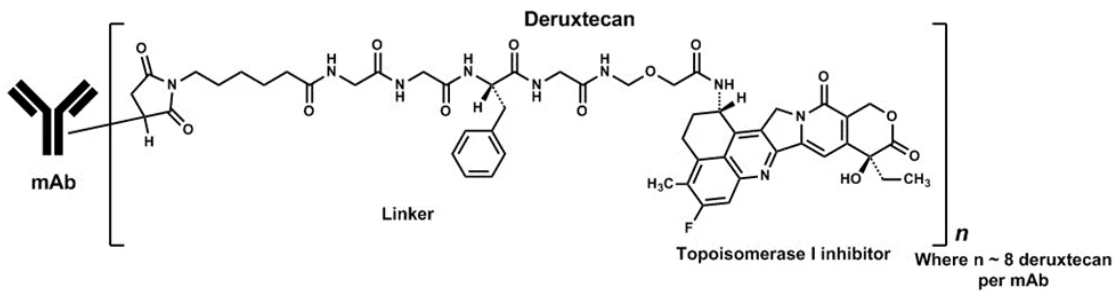
Physicochemical properties: Trastuzumab deruxtecan is a white to yellowish white lyophilized powder.
Pharmaceutical standard: Professed
Product Characteristics:
Trastuzumab deruxtecan is a HER-2 targeted antibody and topoisomerase inhibitor conjugate. The antibody is produced in Chinese hamster ovary cells by recombinant DNA technology, and the topoisomerase inhibitor and linker are produced by chemical synthesis. Approximately 8 molecules of deruxtecan are attached to each antibody molecule.
Unclassified / Non classifié
14. Clinical Trials
14.1. Clinical Trials by Indication
HER2-Positive Breast Cancer After Neoadjuvant HER2-targeted treatment
Table 26 – Summary of patient demographics in clinical trial for patients with HER2-positive breast cancer who have residual invasive disease after neoadjuvant HER2-targeted treatment
| Study # | Study design | Dosage, route of administration and duration | Study Subjects (n) | Mean age (Range) | Sex |
|---|---|---|---|---|---|
| DESTINY-Breast05 | Phase 3, active-controlled, open-label, multicenter study | ENHERTU 5.4 mg/kg IV every 3 weeks for 14 cycles or Trastuzumab emtansine (T-DM1) 3.6 mg/kg IV every 3 weeks for 14 cycles | ENHERTU: 818 T-DM1: 817 | ENHERTU: 50.9 years (24-78) T-DM1: 50.6 years (21-83) | ENHERTU: 99.5% female T-DM1: 99.6% female |
Trial Design and Study Demographics (DESTINY-Breast05)
The efficacy and safety of ENHERTU were evaluated in DESTINY-Breast05, a Phase 3, randomized, multicenter, open-label study. The study included adult patients with HER2-positive breast cancer with residual invasive disease following neoadjuvant therapy. HER2-positivity (IHC3+ or ISH+) was confirmed at a central laboratory.
Patients were eligible if they met at least one high risk criterion: inoperable at disease presentation (clinical stages T4, N0-3, M0 or T1-3, N2-3, M0) with residual invasive disease in the breast or axillary lymph nodes or operable at disease presentation (clinical stages T1-3, N0-1, M0) with positive pathological node status (ypN1-3) after neoadjuvant therapy.
The study excluded patients with history of ILD/pneumonitis requiring treatment with steroids or ILD/pneumonitis at screening, or ECOG performance status >1.
Patients received concurrent or sequential adjuvant radiotherapy as per investigator discretion and hormonal therapy as per local guidelines. All patients received computed tomography (CT) scans of the chest at screening, patients receiving radiotherapy also received regular CT scans of the chest during treatment period and after end of treatment.
Patients were stratified by operative status at disease presentation (operable, inoperable), post neoadjuvant pathological nodal status (positive, negative), tumour hormone receptor status (positive, negative), and HER2-targeted neoadjuvant therapy (single, dual).
Treatment with ENHERTU was administered for a maximum of 14 cycles or until disease recurrence, death, withdrawal of consent, or unacceptable toxicity.
Unclassified / Non classifié
The primary efficacy outcome measure was invasive disease-free survival (IDFS), defined as the time from randomization to first occurrence of ipsilateral local or regional invasive breast cancer recurrence, distant recurrence, contralateral invasive breast cancer, or death from any cause. The key secondary efficacy outcome measure was disease-free survival (DFS), defined as the time between randomization and the date of the first occurrence of an IDFS event, including a secondary primary non-breast cancer event or contralateral or ipsilateral ductal carcinoma in situ. Additional secondary endpoints were brain metastases-free interval (BMFI), distant recurrence-free interval (DRFI), and overall survival (OS).
Demographic and baseline disease characteristics were similar across treatment arms. Of the 1635 patients randomized, the median age was 50.5 years (range: 21 to 83), 10.0% age 65 or older; 99.6% female; 38.8% White, 48.0% Asian, and 2.1% Black or African American. Tumor characteristics were: 71.2% had HR+ status and 28.8% had HR- status; 52.3% had inoperable tumors at disease presentation (T4, N0-3, M0 or T1-3, N2-3, M0); 80.6% had post-neoadjuvant pathological nodal status (ypN1-3). Neoadjuvant treatment characteristics were: 21.2% of patients received single HER2-targeted neoadjuvant therapy; 78.8% received dual HER2-targeted neoadjuvant therapy; 50.3% of patients received anthracyclines and 100% received taxanes as part of neoadjuvant regimen. Characteristics of adjuvant radiotherapy were: 37.0% of patients received sequential adjuvant radiotherapy (RT), 56.1% of patients received concurrent adjuvant RT.
Study Results (DESTINY-Breast05)
The study demonstrated statistically significant and clinically meaningful improvements in IDFS and DFS in patients randomized to ENHERTU compared to T-DM1. Efficacy results are summarized in Table 27, Figure 1 and Figure 2.
Table 27 – Efficacy Results in DESTINY-Breast05
| Efficacy Parameter | ENHERTU (5.4 mg/kg) N=818 | Trastuzumab emtansine (3.6 mg/kg) N=817 |
|---|---|---|
| Invasive Disease-Free Survival (IDFS) | ||
| Number of events (%) | 51 (6.2) | 102 (12.5) |
| Hazard ratio (95% CI) | 0.47 (0.34, 0.66) | |
| p-valuea | p<0.0001 | |
| Disease-Free Survival (DFS) | ||
| Number of events (%) | 52 (6.4) | 103 (12.6) |
| Hazard ratio (95% CI) | 0.47 (0.34, 0.66) | |
| p-valueb | p<0.0001 | |
CI = confidence interval
a Two-sided p-value is based on a stratified log-rank test; crossed the efficacy boundary of 0.0183.
b Two-sided p-value is based on a stratified log-rank test; crossed the efficacy boundary of 0.0144.
Unclassified / Non classifié
Figure 1 – Kaplan-Meier Plot of Invasive Disease-Free Survival (IDFS)
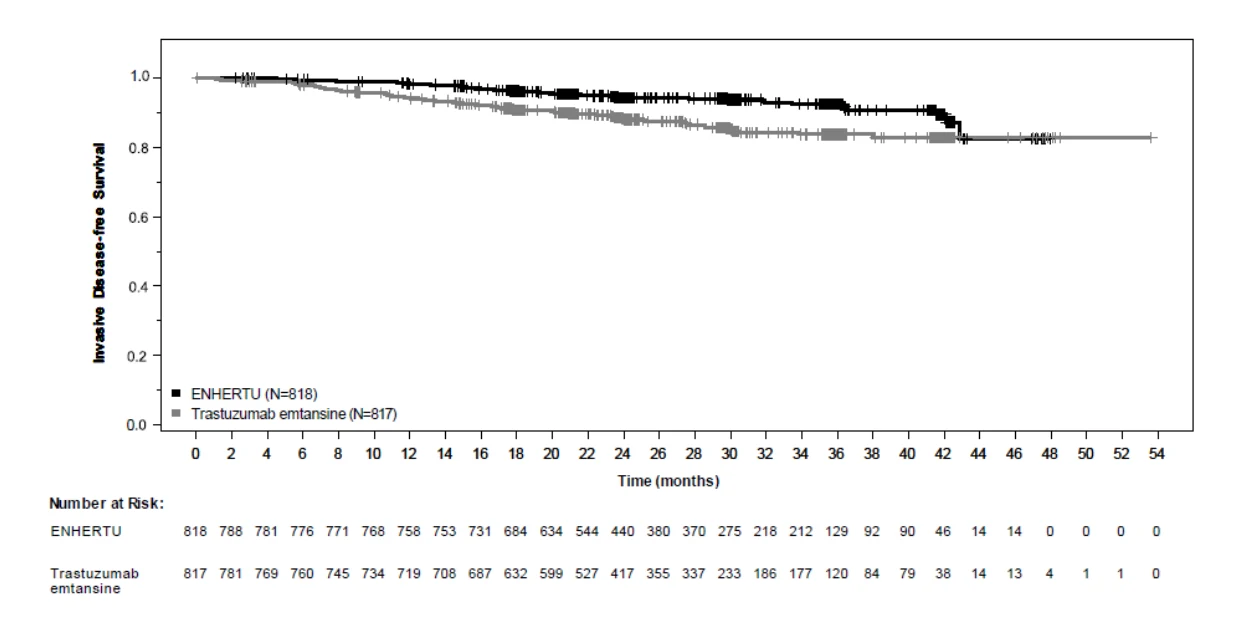
Figure 2 – Kaplan-Meier Plot of Disease-Free Survival (DFS)
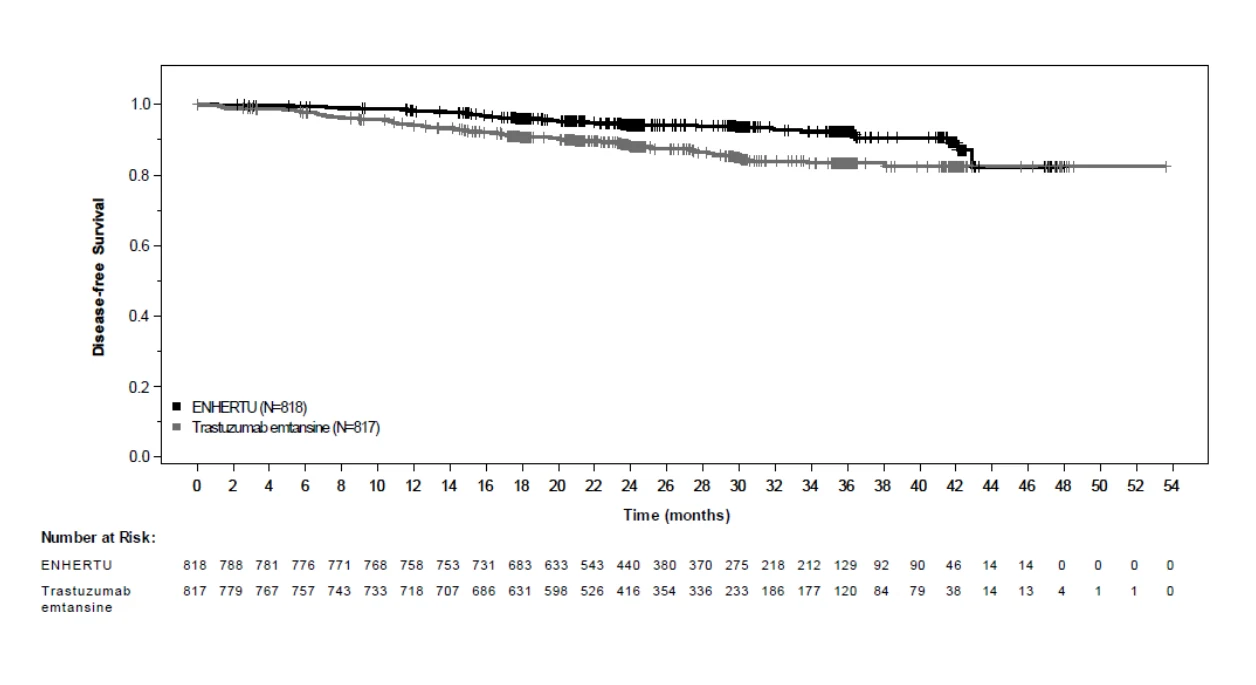
Similar improvements in IDFS and DFS were observed across prespecified subgroups.
Unclassified / Non classifié
HER2-Positive Breast Cancer After at Least One Prior Anti-HER2-based Regimen
Table 28 – Summary of patient demographics in clinical trial for patients with unresectable or metastatic HER2-positive breast cancer after at least one prior anti-HER2-based regimen
| Study # | Study design | Dosage, route of administration and duration | Study Subjects (n) | Mean age (Range) | Sex |
|---|---|---|---|---|---|
| DESTINY-Breast03 | Phase 3, active-controlled, open-label, multicenter study | ENHERTU 5.4 mg/kg IV or Trastuzumab-emtansine (T-DM1) 3.6 mg/kg IV | ENHERTU: 261 T-DM1: 263 | ENHERTU: 54.5 years (27-83) T-DM1: 54.4 years (20-83) | ENHERTU: 99.6% female T-DM1: 99.6% female |
Trial Design and Study Demographics (DESTINY-Breast03)
The efficacy and safety of ENHERTU were demonstrated in a Phase 3, randomized, multicenter, open-label, active-controlled study: DESTINY-Breast03.
The study included adult patients with unresectable or metastatic HER2-positive breast cancer who received prior trastuzumab and taxane therapy for metastatic disease or developed disease recurrence during or within 6 months of completing neoadjuvant or adjuvant therapy involving trastuzumab and taxane. Archival breast tumour samples were required to show HER2 positivity defined as HER2 IHC 3+ or ISH-positive. The study excluded patients with a history of ILD/pneumonitis requiring treatment with steroids or ILD/pneumonitis at screening, patients with untreated and symptomatic brain metastases, patients with a history of clinically significant pulmonary or cardiac disease and patients with prior treatment with an anti-HER2 antibody-drug conjugate in the metastatic setting. Patients were randomized 1:1 to receive either ENHERTU 5.4 mg/kg (N=261) or trastuzumab emtansine 3.6 mg/kg (N=263) by intravenous infusion every three weeks. Randomization was stratified by hormone receptor status, prior treatment with pertuzumab, and history of visceral disease. Treatment was administered until disease progression, death, withdrawal of consent, or unacceptable toxicity.
The primary efficacy outcome measure was progression-free survival (PFS) as assessed by a blinded independent central review (BICR) based on Response Evaluation Criteria in Solid Tumours (RECIST) v1.1. Overall survival (OS) was a key secondary efficacy outcome measure. Confirmed objective response rate (ORR) was a secondary endpoint.
Demographic and baseline disease characteristics were generally similar between treatment arms. Of the 524 patients randomized, the median age was 54 years (range 20.2 to 83.1); female (99.6%); Asian (59.9%), White (27.3%), Black or African American (3.6%); Eastern Cooperative Oncology Group (ECOG) performance status 0 (62.8%) or 1 (36.8%); hormone receptor status (positive: 51.9%); presence of visceral disease (73.3%); presence of stable brain metastases at baseline (15.6%), and 253 (48.3%) patients received one line of prior systemic therapy in the metastatic setting. The percentage of patients who had not received prior treatment for metastatic disease was 9.5%, and 6.7% of patients had received exactly one prior anti-HER2 therapy that was intended for the neoadjuvant or adjuvant therapy and experienced
Unclassified / Non classifié disease progression during or within 6 months of completing treatment (12 months for pertuzumab). The most common prior anti-HER2 cancer therapies received by patients included trastuzumab (99.6%), pertuzumab (61.1%), and an anti-HER2 tyrosine kinase inhibitor (14.9%). Forty-two percent of patients had received prior hormone therapy.
Study Results (DESTINY-Breast03)
At the prespecified interim analysis for PFS based on 245 events (73% of total events planned for final analysis), the study demonstrated a clinically meaningful and statistically significant improvement in PFS in patients randomized to ENHERTU compared to trastuzumab emtansine. A statistically significant improvement in OS was demonstrated at the prespecified second interim analysis of OS.
Efficacy results are summarized in Table 29 and Figure 3.
Table 29 – Efficacy Results in DESTINY-Breast03
| Efficacy Parameter | ENHERTU (5.4 mg/kg) N=261 | trastuzumab emtansine (3.6 mg/kg) N=263 | ||||||||
|---|---|---|---|---|---|---|---|---|---|---|
| Progression-Free Survival per BICR | ||||||||||
| Number of events (%) | 87 (33.3) | 158 (60.1) | ||||||||
| Median, months (95% CI) | NR (18.5, NE) | 6.8 (5.6, 8.2) | ||||||||
| Hazard ratio* (95% CI) | 0.28 (0.22, 0.37) | |||||||||
| p-value† | p< 0.000001‡ | |||||||||
| Overall Survivalb | ||||||||||
| Number of events (%) | 72 (27.6) | 97 (36.9) | ||||||||
| Median, months (95% CI) | NR (40.5, NE) | NR (34.0, NE) | ||||||||
| Hazard ratio (95% CI) | 0.64 (0.47, 0.87) | |||||||||
| p-valueᶲ | p=0.0037 | |||||||||
| Objective Response Rate per BICRa | ||||||||||
| n (%) | 208 (79.7) | 90 (34.2) | ||||||||
| 95% CI | (74.3, 84.4) | (28.5, 40.3) | ||||||||
| Complete Response n (%) | 42 (16.1) | 23 (8.7) | ||||||||
| Partial Response n (%) | 166 (63.6) | 67 (25.5) | ||||||||
CI = confidence interval; NR= not reached, NE=not estimable
PFS 95% CIs calculated using Brookmeyer and Crowley method
a Data cutoff: 21 May 2021. The median duration of follow-up for patients was 15.9 months (range 0.0-32.7) in the ENHERTU arm and 15.3 months (range 0.0-31.3) in the trastuzumab emtansine arm.
b Data cutoff: 25 July 2022 for a pre-planned OS interim analysis. The median duration of follow-up for patients was 28.4 months (range 0.0-46.9) in the ENHERTU arm and 26.5 months (range 0.0-45.0) in the trastuzumab emtansine arm.
c Confirmed ORR
* Based on stratified Cox proportional hazard model
† Based on stratified log-rank test; compared to the efficacy stopping boundary of 2.04x10⁻⁴
‡ Presented as 6 decimal places
ᶲ Based on stratified log-rank test; compared to the efficacy stopping boundary of 1.3x10⁻² (with 68% of total events planned for final analysis)
Unclassified / Non classifié
Figure 3 – Kaplan-Meier Plot of Progression-Free Survival per BICR
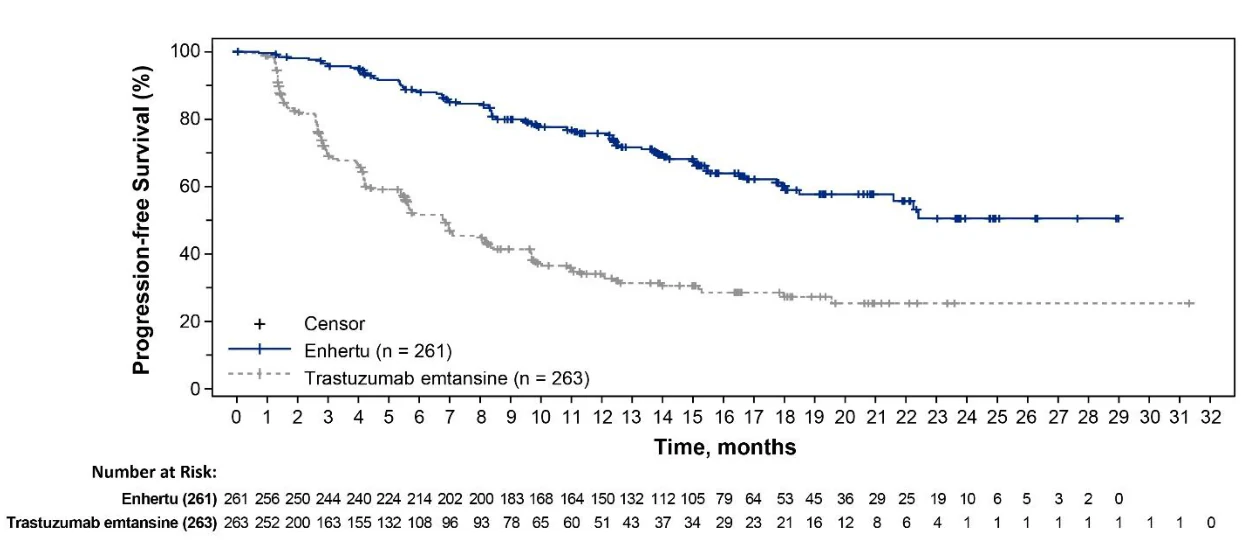
Figure 4 – Kaplan-Meier Plot of Overall Survival
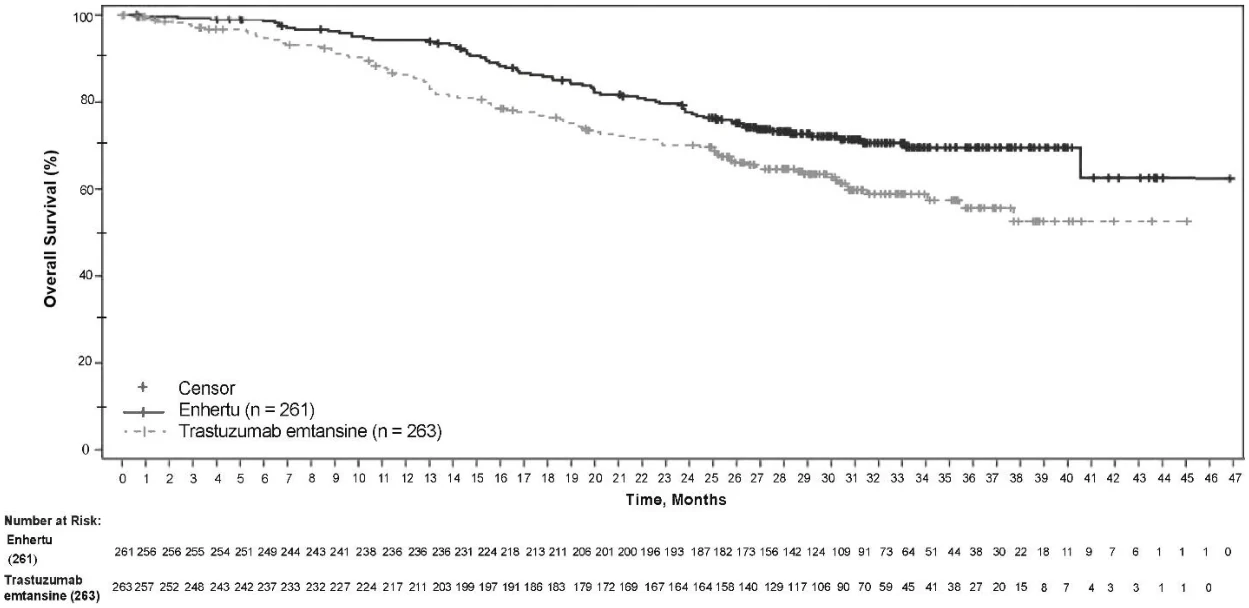
The following PFS results per BICR (ENHERTU arm vs. trastuzumab emtansine arm) were observed at the prespecified interim PFS analysis across prespecified subgroups based on stratification factors and disease characteristics: the hazard ratios (HRs) were 0.32 (95% CI: 0.22, 0.46) and 0.30 (95% CI: 0.20, 0.44) in patients with positive (n=272) and negative (n=248) hormone receptor status, respectively; the HRs were 0.31 (95% CI: 0.22, 0.43) and 0.30 (95% CI: 0.19, 0.47) in patients with (n=320) or without (n=204) prior pertuzumab treatment, respectively; and the HRs were 0.28 (95% CI: 0.21, 0.38) and 0.32 (95% CI: 0.17, 0.58) in patients with (n=384) or without (n=140) a history of visceral disease, respectively.
Unclassified / Non classifié
HER2-Positive Breast Cancer After Trastuzumab Emtansine
Table 30 – Summary of patient demographics in clinical trial for patients with unresectable or metastatic HER2-positive breast cancer after trastuzumab emtansine
| Study # | Study design | Dosage, route of administration and duration | Study Subjects (n) | Mean age (Range) | Sex |
|---|---|---|---|---|---|
| DESTINY-Breast02 | Phase 3, active-controlled, open-label, multicenter study | ENHERTU 5.4 mg/kg IV or TPC (trastuzumab plus capecitabine1 or lapatinib plus capecitabine2) | ENHERTU: 406 TPC: 202 (trastuzumab plus capecitabine: 91; lapatinib plus capecitabine: 111) | ENHERTU: 54.6 years (22-89) TPC: 55.1 years (25-87) | ENHERTU: 99.3% female TPC: 99.0% female |
| DESTINY-Breast01 | Phase 2, single-agent, open-label, multicenter study | ENHERTU 5.4 mg/kg IV | 184 | 56 years (28-96) | 100% female |
TPC: Treatment of Physician’s Choice
1 Trastuzumab: 8 mg/kg IV on Day 1 followed by 6 mg/kg every 21 days (cycled every 21 days); Capecitabine: 1250 mg/m2 orally twice daily on Days 1-14 (cycled every 21 days)
2 Lapatinib: 1250 mg orally daily on Days 1 to 21 (cycled every 21 days); Capecitabine: 1250 mg/m2 orally twice daily on Days 1-14 (cycled every 21 days)
Study: DESTINY-Breast02
Trial Design and Study Demographics (DESTINY-Breast02)
The efficacy and safety of ENHERTU were evaluated in study DESTINY Breast02, a Phase 3, randomized, multicenter, open-label, active-controlled study that enrolled patients with unresectable or metastatic HER2-positive breast cancer who were previously treated with trastuzumab emtansine.
Archival breast tumour samples were required to show HER2 positivity defined as HER2 IHC 3+ or ISH-positive. The study excluded patients with a history of ILD/pneumonitis requiring treatment with steroids or ILD/pneumonitis at screening, patients with untreated and symptomatic brain metastases and patients with a history of clinically significant cardiac disease. Patients were randomized 2:1 to receive either ENHERTU 5.4 mg/kg (N=406) by intravenous infusion every three weeks or treatment of physician’s choice (TPC; N=202, trastuzumab plus capecitabine or lapatinib plus capecitabine). Randomization was stratified by hormone receptor status, prior treatment with pertuzumab, and history of visceral disease. Treatment was administered until disease progression, death, withdrawal of consent, or unacceptable toxicity.
The primary efficacy outcome measure was PFS as assessed by BICR based on RECIST v1.1.
Unclassified / Non classifié
OS was a key secondary efficacy outcome measure. Confirmed ORR and duration of response (DOR), were secondary endpoints.
Demographic and baseline disease characteristics were similar between treatment arms. Of the 608 patients randomized, the median age was 54 years (range 22 to 88); female (99.2%); White (63.2%), Asian (29.3%), Black or African American (2.8%); ECOG performance status 0 (57.4%) or 1 (42.4%); hormone receptor status (positive: 58.6%); presence of visceral disease (78.3%); presence of brain metastases at baseline (18.1%); one line of prior systemic therapy in the metastatic setting (4.9%); and prior pertuzumab therapy (78.0%).
Study Results (DESTINY-Breast02)
The median duration of follow-up for patients was 21.5 months (range 0.1-45.6) in the ENHERTU arm and 18.6 months (range 0.0-45.7) in the TPC arm. The study demonstrated a statistically significant improvement in PFS per BICR and OS in patients randomized to ENHERTU compared to TPC.
Efficacy results are summarized in Table 31, Figure 5 and Figure 6.
Table 31 – Efficacy Results in DESTINY-Breast02
| Efficacy Parameter | ENHERTU (N=406) | Treatment of Physician’s Choice (N=202) | |||||||||
|---|---|---|---|---|---|---|---|---|---|---|---|
| Progression-Free Survival per BICR | |||||||||||
| Number of events (%) | 200 (49.3) | 125 (61.9) | |||||||||
| Median, months (95% CI) | 17.8 (14.3, 20.8) | 6.9 (5.5, 8.4) | |||||||||
| Hazard ratioa (95% CI) | 0.36 (0.28, 0.45) | ||||||||||
| p-value† | p<0.000001‡ | ||||||||||
| Overall Survival | |||||||||||
| Number of events (%) | 143 (35.2) | 86 (42.6) | |||||||||
| Median, months (95% CI) | 39.2 (32.7, NE) | 26.5 (21.0, NE) | |||||||||
| Hazard ratioa (95% CI) | 0.66 (0.50, 0.86) | ||||||||||
| p-valueᶲ | p=0.0021 | ||||||||||
| Objective Response Rate per BICRb | |||||||||||
| n (%) | 283 (69.7) | 59 (29.2) | |||||||||
| 95% CI | (65.0, 74.1) | (23.0, 36.0) | |||||||||
| Complete Response n (%) | 57 (14.0) | 10 (5.0) | |||||||||
| Partial Response n (%) | 226 (55.7) | 49 (24.3) | |||||||||
| Duration of Response per BICR | |||||||||||
| Median, months (95% CI) | 19.6 (15.9, NE) | 8.3 (5.8, 9.5) | |||||||||
CI = confidence interval; NE=not estimable
PFS 95% CIs calculated using Brookmeyer and Crowley method
a Based on stratified Cox proportional hazard model
b Confirmed Objective Response Rate per BICR
† Based on stratified log-rank test
‡ Presented as 6 decimal places
ᶲ Based on stratified log-rank test; crossed the efficacy boundary of 0.004
Unclassified / Non classifié
Figure 5 – Kaplan-Meier Plot of Progression-Free Survival per BICR
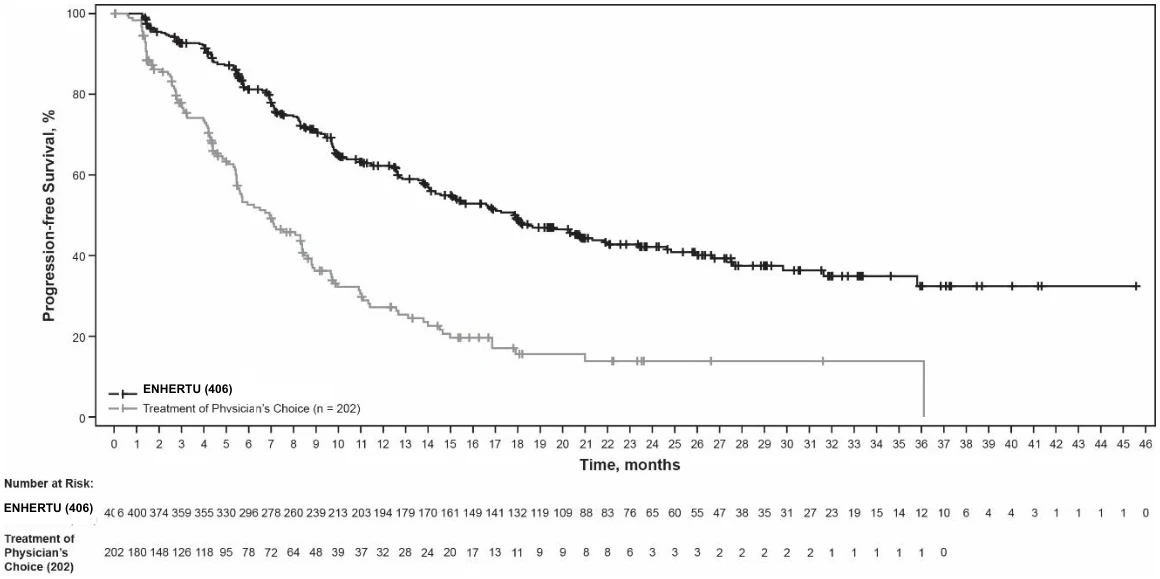
Figure 6 – Kaplan-Meier Plot of Overall Survival
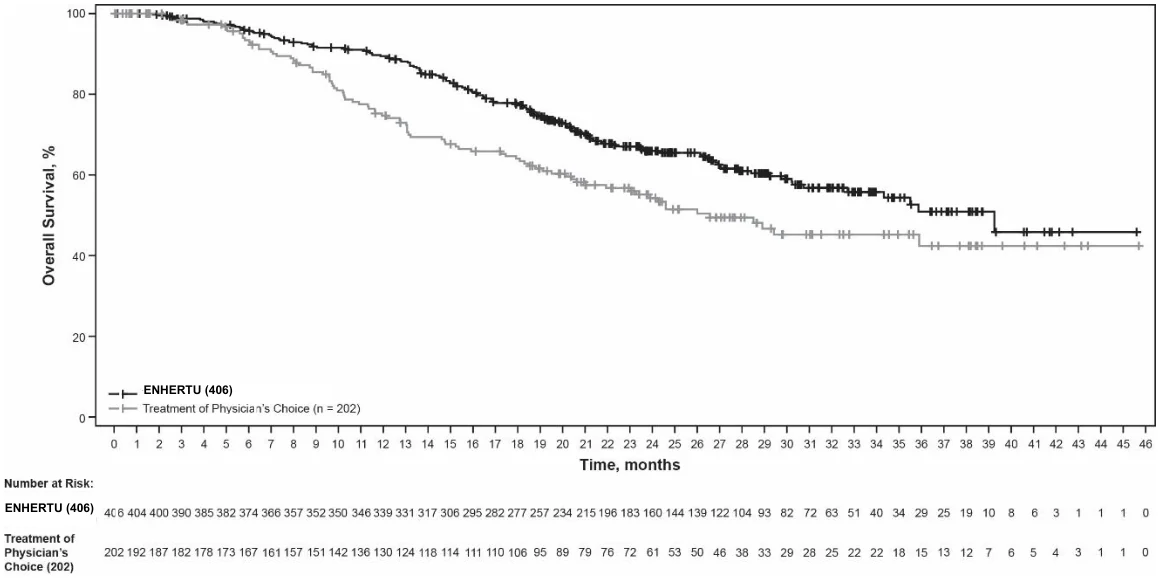
Similar PFS results were observed across patient subgroups based on the following stratification factors: hormone receptor status (positive vs. negative), prior treatment with and without pertuzumab, and history of visceral disease.
Study: DESTINY-Breast01
Trial Design and Study Demographics (DESTINY-Breast01)
The efficacy and safety of ENHERTU were demonstrated in a Phase 2, single-agent, open-label, multicenter study: DESTINY-Breast01.
The study enrolled adult patients with unresectable or metastatic HER2-positive breast cancer
Unclassified / Non classifié who had received prior treatment with trastuzumab emtansine. Patients had received two or more prior anti-HER2 regimens, including trastuzumab emtansine (100%), trastuzumab (100%), and pertuzumab (65.8%). Archival breast tumour samples were required to show HER2 positivity defined as HER2 IHC 3+ or ISH-positive. The study excluded patients with a history of treated ILD or ILD at screening, patients with untreated, symptomatic brain metastases and patients with a history of clinically significant cardiac disease. ENHERTU was administered by intravenous infusion at 5.4 mg/kg once every three weeks until disease progression, death, withdrawal of consent, or unacceptable toxicity.
The primary efficacy outcome measure was confirmed objective response rate (ORR) according to Response Evaluation Criteria in Solid Tumours (RECIST v1.1) in the intent-to-treat (ITT) population as evaluated by independent central review. Duration of response (DOR) was a secondary efficacy measure.
DESTINY-Breast01 (N=184) baseline demographic and disease characteristics were: median age 55 years (range 28 to 96); female (100%); White (54.9%), Asian (38.0%), Black or African American (2.2%); ECOG performance status 0 (55.4%) or 1 (44.0%); hormone receptor status (positive: 52.7%); presence of visceral disease (91.8%); stable brain metastases (13%); median number of prior therapies in the metastatic setting: 5 (range: 2 to 17); prior pertuzumab therapy (65.8%); sum of diameters of target lesions (<5 cm: 42.4%, ≥5 cm: 50.0%).
Study Results (DESTINY-Breast01)
The median duration of follow-up for patients was 11.1 months (range 0.7-19.9). The confirmed ORR was 60.9% (95% CI: 53.4, 68.0) and median DoR with confirmed response was 14.8 months (95% CI: 13.8, 16.9).
Efficacy results are summarized in Table 32.
Table 32 – Efficacy Results by Independent Central Review in DESTINY-Breast01
| Efficacy Parameter | DESTINY-Breast01 N=184 n (%) |
|---|---|
Confirmed Objective Response Rate (95% CI) | 112 (60.9) (53.4, 68.0) |
| Complete Response | 11 (6.0) |
| Partial Response | 101 (54.9) |
Duration of Response Median†, months (95% CI)* | 14.8 (13.8, 16.9) |
ORR 95% CI calculated using Clopper-Pearson method
CI = confidence interval
95% CIs calculated using Brookmeyer-Crowley method
*DOR is based on a median duration of follow-up of 11.1 months.
†Based on Kaplan-Meier estimates
In DESTINY-Breast01, the subgroup of patients who received prior pertuzumab therapy had a confirmed ORR of 65% (95% CI: 55, 73), and those who did not receive prior pertuzumab therapy had a confirmed ORR of 54% (95% CI: 41, 67). The subgroup of patients who were hormone receptor (HR+) at baseline had a confirmed ORR of 58% (95% CI: 47, 68), and those who were hormone receptor negative (HR-) at baseline had a confirmed ORR of 66% (95% CI:
Unclassified / Non classifié
55, 76). The results should be interpreted with caution given the inherent risks with subgroup analyses in general.
HER2-Low and HER2-Ultralow Breast Cancer
Table 33 – Summary of patient demographics in clinical trial for patients with unresectable or metastatic HER2-low and HER2-Ultralow breast cancer
| Study # | Study design | Dosage, route of administration and duration | Study Subjects (n) | Mean age (Range) | Sex |
|---|---|---|---|---|---|
| DESTINY-Breast06 | Phase 3, open-label, multicenter study* | ENHERTU 5.4 mg/kg IV or Chemotherapy (capecitabine1, nab-paclitaxel2, or paclitaxel3) | ENHERTU: 436 Chemotherapy: 430 (capecitabine 257; nab-paclitaxel 105, or paclitaxel 68) | ENHERTU: 58.2 years (28-87) Chemotherapy: 58.2 years (32-83) | ENHERTU: 100% female Chemotherapy: 99.8% female |
| DESTINY-Breast04 | Phase 3, open-label, multicenter study** | ENHERTU 5.4 mg/kg IV or Chemotherapy (eribulin4, capecitabine1, gemcitabine5, nab-paclitaxel6, or paclitaxel7) | ENHERTU: 373 Chemotherapy: 184 (eribulin4: 94; capecitabine1: 37; gemcitabine5: 19; nab-paclitaxel6: 19; paclitaxel7: 15) | ENHERTU: 56.5 years (46-67) Chemotherapy: 56.5 years (45-68) | ENHERTU: 99.5% female Chemotherapy: 100% female |
*Trial included patients with HER2-low and HER2-ultralow breast cancer.
**Trial included patients with HER2-low breast cancer.
1 Capecitabine 1000-1250 mg/m2 orally twice daily on Days 1-14; cycled every 21 days;
2 Nab-paclitaxel 100 mg/m2 IV Days 1, 8, and 15 (cycled every 28 days);
3 Paclitaxel 80 mg/m2 IV on Days 1 and 8; cycled every 21 days;
4 Eribulin 1.4 mg/m2 IV on Days 1 and 8; cycled every 21 days;
5 Gemcitabine Option 1: 800-1200 mg/m2 IV on Days 1 and 8 (cycled every 21 days); Option 2: 800-1200 mg/m2 IV on Days 1, 8 and 15 (cycled every 28 days);
6 Nab-paclitaxel Option 1: 260 mg/m2 IV (cycled every 21 days); Option 2: 100 mg/m2 or 125 mg/m2 IV Days 1, 8, and 15 (cycled every 28 days);
7 Paclitaxel Option 1: 175 mg/m2 IV (cycled every 21 days); Option 2: 80 mg/m2 IV (weekly).
Study: DESTINY-Breast06
Trial Design and Study Demographics (DESTINY-Breast06)
The efficacy of ENHERTU were evaluated in study DESTINY-Breast06, a randomized, multicenter, open-label, phase 3 study that randomized 866 adult patients with advanced or metastatic HR+ breast cancer with HER2-low (IHC 1+ or IHC 2+/ISH-) or HER2-ultralow (IHC 0 with membrane staining, described as IHC >0<1+ in the study) expression as evaluated at a central laboratory using Ventana’s PATHWAY antiHER2/neu (4B5) Rabbit Monoclonal Primary Antibody assay and a validated HER2 ISH assay. HER2-ultralow is defined as faint and
Unclassified / Non classifié incomplete membrane HER2 staining that is seen in >0% and ≤10% of tumour cells. Patients were eligible if they had disease progression on (a) at least 2 lines of endocrine therapy in the metastatic setting or (b) one line of endocrine therapy in the metastatic setting and demonstrated progression within 24 months from the start of adjuvant endocrine therapy, or within 6 months of starting first line endocrine therapy in combination with a CDK 4/6 inhibitor in the metastatic setting. Patients with prior chemotherapy in the neo-adjuvant or adjuvant setting were eligible if they had a disease-free interval greater than 12 months. The study excluded patients with prior chemotherapy for advanced or metastatic disease, patients with a history of ILD/pneumonitis requiring treatment with steroids or ILD/pneumonitis at screening, uncontrolled or significant cardiovascular disease, untreated and symptomatic brain metastases, or ECOG performance status >1.
Patients were randomized 1:1 to receive either ENHERTU 5.4 mg/kg (N=436) by intravenous infusion every three weeks or physician’s choice of single agent chemotherapy (N=430, capecitabine 60%, nab-paclitaxel 24%, or paclitaxel 16%). Randomization was stratified by prior CDK4/6 inhibitor use (yes or no), prior taxane use in the non-metastatic setting (yes or no), and HER2 IHC status of tumour samples (IHC 2+/ISH- vs. IHC 1+ vs. IHC >0 <1+). Treatment with ENHERTU was administered until disease progression, death, withdrawal of consent, or unacceptable toxicity.
The primary efficacy endpoint was PFS in patients with HER2-low breast cancer assessed by BICR based on RECIST v1.1. Key secondary efficacy endpoints were PFS assessed by BICR based on RECIST v1.1 in the overall population (HER2-low and HER2-ultralow), OS in HER2-low patients, and OS in the overall population. Additional secondary endpoints included ORR and DOR.
Demographics and baseline tumour characteristics were similar between treatment arms. Of the 866 patients randomized, the median age was 57 years (range: 28 to 87); 31% were age 65 or older; 99.9% were female; 53% were White, 35% were Asian, and 1% were Black or African American. Patients had an ECOG performance status of 0 (59%) or 1 (39%) at baseline; 18% were HER2 IHC >0<1+, 55% were IHC 1+, 27% were IHC 2+/ISH-; 67% had liver metastases, 32% had lung metastases, 8% had brain metastases, and 3% had bone-only metastases. Patients had a median of 2 prior lines of endocrine therapy in the metastatic setting (range: 1 to 5) with 17% having 1 and 68% having 2. Eighty-nine percent of patients had prior endocrine therapy in combination with CDK4/6i treatment in the metastatic setting, 41% had prior taxane use in the non-metastatic setting.
Study Results (DESTINY-Breast06)
The median duration of follow-up for patients was 18.6 months in the ENHERTU arm and 17.8 months in the chemotherapy arm. The study demonstrated a statistically significant and clinically meaningful improvement in PFS in the patients randomized to ENHERTU compared to chemotherapy in both the HER2-low cohort and the overall population. At the time of the PFS final analysis, overall survival data were immature. Efficacy results are summarized in Table 34, Figure 7 and Figure 8.
Unclassified / Non classifié
Table 34 – Efficacy Results in DESTINY-Breast06
| Efficacy Parameter | HER2-low | Overall Population (HER2-low and HER2-ultralow) |
|---|---|---|
ENHERTU (N=359) | Chemotherapy (N=354) | |
ENHERTU (N=436) | Chemotherapy (N=430) | |
| Progression-Free Survival per BICR | ||
| Number of events (%) | ||
| 225 (62.7) | 232 (65.5) | |
| 269 (61.7) | 271 (63.0) | |
| Median, months (95% CI) | ||
13.2 (11.4, 15.2) | 8.1 (7.0, 9.0) | |
13.2 (12.0, 15.2) | 8.1 (7.0, 9.0) | |
| Hazard ratio (95% CI) | 0.62 (0.52, 0.75)a | 0.64 (0.54, 0.76)b |
| p-valuec | <0.0001d | <0.0001e |
CI = confidence interval a Based on stratified Cox proportional hazards model b Based on unstratified Cox proportional hazards model c Presented as 4 decimal places d Based on stratified log-rank test; compared to the efficacy stopping boundary of 0.05 e Based on unstratified log-rank test; compared to the efficacy stopping boundary of 0.015 | ||
In the HER2-low population, confirmed objective response rate was 56.5% (95% CI: 51.2, 61.7) and 32.2% (95% CI: 27.4, 37.3) in patients randomized to ENHERTU and chemotherapy, respectively. Median duration of response was 14.1 months (95% CI: 11.8, 15.9) and 8.6 months (95% CI: 6.7, 11.3) in patients randomized to ENHERTU and chemotherapy, respectively. In the HER2-low population, 9 (2.5%) patients achieved complete response and 194 (54.0%) patients achieved partial response in the ENHERTU arm compared to no patients with complete response and 114 (32.2%) patients with a partial response treated with chemotherapy.
In the overall population, the ORR was 57.3% (95% CI: 52.5, 62.0) and 31.2% (95% CI: 26.8, 35.8) in patients randomized to ENHERTU and chemotherapy, respectively. Median DOR was 14.3 months (95% CI: 12.5, 15.9) and 8.6 months (95% CI 6.9, 11.5) in patients randomized to ENHERTU and chemotherapy, respectively. In the overall population, 13 (3.0%) patients achieved complete response and 237 (54.4%) patients achieved partial response in the ENHERTU arm compared to no patients with complete response and 134 (31.2%) patients with a partial response treated with chemotherapy.
Unclassified / Non classifié
Figure 7 – Kaplan-Meier Plot of Progression-Free Survival (HER2-low Population)
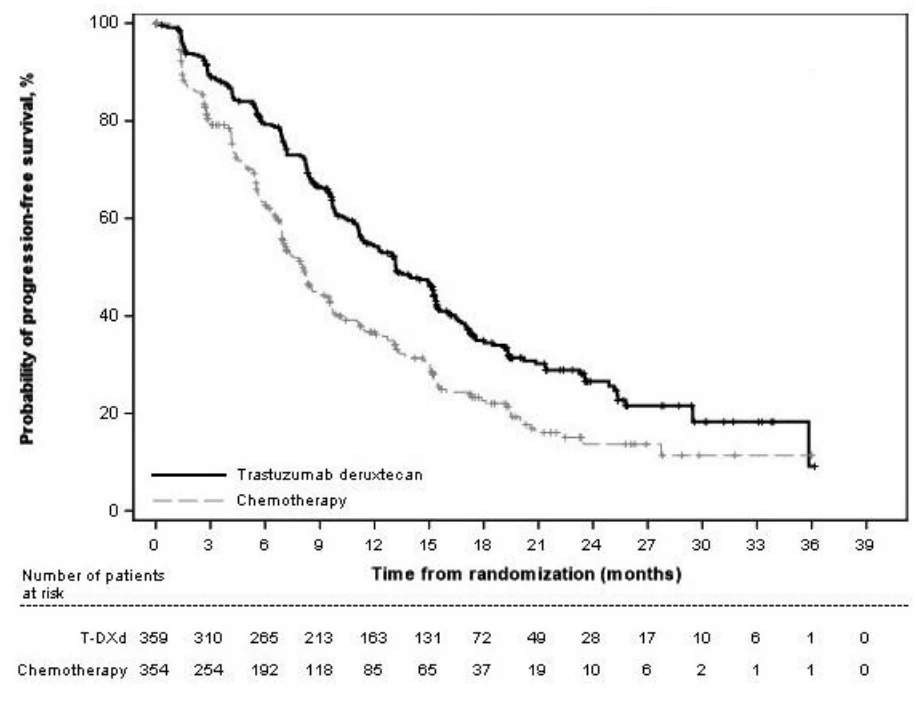
Figure 8 – Kaplan-Meier Plot of Progression-Free Survival (Overall Population)
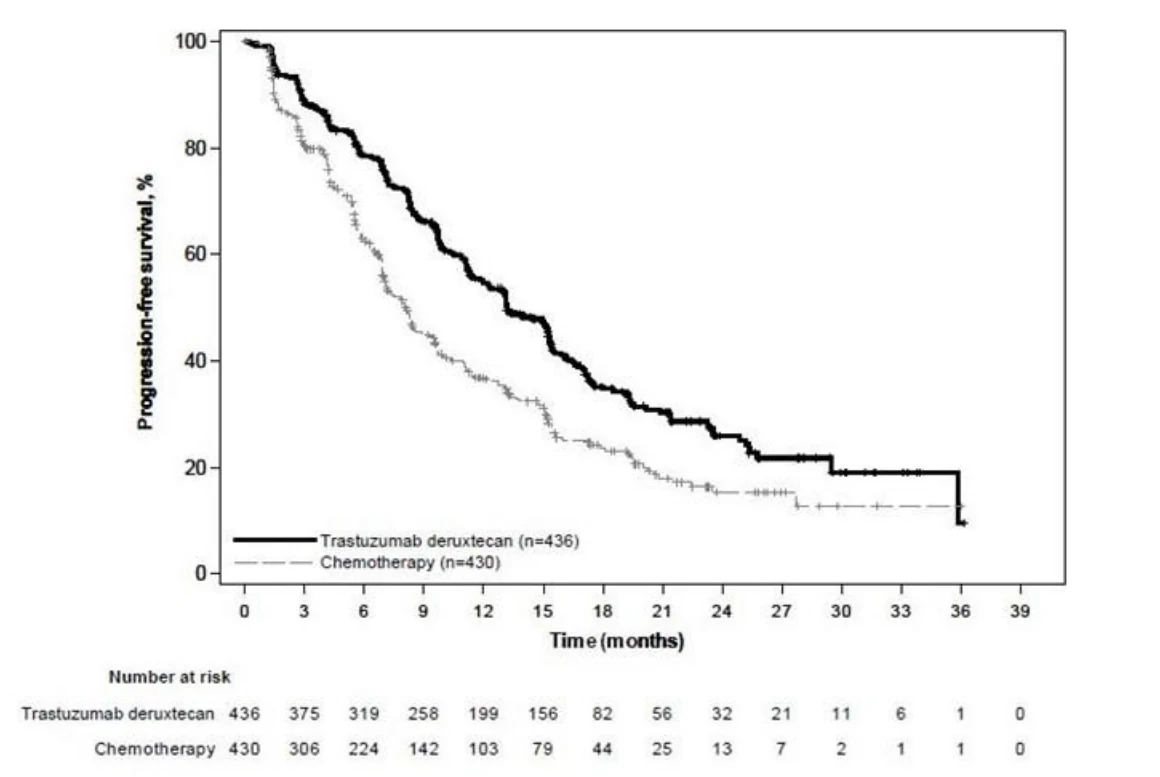
Unclassified / Non classifié
In the HER2-ultralow subgroup, median PFS was 13.2 months (95% CI: 9.8, 17.3) in patients randomized to ENHERTU and 8.3 months (95% CI: 5.8, 15.2) in patients randomized to chemotherapy. PFS was improved in the ENHERTU-treated group [hazard ratio 0.78 (95% CI: 0.50, 1.21)]. Confirmed objective response rate was 61.8% (95% CI: 50.0, 72.8) and 26.3% (95% CI: 16.9, 37.7) in patients randomized to ENHERTU and chemotherapy, respectively. Median duration of response was 14.3 months (95% CI: 9.2, 20.7) and 14.1 months (95% CI: 5.9, not estimable) in patients randomized to ENHERTU and chemotherapy, respectively.
Study: DESTINY-Breast04
Trial Design and Study Demographics (DESTINY-Breast04)
The efficacy and safety of ENHERTU were evaluated in study DESTINY-Breast04, a Phase 3, randomized, multicenter, open-label study that enrolled 557 adult patients with unresectable or metastatic HER2-low breast cancer.
The study included 2 cohorts: 494 hormone receptor-positive (HR+) patients and 63 hormone receptor-negative (HR-) patients. HER2-low expression was defined as IHC 1+ or IHC 2+/ISH- according to the College of American Pathologists (CAP) 2018 HER2 Testing in breast cancer guideline evaluated at a central laboratory using Ventana’s PATHWAY anti-HER2-/neu (4B5) Rabbit Monoclonal Primary Antibody assay and INFORM HER2 Dual ISH assay. Patients should have received at least one prior line (no more than two prior lines) of chemotherapy in the metastatic setting or have developed disease recurrence during or within 6 months of completing adjuvant chemotherapy. Patients with HR+ breast cancer should be refractory to prior endocrine therapy (ET), defined as having progressed on at least 1 ET and determined by the investigator that the patient would no longer benefit from further treatment with ET.
Patients were randomized 2:1 to receive either ENHERTU 5.4 mg/kg (N=373) by intravenous infusion every three weeks or physician’s choice of chemotherapy (N=184; eribulin, capecitabine, gemcitabine, nab-paclitaxel, or paclitaxel). Randomization was stratified by HER2 IHC status of tumour samples (IHC 1+ or IHC 2+/ISH-), number of prior lines of chemotherapy in the metastatic setting (1 or 2), and HR status/prior CDK4/6i treatment (HR+ with prior CDK4/6 inhibitor treatment, HR+ without prior CDK4/6 inhibitor treatment, or HR-). Treatment was administered until disease progression, death, withdrawal of consent, or unacceptable toxicity. The study excluded patients with a history of ILD/pneumonitis requiring treatment with steroids or ILD/pneumonitis at screening and clinically significant cardiac disease. Patients were also excluded for untreated or symptomatic brain metastases or ECOG performance status >1.
The primary efficacy outcome measure was PFS in patients with HR+ breast cancer assessed by BICR based on RECIST v1.1. Key secondary efficacy outcome measures were PFS assessed by BICR based on RECIST v1.1 in the overall population (all randomized HR+ and HR- patients), OS in HR+ patients, and OS in the overall population. ORR and DOR were secondary endpoints.
Demographics and baseline tumour characteristics were generally similar between treatment arms. Of the 557 patients randomized, the median age was 56.5 years (range: 28.4 to 80.5); 23.5% were age 65 or older; 99.6% were female and 0.4% were male; 47.9% were White, 40.0% were Asian, and 1.8% were Black or African American. Patients had an ECOG performance status of 0 (54.8%) or 1 (45.2%) at baseline; 57.6% were IHC 1+, 42.4% were IHC 2+/ISH-; 69.8% had liver metastases; 32.9% had lung metastases; 5.7% had stable brain metastases; and 51.9%, 34.5% and 11.5% had normal, mild and moderate renal functions, respectively. In the metastatic setting, patients had a median of 3 prior lines of systemic therapy (range: 1 to 9) with 57.6% having 1 and 40.9% having 2 prior chemotherapy regimens, median
Unclassified / Non classifié of 2 prior lines of endocrine therapy (range: 0 to 7) with 28.5% having 1 and 30.3% having 2 prior lines, and 3.9% were early progressors (defined as having disease recurrence during or within 6 months of completing neo/adjuvant chemotherapy). In the neo/adjuvant setting, the number of patients that received anthracyclines was 46.3%. In the metastatic setting, patients had received the following cytotoxic agents: taxane (55.1%), capecitabine (49.4%), anthracyclines (19.4%) and eribulin (9.2%). In HR+ patients, the median number of prior lines of endocrine therapy was 2 (range: 0 to 9) and 70.4% had prior CDK4/6i inhibitor treatment.
Study Results (DESTINY-Breast04)
The median duration of follow-up for patients was 16.1 months (range 0.3-33.1) in the ENHERTU arm and 13.5 months (range 0.0-27.8) in the chemotherapy arm. The study demonstrated a statistically significant and clinically meaningful improvement in OS and PFS in patients randomized to ENHERTU compared to chemotherapy in both the HR+ cohort and the overall population.
Efficacy results are summarized in Table 35, Figure 9, and Figure 10.
Table 35 – Efficacy Results in DESTINY-Breast04
| Efficacy Parameter | HR+ Cohort | Overall Population (HR+ and HR- Cohort) |
|---|---|---|
ENHERTU (N=331) | Chemotherapy (N=163) | |
ENHERTU (N=373) | Chemotherapy (N=184) | |
| Progression-Free Survival per BICR | ||
| Number of events (%) | ||
| 211 (63.7) | 110 (67.5) | |
| 243 (65.1) | 127 (69.0) | |
| Median, months (95% CI) | ||
| 10.1 (9.5, 11.5) | 5.4 (4.4, 7.1) | |
| 9.9 (9.0, 11.3) | 5.1 (4.2, 6.8) | |
| Hazard ratio† (95% CI) | 0.51 (0.40, 0.64) | 0.50 (0.40, 0.63) |
| p-value‡ | <0.0001 | <0.0001 |
| Overall Survival | ||
| Number of events (%) | ||
| 126 (38.1) | 73 (44.8) | |
| 149 (39.9) | 90 (48.9) | |
| Median, months (95% CI) | ||
| 23.9 (20.8, 24.8) | 17.5 (15.2, 22.4) | |
| 23.4 (20.0, 24.8) | 16.8 (14.5, 20.0) | |
| Hazard ratio† (95% CI) | 0.64 (0.48, 0.86) | 0.64 (0.49, 0.84) |
| p-value* | 0.0028 | 0.0010 |
CI = confidence interval; BICR = blinded independent central review
PFS, OS and 95% CIs calculated using Brookmeyer and Crowley method
† Based on stratified Cox proportional hazard model
‡ Based on stratified log-rank test; compared to the efficacy stopping boundary of 0.05
* Based on stratified log-rank test; compared to the efficacy stopping boundary of 0.00748
In the HR+ cohort, the ORR was 52.6% (95% CI: 47.0, 58.0) with a median DOR of 10.7 months (95% CI: 8.5, 13.7) in the ENHERTU arm, and ORR was 16.3% (95% CI: 11.0, 22.8) with a median DOR of 6.8 months (95% CI: 6.5, 9.9) in the chemotherapy arm. In the overall population, the ORR was 52.3% (95% CI: 47.1, 57.4) with a median DOR of 10.7 months (95% CI: 8.5, 13.2) in the ENHERTU arm, and ORR was 16.3% (95% CI: 11.3, 22.5) with a median DOR of 6.8 months (95% CI 6.0, 9.9) in the chemotherapy arm.
Unclassified / Non classifié
Figure 9 – Kaplan-Meier Plot of Progression-Free Survival per BICR (Overall Population)
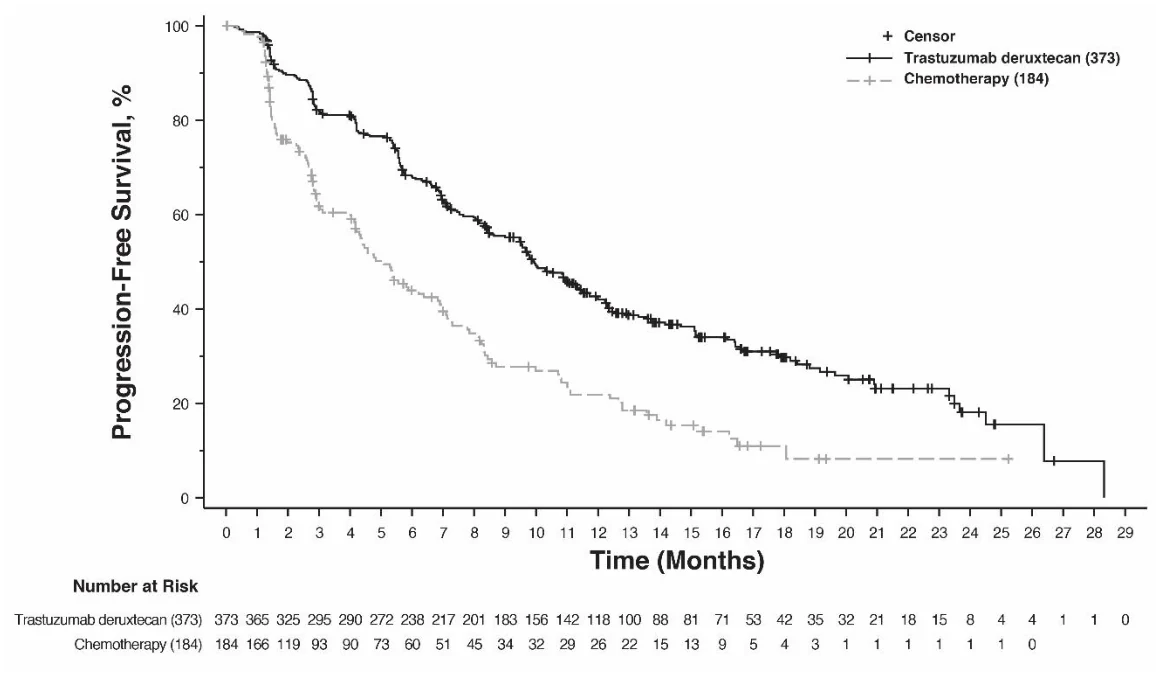
Figure 10 – Kaplan-Meier Plot of Overall Survival (Overall Population)
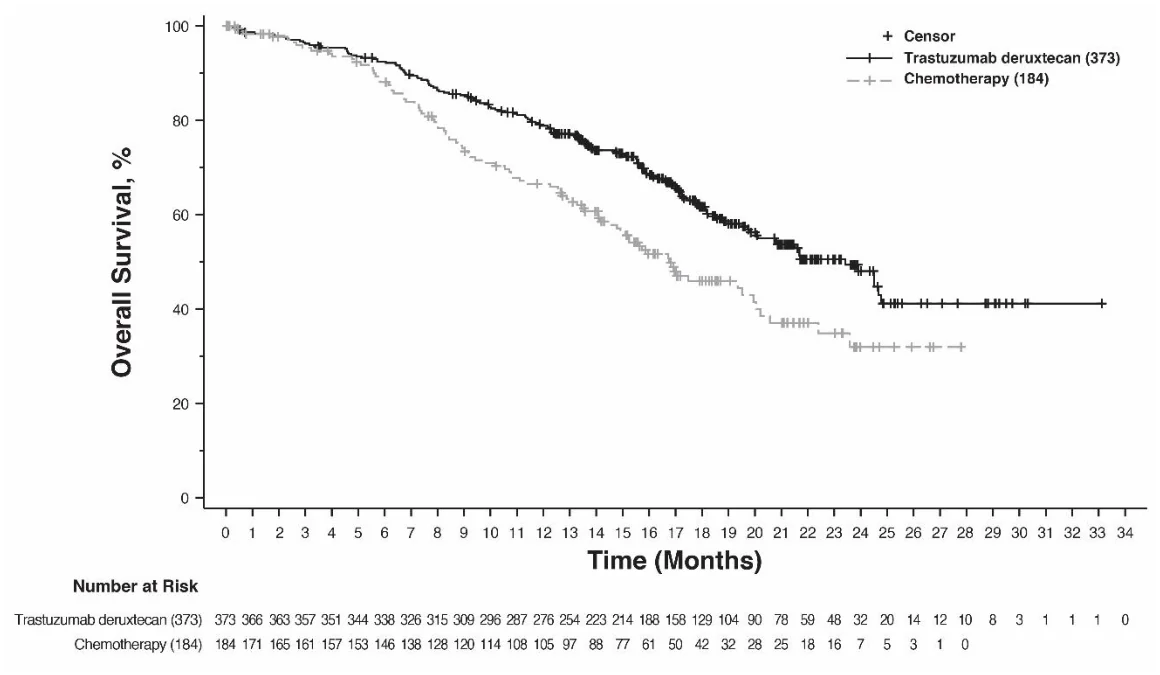
In an exploratory subgroup analysis of sixty-four (11.5%) patients with moderate renal impairment, the hazard ratio for OS was 1.91 (95% CI: 0.84, 4.36). These results should be interpreted with caution given the inherent risks with subgroup analyses.
Unclassified / Non classifié
Unresectable, Locally Advanced or Metastatic HER2-positive Gastric and Gastroesophageal Junction Cancer
Table 36 – Summary of patient demographics in clinical trial for patients with unresectable, locally advanced or metastatic HER2-positive gastric and gastroesophageal junction cancer
| Study # | Study design | Dosage, route of administration and duration | Study Subjects (n) | Mean age (Range) | Sex |
|---|---|---|---|---|---|
| DESTINY-Gastric04 | Phase 3, multicenter, open-label, randomized , active-controlled study | ENHERTU 6.4 mg/kg IV every 3 weeks or Ramucirumab1 plus paclitaxel2 | ENHERTU: 246 Ramucirumab plus paclitaxel: 248 | ENHERTU: 62 years (21 to 84) Ramucirumab plus paclitaxel: 63 years (32 to 87) | ENHERTU: 76% Male Ramucirumab plus paclitaxel: 83% Male |
| DESTINY-Gastric01 | Phase 2, multicenter, open-label, randomized study | ENHERTU 6.4 mg/kg IV every 3 weeks or Chemotherapy (irinotecan3; paclitaxel4) | ENHERTU: 126 Chemotherapy: 62 (irinotecan: 55; paclitaxel: 7) | ENHERTU: 64 years (34 to 82) Chemotherapy: 65 years (28 to 82) | ENHERTU: 76% Male Chemotherapy : 76% Male |
| DESTINY-Gastric02 | Phase 2, multicenter, open-label, single-arm study | ENHERTU 6.4 mg/kg IV every 3 weeks | 79 | 59 years (20 to 78) | 72% Male |
1 Ramucirumab was administered by intravenous infusion on days 1 and 15 of a 28-day cycle at 8 mg/kg
2 Paclitaxel was administered by intravenous infusion days 1, 8, and 15 of a 28-day cycle at 80 mg/m2
3 Irinotecan monotherapy was administered by intravenous infusion biweekly at 150 mg/m2
4 Paclitaxel monotherapy was administered by intravenous infusion weekly at 80 mg/m2
Study: DESTINY-Gastric04
Trial Design and Study Demographics (DESTINY-Gastric04)
The efficacy and safety of ENHERTU were evaluated in DESTINY-Gastric04, a Phase 3, randomized, multicenter, open-label, active-controlled study. The study included adult patients with HER2-positive locally advanced, unresectable, or metastatic gastric or GEJ adenocarcinoma who had progressed on or after a trastuzumab-containing regimen. Patients were randomized 1:1 to receive either ENHERTU (N=246) or ramucirumab plus paclitaxel (N=248). Randomization was stratified by HER2 status (IHC 3+ or IHC 2+/ISH-positive), geographical region (Asia [excluding mainland China] versus Western Europe versus mainland China/rest of the world), and time to progression on first-line therapy (<6 months or ≥6 months). Tumour samples were required to have locally or centrally confirmed HER2 positivity defined as
Unclassified / Non classifié
IHC 3+ or IHC 2+/ISH-positive. The study excluded patients with a history of ILD/pneumonitis requiring treatment with steroids or ILD/pneumonitis at screening, patients with a history of clinically significant cardiac disease, and patients with active brain metastases. Treatment was administered until disease progression, death, or unacceptable toxicity. The primary efficacy outcome measure was overall survival (OS). PFS, confirmed ORR, and DOR were secondary outcome measures.
Demographic and baseline disease characteristics were similar between treatment arms. Of the 494 patients enrolled in DESTINY-Gastric04, the median age was 63.7 years (range 21.1 to 87.0); 79.4% were male; 49.8% were White, 40.1% were Asian, and 0.4% were Black or African American. Patients had an ECOG performance status of either 0 (37.4%) or 1 (61.9%); 61.1% had gastric adenocarcinoma and 38.9% had GEJ adenocarcinoma; 84% were IHC 3+ and 16% were IHC 2+/ISH-positive; 70% had two or more metastatic sites, 61.7% had liver metastases, 6.9% had brain metastases; 15.6% previously received immunotherapy.
Study Results (DESTINY-Gastric04)
The study demonstrated a statistically significant improvement in OS, PFS and confirmed ORR, in patients randomized to ENHERTU compared with ramucirumab plus paclitaxel. Efficacy results are summarized in Table 37, Figure 11, and Figure 12.
Table 37 – Efficacy Results in DESTINY-Gastric04 (Intent-to-Treat Analysis Set)
| Efficacy Parameter | ENHERTU N=246 | Ramucirumab plus paclitaxel N=248 | ||||||||
|---|---|---|---|---|---|---|---|---|---|---|
| Overall Survival (OS) | ||||||||||
| Number of events (%) | 124 (50.4) | 142 (57.3) | ||||||||
| Median, months (95% CI) | 14.7 (12.1, 16.6) | 11.4 (9.9, 15.5) | ||||||||
| Hazard ratio (95% CI)* | 0.70 (0.55, 0.90) | |||||||||
| p-value† | p=0.0044 | |||||||||
| Progression-free Survival (PFS) per Investigator Assessment | ||||||||||
| Number of events (%) | 166 (67.5) | 156 (62.9) | ||||||||
| Median, months (95% CI) | 6.7 (5.6, 7.1) | 5.6 (4.9, 5.8) | ||||||||
| Hazard ratio (95% CI)* | 0.74 (0.59, 0.92) | |||||||||
| p-value† | p=0.0074 | |||||||||
| Confirmed Objective Response Rate (ORR) per Investigator Assessment†† | ||||||||||
| n (%) | 104 (44.3) | 69 (29.1) | ||||||||
| 95% CI | (37.8, 50.9) | (23.4, 35.3) | ||||||||
| p-value§ | p=0.0006 | |||||||||
| Complete Response n (%) | 7 (3.0) | 3 (1.3) | ||||||||
Unclassified / Non classifié
| Efficacy Parameter | ENHERTU N=246 | Ramucirumab plus paclitaxel N=248 |
|---|---|---|
| Partial Response n (%) | 97 (41.3) | 66 (27.8) |
CI=confidence interval
*Two-sided p-value from stratified log-rank test and stratified Cox proportional hazards model adjusted for IRT stratification factors: HER2 status (IHC 3+ or IHC 2+/ISH+).
†Based on log rank test stratified by HER2 status (IHC3+ or IHC2+/ISH+)
††ORR-eligible subjects are those who were randomized at least 77 days (ie, 2 × 6 weeks - 1 week) before DCO date of interim analysis. Confirmed ORR are calculated using the eligible subjects as the denominator: ENHERTU = 235, ramucirumab plus paclitaxel = 237
§p-value is based on the Cochran-Mantel-Haenszel test adjusted for HER2 status (IHC 3+ or IHC 2+/ISH+).
The median duration of response (DOR) per investigator assessment was 7.4 months (95% CI: 5.7, 10.1) in the ENHERTU arm and 5.3 months (95% CI: 4.1, 5.7) in the ramucirumab plus paclitaxel arm.
Figure 11 – Kaplan-Meier Plot of Overall Survival (Full Analysis Set)
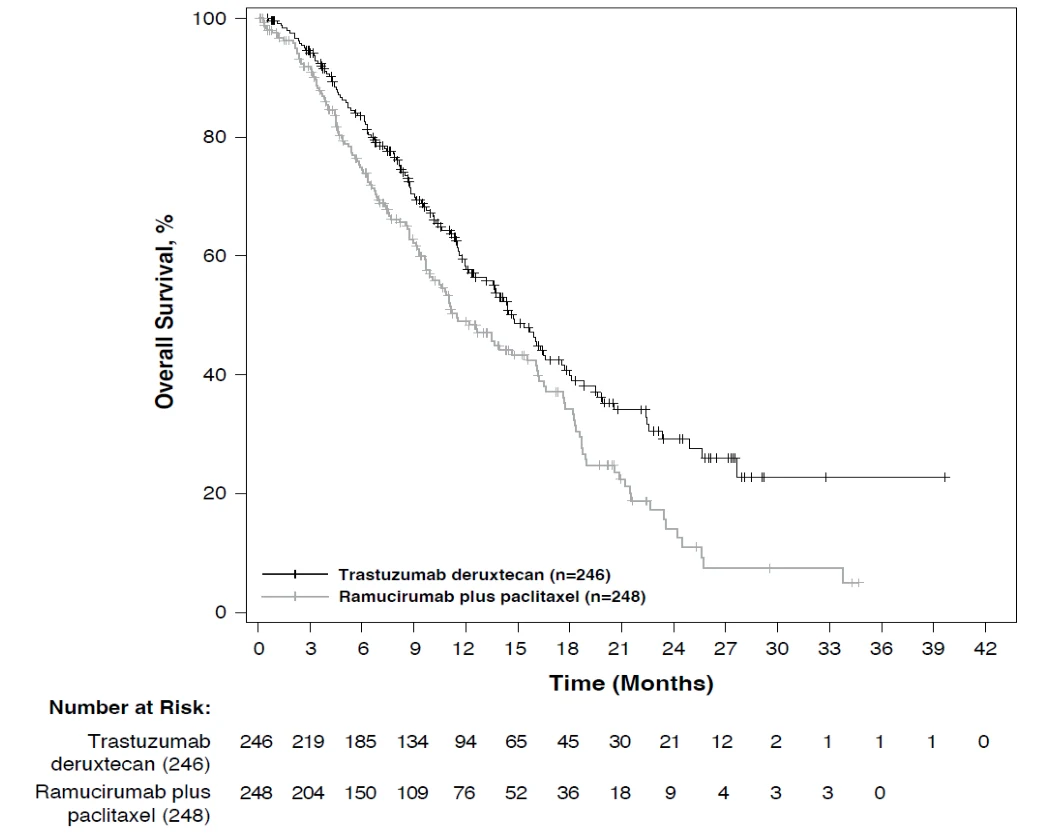
Unclassified / Non classifié
Figure 12 – Kaplan-Meier Plot of Progression-free Survival per Investigator Assessment (Full Analysis Set)
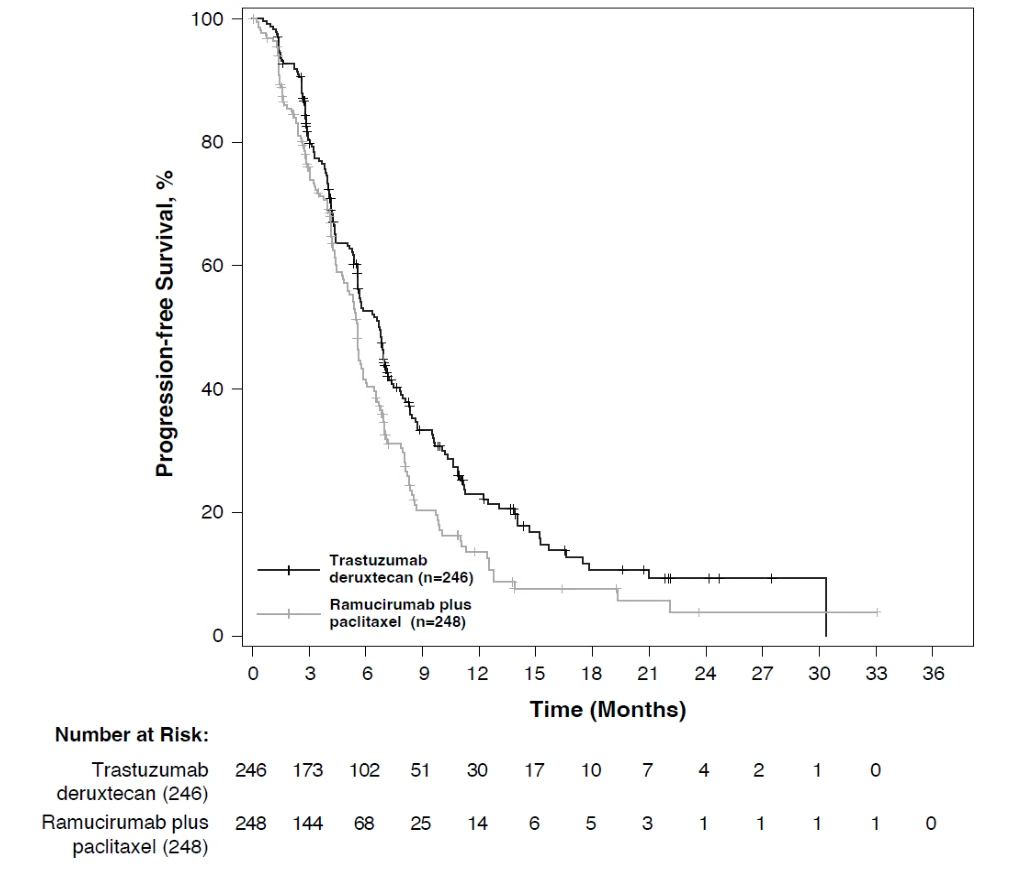
Study: DESTINY-Gastric01
Trial Design and Study Demographics (DESTINY-Gastric01)
The efficacy and safety of ENHERTU were demonstrated in DESTINY-Gastric01, a Phase 2, multicenter, open-label, randomized study conducted at sites in Japan and South Korea. The study included adult patients with unresectable, locally advanced or metastatic HER2-positive gastric or GEJ adenocarcinoma who had progressed on at least two prior regimens, including trastuzumab, a fluoropyrimidine agent, and a platinum agent. Patients were randomized 2:1 to receive either ENHERTU (N=126) or physician’s choice of chemotherapy: either irinotecan (N=55) or paclitaxel (N=7). Randomization was stratified by HER2 status (IHC 3+ or IHC 2+/ISH-positive), ECOG performance status (0 or 1), and region (Japan or South Korea). Tumour samples were required to have centrally confirmed HER2 positivity defined as IHC 3+ or IHC 2+/ISH-positive as determined according to American Society of Clinical Oncology-College of American Pathologists (ASCO-CAP) HER2 test guideline. The study excluded patients with a history of treated or current ILD/pneumonitis, a history of clinically significant cardiac disease, active brain metastases or ECOG performance status >1. Treatment was administered until disease progression, death, withdrawal of consent, or unacceptable toxicity. The primary efficacy outcome measure was unconfirmed ORR assessed by ICR (Independent Central Review) based on RECIST v1.1. OS was a key secondary endpoint. PFS, DOR, and confirmed ORR were additional secondary outcome measures.
Unclassified / Non classifié
Demographic and baseline disease characteristics were similar between treatment arms. Of the 188 patients, the median age was 66 years (range 28 to 82); 76% were male; 100% were Asian. Patients had an ECOG performance status of either 0 (49%) or 1 (51%); 87% had gastric adenocarcinoma and 13% had GEJ adenocarcinoma; 76% were HER2 IHC 3+ and 23% were IHC 2+/ISH-positive; 65% had inoperable advanced cancer; 35% had postoperative recurrent cancer; 54% had liver metastases; 29% had lung metastases; the sum of diameters of target lesions was <5 cm in 47%, ≥5 to <10 cm in 30%, and ≥10 cm in 17%; 55% had two and 45% had three or more prior regimens in the unresectable, locally advanced or metastatic setting.
Study Results (DESTINY-Gastric01)
The primary analysis demonstrated a statistically significant and clinically meaningful improvement in ORR and OS in the ENHERTU-treated group compared to the chemotherapy-treated group. Efficacy results from the primary analysis are summarized in Table 38 and the Kaplan-Meier curve for the OS is shown in Figure 13. At the primary analysis (08 November 2019) the median duration of survival follow-up was 8.1 months (range 1.0–23.1) in the ENHERTU arm and 7.0 months (range 0.3–20.3) in the chemotherapy arm.
Table 38 – Efficacy Results in DESTINY-Gastric01 (Intent-to-Treat Analysis Set)
| Efficacy Parameter | Primary Analysis (08 November 2019) | |||||||||
|---|---|---|---|---|---|---|---|---|---|---|
ENHERTU N=126 | Physician’s Choice of Chemotherapy (Irinotecan or Paclitaxel) N=62 | |||||||||
| Overall Survival (OS)* | ||||||||||
| Median, months (95% CI)† | 12.5 (9.6, 14.3) | 8.4 (6.9,10.7) | ||||||||
| Hazard ratio (95% CI)‡ | 0.59 (0.39, 0.88) | |||||||||
| Stratified Log-rank p-value‡ | p=0.0097 | |||||||||
| Objective Response Rate (ORR)§ | ||||||||||
| n (%) | 61 (48.4) | 8 (12.9) | ||||||||
| 95% CI¶ | (39.4, 57.5) | (5.7, 23.9) | ||||||||
| p-value‡,# | p<0.0001 | |||||||||
| Complete Response n (%) | 11 (8.7) | 0 (0.0) | ||||||||
| Partial Response n (%) | 50 (39.7) | 8 (12.9) | ||||||||
| Confirmed Objective Response Rate (ORR)§ | ||||||||||
| n (%) | 51 (40.5) | 7 (11.3) | ||||||||
| 95% CI¶ | (31.8, 49.6) | (4.7, 21.9) | ||||||||
| p-value‡,# | p<0.0001 | |||||||||
| Complete Response n (%) | 10 (7.9) | 0 (0.0) | ||||||||
| Partial Response n (%) | 41 (32.5) | 7 (11.3) | ||||||||
CI = confidence interval.
* OS was evaluated following a statistically significant outcome of ORR.
† Median based on Kaplan-Meier estimate; 95% CI for median calculated using Brookmeyer-Crowley method
‡ Stratified by region
§ Assessed by independent central review
¶ 95% exact binomial confidence interval
Unclassified / Non classifié
# Based on the Cochran-Mantel-Haenszel test
At the time of primary analysis, progression-free survival was 5.6 months (95% CI: 4.3, 6.9) in the ENHERTU arm and 3.5 months (95% CI: 2.0, 4.3) in the control arm.
The median duration of confirmed response as assessed by independent central review was 11.3 months (95% CI: 5.6, NE) for responders (N =51) in the ENHERTU arm and 3.9 months (95% CI: 3.0, 4.9) for responders (N=7) in the control arm.
The efficacy results observed in the updated analysis (03 June 2020) were consistent with those from the primary analysis (08 November 2019).
Figure 13 – Kaplan-Meier Plot of Overall Survival (Intent to Treat Analysis Set)
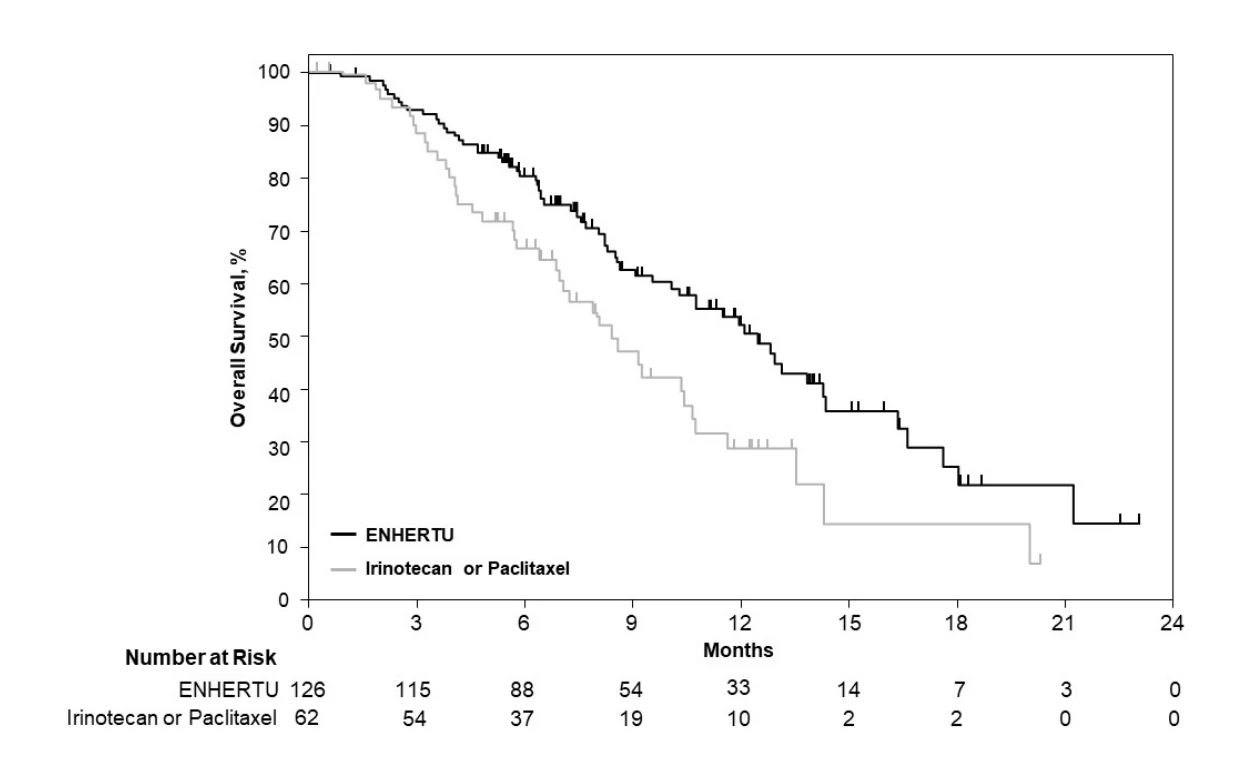
Study: DESTINY-Gastric02
Trial Design and Study Demographics (DESTINY-Gastric02)
The efficacy and safety of ENHERTU were demonstrated in DESTINY-Gastric02, a Phase 2, multicenter, open-label, single-arm study conducted at sites in Europe and the United States. The study enrolled patients with unresectable, locally advanced or metastatic HER2-positive gastric or GEJ adenocarcinoma who had progressed on a prior trastuzumab-based regimen. Patients were required to have centrally confirmed HER2 positivity defined as IHC 3+ or IHC 2+/ISH-positive as determined according to the ASCO-CAP HER2 test guideline. The study excluded patients with a history of treated or current ILD/pneumonitis, a history of clinically significant cardiac disease, with active brain metastases or an ECOG performance status >1. ENHERTU was administered by intravenous infusion at 6.4 mg/kg every three weeks until disease progression, death, withdrawal of consent, or unacceptable toxicity. The primary efficacy outcome measure was confirmed ORR assessed by ICR based on RECIST v1.1.
Unclassified / Non classifié
Of the 79 patients enrolled in DESTINY-Gastric02, demographic and baseline disease characteristics were: median age 61years (range 20 to 78); 72% were male; 87% were White, 5.0% were Asian and 1.0% were Black or African American. Patients had an ECOG performance status of either 0 (37%) or 1 (63%); 34% had gastric adenocarcinoma and 66% had GEJ adenocarcinoma; 86% were HER2 IHC 3+ and 13% were IHC 2+/ISH-positive, and 63% had liver metastases. The median number of prior regimens in the unresectable, locally advanced or metastatic setting was one.
Study Results (DESTINY-Gastric02)
Efficacy results are summarized in Table 39.
Table 39 – Efficacy Results in DESTINYGastric02 (Full Analysis Set*)#
| Efficacy Parameter | DESTINY-Gastric02 N=79 |
|---|---|
Confirmed Objective Response Rate (ORR)† % (95% CI)‡ | 38.0 (27.3, 49.6) |
| Complete response n (%) | 3 (3.8) |
| Partial response n (%) | 27 (34.2) |
* Includes all patients who received at least one dose of ENHERTU with a mediation duration of follow up at the primary analysis of 5.9 months
# Data cut-off date: 09 April 2021
† Assessed by independent central review
‡ Calculated using Clopper-Pearson method
§ Based on Kaplan-Meier estimate
¶ Calculated using the Brookmeyer and Crowley method
The median duration of response at the time of primary analysis was 8.1 months (95% CI: 4.1, NE) for the 30 responders.
The efficacy results observed in the updated analysis (08 November 2021) were consistent with those from the primary analysis (09 April 2021).
HER2-Positive (IHC 3+) Solid Tumours
Table 40 – Summary of patient demographics in clinical trials: DESTINY-PanTumor02, DESTINY-Lung01, DESTINY- CRC02
| Study # | Study design | Dosage, route of administration and duration | Study Subjects (n) | Median age (Range) | Sex |
|---|---|---|---|---|---|
| DESTINY-PanTumor 02 | Phase 2, multicente r, open-label study | ENHERTU 5.4 mg/kg IV every 3 weeks | 267 | 62 years (23 to 85) | 33.3% Male |
Unclassified / Non classifié
| DESTINY-Lung01 | Phase 2, multicente r, open-label study | Cohort 1a: ENHERTU 5.4 mg/kg IV every 3 weeks | Cohort 1a: 41 | Cohort 1a: 62 years (31 to 76) | Cohort 1a: 53.7% Male |
|---|---|---|---|---|---|
| DESTINY- CRC02 | Phase 2, multicente r, open-label, randomize d, 2-part study | Stage 1 Arm 1: ENHERTU 5.4 mg/kg IV every 3 weeks Stage 2: ENHERTU 5.4 mg/kg IV every 3 weeks | Stage 1 Arm 1: 40 Stage 2: 42 | Stage 1 Arm 1: 58 years (26 to 78) Stage 2: 59 years (26 to 84) | Stage 1 Arm 1: 52.5% Male Stage 2: 57.1% Male |
The presented study cohorts above are representative of the HER2-Positive Other Solid Tumours indication. Cohort 1 and Cohort 2 of DESTINY-Lung01 and Stage 1 Arm 2 of DESTINY-CRC02 are not presented due to a difference in patient population and dosing schedule. The efficacy and safety of ENHERTU were evaluated in 156 adult patients with previously treated unresectable or metastatic centrally-confirmed HER2-positive (IHC 3+) solid tumours who were enrolled in one of three Phase 2, multicenter, open-label studies: DESTINY-PanTumor02, DESTINY-Lung01, and DESTINY-CRC02.
Study: DESTINY-PanTumor02
Trial Design and Study Demographics (DESTINY-PanTumor02)
DESTINY-PanTumor02 was a Phase 2, multicenter, open-label study that enrolled 267 adult patients with locally advanced, unresectable, or metastatic HER2-expressing (IHC 3+, IHC 2+) solid tumours who have progressed following at least one prior systemic regimen or who have no satisfactory alternative treatment option. Patients received ENHERTU 5.4 mg/kg by intravenous infusion every three weeks. Treatment was administered until disease progression, death, withdrawal of consent, or unacceptable toxicity. The study excluded patients with a history of ILD/pneumonitis requiring treatment with steroids or ILD/pneumonitis at screening and clinically significant cardiac disease. Patients were also excluded for untreated and symptomatic brain metastases or ECOG performance status >1.
Efficacy was assessed in the subgroup of patients (N=75) with centrally confirmed HER2-positive (IHC 3+) solid tumours. The primary efficacy outcome measure was confirmed objective response rate (ORR) and secondary efficacy outcome measures included duration of response (DOR), progression-free survival (PFS), and overall survival (OS). All outcomes were assessed by independent central review (ICR) based on RECIST v1.1.
Of the 75 patients in the HER2-positive (IHC 3+) subgroup, demographic and baseline disease characteristics were: median age 64 years (range 31 to 85); 37.3% were male; 58.7% were White, 32.0% were Asian, and 4.0% were Black or African American. Patients had an ECOG
Unclassified / Non classifié performance status of either 0 (56%) or 1 (44%) at baseline. The median number of prior regiments was 2.
Study Results (DESTINY-PanTumor02)
The median duration of follow-up for patients was 12.8 months (range 0.4 to 31.6). The confirmed ORR was 61.3% (95% CI: 49.4, 72.4) and median DOR with confirmed response was 20.1 months (95% CI: 9.9, NE).
Efficacy results are summarized in Table 41 and Table 42.
Study: DESTINY-Lung01
Trial Design and Study Demographics (DESTINY-Lung01)
DESTINY-Lung01 was a Phase 2, multicenter, open-label, 2-cohort study that enrolled 181 patients with previously treated, unresectable or metastatic, HER2-expressing (IHC 3+ or IHC 2+) or HER2-mutant non-small cell lung cancer (NSCLC). Patients received ENHERTU 5.4 mg/kg or 6.4 mg/kg by intravenous infusion every three weeks. Treatment was administered until disease progression, death, withdrawal of consent, or unacceptable toxicity. The study excluded patients with a history of ILD/pneumonitis requiring treatment with steroids or ILD/pneumonitis at screening and clinically significant cardiac disease. Patients were also excluded for untreated and symptomatic brain metastases or ECOG performance status >1.
Efficacy was assessed in the subgroup of patients (N=17) with centrally-confirmed HER2-positive (IHC 3+) NSCLC who received ENHERTU 5.4 mg/kg. The primary efficacy outcome measure was confirmed objective response rate (ORR) and secondary efficacy outcome measures were duration of response (DOR), progression-free survival (PFS), and overall survival (OS). All outcomes were assessed by independent central review (ICR) based on RECIST v1.1.
Of the 17 patients in the HER2-positive (IHC 3+) subgroup, demographic and baseline disease characteristics were: median age 59 years (range 31 to 74); 58.8% were male; 64.7% were White, 17.6% were Asian, and 11.8% were Black or African American. Patients had an ECOG performance status of either 0 (11.8%) or 1 (88.2%) at baseline. The median number of prior regimens was 3.
Study Results (DESTINY-Lung01)
The median duration of follow-up for patients was 11.2 months (range 1.9 to 16.0). The confirmed ORR was 52.9% (95% CI: 27.8, 77.0) and median DOR with confirmed response was 6.9 months (95% CI: 4.0, 9.8).
Efficacy results are summarized in Table 41 and Table 42.
Study: DESTINY-CRC02
Trial Design and Study Demographics (DESTINY-CRC02)
DESTINY-CRC02 was a Phase 2, multicenter, randomized, 2-arm study that enrolled 122 patients with previously treated, unresectable or metastatic HER2-expressing (IHC 3+ or IHC 2+/ISH+) colorectal cancer (CRC). Patients received ENHERTU 5.4 mg/kg or 6.4 mg/kg by intravenous infusion every three weeks. Treatment was administered until disease progression, death, withdrawal of consent, or unacceptable toxicity. The study excluded patients with a
Unclassified / Non classifié history of ILD/pneumonitis requiring treatment with steroids or ILD/pneumonitis at screening and clinically significant cardiac disease. Patients were also excluded for untreated and symptomatic brain metastases or ECOG performance status >1.
Efficacy was assessed in the subgroup of patients (N=64) with centrally-confirmed HER2-positive (IHC 3+) CRC who received ENHERTU 5.4 mg/kg. The primary efficacy outcome measure was confirmed objective response rate (ORR) and secondary efficacy outcome measures were duration of response (DOR), progression-free survival (PFS), and overall survival (OS). All outcomes were assessed by independent central review (ICR) based on RECIST v1.1.
Of the 64 patients in the HER2-positive (IHC 3+) subgroup, demographic and baseline disease characteristics were: median age 58 years (range 25 to 78); 53.1% were male; 54.7 % were Asian, and 40.6% were White. Patients had an ECOG performance status of either 0 (57.8%) or 1 (42.2%) at baseline. The median number of prior regimens was 4.
Study Results (DESTINY-CRC02)
The median duration of follow-up for patients was 9.3 months (range 0.5 to 17.1). The confirmed ORR was 46.9% (95% CI: 34.3, 59.8) and median DOR with confirmed response was 5.5 months (95% CI: 4.2, 8.1).
Efficacy results are summarized in Table 41 and Table 42.
Table 41 – Efficacy Results in HER2-positive (IHC 3+) Patients in DESTINY-PanTumor02, DESTINY-Lung01, and DESTINY-CRC02
|
|
| |
|---|---|---|---|
| |||
| |||
| |||
| |||
CI = Confidence interval, NE = Not estimable
† Assessed by independent central review
‡ CI is derived based on the Clopper-Pearson method
§ Calculated using the Kaplan-Meier technique
Unclassified / Non classifié
Table 42 – Efficacy Results in HER2-positive (IHC 3+) Patients by Tumour Type in DESTINY-PanTumor02, DESTINY-Lung01, and DESTINY-CRC02
|
| ||
|---|---|---|---|
CI = Confidence interval, NE = Not estimable, NR = Not reached, NA = Not applicable
† Assessed by independent central review
‡ CI is derived based on the Clopper-Pearson method
§ Calculated using the Kaplan-Meier technique
Among the 2 patients with HER2-positive (IHC 3+) pancreatic cancer, there were no responders based on RECIST v1.1. However, efficacy results should be interpreted with caution given the limited number of patients investigated in some tumour types. In addition, ENHERTU has not been studied in patients with primary central nervous system (CNS) tumours or sarcoma.
16. Non-Clinical Toxicology
General toxicology
Rats
In a six week repeat-dose toxicity study, trastuzumab deruxtecan was administered to rats once every three weeks at doses up to 197 mg/kg (approximately 31 times the clinical dose of 5.4 mg/kg based on AUC). Toxicities were observed in intestines, lymphatic/hematopoietic organs (thymus, lymph nodes, bone marrow), kidneys, skin, testes, and incisor teeth. All changes observed, except for testicular and incisor teeth changes, were reversible following a nine week recovery period.
Cynomolgus Monkeys
In a three month repeat-dose toxicity study, trastuzumab deruxtecan was administered to monkeys once every three weeks at doses up to 30 mg/kg (approximately 9 times the clinical dose of 5.4 mg/kg based on AUC). Toxicities were observed in intestines, testes, skin, bone marrow, kidneys, and lungs. Pulmonary toxicity was observed at the highest dose (30 mg/kg) and histopathologically characterized by aggregation of foamy alveolar macrophages and focal alveolus and/or interstitial inflammation which showed reversibility after a three month recovery period. Changes observed in other organs, except for those in the skin and kidney, also showed
Unclassified / Non classifié reversibility or a trend toward reversibility by the end of a three month recovery period.
Carcinogenicity
Carcinogenicity studies have not been conducted with trastuzumab deruxtecan.
The topoisomerase I inhibitor component of trastuzumab deruxtecan was clastogenic in both an in vivo rat bone marrow micronucleus assay and an in vitro Chinese hamster lung chromosome aberration assay and was not mutagenic in an in vitro bacterial reverse mutation assay.
Reproductive and developmental toxicology
Impairment of Fertility
Dedicated fertility studies have not been conducted with trastuzumab deruxtecan. Based on results from general animal toxicity studies, trastuzumab deruxtecan may impair male reproductive function and fertility.
Developmental Toxicity
There were no animal reproductive or developmental toxicity studies conducted with trastuzumab deruxtecan. Based on results from general animal toxicity studies, trastuzumab deruxtecan and the topoisomerase I inhibitor component were toxic to rapidly dividing cells (lymphatic/hematopoietic organs, intestine, or testes), and the topoisomerase I inhibitor was genotoxic, suggesting the potential for embryotoxicity and teratogenicity.
Juvenile toxicity
No juvenile toxicity studies have been conducted.