


Patient Medication Information: uses, side effects, how to take - Fibryga
What is FIBRYGA used for:
FIBRYGA is used for the treatment of acute bleeding episodes and perioperative prophylaxis in children and adults with congenital afibrinogenemia and hypofibrinogenemia. FIBRYGA may be used as a complementary therapy during the management of uncontrolled severe bleeding in patients with acquired fibrinogen deficiency in the course of surgical interventions.
How FIBRYGA works:
FIBRYGA is a human fibrinogen presented as a powder for solution for intravenous administration (i.e. infusion into a vein). Fibrinogen is a normal constituent of the human blood and supports the blood coagulation of your body. Adequate doses of FIBRYGA may restore abnormally low fibrinogen levels to levels necessary for controlling bleeding.
The ingredients in FIBRYGA are:
Powder:
Medicinal ingredient(s): Fibrinogen (Human)
Non-medicinal ingredients: Glycine, L-Arginine hydrochloride, Sodium chloride, Sodium citrate dihydrate
Solvent:
50 mL or 100 mL Water for Injection
FIBRYGA comes in the following dosage form(s):
FIBRYGA is a powder and solvent for solution for intravenous injection / infusion and comes in the following dosage forms: 1 g, 2 g
Do not use FIBRYGA if:
- you are allergic to human fibrinogen or any of the other ingredients contained in FIBRYGA.
- you have experienced allergic reactions to FIBRYGA in the past.
To help avoid side effects and ensure proper use, talk to your healthcare professional before you take FIBRYGA. Talk about any health conditions or problems you may have, including:
- Allergic reactions (e.g. reddening of the skin, skin rash, itching, fall in blood pressure, difficulty in breathing)
- General symptoms (e.g. chills, fever, nausea, vomiting)
Tell your healthcare professional about all the medicines you take, including any drugs, vitamins, minerals, natural supplements or alternative medicines.
The following may interact with FIBRYGA:
FIBRYGA should not be mixed with other products.
How to take FIBRYGA:
FIBRYGA is injected into a vein. Do not use this medication if it looks cloudy or is leaking. It should be warmed up to room or body temperature before use. Discard any remaining contents after use. Do not use the product after its expiry date (printed on the vial).
Reconstitution:
| Vial Size | Volume of Solvent to be Added to Vial | Approximate Available Volume | Nominal Concentration per mL | ||||
| 1 g | 50 mL | 50 mL | 20 mg | ||||
| 2 g | 100 mL | 100 mL | 20 mg | ||||
| |||||||
| |||||||
| |||||||
| Transfer device | ||
|---|---|---|
| Fig. 1 |
- 4.
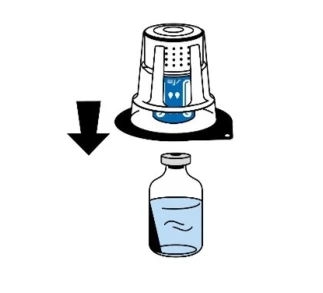
Place the solvent vial on an even, clean surface and hold it firmly. Without removing the blister package, place the blue part of the transfer device on top of the solvent vial. Press straight and firmly down until it snaps into place (Fig. 2). Do not twist while attaching.
Note:
The transfer device must be attached to the solvent vial first and then to the powder (FIBRYGA) vial. Otherwise, loss of vacuum occurs, and transfer of the solvent does not take place.
| Solvent vial | ||
| Fig. 2 |
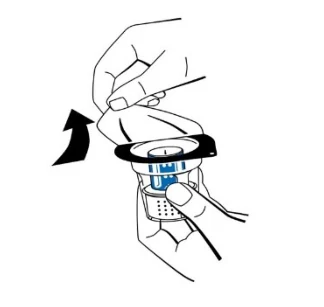
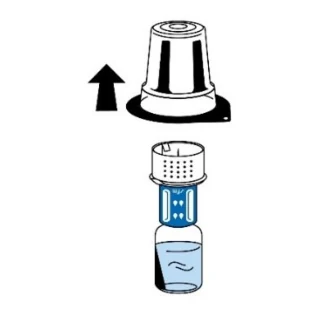
- 5. While holding onto the solvent vial, carefully remove the blister package from the transfer device by pulling vertically upwards. Make sure to leave the transfer device attached firmly to the solvent vial (Fig. 3).
| Solvent vial | ||
| Fig. 3 |
 |
|---|
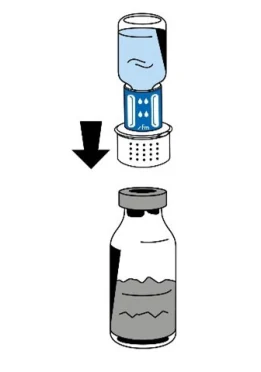
- 6. Place the powder (FIBRYGA) vial on an even, clean surface and hold it firmly. Take the solvent vial with the attached transfer device and turn it upside down. Place the white part of the transfer device connector on top of the powder (FIBRYGA) vial and press firmly down until it snaps into place (Fig. 4). Do not twist while attaching. The solvent will flow automatically into the powder (FIBRYGA) vial.
Solvent vial FIBRYGA vial | ||
| Fig. 4 |
- 7. When transfer of the solvent is complete, gently swirl the FIBRYGA vial with the solvent vial still attached, until the powder is fully dissolved. To avoid foam formation, do not shake the vial. The powder should be dissolved completely within approximately 4 minutes for FIBRYGA 1g and 8 minutes for FIBRYGA 2g. If the product is at room temperature, it should not take longer than approximately 30 minutes to dissolve the powder.On rare occasions, a partially dissolved product cake may be observed. Horizontal agitation of the vial may promote further dissolution. Avoid shaking the vial vertically.
- 8. After reconstitution is complete unscrew the transfer device (blue part) counterclockwise into two parts (Fig. 5). Do not touch the Luer lock connector on the white part of the transfer device.
Empty Solvent vial Reconstituted FIBRYGA vial | ||
| Fig. 5 |
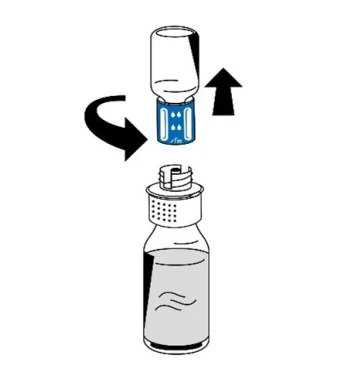
- 9. Discard the empty solvent vial together with the blue part of the transfer device.
- 10. Carefully attach a syringe to the Luer lock connector on the white part of the transfer device (Fig. 6).
- 11. Turn the FIBRYGA vial upside down and draw the solution into the syringe (Fig. 7).
| Reconstituted FIBRYGA vial | Reconstituted FIBRYGA vial | ||
| Fig. 6 | Fig. 7 |
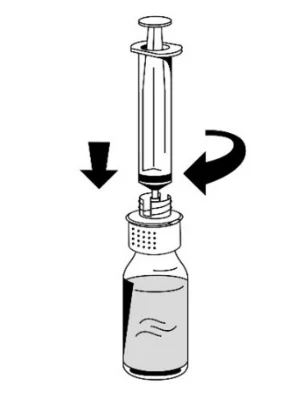
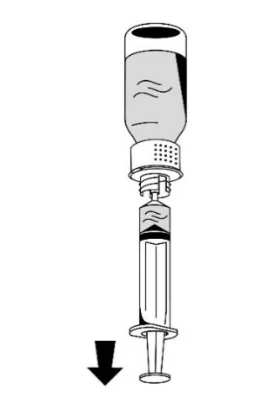
- 12. Once the solution has been transferred, firmly hold the barrel of the syringe (keeping the syringe plunger facing down) and remove the syringe from the transfer device (Fig. 8).
| Empty FIBRYGA vial | ||
| Fig. 8 |
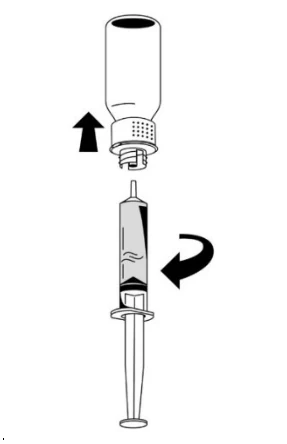
- 13. Dispose of the white part of the transfer device together with the empty FIBRYGA vial.
A standard infusion set is recommended for intravenous application of the reconstituted solution at room temperature.
FIBRYGA should be administered slowly intravenously at a recommended maximum rate of 5 mL per minute for patients with congenital afibrinogenemia and hypofibrinogenemia, and at a recommended maximum rate of 20 mL per minute for patients with acquired fibrinogen deficiency.
Any unused medicinal product or waste material should be disposed of in accordance with local requirements.
Usual dose:
FIBRYGA will be given to you by a healthcare professional in a healthcare setting.
Your doctor will determine the dose(s) of FIBRYGA. The dose and dosage regimen is dependent on the indication and may need to be individualized for each patient. Doses may be adjusted over time to achieve the desired clinical response and plasma fibrinogen levels.
Overdose:
No cases of overdose with human fibrinogen products have been reported.
If you think you, or a person you are caring for, have taken too much FIBRYGA, contact a healthcare professional, hospital emergency department, regional poison control centre or Health Canada’s toll-free number, 1-844 POISON-X (1-844-764-7669) immediately, even if there are no signs or symptoms.
Possible side effects from using FIBRYGA:
The following side effects have been observed in studies with FIBRYGA: two cases of mild pyrexia, two cases of mild skin reactions, a case of mild phlebitis, a case of moderate thrombosis and a severe case of portal vein thrombosis (following splenectomy).
The following side effects have been observed for other fibrinogen products and may potentially also occur after FIBRYGA administration:
- Allergic/ anaphylactic reactions: anaphylaxis, dyspnea, rash, tachypnea, hypotension, shock and tachycardia
- Cardiovascular: thromboembolism, pulmonary embolism
- General: chills, fever, nausea, vomiting
If any of the above listed symptoms occur, are severe or if they worry you, talk to your doctor or pharmacist. These are not all the possible side effects you may have when taking FIBRYGA. For any unexpected effects while taking FIBRYGA, contact your doctor or pharmacist.
If you have a troublesome symptom or side effect that is not listed here or becomes bad enough to interfere with your daily activities, tell your healthcare professional.
Reporting side effects
You can report any suspected side effects associated with the use of health products to Health Canada by:
- Visiting the Web page on Adverse Reaction Reporting (canada.ca/drug-device-reporting) for information on how to report online, by mail or by fax; or
- Calling toll-free at 1-866-234-2345.
NOTE: Contact your healthcare professional if you need information about how to manage your side effects. The Canada Vigilance Program does not provide medical advice.
Storage:
Store at +2°C to +25°C for up to 48 months.
Do not freeze. Protect from light. Discard any remaining contents after use. Do not use after expiry date.
Keep out of reach and sight of children.
If you want more information about FIBRYGA:
- Talk to your healthcare professional
- Find the full product monograph that is prepared for healthcare professionals and includes the Patient Medication Information by visiting the Health Canada Drug Product Database website (Drug Product Database: Access the database); the manufacturer’s website http://www.octapharma.ca, or by calling 1-888-438-0488.
Date of Authorization: January 27, 2026