


Product Monograph - Furosemide Injection, USP (Auro Pharma)
CLINICAL PHARMACOLOGY
Furosemide has no significant pharmacological effects other than on the renal function.
Renal Pharmacology
In dogs, furosemide demonstrated diuretic properties. Diuresis and sodium extraction were induced by doses of 0.125 mg/kg administered intravenously or 0.5 mg/kg administered orally.
Maximum water and sodium excretion is obtained by oral and intravenous doses of 12.5 and 25 mg/kg respectively. Increased potassium excretion can only be demonstrated with doses exceeding 1 mg/kg. The onset of action is rapid after intravenous and oral administration and the duration of activity is approximately 2 and 4 hours respectively.
Furosemide produces an immediate diuresis after intravenous administration and is effective unilaterally after injection into a renal artery. Its action, therefore, is directly on the kidney. The diuretic response is prompt and relatively brief. At the peak of diuretic response 30-40% of the filtered sodium load may be excreted, along with some potassium and with chloride as the major anion. Furosemide augments the potassium output as a result of increased distal potassium secretion.
Its diuretic action is independent of changes in acid-base balance.
Under conditions of acidosis or alkalosis the diuretic produces a chloruresis without augmentation of bicarbonate excretion. It does not inhibit carbonic anhydrase.
On the basis of changes in free-water production furosemide inhibits sodium reabsorption in the ascending limb of Henle's loop. However, proximal sites of action are also involved, as determined by micropuncture. Partial distal inhibition of sodium reabsorption is also possible. It also decreases the urinary excretion of uric acid and prolonged administration may lead to hyperuricemia. Since urate is transported in the proximal tubule, the effect of the drug on uric acid excretion further suggests a proximal tubule site of action.
Administration of furosemide may induce extracellular metabolic alkalosis, primarily by virtue of the disproportionate loss of chloride, but also, in part, as a result of the variable depletion of potassium.
Metabolism and Excretion
Furosemide binds to plasma proteins.
Following intravenous administration of the drug, the diuresis occurs within 30 minutes and the duration of action is about 2 hours.
Urinary excretion is accomplished both by glomerular filtration and proximal tubular secretion. A small fraction is metabolized by cleavage of the side chain.
Action
Animal experiments using stop-flow and micropuncture techniques have demonstrated that furosemide inhibits sodium reabsorption in the ascending limb of Henle's loop as well as in both proximal and distal tubules. The action of furosemide on the distal tubule is independent of any inhibitory effect on carbonic anhydrase or aldosterone.
Furosemide may promote diuresis in cases which have previously proved resistant to other diuretics.
INDICATIONS
Furosemide Injection, USP is indicated when a rapid onset and intense diuresis is desired, e.g. acute pulmonary edema, cerebral edema and when oral therapy is precluded because of interference with intestinal absorption or for other reasons. Generally administered to patients in hospitals or outpatient clinics. In emergencies outside this setting, the recommended dosage should be closely adhered to and the patient should be kept under close observation.
CONTRAINDICATIONS
Furosemide Injection, USP is contraindicated in patients with complete renal shutdown. If increasing azotemia and oliguria occur during treatment of severe progressive renal disease, discontinue furosemide.
In hepatic coma, precoma or in states of electrolyte depletion, furosemide therapy should not be instituted until the underlying condition has been corrected or ameliorated.
Furosemide Injection, USP is contraindicated in patients with a known history of hypersensitivity to furosemide, sulfonamide-derived drugs or to any ingredient in the formulation or component of the container. For a complete listing, see Composition section of the product monograph. Patients allergic to sulfonamides (e.g. sulfonamide antibiotics or sulfonylureas) may show cross-sensitivity to furosemide.
Severe hypokalemia, hyponatremia, hypovolemia, dehydration or hypotension must be regarded as contraindications until serum electrolytes, fluid balance and blood pressure have been restored to normal levels.
As furosemide may be capable of displacing bilirubin from albumin at least in vitro, it should not be administered to jaundiced newborn infants or to infants suffering from diseases (e.g. Rh incompatibility, familial non-hemolytic jaundice, etc.) with the potential of causing hyperbilirubinemia and possibly kernicterus.
WARNINGS
Furosemide Injection, USP is to be used under strict medical supervision and only within a hospital setting. Furosemide is a potent diuretic which, if given in excessive amounts, can lead to a profound diuresis with water and electrolyte depletion. Therefore, careful medical supervision is required; dose and dose schedule have to be adjusted to the individual patient's needs (see DOSAGE AND ADMINISTRATION).
Furosemide Injection, USP administered in doses up to 100 mg should be injected slowly (1 to 2 minutes) when the intravenous route is used.
Cases of tinnitus and reversible deafness have been reported. There have also been some reports of cases, the majority in children undergoing renal transplantation, in which permanent deafness has occurred. In these latter cases, the onset of deafness was usually insidious and gradually progressive up to six months after furosemide therapy. Hearing impairment is more likely to occur in patients with hypoproteinemia or severely reduced renal function who are given large doses of furosemide parenterally, at a rate exceeding 4 mg/minute, or in patients who are also receiving drugs known to be ototoxic. Since this may lead to irreversible damage, these drugs must only be used with furosemide if there are compelling medical reasons.
The teratogenic and embryotoxic potential of furosemide in humans is unknown. Because furosemide has been shown to produce fetal abnormalities in animal reproductive studies, it should not be used in pregnant women or in women of childbearing potential unless the benefits to the patient outweigh the possible risk to the fetus. Treatment during pregnancy requires monitoring of fetal growth.
Sulfonamide diuretics have been reported to decrease arterial responsiveness to pressor amines and to enhance the effect of tubocurarine. Great caution should be exercised in administering curare or its derivatives to patients undergoing furosemide therapy and it is advisable to discontinue furosemide for one week prior to any elective surgery.
Furosemide should be used with caution in patients with hepatic cirrhosis because rapid alterations in fluid and electrolyte balance and diuretic therapy may be related to the development of hepatorenal syndrome. Therefore, strict observation is necessary during the period of diuresis.
Supplemental potassium chloride and, if required, an aldosterone antagonist are helpful in preventing hypokalemia and metabolic alkalosis.
Renal calcifications have occurred in some severely premature infants treated with intravenous furosemide for edema due to patent ductus arteriosus and hyaline membrane disease.
In premature infants furosemide may precipitate nephrocalcinosis/nephrolithiasis. When administered to premature infants with respiratory distress syndrome in the first few weeks of life, diuretic treatment with furosemide may accentuate the risk of a patent ductus arteriosus.
PRECAUTIONS
Excessive diuresis induced by furosemide may result in dehydration and reduction of blood volume, with circulatory collapse and with the possibility of vascular thrombosis and embolism particularly in elderly patients.
Furosemide may cause electrolyte depletion. Frequent serum electrolyte and CO2 content determination should be performed during treatment. It is essential to replace electrolyte losses and to maintain fluid balance so as to avoid any risk of electrolyte depletion (hyponatremia, hypochloremia, hypokalemia, hypomagnesemia or hypocalcemia) and hypovolemia, or hypotension.
During long-term therapy a high-potassium diet is recommended. Potassium supplements may be required especially when high doses are used for prolonged periods. Some electrolyte disturbances (e.g. hypokalemia, hypomagnesemia) may increase the toxicity of certain other drugs (e.g. digitalis preparations and drugs inducing QT interval prolongation syndrome. Particular caution with potassium levels is necessary when the patient is on digitalis glycosides, potassium-depleting steroids, or in the case of infants and children. Potassium supplementation, diminution in dose, or discontinuation of furosemide therapy may be required.
Since rigid sodium restriction is conducive to both hyponatremia and hypokalemia, strict restriction in sodium intake is not advisable in patients receiving furosemide therapy.
Furosemide may lower serum calcium levels and rare cases of tetany have been reported. Calcium levels should be monitored periodically.
In children, urge to defecate, complaints of abdominal pain and cramping have been reported after intravenous furosemide. An association of these symptoms with a low serum calcium and/or a low calcium:protein ratio is possible.
Periodic checks on urine and blood glucose should be made in diabetics and even in those suspected of latent diabetes when receiving furosemide. Increases in blood glucose and alterations in glucose tolerance tests with abnormalities of the fasting and the two-hour postprandial blood sugar levels have been observed. Rare cases of precipitation of diabetes mellitus have been reported.
Particularly careful monitoring is necessary in:
- patients with hypoproteinemia. Cautious dose titration is required.
- premature infants. Renal function must be monitored and renal ultrasonography must be performed
- patients who would be at a particular risk from a pronounced fall in blood pressure
- patients with hepatorenal syndrome
Asymptomatic hyperuricemia can occur and a gout attack may rarely be precipitated.
Since furosemide is a sulfonamide derivative, it should be used with caution in patients with known sulfonamide sensitivity.
It has been reported in the literature that diuretics such as furosemide may enhance the nephrotoxicity of cephalosporins. Therefore the simultaneous administration of these drugs with furosemide is not advisable.
Patients receiving high doses of salicylates in conjunction with furosemide may experience salicylate toxicity at lower doses because of competition for renal excretory sites.
Clinical studies have shown that the administration of indomethacin can reduce the natriuretic and antihypertensive effect of furosemide in some patients. This response has been attributed to inhibition of postaglandin synthesis by indomethacin. As indomethacin is added to the treatment regimen of a patient receiving furosemide or vice versa, the patient should be closely observed to determine if the desired effect of furosemide is obtained. Indomethacin blocks the furosemide induced increase in plasma-renin activity. This should be kept in mind when evaluating plasma- renin activity in hypertensive patients.
It should be noted that diuretics may partially inhibit lactation and that furosemide passes into the breast milk.
DRUG INTERACTIONS
Sulfonamide diuretics have been reported to decrease arterial responsiveness to pressor amines and to enhance the effect of tubocurarine or curare-type muscle relaxants.
In edematous hypertensive patients being treated with antihypertensive agents, care should be taken to reduce the dose of these drugs when furosemide is administered, since furosemide potentiates their hypotensive effect. Especially in combination with ACE inhibitors, a marked hypotension may be seen sometimes progressing to shock. The concomitant administration of furosemide with ACE inhibitors may lead to deterioration in renal function and, in isolated cases, to acute renal failure.
Since furosemide is a sulphonamide derivative, it should be used with caution in patients with known sulphonamide sensitivity.
In case of concomitant use of laxatives, the risk of an increased potassium loss should be considered. Glucocorticoids, carbenoxolone and licorice may also increase potassium loss.
It has been reported in the literature that diuretics such as furosemide may enhance the nephrotoxicity of cephaloridine. Therefore, concomitant administration of both drugs is not advisable.
Administration of furosemide to diabetic patients may result in a possible decrease of diabetic control. Dosage adjustments of the anti-diabetic agent may be needed.
Renal clearance of lithium is decreased in patients receiving furosemide, and lithium toxicity may result.
Patients receiving high doses of salicylates in conjunction with furosemide may experience salicylate toxicity at lower doses because of competition for renal excretory sites.
Non-steroidal anti-inflammatory drugs (e.g. indomethacin, acetyl-salicylic acid) may attenuate the effect of furosemide and may cause renal failure in case of pre-existing hypovolemia. Probenecid and anticonvulsant drugs (phenytoin, carbamazepine, phenobarbitone) may also attenuate the effect of furosemide.
Clinical studies have shown that the administration of indomethacin can reduce the natriuretic and anti-hypertensive effect of furosemide in some patients. This response has been attributed to inhibition of prostaglandin synthesis by indomethacin. Therefore, when indomethacin is added to the treatment of a patient receiving furosemide, or when furosemide is added to the treatment of a patient receiving indomethacin, the patient should be closely observed to determine if the desired effect of furosemide is obtained.
Indomethacin blocks the furosemide-induced increase in plasma rennin activity. This fact should be kept in mind when evaluating plasma rennin activity in hypertensive patients.
Administration of intravenous furosemide within 24 hours after the ingestion of chloral hydrate has caused the sensation of heat, sweating, restlessness, nausea, rise in blood pressure and tachycardia in isolated cases.
ADVERSE REACTIONS
Electrolyte depletion has occurred during therapy with furosemide, especially in patients receiving higher doses and a restricted salt intake. Electrolyte depletion manifests itself by adverse reactions attributed to various body systems: weakness, dizziness, drowsiness, polyuria, polydipsia, orthostatic hypotension, lethargy, sweating, bladder spasms, anorexia, vomiting, mental confusion, meteorism, thirst, headache, muscle cramp, muscle weakness, tetany and cardiac rhythm disorders. (See PRECAUTIONS).
Too vigorous diuresis may induce orthostatic hypotension or acute hypotensive episodes, which may cause signs and symptoms such as impairment of concentrations and reactions, lightheadedness or orthostatic intolerance.
Excessive diuresis induced by Furosemide Injection, USP may result in dehydration and reduction of blood volume, with circulatory collapse and with the possibility of vascular thrombosis and embolism particularly in elderly patients.
Hypersensitivity reactions to furosemide include purpura, photosensitivity, paresthesia, rash and fever. Systemic hypersensitivity reactions include vasculitis, interstitial nephritis and necrotizing angiitis.
Severe anaphylactic and anaphylactoid reactions (e.g. with shock) occur rarely. Increases in liver transaminases have been reported.
Transient elevations in BUN have been observed, especially in patients with renal insufficiency.
As with other diuretics, there may be a transient rise in serum creatinine, uric acid (which may lead to a gout attack in predisposed patients), cholesterol and triglyceride levels during furosemide treatment.
At the commencement of treatment, excessive diuresis may give rise, especially in elderly patients, to a feeling of pressure in the head, dizziness, dryness of the mouth, or blurring of vision.
Symptoms of obstructed micturition (e.g. hydronephrosis, prostatic hypertrophy, ureterostenosis) may become manifest or may be aggravated during medication with diuretics.
Thrombophlebitis and emboli have occurred.
Cases of tinnitus, reversible deafness and vertigo have been reported following parenteral administration of furosemide. Hearing impairment is more likely to occur in patients with hypoproteinemia or severely reduced renal function who are given large doses of furosemide parenterally, at a rate exceeding 4 mg/min, or in patients who are receiving other ototoxic drugs.
In children, urge to defecate, complaints of abdominal pain and cramping have been reported (see PRECAUTIONS).
Transient pain at the injection site following intramuscular injection has been reported. Adverse GI effects of furosemide include nausea, vomiting and diarrhea.
Anemia, eosinophilia, leukopenia and thrombocytopenia (with purpura) have occurred, as well as agranulocytosis, aplastic anemia and hemolytic anemia.
Orthostatic hypotension, thrombocytopenia and emboli have occurred. Paresthesia, blurred vision and headache have been reported.
Diuresis induced by furosemide may be associated with bladder spasms and urge to urinate.
Various forms of dermatitis (e.g. dermatitis bullous), including urticaria, erythema multiforme, exfoliative dermatitis, pruritus and epidermolysis bullosa have occurred.
Dermatologic reactions to furosemide also include purpura and rash. Asymptomatic hyperuricemia can occur and gout may rarely be precipitated. Temporary uricosuria has been reported.
Intrahepatic cholestatic jaundice and pancreatitis have also occurred in patients receiving furosemide.
In addition the following rare adverse reactions have been reported: sweet taste, oral and gastric burning and paradoxical swelling.
Reporting Side Effects You can report any suspected side effects associated with the use of health products to Health Canada by:
NOTE: Contact your health professional if you need information about how to manage your side effects. The Canada Vigilance Program does not provide medical advice. |
SYMPTOMS AND TREATMENT OF OVERDOSAGE
Symptoms: Dehydration, electrolyte depletion and hypotension may be caused by overdosage or accidental ingestion. In cirrhotic patients, overdosage may precipitate hepatic coma.
Treatment: Discontinue the drug. Replace excessive fluid and electrolyte losses. Serum electrolytes, carbon dioxide level and blood pressure should be determined frequently. Adequate drainage must be assured in patients with urinary bladder outlet obstruction (such as prostatic hypertrophy).
Furosemide is not removed by hemodialysis.
DOSAGE AND ADMINISTRATION
Do not add furosemide into the tubing of a running infusion solution.
Changes in blood pressure should be carefully monitored when furosemide is used with other antihypertensive drugs, especially during initial therapy. The dosage of other agents must be reduced by at least 50% as soon as furosemide is added to the regimen to prevent an excessive drop in blood pressure. As blood pressure falls under the potentiating effects of furosemide, a further reduction in dosage or even discontinuation of other antihypertensive drugs may be necessary.
Adults
Edema: Usual initial dose is 20 to 40 mg injected IM or IV as a single dose. IV injections should be given slowly over a period of 1 to 2 minutes. Ordinarily, a prompt diuresis ensues.
If the diuretic response with a single dose of 20 to 40 mg is not satisfactory it may be increased by increments of 20 mg not sooner than 2 hours after the previous dose until the desired diuretic effect has been obtained. Maximum daily dose: 100 mg. Once the effective single dose has been determined, it should then be given once or twice daily.
Parenteral furosemide therapy should be replaced by oral therapy as soon as this is practical.
Acute Pulmonary Edema: Administer 40 mg IV slowly, followed by another 40 mg IV 1 to 1.5 hours later, as indicated by the patient's condition.
Children
Institute therapy in the hospital, in carefully selected patients, under close observation with frequent monitoring of serum electrolytes.
Do not add furosemide into the tubing of a running infusion solution.
The initial dose should be in the range of 0.5 to 1.0 mg/kg body weight. The total daily dose (given in divided doses of 6 to 12 hours apart) should not exceed 2 mg/kg orally or 1 mg/kg parenterally. In the
For management of a suspected drug overdose, contact your regional Poison Control Centre immediately.
newborn and in premature babies, the daily dose should not exceed 1 mg/kg.
Adopt an intermittent dosage schedule as soon as possible using the minimum effective dose at the longest possible intervals. Particular caution with potassium concentrations is always desirable when furosemide is used in infants and children.
Absorption, Metabolism and Excretion
Following intravenous administration of Furosemide Injection, USP, the diuresis occurs within 30 minutes and the duration of action is about 2 hours.
Urinary excretion is accomplished both by glomerular filtration and proximal tubular secretion; together this accounts for roughly 2/3 of the dose, the remainder being excreted in the feces. A small fraction is metabolised by cleavage of the side chain.
The following Table summarizes the elimination kinetics of furosemide.
| Subjects | Route of Administration | Dose (mg) | Rate of Administration | Biliary Excretion | Max. Serum Concentration | t½ (hr) |
| Normal | Oral | 40 | -- | 10-15% | < 1 mcg/ml | 4.0 |
| Normal | I.V. | 40 | Bolus | 10-15% | 2.5 mcg/ml | 4.5 |
| Renal Insufficiency | I.V. | 1000 | 25 mg/min | 60% | 53 mcg/ml | 13.5 |
| Renal Insufficiency | I.V. | 1000 | 4 mg/min | -- | 29 mcg/ml | -- |
PHARMACEUTICAL INFORMATION
Drug Substance
Proper Name: Furosemide
Chemical Name:
4-Chloro-N-furfuryl-5-sulfamoylanthranilic acid
(OR)
5-(Aminosulfonyl)-4-chloro-2-([2-furanylmethyl]amino)benzoic acid.
Structural Formula:
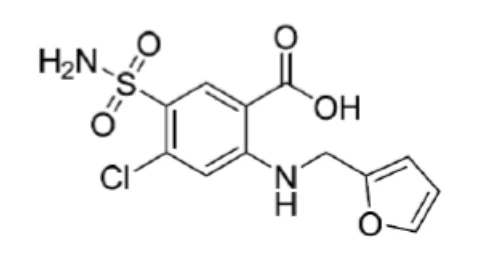
Molecular Formula: C12H11ClN2O5S
Molecular Weight: 330.75 g/mol
Description: White to slightly yellow crystalline powder. Practically insoluble in water; freely soluble in acetone, dimethylformamide and in solutions of alkali hydroxides; soluble in methanol; sparingly soluble in alcohol; slightly soluble in ether; very slightly soluble in chloroform. Melting point about 210 °C, with decomposition.
COMPOSITION
Each mL of Furosemide Injection, USP contains: Furosemide 10 mg, Sodium chloride 7.5 mg, sodium hydroxide and Hydrochloric acid to adjust pH and water for injection.
STABILITY AND STORAGE RECOMMENDATIONS
Store at 15° to 30°C.
AVAILABILITY
Furosemide Injection, USP is available in single use 2 mL amber vials as boxes of 25 vials and in single use 4 mL amber vials as boxes of 10 vials.
TOXICOLOGY
Acute
In mice the LD50 after IV or IM injection are respectively 528 and >250 mg/kg of body weight. In rats the LD50 are >200 and >66.6 mg/kg respectively.
Most animals exhibited reduced motor activity, muscular weakness, ataxia and bradypnea. Furosemide has been reported to be more toxic in newborn than adult rats.
Chronic Toxicity Rats
A one year study was performed on 100 Wistar rats at dosages of 0, 50, 100, 200 and
400 mg/kg/day, five days a week. The drug was administered by gastric intubation in the form of an aqueous suspension.
Discharge from the eye, lethargy, anorexia, dyspnea and weight loss have been observed in animals receiving 200 mg/kg and 400 mg/kg doses.
One death in the 100 mg/kg, two in the 200 mg/kg and ten in the 400 mg/kg groups occurred.
There was a significant dose-related increase in the relative weight of the kidneys. Cardiac and hepatic lesions, related to furosemide, have been observed.
Histological examination of the myocardium revealed severe local fibrosis, similar to the fibrosis induced by potassium deficiency.
The most consistent pathological changes seen in the kidney were degenerative changes in the tubular epithelium manifested by swollen cells with increased density of the cytoplasm.
Occasionally, focal necrosis of the epithelium and decreased cell size were evident, and accumulation of some calcified material. These changes were considered consistent with the nephropathy of potassium deficiency.
Dogs
In a six-month study, twenty beagle dogs have been treated with oral daily doses of 0, 10, 30, 100 and 350 mg/kg.
The highest dose was reduced to 250 mg/kg after the death of two of the four dogs in that group.
Levels of blood sugar and urea nitrogen were elevated in the animals treated with the highest doses. These normalized after treatment was stopped. Urinalysis remainded normal throughout the investigation except for urinary volume, creatinine and electrolyte levels. These changes are in keeping with the action of a diuretic drug.
There was no significant or consistent effect on organ weight. The most consistent pathological findings were renal lesions consisting of calcifications and scarring of the renal parenchyma at all doses > 10 mg/kg. The renal capsule above these lesions sometimes showed strikingly enlarged lymph vessels with thickened walls.
In a 12-month study in Rhesus monkeys, daily oral doses of furosemide of 27 mg/kg and 60 mg/kg brought about pathological findings that consisted of dilated convoluted tubules with casts in 3 out of 20 animals given 27 mg/kg and in 6 out of 9 animals given 60 mg/kg. These lesions were considered drug related.
Reproductive and Teratological Studies
Reproductive and teratological studies have been performed in mice, rats, rabbits, cats, dogs and monkeys. With the exception of mice and rabbits, no abnormalities attributed to furosemide were detected.
Furosemide caused unexplained maternal deaths and abortions in the rabbit at a daily dose of 50 mg/kg (approximately three times the maximum recommended human daily dose of 1000 mg orally) when administered between days 12 to 17 of gestation. In another study in rabbits, a dose of 25 mg/kg caused maternal deaths and abortions. In a third study, none of the pregnant rabbits survived a dose of 100 mg/kg. Data from the above studies indicate foetal lethality which can precede maternal deaths.
The results of a mouse study and one of the three rabbit studies also showed an increased incidence of distention of the renal pelvis and, in some cases, of the ureters in foetuses derived from treated dams as compared to the incidence of foetuses from the control group.
Irritation Studies: Intravenous and intramuscular injections of 0.1 mL of furosemide injection were given twice daily to rabbits weighing between 1 500 and 3 000 g for five consecutive days.
In the animals injected intravenously, a slight increase in size and redness in the injected vein was noted as well as a slight edema in the ear.
Redness at the site of injection was observed in the animals injected intramuscularly.
REFERENCES
- 1. American Hospital Formulary Service, Drug Information, 1988: Furosemide Monograph, pp. 1456-1460.
- 2. Birtch AG, Zakheim RM, Jones LG, Barger AC. Redistribution of renal blood flow produced by furosemide and ethacrynic acid. Circulation Research, 1967; XXI: 869-878.
- 3. Brenner BM, Keimowitz RI, Wright FS, Berliner RW. An inhibitory effect of furosemide on sodium reabsorption by the proximal tubule of the rat nephron. J Clin Investigation, 1969; 48: 290-300.
- 4. Brown CB, Ogg CS, Cameron JS. High dose furosemide in acute renal failure: a controlled trial. Clin Nephrol, 1981; 15: 90-96.
- 5. Compendium of Pharmaceuticals and Specialties, 1989. Furosemide Monograph, pp. 414-415.
- 6. Hook JB, Blatt AH, Brody MJ, Williamson HE. Effects of several saluretic-diuretic agents on renal hemodynamics. J Pharmacol Experimental Therapeutics, 1966; 154(3): 667-673.
- 7. Knoben JE, Anderson PO. Handbook of clinical drug data. Fifth edition, 1983: 518-520.
- 8. Kuhnel HJ, Gunther K, Stein G, Hoffmann-Traeger A. Pharmacokinetics and pharmacodynamics of high-dose furosemide in patients with chronic renal failure or nephrotic syndrome. Int J Clin Pharm Tox, 1987; 25: 616-621.
- 9. Morelli OH, Moledo LI, Alanis E, Gaston OL, Terzaghi O. Acute effects of high dose furosemide in patients with chronic renal failure. Postgrad Med J, 1971; April Suppl: 29-35.
- 10. Morrin PAF. The effect of furosemide, a new diuretic agent, on renal concentrating and diluting mechanisms. Can J Physiology & Pharmacology, 1966; 44: 129-137.
- 11. Ogiso T, Iwaki M, Konishi Y. Effect of furosemide on plasma clearance, anticoagulant effect and protein binding of warfarin in rats. J Pharm Dyn, 1982; 5: 829-840.
- 12. Quick CA, Hoppe W. Permanent deafness associated with furosemide administration. Ann Otol, 1975; 84: 94-101.
- 13. Stein JH, Wilson CB, Kirkendall WM. Differences in the acute effects of furosemide and ethacrynic acid in man. J Lab & Clin Med, 1968; 7(4): 654-665.
- 14. Stockgit JR, Lim CF, Barlow JW, Stevens V, Topliss DJ, Wynne KN. High concentrations of furosemide inhibit serum binding and thyroxine. J Clin Endocrinol Metab, 1984; 59: 62-66.
- 15. Sanofi-aventis Canada Inc., Product Monograph, LASIX (furosemide tablets SDZ) Tablets 20 mg, 40 mg, Control #151334, Date of Revision: February 14, 2012.
- 16. Sandoz Canada Inc. Product Monograph, Furosemide Injection SDZ, Control # 153987, Date of Revision: March 27, 2012