


Product Monograph - Furosemide Injection USP (Hospira Healthcare)
ACTION AND CLINICAL PHARMACOLOGY
Pharmacological experiments have demonstrated that the diuretic action results from the inhibition of sodium reabsorption at the level of the proximal and distal convoluted tubules and also at the ascending limb of the loop of Henle. Furosemide is devoid of carbonic anhydrase and aldosterone inhibitory actions.
The intravenous administration of Furosemide Injection produces a prompt diuretic response of relatively short duration. Furosemide is bound to plasma proteins. The diuretic response is apparent within a few minutes, maximum diuresis occurs within 30 minutes and the duration of action is about two hours.
Furosemide is excreted in the urine by both glomerular filtration and proximal tubular secretion. Only a small fraction is metabolized by cleavage of the side chain.
INDICATIONS
Furosemide Injection is indicated in the treatment of selected cases of edema associated with congestive heart failure, cirrhosis of the liver, and renal disease including the nephrotic syndrome, as well as other edematous states amenable to diuretic therapy.
Furosemide Injection is indicated when a rapid onset and an intense diuresis is desired, e.g. acute pulmonary edema. Furosemide Injection is also indicated when oral therapy is precluded because of interference with intestinal absorption or for other reasons.
Because of the nature of its therapeutic indications, Furosemide Injection will generally be administered to patients in hospital or in out-patient clinics. However, in case of emergency where Furosemide Injection is administered outside of this setting, the recommended dosage should be closely adhered to and the patient kept under close observation.
CONTRAINDICATIONS
Furosemide Injection is contraindicated in patients with complete renal shutdown. If increasing azotemia and oliguria occur during treatment of severe progressive renal disease, the drug should be discontinued. Therapy with Furosemide Injection should not be initiated in patients with hepatic coma or in states of electrolyte depletion until the basic condition is improved or corrected.
Furosemide Injection is also contraindicated in patients with a known history of hypersensitivity to this compound.
Severe hypokalemia, hypovolemia or hypotension must be regarded as contraindications until serum potassium and fluid balance and blood pressure have been restored to normal levels.
As furosemide may be capable of displacing bilirubin from albumin at least in vitro, it should not be administered to jaundiced newborn infants or to infants suffering from diseases (e.g. Rh incompatibility, familial non-hemolytic jaundice, etc.) with the potential of causing hyperbilirubinemia and possibly kernicterus.
WARNINGS
FUROSEMIDE INJECTION MAY PRODUCE A PROFOUND DIURESIS RESULTING IN WATER AND ELECTROLYTE DEPLETION. CAREFUL MEDICAL SUPERVISION IS REQUIRED WITH FREQUENT SERUM ELECTROLYTE AND CO2 CONTENT DETERMINATIONS. DOSAGE AND DOSE SCHEDULE SHOULD BE INDIVIDUALLY ADJUSTED TO THE PATIENT'S NEEDS (SEE DOSAGE AND ADMINISTRATION).
Cases of tinnitus and reversible deafness have been reported. There have also been some reports of cases, the majority in children undergoing renal transplantation, in which permanent deafness has occurred. In these latter cases, the onset of deafness was usually insidious and gradually progressive up to 6 months after furosemide therapy. Hearing impairment is more likely to occur in patients with severely reduced renal function who are given large doses of furosemide parenterally, at a rate exceeding 4 mg per minute or in patients who are also receiving drugs known to be ototoxic.
The effect of furosemide on human pregnancies is unknown. Because furosemide has been shown to produce fetal abnormalities in animal reproductive studies, Furosemide Injection should not be used in pregnant or nursing women or in women of child-bearing potential, unless in the opinion of the attending physician the benefits to the patient outweigh the possible risk to the fetus.
In premature neonates with respiratory distress sydrome, diuretic treatment with furosemide in the first few weeks of life may increase the risk of persistent patent ductus arteriosus (PDA), possibly through a prostaglandin-E-mediated process.
Hearing loss in neonates has been associated with the use of Furosemide Injection.
Sulfonamide diuretics have been reported to decrease arterial responsiveness to pressor amines and to enhance the effects of tubocurarine. Exercise caution in administering curare or derivatives during furosemide therapy. It is advisable to discontinue furosemide one week prior to elective surgery.
When Furosemide Injection is used to treat hepatic cirrhosis and ascites, therapy should be initiated in the hospital. The rapid loss of fluid and alteration in serum electrolytes in these patients might precipitate hepatic coma. Careful observation is mandatory during the period of diuresis. Supple-mental potassium chloride and, if necessary, an aldosterone antagonist might help prevent hypokalemia and metabolic alkalosis.
PRECAUTIONS
Excessive diuresis induced by Furosemide Injection may result in dehydration and reduction of blood volume, with circulatory collapse and with the possibility of vascular thrombosis and embolism particularly in elderly patients. Furosemide Injection may cause electrolyte depletion. Serum electrolytes, CO2, creatinine and BUN should be determined frequently during the first few months of furosemide therapy and periodically thereafter. It is essential to replace electrolyte losses and to maintain fluid balance so as to avoid any risk of electrolyte depletion, hypovolemia, or hypotension.
All patients receiving furosemide therapy should be observed for signs and symptoms of fluid or electrolyte imbalance (hyponatremia, hypochloremic alkalosis, hypokalemia, hypomagnesemia, or hypocalcemia): dryness of mouth, thirst, weakness, lethargy, drowsiness, restlessness, muscle pains or cramps, muscular fatigue, hypotension, oliguria, tachycardia, arrhythmia, or gastrointestinal disturbances such as nausea and vomiting.
Hypokalemia may develop with furosemide, especially when cirrhosis is present, or during concomitant use of corticosteriods. Potassium supplements may be required. Particular caution with potassium levels is necessary when the patient is on digitalis glycosides, potassium depleting steroids, or in the case of infants and children.
Since rigid sodium restriction is conducive to both hyponatremia and hypokalemia, strict restriction in sodium intake is not advisable in patients receiving furosemide therapy.
Furosemide may lower serum levels of calcium (rarely cases of tetany have been reported) and magnesium.
In children, urge to defecate, complaints of abdominal pain and cramping have been reported after intravenous furosemide. An association of these symptoms with a low serum calcium and/or a low calcium protein ratio is possible.
Renal calcifications (from barely visible on X-ray to staghorn) have occurred in some severely premature infants treated with intravenous furosemide for edema due to patent ductus arteriosus and hyaline membrane disease. The concurrent use of chlorothiazide has been reported to decrease hypercalciuria and to dissolve some calculi.
Increased blood glucose levels and changes of glucose tolerance during furosemide therapy have been reported and therefore diabetics and latent diabetics should have their blood and urine glucose monitored during treatment with furosemide. In rare cases, precipitation of diabetes mellitus during furosemide therapy has been observed.
Asymptomatic hyperuricemia can occur and gout may rarely be precipitated.
Since furosemide is sulfonamide derivative, it should be used with caution in patients with known sulfonamide sensitivity.
The possibility exists of exacerbation or activation of systemic lupus erythematosus.
Patients should be observed regularly for the possible occurrence of blood dyscrasias, liver or kidney damage, or other idiosyncratic reactions.
Use in pregnancy
The effect of furosemide on human pregnancy is unknown. Because furosemide has been shown to produce fetal abnormalities in animal reproductive studies, Furosemide Injection should not be used in pregnant women or in women of child-bearing potential, unless in the opinion of the attending physician, the benefits to the patient outweigh the possible risk to the fetus (see WARNINGS).
Use in nursing mothers
Furosemide has been found in the breast milk of lactating women, and may partially inhibit lactation. If the use of the drug is considered essential, then mothers should stop nursing.
Drug Interactions
Since furosemide may enhance cephaloridine's nephrotoxicity, the simultaneous administration of these drugs is not advisable.
Sulfonamide diuretics have been reported to interact with pressor amines and tubocurarine (see WARNINGS). Furosemide may potentiate the action of succinylcholine.
Patients receiving high doses of salicylates in conjunction with furosemide may experience salicylate toxicity at lower doses because of competition for renal excretory sites.
Diuretics enhance the cardiotoxic (e.g. ECG changes) and neurotoxic (e.g. ataxia, confusion and mental disorientation) effects of lithium and these drugs should not be administered concurrently. Furosemide may increase the ototoxic potential of aminoglycoside antibiotics, especially in the presence of impaired renal function. This combination should be avoided.
Furosemide should not be used concomitantly with ethacrynic acid because of the possibility of ototoxicity.
Furosemide may add to or potentiate the therapeutic effect of other antihypertensive drugs.
Patients receiving both indomethacin and furosemide should be observed closely to determine if the desired diuretic and/or antihypertensive effect of furosemide is achieved.
ADVERSE REACTIONS
Gastrointestinal System
Jaundice (including intrahepatic cholestatic jaundice), oral and gastric irritation, cramping, constipation, nausea, vomiting and diarrhea have been reported.
Acute pancreatitis has been encountered in rare instances after furosemide administration.
In children, urge to defecate, complaints of abdominal pain and cramping have been reported after intravenous furosemide (See PRECAUTIONS).
Systemic Hypersensitivity
Vasculitis, interstitial nephritis, and necrotizing angitis
Central Nervous System
Deafness, tinnitus and vertigo, have been reported following the administration of injectable furosemide. Patients with severe impairment of renal function or receiving concomitantly other ototoxic drugs are more likely to develop these adverse reactions (see WARNINGS).
Xanthopsia, paresthesias, blurred vision and headache have been reported.
Hematologic
Anemias (including aplastic anemia and hemolytic anemia), thrombocytopenia (with purpura), leukopenia and rare cases of agranulocytosis responsive to treatment have been observed. Dermatologic-Hypersensitivity
Pruritus, various forms of dermatitis, erythema multiforme, photosensitivity, rash, urticaria and rare cases of exfoliative dermatitis have been encountered.
Cardiovascular
Postural hypotension has been encountered. Orthostatic hypotension may occur and be aggravated by alcohol, barbiturates or narcotics. Thrombophlebitis and emboli have been reported. (See PRECAUTIONS).
Miscellaneous
Electrolyte depletion has occurred during therapy with furosemide. It may be manifested by weakness, dizziness, lethargy, leg cramps, sweating, bladder spasms, anorexia, vomiting and/or mental confusion (see PRECAUTIONS).
BUN elevations, usually reversible, have been observed.
Asymptomatic hyperuricemia has occurred and precipitation of gout manifestations have been reported.
Bladder spasm and urinary frequency might accompany furosemide-induced diuresis.
Hyperglycemia, glycosouria, muscle spasm, restlessness, and fever.
Whenever adverse reactions are moderate or severe, furosemide dosage should be reduced or therapy withdrawn.
SYMPTOMS AND TREATMENT OF OVERDOSAGE
Symptoms
The principal signs and symptoms of overdosage with furosemide are dehydration, blood volume reduction, hypotension, electrolyte depletion, electrolyte imbalance, hypokalemia and hypochloremic alkalosis, and are extensions of its diuretic action. ln cirrhotic patients, overdosage might precipitate hepatic coma.
Treatment
Discontinue the drug. Institute electrolyte and water replacement immediately and adjust on the basis of careful monitoring. Treatment of overdosage is supportive and consists of replacement of excessive fluid and electrolyte losses. Serum electrolytes, carbon dioxide level and blood pressure should be determined frequently. Adequate drainage must be assured in patients with urinary bladder outlet obstruction (such as prostatic hypertrophy). Hemodialysis does not accelerate furosemide elimination.
DOSAGE AND ADMINISTRATION
Furosemide Injection should be injected slowly over a period of 1 to 2 minutes when given by the intravenous route.
FUROSEMIDE INJECTION SHOULD NOT BE ADDED INTO THE TUBING OF A RUNNING INFUSION SOLUTION.
ADULTS
Edema:
The usual initial dose of Furosemide Injection is 20 to 40 mg given as a single dose injected intravenously. Ordinarily a prompt diuresis ensues.
If the diuretic response with a single dose of 20 to 40 mg is not satisfactory it may be increased by increments of 20 mg not sooner than two hours after the previous dose until the desired diuretic effect has been obtained. Maximum daily dose: 100 mg. Once the effective single dose has been determined it should then be given once or twice daily.
Parenteral furosemide therapy should be replaced by oral treatment as soon as possible.
Acute pulmonary edema
The following schedule is recommended: 40 mg of Furosemide Injection are to be slowly injected intravenously followed by another 40 mg intravenously 1 to 1½ hours later if indicated by the patient's condition.
CHILDREN
Furosemide therapy should be instituted in the hospital in carefully selected patients, under close observation with frequent monitoring of serum electrolytes.
The initial dose should be in the range of 0.5 to 1.0 mg/kg body weight, intravenous. The total daily dose (given in divided doses 6 to 12 hours apart) should not exceed 1 mg/kg parenterally.
In the newborn and in premature babies, the daily dose should not exceed 1 mg/kg.
An intermittent dosage schedule should be adopted as soon as possible using the minimum effective dose at the longest possible interval. Particular caution with potassium levels is always desirable when furosemide is used in infants and children.
AVAILABILITY OF DOSAGE FORMS
Ampoules
Amber ampoules of 2 mL or 4 mL containing 10 mg of furosemide per mL in a sterile isotonic solution with a pH of approximately 9.
Syringes
ABBOJECT*-PA Unit-of Use Syringe prefilled 2 mL, containing 10 mg of furosemide, per mL in a sterile isotonic solution with a pH of approximately 9.
ABBOJECT* Unit of Use Syringe 4 mL . Each mL contains 10 mg of furosemide in a sterile isotonic solution with a pH of approximately 9.
NOTE: Medication, fluid path and needle are sterile and nonpyrogenic if caps and needle cover are undisturbed and package intact.
ANSYR® Unit of Use prefilled 5 mL and 10 mL plastic Syringes containing 10 mg of furosemide per mL in a sterile isotonic solution with a pH of approximately 9.
NOTE: Medication and fluid path are sterile and nonpyrogenic if protective cover is undisturbed and package intact.
Protect from light.
Do not use unless the solution is clear and container or seal intact. Inspect solution prior to administration and discard if yellow colour or particulate matter is seen.
Stability and Storage Recommendations:
Store between 15o and 25oC. Do not freeze or expose to temperature above 30oC.
PHARMACEUTICAL INFORMATION
Chemistry
Structural formula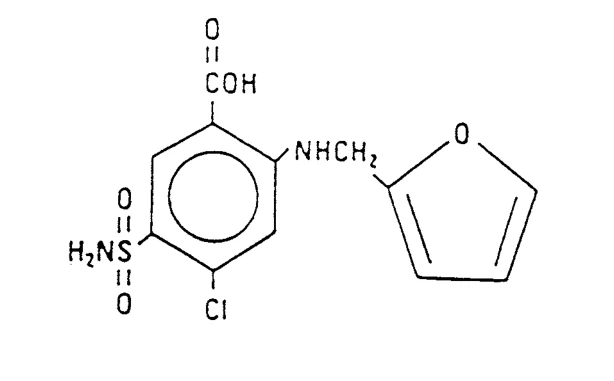
Molecular Formula: Cl2HllClN2O5S Molecular Weight: 330.74
Chemical Name: 4-chloro-N-furfuryl-5-sulfamoylanthranilic acid.
Description: White to off-white, crystalline, odourless powder, practically insoluble in water, freely soluble in acetone and solutions of alkali hydroxides.
Composition:
Ampoules and syringes contain 10 mg of furosemide and 7.5 mg of Sodium Chloride per mL. Sodium hydroxide (1.3 mg/mL) has been added during manufacturing process for pH adjustment. Furosemide Injection contains approximately 3.7 mg (0.2 mmol) of sodium per mL of solution. pH may be also adjusted with hydrochloric acid.
REFERENCES
- 1.
Berman, L.B. and Ebrahimi, A.: Experiences with Furosemide in Renal Disease. Proc. Soc.
Exp. Biol. Med. 118:333, 1965.
- 2.
Fraser, A.G. et al.: The Effects of Furosemide on the Osmolality of the Urine and the
Composition of Renal Tissue. J. Pharm. and Exp. Ther. 148:88, 1965.
- 3. Goodman, L.S. and Gilman, A.: The Pharmacological Basis of Therapeutics: MacMillan Co., toronto, 4th Edition, 1980.
- 4. Hutcheon, D.E. et al.: Diuretic Action of Furosemide. Arch. Intern. Med. 115:542, 1965.
- 5. Hufnagle, K.G., et al.: Renal calcifications, a complication of long term furosemide therapy in Preterm infants. Pediatrics 70(2):360-383, 1982.
- 6. Prandota, J. and Pruitt, A.W.: Furosemide binding to human albumin and plasma of nephrotic children. Clin. Pharmacol. Ther. 17:159, 1975.
- 7.
Quick, C.A. and Hoppe, W.: Permanent Deafness Associated with Furosemide
Administration. Ann. Otol. 34:94, 1975.
- 8. Robson, A.O. et al.: The Diuretic Response to Furosemide. The Lancet, 2:1085, 1964.
- 9. Stokes, W. and Nunn, L.C.A.: A New Effective Diuretic - Lasix. Brit. Med. J. 2:910, 1964.
- 10.
Suki, W. et al.: The site of Action of Furosemide and Other Sulfonamide Diuretics in the
Dog. J. Clin. Invest. 44:1458, 1965.
- 11.
Timmerman, R.J. et al.: Evaluation of Furosemide, A New Diuretic Agent. Curr. Ther. Res.
6:88, 1964.
- 12. Verel, D. et al.: A clinical trial of Furosemide. The Lancet, 2:1088, 1964.