


Patient Medication Information: uses, side effects, how to take - Glassia
What GLASSIA is used for:
GLASSIA is a liquid medicine containing human alpha1-proteinase inhibitor (alpha1-PI) also known as alpha1-antitrypsin (AAT), which is purified from human blood. The main purpose of infusing GLASSIA is to increase the levels of the AAT protein in your blood and lungs. AAT protein protects the lung tissue by blocking certain enzyme-caused damage. Such damage can lead to severe lung disease, such as emphysema.
How GLASSIA works:
This medicine contains the active substance human alpha1-proteinase inhibitor, which is a normal component of the blood and is found in the lung. There, its main function is to protect the lung tissue by limiting the action of an enzyme called neutrophil elastase. Neutrophil elastase can cause damage if its action is not controlled (for example, if you have an alpha1- proteinase inhibitor deficiency).
The ingredients in GLASSIA are:
Medicinal ingredients: alpha1-proteinase (human) inhibitor
Non-medicinal ingredients: monobasic sodium phosphate dihydrate, sodium chloride, water for injection
GLASSIA comes in the following dosage forms:
GLASSIA is supplied in a single-use vial containing the labeled amount of functionally active alpha1-proteinase inhibitor.
The following presentations of GLASSIA are available:
| Amount of Protein | Volume |
|---|---|
| 1000 mg | 50 mL |
| 4000 mg | 200 mL |
| 5000 mg | 250 mL |
Do not use GLASSIA if:
- you are allergic to alpha1-proteinase inhibitor or to any ingredient in the formulation or component of the container
- your body does not make enough immunoglobulin A (IgA), which could cause you to have an allergic reaction to blood products that contain IgA
To help avoid side effects and ensure proper use, talk to your healthcare professional before you take GLASSIA. Talk about any health conditions or problems you may have, including if you:
- You have a history of allergic or other adverse reactions to human alpha1-proteinase inhibitor. Your doctor will inform you about signs of allergic reactions (for example chills, flushing, faster heartbeat, fall in blood pressure, light-headedness, rash, hives, itching, difficulty in breathing or swallowing as well as swelling of your hands, face, or mouth).
If you are pregnant or breast-feeding, think you may be pregnant or are planning to have a baby, ask your doctor or healthcare professional for advice before taking this medicine.
- However, as there is no information available regarding the safety of GLASSIA use during pregnancy, if you are pregnant, this medicine should only be given to you with caution.
- It is unknown whether GLASSIA passes into human milk. If you are breast-feeding, your doctor will discuss with you the risks and benefits of taking this medicine.
- It is not known whether there is any effect of GLASSIA on fertility.
Other warnings you should know about:
GLASSIA like other products made from human plasma, part of our blood, may contain viruses or other agents that can cause infection and illness. However, the processes used to make GLASSIA are specifically designed with the ability to destroy or remove certain viruses if they are present. You should discuss the risks and benefits of this product with your healthcare professional.
Tell your healthcare professional about all the medicines you take, including any drugs, vitamins, minerals, natural supplements or alternative medicines.
How to take GLASSIA:
First infusions should be administered under the supervision of a healthcare professional experienced in the use of human alpha1-proteinase inhibitor or in the treatment of alpha1-proteinase inhibitor deficiency. Subsequent infusions can be administered by a caregiver or by the patient if appropriate training is provided and the use is reviewed at regular intervals. The decision of whether a patient is suitable for home-treatment/self-administration is made by the treating doctor. There are limited data regarding the use of this medicinal product in home-treatment/self-administration. Potential risks associated with home-treatment/self-administration are related to the administration itself as well as to the handling of adverse drug reactions, particularly hypersensitivity.
Do not attempt to do an infusion to yourself unless you or your caregiver have been taught how by your healthcare professional.
Always follow the specific instructions given by your healthcare professional. The steps listed below are general guidelines for using GLASSIA. If you are unsure of the procedures, call your healthcare professional before using.
Prepare a clean flat surface and gather all the materials you will need for the infusion. Check the expiration date and let the vial of GLASSIA warm up to room temperature. Do not apply heat, place in hot water, or microwave. Wash your hands and put on clean exam gloves. If you are infusing yourself at home, the use of gloves is optional.
- 1. Check the vial(s) of GLASSIA:
- • Do not use if the protective cap is missing or broken.
- • Look at the color: it should be clear and colorless to yellow-green. Do not use if the solution is cloudy.
- • It may contain a few (protein) particles.
- • Do not shake the vial(s).
- 2. Gather all supplies
- •
Gather all supplies: vial(s) of GLASSIA as prescribed and infusion supplies: tourniquet, alcohol swabs, intravenous needle set, vented transfer device(s), 5 micron in-line filter (not provided) and 60 mL sterile syringe(s), sterile in-line needle (not provided), vented spike (not provided), sterile intravenous infusion container (bag) (if necessary), administration infusion set, extension set (if necessary), bandage, tape, sterile gauze, sharps container, IV pole or hook, clean gloves (if necessary) and infusion log.
- • If your doctor has prescribed epinephrine pen and/or other supportive care for certain severe allergic symptoms, keep it close at hand during your infusion. Carefully follow your doctor's instructions and training if you have to administer the prescribed medicine for a severe allergic reaction.
- • Wash your hands and allow them to dry.
- • Apply gloves as directed by your healthcare professional. Open supplies as shown by your healthcare professional.
- 3. Prepare the vial(s) for infusion as directed by your healthcare professional:
- • Remove the protective cap from the vial.
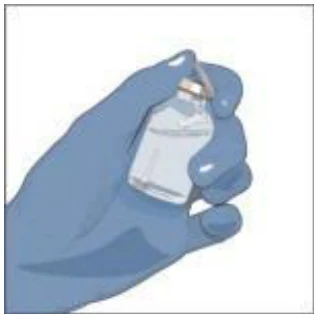
- Wipe the stoppers of each vial that you will need for your dose with a sterile alcohol swab and allow the stopper to dry.
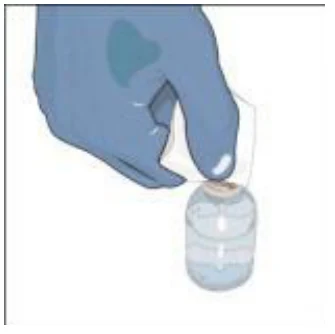
- As directed by your healthcare professional, you may infuse directly from the vial or pool the recommended number of vials of GLASSIA into an empty, sterile container (bag) for intravenous infusion. To infuse directly from the vial, peel clear plastic hanger from vial label and hang the vial from the IV pole or hook. Use the product within 3 hours of entering the vial(s) or pooling into a sterile container (bag).
If you are pooling into a sterile container (bag):
- Attach a vented spike (not provided) to a sterile syringe.
- Insert the vented spike into the center of the GLASSIA vial.
- Turn the vial upside down and pull back on the plunger to pull the GLASSIA solution into the syringe(s).
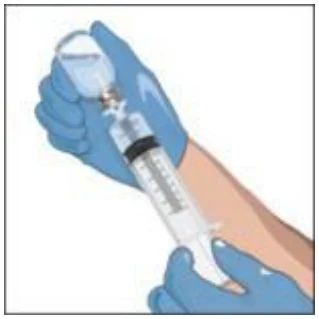
- Remove the syringe from the vented spike.
- Point the syringe tip up and gently push the plunger of the syringe to remove the air. Attach an in-line needle (not provided) to the filled syringe.
- Wipe the injection port on the empty sterile container (bag) with an alcohol swab.
- Remove protective cover of needle and insert the needle into the injection port and fill the empty bag.
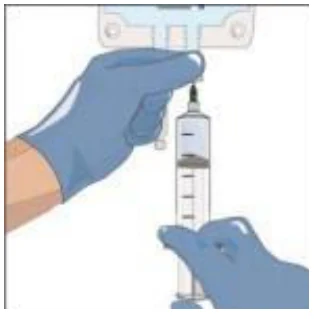
Repeat these steps, if using multiple vials to achieve the desired dose as directed by your healthcare professional, using a new in-line needle with each vial.
- 4. Prepare the infusion set:
- Close the roller clamp on the IV infusion set.
- Attach an in-line 5 micron filter to the end of the IV infusion set. Attach an extension set (if necessary).
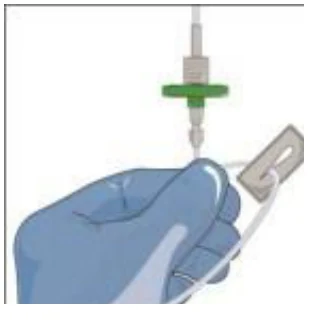
- Remove cap from the IV infusion set spike and insert spike into the infusion port on the bag containing GLASSIA. When infusing directly from the vial, use a vented spike (not provided).
Infusion using a pooling bag:
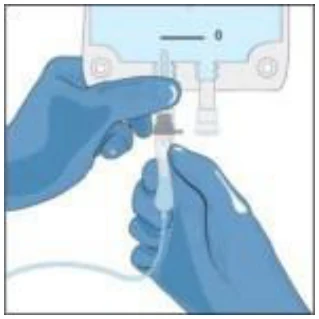
- Hang the pooling bag from an IV pole or hook.
- Squeeze the drip chamber until it is half-full and fill the IV infusion set as directed by your healthcare professional.
Infusion directly from a vial:
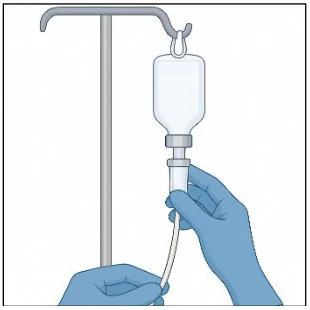
- When infusing directly from the vial, peel clear plastic hanger from vial label and hang the vial from the IV pole or hook.
Squeeze the drip chamber until it is half-full and fill the IV infusion set as directed by your healthcare professional.
- 5. Prepare the infusion site(s):
- Select an infusion site as directed by your healthcare professional. Rotate infusion sites as directed.
- Apply a tourniquet and get the injection site ready by wiping the skin well with an alcohol swab (or other suitable solution suggested by your healthcare professional) and wait for the skin to dry.
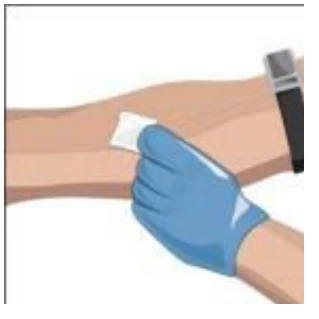
- 6. Insert and secure the intravenous needle set as directed by your healthcare professional.
- • Release the tourniquet and flush the intravenous needle set (butterfly) with normal saline to check needle placement is correct. If not successful repeat steps as directed by your healthcare professional.
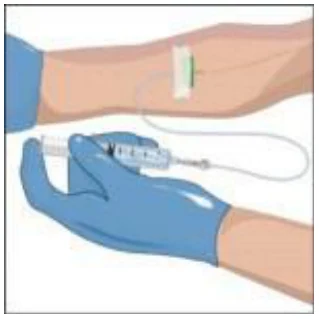
Remove the saline flush syringe and attach the IV infusion set filled with GLASSIA solution.
- 7. Follow your healthcare professional's instructions for infusing GLASSIA:
- Open the roller clamp and administer GLASSIA solution at room temperature at a rate as directed by your healthcare professional. The maximum recommended infusion rate for GLASSIA is 0.2 milliliter per kilogram body weight per minute which will take approximately 15 minutes to infuse.
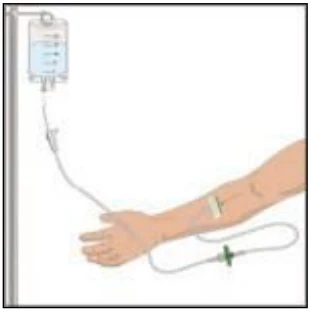
Infusion from pooling bag
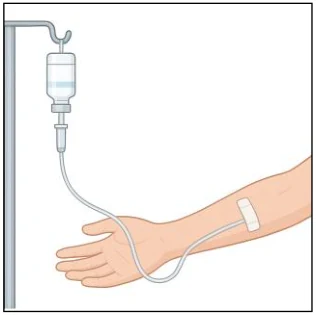
Infusion directly from vial
- Check infusion site occasionally throughout the infusion.
- When the infusion is complete, take the needle out of the vein and use sterile gauze to put pressure on the infusion site for several minutes and then apply a sterile bandage.
Do not recap the intravenous needle set. Place the needle in a hard-walled sharps container for proper disposal. Do not dispose of these supplies in ordinary household trash.
- 8. Record the infusion:
- Write down the product lot number and expiration date in your treatment record/infusion log. Write down the date, time (start and end), dose, site(s) of infusion (to assist in rotating sites) and any reactions after each infusion. Report all reactions to your healthcare professional.
- Throw away all open vials, and any unused solution into a sharps container, as recommended by your healthcare professional.
Usual dose:
Your doctor will determine the amount of GLASSIA that is right for you, and when your treatments should be given.
Overdose:
No cases of suspected overdose have been reported.
| If you think you, or a person you are caring for, have taken too much GLASSIA, contact a healthcare professional, hospital emergency department, regional poison control centre or Health Canada’s toll-free number, 1-844 POISON-X (1-844-764-7669) immediately, even if there are no signs or symptoms. |
|---|
Missed Dose:
Proceed with your next dose immediately and continue at regular intervals as advised by your doctor or healthcare professional.
Do not take a double dose to make up for a forgotten dose.
Possible side effects from using GLASSIA:
- A possible side effect to GLASSIA is worsening or flare-up of your chronic obstructive pulmonary disease (COPD) in which your breathing gets worse than usual.
- The most common side effects are headache and upper respiratory tract infections. Other possible side effects of GLASSIA include: cough, sinus infection, chest discomfort, dizziness, increased liver enzymes, shortness of breath, nausea, and fatigue.
Serious side effects and what to do about them
| Frequency/Side Effect/Symptom | Talk to your healthcare professional | Stop taking this drug and get immediate medical help | |
|---|---|---|---|
| Only if severe | In all cases | ||
| Unknown | |||
| Hypersensitivity / allergic reactions after taking this medicine: hives, swelling in the mouth or throat, itching, chest tightness, trouble breathing, wheezing, fainting or dizziness | X | X | |
These are not all the possible side effects you may feel when taking GLASSIA. If you experience any side effects not listed here, contact your healthcare professional.
If you have a troublesome symptom or side effect that is not listed here or becomes bad enough to interfere with your daily activities, talk to your healthcare professional.
Reporting Side Effects
You can report any suspected side effects associated with the use of health products to Health Canada by:
NOTE: Contact your health professional if you need information about how to manage your side effects. The Canada Vigilance Program does not provide medical advice. |
Storage:
- Store GLASSIA in the refrigerator (2°C to 8°C). Do not freeze.
- You can store GLASSIA at room temperature (up to 25°C) for up to one month. You must use GLASSIA within one month once you remove it from the refrigerator. Do not return GLASSIA to the refrigerator once the product has been stored at room temperature.
- Keep the GLASSIA vial in the box until you are ready to administer the product.
- Check the expiration date on the carton and vial label. Do not use GLASSIA after the expiration date.
Keep out of reach and sight of children.
If you want more information about GLASSIA:
- Talk to your healthcare professional
- Find the full product monograph that is prepared for healthcare professionals and includes this Patient Medication Information by visiting the Health Canada Drug Product Database website (Drug Product Database: Access the database); the manufacturer’s website https://www.takeda.com/en-ca, or by calling 1-800-268-2772.
Date of Authorization: 2026-09-01
GLASSIA® is a registered trademark of Kamada Ltd., used under license.
TAKEDA® and the TAKEDA Logo® are registered trademarks of Takeda Pharmaceutical Company Limited, used under license.