


Patient Medication Information: uses, side effects, how to take - Hibsago
What HIBSAGO is used for:
- HIBSAGO is used with other medicines called “nucleos(t)ide analogues”, to treat adults who have a long term (chronic) hepatitis B virus infection.
How HIBSAGO works:
Chronic hepatitis B is a long-term infection of the liver caused by the hepatitis B virus. It can lead to a condition called “cirrhosis” which is an advanced liver disease. This condition can lower your liver’s ability to work. It can also increase the risk of liver cancer.
HIBSAGO contains the active substance bepirovirsen. Bepirovirsen is a type of medicine called an antisense oligonucleotide.
HIBSAGO lowers the levels of hepatitis B virus proteins and DNA in the blood. In some people, the virus becomes undetectable in the blood and remains under control after treatment is stopped. Your healthcare professional will decide whether you can stop long-term hepatitis B treatment.
The ingredients in HIBSAGO are:
Medicinal ingredient: bepirovirsen (as bepirovirsen sodium)
Non-medicinal ingredients: hydrochloric acid, sodium hydroxide, water for injection
HIBSAGO comes in the following dosage form(s):
150 mg/mL solution
Do not use HIBSAGO if:
- you have a type of liver disease called cirrhosis.
- blood tests done by your healthcare professional show you have low levels of platelets (cells that help your blood to clot to stop bleeding).
- You are allergic to bepirovirsen, any of the other ingredients of this medicine or any parts of the container (see The ingredients in HIBSAGO are).
To help avoid side effects and ensure proper use, talk to your healthcare professional before you take HIBSAGO. Talk about any health conditions or problems you may have, including if you:
- have or have had kidney problems.
- have or have had abnormal bleeding or bruising, low numbers of blood platelets or thrombocytopenia (a condition where you have a low number of blood platelets).
- have or have had an organ transplant.
- have or have had any problems where your immune system attacks healthy body tissue, a condition called “autoimmune disease”.
- have or have had blood vessel inflammation, a condition called “vasculitis”.
- have or have had hepatitis C (an infection of the liver, caused by the hepatitis C virus).
- have or have had hepatitis D (an infection of the liver, caused by the hepatitis D virus).
- have a human immunodeficiency virus (HIV) infection and are taking medicines for it.
- are pregnant, planning to become pregnant, or planning to have a child with your partner.
- are breastfeeding or plan to breastfeed.
- are taking medicines that affect blood clotting. See The following may interact with HIBSAGO for more information.
Other warnings you should know about:
Check-ups and testing:
Your healthcare professional will do blood and urine tests to check on how your liver and kidneys are working.
They will also do tests to check the number of platelets you have. These are the cells in your body that help your blood clot, which stops bleeding.
Bleeding Problems:
Tell your healthcare professional immediately if you experience:
- unusual bleeding.
- a long period of bleeding.
- symptoms of bleeding of the brain such as a severe headache, vomiting, drowsiness, losing consciousness, dizziness, slurred speech, confusion or loss of movement on one side of the body.
Your healthcare professional may pause your use of HIBSAGO if you experience these events.
Immune System Problems:
Tell your healthcare professional if you experience:
- changes in your skin like rashes, red or purple spots, swelling, discomfort, itchiness, scaley patches, raised or red patches.
- joint paint that does not go away on its own.
- flu like symptoms like a fever, feeling aches, fast heartbeats or fast breathing.
- feeling weak or tired all the time, pale skin, shortness of breath.
These may be symptoms of your immune system attacking your body or inflammation of your blood vessels, which could be caused by HIBSAGO. Your healthcare professional may stop your use of HIBSAGO if you experience these symptoms.
Pregnancy:
- Talk to your healthcare professional before taking this medicine if you are pregnant, think you may be pregnant or are planning to have a baby.
- Your healthcare professional will decide if HIBSAGO is right for you based on the benefits to you and the risk to your baby while you are pregnant.
Breastfeeding:
- Talk to your healthcare professional before taking this medicine if you are breastfeeding or planning to breastfeed as HIBSAGO may pass into breast milk.
Preventing the spread of Hepatitis B:
HIBSAGO will NOT stop you from infecting people through sex or transfer of blood or body fluids.
Continue to take precautions to prevent passing on your hepatitis B to other people.
Tell your healthcare professional about all the medicines you take, including any drugs, vitamins, minerals, natural supplements or alternative medicines.
The following may interact with HIBSAGO:
medicines that stop your blood from clotting or lower your blood platelet levels or function, such as:
- acetylsalicylic acid
- clopidogrel
- warfarin
- apixaban
- dabigatran
- heparin
medicines that may lower your kidney function, such as:
- painkillers like acetylsalicylic acid, ibuprofen or naproxen.
- medicines that treat high blood pressure.
- medicines that treat bacterial infections like antibiotics.
- medicines that treat other viral infections.
- peginterferon, a medicine used to treat hepatitis B.
If you are also taking medicines for an HIV (human immunodeficiency virus) infection, keep doing so unless the healthcare professional treating your HIV infection has told you to stop.
How to take HIBSAGO:
Read the Instructions for Use for detailed steps and information on how to inject HIBSAGO.
You will receive your first dose of HIBSAGO under the guidance and supervision of your healthcare professional.
Your healthcare professional will show you or your caregiver how to inject HIBSAGO. Your healthcare professional may then decide if you or your caregiver may inject HIBSAGO. Take HIBSAGO exactly as your healthcare professional tells you.
HIBSAGO is given as an injection under your skin (subcutaneously only).
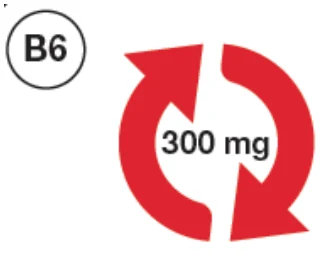
- A 300 mg dose is given as 2 injections (2 syringes).
- A 150 mg dose is given as 1 injection (1 syringe).
- Keep the syringes at room temperature (below 30°C) for at least 30 minutes before you plan to inject HIBSAGO.
- Keep the syringes in the original carton until you are ready to use them, to protect them from light.
- Do NOT inject HISBAGO into a vein or muscle.
- If you are giving yourself the injections, you can inject into your upper leg (thigh) or stomach area (abdomen).
- A caregiver can inject into the upper arm, thigh or abdomen.
- Look at the medicine in the HIBSAGO syringes through the inspection windows. The medicine should be clear and colourless to yellow.
- Do NOT use if the HIBSAGO solution in the syringes is cloudy, discoloured or has particles.
- If two injections are needed, inject the second syringe immediately after the first.
- You can use two different places to inject your two syringes.
- For example, you can give one in the thigh and the other in the abdomen.
- You can also use the same place as long as you leave at least 5 cm (2 inches) between each injection site.
- Do NOT inject where the skin is bruised, tender, red, or hard.
- Between doses, change where you inject HIBSAGO to lower the risk of getting reactions to the injections.
- Where possible, give each dose on the same day(s) each week.
- Keep track of the day(s) of the week you inject HIBSAGO so you remember to inject your next dose on the same day(s) the following week.
Usual dose:
Always use HIBSAGO exactly as your healthcare professional has told you to. Check with your healthcare professional if you are not sure.
Treatment with HIBSAGO typically lasts 24 weeks.
| Recommended dose | ||
|---|---|---|
| When | How much | How often |
| Weeks 1 and 2 | 300 mg (complete contents of 2 syringes) | Twice a week Allow 3 or 4 days between each dose. Where possible, give each dose on the same days each week. |
| Weeks 3 to 24 | 300 mg (complete contents of 2 syringes) | Once a week Where possible, give each dose on the same day each week. |
The usual dose of HIBSAGO is 300 mg. You will have blood and urine tests while you are taking HIBSAGO. Your healthcare professional may decide to change your dose, pause your treatment or stop your treatment early based on the results of the tests done while you are taking HIBSAGO.
- If your dose is 300 mg dose of HIBSAGO, you will need 2 syringes.
- If your dose is 150 mg dose of HIBSAGO, you will need 1 syringe.
While you are taking HIBSAGO, you will have to continue taking your nucleos(t)ide analogue treatment for as long as your healthcare professional recommends.
After you use HIBSAGO:
You will continue to have blood and urine tests done by your healthcare professional but these will happen less often.
Overdose:
| If you think you, or a person you are caring for, have taken too much HIBSAGO, contact a healthcare professional, hospital emergency department, regional poison control centre or Health Canada’s toll-free number, 1-844 POISON-X (1-844-764-7669) immediately, even if there are no signs or symptoms. |
|---|
Missed dose:
If you miss a dose, and your next dose is due in 3 days or more:
- inject the missed dose as soon as you remember. Then continue your treatment as before.
If you miss a dose, and your next dose is due in less than 3 days:
- skip the missed dose and inject the next one at the usual time. Then continue your treatment as before.
Use HIBSAGO for as long as your healthcare professional recommends. Do not stop unless your healthcare professional tells you to stop or you experience serious side effects.
Possible side effects from using HIBSAGO:
These are not all the possible side effects you may have when taking HIBSAGO. If you experience any side effects not listed here, tell your healthcare professional.
injection site reactions, such as:
- redness
- itchiness
- pain at the injection site
- skin colour changes at injection site
- high temperature (fever)
changes to your blood test results
- decreases in platelets (blood cells that help your blood to clot to stop bleeding).
- increases in two substances called “alanine aminotransferase” and “aspartate aminotransferase,” both made by your liver.
- lower number of neutrophils (neutropenia), a type of white blood cell that protects your body from infections.
- lower number of white blood cells (leukopenia)
- lower kidney function
- itching
- rash
- muscle pain
- lack of energy (fatigue)
- feeling cold
- feeling weak (asthenia)
- feeling generally unwell or sick (malaise)
- allergic reactions (hypersensitivity)
- inflammation of blood vessels in the skin (cutaneous vasculitis)
- nausea
- vomiting
Serious side effects and what to do about them
| Frequency/Side Effect/Symptom | Talk to your healthcare professional | Stop taking this drug and get immediate medical help | |||
|---|---|---|---|---|---|
| Frequency/Side Effect/Symptom | Talk to your healthcare professional | Stop taking this drug and get immediate medical help | |||
| Only if severe | In all cases | ||||
| Only if severe | In all cases | ||||
| Unknown | |||||
| Serious liver injury: jaundice (yellow skin or eyes), dark urine, nausea or vomiting, loss of appetite, bloated or painful stomach. | X | X | |||
Thrombocytopenia (very low blood platelets):
| X | X | |||
| Inflammation in your blood vessels, or anaemia (low number of red blood cells) | X | X | |||
| |||||
If you have a troublesome symptom or side effect that is not listed here or becomes bad enough to interfere with your daily activities, tell your healthcare professional.
Reporting side effects
You can report any suspected side effects associated with the use of health products to Health Canada by:
NOTE: Contact your healthcare professional if you need information about how to manage your side effects. The Canada Vigilance Program does not provide medical advice. |
Storage:
- Store at room temperature (below 30°C).
- Do NOT freeze.
- Store in the original carton to protect from light.
- Do NOT shake.
- Throw away if the expiry date has passed, or it has been 12 weeks since you received your carton, whichever comes first.
- Each pre-filled syringe must be administered within 6 hours once removed from the carton. Throw away if not administered within 6 hours.
- Do NOT use HIBSAGO after the expiry date shown on the pack.
- Keep out of reach and sight of children.
If you want more information about HIBSAGO:
- Talk to your healthcare professional.
- Find the full product monograph that is prepared for healthcare professionals and includes the Patient Medication Information by visiting the Health Canada Drug Product Database website (https://www.canada.ca/en/health-canada/services/drugs-health-products/drug-products/drug-product-database.html); the manufacturer’s website www.gsk.ca; or by calling 1-800-387-7374.
Date of Authorization: 2026-10-30
©2026 GSK group of companies or its licensor
Trademarks are owned by or licensed to the GSK group of companies.
Instructions For Use
 INSTRUCTIONS FOR USE HIBSAGO bepirovirsen injection For subcutaneous use 150 mg/mL Each carton contains 2 pre-filled syringes (150 mg / mL each) This Instructions for Use contains information on how to inject HIBSAGO. |
|---|
| Read this section first |
Read this Instructions for Use before you start using HIBSAGO and each time you get another prescription. There may be new information. Before using your HIBSAGO syringe, it is important that your healthcare professional explains your HIBSAGO dosing instructions and shows you (or your caregiver) how to use the syringe the right way. If you do not follow these instructions, you may not get all your medicine. Important Information
|
Do NOT use HIBSAGO syringe if:
| Do NOT:
|
|---|
| If any of these happen, throw away the HIBSAGO syringe in a sharps disposal container and use a new HIBSAGO syringe. Keep out of reach of children. Contains small parts. |
|---|
| Get to know your HIBSAGO syringes |
|---|
Before Use 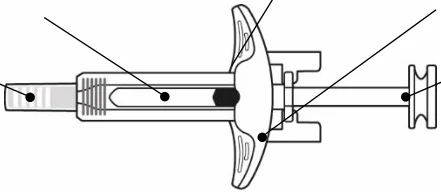 After Use 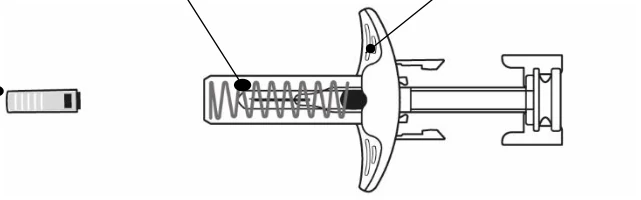 Grey needle cap (needle inside) White finger grip Inspection window (medicine inside) Stopper White plunger Grey needle cap Needle guard After use, the automatic needle guard is activated and pulls up (retracts) the needle. Stopper |
| Storage |
Syringes stored in the carton
Syringes removed from the carton
Keep out of the reach of children. Contains small parts. |
| |||
|---|---|---|---|
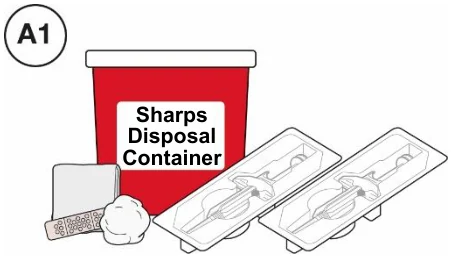 Sharps Disposal Container | Gather supplies Supplied
Not supplied
| ||
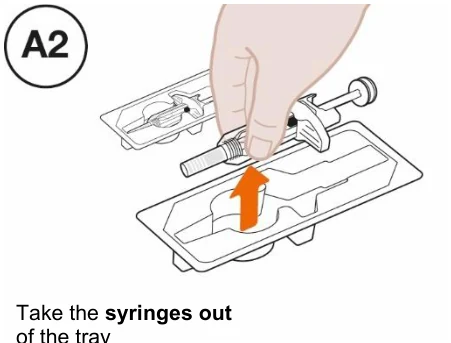 Take the syringes out of the tray | Take out your syringes
| ||
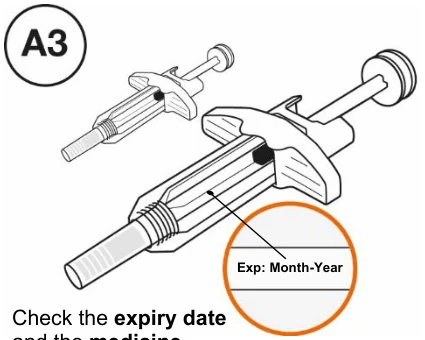 Check the expiry date and the medicine Exp: Month-Year | Check your syringes
| ||
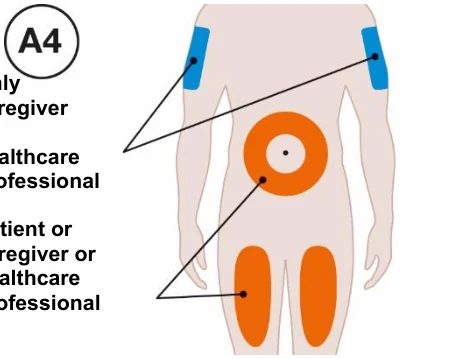 Only caregiver or healthcare professional Patient or caregiver or healthcare professional | Choose your injection sites
| ||
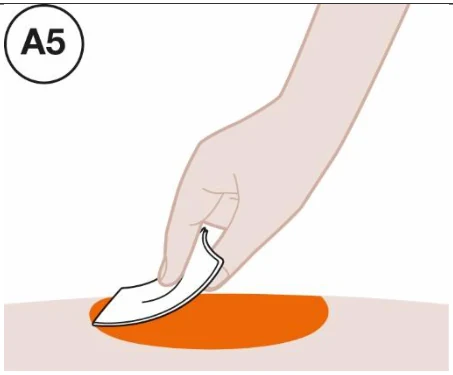 | Clean the injection sites
| ||
| |||
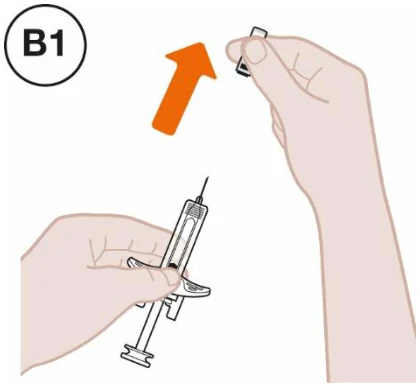 | Pull off the grey needle cap
| ||
| |||
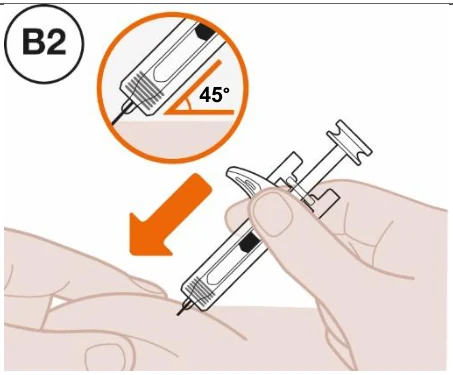 45° | Position the syringe at the injection site
| ||
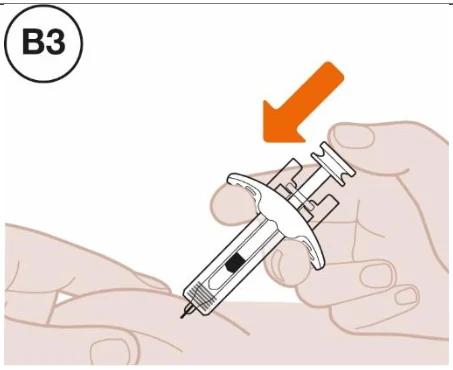 | Start the injection
| ||
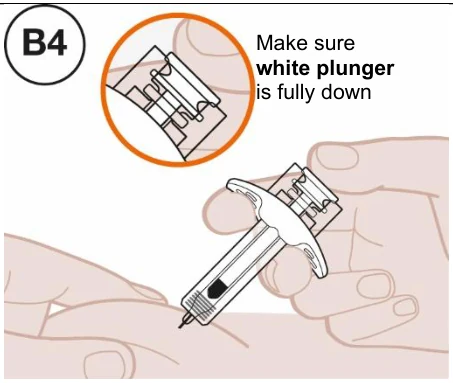 Make sure white plunger is fully down | Fully press the white plunger
| ||
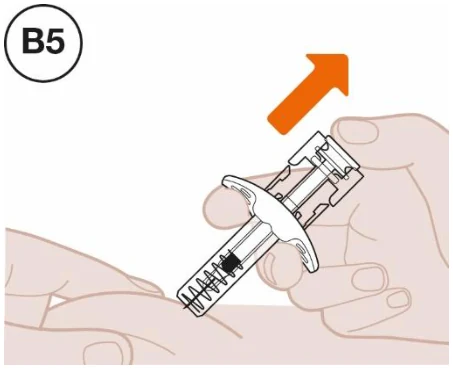 | Slowly lift thumb after injection completes
| ||
| |||
Repeat with second syringe for 300 mg dose
| |||
| C. Throw Away |
|---|
Throw away any unused medicinal product or waste material in accordance with local requirements. Keep your used syringes and needle caps out of the sight and reach of children. |
 |
|---|
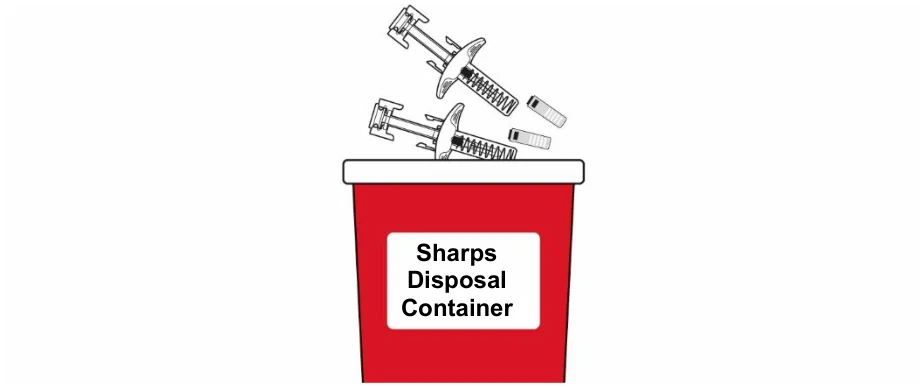 Sharps Disposal Container |
|---|