


Patient Medication Information: uses, side effects, how to take - Fuzeon
ABOUT THIS MEDICATION
What the medication is used for:
- FUZEON is a type of medicine called an HIV (human immunodeficiency virus) fusion inhibitor.
- FUZEON is always used in combination with other anti-HIV medicines to treat people with HIV infection.
What it does:
FUZEON blocks HIV's ability to infect healthy CD4 cells. When used in combination with other anti-HIV medicines, FUZEON has been shown to reduce the amount of HIV in the blood and increase the number of CD4 cells keeping your immune system as healthy as possible, so it can help fight infection.
FUZEON does not cure HIV infection or AIDS.
FUZEON does not reduce the risk of passing HIV to other people through unprotected sex, sharing used needles, or contaminated blood. For your own health and the health of others, it is important to continue to practice safe sex. Use a latex or polyurethane condom or other barrier to reduce the risk of sexual contact with semen, vaginal secretions, or blood. Do not use or share dirty needles.
When it should not be used:
Do not use FUZEON if you are allergic to any of the ingredients in FUZEON (see the end of this section for a list of ingredients in FUZEON).
What the medicinal ingredient is:
The medicinal ingredient found in FUZEON is enfuvirtide.
What the non-medicinal ingredients are:
FUZEON contains the following non-medicinal ingredients: hydrochloric acid, mannitol, sodium carbonate, and sodium hydroxide.
What dosage forms it comes in:
FUZEON is available in powder supplied in single-use vials, for reconstitution with sterile water for injection. Each vial contains 108 mg of the active ingredient enfuvirtide.
FUZEON is packaged in convenience kits containing FUZEON vials, diluent (sterile water for injection), reconstitution syringes+, and administration syringes+.
If you run out of supplies (for example, if you run out of syringes, sharps container, etc.) call your doctor’s office or pharmacy where you originally obtained your supplies.
WARNINGS AND PRECAUTIONS
Serious Warnings and Precautions
Allergic reactions have been associated with the use of FUZEON in clinical trials (see ‘Allergic Reactions’ below).
BEFORE you use FUZEON talk to your doctor or pharmacist if:
- you are allergic to FUZEON or any of its ingredients.
you are pregnant or plan to become pregnant while using FUZEON. The effects of FUZEON on pregnant women or on the fetus are not known.
- you are breast-feeding. It is recommended that HIV-positive mothers using FUZEON not breast-feed their infants. Experts advise against breast-feeding if you are HIV-positive. Breast-feeding carries the risk of passing HIV to your baby. Also, it is not known if FUZEON passes into human breast milk.
- you have any other medical conditions.
- you use any other medicines, including prescription and nonprescription medicines, or nutritional, herbal, and dietary supplements
Be sure to purchase antiseptic pads at the time FUZEON is dispensed as they are not included in the FUZEON kit (see FUZEON Injection Directions for antiseptic pad use).
This information will help your doctor and you decide whether you should use FUZEON and what extra care may need to be taken while you are on the medication. If you have any doubts about your health condition or about using FUZEON, talk to your doctor.
INTERACTIONS WITH THIS MEDICATION
- FUZEON has been shown not to interact with other anti-HIV medicines. You can decide to use FUZEON at the same times or at different times than your other anti-HIV medicines.
- FUZEON has been shown not to interact with rifampicin (known also as rifampin).
- FUZEON has not been tested with all medicines including nonprescription medicines, and it has not been tested with nutritional, herbal or dietary supplements. It is important to discuss with your doctor all of the medications and nutritional, herbal or dietary supplements you are using or are planning to use before you begin treatment with FUZEON.
PROPER USE OF THIS MEDICATION
Your doctor has prescribed FUZEON after carefully studying your case. Other people may not benefit from taking this medicine, even though their problems may seem similar to yours. Do not give your FUZEON to anyone else.
- You should be under a doctor's care when using FUZEON.
- FUZEON must be used in combination with other anti-HIV medicines.
- Before you begin using FUZEON, make sure you understand all of the information provided with your medicine. You or your caregiver should be properly trained before injecting FUZEON. If you do not understand some of the information, talk with your doctor or nurse about your questions or concerns.
- Be sure to read the consumer information for the other products your doctor may prescribe for use with FUZEON.
- FUZEON is injected under the skin two times a day. Complete, step-by-step instructions about injecting FUZEON are given in the FUZEON Injection Directions provided with your medicine.
- You must use FUZEON every day exactly as your doctor prescribed it. Do not change your dose or stop using FUZEON without first talking with your doctor.
- When your supply of FUZEON runs low, be sure to have it refilled. This is very important because the amount of virus in your blood may increase if the medicine is stopped for even a short time. If you miss or skip doses of FUZEON, HIV may develop resistance to FUZEON and become harder to treat.
- It is important that you properly discard your used syringes after injecting FUZEON. Discard all used syringes into your sharps waste container. Your doctor or nurse will give you additional instructions about the safe disposal of your used syringes.
Usual dose:
The recommended dose of FUZEON in adults is 90 mg (1 mL) twice daily injected under the skin. Refer to the FUZEON Injection Directions for step-by-step instructions about injecting FUZEON.
FUZEON can be injected before or after a meal.
The dosage for children is based on weight and will be determined by the doctor.
Overdose:
As with any prescription medicine, if you use more than the recommended dosage, seek medical attention immediately. Experience of FUZEON overdose is unknown, and there is no specific antidote for overdose with this drug.
| In case of drug overdose, contact a health care practitioner, hospital emergency department or regional Poison Control Centre immediately, even if there are no symptoms. |
Missed Dose:
If you miss a dose of FUZEON, you should take the missed dose as soon as possible and then take your next dose as scheduled. If you have missed a dose of FUZEON and it is close to the time when you are supposed to take your next dose, wait and take the next dose as regularly scheduled. Do not take two doses of FUZEON at once.
SIDE EFFECTS AND WHAT TO DO ABOUT THEM
Unwanted effects are possible with all medicines. Talk to your doctor or pharmacist if you are worried about side effects or find them very bothersome, and report any new or continuing symptoms to your doctor immediately. Your doctor will be able to tell you what to do and may be able to help you with these side effects.
This list of side effects is not complete. If you have questions about side effects, ask your doctor, nurse, or pharmacist. Report any new or worsening symptoms to your doctor immediately.
Allergic Reactions
There have been a small number of allergic reactions reported in patients using FUZEON. Symptoms of an allergic reaction could include the following (either alone or in combination): difficulty breathing; fever with vomiting and skin rash; blood in your urine; or swelling of your feet. If you develop any of these symptoms, you should call your doctor immediately.
Injection Site Reactions
- You will probably experience one or more of the following mild to moderate reactions at the location where you inject your medicine: itchiness, swelling, redness, pain or tenderness, hardened skin, or bumps. You may experience more severe pain, discomfort or other symptoms requiring pain medications or limiting your usual activities.
- Injection site reactions can appear within the first week of treatment with FUZEON and generally do not get worse with continued use of FUZEON. Reactions at an individual injection site usually last for fewer than 7 days but can last 14 days or longer. Discuss ways to help manage your injection site reactions with your healthcare professional.
- Injection site reactions may be worse when injections are repeated in the same place on the body, or when the injection is given deeper than intended (for example, into the muscle).
- Remember that reactions at injection sites are a common side effect of using FUZEON. In studies, most patients said that these reactions were tolerable and very few stopped using FUZEON because of them. If you experience reactions at an injection site, it is important not to stop using FUZEON until you have talked with your doctor about any concerns you may have.
In rare instances, patients experienced an infection at an individual injection site. To reduce the risk of
- infection, it is important that you follow the FUZEON Injection Instructions provided with your medicine.
When should you contact your doctor about injection site reactions?
You should call your doctor if there is evidence of infection at the site of injection such as drainage or increasing heat, swelling, redness or pain.
Almost all patients using FUZEON have injection site reactions. If you are worried about the reaction you are having, call your doctor or nurse to help you decide if you need medical attention. If the injection site reaction you are having is severe (defined as a Grade 3 or 4 below), call your doctor immediately.
This scale will help you judge the seriousness of your injection site reaction. The scale will also help you explain your reaction when you talk to your doctor or nurse:
Grade 1: mild soreness at the injection site
Grade 2: pain at the injection site that does not limit your daily
activities
Grade 3: severe pain at the injection site that requires pain
medicine* or limits usual activities
Grade 4: severe pain requiring hospitalization
* Your doctor can recommend which pain medicine will work best for you.
Pneumonia
Patients with HIV get bacterial pneumonia more often than patients without HIV. In clinical trials, patients using FUZEON with other HIV medicines got bacterial pneumonia more often than patients not receiving FUZEON. It is unclear if this was related to the use of FUZEON. You should contact your healthcare professional right away if you have a cough, fever or trouble breathing. Patients are more likely to get bacterial pneumonia if they had a low number of CD4 cells, increased amount of HIV in the blood, intravenous (injected into the vein) drug use, smoking or had experienced lung disease in the past. It is unclear if pneumonia is related to FUZEON.
Immune Reconstitution Inflammatory Syndrome
Changes in your immune system can happen when you start taking HIV medicines. Your immune system may get stronger and begin to fight infections that have been hidden in your body for a long time, or you could develop an autoimmune disease in which your immune system reacts against your own body (e.g. Grave's disease (which affects the thyroid gland), Guillain-Barre syndrome (which affects the nervous system) or polymyositis (which affects the muscles) and it may develop at any time, sometimes months later after the start of HIV therapy). Sometimes symptoms can be severe, so if you develop high temperature (fever), joint or muscle pain, redness, rash, swelling, or fatigue or any new symptoms contact your doctor immediately.
Additional information about possible side effects:
- The following side effects were seen more frequently in patients using FUZEON with their other anti-HIV medicines than in patients not using FUZEON with their other anti-HIV medicines: cough; headache; pain and numbness in feet or legs; dizziness; loss of sleep; depression; decreased appetite; inflamed sinuses; enlarged lymph nodes; weight decrease; weakness or loss of strength; muscle pain; constipation; and pain and inflammation of the pancreas.
- There have been other side effects in patients using FUZEON. However, these side effects may have been due to other medicines that patients were using or to HIV disease itself. Some of these side effects can be serious.
| SERIOUS SIDE EFFECTS, HOW OFTEN THEY HAPPEN AND WHAT TO DO ABOUT THEM | ||
|---|---|---|
| Symptom / effect | Talk with your doctor or pharmacist | Stop taking drug and call your doctor or pharmacist |
| Only if severe | In all cases | |
| SERIOUS SIDE EFFECTS, HOW OFTEN THEY HAPPEN AND WHAT TO DO ABOUT THEM |
|---|
| Symptom / effect | Talk with your doctor or pharmacist | Stop taking drug and call your doctor or pharmacist | |||
|---|---|---|---|---|---|
| Common | Injection Site Reactions Symptoms: itchiness, swelling, redness, pain or tenderness of skin, hardened skin, or bumps. | ✓ (defined as Grade 3 or 4 ) | |||
| Uncommon | Allergic Reactions Symptoms: trouble breathing, nausea, chills, shivering, fever with vomiting and skin rash, blood in your urine, swelling of feet, low blood pressure which may make you faint or feel faint. Pneumonia Symptoms: cough with fever, rapid breathing, or shortness of breath. | ✓ ✓ | |||
Contact your healthcare provider immediately if you develop any of the symptoms associated with an allergic reaction or pneumonia.
This is not a complete list of side effects. For any unexpected effects while taking FUZEON, contact your doctor or pharmacist.
HOW TO STORE IT
Unopened FUZEON vials can be stored at room temperature (15-30ºC). The sterile water for injection (diluent) may be stored at room temperature.
After FUZEON has been mixed with the sterile water for injection, the vial can be stored in a refrigerator for up to 24 hours.
Do not use FUZEON or sterile water for injection after the expiration date on the vials.
Keep this and all other medications out of the reach and sight of children. Do not keep medicine that is out of date or that you no longer need. Vials of FUZEON that are not used should be returned to the pharmacy. Opened vials of FUZEON containing unused amounts of medicine should be safely discarded. For further information on the proper disposal of FUZEON and its components see section below “Discarding Used Syringes and Other Supplies”.
REPORTING SUSPECTED SIDE EFFECTS
You can report any suspected adverse reactions associated with the use of health products to the Canada Vigilance Program by one of the following 3 ways: --------------------------------------------------------------------------
Postage paid labels, Canada Vigilance Reporting Form and the adverse reaction reporting guidelines are available on the MedEffect™ Canada Web site at www.healthcanada.gc.ca/medeffect. NOTE: Should you require information related to the management of side effects, contact your health professional. The Canada Vigilance Program does not provide medical advice. |
MORE INFORMATION
This document plus the full product monograph, prepared for health professionals can be found at:
http:// www.rochecanada.com
or by contacting the sponsor, Hoffmann-La Roche Limited, at 1-888-762-4388.
Last revised: March 25, 2020
©Copyright 2003-2020 Hoffmann-La Roche Limited
FUZEON® is a registered trade-mark of F. Hoffmann-La Roche AG, used under license.
All other trade-marks are the property of their respective owners.
+ Syringes manufactured by Terumo (Philippines) Corp., 124 East Main Ave., Laguna Technopark, Binan, Laguna, Philippines.

Hoffmann-La Roche Limited
Mississauga, Ontario L5N 5M8
| FUZEON INJECTION DIRECTIONS |
The following is a basic, step-by-step guide to injecting FUZEON (enfuvirtide). Please read this guide in its entirety before proceeding. Contact your healthcare professional if you have any questions about FUZEON or its administration.
These instructions are for an adult dose of 1 mL of FUZEON. If your prescription is for less than 1 mL your healthcare professional may tell you to use different syringes.
It can take up to 1 hour to prepare FUZEON - mostly time for the powder to dissolve. Be sure to plan ahead, allowing yourself enough time.
Safety Tips
Wash your hands well to reduce the risk of bacterial infections. Do not touch anything except the medicine and supplies.
- When handling the syringe, do not touch the needle. Do not touch the tops of the vials once they have been cleaned with alcohol pads.
- Make sure none of the items in your kit have been opened. Do not use opened materials.
- Never use a syringe with a bent or damaged needle.
- Never mix FUZEON with tap water. Use only the sterile water for injection provided to mix FUZEON.
- Never mix FUZEON in the same syringe with other injectable medicines.
- There should never be any particles floating in the FUZEON once it is completely mixed with the sterile water for injection. If you see any, do not use it. Contact your pharmacist.
- The only recommended route of injection is subcutaneous (under the skin). FUZEON should not be given intravenously (directly into your veins) or intramuscularly (directly into your muscle).
- Use syringes, vials of FUZEON and vials of sterile water for injection only once.
- Discard used syringes into your sharps container. Consult your doctor if you have any questions about safe disposal of these items.
When to Have a Caregiver Assist You
Certain injection sites, such as the upper arms, can be difficult to use at first. Have your partner, a friend, or a family member with you if you need help. To reduce the risk of infection to the patient or needle-stick injury to the caregiver, anyone giving or helping with injections should also attend an injection training session with your healthcare professional. Administration instructions are available from your healthcare professional.
If someone will be assisting you with your injections, purchase a supply of latex gloves for them. These should always be worn by anyone who helps you.
About the Safety Syringe+
The syringes supplied with your medicine have a coloured needle protection device that is attached to the needle. This safety device covers the needle after use and reduces the risk of needle-stick injuries. Do not tear off the needle protection device from the syringe.
Although these syringes offer this safety feature, it is important that you dispose of used syringes properly and according to the instructions given to you by your healthcare professional.
If your doctor has prescribed other syringes, please follow the instructions provided for those syringes and the mixing and administration instructions provided for FUZEON below.
Getting Ready
Gather all of the following supplies onto a clean surface:
Included in the convenience kit:
- One vial of FUZEON
- One vial of sterile water for injection
- One 3-mL syringe+ (larger syringe) with a 25 mm needle
- One 1-mL syringe+ (smaller syringe) with a 13 mm needle
*Not included in the convenience kit:
- 3-4 alcohol or other antiseptic pads
- Sharps waste container
*You may need to purchase these items.
Washing Hands
Wash hands thoroughly with soap and water. Dry your hands with a clean paper towel and also use the paper towel to turn off the faucet. After washing hands, do not touch anything except the injection supplies and the injection site.
If you are giving the injection to someone else, be sure to wear latex gloves.
Open Syringe Packages and Remove Vial Caps
- Discard packages and vial caps into the trash.
- Place syringes and vials onto a clean surface.
Clean the Tops of Vials
- Wipe each vial top with a fresh alcohol pad. Let the tops air-dry.
- Be sure not to touch the rubber tops after cleaning them. If you touch them, be sure to clean them again.
+ Syringes manufactured by Terumo (Philippines) Corp., 124 East Main Ave., Laguna Technopark, Binan, Laguna, Philippines.
Mixing FUZEON Draw Up Sterile Water for Injection | ||
| Step 1: | Pick up the 3-mL, large syringe. Using your index finger, push back the coloured needle protection device towards the body of the syringe. | 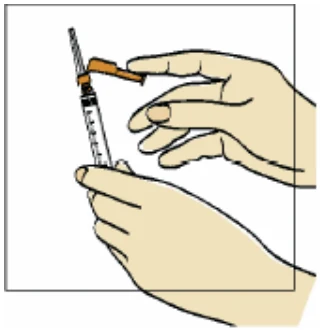 |
| To ensure that the needle is secure, hold the clear plastic cap and tighten the needle with a gentle clockwise twist. Do not use too much force as the needle may loosen. | ||
| Step 2: | Remove the clear plastic cap by pushing towards the syringe and pulling the cap off. | 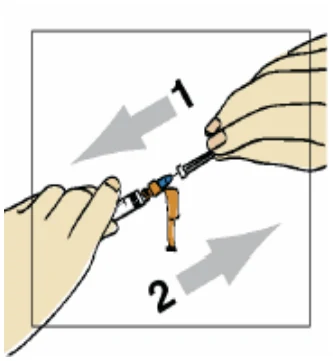 |
| Draw back 1.1 mL of air. | ||
| Step 3: | Insert the syringe needle into the rubber top of the sterile water vial and press the plunger, injecting the air. | 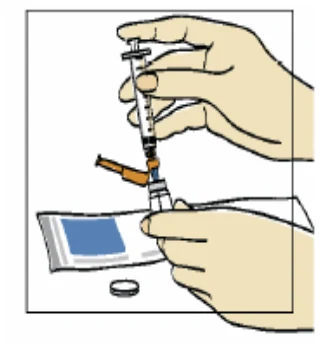 |
| Step 4: | With the needle still in the vial, turn the vial upside down. Make sure the tip of the needle is always below the surface of the sterile water to help keep any air bubbles from entering the syringe. Slowly pull the plunger past the 1.1-mL mark. | 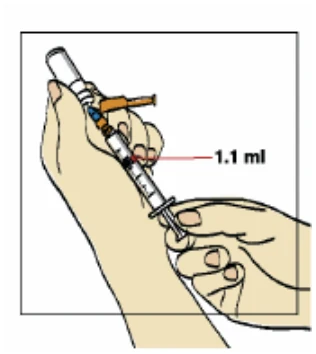 |
| Step 5: | With the needle still in the vial, tap or flick the syringe gently to make any air bubbles rise to the top. If extra air enters the syringe, gently press the plunger to force any air back into the vial and withdraw the sterile water again, making sure you have 1.1 mL of sterile water in the syringe |
| Step 6: | Remove the needle from the vial, making sure you never touch the needle with your fingers or any other object. If the needle touches your fingers or any other object, discard the syringe and start over with a new one. Discard the sterile water vial into the trash. The sterile water vial is intended for single use only. |
Inject Sterile Water Into FUZEON
| Step 7: | Gently tap the FUZEON vial to loosen the powder. Hold the water-filled syringe by the barrel and push the needle through the rubber top of the FUZEON vial at a slight angle. | |
| Step 8: | Press the syringe plunger slowly. Allow the water to flow slowly down the inside of the vial. Be careful not to forcefully shoot water into the powder, since this can cause foaming. If foaming occurs, it may take longer for the FUZEON to completely dissolve. | 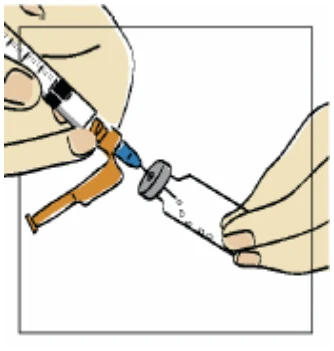 |
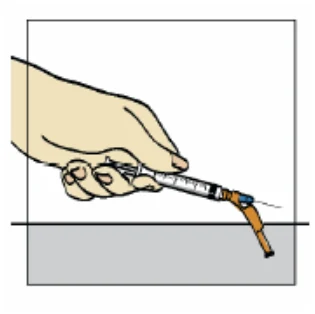
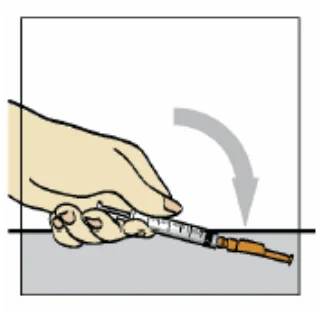
| Step 9: | After all of the sterile water has been added to the FUZEON vial, remove the syringe from the vial. Hold the barrel of the syringe with one hand and gently press the coloured needle protection device down on a flat surface until it covers the needle. You will hear a click. Do not use your free hand to press the device over the needle. | |
 |  | |
| Discard the syringe into the sharps container | ||
Mix
| Step 10: | Gently tap the FUZEON vial with your fingertip for 10 seconds until the powder begins to dissolve. Never shake the vial or turn it upside down to mix—this will cause excessive foaming. |
| You may also gently and slowly roll the vial between your hands. | |
| If there are some undissolved pieces sticking to the wall of the vial above the water level, slowly roll the vial in an upright position between your hands for a short time until the pieces fall back into the water. After the powder begins to dissolve, set the vial aside to allow it to completely dissolve. The FUZEON may take up to 45 minutes to dissolve. | |
| If you accidentally touch the rubber top, be sure to clean it again with a new alcohol pad. | |
| Make sure the FUZEON has dissolved completely. The solution should be clear and colourless. Allow any bubbles that may have formed to settle. If bubbles still exist, gently tap the side of the FUZEON vial to help settle them. | |
| As with all injectable medicines, it is important to inspect the FUZEON solution for particles. If you notice any particles in the FUZEON solution, discard the vial or return it to your pharmacy. | |
| Once a dose of FUZEON is mixed with sterile water, it must be used immediately or stored in a refrigerator in the vial and used within 24 hours. Do not store FUZEON in the syringe. | |
| If you are preparing both of your daily doses at one time, be sure to use new syringes, a new vial of sterile water for injection, and a new vial of FUZEON for each dose. If you have refrigerated your already mixed FUZEON, let it come to room temperature and make sure that it is clear and colourless before injecting. |
Giving the Injection
Select Injection Site
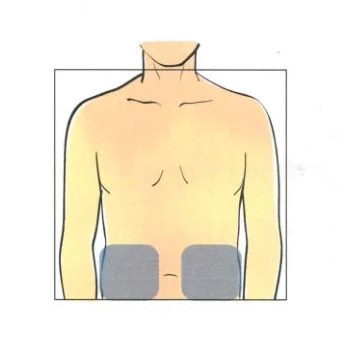
- Injection sites include the abdomen, upper thighs, and upper arms.
 | 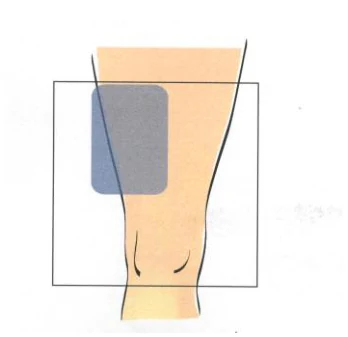 | 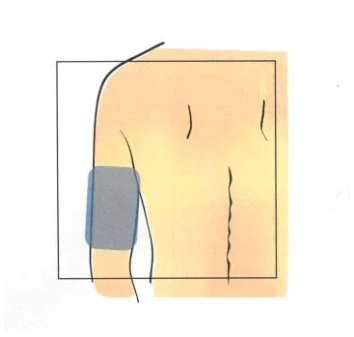 |
- Choose a site that is in a different area from the site used for your previous injection and where there are no current injection site reactions.
- With the tips of your fingers, feel for any hard bumps that may be present from past injections. Do not inject in the areas where these bumps are present. Do not inject into moles, scar tissue, bruises, your belly button, or areas that could be irritated by a belt or waistline of your clothes.
Clean the Injection Site
Clean the area for injection with an alcohol pad. Start at the center, apply pressure, and clean in a circular motion, working outward. Allow to air-dry completely.
Draw Up FUZEON
| Step 1: | Wipe the top of the FUZEON vial again with a new alcohol pad | ||
| Now, pick up the 1-mL, small syringe. Using your index finger, push back the coloured needle protection device towards the body of the syringe. | 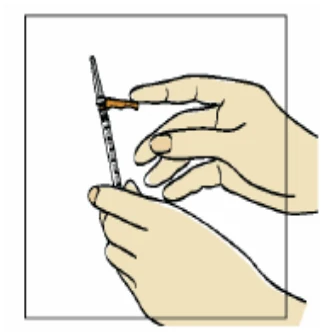 | ||
| To ensure that the needle is secure, hold the clear plastic cap and tighten the needle with a gentle clockwise twist. Do not use too much force as the needle may loosen. | |||
| Remove the clear plastic cap by pushing towards the syringe and pulling the cap off. | 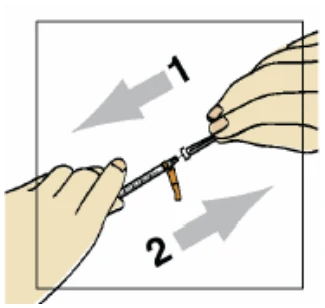 | ||
Pull back the plunger to get 1 mL of air. Be careful not to pull the plunger too fast past the 1 mL marker and/or out of the barrel. Insert the syringe into the vial of mixed FUZEON. Before turning the vial upside down, slowly inject the air into the FUZEON, and keep the needle in the vial. | |||
| Step 2: | Gently turn the vial upside down. Make sure the tip of the needle is always below the surface of the solution to help keep air bubbles from entering the syringe. Slowly pull back the plunger to get 1.0-mL of FUZEON or the amount prescribed by your doctor. Be careful not to pull the plunger too fast past the 1 mL marker and/or out of the barrel. | 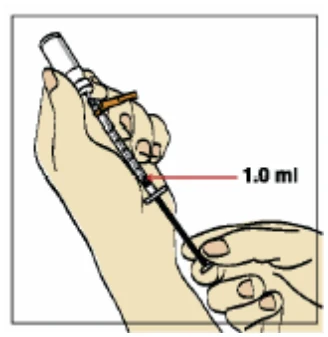 | |
| Step 3: | With the needle still in the vial, tap or flick the syringe gently to make any air bubbles rise to the top. If extra air enters the syringe, gently press the plunger to inject the air back into the vial and withdraw the FUZEON again, making sure you have 1.0 mL of FUZEON in the syringe or the amount prescribed by your doctor. This step may be repeated until the air bubbles are removed and the correct amount of FUZEON is in the syringe. Remove the needle from the vial. |
Inject FUZEON
| Step 4: | Choose an injection site and pinch as much of a skin fold as possible without making yourself uncomfortable. | 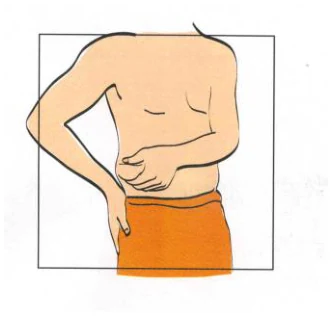 |
| FUZEON is injected into a thin layer of fatty tissue directly beneath the surface of the skin. Do not inject into muscle or veins. | ||
| Step 5: | Pierce the skin at a 45-degree angle. | 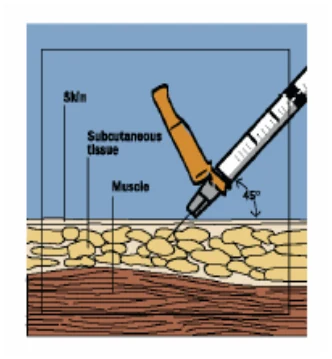 |
Tip: Your healthcare professional may suggest different injection techniques that will work best for you.
| Step 6: | When the needle is in, release the skin, and using the same hand, hold on to the syringe barrel to help steady it and prevent shifting. |
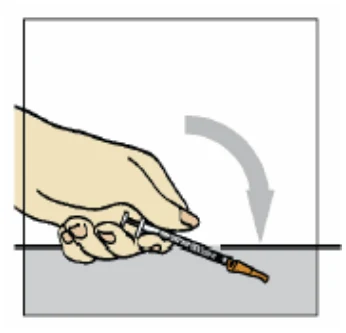
| Step 7: | Using the thumb, depress the plunger to inject the FUZEON. After the dose is fully delivered, remove the needle from the skin. Hold the barrel of the syringe with one hand and gently press the coloured needle protection device down on a flat surface until it covers the needle. You will hear a click. Do not use your free hand to press the device over the needle. |
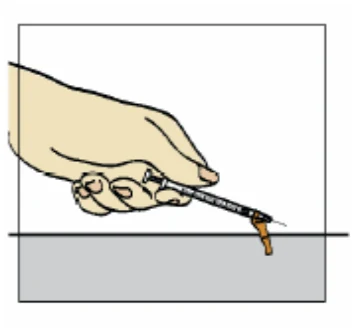 |  | |
Discard the syringe into the sharps waste container. Cover the injection site with a bandage if any blood or medicine is present. |
Discarding Used Syringes and Other Supplies
To minimize the release of pharmaceuticals in the environment, medicine should not be disposed via wastewater or through household waste. Discard all used syringes directly into the sharps container. Keep the cover of this container tight and keep the container out of the reach of children. Check with your healthcare professional about proper disposal of the container. Do not overfill your sharps waste container. If your container fills up before your next refill of FUZEON contact your physician or pharmacy.
In addition, you should safely discard all used alcohol pads and vials, even if the vials contain unused amounts of medicine or sterile water for injection. The vials of FUZEON and sterile water for injection are intended for single use only. Used supplies other than syringes (alcohol pads and vials) may be discarded into the trash as long as no blood is visible. If blood is visible, discard the items into the sharps waste container.
If you have any questions or concerns about the safe disposal of these materials, please call your healthcare professional.
This guide does not provide all known information about FUZEON. If you have any questions or concerns about your treatment, please speak with your doctor or pharmacist.