


Product Monograph - Isentress (Merck Canada, 400 mg, 600 mg)
Recent Major Label Changes
Table of Contents
Sections or subsections that are not applicable at the time of the preparation of the most recent authorized product monograph are not listed.
Recent Major Label Changes ................................................................................................... 2
Table of Contents ................................................................................................................... 2
Part 1: Healthcare Professional Information ........................................................................... 4
- 1.
Indications ....................................................................................................................... 4
1.1. Pediatrics ................................................................................................................... 4
1.2. Geriatrics .................................................................................................................... 4
- 2. Contraindications ............................................................................................................ 4
- 4.
Dosage and Administration ............................................................................................. 4
4.1. Dosing Considerations................................................................................................ 4
4.2. Recommended Dose and Dosage Adjustment ........................................................... 5
4.3. Reconstitution ............................................................................................................ 5
4.4. Administration ........................................................................................................... 5
4.5. Missed Dose ............................................................................................................... 5
- 5. Overdose ......................................................................................................................... 6
- 6. Dosage Forms, Strengths, Composition, and Packaging ................................................... 6
- 7.
Warnings and Precautions ............................................................................................... 7
General ................................................................................................................................. 7
Severe Skin and Hypersensitivity Reactions .......................................................................... 7
Drug Interactions .................................................................................................................. 7
Immune ................................................................................................................................ 8
Musculoskeletal .................................................................................................................... 8
7.1. Special Populations .................................................................................................... 8
7.1.1. Pregnancy ........................................................................................................ 8
7.1.2. Breastfeeding .................................................................................................. 9
7.1.3. Pediatrics (6-18 years of age) .......................................................................... 9
7.1.4. Geriatrics (≥65 years of age) .......................................................................... 10
- 8.
Adverse Reactions ......................................................................................................... 10
8.1. Adverse Reaction Overview ..................................................................................... 10
8.2. Clinical Trial Adverse Reactions ................................................................................ 10
8.2.1. Clinical Trial Adverse Reactions – Pediatrics .................................................. 19
8.3. Less Common Clinical Trial Adverse Reactions ......................................................... 19
| 1 Indications, 1.1 Pediatrics | 10/2026 |
|---|---|
| 4 Dosage and Administration | 10/2026 |
| 7 Warnings and Precautions, 7.1.3 Pediatrics | 10/2026 |
8.4. Abnormal Laboratory Findings: Hematologic, Clinical Chemistry, and Other Quantitative Data ............................................................................................................... 21
8.5. Post-Market Adverse Reactions ............................................................................... 25
- 9.
Drug Interactions ........................................................................................................... 26
9.2. Drug Interactions Overview ..................................................................................... 26
9.3. Drug-Behaviour Interactions .................................................................................... 26
9.4. Drug-Drug Interactions ............................................................................................ 26
9.5. Drug-Food Interactions ............................................................................................ 32
9.6. Drug-Herb Interactions ............................................................................................ 32
9.7. Drug-Laboratory Test Interactions ........................................................................... 32
- 10.
Clinical Pharmacology ................................................................................................... 32
10.1. Mechanism of Action .......................................................................................... 32
10.2. Pharmacodynamics ............................................................................................ 32
10.3. Pharmacokinetics ............................................................................................... 32
- 11. Storage, Stability, and Disposal ...................................................................................... 36
Part 2: Scientific Information ................................................................................................ 37
- 13. Pharmaceutical Information .......................................................................................... 37
- 14.
Clinical Trials .................................................................................................................. 37
14.1. Clinical Trials by Indication ................................................................................. 37
Adults ............................................................................................................................ 37
Pediatric Patients .......................................................................................................... 51
- 15. Microbiology ................................................................................................................. 52
- 16. Non-Clinical Toxicology .................................................................................................. 53
Patient Medication Information ........................................................................................... 55
Part 1: Healthcare Professional Information
1. Indications
ISENTRESS® (raltegravir) is indicated in combination with other antiretroviral agents for the treatment of human immunodeficiency virus (HIV-1) infection in adults and pediatric patients 6 years of age and older and weighing at least 25 kg.
ISENTRESS HD® (raltegravir) is indicated in combination with other antiretroviral agents for the treatment of human immunodeficiency virus (HIV-1) infection in adults and pediatric patients weighing at least 40 kg.
1.1. Pediatrics (6 - 18 years of age and weighing at least 25kg)
ISENTRESS® is indicated in combination with other antiretroviral agents for the treatment of HIV-1 infection in pediatric patients 6 years of age and older with body weight at least 25 kg.
ISENTRESS® has not been authorized for pediatric patients less than 6 years of age or weighing less than 25 kg.
ISENTRESS HD® is indicated in combination with other antiretroviral agents for the treatment of HIV-1 infection in pediatric patients weighing at least 40 kg.
ISENTRESS® HD has not been authorized for pediatric patients weighing less than 40 kg.
(see 7 Warnings and Precautions, 7.1.3 Pediatrics and 4 Dosage and Administration).
1.2. Geriatrics
Geriatrics (≥65 years of age):
Clinical studies of ISENTRESS® did not include sufficient numbers of patients aged 65 and over to determine whether they respond differently from younger patients. In general, dose selection for an elderly patient should be cautious, reflecting the greater frequency of decreased hepatic, renal, or cardiac function, and of concomitant disease or other drug therapy.
2. Contraindications
- ISENTRESS® is contraindicated in patients who are hypersensitive to any component of this medicine. For a complete listing of components, see 6 Dosage Forms, Strengths, Composition, and Packaging .
4. Dosage and Administration
4.1. Dosing Considerations
ISENTRESS HD® is available in the following dose strength:
- 600 mg film-coated tablet for once daily use
ISENTRESS® is available in the following dose strength:
- 400 mg film-coated tablet for twice daily use
Because the formulations have different pharmacokinetic profiles, do not substitute the 400 mg tablet for the 600 mg tablet to create a 1200 mg once daily dose (see 10 Clinical Pharmacology,10.3 Pharmacokinetics).
During coadministration of ISENTRESS® 400 mg tablets with rifampin, the recommended dosage of ISENTRESS® is 800 mg twice daily in adults. There are no data to guide coadministration of ISENTRESS® with rifampin in patients below 18 years of age (see 9 Drug Interactions).
4.2. Recommended Dose and Dosage Adjustment
For the treatment of patients with HIV-1 infection the dosage of ISENTRESS® or ISENTRESS HD® is as follows:
ISENTRESS® Twice Daily Dosing:
Adults and pediatric patients aged 6 years of age weighing at least 25 kg, and able to swallow a tablet:
One 400 mg tablet twice daily, orally.
ISENTRESS HD® Once Daily Dosing:
Adult and pediatric patients weighing at least 40 kg, who are either treatment-naïve or virologically suppressed on an initial regimen of ISENTRESS® 400 mg twice daily:
Two 600 mg tablets once daily, orally.
Do not substitute the 400 mg tablet for the 600 mg tablet to create a 1200 mg once daily dose.
Hepatic/biliary/Pancreatic
There were no clinically important pharmacokinetic differences between patients with moderate hepatic insufficiency and healthy subjects. No dosage adjustment is necessary for patients with mild to moderate hepatic insufficiency. The effect of severe hepatic insufficiency on the pharmacokinetics of raltegravir has not been studied.
Renal
There were no clinically important pharmacokinetic differences between patients with severe renal insufficiency and healthy subjects. No dosage adjustment is necessary.
4.3. Reconstitution
- Not applicable.
4.4. Administration
ISENTRESS® is to be given in a combination regimen with other antiretroviral agents.
ISENTRESS® can be administered with or without food.
4.5. Missed Dose
If a dose of ISENTRESS® is missed, the dose should be taken as soon as possible. However, if it is almost time for the next dose of ISENTRESS®, the missed dose should be skipped in order to return to the regular dosing schedule.
5. Overdose
Activated charcoal may be administered to aid in the removal of unabsorbed drug. The extent to which ISENTRESS® may be dialyzable is unknown.
No specific information is available on the treatment of overdosage with ISENTRESS®. Multiple doses as high as 1800 mg (3 x 600 mg) q.d. for 28 days and 800 mg b.i.d. were studied in Phase I without evidence of toxicity. Occasional doses of 2400 mg per day were taken in Phase III studies without evidence of toxicity. Based upon available data, raltegravir appears to be well tolerated at doses up to 800 mg b.i.d. and when administered with drugs that increase exposure by 50–70% (such as tenofovir and atazanavir).
| For the most recent information in the management of a suspected drug overdose, contact your regional poison control centre or Health Canada’s toll-free number, 1-844 POISON-X (1-844-764-7669). |
|---|
- 6. Dosage Forms, Strengths, Composition, and Packaging
Table 1 – Dosage Forms, Strengths, and Composition
| Route of Administration | Dosage Form / Strength / Composition | Non-Medicinal Ingredients |
|---|---|---|
| Oral | Film coated tablets 400 mg and 600 mg raltegravir (as raltegravir potassium) | |
| ISENTRESS® 400 mg film-coated tablets contains 434.4 mg of raltegravir (as potassium salt), equivalent to 400 mg of raltegravir free phenol. | calcium phosphate dibasic anhydrous, hypromellose 2208, lactose monohydrate, magnesium stearate, microcrystalline cellulose, poloxamer 407 (contains 0.01% butylated hydroxytoluene as antioxidant), sodium stearyl fumarate. In addition, the film coating contains the following inactive ingredients: black iron oxide and red iron oxide, polyethylene glycol 3350, polyvinyl alcohol, talc and titanium dioxide. | |
Description
ISENTRESS HD® film-coated 600-mg tablets are yellow, oval-shaped tablets debossed with corporate logo and “242” on one side. The tablets are packaged in white, HDPE bottles and enclosed with a child resistant closure. Each bottle contains 60 tablets and silica gel desiccant.
ISENTRESS® film-coated 400-mg tablets are pink, oval-shaped, with 227 on one side. They are supplied as unit-of-use bottles of 60.
7. Warnings and Precautions
General
Do not substitute ISENTRESS® 400 mg film-coated tablets for ISENTRESS HD® 600 mg film-coated tablets.
Severe Skin and Hypersensitivity Reactions
Severe, potentially life-threatening, and fatal skin reactions have been reported. These include cases of Stevens-Johnson syndrome and toxic epidermal necrolysis. Hypersensitivity reactions have also been reported and were characterized by rash, constitutional findings, and sometimes, organ dysfunction, including hepatic failure. Discontinue ISENTRESS® and other suspect agents immediately if signs or symptoms of severe skin reactions or hypersensitivity reactions develop (including, but not limited to, severe rash or rash accompanied by fever, general malaise, fatigue, muscle or joint aches, blisters, oral lesions, conjunctivitis, facial edema, hepatitis, eosinophilia, angioedema). Clinical status including liver aminotransferases should be monitored and appropriate therapy initiated. Delay in stopping ISENTRESS® treatment or other suspect agents after the onset of severe rash may result in a life-threatening reaction.
Drug Interactions
Antacids
It is not recommended to administer antacids (containing aluminum and/or magnesium) with ISENTRESS® 400 mg twice daily (see 9 Drug Interactions, 9.4 Drug-Drug Interactions, Effect of Other Agents on the Pharmacokinetics of Raltegravir).
Coadministration of ISENTRESS® 1200 mg (2 x 600 mg) once daily with calcium carbonate and aluminum/magnesium containing antacids resulted in reduced raltegravir plasma levels therefore coadministration is not recommended.
Atazanavir
Coadministration of ISENTRESS® 1200 mg (2 x 600 mg) once daily with atazanavir resulted in increased
| ISENTRESS HD® 600 mg film-coated tablets contains 651.6 mg of raltegravir (as potassium salt), equivalent to 600 mg of raltegravir free phenol. | croscarmellose sodium, hypromellose 2910, magnesium stearate, microcrystalline cellulose. In addition, the film coating contains the following inactive ingredients: black iron oxide, carnauba wax, hypromellose 2910, iron oxide yellow, lactose monohydrate, titanium dioxide, and triacetin. |
raltegravir plasma levels therefore coadministration is not recommended (see 9 Drug Interactions).
Tipranavir/ritonavir
Coadministration of ISENTRESS® 1200 mg (2 x 600 mg) once daily with tipranavir/ritonavir could result in decreased raltegravir trough plasma levels therefore coadministration is not recommended (see9 Drug Interactions).
Strong inducers of drug metabolizing enzymes
Caution should be used when coadministering ISENTRESS® 400 mg twice daily with strong inducers of uridine diphosphate glucuronosyltransferase (UGT) 1A1 (e.g., rifampin) due to reduced plasma concentrations of raltegravir (see9 Drug Interactions).
Strong inducers of drug metabolizing enzymes (e.g., rifampin) have not been studied with ISENTRESS® 1200 mg (2 x 600 mg) once daily but could result in decreased raltegravir trough plasma level therefore coadministration with ISENTRESS® 1200 mg (2 x 600 mg) once daily is not recommended (see 9 Drug Interactions).
Immune
Immune Reconstitution Inflammatory Syndrome
During the initial phase of treatment, patients responding to antiretroviral therapy may develop an inflammatory response to indolent or residual opportunistic infections (such as Mycobacterium avium complex, cytomegalovirus, Pneumocystis jirovecii pneumonia, and tuberculosis, or reactivation of varicella zoster virus), which may necessitate further evaluation and treatment.
Autoimmune disorders (such as Graves’ disease, polymyositis and Guillain-Barre syndrome) have also been reported to occur in the setting of immune reconstitution, however the time to onset is more variable, and can occur many months after initiation of treatment.
Musculoskeletal
Grade 2–4 creatine kinase laboratory abnormalities were observed in patients treated with raltegravir (see 8 Adverse Reactions). Cases of myopathy and rhabdomyolysis have been reported with raltegravir. A relationship to raltegravir is not clear in a majority of these cases; however there have been isolated post-market reports of myopathy and rhabdomyolysis either with an association to raltegravir or where a relationship to raltegravir could not be ruled out. Use with caution in patients at increased risk of myopathy or rhabdomyolysis, such as patients receiving concomitant medications known to cause these conditions.
7.1. Special Populations
7.1.1. Pregnancy
Human Data
ISENTRESS has not been studied in pregnant women. ISENTRESS should not be used in pregnant women unless the potential benefits outweigh the potential risks to the fetus.
Prospective reports of 1032 exposures to raltegravir during pregnancy resulting in 967 live births are available from the antiretroviral pregnancy registry (APR). These reports include 514 first trimester exposures (424 exposures in the periconception period). The rate of congenital defects was 3.5% (95% CI: 2.1% to 5.5 %) following first trimester exposure to raltegravir and 3.6 % (95% CI: 2.0% to 5.7%) following second or third trimester exposure to raltegravir. The rate of miscarriage is not reported in the APR. The background rates of spontaneous abortion and fetal death/stillbirth in the US general population are 15-20% and ~3%, respectively. The background risk for major birth defects and miscarriage for the indicated population is unknown. The background birth defect rate is 2.7% in the U.S. reference population of the Metropolitan Atlanta Congenital Defects MACDP. Methodological limitations of the APR include the use of MACDP as the external comparator group. The MACDP population is not disease-specific, evaluates women and infants from a limited geographic area, and does not include outcomes for births that occurred at <20 weeks gestation.
There are limited data on the use of ISENTRESS 1200 mg (2 x 600 mg) once daily in pregnant women.
Animal Data
Developmental toxicity studies were performed in rabbits (at doses up to 1000 mg/kg/day) and rats (at doses up to 600 mg/kg/day). The highest doses in these studies produced systemic exposures in these species approximately 3-to 4-fold above the exposure at the recommended human dose. No treatment related external, visceral, or skeletal changes were observed in rabbits. Treatment-related increases over controls in the incidence of supernumerary ribs were seen in rats at 600 mg/kg/day (exposures 4.4- fold above the exposure at the recommended human dose). In both rabbits and rats, no treatment related effects on embryonic/fetal survival or fetal weights were observed.
In rats, at a maternal dose of 600 mg/kg/day, mean drug concentrations in fetal plasma were approximately 1.5- to 2.5-fold greater than in maternal plasma at 1 hour and 24 hours postdose, respectively. In rabbits, at a maternal dose of 1000 mg/kg/day, mean drug concentrations in fetal plasma were approximately 2% of the mean maternal concentration at both 1 and 24 hours postdose. Toxicokinetic studies demonstrated placental transfer of drug in both species.
Antiretroviral Pregnancy Registry (APR)
To monitor maternal-fetal outcomes of pregnant patients exposed to ISENTRESS®, an International Antiretroviral Pregnancy Registry has been established.
Physicians are encouraged to report pregnancy cases for inclusion in the registry:
http://www.apregistry.com/
Telephone: 1-800-258-4263
Fax: 1-800-800-1052
7.1.2. Breastfeeding
It is not known whether raltegravir is secreted in human milk. However, raltegravir is secreted in the milk of lactating rats. In rats, at a maternal dose of 600 mg/kg/day, mean drug concentrations in milk were approximately 3-fold greater than in maternal plasma. Breast-feeding is not recommended while taking ISENTRESS®. In addition, it is recommended that HIV-infected mothers not breast-feed their infants to avoid risking postnatal transmission of HIV.
7.1.3. Pediatrics (6-18 years of age)
Based on an open-label, multicenter clinical trial in pediatric patients, the safety profile of ISENTRESS® 400 mg tablets in pediatric patients 6 years of age and older was comparable to that observed in adults (see 8 Adverse Reactions, 8.2.1 Clinical Trial Adverse Reactions - Pediatrics).
ISENTRESS® 1200 mg (2 X 600 mg) once daily has not been studied in pediatric patients. However, population PK modeling and simulation support the use of 1200 mg (2 x 600 mg) once daily in pediatric patients weighing at least 40 kg (see 4 Dosage and Administration and 10 Clinical Pharmacology).
Use of once daily dosing regimen 1200 mg (2 x 600 mg) is NOT recommended for pediatric patients below 40 kg.
7.1.4. Geriatrics (≥65 years of age)
Clinical studies of ISENTRESS® did not include sufficient numbers of patients aged 65 and over to determine whether they respond differently from younger patients. In general, dose selection for an elderly patient should be cautious, reflecting the greater frequency of decreased hepatic, renal, or cardiac function, and of concomitant disease or other drug therapy.
8. Adverse Reactions
8.1. Adverse Reaction Overview
The most common adverse reactions of moderate to severe intensity (≥2%) are insomnia, headache, dizziness, nausea and fatigue.
8.2. Clinical Trial Adverse Reactions
Clinical trials are conducted under very specific conditions. Therefore, the frequencies of adverse reactions observed in the clinical trials may not reflect frequencies observed in clinical practice and should not be compared to frequencies reported in clinical trials of another drug.
Adverse Experiences in Treatment-Experienced Adults
The safety assessment of ISENTRESS® in treatment-experienced patients is based on the pooled safety data from the randomized clinical studies P018 and P019, reported using the recommended dose of ISENTRESS® 400 mg twice daily in combination with optimized background therapy (OBT) in 462 patients, in comparison to 237 patients taking placebo in combination with OBT. During double-blind treatment, the total follow-up was 1051 patient-years in the group receiving ISENTRESS® 400 mg b.i.d. and 322 patient-years in the group receiving placebo.
For patients in the group receiving ISENTRESS® 400 mg twice daily + OBT (mean follow-up 118.7 weeks) and the comparator group placebo + OBT (mean follow-up 71.0 weeks) in the pooled analysis for studies P018 and P019, the most commonly reported clinical adverse experiences (>10% in either group), of all intensities and regardless of causality were: diarrhea in 26.6% and 24.9%, nausea in 13.6% and 16.0%, headache in 12.1% and 13.5%, nasopharyngitis in 14.3% and 8.9%, fatigue in 12.1% and 5.9%, upper respiratory tract infection in 15.8% and 10.1%, bronchitis in 12.1% and 6.8%, pyrexia in 9.7% and 13.9%, vomiting in 8.9% and 11.0% of patients, respectively.
Clinical adverse events of all intensities and regardless of causality occurring in ≥2% of treatment-experienced adult patients are presented in Table 2.
Table 2 – Percentage of Patients with Adverse Experience of All Intensities and Regardless of Causality Occurring in ≥2% of Treatment-Experienced Adult Patients in Either Treatment Group
| System Organ Class, Preferred Term | Randomized Studies P018 and P019 | |||
|---|---|---|---|---|
| System Organ Class, Preferred Term | Randomized Studies P018 and P019 | |||
| System Organ Class, Preferred Term | Randomized Studies P018 and P019 | |||
| ISENTRESS® 400 mg b.i.d. + OBT | Placebo + OBT | |||
| ISENTRESS® 400 mg b.i.d. + OBT | Placebo + OBT | |||
| ISENTRESS® 400 mg b.i.d. + OBT | Placebo + OBT | |||
| (N = 462) | (N = 237) | |||
| (N = 462) | (N = 237) | |||
| (N = 462) | (N = 237) | |||
| n | (%) | n | (%) | |
| n | (%) | n | (%) | |
| n | (%) | n | (%) | |
| Patients With One Or More Adverse Experiences | 433 | (93.7) | 213 | (89.9) |
| Patients With No Adverse Experience | 29 | (6.3) | 24 | (10.1) |
| Blood And Lymphatic System Disorders | 52 | (11.3) | 23 | (9.7) |
| Anemia | 16 | (3.5) | 11 | (4.6) |
| Lymphadenopathy | 25 | (5.4) | 7 | (3.0) |
| Neutropenia | 6 | (1.3) | 5 | (2.1) |
| Eye Disorders | 44 | (9.5) | 18 | (7.6) |
| Conjunctivitis | 16 | (3.5) | 1 | (0.4) |
| Gastrointestinal Disorders | 262 | (56.7) | 126 | (53.2) |
| Abdominal Discomfort | 6 | (1.3) | 6 | (2.5) |
| Abdominal Distension | 17 | (3.7) | 8 | (3.4) |
| Abdominal Pain | 35 | (7.6) | 13 | (5.5) |
| Abdominal Pain Upper | 21 | (4.5) | 11 | (4.6) |
| Aphthous Stomatitis | 6 | (1.3) | 5 | (2.1) |
| Constipation | 22 | (4.8) | 2 | (0.8) |
| Diarrhea | 123 | (26.6) | 59 | (24.9) |
| Dyspepsia | 15 | (3.2) | 3 | (1.3) |
| Flatulence | 19 | (4.1) | 8 | (3.4) |
| Gastritis | 11 | (2.4) | 8 | (3.4) |
| Gastrooesophageal Reflux Disease | 10 | (2.2) | 3 | (1.3) |
| Hemorrhoids | 14 | (3.0) | 6 | (2.5) |
| Nausea | 63 | (13.6) | 38 | (16.0) |
| Vomiting | 41 | (8.9) | 26 | (11.0) |
| General Disorders And Administration Site Conditions | 194 | (42.0) | 94 | (39.7) |
| Asthenia | 20 | (4.3) | 9 | (3.8) |
| Chest Pain | 17 | (3.7) | 4 | (1.7) |
| Fatigue | 56 | (12.1) | 14 | (5.9) |
| Oedema Peripheral | 16 | (3.5) | 7 | (3.0) |
| Pyrexia | 45 | (9.7) | 33 | (13.9) |
| Infections And Infestations | 328 | (71.0) | 153 | (64.6) |
| Anogenital Warts | 18 | (3.9) | 4 | (1.7) |
| Bronchitis | 56 | (12.1) | 16 | (6.8) |
| Cellulitis | 14 | (3.0) | 5 | (2.1) |
| Folliculitis | 16 | (3.5) | 2 | (0.8) |
| Gastroenteritis | 26 | (5.6) | 8 | (3.4) |
| Genital Herpes | 10 | (2.2) | 6 | (2.5) |
| Herpes Simplex | 16 | (3.5) | 5 | (2.1) |
| Herpes Zoster | 34 | (7.4) | 4 | (1.7) |
| Influenza | 33 | (7.1) | 10 | (4.2) |
| Nasopharyngitis | 66 | (14.3) | 21 | (8.9) |
| Oesophageal Candidiasis | 4 | (0.9) | 6 | (2.5) |
| Onychomycosis | 9 | (1.9) | 5 | (2.1) |
| Oral Candidiasis | 10 | (2.2) | 23 | (9.7) |
| Pharyngitis | 18 | (3.9) | 5 | (2.1) |
| Pneumonia | 33 | (7.1) | 12 | (5.1) |
| Respiratory Tract Infection | 19 | (4.1) | 1 | (0.4) |
| Rhinitis | 9 | (1.9) | 6 | (2.5) |
| Sinusitis | 32 | (6.9) | 10 | (4.2) |
| Tooth Infection | 4 | (0.9) | 5 | (2.1) |
| Upper Respiratory Tract Infection | 73 | (15.8) | 24 | (10.1) |
| Urinary Tract Infection | 15 | (3.2) | 12 | (5.1) |
| Investigations | 38 | (8.2) | 23 | (9.7) |
| Weight Decreased | 16 | (3.5) | 9 | (3.8) |
| Metabolism And Nutrition Disorders | 75 | (16.2) | 30 | (12.7) |
| Anorexia | 11 | (2.4) | 7 | (3.0) |
| Decreased Appetite | 12 | (2.6) | 3 | (1.3) |
| Hyperlipidemia | 12 | (2.6) | 1 | (0.4) |
| Musculoskeletal And Connective Tissue Disorders | 151 | (32.7) | 55 | (23.2) |
| Arthralgia | 30 | (6.5) | 10 | (4.2) |
| Back Pain | 33 | (7.1) | 10 | (4.2) |
| Muscle Spasms | 17 | (3.7) | 8 | (3.4) |
| Musculoskeletal Pain | 13 | (2.8) | 2 | (0.8) |
| Myalgia | 17 | (3.7) | 10 | (4.2) |
| Pain In Extremity | 31 | (6.7) | 10 | (4.2) |
| Neoplasms Benign, Malignant And Unspecified (Incl Cysts And Polyps) | 70 | (15.2) | 19 | (8.0) |
| Skin Papilloma | 31 | (6.7) | 9 | (3.8) |
| Nervous System Disorders | 156 | (33.8) | 68 | (28.7) |
| Dizziness | 33 | (7.1) | 6 | (2.5) |
| Headache | 56 | (12.1) | 32 | (13.5) |
| Hypoesthesia | 10 | (2.2) | 4 | (1.7) |
| Neuropathy Peripheral | 21 | (4.5) | 9 | (3.8) |
| Paresthesia | 11 | (2.4) | 5 | (2.1) |
| Psychiatric Disorders | 80 | (17.3) | 42 | (17.7) |
| Anxiety | 16 | (3.5) | 9 | (3.8) |
| Depression | 18 | (3.9) | 12 | (5.1) |
| Insomnia | 32 | (6.9) | 13 | (5.5) |
| Reproductive System And Breast Disorders | 52 | (11.3) | 17 | (7.2) |
| Erectile Dysfunction | 11 | (2.4) | 2 | (0.8) |
| Respiratory, Thoracic And | 99 | (21.4) | 48 | (20.3) |
| Mediastinal Disorders | ||||
| Asthma | 8 | (1.7) | 5 | (2.1) |
| Cough | 32 | (6.9) | 14 | (5.9) |
| Oropharyngeal Pain | 15 | (3.2) | 9 | (3.8) |
| Sinus Congestion | 5 | (1.1) | 5 | (2.1) |
| Skin And Subcutaneous Tissue Disorders | 171 | (37.0) | 70 | (29.5) |
| Eczema | 8 | (1.7) | 8 | (3.4) |
| Erythema | 11 | (2.4) | 4 | (1.7) |
| Lipodystrophy Acquired | 16 | (3.5) | 5 | (2.1) |
| Night Sweats | 15 | (3.2) | 5 | (2.1) |
| Pruritus | 18 | (3.9) | 10 | (4.2) |
| Rash | 41 | (8.9) | 10 | (4.2) |
| Skin Lesion | 16 | (3.5) | 2 | (0.8) |
| Vascular Disorders | 54 | (11.7) | 20 | (8.4) |
| Hypertension | 35 | (7.6) | 9 | (3.8) |
Discontinuations
In the pooled analyses for studies P018 and P019, the rates of discontinuation of therapy due to adverse experiences (clinical and laboratory) were 4.5% in patients receiving ISENTRESS® + OBT and 5.5% in patients receiving placebo + OBT.
Serious Events
The following serious drug related adverse reactions were reported in clinical studies: gastritis, hepatitis, renal failure, genital herpes, accidental overdose.
Adverse Experiences in Treatment-Naïve Adults
The safety of ISENTRESS® was evaluated in HIV-infected treatment-naïve subjects in 2 Phase III studies: STARTMRK (Protocol 021) evaluated ISENTRESS® 400 mg twice daily versus efavirenz, both in combination with emtricitabine (+) tenofovir disoproxil fumarate and ONCEMRK (Protocol 292) evaluated ISENTRESS® 1200 mg (2 x 600 mg) once daily versus ISENTRESS® 400 mg twice daily, both in combination with emtricitabine (+) tenofovir disoproxil fumarate.
STARTMRK (Protocol 021; ISENTRESS® 400 mg twice daily)
The following safety assessment of ISENTRESS® in treatment-naïve patients is based on the randomized double-blind active controlled study of treatment-naïve patients, STARTMRK (Protocol 021) with ISENTRESS® 400 mg twice daily in combination with a fixed dose of emtricitabine 200 mg (+) tenofovir disoproxil fumarate 245 mg, (N = 281) versus efavirenz (EFV) 600 mg at bedtime in combination with emtricitabine (+) tenofovir disoproxil fumarate (N = 282). During double-blind treatment, the total follow-up for patients receiving ISENTRESS® 400 mg twice daily + emtricitabine (+) tenofovir disoproxil fumarate was 1104 patient-years and 1036 patient-years for patients receiving efavirenz 600 mg at bedtime + emtricitabine (+) tenofovir disoproxil fumarate.
Numbers (%) of patients with clinical adverse experiences and with drug-related adverse experiences in the group receiving ISENTRESS®, were less frequent than in the group receiving efavirenz based on the nominal p-values (0.325 and <0.001 respectively).
The most commonly reported clinical adverse experiences (>10% in either group), of all intensities and regardless of causality in patients treated with ISENTRESS® + emtricitabine (+) tenofovir disoproxil fumarate versus the patients treated with efavirenz + emtricitabine (+) tenofovir disoproxil fumarate, were: diarrhea in 25.6 and 27.0%, nausea in 16.7% and 14.5%, vomiting in 8.2% and 10.6%, headache in 26.0% and 28.4%, fatigue in 9.3% and 13.5%, influenza in 11.7% and 13.5%, nasopharyngitis in 26.7% and 22.3%, upper respiratory tract infection in 21.4% and 20.2%, arthralgia in 8.5% and 11.7%, back pain in 12.1% and 9.9%, dizziness in 16.4% and 38.3%, abnormal dreams in 8.2% and 13.1%, anxiety in 8.9% and 11.0%, depression in 10.3% and 11.7%, insomnia in 15.7% and 14.9%, cough in 16.7% and 12.1%, pyrexia in 15.7% and 13.8% and rash in 7.8% and 13.8% of patients, respectively.
Clinical adverse events of all intensities and regardless of causality occurring in ≥2% of treatment-naïve adult patients are presented in Table 3.
Table 3 – Percentage of Patients with Adverse Experience of All Intensities and Regardless of Causality Occurring in (≥2%) of Treatment-Naïve Adult Patients in Either Treatment Group
| System Organ Class, Preferred Term | Randomized Study Protocol 021 | ||||||||||
| System Organ Class, Preferred Term | Randomized Study Protocol 021 | ||||||||||
| System Organ Class, Preferred Term | Randomized Study Protocol 021 | ||||||||||
| System Organ Class, Preferred Term | Randomized Study Protocol 021 | ||||||||||
ISENTRESS® 400 mg b.i.d. (N = 281) | Efavirenz 600 mg q.h.s. (N = 282) | ||||||||||
ISENTRESS® 400 mg b.i.d. (N = 281) | Efavirenz 600 mg q.h.s. (N = 282) | ||||||||||
ISENTRESS® 400 mg b.i.d. (N = 281) | Efavirenz 600 mg q.h.s. (N = 282) | ||||||||||
ISENTRESS® 400 mg b.i.d. (N = 281) | Efavirenz 600 mg q.h.s. (N = 282) | ||||||||||
| n | (%) | n | (%) | ||||||||
| n | (%) | n | (%) | ||||||||
| n | (%) | n | (%) | ||||||||
| n | (%) | n | (%) | ||||||||
| Patients With One Or More Adverse Experiences | 271 | (96.4) | 276 | (97.9) | |||||||
| Patients With No Adverse Experience | 10 | (3.6) | 6 | (2.1) | |||||||
| Blood And Lymphatic System Disorders | 25 | (8.9) | 14 | (5.0) | |||||||
| Lymphadenopathy | 13 | (4.6) | 5 | (1.8) | |||||||
| Ear And Labyrinth Disorders | 26 | (9.3) | 29 | (10.3) | |||||||
| Vertigo | 7 | (2.5) | 14 | (5.0) | |||||||
| Eye Disorders | 18 | (6.4) | 40 | (14.2) | |||||||
| Conjunctivitis | 7 | (2.5) | 14 | (5.0) | |||||||
| Gastrointestinal Disorders | 169 | (60.1) | 175 | (62.1) | |||||||
| Abdominal Discomfort | 6 | (2.1) | 4 | (1.4) | |||||||
| Abdominal Distension | 10 | (3.6) | 7 | (2.5) | |||||||
| Abdominal Pain | 25 | (8.9) | 20 | (7.1) | |||||||
| Abdominal Pain Upper | 8 | (2.8) | 19 | (6.7) | |||||||
| Constipation | 5 | (1.8) | 10 | (3.5) | |||||||
| Diarrhea | 72 | (25.6) | 76 | (27.0) | |||||||
| Dyspepsia | 25 | (8.9) | 14 | (5.0) | |||||||
| Flatulence | 14 | (5.0) | 19 | (6.7) | |||||||
| Gastritis | 14 | (5.0) | 12 | (4.3) | |||||||
| Gastrooesophageal Reflux Disease | 9 | (3.2) | 7 | (2.5) | |||||||
| Gingivitis | 8 | (2.8) | 7 | (2.5) | |||||||
| Hemorrhoids | 11 | (3.9) | 8 | (2.8) | |||||||
| Nausea | 47 | (16.7) | 41 | (14.5) | |||||||
| Toothache | 10 | (3.6) | 5 | (1.8) | |||||||
| Vomiting | 23 | (8.2) | 30 | (10.6) | |||||||
| General Disorders And Administration Site Conditions | 101 | (35.9) | 126 | (44.7) | |||||||
| Asthenia | 17 | (6.0) | 16 | (5.7) | |||||||
| Chest Pain | 8 | (2.8) | 13 | (4.6) | |||||||
| Chills | 8 | (2.8) | 7 | (2.5) | |||||||
| Fatigue | 26 | (9.3) | 38 | (13.5) | |||||||
| Influenza Like Illness | 10 | (3.6) | 11 | (3.9) | |||||||
| Malaise | 5 | (1.8) | 6 | (2.1) | |||||||
| Oedema Peripheral | 4 | (1.4) | 9 | (3.2) | |||||||
| Pain | 11 | (3.9) | 7 | (2.5) | |||||||
| Pyrexia | 44 | (15.7) | 39 | (13.8) | |||||||
| Infections And Infestations | 222 | (79.0) | 216 | (76.6) | |||||||
| Acarodermatitis | 7 | (2.5) | 6 | (2.1) | |||||||
| Acute Sinusitis | 6 | (2.1) | 5 | (1.8) | |||||||
| Body Tinea | 3 | (1.1) | 8 | (2.8) | |||||||
| Bronchitis | 29 | (10.3) | 30 | (10.6) | |||||||
| Ear Infection | 6 | (2.1) | 8 | (2.8) | |||||||
| Folliculitis | 9 | (3.2) | 7 | (2.5) | |||||||
| Furuncle | 2 | (0.7) | 6 | (2.1) | |||||||
| Gastroenteritis | 18 | (6.4) | 19 | (6.7) | |||||||
| Gastroenteritis Viral | 1 | (0.4) | 8 | (2.8) | |||||||
| Genital Herpes | 12 | (4.3) | 15 | (5.3) | |||||||
| Herpes Simplex | 10 | (3.6) | 11 | (3.9) | |||||||
| Herpes Zoster | 14 | (5.0) | 16 | (5.7) | |||||||
| Influenza | 33 | (11.7) | 38 | (13.5) | |||||||
| Nasopharyngitis | 75 | (26.7) | 63 | (22.3) | |||||||
| Onychomycosis | 13 | (4.6) | 14 | (5.0) | |||||||
| Oral Candidiasis | 9 | (3.2) | 6 | (2.1) | |||||||
| Oral Herpes | 7 | (2.5) | 9 | (3.2) | |||||||
| Otitis Media | 6 | (2.1) | 7 | (2.5) | |||||||
| Pharyngitis | 27 | (9.6) | 26 | (9.2) | |||||||
| Pneumonia | 8 | (2.8) | 11 | (3.9) | |||||||
| Respiratory Tract Infection | 3 | (1.1) | 6 | (2.1) | |||||||
| Rhinitis | 9 | (3.2) | 11 | (3.9) | |||||||
| Secondary Syphilis | 7 | (2.5) | 1 | (0.4) | |||||||
| Sinusitis | 23 | (8.2) | 23 | (8.2) | |||||||
| Syphilis | 14 | (5.0) | 14 | (5.0) | |||||||
| Tinea Pedis | 8 | (2.8) | 7 | (2.5) | |||||||
| Tonsillitis | 10 | (3.6) | 8 | (2.8) | |||||||
| Tooth Abscess | 5 | (1.8) | 6 | (2.1) | |||||||
| Upper Respiratory Tract Infection | 60 | (21.4) | 57 | (20.2) | |||||||
| Urethritis | 7 | (2.5) | 2 | (0.7) | |||||||
| Urinary Tract Infection | 8 | (2.8) | 14 | (5.0) | |||||||
| Injury, Poisoning And Procedural Complications | 56 | (19.9) | 56 | (19.9) | |||||||
| Contusion | 6 | (2.1) | 9 | (3.2) | |||||||
| Laceration | 6 | (2.1) | 5 | (1.8) | |||||||
| Ligament Sprain | 4 | (1.4) | 7 | (2.5) | |||||||
| Muscle Strain | 2 | (0.7) | 6 | (2.1) | |||||||
| Investigations | 18 | (6.4) | 26 | (9.2) | |||||||
| Weight Decreased | 6 | (2.1) | 10 | (3.5) | |||||||
| Metabolism And Nutrition Disorders | 39 | (13.9) | 54 | (19.1) | |||||||
| Decreased Appetite | 12 | (4.3) | 19 | (6.7) | |||||||
| Hyperlipidemia | 2 | (0.7) | 10 | (3.5) | |||||||
| Hypertriglyceridemia | 1 | (0.4) | 6 | (2.1) | |||||||
| Musculoskeletal And Connective Tissue Disorders | 95 | (33.8) | 105 | (37.2) | |||||||
| Arthralgia | 24 | (8.5) | 33 | (11.7) | |||||||
| Back Pain | 34 | (12.1) | 28 | (9.9) | |||||||
| Muscle Spasms | 3 | (1.1) | 7 | (2.5) | |||||||
| Musculoskeletal Pain | 5 | (1.8) | 10 | (3.5) | |||||||
| Myalgia | 11 | (3.9) | 15 | (5.3) | |||||||
| Neck Pain | 8 | (2.8) | 5 | (1.8) | |||||||
| Pain in Extremity | 18 | (6.4) | 15 | (5.3) | |||||||
| Neoplasms Benign, Malignant And Unspecified (Incl Cysts And Polyps) | 33 | (11.7) | 43 | (15.2) | |||||||
| Anogenital Warts | 8 | (2.8) | 13 | (4.6) | |||||||
| Kaposi’s Sarcoma AIDS Related | 2 | (0.7) | 6 | (2.1) | |||||||
| Skin Papilloma | 11 | (3.9) | 11 | (3.9) | |||||||
| Nervous System Disorders | 134 | (47.7) | 179 | (63.5) | |||||||
| Dizziness | 46 | (16.4) | 108 | (38.3) | |||||||
| Headache | 73 | (26.0) | 80 | (28.4) | |||||||
| Hypoesthesia | 5 | (1.8) | 7 | (2.5) | |||||||
| Memory Impairment | 6 | (2.1) | 0 | (0.0) | |||||||
| Migraine | 9 | (3.2) | 3 | (1.1) | |||||||
| Paresthesia | 8 | (2.8) | 13 | (4.6) | |||||||
| Somnolence | 3 | (1.1) | 22 | (7.8) | |||||||
| Psychiatric Disorders | 99 | (35.2) | 127 | (45.0) | |||||||
| Abnormal Dreams | 23 | (8.2) | 37 | (13.1) | |||||||
| Anxiety | 25 | (8.9) | 31 | (11.0) | |||||||
| Depression | 29 | (10.3) | 33 | (11.7) | |||||||
| Insomnia | 44 | (15.7) | 42 | (14.9) | |||||||
| Nightmare | 10 | (3.6) | 15 | (5.3) | |||||||
| Sleep Disorder | 2 | (0.7) | 7 | (2.5) | |||||||
| Renal And Urinary Disorders | 25 | (8.9) | 24 | (8.5) | |||||||
| Dysuria | 9 | (3.2) | 3 | (1.1) | |||||||
| Reproductive System And Breast Disorders | 35 | (12.5) | 41 | (14.5) | |||||||
| Erectile Dysfunction | 13 | (4.6) | 5 | (1.8) | |||||||
| Respiratory, Thoracic And Mediastinal Disorders | 105 | (37.4) | 85 | (30.1) | |||||||
| Asthma | 3 | (1.1) | 6 | (2.1) | |||||||
| Cough | 47 | (16.7) | 34 | (12.1) | |||||||
| Dyspnea | 6 | (2.1) | 9 | (3.2) | |||||||
| Nasal Congestion | 13 | (4.6) | 8 | (2.8) | |||||||
| Oropharyngeal Pain | 22 | (7.8) | 15 | (5.3) | |||||||
| Productive Cough | 8 | (2.8) | 4 | (1.4) | |||||||
| Rhinitis Allergic | 18 | (6.4) | 6 | (2.1) | |||||||
| Rhinorrhea | 10 | (3.6) | 10 | (3.5) | |||||||
| Sinus Congestion | 5 | (1.8) | 10 | (3.5) | |||||||
| Skin And Subcutaneous Tissue Disorders | 98 | (34.9) | 140 | (49.6) | |||||||
| Acne | 10 | (3.6) | 5 | (1.8) | |||||||
| Alopecia | 6 | (2.1) | 5 | (1.8) | |||||||
| Dermatitis | 9 | (3.2) | 8 | (2.8) | |||||||
| Dermatitis Allergic | 2 | (0.7) | 8 | (2.8) | |||||||
| Eczema | 9 | (3.2) | 5 | (1.8) | |||||||
| Night Sweats | 9 | (3.2) | 2 | (0.7) | |||||||
| Pruritus | 12 | (4.3) | 15 | (5.3) | |||||||
| Rash | 22 | (7.8) | 39 | (13.8) | |||||||
| Rash Maculo-Papular | 2 | (0.7) | 9 | (3.2) | |||||||
| Rash Papular | 3 | (1.1) | 6 | (2.1) | |||||||
| Seborrheic Dermatitis | 3 | (1.1) | 9 | (3.2) | |||||||
| Skin Lesion | 8 | (2.8) | 7 | (2.5) | |||||||
| Vascular Disorders | 25 | (8.9) | 29 | (10.3) | |||||||
| Hypertension | 18 | (6.4) | 18 | (6.4) | |||||||
Discontinuations
In the study P021, the rate of discontinuation of therapy due to adverse reactions (clinical and laboratory) was 5.0% in patients receiving ISENTRESS® + emtricitabine (+) tenofovir disoproxil fumarate and 10.0% in patients receiving efavirenz + emtricitabine (+) tenofovir disoproxil fumarate.
Serious Events
The following serious drug-related adverse reactions were reported in the clinical study, P021: anemia, immune reconstitution inflammatory syndrome, mental disorder, suicide attempt, depression.
ONCEMRK (Protocol 292; ISENTRESS® 1200 mg [2 x 600 mg] once daily)
The safety of ISENTRESS® 1200 mg (2 x 600 mg) once daily was based on the analyses of 48 and 96-week data from a randomized double-blind active controlled study in 797 treatment naïve HIV-1 infected patients, comparing 531 patients receiving ISENTRESS® 1200 mg (2 x 600 mg) once daily with 266 patients receiving ISENTRESS® 400 mg twice daily, each in combination with emtricitabine (+) tenofovir disoproxil fumarate. The total follow-up for patients on ISENTRESS® 1200 mg (2 x 600 mg) once daily was 515.6 patient-years at 48 weeks and 913.3 patient-years at 96 weeks and for ISENTRESS® 400 mg twice daily was 257.7 patient years at 48 weeks and 450.1 patient-years at 96 weeks.
The proportion of patients at week 48 with drug-related clinical and laboratory adverse experiences in the group receiving ISENTRESS® 1200 mg (2 x 600 mg) once daily, and the group receiving ISENTRESS® 400 mg twice daily were generally similar (24.5%, 1.5% versus 25.6%, 1.5%, respectively).
The rates of discontinuation of therapy due to clinical and laboratory adverse experiences at week 48 were 0.8% and 0.4% in patients receiving ISENTRESS® 1200 mg (2 x 600 mg) once daily and 2.3% and 0% in patients receiving ISENTRESS® 400 mg twice daily.
The most commonly reported clinical adverse experiences at week 48 (>10% in either treatment group), of all intensities and regardless of causality, respectively, were headache (13.4% versus 10.9%), nausea (11.3% versus 9.8%), and diarrhea (10.9% versus 11.3%).
There were no drug-related clinical adverse reactions of moderate to severe intensity occurring in ≥2% of patients reported in either treatment group.
The rates of serious clinical adverse experiences at week 48 were similar between patients receiving ISENTRESS® 1200 mg (2 x 600 mg) once daily and in patients receiving ISENTRESS® 400 mg twice daily (5.8% versus 9.4%, respectively). The rates of serious drug related clinical adverse experiences were also similar between the treatment groups (0.2% versus 0.8%, respectively).
Overall, the clinical adverse experiences at week 96 were consistent with those observed at week 48.
CNS Events
In treatment-naïve patients (P021) central nervous system (CNS) adverse reactions, as measured by proportion of patients with 1 or more CNS symptoms (described below) were reported significantly less frequently in the group receiving ISENTRESS® + emtricitabine (+) tenofovir disoproxil fumarate as compared with the group receiving efavirenz + emtricitabine (+) tenofovir disoproxil fumarate, p <0.001, <0.001, <0.001 and <0.001for cumulative events through Weeks 8, 48, 96 and 156, respectively. In the group receiving ISENTRESS®, the percentage of patients with 1 or more CNS symptoms was 20.3% compared to 52.1% in the group receiving efavirenz by Week 8, and 26.3% compared to 58.5% by Week 48, and 28.8% compared to 60.6% by Week 96, and 31.3% compared to 62.4% by Week 156. CNS adverse reactions for this analysis were dizziness, insomnia, concentration impaired, somnolence, depression, nightmare, confusional state, suicidal ideation, nervous system disorder, psychotic disorder, abnormal dreams, suicide attempt, acute psychosis, delirium, depressed level of consciousness, hallucination, auditory hallucination, completed suicide and major depression.
Table 4 – Number (%) of Patients With Specific Clinical Adverse Experiences (Incidence >0% in One or More Treatment Groups) by System Organ Class – Nervous System Disorders and Psychiatric Disorders – Weeks 96 and 240 respectively
| Randomized Study Protocol 021 | ||||||||||||||||||||||
|---|---|---|---|---|---|---|---|---|---|---|---|---|---|---|---|---|---|---|---|---|---|---|
ISENTRESS® 400 mg b.i.d. | Efavirenz 600 mg q.h.s. | ISENTRESS® 400 mg b.i.d. | Efavirenz 600 mg q.h.s. | |||||||||||||||||||
| (N = 281) | (N = 282) | (N = 281) | (N = 282) | |||||||||||||||||||
| n | (%) | n | (%) | n | (%) | n | (%) | |||||||||||||||
| Patients With One Or More Adverse Experiences | 81 | (28.8) | 171 | (60.6) | 110 | (39.1) | 181 | (64.2) | ||||||||||||||
| Patients With No Adverse Experience | 200 | (71.2) | 111 | (39.4) | 171 | (60.9) | 101 | (35.8) | ||||||||||||||
| Nervous System Disorders | 24 | (8.5) | 120 | (42.6) | 47 | (16.7) | 124 | (44.0) | ||||||||||||||
| Dizziness | 23 | (8.2) | 104 | (36.9) | 46 | (16.4) | 108 | (38.3) | ||||||||||||||
| Nervous System Disorder | 0 | (0.0) | 3 | (1.1) | 0 | (0.0) | 3 | (1.1) | ||||||||||||||
| Somnolence | 3 | (1.1) | 22 | (7.8) | 3 | (1.1) | 22 | (7.8) | ||||||||||||||
| Psychiatric Disorders | 66 | (23.5) | 86 | (30.5) | 84 | (29.9) | 99 | (35.1) | ||||||||||||||
| Abnormal Dreams | 21 | (7.5) | 37 | (13.1) | 23 | (8.2) | 37 | (13.1) | ||||||||||||||
| Confusional State | 1 | (0.4) | 1 | (0.4) | 1 | (0.4) | 1 | (0.4) | ||||||||||||||
| Depressed Mood | 2 | (0.7) | 5 | (1.8) | 2 | (0.7) | 5 | (1.8) | ||||||||||||||
| Depression | 17 | (6.0) | 17 | (6.0) | 29 | (10.3) | 33 | (11.7) | ||||||||||||||
| Depressive Symptom | 0 | (0.0) | 1 | (0.4) | 0 | (0.0) | 1 | (0.4) | ||||||||||||||
| Hallucination | 0 | (0.0) | 0 | (0.0) | 0 | (0.0) | 1 | (0.4) | ||||||||||||||
| Hallucination, Auditory | 0 | (0.0) | 1 | (0.4) | 0 | (0.0) | 1 | (0.4) | ||||||||||||||
| Hallucination, Visual | 0 | (0.0) | 1 | (0.4) | 0 | (0.0) | 1 | (0.4) | ||||||||||||||
| Insomnia | 34 | (12.1) | 31 | (11.0) | 44 | (15.7) | 42 | (14.9) | ||||||||||||||
| Major Depression | 2 | (0.7) | 0 | (0.0) | 2 | (0.7) | 0 | (0.0) | ||||||||||||||
| Nightmare | 8 | (2.8) | 14 | (5.0) | 10 | (3.6) | 15 | (5.3) | ||||||||||||||
| Psychotic Disorder | 1 | (0.4) | 0 | (0.0) | 1 | (0.4) | 0 | (0.0) | ||||||||||||||
| Suicidal Behaviour | 0 | (0.0) | 1 | (0.4) | 0 | (0.0) | 1 | (0.4) | ||||||||||||||
| Suicidal Ideation | 0 | (0.0) | 1 | (0.4) | 1 | (0.4) | 1 | (0.4) | ||||||||||||||
| Suicide Attempt | 1 | (0.4) | 0 | (0.0) | 4 | (1.4) | 0 | (0.0) | ||||||||||||||
8.2.1. Clinical Trial Adverse Reactions – Pediatrics
Pediatric Adverse Reactions
ISENTRESS® has been studied in 126 antiretroviral treatment-experienced HIV-1 infected pediatric patients 2 through 18 years of age, in combination with other antiretroviral agents in IMPAACT P1066 (see 7 Warnings and Precautions, 7.1.3 Pediatrics and 14 Clinical Trials, 14.1 Clinical Trial by Indication, Pediatric Patients). Of the 126 patients, 96 received the recommended dose of ISENTRESS®.
In these 96pediatric patients, the frequency, type and severity of drug related adverse reactions through Week 24 were comparable to those observed in adults.
One patient experienced drug related clinical adverse reactions of Grade 3 psychomotor hyperactivity, abnormal behavior and insomnia; one patient experienced a Grade 2 serious drug related allergic rash.
One patient experienced drug related laboratory abnormalities, Grade 4 AST and Grade 3 ALT, which were considered serious.
8.3. Less Common Clinical Trial Adverse Reactions
Less Common Clinical Trial Adverse Drug Reactions (<2%) in Adults
Drug-related clinical adverse reactions occurring in less than 2% of treatment-experienced patients (n = 462) receiving ISENTRESS® + OBT and treatment-naïve patients (n = 281) receiving ISENTRESS® + emtricitabine (+) tenofovir disoproxil fumarate and of moderate to severe intensity are listed below by system organ class:
Blood and Lymphatic System Disorders: lymph node pain, neutropenia, anemia, lymphadenopathy
Cardiac Disorders: ventricular extrasystoles
Ear and Labyrinth Disorders: vertigo, tinnitus
Eye Disorders: visual impairment
Gastrointestinal Disorders: diarrhea, nausea, abdominal pain, abdominal distension, abdominal pain upper, vomiting, constipation, abdominal discomfort, dyspepsia, flatulence, gastritis, gastroesophageal reflux disease, dry mouth, eructation, erosive duodenitis
General Disorders and Administration Site Conditions: asthenia, fatigue, pyrexia, chills, face edema, peripheral edema, submandibular mass
Hepatobiliary Disorders:hepatitis, hepatitis alcoholic
Immune System Disorders: drug hypersensitivity, immune reconstitution inflammatory syndrome
Infections and Infestations: herpes simplex, genital herpes, gastroenteritis, herpes zoster, folliculitis, lymph node abscess
Investigations: weight increased, weight decreased
Metabolism and Nutrition Disorders: diabetes mellitus, dyslipidemia, increased appetite, decrease appetite, hypercholesterolemia and body fat disorder
Musculoskeletal and Connective Tissue Disorders: arthralgia, myalgia, back pain, musculoskeletal pain, osteoporosis, polyarthritis, arthritis, neck pain
Nervous System Disorders: dizziness, neuropathy peripheral, paresthesia, somnolence, tension headache, tremor, hypersomnia, memory impairment
Psychiatric Disorders: depression, insomnia, anxiety, abnormal dreams, nightmare, mental disorder, confusional state, major depression, suicide attempt
Renal and Urinary Disorders: nephritis, nephrolithiasis, nocturia, renal failure, tubulointerstitial nephritis
Reproductive System and Breast Disorders: gynecomastia, erectile dysfunction
Respiratory, Thoracic and Mediastinal Disorders: epistaxis
Skin and Subcutaneous Tissue Disorders: lipodystrophy acquired, rash, hyperhidrosis, dermatitis acneiform, erythema, lipohypertrophy, night sweats, rash macular, rash maculo-papular, rash pruritic, xeroderma, prurigo, lipoatrophy, pruritus, acne, alopecia, skin lesion, lipoatrophy
Selected Adverse Experiences
Additional neoplasms, benign, malignant and unspecified
In studies of ISENTRESS® 400 mg twice daily, cancers were observed in treatment-experienced patients who initiated ISENTRESS® or placebo, both with OBT and in treatment-naïve patients who initiated ISENTRESS® or efavirenz, both with emtricitabine (+) tenofovir disoproxil fumarate; several were recurrent. The types and rates of specific cancers were those expected in a highly immunodeficient population (many had CD4+ cell counts below 50 cells/mm3 and most had prior AIDS diagnoses). The risk of developing cancer in these studies was similar in the group receiving ISENTRESS® and the group receiving the comparator.
Additional musculoskeletal and connective tissue disorders
Grade 2–4 creatine kinase laboratory abnormalities were observed in patients treated with ISENTRESS® (see Table 5). Myopathy and rhabdomyolysis have been reported. Use with caution in patients at increased risk of myopathy or rhabdomyolysis, such as patients receiving concomitant medications known to cause these conditions.
Rash
Rash occurred more commonly in treatment-experienced patients receiving regimens containing ISENTRESS® + darunavir compared to patients receiving ISENTRESS® without darunavir or darunavir without ISENTRESS®. However, rash that was considered drug related occurred at similar rates for all three groups. These rashes were mild to moderate in severity and did not limit therapy; there were no discontinuations due to rash.
Patients with Co-existing Conditions
Patients Co-infected with Hepatitis B and/or Hepatitis C Virus
In Phase III studies of ISENTRESS®, patients with chronic (but not acute) active hepatitis B and/or hepatitis C co-infection were permitted to enroll provided that baseline liver function tests did not exceed 5 times the upper limit of normal (ULN). In the treatment experienced studies, BENCHMRK 1 and BENCHMRK 2 (Protocol 018 and Protocol 019), 16% of all patients (114/699) were co-infected; in the treatment-naïve studies, STARTMRK (Protocol 021) and ONCEMRK (Protocol 292), 6% (34/563) and 2.9% (23/797), respectively, were co-infected. In general the safety profile of ISENTRESS® in patients with hepatitis B and/or hepatitis C virus co infection was similar to that in patients without hepatitis B and/or hepatitis C virus co-infection, although the rates of AST and ALT abnormalities were somewhat higher in the subgroup with hepatitis B and/or hepatitis C virus co-infection for both treatment groups. At 96 weeks, in treatment-experienced patients, Grade 2 or higher laboratory abnormalities that represent a worsening Grade from baseline of AST, ALT or total bilirubin occurred in 29%, 34% and 13%, respectively, of co-infected patients treated with ISENTRESS® as compared to 11%, 13% and 9% of all other patients treated with ISENTRESS®. At 240-weeks, in treatment-naïve patients (P021), Grade 2 or higher laboratory abnormalities that represent a worsening Grade from baseline of AST, ALT or total bilirubin occurred in 22%, 44% and 17%, respectively, of co infected patients treated with ISENTRESS® as compared to 13%, 13% and 5% of all other patients treated with ISENTRESS®.
8.4. Abnormal Laboratory Findings: Hematologic, Clinical Chemistry, and Other Quantitative Data
Clinical Trial Findings
Laboratory abnormalities in Treatment-Experienced Adults
The percentages of treatment experienced adult patients receiving either ISENTRESS® 400 mg twice daily or placebo (both with OBT) in P018 and P019 with selected Grades 2 to 4 laboratory abnormalities that represent a worsening from baseline are presented in Table 5.
Table 5 – Selected Laboratory Abnormalities Reported in Treatment-Experienced Adult Patients (≥2%)
| Randomized Studies P018 and P019 | ||||
|---|---|---|---|---|
| Randomized Studies P018 and P019 | ||||
| ISENTRESS® 400 mg b.i.d. | Placebo | |||
| ISENTRESS® 400 mg b.i.d. | Placebo | |||
| (N = 462) | (N = 237) | |||
| (N = 462) | (N = 237) | |||
Laboratory Parameter Preferred Term | Limit | Grade | (%) | (%) |
Laboratory Parameter Preferred Term | Limit | Grade | (%) | (%) |
| hematology laboratory test | ||||
| absolute neutrophil count (109/L) | 0.75–0.999 | Grade 2 | (4.1) | (5.9) |
| 0.50–0.749 | Grade 3 | (3.0) | (3.4) | |
| hemoglobin (mmol/L) | 1.16–1.31 | Grade 2 | (1.3) | (2.5) |
| platelet count (109/L) | 50–99.999 | Grade 2 | (3.5) | (5.1) |
| blood chemistry test | ||||
| fasting (non-random) serum LDL-C (mmol/L) | 4.13–4.90 | Grade 2 | (14.5) | (8.2) |
| ≥4.91 | Grade 3 | (6.5) | (6.5) | |
| fasting (non-random) serum cholesterol (mmol/L) | 6.20–7.77 | Grade 2 | (20.6) | (16.9) |
| >7.77 | Grade 3 | (11.0) | (6.2) | |
| fasting (non-random) serum triglyceride (mmol/L) | 5.65–8.48 | Grade 2 | (9.6) | (10.3) |
| 8.49–13.56 | Grade 3 | (6.3) | (5.8) | |
| >13.56 | Grade 4 | (4.5) | (2.2) | |
| fasting (non-random) serum glucose test (mmol/L) | 6.95–13.88 | Grade 2 | (11.3) | (7.5) |
| 13.89–27.75 | Grade 3 | (2.9) | (1.3) | |
| total serum bilirubin | 1.6–2.5 x ULN | Grade 2 | (5.6) | (3.0) |
| 2.6–5.0 x ULN | Grade 3 | (3.0) | (2.5) | |
| serum creatinine | 1.4–1.8 x ULN | Grade 2 | (3.3) | (3.0) |
| serum aspartate aminotransferase | 2.6–5.0 x ULN | Grade 2 | (9.5) | (8.5) |
| 5.1–10.0 x ULN | Grade 3 | (4.3) | (3.0) | |
| serum alanine aminotransferase | 2.6–5.0 x ULN | Grade 2 | (10.8) | (9.7) |
| 5.1–10.0 x ULN | Grade 3 | (4.8) | (2.5) | |
| serum alkaline phosphatase | 2.6–5.0 x ULN | Grade 2 | (2.2) | (0.4) |
| serum pancreatic amylase test | 2.1–5.0 x ULN | Grade 3 | (4.6) | (3.0) |
| serum lipase test | 1.6–3.0 x ULN | Grade 2 | (5.9) | (3.8) |
| 3.1–5.0 x ULN | Grade 3 | (2.0) | (0.8) | |
| serum creatine kinase | 6.0–9.9 x ULN | Grade 2 | (2.6) | (2.1) |
| 10.0–19.9 x ULN | Grade 3 | (4.1) | (2.5) | |
| ≥20.0 x ULN | Grade 4 | (3.0) | (1.3) | |
| ULN = Upper limit of normal range. | ||||
Laboratory abnormalities in Treatment- Naïve Adults
STARTMRK (Protocol 021; ISENTRESS® 400 mg twice daily)
The percentages of treatment-naïve adult patients receiving either ISENTRESS® 400 mg twice daily or efavirenz (both with emtricitabine (+) tenofovir disoproxil fumarate) in P021 with selected Grades 2 to 4 laboratory abnormalities that represent a worsening from baseline are presented in Table 6.
Table 6 – Selected Laboratory Abnormalities Reported in Treatment-Naïve Adult Patients (≥2%)
| Randomized Study P021 | ||||||
|---|---|---|---|---|---|---|
| ISENTRESS® 400 mg b.i.d. | Efavirenz 600 mg q.h.s. | |||||
| (N = 281) | (N = 282) | |||||
Laboratory Parameter Preferred Term | Limit | Grade | (%) | (%) | ||
| hematology laboratory test | ||||||
| absolute neutrophil count (109/L) | 0.75–0.999 | Grade 2 | (2.8) | (5.0) | ||
| 0.50–0.749 | Grade 3 | (2.8) | (1.4) | |||
| blood chemistry test | ||||||
| fasting (non-random) serum LDL-C (mmol/L) | 4.14–4.90 | Grade 2 | (8.5) | (11.5) | ||
| ≥4.91 | Grade 3 | (3.0) | (10.3) | |||
| fasting (non-random) serum cholesterol (mmol/L) | 6.21–7.76 | Grade 2 | (12.3) | (19.1) | ||
| >7.76 | Grade 3 | (0.0) | (6.4) | |||
| fasting (non-random) serum triglyceride (mmol/L) | 8.47–8.48 | Grade 2 | (0.7) | (4.9) | ||
| fasting (non-random) serum glucose test (mmol/L) | 6.99–13.88 | Grade 2 | (6.6) | (6.0) | ||
| total serum bilirubin | 1.6–2.5 x ULN | Grade 2 | (4.6) | (0.4) | ||
| serum aspartate aminotransferase | 2.6–5.0 x ULN | Grade 2 | (7.5) | (10.4) | ||
| 5.1–10.0 x ULN | Grade 3 | (4.6) | (2.9) | |||
| serum alanine aminotransferase | 2.6–5.0 x ULN | Grade 2 | (11.0) | (11.8) | ||
| 5.1–10.0 x ULN | Grade 3 | (1.8) | (2.2) | |||
| serum alkaline phosphatase (IU(alk phos)/L) | 2.6–5.0 x ULN | Grade 2 | (1.1) | (3.2) | ||
| ULN = Upper limit of normal range | ||||||
Lipids, Change from Baseline
Changes from baseline in fasting lipids are shown in Table 7.
Table 7 – Lipid Values, Mean Change from Baseline, Protocol 021
| Laboratory Parameter Preferred Term | ISENTRESS® 400 mg Twice Daily + Emtricitabine (+) Tenofovir Disoproxil Fumarate N = 207 | Efavirenz 600 mg At Bedtime + Emtricitabine (+) Tenofovir Disoproxil Fumarate N = 187 | ||||
|---|---|---|---|---|---|---|
| Change from Baseline at Week 240 | Change from Baseline at Week 240 | |||||
Baseline Mean (mmol/L) [mg/dL] | Week 240 Mean (mmol/L) [mg/dL] | Mean Change (mmol/L) [mg/dL]) | Baseline Mean (mmol/L) [mg/dL] | Week 240 Mean (mmol/L) [mg/dL] | Mean Change (mmol/L) [mg/dL] | |
| LDL-Cholesterol* | (2,49) [96] | (2,74) [106] | (0,26) [10] | (2,41) [93] | (3,06) [118] | (0,65) [25] |
| HDL-Cholesterol* | (0,98) [38] | (1,14) [44] | (0,16) [6] | (0,98) [38] | (1,32) [51] | (0,34) [13] |
| Total Cholesterol* | (4,12) [159] | (4,53) [175] | (0,41) [16] | (4,06) [157] | (5,20) [201] | (1,14) [44] |
| Triglyceride* | (1,45) [128] | (1,47) [130] | (0,02) [2] | (1,59) [141] | (2,01) [178] | (0,42) [37] |
| Total: HDL-C ratio | (4.20) [4.18] | (3,97) [3.98] | (2,56) [2,67] | (4,15) [4.13] | (3,95) [3,95] | (3,35) [3,38] |
| Non-HDL-C | (3,13) [121] | (3,39) [131] | (0,26) [10] | (3,08) [119] | (3,89) [150] | (0,80) [31] |
| * Fasting (non-random) laboratory tests at Week 240. | ||||||
| Notes: | ||||||
| N = total number of subjects per treatment group with at least one lipid test result available. The analysis is based on all available data. | ||||||
| If subjects initiated or increased serum lipid-reducing agents, the last available lipid values prior to the change in therapy were used in the analysis. If the missing data was due to other reasons, subjects were censored thereafter for the analysis. At baseline, serum lipid-reducing agents were used in 5% of subjects in the group receiving ISENTRESS® and 3% in the efavirenz group. Through Week 240, serum lipid-reducing agents were used in 9% of subjects in the group receiving ISENTRESS® and 15% in the efavirenz group. | ||||||
Through 240 weeks of therapy, ISENTRESS® demonstrated minimal effects on serum lipids with small increases in total cholesterol, HDL-C, LDL-C, triglycerides and non-HDL-C. The group treated with efavirenz had a significantly higher mean change from baseline in total cholesterol, HDL-C, LDL-C, triglycerides and non-HDL-C.
ONCEMRK (Protocol 292; ISENTRESS® 1200 mg [2 x 600 mg] once daily)
The percentages of patients receiving either ISENTRESS® 1200 mg (2 x 600 mg) once daily or ISENTRESS® 400 mg twice daily in P292 with selected Grade 2 to 4 laboratory abnormalities that represent a worsening Grade from baseline are presented in Table 8. Overall, the laboratory abnormalities at week 96 were consistent with those observed at week 48.
Table 8 - Selected Laboratory Abnormalities Reported in Treatment-Naïve Adult Patients (≥2%)
Randomized Study P292 week 48 | ||||||
|---|---|---|---|---|---|---|
| Laboratory Parameter Preferred Term (Unit) | Limit | Raltegravir 1200 mg Once Daily (N = 531) | Raltegravir 400 mg Twice Daily (N = 266) | |||
| Blood Chemistry Test | ||||||
| Aspartate aminotransferase | ||||||
| Grade 2 | 2.6-5.0 x ULN | 3.0% | 1.9% | |||
| Alanine aminotransferase | ||||||
| Grade 2 | 2.6-5.0 x ULN | 2.5% | 0.8% | |||
| Lipase | ||||||
| Grade 2 | 1.6-3.0 x ULN | 5.1% | 4.5% | |||
| Creatine Kinase | ||||||
| Grade 2 | 6.0-9.9 x ULN | 3.2% | 2.3% | |||
| Grade 3 | 10.0-19.9 x ULN | 1.1% | 2.6% | |||
ULN = Upper limit of normal range Note: Raltegravir 1200 mg once daily and raltegravir 400 mg twice daily were administered with Truvada† | ||||||
8.5. Post-Market Adverse Reactions
The following additional adverse experiences have been reported in post-marketed experience without regard to causality:
Blood and Lymphatic System Disorders: thrombocytopenia
Hepatobiliary Disorders: hepatic failure (with and without associated hypersensitivity) in patients with underlying liver disease and/or concomitant medications
Musculoskeletal and Connective Tissue Disorders: rhabdomyolysis
Nervous System Disorders: cerebellar ataxia
Psychiatric Disorders: depression (particularly in patients with a pre-existing history of psychiatric illness), including suicidal ideation and behaviors, paranoia
Skin and Subcutaneous Tissue Disorders: Stevens-Johnson syndrome, drug rash with eosinophilia and systemic symptoms (DRESS)
9. Drug Interactions
9.2. Drug Interactions Overview
Raltegravir does not inhibit (IC50>100 μM) CYP1A2, CYP2B6, CYP2C8, CYP2C9, CYP2C19, CYP2D6 or CYP3A in vitro. Moreover, in vitro, raltegravir did not induce CYP3A4. A midazolam drug interaction study confirmed the low propensity of raltegravir to alter the pharmacokinetics of agents metabolized by CYP3A4 in vivo by demonstrating a lack of meaningful effect of raltegravir on the pharmacokinetics of midazolam, a sensitive CYP3A4 substrate.
Similarly, raltegravir is not an inhibitor (IC50>50 μM) of the UDP-glucuronosyltransferases (UGT) tested (UGT1A1, UGT2B7), and raltegravir does not inhibit P-glycoprotein-mediated transport. Based on these data, ISENTRESS® is not expected to affect the pharmacokinetics of drugs that are substrates of these enzymes or P-glycoprotein (e.g., protease inhibitors, NNRTIs, methadone, opioid analgesics, statins, azole antifungals, proton pump inhibitors and anti-erectile dysfunction agents).
9.3. Drug-Behaviour Interactions
Not applicable.
9.4. Drug-Drug Interactions
Effect of Raltegravir on the Pharmacokinetics of Other Agents
In drug interaction studies performed using the 400 mg twice daily dose, raltegravir did not have a clinically meaningful effect on the pharmacokinetics of the following: hormonal contraceptives, methadone, maraviroc, tenofovir, midazolam, lamivudine, etravirine, darunavir/ritonavir, telaprevir and boceprevir. In a multiple-dose drug interaction study, ethinyl estradiol and norelgestromin AUC values were 98% and 114%, respectively, when coadministered with raltegravir as compared to when administered without raltegravir. In a multiple-dose drug interaction study, tenofovir AUC and trough concentrations when coadministered with raltegravir were 90% and 87% of values obtained with tenofovir disoproxil fumarate monotherapy. In another drug interaction study, midazolam AUC from coadministration was 92% of the value obtained with midazolam alone. In a Phase II study, lamivudine pharmacokinetics were similar in patients receiving combinations with raltegravir versus with efavirenz.
Effect of Other Agents on the Pharmacokinetics of Raltegravir
Raltegravir is not a substrate of cytochrome P450 (CYP) enzymes.
Based on in vivo and in vitro studies, raltegravir is eliminated mainly by metabolism via a UGT1A1-mediated glucuronidation pathway.
Inducers of Drug Metabolizing Enzymes
Coadministration of ISENTRESS® 400 mg twice daily with drugs that are potent inducers of UGT1A1, such as rifampin (an inducer of numerous drug metabolizing enzymes), reduces plasma concentrations of raltegravir. Caution should be used when coadministering ISENTRESS® 400 mg twice daily with rifampin or other strong inducers of UGT1A1. (see 7 Warnings and Precautions). The impact of other potent inducers of drug metabolizing enzymes, such as phenytoin and phenobarbital, on UGT1A1 is unknown. Other less potent inducers (e.g., efavirenz, nevirapine, rifabutin, glucocorticoids, St. John’s Wort, pioglitazone) may be used with the recommended dose of ISENTRESS® 400 mg twice daily. The impact of drugs that are strong inducers of UGT1A1 such as rifampin on ISENTRESS® 1200 mg (2 x 600 mg) once daily is unknown, but co-administration is likely to decrease raltegravir trough levels based on the reduction in trough concentrations observed with ISENTRESS® 400 mg twice daily; therefore coadministration with ISENTRESS® 1200 mg (2 x 600 mg) once daily is not recommended.
The impact of other strong inducers of drug metabolizing enzymes, such as phenytoin and phenobarbital, on UGT1A1 is unknown therefore coadministration with ISENTRESS® 1200 mg (2 x 600 mg) once daily is not recommended. In drug interaction studies, efavirenz did not have a clinically meaningful effect on the pharmacokinetics of ISENTRESS® 1200 mg (2 x 600 mg) once daily, therefore other less potent inducers (e.g., efavirenz, nevirapine, rifabutin, glucocorticoids, St. John's wort, pioglitazone) may be used with ISENTRESS® 1200 mg (2 x 600 mg) once daily.
Inhibitors of UGT1A1
Coadministration of ISENTRESS® 400 mg twice daily with drugs that are known to be potent UGT1A1 inhibitors (e.g., atazanavir; see Table 9) increases plasma levels of raltegravir. However, the degree of increase is modest and combination therapy with these inhibitors was well tolerated in the clinical studies such that no dose adjustment is required for ISENTRESS® 400 mg twice daily.
Coadministration of atazanavir with ISENTRESS® 1200 mg (2 x 600 mg) once daily significantly increased plasma levels of raltegravir therefore coadministration of ISENTRESS® 1200 mg (2 x 600 mg) once daily and atazanavir is not recommended.
Antacids
In a drug interaction study in HIV patients, concomitant administration of an antacid (containing divalent metal cations, e.g., aluminium and magnesium) within 6 hours of ISENTRESS® 400 mg twice daily reduced raltegravir absorption by chelation, resulting in significantly decreased raltegravir plasma levels. Administration of antacids (containing aluminium and/or magnesium) with ISENTRESS® 400 mg twice daily is not recommended. Coadministration of antacids (containing calcium carbonate) with ISENTRESS® 400 mg twice daily decreased raltegravir plasma levels; however, this interaction is not considered clinically meaningful. Therefore, antacids (containing calcium carbonate) may be coadministered with ISENTRESS®400 mg twice daily.
Coadministration of ISENTRESS® 1200 mg (2 x 600 mg) once daily with aluminum/magnesium and calcium carbonate containing antacids are likely to result in clinically meaningful reductions in the plasma trough levels of raltegravir. Based on these findings, coadministration of aluminum/magnesium and calcium carbonate containing antacids with ISENTRESS® 1200 mg 2 x 600 mg) once daily, is not recommended.
Agents that increase Gastric pH
In a drug interaction study in HIV patients, coadministration of agents that increase gastric pH, e.g., famotidine (H2 blocker) or omeprazole (proton pump inhibitor) with ISENTRESS® 400 mg twice daily resulted in increased raltegravir plasma levels due to increased solubility of raltegravir. However, since concomitant use of proton pump inhibitors (PPIs) or H2 blockers with ISENTRESS® 400 mg twice daily did not result in a unique safety signal in Phase 3 studies, famotidine or omeprazole may be coadministered with ISENTRESS®.
Additional Considerations
In drug interaction studies of ISENTRESS® 400 mg twice daily, atazanavir, efavirenz, ritonavir, tenofovir, tipranavir/ritonavir and telaprevir did not have a clinically meaningful effect on the pharmacokinetics of raltegravir. Rifampin, which is a strong inducer of drug metabolizing enzymes, caused a decrease in trough levels of raltegravir (see subsections Inducers of Drug Metabolizing Enzymes and Inhibitors of
UGT1A1 above).
No studies have been conducted to evaluate the drug interactions of ritonavir, tipranavir/ritonavir, boceprevir or etravirine with ISENTRESS® 1200 mg (2 x 600 mg) once daily. While the magnitudes of change on raltegravir exposure from ISENTRESS® 400 mg twice daily by ritonavir, boceprevir or etravirine were small, the impact from tipranavir/ritonavir was greater (GMR Ctrough=0.45, GMR AUC=0.76). Coadministration of ISENTRESS® 1200 mg (2 x 600 mg) once daily and tipranavir/ritonavir is not recommended.
Previous studies of ISENTRESS® 400 mg twice daily showed that coadministration of tenofovir disoproxil fumarate (a component of Truvada†) increased raltegravir exposure. Truvada† was identified to increase raltegravir 1200 mg (2 x 600 mg) once daily bioavailability by 12%, however its impact is not clinically meaningful. Therefore, coadministration of Truvada† and ISENTRESS® 1200 mg (2 x 600 mg) once daily is permitted.
Findings from clinical studies conducted for ISENTRESS® 400 mg twice daily to evaluate the effect of raltegravir on coadministered drugs and presented in Table 9 may be used as references to raltegravir 1200 mg once daily, unless otherwise noted.
All interaction studies were performed in adults. Drug interactions are further described below in Table 9.
Table 9 – Effect of Other Agents on the Pharmacokinetics of Raltegravir in Adults
| Coadministe red Drug/Class Name | Coadmi-nistered Drug Dose/ Schedule | Raltegrav ir Dose/ Schedule | Ratio (90% Confidence Interval) of Raltegravir Pharmacokinetic Parameters with/without Coadministered Drug; No Effect = 1.00 | Clinical Comment | ||||||||||||||||||
|---|---|---|---|---|---|---|---|---|---|---|---|---|---|---|---|---|---|---|---|---|---|---|
| Coadministe red Drug/Class Name | Coadmi-nistered Drug Dose/ Schedule | Raltegrav ir Dose/ Schedule | Ratio (90% Confidence Interval) of Raltegravir Pharmacokinetic Parameters with/without Coadministered Drug; No Effect = 1.00 | Clinical Comment | ||||||||||||||||||
| Coadministe red Drug/Class Name | Coadmi-nistered Drug Dose/ Schedule | Raltegrav ir Dose/ Schedule | Ratio (90% Confidence Interval) of Raltegravir Pharmacokinetic Parameters with/without Coadministered Drug; No Effect = 1.00 | Clinical Comment | ||||||||||||||||||
| Coadministe red Drug/Class Name | Coadmi-nistered Drug Dose/ Schedule | Raltegrav ir Dose/ Schedule | Ratio (90% Confidence Interval) of Raltegravir Pharmacokinetic Parameters with/without Coadministered Drug; No Effect = 1.00 | Clinical Comment | ||||||||||||||||||
| Coadministe red Drug/Class Name | Coadmi-nistered Drug Dose/ Schedule | Raltegrav ir Dose/ Schedule | Ratio (90% Confidence Interval) of Raltegravir Pharmacokinetic Parameters with/without Coadministered Drug; No Effect = 1.00 | Clinical Comment | ||||||||||||||||||
| n | Cmax | AUC | Cmin | |||||||||||||||||||
| n | Cmax | AUC | Cmin | |||||||||||||||||||
| n | Cmax | AUC | Cmin | |||||||||||||||||||
| n | Cmax | AUC | Cmin | |||||||||||||||||||
| n | Cmax | AUC | Cmin | |||||||||||||||||||
| Metal Cation Antacids | ||||||||||||||||||||||
aluminum and magnesium hydroxide antacid | 20 mL single dose given with raltegravir | 400 mg twice daily | 25 | 0.56 (0.42, 0.73) | 0.51 (0.40, 0.65) | 0.37 (0.29, 0.48) | Concomitant use or staggered administration of antacids (containing aluminium and/or magnesium) with ISENTRESS® 400 mg twice daily is not recommended | |||||||||||||||
| 20 mL single dose given 2 hours before raltegravir | 23 | 0.49 (0.33, 0.71) | 0.49 (0.35, 0.67) | 0.44 (0.34, 0.55) | ||||||||||||||||||
| 20 mL single dose given 2 hours after raltegravir | 23 | 0.78 (0.53, 1.13) | 0.70 (0.50, 0.96) | 0.43 (0.34, 0.55) | ||||||||||||||||||
| 20 mL single dose given 6 hours | 16 | 0.90 (0.58, 1.40) | 0.87 (0.64, 1.18) | 0.50 (0.39, 0.65) | ||||||||||||||||||
| before raltegravir | ||||||||||||||||||||||
| 20 mL single dose given 6 hours after raltegravir | 16 | 0.90 (0.58, 1.41) | 0.89 (0.64, 1.22) | 0.51 (0.40, 0.64) | ||||||||||||||||||
| aluminum and magnesium hydroxide antacid | 20 mL single dose given 12 hours after raltegravir | 1200 mg single dose | 19 | 0.86 (0.65, 1.15) | 0.86 (0.73, 1.03) | 0.42 (0.34, 0.52) | Concomitant use of antacids (containing aluminium and/or magnesium) with ISENTRESS® 1200 mg once daily is not recommended | |||||||||||||||
| calcium carbonate | 3000 mg single dose | 400 mg twice daily | 24 | 0.48 (0.36, 0.63) | 0.45 (0.35, 0.57) | 0.68 (0.53, 0.87) | No dose adjustment required for ISENTRESS® 400 mg twice daily | |||||||||||||||
| calcium carbonate antacid | 3000 mg single dose given with raltegravir | 1200 mg single dose | 19 | 0.26 (0.21, 0.32) | 0.28 (0.24, 0.32) | 0.52 (0.45, 0.61) | Concomitant use of antacids (containing calcium carbonate) with ISENTRESS® 1200 mg once daily is not recommended | |||||||||||||||
| 3000 mg single dose given 12 hours after raltegravir | 1200 mg single dose | 19 | 0.98 (0.81, 1.17) | 0.90 (0.80, 1.03) | 0.43 (0.36, 0.51) | |||||||||||||||||
| H2 Receptor Antagonist | ||||||||||||||||||||||
| famotidine | 20 mg daily† | 400 mg twice daily | 18 | 1.60 (1.14, 2.24) | 1.44 (1.09, 1.90) | 1.06 (0.85, 1.34) | No dose adjustment required for ISENTRESS® 400 mg twice daily and 1200 mg once daily | |||||||||||||||
| Proton Pump Inhibitors | ||||||||||||||||||||||
| omeprazole | 20 mg daily | 400 mg twice daily | 18 | 1.51 (0.98, 2.35) | 1.37 (0.99, 1.89) | 1.24 (0.95, 1.62) | No dose adjustment required for ISENTRESS® 400 mg twice daily and 1200 mg once daily | |||||||||||||||
| Antibacterial | ||||||||||||||||||||||
| rifampin | 600 mg daily | 400 mg single dose | 9 | 0.62 (0.37, 1.04) | 0.60 (0.39, 0.91) | 0.39 (0.30, 0.51) | Use with caution with ISENTRESS® 400 mg twice daily (see 7 Warnings and Precautions, General) Concomitant use with ISENTRESS® 1200 mg once daily is not recommended | |||||||||||||||
| rifampin | 600 mg daily | 800 mg twice daily | 14 | 1.62‡ (1.12, 2.33) | 1.27‡ (0.94, 1.71) | 0.47‡ (0.36, 0.61) | ||||||||||||||||
| HIV – Antiviral: Protease Inhibitors (PI) | ||||||||||||||||||||||
| atazanavir | 400 mg daily | 100 mg single dose | 10 | 1.53 (1.11, 2.12) | 1.72 (1.47, 2.02) | 1.95 (1.30, 2.92) | No dosage adjustment required for ISENTRESS® 400 mg twice daily | |||||||||||||||
| atazanavir | 400 mg daily | 1200 mg single dose | 14 | 1.16 (1.01, 1.33) | 1.67 (1.34, 2.10) | 1.26 (1.08, 1.46) | Not recommended with ISENTRESS® 1200 mg once daily | |||||||||||||||
atazanavir/ ritonavir | 300 mg/ 100 mg daily | 400 mg twice daily | 10 | 1.24 (0.87, 1.77) | 1.41 (1.12, 1.78) | 1.77 (1.39, 2.25) | No dosage adjustment required for ISENTRESS® 400 mg twice daily | |||||||||||||||
| ritonavir | 100 mg twice daily | 400 mg single | 10 | 0.76 (0.55, 1.04) | 0.84 (0.70, 1.01) | 0.99 (0.70, 1.40) | No dosage adjustment | |||||||||||||||
| dose | required for ISENTRESS® 400 mg twice daily and 1200 mg once daily | |||||||||||||||||||||
| tipranavir/rit onavir | 500 mg/ 200 mg twice daily | 400 mg twice daily | 15 (14 for Cmin) | 0.82 (0.46, 1.46) | 0.76 (0.49, 1.19) | 0.45 (0.31, 0.66) | No dosage adjustment required for ISENTRESS® 400 mg twice daily Co-administration of ISENTRESS® (1200 mg once daily) is not recommended. | |||||||||||||||
| HIV – Antiviral: Non-Nucleoside Reverse Transcriptase Inhibitor (NNRTI) | ||||||||||||||||||||||
| efavirenz | 600 mg daily | 400 mg single dose | 9 | 0.64 (0.41, 0.98) | 0.64 (0.52, 0.80) | 0.79 (0.49, 1.28) | No dosage adjustment required for ISENTRESS® 400 mg twice daily | |||||||||||||||
| efavirenz | 600 mg daily | 1200 mg single dose | 21 | 0.91 (0.70, 1.17) | 0.86 (0.73, 1.01) | 0.94 (0.76, 1.17) | No dosage adjustment required for ISENTRESS® 1200 mg once daily | |||||||||||||||
| etravirine | 200 mg twice daily | 400 mg twice daily | 19 | 0.89 (0.68, 1.15) | 0.90 (0.68, 1.18) | 0.66 (0.34, 1.26) | No dosage adjustment required for ISENTRESS® 400 mg twice daily and 1200 mg once daily | |||||||||||||||
| HIV – Antiviral: Nucleotide Analog Reverse Transcriptase Inhibitor (NRTI) | ||||||||||||||||||||||
| tenofovir disoproxil fumarate | 300 mg daily | 400 mg twice daily | 9 | 1.64 (1.16, 2.32) | 1.49 (1.15, 1.94) | 1.03 (0.73, 1.45) | No dosage adjustment required for ISENTRESS® | |||||||||||||||
| 400 mg twice daily | ||||||||||||||||||||||
† Famotidine was administered 2 hours prior to ISENTRESS® administration ‡ Compared to 400 mg twice daily administered alone | ||||||||||||||||||||||
Rash occurred frequently in healthy subjects in a drug-interaction study when darunavir/ritonavir was coadministered with ISENTRESS®. Darunavir/ritonavir should be coadministered with ISENTRESS® only if the benefits outweigh the risks.
9.5. Drug-Food Interactions
ISENTRESS® may be administered with or without food. For information on the effects of food on oral absorption of ISENTRESS®, please see 10.3 Pharmacokinetics.
9.6. Drug-Herb Interactions
Interactions with herbal products have not been studied.
9.7. Drug-Laboratory Test Interactions
Interactions with laboratory tests have not been studied.
10. Clinical Pharmacology
10.1. Mechanism of Action
ISENTRESS® contains raltegravir, a human immunodeficiency virus integrase strand transfer inhibitor. Raltegravir inhibits the catalytic activity of HIV integrase, an HIV-encoded enzyme that is required for viral replication. Inhibition of integrase prevents the covalent insertion, or integration, of the HIV genome into the host cell genome during the early phase of infection. HIV genomes that fail to integrate cannot direct the production of new infectious viral particles, so inhibiting integration prevents propagation of the viral infection. Raltegravir did not significantly inhibit human phosphoryltransferases including DNA polymerases α, β, and γ.
10.2. Pharmacodynamics
Cardiac Electrophysiology
In a randomized, placebo-controlled, crossover study, 31 healthy subjects were administered a single oral supratherapeutic dose of raltegravir 1600 mg and placebo. There was no effect on the QTc interval. Peak raltegravir plasma concentrations were approximately 4-fold higher than the peak concentrations following a 400-mg dose.
10.3. Pharmacokinetics
Absorption - Adults
As demonstrated in healthy volunteers administered single oral doses of raltegravir (400 mg film coated tablet) in the fasted state, raltegravir 400 mg twice daily is rapidly absorbed with a Tmax of approximately 3 hours postdose in the fasted state. Raltegravir AUC and Cmax increase dose proportionally over the dose range 100 mg to 1600 mg. Raltegravir Ctrough increases dose proportionally over the dose range of 100 mg to 800 mg and increases slightly less than dose proportionally over the dose range 100 mg to 1600 mg. In patients on 400 mg twice daily monotherapy, raltegravir drug exposures were characterized by a geometric mean AUCT of 14.3µM·hr and Ctrough of 142 nM. With twice-daily dosing, pharmacokinetic steady state is achieved rapidly, within approximately the first 2 days of dosing. There is little to no accumulation in AUC and Cmax and evidence of slight accumulation in Ctrough. The absolute bioavailability of raltegravir has not been established.
Following administration of a single 1200 mg dose (2 x 600 mg tablet), raltegravir is also rapidly absorbed with a median Tmax of approximately 1.5 to 2 hours in the fasted state. The bioavailability of raltegravir following once daily multiple dose administration of a 2 x 600 mg tablet is not comparable to the bioavailability of raltegravir following once daily multiple dose administration of a 3 x 400 mg tablet such that there were increases of 21% and 46% for AUCT and Cmax respectively while Ctrough values were similar with the 600 mg tablets. Following administration of a 1200 mg once daily dosing of the 600 mg tablets in patients, steady state AUCT was 53.7 h·μM, Ctrough was 75.6 nM, and median Tmax was 1.50 h.
Effect of Food on Oral Absorption
ISENTRESS® may be administered with or without food. Raltegravir was administered without regard to food in the pivotal safety and efficacy studies in HIV-infected patients. The effect of consumption of low-, moderate- and high-fat meals on steady-state raltegravir pharmacokinetics was assessed in healthy volunteers (Table 10). Administration of multiple doses of raltegravir 400 mg twice daily following a moderate-fat meal did not affect raltegravir AUCT to a clinically meaningful degree with an increase of 13% relative to fasting. Raltegravir Ctrough was 66% higher and Cmax was 5% higher following a moderate-fat meal compared to fasting. Administration of 400 mg twice daily raltegravir following a high-fat meal increased AUCT and Cmax by approximately 2-fold and increased Ctrough by 4.1-fold. Administration of 400 mg twice daily raltegravir following a low-fat meal decreased AUCT and Cmax by 46% and 52%, respectively; Ctrough was essentially unchanged. Food appears to increase pharmacokinetic variability relative to fasting.
Table 10 – Comparison of Raltegravir Plasma Pharmacokinetics in Healthy Adult Male and Female Subjects Administered Multiple Oral Doses of 400 mg Twice Daily Raltegravir in the Fasted State and After a Specified Meal
| AUCT (μM•hr)a | Cmax (μM)a | C 12hr (nM)a | Tmax (hr)b | |||||
| Fasted | 10.0 | 2.71 | 110 | 3.0 | ||||
| Low-Fat Meal | 5.38 | 1.31 | 94 | 3.0 | ||||
| Moderate-Fat Meal | 11.3 | 2.85 | 182 | 4.0 | ||||
| High-Fat Meal | 21.2 | 5.32 | 453 | 4.0 | ||||
a Geometric Mean b Median AUCT = AUC over a steady state dosing interval | ||||||||
Following administration of a single 1200 mg dose of the 600 mg tablets under low fat, low calorie fed conditions, there were decreases in AUCt, Cmax and C24hr by approximately 42%, 52% and 16%, respectively when compared to administration under fasting conditions. When a single 1200 mg dose of the 600 mg tablets was administered under high fat, high calorie fed conditions, AUCt was similar; however, there were decreases in C24hr and Cmax by approximately 12% and 28%, respectively when compared to administration under fasting conditions (Table 11).
Table 11 – Comparison of Raltegravir Plasma Pharmacokinetics in Healthy Adult Male and Female Subjects Following Administration of a Single 1200 mg Oral Dose of the 600 mg Raltegravir Tablets in the Fasted State and After a Specified Meal
| AUCt (μM.hr)a | Cmax (μM)a | C24hr (nM)a | Tmax (hr)b | |||||
| Fasted | 56.5 | 22.6 | 57.7 | 1.50 | ||||
| Low-Fat Meal | 32.9 | 10.8 | 48.2 | 2.00 | ||||
| High-Fat Meal | 57.6 | 16.3 | 50.7 | 3.00 | ||||
a Geometric Mean b Median AUCt = AUC to the last timepoint with a detectable concentration value | ||||||||
Distribution - Adults
Raltegravir is approximately 83% bound to human plasma protein over the concentration range of 2 to 10 µM.
In two studies of HIV-1 infected subjects who received raltegravir 400 mg twice daily, raltegravir was readily detected in the cerebrospinal fluid. In the first study (n = 18), the median cerebrospinal fluid concentration was 5.8% (range 1 to 53.5%) of the corresponding plasma concentration. In the second study (n = 16), the median cerebrospinal fluid concentration was 3% (range 1 to 61%) of the corresponding plasma concentration. These median proportions are approximately 3- to 6-fold lower than the free fraction of raltegravir in plasma.
Metabolism and Excretion - Adults
The apparent terminal half-life of raltegravir is approximately 9 hours, with a shorter α-phase half-life (~1 hour) accounting for much of the AUC. Following administration of an oral dose of radiolabeled raltegravir, approximately 51 and 32% of the dose was excreted in feces and urine, respectively. In feces, only raltegravir was present, most of which is likely derived from hydrolysis of raltegravir-glucuronide secreted in bile as observed in preclinical species. Two components, namely raltegravir and raltegravir-glucuronide, were detected in urine and accounted for approximately 9 and 23% of the dose, respectively. The major circulating entity was raltegravir and represented approximately 70% of the total radioactivity; the remaining radioactivity in plasma was accounted for by raltegravir-glucuronide. Studies using isoform-selective chemical inhibitors and cDNA-expressed UGT show that UGT1A1 is the main enzyme responsible for the formation of raltegravir-glucuronide. Thus, the data indicate that the major mechanism of clearance of raltegravir in humans is UGT1A1-mediated glucuronidation.
Special Populations and Conditions
Pediatrics: the doses recommended for HIV-infected pediatric patients aged 6 through 18 years of age (see 4 Dosage and Administration, 4.2 Recommended Dose and Dosage Adjustment) resulted in a pharmacokinetic profile of raltegravir similar to that observed in adults receiving 400 mg twice daily. Table 12 displays pharmacokinetic parameters in the 400 mg tablet (6 through 18 years of age).
Table 12 – Raltegravir Pharmacokinetic Parameters IMPAACT P1066 Following Administration of Doses in Dosage and Administration
| Age | Formulation | Dose | N* | Geometric Mean (%CV) AUC 0-12hr (μM*hr) | Geometric Mean (%CV) C12hr (nM) |
|---|---|---|---|---|---|
| 12 through 18 years | 400 mg tablet | 400 mg twice daily, regardless of weight** | 11 | 15.7 (98%) | 333 (78%) |
| 6 to less than 12 years | 400 mg tablet | 400 mg twice daily, for patients ≥25 kg | 11 | 15.8 (120%) | 246 (221%) |
* Number of patients with intensive pharmacokinetic (PK) results at the final recommended dose. ** Patients in this age group received approximately 8 mg/kg dose at time of intensive PK which met PK and safety targets. Based on review of the individual profiles and receipt of a mean dose of 390 mg, 400 mg twice daily was selected as the recommended dose for this age group. | |||||
ISENTRESS® 1200 mg (2 x 600 mg) once daily was not evaluated in a pediatric clinical study, however, population PK modeling and simulation analyses were conducted. Given that all the pediatric simulated exposures are within the adult exposures observed from Phase III ONCEMRK (Protocol 292), and that there are no safety concerns at the same exposure values, a weight cutoff of 40 kg is deemed adequate to achieve a safe administration of ISENTRESS® 1200 mg (2 x 600 mg) once daily while maintaining clinical efficacy. These results support the use of ISENTRESS® 1200 mg (2 x 600 mg) once daily in pediatric patients weighing at least 40 kg.
Geriatrics: The effect of age (18 years and older) on the pharmacokinetics of raltegravir was evaluated in the composite analysis and the population pharmacokinetic (PK) analysis. There was no clinically meaningful effect of age on raltegravir pharmacokinetics. No dosage adjustment is necessary.
Gender: A study of the pharmacokinetics of raltegravir 400 mg twice daily was performed in young adult healthy males and females. Additionally, the effect of gender was evaluated in a composite analysis of pharmacokinetic data from 103 healthy subjects and 28 HIV patients receiving raltegravir monotherapy with fasted administration. The effect of gender was also evaluated in a population PK analysis of concentration data from 80 healthy subjects and HIV patients receiving raltegravir alone or in combination with other drugs and in fasted and fed conditions. There were no clinically important pharmacokinetic differences due to gender. For raltegravir 1200 mg (2 x 600 mg) once daily, based on population pharmacokinetic analysis, there were no clinically important pharmacokinetic differences due to gender. No dosage adjustment is necessary.
Race and ethnicity: The effect of race on the pharmacokinetics of raltegravir was evaluated in the composite analysis for ISENTRESS® 400 mg twice daily, and no clinically meaningful effect of race on raltegravir pharmacokinetics was concluded. For ISENTRESS® 1200 mg (2 x 600 mg) once daily, population PK analysis also demonstrated that the impacts of race and ethnicity are not clinically meaningful. No dosage adjustment is necessary.
Body Mass Index (BMI) and Body Weight: The composite analysis assessed the effect of BMI on the pharmacokinetics of raltegravir in adults. There was no clinically meaningful effect of BMI on raltegravir pharmacokinetics. Additionally, no clinically meaningful effect of body weight on raltegravir pharmacokinetics was identified in the population PK analysis for both ISENTRESS 400 mg twice daily and ISENTRESS® 1200 mg (2 x 600 mg) once daily. No dosage adjustment is necessary.
Hepatic Insufficiency: Raltegravir is eliminated primarily by glucuronidation in the liver. A study of the pharmacokinetics of raltegravir was performed in adult patients with moderate hepatic insufficiency. Additionally, hepatic insufficiency was evaluated in the composite pharmacokinetic analysis. There were no clinically important pharmacokinetic differences between patients with moderate hepatic insufficiency and healthy subjects. No dosage adjustment is necessary for patients with mild to moderate hepatic insufficiency. No hepatic impairment study has been conducted with ISENTRESS® 1200 mg (2 x 600 mg) once daily; however, based on results with ISENTRESS® 400 mg twice daily tablet, no clinically meaningful effect is expected for mild and moderate hepatic impairment. The effect of severe hepatic insufficiency on the pharmacokinetics of raltegravir has not been studied.
Renal Insufficiency: Renal clearance of unchanged drug is a minor pathway of elimination. A study of the pharmacokinetics of raltegravir was performed in adult patients with severe renal insufficiency. Additionally, renal insufficiency was evaluated in the composite pharmacokinetic analysis. There were no clinically important pharmacokinetic differences between patients with severe renal insufficiency and healthy subjects. No dosage adjustment is necessary. No renal impairment study was conducted with ISENTRESS® 1200 mg (2 x 600 mg) once daily; however, based on results with ISENTRESS® 400 mg twice daily tablet, no clinically meaningful effect is anticipated. Because the extent to which ISENTRESS® may be dialyzable is unknown, dosing before a dialysis session should be avoided.
Genetic Polymorphism: There is no evidence that common UGT1A1 polymorphisms alter raltegravir pharmacokinetics to a clinically meaningful extent. In a comparison of 30 adult subjects with *28/*28 genotype (associated with reduced activity of UGT1A1) to 27 adult subjects with wild-type genotype, the geometric mean ratio (90% CI) of AUC was 1.41 (0.96, 2.09).
- 11. Storage, Stability, and Disposal
400 mg Tablets
Store at room temperature (15°C–30°C).
Keep the desiccant in the bottle.
600 mg Tablets
Store at room temperature (15°C–30°C) in the original package with the bottle tightly closed.
Keep the desiccant in the bottle to protect from moisture.
Part 2: Scientific Information
13. Pharmaceutical Information
Drug Substance
Non-proprietary name of the drug substance: Raltegravir potassium
Chemical name: N-[(4-Fluorophenyl)methyl]-1,6-dihydro-5-hydroxy-1-methyl-2-[1-methyl-1-[[(5-methyl-1,3,4-oxadiazol-2-yl)carbonyl]amino]ethyl]-6-oxo-4-pyrimidinecarboxamide monopotassium salt
Molecular formula and molecular mass: C20H20FKN6O5 482.51
Structural formula:
N N HN O HN O O H3C CH3 H3C O N N O H3C F K
Physicochemical properties:
Raltegravir potassium is a white to off-white powder. It is soluble in water, slightly soluble in methanol, very slightly soluble in ethanol and acetonitrile and insoluble in isopropanol.
Table 13 – Solubility of Raltegravir (potassium salt) in Aqueous Solutions
| pH | Raltegravir Conc (mg/mL) | Final pH |
| 2 (0.01N HCl) | 0.01 | 2.4 |
| 4 (50mM Na citrate) | 0.01 | 4.4 |
| 5 (50mM Na citrate) | 0.03 | 5.4 |
| 6 (50mM Na phosphate) | 0.02 | 6.1 |
| 7 (50mM Na phosphate) | 0.48 | 6.8 |
| 8 (50mM Na phosphate) | >30 | - |
| 10 (0.01N NaOH) | >30 | - |
| Water | 70.79 | - |
14. Clinical Trials
14.1. Clinical Trials by Indication
Adults
This indication is based on the evidence of durable efficacy of ISENTRESS® 400 mg twice daily from the original analysis of 48 week data from 3, randomized, double-blind, controlled trials.
The efficacy of ISENTRESS® 400 mg twice daily is supported by data from two randomized, double-blind, controlled trials in antiretroviral treatment-experienced subjects, BENCHMRK 1 (48 and 96 weeks), and BENCHMRK 2 (48 and 96 weeks); and by data from one randomized, double-blind, controlled trial in antiretroviral treatment-naive subjects, STARTMRK (48, 96, 156 and 240 weeks).
The efficacy of ISENTRESS® 1200 mg once daily is supported by data from one randomized, double-blind, controlled trial in antiretroviral treatment-naive subjects, ONCEMRK (48 and 96 weeks).
Treatment-Experienced Adult Patients
BENCHMRK- 1 and BENCHMRK- 2 are Phase III studies to evaluate the safety and antiretroviral activity of ISENTRESS® 400 mg b.i.d. in combination with an optimized background therapy (OBT), versus OBT alone, in HIV-infected patients, 16 years or older, with documented resistance to at least 1 drug in each of 3 classes (NRTIs, NNRTIs, PIs) of antiretroviral therapies. Randomization was stratified by degree of resistance to PI (1PI vs. >1PI) and the use of enfuvirtide in the OBT. Prior to randomization, OBT was selected by the investigator based on genotypic/phenotypic resistance testing and prior ART history.
Table 14 shows the demographic characteristics between patients in the group receiving ISENTRESS® 400 mg b.i.d. and patients in the group receiving placebo.
Table 14 – Baseline Population Characteristics
| ISENTRESS® 400 mg b.i.d. | Placebo | |||||||||||
| ISENTRESS® 400 mg b.i.d. | Placebo | |||||||||||
| BENCHMRK-1 and -2 Pooled | + OBT | + OBT | ||||||||||
| BENCHMRK-1 and -2 Pooled | + OBT | + OBT | ||||||||||
| (N = 462) | (N = 237) | |||||||||||
| (N = 462) | (N = 237) | |||||||||||
| Gender n (%) | ||||||||||||
| Male | 405 (87.7) | 210 (88.6) | ||||||||||
| Female | 57 (12.3) | 27 (11.4) | ||||||||||
| Race n (%) | ||||||||||||
| White | 301 (65.2) | 173 (73.0) | ||||||||||
| 65 (14.1) | 26 (11.0) | |||||||||||
| Asian | 16 (3.5) | 6 (2.5) | ||||||||||
| Hispanic | 53 (11.5) | 19 (8.0) | ||||||||||
| Others | 27 (5.8) | 13 (5.5) | ||||||||||
| Age (years) | ||||||||||||
| Median (min, max) | 45.0 (16 to 74) | 45.0 (17 to 70) | ||||||||||
| CD4 Cell Count | ||||||||||||
| Median (min, max), cells/mm3 | 119 (1 to 792) | 123 (0 to 759) | ||||||||||
| ≤50 cells/mm3, n (%) | 146 (31.6) | 78 (32.9) | ||||||||||
| >50 and≤200 cells/mm3, n (%) | 173 (37.4) | 85 (35.9) | ||||||||||
| Plasma HIV RNA | ||||||||||||
| Median (min, max), log10 copies/mL | 4.8 (2.3 to 5.9) | 4.7 (2.3 to 5.9) | ||||||||||
| ≥100,000 copies/mL, n (%) | 165 (35.7) | 78 (32.9) | ||||||||||
| History of AIDS n (%) | ||||||||||||
| Yes | 427 (92.4) | 215 (90.7) | ||||||||||
| Prior Use of ART, Median (1st Quartile, 3rd Quartile) | ||||||||||||
| Years of ART Use | 10.1 (7.3 to 12.1) | 10.2 (7.9 to 12.4) | ||||||||||
| Number of ART | 12.0 (9 to 15) | 12.0 9 to 14) | ||||||||||
| Hepatitis Co-infection* n (%) | ||||||||||||
| No Hepatitis B or C | 385 (83.3) | 200 (84.4) | ||||||||||
| Hepatitis B only | 36 (7.8) | 7 (3.0) | ||||||||||
| Hepatitis C only | 37 (8.0) | 28 (11.8) | ||||||||||
| Co-infection of Hepatitis B and C | 4 (0.9) | 2 (0.8) | ||||||||||
| Stratum n (%) | ||||||||||||
| Enfuvirtide in OBT | 175 (37.9) | 89 (37.6) | ||||||||||
| Resistant to ≥2 PI | 447 (96.8) | 226 (95.4) | ||||||||||
| * Hepatitis B surface antigen positive or hepatitis C antibody positive. | ||||||||||||
Table 15 compares the characteristics of optimized background therapy at baseline in the group receiving ISENTRESS® 400 mg b.i.d. and patients in the control group.
Table 15 – Characteristics of Optimized Background Therapy at Baseline
| ISENTRESS® 400 mg b.i.d. | Placebo | ||||||
| BENCHMRK-1 and -2 Pooled | + OBT | + OBT | |||||
| (N = 462) | (N = 237) | ||||||
| Number of ARTs in OBT | |||||||
| Median (min, max) | 4 (1 to 7) | 4 (2 to 7) | |||||
| Number of Active PI in OBT by Phenotypic Resistance Test* | |||||||
| 0 | 165 (35.7) | 96 (40.5) | |||||
| 1 or more | 278 (60.2) | 137 (57.8) | |||||
| Phenotypic Sensitivity Score (PSS)† | |||||||
| 0 | 67 (14.5) | 43 (18.1) | |||||
| 1 | 144 (31.2) | 71 (30.0) | |||||
| 2 | 142 (30.7) | 66 (27.8) | |||||
| 3 or more | 85 (18.4) | 48 (20.3) | |||||
| Genotypic Sensitivity Score (GSS)† | |||||||
| 0 | 116 (25.1) | 65 (27.4) | |||||
| 1 | 177 (38.3) | 95 (40.1) | |||||
| 2 | 111 (24.0) | 49 (20.7) | |||||
| 3 or more | 51 (11.0) | 23 (9.7) | |||||
* Darunavir use in OBT in darunavir naïve patients was counted as one active PI. † The Phenotypic Sensitivity Score (PSS) and the Genotypic Sensitivity Score (GSS) were defined as the total oral ARTs in OBT to which a patient’s viral isolate showed phenotypic sensitivity and genotypic sensitivity, respectively, based upon phenotypic and genotypic resistance tests. Enfuvirtide use in OBT in enfuvirtide-naïve patients was counted as one active drug in OBT in the GSS and PSS. Similarly, darunavir use in OBT in darunavir-naïve patients was counted as one active drug in OBT. | |||||||
Week 96 outcomes for the 699 patients randomized and treated with the recommended dose of ISENTRESS® 400 mg b.i.d. or comparator in the pooled BENCHMRK 1 and 2 studies are shown in Table 16.
Table 16 – Virologic Outcomes of Randomized Treatment of Protocols 018 and 019 at 96 Weeks (Pooled Analysis)
ISENTRESS® 400 mg Twice Daily + OBT (N = 462) | Placebo + OBT (N = 237) | ||||
|---|---|---|---|---|---|
Subjects with HIV-1 RNA less than 50 copies/mL | 55% | 27% | |||
| Virologic Failure* | 35% | 66% | |||
No virologic data at Week 96 Window | |||||
| Reasons | |||||
Discontinued study due to AE or death† | 3% | 3% | |||
| Discontinued study for other reasons‡ | 4% | 4% | |||
| Missing data during window but on study | 4% | <1% | |||
* Includes subjects who switched to open-label raltegravir after Week 16 due to the protocol-defined virologic failure, subjects who discontinued prior to Week 96 for lack of efficacy, subjects changed OBT due to lack of efficacy prior to Week 96, or subjects who were ≥50 copies in the 96 week window. † Includes subjects who discontinued due to AE or Death at any time point from Day 1 through the Week 96 window if this resulted in no virologic data on treatment during the Week 96 window. ‡ Other includes: withdrew consent, loss to follow-up, moved etc., if the viral load at the time of discontinuation was <50 copies/mL. | |||||
The mean changes in plasma HIV-1 RNA from baseline were -1.81 log10 copies/mL in the group receiving ISENTRESS® 400 mg b.i.d. and -0.75 log10 copies/mL for the control group. The mean increase from baseline in CD4+ cell counts was higher in the group receiving ISENTRESS® 400 mg b.i.d. (118 cells/mm3) than in the control group (47 cells/mm3).
Table 17 – Proportion of Patients With HIV RNA <50 Copies/mL Over Time – Protocols 018 and 019 Combined (Non-Completer = Failure Approach†)
| Response | Difference in Percent Response | |||||||||||||||
| Response | Difference in Percent Response | |||||||||||||||
| ISENTRESS® 400 mg b.i.d. (Group A) | Placebo (Group B) | [Group A Minus Group B]‡ | ||||||||||||||
| ISENTRESS® 400 mg b.i.d. (Group A) | Placebo (Group B) | [Group A Minus Group B]‡ | ||||||||||||||
| Endpoint | Visit | n/N | % (95% CI) | n/N | % (95% CI) | (95% CI) | ||||||||||
| Endpoint | Visit | n/N | % (95% CI) | n/N | % (95% CI) | (95% CI) | ||||||||||
| Proportions with HIV RNA <50 copies/mL | Week 2 | 102/462 | 22.1 (18.4, 26.1) | 24/237 | 10.1 (6.6, 14.7) | 12.0 (6.3, 17.2) | ||||||||||
| Week 4 | 195/459 | 42.5 (37.9, 47.2) | 43/237 | 18.1 (13.5, 23.7) | 24.3 (17.4, 30.8) | |||||||||||
| Week 8 | 247/458 | 53.9 (49.2, 58.6) | 66/236 | 28.0 (22.3, 34.2) | 26.0 (18.4, 33.1) | |||||||||||
| Week 12 | 275/460 | 59.8 (55.1, 64.3) | 74/237 | 31.2 (25.4, 37.5) | 28.6 (21.0, 35.7) | |||||||||||
| Week 16 | 283/457 | 61.9 (57.3, 66.4) | 82/236 | 34.7 (28.7, 41.2) | 27.2 (19.5, 34.5) | |||||||||||
| Week 24 | 289/461 | 62.7 (58.1, 67.1) | 80/237 | 33.8 (27.8, 40.2) | 28.9 (21.3, 36.2) | |||||||||||
| Week 32 | 282/453 | 62.3 (57.6, 66.7) | 78/237 | 32.9 (27.0, 39.3) | 29.3 (21.7, 36.6) | |||||||||||
| Week 40 | 290/458 | 63.3 (58.7, 67.7) | 78/237 | 32.9 (27.0, 39.3) | 30.4 (22.8, 37.6) | |||||||||||
| Week 48 | 285/459 | 62.1 (57.5, 66.5) | 78/237 | 32.9 (27.0, 39.3) | 29.2 (21.5, 36.4) | |||||||||||
| Week 60 | 281/456 | 61.6 (57.0, 66.1) | 72/236 | 30.5 (24.7, 36.8) | 31.1 (23.5, 38.2) | |||||||||||
| Week 72 | 269/460 | 58.5 (53.8, 63.0) | 70/237 | 29.5 (23.8, 35.8) | 28.9 (21.4, 36.1) | |||||||||||
| Week 84 | 265/460 | 57.6 (52.9, 62.2) | 66/237 | 27.8 (22.2, 34.0) | 29.8 (22.3, 36.8) | |||||||||||
| Week 96 | 262/460 | 57.0 (52.3, 61.5) | 62/237 | 26.2 (20.7, 32.2) | 30.8 (23.4, 37.7) | |||||||||||
| † Approach to handling missing values: Non-Completer = Failure (NC = F) Approach. | ||||||||||||||||
| ‡ A positive value means ISENTRESS® is better than Placebo. | ||||||||||||||||
| Note: ISENTRESS® and Placebo were administered with Optimized Background Therapy (OBT). | ||||||||||||||||
| N = Number of patients in each treatment group. | ||||||||||||||||
| n = Number of patients in each subcategory. | ||||||||||||||||
Virologic responses at Week 96 by baseline genotypic and phenotypic sensitivity score are shown in Table 18.
Table 18 – Virologic Response at 96 Week Window by Baseline Genotypic/Phenotypic Sensitivity Score
Percent with HIV-1 RNA <50 copies/mL At Week 96 | |||||||||
| n | ISENTRESS® 400 mg Twice Daily + OBT (N = 462) | n | Placebo + OBT (N = 237) | ||||||
| Phenotypic Sensitivity Score (PSS)* | |||||||||
| 0 | 67 | 43 | 43 | 5 | |||||
| 1 | 144 | 58 | 71 | 23 | |||||
| 2 | 142 | 61 | 66 | 32 | |||||
| 3 or more | 85 | 48 | 48 | 42 | |||||
| Genotypic Sensitivity Score (GSS)* | |||||||||
| 0 | 116 | 39 | 65 | 5 | |||||
| 1 | 177 | 62 | 95 | 26 | |||||
| 2 | 111 | 61 | 49 | 53 | |||||
| 3 or more | 51 | 49 | 23 | 35 | |||||
| * The Phenotypic Sensitivity Score (PSS) and the Genotypic Sensitivity Score (GSS) were defined as the total oral ARTs in OBT to which a patient’s viral isolate showed phenotypic sensitivity and genotypic sensitivity, respectively, based upon phenotypic and genotypic resistance tests. Enfuvirtide use in OBT in enfuvirtide-naïve patients was counted as one active drug in OBT in the GSS and PSS. Similarly, darunavir use in OBT in darunavir-naïve patients was counted as one active drug in OBT. | |||||||||
Switch of Suppressed Patients from Lopinavir (+) Ritonavir to Raltegravir
The SWITCHMRK 1 & 2 studies evaluated HIV-infected patients receiving suppressive (screening HIV RNA
<50 copies/ml; stable regimen >3 months) therapy with lopinavir 200 mg (+) ritonavir 50 mg 2 tablets twice daily plus at least 2 nucleoside reverse transcriptase inhibitors and randomized them 1:1 to continue lopinavir (+) ritonavir 2 tablets twice daily (n = 174 and n = 178, respectively) or replace lopinavir (+) ritonavir with raltegravir 400 mg twice daily (n = 174 and n = 176, respectively). Patients with a prior history of virological failure were not excluded and the number of previous antiretroviral therapies was not limited.
These studies were terminated after the primary efficacy analysis at Week 24 because they failed to demonstrate non-inferiority of raltegravir versus lopinavir (+) ritonavir. In both studies at Week 24, suppression of HIV RNA to less than 50 copies/ml was maintained in 84.4% of the raltegravir group versus 90.6% of the lopinavir (+) ritonavir group, (Non-completer = Failure). In patients who had never experienced virological failure before study entry, similar virologic response rates were seen in the raltegravir and the lopinavir (+) ritonavir groups.
Treatment-Naïve Adult Patients
STARTMRK (Protocol 021; ISENTRESS® 400 mg twice daily)
STARTMRK is a Phase III study to evaluate the safety and antiretroviral activity of ISENTRESS® 400 mg twice daily + emtricitabine (+) tenofovir disoproxil fumarate versus efavirenz 600 mg at bedtime plus emtricitabine (+) tenofovir disoproxil fumarate in treatment-naïve HIV-infected patients with HIV RNA >5000 copies/mL. Randomization was stratified by screening HIV RNA level (≤50,000 copies/mL; and >50,000 copies/mL) and by hepatitis status.
Table 19 shows the demographic characteristics between patients in the group receiving ISENTRESS® 400 mg twice daily and patients in the group receiving efavirenz.
Table 19 – Patient Baseline Characteristics
| ISENTRESS® | Efavirenz | Total | |||||||||||||||
| ISENTRESS® | Efavirenz | Total | |||||||||||||||
| ISENTRESS® | Efavirenz | Total | |||||||||||||||
400 mg Twice Daily | 600 mg At Bedtime | ||||||||||||||||
400 mg Twice Daily | 600 mg At Bedtime | ||||||||||||||||
400 mg Twice Daily | 600 mg At Bedtime | ||||||||||||||||
| (N = 281) | (N = 282) | (N = 563) | |||||||||||||||
| (N = 281) | (N = 282) | (N = 563) | |||||||||||||||
| (N = 281) | (N = 282) | (N = 563) | |||||||||||||||
| Gender n (%) | |||||||||||||||||
| Male | 227 (80.8) | 231 (81.9) | 458 (81.3) | ||||||||||||||
| Female | 54 (19.2) | 51 (18.1) | 105 (18.7) | ||||||||||||||
| Race n (%) | |||||||||||||||||
| White | 116 (41.3) | 123 (43.6) | 239 (42.5) | ||||||||||||||
| 33 (11.7) | 23 (8.2) | 56 (9.9) | |||||||||||||||
| Asian | 36 (12.8) | 32 (11.3) | 68 (12.1) | ||||||||||||||
| Hispanic | 60 (21.4) | 67 (23.8) | 127 (22.6) | ||||||||||||||
| Native American | 1 (0.4) | 1 (0.4) | 2 (0.4) | ||||||||||||||
| Multiracial | 35 (12.5) | 36 (12.8) | 71 (12.6) | ||||||||||||||
| Region n (%) | |||||||||||||||||
| Latin America | 99 (35.2) | 97 (34.4) | 196 (34.8) | ||||||||||||||
| Southeast Asia | 34 (12.1) | 29 (10.3) | 63 (11.2) | ||||||||||||||
| North America | 82 (29.2) | 90 (31.9) | 172 (30.6) | ||||||||||||||
| EU/Australia | 66 (23.5) | 66 (23.4) | 132 (23.4) | ||||||||||||||
| Age (years) | |||||||||||||||||
| 18–64 n (%) | 279 (99.3) | 278 (98.6) | 557 (98.9) | ||||||||||||||
| ≥65 n (%) | 2 (0.7) | 4 (1.4) | 6 (1.1) | ||||||||||||||
| Mean (SD) | 37.6 (9.0) | 36.9 (10.0) | 37.2 (9.5) | ||||||||||||||
| Median (min, max) | 37.0 (19 to 67) | 36.0 (19 to 71) | 37.0 (19 to 71) | ||||||||||||||
| CD4 Cell Count (cells/microL) | |||||||||||||||||
| N† | 281 | 281 | 562 | ||||||||||||||
| Mean (SD) | 218.9 (124.2) | 217.4 (133.6) | 218.1 (128.8) | ||||||||||||||
| Median (min, max) | 212.0 (1 to 620) | 204.0 (4 to 807) | 207.5 (1 to 807) | ||||||||||||||
| Plasma HIV RNA (log10 copies/mL) | |||||||||||||||||
| N† | 281 | 282 | 563 | ||||||||||||||
| Mean (SD) | 5.0 (0.6) | 5.0 (0.6) | 5.0 (0.6) | ||||||||||||||
| Median (min, max) | 5.1 (2.6 to 5.9) | 5.0 (3.6 to 5.9) | 5.0 (2.6 to 5.9) | ||||||||||||||
| Plasma HIV RNA (copies/mL) | |||||||||||||||||
| N† | 281 | 282 | 563 | ||||||||||||||
| Geometric Mean | 103,205 | 10,6215 | 104,702 | ||||||||||||||
| Median (min, max) | 114,000 (400 to 750,000) | 104,000 (4,410 to 750,000) | 110,000 (400 to 750,000) | ||||||||||||||
| History of AIDS n (%) | |||||||||||||||||
| Yes | 52 (18.5) | 59 (20.9) | 111 (19.7) | ||||||||||||||
| Stratum n (%) | |||||||||||||||||
| Screening HIV RNA≤ 50,000 | 75 (26.7) | 80 (28.4) | 155 (27.5) | ||||||||||||||
| Hepatitis B or C Positive‡ | 18 (6.4) | 16 (5.7) | 34 (6.0) | ||||||||||||||
| Viral Subtype n (%) | |||||||||||||||||
| Clade B | 219 (77.9) | 230 (81.6) | 449 (79.8) | ||||||||||||||
| Non-Clade B§ | 59 (21.0) | 47 (16.7) | 106 (18.8) | ||||||||||||||
| Missing | 3 (1.1) | 5 (1.8) | 8 (1.4) | ||||||||||||||
| Baseline Plasma HIV RNA† n (%) | |||||||||||||||||
| ≤ 50,000 copies/mL | 79 (28.1) | 84 (29.8) | 163 (29.0) | ||||||||||||||
| >50,000 copies/mL | 202 (71.9) | 198 (70.2) | 400 (71.0) | ||||||||||||||
| ≤ 100,000 copies/mL | 127 (45.2) | 139 (49.3) | 266 (47.2) | ||||||||||||||
| >100,000 copies/mL | 154 (54.8) | 143 (50.7) | 297 (52.8) | ||||||||||||||
| Baseline CD4 Cell Counts n (%) | |||||||||||||||||
| ≤ 50 cells/mm3 | 27 (9.6) | 31 (11.0) | 58 (10.3) | ||||||||||||||
| >50 cells/mm3 and≤200 cells/mm3 | 104 (37.0) | 105 (37.2) | 209 (37.1) | ||||||||||||||
| >200 cells/mm3 | 150 (53.4) | 145 (51.4) | 295 (52.4) | ||||||||||||||
| missing | 0 (0.0) | 1 (0.4) | 1 (0.2) | ||||||||||||||
† Patients with missing results excluded. ‡ Evidence of hepatitis B surface antigen or evidence of HCV RNA by polymerase chain reaction (PCR) quantitative test for hepatitis C Virus. § Non-Clade B Subtypes (# of patients): Clade A (4), A/C (1), A/G (2), A1(1), AE (29), AG (12), BF (6), C (37), D (2), F (2), F1 (5), G (2), Complex (3) Notes: ISENTRESS® and efavirenz were administered with emtricitabine (+) tenofovir disoproxil fumarate N = Number of patients in each group. n (%) = Number (percent) of patients in each sub-category. | |||||||||||||||||
Patients receiving ISENTRESS® achieved viral suppression (HIV RNA < 50 copies/mL) earlier than those receiving efavirenz, both in combination with emtricitabine (+) tenofovir disoproxil fumarate.
In the STARTMRK trial of combination antiretroviral therapy in treatment-naïve patients, ISENTRESS® with emtricitabine (+) tenofovir disoproxil fumarate demonstrated through 156 weeks consistent virologic and immunologic efficacy non-inferior to that of efavirenz with emtricitabine (+) tenofovir disoproxil fumarate with respect to the number of subjects with HIV-1 RNA <50 copies/mL [76% vs. 68%; 7.4% (-0.1% , 14.7%)]. In addition, ISENTRESS® with emtricitabine (+) tenofovir disoproxil fumarate demonstrated comparable efficacy relative to efavirenz with emtricitabine, tenofovir disoproxil fumarate across demographic and baseline prognostic factors, including: baseline plasma HIV RNA level >100,000 copies/mL, baseline CD4 cells ≤50 cells/mm3, demographic groups (including age, gender, region, and race), viral subtypes (comparing non-clade B as a group to clade B), and viral hepatitis co-infection status (hepatitis B and/or C).
Table 20 – Virologic Outcomes of Randomized Treatment of Protocol 021 at 240 Weeks
ISENTRESS® 400 mg Twice Daily (N = 281) | Efavirenz 600mg At bedtime (N = 282) | Difference (ISENTRESS® – Efavirenz) (CI) | |||||
|---|---|---|---|---|---|---|---|
| Subjects with HIV-1 RNA less than 50 copies/mL | 66% | 60% | 6.64% (-1.4%, 14.5%) | ||||
| Virologic Failure* | 8% | 15% | |||||
| No virologic data at Week 240 Window | |||||||
| Reasons | |||||||
| Discontinued study due to AE or death† | 5% | 10% | |||||
| Discontinued study for other reasons‡ | 15% | 14% | |||||
| Missing data during window but on study | 6% | 2% | |||||
* Includes subjects who discontinued prior to Week 240 for lack of efficacy or subjects who are ≥50 copies/mL in the 240-week window (+/-6 weeks). † Includes subjects who discontinued due to AE or Death at any time point from Day 1 through the Week 240 window if this resulted in no virologic data on treatment during Week 240 visit window. ‡ Other includes: withdrew consent, loss to follow-up, moved etc., if the viral load at the time of discontinuation was <50 copies/mL. | |||||||
The mean changes in CD4 count from baseline were 295 cells/mm3 in the group receiving ISENTRESS® 400 mg twice daily and 236 cells/mm3 in the group receiving efavirenz 600 mg at bedtime.
In the STARTMRK trial of combination antiretroviral therapy in treatment-naïve patients, ISENTRESS® with emtricitabine (+) tenofovir disoproxil fumarate demonstrated through 240 weeks consistent virologic and immunologic efficacy relative to efavirenz with emtricitabine (+) tenofovir disoproxil fumarate across demographic and baseline prognostic factors, including: baseline plasma HIV RNA level >100,000 copies/mL, baseline CD4 cells ≤50 cells/mm3, demographic groups (including age, gender, region, and race), viral subtypes (comparing non-clade B as a group to clade B), and viral hepatitis co-infection status (hepatitis B and/or C).
Long-Term Treatment-Naïve Results
Table 21 – Proportion of Patients With HIV RNA <50 Copies/mL Over Time – Protocol 021 (Non-Completer = Failure Approach†)
| Response | Difference in Percent Response | ||||||||||||||||
| ISENTRESS® 400 mg b.i.d. (Group A) | Efavirenz 600 mg q.h.s. (Group B) | [Group A Minus Group B]‡ | |||||||||||||||
| Endpoint | Visit | n/N | % (95% CI) | n/N | % (95% CI) | (95% CI) | |||||||||||
| Proportions with HIV RNA <50 copies/mL | Week 2 | 62/281 | 22.1 (17.4, 27.4) | 6/282 | 2.1 (0.8, 4.6) | 20.3 (15.1, 26.0) | |||||||||||
| Week 4 | 144/279 | 51.6 (45.6, 57.6) | 33/282 | 11.7 (8.2, 16.0) | 40.6 (34.0, 47.1) | ||||||||||||
| Week 8 | 209/281 | 74.4 (68.9, 79.4) | 107/282 | 37.9 (32.3, 43.9) | 37.0 (29.6, 44.1) | ||||||||||||
| Week 12 | 227/278 | 81.7 (76.6, 86.0) | 169/282 | 59.9 (54.0, 65.7) | 22.1 (15.1, 29.2) | ||||||||||||
| Week 16 | 242/281 | 86.1 (81.5, 89.9) | 219/281 | 77.9 (72.6, 82.6) | 8.4 (2.2, 14.8) | ||||||||||||
| Week 24 | 244/279 | 87.5 (83.0, 91.1) | 239/282 | 84.8 (80.0, 88.7) | 2.7 (-3.1, 8.5) | ||||||||||||
| Week 32 | 241/278 | 86.7 (82.1, 90.5) | 239/280 | 85.4 (80.7, 89.3) | 1.3 (-4.5, 7.2) | ||||||||||||
| Week 40 | 239/280 | 85.4 (80.7, 89.3) | 234/281 | 83.3 (78.4, 87.4) | 2.1 (-4.0, 8.2) | ||||||||||||
| Week 48 | 241/280 | 86.1 (81.5, 89.9) | 230/281 | 81.9 (76.8, 86.2) | 4.2 (-1.9, 10.3) | ||||||||||||
| Week 60 | 231/281 | 82.2 (77.2, 86.5) | 225/282 | 79.8 (74.6, 84.3) | 2.4 (-4.1, 8.9) | ||||||||||||
| Week 72 | 241/281 | 85.8 (81.1, 89.6) | 231/282 | 81.9 (76.9, 86.2) | 3.8 (-2.3, 10.0) | ||||||||||||
| Week 84 | 234/280 | 83.6 (78.7, 87.7) | 223/281 | 79.4 (74.2, 83.9) | 4.2 (-2.3, 10.7) | ||||||||||||
| Week 96 | 228/281 | 81.1 (76.1, 85.5) | 222/282 | 78.7 (73.5, 83.4) | 2.4 (-4.3, 9.0) | ||||||||||||
| Week 108 | 228/281 | 81.1 (76.1, 85.5) | 211/279 | 75.6 (70.2, 80.5) | 5.4 (-1.4, 12.2) | ||||||||||||
| Week 120 | 220/277 | 79.4 (74.2, 84.0) | 213/281 | 75.8 (70.4, 80.7) | 3.5 (-3.4, 10.4) | ||||||||||||
| Week 132 | 214/279 | 76.7 (71.3, 81.5) | 207/281 | 73.7 (68.1, 78.7) | 2.9 (-4.2, 10.1) | ||||||||||||
| Week 144 | 217/280 | 77.5 (72.2, 82.3) | 197/281 | 70.1 (64.4, 75.4) | 7.3 (0.0, 14.5) | ||||||||||||
| Week 156 | 212/281 | 75.4 (70.0, 80.4) | 194/282 | 68.8 (63.0. 74.2) | 6.6 (-0.8, 14.0) | ||||||||||||
| Week 168 | 208/281 | 74.0 (68.5, 79.0) | 192/282 | 68.1 (62.3, 73.5) | 5.9 (-1.7, 13.3) | ||||||||||||
| Week 180 | 206/280 | 73.6 (68.0, 78.6) | 192/280 | 68.6 (62.8, 74.0) | 4.9 (-2.6, 12.4) | ||||||||||||
| Week 192 | 214/281 | 76.2 (70.7, 81.0) | 189/282 | 67.0 (61.2, 72.5) | 9.0 (1.6, 16.4) | ||||||||||||
| Week 204 | 205/280 | 73.2 (67.6, 78.3) | 187/281 | 66.5 (60.7, 72.0) | 6.5 (-1.0, 14.1) | ||||||||||||
| Week 216 | 205/277 | 74.0 (68.4, 79.1) | 186/282 | 66.0 (60.1, 71.5) | 7.9 (0.3, 15.4) | ||||||||||||
| Week 228 | 197/280 | 70.4 (64.6, 75.6) | 178/281 | 63.3 (57.4, 69.0) | 6.8 (-1.0, 14.5) | ||||||||||||
| Week 240 | 198/279 | 71.0 (65.3, 76.2) | 171/279 | 61.3 (55.3, 67.0) | 9.5 (1.7, 17.3) | ||||||||||||
| † Approach to handling missing values: Non-Completer = Failure (NC = F) Approach. | |||||||||||||||||
| ‡ A positive value means ISENTRESS® is better than Efavirenz. The 95% CIs were calculated using Miettinen and Nurminen’s method with weights proportional to the size of each stratum (screen HIV RNA>50,000 copies/mL or ≤50,000 copies/mL). | |||||||||||||||||
| Note: ISENTRESS® and Efavirenz were administered with emtricitabine (+) tenofovir disoproxil fumarate. | |||||||||||||||||
| N = Number of patients in each treatment group. | |||||||||||||||||
| n = Number of patients in each subcategory. | |||||||||||||||||
ONCEMRK (Protocol 292; ISENTRESS® 1200 mg [2 x 600 mg] once daily)
ONCEMRK is a Phase III study to evaluate the safety and antiretroviral activity of ISENTRESS® 1200 mg (2 x 600 mg) once daily versus ISENTRESS® 400 mg twice daily, both in combination with emtricitabine (+) tenofovir disoproxil fumarate, in treatment-naïve HIV-infected patients with HIV RNA ≥ 1000 copies/mL. Randomization was stratified by screening HIV RNA level (≤100,000 copies/mL; and >100,000 copies/mL) and by hepatitis status.
Table 22 shows the demographic characteristics for both treatment groups.
Table 22 - Subject Baseline Characteristics by Treatment Group
Raltegravir 1200 mg Once daily (N = 531) n (%) | Raltegravir 400 mg Twice daily (N = 266) n (%) | Total (N = 797) n (%) | ||||||||||||||||||||
| Gender n (%) | ||||||||||||||||||||||
| Male | 440 (82.9) | 234 (88.0) | 674 (84.6) | |||||||||||||||||||
| Female | 91(17.1) | 32 (12.0) | 123 (15.4) | |||||||||||||||||||
| Race n (%) | ||||||||||||||||||||||
| American Indian or Alaska Native | 3 (0.6) | 3 (1.1) | 6 (0.8) | |||||||||||||||||||
| Asian | 83 (15.6) | 40 (15.0) | 123 (15.4) | |||||||||||||||||||
| Black or African American | 98 (18.5) | 36 (13.5) | 134 (16.8) | |||||||||||||||||||
| Multiple | 46 (8.7) | 14 (5.3) | 60 (7.5) | |||||||||||||||||||
| Native Hawaiian or Other Pacific Islander | 0 (0.0) | 1 (0.4) | 1 (0.1) | |||||||||||||||||||
| White | 301 ( 56.7) | 172 (64.7) | 473 ( 59.3) | |||||||||||||||||||
| Ethnicity n (%) | ||||||||||||||||||||||
| Hispanic or Latino | 126 (23.7) | 52 (19.5) | 178 (22.3) | |||||||||||||||||||
| Not Hispanic or Latino | 380 (71.6) | 205 (77.1) | 585 (73.4) | |||||||||||||||||||
| Not Reported | 19 (3.6) | 8 (3.0) | 27 (3.4) | |||||||||||||||||||
| Unknown | 6 (1.1) | 1 (0.4) | 7 (0.9) | |||||||||||||||||||
| Region n (%) | ||||||||||||||||||||||
| Africa | 43 (8.1) | 13 (4.9) | 56 (7.0) | |||||||||||||||||||
| Asia/Pacific | 86 (16.2) | 46 (17.3) | 132 (16.6) | |||||||||||||||||||
| Europe | 200 (37.7) | 112 (42.1) | 312 (39.1) | |||||||||||||||||||
| Latin America | 77 (14.5) | 26 (9.8) | 103 (12.9) | |||||||||||||||||||
| North America | 125 (23.5) | 69 (25.9) | 194 (24.3) | |||||||||||||||||||
| Age (years) | ||||||||||||||||||||||
| 18 to 64 | 527 (99.2) | 263 (98.9) | 790 (99.1) | |||||||||||||||||||
| >=65 | 4 (0.8) | 3 (1.1) | 7 (0.9) | |||||||||||||||||||
| Mean (SD) | 35.4 (10.3) | 36.9 (11.0) | 35.9 (10.5) | |||||||||||||||||||
| Median (min, max) | 34.0 (18,66) | 35.0 (19,84) | 34.0 (18,84) | |||||||||||||||||||
| Baseline CD4 Cell Count (cells/mm3) | ||||||||||||||||||||||
| N† | 531 | 266 | 797 | |||||||||||||||||||
| Mean (SD) | 407.6 (213.7) | 428.9 (217.3) | 414.7 (215.0) | |||||||||||||||||||
| Median (min, max) | 380.0 (19,1836) | 415.5 (19,1130) | 390.0 (19,1836) | |||||||||||||||||||
| Baseline CD4 Cell Counts n (%) | ||||||||||||||||||||||
| <=50 cells/mm3 | 9 (1.7) | 6 (2.3) | 15 (1.9) | |||||||||||||||||||
| >50 cells/mm3 and <=200 cells/mm3 | 60 (11.3) | 31 (11.7) | 91 (11.4) | |||||||||||||||||||
| >200 cells/mm3 | 462 (87.0) | 229 (86.1) | 691 (86.7) | |||||||||||||||||||
| Baseline Plasma HIV RNA (log10 copies/mL) | ||||||||||||||||||||||
| N† | 531 | 266 | 797 | |||||||||||||||||||
| Mean (SD) | 4.6 (0.7) | 4.6 (0.7) | 4.6 (0.7) | |||||||||||||||||||
| Median (min, max) | 4.6 (1.6, 6.6) | 4.6 (2.7, 6.2) | 4.6 (1.6, 6.6) | |||||||||||||||||||
| Baseline Plasma HIV RNA (copies/mL) | ||||||||||||||||||||||
| N† | 531 | 266 | 797 | |||||||||||||||||||
| Geometric Mean | 40518.8 | 40733.2 | 40590.2 | |||||||||||||||||||
| Median (min, max) | 43890.0 (39, 3910386) | 40631.0 (454, 1466713) | 42424.0 (39,3910386) | |||||||||||||||||||
| Baseline Plasma HIV RNA n (%) | ||||||||||||||||||||||
| <=100,000 copies/mL | 382 (71.9) | 189 (71.1) | 571 (71.6) | |||||||||||||||||||
| >100,000 copies/mL | 149 (28.1) | 77 (28.9) | 226 (28.4) | |||||||||||||||||||
| Baseline Plasma HIV RNA n (%) | ||||||||||||||||||||||
| <=500,000 copies/mL | 506 (95.3) | 251 (94.4) | 757 (95.0) | |||||||||||||||||||
| >500,000 copies/mL | 25 (4.7) | 15 (5.6) | 40 (5.0) | |||||||||||||||||||
| History of AIDS n (%) | ||||||||||||||||||||||
| Yes | 79 (14.9) | 28 (10.5) | 107 (13.4) | |||||||||||||||||||
| No | 452 (85.1) | 238 (89.5) | 690 (86.6) | |||||||||||||||||||
| Stratum n (%) | ||||||||||||||||||||||
| Screening HIV RNA<= 100,000 | 382 (71.9) | 190 (71.4) | 572 (71.8) | |||||||||||||||||||
| Hepatitis B and/or C Positive†† | 15 (2.8) | 8 (3.0) | 23 (2.9) | |||||||||||||||||||
| Baseline Hepatitis Status | ||||||||||||||||||||||
| Hep B Positive Only | 11 (2.1) | 3 (1.1) | 14 (1.8) | |||||||||||||||||||
| Hep C Positive Only | 4 (0.8) | 4 (1.5) | 8 (1.0) | |||||||||||||||||||
| Both Hep B and Hep C Positive | 0 (0.0) | 1 (0.4) | 1 (0.1) | |||||||||||||||||||
| Viral Subtype n (%) | ||||||||||||||||||||||
| Clade B | 335 (63.1) | 186 (69.9) | 521 (65.4) | |||||||||||||||||||
| Non-Clade B | 194 (36.5) | 77 (28.9) | 271 (34.0) | |||||||||||||||||||
| Missing | 2 (0.4) | 3 (1.1) | 5 (0.6) | |||||||||||||||||||
† Subjects with missing results excluded. †† Evidence of hepatitis B surface antigen or evidence of HCV RNA by polymerase chain reaction (PCR) quantitative test for hepatitis C Virus. Nineteen subjects previously classified as hepatitis B or C positive were subsequently identified based on lab tests as being hepatitis B or C negative. Three subjects previously classified as hepatitis B or C negative were subsequently identified based on lab tests as being hepatitis B or C positive. Note: Raltegravir 1200 mg once daily and raltegravir 400 mg twice daily were administered with Truvada†. N = Number of patients randomized and treated in each treatment group. n (%) = Number (percent) of patients in each sub-category. | ||||||||||||||||||||||
The ISENTRESS® 1200 mg (2 x 600 mg) once daily regimen was non-inferior to the ISENTRESS® 400 mg twice daily regimen at both Weeks 48 and 96. At Week 48, 88.9% versus 88.3% of once-daily and twice-daily patients, respectively, had HIV RNA <40 copies/mL. At Week 96, 81.5% versus 80.1% of once-daily and twice-daily patients, respectively, had HIV RNA <40 copies/mL. A summary of antiretroviral response and immunologic effect at Week 48 is shown in Table 23.
Table 23 - Efficacy Analysis by Treatment Group at Week 48 (Non-Completer = Failure Approach†)
Unadjusted Data Summary by Treatment Group | Treatment Difference (once daily – twice daily)** | |||||||||||||
| Raltegravir | Raltegravir | Estimated Difference (95% CI) | ||||||||||||
| 1200 mg once daily | 400 mg twice daily | |||||||||||||
| Parameter | n/N (%) | n/N (%) | ||||||||||||
| Primary | ||||||||||||||
| Proportion of Patients with HIV RNA <40 copies/mL† | 472/531 (88.9) | 235/266 (88.3) | 0.5 (-4.2, 5.2)§ | |||||||||||
| Supportive | ||||||||||||||
| Proportion of Patients with HIV RNA <50 copies/mL† | 477/531 (89.8) | 240/266 (90.2) | -0.4 (-4.9, 4.0) | |||||||||||
| Proportion of Patients with HIV RNA <200 copies/mL† | 484/531 (91.1) | 243/266 (91.4) | -0.2 (-4.4, 4.0) | |||||||||||
| Mean (95% CI) | Mean (95% CI) | Mean Difference (95% CI) | ||||||||||||
| Secondary | ||||||||||||||
| Change from Baseline in CD4 Cell Count (cells/mm3)‡ | 232 (215, 249) | 234 (213, 255) | -2.1 (-31, 27) | |||||||||||
** The 95% CIs for the treatment differences in percent response were calculated using stratum-adjusted Mantel-Haenszel method with the difference weighted by the harmonic mean of sample size per arm for each stratum (screening HIV-1 RNA <=100,000 copies/mL or HIV-1 RNA >100,000 copies/mL). The 95% CI for mean difference in CD4 change was based on t-distribution. † Approach to handling missing values: Non-Completer = Failure (NC = F) Approach. ‡ OF: Observed Failure approach. § Raltegravir 1200 mg once daily is concluded non-inferior to raltegravir 400 mg twice daily if the lower bound of the 95% CI for the difference in percent response is above -10 percentage points. Note: Raltegravir 1200 mg once daily and raltegravir 400 mg twice daily were administered with Truvada† N = Number of subjects in each treatment group. | ||||||||||||||
Virologic outcomes by the Snapshot Approach at Week 48 are shown in Table 24.
Table 24 - Virologic Outcomes of Randomized Treatment of Protocol 292 at Week 48
| Outcome | Raltegravir 1200 mg once daily (N=531) n (%) | Raltegravir 400 mg twice daily (N=266) n (%) |
| HIV RNA <40 copies/mL | 472 (88.9) | 235 (88.3) |
| HIV RNA ≥ 40 copies/mL** | 29 (5.5) | 16 (6.0) |
| No Virologic Data at Week 48 Window | 30 (5.6) | 15 (5.6) |
| Reasons | ||
| Discontinued study due to AE or Death† | 6 (1.1) | 6 (2.3) |
| Discontinued study for Other Reasons‡ | 20 (3.8) | 7 (2.6) |
| On study but missing data in window | 4 (0.8) | 2 (0.8) |
** Includes subjects who changed any component of background therapy to a new drug class or changed background components that were not permitted per protocol or changed any background drug in the regimen because of lack of efficacy (perceived or documented) before Week 48, subjects who discontinued study drug or study before Week 48 for lack or loss of efficacy and subjects with HIV RNA equal to or above 40 copies/mL in the Week 48 window (relative day 295 - 378). † Includes subjects who discontinued because of adverse event (AE) or death at any time point from Day 1 through the time window if this resulted in no virologic data on treatment during the specified window. ‡ Other Reasons includes: lost to follow-up, non-compliance with study drug, physician decision, pregnancy, withdrawal by subject. Note: Raltegravir 1200 mg once daily and raltegravir 400 mg twice daily were administered with Truvada†. n (%) = Number (Percent) of subjects in each category. | ||
Figure 1 presents the proportion of patients with HIV RNA <40 copies/mL over time by treatment group.
Figure 1 - Proportion of Subjects With HIV RNA < 40 copies/mL Over Time (95% CI) Snapshot Approach (Non-Completer=Failure)
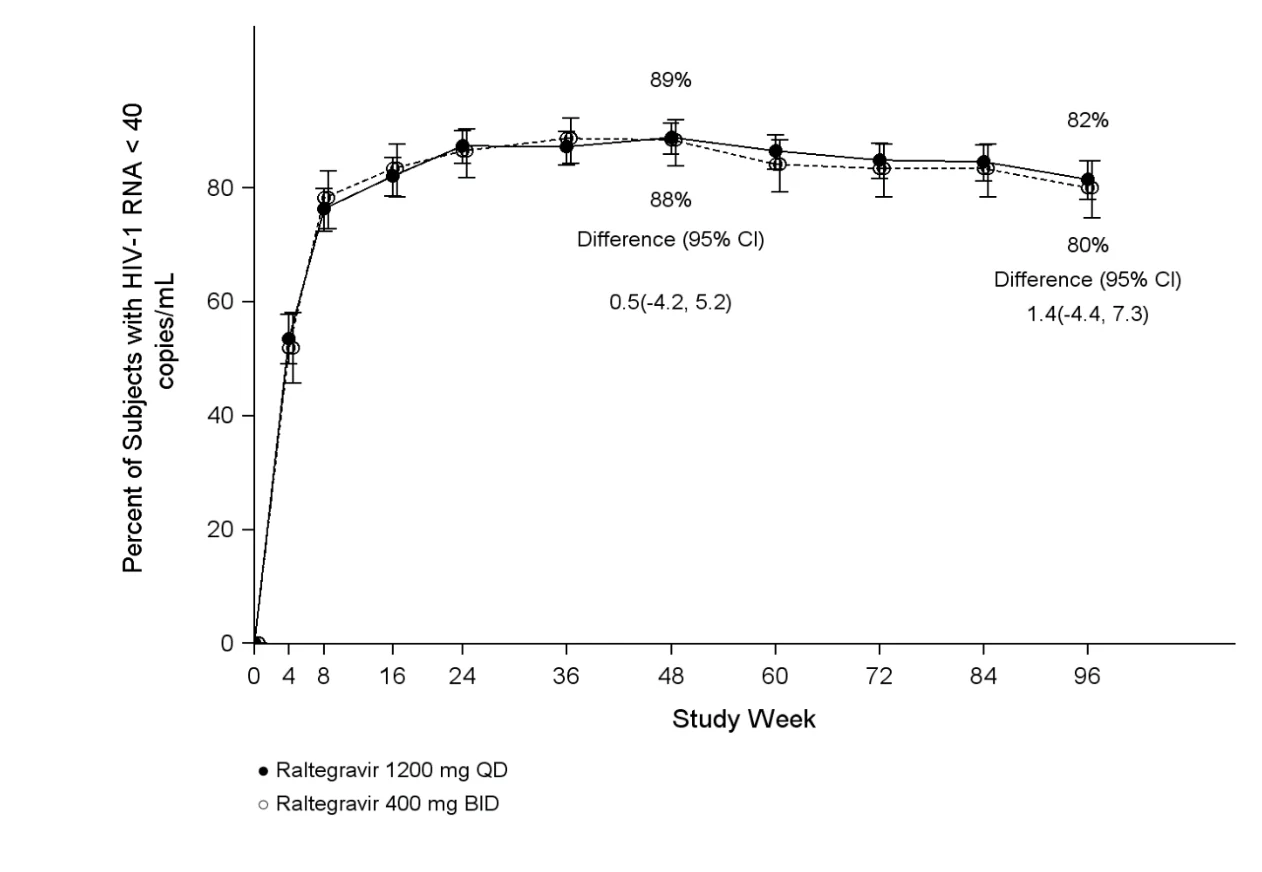
In the ONCEMRK trial, ISENTRESS® 1200 mg (2 x 600 mg) once daily demonstrated consistent virologic and immunologic efficacy relative to ISENTRESS® 400 mg twice daily, both in combination with emtricitabine (+) tenofovir disoproxil fumarate, across demographic and baseline prognostic factors, including: baseline HIV RNA levels >100,000 copies/mL and >500,000 copies/mL, baseline CD4 cells ≤50 cells/mm3, demographic groups (including age, gender, race, ethnicity and region), viral hepatitis co-infection status (hepatitis B and/or C), concomitant proton pump inhibitors/H2 blockers use and viral subtypes (comparing non-clade B as a group to clade B).
Consistent efficacy in patients receiving ISENTRESS® 1200 mg (2 x 600 mg) once daily was observed across HIV subtypes with 94.6% (296/313) and 93.6% (175/187) of patients with B and non-B subtypes, respectively, achieving HIV RNA <40 copies/mL at week 48 (OF approach). Consistent results were observed at week 96.
Pediatric Patients
IMPAACT P1066 is a Phase I/II open label multicenter trial to evaluate the pharmacokinetic profile, safety, tolerability, and efficacy of raltegravir in HIV infected children. This study enrolled 126 treatment experienced pediatric patients 2 through 18 years of age. Patients were stratified by age, enrolling adolescents first and then successively younger children. Patients received either the 400 mg tablet formulation (6 through 18 years of age) or the chewable tablet formulation (2 through 11 years of age). The chewable tablet formulation is not available in Canada. Raltegravir was administered with an optimized background regimen.
The initial dose finding stage included intensive pharmacokinetic evaluation. Dose selection was based upon achieving similar raltegravir plasma exposure and trough concentration as seen in adults, and acceptable short term safety. After dose selection, additional patients were enrolled for evaluation of long term safety, tolerability and efficacy. Of the 126 patients, 96 received the recommended dose of ISENTRESS® (see 4 Dosage and Administration).
These 96 patients had a median age of 13 (range 2 through 18) years, were 51% Female, 34% Caucasian, and 59% Black. At baseline, mean plasma HIV-1 RNA was 4.3 log10 copies/mL, median CD4 cell count was 481 cells/mm3 (range: 0–2361) and median CD4% was 23.3% (range: 0–44). Overall, 8% had baseline plasma HIV-1 RNA >100,000 copies/mL and 59% had a CDC HIV clinical classification of category B or C. Most patients had previously used at least one NNRTI (78%) or one PI (83%).
Ninety-three (97%) patients 2 through 18 years of age completed 24 weeks of treatment (3 discontinued due to non-compliance). At Week 24, 72% achieved ≥1 log10 HIV RNA drop from baseline or <400 copies/mL; 54% achieved HIV RNA <50 copies/mL. The mean CD4 count (percent) increase from baseline to Week 24 was 119 cells/mm3 (3.8%).
Seventy-two (95%) patients 6 through 18 years of age completed 48 weeks of treatment (4 discontinued due to non-compliance). At Week 48, 77% achieved ≥1 log10 HIV RNA drop from baseline or <400 copies/mL; 56% achieved HIV RNA <50 copies/mL. The mean CD4 count (percent) increase from baseline to Week 48 was 155 cells/mm3 (4.7%).
- 15. Microbiology
Microbiology
Raltegravir at concentrations of 31 ± 20 nM resulted in 95% inhibition (IC95) of viral spread (relative to an untreated virus-infected culture) in human T-lymphoid cell cultures infected with the cell-line adapted HIV-1 variant H9IIIB. In addition, raltegravir at concentrations of 6 to 50 nM resulted in 95% inhibition of viral spread in cultures of mitogen-activated human peripheral blood mononuclear cells infected with diverse, primary clinical isolates of HIV-1, including isolates from 5 non-B subtypes, and isolates resistant to reverse transcriptase inhibitors and protease inhibitors. In a single-cycle infection assay, raltegravir inhibited infection of 23 HIV isolates representing 5 non-B subtypes and 5 circulating recombinant forms with IC50 values ranging from 5 to 12 nM. Raltegravir also inhibited replication of an HIV-2 isolate when tested in CEMx174 cells (IC95 = 6 nM). Additive to synergistic antiretroviral activity was observed when human T-lymphoid cells infected with the H9IIIB variant of HIV-1 were incubated with raltegravir in combination with nucleoside analog reverse transcriptase inhibitors (zidovudine, zalcitabine, stavudine, abacavir, tenofovir, didanosine, or lamivudine); non-nucleoside reverse transcriptase inhibitors (efavirenz, nevirapine, or delavirdine); protease inhibitors (indinavir, saquinavir, ritonavir, amprenavir, lopinavir, nelfinavir, or atazanavir); or the entry inhibitor enfuvirtide.
Drug Resistance
The mutations observed in HIV-1 integrase that contributed to raltegravir resistance (evolved either in vitro or in patients treated with raltegravir) generally included a substitution at either Y143 (changed to C, H or R) or Q148 (changed to H, K, or R) or N155 (changed to H) plus one or more additional mutations (e.g., L74I/M, E92Q, T97A, E138A/K, G140A/S, V151I, G163R, H183P, Y226C/D/F/H, S230R, and D232N).
Recombinant viruses containing a single primary mutation (Q148H, K or R, or N155H) displayed decreased replication capacity and reduced susceptibility to raltegravir in vitro. Secondary mutations further decreased susceptibility to raltegravir and sometimes acted as compensatory mutations for viral replication capacity.
Mutations conferring resistance to raltegravir generally also confer resistance to the integrase strand transfer inhibitor elvitegravir. Mutations at amino acid 143 confer greater resistance to raltegravir than to elvitegravir, and the E92Q mutation confers greater resistance to elvitegravir than to raltegravir. Viruses harboring a mutation at amino acid 148, along with one or more other raltegravir resistance mutations, may also have clinically significant resistance to dolutegravir.
Treatment-Naïve Subjects:
By Week 96 in the STARTMRK trial, the primary raltegravir resistance-associated substitutions were observed in 4 (2 with Y143H/R and 2 with Q148H/R) of the 10 virologic failure subjects with evaluable genotypic data from paired baseline and raltegravir treatment-failure isolates.
Treatment-Experienced Subjects:
By Week 96 in the BENCHMRK trials, at least one of the primary raltegravir resistance-associated substitutions, Y143C/H/R, Q148H/K/R, and N155H, was observed in 76 of the 112 virologic failure subjects with evaluable genotypic data from paired baseline and raltegravir treatment-failure isolates. The emergence of the primary raltegravir resistance-associated substitutions was observed cumulatively in 70 subjects by Week 48 and 78 subjects by Week 96, 15.2% and 17% of the raltegravir recipients, respectively. Some (n = 58) of those HIV-1 isolates harboring one or more of the primary raltegravir resistance-associated substitutions were evaluated for raltegravir susceptibility yielding a median decrease of 26.3-fold (mean 48.9 ± 44.8-fold decrease, ranging from 0.8- to 159-fold) compared to the wild-type reference.
16. Non-Clinical Toxicology
General toxicology
Acute Toxicity
In dogs, an intravenous 3-day rising dose escalation study caused mortality at high doses; this is considered to result from cardiac arrhythmia secondary to the excessive potassium salt administered in the drug formulation. Mild physical signs were noted at lower doses. In a 7-day intravenous study in dogs, at 100 mg/kg/day (exposure approximately 23-fold above the exposure at the recommended human dose), treatment-related effects were limited to physical signs which included body weight loss; minimal increases in serum urea nitrogen; increases in alanine aminotransferase activity, alkaline phosphatase activity, and cholesterol; and very slight renal tubular dilatation.
Chronic Toxicity
Chronic repeat dose toxicity studies were conducted in rats (6 month duration) and dogs (1 year duration). In dogs, transient and/or intermittent emesis and weight loss were observed at 360 mg/kg/day (exposure 9 fold above the exposure at the recommended human dose). In rats, mortality, preceded by physical signs of drug intolerance, was seen at 600 mg/kg/day (exposures 4.8 fold above the exposure at the recommended human dose), but not at 120 mg/kg/day. In rats, inflammation of the nasal cavity and degeneration of the stomach mucosa occurred at 120 mg/kg/day (exposures 1.6 fold above the exposure at the recommended human dose) and is suggestive of irritative properties of the drug.
Carcinogenicity
Carcinogenicity studies of raltegravir in mice did not show any carcinogenic potential. At the highest dose levels, 400 mg/kg/day in females and 250 mg/kg/day in males, systemic exposure was approximately 2-fold greater (females) or equal to (males) the AUC (54 µM●hr) at the 400-mg twice daily dose. In rats, carcinogenic potential considered to be specific for this species was identified, but is regarded as having minimal relevance for humans. In rats, tumors (squamous cell carcinoma) of the nose/nasopharynx were identified in high- and mid-dose group animals. These neoplasms are considered to result from local deposition and/or aspiration of drug on the mucosa of the nose/nasopharynx during dosing and are an expected consequence of chronic irritation and inflammation. Consistent with this, the increased incidence of these neoplasms correlated with oral dosing of high concentrations of raltegravir (>300 mg/kg) instead of systemic exposure. However, at the NOAEL, systemic exposure was 1.4 to 1.7 fold greater than the AUC (54 µM●hr) at the clinical 400-mg twice daily dose.
Genotoxicity
All genotoxicity studies to evaluate mutagenicity and clastogenicity were negative.
Reproductive and Developmental toxicology
No effect on fertility was seen in male and female rats at doses up to 600 mg/kg/day which resulted in 3 fold exposure above the exposure at the recommended human dose.
Development
Oral administration of up to 600 mg/kg/day to juvenile rats resulted in drug irritation effects in the stomach which were similar to those seen in adult rats. No additional toxicities were noted in juvenile rats indicating that juvenile rats were no more sensitive to drug effects than adult rats.
Treatment-related increases over controls in the incidence of supernumerary ribs were seen in rats at 600 mg/kg/day (exposures 4.4- fold above the exposure at the recommended human dose).