


Product Monograph - Jamp Eltrombopag
RECENT MAJOR LABEL CHANGES
None
TABLE OF CONTENTS
Sections or subsections that are not applicable at the time of authorization are not listed.
RECENT MAJOR LABEL CHANGES ............................................................................ 2
TABLE OF CONTENTS .................................................................................................. 2
PART I: HEALTH PROFESSIONAL INFORMATION .................................................... 4
- 1.
INDICATIONS ...................................................................................................... 4
- 1.1 Pediatrics ...................................................................................................... 4
- 1.2 Geriatrics ...................................................................................................... 4
- 2 CONTRAINDICATIONS ....................................................................................... 4
- 3 SERIOUS WARNINGS AND PRECAUTIONS BOX ............................................ 5
- 4
DOSAGE AND ADMINISTRATION ..................................................................... 5
- 4.1 Dosing Considerations ................................................................................. 5
- 4.2 Recommended Dose and Dosage Adjustment ............................................. 6
- 4.4 Administration ............................................................................................ 11
- 4.5 Missed Dose .............................................................................................. 11
- 5 OVERDOSAGE .................................................................................................. 11
- 6 DOSAGE FORMS, STRENGTHS, COMPOSITION AND PACKAGING ........... 12
- 7
WARNINGS AND PRECAUTIONS .................................................................... 12
- 7.1 Special Populations ................................................................................... 18
- 7.1.1 Pregnant Women ................................................................................... 18
- 7.1.2 Breast-feeding ........................................................................................ 19
- 7.1.3 Pediatrics ............................................................................................... 19
- 7.1.4 Geriatrics ................................................................................................ 19
- 8
ADVERSE REACTIONS .................................................................................... 19
- 8.1 Adverse Reaction Overview ...................................................................... 19
- 8.2 Clinical Trial Adverse Reactions ................................................................ 20
- 8.2.1 Clinical Trial Adverse Reactions - Pediatrics .......................................... 28
- 8.3 Less Common Clinical Trial Adverse Reactions ........................................ 29
- 8.3.1 Less Common Clinical Trial Adverse Reactions – Pediatrics ................. 31
8.5 Post-Market Adverse Reactions ................................................................ 32
- 9
DRUG INTERACTIONS ..................................................................................... 33
9.2 Drug Interactions Overview ....................................................................... 33
- 9.4 Drug-Drug Interactions .............................................................................. 33
- 9.5 Drug-Food Interactions .............................................................................. 36
- 9.6 Drug-Herb Interactions .............................................................................. 36
- 9.7 Drug-Laboratory Test Interactions ............................................................. 36
- 10
CLINICAL PHARM ACOLOGY.......................................................................... 36
- 10.1 Mechanism of Action .............................................................................. 36
- 10.2 Pharmacodynamics ................................................................................ 36
- 10.3 Pharmacokinetics ................................................................................... 36
- 11 STORAGE, STABILITY AND DISPOSAL ......................................................... 39
- 12 SPECIAL HANDLING INSTRUCTIONS ............................................................ 39
- 13 PHARMACEUTICAL INFORMATION ............................................................... 40
- 14
CLINICAL TRIALS ............................................................................................. 41
- 14.1 Clinical Trials by Indication ..................................................................... 41
Chronic Immune Thrombocytopenia (ITP) .......................................................... 41
Pediatric Chronic Immune Thrombocytopenia (ITP) ........................................... 47
Chronic Hepatitis C-Related Thrombocytopenia ................................................ 49
Severe Aplastic Anemia (SAA) ........................................................................... 53
14.3 Comparative Bioavailability Studies……………………………………….......55
- 15 Microbiology ..................................................................................................... 56
- 16 NON-CLINICAL TOXICOLOGY ......................................................................... 56
- 17 SUPPORTING PRODUCT MONOGRAPH…………………………………………59
PATIENT MEDICATION INFORMATION ..................................................................... 60
PART I: HEALTH PROFESSIONAL INFORMATION
1. INDICATIONS
- JAMP Eltrombopag (eltrombopag tablets) are indicated for the treatment of chronic immune thrombocytopenia (ITP) to increase platelet counts in adult and pediatric patients one year and older who have had an insufficient response to corticosteroids or immunoglobulins.
- JAMP Eltrombopag is indicated to increase platelet counts in thrombocytopenic patients with chronic hepatitis C virus (HCV) infection to allow the initiation and maintenance of interferon -based therapy.
- JAMP Eltrombopag is indicated for the treatment of adult patients with severe aplastic anemia (SAA) who have had an insufficient response to immunosuppressive therapy.
1.1 Pediatrics
Pediatrics (< 18 years): The safety and efficacy of eltrombopag tablets have not been established in pediatric ITP patients younger than 1 year. In pediatric ITP patients one year and older the long- term safety and efficacy of eltrombopag tablets have not been studied. The safety and efficacy of eltrombopag tablets in pediatric patients with chronic HCV or SAA have not been established.
1.2 Geriatrics
Geriatrics (≥ 65 years of age): Clinical studies of eltrombopag tablets did not include sufficient numbers of patients aged 65 and older to determine whether they respond differently from younger patients. In general, caution should be exercised in the administration and monitoring of JAMP Eltrombopag in elderly patients, reflecting the greater frequency of decreased hepatic, renal or cardiac function and of concomitant disease or other drug therapy.
2 CONTRAINDICATIONS
- JAMP Eltrombopag is contraindicated in patients with severe hepatic impairment (Child-Pugh Class C) (see 7 Hepatic/Biliary/Pancreatic, Hepatic Impairment and Hepatotoxicity).
- JAMP Eltrombopag is contraindicated in patients who are hypersensitive to this drug or to any ingredient in the formulation, including any non-medicinal ingredient, or component of the container For a complete listing of excipients (see 6 DOSAGE FORMS, STRENGTHS, COMPOSITION AND PACKAGING). In patients with chronic hepatitis C virus (HCV) infection, the Product Monographs for both pegylated interferon and ribavirin should be consulted for relevant contraindications associated with the use of these products.
3 SERIOUS WARNINGS AND PRECAUTIONS BOX
Serious Warnings and Precautions
| JAMP Eltrombopag should be used with caution in chronic hepatitis C patients with cirrhosis as it may increase the risk of hepatic decompensation and death when administered with pegylated interferon and ribavirin. Patients with low albumin levels (< 35 g/L) or Model for End-Stage Liver Disease (MELD) score ≥10 at baseline had a greater risk of hepatic decompensation. Patients with these characteristics should be closely monitored for signs and symptoms of hepatic decompensation (see 7 Hepatic/Biliary/Pancreatic, Hepatic Decompensation – Use with Interferon). |
|---|
4 DOSAGE AND ADMINISTRATION
4.1 Dosing Considerations
JAMP Eltrombopag is only available as tablets and cannot be used in patients who are unable to swallow JAMP Eltrombopag tablets whole.
Chronic Immune Thrombocytopenia (ITP)
JAMP Eltrombopag treatment should be initiated and maintained by a physician who is experienced in the treatment of haematological diseases, who understands the benefits and risks associated with the treatment of ITP, and who is experienced in counselling patients for whom JAMP Eltrombopag is indicated.
Prior to prescribing JAMP Eltrombopag, physicians should:
- Ensure the eligibility of patients to meet the above criteria,
- Counsel each patient on the risks and benefits of JAMP Eltrombopag, and
- Ensure patients are able to swallow the JAMP Eltrombopag tablets whole (see 4.4 Administration below).
JAMP Eltrombopag dosing regimens must be individualized based on the patient’s platelet counts. The objective of treatment with JAMP Eltrombopag should not be to normalize platelet counts but to maintain platelet counts above the level for hemorrhagic risk (> 50 x 109/L), and generally below 150 – 200 x 109/L. Use the lowest effective dosing regimen to maintain platelet counts, as clinically indicated.
In most patients, measurable elevations in platelet counts take 1-2 weeks to occur (see 14 CLINICAL TRIALS).
Chronic Hepatitis C-related Thrombocytopenia
Eltrombopag tablets are given in combination with pegylated interferon and ribavirin. Reference should be made to the full Product Monographs for each respective co-administered medicinal product for comprehensive details of administration. The directions regarding the dosage, dose adjustment guidelines in the event of toxicity and other relevant safety information or contraindications for pegylated interferon and ribavirin should be followed.
JAMP Eltrombopag should be used only in patients with chronic hepatitis C whose degree of thrombocytopenia prevents the initiation of interferon-based therapy and limits the ability to maintain interferon-based therapy.
Use the lowest dose of JAMP Eltrombopag to achieve and maintain a platelet count necessary to initiate and maintain antiviral therapy. Dose adjustments are based upon the patient’s platelet count response, see Table 2, below. Do not use JAMP Eltrombopag to normalize platelet counts. In clinical studies, platelet counts generally increased within 1 week of starting eltrombopag tablets.
The safety and efficacy of eltrombopag tablets have not been established in combination with direct acting antiviral agents used in the treatment of chronic hepatitis C virus infection.
Severe Aplastic Anemia (SAA)
Use the lowest dose of JAMP Eltrombopag to achieve and maintain a hematologic response. Dose adjustments are based upon the platelet count. Do not use JAMP Eltrombopag to normalize platelet counts (see 7 WARNINGS AND PRECAUTIONS, Hematologic, Thrombotic or thromboembolic complications). Hematologic response requires dose titration, generally up to 150 mg, and may take up to 16 weeks after starting JAMP Eltrombopag (See 14.1 Clinical Trials by Indication, Severe Aplastic Anemia).
4.2 Recommended Dose and Dosage Adjustment
Chronic Immune Thrombocytopenia (ITP)
Initial Dose Regimen
Adults and Pediatric Patients Aged 6 years and above:
The recommended starting dose of JAMP Eltrombopag is 50 mg once daily. For ITP patients of East-
/Southeast-Asian ancestry aged 6 and above, initiate JAMP Eltrombopag at a reduced dose of 25 mg once daily (see 4 DOSAGE AND ADMINISTRATION).
Pediatric Patients Aged 1 to < 6 years:
The recommended starting dose of JAMP Eltrombopag is 25 mg once daily.
Monitoring and Dose Adjustment
Adults and Pediatric Patients Aged 1 to < 18 years:
If after 2 to 3 weeks of initial therapy, the platelet counts are below the clinically indicated levels (e.g., 50 x 109/L), the dose may be increased to a maximum of 75 mg once daily (see Table 1).
A dose reduction should be considered with platelet counts increasing to over 150 x 109/L. At platelet counts over 200 x 109/L dose reduction is recommended (see Table 1).
JAMP Eltrombopag should be interrupted if platelet counts increase to > 300 x 109/L. Once the platelet count is < 150 x 109/L; reinitiate therapy at a reduced dose. If platelet counts remain at
> 300 x 109/L after 2 weeks of therapy of the lowest dose of JAMP Eltrombopag, discontinue treatment (see Table 1).
Table 1 Dose Adjustments of JAMP Eltrombopag in ITP patients
| Platelet Count Result | Dose Adjustment or Response |
|---|---|
| < 50 x 109/L following at least 2 weeks of JAMP Eltrombopag | Increase daily dose by 25 mg to a maximum of 75 mg/day For patients taking 25 mg once every other day, increase dose to 25 mg once daily. |
| ≥ 50 x 109/L to ≤ 200 x 109/L | Use lowest dose of JAMP Eltrombopag and/or concomitant ITP treatment to maintain platelet counts that avoid or reduce bleeding. |
> 200 x 109/L to ≤ 300 x 109/L at any time | Decrease the daily dose by 25 mg. Wait 2 weeks to assess the effects of this and any subsequent dose adjustments For patients taking 25 mg once daily, consideration should be given to dosing at 25 mg once every other day. |
| > 300 x 109/L | Stop JAMP Eltrombopag. Increase the frequency of platelet monitoring to twice weekly. Once the platelet count is < 150 x 109/L, reinitiate therapy at a daily dose reduced by 25 mg. For patients taking 25 mg once daily, consideration should be given to reinitiating therapy at 25 mg once every other day. |
| > 300 x 109/L after 2 weeks of therapy at lowest dose of JAMP Eltrombopag | Discontinue JAMP Eltrombopag. |
The standard dose adjustment, whether decreased or increased, would be 25 mg once daily. However, in a few patients an alternate dosing of different tablet strengths on different days may be required.
After any JAMP Eltrombopag dose adjustment, platelet counts should be monitored at least once weekly for 2 to 3 weeks. Wait for at least 2 weeks to see the effect of any dose increase on the patient’s platelet response prior to considering another dose adjustment. In patients with liver disease, wait at least 3 weeks before considering dose adjustment (see All Indications, Hepatic Impairment, below).
Monitor clinical hematology and liver tests regularly throughout therapy with JAMP Eltrombopag and modify the dose of JAMP Eltrombopag based on platelet counts as outlined in Table 1. During therapy with JAMP Eltrombopag, assess complete blood counts (CBC), including platelet count and peripheral blood smears, weekly until a stable platelet count (≥ 50 x 109/L for at least 4 weeks) has been achieved. Obtain CBC including platelet count and peripheral blood smears, monthly thereafter.
JAMP Eltrombopag can be administered in addition to other ITP medicinal products. Modify the dose regimen of concomitant ITP medicinal products, as medically appropriate, to avoid excessive increases in platelet counts during therapy with JAMP Eltrombopag.
Discontinuation
Discontinue JAMP Eltrombopag if the platelet count does not increase to a level sufficient to avoid clinically important bleeding after 4 weeks of therapy with JAMP Eltrombopag at the maximum daily dose of 75 mg. Excessive platelet count responses, as outlined in Table 1, or important liver test abnormalities also necessitate discontinuation of JAMP Eltrombopag (see 7 WARNINGS AND PRECAUTIONS).
The reoccurrence of thrombocytopenia is possible upon discontinuation of treatment.
Chronic Hepatitis C-related Thrombocytopenia
Adults (≥ 18 years of age):
JAMP Eltrombopag should be initiated at a dose of 25 mg once daily. No dosage adjustment is necessary for HCV patients of East-/Southeast-Asian ancestry or patients with mild hepatic impairment.
The dose of JAMP Eltrombopag should be adjusted in 25 mg increments every 2 weeks as necessary to achieve the target platelet count required to initiate antiviral therapy (see Table 2). Platelet counts should be monitored every week prior to starting antiviral therapy.
During antiviral therapy, the dose of JAMP Eltrombopag should be adjusted as necessary to avoid dose reduction of peginterferon. Platelet counts should be monitored weekly during antiviral therapy until a stable platelet count is achieved. CBC’s, including platelet counts and peripheral blood smears should be obtained monthly thereafter.
Do not exceed a dose of 100 mg JAMP Eltrombopag once daily.
For specific dosage instructions for peginterferon alfa or ribavirin, refer to their respective Product Monographs.
Table 2 Dose adjustments of JAMP Eltrombopag in HCV patients during antiviral therapy
| Platelet Count Result | Dose Adjustment or Response |
|---|---|
| < 50 x 109/L following at least 2 weeks of therapy | Increase daily dose by 25 mg increments every 2 weeks as necessary to a maximum of 100 mg / day. For patients taking 25 mg once every other day, increase the dose to 25 mg once daily before increasing the dose amount by 25 mg. |
| ≥ 50 x 109/L to ≤ 150 x 109/L | Maintain the lowest dose of JAMP Eltrombopag to achieve these values so as to avoid dose reductions of peginterferon. |
| > 150 x 109/L to ≤ 200 x 109/L | Decrease the daily dose by 25 mg. Wait 2 weeks to assess the effects of this and any subsequent dose adjustments. For patients taking 25 mg JAMP Eltrombopag once daily, consideration should be given to dosing at 25 mg once every other day. |
| > 200 x 109/L | Stop JAMP Eltrombopag; increase the frequency of platelet monitoring to twice weekly. Once the platelet count is < 150 x 109/L, reinitiate therapy at a lower daily dose. For patients taking 25 mg JAMP Eltrombopag once daily, consideration should be given to reinitiating therapy at 25 mg once every other day. |
| > 200 x 109/L after 2 weeks of therapy at lowest dose of JAMP Eltrombopag | Discontinue JAMP Eltrombopag. |
Discontinuation
When JAMP Eltrombopag is given in combination with antiviral therapies reference should be made to the full Product Monograph of the respective co-administered medicinal products for comprehensive details of administration. The directions regarding the dose, dose adjustment guidelines in the event of toxicity and other relevant safety information or contraindications for the respective antiviral medicinal products should be followed.
In patients with HCV genotype 1/4/6, independent of the decision to continue interferon therapy, discontinuation of JAMP Eltrombopag therapy should be considered in patients who do not achieve virological response at week 12. If HCV-RNA remains detectable after 24 weeks of treatment, JAMP Eltrombopag therapy should be discontinued.
JAMP Eltrombopag treatment should be terminated when antiviral therapy is discontinued. Excessive platelet count responses, as outlined in Table 2 or important liver test abnormalities may also necessitate discontinuation of JAMP Eltrombopag (see 7 WARNINGS AND PRECAUTIONS).
Severe Aplastic Anemia (SAA)
Adults (≥ 18 years of age):
JAMP Eltrombopag should be initiated at a dose of 50 mg once daily. For SAA patients of East-
/Southeast-Asian ancestry or those with mild or moderate hepatic impairment (Child-Pugh Class A, B), JAMP Eltrombopag should be initiated at a reduced dose of 25 mg once daily (See 4 DOSAGE AND ADMINISTRATION).
The dose of JAMP Eltrombopag should be initiated in 50 mg increments every 2 weeks as necessary to achieve the target platelet count ≥ 50 x 109/L. For patients with mild or moderate hepatic impairment or patients of East-/Southeast-Asian ancestry, increase the dose initially by 25 mg to achieve a 50 mg daily dose before considering further dose increases. Do not exceed a dose of 150 mg daily. Clinical hematology and liver tests should be monitored regularly throughout therapy with JAMP Eltrombopag and the dosage regimen of JAMP Eltrombopag should be modified based on platelet counts as outlined in Table 3.
Table 3 Dose adjustments of JAMP Eltrombopag in SAA patients
| Platelet Count Result | Dose Adjustment or Response |
|---|---|
| Platelet Count Result | Dose Adjustment or Response |
| < 50 x 109/L following at least 2 weeks of JAMP Eltrombopag | Increase daily dose by 50 mg every two weeks as necessary to a maximum of 150 mg/day. For patients taking 25 mg once daily, increase the dose to 50 mg daily before increasing the dose amount by 50 mg. |
| ≥ 50 x 109/L to ≤ 200 x 109/L | Maintain the lowest dose of JAMP Eltrombopag to achieve these values. |
| > 200 x 109/L to ≤ 300 x 109/L at any time | Decrease the daily dose by 50 mg (or by 25 mg if these values are achieved with a 50 mg daily dose - i.e., in the East-/Southeast-Asian ancestry or in patients with liver disease). Wait 2 weeks to assess the effects of this and any subsequent dose adjustments. |
| > 300 x 109/L | Stop JAMP Eltrombopag for at least one week. Once the platelet count is < 150 x 109/L, reinitiate therapy at a dose reduced by 50 mg. |
| > 300 x 109/L after 2 weeks of therapy at lowest dose of JAMP Eltrombopag | Discontinue JAMP Eltrombopag. |
Tapering for Tri-lineage (white blood cells, red blood cells, and platelets) Responders: Once platelet count is > 50 x 109/L, hemoglobin is > 100 g/L in the absence of red blood cell (RBC) transfusions, and absolute neutrophil count (ANC) is > 1 x 10⁹/L for more than 8 weeks, the dose of JAMP Eltrombopag should be reduced by up to 50%. If counts stay stable after 8 weeks at the reduced dose, then JAMP Eltrombopag should be discontinued and blood counts monitored as clinically indicated. If platelet counts drop to < 30 x 109/L, hemoglobin to < 90 g/L, or ANC to < 0.5 x 10⁹/L, JAMP Eltrombopag may be reinitiated at the previous dose.
Discontinuation
If no hematologic response has occurred after 16 weeks of therapy with JAMP Eltrombopag, therapy should be discontinued. Discontinuation of JAMP Eltrombopag should be considered if new cytogenetic abnormalities are observed (see 8.2 Clinical Trial Adverse Drug Reactions - Severe Aplastic Anemia). Excessive platelet count responses (as outlined in Table 3) or important liver test abnormalities also necessitate discontinuation of JAMP Eltrombopag (see 7 WARNINGS AND PRECAUTIONS, Hepatic/Biliary/Pancreatic, Hepatotoxicity).
All indications
Pediatrics (< 18 years of age): The safety and efficacy of eltrombopag tablets have not been established in pediatric ITP patients younger than 1 year. The safety and efficacy of eltrombopag tablets in pediatric patients with chronic HCV or SAA have not been established.
Hepatic Impairment: JAMP Eltrombopag is contraindicated in patients with severe hepatic impairment (Child-Pugh Class C) (See 2 CONTRAINDICATIONS) and caution should be exercised when administering JAMP Eltrombopag to patients with mild or moderate hepatic impairment, since exposure to eltrombopag increases with increasing degrees of hepatic dysfunction (see 10.3 Pharmacokinetics, Special Populations and Conditions - Hepatic Impairment).
The risk of thromboembolic events of the portal venous system has been found to be increased in patients with chronic liver disease treated with 75 mg eltrombopag tablets once daily for two weeks in preparation for invasive procedures. JAMP Eltrombopag therefore should not be used in ITP or SAA patients with hepatic impairment (Child-Pugh Class A and B) unless the expected benefit outweighs the identified risk of portal venous thrombosis (see 7 WARNINGS AND PRECAUTIONS).
If the use of JAMP Eltrombopag is deemed necessary in adult ITP or SAA patients with liver impairment (Child-Pugh Class A and B), the starting dose must be 25 mg once daily. Attempts to maintain platelet counts below 200 x 109/L should be carried out in these patient populations. There are no data in pediatric patients with hepatic impairment.
After initiating JAMP Eltrombopag or following any dose increase in ITP patients with liver impairment (Child-Pugh Class A and B), wait a minimum of 3 weeks before increasing the dose.
Thrombocytopenic patients with chronic HCV should initiate JAMP Eltrombopag at the usual dose of 25 mg once daily (see 14.1 Clinical Trials by Indication, Pharmacokinetic Interactions).
Renal Impairment: No dose adjustment is generally necessary in patients with renal impairment. JAMP Eltrombopag should be used in patients having impaired renal function with caution and close monitoring, for example by testing serum creatinine and/or performing urine analysis (see 10.3 Pharmacokinetics, Special Populations and Conditions - Renal Impairment).
There are limited data with the use of eltrombopag tablets in patients with severe renal impairment (creatinine clearance < 30mL/min), therefore it is generally not recommended for use in these patients (see 7 WARNINGS AND PRECAUTIONS, Renal and 10.3 Pharmacokinetics, Special Populations and Conditions - Renal Impairment).
Asian Patients: JAMP Eltrombopag should be initiated at a reduced dose of 25 mg once daily is recommended for SAA and adult and pediatric (aged 6 to < 18 years) ITP patients of East-
/Southeast-Asian ancestry (see 10.3 Pharmacokinetics, Special Populations and Conditions
- Ethnic Origin).
No dosage adjustment is necessary for chronic HCV patients of East-/Southeast-Asian ancestry. JAMP Eltrombopag should be initiated at the recommended dose of 25 mg once daily (see 10.3 Pharmacokinetics, Special Populations and Conditions).
Patient platelet count should continue to be monitored and the standard criteria for further dose modification followed.
Elderly: There are limited data on the use of eltrombopag tablets in patients aged 65 years and older and no clinical experience in patients aged over 85 years. In the clinical studies of eltrombopag tablets, overall no clinically significant differences in the safety of eltrombopag tablets were observed between patients aged at least 65 years and younger patients. Other reported clinical experience has not identified differences in responses between the elderly and younger patients, but greater sensitivity of some older individuals cannot be ruled out (see 10.3 Pharmacokinetics, Special Populations and Conditions).
Food Interactions: JAMP Eltrombopag should be taken at least two hours before or four hours after antacids, dairy products, or mineral supplements, or any other products containing polyvalent cations (e.g., aluminium, calcium, iron, magnesium, selenium and zinc).
JAMP Eltrombopag may be taken with food containing little (< 50 mg) or preferably no calcium (see 14.1 Clinical Trials by Indication, Pharmacokinetic Interactions).
4.4 Administration
Patients should swallow the tablets whole, with some water. They should NOT crush tablets and then mix with food or liquids.
4.5 Missed Dose
If a dose of JAMP Eltrombopag is missed, the patient should be advised to take it as soon as they remember, and then continue with the next dose at the regular interval. Two doses should not be taken at the same time to make up for a missed dose.
5 OVERDOSAGE
In the event of overdose, platelet counts may increase excessively and result in thrombotic/thromboembolic complications. In case of an overdose, oral administration of a metal cation-containing preparation, such as calcium, aluminium or magnesium preparation at the earliest possible opportunity, to chelate eltrombopag and thus limit absorption should be considered. Platelet counts should be closely monitored. Treatment with JAMP Eltrombopag should be reinitiated in accordance with dosing and administration recommendations (see 4 DOSAGE AND ADMINISTRATION).
Because eltrombopag is not significantly renally excreted and is highly bound to plasma proteins, hemodialysis would not be expected to be an effective method to enhance the elimination of eltrombopag.
For the most recent information in the management of a suspected drug overdose, contact your regional poison control centre or Health Canada’s toll-free number, 1-844 POISON-X (1-844-764-7669). |
|---|
In the clinical studies, there was one report of overdose where the patient ingested 5,000 mg of eltrombopag. Reported adverse events included mild rash, transient bradycardia, fatigue and elevated transaminases. Liver enzymes measured between Days 2 and 18 after ingestion peaked at a 1.6-fold ULN in AST, a 3.9-fold ULN in ALT, and a 2.4-fold ULN in total bilirubin. The patient’s platelet count increased to a maximum of 929 x 109/L at 13 days following the ingestion. After 2 months follow-up, all events resolved without sequelae.
6 DOSAGE FORMS, STRENGTHS, COMPOSITION AND PACKAGING
Table 4 Dosage Forms, Strengths, Composition and Packaging
| Route of Administration | Dosage Form / Strength/Composition | All Non-medicinal Ingredients |
|---|---|---|
| Oral | Film-coated Tablets/ 25 mg, 50 mg Each tablet contains eltrombopag as eltrombopag olamine. | Hydroxypropylcellulose, hypromellose, macrogol, magnesium stearate, mannitol, microcrystalline cellulose, povidone k-30, sodium starch glycolate, talc, and titanium dioxide. The 50 mg tablets also contain indigo carmine, iron oxide red and iron oxide yellow. |
25 mg of Eltrombopag film-coated tablets:
White, round, biconvex film-coated tablets (approximately 7.1 mm in diameter) debossed with "25" on one side, available in blister pack of 28 tablets.
50 mg of Eltrombopag film-coated tablets:
Brown, round, biconvex film-coated tablets (approximately 9.6 mm in diameter) debossed with "50" on one side, available in blister pack of 28 tablets.
7 WARNINGS AND PRECAUTIONS
Please see 3 SERIOUS WARNINGS AND PRECAUTIONS BOX.
General
The diagnosis of ITP in pediatric patients as well as adults and elderly patients should be confirmed by exclusion of other clinical entities presenting with thrombocytopenia. The effectiveness and safety of eltrombopag tablets have not been established for use in other thrombocytopenic conditions including chemotherapy-induced thrombocytopenia and myelodysplastic syndromes (MDS). There is a theoretical concern that thrombopoietin receptor agonists, including eltrombopag, may stimulate the progression of existing hematopoietic malignancies such as MDS (see Hematologic, Hematologic malignancies below). Consideration should be given to performing a bone marrow aspirate and biopsy over the course of the disease and treatment, particularly in patients over 60 years of age, those with systemic symptoms or abnormal signs such as increased peripheral blast cell.
In patients with chronic hepatitis C virus (HCV) infection, the Product Monographs for both pegylated interferon and ribavirin should be consulted for relevant warnings and precautions associated with the use of these products.
The safety and efficacy of eltrombopag tablets have not been established in combination with direct acting antiviral agents used in the treatment of chronic hepatitis C virus (see 9.4 Drug-Drug Interactions).
Carcinogenesis and Mutagenesis
Cytogenetic abnormalities: Cytogenetic abnormalities are known to occur in SAA patients. It is not known whether eltrombopag tablets increase the risk of cytogenetic abnormalities in patients with SAA. In the phase II SAA clinical study with eltrombopag tablets , the incidence of new cytogenetic abnormalities was observed in 19% of patients [8/43 (where 5 of them had changes in chromosome 7)]. The median time on study to a cytogenetic abnormality was 2.9 months.
For SAA patients who have an insufficient response to immunosuppressive therapy, bone marrow examination with aspirations for cytogenetics is recommended prior to initiation of JAMP Eltrombopag, at 3 months of treatment and 6 months thereafter. Discontinuation of JAMP Eltrombopag should be considered if new cytogenetic abnormalities are observed.
Hematologic malignancies: TPO-R agonists are growth factors that lead to thrombopoietic progenitor cell expansion, differentiation and platelet production. The TPO-R is predominantly expressed on the surface of cells of the myeloid lineage. For TPO-R agonists there is a theoretical concern that they may stimulate the progression of existing hematopoietic malignancies such as myelodysplasia (MDS). The effectiveness and safety of eltrombopag tablets have not been established for the treatment of thrombocytopenia due to MDS.
Increased risk of death and progression of MDS to acute myeloid leukemia (AML) were observed in a randomized, double-blind, placebo-controlled, multicenter study in patients with International Prognostic Scoring System (IPSS) intermediate-1, intermediate-2 or high risk MDS with thrombocytopenia, receiving azacitidine in combination with either eltrombopag tablets or placebo. This study was terminated due to lack of efficacy and safety reasons, including increased progression to AML. Patients received eltrombopag tablets or placebo at a starting dose of 200 mg once daily, up to a maximum of 300 mg once daily, in combination with azacitidine for at least six cycles. The incidence of death (overall survival) was 32% (57/179) in the eltrombopag arm versus 29% (51/177) in the placebo arm (HR [95% CI] = 1.42 [0.97, 2.08], showing an increased relative risk of death in this study by 42% in the eltrombopag arm). The incidence of progression to AML was 12% (21/179) in the eltrombopag arm versus 6% (10/177) in the placebo arm (HR [95% CI] = 2.66 [1.312, 5.41], showing an increased relative risk of progression to AML in this study by 166% in the eltrombopag arm).
In clinical studies with eltrombopag tablets in SAA, 5% of patients (4/73) were diagnosed with MDS. The median time to diagnosis was 3 months from the start of eltrombopag tablets treatment.
Prior to initiation of JAMP Eltrombopag, examine the peripheral blood smear closely to establish a baseline level of cellular morphologic abnormalities. Following identification of a stable dose of JAMP Eltrombopag, examine peripheral blood smears and complete blood counts (CBC) monthly for new or worsening morphological abnormalities (e.g., teardrop and nucleated red blood cells, immature white blood cells) or cytopenia(s). If the patient develops new or worsening morphological abnormalities or cytopenia(s), discontinue treatment with JAMP Eltrombopag and consider a bone marrow biopsy.
Discontinuation of JAMP Eltrombopag should be considered if hematologic malignancies develop.
Hematologic
Thrombotic or thromboembolic complications: Platelet counts above the normal range may present an increased risk of thrombotic complications. Thromboembolic events (TEE) were observed at low and normal platelet counts.
The risk of TEE, such as portal vein thrombosis, has been found to be increased in patients with chronic liver disease treated with 75 mg eltrombopag tablets once daily for two weeks in preparation for invasive procedures. Therefore, JAMP Eltrombopag should not be used in ITP and SAA patients with hepatic impairment (Child-Pugh Class A and B) unless the expected benefit outweighs the identified risk of portal venous thrombosis, an adverse event which may lead to death (see 4 DOSAGE AND ADMINISTRATION).
In adult clinical studies with eltrombopag tablets in ITP (n = 763), 42 patients experienced a total of 53 TEEs (a patient may have experienced more than 1 TEE), which included deep vein thrombosis (n = 10), pulmonary embolism (n = 7), cerebral infarction (n = 7), thrombophlebitis superficial
(n = 6), hemiparesis (n = 4), acute myocardial infarction (n = 3), myocardial infarction (n = 3), transient ischemic attack (n = 3), pulmonary infarction (n = 2), cerebral venous thrombosis
(n = 1), embolic cerebral infarction (n = 1), embolism (n = 1), coronary artery occlusion (n = 1), thrombophlebitis (n = 1), thrombosis (n = 1), transverse sinus thrombosis (n = 1) and venous thrombosis limb (n=1). TEEs were observed at low and normal platelet counts.
In the two controlled Phase III studies in thrombocytopenic patients with HCV receiving interferon-based therapy (n = 1439), 38 out of 955 patients (4%) treated with eltrombopag tablets and
6 out of 484 patients (1%) in the placebo group experienced TEEs. Reported thrombotic/thromboembolic complications included both venous and arterial events. The majority of TEEs were non-serious and resolved by the end of the study. Portal vein thrombosis was the most common TEE in both treatment groups (2% in patients treated with eltrombopag tablets versus < 1% for placebo). No specific temporal relationship between start of treatment and occurrence of TEE was observed. Patients with low albumin levels (≤ 35 g/L), MELD score ≥ 10, or age greater than 60 years demonstrated an increased risk of TEE. JAMP Eltrombopag should only be administered to such patients after careful consideration of the expected benefits in comparison with the risks. Patients should be closely monitored for signs and symptoms of TEEs.
During clinical study and post-market experience, cases of thrombotic microangiopathy with acute renal failure were reported in association with eltrombopag tablets administration in ITP patients. Renal function recovered partially with discontinuation of eltrombopag and in one case renal function worsened on treatment. In some of these reported cases of thrombotic microangiopathy with acute renal failure the patients had concurrent risk factors for thromboembolism (e.g., antiphospholipid syndrome and systemic lupus erythematosus).
Caution should be used when administering JAMP Eltrombopag to patients with known risk factors for thromboembolism including but not limited to inherited (e.g., Factor V Leiden) or acquired risk factors (e.g., ATIII deficiency, antiphospholipid syndrome and systemic lupus erythematosus), advanced age, patients with prolonged periods of immobilisation, malignancies, contraceptives and hormone replacement therapy, surgery/trauma, obesity and smoking. Platelet counts should be closely monitored, and consideration given to reducing the dose or discontinuing JAMP Eltrombopag if the platelet count exceeds the target levels (see 4 DOSAGE AND ADMINISTRATION). The risk-benefit balance should be considered in patients at risk of TEEs of any aetiology.
Re-occurrence of thrombocytopenia following discontinuation of eltrombopag tablets: Thrombocytopenia is likely to reoccur upon discontinuation of treatment with JAMP Eltrombopag in ITP patients. Following discontinuation of JAMP Eltrombopag, platelet counts returned to baseline levels within 2 weeks in the majority of patients (see 14 CLINICAL TRIALS), which increases the bleeding risk and in some cases may lead to bleeding. This risk is increased if JAMP Eltrombopag is discontinued in the presence of anticoagulants or antiplatelet agents. It is recommended that, if treatment with JAMP Eltrombopag is discontinued, ITP treatment be restarted according to current treatment guidelines. Additional medical management may include cessation of anticoagulant and/or anti-platelet therapy, reversal of anticoagulation, or platelet support. Platelet counts must be monitored weekly for 4 weeks following discontinuation of JAMP Eltrombopag.
Bone marrow reticulin formation and risk of bone marrow fibrosis: Thrombopoietin receptor (TPO-R) agonists, including eltrombopag, may increase the risk for development or progression of reticulin fibers within the bone marrow.
In a longitudinal 2-year bone marrow study with 162 previously treated adults with ITP, where serial bone marrow biopsies from baseline and after 1 and 2 years of treatment with eltrombopag tablets were compared, results showed increases from baseline in bone marrow fibrosis grade and development of collagen fibres while on treatment in some patients (see 8.3 Less Common Clinical Trial Adverse Reactions - Bone Marrow Reticulin Formation). In the 4 patients who had post-treatment biopsies performed to assess the reversibility in fibrosis, 3 had post-treatment biopsies that showed a lower bone marrow fibrosis grade after discontinuation of treatment. The clinical relevance of these findings has not been established. None of the patients had clinical symptoms typical of bone marrow dysfunction or abnormalities of clinical concern reported in the complete blood count or peripheral blood smear.
In the adult ITP clinical studies 3 patients discontinued eltrombopag tablets treatment due to bone marrow reticulin deposition.
Prior to initiation of JAMP Eltrombopag, examine the peripheral blood smear closely to establish a baseline level of cellular morphologic abnormalities. Following identification of a stable dose of JAMP Eltrombopag, examine peripheral blood smears and complete blood counts (CBC) monthly for new or worsening morphological abnormalities (e.g., teardrop and nucleated red blood cells, immature white blood cells) or cytopenia(s). If the patient develops new or worsening morphological abnormalities or cytopenia(s), discontinue treatment with JAMP Eltrombopag and consider a bone marrow biopsy, including staining for fibrosis.
Hepatic/Biliary/Pancreatic
Hepatotoxicity: JAMP Eltrombopag administration can cause abnormal liver function, severe hepatotoxicity and potentially fatal liver injury.
Cases of severe drug-induced liver injury have been reported during clinical studies and post- marketing. During clinical study, the elevation of liver laboratory values typically occurred within three months of initiation of eltrombopag tablets; in all cases the events resolved following discontinuation of eltrombopag tablets.
In the controlled clinical studies in adult and pediatric patients (aged 1 to 17 years) with chronic ITP who received eltrombopag tablets (see 14 CLINICAL TRIALS), increases in serum alanine aminotransferase (ALT), aspartate aminotransferase (AST) and indirect (unconjugated) bilirubin were observed. These findings were mostly mild (Grade 1-2), reversible and not accompanied by clinically significant symptoms that would indicate impaired liver function. Across three placebo- controlled Phase III studies in adults with chronic ITP, one patients in the placebo group and one patients in the eltrombopag tablets group experienced a Grade 4 liver test abnormality. In two placebo-controlled studies in pediatric patients (aged 1 to 17 years) with chronic ITP,
ALT ≥ 3 times the upper limit of normal (x ULN) was reported in 5 (4.7 %) patients and no (0%) patients in the eltrombopag tablets and placebo groups, respectively. Two of the 5 eltrombopag tablets patients (one White; one South East Asian) had increases in ALT ≥ 5 x ULN. Most hepatobiliary laboratory abnormalities and hepatobiliary adverse events occurred in patients 6-11 years of age. Among 171 pediatric patients who received at least one dose of eltrombopag tablets at any time in either study (median duration of treatment of 171 days), there were an additional 7 patients with ALT ≥ 3x ULN, among them 5 patients (1 White; 4 Asian) with increases in ALT ≥ 5 x ULN.
In clinical studies in patients with chronic hepatitis C, 11 patients treated with eltrombopag tablets (1%) experienced drug-induced liver injury. In two controlled clinical studies in thrombocytopenic patients with HCV, ALT or AST ≥ 3 x the upper limit of normal (ULN) were reported in 34% and 38% of the eltrombopag and placebo groups, respectively. JAMP Eltrombopag administration in combination with peginterferon/ribavirin therapy is associated with indirect hyperbilirubinaemia. Overall, total bilirubin ≥ 1.5 x ULN was reported in 76% and 50% of the eltrombopag tablets and placebo groups, respectively.
In the single-arm, monotherapy refractory SAA study, adverse events due to transaminase increases were reported in 26% (11/43) of patients. Concurrent ALT or AST > 3 x ULN with total bilirubin > 1.5 x ULN were reported in 5% of patients. ALT or AST > 3 x ULN were reported in 21% of patients and > 5 x ULN in 9% of patients. Total bilirubin > 1.5 x ULN occurred in 14% of patients.
Serum ALT, AST and bilirubin should be measured prior to initiation of JAMP Eltrombopag, every 2 weeks during the dose adjustment phase, and monthly following establishment of a stable dose. Eltrombopag inhibits UGT1A1 and OATP1B1 (see 14.1 Clinical Trials by Indication, Detailed Pharmacology), which may lead to indirect hyperbilirubinemia. If bilirubin is elevated, fractionation should be performed. Abnormal serum liver tests should be evaluated with repeat testing within 3 to 5 days. If the abnormalities are confirmed, serum liver tests should be monitored until the abnormalities resolve, stabilize, or return to baseline levels. JAMP Eltrombopag should be discontinued if ALT levels increase (≥ 3x ULN) in patients with normal liver function or ≥ 3x baseline (or > 5 x ULN, whichever is the lower) in patients with elevations in transaminases before treatment and that are:
- progressive, or
- persistent for ≥ 4 weeks, or
- accompanied by increased direct bilirubin, or
- accompanied by clinical symptoms of liver injury or evidence for hepatic decompensation.
Hepatic Impairment: Caution should be exercised when administering JAMP Eltrombopag to patients with any degree of hepatic disease, since exposure to eltrombopag increases with increasing degrees of hepatic impairment (see 10.3 Pharmacokinetics, Special Populations and Conditions - Hepatic Impairment). JAMP Eltrombopag should not be used in ITP and SAA patients with mild or moderate hepatic impairment (Child-Pugh Class A and B) unless the expected benefit outweighs the identified risk of portal venous thrombosis, which can lead to death. Use a lower starting dose if JAMP Eltrombopag is administered to these patients (see 4.2 Recommended Dose and Dosage Adjustment - Hepatic Impairment). No dosage adjustment is necessary for HCV patients with mild or moderate hepatic impairment.
JAMP Eltrombopag is contraindicated in patients with severe hepatic impairment (see 2 CONTRAINDICATIONS). Due to limited data in patients with severe hepatic impairment (Child- Pugh Class C), a risk-benefit profile could not be established in this patient population.
Hepatic Decompensation – Use with Interferon: Chronic hepatitis C virus infected patients with liver cirrhosis may be at risk of hepatic decompensation and death when receiving therapy with pegylated interferon and ribavirin. In patients with low albumin levels (< 35 g/L) or with a Model for End-Stage Liver Disease (MELD) score ≥ 10 at baseline, there was a 3-fold greater risk of hepatic decompensation, and an increase in the risk of a fatal adverse event compared to those without advanced liver disease.
In the two controlled clinical studies in patients with chronic hepatitis C virus infection and thrombocytopenia, adverse events related to hepatic decompensation (ascites, hepatic encephalopathy, variceal hemorrhage, and spontaneous bacterial peritonitis) occurred more frequently in the eltrombopag arm (11%) than in the placebo arm (6%).
JAMP Eltrombopag should only be administered to such patients after careful consideration of the expected benefits compared to the associated risks. Patients with these characteristics should be closely monitored for signs and symptoms of hepatic decompensation.
Monitoring and Laboratory Tests
Complete Blood Counts (CBC): Monitor CBC, including platelet counts and peripheral blood smears, prior to initiation, throughout, and following discontinuation of therapy with JAMP Eltrombopag. Prior to the initiation of JAMP Eltrombopag, examine the peripheral blood differential to establish the extent of red and white blood cell abnormalities. Obtain CBC, including platelet counts and peripheral blood smears, weekly during the dose adjustment phase of therapy with JAMP Eltrombopag and then monthly following establishment of a stable dose of JAMP Eltrombopag. The dose of JAMP Eltrombopag may need to be modified based on platelet counts (see 4 DOSAGE AND ADMINISTRATION). Examine the monthly peripheral blood smears and CBC for new or worsening morphologic abnormalities or cytopenia(s); if present, discontinue treatment with JAMP Eltrombopag and consider a bone marrow biopsy, including staining for fibrosis. Obtain CBC, including platelet counts, weekly for 4 weeks following discontinuation of JAMP Eltrombopag.
Liver Tests: Monitor serum liver tests (ALT, AST, and bilirubin) prior to initiation of JAMP Eltrombopag, then every 2 weeks during the dose adjustment phase, and monthly following establishment of a stable dose. If bilirubin is elevated, perform fractionation. If abnormal levels are detected, repeat the tests within 3 to 5 days. If the abnormalities are confirmed, monitor serum liver tests weekly until the abnormalities resolve, stabilize, or return to baseline levels. Discontinue JAMP Eltrombopag if important liver test abnormalities occur (see 4 DOSAGE AND ADMINISTRATION).
Bone Marrow Examination: For ITP patients, consideration should be given to performing a bone marrow aspirate and biopsy over the course of the disease and treatment, particularly in patients over 60 years of age, those with systemic symptoms or abnormal signs such as increased peripheral blast cell. For SAA patients who have an insufficient response to immunosuppressive therapy, bone marrow examination with aspirations for cytogenetics is recommended prior to initiation of JAMP Eltrombopag, at 3 months of treatment and 6 months thereafter. Discontinuation of JAMP Eltrombopag should be considered if new cytogenetic abnormalities are observed.
Refer to the pegylated interferon and ribavirin Product Monographs for directions regarding dose reduction or discontinuation, as well as pregnancy testing requirements.
Ophthalmologic
Cataracts: In the two controlled clinical Phase III studies in thrombocytopenic adult patients with HCV (n=1439), receiving interferon therapy, progression of pre-existing baseline cataract(s) or incident cataract was reported in 8% of patients treated with eltrombopag tablets and 5% of patients treated with placebo. In one uncontrolled extension study in adult patients with chronic ITP, cataract developed in 9% of patients and was considered a serious adverse event in 5% of patients. Cataracts were observed in toxicology studies of eltrombopag tablets in rodents (see 16_NON-CLINICAL TOXICOLOGY – Repeat Dose Toxicity).
In two placebo-controlled studies in pediatric patients (aged 1 to 17 years) with chronic ITP, two cataract events occurred in patients who received at least one dose of eltrombopag tablets at any time on study. In studies in pre-weaning juvenile rats treated with non-tolerated doses and younger mice treated with tolerated doses, ocular opacities have been observed (see 16_NON-CLINICAL TOXICOLOGY– Juvenile Toxicity).
Perform a baseline ocular examination prior to administration of JAMP Eltrombopag, and regularly monitor patients for signs and symptoms of cataracts during therapy with JAMP Eltrombopag.
Renal
Renal Impairment: Patients with renal impairment may have decreased exposure to JAMP Eltrombopag (see 10.3 Pharmacokinetics, Special Populations and Conditions - Renal Impairment).
JAMP Eltrombopag should be used with caution in patients with impaired renal function, and close monitoring performed, for example, by testing serum creatinine and/or urine analysis (see 4.2 Recommended Dose and Dosage Adjustment - Renal Impairment).
There are limited data with the use of eltrombopag tablets in patients with severe renal impairment (creatinine clearance < 30mL/min), therefore it is generally not recommended for use in these patients.
Reproductive Health: Female and Male Potential
Fertility
Eltrombopag did not affect female or male fertility in rats at doses 2 and 3 times respectively, the human clinical exposure based on AUC (see 16 Reproductive and Developmental Toxicity).
7.1 Special Populations
7.1.1 Pregnant Women
Eltrombopag tablets have not been studied in pregnant women. JAMP Eltrombopag should only be used during pregnancy if the expected benefit justifies the potential risk to the fetus.
Eltrombopag was studied in pregnant rats and rabbits, and caused a low incidence of cervical ribs (a fetal variation) along with reduced fetal body weight at doses that were maternally toxic (see 16 Reproductive and Developmental Toxicity).
In patients with chronic hepatitis C virus infection, JAMP Eltrombopag must be used in combination with pegylated interferon and ribavirin. Teratogenic and/or embryocidal effects have been demonstrated in all animal species exposed to ribavirin, while interferons have been shown to have abortifacient effects in animals. Refer to the prescribing information for pegylated interferon and ribavirin for full details.
7.1.2 Breast-feeding
It is not known whether eltrombopag is excreted in human milk. Studies in animals have shown that eltrombopag is likely secreted into milk (see 16 NON-CLINICAL TOXICOLOGY); therefore, a risk to the suckling child cannot be excluded. JAMP Eltrombopag is not recommended for nursing mothers unless the expected benefit justifies the potential risk to the infant.
7.1.3 Pediatrics
Pediatrics (< 18 years of age): The safety and efficacy of eltrombopag tablets have not been established in pediatric ITP patients younger than 1 year. Data are very limited for pediatric patients with chronic ITP between 1 and 2 years of age. Cataracts were observed in clinical studies with pediatric ITP patients and in juvenile rodents in an age-dependant manner with the youngest animals having the highest incidence. There are insufficient clinical data to determine whether pediatric patients are at an increased risk of eltrombopag tablets-induced cataracts. For all patients, regardless of age, perform a baseline ocular examination prior to administration of JAMP Eltrombopag, and regularly monitor for signs and symptoms of cataracts during therapy with JAMP Eltrombopag.
The safety and efficacy of eltrombopag tablets in pediatric patients with chronic HCV or SAA have not been established.
7.1.4 Geriatrics
Geriatrics (> 65 years of age): Clinical studies of eltrombopag tablets did not include sufficient numbers of patients aged 65 and older to determine whether they respond differently from younger patients. In general, caution should be exercised in the administration and monitoring of JAMP Eltrombopag in elderly patients, reflecting the greater frequency of decreased hepatic, renal, or cardiac function and of concomitant disease or other drug therapy.
8 ADVERSE REACTIONS
8.1 Adverse Reaction Overview
In the adult ITP clinical studies, hemorrhage was the most common serious adverse reaction and most hemorrhage reactions followed discontinuation of eltrombopag. Other serious adverse reactions included liver test abnormalities and thromboembolic complications.
Based on an analysis of adult chronic ITP patients receiving eltrombopag tablets in 3 controlled and
2 uncontrolled clinical studies, the median duration of exposure to eltrombopag tablets was 379 days and patient year’s exposure was 584 in this study population. Based on a final analysis of adult chronic ITP patients receiving eltrombopag tablets in one uncontrolled extension study, the median daily dose was 51 mg and the median duration of exposure was 865 days. The safety of eltrombopag tablets in pediatric patients (aged 1 to 17 years) with previously treated chronic ITP has been demonstrated in a pooled safety population of 157 patients, 107 treated with eltrombopag tablets and 50 treated with placebo. The median exposure to eltrombopag tablets in the randomized period was 91 days. The most common adverse reactions observed with eltrombopag tablets (≥ 10% and greater than placebo) were upper respiratory tract infection and nasopharyngitis. The number of patients with adverse events leading to discontinuation from study treatment was 1.9% versus 2.0%, eltrombopag tablets versus placebo, respectively.
In the HCV clinical studies, the safety of eltrombopag tablets in combination with interferon and ribavirin is supported by a clinical database of 1576 eltrombopag-treated adult patients enrolled in two pivotal, placebo-controlled, phase III studies and one supportive phase II study. The total patient years of exposure to eltrombopag in this study population was 674.06. The most commonly reported adverse events were fatigue, headache, myalgia, fever, and rigors. The Product Monographs for both pegylated interferon and ribavirin should be consulted for relevant safety information.
In the SAA pivotal phase II study (n=43), nausea, fatigue, cough, diarrhea, and headache were the most common adverse reactions reported. The most common serious adverse events reported were febrile neutropenia, sepsis and viral infection.
8.2 Clinical Trial Adverse Reactions
Clinical trials were conducted under very specific conditions. The adverse reaction rates observed in the clinical trials therefore, may not reflect the rates observed in practice and should not be compared to the rates in the clinical trials of another drug. Adverse reaction information from clinical trials is useful for identifying and approximating rates of adverse drug reactions in the real world use.
Adult Chronic Immune Thrombocytopenia (ITP)
The safety of eltrombopag tablets have been demonstrated in two randomised, double-blind, placebo controlled studies in 211 adults with previously treated chronic ITP (see 14 CLINICAL TRIALS). Most adverse reactions associated with eltrombopag tablets were mild to moderate in severity, early in onset and rarely treatment limiting. The most common adverse events were nausea, vomiting, diarrhea and headache. The drug-related adverse events occurring in ≥ 1% of adult patients, and which were more common in the treatment group as compared to placebo in the Phase III, double-blind, placebo-controlled 6 week study, TRA100773B, and 6 month study, RAISE (TRA102537), are presented in Table 5 and Table 6, respectively.
The safety of eltrombopag tablets over long-term dosing was evaluated in one single arm, open-label, extension study, EXTEND (TRA105325), in 302 adult patients with previously treated chronic ITP who were previously enrolled in an eltrombopag study. Overall, the safety data from this study reflect the known safety profile of eltrombopag tablets. Drug-related adverse events occurring in
≥ 3% of patients are presented in Table 7.
Table 5 Drug-Related Adverse Events ≥ 1% in Adult ITP Patients over 6 weeks (Study TRA100773B)
| Body System/Adverse Event | Treatment Group, n (%) | |||||
|---|---|---|---|---|---|---|
| Body System/Adverse Event | Treatment Group, n (%) | |||||
Eltrombopag Tablets N=76 | Placebo N=38 | |||||
Eltrombopag Tablets N=76 | Placebo N=38 | |||||
| Cardiac disorders | ||||||
| Sinus tachycardia | 1(1) | 0 | ||||
| Gastrointestinal | ||||||
| Nausea | 4(5) | 0 | ||||
| Vomiting | 2(3) | 0 | ||||
| Abdominal distension | 1(1) | 0 | ||||
| Constipation | 1(1) | 0 | ||||
| Diarrhea | 1(1) | 0 | ||||
| Hemorrhoids | 1(1) | 0 | ||||
| Hepatobiliary disorders | ||||||
| Hepatic function abnormal | 1(1) | 0 | ||||
| General disorders and administration site conditions | ||||||
| Fatigue | 2(3) | 0 | ||||
| Malaise | 1(1) | 0 | ||||
| Investigations | ||||||
| Protein total increased | 3(4) | 1(3) | ||||
| ALT increased | 2(3) | 0 | ||||
| AST increased | 2(3) | 0 | ||||
| Metabolism and nutrition disorders | ||||||
| Hypokalemia | 1(1) | 0 | ||||
| Musculoskeletal and connective tissue disorders | ||||||
| Myalgia | 3(4) | 0 | ||||
| Arthralgia | 1(1) | 0 | ||||
| Bone pain | 1(1) | 0 | ||||
| Nervous system disorders | ||||||
| Headache | 4(5) | 1(3) | ||||
| Psychiatric disorders | ||||||
| Sleep disorder | 1(1) | 0 | ||||
| Skin and subcutaneous tissue disorders | ||||||
| Alopecia | 1(1) | 0 | ||||
| Night sweats | 1(1) | 0 | ||||
Table 6 Drug-Related Adverse Events ≥ 1% in Adult ITP Patients over 6 months (RAISE)
| Body System/Adverse Event | Treatment Group, n (%) | ||||||
|---|---|---|---|---|---|---|---|
| Body System/Adverse Event | Treatment Group, n (%) | ||||||
Eltrombopag Tablets N=135 | Placebo N=61 | ||||||
Eltrombopag Tablets N=135 | Placebo N=61 | ||||||
| Eye disorders | |||||||
| Dry eye | 2(1) | 0 | |||||
| Gastrointestinal | |||||||
| Nausea | 6(4) | 0 | |||||
| Constipation | 3(2) | 1(2) | |||||
| Diarrhea | 4(3) | 0 | |||||
| Dry mouth | 3(2) | 0 | |||||
| Vomiting | 2(1) | 0 | |||||
| General Disorders and Administration Site Conditions | |||||||
| Feeling hot | 2(1) | 0 | |||||
| Hepatobiliary disorders | |||||||
| Hepatic function abnormal | 2(1) | 0 | |||||
| Investigations | |||||||
| ALT increased | 6(4) | 2(3) | |||||
| Hemoglobin increased | 2(1) | 0 | |||||
| Transaminases increased | 2(1) | 0 | |||||
| Musculoskeletal and connective tissue disorders | |||||||
| Arthralgia | 2(1) | 0 | |||||
| Nervous system disorder | |||||||
| Headache | 15(11) | 5(8) | |||||
| Paraesthesia | 3(2) | 0 | |||||
| Skin and subcutaneous tissue disorders | |||||||
| Hyperhidrosis | 3(2) | 0 | |||||
| Rash | 2(1) | 0 | |||||
EXTEND (TRA105325)
Table 7 Drug- Related Adverse Events ≥ 3% in Adult Chronic ITP Patients in EXTEND (Safety Population)
| Preferred Term | Eltrombopag Tablets N=302 |
|---|---|
| Any AE; n (%) | 133 (44) |
| Headache | 30 (10) |
| Alanine aminotransferase increased | 16 (5) |
| Aspartate aminotransferase increased | 15 (5) |
| Cataract | 15 (5) |
| Fatigue | 14 (5) |
| Blood bilirubin increased | 12 (4) |
| Nausea | 11 (4) |
| Hyperbilirubinaemia | 9 (3) |
| Diarrhoea | 8 (3) |
The safety of eltrombopag tablets were also assessed in all patients treated in 7 adult ITP clinical studies (N=763 eltrombopag tablets-treated patients and 179 placebo-treated patients). Thromboembolic events were reported in 6% of eltrombopag tablets-treated patients versus 0% of placebo-treated patients and thrombotic microangiopathy with acute renal failure was reported in 1.2% of eltrombopag tablets -treated patients versus 0% of placebo-treated patients. Dry mouth was reported in 1% of eltrombopag tablets-treated patients versus 0% of placebo-treated patients. Back pain was reported in 10.5% of eltrombopag tablets-treated patients versus 1.7% of placebo-treated patients.
Chronic Hepatitis C Virus Infection
ENABLE 1 (N = 716, 715 treated with eltrombopag tablets) and ENABLE 2 (N = 805) were randomized, double-blind, placebo-controlled, multicentre studies to assess the efficacy and safety of eltrombopag tablets in thrombocytopenic patients with HCV infection who were otherwise eligible to initiate antiviral therapy (see 14 CLINICAL TRIALS).
In the HCV studies, the safety population consisted of all randomized patients who received double-blind study drug during Part 2 of ENABLE 1 (eltrombopag tablets N=449, placebo N=232) and ENABLE 2 (eltrombopag tablets N=506, placebo N=252).
Table 8 presents the most common adverse reactions, as determined by higher incidence in the eltrombopag arm and reported during the double-blind phase of ENABLE 1 and ENABLE 2 (experienced by ≥ 3% of patients receiving eltrombopag tablets, compared to placebo).
Table 8 Adverse Drug Reactions (Grades 2-4) ≥ 3% in Two Placebo-Controlled Studies in Adults with Chronic Hepatitis C Virus (ENABLE 1 and ENABLE 2)
| Body System/Adverse Event | Eltrombopag Tablets (N=955) | Placebo (N=484) |
|---|---|---|
| Body System/Adverse Event | Eltrombopag Tablets (N=955) | Placebo (N=484) |
| Body System/Adverse Event | Eltrombopag Tablets (N=955) | Placebo (N=484) |
| ANY EVENT | 769 (81%) | 392 (81%) |
| Blood and lymphatic system disorders | ||
| Anaemia | 236 (25%) | 112 (23%) |
| Lymphopenia | 26 (3%) | 10 (2%) |
| General disorders and administration site conditions | ||
| Fatigue | 104 (11%) | 45 (9%) |
| Pyrexia | 71 (7%) | 33 (7%) |
| Asthenia | 54 (6%) | 16 (3%) |
| Influenza like illness | 52 (5%) | 23 (5%) |
| Oedema peripheral | 38 (4%) | 5 (1%) |
| Irritability | 25 (3%) | 6 (1%) |
| Chills | 24 (3%) | 10 (2%) |
| Gastrointestinal disorders | ||
| Diarrhea | 60 (6%) | 15 (3%) |
| Ascites | 51 (5%) | 14 (3%) |
| Abdominal pain | 30 (3%) | 11 (2%) |
| Vomiting | 22 (2%) | 8 (2%) |
| Abdominal pain upper | 18 (2%) | 6 (1%) |
| Investigations | ||
| Blood bilirubin increased | 58 (6%) | 11 (2%) |
| White blood cell count decreased | 44 (5%) | 21 (4%) |
| Weight decreased | 43 (5%) | 14 (3%) |
| Haemoglobin decreased | 41 (4%) | 16 (3%) |
| Infections and infestations | ||
| Urinary tract infection | 34 (4%) | 12 (2%) |
| Bronchitis | 19 (2%) | 6 (1%) |
| Pneumonia | 15 (2%) | 8 (2%) |
| Psychiatric disorders | ||
| Insomnia | 51 (5%) | 22 (5%) |
| Depression | 38 (4%) | 18 (4%) |
| Nervous system disorders | ||
| Headache | 54 (6%) | 24 (5%) |
| Hepatic encephalopathy | 21 (2%) | 1 (<1%) |
| Skin and subcutaneous tissues disorders | ||
| Pruritus | 26 (3%) | 7 (1%) |
| Rash | 26 (3%) | 9 (2%) |
| Hepatobiliary disorders | ||
| Hyperbilirubinaemia | 68 (7%) | 14 (3%) |
| Musculoskeletal and connective tissue disorders | ||
| Arthralgia | 27 (3%) | 14 (3%) |
| Myalgia | 26 (3%) | 5 (1%) |
| Back pain | 21 (2%) | 4 (<1%) |
| Respiratory, thoracic and mediastinal disorders | ||
| Cough | 30 (3%) | 7 (1%) |
| Dyspnea | 21 (2%) | 7 (1%) |
| Metabolism and nutrition disorders | ||
| Decreased appetite | 30 (3%) | 15 (3%) |
| Neoplasms benign, malignant and unspecified (incl cysts and polyps) | ||
| Hepatic neoplasm, malignant | 34 (4%) | 13 (3%) |
In ENABLE 1 and ENABLE 2, progression of pre-existing baseline cataract(s) or new case of cataract were reported in 8 % of patients treated with eltrombopag tablets and 5 % of patients treated with placebo during the double blind-phase.
The most common adverse events occurring during open-label treatment with eltrombopag tablets in Part 1 of ENABLE 1 and 2 (see 14 CLINICAL TRIALS) were headache, fatigue, nausea, diarrhea, and insomnia.
The safety of eltrombopag was also assessed in all patients treated with eltrombopag tablets in the two controlled studies, including patients who initially received eltrombopag tablets in the pre-antiviral treatment phase of the study and were later randomized to the placebo arm (N=1520 eltrombopag tablets-treated patients). Thromboembolic events (including portal vein thrombosis) was reported in 3% of eltrombopag tablets-treated patients and 1% of placebo-treated patients and hepatic failure was reported in 1% of eltrombopag tablets-treated patients and <1% of placebo-treated patients.
Severe Aplastic Anemia (SAA)
In the single-arm phase II study, 43 patients with severe aplastic anemia received eltrombopag tablets with 11 patients (26%) treated for > 6 months and 7 patients (16%) treated for > 1 year (see 14 CLINICAL TRIALS). The most common adverse reactions (≥ 20%) were nausea, fatigue, cough, diarrhea, and headache.
Table 9 Adverse Reactions (> 5%) From the Single Arm Phase II Study in Adults with
Severe Aplastic Anemia (Study ELT112523)
| Adverse Reaction | Eltrombopag Tablets (n = 43) (%) |
|---|---|
| Adverse Reaction | Eltrombopag Tablets (n = 43) (%) |
| Adverse Reaction | Eltrombopag Tablets (n = 43) (%) |
| Gastrointestinal disorders | |
| Nausea | 33 |
| Diarrhea | 21 |
| Abdominal pain | 12 |
| Abdominal discomfort | 9 |
| Gingival bleeding | 9 |
| Oral mucosal blistering | 9 |
| Oral pain | 7 |
| Vomiting | 7 |
| General disorders and administrative conditions | |
| Fatigue | 30 |
| Pyrexia | 14 |
| Asthenia | 9 |
| Chills | 9 |
| Edema peripheral | 7 |
| Respiratory, thoracic and mediastinal disorders | |
| Cough | 23 |
| Oropharyngeal pain | 14 |
| Rhinorrhea | 12 |
| Dyspnea exertional | 9 |
| Epistaxis | 9 |
| Hepatobiliary disorders | |
| Hyperbilirubinemia* | 7 |
| Nervous System Disorders | |
| Headache | 21 |
| Dizziness | 14 |
| Musculosketal and connective tissue disorders | |
| Pain in extremity | 19 |
| Arthralgia | 12 |
| Muscle spasms | 12 |
| Back pain | 9 |
| Investigations | |
| Transaminases increased | 12 |
| Liver function test abnormal | 9 |
| Alanine aminotransferase increased | 7 |
| Aspartate aminotransferase increased | 7 |
| Blood creatine phosphokinase increased | 7 |
| Skin and subcutaneous tissue disorders | |
| Petechiae | 7 |
| Rash | 7 |
| Eye disorders | |
| Dry eye | 9 |
| Psychiatric disorders | |
| Insomnia | 9 |
| Anxiety | 7 |
| Depression | 7 |
| Metabolism and nutrition disorders | |
| Iron overload | 7 |
*Hyperbilirubinemia includes preferred terms of blood bilirubin increased and hyperbilirubinemia.
The most common serious adverse events reported were febrile neutropenia, sepsis and viral infection.
Four patients (9%) discontinued treatment with eltrombopag tablets due to cataract, abdominal discomfort, acute hepatitis B and sepsis.
8.2.1 Clinical Trial Adverse Reactions - Pediatrics
Pediatric Chronic Immune Thrombocytopenia (ITP)
PETIT2 (TRA115450)
The data described below reflect median exposure to eltrombopag tablets of 91 days for 92 pediatric patients (aged 1 to 17 years) with chronic ITP in the Randomized Period of the randomized, placebo-controlled Phase III PETIT2 study. (see 14 CLINICAL TRIALS).
The overall incidence of adverse events (AEs) was higher in eltrombopag tablets patients (81%) than in placebo patients (72%). The incidence of Grade 3 AEs was 13% versus 7% in the eltrombopag tablets group versus the placebo group, respectively. Grade 3 events were predominantly hepatobiliary AEs in the eltrombopag tablets group and bleeding AEs in the placebo group. Adverse drug reactions in the adult ITP study population (Tables 5, 6 and 7) may also occur in the pediatric ITP population.
Table 10 presents the most common adverse reactions (experienced by greater than or equal to 3% of pediatric patients one year and older) in study PETIT2, with a higher incidence for eltrombopag tablets versus placebo.
Table 10 Adverse Reactions (≥ 3%) with a Higher Incidence for Eltrombopag Tablets versus Placebo in Pediatric Patients 1 Year and Older with Chronic ITP in Study PETIT2 (Randomized Period Safety Population)
| Body System/Adverse Reaction | Treatment Group, n (%) | ||||||
|---|---|---|---|---|---|---|---|
Eltrombopag Tablets N= 63 | Placebo N= 29 | ||||||
| Gastrointestinal | |||||||
| Abdominal pain | 6 (9.5) | 0 | |||||
| Diarrhea | 3 (4.8) | 0 | |||||
| Toothache | 3 (4.8) | 0 | |||||
| General disorders and administration site conditions | |||||||
| Pyrexia | 4 (6.3) | 1 (3.4) | |||||
| Infections and Infestations | |||||||
| Nasopharyngitis | 11 (17.5) | 2 (6.9) | |||||
| Upper respiratory tract infection | 7 (11.1) | 1 (3.4) | |||||
| Investigations | |||||||
| AST increased | 4 (6.3) | 0 | |||||
| ALT increased | 3 (4.8) | 0 | |||||
| Metabolism and Nutrition Disorders | |||||||
| Decreased appetite | 3 (4.8) | 0 | |||||
| Vitamin D deficiency | 3 (4.8) | 0 | |||||
| Respiratory, thoracic, and mediastinal disorders | |||||||
| Cough | 7 (11.1) | 0 | |||||
| Oropharyngeal pain | 3 (4.8) | 0 | |||||
| Skin and subcutaneous tissue disorders | |||||||
| Rash | 3 (4.8) | 0 | |||||
8.3 Less Common Clinical Trial Adverse Reactions
Clinical Trial Adverse Drug Reactions occurring in < 1% of Adult ITP Patients
The drug-related adverse events occurring in < 1% of eltrombopag tablets treated patients (with a higher incidence compared to placebo) in the phase III, double-blind, placebo-controlled studies are presented below. The events are categorized by body system.
Blood and lymphatic system disorders: bone marrow reticulin increased
Cardiac Disorders: tachycardia
Ear and labyrinth disorders: vertigo
Eye Disorders: eye pain, lacrimation increased, lenticular opacities, retinal depigmentation hemorrhage, visual acuity reduced
Gastrointestinal: abdominal pain, abdominal pain upper, dyspepsia, feces discoloured, glossodynia, oral discomfort
General disorders and administration site conditions: asthenia, inflammation of wound, sensation of foreign body
Hepatobiliary disorders: hepatic lesions, hyperbilirubinemia
Infections and infestations: oral herpes, pharyngitis, sinusitis
Investigations: blood albumin increased, blood alkaline phosphatase increased, blood creatinine increased, hepatic enzyme increased
Metabolism and nutrition disorder: decreased appetite
Neoplasms, benign, malignant and unspecified (incl. cysts and polyps): Rectosigmoid cancer
Nervous system disorder: dysaesthesia, dysgeusia, hypoasthesia, somnolence
Respiratory, thoracic and mediastinal disorder: oropharyngeal blistering, pulmonary embolism, pulmonary infarction, sinus disorder
Skin and subcutaneous tissue disorders: cold sweat, pruritus, pruritus generalized, skin exfoliation, swelling face, urticaria
Vascular disorders: deep vein thrombosis, hot flush, thrombophlebitis superficial
In an additional clinical study in patients with chronic ITP, one patient treated with eltrombopag tablets (< 1%) experienced drug-induced liver injury.
Bone Marrow Reticulin Formation:
Serial bone marrow biopsies were collected in a longitudinal 2-year bone marrow study with 162 previously treated adults with ITP. Results showed increases in bone marrow fibrosis grade from baseline in 34% of patients and the presence of collagen in 6 patients after 1 or 2 years of eltrombopag tablets treatment. The shifts from baseline in patients with available biopsies are presented in Table 11. Collagen was not present in any patients at baseline. Four patients had post - treatment biopsies performed to assess the reversibility in fibrosis. Three of the 4 post-treatment biopsies showed a lower bone marrow fibrosis grade after discontinuation of treatment and 1 showed no change in bone marrow fibrosis grade.
Table 11 Shifts From Baseline To On-Treatment Assessment of European Consensus Scale
| Maximum grade during time interval (N=162) | ||||||||||||||||||||
|---|---|---|---|---|---|---|---|---|---|---|---|---|---|---|---|---|---|---|---|---|
| Time interval | n | Baseline grade | MF-0 | MF-1 | MF-2 | MF-3 | Total | |||||||||||||
| 1-year | 127 | MF-0 | 82 (65) | 33 (26) | 2 (2) | 2 (2) | 119 (94) | |||||||||||||
| MF-1 | 3 (2) | 2 (2) | 1 (<1) | 0 | 6 (5) | |||||||||||||||
| MF-2 | 0 | 0 | 0 | 0 | 0 | |||||||||||||||
| MF-3 | 0 | 0 | 0 | 0 | 0 | |||||||||||||||
| Missing | 2 (2) | 0 | 0 | 0 | 2 (2) | |||||||||||||||
| Total | 87 (69) | 35 (28) | 3 (2) | 2 (2) | 127 (100) | |||||||||||||||
| 2-year | 93 | MF-0 | 79 (85) | 9 (10) | 0 | 0 | 88 (95) | |||||||||||||
| MF-1 | 2 (2) | 1 (1) | 0 | 0 | 3 (3) | |||||||||||||||
| MF-2 | 0 | 0 | 0 | 0 | 0 | |||||||||||||||
| MF-3 | 0 | 0 | 0 | 0 | 0 | |||||||||||||||
| Missing | 2 (2) | 0 | 0 | 0 | 2 (2) | |||||||||||||||
| Total | 83 (89) | 10 (11) | 0 | 0 | 93 (100) | |||||||||||||||
European Consensus scale, MF. MF-0: Scattered linear reticulin with no intersections corresponding to normal bone marrow; MF-1: Loose network of reticulin with many intersections, especially in perivascular areas; MF- 2: Diffuse and dense increase in reticulin with extensive intersections, occasionally only focal bundles of collagen and/or focal osteosclerosis; MF-3: Diffuse and dense increase in reticulin with extensive intersections with coarse bundles of collagen, often associated with significant osteosclerosis.
Clinical Trial Adverse Drug Reactions occurring in ≤ 5% of SAA Patients
The drug-related adverse events occurring in ≤ 5% of eltrombopag tablets treated severe aplastic anemia patients in the single arm phase II study in adults with severe aplastic anemia are presented below.
Blood and lymphatic system disorders: neutropenia, splenic infarction
Eye Disorders: cataract, ocular icterus, vision blurred, visual impairment, vitreous floaters
Gastrointestinal: constipation, abdominal distension, dysphagia, feces discolored, flatulence, gastrointestinal motility disorder, swollen tongue
General disorders and administration site conditions: malaise, pain
Hepatobiliary disorders: hyperbilirubinemia, jaundice
Investigations: blood bilirubin increased
Metabolism and nutrition disorder: decreased appetite, hypoglycemia, increased appetite
Musculoskeletal and connective tissue disorders: bone pain, myalgia
Nervous system disorder: dizziness postural, syncope
Psychiatric disorders: middle insomnia
Renal and urinary disorders: chromaturia
Skin and subcutaneous tissue disorders: pruritus, urticaria, rash macular, skin lesion
In the single-arm phase II study in SAA, patients had bone marrow aspirates evaluated for cytogenetic abnormalities. Eight patients had a new cytogenetic abnormality reported, including 5 patients who had changes in chromosome 7. Three patients were diagnosed with MDS following treatment with eltrombopag tablets.
8.3.1 Less Common Clinical Trial Adverse Reactions – Pediatrics
Clinical Trial Adverse Reactions occurring in < 3% of Pediatric Patients
The adverse reactions occurring in < 3% of pediatric patients (with a higher incidence on eltrombopag tablets compared to placebo) in study PETIT2 are presented below. The events are categorized by body system.
Blood and lymphatic system disorders: anemia
Ear and labyrinth disorders: motion sickness
Eye Disorders: retinal vascular disorder
Gastrointestinal disorders and administration site conditions: constipation, dyspepsia, lip hemorrhage, mouth hemorrhage, nausea
General disorders and administration site conditions: pain, asthenia, non-cardiac chest pain
Immune system disorders: allergy to chemicals
Infections and infestations: bronchitis, cellulitis, furuncle, influenza, lice infestation, meningitis aseptic, pharyngitis, pneumonia, pneumonia fungal, subcutaneous abscess, viral pharyngitis
Injury, poisoning and procedural complications: contusion, excoriation, joint injury, soft tissue injury
Investigations: activated partial thromboplastin time prolonged, blood alkaline phosphatase increased, alanine aminotransferase abnormal, aspartate aminotransferase abnormal, platelet count increased
Musculoskeletal and connective tissue disorders: back pain, groin pain, osteoporosis
Nervous system disorders: paresthesia, somnolence
Psychiatric disorders: bulimia nervosa
Respiratory, thoracic and mediastinal disorders: bronchospasm, rhinorrhea, tonsillar hypertrophy
Skin and subcutaneous tissue disorders: dermatitis allergic, rash pruritic
8.5 Post-Market Adverse Reactions
The following adverse drug reactions have been reported during post-approval use of eltrombopag tablets. These include spontaneous case reports as well as serious adverse events from registries, investigator sponsored studies, clinical pharmacology studies and exploratory studies in unapproved indications. Because they are reported voluntarily from a population of uncertain size, it is not possible to reliably estimate their frequency. Adverse drug reactions are listed according to system organ classes in MedDRA.
Skin and subcutaneous tissue disorders: Skin discolouration (In patients taking eltrombopag tablets reversible skin discolouration including hyperpigmentation and skin yellowing was observed at eltrombopag tablets doses as low as 50 mg per day; scleral discolouration was also reported in association with skin discoloration in some patients. Skin discolouration was particularly observed in patients taking eltrombopag tablets for unapproved indications where doses higher than 100 mg per day were administered).
9 DRUG INTERACTIONS
9.2 Drug Interactions Overview
Clinically significant drug interactions involving glucuronidation are not anticipated due to limited contribution of individual UGT enzymes in the glucuronidation of eltrombopag and potential co- medications. No clinically significant interactions are expected when eltrombopag and CYP450 substrates, inducers or inhibitors are co-administered (see 14.1 Clinical Trials by Indication, Pharmacokinetic Interactions).
9.4 Drug-Drug Interactions
The drugs listed in this table are based on either drug interaction case reports or studies, or potential interactions due to the expected magnitude and seriousness of the interaction (i.e., those identified as contraindicated).
Table 12 - Established or Potential Drug-Drug Interactions
| Drug class | Source of Evidence | Effect | Clinical comment |
|---|---|---|---|
| Drug class | Source of Evidence | Effect | Clinical comment |
| Drug class | Source of Evidence | Effect | Clinical comment |
| Drugs that may have their plasma concentrations altered by eltrombopag | |||
| HMG CoA reductase inhibitors/OATP1B1 and BCRP substrates | T/CT | In vitro studies demonstrated that eltrombopag is not a substrate for the organic anion transporter polypeptide, OATP1B1, but is an inhibitor of this transporter. In vitro studies also demonstrated that eltrombopag is a breast cancer resistance protein (BCRP) substrate and inhibitor. When eltrombopag tablets and rosuvastatin were co-administered in a clinical drug interaction study (see 14.1 Clinical Trials by Indication, Pharmacokinetic Interactions) there was increased plasma rosuvastatin exposure. Interactions are also expected with other HMG CoA reductase inhibitors, including pravastatin, simvastatin and lovastatin, however, clinically significant interactions are not expected between eltrombopag and atorvastatin or fluvastatin. | When co-administered with JAMP Eltrombopag, a reduced dose of statins should be considered and careful monitoring should be undertaken. In clinical studies with eltrombopag tablets, a dose reduction of rosuvastatin by 50% was recommended for co-administration of rosuvastatin and eltrombopag. Concomitant administration of JAMP Eltrombopag and other OATP1B1 and BCRP substrates should be undertaken with caution. |
| Drugs that may decrease eltrombopag plasma concentrations | |||
| Cyclosporine | CT | Co-administration of eltrombopag tablets with cyclosporine may cause a decrease in the concentration of eltrombopag (see 14.1 Clinical Trials by Indication, Pharmacokinetic Interactions), though the exact mechanism is unknown | Caution should be used when co-administration of JAMP Eltrombopag with cyclosporine takes place. Platelet count should be monitored at least weekly for 2 to 3 weeks in order to ensure appropriate medical management of the dose of JAMP Eltrombopag when cyclosporine therapy is initiated or discontinued. |
| Lopinavir/ritonavir | CT | Co-administration of eltrombopag tablets with lopinavir/ritonavir (LPV/RTV) may cause a decrease in the concentration of eltrombopag (see 14.1 Clinical Trials by Indication, Pharmacokinetic Interactions). | Caution should be used when co-administration of JAMP Eltrombopag with LPV/RTV takes place. Platelet count should be monitored at least weekly for 2 to 3 weeks in order to ensure appropriate medical management of the dose of JAMP Eltrombopag when lopinavir/ritonavir therapy is initiated or discontinued. |
| Drugs that may alter eltrombopag plasma concentrations | |||
| Polyvalent cations (chelation), such as aluminium, calcium, iron, magnesium, selenium and zinc | CT | Eltrombopag chelates with polyvalent cations (see 14.1 Clinical Trials by Indication, Pharmacokinetic Interactions). | JAMP Eltrombopag should be taken at least two hours before or four hours after any products such as antacids, dairy products, or mineral supplements containing polyvalent cations to avoid significant reduction in eltrombopag absorption (see 4 DOSAGE AND ADMINISTRATION, and 14.1 Clinical Trials by Indication, Pharmacokinetic Interactions). |
| Peginterferon alfa-2a/b and ribavirin therapy | CT | Co-administration of peginterferon alfa 2a (PEGASYS*) or 2b (PEGETRON*) and ribavirin did not affect eltrombopag exposure in 2 randomized, double-blind, placebo-controlled studies with adult patients with chronic hepatitis C. | It is not anticipated that the plasma concentrations of eltrombopag will be altered by co- administration of peginterferon alfa-2a/b and ribavirin therapy |
| HCV protease inhibitors | |||
| Boceprevir and telaprevir | CT | A study in 56 healthy volunteers was conducted with eltrombopag and the HCV protease inhibitors boceprevir and telaprevir. Co- administration of eltrombopag with either telaprevir or boceprevir did not alter plasma concentrations of eltrombopag. Eltrombopag did not affect plasma concentrations of telaprevir. Eltrombopag did not affect the AUC or Cmax of boceprevir, but reduced the Cτ by 32% (see 14.1 Clinical Trials by Indication, Pharmacokinetic Interactions). | It is not anticipated that co-administration of eltrombopag and boceprevir or telaprevir will alter the plasma concentration of these drugs. |
Legend: CT = Clinical Trial; T = Theoretical
9.5 Drug-Food Interactions
Administration of a single 50 mg-dose of eltrombopag tablet with a standard high-calorie, high-fat breakfast that included dairy products reduced plasma eltrombopag concentrations. Food low in calcium (< 50 mg calcium) did not significantly impact plasma eltrombopag exposure, regardless of calorie or fat content (see 4 DOSAGE AND ADMINISTRATION and 14.1 Clinical Trials by Indication, Pharmacokinetic Interactions).
9.6 Drug-Herb Interactions
Interactions with herbal products have not been established.
9.7 Drug-Laboratory Test Interactions Interference with serological testing
Eltrombopag is highly colored and has the potential to interfere with some laboratory tests. Serum discoloration and interference with total bilirubin and creatinine testing have been reported in patients taking eltrombopag tablets. If the laboratory results and clinical observations are inconsistent, re-testing using another method may help in determining the validity of the result.
10 CLINICAL PHARMACOLOGY
10.1 Mechanism of Action
Thrombopoietin (TPO) is the main cytokine involved in regulation of megakaryopoiesis and platelet production, and is the endogenous ligand for the thrombopoietin receptor (TPO- Receptor). Eltrombopag interacts with the transmembrane domain of the human TPO-Receptor and initiates signaling cascades similar but not identical to that of endogenous TPO, inducing proliferation and differentiation of megakaryocytes from bone marrow progenitor cells.
10.2 Pharmacodynamics
Eltrombopag differs from TPO with respect to the effects on platelet aggregation. Unlike TPO, eltrombopag treatment of normal human platelets does not enhance adenosine diphosphate (ADP)-induced aggregation or induce P-selectin expression, nor does it antagonize platelet aggregation induced by ADP or collagen.
10.3 Pharmacokinetics
The pharmacokinetic (PK) parameters of eltrombopag after administration of an eltrombopag oral dose to adult patient with ITP are shown in Table 13.
Table 13 Steady–State Plasma Eltrombopag, Pharmacokinetic Parameters in Adults with Immune Thrombocytopenia
Eltrombopag Dose (once daily) | N | Cmax (mcg/mL) | AUC(0-τ ) (mcg.hr/mL) |
|---|---|---|---|
| 50 mg | 34 | 8.01 (6.73, 9.53) | 108 (88, 134) |
| 75 mg | 26 | 12.7 (11.0, 14.5) | 168 (143, 198) |
Data presented as geometric mean (95 % CI). AUC(0-τ) and Cmax based on population PK post-hoc estimates.
Plasma eltrombopag concentration-time data collected in 590 patients with HCV enrolled in Phase III studies TPL103922/ENABLE 1 and TPL108390/ENABLE 2 were combined with data from patients with HCV enrolled in the Phase II study TPL102357 and healthy adults in a population PK analysis.
Plasma eltrombopag Cmax and AUC(0-τ) estimates for patients with HCV enrolled in the Phase III studies are presented for each dose studied in Table 14.
Table 14 Steady-State Plasma Eltrombopag Pharmacokinetic Parameters in Patients with Chronic HCV
Eltrombopag Dose (once daily) | N | Cmax (mcg/mL) | AUC(0-τ ) (mcg.h/mL) |
|---|---|---|---|
| 25 mg | 330 | 6.40 (5.97, 6.86) | 118 (109, 128) |
| 50 mg | 119 | 9.08 (7.96, 10.35) | 166 (143, 192) |
| 75 mg | 45 | 16.71 (14.26, 19.58) | 301 (250, 363) |
| 100 mg | 96 | 19.19 (16.81, 21.91) | 354 (304, 411) |
Data presented as geometric mean (95% CI). AUC(0-τ) and Cmax based on population PK post-hoc estimates at the highest dose in the data for each patient.
Absorption: Eltrombopag is absorbed with a peak concentration occurring 2 to 6 hours after oral administration. Administration of eltrombopag concomitantly with antacids, dairy products, mineral supplements or other products containing polyvalent cations significantly reduces eltrombopag exposure (see 9 DRUG INTERACTIONS). The absolute oral bioavailability of eltrombopag after administration to humans has not been established. Based on urinary excretion and metabolites eliminated in faeces, the oral absorption of drug-related material following administration of a single 75 mg eltrombopag solution dose was estimated to be at least 52%.
Distribution: Eltrombopag is highly bound to human plasma proteins (> 99%). Eltrombopag is not a substrate for P-glycoprotein or OATP1B1.
Metabolism: Eltrombopag is primarily metabolized through cleavage, oxidation and conjugation with glucuronic acid, glutathione, or cysteine. In a human radiolabel study, eltrombopag accounted for approximately 64% of plasma radiocarbon AUC(0-∞). Minor metabolites, each accounting for < 10% of the plasma radioactivity, arising from glucuronidation and oxidation were also detected. Based on a human study with radiolabeled eltrombopag, it is estimated that approximately 20% of a dose is metabolized by oxidation. In vitro studies identified CYP1A2 and CYP2C8 as the isoenzymes responsible for oxidative metabolism, uridine diphosphoglucuronyl transferase UGT1A1 and UGT1A3 as the isozymes responsible for glucuronidation, and that bacteria in the lower gastrointestinal tract may be responsible for the cleavage pathways.
Elimination: Absorbed eltrombopag is extensively metabolized. The predominant route of eltrombopag excretion is via feces (59%) with 31% of the dose found in the urine as metabolites. Unchanged parent compound (eltrombopag olamine) is not detected in urine. Unchanged eltrombopag olamine excreted in feces accounts for approximately 20% of the dose. The plasma elimination half-life of eltrombopag is approximately 21-32 hours.
Special Populations and Conditions
Pediatrics: The pharmacokinetics of eltrombopag have been evaluated in a population pharmacokinetic analysis which included 168 pediatric ITP patients dosed once daily in two studies, TRA108062 (PETIT) and TRA115450 (PETIT 2). Plasma eltrombopag apparent clearance following oral administration (CL/F) increased with increasing body weight. The effects of race and sex on plasma eltrombopag CL/F estimates were consistent between pediatric and adult patients. Pediatric ITP patients of East-/Southeast-Asian ancestry had approximately 43% higher plasma eltrombopag AUC(0-τ) values (30% lower CL/F) as compared to non-Asian patients. Female pediatric ITP patients had approximately 25% higher plasma eltrombopag AUC(0-τ) values (20% lower CL/F) as compared to male patients.
The pharmacokinetic parameters of eltrombopag in pediatric patients with ITP are shown in Table 15.
Table 15 Steady-State Plasma Eltrombopag Pharmacokinetic Parameters in Pediatric Patients with ITP (50 mg Once Daily Dosing Regimen)
| Age | Cmax (mcg/mL) | AUC(0-τ ) (mcg.hr/mL) |
|---|---|---|
| 12 to 17 years (n = 62) | 6.80 (6.17, 7.50) | 103 (91.1, 116) |
| 6 to 11 years (n =68) | 10.3 (9.42, 11.2) | 153 (137, 170) |
| 1 to 5 years (n = 38) | 11.6 (10.4, 12.9) | 162 (139, 187) |
Data presented as geometric mean (95%CI). AUC(0-τ) and Cmax based on population PK post-hoc estimates for a
50 mg once daily dose.
Geriatrics: The age difference of eltrombopag pharmacokinetics was evaluated using population PK analysis in 28 healthy patients and 635 patients with HCV ranging from 19 to 74 years old. Based on model estimate, elderly (> 60 years) patients had approximately 36% higher plasma eltrombopag AUC(0-τ) as compared to younger patients (see 4 DOSAGE AND ADMINISTRATION).
Sex: The influence of gender on the pharmacokinetics of eltrombopag was evaluated using a population pharmacokinetics analysis in 111 healthy adults (14 females) and 88 patients with ITP (57 females). Based on estimates from the population pharmacokinetics analysis, female ITP patients had approximately 50% higher plasma eltrombopag AUC(0-τ) as compared to male ITP patients, without adjustment for body weight differences.
The influence of gender on eltrombopag pharmacokinetics was evaluated using population pharmacokinetics analysis in 635 patients with HCV (260 females). Based on model estimate, female HCV patients had approximately 41% higher plasma eltrombopag AUC(0-τ) as compared to male patients.
Ethnic origin:
ITP: The influence of East-Asian ethnicity on the pharmacokinetics of eltrombopag was evaluated using a population pharmacokinetic analysis in 111 healthy adults (31 East-Asians) and 88 patients with ITP (18 East-Asians). Based on estimates from the population pharmacokinetic analysis, East-Asian ITP patients had approximately 87% higher plasma eltrombopag AUC( 0-τ) values as compared to non-East-Asian patients who were predominantly Caucasian, without adjustment for body weight differences (see 4 DOSAGE AND ADMINISTRATON).
HCV-associated thrombocytopenia: The influence of East-/Southeast-Asian ethnicity on the pharmacokinetics of eltrombopag was evaluated using a population PK analysis in 635 patients with HCV (145 East-Asians and 69 Southeast-Asians). Based on estimates from the population PK analysis, East-Asian and Southeast-Asian patients had similar pharmacokinetics of eltrombopag. On average, East-/Southeast Asian patients had approximately 55% higher plasma eltrombopag AUC(0-τ) values as compared to patients of other races who were predominantly Caucasian, without adjustment for body weight differences (see 4 DOSAGE AND ADMINISTRATON).
Hepatic Impairment: The pharmacokinetics of eltrombopag have been studied after administration of eltrombopag to adult patients with liver cirrhosis (hepatic impairment). Following the administration of a single 50 mg dose, the AUC(0-∞) of eltrombopag was 41% higher in patients with mild hepatic impairment and 80% to 93% higher in patient with moderate to severe hepatic impairment, compared with healthy volunteers. There was substantial variability and significant overlap in exposures between patients with hepatic impairment and healthy volunteers. Unbound eltrombopag (active) concentrations for this highly protein bound medicinal product were not measured.
The influence of hepatic impairment on the pharmacokinetics of eltrombopag following repeat administration was evaluated using a population pharmacokinetics analysis in 28 healthy adults and 714 patients with hepatic impairment (673 patients with HCV and 41 patients with chronic liver disease of other aetiology). Of the 714 patients, 642 were with mild hepatic impairment, 67 with moderate hepatic impairment, and 2 with severe hepatic impairment. Compared to healthy volunteers, patients with mild hepatic impairment had approximately 111% (95% CI: 45% to 283%) higher plasma eltrombopag AUC(0-τ) values and patients with moderate hepatic impairment had approximately 183% (95% CI: 90% to 459%) higher plasma eltrombopag
AUC(0-τ) values.
The population PK/PD analysis of data collected in patients with chronic liver disease determined that the rate of platelet production was linearly related to plasma eltrombopag concentrations. In patients with chronic liver disease, the time to peak platelet count was approximately 3 weeks from the start of dosing.
Renal Impairment: The pharmacokinetics of eltrombopag have been studied after administration of eltrombopag to adult patients with renal impairment. Following administration of a single 50 mg-dose, the AUC(0-∞ of eltrombopag was 32% to 36% lower in patients with mild to moderate renal impairment, and 60% lower in patients with severe renal impairment compared with healthy volunteers. There was substantial variability and significant overlap in exposures between patients with renal impairment and healthy volunteers. Unbound eltrombopag (active) concentrations for this highly protein bound medicinal product were not measured.
11 STORAGE, STABILITY AND DISPOSAL
Store 15-30°C. Keep out of reach and sight of children.
12 SPECIAL HANDLING INSTRUCTIONS
No special handling instructions are required.
PART II: SCIENTIFIC INFORMATION
- 13
PHARMACEUTICAL INFORMATION Drug Substance
Proper name:
Eltrombopag olamine
Chemical name:
3'-{(2Z)-2-[1-(3,4-dimethylphenyl)-3-methyl-5-oxo-1,5-dihydro-4H-pyrazol-4-ylidene] hydrazino}-2'- hydroxy-3-biphenylcarboxylic acid-2-aminoethanol (1:2)
Molecular formula and molecular mass:
C25H22N4O4.2(C2H7NO)
564.65 g/mol (eltrombopag olamine)
442.48 g/mol (eltrombopag)
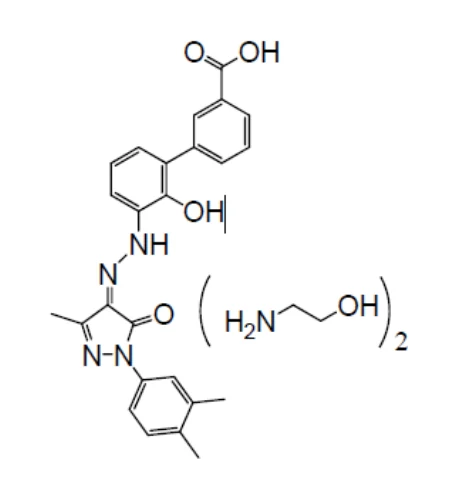
Structural formula:
Physicochemical properties:
Eltrombopag olamine is a red to brown crystalline solid, sparingly soluble in dimethyl sulphoxide, and insoluble in water.
14 CLINICAL TRIALS
- 14.1 Clinical Trials by Indication Chronic Immune Thrombocytopenia (ITP)
One Phase II, randomised, double blind, placebo-controlled study, TRA100773A, two Phase III, randomised, double blind, placebo-controlled studies RAISE (TRA102537) and TRA100773B and two open-label studies REPEAT (TRA108057) and EXTEND (TRA105325) evaluated the safety and efficacy of eltrombopag in previously treated adult patients diagnosed with chronic ITP for at least 6 months (see Table 16). Overall, eltrombopag was administered to a total of 446 patients, 280 patients for at least 6 months and 228 patients for at least 1 year.
Table 16 Summary of patient demographics for clinical trials in ITP
| Study # | Study design | Dosage, route of administration and duration | Study subject (N=number) | Mean age (Range) | Sex (%) |
|---|---|---|---|---|---|
| Study # | Study design | Dosage, route of administration and duration | Study subject (N=number) | Mean age (Range) | Sex (%) |
| RAISE (TRA102537) | Phase III, double- blind, randomized, placebo- controlled. | Eltrombopag 50 mg or matching Placebo; Daily oral dosing for 6 months; Dose modification (to 25 mg or 75 mg) allow ed based on individual platelet counts. | N = 197 Placebo: 62 | Placebo: 52.5 years (18 - 77) | Female: 69 Male: 31 |
| Eltrombopag: 135 | Eltrombopag: 4 7 years (18 - 85) | Female: 69 Male: 31 | |||
| TRA100773A | Phase II, double- blind, randomized, placebo- controlled. | Eltrombopag 30, 50, or 75 mg or matching Placebo; Daily oral dosing for 6 weeks. | Total N = 118 Placebo: 29 | Placebo: 43 years (18 - 85) | Female: 55 Male: 45 |
| Eltrombopag: 30 mg: 30 | Eltrombopag: 30 mg: 53 years (23 - 79) | Female: 53 Male: 47 | |||
| 50 mg: 30 | 50 mg: 47 years (23 - 81) | Female: 70 Male: 30 | |||
| 75 mg: 29 | 75 mg: 54 years (18 - 85) | Female: 71 Male:29 | |||
| TRA100773B | Phase III, double- blind, randomized, placebo- controlled. | Eltrombopag 50 mg or matching Placebo; Daily oral dosing for 6 weeks; Dose escalation to 75 mg allow ed for non-responders. | N = 114 Placebo: 38 | Placebo: 51 years (21 - 79) | Female: 71 Male: 29 |
| Eltrombopag: 76 | Eltrombopag: 47 years (19 - 84) | Female: 57 Male: 43 | |||
| REPEAT (TRA108057) | Single arm, open- label, intermittent dose. | Eltrombopag 50 mg; Daily oral dosing for up to 6 weeks, off- therapy for up to 4 w eeks for 3 cycles; Dose escalation to 75 mg after Day 21 allowed. | N = 66 (Completed = 48) | Eltrombopag: 50 years (20-79) | Female: 68 Male: 32 |
| EXTEND (TRA105325) | Single arm, open- label, extension study, previously enrolled in an eltrombopag study. | Eltrombopag 50 mg Daily oral dosing Dose modification (to 25 mg or 75 mg once daily) allowed based on individual platelet counts. | N = 299 (Received treatment = 298 Ongoing = 154 Withdraw n = 122) | Eltrombopag: 50 years (18 - 86) | Female: 198 Male: 101 |
RAISE (TRA102537): In RAISE, the primary efficacy endpoint was the odds of achieving a platelet count ≥ 50 x 109/L and ≤ 400 x 109/L, during the 6 month treatment period, for patients receiving eltrombopag relative to placebo. One hundred and ninety seven patients were randomized and were stratified based upon splenectomy status, use of ITP medication at baseline, and baseline platelet count. Patients received study medication for up to 6 months, during which time the dose of eltrombopag could be adjusted based on individual platelet counts. In addition, patients could have tapered off concomitant ITP medications and received rescue treatments as dictated by local standard of care.
A summary of baseline disease characteristics and key efficacy results is provided in Table 18. One week after treatment with study medication, platelet counts rose to between 50 - 400 x 109/L in 37% of eltrombopag-treated patients compared to 7% of placebo-treated patients. The proportion of responders in the eltrombopag group was between 37% and 56% for all nominal on - therapy visits, with a minimum of 37% at Day 8 and a maximum of 56% at Day 36. In comparison, the proportion of responders in the placebo group was between 7% and 19% for all nominal on - therapy visits, with a minimum of 7% at Day 8 and a maximum of 19% at Week 22 (see Figure 1). One week after discontinuation of treatment, more than 40% of patients treated with eltrombopag maintained platelet counts between 50 - 400 x 109/L, compared to placebo (15%). Two weeks after the end of treatment, the proportion of responders in the eltrombopag was similar to the placebo group.
The odds of achieving a platelet count between 50 x 109/L and 400 x 109/L during the 6 month treatment period were 8 times higher for eltrombopag treated patients than for placebo-treated patients.
Median platelet counts were maintained above 50 x 109/L at all on-therapy visits starting at Day 15 in the eltrombopag group; in contrast, median platelet counts in the placebo group remained below 30 x 109/L throughout the study.
At baseline, 77% of patients in the placebo group and 73% of patients in the eltrombopag group reported any bleeding (WHO Grades 1-4); clinically significant bleeding (WHO Grades 2-4) at baseline was reported in 28% and 22% of patients in the placebo and eltrombopag groups, respectively. The proportion of patients with any bleeding (Grades 1 -4) and clinically significant bleeding (Grades 2-4) was reduced from baseline by approximately 50% throughout the 6 month treatment period in eltrombopag-treated patients. When compared to the placebo group, the odds of any bleeding (Grades 1-4) and the odds of clinically significant bleeding (Grades 2-4) were 76% and 65% lower in the eltrombopag-treated patients compared to the placebo-treated patients.
Significantly fewer eltrombopag-treated patients required rescue treatment compared to placebo-treated patients.
Figure 1 Summary of Responders (Platelet Counts ≥ 50 x 109/L and ≤ 400 x 109/L). Day 8 to 4-weeks post treatment discontinuation, Primary Dataset (ITT Population)
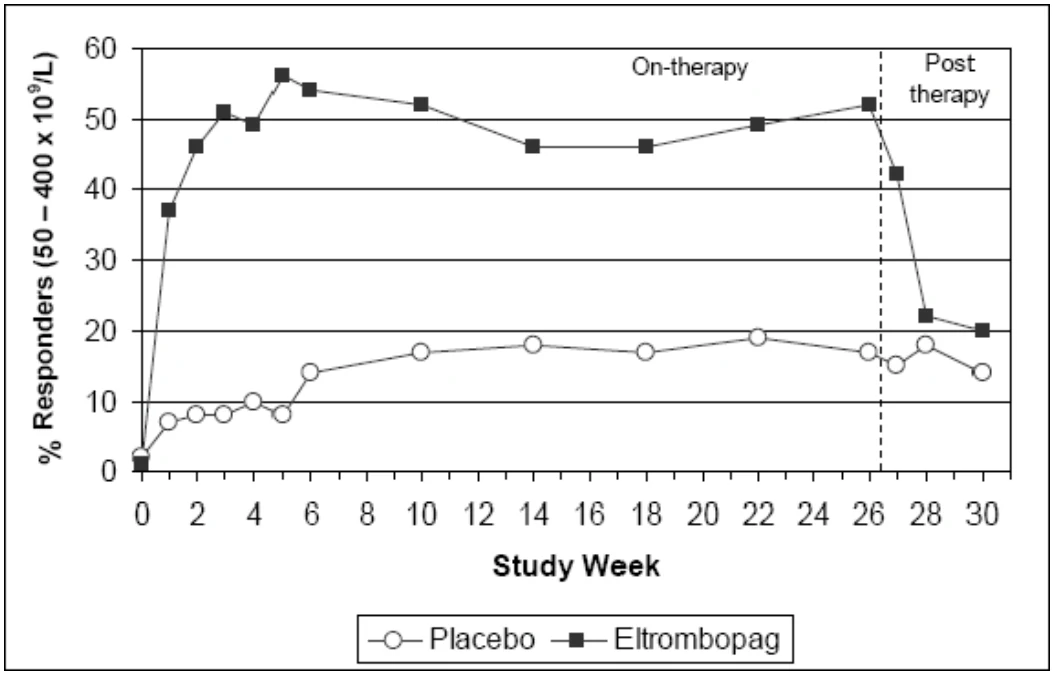
Eltrombopag therapy allowed significantly more patients to reduce or discontinue baseline ITP therapies compared to placebo.
Four placebo and 14 eltrombopag patients had at least 1 haemostatic challenge (defined as an invasive diagnostic or surgical procedure) during the study. However, fewer eltrombopag -treated patients (29%) required rescue treatment to manage their haemostatic challenge, compared to placebo-treated patients (50%).
In terms of improvements in health-related quality of life, statistically significant improvements from baseline were observed in the eltrombopag group with fatigue, including severity and impact on thrombocytopenia-impacted daily activities and concerns (as measured by the vitality subscale of the SF36, the motivation and energy inventory, and the 6-item extract from the thrombocytopenia subscale of the FACIT-Th). Comparing the eltrombopag group to the placebo group, statistically significant improvements were observed with thrombocytopenia impacted activities and concerns specifically regarding motivation, energy and fatigue, as well as physical and emotional role and overall mental health. The odds of meaningful improvement in health related quality of life while on therapy were significantly greater among patients treated with eltrombopag than placebo.
In RAISE the response to eltrombopag relative to placebo was similar irrespective of ITP medication use, splenectomy status and baseline platelet count (≤ 15 x 109/L, > 15 x 109/L) at randomization.
Table 19 Summary of Efficacy Results for the RAISE Study
Eltrombopag N=135 | Placebo (PBO) N=62 | |||||||||||
|---|---|---|---|---|---|---|---|---|---|---|---|---|
| Baseline Disease Characteristics | ||||||||||||
| Patients with baseline platelet count ≤ 15 x 109/La, n (%) | 67 (50) | 30 (48) | ||||||||||
| Patients with baseline platelet count > 15 x 109/L, n (%) | 68 (50) | 31 (50) | ||||||||||
| Proportion of patients that used ITP medication at randomization, n (%) | 63 (47) | 31 (50) | ||||||||||
| Splenectomised patients, n (%) | 50 (37) | 21 (34) | ||||||||||
| Non-Splenectomised patients, n (%) | 85 (63) | 41 (66) | ||||||||||
| Primary Endpoint | ||||||||||||
| Odds ratio (OR) for responding to treatment, Eltrombopag/Placebob, c | 8.2 | |||||||||||
| 99% CI | 3.59, 18.73 | |||||||||||
| p-value (two-sided vs. PBO) | <0.001 | |||||||||||
| Key Secondary Endpoints | ||||||||||||
| Analysis of Any Bleeding (WHO Grades 1-4) | ||||||||||||
| OR bleeding throughout 6 months, Eltrombopag/Placeboc | 0.24 | |||||||||||
| 95% CI | 0.16, 0.38 | |||||||||||
| p-value (two-sided vs. PBO) | <0.001 | |||||||||||
| Patients with bleeding at any time during 6 months, n (%) | 106 (79) | 56 (93) | ||||||||||
| OR bleeding at any time in 6 months, Eltrombopag/Placebod | 0.21 | |||||||||||
| 95% CI | 0.06, 0.71 | |||||||||||
| p-value (two-sided vs. PBO) | 0.012 | |||||||||||
| Analysis of Clinically Significant Bleeding (WHO Grades 2-4) | ||||||||||||
| OR bleeding throughout 6 months, Eltrombopag/Placeboc | 0.35 | |||||||||||
| 95% CI | 0.19, 0.64 | |||||||||||
| p-value (two-sided, vs. PBO) | <0.001 | |||||||||||
| Patients with bleeding at any time during 6 months, n (%) | 44 (33) | 32 (53) | ||||||||||
| OR bleeding at any time in 6 months, Eltrombopag/Placebod | 0.30 | |||||||||||
| 95% CI | 0.14, 0.66 | |||||||||||
| p-value (two-sided vs. PBO) | 0.002 | |||||||||||
| Concomitant Medication Reduction/Use of Rescue Medications | ||||||||||||
| Proportion of patients receiving rescue treatment, n (%)d | 25 (19) | 25 (40) | ||||||||||
| OR Eltrombopag/Placebod | 0.33 | |||||||||||
| 95% CI | 0.16, 0.64 | |||||||||||
| p-value (two-sided vs. PBO) | 0.001 | |||||||||||
| Patients who reduced/discontinued ≥ 1 baseline ITP Medication, n (%)e | 37 (59) | 10 (32) | ||||||||||
| OR Eltrombopag/Placebod | 3.10 | |||||||||||
| 95% CI | 1.24, 7.75 | |||||||||||
| p-value (two-sided vs. PBO) | 0.016 | |||||||||||
- a. One patient in the placebo group has a missing baseline platelet count
- b. Responders defined as patients achieving platelet count between 50 to 400 x 109/L,
- c. Repeated measures model for binary data adjusted for use of ITP medication at baseline, splenectomy status. baseline platelet count ≤ 15 x 109/L and baseline dichotomized WHO Bleeding Scale for any bleeding and Clinically Significant Bleeding) using GEE methodology.
- d.
Logistic regression model adjusted for use of ITP medication at baseline, splenectomy status, baseline platelet count
≤ 15 x 109/L (and baseline dichotomized WHO Bleeding Scale for Any bleeding and Clinically Significant Bleeding).
- e. Denominator is number of patient taking an ITP medication at baseline.
TRA100773B: In TRA100773B, the primary efficacy endpoint was the proportion of responders, defined as patients who had an increase in platelet counts to ≥ 50 x 109/L at Day 43 from a baseline < 30 x 109/L; patients who withdrew prematurely due to a platelet count > 200 x 109/L were considered responders, those discontinued for any other reason were considered non-responders irrespective of platelet count.
A summary of baseline disease characteristics and key efficacy results is provided in Table 19. Fifty-nine percent of patients on eltrombopag responded, compared to 16% of patients on placebo. The odds of responding were 9 times higher for eltrombopag treated patients compared to placebo. At baseline, 61% of patients in the eltrombopag group and 66% of patients in the placebo group reported any bleeding (Grade 1-4). At Day 43, 39% of patients in the eltrombopag treatment group had bleeding compared with 60% in the placebo group. Analysis over the treatment period using a repeated measures model for binary data confirmed that a lower proportion of eltrombopag patients had bleeding (Grade 1-4) at any point in time over the course of their treatment (Day 8 up to Day 43) compared to patients in the placebo group (see Table 20). Two placebo and one eltrombopag patients had at least one haemostatic challenge during the study.
In TRA100773B the response to eltrombopag relative to placebo was similar irrespective of ITP medication use, splenectomy status and baseline platelet count (≤ 15 x 109/L, > 15 x 109/L) at randomization.
Table 20 Summary Efficacy Results for Study TRA100773B
Eltrombopag N=76 | Placebo N=38 | ||||||||||
|---|---|---|---|---|---|---|---|---|---|---|---|
| Baseline Disease Characteristics | |||||||||||
| Patients with baseline platelet count ≤ 15 x 109/L, n (%) | 38 (50) | 17 (45) | |||||||||
| Patients with baseline platelet count > 15 x 109/L, n (%) | 38 (50) | 21 (55) | |||||||||
| Proportion of patients that used ITP medication at randomization, n (%) | 32 (42) | 17 (45) | |||||||||
| Splenectomised patients, n (%) | 31 (41) | 14 (37) | |||||||||
| Non-Splenectomised patients, n (%) | 45 (59) | 24 (63) | |||||||||
| Primary Endpoint | |||||||||||
| Proportion of patients who responded to treatment, n (%) | 43(59)a | 6 (16)a | |||||||||
| Odds ratio (OR) for responding to treatment, Eltrombopag/Placebob | 9.61 | ||||||||||
| 99% CI | (3.31, 27.86) | ||||||||||
| p-value (two-sided vs. PBO) | <0.001 | ||||||||||
| Key Secondary Endpoint | |||||||||||
| Analysis of Any Bleeding (WHO Grades 1-4) | |||||||||||
| OR bleeding at any time during 6 weeks, Eltrombopag/Placebo | 0.49 | ||||||||||
| 95% CI | (0.26, 0.89) | ||||||||||
| p-value (two-sided, vs. PBO) | 0.021 | ||||||||||
- a One patient did not have a platelet count at 6 weeks
- b Responder defined as patients who had an increase in platelet counts to ≥ 50 x 109/L frombaseline < 30 x 109/L after up to 6-weeks of dosing
REPEAT (TRA108057): REPEAT evaluated the efficacy, safety and consistency of response following repeated, intermittent, short-term dosing of eltrombopag over 3 cycles of therapy in adults with previously treated chronic ITP. A cycle was defined as an up to 6-week on-therapy period followed by an up to 4-week off-therapy period. The primary endpoint in REPEAT was the proportion of patients who achieved a platelet count ≥ 50 x 109/L and at least 2x baseline in Cycle 2 or 3, given this response in Cycle1.
Of the 52 patients who responded in Cycle 1, 33 (63%) achieved a platelet count of ≥ 50 x 109/L and at least 2x baseline on Day 8 in Cycle 1; on Day 15, 37 (79%) of 47 evaluable patients achieved this level of response (see Table 21).
Table 21 Analysis of Responders in Cycle 1 and Cycle 2 or 3 (ITT Populations)
| Eltrombopag 50 mg (N=66) | |
|---|---|
| Evaluable in Cycle 1, n | 65* |
| Responders in Cycle 1, n (%) | 52 (80) |
| Evaluable in Cycle 2 or 3, n | 52 |
| Responders in Cycle 1 and in Cycle 2 or 3, n (%) | 45 (87) |
| Proportion | 0.87 |
| 95 % CI for Proportion (Exact Methods) | (0.74, 0.94) |
*1 patient was not evaluable for Cycle 1 due to a missing platelet count assessment at Day 43.
A reduction in any bleeding (WHO Grade 1-4) and clinically significant bleeding
(WHO Grade 2- 4) during the treatment phases was demonstrated in each cycle. At the baseline visit of Cycle 1, 50% and 19% of patients reported any bleeding and clinically significant bleeding, respectively. At the Day 43 Visit of Cycle 1, the proportion of patients bleeding was reduced; 12% and 0% of patients reported any bleeding and clinically significant bleeding, respectively. Similar results were found during the subsequent treatment cycles.
Eight patients successfully managed 10 haemostatic challenges without need for additional therapy to elevate platelet counts and without unexpected bleeding.
EXTEND (TRA105325): EXTEND evaluated the safety and efficacy of eltrombopag in patients (n=299) with chronic ITP who were previously enrolled in an eltrombopag study. In this study, patients were permitted to modify their dose of study medication as well as decrease or eliminate concomitant ITP medications.
Two hundred and forty-nine patients completed ≥ 6 months of treatment, 210 completed
≥ 12 months of treatment, 138 patients completed ≥ 2 years of treatment, and 24 patients completed ≥ 3 years of treatment. The median followup was 100 weeks. The majority of patients had baseline platelet counts of < 30 x 109/L (70%) The median daily dose of eltrombopag following at least 6 months (Day 182) of therapy was 50 mg (n = 252).
At baseline, 56% of patients had any bleeding (WHO Bleeding Grades 1 –4) and 16% had clinically significant bleeding (WHO Bleeding Grades 2 indicating clinically significant bleeding). The proportion of patients with any bleeding and clinically significant bleeding decreased from baseline by approximately 50% for the majority of assessments up to 1 year.
Sixty-five percent of patients who reduced a baseline medication permanently discontinued or had a sustained reduction of their baseline ITP medication and did not require any subsequent rescue treatment. Ninety-six percent of these patients maintained this discontinuation or reduction for at least 24 weeks. Fifty-four percent of patients completely discontinued at least one baseline ITP medication, and 49% of patients permanently discontinued all baseline ITP medications, without subsequent rescue treatment.
Fifty-six patients experienced at least one haemostatic challenge during the study. No patients experienced unexpected bleeding complications related to the procedure while on study.
Pediatric Chronic Immune Thrombocytopenia (ITP)
PETIT2 (TRA115450): The efficacy of eltrombopag in pediatric patients (aged 1 to 17 years) with chronic ITP for at least 12 months was evaluated in a Phase III double-blind, placebo-controlled study (Table 22). Overall, eltrombopag was administered to 63 pediatric patients with median exposure of 91 days during the Randomized Period. During the study, doses could be increased every 2 weeks, based on individual platelet counts, to a maximum of 75 mg once daily. The dose of eltrombopag was reduced if the platelet count exceeded 200 x 109/L and interrupted if it exceeded 400 x 109/L. In pediatric clinical trials, patients between 1 to 5 years of age were administered eltrombopag as powder for oral suspension.
The median duration of treatment with eltrombopag in pediatric clinical trials was 5.6 months with a minimum duration of 0.5 months and a maximum duration of 9.0 months.
Table 22 Summary of Trial Design and Patient Demographics for Study PETIT2 (TRA115450) in Pediatric ITP (Randomized Phase)
| Study # | Study design | Dosage, route of administration and duration | Study subject (N=number) | Mean age (Range) | Sex (%) | ||||
|---|---|---|---|---|---|---|---|---|---|
| Study # | Study design | Dosage, route of administration and duration | Study subject (N=number) | Mean age (Range) | Sex (%) | ||||
| PETIT2 (TRA1154 50) | Phase III, tw o-part double-blind, randomized, placebo- controlled and open- label. | Cohorts 1 (12-17 years) and 2 (6-11 years) starting dose*: Eltrombopag 50 mg (if w eighing ≥ 27 kg) or 37.5 mg (if w eighing < 27 kg) or matching Placebo; Daily oral tablet dosing | Cohort 1 N=33 Placebo: 10 Eltrombopag: 23 | Cohort 1 Placebo: 14.3 years (12-17) Eltrombopag:1 4.0 years (12- 17) | Cohort 1 Female: 30 Male: 70 Female: 39.1 Male: 60.9 | ||||
Cohort 2 N=39 Placebo: 13 Eltrombopag: 26 | Cohort 2 Placebo: 8.7 years (6-11) Eltrombopag: 8.3 years (6- 16) | Cohort 2 Female: 53.8 Male: 46.2 Female: 50.0 Male: 50.0 | |||||||
Cohort 3 (1-5 years) starting dose#: 1.2 mg/kg or matching Placebo; Daily oral suspension dosing Part 1 (Randomized): 13 w eeks Part 2 (Open-label): 24 w eeks | Cohort 3 N=20 Placebo: 6 Eltrombopag: 14 | Cohort 3 Placebo: 4.7 years (4-5) Eltrombopag: 3.6 years (1-5) | Cohort 3 Female: 66.7 Male: 33.3 Female: 57.1 Male:42.9 | ||||||
* A reduced dose of 25 mg once daily was used for East Asian patients aged 6 to 17 years, regardless of weight.
# The starting dose for East Asian patients aged 1 to 5 years was 0.8 mg/kg once daily administered as oral suspension.
Patients who were refractory or relapsed to at least one prior ITP therapy or unable to continue other ITP treatments for a medical reason, and had a platelet count < 30 x 109/L (n = 92) were stratified by age and randomized (2:1) to eltrombopag (n = 63) or placebo (n = 29).
Across the three cohorts, the median age of the patients was 9 years; 48% were female; the majority were White (64%), and the remainder were primarily of Asian ancestry (defined as Japanese, East Asian or South East Asian). Approximately 63% of patients had a baseline platelet count less than or equal to 15 x 109/L. Seventy-three percent in the group treated with eltrombopag and 90% in the group treated with placebo had received at least two prior ITP therapies (predominantly corticosteroids and immunoglobulins). Four (6%) patients in the group treated with eltrombopag had undergone splenectomy.
The primary efficacy endpoint was a sustained response, defined as the proportion of patients achieving platelet counts ≥ 50 x 109/L for at least 6 out of 8 weeks (in the absence of rescue therapy), between Weeks 5 to 12 during the double-blind period.
Overall, a significantly greater proportion of eltrombopag patients (40%) compared with placebo patients (3%) achieved the primary endpoint (p<0.001) which was similar across the three age cohorts (Table 23).
Table 23 Summary of Efficacy Results for the PETIT2 study
Eltrombopag n/N (%) | Placebo n/N (%) | |
|---|---|---|
| Overall | 25/63 (40)* | 1/29 (3) |
| Cohort 1 | 9/23 (39) | 1/10 (10) |
| Cohort 2 | 11/26 (42) | 0/13 (0) |
| Cohort 3 | 5/14 (36) | 0/6 (0) |
* p-value <0.001 for eltrombopag versus placebo
A greater proportion of patients treated with eltrombopag (75%) compared with placebo (21%) had a platelet response (at least one platelet count > 50 x 109/L during the first 12 weeks of randomized treatment in absence of rescue therapy). The median of the maximum duration for which a platelet count ≥ 50 x 109/L was continuously maintained during the first 12 weeks of the Randomized Period was 3.0 weeks (range: 0-12) for eltrombopag compared to 0 week (range: 0-8) for placebo.
Fewer eltrombopag patients required rescue treatment during the randomized period compared to placebo patients (19% [12/63] vs. 24% [7/29]).
Patients were permitted to reduce or discontinue baseline ITP therapy only during the open- label phase of the study and 53% (8/15) of patients were able to reduce (n = 1) or discontinue (n = 7) baseline ITP therapy, mainly corticosteroids, without needing rescue therapy.
Chronic Hepatitis C-Related Thrombocytopenia
The efficacy and safety of eltrombopag for the treatment of thrombocytopenia in patients with HCV infection were evaluated in two randomized, double-blind, placebo-controlled studies. ENABLE 1 utilized peginterferon alfa-2a (PEGASYS*) plus ribavirin for antiviral treatment and ENABLE 2 utilized peginterferon alfa-2b (PEGETRON*) plus ribavirin.
Table 24 Summary of Trial Design and Patient Demographics for Clinical Trials in HCV
| Study # | Study design | Dosage, route of administration and duration | Study subject (N=number) | Mean age (Range) | Sex (%) |
|---|---|---|---|---|---|
| Study # | Study design | Dosage, route of administration and duration | Study subject (N=number) | Mean age (Range) | Sex (%) |
| Pre-antiviral | Pre-antiviral | Pre-antiviral | Pre-antiviral | ||
| treatment phase: | treatment phase: | treatment | treatment | ||
| 25 mg once daily, increased in 25 mg | Eltrombopag | phase: | phase: | ||
| increments, up to | N=715 | Eltrombopag | F: 269 (38%) | ||
| 100 mg | 51.8 yrs (19-76 yrs) | M: 446 | |||
| (62%) | |||||
| ENABLE 1 (TPL103922) | Phase III, double- blind, randomized, placebo-controlled | Antiviral treatment phase: Same dose as pre-treatment phase or placebo | Treatment phase: Placebo N=232 | Treatment phase: Placebo 51.4 yrs | Treatment phase: Placebo |
| (23-72 yrs) | F: 73 (31%) M: 159 | ||||
| (69%) | |||||
| Eltrombopag | Eltrombopag | Eltrombopag | |||
| N=450 | 52.1 yrs (19-76 yrs) | F: 186 (41%) | |||
| M: 264 | |||||
| (59%) | |||||
| Pre-antiviral | Pre-antiviral | Pre-antiviral | Pre-antiviral | ||
| treatment phase: 25 | treatment phase: | treatment | treatment | ||
| mg once daily, increased in 25 mg | Eltrombopag | phase: | phase: | ||
| increments, up to | N=805 | Eltrombopag | F: 295 (37%) | ||
| 100 mg | 52.2 yrs (22-83 yrs) | M: 510 (63%) | |||
| ENABLE 2 (TPL108390) | Phase III, double- blind, randomized, placebo-controlled | Antiviral treatment phase: Same dose as pre-treatment phase or placebo | Treatment phase: Placebo N=253 | Treatment phase: Placebo 52.0 yrs | Treatment phase: Placebo |
| (26-74 yrs) | F: 93 (37%) M: 160 | ||||
| (63%) | |||||
| Eltrombopag | Eltrombopag | Eltrombopag | |||
| N=506 | 52.4 yrs (22-83 yrs) | F: 185 (37%) M: 321 | |||
| (63%) |
ENABLE 1 and ENABLE 2 were global, multicenter, two-part studies that used a randomized withdrawal design. The studies were identical in design and differed only in the pegylated interferon/ribavirin used (ENABLE 1 utilized peginterferon alfa-2a (PEGASYS*) plus ribavirin for antiviral treatment and ENABLE 2 utilized peginterferon alfa-2b (PEGETRON*) plus ribavirin.
They consisted of two phases: an open-label (OL) pre-antiviral treatment phase (Part 1) and randomized, double-blind (DB), placebo-controlled antiviral treatment phase (Part 2). In the pre- antiviral treatment phase (Part 1), all patients received open-label eltrombopag to increase the platelet count to ≥ 90 x 109/L for ENABLE 1 and ≥ 100 x 109/L for ENABLE 2. Median baseline platelet counts (approximately 60 x 109/L) were similar among all treatment groups.
In both studies, eltrombopag was administered at an initial dose of 25 mg once daily for 2 weeks. Dose escalations could occur every 2 weeks, in 25 mg increments up to a maximum of 100 mg eltrombopag daily, as needed to reach target platelet counts required to enter Part 2 of the study. The maximal time patients could receive open-label eltrombopag in Part 1 was 9 weeks.
Once eligible for Part 2, patients were randomized (2:1) to the same dose of eltrombopag received at the end of the pre-treatment phase (Part 1) or to placebo. Eltrombopag or placebo was administered in combination with pegylated interferon/ribavirin antiviral treatment for up to 48 weeks (actual duration depending on HCV genotype). All patients in ENABLE 1 and ENABLE 2 were to attend post-treatment follow-up visits up to 24 weeks.
In both ENABLE 1 and ENABLE 2, patients with a platelet count of < 75 x 109/L were enrolled and stratified by platelet count (< 50 x 109/L and ≥ 50 x 109/L to < 75 x 109/L), screening HCV RNA (< 800,000 IU/mL and ≥ 800,000 IU/mL), and HCV genotype (genotype 2/3, and genotype 1/4/6).
The primary efficacy endpoint for both studies was sustained virologic response (SVR) defined as the percentage of patients with non-detectable e HCV-RNA at 24 weeks after completion of the planned treatment period.
Baseline disease characteristics are described in Table 25 below.
Table 25 Baseline Disease Characteristics (Pooled Data, Intent-to-Treat Population)
Eltrombopag (N=956) | Placebo (N=485) | |
|---|---|---|
| HCV genotype, n (%) | n=953 | n=484 |
| 1 | 612 (64) | 309 (64) |
| 2 | 67 (7) | 50 (10) |
| 3 | 228 (24) | 101 (21) |
| 4 | 41 (4) | 22 (5) |
| 6 | 5 (<1) | 2 (<1) |
| HCV RNA, n (%) | n=954 | n=483 |
| < 800,000 IU/mL | 502 (53) | 244 (51) |
| ≥ 800, 000 IU/mL | 452 (47) | 239 (49) |
| Prior Antiviral Medications, n (%) | n=956 | n=485 |
| Naive | 654 (68) | 334 (69) |
| Experienced | 302 (32) | 151 (31) |
| Child-Pugh Classification, n (%) | n=953 | n=485 |
| A (score 5-6) | 911 (96) | 459 (95) |
| B (score 7-9) | 42 (4) | 26 (5) |
| ALT, n(%) | n=956 | n=485 |
| Normal | 216 (23) | 103(21) |
| Elevated | 740(77) | 382(79) |
Baseline Platelet Count (Gi/L), n(%) < 50 | n=956 264 (28) | n=485 139(29) |
| ≥ 50 | 692 (72) | 346(71) |
MELD Score n(%) < 10 ≥ 10 | n=941 541 (57) 400 (43) | n=477 264 (55) 213 (45) |
Baseline Albumin (g/L), n(%) ≤ 35 > 35 | n=955 275 (29) 680 (71) | n=484 139(29) 345(71) |
FibroSURE Score; n (%) 0/1/2 3/4 | n=842 83 (10) 759 (90) | n=426 42 (10) 384 (90) |
Note: n represents patients w ith evaluable data.
In the pre-antiviral phase (Part 1) of ENABLE 1 and ENABLE 2, platelet counts began to rise within the first week of treatment with eltrombopag, and the median time to achieve the target platelet count ≥ 90 x 109/L was approximately 2 weeks. Ninety-five percent of patients were able to initiate antiviral therapy, with over 80% of patients receiving 25 mg or 50 mg eltrombopag at randomization into the antiviral treatment phase (Part 2).
In both studies, a significantly greater proportion of patients treated with eltrombopag achieved SVR (see Table 23). A greater proportion of patients on eltrombopag achieved SVR regardless of baseline platelet count (< 50 x 109/L versus ≥ 50 x 109/L) compared to placebo. In patients with high viral loads (> 800,000), the SVR rate was reported at 18% for eltrombopag versus 8% for placebo. Significantly more patients reached the antiviral milestones of early virologic response (EVR), complete EVR, end-of-treatment response (ETR), and SVR at 12 weeks when treated with eltrombopag.
Table 26 ENABLE 1 and ENABLE 2 Virologic and Platelet Response in Adults With Chronic Hepatitis C Virus
| ENABLE 1a | ENABLE 2b | Pooled Data | ||||||||||||||||||
|---|---|---|---|---|---|---|---|---|---|---|---|---|---|---|---|---|---|---|---|---|
| Pre-antiviral Treatment Phase | N = 715 | N = 805 | N =1520 | |||||||||||||||||
% Patients who achieved target platelet counts and initiated antiviral therapyc | 95% | 94% | 95% | |||||||||||||||||
| Antiviral Treatment Phase | Eltrombopag N = 450 % | Placebo N = 232 % | Eltrombopag N = 506 % | Placebo N = 253 % | Eltrombopag N=956 % | Placebo N = 485 % | ||||||||||||||
| Overall SVR24d | 23 | 14 | 19 | 13 | 21 | 13 | ||||||||||||||
| HCV Genotype 2,3 | 35 | 24 | 34 | 25 | 35 | 25 | ||||||||||||||
| HCV Genotype 1,4,6 | 18 | 10 | 13 | 7 | 15 | 8 | ||||||||||||||
Platelet count < 50 Gi/L Platelet count ≥ 50 Gi/L | 23 23 | 16 14 | 18 20 | 6 15 | 20 21 | 11 14 | ||||||||||||||
HCV RNA < 800,000 IU/mL HCV RNA ≥ 800,000 IU/mL | 28 18 | 20 9 | 20 18 | 17 8 | 24 18 | 18 8 | ||||||||||||||
a Eltrombopag given in combination with peginterferon alfa-2a (180 mcg once weekly for 48 weeks for genotypes 1 or 4; 24 weeks for genotype 2 or 3) plus ribavirin (800 to 1,200 mg daily in 2 divided doses orally).
b Eltrombopag given in peginterferon alfa-2b (1.5 mcg/kg once weekly for 48 w eeks for genotype 1; 24 weeks for genotype 2 or 3) plus ribavirin (800 to 1,400 mg orally).
c Target platelet count was ≥ 90 x 109/L for ENABLE 1 and ≥ 100 x 109/L for ENABLE 2.
d SVR: sustained viral response at 24 w eeks following commencement of anti-viral therapy, p value <0.05 for both ENABLE 1 and ENABLE 2
Results of secondary endpoint analyses showed the following: Significantly fewer patients treated with eltrombopag prematurely discontinued antiviral therapy compared to placebo (45% versus 60%, P = 0.0001). A greater proportion of patients on eltrombopag were reported to not require any antiviral dose reduction as compared to placebo (45% versus 27%), while the majority of patients treated with eltrombopag (76%) maintained a platelet count ≥ 50 x 109/L, compared to 19% for placebo. A greater proportion of patients in the placebo group (20%) were seen to have had a platelet count nadir less than 25 x 109/L during treatment, compared to patients treated with eltrombopag (3%).
Median platelet counts observed at the start of antiviral therapy were similar in both eltrombopag and placebo groups (134 x 109/L versus 135 x 109, respectively) for pooled data in the HCV patient population. Four (4) weeks following the initiation of the double-blind treatment phase, platelet counts decreased to approximately 97 x 109/L in the eltrombopag group and
48 x 109/L in the placebo group. Median platelet counts remained near Week 4 values for the remainder of the double-blind treatment phase (Part 2).
Severe Aplastic Anemia (SAA)
CETB115AUS28T
Eltrombopag was studied in a single-arm, single-center, phase II study in 43 patients with severe aplastic anemia who had an insufficient response to at least one course of antithymocyte globulin (rabbit or horse) plus cyclosporine and who had a platelet count ≤ 30 x 109/L.
Eltrombopag was administered at an initial dose of 50 mg once daily for 2 weeks and increased by 25 mg over 2 week periods up to a maximum dose of 150 mg once daily. The primary endpoint was hematological response assessed after 12 or 16 weeks of eltrombopag treatment.
Hematological response was defined as meeting one or more of the following criteria:
- 1) platelet count increases to 20 x 109/L above baseline, or stable platelet counts with transfusion independence for a minimum of 8 weeks;
- 2) hemoglobin increase by > 15g/L, or a reduction in ≥ 4 units of RBC transfusions for
8 consecutive weeks;
- 3) absolute neutrophil count (ANC) increase of 100% or an ANC increase > 0.5 x 10⁹/L.
Eltrombopag was discontinued after 16 weeks if no hematologic response or transfusion independence was observed. Patients who responded continued therapy in an extension phase of the study.
The treated population had median age of 45 years (range 17 to 77 years) and 56% were male. At baseline, the median platelet count was 20 x 109/L, hemoglobin was 84 g/L, ANC was
0.58 x 10⁹/L and absolute reticulocyte count was 24.3 x 10⁹/L. Eighty-six percent of patients were RBC transfusion dependent and 91% were platelet transfusion dependent. The majority of patients (84%) had received at least 2 prior immunosuppressive therapies. Three patients had cytogenetic abnormalities at baseline.
Table 27 presents the primary efficacy results.
Table 27 Hematologic Response in Severe Aplastic Anemia
| Outcome | Eltrombopag N = 43 |
|---|---|
Response Rate, N (%) 95% CI (%) | 17 (40) (25, 56) |
Bi- or tri-lineage responses were observed in 4/43 patients (9%) at the initial response assessment and in 8/43 patients (19%) at the last assessment. The longest platelet transfusion free period in responders ranged from 8 to 1,096 days with a median of 200 days. The longest RBC transfusion free period in responders ranged from 15 to 1,082 days with a median of 208 days. Four patients who tapered off treatment with eltrombopag due to a tri-lineage response maintained a response for a median follow up period of 8 months (7.2 to 10.6 months).
Detailed Pharmacology
Eltrombopag does not stimulate platelet production in mice, rats or dogs because of unique TPO receptor specificity and therefore data from these animals do not fully model potential adverse effects related to the pharmacology of eltrombopag in humans.
Pharmacokinetic Interactions
Based on a human study with radiolabeled eltrombopag, glucuronidation plays a minor role in the metabolism of eltrombopag. Human liver microsome studies identified UGT1A1 and UGT1A3 as the enzymes responsible for eltrombopag glucuronidation. Eltrombopag was an inhibitor of a number of UGT enzymes in vitro. Clinically significant drug interactions involving glucuronidation are not anticipated due to limited contribution of individual UGT enzymes in the glucuronidation of eltrombopag and potential co-medications.
Based on a human study with radiolabelled eltrombopag, approximately 21% of an eltrombopag dose could undergo oxidative metabolism. Human liver microsome studies identified CYP1A2 and CYP2C8 as the enzymes responsible for eltrombopag oxidation. In studies utilizing human liver microsomes, eltrombopag (up to 100 mcM) showed no in vitro inhibition of the CYP450 enzymes 1A2, 2A6, 2C19, 2D6, 2E1, 3A4/5, and 4A9/11, and was an inhibitor of CYP2C8 and CYP2C9 as measured using paclitaxel and diclofenac as the probe substrates, with IC50 values of 24.8 mcM (11 mcg/mL) and 20.2 mcM (8.9 mcg/mL), respectively. Administration of eltrombopag 75 mg once daily for 7 days to 24 healthy male patients did not inhibit or induce the metabolism of probe substrates for 1A2 (caffeine), 2C19 (omeprazole), 2C9 (flurbiprofen), or 3A4 (midazolam) in humans. No clinically significant interactions are expected when eltrombopag and CYP450 substrates, inducers or inhibitors are co-administered.
In vitro studies demonstrate that eltrombopag is an inhibitor of the OATP1B1 transporter, with an IC50 value of 2.7 mcM (1.2 mcg/mL) and an inhibitor of the BCRP transporter, with an IC50 value of 2.7 mcM (1.2 mcg/mL). Administration of eltrombopag 75 mg once daily for 5 days with a single 10 mg dose of the OATP1B1 and BCRP substrate rosuvastatin to 39 healthy adult patients increased plasma rosuvastatin Cmax 103% (90% CI: 82%, 126%) and AUC(0-∞) 55% (90% CI: 42%, 69%) (see 9.4 Drug-Drug Interactions).
Administration of a single dose of eltrombopag 50 mg tablet with 200 mg cyclosporine decreased the Cmax and the AUC(0-∞) of eltrombopag by 25% (90% CI: 15%, 35%) and 18% (90% CI: 8%, 28%), respectively. The co-administration of 600 mg cyclosporine decreased the Cmax and the AUC(0-∞) of eltrombopag by 39% (90% CI: 30%, 47%) and 24% (90% CI: 14%, 32%), respectively. The exact mechanism is unknown.
Co-administration of eltrombopag with lopinavir/ritonavir (LPV/RTV) may cause a decrease in the concentration of eltrombopag. A study in 40 healthy volunteers showed that the co-administration of single dose eltrombopag 100 mg with repeat dose LPV/RTV 400/100 mg twice daily resulted in a reduction in eltrombopag plasma AUC(0-∞) by 17% (90% CI:6.6%, 26.6%) (see 9.4 Drug- Drug Interactions).
Co-administration of eltrombopag with the HCV protease inhibitor boceprevir did not have an effect on the concentration of eltrombopag. A study in 28 healthy volunteers showed that the co- administration of single dose eltrombopag 200 mg with repeat dose boceprevir 750 mg three times daily reduced the boceprevir plasma AUC(0-∞) by 4% (90% CI: -14.7%, 8.5%). Co- administration of single dose eltrombopag 200 mg with repeat dose boceprevir 800 mg three times daily reduced the boceprevir plasma AUC(0-∞) by 4% (90% CI: 0.8%, 7.9%) and the Cτ by 32% (90% CI -41.7%, -21.4%) (see 9.4 Drug-Drug Interactions).
Co-administration of eltrombopagwith the HCV protease inhibitor telaprevir did not have an effect on the concentration of eltrombopag A study in 28 healthy volunteers showed that the co- administration of single dose eltrombopag 200 mg with repeat dose telaprevir 750 mg three times daily reduced the eltrombopag plasma AUC(0-∞) by 6% (90% CI: -14.7%, 3.5%). Co-administration of single dose eltrombopag 200 mg with repeat dose telaprevir 750 mg three times daily reduced the telaprevir plasma AUC(0-∞) by 2% (90% CI: -6.1%, 2.5%) (see 9.4 Drug-Drug Interactions).
Administration of a single dose of eltrombopag 75 mg with a polyvalent cation-containing antacid (1,524 mg aluminium hydroxide and 1,425 mg magnesium carbonate) decreased plasma eltrombopag AUC(0-∞) by 70% (90% CI: 64%, 76%) and Cmax by 70% (90% CI: 62%, 76%) (see 4 DOSAGE AND ADMINISTRATION and 9.4 Drug-Drug Interactions).
Administration of a single 50 mg dose of eltrombopag with a standard high-calorie, high-fat breakfast that included dairy products reduced plasma eltrombopag AUC( 0-∞) by 59% (90% CI: 54%, 64%) and Cmax by 65% (90% CI: 59%, 70%). Whereas, low-calcium food (< 50 mg calcium) including fruit, lean ham, beef and unfortified (no added calcium, magnesium, iron) fruit juice, unfortified soy milk, and unfortified grain did not significantly impact plasma eltrombopag exposure, regardless of calorie and fat content (see 4 DOSAGE AND ADMINISTRATION and 9.4 Drug-Drug Interactions).
14.3 Comparative Bioavailability Studies
A randomized, two-treatment, two-period, two-sequence, single-dose, crossover, bioequivalence study of PrJAMP Eltrombopag (eltrombopag as eltrombopag olamine), 25 mg film-coated tablets (JAMP Pharma Corporation) and PrREVOLADE® (eltrombopag as eltrombopag olamine), 25 mg film-coated tablets (Novartis Pharmaceuticals Canada Inc.) was conducted in 44 healthy, adult, Asian subjects under fasting conditions. A summary of the data from the 40 subjects that were included in the statistical analysis is presented in the following table.
SUMMARY TABLE OF THE COMPARATIVE BIOAVAILABILITY DATA
Eltrombopag (1 x 25 mg) Geometric Mean Arithmetic Mean (CV%) | ||||
| Parameter | Test1 | Reference2 | % Ratio of Geometric Means | 90% Confidence Interval |
AUC0-72h (mcg·h/mL) | 43.65 46.34 (34.99) | 50.10 52.52 (30.14) | 87.1 | 82.2 - 92.3 |
AUCI (mcg·h/mL) | 48.00 51.59 (38.66) | 55.25 58.66 (34.57) | 86.9 | 81.7 - 92.4 |
Cmax (mcg/mL) | 3.23 3.38 (28.23) | 3.69 3.80 (23.46) | 87.4 | 82.3 - 92.8 |
Tmax3 (h) | 4.00 (2.00 - 8.00) | 3.00 (1.50 - 5.00) | ||
T½4 (h) | 22.82 (20.45) | 23.40 (23.38) | ||
1 PrJAMP Eltrombopag (eltrombopag as eltrombopag olamine), 25 mg film-coated tablets (JAMP Pharma Corporation)
2 PrREVOLADE® (eltrombopag as eltrombopag olamine), 25 mg film-coated tablets (Novartis Pharmaceuticals Canada Inc.)
3 Expressed as the median (range) only
4 Expressed as the arithmetic mean (CV%) only
A randomized, two-treatment, two-period, two-sequence, single-dose, crossover, bioequivalence study PrJAMP Eltrombopag (eltrombopag as eltrombopag olamine), 50 mg film-coated tablets
(JAMP Pharma Corporation) and PrREVOLADE® (eltrombopag as eltrombopag olamine), 50 mg film-coated tablets (Novartis Pharmaceuticals Canada Inc.) was conducted in 50 healthy, adult, Asian subjects under fasting conditions. A summary of the data from the 49 subjects that were included in the statistical analysis is presented in the following table.
SUMMARY TABLE OF THE COMPARATIVE BIOAVAILABILITY DATA
Eltrombopag (1 x 50 mg) Geometric Mean Arithmetic Mean (CV%) | ||||
| Parameter | Test1 | Reference2 | % Ratio of Geometric Means | 90% Confidence Interval |
AUC0-72h (mcg·h/mL) | 72.61 78.86 (34.19) | 73.35 82.01 (41.61) | 99.0 | 92.8 - 105.6 |
AUCI (mcg·h/mL) | 79.16 86.78 (36.63) | 79.75 90.47 (45.01) | 99.3 | 92.8 - 106.2 |
Cmax (mcg/mL) | 6.40 6.75 (29.02) | 6.36 6.82 (32.21) | 100.7 | 93.3 - 108.6 |
Tmax3 (h) | 3.00 (1.50 - 6.00) | 3.00 (1.50 - 5.50) | ||
T½4 (h) | 23.06 (21.95) | 22.44 (23.12) | ||
1 PrJAMP Eltrombopag (eltrombopag as eltrombopag olamine), 50 mg film-coated tablets (JAMP Pharma Corporation)
2 PrREVOLADE® (eltrombopag as eltrombopag olamine), 50 mg film-coated tablets (Novartis Pharmaceuticals Canada Inc.)
3 Expressed as the median (range) only
4 Expressed as the arithmetic mean (CV%) only
15 MICROBIOLOGY
No microbiological information is required for this drug product.
16 NON-CLINICAL TOXICOLOGY
General Toxicology
Eltrombopag does not stimulate platelet production in mice, rats, or dogs because of unique TPO receptor specificity. These animal species do not therefore model any potential on-target adverse effects related to the pharmacology of eltrombopag in the general toxicology, reproductive toxicology, and carcinogenicity studies. In the absence of nonclinical models to study potential on-target effects, it is acknowledged that the toxicology program lacks the ability to fully evaluate the safety eltrombopag through study of the exaggerated pharmacology. The toxicology evaluation was therefore limited to identify potential off-target effects.
Repeat Dose Toxicity
The toxicity of repeated oral doses of eltrombopag has been assessed in mice, rats, rabbit s and dogs in studies of up to 13, 28, 1 and 52 weeks, respectively. Eltrombopag was well tolerated with no adverse treatment-related clinical signs, effects on food consumption or body weight, or mortality for up to 13 weeks in mice at doses ≤ 100 mg/kg/day (652 mcg.h/mL), 28 weeks or 2 years in rats at doses ≤ 30 or 40 mg/kg/day (661 or 677 mcg.h/mL, respectively), 1 week in rabbits at doses ≤ 150 mg/kg/day (59 mcg.h/mL), and 52 weeks in dogs at doses ≤ 30 mg/kg/day (418 mcg.h/mL). Systemic exposures at these dose levels were 4.5-fold the maximum proposed human exposure in mice and rats, 0.4-fold in rabbits and 2.9-fold in dogs.
Treatment-related cataracts were detected in rodents and were dose and time-dependent.
At ≥ 6 times the human clinical exposure based on AUC in ITP patients at 75 mg/day and
3 times the human clinical exposure based on AUC in HCV patients at 100 mg/day, cataracts were observed in mice after 6 weeks and rats after 28 weeks of dosing. At ≥ 4 times the human clinical exposure based on AUC in ITP patients at 75 mg/day and 2 times the human clinical exposure based on AUC in HCV patients at 100 mg/day, cataracts were observed in mice after 13 weeks and in rats after 39 weeks of dosing.
Cataracts have not been observed in dogs after 52 weeks of dosing at 2 times the human clinical exposure in ITP or pediatric ITP patients and equivalent to the human clinical exposure in HCV patients based on AUC.
Renal tubular toxicity was observed in studies of up to 14 days duration in mice and rats at exposures that were generally associated with morbidity and mortality. Tubular toxicity was also observed in a 2 year oral carcinogenicity study in mice at doses of 25, 75 and 150 mg/kg/day. Effects were less severe at lower doses and were characterized by a spectrum of regenerative changes. The exposure at the lowest dose was 1.2 times and 0.8 times the human clinical exposure based on AUC in ITP and pediatric ITP patients, respectively, at 75 mg/day and 0.6 times the human clinical exposure respectively, based on AUC in HCV patients at
100 mg/day.
Renal effects were not observed in rats after 28 weeks or in dogs after 52 weeks at exposures
4 and 2 times respectively, the human clinical exposure in ITP patients, 3 and 2 times, respectively, the human clinical exposure in pediatric ITP patients, and 2 times and equivalent to the human clinical exposure in HCV patients, based on AUC.
Hepatocyte degeneration and/or necrosis, often accompanied by increased serum liver enzymes, was observed in mice, rats and dogs at doses that were associated with morbidity and mortality or were poorly tolerated. No hepatic effects were observed after chronic dosing in rats (28 weeks) or dogs (52 weeks) at exposures up to 4 or 2 times, respectively, the human clinical exposure in ITP patients, and 3 and 2 times, respectively, the human clinical exposure in pediatric ITP patients at 75 mg/day, and 2 times or equivalent to the human clinical exposure in HCV patients at 100 mg/day, based on AUC.
Carcinogenicity
Eltrombopag was not carcinogenic in mice at doses up to 75 mg/kg/day or in rats at doses up to 40 mg/kg/day (exposures up to 4 times and 2 times the human clinical exposure based on AUC in ITP and pediatric ITP patients, respectively, and 2 times the human clinical exposure based on AUC in HCV patients at 100 mg/day).
Genotoxicity
Eltrombopag was not mutagenic or clastogenic in a bacterial mutation assay or in two in vivo assays in rats (micronucleus and unscheduled DNA synthesis, 10 times and 8 times the human clinical exposure based on Cmax in ITP and pediatric ITP patients, respectively, at 75 mg/day and 7 times the human clinical exposure in HCV patients at 100 mg/day). In the in vitro mouse lymphoma assay, eltrombopag was marginally positive (< 3 fold increase in mutation frequency). These in vitro and in vivo findings suggest that eltrombopag does not pose a genotoxic risk to humans.
Phototoxicity
In vitro studies with eltrombopag suggest a potential photosafety risk; however, in rodents there was no evidence of cutaneous phototoxicity (10 times and 7 times the human clinical exposure in ITP and pediatric ITP patients, respectively, and 5 times the human clinical exposure in HCV patients, based on AUC) or ocular phototoxicity ( ≥ 6 times and ≥ 4 times the human clinical exposure in ITP and pediatric ITP patients, respectively, and ≥ 3 times the human clinical exposure in HCV patients, based on AUC). Furthermore, a clinical pharmacology study in 36 patients showed no evidence that photosensitivity was increased following administration of eltrombopag 75 mg. This was measured by delayed phototoxic index. Nevertheless, a potential risk of photoallergy cannot be ruled out since no specific preclinical study could be performed.
Reproductive and Developmental Toxicity
Eltrombopag did not affect female fertility, early embryonic development or embryofetal development in rats at doses up to 20 mg/kg/day (2 times and approximately equivalent to the human clinical exposure in ITP and pediatric ITP patients, respectively, at 75 mg/day and equivalent to the human clinical exposure in HCV patients at 100 mg/day, based on AUC). Also there was no effect on embryofetal development in rabbits at doses up to 150 mg/kg/day, the highest dose tested (0.3 to 0.5 times the human clinical exposure in ITP, pediatric ITP, and HCV patients based on AUC). However, at a maternally toxic dose of 60 mg/kg/day (6 times and 4 times the human clinical exposure in ITP and pediatric ITP patients, respectively, and 3 times the human clinical exposure in HCV patients, based on AUC) in rats, eltrombopag treatment was associated with embryo lethality (increased pre and post implantation loss), reduced fetal body weight and gravid uterine weight in the female fertility study and a low incidence of cervical ribs and reduced fetal body weight in the embryofetal development study.
Special Populations and Conditions
Eltrombopag did not affect male fertility in rats at doses up to 40 mg/kg/day, the highest dose tested (3 times the human clinical exposure in ITP and pediatric ITP patients and 2 times the human clinical exposure in HCV patients, based on AUC). In the pre- and post-natal development study in rats, there were no undesirable effects on pregnancy, parturition or lactation of F0 female rats at maternally non-toxic doses (10 and 20 mg/kg/day) and no effects on the growth, development, neurobehavioral or reproductive function of the offspring (F1). Eltrombopag was detected in the plasma of all F1 rat pups for the entire 22 hour sampling period following administration of medicinal product to the F0 dams, suggesting that rat pup exposure to eltrombopag was likely via lactation.
Juvenile Toxicity
Age-dependent development of hepatic excretory pathways and reduced hepatic clearance led to higher exposures of eltrombopag and poor tolerability in very young rats. In a juvenile rat study using pups treated from days 4-31 postpartum, all pups at 60 mg/kg/day were either found dead or euthanized by day 14. Six pups were found dead or euthanized early at 30 mg/kg/day, a dose that is 9 times the maximum clinical exposure in pediatric ITP patients at 75 mg/day, based on AUC. In juvenile rats dosed from day 32-63 postpartum, mortality was not observed.
In definitive juvenile toxicity studies in rats, eltrombopag was not associated with adverse effects at doses up to 15 mg/kg/day in pups dosed from Days 4 to 31 pp and 40 mg/kg/day in pups dosed from Days 32 to 63 pp. In rat pups dosed from Days 4 to 31 pp, a dose of 15 mg/kg/day (exposure 5 times the human clinical exposure based on AUC in pediatric ITP patients at
75 mg/day) was associated with slight reductions in body weight gain and slight decreases in red cell parameters with an apparent regenerative increase in reticulocyte counts. Discoloration of the skin, fur and other organs (attributed to the color of eltrombopag) was observed in rat pups at very high systemic exposure and was reversible following an off-treatment period. In rat pups dosed from Days 32 to 63 pp, a dose of 40 mg/kg/day was associated with similar slight changes in red blood cell parameters and slight decreases in serum cholesterol and triglyceride concentrations.
Cataracts were observed in mice and rats. Development of cataracts is dose -, time- and age- dependent, i.e., the young rapidly developing lens epithelium of the mouse, was more susceptible than the older, developmentally quiescent lens epithelium. At non-tolerated doses (9 times the maximum human clinical exposure in pediatric ITP patients at 75 mg/day, based on AUC) in pre- weaning juvenile rats dosed from Days 4-32 pp (approximately equating to a 2-year old human at the end of the dosing period), ocular opacities were observed. Cataracts were not observed in juvenile rats given tolerated doses at 5 times the human clinical exposure in pediatric ITP patients, based on AUC. In young mice (6 weeks of age at initiation of dosing) given 150 mg/kg eltrombopag, development of cataracts was observed with an onset of approximately 6 to 7 weeks at 5 times the maximum human clinical exposure in pediatric ITP patients at 75 mg/day, based on AUC. However, in mice 26-weeks of age at the initiation of dosing, a dose of 150 mg/kg/day did not cause cataract formation.
17 SUPPORTING PRODUCT MONOGRAPH
- 1. PrREVOLADE (Tablets, 25 mg and 50 mg), control 247826, Product Monograph, Novartis Pharmaceuticals Canada Inc. (Nov 03, 2021)