


Product Monograph - Hemlibra
Recent Major Label Changes
Table of Contents
Recent Major Label Changes ................................................................................................. 2
Table of Contents ................................................................................................................. 2
Part 1: Healthcare Professional Information.......................................................................... 4
- 1.
Indications..................................................................................................................... 4
1.1. Pediatrics ..................................................................................................................... 4
1.2. Geriatrics ...................................................................................................................... 4
- 2. Contraindications .......................................................................................................... 4
- 3. Serious Warnings and Precautions Box ........................................................................... 4
- 4.
Dosage and Administration ............................................................................................ 4
4.1. Dosing Considerations ................................................................................................. 4
4.2. Recommended Dose and Dosage Adjustment ............................................................ 5
4.3. Reconstitution ............................................................................................................. 5
4.4. Administration ............................................................................................................. 5
4.5. Missed Dose ................................................................................................................. 7
- 5. Overdose ....................................................................................................................... 7
- 6. Dosage Forms, Strengths, Composition, and Packaging .................................................. 7
- 7.
Warnings and Precautions ............................................................................................. 8
General ................................................................................................................................... 8
Driving and Operating Machinery .......................................................................................... 8
Hematologic ........................................................................................................................... 8
Immune .................................................................................................................................. 9
Monitoring and laboratory tests .......................................................................................... 10
7.1. Special Populations .................................................................................................... 10
7.1.1. Pregnant Women ............................................................................................. 10
7.1.2. Breastfeeding ................................................................................................... 11
7.1.3. Pediatrics .......................................................................................................... 11
7.1.4. Geriatrics .......................................................................................................... 11
- 8.
Adverse Reactions ....................................................................................................... 11
8.1. Adverse Reaction Overview ....................................................................................... 11
8.2. Clinical Trial Adverse Reactions ................................................................................. 11
8.2.1. Clinical Trial Adverse Reactions – Pediatrics.................................................... 13
8.3. Less Common Clinical Trial Adverse Reactions ......................................................... 14
8.5. Post-Market Adverse Reactions ................................................................................ 14
- 9.
Drug Interactions ......................................................................................................... 14
9.2. Drug Interactions Overview ....................................................................................... 14
9.3. Drug-Behaviour Interactions ..................................................................................... 14
9.4. Drug-Drug Interactions .............................................................................................. 14
9.5. Drug-Food Interactions .............................................................................................. 15
9.6. Drug-Herb Interactions .............................................................................................. 15
9.7. Drug-Laboratory Test Interactions ............................................................................ 15
- 10.
Clinical Pharmacology .................................................................................................. 15
10.1. Mechanism of Action ............................................................................................. 15
10.2. Pharmacodynamics ................................................................................................ 16
10.3. Pharmacokinetics ................................................................................................... 16
10.4. Immunogenicity ..................................................................................................... 18
- 11. Storage, Stability, and Disposal .................................................................................... 19
Part 2: Scientific Information .............................................................................................. 20
- 13. Pharmaceutical Information ........................................................................................ 20
- 14.
Clinical Trials ............................................................................................................... 20
14.1. Clinical Trials by Indication .................................................................................... 20
14.2. Comparative Bioavailability Studies ...................................................................... 31
- 15. Microbiology ............................................................................................................... 31
- 16. Non-Clinical Toxicology ................................................................................................ 31
- 17. Supporting Product Monographs ................................................................................. 32
Patient Medication Information ......................................................................................... 33
Part 1: Healthcare Professional Information
1. Indications
Hemlibra® (emicizumab injection) is indicated for hemophilia A (congenital factor VIII deficiency) patients with or without factor VIII inhibitors as routine prophylaxis to prevent bleeding or reduce the frequency of bleeding episodes.
1.1. Pediatrics
Pediatrics (< 18 years): Hemlibra pharmacokinetics, safety and efficacy data have been collected in 137 pediatric patients between 1 and 18 years of age. There are no clinical efficacy or safety data of Hemlibra in patients less than 1 year of age. Based on the data submitted and reviewed by Health Canada, the safety and efficacy of Hemlibra in pediatric patients has been established; therefore, Health Canada has authorized an indication for pediatric use (see Recommended Dose and Dose Adjustment [4.2] and Pharmacokinetics, Special Populations and Conditions [10.3]).
1.2. Geriatrics
Geriatrics (> 65 years of age): Clinical studies of Hemlibra did not include sufficient numbers of patients aged 65 and over to determine whether there are differences in safety or efficacy compared with younger patients.
2. Contraindications
Hemlibra is contraindicated in patients who are hypersensitive to this drug or to any ingredient in the formulation, including any non-medicinal ingredient, or component of the container. For a complete listing, see Dosage Forms, Strengths, Composition, and Packaging [6].
3. Serious Warnings and Precautions Box
The following serious adverse reactions have been reported when on average a cumulative amount of >100 U/kg/24 hours of activated prothrombin complex concentrate (aPCC) was administered for 24 hours or more to patients receiving Hemlibra prophylaxis.
- Thrombotic microangiopathy (TMA)
- Thromboembolism
Discontinue aPCC at least 24 hours before starting Hemlibra and avoid use of aPCC during Hemlibra treatment unless no other treatment options/alternatives are available. If aPCC is indicated in a patient receiving Hemlibra prophylaxis, the initial dose should not exceed 50 U/kg. Monitor for the development of thrombotic microangiopathy and thrombotic events if aPCC is administered. Discontinue aPCC and suspend dosing of Hemlibra if symptoms occur (see Warnings and Precautions [7]).
4. Dosage and Administration
4.1. Dosing Considerations
- Treatment should be initiated under the supervision of a healthcare professional experienced in the treatment of hemophilia and/or bleeding disorders.
- Treatment with bypassing agents should be discontinued the day before starting Hemlibra therapy (see Warnings and Precautions, Hematologic [7]).
- FVIII prophylaxis may be continued for the first 7 days of Hemlibra treatment.
4.2. Recommended Dose and Dosage Adjustment
A loading dose of 3 mg/kg Hemlibra once weekly is recommended for the first 4 weeks as a subcutaneous injection. This is followed by a maintenance dose administered one week after the last loading dose. The maintenance dose should be selected based on physician and patient/caregiver dosing regimen preference to support adherence taking into account the age and weight of the patient as outlined below.
Use in Adolescents and Adults ≥ 40 kilograms (kg)
The recommended maintenance dose for adolescents (12-17 years of age) and adults (≥ 18 years of age) who weigh ≥ 40 kg with or without inhibitors to FVIII is 1.5 mg/kg once weekly, or 3 mg/kg every two weeks, or 6 mg/kg every four weeks, administered as a subcutaneous injection. No dosage adjustments of Hemlibra are recommended.
Use in Pediatrics and Patients < 40 kg
The recommended maintenance dose for pediatric patients (< 12 years of age) of any weight or patients of any age who weigh < 40 kg with or without inhibitors to FVIII is 1.5 mg/kg once weekly or 3 mg/kg every two weeks, administered as a subcutaneous injection. No dose adjustments are recommended in pediatric patients (see Clinical Trials by Indication [14.1] and Pharmacokinetics, Special Populations and Conditions [10.3]).
Use in Geriatrics
No dose adjustments are recommended in patients ≥ 65 years of age. There are no data in patients over 75 years old (see Pharmacokinetics, Special Populations and Conditions [10.3]).
Renal and hepatic impairment
No dose adjustments are recommended in patients with renal or hepatic impairment. Hemlibra has not been studied in patients with severe renal impairment or severe hepatic impairment (see Pharmacokinetics, Special Populations and Conditions [10.3]).
4.3. Reconstitution
Reconstitution is not required.
4.4. Administration
Hemlibra is for subcutaneous use only. Hemlibra should be administered using appropriate aseptic technique.
The injection should be restricted to the recommended injection sites: the abdomen, the upper outer arms and the thighs (see Pharmacokinetics, Absorption [10.3]). No data are available on injection at other sites of the body.
Administration of Hemlibra subcutaneous injection in the upper outer arm should be performed by a caregiver or healthcare professional.
Alternating the site of injection may help prevent or reduce injection site reactions (see Clinical Trial Adverse Reactions [8.2]). Hemlibra subcutaneous injection should not be administered into areas where the skin is red, bruised, tender or hard, or areas where there are moles or scars.
During treatment with Hemlibra, other medicinal products for subcutaneous administration should, preferably, be injected at different anatomical sites.
Administration by the patient and/or caregiver
Hemlibra is intended for use under the guidance of a healthcare professional. After proper training in subcutaneous injection technique, a patient may self-inject Hemlibra, or the patient’s caregiver may administer Hemlibra, if their physician determines that it is appropriate.
The physician and the caregiver should determine the appropriateness of a child self-injecting Hemlibra. However, self-administration is not recommended for children below 7 years of age.
Instructions for administration:
Hemlibra solution is a sterile, preservative-free, and ready to use solution for subcutaneous injection that does not need to be diluted.
Hemlibra solution should be inspected visually to ensure there is no particulate matter or discolouration prior to administration. Hemlibra is a colourless to slightly yellow solution. Hemlibra solution should be discarded if particulate matter is visible or the product is discoloured.
Refer to the Hemlibra Patient Medication Information for handling instructions when combining vials in a syringe. Do not combine Hemlibra vials of different concentrations (30 mg/mL and 150 mg/mL) in a single syringe.
Hemlibra solution for injection vials are for single-use only.
A syringe, a transfer needle with filter and an injection needle are needed to withdraw Hemlibra solution from the vial and inject it subcutaneously.
A 1 mL syringe should be used for an injection up to 1 mL of Hemlibra solution. Administer doses of Hemlibra greater than 1 mL and up to 2 mL with a 2 mL to 3 mL syringe.
Recommended criteria for syringes and needles are defined to ensure correct and safe administration of Hemlibra. These criteria are based on handling considerations (e.g., dosing accuracy, subcutaneous injection), Hemlibra characteristics (e.g., viscosity), and compatibility between Hemlibra and device materials.
1 mL syringe
Criteria: Transparent polypropylene or polycarbonate syringe with Luer-Lock™ tip (if not available, a syringe with Luer Slip tip can be used), graduation 0.01 mL, sterile, for injection only, single-use, latex-free and non-pyrogenic.
2 to 3 mL syringe
Criteria: Transparent polypropylene or polycarbonate syringe with Luer-Lock™ tip (if not available, a syringe with Luer Slip tip can be used), graduation 0.1 mL, sterile, for injection only, single-use, latex-free and non-pyrogenic.
Transfer needle with filter:
Criteria: Stainless steel with Luer-Lock™ connection (if not available, a needle with Luer Slip connection can be used), sterile, gauge 18 G, length 1” to 1½’’, blunt or single-bevel (or semi-blunt tip), single-use, latex-free, containing a 5 micrometer filter and non-pyrogenic.
Injection needle:
Criteria: Stainless steel with Luer-Lock™ connection (in case not locally available, an injection needle with Luer Slip connection can be used), sterile, gauge 26 G (acceptable range: 25-27 G), length preferably 3/8'' or maximally ½’’, single-use, latex-free and non-pyrogenic, preferably including needle safety feature.
Once transferred from the vial to the syringe, the medicinal product should be used immediately since it does not contain any antimicrobial preservative.
Incompatibilities
No incompatibilities between Hemlibra and the recommended syringes and needles have been observed.
Disposal of syringes/sharps
The following procedures should be strictly adhered to regarding the use and disposal of syringes:
- Needles and syringes should never be reused.
- Place all used needles and syringes into a sharps container (puncture-proof disposable container).
Disposal of unused/expired medicines
The release of pharmaceuticals in the environment should be minimized. Medicines should not be disposed of via wastewater and disposal through household waste should be avoided. Use established “collection systems”, if available in your location. Local requirements should be followed for the disposal process of unused/expired medicines.
4.5. Missed Dose
If a patient misses a scheduled subcutaneous injection of Hemlibra, the patient should be instructed to take the missed dose as soon as possible, before the day of the next scheduled dose. The patient should then administer the next dose on the usual scheduled dosing day. The patient should not take two doses on the same day to make up for a missed dose.
5. Overdose
There is limited experience with overdose of Hemlibra. Accidental overdose may result in hypercoagulability.
Patients who receive an accidental overdose should immediately contact their physician and be monitored closely.
For the most recent information in the management of a suspected drug overdose, contact your regional poison control centre or Health Canada’s toll-free number, 1-844 POISON-X (1-844-764-7669).
- 6. Dosage Forms, Strengths, Composition, and Packaging
To help ensure the traceability of biologic products, healthcare professionals should record both the brand name and the non-proprietary (active ingredient) name as well as other product-specific identifiers such as the Drug Identification Number (DIN) and the batch/lot number of the product supplied.
Table 1 – Dosage Forms, Strengths, and Composition
7. Warnings and Precautions
See 3 Serious Warnings and Precautions Box.
General
In order to improve traceability of biological medicinal products, the tradename and the batch number of the administered product should be clearly recorded (or stated) in the patient file.
Advise patients/caregivers to record the batch number of the product whenever Hemlibra is administered outside of a healthcare setting.
Driving and Operating Machinery
There is no evidence that treatment with Hemlibra results in an increase in adverse reactions that might lead to the impairment of the ability to drive and use machines.
Hematologic
Thrombotic microangiopathy associated with Hemlibra and activated prothrombin complex concentrate
Cases of thrombotic microangiopathy (TMA) were reported from a clinical trial in patients receiving Hemlibra prophylaxis when on average a cumulative amount of > 100 U/kg/24 hours of activated prothrombin complex concentrate (aPCC) for 24 hours or more were administered (see Adverse Reactions, Thrombotic Microangiopathy [8]). Treatment for the TMA events included supportive care with or without plasmapheresis and hemodialysis. Patients presented with thrombocytopenia, microangiopathic hemolytic anemia, and acute kidney injury, without severe deficiencies in ADAMTS13 activity. Evidence of improvement was seen within one week following discontinuation of aPCC.
Patients receiving Hemlibra prophylaxis should be monitored for the development of TMA when administering aPCC. The healthcare professional should immediately discontinue aPCC and interrupt Hemlibra therapy if clinical symptoms and/or laboratory findings consistent with TMA occur, and manage as clinically indicated. Healthcare professionals and patients/caregivers should weigh the benefits and risks of resuming Hemlibra prophylaxis following complete resolution of TMA on a case-
| Route of Administration | Dosage Form/ Strength/Composition | Non-Medicinal Ingredients |
| Subcutaneous | Solution, in vials: 12 mg/0.4 mL (30 mg/mL), 30 mg/mL, 60 mg/0.4 mL (150 mg/mL), 105 mg/0.7 mL (150 mg/mL), 150 mg/mL, 300 mg/2 mL (150 mg/mL) | L-Arginine, L-Aspartic Acid, L-Histidine, Poloxamer 188, water for injection |
by-case basis.
Caution should be used when treating patients who are at high risk for TMA (e.g. have a previous medical history or family history of TMA), or those who are receiving concomitant medications known to be a risk factor for the development of TMA (e.g. cyclosporine, quinine, tacrolimus).
Thromboembolism associated with Hemlibra and activated prothrombin complex concentrate
Thrombotic events were reported from a clinical trial in patients receiving Hemlibra prophylaxis when on average a cumulative amount of > 100 U/kg/24 hours of aPCC for 24 hours or more were administered (see Adverse Reactions, Thromboembolism [8]). No cases required anticoagulation therapy. Evidence of improvement or resolution was seen after discontinuation of aPCC.
Patients receiving Hemlibra prophylaxis should be monitored for the development of thromboembolism when administering aPCC. The healthcare professional should immediately discontinue aPCC and interrupt Hemlibra therapy if clinical symptoms, imaging, and/or laboratory findings consistent with thrombotic events occur, and manage as clinically indicated. Healthcare professionals and patients/caregivers should weigh the benefits and risks of resuming Hemlibra prophylaxis following complete resolution of thrombotic events on a case-by-case basis. In case a bypassing agent is indicated in a patient receiving Hemlibra prophylaxis, see below for dosing recommendations for the use of bypassing agents.
Guidance on the use of bypassing agents
Treatment with bypassing agents should be discontinued the day before starting Hemlibra therapy.
Healthcare professionals should discuss with all patients and/or caregivers the exact dose and schedule of bypassing agents to use, if required while receiving Hemlibra prophylaxis.
Hemlibra increases the patients’ coagulation potential. The bypassing agent dose required may therefore be lower than that used without Hemlibra prophylaxis. The dose and duration of treatment with bypassing agents will depend on the location and extent of bleeding and on the patient’s clinical condition. Avoid use of aPCC unless no other treatment options/alternatives are available. If aPCC is indicated in a patient receiving Hemlibra prophylaxis, the initial dose should not exceed 50 U/kg. If bleeding is not controlled with the initial dose of aPCC up to 50 U/kg, additional aPCC doses should be administered under medical guidance or supervision, and the total aPCC dose should not exceed 100 U/kg in the first 24-hours of treatment. Treating physicians must carefully weigh the risk of TMA and thromboembolism against the risk of bleeding when considering aPCC treatment beyond a maximum of 100 U/kg in the first 24-hours.
In clinical trials, no cases of thrombotic microangiopathy or thrombotic events were observed with use of activated recombinant human FVII (rFVIIa) alone in patients receiving Hemlibra prophylaxis. Nonclinical investigations have shown a procoagulant effect of emicizumab on rFVIIa; therefore, a potential risk of thromboembolism cannot be excluded.
Bypassing agent dosing guidance should be followed for at least 6 months following discontinuation of Hemlibra prophylaxis (see Pharmacokinetics, Elimination [10.3]).
Immune
Anti-emicizumab antibodies and neutralizing anti-emicizumab antibodies have been reported in 4.9% and 2.6% of patients treated with Hemlibra in clinical trials, respectively (see Clinical Pharmacology, Immunogenicity [10.4]). Most patients found to have anti-emicizumab antibodies did not experience a change in emicizumab plasma concentrations or an increase in bleeding events; however, in uncommon (≥ 1/1,000 to < 1/100) cases, the presence of neutralizing anti-emicizumab antibodies with decreasing emicizumab concentration may be associated with loss of efficacy.
In case of clinical signs of loss of efficacy (e.g. increase in breakthrough bleeding events), prompt evaluation by a physician should be sought to assess the etiology and a possible change in treatment should be considered.
Monitoring and laboratory tests
Laboratory coagulation test interference
Hemlibra affects intrinsic pathway clotting-based laboratory tests, including the activated clotting time (ACT), activated partial thromboplastin time (aPTT) and all assays based on aPTT, such as one-stage factor VIII activity (see Table 2 below). Therefore, intrinsic pathway clotting-based laboratory test results in patients treated with Hemlibra should not be used to monitor Hemlibra activity, determine dosing for factor replacement or anti-coagulation, or measure factor VIII inhibitor titers. Laboratory tests affected and unaffected by Hemlibra are shown in Table 2 below (see Drug-Laboratory Test Interactions [9.7]).
Table 2 – Coagulation Test Results Affected and Unaffected by Hemlibra
| Results Affected by Hemlibra | Results Unaffected by Hemlibra |
|---|---|
Activated partial thromboplastin time (aPTT) Bethesda assays (clotting-based) for FVIII inhibitor titers One-stage, aPTT–based, single-factor assays (e.g., FVIII activity) aPTT-based activated protein C resistance (APC-R) Activated clotting time (ACT) | Bethesda assays (bovine chromogenic) for FVIII inhibitor titers Thrombin time (TT) One-stage, prothrombin time-based, single-factor assays Chromogenic-based single-factor assays other than FVIII* Immuno-based assays (e.g., ELISA, turbidimetric methods) Genetic tests of coagulation factors (e.g., Factor V Leiden, Prothrombin 20210) |
| *For important considerations regarding FVIII chromogenic activity assays, see Drug-Laboratory Test Interactions [9.7]. | |
7.1. Special Populations
7.1.1. Pregnant Women
There are no clinical studies of Hemlibra use in pregnant women. Animal reproduction studies have not been conducted with Hemlibra as the vast majority of patients treated with Hemlibra are males. It is not known whether Hemlibra can cause fetal harm when administered to a pregnant woman or can affect reproductive capacity. Hemlibra should be used during pregnancy only if the potential benefit for the mother outweighs the potential risk to the fetus.
Contraception
Women of childbearing potential receiving Hemlibra should use effective contraception during, and for at least 6 months after cessation of Hemlibra treatment (see Pharmacokinetics, Elimination [10.3]).
Labour and delivery
The safe use of Hemlibra during labour and delivery has not been established.
7.1.2. Breastfeeding
It is not known whether emicizumab is excreted in human milk. No studies have been conducted to assess the impact of emicizumab on milk production or its presence in breast milk. Human IgG is known to be present in human milk. The developmental and health benefits of breastfeeding should be considered, along with the mother’s clinical need for Hemlibra and any potential adverse effects on the breastfed infant from Hemlibra or from the underlying maternal condition.
7.1.3. Pediatrics
The safety and efficacy of Hemlibra have been established in pediatric patients. Use of Hemlibra in pediatric hemophilia A patients <12 years of age (with or without FVIII inhibitors) is supported by two randomized studies (HAVEN 3 and HAVEN 1) and three single-arm studies (HAVEN 6, HAVEN 4 and HAVEN 2).
These five clinical studies included a total of 137 pediatric patients in the following age groups: 61 adolescents (12 years to < 18 years), 71 children (2 years to < 12 years) and 5 infants (1 month to < 2 years) (see Clinical Trials by Indication [14.1]). Safety and efficacy results were consistent with those observed for adults.
7.1.4. Geriatrics
The safety and efficacy of Hemlibra have not been specifically tested in a geriatric population. Clinical studies of Hemlibra included 15 patients aged 65 and over. Relative bioavailability decreased with older age, but no clinically important differences were observed in the pharmacokinetics of emicizumab between patients <65 years and patients ≥65 years (see Recommended Dose and Dose Adjustment [4.2] and Pharmacokinetics, Special Populations and Conditions [10.3]).
8. Adverse Reactions
8.1. Adverse Reaction Overview
The following adverse drug reactions (ADRs) are based on pooled data from five phase III clinical trials (three adult and adolescent studies [HAVEN 1, Study BH29884; HAVEN 3, BH30071; HAVEN 4, BO39182], a pediatric study [HAVEN 2, Study BH29992], and an all-age group study [HAVEN 6, Study BO41423]) in which a total of 444 patients with hemophilia A received at least one dose of Hemlibra as routine prophylaxis. Three hundred and seven (69.1%) patients were adults (of which two were female) (≥ 18 years), 61 (13.7%) were adolescents (≥12 to <18 years), 71 (16.0%) were children (≥ 2 to < 12 years) and 5 (1.1%) were infants (≥1 month to < 2 years). The median duration of exposure for safety analysis across the studies was 32.0 weeks (range: 0.1 to 94.3 weeks).
8.2. Clinical Trial Adverse Reactions
Clinical trials are conducted under very specific conditions. Therefore, the frequencies of adverse reactions observed in the clinical trials may not reflect frequencies observed in clinical practice and should not be compared to frequencies reported in clinical trials of another drug.
Three patients (0.7%) in the pooled phase III clinical trials receiving Hemlibra prophylaxis withdrew from treatment due to ADRs, which were thrombotic microangiopathy, skin necrosis contemporaneous with superficial thrombophlebitis and headache.
Adverse drug reactions from clinical trials in patients who received Hemlibra are listed by MedDRA system organ class (Table 3).
Table 3 – Adverse Drug Reactions Reported in ≥1% of Patients from Pooled Clinical Trials with Hemlibra
| System Organ Class | Number of patients (N=444) n (%) | |
|---|---|---|
| ADR (preferred term, MedDRA) | ||
| General disorders and administration site conditions | ||
| Injection site reactions | 86 (19.4%) | |
| Pyrexia | 23 (5.2%) | |
| Nervous system disorders | ||
| Headache | 62 (14.0%) | |
| Gastrointestinal disorders | ||
| Diarrhea | 21 (4.7%) | |
| Musculoskeletal and connective tissue disorders | ||
| Arthralgia | 63 (14.2%) | |
| Myalgia | 13 (2.9%) | |
Description of selected adverse drug reactions
The most serious adverse drug reactions reported from the clinical trials with Hemlibra were TMA and thrombotic events, including cavernous sinus thrombosis and superficial vein thrombosis contemporaneous with skin necrosis (see below and Warnings and Precautions [7]).
Thrombotic microangiopathy
In the pooled phase III clinical trials, thrombotic microangiopathy (TMA) events were reported in less than 1% of patients (3/444) and in 9.7% of patients (3/31) who received at least one dose of aPCC. All 3 TMAs occurred when on average a cumulative amount of > 100 U/Kg/24 hours of aPCC for 24 hours or more was administered during a treatment event (see Warnings and Precautions, Hematologic, Thrombotic microangiopathy) [7]. Patients presented with thrombocytopenia, microangiopathic hemolytic anemia, and acute kidney injury, without severe deficiencies in ADAMTS13 activity.
Thrombotic events
In pooled phase III clinical trials, serious thrombotic events were reported in less than 1% of patients (2/444) and in 6.5% of patients (2/31) who received at least one dose of aPCC. Both serious thrombotic events occurred when on average a cumulative amount of > 100 U/Kg/24 hours of aPCC for 24 hours or more was administered during a treatment event (see Warnings and Precautions, Hematologic, Thrombotic Events [7]).
Characterization of aPCC treatment in pivotal clinical trials
There were 82 instances of aPCC treatment, of which eight instances (10%) consisted of on average a cumulative amount of >100 U/kg/24 hours of aPCC for 24 hours or more; two of the eight were associated with thrombotic events and three of the eight were associated with TMA (Table 4). No TMA or thrombotic events were associated with the remaining instances of aPCC treatment. Of all instances of aPCC treatment, 68% consisted of only one infusion < 100 U/kg.
Table 4 – Characterization of aPCC Treatment* in Pooled Clinical Trials
| Duration of aPCC treatment | Average cumulative amount of aPCC over 24 hours (U/kg/24 hours) | ||
|---|---|---|---|
| <50 | 50–100 | >100 | |
| <24 hours | 9 | 47 | 13 |
| 24-48 hours | 0 | 3 | 1a |
| >48 hours | 1 | 1 | 7b |
* An instance of aPCC treatment is defined as all doses of aPCC received by a patient, for any reason, until there was a 36-hour treatment-free break. Includes all instances of aPCC treatment excluding those in the first 7 days and those that occurred 30 days after the discontinuation of Hemlibra.
a Thrombotic event (1 case)
b Thrombotic event (1 case) and thrombotic microangiopathy (3 cases)
Injection site reactions
Injection site reactions (ISRs) were reported very commonly (19.4%) from clinical trials. All ISRs observed in the Hemlibra clinical trials were reported as being non-serious and mild to moderate in intensity and 94.9% resolved without treatment. The most commonly reported ISR symptoms were injection site erythema (10.6%), injection site pain (4.1%); injection site pruritus (2.9%), and injection site swelling (2.7%).
Immunogenicity
In the pooled phase III clinical trials with Hemlibra, 4.9% of patients (36/739) tested positive for anti-emicizumab antibodies and 2.6% of patients (19/739) developed neutralizing anti-emicizumab antibodies. Four patients (0.5%) with neutralizing anti-emicizumab antibodies had an associated decrease in emicizumab concentration. As a consequence of their decreased emicizumab concentrations, their annualized rate of treated bleeding events and annualized rate of all bleeding events were higher compared to those in anti-emicizumab antibody negative patients. There was no clinically apparent impact of the presence of anti-emicizumab antibodies (including neutralizing antibodies) on safety (see Clinical Pharmacology, Immunogenicity [10.4]).
The data reflect the number of patients whose test results were considered positive for antibodies to emicizumab using an enzyme-linked immunosorbent assay (ELISA) and for neutralizing anti-emicizumab antibodies using a FVIII chromogenic assay. Immunogenicity assay results may be influenced by several factors including assay sensitivity and specificity, sample handling, timing of sample collection, concomitant medicinal products and underlying disease. For these reasons, comparison of incidence of antibodies to emicizumab with the incidence of antibodies to other products may be misleading.
8.2.1. Clinical Trial Adverse Reactions – Pediatrics
The safety and efficacy of Hemlibra have been established in pediatric patients. Use of Hemlibra in pediatric patients with hemophilia A with FVIII inhibitors is supported by the randomized HAVEN 1 trial (BH29884) and the single-arm HAVEN 2 trial (BH29992) and HAVEN 6 Trial (BO41423). The pooled pediatric safety data included pediatric patients in the following age groups: 61 adolescents (12 years to less than 18 years), 71 children (2 years up to less than 12 years) and 5 infants (1 year up to less than 2 years). No differences in efficacy were observed between the different age groups (see Clinical Trials by Indication [14.1]).
In general, the adverse reactions in Hemlibra-treated pediatric patients were similar in type to those seen in adult patients.
8.3. Less Common Clinical Trial Adverse Reactions
Blood and lymphatic system disorders: Thrombotic microangiopathy (0.8%)
Infections and Infestations: Cavernous sinus thrombosis (0.3%)
Skin and subcutaneous tissue disorders: Skin necrosis (0.3%)
Vascular disorders: Thrombophlebitis superficial (0.3%)
8.5. Post-Market Adverse Reactions
The following adverse drug reactions have been identified from post marketing surveillance with Hemlibra (see Table 5). Adverse drug reactions from post marketing surveillance are listed by MedDRA system organ class.
Table 5 – Adverse Drug Reactions from Post marketing Surveillance
| System Organ Class | Frequency | |
|---|---|---|
| ADR (preferred term, MedDRA) | ||
| Immune system disorders | ||
| Hypersensitivityb | Uncommonb | |
| Skin and subcutaneous tissue disorders | ||
| Angioedemaa | Uncommon | |
| Urticariac | Common | |
| Rashc | Common | |
a Frequency estimated at the upper limit of the 95% confidence interval utilizing the clinical trial safety population.
b Includes Preferred Terms Hypersensitivity and Drug Hypersensitivity. Frequency derived from clinical trial data (n=855)
the frequency of Uncommon represents an incidence of 0.9%.
c Frequency derived from clinical trial data (n=784).
9. Drug Interactions
9.2. Drug Interactions Overview
No adequate or well-controlled drug-drug interaction studies have been conducted with Hemlibra.
9.3. Drug-Behaviour Interactions
Not applicable.
9.4. Drug-Drug Interactions
Clinical experience indicates a likely drug interaction exists with Hemlibra and aPCC (see Warnings and Precautions, Hematologic [7] and Adverse Reactions [8]).
There is a possibility for hypercoagulability with rFVIIa or FVIII with Hemlibra based on preclinical experiments.
Hemlibra increases coagulation potential, therefore the coagulation factor dose required to achieve hemostasis may be lower than when used without Hemlibra prophylaxis.
9.5. Drug-Food Interactions
Interactions with food have not been established.
9.6. Drug-Herb Interactions
Interactions with herbal products have not been established.
9.7. Drug-Laboratory Test Interactions
Effect of Hemlibra on coagulation tests
Hemlibra restores the tenase cofactor activity of missing activated factor VIII (FVIIIa). Coagulation laboratory tests based on intrinsic clotting (e.g., aPTT) measure the total clotting time including time needed for activation of FVIII to FVIIIa by thrombin. Such intrinsic pathway-based tests will yield overly shortened clotting times with Hemlibra, which does not require activation by thrombin. The overly shortened intrinsic clotting time will then disturb all single-factor assays based on aPTT, such as the one-stage FVIII activity assay (see Warnings and Precautions, Monitoring and Laboratory Tests [7]). However, single-factor assays utilizing chromogenic or immuno-based methods are unaffected by Hemlibra and may be used to monitor coagulation parameters during treatment, with specific considerations for FVIII chromogenic activity assays as described below.
Chromogenic FVIII activity tests may be manufactured with either human or bovine coagulation proteins. Assays containing human coagulation factors are responsive to Hemlibra but may overestimate the clinical hemostatic potential of Hemlibra. In contrast, assays containing bovine coagulation factors are insensitive to Hemlibra (no activity measured) and can be used to monitor endogenous or infused FVIII activity, or to measure anti-FVIII inhibitors.
Hemlibra remains active in the presence of inhibitors against FVIII and so will produce a false-negative result in clotting-based Bethesda assays for functional inhibition of FVIII. Instead, a chromogenic Bethesda assay utilizing a bovine-based FVIII chromogenic test that is insensitive to Hemlibra may be used.
Due to the long half-life of Hemlibra, effects on coagulation assays may persist for up to 6 months after the last dose (see Pharmacokinetics, Elimination [10.3]).
10. Clinical Pharmacology
10.1. Mechanism of Action
Emicizumab bridges activated factor IX and factor X to restore the natural function of activated factor VIII that is missing in hemophilia A patients and needed for effective hemostasis.
Emicizumab has no structural relationship or sequence homology to FVIII and, as such, does not induce or enhance the development of direct inhibitors to FVIII.
10.2. Pharmacodynamics
Hemophilia A is an X-linked hereditary disorder of blood coagulation due to a deficiency of functional FVIII and results in bleeding into joints, muscles or internal organs, either spontaneously or as result of accidental or surgical trauma. Prophylactic therapy with Hemlibra shortens the aPTT and increases the reported FVIII activity (using a chromogenic assay with human coagulation factors). These two pharmacodynamic markers do not reflect the true hemostatic effect of emicizumab in vivo (aPTT is overly shortened and reported FVIII activity may be overestimated) but provide a relative indication of the pro-coagulant effect of emicizumab.
10.3. Pharmacokinetics
The pharmacokinetics of emicizumab were determined via a non-compartmental analysis in healthy subjects and using a population pharmacokinetic analysis on a database composed of 389 patients with hemophilia A.
Absorption
Following subcutaneous administration in hemophilia A patients, the absorption half-life was 1.6 days. Following multiple subcutaneous administrations of 3 mg/kg once weekly for the first 4 weeks in hemophilia A patients, mean trough plasma concentrations of emicizumab achieved 52.6±13.6 µg/mL at Week 5.
The mean (±SD) Ctrough and Cmax and ratios of Cmax/Ctrough at steady state for the recommended maintenance doses of 1.5 mg/kg once weekly, 3 mg/kg every two weeks or 6 mg/kg every four weeks are shown in Table 6.
Table 6 – Mean (± SD) Steady State Emicizumab Concentrations
| Maintenance Dose | |||||||
|---|---|---|---|---|---|---|---|
| Parameters | 1.5 mg/kg QW | 3 mg/kg Q2W | 6 mg/kg Q4W | ||||
| Cmax, ss (µg/mL) | 55.1±15.9 | 58.3±16.4 | 67.0±17.7 | ||||
| Cavg, ss (µg/mL) | 53.7 ±15.6 | 53.7 ±15.6 | 53.7 ±15.6 | ||||
| Ctrough, ss (µg/mL) | 51.2±15.2 | 46.9±14.8 | 38.5±14.2 | ||||
| Cmax/Ctrough ratio | 1.08±0.03 | 1.26±0.12 | 1.85±0.47 | ||||
| Cavg, ss = average concentration at steady state; Cmax, ss = maximum plasma concentration at steady state; Ctrough, ss = trough concentration at steady state; QW = once weekly; Q2W = every two weeks; Q4W = every four weeks. Pharmacokinetic parameters derived from the population PK model. | |||||||
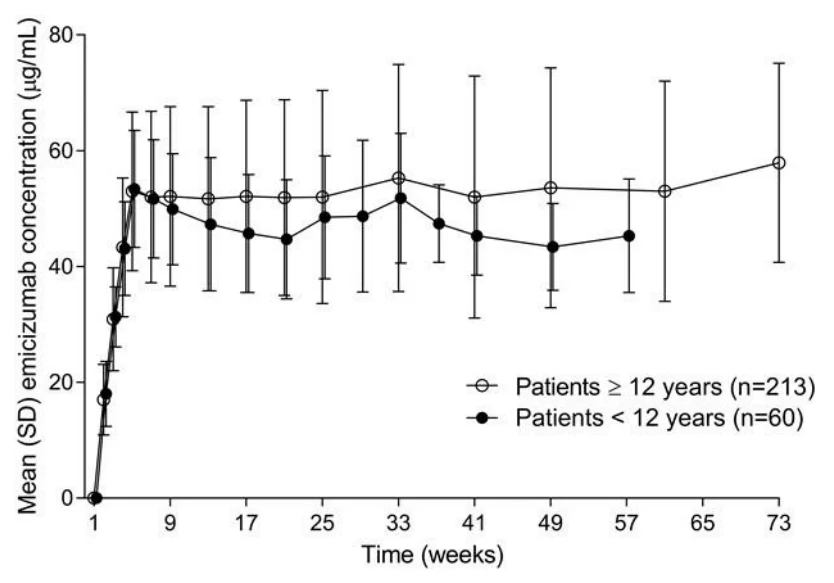
The PK profiles observed following once weekly dosing (3 mg/kg/week for 4 weeks followed by 1.5 mg/kg/week) in adults/adolescents (≥ 12 years) and children (< 12 years) are shown in Figure 1.
Figure 1 Mean Plasma Emicizumab Concentration versus Time Profiles for Patients ≥ 12 Years (Studies HAVEN 1 and HAVEN 3) Compared with Patients <12 Years (Study HAVEN 2) receiving the 1.5 mg/kg maintenance dose
In healthy subjects, the absolute bioavailability following subcutaneous administration of 1 mg/kg was between 80.4% and 93.1% depending on the injection site. Similar pharmacokinetic profiles were observed following subcutaneous administration in the abdomen, upper arm, and thigh. Emicizumab can be administered interchangeably at these anatomical sites (see Administration [4.4]).
Distribution
Following a single intravenous dose of 0.25 mg/kg emicizumab in healthy subjects, the volume of distribution at steady state was 106 mL/kg (i.e., 7.4 L for a 70-kg adult). Emicizumab is not intended for intravenous use (see Administration [4.4]). The apparent volume of distribution (V/F), estimated from the population PK analysis, in hemophilia A patients following multiple subcutaneous doses of emicizumab was 10.4 L.
Metabolism
The metabolism of emicizumab has not been studied. IgG antibodies are mainly catabolized by lysosomal proteolysis and then eliminated from or reused by the body.
Elimination
Following single subcutaneous injection in healthy subjects, the elimination half-life was approximately 4 to 5 weeks. Following multiple subcutaneous injections in hemophilia A patients, the apparent clearance was 0.27 L/day and the elimination apparent half-life was 26.9 days.
Special populations and conditions
Pediatrics
Lower mean and trough plasma concentrations of emicizumab were observed in pediatric patients compared to adolescents and adults (Figure 1), although no clinically important differences were observed at the recommended loading and maintenance doses (see Recommended Dose and Dosage Adjustment [4.2]).
Geriatrics
Relative bioavailability decreased with older age, but no clinically important differences were observed in the pharmacokinetics of emicizumab between patients < 65 years and patients ≥ 65 years.
Sex
There is no sufficient data in female patients to conclude if gender might affect the pharmacokinetics of emicizumab.
Ethnic origin
Population pharmacokinetics analyses in patients with hemophilia A showed that race did not affect the pharmacokinetics of emicizumab.
Hepatic Insufficiency
Most of the patients with hemophilia A in the population pharmacokinetic analysis had normal hepatic function (bilirubin and AST ≤ ULN, n=300) or mild hepatic impairment (bilirubin ≤ ULN and AST > ULN or bilirubin < 1.0 to 1.5 × ULN and any AST, n=51). Only 6 patients had moderate hepatic impairment (1.5 × ULN < bilirubin ≤ 3 × ULN and any AST). Mild or moderate hepatic impairment did not affect the pharmacokinetics of emicizumab (see also Recommended Dose and Dosage Adjustment [4.2]). Hepatic impairment was defined by the National Cancer Institute (NCI) criteria on hepatic dysfunction.
Renal Insufficiency
No dedicated studies on the effect of renal impairment on the pharmacokinetics of emicizumab have been conducted. Most of the patients with hemophilia A in the population pharmacokinetic analysis had normal renal function (N = 332; creatinine clearance [CLcr] ≥ 90 mL/min) or mild renal impairment (N = 27; CLcr of 60-89 mL/min). Only 2 patients had moderate renal impairment (CLcr of 30-59 mL/min). No patients had severe renal impairment. Mild or moderate renal impairment did not appear to have an impact on the pharmacokinetics of emicizumab (see Recommended Dose and Dose Adjustment [4.2]).
10.4. Immunogenicity
As with all therapeutic proteins, there is a potential for immunogenicity. The detection of antibody formation is highly dependent on the sensitivity and specificity of the assay.
A total of 739 patients were tested for anti-emicizumab antibodies in the pooled phase III clinical trials, of which 36 patients (4.9%) tested positive for anti-emicizumab antibodies. In 19 patients (2.6%), anti-emicizumab antibodies were neutralizing in vitro. Of these 19 patients, the neutralizing anti-emicizumab antibodies did not appear to have a clinically meaningful impact on the pharmacokinetics or efficacy of Hemlibra in 15 patients, while decreased emicizumab plasma concentrations were observed in four patients (0.5%). For these four patients, the median annualized bleed rates for treated and all bleeds were 14.1 (vs. 0.4-1.0 for other anti-emicizumab antibody statuses) and 15.2 (vs. 0.5-2.3 for other anti-emicizumab antibody statuses), respectively.
There was no apparent clinical impact of the presence of anti-emicizumab antibodies on safety. However, this is based on a small number of patients who developed these anti-emicizumab antibodies.
- 11. Storage, Stability, and Disposal
Hemlibra should not be used after the expiry date (EXP) shown on the pack.
Store at 2-8°C. Do not freeze. Do not shake. Keep the vial in the outer carton in order to protect from light. Once removed from the refrigerator, unopened vials can be kept at room temperature (below 30°C) for up to 7 days. After storage at room temperature, unopened vials may be returned to the refrigerator. Cumulative storage time at room temperature should not exceed 7 days.
Part 2: Scientific Information
13. Pharmaceutical Information
Drug Substance
Non-proprietary name of the drug substance(s): emicizumab
Chemical name: recombinant humanized monoclonal modified IgG4 bispecific antibody that binds to FIX, FIXa, FX, and FXa.
Molecular formula and molecular mass: Approximately 145,637 Da (peptide chains only)
Product Characteristics:
Emicizumab is an engineered humanized monoclonal modified immunoglobulin G4 (IgG4) bispecific antibody, bridging factor IXa and factor X. It is produced by recombinant DNA technology in Chinese hamster ovary (CHO) cells.
14. Clinical Trials
14.1. Clinical Trials by Indication
Table 7 – Summary of patient demographics for clinical trials in hemophilia A patients with or without FVIII inhibitors
| Study # | Trial design | Dosage, route of administration and duration | Study patients | Median age (Range) and hemophilia A severity | Sex |
| Study # | Trial design | Dosage, route of administration and duration | Study patients | Median age (Range) and hemophilia A severity | Sex |
| Study # | Trial design | Dosage, route of administration and duration | Study patients | Median age (Range) and hemophilia A severity | Sex |
HAVEN 1 (BH29884) | Randomized, open-label, Phase 3 study, with two additional nonrandomized arms | Hemlibra SC 3 mg/kg/week for 4 weeks followed by 1.5 mg/kg/week | Randomized: Arm A (Hemlibra prophylaxis): N = 35 Arm B (bypassing agent [BPA] on demand): N = 18 Non-Randomized: Arm C (Hemlibra prophylaxis with prior BPA prophylaxis): N = 49 | Median: 28 years (12-75) Mild: 3 (3%) Moderate: 3 (3%) Severe: 96 (94%) | Male (100%) |
HAVEN 2 (BH29992) | Single-arm, open-label Phase 3 Study | Hemlibra SC 3 mg/kg/week for 4 weeks followed by 1.5 mg/kg/week | N = 60 | Median: 7.0 years (1-15) Mild: 2 (3%) Moderate: 1 (2%) Severe: 57 (95%) | Male (100%) |
HAVEN 3 (BH30071) | Randomized, open-label, Phase 3 study, with an additional nonrandomized arm | Hemlibra SC 3 mg/kg/week for 4 weeks followed by 1.5 mg/kg QW or 3 mg/kg Q2W | Arm A (Hemlibra 1.5 mg/kg QW) N = 36 Arm B (Hemlibra 3 mg/kg Q2W) N = 35 Arm C (Control) N = 18 | Median: 38 years (13-77) Severe: 100% | Male (100%) |
HAVEN 4 (BO39182) | Single-arm, open-label, Phase 3 study, with a PK run-in part | Hemlibra SC 6 mg/kg Q4W (PK Run-in Part) 3 mg/kg QW for 4 weeks followed by 6 mg/kg Q4W (Expansion part) | N = 48 (41 in expansion part, 7 in PK run-in) | PK Run-in Median: 37 years (14 – 50) Severe: 100% Expansion Part Median: 39 years (14 – 68) Severe: 97.6% Moderate: 0% Mild: 2.4% | Male (100%) |
| HAVEN 6 (BO41423) | Multicenter, open-label, single-arm study of emicizumab | The emicizumab dosing regimen was loading doses of emicizumab 3 mg/kg SC QW for 4 weeks followed by a maintenance dose of either 1.5 mg/kg SC QW, 3 mg/kg SC Q2W, or 6 mg/kg SC Q4W based on patient preference | Enrolled: 72 Treated: 71 | Median: 23 years (2-71) Mild: 20 (28.2%) Moderate: 51 (71.8%) | Male: 69 (97.2%) Female: 2 (2.8%) |
The efficacy of Hemlibra for routine prophylaxis in patients with hemophilia A was evaluated in five clinical studies (three adult and adolescent studies in patients with hemophilia A with or without FVIII inhibitors [HAVEN 1, HAVEN 3, and HAVEN 4], a pediatric study in patients with hemophilia A with FVIII inhibitors [HAVEN 2], and an all-age group study in patients with mild or moderate hemophilia A without FVIII inhibitors [HAVEN 6]).
Clinical studies in adult and adolescent patients with hemophilia A with or without FVIII inhibitors
HAVEN 3 (Study BH30071) – Patients (aged ≥ 12 years old) with hemophilia A without FVIII inhibitors
The HAVEN 3 study was a randomized, multicenter, open-label, phase III clinical study in 152 adolescent and adult males (aged ≥ 12 years and ≥ 40 kg) with hemophilia A without FVIII inhibitors who previously received either episodic (on demand) or prophylactic treatment with FVIII. Patients received subcutaneous Hemlibra, 3 mg/kg once weekly for the first four weeks followed by either 1.5 mg/kg once weekly (Arms A and D) or 3 mg/kg every two weeks (Arm B) thereafter, or no prophylaxis (Arm C). Patients in Arm C could switch to Hemlibra (3 mg/kg every two weeks) after completing at least 24 weeks without prophylaxis.
Eighty-nine patients previously treated with episodic (on demand) FVIII were randomized in a 2:2:1 ratio to receive Hemlibra either once weekly (Arm A; N = 36), every two weeks (Arm B; N = 35) or no prophylaxis (Arm C; N = 18), with stratification by prior 24-week bleed rate (< 9 or ≥ 9). Sixty-three patients previously treated with prophylactic FVIII were enrolled into Arm D to receive Hemlibra (1.5 mg/kg once weekly).
The primary objective of the study was to evaluate in patients previously treated with episodic FVIII the efficacy of prophylactic Hemlibra weekly (Arm A) or every two weeks (Arm B) compared to no prophylaxis (Arm C) based on the number of bleeds requiring treatment with coagulation factors. Other objectives of the study included evaluation of the randomized comparison of Arms A or B and Arm C for the efficacy of Hemlibra prophylaxis in reducing the number of all bleeds, spontaneous bleeds, joint bleeds, and target joint bleeds.
The efficacy of Hemlibra prophylaxis was also compared with previous prophylactic FVIII treatment (Arm D) in patients who had participated in a non-interventional study (NIS) BH29768 prior to enrollment. Only patients from the NIS were included in this comparison, because bleed and treatment data were collected with the same level of granularity as used in HAVEN 3.
The efficacy results of Hemlibra prophylaxis compared with no prophylaxis are shown below in Table 8.
Table 8 – Annualized Bleed Rate with Hemlibra Prophylaxis versus No Prophylaxis in Patients ≥ 12 Years of Age without Factor VIII Inhibitors
| Endpoint | Arm C: No Prophylaxis (N = 18) | Arm A: Hemlibra 1.5 mg/kg weekly (N = 36) | Arm B: Hemlibra 3 mg/kg every 2 weeks (N = 35) | |||||||||||||||||
|---|---|---|---|---|---|---|---|---|---|---|---|---|---|---|---|---|---|---|---|---|
| Endpoint | Arm C: No Prophylaxis (N = 18) | Arm A: Hemlibra 1.5 mg/kg weekly (N = 36) | Arm B: Hemlibra 3 mg/kg every 2 weeks (N = 35) | |||||||||||||||||
| Treated Bleeds | ||||||||||||||||||||
| ABR (95% CI) a | 38.2 (22.9; 63.8) | 1.5 (0.9; 2.5) | 1.3 (0.8; 2.3) | |||||||||||||||||
| % reduction (95% CI), p-value | NA | 96% (92.5%; 98.0%), < 0.0001 | 97% (93.4%; 98.3%), < 0.0001 | |||||||||||||||||
| % patients with 0 bleeds (95% CI) | 0.0 (0.0; 18.5) | 55.6 (38.1; 72.1) | 60.0 (42.1; 76.1) | |||||||||||||||||
| Median ABR (IQR) | 40.4 (25.3; 56.7) | 0 (0; 2.5) | 0 (0; 1.9) | |||||||||||||||||
| All Bleeds | ||||||||||||||||||||
| ABR (95% CI) a | 47.6 (28.5; 79.6) | 2.5 (1.6; 3.9) | 2.6 (1.6; 4.3) | |||||||||||||||||
| % reduction (95% CI), p-value | NA | 95% (90.1%; 97%), <0.0001 | 94% (89.7%; 97%), <0.0001 | |||||||||||||||||
| % patients with 0 bleeds (95% CI) | 0 (0.0:18.5) | 50 (32.9; 67.1) | 40 (23.9; 57.9) | |||||||||||||||||
| Median ABR (IQR) | 46.9 (26.1; 73.9) | 0.6 (0; 3.9) | 1.6 (0; 4.0) | |||||||||||||||||
| Treated Spontaneous Bleeds | ||||||||||||||||||||
| ABR (95% CI) a | 15.6 (7.6; 31.9) | 1.0 (0.5; 1.9) | 0.3 (0.1; 0.8) | |||||||||||||||||
| % reduction (95% CI), p-value | NA | 94% (84.9%; 97.5%), <0.0001 | 98% (94.4%; 99.4%), <0.0001 | |||||||||||||||||
| % patients with 0 bleeds (95% CI) | 22.2 (6.4; 47.6) | 66.7 (49.0; 81.4) | 88.6 (73.3; 96.8) | |||||||||||||||||
| Median ABR (IQR) | 10.8 (2.1; 26.0) | 0 (0; 1.3) | 0 (0; 0) | |||||||||||||||||
| Treated Joint Bleeds | ||||||||||||||||||||
| ABR (95% CI) a | 26.5 (14.67; 47.79) | 1.1 (0.59; 1.89) | 0.9 (0.44; 1.67) | |||||||||||||||||
| % reduction (95% CI), p-value | NA | 96% (91.5%; 98.1%), <0.0001 | 97% (93%; 98.5%), <0.0001 | |||||||||||||||||
| % patients with 0 bleeds (95% CI) | 0 (0; 18.5) | 58.3 (40.8; 74.5) | 74.3 (56.7; 87.5) | |||||||||||||||||
| Median ABR (IQR) | 21.3 (14.5; 41.3) | 0 (0; 1.9) | 0 (0; 1.3) | |||||||||||||||||
| ABR = annualized bleed rate; CI = confidence interval; IQR = interquartile range, 25th percentile to 75th percentile; NA = not applicable a Based on negative binomial regression model. | ||||||||||||||||||||
Patients treated with Hemlibra experienced less treated target joint bleeds, compared to the no prophylaxis arm. The ABR (95% CI) was 0.6 (0.3; 1.4), 0.7 (0.3; 1.6) and 13.0 (5.2; 32.3) for Arm A (Hemlibra 1.5 mg/kg QW), Arm B (Hemlibra 3 mg/kg Q2W) and Arm C (no prophylaxis), respectively. Patients with zero treated target joint bleeds (95% CI) comprised 69.4% (51.9; 83.7), 77.1% (59.9; 89.6) and 27.8% (9.7; 53.5) of the patients in Arm A (Hemlibra 1.5 mg/kg QW), Arm B (Hemlibra 3 mg/kg Q2W) and Arm C (no prophylaxis), respectively.
In the intra-patient analysis, Hemlibra prophylaxis resulted in a statistically significant (p<0.0001) reduction in bleed rate for treated bleeds compared with previous FVIII prophylaxis collected in the NIS prior to enrollment. The mean (NBR model) ABR for patients on Hemlibra and FVIII prophylaxis were 1.5 (95% CI: 1, 2.3) and 4.8 (95% CI: 3.2, 7.1), respectively. The median (IQR) ABR for patients on Hemlibra and FVIII prophylaxis were 0 (95% CI: 0, 2.1) and 1.8 (95% CI: 0, 7.6), respectively. The percentage of patients with zero bleeds on Hemlibra and FVIII prophylaxis were 54.2 (95% CI: 39.2; 68.6) and 39.6 (95% CI: 25.8; 54.7), respectively.
HAVEN 4 (Study BO39182) – Patients (aged ≥ 12 years old) with hemophilia A with or without FVIII inhibitors
Hemlibra was investigated in a single arm, multicenter clinical study in 41 adult and adolescent males (aged ≥ 12 years and ≥ 40 kg) with hemophilia A with or without FVIII inhibitors who previously received either episodic (“on demand”) or prophylactic treatment with FVIII or bypassing agents or FVIII. The results for 36 of the 41 patients without inhibitors are reported here (see section below for the results of the 5 patients with inhibitors to FVIII). Hemlibra prophylaxis consisted of a loading dose of 3 mg/kg Hemlibra once weekly for four weeks followed the next week by a 6 mg/kg Hemlibra maintenance dose that was repeated every four weeks thereafter.
The primary objective of the study was to evaluate the efficacy of Hemlibra prophylaxis in maintaining adequate bleed control, given every four weeks based on treated bleeds. Other objectives were to evaluate the clinical efficacy of Hemlibra prophylaxis on all bleeds, treated spontaneous bleeds, treated joint bleeds and treated target joint bleeds.
Efficacy results for the HAVEN 4 clinical study are summarized below for 36 of the 41 patients ≥12 years old with hemophilia A without inhibitors (see Table 9). The median observation time of 25.6 weeks (range: 24.1 – 29.4 weeks).
Table 9 – Annualized Bleed Rate with Hemlibra Prophylaxis in Patients ≥ 12 Years of Age without Factor VIII Inhibitors
| Hemlibra 6 mg/kg Q4W | ||||||||||||
|---|---|---|---|---|---|---|---|---|---|---|---|---|
| Endpoints | aABR (95% CI) | bMedian ABR (IQR) | % Zero Bleeds (95% CI) | |||||||||
| N = | 36 | 36 | 36 | |||||||||
| Treated Bleeds | 2.6 (1.5, 4.7) | 0 (0; 2.1) | 52.8 (35.5, 69.6) | |||||||||
| All Bleeds | 4.8 (3.2, 7.1) | 2.1 (0; 6.1) | 27.8 (14.2, 45.2) | |||||||||
| Treated Spontaneous Bleeds | 0.6 (0.2; 1.6) | 0 (0; 0) | 83.3 (67.2, 93.6) | |||||||||
| Treated Joint Bleeds | 1.8 (0.8, 4) | 0 (0; 1.9) | 69.4 (51.9, 83.7) | |||||||||
| Treated Target Joint Bleeds | 1.1 (0.4, 3.7) | 0 (0; 0) | 83.3 (67.2, 93.6) | |||||||||
aCalculated with negative binomial regression (NBR) model. bCalculated ABR Bleed definitions adapted based on ISTH criteria. Treated bleeds: bleeds treated with FVIII All bleeds: bleeds treated and not treated with FVIII. Patients exposed to Hemlibra started with a loading dose of 3 mg/kg/week for 4 weeks. ABR= Annualized Bleed Rate; CI= confidence interval; IQR=interquartile range, 25th percentile to 75th percentile; Q4W = once every four week prophylaxis | ||||||||||||
HAVEN 6 (Study BO41423) – Patients (all ages) with mild or moderate hemophilia A without FVIII inhibitors
The HAVEN 6 study was a multicenter, open-label, single-arm study in 71 emicizumab-treated patients (aged 2 to 71 years, median age 23) with mild (n = 20 [28.2%]) or moderate (n = 51 [71.8%]) hemophilia A without FVIII inhibitors for whom prophylaxis was indicated, as assessed by the investigator. Most patients were male (69 patients [97.2%]), and 2 were female (2.8%). At study entry, 34 patients (47.9%) were on episodic and 37 patients (52.1%) were on prophylactic treatment with FVIII. Patients received subcutaneous Hemlibra, 3 mg/kg once weekly for the first four weeks followed by patient preference for one of the following maintenance regimens, from week 5: 1.5 mg/kg once weekly (n = 24 [33.8%]), 3 mg/kg every two weeks (n = 39 [54.9%]) or 6 mg/kg every four weeks (n = 8 [11.3%]), thereafter.
The primary efficacy objective of the study was to evaluate the efficacy of Hemlibra prophylaxis based on the number of bleeds requiring treatment with coagulation factors (i.e. treated bleeds) over time. Other objectives were to evaluate the efficacy of Hemlibra prophylaxis based on the number of all bleeds, spontaneous bleeds, joint bleeds, and target joint bleeds over time.
Interim efficacy results for the HAVEN 6 clinical study are summarized in Table 10. The median observation time is 27.6 weeks (range: 6.7 - 61.7 weeks).
Table 10 – Annualized Bleed Rate with Hemlibra Prophylaxis in Patients with Mild or Moderate Hemophilia A without FVIII Inhibitors
| cHemlibra 1.5 mg/kg QW, 3 mg/kg Q2W or 6 mg/kg Q4W | |||||||||||
|---|---|---|---|---|---|---|---|---|---|---|---|
| Endpoints | aABR (95% CI) | bMedian ABR (IQR) | % Zero Bleeds (95%CI) | ||||||||
| N | 71 | 71 | 71 | ||||||||
| Treated Bleeds | 0.8 [0.41;1.46] | 0.0 [0.00; 0.00] | 80.3 [69.1; 88.8] | ||||||||
| All Bleeds | 2.3 [1.63; 3.10] | 1.5 [0.00; 3.79] | 46.5 [34.5; 58.7] | ||||||||
| Treated Spontaneous Bleeds | 0.1 [0.02;0.23] | 0.0 [0.00; 0.00] | 95.8 [88.1; 99.1] | ||||||||
| Treated Joint Bleeds | 0.3 [0.12; 0.65] | 0.0 [0.00; 0.00] | 90.1 [80.7; 95.9] | ||||||||
| Treated Target Joint Bleeds | *Did not converge | 0.0 [0.00; 0.00] | 94.4 [86.2; 98.4] | ||||||||
a Calculated with negative binomial regression (NBR) model b Calculated ABR Bleed definitions adapted based on ISTH criteria Treated bleeds: bleeds treated with FVIII. All bleeds: bleeds treated and not treated with FVIII. Patients exposed to emicizumab started with a loading dose of 3mg/kg/week for 4 weeks. ABR=Annualized Bleed Rate, CI=confidence interval; IQR=interquartile range; 25th percentile to 75th percentile; QW=once every week; Q2W=once every two weeks; Q4W=once every four weeks prophylaxis c 1.5 mg/kg QW (n = 24); 3 mg/kg Q2W, (n = 39); 6 mg/kg Q4W (n = 8) *Model may not converge due to too short follow-up times combined with a low number of bleeds | |||||||||||
HAVEN 1 (Study BH29884) – Patients (aged ≥ 12 years old) with hemophilia A with FVIII inhibitors
Hemlibra prophylaxis was evaluated in a randomized, multicenter, open-label clinical study in 109 adolescent and adult males (aged ≥12 years old and ≥40 kg) with hemophilia A with FVIII inhibitors who had previously received either episodic (on-demand) or prophylactic treatment with bypassing agents. In the study, patients received weekly Hemlibra prophylaxis (Arms A and C) 3 mg/kg once weekly for 4 weeks followed by 1.5 mg/kg once weekly thereafter — or no prophylaxis (Arm B).
The majority of patients (60.6%) in the study experienced at least 9 bleeds in the 24 weeks prior to study entry, with 68.6% in Arm A, 72.2% in Arm B and 53.1% in Arm C. Overall, 52.3% of patients in the study were previously treated using Immune Tolerance Induction (ITI), with 40.0% in Arm A, 38.9% in Arm B and 67.3% in Arm C. Target joints involvement was seen in 69.7% of patients in the study, with 71.4% in Arm A, 72.2% in Arm B and 69.4% in Arm C.
Fifty-three patients previously treated with episodic (on-demand) bypassing agents were randomized in a 2:1 ratio to receive Hemlibra prophylaxis (Arm A) or no prophylaxis (Arm B), with stratification by prior 24-week bleed rate (< 9 or ≥ 9). Patients randomized to Arm B could switch to Hemlibra prophylaxis after completing at least 24 weeks without prophylaxis.
Forty-nine patients previously treated with prophylactic bypassing agents were enrolled in Arm C to receive Hemlibra prophylaxis. These patients were previously treated with episodic (on-demand) bypassing agents in the non-interventional study (NIS) BH29768.
The primary objective of the study was to evaluate among patients previously treated with episodic (on-demand) bypassing agents the treatment effect of weekly Hemlibra prophylaxis compared with no prophylaxis (Arm A vs. Arm B) on the number of bleeds requiring treatment with coagulation factors over time (minimum of 24 weeks or date of discontinuation). Other secondary objectives of the randomized comparison of Arms A and B were the efficacy of weekly Hemlibra prophylaxis in reducing the number of all bleeds, spontaneous bleeds, joint bleeds and target joint bleeds, as well as assessing patients’ health-related quality of life and health status.
The study also evaluated the efficacy of weekly Hemlibra prophylaxis compared with previous episodic (on demand) and prophylactic bypassing agents (separate comparisons) in patients who had participated in the NIS prior to enrollment (Arms A and C, respectively). Only patients from the NIS were included in this comparison, because bleed and treatment data were collected with the same level of granularity in both periods.
In HAVEN 1, Hemlibra weekly prophylaxis met all primary and secondary objectives for patients included in the open-label randomized portion of the study (Table 11).
Table 11 – Annualized Bleed Rate with Hemlibra Prophylaxis versus No Prophylaxis in Patients ≥ 12 Years of Age with Factor VIII Inhibitors
| Endpoint | Arm B: episodic (on-demand) bypassing agents | Arm A: 1.5 mg/kg Hemlibra weekly | |||||||||
|---|---|---|---|---|---|---|---|---|---|---|---|
| Endpoint | Arm B: episodic (on-demand) bypassing agents | Arm A: 1.5 mg/kg Hemlibra weekly | |||||||||
| n=18 | n=35 | ||||||||||
| Treated Bleeds | |||||||||||
| ABR (95% CI) | 23.3 (12.3; 43.9) | 2.9 (1.7; 5.0) | |||||||||
| % reduction (95% CI), p-value | 87% (72.3%; 94.3%), <0.0001 | ||||||||||
| % patients with 0 bleeds (95% CI) | 5.6 (0.1; 27.3) | 62.9 (44.9; 78.5) | |||||||||
| Median ABR (IQR) | 18.8 (13.0; 35.1) | 0 (0; 3.7) | |||||||||
| All Bleeds | |||||||||||
| ABR (95% CI) | 28.3 (16.8; 47.8) | 5.5 (3.6; 8.6) | |||||||||
| % reduction (95% CI), p-value | 80% (62.5%; 89.8%), <0.0001 | ||||||||||
| % patients with 0 bleeds (95% CI) | 5.6 (0.1; 27.3) | 37.1 (21.5; 55.1) | |||||||||
| Treated Spontaneous Bleeds | |||||||||||
| ABR (95% CI) | 16.8 (9.9; 28.3) | 1.3 (0.7; 2.2) | |||||||||
| % reduction (95% CI), p-value | 92% (84.6%; 96.3%), <0.0001 | ||||||||||
| % patients with 0 bleeds (95% CI) | 11.1 (1.4; 34.7) | 68.6 (50.7; 83.1) | |||||||||
| Treated Joint Bleeds | |||||||||||
| ABR (95% CI) | 6.7 (2.0; 22.4) | 0.8 (0.3; 2.2) | |||||||||
| % reduction (95% CI), p-value | 89% (48%; 97.5%), 0.005 | ||||||||||
| % patients with 0 bleeds (95% CI) | 50.0 (26.0; 74.0) | 85.7 (69.7; 95.2) | |||||||||
| Treated Target Joint Bleeds | |||||||||||
| ABR (95% CI) | 3.0 (1.0; 9.1) | 0.1 (0.0; 0.6) | |||||||||
| % reduction (95% CI), p-value | 95% (77.3%; 99.1%), 0.0002 | ||||||||||
| % patients with 0 bleeds (95% CI) | 50.0 (26.0; 74.0) | 94.3 (80.8; 99.3) | |||||||||
Based on a negative binomial regression (NBR) model and p-value from Stratified Wald test, comparing bleed rate between specified arms. Arm B: includes no prophylaxis period only. Bleed definitions adapted based on ISTH criteria. Treated bleeds: bleeds treated with bypassing agents. All bleeds: bleeds treated and not treated with bypassing agents. ABR= Annualized Bleed Rate; CI= confidence interval; IQR=interquartile range, 25th percentile to 75th percentile | |||||||||||
In the intra-patient analysis, Hemlibra prophylaxis resulted in a statistically significant reduction in bleed rate for treated bleeds compared with previous bypassing agent prophylaxis collected in the NIS prior to enrollment (Table 12). At the time of the primary analysis, 2 of the 24 patients on Hemlibra prophylaxis had no improvement in their baseline ABR at the data cut-off point.
Table 12 – Intra-Patient Comparison of Annualized Bleed Rate (Treated Bleeds) with Hemlibra Prophylaxis versus Previous Bypassing Agent Prophylaxis
| Endpoint | Arm CNIS: previous treatment with prophylactic bypassing agent | Arm C: Hemlibra 1.5 mg/kg weekly | ||||||
| N=24 | N=24 | |||||||
| Median Efficacy Period (weeks) | 32.1 | 30.1 | ||||||
| Treated Bleeds | ||||||||
| ABR (95% CI) | 15.7 (11.1; 22.3) | 3.3 (1.3; 8.1) | ||||||
| % reduction (95% CI), p-value | 79% (51.4%; 91.1%), 0.0003 | |||||||
| % patients with 0 bleeds (95% CI) | 12.5 (2.7; 32.4) | 70.8 (48.9; 87.4) | ||||||
| Median ABR (IQR) | 12.0 (5.7; 24.2) | 0.0 (0.0; 2.2) | ||||||
Based on a negative binomial regression (NBR) model and p-value from Stratified Wald test, comparing bleed rate between specified arms. Intra-patient comparator data from non-interventional (NIS) study BH29768 Only patients who participated in the NIS BH29768 and in study BH29884 are included. Treated bleeds: bleeds treated with bypassing agents. Bleed definitions adapted based on ISTH criteria. ABR= Annualized Bleed Rate; CI= confidence interval; RR= rate ratio IQR=interquartile range, 25th percentile to 75th percentile. | ||||||||
Health-related quality of life (HRQoL) for patients aged ≥ 18 years was evaluated at Week 25 for patients enrolled in Arms A and B based on the Haemophilia-specific Quality of Life (Haem-A-QoL) questionnaire for adults. The Haem-A-QoL is a valid and reliable measure of HRQoL (Table 13).
Table 13 – Change in Haem-A-QoL Total Score and Physical Health Score with Hemlibra Prophylaxis versus No Prophylaxis in Patients (>18 Years of Age) with Factor VIII Inhibitors at 25 Weeks
| Haem-A-QoL Scores at Week 25 | Arm B: episodic (on-demand) bypassing agents (N=16) | Arm A: 1.5 mg/kg Hemlibra weekly (N=31) | ||||||
|---|---|---|---|---|---|---|---|---|
| Total Score (range 0-100) | ||||||||
| n | 14a | 25a | ||||||
| Adjusted mean | 43.2 | 29.2 | ||||||
| Difference in adjusted means (95% CI) | 14.0 (5.6, 22.5) | |||||||
| p-value | 0.0019 | |||||||
| Physical Health | ||||||||
| N | 14 | 25 | ||||||
| Adjusted mean | 54.2 | 32.6 | ||||||
| Difference in adjusted means (95% CI) | 21.6 (7.9, 35.2) | |||||||
| p-value | 0.0029 | |||||||
Arm B: includes no prophylaxis period only. Patients exposed to emicizumab started with loading dose 3mg/kg/week for 4 weeks. Lower scores are reflective of better HRQoL. Clinically meaningful difference: Total score: 7 points; Physical Health: 10 points. a Only patients ≥18 years completed the Haem-A-QoL questionnaire. | ||||||||
HAVEN 2 (Study BH29992) – Pediatric Patients
Hemlibra weekly prophylaxis was evaluated in a single-arm, multicenter, open-label clinical study in pediatric patients (age < 12 years old, or 12 to 17 years old weighing < 40 kg) with hemophilia A with factor VIII inhibitors. Patients received Hemlibra prophylaxis at 3 mg/kg once weekly for the first four weeks followed by 1.5 mg/kg once weekly (QW) thereafter.
The study evaluated the pharmacokinetics, safety, and efficacy of weekly Hemlibra prophylaxis, including the efficacy of weekly Hemlibra prophylaxis compared with previous episodic (on-demand) and prophylactic bypassing agent treatment in patients who had participated in the non-interventional study (NIS) BH29768 prior to enrollment (intra-patient comparison).
At the time of the interim analysis, the clinical study had enrolled 60 male patients. Thirty-eight patients aged 6 to < 12 years, 17 patients aged 2 to < 6 years, two patients aged < 2 years and three patients aged ≥ 12 years.
The interim analysis efficacy results for HAVEN 2 are summarized below (see Table 14). Of the 60 patients, 57 patients < 12 years old were evaluable for efficacy; annualized bleed rate and percent of patients with zero bleeds were calculated for 23 patients <12 years of age who received weekly Hemlibra prophylaxis for at least 12 weeks. The median observation time for these patients was 38.1 weeks (range: 12.7 – 41.6).
Table 14 – Annualized Bleed Rate with Hemlibra Prophylaxis in Pediatric Patients < 12 Years of Age (Interim Analysis)
| Hemlibra 1.5 mg/kg weekly | ||||||||||||
|---|---|---|---|---|---|---|---|---|---|---|---|---|
| Endpoint | aABR (95% CI) | dMedian ABR (IQR) | % Zero Bleeds (95% CI) | |||||||||
| bN | 23 | 23 | 23 | |||||||||
| Treated Bleeds | 0.2 (0.1; 0.6) | 0.0 (0.0; 0.0) | 87.0 (66.4; 97.2) | |||||||||
| All Bleeds | 2.9 (1.8; 4.9) | 1.5 (0.00; 4.53) | 34.8 (16.4; 57.3) | |||||||||
| Treated Spontaneous Bleeds | 0.1 (0.0; 0.5) | 0.0 (0.0; 0.0) | 95.7 (78.1; 99.9) | |||||||||
| Treated Joint Bleeds | 0.1 (0.0; 0.5) | 0.0 (0.0; 0.0) | 95.7 (78.1; 99.9) | |||||||||
| Treated Target Joint Bleeds | cNot Estimable | 0.0 (0.0; 0.0) | 100.0 (85.2; 100.0) | |||||||||
a Calculated with negative binomial regression (NBR) model. b Efficacy data from treated patients aged < 12 years who had been on study BH29992 for at least 12 weeks (n = 23) c No treated target joint bleeds were reported. d Calculated ABR Bleed definitions adapted based on ISTH criteria. Treated bleeds: bleeds treated with bypassing agents. All bleeds: bleeds treated and not treated with bypassing agents. Patients exposed to emicizumab started with a loading dose of 3 mg/kg/week for 4 weeks. ABR= Annualized Bleed Rate; CI = confidence interval; IQR = interquartile range, 25th percentile to 75th percentile | ||||||||||||
In the intra-patient interim analysis, weekly Hemlibra prophylaxis resulted in a clinically meaningful (99%) reduction in bleed rate for treated bleeds in 13 pediatric patients after at least 12 weeks of treatment compared to their bleed rate collected in the NIS prior to enrollment (see Table 15).
Table 15 – Intra-Patient Comparison of Annualized Bleed Rate (Treated Bleeds) with Hemlibra Prophylaxis versus Previous Bypassing Agent Prophylaxis
| Endpoint | Previous treatment with prophylactic bypassing agent | Hemlibra 1.5 mg/kg weekly | ||||||||
| N=13 | N=13 | |||||||||
| Treated Bleeds | ||||||||||
| ABR (95% CI) | 17.2 (12.4; 23.8) | 0.2 (0.1; 0.8) | ||||||||
| % reduction (95% CI) | 99% 0.01 (0.00; 0.04) | |||||||||
| % patients with 0 bleeds (95% CI) | 7.7 (0.2; 36.0) | 84.6 (54.6; 98.1) | ||||||||
| Median ABR (IQR) | 14.3 (11.02;24.35) | 0.0 (0.00;0.00) | ||||||||
Confidence interval comes from negative binomial regression (NBR) model Intra-patient comparator data from non-interventional study (NIS) BH29768 Only patients <12 years old who participated in the NIS BH29768; and in study BH29992 for at least 12 weeks are included. Treated bleeds: bleeds treated with bypassing agents. Bleed definitions adapted based on ISTH criteria. ABR= Annualized Bleed Rate; CI= confidence interval; RR= rate ratio Note: 12 patients received prior bypassing agent prophylactic; 1 patient received prior episodic bypassing agents. | ||||||||||
HAVEN 4 (BO39182) – Adolescents and Adults
Efficacy of the 6 mg/kg every 4-week maintenance Hemlibra prophylactic dosing regimen was evaluated in a subgroup of 5 hemophilia A patients with FVIII inhibitors based on the bleed rate for bleeds requiring treatment with coagulation factors. The median observation time was 26.1 weeks (range 24.4 – 28.6 weeks). Hemlibra prophylaxis resulted in an ABR (95% CI) for treated bleeds of 1.2 (0.1, 14.8) based on negative binomial regression. On Hemlibra prophylaxis with 6 mg/kg every 4 weeks, 4 patients with FVIII inhibitors had zero treated bleeds. Although limited by small patient numbers, the efficacy of the 6 mg/kg every 4-week maintenance dose is consistent with the results observed for this dosing regimen in hemophilia A patients without inhibitors.
14.2. Comparative Bioavailability Studies
Not applicable.
15. Microbiology
Not applicable.
16. Non-Clinical Toxicology
Preclinical data reveal no special hazards for humans based on studies of acute and repeated dose toxicity, including safety pharmacology endpoints and endpoints for reproductive toxicity.
General toxicology
Repeat dose toxicology
The cynomolgus monkey was selected as the species of choice in the nonclinical safety assessment on the basis of its cross-reactivity for emicizumab. Cynomolgus monkeys have been administered emicizumab weekly for 4 weeks in duration by the IV route and for up to 26 weeks in duration by the SC route. Safety pharmacology endpoints (CNS, cardiovascular, respiratory system) and fertility endpoints (testicular size, sperm examinations, menstrual cyclicity) were included in the general toxicity studies. No toxicological changes attributable to SC or IV administration of emicizumab were observed; the NOAEL was the highest tested dose in each study (i.e., 100 mg/kg/week for IV dosing and 30 mg/kg/week for SC dosing).
Genotoxicity
No studies have been performed to establish the mutagenic potential of emicizumab.
Carcinogenicity
No carcinogenicity studies have been performed to establish the carcinogenic potential of emicizumab.
Reproductive and developmental toxicology
Impairment of fertility
Emicizumab did not cause any toxicological changes in the reproductive organs of male or female cynomolgus monkeys at doses of up to 30 mg/kg/week in subcutaneous general toxicity studies of up to 26-week duration and at doses of up to 100 mg/kg/week in a 4-week intravenous general toxicity study.
Reproductive toxicity
No data are available with respect to potential side effects of emicizumab on embryo-fetal development.
Special toxicology
Other
In an in vitro study of cytokine release that used the whole blood of healthy adults, the levels of cytokines induced by emicizumab were comparable to those induced by other low-risk antibodies.
Using FVIII-deficient human plasma, emicizumab shortened in vitro the pathologically prolonged aPTT in a concentration-dependent manner and also promotes thrombin generation triggered by activated factor XI (FXIa). As emicizumab has no structural relationship with human FVIII (hFVIII), its procoagulant potency was fully retained in the presence of inhibitors to FVIII. In a cynomolgus monkey hemophilia A model subcutaneous (SC) and intravenous (IV) administration of emicizumab corrected abnormal prolonged aPTT and prevented spontaneous and provoked tissue and joint bleeding. There is a possibility for hypercoagulability with emicizumab in combination with aPCC, rFVIIa or FVIII based on preclinical experiments.
17. Supporting Product Monographs
FEIBA NF (Anti-Inhibitor Coagulant Complex) Product Monograph. Shire Pharma Canada ULC., April 2018.
NiaStase RT® (eptacog alfa [activated]) Product Monograph. Novo Nordisk Canada Inc., November 2017.