


Patient Medication Information: uses, side effects, how to take - Kyleena
Serious Warnings and Precautions
|
What is KYLEENA used for?
KYLEENA is used to prevent pregnancy for up to 5 years.
How does KYLEENA work?
KYLEENA is an intrauterine system (IUS). It is placed in your uterus by your healthcare professional. KYLEENA works by slowly releasing a low amount of a hormone called levonorgestrel directly into the uterus every day. Levonorgestrel is similar to a sex hormone produced naturally by the body. It is also used in many birth control pills (the “Pill”).
KYLEENA may work to prevent pregnancy in several ways including:
- reducing the monthly thickening of the lining of the uterus,
- thickening the mucus in the cervix (this makes it harder for sperm to pass through the cervix), and
- impairing sperm movement and function.
Together, these actions prevent the sperm and egg from coming into contact and work together to prevent pregnancy.
KYLEENA does not contain any estrogen.
In clinical trials, there was less than 1 pregnancy per year for every 100 women using KYLEENA.
KYLEENA is a long acting reversible contraceptive (LARC). LARCs are highly effective in preventing pregnancy. They can be used for a long period of time and are easy to use.
Other Ways to Prevent Pregnancy
Other methods of birth control are available to you. When used properly, other methods of birth control work well enough for many women.
The table below shows the typical pregnancy rates for different methods of birth control. It also shows the pregnancy rate when no birth control is used. The rates show the number of women out of 100 who would become pregnant within the first year of use.
| Reported Pregnancies per 100 Women Within the First Year of Use | |
| Hormonal Intrauterine system (IUS) | less than 1 |
| Copper Intrauterine device (IUD) | less than 1 |
| Progesterone Injection | 6 |
| Combined hormonal contraceptive (pill, patch or ring) | 9 |
| Diaphragm | 12 |
| Male condom | 18 |
| Female condom | 21 |
| Sponge, spermicide | 12-28 |
| Withdrawal method | 22 |
| Natural family planning | 24 |
| No birth control | 85 |
The pregnancy rates listed in the table vary widely. This is because of differences in how carefully and regularly people use each method of birth control. Regular users may have lower pregnancy rates. Others may expect pregnancy rates in the middle ranges. This does not apply to IUSs and IUDs because they are placed in the uterus and do not depend on user compliance.
What are the ingredients in KYLEENA?
Medicinal ingredients: levonorgestrel
Non-medicinal ingredients: barium sulphate, copper phthalocyanine, polydimethylsiloxane elastomer, polyethylene, polypropylene, silica colloidal anhydrous, silver.
KYLEENA comes in the following dosage form:
Intrauterine system (IUS): 19.5 mg levonorgestrel
Do not use KYLEENA if:
you are:
- allergic to levonorgestrel, or to any of the other ingredients of KYLEENA or to the components of the container
- pregnant or think you may be pregnant
you have or had any of the following conditions:
- a pelvic infection [pelvic inflammatory disease (PID)] or have had one multiple times
- an untreated infection of your vagina and/or cervix
- an infection of your uterus after delivering a baby
- bleeding from the vagina that has not been explained
- a condition that changes the space inside your uterus, such as large abnormal growths (fibroids)
- abnormalities of the cells in the cervix (your healthcare professional can tell you if you have this)
- a known or suspected tumour that grows in response to progestogen (a hormone). This includes breast cancer
- liver disease/problems or tumours
- an infection of your uterus after an abortion in the past 3 months
- cancer of the uterus or the cervix
- already have an IUS or IUD in your uterus
- tumours related to pregnancy
- an infection of the heart valves or lining of the heart (bacterial endocarditis)
To help avoid side effects and ensure proper use, talk to your healthcare professional before you use KYLEENA. Talk about any health conditions or problems you may have, including if you:
- are breastfeeding
- have given birth in the last 36 weeks
- have ever had an ectopic pregnancy (development of a fertilized egg outside the uterus). Ectopic pregnancy is more likely if you accidentally become pregnant while using KYLEENA
- have had surgery on your fallopian tubes
- have a history of ovarian cysts. There is an increased risk of cysts on the ovary
- have an unusual menstrual bleeding pattern or a history of heavy menstrual bleeding
- have an unusual or unpleasant (e.g., smelly) vaginal discharge or vaginal itching
- have or have a history of strokes, heart attacks or any heart problems
- have or have a family history of high blood pressure or abnormal blood fat levels
- have or have a family history of blood clots (thrombosis)
- have an abnormality of your heart or if you have any problem with your heart valves
- are diabetic or have a family history of diabetes
- have or had liver problems or jaundice (a yellowing of the skin, whites of the eyes and/or nails)
- are taking any other medications
- have a history of migraine, dizziness or blurred vision
- have severe headaches
- have a history of emotional problems such as depression
- smoke
- are overweight or have a higher than normal body mass index (BMI ≥40 kg/m2)
- have Systemic Lupus Erythematosus, an autoimmune condition
Other warnings you should know about:
KYLEENA was not studied in women less than 18 years old.
If you see a different healthcare professional, inform him/her that you are using KYLEENA. You should inform your healthcare professional if you are scheduled for Magnetic Resonance Imaging (MRI). KYLEENA can be safely scanned with MRI under most standard conditions.
Tell your healthcare professional if you are scheduled for any lab tests. Certain tests may be affected by hormonal birth control. Also, tell your healthcare professional if you are scheduled for surgery requiring prolonged bed rest.
KYLEENA should be used only under the supervision of your healthcare professional. Visit your healthcare professional 4 to 12 weeks after you have KYLEENA placed. You should have a follow-up visit at least once a year. Your visits may include a blood pressure check, breast exam, pelvic exam (including a Pap smear) and an abdominal exam. Carefully follow all directions given to you. Otherwise, you may become pregnant.
If you and your healthcare professional decide that, for you, the benefits of KYLEENA outweigh the risks, you should be aware of the following:
1 Blood and Heart Problems (including blood clot in legs, lungs, heart, eyes, or brain)
You should talk to your healthcare professional about risk factors for blood clots and other heart problems.
Tell your healthcare professional right away if you notice the following:
- Sharp pain in the chest, coughing blood, or sudden shortness of breath. These could be signs of a blood clot in the lung.
- Leg pain and/or swelling. These could be signs of a blood clot in the leg.
- Crushing chest pain or heaviness. These could be signs of a heart attack.
- Sudden severe or worsening headache or vomiting, dizziness or fainting, eye or speech problems, or weakness or numbness in an arm or leg. These could be signs of a stroke.
- Sudden blurry of full loss of vision, eye pain or eye pressure. These could be signs of a blood clot in the eye.
Any of these conditions can cause death or disability. Blood clots also occur rarely in the eye, resulting in serious vision problems. It can also happen in a blood vessel leading to an arm or leg, resulting in damage to or loss of a limb.
2 Breast Cancer
Cases of breast cancer have been reported in users of another levonorgestrel releasing IUS. Major risk factors for breast cancer are increasing age and a strong history of breast cancer in the family (mother or sister). Other established risk factors include onset of having your period before 12 years old, never having a child, having your first full pregnancy after 30 years old, never having breast fed a child, and drinking alcohol every day.
Tell your healthcare professional if you see any breast lumps. Your healthcare professional should show you how to do breast self-examinations when you are using KYLEENA.
3 Diabetes
If you have diabetes and use KYLEENA, your blood sugar levels should be watched closely.
4 Infections
In the first 3 weeks after placement of an IUS/IUD, there is an increased risk of a serious pelvic infection called pelvic inflammatory disease (PID). Other known risk factors for PID are having multiple sexual partners, frequent intercourse, sexually transmitted infections (STIs) and young age.
PID can cause serious problems such as difficulty getting pregnant, development of a pregnancy outside the uterus (ectopic pregnancy), or pelvic pain that does not go away. PID is usually treated with antibiotics. More serious cases of PID may require surgery.
Tell your healthcare professional right away if you have signs of PID. These can include long-lasting or heavy bleeding, unusual vaginal discharge, pain in your lower stomach area, painful sex, chills or fever.
5 Ectopic Pregnancy
While using KYLEENA, the risk of pregnancy is low. However, if you get pregnant while using KYLEENA, it is more likely that the pregnancy will be ectopic. This means that the pregnancy is not in the uterus. Ectopic pregnancy is a serious condition. Tell your healthcare professional immediately if you have lower abdominal pain, especially if you have missed a period and/or have unexpected bleeding. These can be signs of an ectopic pregnancy.
6 Cysts on the Ovary
Cysts (fluid filled sacs) on the ovary commonly occur in women using KYLEENA. These cysts usually disappear within a few months on their own. However, cysts can sometimes cause pain and may need medical attention.
7 Uterine Perforations
KYLEENA may become attached to or go through the wall of the uterus. This is called perforation and it happens most often during placement. Perforation is uncommon. If this happens, KYLEENA must be removed.
The risk of perforation is higher in women who are breastfeeding when KYLEENA is placed. The risk is also higher when placement takes place up to 36 weeks after a delivery. The risk of perforation may be increased in women with a differently shaped uterus or a uterus that is fixed and leans backward.
8 Use While Breastfeeding
You can use KYLEENA when you are breastfeeding. Small amounts of the hormone in KYLEENA have been found in the breast milk of women using a different IUS. This does not appear to affect the health of your baby when you start using KYLEENA 6 weeks after delivery. Levonorgestrel does not appear to affect the amount or the quality of breast milk. However, isolated cases of decreased milk production have been reported among women using KYLEENA.
9 Use in Pregnancy
If you become pregnant with KYLEENA in place, you should have it removed as soon as possible. If it is left in place during pregnancy, the chances of having a miscarriage or early delivery increase. It is not known if KYLEENA can cause long-term effects on the baby if it stays in place during pregnancy.
Removing KYLEENA may cause a miscarriage. If KYLEENA cannot be removed, talk with your healthcare professional about the benefits and risks of continuing the pregnancy, and possible effects to your unborn child.
10 Use After Pregnancy and Abortion
After childbirth, KYLEENA should be placed only when the uterus has returned to normal size. KYLEENA should not be placed for at least 6 weeks after delivery.
KYLEENA can be placed right after an abortion which took place in the first three months (first trimester) of pregnancy. If an abortion takes place in the second trimester, placement of KYLEENA should be delayed for 6 weeks or until the uterus has returned to normal size.
11 Pregnancy After Stopping KYLEENA
If you wish to become pregnant, ask your healthcare professional to remove KYLEENA. Your usual fertility level should return after removal.
12 Broken KYLEENA
KYLEENA may break, most often during a difficult removal. Broken pieces must be found and removed. Surgery may be needed to do this.
Driving or Using Machines
The effect of KYLEENA on the ability to drive or to use machines has not been studied. Do not drive or use machines until you know how you react to KYLEENA.
How Will KYLEENA Affect My Periods?
KYLEENA may affect your menstrual cycle. For the first 3 to 6 months, your period may become irregular and the number of bleeding days may increase. You may also have frequent spotting or light vaginal bleeding. Some women have heavy or prolonged bleeding during this time. Contact your healthcare professional if this persists.
Overall, you are likely to have a gradual reduction in the amount and number of days of bleeding each month. Some women eventually find that periods stop altogether.
When KYLEENA is removed, periods soon return to normal.
What if I Stop Having Periods?
Over time, your menstrual period may gradually disappear when using KYLEENA. This is because of the effect of the hormone on the lining of the uterus. The normal monthly thickening of the uterine lining with blood does not happen; therefore, there is little or no bleeding, as happens during a usual menstrual period. It does not necessarily mean you have reached menopause or are pregnant.
If, however, you are having regular menstrual periods and then do not have one for 6 weeks or longer, it is possible that you may be pregnant. You should speak to your healthcare professional.
Tell your healthcare professional about all the medicines you take, including any drugs, vitamins, minerals, natural supplements or alternative medicines.
The following may interact with KYLEENA:
Certain drugs may interact with KYLEENA. They can make it less able to prevent pregnancy. Hormonal birth control may become less reliable if you are taking drugs that affect your liver (such as primidone, barbiturates, phenytoin, carbamazepine, and rifampicin). KYLEENA is not likely to be affected by these drugs. This is because it releases a very small amount of hormone directly inside your uterus. If you are taking other medications, ask your healthcare professional if you need to use an additional method of birth control.
KYLEENA is visible during X-ray exams. KYLEENA also contains a small silver ring that makes it visible by ultrasound.
How to use KYLEENA:
What it looks like:
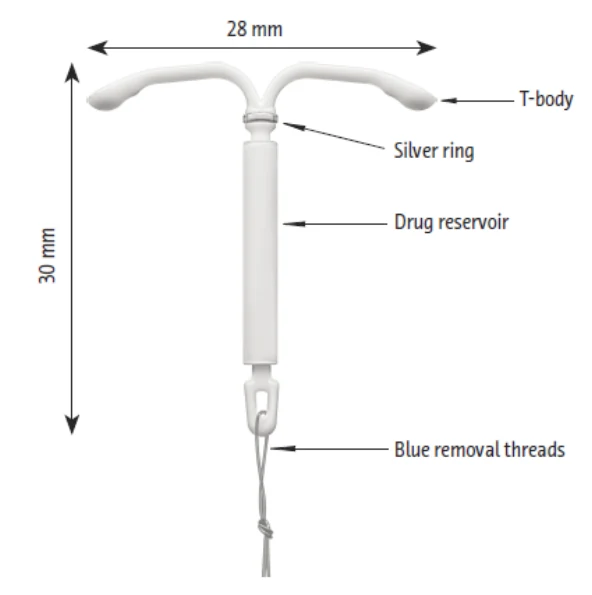
KYLEENA consists of a small, white, T-shaped body made from soft, flexible plastic. The vertical and horizontal arms of the T-body are about 3 cm long. The vertical arm is surrounded by a narrow, cylindrical shaped drug reservoir that contains levonorgestrel. Two fine blue plastic threads are attached to the tip of the vertical arm. These threads are used for removal of the system. The threads can also be used to check if KYLEENA is in place. In addition, the vertical stem contains a silver ring located close to the horizontal arms, which is visible under ultrasound. KYLEENA is packaged with the EvoInserter (which is used to place KYLEENA).
How is KYLEENA Placed?
Before KYLEENA is placed, you will have a pelvic exam to determine the position and size of your uterus. You may also have a Pap smear and a breast exam. If necessary, you may also have other tests (i.e., for infections including STIs).
Your healthcare professional will place the thin flexible plastic tube of the insertion device containing KYLEENA into your uterus. Once KYLEENA is in the correct position, your healthcare professional will withdraw the tube and leave KYLEENA in your uterus. Your healthcare professional will trim the removal threads to a suitable length. The procedure takes only a few minutes.
Most women experience either no pain or only mild pain during placement of KYLEENA. Some women may experience some discomfort. You may wish to discuss the need for a painkiller or local anesthetic with your healthcare professional.
Some women may feel dizzy after KYLEENA is placed. This feeling goes away after a short rest. The placement may cause a seizure in patients who have epilepsy. You may also experience some bleeding during or just after placement. After placement you may feel some cramp-like menstrual pain; however, this usually stops within a few days.
It is uncommon, but KYLEENA may go through the wall of the uterus during placement and come to rest outside the uterus. If this happens KYLEENA must be removed.
When Should KYLEENA be Placed?
KYLEENA should be placed within 7 days of the start of your period. In this case, no back up birth control is needed. If it is certain that you are not pregnant, KYLEENA may also be placed at any other time during your cycle. Tell your healthcare professional if you have had unprotected sex since your last period. If KYLEENA is placed more than 7 days since your period started, use a condom or diaphragm, or do not have sex for the next 7 days. KYLEENA cannot be used as emergency birth control.
When replacing an existing KYLEENA for a new one, it is not necessary to wait for your period. A new KYLEENA can be placed at any time of the cycle.
How Quickly Does KYLEENA Start to Work?
KYLEENA starts to work right away if it is placed within 7 days of the start of your period. It is best to wait 24-48 hours before having intercourse in case of discomfort. If KYLEENA is placed more than 7 days after the start of your period, use a condom or diaphragm for the next 7 days. Alternatively, do not have sex for the next 7 days.
How Often Should I Have KYLEENA Checked?
You should have KYLEENA checked about 4 to 12 weeks after it is placed, again at 12 months and then once a year until it is removed. KYLEENA can stay in place for up to 5 years before it must be removed. You should receive a Patient Reminder Card from your healthcare professional after the placement of KYLEENA. Keep this card until KYLEENA is removed and bring it with you to every medical appointment.
How Can I Check if KYLEENA is in Place?
After each menstrual period or about once a month, you should check by feeling if the threads are still in place. Your healthcare professional will show you how to do this. Do not pull on the threads as you may accidentally pull KYLEENA out.
If you cannot feel the threads, this may mean that KYLEENA has fallen out (expulsion) or gone through the uterus (perforation). See your healthcare professional and in the meantime, use another method of birth control (like condoms) that does not include hormones. You should also see your healthcare professional if you can feel the lower end of KYLEENA itself.
Will KYLEENA be felt during Sexual Intercourse?
After KYLEENA is placed, it is recommended to wait 24 to 48 hours before having sexual intercourse. You and your partner should not be able to feel KYLEENA during intercourse. If you can feel KYLEENA or if you feel any pain, avoid having sex until your healthcare professional has checked if KYLEENA is still in the correct position.
The removal threads may be felt by your partner during intercourse.
Can Tampons or Menstrual Cups be Used?
Use of sanitary pads is recommended. If tampons or menstrual cups are used, you should change them carefully so as not to pull the threads of KYLEENA.
Can KYLEENA Fall Out?
Although unlikely, KYLEENA may fall out on its own. KYLEENA could be pushed out either fully or partially during your period. This is called expulsion. This is more likely to occur if you are overweight or have a history of heavy periods. If KYLEENA is out of place, it may not work as expected. If this happens, you are not protected against pregnancy.
Some symptoms of an expulsion are pain and abnormal bleeding. KYLEENA may also come out without you noticing. An unusual increase in the amount of bleeding during your period might be a sign that this has happened.
If you think KYLEENA has fallen out (fully or partially), avoid intercourse or use a non-hormonal method of birth control (like condoms) and talk to your healthcare professional. They might do an ultrasound and x-ray to confirm if KYLEENA has fallen out. KYLEENA should be removed if it is pushed out partially. KYLEENA can be replaced with a new one once pregnancy is ruled out. Your healthcare professional will decide what is best for you.
Removal of KYLEENA
KYLEENA should not be left in place for more than 5 years. KYLEENA can be easily removed by your healthcare professional if you wish to become pregnant.
You may become pregnant upon removal of KYLEENA if you have had sexual intercourse during the previous week. You could become pregnant as soon as KYLEENA is removed, so you should use another method of birth control if you do not want to become pregnant. Talk to your healthcare professional about the best birth control methods for you, because your new method may need to be started 7 days before KYLEENA is removed to prevent pregnancy. Tell your healthcare professional if you have had sexual intercourse during the week before.
Missed Dose:
If you wish to continue using KYLEENA after 5 years, your healthcare professional can place a new system immediately after removing the old system. If the same KYLEENA system has been left in place for longer than 5 years, you may become pregnant. Pregnancy should be ruled out before placement of a new system.
What are possible side effects from using KYLEENA?
These are not all the possible side effects you may feel when taking KYLEENA. If you experience any side effects not listed here, contact your healthcare professional. Please also see the box called “Serious Warnings and Precautions.”
- acne/oily skin
- nausea
- hair loss
- infection of the ovaries, fallopian tubes or uterus
- painful periods
- breast pain/discomfort
- discharge from the vagina
- excess hair on the face, chest, stomach or legs
- breakage of the IUS
- increased blood pressure
Side effects with KYLEENA are more common during the first months of use; they gradually decrease over time. Differences in your menstrual bleeding are the most common side effects of KYLEENA during the first months after the system is placed, but these effects should decrease over time.
Few women using KYLEENA after delivery have reported less milk production.
SERIOUS SIDE EFFECTS AND WHAT TO DO ABOUT THEM
| Symptom/ effect | Talk with your Healthcare Professional | Get immediate medical help | |
|---|---|---|---|
| Only if severe | In all cases | ||
| VERY COMMON | |||
| Vaginal bleeding changes: Increased or decreased menstrual bleeding, spotting, infrequent periods or absence of bleeding | |||
| Vaginal Infection (inflammation of the vagina or surrounding area): Itching, or unusual or increased discharge from the vagina | |||
| Headache | |||
| Abdominal pain/ pelvic pain | |||
| Cysts on the ovaries: Pelvic pain, painful intercourse, abdominal bloating or swelling, pain during bowel movements. (Cysts usually disappear on their own within a few months and may not show symptoms. Serious cysts are uncommon.) | |||
| COMMON | |||
| Expulsion (KYLEENA has fallen out): An unusual increase in the amount of bleeding during your period |
SERIOUS SIDE EFFECTS AND WHAT TO DO ABOUT THEM
| Symptom/ effect | Talk with your Healthcare Professional | Get immediate medical help |
|---|
| Only if severe | In all cases | ||
|---|---|---|---|
| Migraine | |||
| Depressed Mood/Depression: Sad mood that won’t go away. If you have a history of depression, your depression may become worse | |||
| UNCOMMON | |||
| Pelvic Infection: Constant pain in the lower stomach area, together with fever or unusual discharge from the vagina | |||
| Intrauterine pregnancy, miscarriage, or ectopic pregnancy: Constant pain in the lower stomach area, together with nausea or breast tenderness and/or vaginal bleeding | |||
| Perforation of the uterus [attached to (embedded) or gone through the wall of the uterus]: Severe lower abdominal pain which may be together with bleeding | |||
| VERY RARE | |||
| Allergic reaction including itchiness, rash, swelling of face and lips, cheeks, tongue and/or throat | |||
| UNKNOWN | |||
| Deep vein thrombosis (blood clot in the deep veins of the leg or arm): Swelling, pain, arm or leg may be warm to the touch and may appear red | |||
| Pulmonary embolism (blood clot in the lung): Chest pain that may increase with deep breathing, cough, coughing up bloody sputum, shortness of breath | |||
| Stroke (bleeding or blood clot in the brain): Sudden numbness, weakness or tingling of the face, arm, or leg, particularly on one side of the body, sudden headache, blurry vision, difficulty swallowing or speaking, or lethargy, dizziness, fainting, vomiting, trouble understanding, trouble with walking and loss of balance |
If you have a troublesome symptom or side effect that is not listed here or becomes bad enough to interfere with your daily activities, talk to your healthcare professional.
Reporting Side Effects
You can report any suspected side effects associated with the use of health products to Health Canada by:
NOTE: Contact your health professional if you need information about how to manage your side effects. The Canada Vigilance Program does not provide medical advice. |
Storage:
Store at controlled room temperature (between 15°C and 30°C).
Keep out of reach and sight of children and pets.
Do not throw away medicines via wastewater or household waste. Ask your pharmacist on how to throw away medicines you no longer need. These measures will help to protect the environment.
If you want more information about KYLEENA:
- Talk to your healthcare professional
- Find the full product monograph that is prepared for healthcare professionals and includes this Patient Medication Information by visiting the Health Canada website (https://www.canada.ca/en/health-canada/services/drugs-health-products/drug-products/drug-product-database.html); the manufacturer’s website http://www.bayer.ca or by contacting Bayer at 1-800-265-7382.
Bayer Inc. 2920 Matheson Blvd East Mississauga, Ontario L4W 5R6 |
Last Revised: September 21, 2021
© 2021, Bayer Inc.
® TM see www.bayer.ca/tm-mc
 |