


Product Monograph - Latanoprost (Laboratoire Riva)
ACTION AND CLINICAL PHARMACOLOGY
LATANOPROST (latanoprost), a prostaglandin F2 α (13,14-dihydro-17-phenyl-18,19,20-trinor-
PGF2α isopropyl ester) analogue, is a selective prostanoid FP receptor agonist which reduces the intraocular pressure by increasing the outflow of aqueous humour. Studies in animals and man indicate that the main mechanism of action is increased uveoscleral outflow.
Glaucoma is a disease with characteristic optic nerve damage and a corresponding visual field defect. Increased intraocular pressure (IOP) is one of the main risk factors. However, disturbances in blood flow may also play a role in some cases. In ocular hypertension, patients may have increased IOP but without changes in the visual field or corresponding optic nerve damage.
Latanoprost is a sterile, isotonic, buffered aqueous solution with a pH of approximately 6.7.
Each mL contains 50 µg of latanoprost, a colourless to slightly yellow oil. Latanoprost is an isopropyl ester prodrug which is well absorbed through the cornea and upon entering the aqueous humour is rapidly and completely hydrolysed to the biologically active acid. Studies in humans indicate that the peak concentration in the aqueous humour is reached about two hours after topical administration.
Following topical administration in monkeys, latanoprost is primarily distributed in the anterior segment, conjunctiva and eyelids with only minute quantities reaching the posterior segment.
Reduction of IOP following a single dose in humans starts about 3 to 4 hours following topical administration, and the maximum effect is reached after 8 to 12 hours. Pressure reduction is maintained for at least 24 hours.
There is practically no metabolism of the acid of latanoprost in the eye. The plasma clearance is rapid and occurs in the liver. In humans, the half-life of the biologically active acid in plasma is approximately 17 minutes. In animal studies, the main metabolites were the 1,2-dinor and the
1,2,3,4-tetranor metabolites which exerted only weak or no biologic activity, and were excreted primarily in urine.
Clinical Studies
In five controlled clinical trials of up to 6 months duration, reduction of IOP was evaluated in patients with open-angle glaucoma or ocular hypertension treated with either latanoprost dosed once a day or timolol dosed twice a day. The mean baseline IOP (mmHg) in these studies ranged from 23.1 to 29.9 and 23.1 to 28.7 for the groups treated with latanoprost and timolol, respectively.
The results are shown below.
Reduction of IOP (mmHg) in Patients Treated with Latanoprost as Compared to Timolol*
| Study (ref. #) | No. of Patients | Baseline IOP mmHg | Change from Baseline mmHg (%)** | Between Group Comparison (p-Value) | |||
| Latanoprost | Timolol | Latanoprost | Timolol | Latanoprost | Timolol | ||
| Study 1 (24) | 128 | 140 | 24.4 | 24.1 | -6.2 (25.4) | -4.5 (17.8) | <0.001 |
| Study 2 (26 ) | 149 | 145 | 25.2 | 25.4 | -7.9 (30.9) | -7.4 (29.1) | 0.2 |
| Study 3 (2) | 183 | 84 | 25.1 | 24.6 | -7.8 (30.7) | -6.6 (26.0) | 0.002 |
| Study 4 (34 ) | 30 | 30 | 29.9 | 28.7 | -11.7 (39.1) | -8.5 (29.6) | 0.045 |
| Study 5 (35) | 76 | 78 | 23.1 | 23.1 | -6.2 (26.8) | -4.4 (19.0) | <0.001 |
* Intent-to-treat (ITT) analysis, except for Study 5, which evaluated data for patients who completed the study ** Mean diurnal IOPs (mean of 3 different daytime readings) used in Studies 1-4. Mean morning IOPs, representing trough values for both treatments, used in Study 5.
In latanoprost studies of up to 24 months duration, there was no evidence of long-term drift in IOP reduction; the mean diurnal IOP reduction remained constant in patients treated up to 24 months.
Similar results were obtained from a 3 month phase III clinical trial in Asian patients with chronic angle closure glaucoma. In this study, 137 patients received latanoprost once daily and 138 patients received timolol twice daily. Latanoprost reduced IOP by 30% from the untreated baseline of 25.2 mmHg. Timolol reduced IOP by 20% from a baseline of 25.9 mmHg. The p-value for the difference between the IOP reduction by latanoprost versus timolol was p<0.001. The benefit to patients from latanoprost was irrespective of their degree of angle closure.
A 3-year open-label prospective safety study with a 2-year extension phase was conducted to evaluate the progression of increased iris pigmentation with continuous use of latanoprost once-daily as adjunctive therapy in 519 patients with open-angle glaucoma. The analysis was based on observed-cases population of the 380 patients who continued in the extension phase.
Results showed that the onset of noticeable increased iris pigmentation occurred within the first year of treatment for the majority of the patients who developed noticeable increased iris pigmentation. Patients continued to show signs of increasing iris pigmentation throughout the five years of the study. Observation of increased iris pigmentation did not affect the incidence, nature or severity of adverse events (other than increased iris pigmentation)
recorded in the study. In the study, IOP reduction was similar regardless of the development of increased iris pigmentation during the study.
Clinical trials have shown that latanoprost has no significant effect on production of aqueous humour and no effect on the blood-aqueous barrier. At clinical dose levels, latanoprost has negligible or no effects on intraocular blood circulation when studied in monkeys. However, mild to moderate conjunctival or episcleral hyperemia may occur as a result of topical administration.
Latanoprost has not induced fluorescein leakage in the posterior segment of pseudophakic human eyes during short term treatment.
Phase II clinical trials have also demonstrated that latanoprost is effective in combination with other drugs used for treatment of glaucoma. The IOP reducing effect of latanoprost is additive to that of beta-adrenergic antagonists (timolol), adrenergic agonists (dipivefrin, epinephrine), cholinergic agonists (pilocarpine) and carbonic anhydrase inhibitors (acetazolamide).
INDICATIONS AND CLINICAL USE
LATANOPROST (latanoprost) is indicated for the reduction of intraocular pressure in patients with open-angle glaucoma or ocular hypertension. LATANOPROST may be used for the reduction of intraocular pressure in patients with chronic angle-closure glaucoma who underwent peripheral iridotomy or laser iridoplasty.
See information in sections of ACTION AND CLINICAL PHARMACOLOGY, WARNINGS,
PRECAUTIONS AND ADVERSE REACTIONS.
CONTRAINDICATIONS
Known hypersensitivity to benzalkonium chloride or any other ingredient in this product.
WARNINGS
Latanoprost has been reported to cause changes to pigmented tissues. The most frequently reported changes have been increased pigmentation of the iris, periorbital tissue (eyelid) and eyelashes, and growth of eyelashes. Pigmentation is expected to increase as long as latanoprost is administered. After discontinuation of latanoprost, pigmentation of the iris is likely to be
permanent while pigmentation of the periorbital tissue and eyelash changes have been reported to be reversible in some patients. Patients who receive treatment should be informed of the possibility of increased pigmentation. The effects of increased pigmentation beyond 5 years are not known. Patients who are expected to receive treatment in only one eye should be informed about the potential for increased pigmentation in the treatment eye and thus, heterochromia between the eyes.
Fertililty
Latanoprost has not been found to have any effect on male or female fertility in animal studies.
Use in Pregnancy
Reproduction studies have been performed in rats and rabbits. In rabbits an incidence of 4 of 16 dams had no viable fetuses at a dose that was approximately 80 times the maximum human dose, and the highest nonembryocidal dose in rabbits was approximately 15 times the maximum human dose (see TOXICOLOGY). Latanoprost should be used during pregnancy only if the potential benefit justifies the potential risk to the fetus.
Use in Nursing Mothers
The active substance in latanoprost ophthalmic solution and its metabolites may pass into breast milk and latanoprost should therefore be used with caution in nursing women (see
TOXICOLOGY).
Use in Pediatrics
The safety and efficacy of the use of latanoprost in children has not been established.
PRECAUTIONS
General
Latanoprost may gradually increase the pigmentation of the iris. This effect has predominantly been seen in patients with mixed coloured irides, i.e., blue-brown, grey-brown, green-brown or yellow-brown. The eye colour change is due to increased melanin content in the stromal melanocytes rather than to an increase in the number of melanocytes. This change may not be noticeable for several months to years (see WARNINGS). Typically, the brown pigmentation around the pupil spreads concentrically towards the periphery of the iris and the entire iris or parts of the iris become more brownish. Neither nevi nor freckles of the iris appear to be affected by treatment. While treatment with latanoprost can be continued in patients who develop noticeably increased pigmentation, these patients should be examined regularly.
During clinical trials, the increase in brown iris pigment has not been shown to progress further upon discontinuation of treatment, but the resultant colour change may be permanent.
Eyelid skin darkening, which may be reversible, has been reported in association with the use of latanoprost (see WARNINGS).
Latanoprost may gradually change eyelashes and vellus hair in the treated eye; these changes include increased length, thickness, pigmentation, the number of lashes or hairs, and misdirected growth of eyelashes. Eyelash changes are usually reversible upon discontinuation of treatment.
Macular edema, including cystoid macular edema, has been reported during treatment with latanoprost. These reports have mainly occurred in aphakic patients, in pseudophakic patients with torn posterior lens capsule, or in patients with known risk factors for macular edema.
Latanoprost should be used with caution in patients who do not have an intact posterior capsule or who have known risk factors for macular edema.
There is no experience with latanoprost in patients with inflammatory ocular conditions, inflammatory glaucoma, neovascular glaucoma or congenital glaucoma, and only limited experience with pseudophakic patients and in patients with pigmentary glaucoma.
Latanoprost should be used with caution in patients with a history of intraocular inflammation
(iritis/uveitis) and should generally not be used in patients with active intraocular inflammation.
Latanoprost should be used with caution in patients with a history of herpetic keratitis.
Latanoprost should be avoided in cases of active herpes simplex keratitis and in patients with a history of recurrent herpetic keratitis specifically associated with prostaglandin analogues.
There is no experience in patients with severe or uncontrolled asthma. Such patients should therefore be treated with caution until there is sufficient experience (see ADVERSE
REACTIONS AND PHARMACOLOGY, HUMAN PHARMACODYNAMICS for experience in patients with mild to moderate asthma).
Latanoprost has not been studied in patients with renal or hepatic impairment and should, therefore, be used with caution in such patients.
There have been reports of bacterial keratitis associated with the use of multiple-dose containers of topical ophthalmic products. These containers had been inadvertently contaminated by patients who, in most cases, had a concurrent corneal disease or a disruption of ocular epithelial surface
(see INFORMATION FOR THE CONSUMER).
Contact lenses should be removed prior to the administration of latanoprost, and may be reinserted
15 minutes after administration (see INFORMATION FOR THE CONSUMER).
Drug Interactions
In vitro studies have shown that precipitation occurs when eye drops containing thimerosal are mixed with latanoprost. If such drugs are used, they should be administered with an interval of at least 5 minutes between applications.
ADVERSE REACTIONS
The ocular adverse events and ocular signs and symptoms reported in 5 to 15% of the patients on latanoprost in the three 6 month, multi-centre, double-masked, active-controlled trials were blurred vision, burning and stinging, conjunctival hyperemia, foreign body sensation, itching, increased iris pigmentation and punctate epithelial keratopathy.
Local conjunctival hyperemia was observed: however, less than 1% of the latanoprost treated patients required discontinuation of therapy because of intolerance to conjunctival hyperemia.
In addition to the above listed ocular events/signs and symptoms, the following were reported in 1 to 4% of the patients: dry eye, excessive tearing, eye pain, lid crusting, lid edema, lid erythema, lid discomfort/pain and photophobia.
The following events were reported in less than 1% of the patients: conjunctivitis, diplopia and discharge from the eye.
During clinical studies, there were extremely rare reports of the following: retinal artery embolus, retinal detachment, and vitreous hemorrhage from diabetic retinopathy.
The most common systemic adverse events seen with latanoprost were upper respiratory tract infection/cold/flu which occurred at a rate of approximately 4%. Pain in muscle/joint/back, chest pain/angina pectoris and rash/allergic skin reaction each occurred at a rate of 1 to 2%.
Macular edema, including cystoid macular edema, has been reported during treatment with latanoprost. These reports have mainly occurred in aphakic patients, in pseudophakic patients with
a torn posterior lens capsule, or in patients with known risk factors for macular edema. Latanoprost should be used with caution in these patients. Upon discontinuation of latanoprost treatment, visual acuity has improved, in some cases with concurrent treatment with topical steroidal and non-steroidal anti-inflammatory drugs.
Latanoprost has been reported to cause darkening, thickening and lengthening of eye lashes.
Based on spontaneous reports, rare cases of iritis/uveitis and very rare cases of darkening of the palpebral skin have been reported.
The following events, which have been chosen for inclusion due to either their seriousness, frequency of reporting, possible causal connection to latanoprost, or a combination of these factors, have been reported during postmarketing use of latanoprost in clinical practice and in the literature:
eyelash changes (increased length, thickness, pigmentation of eyelashes, increased number of eyelashes and vellus hairs on the eyelid, curling of eyelashes, misdirected eyelashes sometimes resulting in eye irritation); eyelid skin darkening: periorbital and lid changes resulting in deepening of the eyelid sulcus; intraocular inflammation (iritis/uveitis); macular edema, including cystoid macular edema; corneal edema and erosions; localized skin reaction on the eyelid; photophobia;
toxic epidermal necrolysis; infections and infestations: herpetic keratitis. Those events are reported voluntarily from a population of unknown size; therefore, estimates of frequency cannot be made.
Rare cases of asthma, asthma aggravation, acute asthma attack and dyspnoea have been reported.
There is limited experience from patients with asthma but latanoprost neither was found to affect pulmonary function when studied in a small number of steroid treated patients suffering from moderate asthma nor was it found to affect the pulmonary function, airway reactivity or β2- responsiveness when studied in a small number of non-steroid treated asthma patients.
SYMPTOMS AND TREATMENT OF OVERDOSAGE
Apart from ocular irritation and conjunctival or episcleral hyperemia, no other ocular side effects of latanoprost administered at high doses are known. Intravenous infusion of up to 3 µg/kg in
healthy volunteers produced mean plasma concentrations 200 times higher than during clinical treatment and no adverse reactions were observed. Intravenous doses of 5.5 to 10 µg/kg caused abdominal pain, dizziness, fatigue, hot flushes, nausea and sweating.
In monkeys, latanoprost has been infused i.v. in doses of up to 500 µg/kg without major effects on the cardiovascular system. Intravenous administration in monkeys has been associated with transient bronchoconstriction. However, in patients with bronchial asthma, bronchoconstriction was not induced by latanoprost when administered topically to the eyes at a dose 7 times the recommended clinical dose. If overdosage with latanoprost occurs, treatment should be symptomatic.
| For management of a suspected overdose, contact your local Poison Control Centre immediately. |
DOSAGE AND ADMINISTRATION
The recommended dose for adults, including the elderly (over 60 years of age), is one drop in the affected eye(s) once daily. Optimal effect is obtained if LATANOPROST (latanoprost) is administered in the evening.
The dose of LATANOPROST should not exceed once daily as it has been shown that more frequent administration decreases the IOP lowering effect. Reduction of IOP in humans starts about 3 to 4 hours after treatment and maximum effect is reached after 8 to 12 hours. Pressure reduction is maintained for at least 24 hours.
If one dose is missed, treatment should continue with the next dose the following day.
Use in combination with other drugs
LATANOPROST may be used concomitantly with other topical ophthalmic products to further lower intraocular pressure. If more than one topical ophthalmic drug is being used, the drugs should be administered at least 5 minutes apart.
PHARMACEUTICAL INFORMATION
Drug Substance
Common Name: Latanoprost
Chemical Names: 1) Isopropyl-(Z)-7[(1R,2R,3R,5S)3,5-dihydroxy-2-[(3R)-3- hydroxy-5-phenylpentyl]cyclopentyl]-5-heptenoate
- 2) 13, 14-dihydro-17-phenyl-18, 19, 20-trinor-PGF2α-isopropyl ester
CAS No.: 130209-82-4
Molecular Formula: C26H40O5
Structural Formula:
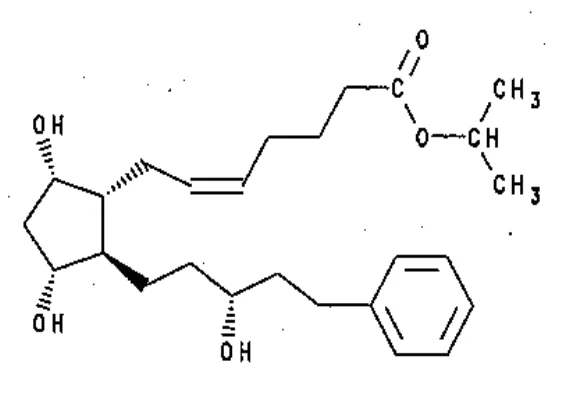
Molecular Weight: 432.58 g/mol
Physical Form: Colourless to slightly yellow oil.
Solubility: Very soluble in acetonitrile and freely soluble in acetone, ethanol, ethyl acetate, isopropanol, methanol and octanol, and practically insoluble in water.
Composition
Each mL of LATANOPROST sterile ophthalmic solution contains 50 µg/mL latanoprost, including the following inactive ingredients: benzalkonium chloride, dibasic sodium phosphate monohydrate, monobasic sodium phosphate monohydrate, purified water, sodium chloride. LATANOPROST is buffered to a pH of approximately 6.7 and is isotonic with lacrimal fluid.
Stability and Storage Recommendations
Store unopened bottle under refrigeration (2 to 8°C). Protect from light. Once opened, bottle may be stored at room temperature up to 25°C, for up to six weeks.
AVAILABILITY OF DOSAGE FORMS
LATANOPROST (latanoprost) is a sterile, isotonic, buffered aqueous solution of latanoprost
50 µg/mL. One drop contains approximately 1.5 µg of latanoprost. LATANOPROST is intended for topical administration on the eye. The non-medicinal ingredients are:
Benzalkonium Chloride 50%*, Dibasic Anhydrous Sodium Phosphate, Monobasic
Sodium Phosphate Monohydrate and Sodium Chloride.
* Benzalkonium chloride is used as 50% solution in water, containing small amounts of ethyl alcohol.
LATANOPROST is supplied in a 5 mL plastic ophthalmic dispenser bottle with a dropper tip, screw cap and tamper proof polyethylene overcap.
Each bottle contains 2.5 mL of LATANOPROST corresponding to approximately 80 drops of solution.