


Patient Medication Information: uses, side effects, how to take - Loargys
What LOARGYS is used for:
LOARGYS is used to treat hyperargininemia in adults and children 2 years of age and older who have arginase 1 deficiency (ARG1-D). LOARGYS is used in combination with a diet low in protein.
How LOARGYS works:
LOARGYS contains the active substance pegzilarginase. In people with ARG1-D, the enzyme (arginase 1) that breaks down arginine does not work properly. Pegzilarginase replaces this enzyme activity.
The ingredients in LOARGYS are:
Medicinal ingredient: pegzilarginase
Non-medicinal ingredients: dipotassium phosphate, glycerol, hydrochloric acid (for pH-adjustment), potassium dihydrogen phosphate, sodium chloride, sodium hydroxide (for pH-adjustment) and water for injections.
LOARGYS comes in the following dosage form:
Solution; 5 mg/mL pegzilarginase
Do not use LOARGYS if:
- you have had a severe allergic reaction to pegzilarginase or any of the other ingredients in this medicine including parts of the container.
To help avoid side effects and ensure proper use, talk to your healthcare professional before you take LOARGYS. Talk about any health conditions or problems you may have, including if you:
- are pregnant, think you may be pregnant or are planning to have a baby. LOARGYS should not be used during pregnancy. It should also not be used by women who can get pregnant and are not using birth control.
- have liver or kidney problems.
Other warnings you should know about:
Allergic reaction: LOARGYS may cause allergic reactions. This is most likely to occur after the first few doses, but may also occur later in treatment. Your first dose will be given under the supervision of a healthcare professional who will watch you for signs of allergic reaction.
Signs of an allergic reaction include swelling of the face, rash, hives, itching, flushing, tightness of the chest, wheezing and shortness of breath. If this happens to you after using LOARGYS, seek medical help right away. Your healthcare professional may decide you need treatment with other medicines to either prevent or treat an allergic reaction.
Breastfeeding: If you are breastfeeding, talk to your healthcare professional before starting LOARGYS. It is not known if LOARGYS passes into breast milk. There could be risks to a breastfeeding child if you use LOARGYS. You and your healthcare professional will decide if you should use LOARGYS while you are breastfeeding.
Fertility: Based on results from animal studies, treatment with LOARGYS may affect your ability have children in the future. If you have questions about this, talk to your healthcare professional.
Blood tests:
- LOARGYS can interfere with routine blood tests for arginine. If you are having blood work done, tell your healthcare professional that you are receiving LOARGYS.
- Before and during your treatment, your healthcare professional will do blood tests to check what dose of LOARGYS is right for you.
Tell your healthcare professional about all the medicines you take, including any drugs, vitamins, minerals, natural supplements or alternative medicines.
How to take LOARGYS:
- LOARGYS is given either as an infusion (drip) directly into your vein (intravenous (IV) infusion) or as an injection under the skin (subcutaneous (SC) injection).
- To start, LOARGYS will be given to you by a healthcare professional for at least the first 8 weeks.
Your healthcare professional may eventually decide that you can use LOARGYS at home by SC injection. For this to be considered:
- You must have been receiving LOARGYS for at least 8 weeks and be on a stable dose.
- Your healthcare professional must determine that your risk for an allergic reaction is low.
- You and/or your caregiver must be trained on how to give the dose.
- You will receive LOARGYS by SC injection at the same dose and on the same schedule as you were receiving it from your healthcare professional.
- Read the Instructions for use at the end of this leaflet, which describes how to inject LOARGYS.
- Always use LOARGYS exactly as your healthcare professional has told you. Check with them if you are not sure.
LOARGYS is expected to be used in combination with other ways to manage the disease including:
- a low protein diet
- food supplements with essential amino acids
- other medicines to manage the symptoms of the disease
- Do not shake the LOARGYS vials.
Usual dose:
- Your healthcare professional will decide how much LOARGYS is right for you. It will depend on your weight and the levels of arginine in your blood.
- The recommended starting dose of LOARGYS is 0.1 mg/kg of body weight given once per week.
- Your dose may be increased or decreased by your healthcare professional to keep your blood arginine levels under control.
- Your healthcare professional will do regular blood tests to check your blood arginine levels and change your dose if needed.
Overdose:
If you have been given too much LOARGYS, your blood arginine level may become too low. Symptoms may include nausea, vomiting, diarrhea and tiredness. If you or your healthcare professional suspect that you have been given more LOARGYS than you should, you will be closely monitored and given treatment as needed.
If you think you, or a person you are caring for, have taken too much LOARGYS, contact a healthcare professional, hospital emergency department, regional poison control centre or Health Canada’s toll-free number, 1-844 POISON-X (1-844-764-7669) immediately, even if there are no signs or symptoms.
Missed dose:
If you miss a dose of LOARGYS:
- if your dose is given by a healthcare professional: contact them as soon as possible to schedule the next dose; or
- if you are administering LOARGYS at home: administer the missed dose as soon as possible.
- Do not give two doses on the same day.
- Do not give a second dose within 4 days of another dose to make up for the missed dose.
- Be sure that there are at least 4 days between doses.
Possible side effects from using LOARGYS:
These are not all the possible side effects you may have when taking LOARGYS. If you experience any side effects not listed here, tell your healthcare professional.
- Injection site reaction (pain, swelling, irritation, redness and rash around the site of injection)
- Vomiting
- Constipation
- Dizziness
- Falls
- Fever
- Cold (upper respiratory infection)
- Runny nose
- Itching
- Abnormal blood test for liver function
Serious side effects and what to do about them
| Frequency/Side Effect/Symptom | Talk to your healthcare professional | Get immediate medical help |
|---|---|---|
| Only if severe | In all cases | |
| Very common | ||
| Hypersensitivity (allergic reaction, sometimes severe): swelling of your face, lip swelling, skin rash, sudden redness of the skin (flushing), difficulty breathing | ||
| X | ||
If you have a troublesome symptom or side effect that is not listed here or becomes bad enough to interfere with your daily activities, tell your healthcare professional.
Reporting side effects
You can report any suspected side effects associated with the use of health products to Health Canada by:
- Visiting the Web page on Adverse Reaction Reporting (canada.ca/drug-device-reporting) for information on how to report online, by mail or by fax; or
- Calling toll-free at 1-866-234-2345.
NOTE: Contact your healthcare professional if you need information about how to manage your side effects. The Canada Vigilance Program does not provide medical advice.
Storage:
Store in a refrigerator (2 °C – 8 °C). Do not freeze. Do not shake. Store in the original carton to protect from light.
Once removed from the refrigerator, LOARGYS can be stored for 2 hours at room temperature up to 25 °C.
Once the dose is drawn up into the syringe, it should be given as soon as possible. It can; however, be stored in the syringe for:
- 2 hours when stored at room temperature up to 25 °C, or
- 4 hours when refrigerated at 2 °C – 8 °C.
Keep out of reach and sight of children.
If you want more information about LOARGYS:
- Talk to your healthcare professional
- Find the full product monograph that is prepared for healthcare professionals and includes the Patient Medication Information by visiting the Health Canada Drug Product Database website (canada.ca/en/health-canada/services/drugs-health-products/drug-products/drug-product-database.html); the manufacturer’s website https://www.immedica.com; or by calling 1-844-576-2707.
Date of Authorization: 2026-05-29
Instructions for use
The steps below describe how to prepare and give LOARGYS at home, as an injection under the skin (subcutaneous injection). If you are injecting this medicine yourself, you will be trained on how to prepare and inject LOARGYS by your healthcare professional.
Do not inject this medicine yourself unless you have received training and you understand the steps.
Your healthcare professional will decide the correct dose for you and will tell you how much (volume in mL) to inject. You may need more than one LOARGYS vial to get the correct dose. You may also need to divide the total dose into more than one injection. Your healthcare professional will tell you exactly what is right for you. Contact your healthcare professional if you are not sure or have questions about how to prepare and give LOARGYS at home.
Each vial is for single use only. Always use new vials for each dose.
Do not mix LOARGYS with other solutions for injection.
Do not shake.
Preparation:
Make sure you have everything you need for the injection(s):
- LOARGYS vial(s)
- A graduated syringe
- 1 large needle (e.g. 18 Gauge) per vial, to withdraw the dose
- 1 small needle (e.g. 26-27 Gauge) per injection
Alcohol wipes
- Gauze pad and bandage, if needed
- A sharps container
Only the LOARGYS vial is included in the carton. All other components will be provided to you by your healthcare professional.
- 1. Check the name and the strength of the vial(s) to make sure it contains the correct medicine and that you have the correct number of vials at hand. Check the expiry date on the carton. Do not use if the product has expired.
- 2. Take the unopened LOARGYS vial(s) out of the refrigerator 15 to 30 minutes before the planned injection to allow the solution to reach room temperature. Do not use external heat.
- 3. Wash your hands.
- 4. The solution in the vial should be colourless to slightly yellow or slightly pink, clear to slightly opalescent (pearly). Do not use if the solution is cloudy or contains visible particles.
- 5. Place the vial on a clean flat surface. Remove the plastic flip-off cap from the vial.
- 6. Wipe the top of the vial with an alcohol swab and allow to air dry. Do not touch the top of the vial or allow it to touch anything else once wiped.
Withdrawing solution from the vial:
- 1. Attach a large needle to the graduated syringe. Remove the needle cap.
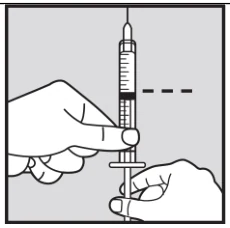
- 2. Pull the plunger back to draw air into the graduated syringe. Pull the plunger to the line that would be equal to the volume to withdraw from the vial (in mL).
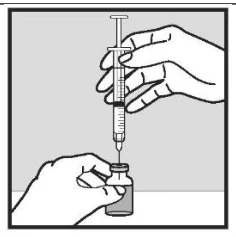
- 3.
Keep the vial on a flat surface. Slowly insert the large needle through the rubber seal into the vial.
- a) For single or first vial: The tip of the large needle should not touch the solution to avoid forming foam. Continue to step 4.
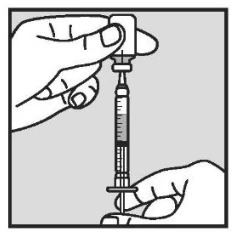
- b) For subsequent vial(s): Turn the vial upside down, ensure the tip of the large needle is in the air space above the solution to avoid forming foam.
- 4. Slowly push the plunger to inject the air into the vial.
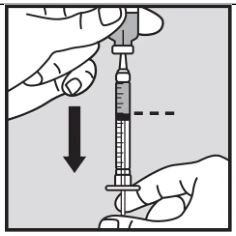
- 5. Keep the large needle in the vial and hold it upside down. With the large needle in the solution, slowly pull the plunger to the mark equal to the volume needed.
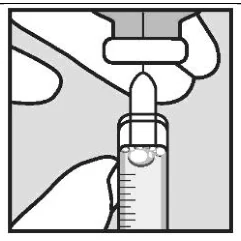
- 6. Before removing the large needle from the vial, check the solution in the syringe for air bubbles. If there are bubbles, continue to hold the vial upside down with the large needle pointing upwards. Gently tap the barrel of the syringe with your finger. Once all the air bubbles are at the top, gently push the plunger to push out the bubbles through the large needle.
- 7. Check the volume to give (in mL), against the markings on the syringe to make sure that you have withdrawn the correct amount of solution.
- 8. Pull the large needle with the syringe from the vial. Detach the large needle from the syringe and dispose the large needle in your sharps container.
- 9. You may need to use several vials to withdraw the complete volume (in mL). To do this, repeat steps 1-8 above for each vial needed to obtain the total dose (in mL) or as shown to you by your healthcare professional. Always follow the instructions given to you by your healthcare professional. For each new vial, use a new needle.
- 10.
Attach a small needle to the filled syringe. Do not remove the needle cap. Ensure the small needle is firmly attached to the syringe.
Note: If the solution is not to be used immediately, protect the syringe from light. After preparation, LOARGYS can be stored at room temperature (up to 25 °C) for up to 2 hours before administration. After this time, the prepared LOARGYS cannot be used anymore and must be discarded in the sharps container.
Giving the dose:
- 1.
Remove the cap from the small needle. Hold the syringe with the small needle pointing up and tap the barrel of the syringe with your finger to remove any air bubbles.
Check that the volume contained in the syringe matches the amount your healthcare professional instructed you to take. The volume given in a single injection should not be more than 1 mL. If you need to inject more than 1 mL, you will need more than one injection, each in a different spot.
- 2.
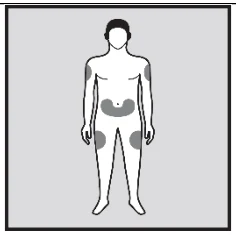
Choose an injection site (abdomen or, side of the thigh). A caregiver can give the injection into the side or back of the upper arms. Rotate injection sites between doses.
Do not inject into scar tissue or areas that are reddened, inflamed, or swollen. If injecting into the abdomen, avoid the area directly surrounding the belly button.
If more than 1 injection is needed for a single dose of LOARGYS, the injection sites should be at least 3 cm apart.
- 3. Clean the injection site using an alcohol swab. Allow the skin to dry.
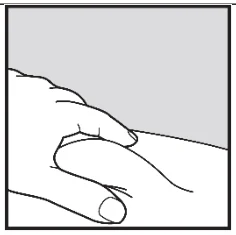
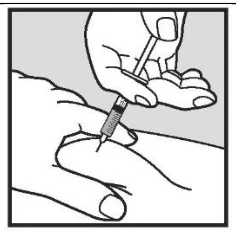
- 4. Gently pinch the skin of the chosen injection site between your thumb and index finger.
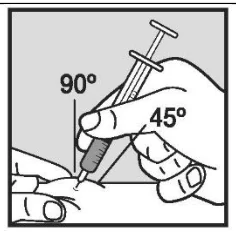
- 5. Hold the syringe like a pencil or dart. Insert the small needle into the raised skin at a 45° to 90° angle.
- 6.
While continuing to pinch the skin, slowly push the plunger until you have injected the desired volume.
Reminder:
- If you need to inject a volume of more than 1 mL of LOARGYS, you will need more than one injection.
- Switch the injection site for each injection. Make sure that the new injection site is more than 3 cm away.
- Slowly press the plunger down until you have injected the volume needed. Repeat until you have injected your total dose.
- Always use a new small needle for each injection.
- 7. Remove the small needle from the skin by pulling it straight out. Release the pinched skin. Gently press a gauze pad over the injection site for a few seconds. Apply a bandage if needed.
- 8. Put your used vials (even if not fully empty), syringe, needles and caps in the sharps container.
Write down the date of the injection and all the sites where you have injected. This will help you to know where to inject next.