


Product Monograph - Loargys
Recent Major Label Changes
Not applicable.
Table of Contents
Certain sections or subsections that are not applicable at the time of the preparation of the most recent authorized product monograph are not listed.
Recent Major Label Changes ................................................................................................... 2
Table of Contents ................................................................................................................... 2
Part 1: Healthcare Professional Information ........................................................................... 4
- 1.
Indications ....................................................................................................................... 4
1.1. Pediatrics .................................................................................................................. 4
1.2. Geriatrics .................................................................................................................. 4
- 2. Contraindications ............................................................................................................ 4
- 4.
Dosage and Administration ............................................................................................. 4
4.1. Dosing Considerations .............................................................................................. 4
4.2. Recommended Dose and Dosage Adjustment ......................................................... 5
4.3. Reconstitution .......................................................................................................... 6
4.4. Administration .......................................................................................................... 6
4.5. Missed Dose ............................................................................................................. 7
- 5. Overdose ......................................................................................................................... 7
- 6. Dosage Forms, Strengths, Composition, and Packaging ................................................... 7
- 7.
Warnings and Precautions ............................................................................................... 8
Immune ................................................................................................................................ 8
Monitoring and Laboratory Tests ......................................................................................... 9
Reproductive Health ............................................................................................................. 9
7.1. Special Populations .................................................................................................. 9
7.1.1. Pregnancy ........................................................................................................ 9
7.1.2. Breastfeeding .................................................................................................. 9
7.1.3. Pediatrics ......................................................................................................... 9
7.1.4. Geriatrics ....................................................................................................... 10
- 8.
Adverse Reactions ......................................................................................................... 10
8.1. Adverse Reaction Overview .................................................................................... 10
8.2. Clinical Trial Adverse Reactions .............................................................................. 10
8.2.1. Clinical Trial Adverse Reactions – Pediatrics .................................................. 12
8.5. Post-market adverse reactions .................................................................................... 12
- 9.
Drug Interactions ........................................................................................................... 12
9.2. Drug Interactions Overview .................................................................................... 12
9.3. Drug-Behaviour Interactions .................................................................................. 12
9.4. Drug-Drug Interactions ........................................................................................... 12
9.5. Drug-Food Interactions........................................................................................... 12
9.6. Drug-Herb Interactions ........................................................................................... 13
9.7. Drug-Laboratory Test Interactions ......................................................................... 13
- 10.
Clinical Pharmacology ................................................................................................... 13
10.1. Mechanism of Action .............................................................................................. 13
10.2. Pharmacodynamics ................................................................................................ 13
10.3. Pharmacokinetics ................................................................................................... 14
10.4. Immunogenicity ...................................................................................................... 15
- 11. Storage, Stability, and Disposal ...................................................................................... 16
Part 2: Scientific Information ................................................................................................ 17
- 13. Pharmaceutical Information .......................................................................................... 17
- 14.
Clinical Trials .................................................................................................................. 17
14.1. Clinical Trials by Indication ..................................................................................... 17
16 Non-Clinical Toxicology .................................................................................................. 20
Patient Medication Information ........................................................................................... 24
Instructions for use ............................................................................................................... 29
Part 1: Healthcare Professional Information
1. Indications
LOARGYS (pegzilarginase) is indicated for the treatment of hyperargininemia in adults and pediatric patients aged 2 years and older with arginase 1 deficiency (ARG1-D), in conjunction with dietary protein restriction.
1.1. Pediatrics
Pediatrics (≥ 2 years of age): Based on the data submitted and reviewed by Health Canada, the safety and efficacy of LOARGYS in pediatric patients have been established. Therefore, Health Canada has authorized an indication for pediatric use.
Pediatrics (< 2 years of age): No data are available; therefore, the safety and efficacy of LOARGYS in children below 2 years of age have not yet been established.
1.2. Geriatrics
Geriatrics (≥ 65 years of age): No data are available; therefore, the safety and efficacy of LOARGYS in patients older than 65 years have not been established.
2. Contraindications
LOARGYS is contraindicated in patients with severe hypersensitivity to this drug or to any ingredient in the formulation, including any non-medicinal ingredient, or component of the container. For a complete listing, see 6 Dosage Forms, Strengths, Composition, and Packaging.
4. Dosage and Administration
4.1. Dosing Considerations
- LOARGYS is intended for chronic management of hyperargininemia in patients with ARG1-D in conjunction with individualised disease management such as dietary protein restriction, amino acid supplements and pharmacological treatment including nitrogen scavengers.
- Treatment can be initiated as either intravenous infusion or subcutaneous injection. In clinical trials, treatment was initiated as intravenous administration with subsequent transition to subcutaneous administration after 8 weeks, at the earliest (see 14 Clinical Trials).
- Prior to initiating treatment, a baseline plasma arginine concentration must be obtained.
- Patients must be supervised by a healthcare professional experienced in the management of patients with inherited metabolic diseases and management of hypersensitivity reactions, including anaphylaxis, see 7 Warnings and Precautions.
- The healthcare professional must administer LOARGYS for at least the first 8 weeks to monitor and treat any hypersensitivity reaction, which can include anaphylaxis. After that, once a stable maintenance dose has been established and the risk for hypersensitivity reactions is assessed as low, subcutaneous injections may be administered by the patient or caregiver following adequate training, using the same dose and frequency.
Pre-medication with an antihistamine and/or corticosteroid should be considered in patients who
- previously have developed a hypersensitivity reaction in connection with LOARGYS treatment.
4.2. Recommended Dose and Dosage Adjustment
The recommended starting dose of LOARGYS is 0.1 mg/kg once weekly. The dose may be increased or decreased in 0.05 mg/kg increments to achieve therapeutic goals. Doses above 0.2 mg/kg per week have not been studied in clinical trials in ARG1-D.
To maximise the time within the normal range, dose adjustments should be aimed at achieving a pre-dose level of plasma arginine near the upper limit of normal (ULN) (see 14 Clinical Trials). After four weeks of LOARGYS administration, measure pre-dose plasma arginine (7 days after prior dose) to determine the need for dosage adjustment. If two consecutive weekly pre-dose plasma arginine measurements are not in the desired therapeutic range, increase or decrease the weekly LOARGYS dosage. It is recommended to monitor plasma arginine levels (prior to LOARGYS dosing) weekly for 2 weeks after any dose adjustment to assess impact of the dose change.
Once the individualised dose level has been established, monitoring of plasma arginine concentration is recommended to be performed in accordance with standard clinical monitoring visits.
If LOARGYS treatment is initiated intravenously, subcutaneous administration, at the same dose and frequency of intravenous therapy, should be considered after at least 8 weeks of treatment, in order to reduce the risk of episodes with hypoargininemia (see 7 Warnings and Precautions; 10.2 Pharmacodynamics; and 10.3 Pharmacokinetics).
Validated methods to monitor arginine levels are to be used in patients treated with LOARGYS, as standard methods are not adequate to control residual enzyme activity of pegzilarginase after sampling, and may lead to artificially low arginine levels, and incorrect dose adjustments (see 7 Warnings and Precautions).
In the event of a severe hypersensitivity reaction (e.g., anaphylaxis), discontinue LOARGYS and immediately initiate appropriate medical treatment, including use of epinephrine, see 7 Warnings and Precautions. In the event of a mild or moderate hypersensitivity reaction, consider treatment with antihistamines and/or corticosteroids. For intravenous administration, consider temporarily holding the infusion or slowing the infusion rate.
Pediatrics (≥ 2 years of age): Based on the data submitted and reviewed by Health Canada, the safety and efficacy of LOARGYS in pediatric patients have been established. Therefore, Health Canada has authorized an indication for pediatric use.
Pediatrics (< 2 years of age): No data are available; therefore, the safety and efficacy of LOARGYS in children below 2 years of age have not yet been established.
Hepatic Impairment: LOARGYS has not been studied in patients with hepatic impairment. Changes in the clearance of the enzyme are expected, see 10 Clinical Pharmacology.
Renal Impairment: LOARGYS has not been studied in patients with renal impairment. It cannot be excluded that elimination of PEG is decreased in patients with impaired renal function, see 10 Clinical Pharmacology.
4.3. Reconstitution
Use aseptic technique when preparing and administering LOARGYS.
For intravenous administration
Dilute with 0.9 % sodium chloride solution for injection to achieve the desired volume of infusion (minimum pegzilarginase concentration 0.015 mg/mL and maximum pegzilarginase concentration 0.5 mg/mL).
For subcutaneous administration
For subcutaneous administration the undiluted solution is used.
See also 11 Storage, Stability, and Disposal.
4.4. Administration
LOARGYS is intended for intravenous infusion or subcutaneous injection (see 4.1 Dosing Considerations).
Determine the total dose and volume of LOARGYS to be administered (and the number of vials needed) based on the patient’s weight (kg) and dose level (mg/kg).
Calculate the total dose based on the desired dose level in mg/kg and the patient’s weight rounded to a whole number.
Total dose (mg) = Patient weight (kg) ∗ Dose level (mg/kg)
Calculate the volume of solution to be administered based on the calculated total dose and solution strength. Round the calculated volume to nearest 0.1 mL.
Volume of LOARGYS (mL) = Total dose (mg) Solution strength (5 mg/mL)
- Calculate the number of vials needed based on the calculated volume of LOARGYS. One vial of LOARGYS contains 0.4 mL or 1 mL solution.
- Remove the vial(s) from the refrigerator to reach room temperature.
- Inspect the vial(s) visually for particulate matter and discoloration prior to administration. LOARGYS is a colourless to slightly yellow or slightly pink, clear to slightly opalescent liquid, essentially free of visible foreign particles. Discard any vial(s) not consistent with this appearance.
- Withdraw the intended dose into the syringe. See 11 Storage, Stability, and Disposal for storage conditions.
For intravenous administration
- LOARGYS must be diluted and infused over at least 30 minutes.
- For instructions on preparation and dilution of the medicinal product before administration, see 4.3 Reconstitution.
- Do not mix other medicinal products with LOARGYS or infuse other medicinal products concomitantly via the same intravenous access line.
For subcutaneous administration
- Administer the undiluted solution as subcutaneous injection into the abdomen, lateral part of the thigh, or the side or back of the upper arms. Injection in the side or back of the upper arm should only be done by a healthcare professional or caregiver. Rotate injection sites between doses. Do not inject into scar tissue or areas that are reddened, inflamed, or swollen.
- If injecting into the abdomen, avoid the area directly surrounding the navel.
- If more than 1 injection is needed for a single dose of LOARGYS, the injection sites should be at least 3 cm apart.
Do not shake.
LOARGYS vial is for single use only. Discard unused portion of the medicinal product.
4.5. Missed Dose
If a dose is missed, administer LOARGYS as soon as possible. Do not administer two LOARGYS doses on the same day or within four days of another dose to make up for a missed dose. Ensure there is a minimum of four days between doses.
5. Overdose
Potential effects from an overdose would likely be an exaggerated pharmacologic effect of pegzilarginase resulting in abnormally low plasma arginine levels .
In an oncology Phase 1 trial in subjects with advanced solid tumours, 1 subject inadvertently received 1.6 mg/kg of pegzilarginase (16 × the recommended initial dose of 0.1 mg/kg in ARG1-D patients). The subject developed nausea, vomiting, diarrhoea, and fatigue, and was successfully treated with intravenous supportive care without sequelae.
Patients suspected of receiving an overdose should be closely monitored and general supportive measures should be initiated.
For the most recent information in the management of a suspected drug overdose, contact your regional poison control centre or Health Canada’s toll-free number, 1-844 POISON-X (1-844-764-7669).
- 6. Dosage Forms, Strengths, Composition, and Packaging
To help ensure the traceability of biologic products, healthcare professionals should record both the brand name and the non-proprietary (active ingredient) name as well as other product-specific identifiers such as the Drug Identification Number (DIN) and the batch/lot number of the product supplied.
Table 1 – Dosage Forms, Strengths, and Composition
Description
LOARGYS is a sterile, preservative-free, colourless to slightly yellow or slightly pink, clear to slightly opalescent liquid, essentially free of visible foreign particles.
Each pack contains 1 vial with 0.4 mL or 1 mL solution.
0.4 mL solution in a 3 mL type 1 glass vial with a Fluorotec coated chlorobutyl rubber stopper, aluminium seal and a blue flip-off cap.
1 mL solution in a 5 mL type 1 glass vial with a Teflon coated chlorobutyl rubber stopper, aluminium seal and a white flip-off cap.
7. Warnings and Precautions
Immune
Hypersensitivity reactions, including anaphylaxis
Hypersensitivity reactions, including anaphylaxis (with symptoms such as facial swelling, rash, flushing, dyspnoea) have occurred in LOARGYS treated subjects with intravenous and subcutaneous administration. The reactions generally occurred with the first few doses, but may also occur later in treatment (see 8 Adverse Reactions for additional details).
The initial administrations of LOARGYS should be performed under medical observation.
If a hypersensitivity reaction occurs, appropriate medical treatment should be provided and the patient monitored until signs and symptoms are resolved. The management of hypersensitivity reactions may include temporarily interrupting the administration or lowering the infusion rate and/or treatment with antihistamines and/or corticosteroids. In severe cases stopping the administration and epinephrine treatment may be necessary. Pre-medication with an antihistamine and/or corticosteroid should be considered in patients who previously have developed a hypersensitivity reaction in connection with LOARGYS treatment.
In case of administration by a non-healthcare professional, the patient should be informed of the early signs of severe hypersensitivity reactions e.g., hives, lip swelling, generalised urticaria, tightness of the chest, wheezing and hypotension. Prescription of medication for treatment of a potential severe
| Route of Administration | Dosage Form/ Strength/Composition | Non-Medicinal Ingredients |
| intravenous infusion or subcutaneous injection | solution 5 mg/mL pegzilarginase Presentation
| Dipotassium phosphate Glycerol Hydrochloric acid (for pH-adjustment) Potassium dihydrogen phosphate Sodium chloride Sodium hydroxide (for pH-adjustment) Water for injections |
hypersensitivity reaction should be considered. Patients should also be advised what to do if symptoms of severe hypersensitivity occur which includes seeking immediate medical support.
Monitoring and Laboratory Tests
Monitoring of plasma arginine
LOARGYS will interfere with routine arginine laboratory analysis, resulting in erroneous low measurements due to post-collection degradation of arginine. The testing laboratory should be informed that the patient is treated with a medicinal product that metabolises and reduces arginine levels. Alternative validated sampling procedures to measure arginine must be used in patients treated with LOARGYS. This includes blood collection tubes containing the enzyme-blocker nor-NOHA.
Reproductive Health
- Fertility
No human data are available. In fertility studies conducted with rats without ARG1-D, pegzilarginase produced effects on spermatogenesis (e.g., decreased sperm motility, decreased sperm concentration, and increased abnormal sperm morphology) in males and reduced fertility and fecundity in females (see 16 Non-Clinical Toxicology).
7.1. Special Populations
7.1.1. Pregnancy
There is no data on the use of LOARGYS in pregnant women.
Treatment with LOARGYS and maternal hypoargininemia during LOARGYS treatment poses a risk to the fetus. LOARGYS is not recommended during pregnancy and in women of childbearing potential not using contraception.
In animal reproduction studies conducted with pregnant rats and rabbits without ARG1-D, intravenous administration of pegzilarginase during organogenesis resulted in maternal toxicity and an increased incidence of fetal growth deficiencies, including low fetal weights and skeletal malformations (see 16 Non-Clinical Toxicology).
7.1.2. Breastfeeding
It is unknown whether pegzilarginase is excreted in human or animal milk. Precaution should be exercised because many drugs can be excreted in human milk. Maternal hypoargininemia during LOARGYS treatment may result in low arginine concentrations in breastmilk and insufficient arginine intake by the infant. A risk to the breastfed new-born/infant cannot be excluded. A decision must be made whether to discontinue breastfeeding or to discontinue/abstain from LOARGYS therapy taking into account the benefit of breastfeeding for the child and the benefit of therapy for the woman.
7.1.3. Pediatrics
The safety and efficacy of LOARGYS have been established in pediatric patients aged 2 years and older with ARG1-D (see 8.2.1. Clinical Trial Adverse Reactions – Pediatrics and 14 Clinical trials).
As no data are available; the safety and efficacy of LOARGYS in children below 2 years of age have not yet been established.
7.1.4. Geriatrics
No data are available; therefore, the safety and efficacy of LOARGYS in patients older than 65 years have not been established.
8. Adverse Reactions
8.1. Adverse Reaction Overview
The most commonly reported adverse reactions in patients in clinical trials were injection site reactions (13.6 %) and hypersensitivity (12.5 %).
Assessment of adverse reactions was based on exposure in 48 ARG1-D patients (8 adults and 40 children between the ages of 2 and 31 years at enrolment) with treatment duration of up to approximately 5 years across 3 clinical trials.
Due to the small size of the safety database in the ARG1-D population (N=48), the adverse reaction frequency for uncommon, rare and very rare could not be reliably estimated.
8.2. Clinical Trial Adverse Reactions
Clinical trials are conducted under very specific conditions. Therefore, the frequencies of adverse reactions observed in the clinical trials may not reflect frequencies observed in clinical practice and should not be compared to frequencies reported in clinical trials of another drug.
Treatment Emergent Adverse Events (TEAEs) from the pivotal double-blind placebo-controlled trial
A total of 21 patients between 2 and 28 years of age, at enrollment, received intravenous LOARGYS dosages up to 0.2 mg/kg and 11 patients received placebo once weekly for 24 weeks.
Table 2 – Treatment Emergent Adverse Events reported in ≥2 LOARGYS treated subjects and at a higher frequency than placebo in the double-blind controlled study
System organ class Preferred term | LOARGYS N = 21 n (%) | Placebo N = 11 n (%) |
|---|---|---|
| Gastrointestinal disorders | ||
| Vomiting | 6 (29) | 3 (27) |
| Constipation | 3 (14) | 1 (9) |
| General disorders and administration site conditions | ||
| Pyrexia | 4 (19) | 0 |
| Immune system disorders | ||
| Hypersensitivitya | 2 (10) | 0 |
| Infections and infestations | ||
| Nasopharyngitis | 2 (10) | 0 |
| Injury, poisoning and procedural complications | ||
| Fall | 2 (10) | 0 |
| Investigations | ||
| Alanine aminotransferase increased | 2 (10) | 0 |
| Aspartate aminotransferase increased | 2 (10) | 0 |
| Nervous system disorders | ||
| Dizziness | 2 (10) | 0 |
| Respiratory, thoracic and mediastinal disorders | ||
| Rhinorrhoea | 2 (10) | 0 |
| Skin and subcutaneous tissue disorders | ||
| Pruritus | 2 (10) | 0 |
a Includes reactions that were classified as hypersensitivity during the trial and reactions that were assessed as hypersensitivity based on symptoms and temporal relationship with drug.
Description of selected adverse reactions
Hypersensitivity
Hypersensitivity reactions with symptoms including facial swelling, rash, flushing and dyspnoea have been reported.
In clinical trials, when administered intravenously, 6 of 48 (12.5 %) LOARGYS-treated patients, experienced signs and symptoms either consistent with, or that may be related to a hypersensitivity reaction. The reactions generally occurred with the first few doses. The reactions were mild or moderate and resolved spontaneously, or rapidly after treatment with standard medical care. None of the reactions led to discontinuation of treatment. In the clinical trials, pre-medication with non-sedating antihistamines was considered on an individual basis prior to administration (see 7 Warnings and Precautions).
Post-marketing, hypersensitivity reactions were reported, even involving patients treated by subcutaneous administration who were pre-medicated with antihistamines.
Injection site reactions
Injection site reactions were reported in 13.6 % (6/44) of LOARGYS-treated patients after subcutaneous administration. Signs and symptoms included pain, erythema, swelling, irritation and rash at the injection site. The injection site reactions were mild in severity and resolved spontaneously or with standard medical care without dose interruption.
Long-Term Safety:
Long-term safety data are available in 45 LOARGYS-treated subjects with ARG1-D from the open-label, long-term extension portion of the phase 3, randomized Study CAEB1102-300A (N=31) and the phase 2, open-label extension study CAEB1102-102A (N=14) (see 14 Clinical Trials). The overall adverse event profile was consistent with the double-blind period of Study CAEB1102-300A. New events observed in the long-term extension portion of Study CAEB1102-300A included fatigue (35.5%) and COVID-19 (19.4%) however, causality with LOARGYS has not been established.
The incidence of adverse events overall was similar with intravenous and subcutaneous administration (89.6 % (43/48) versus 97.7 % (43/44)). The slightly higher incidence during subcutaneous administration may be attributed to the fact that subjects received subcutaneous administration for a longer period of time than intravenous administration.
8.2.1. Clinical Trial Adverse Reactions – Pediatrics
The majority of patients treated with LOARGYS in the ARG1-D development programme were pediatric patients with 83 % (40/48) being children (2-18 years old). The safety profile of LOARGYS presented in the safety section is therefore considered representative for the pediatric population above 2 years.
8.5. Post-market adverse reactions
Immune system disorders: anaphylaxis
9. Drug Interactions
9.2. Drug Interactions Overview
No drug interaction studies have been performed. Pegzilarginase is a recombinant human enzyme and therefore no cytochrome P450 mediated drug-drug interactions are expected.
9.3. Drug-Behaviour Interactions
The interaction of LOARGYS with individual behavioural risks (e.g. cigarette smoking, cannabis use, and/or alcohol consumption) has not been studied.
9.4. Drug-Drug Interactions
No drug interaction studies have been performed.
9.5. Drug-Food Interactions
Interactions with food have not been established.
9.6. Drug-Herb Interactions
Interactions with herbal products have not been established.
9.7. Drug-Laboratory Test Interactions
LOARGYS will interfere with routine arginine laboratory analysis (see 7 Warnings and Precautions).
10. Clinical Pharmacology
10.1. Mechanism of Action
ARG1-D is an inherited metabolic disease characterised by deficiency of the arginase 1 enzyme and associated with the persistent elevation of plasma arginine leading to disease manifestations and progression of clinical symptoms.
Pegzilarginase is a cobalt substituted recombinant human arginase 1 enzyme conjugated with 5 kDa mPEG carriers. The mPEG carrier reduces clearance of pegzilarginase and extends its half-life. Pegzilarginase is intended to substitute for the deficient human arginase 1 enzyme activity in patients with ARG1-D.
10.2. Pharmacodynamics
The pharmacodynamic (PD) effects of pegzilarginase have been evaluated in adults and pediatric subjects with ARG1-D across a range of doses administered both intravenously and subcutaneously.
Intravenous administration of pegzilarginase resulted in early reductions in plasma arginine levels with median time to nadir (lowest arginine level) of 2-5 hours. It is expected that plasma arginine will reach its steady-state on or before Week 8 (see 14 Clinical Trials, Figure 1). It is not expected for the time to reach these levels to be influenced by the baseline plasma arginine value or the route of administration.
Plasma arginine levels remained controlled after switching from intravenous to subcutaneous administration at the same dose, and subcutaneous administration led to fewer and shorter episodes of pegzilarginase-induced hypoargininemia. At steady-state, plasma arginine levels decreased below lower normal limit of 40 micromolar (lower limit of normal in the clinical trials) for at least 2 to 4 days after intravenous administration with a geomean nadir plasma arginine concentration of 6 micromolar approximately 4 hours post infusion. After subcutaneous administration, plasma arginine levels stayed within normal range or decreased below lower normal limit for less then 3 days with a geomean nadir plasma arginine concentration of 25 micromolar approximately 48 hours post injection. Subcutaneous administration of LOARGYS allowed a comparable control of plasma arginine levels with smaller fluctuations. The clinical significance of subsequent hypoargininemia periods under chronic intravenous administrated treatment is unknown.
Corresponding significant increases in plasma ornithine levels and decreases in plasma guanidino compound levels were demonstrated with pegzilarginase treatment.
Treatment with pegzilarginase does not directly target elevated plasma ammonia levels.
10.3. Pharmacokinetics
The pharmacokinetic (PK) properties of pegzilarginase were evaluated following intravenous and subcutaneous administration in adults and pediatric subjects with ARG1-D. Population PK analysis has been used to characterise the pharmacokinetics of pegzilarginase.
The following PK parameters at steady state were derived using the final population PK model (Table 3). The final PK model was based on data obtained from 20 female and 17 male subjects, aged 2-31 years old with body weights 12.2-76.7 kg. In the clinical trials, the dose range was 0.015-0.2 mg/kg. Simulated dose in the model was 0.1 mg/kg for 5 weeks.
Table 3 – Pharmacokinetic parameters at steady state
| Pegzilarginase | |||||
|---|---|---|---|---|---|
| Intravenous | Subcutaneous | ||||
Steady state exposure [Cmax (µg/mL)]* | 2.48 (19.9 %) | 0.579 (19.9 %) | |||
Steady state exposure [AUC0168 (h × µg/mL)]* | 108 (18.3 %) | 61.3 (18.3 %) | |||
| tmax (h)** | 0.25^ | 34 (22.0 - 46.0) | |||
| Vss (mL)* | 1700 (26.4 %) | 2800 (36.1 %)† | |||
| t1/2 (h)* | 50.2 (7.53 %) | 50.2 (7.53 %) | |||
| CLss (mL/h)* | 29.6 (42.8 %) | 29.6 (42.8 %) | |||
Abbreviations: AUC0-168=area under the concentration-time curve from time 0 to 168 hours; CLss=Clearance at steady state; Cmax=maximum observed concentration; t½=half-life; tmax=time to maximum concentration; Vss=Volume of distribution at steady state
* Data displayed are geometric mean and geometric coefficient of variation (%)
** Data displayed as [median (range)]
^ For intravenous dosing, the tmax corresponds to the time of the first measured PK sample. In these simulations the first PK sample was set at the end of infusion (0.25 h post-dose) for all subjects with no variability.
† For subcutaneous dosing, Vz (volume of distribution during the terminal phase) is presented.
Simulations were performed for a patient with a body weight of 31 kg.
Absorption
Following subcutaneous administration, the mean absolute bioavailability was 57 % and the maximum concentration was reached approximately 34 hours post-dose. Exposure to pegzilarginase increase in an approximately dose-proportional manner with linear PK over a dose range of 0.04 to 0.2 mg/kg intravenous and 0.06 to 0.2 mg/kg subcutaneous. Negligible accumulation was observed after weekly dosing.
Distribution
Pegzilarginase is mainly distributed in the vascular system, with a total volume of distribution of approximately 47 mL/kg, which is similar to human serum volume. The PK was best described with a population-PK model which comprised two-compartments (central and peripheral).
Metabolism
The enzyme is expected to be metabolised into small peptides and amino acids by catabolic pathways.
Elimination
Pegzilarginase is a pegylated recombinant human enzyme. To allow once-weekly administration, PEG has been used as a carrier to prolong the half-life of pegzilarginase compared to endogenous arginase. Based on population PK analysis; pegzilarginase has a half-life of approximately 50 hours. Pegzilarginase utilizes a 5 kDa PEG which is eliminated via renal glomerular filtration in patients with normal renal function.
Special populations and conditions
Age and sex were not found to be significant covariates once body weight was taken into account.
- Hepatic Insufficiency: Pegzilarginase has not been studied in patients with hepatic impairment. Changes in the clearance of the enzyme are expected as pegzilarginase is metabolised by catabolic pathways.
- Renal Insufficiency: Pegzilarginase has not been studied in patients with renal impairment. It cannot be excluded that elimination of PEG is decreased in patients with impaired renal function.
- Bodyweight: Pegzilarginase exposure was generally comparable across body-weight groups with weight-based dosing.
10.4. Immunogenicity
There is potential for immunogenicity to pegylated therapeutic proteins. The observed incidence of anti-drug antibodies (ADAs) is highly dependent on the sensitivity and specificity of the assay. Differences in assay methods preclude meaningful comparisons of the incidence of ADAs in the trials described below with the incidence of ADAs in other studies, including those of pegzilarginase. Across all clinical trials in the pegzilarginase ARG1-D development program with a treatment period from 6 to 274 weeks, 12 of 48 pediatric and adult participants (25 %) tested positive for ADAs against PEG and/or the protein moiety of pegzilarginase, with the majority detected early after the first dose (Table 4). There was no assay available for detecting neutralising antibodies during the clinical development programme. The ADAs were transient in nature and for most participants resolved during continued treatment with a median duration of ADA positivity lasting approximately two weeks.
Table 4 – ADAs incidence in LOARGYS-treated subjects in Trials 101A, 102A and 300A.
| Study # | Only anti-Pegzilarginase | Only anti-PEG | Both Anti-Pegzilarginase and Anti-PEG |
|---|---|---|---|
CAEB1102-101A & CAEB1102-102A (up to 274 weeks) (N=16) | 1 (6 %) | 2 (13 %) | 5 (31 %) |
| CAEB1102-300A | 3 (9 %) | 0 (0 %) | 1 (3 %) |
(up to 152 weeks) (N=32) | |||
Anti-Drug Antibody Effects on Pharmacokinetics
Across studies, LOARGYS-treated participants who had higher anti-PEG antibody titers had lower Cmax, increased clearance and decreased AUC of pegzilarginase compared to participants with lower anti-PEG antibody titers or those who did not develop ADA.
Anti-Drug Antibody Effects on Pharmacodynamics
Across studies, LOARGYS-treated participants who had higher anti-PEG antibody titers had lower plasma arginine reduction compared to participants with lower anti-PEG antibody titers or those who did not develop ADA.
In the LOARGYS-treated patients who exhibited the highest anti-pegzilarginase antibody titers and the highest anti-PEG antibody titers, the arginine concentrations were higher after the ADAs developed.
Anti-Drug Antibody Effects on Safety
Across studies, hypersensitivity reactions occurred in a greater incidence in ADA-positive versus ADA-negative participants. Five LOARGYS-treated participants who experienced hypersensitivity reactions were ADA-positive and were all positive for IgM and IgG anti-PEG ADA at the time of their first hypersensitivity TEAE. From those 5 subjects, 4 were tested for IgE and only one tested positive for IgE anti-pegzilarginase.
- 11. Storage, Stability, and Disposal
Store in a refrigerator (2 °C – 8 °C).
Do not freeze.
Do not shake.
Store in the original carton in order to protect from light.
Once removed from the refrigerator, LOARGYS can be stored for 2 hours at room temperature up to 25 °C.
Storage after preparation
Chemical and physical stability has been demonstrated for 2 hours when stored at room temperature up to 25 °C or up to 4 hours if stored refrigerated at 2 °C to 8 °C. If the product is not used within these time frames, it must be discarded. From a microbiological point of view, the product should be used immediately after preparation.
Discard unused portion of the medicinal product. Each vial is for single use only.
No special requirements for disposal.
Part 2: Scientific Information
13. Pharmaceutical Information
Drug Substance
Non-proprietary name of the drug substance(s): pegzilarginase
Chemical name: Poly (oxy-1,2-ethanediyl), α-(carboxymethyl)-ω-methoxy-, amide with arginase 1 [cobalt cofactor] (synthetic human) (1:10), trimer
Molecular formula and molecular mass: The molecular weight of pegzilarginase is approximately 224-344 kDa
Physicochemical properties: Colourless to slightly yellow or slightly pink, clear to slightly opalescent liquid. pH: 7.0-7.6. Osmolality: 250-305 mOsm/kg
Product Characteristics:
Pegzilarginase is a cobalt substituted recombinant human arginase 1 enzyme conjugated with 5 kDa mPEG. The mPEG carrier reduces clearance of pegzilarginase resulting in an extended half-life while maintaining the functions of the enzyme.
14. Clinical Trials
14.1. Clinical Trials by Indication
Arginase 1 Deficiency
The safety and efficacy of LOARGYS for the treatment of ARG1-D were evaluated in 3 clinical trials involving a total of 48 patients with ARG1-D.
Table 5 – Summary of Patient Demographics for Clinical Trials in the treatment of ARG1-D
| Study # | Study design | Dosage, route of administration and duration | Study subjects | Age a (Min-Max) | Sex |
| CAEB1102 -300A; ‘study 300A’ | Phase 3, multicenter, randomized, double-blind, placebo-controlled trial | Double-Blind (DB) period: LOARGYS (N=21) or placebo (N=11) intravenously once weekly at an initial dose of 0.1 mg/kg and titrated within a range of 0.05 mg to 0.2 mg/kg Duration of double-blind period: 24 weeks Long-term extension period: The double-blind period was followed by a long-term extension period where patients initially randomized to placebo were switched to receive LOARGYS and where patients were allowed to be transferred to weekly subcutaneous administration. Median duration of the long-term extension part (excluding double-blind period): 94 weeks (range 62 to 152 weeks) | 32 | 2-29 years | Female: 40.6 % Male: 59.4 % |
a No data from clinical trials are available in subjects older than 32 years of age, or in subjects with arginine levels near 200 µM on dietary protein restriction alone.
The pivotal study 300A was a phase 3 multicenter trial evaluating the safety and efficacy of LOARGYS in pediatric and adult subjects with arginase 1 deficiency (ARG1-D). The trial included a 24-week randomized, double-blind (DB), placebo-controlled period followed by long-term extension period where all patients received pegzilarginase and where patients were allowed to be switched from weekly intravenous (IV) infusions to weekly subcutaneous (SC) injections.
The full analysis set (FAS) population consisted of a total of 32 pediatric and adult subjects who were randomized in a 2:1 ratio to receive either pegzilarginase IV once weekly at an initial dose of dose of 0.1 mg/kg and titrated within a range of 0.05 mg to 0.2 mg/kg, or matched placebo. Randomization was stratified by severity of prior history of hyperammonemia (≥1 hyperammonemic episode within 90 days of consent or ≥2 hyperammonemic episodes within 365 days of consent vs. No hyperammonemic episodes within 365 days of consent, or 1 hyperammonemic episode occurring >90 days prior to consent). All subjects were to continue on any previously prescribed dietary regimen and ammonia scavengers throughout the DB period.
The study population in study 300A comprised pediatric and adult subjects aged from 2 to 29 years at enrollment); 40.6 % female subjects, 59.4 % male subjects; including White, Asian, Black or African American and Mixed racial groups, and both Hispanic or Latino and Not Hispanic or Latino ethnic groups) with ARG1-D. Ninety percent of LOARGYS-treated patients were pediatric patients aged 2 to 17 years of age (median pediatric age was 9 years). The primary efficacy endpoint assessed the change from baseline in plasma arginine in subjects treated with LOARGYS compared to placebo at Week 24. The key secondary endpoints assessing functional mobility were the change from baseline after 24 weeks of treatment in Gross Motor Function Measure Part E (GMFM-E; walking running, jumping; score range 0-72, with a higher score representing better gross motor function) and the 2-minute walk test (2MWT).
The key efficacy results from study 300A evaluating the 24-week DB treatment period with LOARGYS in subjects with ARG1-D are presented in Table 6 and Figure 1.
Table 6 – Analysis of plasma arginine endpoints during Study 300A double-blind period
| LOARGYS (N=21) | Placebo (N=11) | |||||
|---|---|---|---|---|---|---|
| Primary endpoint: Change from Baseline to week 24 | ||||||
| Baseline | Week 24 | Baseline | Week 24 | |||
| Geometric mean (μM) (SD) | 354.0 (1.30) | 86.4 (1.60) | 464.7 (1.21) | 426.5 (1.31) | ||
| Estimated week 24 change compared to Baseline (95 % CIs) | 76.7 % (-146.7 %, 300.1 %) | 0.0 % (-234.4 %, 232.4 %) | ||||
| Estimated Pegzilarginase week 24 change relative to placebo (95 % CI)a | 76.7 % (67.1 %, 83.5 %)* | |||||
a Based on an MMRM (Mixed Model for Repeated Measures) with visit, randomized trial treatment, and interaction between visit and randomized trial treatment as effects and logged Baseline value included as a covariate. Default covariance structure type=unstructured. Week 24 estimated % reduction was based on geometric mean ratio and accompanying 95 % CI;
* Statistically significance at the prespecified level of 5 % (p<0.0001). Abbreviations: CI=confidence interval; SD=standard deviation.
Figure 1 - Summary of least square mean (95 % CI) 168-hour post dose arginine levels (µM) over time in Study CAEB1102-300A double-blind period
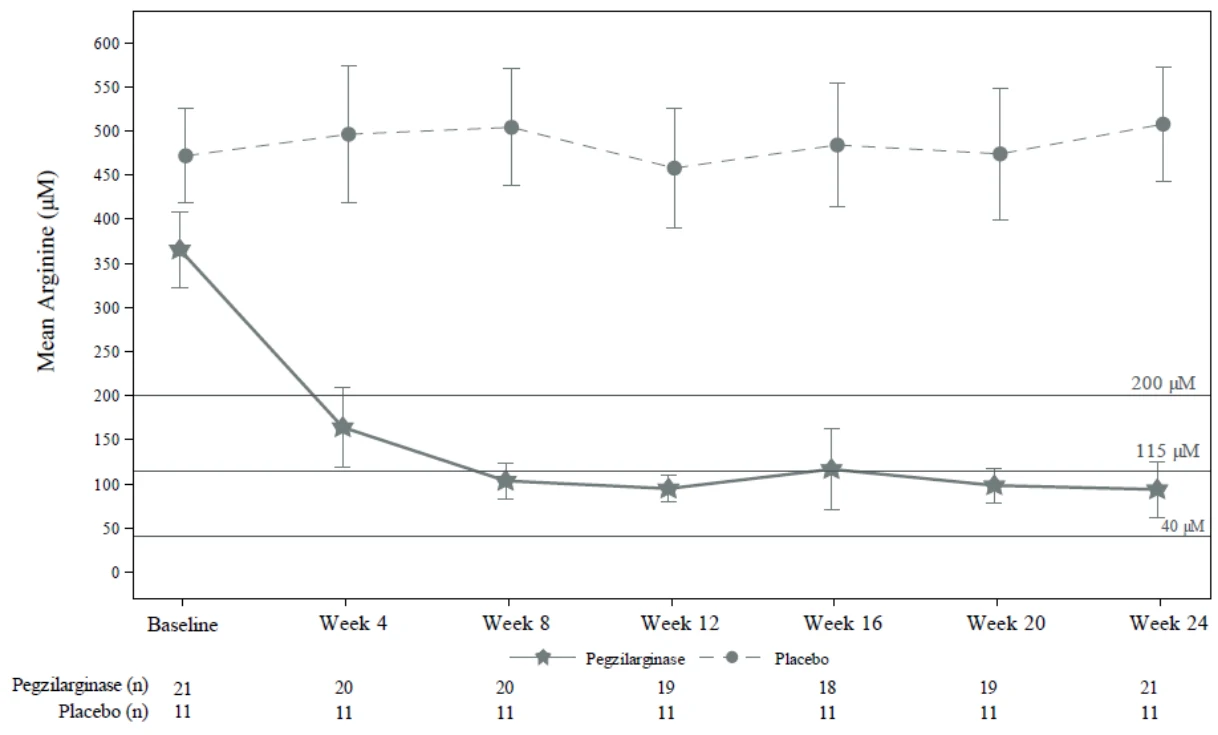
Notes: Medical guideline recommendation for plasma arginine: <200 μM; Normal range defined as 40–115 μM in the clinical trial.
Treatment with LOARGYS also resulted in numerical improvements in mobility relative to placebo after 24 weeks as assessed by GMFM-E and 2MWT performance. The estimated GMFM-E mean change from week 24 to baseline was 4.2 points in the LOARGYS arm vs -0.4 points in placebo arm (Adjusted difference: 4.6 (95 %CI; -1.1, 10.2)). The estimated 2WMT mean change from week 24 to baseline was 7.4 meters in the LOARGYS arm vs 1.9 meters in placebo arm (Adjusted difference: 5.5 (95 %CI; -15.6, 26.7)).
One subject withdrew consent due to personal reasons and discontinued the trial at week 6 of the DB period. All other subjects (N=31) entered the long-term extension part of the trial and were still on treatment at the time of study closure. The median duration of pegzilarginase exposure in the long-term extension period, excluding the DB period of 24 weeks, was 94 weeks (range: 62 to 152 weeks).
During the open-label extension, subjects who previously received pegzilarginase demonstrated sustained reductions in plasma arginine concentrations. Subjects initially randomized to placebo and treated with pegzilarginase in the open-label extension period showed similar reductions in plasma arginine concentrations.
16 Non-Clinical Toxicology
The non-clinical toxicology studies were conducted with rats, rabbits, and monkeys that have normal arginase-1 enzyme activity and therefore normal circulating arginine levels at baseline. Dose-dependent and adverse loss of appetite and reductions in body weight gain were attributed to marked and sustained arginine depletion below the normal range. These findings were reversible following cessation of pegzilarginase administration and could be due to exaggerated pharmacology. The relevance of such findings for ARG1-D patients is unclear.
General toxicology:
Repeat-dose toxicity
In the 13-week repeat-dose toxicity study, monkeys received pegzilarginase administered once weekly by IV bolus injection at doses of 0, 0.1, 0.3, or 1 mg/kg. Clinical signs observed at 1 mg/kg included decreased body weight, increased incidences of tremors, inappetence, watery feces, decreased activity, ataxia, muscle wasting, and/or unkempt/hunched appearance. Two males in the 1 mg/kg dose group were euthanized moribund on Days 26 and 71 due to body weight loss (approximately 25 % compared to Day -1).
Hematology changes included decreases in red cell mass, indicative of bone marrow suppression, at 0.3 mg/kg and 1 mg/kg in males and 1 mg/kg in females that did not completely reverse following the 4-week recovery; this finding was associated with increases in reticulocytes, which is considered a marker of a normal regenerative erythropoietic response. High-dose animals showed decreased neutrophil (up to 84% reduction), lymphocyte (up to 62% reduction), and/or platelet (up to 50% reduction) counts relative to individual baseline values; however, immunotoxicity assessments were not conducted. Decreased thymus weights were observed in main study females at 1 mg/kg and were considered secondary to stress. Some animals in the 1 mg/kg dosing group developed mucosal hyperplasia in the stomach and intestines, in some cases accompanied by erosion/ulceration of the rectal mucosa. Skin effects included sparse hair, dry and discolored skin, and epidermal hyperplasia in high-dose monkeys. No apparent PEGylation effects (i.e., cellular vacuolation of phagocytic or nonphagocytic cells related to the PEG moiety of pegzilarginase) were observed by histopathology.
Based on the adverse body weight effects in males and females at 1 mg/kg, resulting in the early euthanasia of 2 male animals at 1 mg/kg, the No Observed Adverse Effect Level (NOAEL) in male and female cynomolgus monkeys was 0.3 mg/kg (equal to 2-times the anticipated human exposure of patients [2 to 28 years of age] given the maximum recommended human dose [MRHD] of 0.2 mg/kg by IV injection based on area under the curve [AUC]).
Genotoxicity: No studies have been performed to evaluate the genotoxic potential of pegzilarginase.
Carcinogenicity: No long-term animal studies have been performed to evaluate the carcinogenic potential of pegzilarginase.
Reproductive and developmental toxicology:
Fertility and Early Embryonic Development
A fertility study was conducted to determine the potential effects of pegzilarginase on female and male fertility in rats administered 0.1, 0.3, or 1 mg/kg by IV bolus injection once per week 56 days prior to pairing in males until euthanasia (approximately gestation day [GD] 13 of females) and 14 days prior to pairing in females until GD 7. Two high-dose males were euthanized in extremis on study days 54 and 68 due to thin appearance. Male rats dosed at 1 mg/kg (0.8-times the MRHD, based on body surface area) showed statistically significantly decreased sperm motility (41% compared to 82% in controls) and concentration (4.5 X 10⁸ total sperm per gram cauda epididymis compared to 8.9 X 10⁸ total sperm per gram cauda epididymis in controls), as well as a statistically significantly increased abnormal sperm (40.9% compared to 2.3% in controls). In naïve female rats paired with males treated at 1 mg/kg/dose, pegzilarginase-related effects included a statistically significant reduction in uterine implantation sites and increased pre-implantation loss. Females dosed at 1 mg/kg (0.8-times the MRHD, based on body surface area) showed an increase in the number of non-pregnant animals (4 of 22), which reduced both the fertility and fecundity indices. The fertility and fecundity indices were 82%, which were below the indices for control females (100%) and outside the range of historical control data. The NOAEL for reproductive performance and fertility was 0.3 mg/kg/dose in males and females.
Embryo-Fetal Development
An embryo-fetal development toxicity study was conducted in pregnant rats dosed at 0.1, 0.3, or 1 mg/kg by IV bolus injection on GD 6, 11, and 16. At the 1 mg/kg/dose, where arginine levels were maintained below the normal range for the animal for 168 hours following dosing beginning GD 16, a pegzilarginase-related decrease in food consumption, mean gestational body weights, and mean gestational body weight gain were observed at various timepoints until the end of the study. Maternal clinical observations included thin body condition and loss of skin elasticity. Fetal body weights were reduced in both males (-11.5 %) and females (-8.7 %). Compared to controls (0%), there were statistically significant increases in the incidence of bent scapula (litter incidence of 31.6%), total skeletal malformations (31.6%), incompletely ossified interparietal bone (31.6%), and incompletely ossified parietal bone (31.6%) in the 1 mg/kg dosing group.
The incompletely ossified interparietal bone skeletal variation was outside the range of recent historical control data and considered test-article related, and indicative of a delay in development. The incidence of incompletely ossified parietal bone skeletal variation was within recent historical control data. Additional malformations of the forelimb bones were observed in a single fetus at 1 mg/kg/dose and included bent ulna, bent radius, and bent humerus. Of the above-mentioned malformations, the bent scapula was outside the historical control range (4.2 %) and bent humerus has not been seen in recent historical control data.
In conclusion, the NOAEL for maternal and developmental toxicity in rats was 0.3 mg/kg/dose (equal to 1-times the anticipated human exposure at the MRHD based on AUC).
An embryo-fetal developmental study was conducted in pregnant rabbits dosed at 0.06, 0.1, or 0.3 mg/kg by IV bolus injection on GD 6, 13, and 20. At 0.3 mg/kg/dose there was a statistically significant increase in observations of bent ribs (variation, litter incidence 47.4 %) that exceeded historical control data (4.5%). Malformations were observed in the 0.3 mg/kg/dose group that were not present in concurrent controls or in recent historical control data, these included a fetus with a bent clavicle and two fetuses with a bent radius, one of which also had a bent ulna.
At the 0.3 mg/kg/dose level, there were effects observed on maternal clinical observations, decreases in mean gestational body weight, mean gestational body weight gain, and mean gestational food consumption that were considered adverse. In fetuses, 0.3 mg/kg was considered adverse due to decreased body weights. The NOAEL for maternal and developmental toxicity was 0.1 mg/kg/dose (equal to 0.38-times the anticipated human exposure at the MRHD based on AUC).
Pre- and Postnatal Development
A rat study evaluated the possible adverse effects of pegzilarginase on the pregnant and lactating female and on the development of the conceptus and the offspring following exposure of the female from implantation (GD 6) through weaning (lactational day [LD] 20). Dose levels of 0.1, 0.3, or 1 mg/kg/dose were administered by IV injection once weekly to pregnant rats. The first filial generation (F1) female and male pups in the 1 mg/kg dosing group showed decreased body weights during lactation, at the time of vaginal opening or preputial separation, and for most of the growth period overall. Also, there was an effect on learning and memory from the passive avoidance testing in F1 males at 1 mg/kg/dose, as the overall latency of crossing over to the dark box for males was statistically significantly shorter on Days 2 and 3 of testing in comparison to concurrent controls. These observations were considered pegzilarginase-related and adverse. F1 males and females in the low- and mid-dose groups showed reduced fertility and fecundity indices (71% and 75%, respectively) compared to controls (91%) that were also outside the range of historical control data (80%). Two females in the control group, 6 females in the 0.1 mg/kg/dose group, 4 females in the 0.3 mg/kg/dose group, and 3 females in the 1 mg/kg/dose group were not pregnant. A NOAEL could not be determined for this study due to the changes in F1 fertility/fecundity observed at the lowest dose. Pegzilarginase was not detected in the blood of the F1 neonate (on postnatal day 4) or F1 pup at weaning (postnatal day 20). There was no assessment of pegzilarginase levels in maternal breastmilk. There were no assessments of arginine levels in maternal breastmilk or F1 blood.
Juvenile toxicity:
Juvenile rats were administered 0.1, 0.3, or 1 mg/kg by IV bolus injection once per week for 13-weeks or 6-months starting on PND 21 (approximately equivalent to 2 years of age in humans). At dose levels ≥ 0.3 mg/kg, rats developed hematology and clinical chemistry changes (e.g. decreases in red cell mass, increased reticulocytes, increased neutrophils, decreased eosinophils and creatine). At 1 mg/kg rats showed 12% to 24% reduction in body weight and developed clinical signs. At dose levels ≥ 0.3 mg/kg, males developed decreased testes, seminal vesicles, epididymides, and prostate organ weights. Atrophy was observed in the seminiferous tubules with loss and/or vacuolation of tubular germ cells. The male rat organ weight findings were reversable. The associated histological changes, which included reduced sperm motility, lower caudal epididymal sperm counts, and increased percentage of abnormal sperm, were not reversible in the recovery period of 6 weeks; however, it is noted that the normal sperm cycle is 9 weeks. The NOAEL was identified as 1 mg/kg administered once per week in females and 0.1 mg/kg administered once per week in males based on changes in reproductive organs observed at higher doses (equal to 7.0- and 0.6-times the anticipated human exposure at the MRHD based on AUC, respectively).
Juvenile rats administered 0, 0.3, 1, or 3 mg/kg by IV bolus injection once per week for 6-weeks produced similar findings as the long-term study. In addition, rats developed shorter femur and tibia (lengths that were 6 to 8 % lower than those of control rats). The NOAEL was identified as 1 mg/kg administered once per week (equal to 5-times the anticipated human exposure at the MRHD based on AUC).