


Product Monograph - Elfabrio
Recent Major Label Changes
| Not applicable. |
|---|
Table of Contents
Certain sections or subsections that are not applicable at the time of the preparation of the most recent authorized product monograph are not listed.
Recent Major Label Changes ……………………………………………………………………………………….……….2
Table of Contents ................................................................................................................... 2
PART 1: Healthcare Professional Information ......................................................................... 4
- 1.
Indications .................................................................................................................. 4
1.1. Pediatrics .............................................................................................................. 4
1.2. Geriatrics .............................................................................................................. 4
- 2. Contraindications ........................................................................................................ 4
- 3. Serious Warnings and Precautions Box ....................................................................... 4
- 4.
Dosage and Administration ......................................................................................... 4
4.1. Dosing Considerations .......................................................................................... 4
4.2. Recommended Dose and Dosage Adjustment ..................................................... 5
4.3. Reconstitution ...................................................................................................... 5
4.4. Administration ...................................................................................................... 7
4.5. Missed Dose ......................................................................................................... 9
- 5. Overdose..................................................................................................................... 9
- 6. Dosage Forms, Strengths, Composition and Packaging ................................................ 9
- 7.
Warnings and Precautions ........................................................................................... 9
General .......................................................................................................................... 10
Driving and Operating Machinery ................................................................................. 10
Immune .......................................................................................................................... 10
Monitoring and Laboratory Tests .................................................................................. 11
Renal .............................................................................................................................. 12
Reproductive Health: Female and Male Potential ........................................................ 12
7.1. Special Populations ............................................................................................. 12
7.1.1. Pregnancy ....................................................................................................... 12
7.1.2. Breastfeeding ................................................................................................. 12
7.1.3. Pediatrics ........................................................................................................ 12
7.1.4. Geriatrics ........................................................................................................ 12
- 8.
Adverse Reactions ..................................................................................................... 13
8.1. Adverse Reaction Overview ................................................................................ 13
8.2. Clinical Trial Adverse Reactions .......................................................................... 13
8.3. Less Common Clinical Trial Adverse Reactions ................................................... 15
- 9.
Drug Interactions ...................................................................................................... 15
9.2. Drug Interactions Overview ................................................................................ 15
9.3. Drug-Behaviour Interactions .............................................................................. 15
9.4. Drug-Drug Interactions ....................................................................................... 15
9.5. Drug-Food Interactions ....................................................................................... 15
9.6. Drug-Herb Interactions ....................................................................................... 15
9.7. Drug-Laboratory Test Interactions ...................................................................... 15
- 10.
Clinical Pharmacology ............................................................................................... 15
10.1. Mechanism of Action ...................................................................................... 15
10.2. Pharmacodynamics ........................................................................................ 15
10.3. Pharmacokinetics ........................................................................................... 16
10.4. Immunogenicity .............................................................................................. 17
- 11. Storage, Stability and Disposal .................................................................................. 19
PART 2: Scientific Information .............................................................................................. 20
- 13. Pharmaceutical Information ...................................................................................... 20
- 14.
Clinical Trials ............................................................................................................. 21
14.1. Clinical Trials by Indication ............................................................................. 21
- 16. Non-Clinical Toxicology ................................................................................................... 23
Patient Medication Information ........................................................................................... 26
PART 1: Healthcare Professional Information
1. Indications
ELFABRIO (pegunigalsidase alfa for injection) is an enzyme replacement therapy indicated for the long-term treatment of adult patients with a confirmed diagnosis of Fabry disease (deficiency of α-galactosidase A).
1.1. Pediatrics
Pediatrics (<18 years of age): No data are available to Health Canada; therefore, Health Canada has not authorized an indication for pediatric use.
1.2. Geriatrics
Geriatrics (≥65 years): The safety and efficacy of ELFABRIO in patients older than 65 years have not been established. Clinical studies of ELFABRIO did not include patients 65 years of age and older to determine if they respond differently from younger adult patients. Caution should be exercised when prescribing in patients 65 years of age and older.
2. Contraindications
ELFABRIO is contraindicated in patients who are hypersensitive to this drug or to any ingredient in the formulation, including any non-medicinal ingredient, or component of the container (see 6 Dosage Forms, Strengths, Composition and Packaging).
3. Serious Warnings and Precautions Box
Hypersensitivity Reactions Including Anaphylaxis
- Patients treated with ELFABRIO have experienced severe hypersensitivity reactions, including anaphylaxis. Appropriate medical support measures, including cardiopulmonary resuscitation equipment, should be readily available during ELFABRIO administration. Patients should be monitored during and after infusions. If a severe hypersensitivity reaction (e.g., anaphylaxis) occurs, infusion should be immediately paused, appropriate medical treatment initiated, and the benefits and risks of re-administration of ELFABRIO should be considered (see Immune).
4. Dosage and Administration
4.1. Dosing Considerations
- ELFABRIO treatment must be managed by a healthcare professional experienced in the treatment of patients with Fabry disease.
- Appropriate medical support measures should be readily available when ELFABRIO is administered to patients who have not had treatment before, or who have experienced severe hypersensitivity reactions to enzyme replacement therapy (ERT) including ELFABRIO in the past.
In ERT-experienced patients, if pre-treatment with antihistamines, antipyretics, and/or corticosteroids was used prior to ERT administration, consider similar pre-treatment with these
- medications before the first several ELFABRIO infusions. After the initial 3 months (6 infusions) of treatment with ELFABRIO, a stepwise decrease in the pre-treatment regimen and/or discontinuation of the pre-treatment medication(s) can be considered based on appropriate tolerability of the patient to ELFABRIO.
- In ERT-naïve patients, prior to ELFABRIO administration, pre-treating with antihistamines, antipyretics, and/or corticosteroids may be considered (see Immune).
4.2. Recommended Dose and Dosage Adjustment
The recommended dosage of ELFABRIO, based on actual body weight, is 1 mg/kg administered by intravenous infusion every other week. The initial recommended ELFABRIO infusion rates for ERT-experienced or ERT-naïve patients are based on actual body weight (see 4.4 Administration).
Patients with renal or hepatic impairment: No specific dose adjustments for ELFABRIO are recommended for these patients (see 10.3 Pharmacokinetics).
Geriatric use (≥65years): Safety and efficacy of ELFABRIO in patients older than 65 years have not been evaluated and no alternative dose regimens can be recommended for these patients.
Pediatric use (<18 years): Health Canada has not authorized an indication for pediatric use (see 1.1 Pediatrics).
Modifications Due to Hypersensitivity Reactions and/or Infusion-Associated Reactions
In the event of a severe hypersensitivity reaction (e.g., anaphylaxis) or severe infusion-associated reaction (IAR), immediately discontinue ELFABRIO administration and initiate appropriate medical treatment. For additional recommendations in the event of a severe hypersensitivity reaction or IAR, see Immune.
In the event of a mild to moderate hypersensitivity reaction or a mild to moderate IAR, consider temporarily holding the infusion for 15 to 30 minutes, slowing the infusion rate by 25% to 50% of the recommended rate, and initiating appropriate medical treatment (see Immune).
If symptoms persist despite temporarily holding or slowing the infusion, stop the infusion and monitor the patient. If symptoms continue to persist, discontinue the infusion, and consider re-initiating the infusion within 7 to 14 days with appropriate pre-treatment.
If symptoms subside following holding or slowing the infusion, resume infusion at 25% to 50% of the rate at which the reaction occurred. If tolerated, increase the infusion rate by increments of 25% of the recommended rate every third infusion until the recommended infusion rate is reached. Closely monitor the patient.
4.3. Reconstitution
Parenteral Products
Preparation before infusion:
- Use aseptic technique during preparation.
- Each vial of ELFABRIO is for single-use only.
- Shaking or agitating this medicinal product must be avoided.
Calculating the dose:
Determine the number of ELFABRIO vials required for the infusion based on actual body weight in kg and the recommended dose (see 4.2 Recommended Dose and Dosage Adjustment and 6 Dosage Forms, Strengths, Composition and Packaging).
- 1. Patient’s body weight (kg) x dose (mg/kg) = Patient dose (mg).
- 2.
Patient’s dose (in mg) divided by 2 mg/mL (per vial) = Total volume needed to dilute.
- Each vial has a concentration of 2 mg/mL with an extractable volume of 10.0 mL (20 mg/10 mL) or 2.5 mL (5 mg/2.5 mL).
- If the number of vials includes a fraction, round up to the next whole number.
Example: in a 80 kg patient dosed at 1 mg/kg
- Patient dose (mg): 80 kg x 1 mg/kg = 80 mg total dose.
- Total volume needed: 80 divided by 2 mg/mL (concentration per vial) = 40 mL.
Number of vials to use:
- For 20 mg/10 mL vials: 80 mg/20 mg = 4 vials.
- For 5 mg/2.5 mL vials: 80 mg/5 mg = 16 vials.
Items needed for dilution:
- ELFABRIO 2 mg/mL vials (10 mL or 2.5 mL).
- Sodium chloride 9 mg/mL (0.9%) for injection at room temperature of 20°C to 25°C Note: Choose a bag size(s) sufficient to dose based on the patient’s body weight.
- A needle of 18 gauge or lesser diameter.
- Do not use filter needles during preparation of the infusion.
Dilution and preparation of the infusion:
- 1. Remove the appropriate number of ELFABRIO vials from the refrigerator and allow the vials to sit for 15-30 minutes at room temperature 20°C to 25°C (68°F to 77°F) before use. Avoid shaking or agitating the vials. Do not use an external heat source to heat the product because heat may damage the product.
- 2. Visually inspect the solution in the vials for particulate matter and discoloration. The solution should be clear and colorless. Discard if the solution is discolored or if visible particulate matter is present.
- 3. Dilute the supplied ELFABRIO solution required for a dose in 0.9% Sodium Chloride Injection to a total volume based on actual body weight specified in Tables 1 and 2 below.
- 4. Prior to adding the volume of ELFABRIO required for the dose, remove airspace within an infusion bag. Remove an equal volume of 0.9% Sodium Chloride Injection solution that will be replaced by the volume (mL) of ELFABRIO needed for the bag. Avoid foaming in the syringe. Withdraw the volume of ELFABRIO required for the dose from the vials (discard any unused solution remaining in the vial).
- 5. Slowly inject the ELFABRIO solution directly into the 0.9% Sodium Chloride Injection solution through the port of the infusion bag. Do not inject in the airspace that may remain within the infusion bag.
- 6. Gently invert or massage the infusion bag to mix the diluted solution to prevent foaming. Avoid vigorous shaking or agitation. Do not use a pneumatic tube to transport the infusion bag.
The infusion solution should be administered as close to after dilution preparation as possible at room temperature (see 4.4 Administration and 11 Storage, Stability and Disposal).
Preparing for administration:
If it is not possible to start the infusion following dilution, the diluted solution is stable for up to 24 hours refrigerated at 2°C to 8°C, followed by up to 8 hours at room temperature. Refer to the in-use stability storage conditions (see 11 Storage, Stability and Disposal). Do not freeze or shake.
The normal saline bag for infusion containing ELFABRIO is administered using an infusion pump. Prior to infusion, inspect the infusion bag for foaming and if foaming is present, let foaming dissipate. Avoid shaking and handle infusion bag gently to prevent foaming.
An intravenous administration set should be used with a low protein-binding, 0.2 micron, in-line filter. If the intravenous line blocks during infusion, change the filter.
Other medicines should not be infused in the same intravenous line as the diluted ELFABRIO solution.
4.4. Administration
ELFABRIO is to be administered by intravenous infusion.
After comprehensive evaluation of IAR risks, infusion can be administered in all sites of patient care including at home, in-clinic, and in hospital, where all administration must be conducted under the supervision of a healthcare professional (see 2 Contraindications and 7 Warnings and Precautions).
The total volume of infusion is determined by the patient’s body weight. For the initial 4-6 infusions, infuse ELFABRIO using the infusion rates described in Table 1 for ERT-experienced patients and Table 2 for ERT-naïve patients.
At the end of the infusion, flush the line with 0.9% Sodium Chloride Injection using the same infusion rate as the one used for the last part of the ELFABRIO infusion.
ERT-experienced patients:
Table 1 presents the recommended infusion rates for the initial 4-6 ELFABRIO infusions based on actual body weight for ERT-experienced patients.
Table 1. Recommended Infusion Rate1 for ERT-Experienced Patients for the Initial 4-6 ELFABRIO Intravenous Infusions Based on Actual Body Weight
| Actual Body Weight | Total Infusion Volume | Infusion Rate1 |
|---|---|---|
| ˂70 kg | 150 mL | 0.83 mL/min (50 mL/h) |
| 70-100 kg | 250 mL | 1.39 mL/min (83 mL/h) |
| >100 kg | 500 mL | 2.78 mL/min (167 mL/h) |
1 Infusion rate may be increased if the patient tolerates the initial 4-6 infusions. Infusion rate may be slowed in case of a hypersensitivity reaction or an IAR (see 4.2 Recommended Dose and Dosage Adjustment).
ERT-naïve patients:
Table 2 presents the recommended infusion rates for the initial 4-6 ELFABRIO infusions based on actual body weight for ERT-naïve patients.
Table 2. Recommended Infusion Rate1 for ERT-Naïve Patients for the Initial 4-6 ELFABRIO Intravenous Infusions Based on Actual Body Weight
| Actual Body Weight | Total Infusion Volume | Infusion Rate1 |
|---|---|---|
| ˂70 kg | 150 mL | 0.63 mL/min (37.5 mL/h) |
| 70-100 kg | 250 mL | 1 mL/min (60 mL/h) |
| >100 kg | 500 mL | 1.38 mL/min (83 mL/h) |
1 Infusion rate may be increased if the patient tolerates the initial 4-6 infusions. Infusion rate may be slowed in case of a hypersensitivity reaction or an IAR (see 4.2 Recommended Dose and Dosage Adjustment).
Administration of ELFABRIO to Patients Previously Treated with ERT with an Infusion Duration Over 3 Hours
In patients previously treated with an ERT with an infusion duration over 3 hours:
- Use the same infusion rate for the ELFABRIO infusion.
- May decrease the duration of every third infusion after the initial 4-6 ELFABRIO infusions in decrements of 30 minutes as tolerated. The recommended minimum infusion duration of the maintenance infusion is 1.5 hours.
Home Infusion
Infusion of ELFABRIO at home under the supervision of a healthcare professional may be considered for patients who meet the criteria below. The decision to have a patient move to home infusion should be made after evaluation and upon recommendation by the treating healthcare professional (see 7 Warnings and Precautions).
The treating healthcare professional should be consulted if the patient experiences significant infusion reactions or if changes to recommended dose and/or infusion rate are required. The infusion duration should remain constant for home administration and the duration should only be decreased in a healthcare facility. In case of a missed dose or delayed infusion, a healthcare professional should be contacted.
A patient’s underlying co-morbidities and ability to adhere to the home infusion requirements need to be taken into account when evaluating the patient for eligibility to receive home infusion. The following criteria should be considered:
- The patient must have no ongoing concurrent condition that, in the opinion of the healthcare professional, may affect the patient’s ability to tolerate the infusion.
- The patient is considered medically stable. A comprehensive evaluation must be completed before the initiation of home infusion.
- The patient must have received ELFABRIO infusions for a few months that could be in a hospital or in another appropriate setting of outpatient care. Documentation of a pattern of well-tolerated infusions is a prerequisite for the initiation of home infusion.
- The patient must be willing and able to comply with home infusion procedures.
- Home infusion infrastructure, resources, and procedures, including training, must be established and available to the home infusion staff. The home infusion staff should be available during the home infusion and for a specified time after infusion, depending on the patient’s tolerance prior to starting home infusion.
- For patients switching to ELFABRIO from another ERT, it is recommended that the first infusions of ELFABRIO occur in a hospital/clinic setting due to the risk of IARs.
If the patient experiences adverse reactions during the home infusion, the infusion process should be stopped immediately, and appropriate medical treatment should be initiated (see 7 Warnings and Precautions). Subsequent infusions may need to occur in a hospital or in an appropriate setting of outpatient care until no such adverse reaction is present. Dose and infusion rate must not be changed without consulting the responsible healthcare professional.
Patients and/or healthcare professionals must be informed about the risks associated with home infusion of ELFABRIO and receive proper education on managing severe IARs. This includes understanding necessary actions and emergency contact details, which should be documented in the patient's infusion diary. Educational risk materials for home infusion are available through the manufacturer.
4.5. Missed Dose
If one or more doses are missed, restart ELFABRIO treatment as soon as possible, returning to the prescribed 2 week interval between infusions thereafter. Do not double a dose to compensate for a missed dose.
5. Overdose
There is no experience with overdose of ELFABRIO during clinical trials. In the event of an overdose, supportive medical care should be administered immediately including consulting with a healthcare professional and close observation of the clinical status of the patient.
For the most recent information in the management of a suspected drug overdose, contact your regional poison control centre or Health Canada’s toll-free number, 1-844 POISON-X (1-844-764-7669).
6. Dosage Forms, Strengths, Composition and Packaging
Table 3. Dosage Forms, Strengths, Composition and Packaging
Description
The active substance, pegunigalsidase alfa, is a covalent conjugate of prh-α-galactosidase A with polyethylene glycol (PEG).
Each vial contains 20 mg of pegunigalsidase alfa in a volume of 10 mL or 5 mg of pegunigalsidase alfa in a volume of 2.5 mL, at a concentration of 2 mg/mL.
The concentrate must be diluted further prior to administration (see 4.3 Reconstitution).
Package size: 1 vial per carton.
7. Warnings and Precautions
Please see 3 Serious Warnings and Precautions Box
| Route of Administration | Dosage Form/Strength/Composition | Non-Medicinal Ingredients |
| Intravenous infusion | Concentrate solution, 2 mg/mL | Citric acid, Sodium chloride, Sodium citrate tribasic dihydrate, Water for injection |
General
Patients that received prior ERT are more likely to have pre-existing anti-drug antibodies (ADA) to pegunigalsidase alfa which could be due to the ADA cross-reactivity to pegunigalsidase alfa by prior ERT. When switching from other ERT to ELFABRIO:
- Pre-existing ADA may reduce the plasma pegunigalsidase alfa concentrations, which may reduce ELFABRIO efficacy (see 10.4 Immunogenicity).
- The risk of ELFABRIO-related hypersensitivity and infusion-associated reactions may be increased in certain patients with pre-existing ADA from prior ERT (see Immune, and 8.2 Clinical Trial Adverse Reactions).
Consider monitoring clinical or pharmacodynamic responses (e.g., plasma lyso-Gb3 levels) when switching from agalsidase beta to ELFABRIO, in patients with pre-existing ADA (see Monitoring and Laboratory Tests).
Driving and Operating Machinery
Since dizziness and vertigo have been reported as adverse reactions, ELFABRIO may influence the ability to drive and use machines. Caution is required when driving or operating a vehicle or potentially dangerous machinery.
Immune
Hypersensitivity Reactions including Anaphylaxis
Hypersensitivity reactions including anaphylaxis have been reported in ELFABRIO-treated patients (see 8.1 Adverse Reaction Overview). In clinical trials, 20 (14%) of ELFABRIO-treated patients experienced hypersensitivity reactions. In these trials, 4 ELFABRIO-treated patients (3%; 1 naïve to ERT and 3 ERT-experienced patients) experienced anaphylaxis during the initial infusion and were positive for anti-pegunigalsidase alfa IgE antibodies (referred to as IgE ADA) (see 8.1 Adverse Reaction Overview, 8.2 Clinical Trial Adverse Reactions, and 10.4 Immunogenicity). The risk of pegunigalsidase alfa-related hypersensitivity may be increased in certain patients with pre-existing ADA from prior ERT (see General). Consider monitoring patients who demonstrate hypersensitivity reactions during ELFABRIO treatment for the presence of IgG and IgE ADA (see Monitoring and Laboratory Tests, and 10.4 Immunogenicity).
Premedication with oral antihistamine, antipyretics, and/or corticosteroids may be administered to assist with signs and symptoms related to hypersensitivity reactions experienced with prior ERT treatment. Reduction of the infusion rate, temporary interruption of the infusion, symptomatic treatment with oral antihistamine or antipyretics, and appropriate medical support should be readily available to manage serious hypersensitivity reactions during ELFABRIO administration.
If anaphylaxis or severe allergic reactions occur, infusion should be immediately discontinued, and appropriate medical treatment should be initiated. The current medical standards for emergency treatment of anaphylactic reactions are to be observed and cardiopulmonary resuscitation equipment should be readily available.
The risks and benefits of re-administering ELFABRIO following severe hypersensitivity reactions (including anaphylaxis) should be carefully considered. Patients may be rechallenged using slower infusion rates. In patients with severe hypersensitivity reaction, desensitization measures to ELFABRIO may be considered. Desensitization involves administering small, incremental doses of ELFABRIO under controlled conditions and at carefully timed intervals to induce temporary immune tolerance, to reduce the patient’s immune reactivity and allow continued treatment. If the decision is made to readminister ELFABRIO, ensure the patient tolerates the infusion. If the patient tolerates the infusion, the rate may be increased to reach the recommended rate. If a mild or moderate hypersensitivity reaction occurs, consider temporarily holding the infusion or slowing the infusion rate (see 4.2 Recommended Dose and Dosage Adjustment).
If a patient experiences anaphylaxis or severe allergic reactions in the home setting, and if the patient continues therapy, their next infusions must occur in a clinical setting equipped to deal with such medical emergencies.
Infusion-Associated Reactions
In clinical trials, infusion-associated reactions (IARs) were reported to occur at any time during and/or within a few hours after the ELFABRIO infusion (see 8.2 Clinical Trials Adverse Reactions). One or more IARs were experienced by 41 (29%) of ELFABRIO-treated patients. The most commonly observed symptoms of IARs were hypersensitivity, itching, nausea, dizziness, chills and muscular pain. The risk of pegunigalsidase alfa-related IARs may be increased in certain patients with pre-existing ADA from prior ERT and severe IARs are more likely to occur in ADA positive patients (see General). Patients who develop infusion or immune reactions with ELFABRIO treatment should be monitored (see Monitoring and Laboratory Tests).
Patients with advanced Fabry disease may have compromised cardiac function which may predispose them to a higher risk of severe complications from IARs. Closely monitor patients with compromised cardiac function if ELFABRIO is administered to these patients.
Pre-treatment with antihistamines, antipyretics, and/or corticosteroids may prevent subsequent reactions in those cases where symptomatic treatment was required, although IARs occurred in some patients after receiving pre-treatment (see 4.1 Dosing Considerations). For management of IARs see 4.2 Recommended Dose and Dose Adjustment.
The presence of ADAs to ELFABRIO may be associated with a higher risk of IARs, and severe IARs are more likely to occur in ADA positive patients. Patients who develop infusion or immune reactions with ELFABRIO treatment should be monitored.
Additionally, patients who are ADA positive to other enzyme replacement therapies, who have experienced hypersensitivity reactions to ELFABRIO and patients who are switching to ELFABRIO should be monitored.
Monitoring and Laboratory Tests
Consider monitoring patients who demonstrate hypersensitivity reactions or IARs during ELFABRIO treatment for the presence of IgG and IgE ADA (see 10.4 Immunogenicity).
Consider regular monitoring of renal function (e.g. serum creatinine and urinary protein to creatinine ratio) if there is a clinical concern about renal function decline.
Closely monitor patients with compromised cardiac function, as this may predispose them to a higher risk of severe complications from IARs.
Consider monitoring clinical or pharmacodynamic responses (e.g., plasma lyso-Gb3 levels) when switching from agalsidase beta or agalsidase alfa to ELFABRIO, in patients with pre-existing ADA.
Renal
A severe case of membranoproliferative glomerulonephritis was reported during the clinical trials due to immune depositions in the kidney (see 8.1 Adverse Reaction Overview). This event led to a decline in renal function, which improved upon discontinuation of ELFABRIO but did not return to baseline by the end of the trial. Monitor serum creatinine and urinary protein to creatinine ratio (see Monitoring and Laboratory Tests). If membranoproliferative glomerulonephritis is suspected, discontinue ELFABRIO until a diagnostic evaluation can be conducted.
Reproductive Health: Female and Male Potential
Fertility
There are no studies assessing the potential effect of pegunigalsidase alfa on fertility in humans.
7.1. Special Populations
7.1.1. Pregnancy
There are no available data on the use of ELFABRIO in pregnant women. Therefore, the use of ELFABRIO is not recommended during pregnancy. Animal reproductive and developmental toxicity studies have been conducted with pegunigalsidase alfa. Maternal toxicity and embryo-fetal toxicity were observed following intravenous administration of pegunigalsidase alfa to pregnant rabbits at doses of 10 and 20 mg/kg body weight twice per week. Maternal toxicity consisted of mortality and decreased body weight and food consumption. Embryo-fetal toxicity consisted of increased incidences of abortions, late resorptions, post-implantation loss, and small fetuses, as well as decreased fetal weights. Pegunigalsidase alfa was also shown to cross the placental barrier following intravenous administration to pregnant rats, resulting in fetal exposure (see 16 Non-Clinical Toxicology).
There is a pregnancy safety study for ELFABRIO. If a patient becomes pregnant while receiving ELFABRIO, healthcare providers should report ELFABRIO exposure by calling 1-888-661-9260 or visiting https://chiesirarediseases.com/contact-us/medicalinformation-form.
7.1.2. Breastfeeding
It is unknown if pegunigalsidase alfa is excreted in human milk. Available data in animals have shown excretion of pegunigalsidase alfa in milk (see 16 Non-Clinical Toxicology). A risk of newborns/infants exposure to ELFABRIO through breast milk cannot be excluded. The developmental and health benefits of breastfeeding should be considered along with the mother’s clinical need for ELFABRIO and any potential adverse effects on the breastfed infant from pegunigalsidase alfa.
7.1.3. Pediatrics
Pediatrics (<18 years): No data are available to Health Canada; therefore, Health Canada has not authorized an indication for pediatric use.
7.1.4. Geriatrics
The safety and efficacy of ELFABRIO in patients older than 65 years have not been established. Clinical studies of ELFABRIO did not include patients 65 years of age and older to determine if they respond differently from younger adult patients. Caution should be exercised when prescribing in these patients.
8. Adverse Reactions
8.1. Adverse Reaction Overview
Safety data were available for 141 patients (94 male and 47 female) treated with pegunigalsidase alfa at any dose or dosing regimen in clinical studies. Overall, cumulative exposure amounted to 4874.71 patient months (about 406 patient years). The mean exposure time was 34.3 months with a maximum exposure duration of 91 months (approximately 7.5 years). The safety database included 17 ERT-naïve patients and 124 ERT-experienced patients (switching from agalsidase beta or agalsidase alfa to ELFABRIO).
The most frequently reported (>15%) treatment-emergent adverse events (TEAEs) were nasopharyngitis, fatigue, headache, back pain, cough, diarrhea, pain in extremity, nausea, upper respiratory tract infection, pyrexia, and sinusitis. Related events, which occurred in 41.1% of patients overall, were mostly considered IARs, generally mild or moderate in intensity, and resolved on continued treatment.
Hypersensitivity reactions have been reported in 20 (14%) of ELFABRIO-treated patients. A total of 43 subjects experienced at least one serious AE while on treatment with ELFABRIO. Related serious AEs were reported for 5 patients (3.5%), and 4 of the 5 ELFABRIO-treated patients (1 naïve to ERT and 3 ERT-experienced patients) experienced anaphylaxis during the initial infusion and were positive for anti-pegunigalsidase alfa IgE ADA (see Immune, 8.2 Clinical Trial Adverse Reactions, and 10.4 Immunogenicity). In addition, a case of chills was reported in an ERT-experienced patients after 6 months of treatment with ELFABRIO.
One additional severe related TEAE was a case of membranoproliferative glomerulonephritis reported in a patient with a history of proteinuria that had not resolved by the end of follow-up. A biopsy revealed the immune-complex mediated nature of this event. Upon discontinuation of the treatment, the eGFR values stabilized and the glomerulonephritis was reported as resolving.
8.2. Clinical Trial Adverse Reactions
Clinical trials are conducted under very specific conditions. The adverse reaction rates observed in the clinical trials; therefore, may not reflect the rates observed in practice and should not be compared to the rates in the clinical trials of another drug.
The safety of ELFABRIO was evaluated in a Phase 3 randomized, double-blind, active-controlled study (Trial 2) included 77 ERT-experienced adult patients with confirmed Fabry disease who were randomized to receive treatment with ELFABRIO or agalsidase beta (see 14.1 Clinical Trials by Indication).
The most common adverse reactions that were reported in ≥2% of patients treated with ELFABRIO from Trial 2 are listed by MedDRA system organ class in Table 4.
Table 4. Adverse Reactions Reported in ≥2% of ELFABRIO-Treated Patients in Trial 2
System Organ Class Adverse Reaction | ELFABRIO N=52 n(%) | Agalsidase beta N=25 n(%) |
|---|---|---|
Gastrointestinal disorders vomiting nausea | 2 (3.8%) 2 (3.8%) | 0 1 (4.0%) |
General disorders and administration site conditions fatigue chills | 3 (5.8%) 2 (3.8%) | 2 (8.0%) 1 (4.0%) |
Immune system disorders hypersensitivity | 2 (3.8%) | 1 (4.0%) |
Injury, poisoning and procedural complications Infusion-associated reaction | 2 (3.8%) | 1 (4.0%) |
Nervous system disorders headache paresthesia | 2 (3.8%) 2 (3.8%) | 2 (8.0%) 1 (4.0%) |
Infusion-associated reactions (IARs) (adverse reactions within 2 hours of infusion)
In clinical trials, IARs were reported to occur during the ELFABRIO infusion or within a few hours following its completion. Overall, 41 of ELFABRIO-treated patients (29%) experienced at least one IAR. The most commonly observed symptoms included hypersensitivity, itching, nausea, dizziness, chills and muscular pain. IARs predominantly occurred within the first year of treatment with ELFABRIO and no serious IAR was observed during the second year and beyond.
Among patients treated with 1 mg/kg every other week, IARs were reported in 26 patients (23%). Five severe and serious IARs were observed in male patients and 4 of these events were confirmed as IgE-mediated hypersensitivity reactions (bronchospasm, Type 1 hypersensitivity) that occurred at the first infusion of ELFABRIO and led to study discontinuation. These cases corresponded to a rate of 1.4 events per 100 patient-years. All affected patients recovered with appropriate management, although each event resulted in discontinuation of treatment. The remaining IARs were generally mild to moderate in severity and resolved without interruption of therapy.
The risk of ELFABRIO-related hypersensitivity and infusion-associated reactions may be increased in certain patients with pre-existing ADA from prior ERT (see General).
Of these 5 patients suffering severe and serious IAR, 1 patient was treatment naïve in Trial 1 and was IgE positive and IgG negative at baseline with treatment induced IgG ADA after the first and only dose. The other four patients with severe and serious IAR were treatment-experienced with only two of those patients having pre-existing IgG ADA at baseline.
Overall, 16/26 (61%) patients with IARs were ADA-positive (10 patients with pre-existing values, 6 patients induced during treatment), however 3 out of the 5 patients with severe and serious IARs were ADA IgG positive (2 with pre-existing ADA at baseline, 1 with treatment-induced ADA).
8.3. Less Common Clinical Trial Adverse Reactions
Renal: Glomerulonephritis membranoproliferative
9. Drug Interactions
9.2. Drug Interactions Overview
No interaction studies have been performed using ELFABRIO.
9.3. Drug-Behaviour Interactions
The interaction of ELFABRIO with individual behavioural risks (e.g. cigarette smoking, cannabis use, and/or alcohol consumption) has not been studied.
9.4. Drug-Drug Interactions
Interactions with other drugs have not been established.
9.5. Drug-Food Interactions
Interactions with food have not been established.
9.6. Drug-Herb Interactions
Interactions with herbal products have not been established.
9.7. Drug-Laboratory Test Interactions
Interactions with laboratory tests have not been established.
10. Clinical Pharmacology
10.1. Mechanism of Action
The active substance of ELFABRIO is pegunigalsidase alfa, a pegylated recombinant form of human α-galactosidase A.
Pegunigalsidase alfa provides an exogenous α-galactosidase A, the enzyme that catalyses the hydrolysis of the terminal α-galactosyl moieties of oligosaccharides and polysaccharides in the lysosome, reducing accumulated globotriaosylceramide (Gb3) and globotriaosylsphingosine (Lyso-Gb3) caused by α-galactosidase A deficiency in Fabry disease.
10.2. Pharmacodynamics
Plasma globotriaosylsphingosine (lyso-Gb3, a metabolite of Gb3) concentrations are elevated in patients with Fabry disease who were:
ERT-naïve or had not received ERT treatment for at least 26 weeks and had a negative test for anti-pegunigalsidase alfa antibodies (Trial 1 and its long term extension study), ELFABRIO treatment resulted in significant reductions in median plasma lyso-Gb3 concentrations from baseline approximately:
- 43% (Week 4), 57% (Week 26), 68% (Week 52), and 84% (Week 104) in male patients, and
- 3% (Week 4), 19% (Week 26), 32% (Week 52), and 75% (Week 104) in female patients.
ERT-experienced for at least 104 weeks (Trial 2), switching to ELFABRIO treatment resulted in increases in median plasma lyso-Gb3 concentrations from baseline:
- Approximately 14% (Week 6), 15% (Week 26), and 18% (Week 104) in male patients, and
- No significant changes in median plasma lyso-Gb3 concentrations in female patients.
Pegunigalsidase alfa exposure-response relationship is unknown.
10.3. Pharmacokinetics
The pharmacokinetics (PK) of pegunigalsidase alfa were evaluated in adult patients with Fabry disease. The pharmacokinetics of pegunigalsidase alfa in plasma following intravenous infusion of ELFABRIO 1 mg/kg every other week in adult treatment-naïve patients with Fabry disease (Trial 1; see 14 Clinical Trials) are summarized in Table 5. The maximum plasma concentration (Cmax) and area under the concentration-time curve (AUC) of pegunigalsidase alfa increased with longer duration of treatment. In adult ERT-experienced patients with Fabry disease, mean Cmax ranged from 21.2 to 23.3 μg/mL and mean AUCtau ranged from 958 to 1074 μg·h/mL following intravenous infusion of ELFABRIO 1 mg/kg every other week.
Table 5. Summary of Pegunigalsidase Alfa Pharmacokinetic Parameters in Adult ERT-Naïve1 Patients with Fabry Disease Following Intravenous Infusion of ELFABRIO 1 mg/kg Every Other Week
| Mean Infusion duration (h) | Number of subjects | Cmax (µg/mL) | t½ (h) | AUC0-∞ (µg·h/mL) | CL (mL/h/kg) | Vd (mL/kg) | |
| Day 1 | 5.5 | 6 | 11.1±2.4 | 78.9±10.3 | 391±136 | 2.9±0.7 | 321±71 |
| Week 13 | 4.4 | 6 | 11.9±2.4 | 85.7±28.4 | 510±174 | 2.3±0.8 | 271±89 |
| Week 26 | 3.9 | 6 | 13.3±3.0 | 96.5±31.4 | 748±200 | 1.6±0.6 | 226±116 |
| Week 52 | 3.3 | 6* | 17.3±6.1 | 121±22 | 1428±875 | 1.1±0.7 | 186±91 |
PK parameters are presented as arithmetic mean ± standard deviation
Cmax=maximum plasma concentration; AUC=area under the plasma concentration-time curve; Vd= volume of distribution; t1/2=elimination half-life; CL=clearance
1 Includes patients who had not received ERT for at least 26 Weeks and who tested negative for anti-pegunigalsidase alfa antibodies at screening.
* n=5 for t1/2 and related parameters (AUC0-∞, CL, Vd) because of non-estimated t1/2 in one subject
Special populations and conditions
Hepatic impairment: No formal studies have been conducted to assess the effect of hepatic impairment on PK of pegunigalsidase alfa.
Renal impairment: No formal study was conducted to assess the effect of renal impairment on PK of pegunigalsidase alfa. Pegunigalsidase alfa is a protein and is expected to be metabolically degraded through peptide hydrolysis. Intact pegunigalsidase alfa (molecular weight of approximately 116 kDa) is unlikely to be filtered by kidney or excreted in urine.
10.4. Immunogenicity
The observed incidence of IgG anti-drug antibodies (ADA) is highly dependent on the sensitivity and specificity of the assay. Differences in assay methods preclude meaningful comparisons of the incidence of ADA in the studies described below with the incidence of ADA in other studies, including those of pegunigalsidase alfa ELFABRIO or of other pegunigalsidase alfa products.
The incidences of IgG ADA in ELFABRIO-treated patients with Fabry disease in Trials 1 and 2 are shown in Table 6.
Immunogenicity in ERT-Naïve Patients or Those Who Did Not Receive ERT for 26 Weeks
In Trial 1 (ERT-naïve patients with Fabry disease or those who did not receive ERT for 26 weeks):
- Four of the 14 ELFABRIO-treated who were IgG anti-pegunigalsidase alfa antibodies (anti-drug antibodies or ADA) negative at baseline became ADA positive during ELFABRIO treatment. The onset of ADA positivity in 3 of these patients occurred within 26 weeks after starting ELFABRIO treatment.
- Two patients had ADA prior to receiving their first ELFABRIO dose. One of these patients remained ADA positive after receiving ELFABRIO treatment (this patient had boosted antibody titers during ELFABRIO treatment).
Immunogenicity in ERT-Experienced Patients
In Trial 2 (ERT-experienced patients with Fabry disease who switched from agalsidase beta):
- Three of the 34 ELFABRIO-treated patients who were ADA negative at baseline became ADA positive during ELFABRIO treatment. The onset of ADA positivity occurred within 26 weeks after starting ELFABRIO treatment in 1 patient and more than 52 weeks in the remaining 2 patients.
Eighteen ELFABRIO-treated patients had ADA prior to receiving their first ELFABRIO dose:
- 17 (94%) patients remained ADA positive after receiving ELFABRIO treatment at 1 or more timepoints.
- 3 (17%) patients had treatment-boosted response in ADA titers.
Table 6. ADA Incidence in ELFABRIO-Treated Patients with Fabry Disease (Trials 1 and 2)
Trial 1 ERT-Naïve1 Patients | Trial 2 ERT-Experienced Patients | |||
|---|---|---|---|---|
| Baseline | ||||
Male (N=11) | Female (N=7) | Male (N=29) | Female (N=23) | |
| ADA | 1 (9%) | 1 (14%) | 18 (62%) | 0 |
| Neutralizing antibody2 | 0 | 0 | 17/18 | 0 |
| Anti-enzyme antibody3 | 1/1 | 1/1 | 18/18 | 0 |
| Anti-PEG antibody4 | 0 | 0 | 2/18 | 0 |
| Anti-plant glycan antibody5 | 1/1 | 1/1 | 0 | 0 |
| At any time during ELFABRIO treatment* | ||||
Male (N=9) | Female (N=7) | Male (N=29) | Female (N=23) | |
| ADA | 5 (56%) | 0 | 17 (59%) | 3 (13%) |
| Neutralizing antibody2 | 3/5 | 0 | 14/17 | 1/3 |
| Anti-enzyme antibody3 | 4/5 | 0 | 17/17 | 1/3 |
| Anti-PEG antibody4 | 1/5 | 0 | 2/17 | 1/3 |
| Anti-plant glycan antibody5 | 2/5 | 0 | 0 | 0 |
ADA, anti-drug antibodies
*ADA incidence after ELFABRIO treatment was determined if positive at any timepoint during ELFABRIO treatment.
In Trial 1, of those that were positive at baseline (N=2) or any timepoint during ELFABRIO treatment (N=5), 4 became negative for ADA during Trial 1 through their last timepoint on study. In Trial 2, of those that were positive at baseline (N=18) or any timepoint during ELFABRIO treatment (N=20), 8 became negative for ADA during Trial 2 through their last timepoint on study.
1 Includes patients who had not received ERT for at least 26 Weeks and who tested negative for anti-pegunigalsidase alfa antibodies at screening.
2 Neutralizing antibodies that inhibit enzyme activity, tested for IgG ADA positive samples only. Assessments for neutralizing antibodies that inhibit cellular uptake of enzyme have not been performed.
3 Anti-pegunigalsidase alfa antibodies specific to the enzyme moiety on pegunigalsidase alfa, tested for IgG ADA positive samples only
4 Anti-pegunigalsidase alfa antibodies specific to the PEG moieties on pegunigalsidase alfa, tested for IgG ADA positive samples only
5 Anti-pegunigalsidase alfa antibodies specific to the plant glycan motifs on pegunigalsidase alfa, tested for IgG ADA positive samples only
ADA Effects on Safety and Efficacy
IRRs occurred more frequently in ELFABRIO-treated patients who were IgG ADA positive compared to those that were IgG ADA negative (see Immune). The effect of IgE ADA on hypersensitivity reactions of ELFABRIO treatment has not been fully characterized (see Immune).
The effect of IgG ADA on the effectiveness of ELFABRIO has not been fully characterized (see General).
ADA Effects on Pharmacodynamics
In Trial 2, baseline and post-treatment plasma lyso-Gb3 levels were higher in ELFABRIO-treated patients who were IgG ADA positive at baseline or at any time during the treatment compared with patients who were IgG ADA negative at baseline and at any time during the treatment (see 10.2 Pharmacodynamics). The IgG ADA positive patient who had plasma pegunigalsidase alfa concentrations below the limit of quantification of the assay had the highest plasma lyso-Gb3 levels among ELFABRIO-treated patients.
ADA Effects on Pharmacokinetics
IgG ADA including pre-existing IgG ADA reduced plasma pegunigalsidase alfa concentrations in ELFABRIO-treated patients with Fabry disease. Patients with higher ADA titers had lower pegunigalsidase alfa concentrations compared to those with lower ADA titers.
In Trial 1 in patients who were negative for ADA at screening, 3 patients developed ADA following ELFABRIO treatment and had plasma pegunigalsidase alfa concentration measures. Of these three patients:
- The plasma pegunigalsidase alfa concentrations were transiently decreased in two of the patients who received 0.2 mg/kg of ELFABRIO intravenously every other week (0.2 times the approved recommended dosage), and
- No ADA effect on pegunigalsidase alfa concentrations was observed in the third patient who received 1 mg/kg of ELFABRIO intravenously every other week.
In Trial 2, 3 of 17 patients who had plasma pegunigalsidase alfa concentration measures had pre-existing ADA at baseline and maintained ADA positive status following ELFABRIO treatment (see
Immune). Of these three patients:
- 1 patient with the highest ADA titer had plasma pegunigalsidase alfa concentrations that were below the limit of quantification of the assay at all trial visits with pharmacokinetic assessments, and
- 2 patients had low plasma pegunigalsidase alfa AUC, approximately 5% of the expected AUC for ADA-negative ELFABRIO-treated patients.
11. Storage, Stability and Disposal
ELFABRIO (pegunigalsidase alfa) vials should be stored in a refrigerator at 2 - 8°C. Do not freeze. Do not use beyond expiration date stated on the vial and carton.
Diluted solution for infusion
Chemical and physical in use stability has been demonstrated for 72 hours both at 2°C to 8°C and below 25°C.
From a microbiological point of view, the product should be used immediately. If not used immediately, in-use storage times and conditions prior to use are the responsibility of the user and would normally not be longer than 24 hours in the refrigerator (2°C to 8°C) or 8 hours if stored below 25°C, unless dilution has taken place in controlled and validated aseptic conditions.
Any unused medicinal product or waste material must be disposed of in accordance with local requirements.
PART 2: Scientific Information
13. Pharmaceutical Information
Drug Substance
Proper name:
Pegunigalsidase alfa
Chemical name:
Recombinant human alpha-galactosidase-A enzyme homodimer, conjugated with an average of eight bis-functional polyethylene glycol (PEG)-based crosslinkers resulting in a mixture of 4-({α-[2-(3-carboxypropanamido) ethyl]poly(oxyethylene)-ω-yl}amino)-4-oxobutanoyl groups and (polyethylene glycol-O,O'-diyl)bis[ethane-2,1-diylazanediyl(1,4-dioxobutane-4,1-diyl)] bridges on each dimeric protein
Molecular formula and molecular mass:
The predicted molecular weight of the pegunigalsidase alfa homodimer, comprised of two PEGylated α-galactosidase A subunits, is approximately 117 kDa.
Structure:
The amino acid length and numbering of the plant produced recombinant protein sequence is different from that of the human sequence. The leader sequence is removed during protein processing in the plant cells, keeping the G33 that becomes G1 in the mature protein, and the plant derived prh-alpha-GAL-A contains an additional glycine at its N-terminus and an additional SEKDEL amino acid sequence at the C-terminus. One subunit consists of 405 amino acids that form a single chain protein. See prh-alpha-GAL-A Amino Acid Sequence (Without Signal Peptide) below:
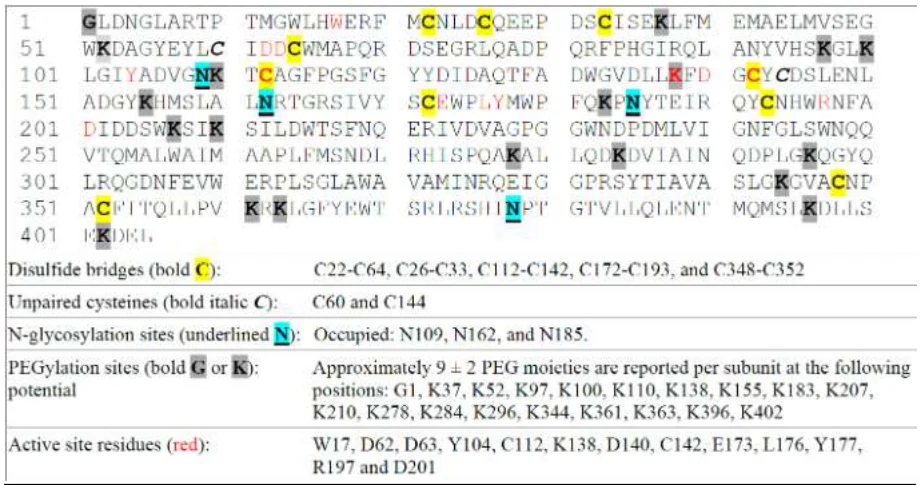
Physicochemical properties:
Pegunigalsidase alfa drug substance is a glycyl-human α-galactosidasyl-L-seryl-L-α-glutamyl-L-lysyl-L-α-aspartyl-L-α-glutamyl-L-leucine, dimer, glycosylated with plant glycans, produced in Nicotiana tabacum cells, substituted with an average of eight 4-({α-[2-(3-carboxypropanamido) ethyl]poly(oxyethylene)-ω-yl}amino)-4-oxobutanoyl groups (2 kDa each) and crosslinking (polyethylene glycol-O,O'-diyl)bis[ethane-2,1-diylazanediyl(1,4-dioxobutane-4,1-diyl)] bridges (2 kDa each) per dimeric protein
Pharmaceutical standard:
Not available
Product Characteristics
Pegunigalsidase alfa is a purified PEGylated plant recombinant human α-galactosidase A enzyme formulated in a citrate buffer (pH 5.9-6.4) containing sodium chloride.
Pegunigalsidase alfa is a hydrolytic lysosomal neutral glycosphingolipid-specific enzyme, is a PEGylated and crosslinked, chemically modified, recombinant human α-galactosidase A enzyme that is produced by genetically modified Bright Yellow 2 (Nicotiana tabacum) plant cells. The amino acid sequence of one subunit of pegunigalsidase alfa consists of 405 amino acids, of which 398 amino acids are identical to human α-galactosidase A with an additional 6 amino acids (SEKDEL) included at the C-terminal to encode an endoplasmic retrieval signal, and an additional glycine at the N-terminus derived from the signal peptide.
The ELFABRIO drug product is a clear, colorless concentrated solution for injection.
14. Clinical Trials
14.1. Clinical Trials by Indication
Treatment of adult patients with a confirmed diagnosis of FD (deficiency of α-galactosidase A).
Trial Design and Study Demographics
The efficacy of ELFABRIO (pegunigalsidase alfa for injection) was evaluated in two clinical studies in ERT-naïve or ERT-experienced patients with FD.
Trial 1
Trial 1 (PB-102-F01/02) was a Phase 1/2 open-label single-arm dose-finding study which evaluated the efficacy of pegunigalsidase alfa on histological decreases in accumulated globotriaosylceramide substrate in kidney peritubular capillaries at 6 months assessed using Barisoni Lipid Inclusion Scoring System (BLISS). Trial 1 enrolled 18 patients diagnosed with FD who were ERT-naïve or who had not received ERT for more than 26 weeks and had a negative test for anti-pegunigalsidase alfa IgG antibodies prior to enrollment. Patients received pegunigalsidase alfa at 0.2 mg/kg, 1 mg/kg, or 2 mg/kg given IV infusion every other week for 52 weeks. Two patients in the 1 mg/kg treatment group discontinued the trial after their first infusion; one of them discontinued due to severe hypersensitivity reaction. Among the remaining 16 patients who completed Trial 1, 9 (56%) were males and 7 (44%) were females ranging in age from 17 to 54 years with a median age of 30 years. Twelve patients were White (75%) and 3 were Black or African American (19%). Three patients were Hispanic/Latino and 13 patients were not Hispanic/Latino. Of the 9 males, 7 (78%) had the classic phenotype. The median baseline eGFR and proteinuria was 115 mL/min/1.73 m2 and 0.11 g/g respectively. Among the male patients, the median value of residual α-galactosidase A activity was 2.4% (range: 0.0%-9.3%) in plasma and 1.3% (range: 0.0%-3.4%) in leukocytes.
Trial 2
Trial 2 (PB-102-F20) was a Phase 3 multicenter, randomized, double-blind, and active-controlled study in ERT-experienced adults diagnosed with FD. In Trial 2, the effects of ELFABRIO on annualized eGFR slope—a recognized clinical endpoint—was evaluated in comparison with agalsidase beta, an approved ERT with a similar mechanism of action. Eligible patients were treated with agalsidase beta for at least one year prior to trial entry (the mean duration of agalsidase beta treatment prior to enrollment was 5.7 years). Patients were randomized 2:1 to receive ELFABRIO (1 mg/kg IV infusion) or agalsidase beta (1 mg/kg IV infusion) every other week for 104 weeks. A total of 77 patients were randomized and received at least one dose of ELFABRIO (N=52, 68%) or agalsidase beta (N=25, 32%). Of these patients, 47 (61%) were males and 30 (39%) were females. Patients were 18 to 60 years of age with a median age of 46 years at baseline; 72 (94%) were White, 3 (4%) were Black or African American and 2 (3%) were Asian. Two patients were Hispanic/Latino and 75 patients were not Hispanic/Latino. Forty-one (53%) patients had the classic phenotype. The median baseline eGFR and proteinuria was 75 mL/min/1.73 m2 and 0.11 g/g, respectively.
A summary of the study design and patient demographics for the 2 studies are provided in Table 7.
Table 7. Summary of Patient Demographics for Clinical Trials in FD
| Study # | Study design | Dosage, route of administration and duration | Study subjects (N) | Mean age (Range) | Sex |
| 1 | Phase 1/2, open-label dose-ranging | 0.2 mg/kg*, 1 mg/kg, or 2 mg/kg* Pegunigalsidase alfa IV infusion EOW Duration: 52 weeks | 0.2 mg/kg: N = 6 1 mg/kg: N = 8 2 mg/kg: N = 4 | 0.2 mg/kg: 30.0 years (21-50 years) 1 mg/kg: 33.5 years (17-52 years) 2 mg/kg: 40.0 years (20-54 years) | 0.2 mg/kg: 4 Males, 2 Females 1 mg/kg: 6 Males, 2 Females 2 mg/kg: 3 Males, 1 Female |
| 2 | Phase 3, multicenter, randomized, double-blind, active-controlled | 1 mg/kg ELFABRIO IV infusion EOW or 1 mg/kg Agalsidase beta IV infusion EOW Duration: 104 weeks | N=77 (52 in ELFABRIO arm and 25 in Agalsidase beta arm) | Total: 44.3 years (18-60 years) ELFABRIO arm: 43.9 years (20-60 years) Agalsidase beta arm: 45.2 years (18-58 years) | Total: 47 Males, 30 Females ELFABRIO arm: 29 Males, 23 Females Agalsidase beta arm: 18 Males, 7 Females |
Legend: EOW = every other week; IV = intravenous
* The 0.2 mg/kg and 2 mg/kg dosage regimens are not approved and are not recommended
Study Results
Trial 1
The average number of globotriaosylceramide (Gb3) inclusions per renal peritubular capillary (PTC) in renal biopsy specimens of patients was assessed by light microscopy using the quantitative BLISS methodology. Evaluable renal biopsies were obtained at baseline and at 26 weeks of treatment in 14 ERT-naïve FD subjects of the 16 patients who completed Trial 1. Treatment with pegunigalsidase alfa demonstrated significant and sustained reductions of the Gb3 substrate from the renal. The observed median percent reduction compared to baseline in number of Gb3 inclusions per PTC was -78% (95% CI: -86%, -53%); the mean absolute reduction compared to baseline was -3.1 (95% CI: -4.8, -1.4); and additional analyses performed at the subject level showed that 11 out of 14 subjects (79%) had at least a 50% reduction from baseline in the number of renal Gb3 inclusions (ranged from -53% to -95%).
Table 8. Summary of the Renal Biopsy BLISS Score1 of Gb3 Inclusions at Baseline and after 26 Weeks of ELFABRIO Treatment in Adults with Fabry Disease (Trial 1)
| All Patients | Males | Females | ||||||||
|---|---|---|---|---|---|---|---|---|---|---|
| (N=14) | (N=8) | (N=6) | ||||||||
| Median (range) | ||||||||||
| Baseline | 3.2 (0.4, 9.0) | 6.8 (0.4, 9.0) | 1.2 (0.8, 3.3) | |||||||
| Week 26 | 0.7 (0.3, 2.5) | 0.7 (0.3, 2.5) | 0.7 (0.3, 1.4) | |||||||
| Change at Week 26 | -2.5 (-8.5, 0.5) | -5.3 (-8.5, 0.5) | -0.7 (-2.5, 0.1) | |||||||
| Mean Change at Week 26 (95% CI) | -3.1 (-4.8, -1.4) | -4.7 (-7.1, -2.3) | -1.0 (-2.1, 0.1) | |||||||
1 The BLISS methodology counts the number of Gb3 inclusions in each renal PTC contained in a biopsy specimen. For each biopsy specimen (slide), approximately 300 renal PTCs were scored, and the final biopsy score for each patient was determined as the average number of Gb3 inclusions per PTC.
Trial 2
The primary endpoint of the annualized rate of change in estimated eGFR (eGFR slope) assessed over 104 weeks comparing ELFABRIO to the approved ERT agalsidase beta was similar between the arms. The mean slopes for eGFR were -2.4 (95% CI: -3.6; -1.1) mL/min/1.73 m²/year for the ELFABRIO arm and -2.3 (95% CI: -4.1; -0.5) for the agalsidase beta arm. The treatment difference was -0.1 (95% CI: -2.3; 2.1) mL/min/1.73 m2/year.
16. Non-Clinical Toxicology
General Toxicology:
Repeat-Dose Toxicity in Mice
In a 26-week study, male and female ICR (CD-1®) mice were administered doses of 0 (vehicle control), 2, 10, and 40 mg/kg body weight by intravenous injection every other week (14 doses). Exposures at the two lowest doses were below the human exposure at the maximum recommended human dose (MRHD) of 1 mg/kg once every other week and exposure at the highest dose was approximately 2-fold the human exposure at the MRHD on an AUC basis. The study included an interim assessment after 12 weeks of dosing. Mortality and clinical signs occurred beginning after the third injection in some animals of all dose groups; the incidence did not follow a dose-response. Pre-treatment with an antihistamine was performed from the fourth injection and until the end of the dosing period and had an ameliorating effect on mortality, although some deaths were still observed after the start of pre-treatment. The clinical signs (dyspnea, decreased activity, cyanosis, and abdominal position) occurred only on dosing days, within 5 to 10 minutes of dosing. Cyanosis and abdominal position preceded death in some cases, and dyspnea and decreased activity quickly resolved in surviving animals. These findings suggested that some mice developed an allergic response to the humanized drug.
Renal toxicity was observed at the high-dose of 40 mg/kg body weight. Increased incidences of nephropathy and interstitial lymphocytic infiltration in the kidney were observed, with males also displaying an increase in severity in these findings. No test article-related renal changes were noted in the recovery animals, suggesting reversibility of the effects observed at the high dose.
Evidence of liver injury following short-term repeat dosing was also observed at the high-dose of 40 mg/kg body weight. An increased incidence of hepatocellular necrosis was observed, which in males, was accompanied by oval cell proliferation. In males, the effects were observed following 12 weeks of dosing, but not after 26 weeks of dosing or after the 6-week recovery period, demonstrating resolution even with continued dosing. No resolution or reversibility was observed in females, although, unlike in males, only a small number of females was affected.
A no-observed-adverse-effect level (NOAEL) for pegunigalsidase alfa could not be determined for this study on the basis that pegunigalsidase alfa-related mortalities were observed at all doses.
Repeat-Dose Toxicity in Cynomolgus Monkeys
In a 26-week study, cynomolgus monkeys were administered doses of 0 (vehicle control), 2, 10, and 40 mg/kg body weight via a 1-hour intravenous infusion once every 12 to 16 days. Exposures at the two lowest doses were below the human exposure at the MRHD and exposure at the highest dose was approximately 4-fold the human exposure at the MRHD on an AUC basis. The study included an interim assessment after 3 months of dosing. Clinical signs post-dosing or during dosing were observed in some animals at all doses and consisted of red discoloration of the face, discoloured skin on forelimb, decreased activity, and other symptoms, suggesting an allergic response. Antihistamine treatment and/or pre-treatment ameliorated the symptoms. Effects in the liver were observed at the high-dose of 40 mg/kg body weight, consisting of Kupffer cell hypertrophy. This finding was not observed in the recovery animals and was not considered to be an adverse effect as it was not associated with correlating tissue damage.
A NOAEL for pegunigalsidase alfa could not be determined for this study on the basis that pegunigalsidase alfa-related allergic reactions requiring treatment were observed at all doses. However, no other adverse effects were observed in this study, including on cardiovascular function.
Genotoxicity:
Genotoxicity studies have not been conducted with pegunigalsidase alfa.
Carcinogenicity:
Carcinogenicity studies have not been conducted with pegunigalsidase alfa.
Reproductive and developmental toxicology:
In a fertility and early embryonic development study, Sprague Dawley rats were administered pegunigalsidase alfa via a slow intravenous bolus injection at doses of 0, 2, 10, and 40 mg/kg body weight twice per week. Male rats were dosed beginning 4 weeks prior to mating, through mating to approximately 2 weeks post-mating (total of approximately 7 weeks) and female rats were dosed beginning 2 weeks prior to mating, through mating to gestation day (GD) 7. No adverse effects on male fertility (including sperm count, motility, and morphology), female fertility, or embryonic survival were observed. The NOAEL for effects on fertility and early embryonic development was 40 mg/kg body weight, the highest dose tested.
In an embryofetal development study conducted in Sprague-Dawley rats, pregnant animals were administered pegunigalsidase alfa by a slow intravenous bolus injection at doses of 0, 2, 10, and 40 mg/kg body weight on GD 6, 9, 12, and 15. Exposures at the two lowest doses were below the human exposure at the MRHD and exposure at the highest dose was 3.6-fold the human exposure at the
MRHD on an AUC basis. No maternal toxicity or adverse effects on embryofetal development were observed. The NOAEL for maternal toxicity and fetal developmental effects was 40 mg/kg body weight, the highest dose tested.
In an embryofetal development study conducted New Zealand White rabbits, pregnant animals were administered pegunigalsidase alfa via a slow bolus intravenous injection at doses of 0, 2, 10, and 20 mg/kg body weight on GD 6, 9, 12, 15, and 18. Exposures at the two lowest doses were below the human exposure at the MRHD and exposure at the highest dose was 1.8-fold the human exposure at the MRHD on an AUC basis. Maternal toxicity was observed, consisting of mortality at doses of 10 and 20 mg/kg body weight, and decreased body weight with correlating decreased food consumption at 20 mg/kg body weight. Embryofetal toxicity was also observed, including increased incidence of abortions at 10 and 20 mg/kg body weight and increased incidence of late resorptions and post-implantation loss at 20 mg/kg body weight. Decreased fetal weights were also observed at 10 and 20 mg/kg body weight and correlated with small fetuses at 20 mg/kg body weight. There was no increase in external, skeletal, or visceral malformations. The NOAEL for maternal toxicity was 2 mg/kg body weight based on the maternal toxicity observed at the higher doses (10 and 20 mg/kg body weight). The NOAEL for fetal/developmental toxicity following in utero exposure was also 2 mg/kg body weight based on the adverse effects in fetuses at the higher doses.
In a study to investigate intrauterine exposure to pegunigalsidase alfa, pregnant Sprague Dawley rats were administered pegunigalsidase alfa intravenously at a dose of 40 mg/kg body weight on GD 6, 9, 12, 15, 18, and 20. Maternal and fetal plasma concentrations of pegunigalsidase alfa were assessed on GD 20, 10 minutes after the end of the infusion of the last dose. Plasma exposure in maternal samples ranged between 507,000 to 740,000 ng/mL and concurrent fetal plasma exposure ranged from 33 to 128 ng/mL. The fetus/mother ratios ranged from 0.005 to 0.025%. The results demonstrate transfer of pegunigalsidase alfa across the placental barrier.
In a study to investigate pegunigalsidase alfa excretion in milk, previously pregnant Sprague Dawley rats were administered pegunigalsidase alfa by intravenous infusion at a dose of 40 mg/kg body weight on lactation day (LD) 1, 4, 7, and 10. Concentrations of pegunigalsidase alfa in maternal milk and plasma and in pooled pup plasma were assessed on LD 10 at 0.5, 1, 3, and 6 hours after the end of infusion. Pegunigalsidase alfa was excreted into milk (maximum 6.23% of maternal plasma exposure) and absorbed by the suckling pups to a minimal extent (maximum 0.014% of the maternal plasma exposure). While maternal plasma exposure levels declined between 0.5 hours (maximum exposure levels) and the last sampling time point (6 hours after end of infusion), respective exposure levels in milk increased. Systemic exposure levels in suckling rats were marginal and comparable at all sampling time points (22to 28 ng/mL). The results demonstrate excretion of pegunigalsidase alfa in milk with subsequent systemic absorption in nursing offspring.
Prenatal and postnatal developmental toxicity studies were not performed with pegunigalsidase alfa and the risks for the fetus and offspring during the late pregnancy and lactation stages are unknown.