


Patient Medication Information: uses, side effects, how to take - Lolo
What is LOLO used for?
- LOLO is used to prevent pregnancy.
- LOLO is a birth control pill. It is considered to be a combination oral contraceptive. This is because it contains two female sex hormones: norethindrone acetate and ethinyl estradiol. LOLO has been shown to be effective in preventing pregnancy when taken as prescribed by your healthcare professional.
How does LOLO work?
Combination hormonal contraceptives, like LOLO work in two ways:
- to stop the monthly release of an egg by the ovaries.
- to change the mucus produced by your cervix. This slows the movement of the sperm through the mucus and through the uterus.
Effectiveness of LOLO
The results of one clinical trial show that, about 3 out of 100 women may get pregnant during the first year they use LOLO. The chance of becoming pregnant increases if LOLO is not used correctly.
Women who were overweight (with a Body Mass Index (BMI) above 35 kg/m2) were not studied in the clinical trial. It is not known how well LOLO will prevent pregnancy in these women. If you are overweight (obese), you and your healthcare professional will decide if LOLO is the best choice for you.
Other Ways to Prevent Pregnancy
There are other methods of birth control available. These are usually less effective than birth control pills. If used properly, the other methods of birth control are effective enough for many women.
Serious Warnings and Precautions
|
The following table lists pregnancy rates for different types of birth control. A pregnancy rate is the number of women out of 100 who would become pregnant in one year.
Reported Pregnancies per 100 Women per Year:
| Combination pill | less than 1 to 3 |
|---|---|
| Intrauterine device (IUD) | less than 1 to 6 |
| Condom & spermicidal foam or gel | 1 to 6 |
| Mini-pill | 3 to 6 |
| Condom | 2 to 12 |
| Diaphragm with spermicidal foam or gel | 3 to 18 |
| Spermicide | 3 to 21 |
| Sponge with spermicide | 3 to 28 |
| Cervical cap with spermicide | 5 to 18 |
| Periodic abstinence (rhythm), all types | 2 to 20 |
| No birth control | 60 to 85 |
There are differences in these pregnancy rates. This is because not all people use birth control as carefully or as regularly as they should. This does not apply to IUDs since these are implanted in the uterus. If you are careful and use your birth control regularly, pregnancy rates should be lower. Some types of birth control will require more effort than taking a single pill every day.
What are the ingredients in LOLO?
Medicinal ingredients: ethinyl estradiol and norethindrone acetate
Non-medicinal ingredients for the blue tablets and white tablets: Lactose monohydrate, magnesium stearate, mannitol, microcrystalline cellulose, povidone, sodium starch glycolate and vitamin E. The blue tablets also contain FD&C Blue No. 1 Aluminum Lake.
Ingredients for the lilac tablets: Anhydrous lactose, lake blend, magnesium stearate, microcrystalline cellulose.
LOLO comes in the following dosage forms:
- White tablets: 10 mcg ethinyl estradiol
- Blue tablets: 1 mg norethindrone acetate, and 10 mcg ethinyl estradiol
- Lilac tablets: no active ingredient (placebo)
Do not use LOLO if:
- you have or had a blood clot in the legs (deep vein thrombosis), lung (pulmonary embolism), eyes or somewhere else in your body;
- you have or had inflammation of a vein. This is called thrombophlebitis;
- you had a stroke or heart attack;
- you have coronary artery disease (including angina) or a condition that may be a first sign of stroke (such as ministroke or small reversible stroke);
- you have or had a disease of the heart valves with complications;
- you have liver disease (including hepatitis C) or have a history of liver tumours (cancerous or non-cancerous);
- you have or had jaundice. This is when the skin or whites of the eyes turn yellow. This may have been related to other medicines you were taking or may have happened during pregnancy;
- you have or you think you have breast cancer, cancer of the endometrium (lining of the uterus) or a cancer that is sensitive to hormones;
- you have unusual vaginal bleeding without a known reason;
- you have blood vessel disease of the eye that has caused loss of vision;
- you are pregnant or think you may be pregnant;
- you have or had migraine headaches;
- you have or had inflammation of the pancreas (pancreatitis) and high levels of fat in your blood (triglycerides);
- you have severe high blood pressure or high blood pressure that is not under control;
you have a blood clotting disorder such as:
- Factor V Leiden mutation,
- Activated protein C (APC) resistance,
- Protein C deficiency,
- Protein S deficiency,
- Hyperhomocysteinemia,
- Prothrombin mutation G20210A,
- Antiphospholipid-antibodies.
- you have diabetes with complications;
- you have an unusual amount of lipoproteins in your blood;
- you are over age 35 and you smoke;
- you are scheduled for major surgery;
- you have or will have long periods where you are not mobile including prolonged bed rest;
- you are taking medicines to treat hepatitis C called ombitasvir, paritaprevir, ritonavir, with or without dasabuvir. Using these drugs at the same time as LOLO can cause problems with your liver, such as an increase in the alanine transaminase (ALT) liver enzyme. You must finish your hepatitis C treatment first before starting LOLO. Your healthcare professional will tell you when to start, stop or restart LOLO if you need to take these hepatitis C drugs;
- you are allergic to ethinyl estradiol, norethindrone acetate or to any of the other ingredients in LOLO.
Tell your doctor if you have ever had any of the above conditions. Your healthcare professional can recommend another method of birth control.
To help avoid side effects and ensure proper use, talk to your healthcare professional before you take LOLO. Talk about any health conditions or problems you may have, including if you:
- are overweight;
- have a history of breast disease (such as breast lumps) or family history of breast cancer;
- have high blood pressure;
- have high cholesterol;
- have diabetes;
- have heart or kidney disease;
- have a history of seizures or have epilepsy;
- have a history of depression;
- have cholestasis. This is a condition where the bile flow from the liver is decreased.
- wear contact lenses;
- have uterine fibroids. These are benign tumours of the uterus.
- are under 18 years of age;
- are in menopause;
- have porphyria. This is a disease of blood pigment that is passed down in families (inherited).
- have systemic lupus erythematosus. This is a disease of the immune system that affects many organs of the body.
- have inflammatory bowel disease including Crohn’s disease or ulcerative colitis;
- have haemolytic uremic syndrome. This is when there is an abnormal breakdown of blood cells, which clogs the kidney.
- have sickle cell disease. This is a disease that affects hemoglobin, a molecule in red blood cells that delivers oxygen throughout the body.
- have problems with the valves in your heart and/or have an irregular heart beat;
- have a condition called hereditary angioedema or if you have had episodes of swelling in body parts such as hands, feet, face, eyes or airway passages.
Other warnings you should know about:
Blood clot in legs, lungs, heart, eyes or brain
Women who use birth control that contains hormones are more likely to develop blood clots. Blood clots are the most common serious side effects of birth control pills. The risk for clots is highest during the first year a woman uses a hormonal birth control. Clots can occur in many areas of the body and can lead to blindness or impaired vision as well as damage to or loss of a limb and death.
While you are taking LOLO, if you have any of the below symptoms, contact your healthcare professional right away. These are signs of blood clots:
- sharp pain in your chest,
- coughing up blood,
- sudden shortness of breath,
- pain and / or swelling in your calf,
- crushing chest pain or chest heaviness,
- sudden severe or worsening headache,
- vomiting,
- dizziness,
- fainting,
- changes in vision,
- changes in speech,
- weakness or numbness in an arm or leg,
- sudden pain, swelling and slight blue discoloration of an arm or leg.
Cancer
Using birth control pills may increases the risk of certain cancers including cancer of the breast, cervix and liver.
Breast cancer:
The risk of breast cancer in women increases as you get older. It also increases if there is family history of breast cancer, meaning if your mother or sister have or had breast cancer. Other factors that increase your risk for breast cancer are being obese, never having children, or having your first full-term pregnancy at a late age.
If you have breast cancer now, or had it in the past, do not use birth control pills. The hormones in these pills can affect some cancers.
Some women who use birth control pills may have a higher risk of developing breast cancer before menopause. These women may have used birth control pills for a long time (more than eight years), or may have started using birth control pills at an early age.
In a few women, using of birth control pills can speed up the growth of a breast cancer that has not yet been found. Finding breast cancer early can reduce the effect of the cancer on a woman’s life expectancy. The risks for breast cancer related to using birth control pills seem to be small. You should, however, have a healthcare professional check your breasts at least once per year.
While you are taking LOLO, check your breasts often. See your healthcare professional if you notice any changes, such as:
- dimpling or sinking of the skin,
- changes in the nipple, or
- any lumps you can see or feel.
Cervical cancer:
Women who use birth control pills may have a higher chance of getting cervical cancer. However, this may be due to other reasons including infection with the Human Papilloma Virus (HPV). HPV is an important risk factor for cervical cancer. However, it is possible that oral birth control pills may also cause such cancers.
Liver cancer:
Liver cancer (hepatocellular carcinoma) and liver tumours may be linked to oral birth control pills. The risk for liver cancer increases the longer these pills are used. However liver tumours are extremely rare. If you feel severe abdominal pain or find a lump in your abdomen, contact your healthcare professional right away.
Gallbladder disease
The risk for gallbladder disease that needs surgery is higher in women using birth control pills. The risk is highest in the first year of use and increases the longer these pills are used.
Vaginal bleeding
Breakthrough bleeding or spotting sometimes happens in women using birth control pills including LOLO. This is blood coming from the vagina between periods. It is most likely to happen in the first three months of starting a birth control pill. If the bleeding is heavy or does not stop, contact your healthcare professional.
While you are taking LOLO you may not get your period each month. If you were not taking LOLO as directed by your healthcare professional, you should have a pregnancy test. This will rule out if the missed period is because you are pregnant.
If you go more than 6 months without a period contact your healthcare professional. This will be especially important if you also notice secretions from your breasts.
Use after pregnancy, miscarriage or an abortion
Your healthcare professional will tell you when to start using LOLO after childbirth, miscarriage or an abortion.
Pregnancy after stopping LOLO
You will have a menstrual period when you stop using LOLO. Wait until after your next period before getting pregnant. This will help to better date the pregnancy. Speak to your healthcare professional about other forms of birth control you can use during this time.
Breast feeding
If you are breastfeeding, talk to your healthcare professional before starting the birth control pill. Other types of birth control, instead of a birth control pill, are recommended until your baby has stopped breastfeeding. The hormones in the pill may lower the amount and quality of your breast milk. This may not happen, however, if you wait until after nursing is established.
Skin conditions
Chloasma may develop while you are using LOLO. This appears as yellowish-brown patches on the skin, particularly of the face. It is more likely to happen if you have previously had chloasma gravidarum. This is when these patches appear on the skin of the face during pregnancy. This is commonly known as “the mask of pregnancy”.
If you have or had chloasma, avoid too much exposure to the sun while using LOLO. Sunlight contains invisible rays (ultraviolet light) that can burn the skin.
Surgery or medical treatment
Be sure to tell your healthcare professional if you are scheduled for surgery or other medical treatment. You may need to stop using LOLO four weeks before surgery. You may need to wait until after your first period following surgery before restarting LOLO.
Check-ups and tests
Before starting LOLO, you will need to have examinations and tests. Your healthcare professional will conduct a physical exam. He or she will examine your breasts, liver, arms and legs and will conduct a pelvic exam. Your healthcare professional will also ask you some questions about your personal health history and that of your close relatives. He or she will also measure your blood pressure and do blood tests.
While you are taking LOLO, you will need to have regular check-ups with your healthcare professional. Your first check up should be about three months after starting LOLO. Afterward, you will see your healthcare professional about once per year. At these visits, your healthcare professional will conduct physical and internal exams. He or she will also measure your blood pressure and do blood tests.
If you are scheduled for any laboratory tests, be sure to tell your healthcare professional that you are taking LOLO. This is because birth control pills can affect some blood tests.
LOLO may not work as well as it should to prevent pregnancy if you:
- miss pills,
- don’t take your pills as directed by your healthcare professional,
- have gastrointestinal problems
- are taking certain medicines.
Tell your healthcare professional about all the medicines you take, including any drugs, vitamins, minerals, natural supplements or alternative medicines.
Some medicines can affect how birth control pills work. In fact, some medicines may make birth control pills less effective. This means that you may not be fully protected from getting pregnant. As well, you may develop unexpected vaginal bleeding. You may need to use an additional (back-up) method of birth control while you are taking other medicines. Your healthcare professional will talk to you about this and tell you for how long this will be needed.
If you see a different healthcare professional or a dentist who prescribes another medicine to you, be sure to tell him or her that you are using LOLO. They can tell you if you need to use additional birth control and, if so, for how long.
The following may interact with LOLO:
- medicines to treat epilepsy including ethosuximide, felbamate, lamotrigine, oxcarbazepine, phenobarbital, phenytoin, primidone, barbiturates, carbamazepine, topiramate;
- medicines to treat tuberculosis including rifampin, rifabutin;
- medicines to treat HIV infections including ritonavir, nevirapine;
- alpha-II adrenoreceptor agents including clonidine;
- medicines for hepatitis C virus including ombitasvir, paritaprevir/ritonavir, with or without dasabuvir, telaprevir;
- medicines to treat bacterial infections including ampicillin, cotrimoxazole, penicillins, chloramphenicol, neomycin, nitrofurantoin, sulfonamides, tetracyclines, troleandomycin, metronidazole;
- medicines to treat fungal infections including griseofulvin;
- medicines to lower cholesterol levels including clofibrate;
- medicines to prevent blood clots;
- St. John’s wort, an herbal product used to treat depression and other conditions;
- medicines to treat high blood pressure including guanethidine, methyldopa, beta blockers, reserpine;
- medicines to treat diabetes including insulin and oral drugs that lower blood sugar;
- medicines to help you relax or sleep including benzodiazepines, chlordiazepoxide, lorazepam, oxazepam, diazepam, phenothiazines, reserpine, barbiturates, chloral hydrate, glutethimide, meprobamate;
- medicines to treat depression including clomipramine;
- medicines to treat fever, pain or inflammation including acetaminophen, acetylsalicylic acid (ASA), antipyrine, meperidine, prednisone, phenylbutazone;
- medicines to treat allergies;
- medicines to treat migraine headaches;
- folic acid and vitamins E and B12;
- a medicine to help prevent organ rejection called cyclosporine;
- a medicine to help treat bleeding called aminocaproic acid;
- medicines to treat lung diseases such as asthma and Chronic obstructive pulmonary disease (bronchitis, emphysema) including theophylline;
- medicines to slow the heart rate including isoproterenol;
- medicine to treat high blood pressure in the blood vessels between the heart and the lungs (pulmonary hypertension) including bosentan.
Antacids may affect how LOLO is absorbed in your body. If you need to use antacids, like TUMS, take them 2 hours before or 2 hours after taking LOLO.
The effects of caffeine and alcohol may also be increased. This is because birth control pills affect how these are metabolized.
How to take LOLO:
Be sure to read these directions:
- before you start taking your pills, and
- anytime you are not sure what to do.
- For Day 1 Starters, pick the Day Label strip that corresponds with the first day of your period. This is the day you start bleeding or spotting, even if it is almost midnight when the bleeding begins. If you are a Sunday Starter (your healthcare professional has told you to start LOLO on the Sunday after your period begins), pick the day label strip that starts with Sunday.
- Place the Day Label strip on the top edge of the blister card. This sticker will go over the words: “Place Day Label Here”. Labelling the card with the days of the week will help remind you to take your pill everyday.
Look at your pill pack:
Each LOLO pack contains:
- 24 blue pills. These contain progestin and estrogen hormones.
- 2 white pills. These contain only estrogen.
- 2 lilac pills. These do not contain any hormones and are considered placebos.
Check the pill pack for:
- where to start taking pills; and
the order to take the pills. Follow the arrows in the diagram. Take pills from left to right in
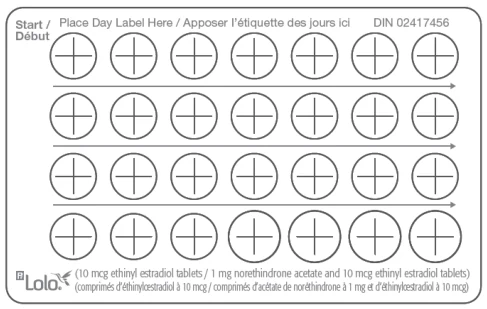
Week 1
Week 2
Week 3
Week 4
Taking LOLO:
- Take LOLO exactly as directed by your healthcare professional.
- Take 1 pill each day at about the same time.
Take LOLO with or without food.
Start taking LOLO on either:
- Day 1 of your period. This is called “Day 1 Start”; or
- The first Sunday after your period starts. This is called “Sunday Start”.
Take LOLO according to this schedule:
- Take 1 blue tablet each day for 24 days in a row.
- Then, take 1 white tablet each day for 2 days in row.
- Then, take 1 lilac tablet each day for 2 days in a row.
- Start a new pack of LOLO on the next day. Follow the above schedule with each pack of LOLO.
- Be sure to use all the pills in each pack.
- Do not skip any days. There is no need to stop taking LOLO for a rest period.
- Do not skip pills even if you are spotting or bleeding between monthly periods or feel sick to your stomach.
- Do not skip pills even if you do not have sex very often.
If you have trouble remembering to take the pill, talk to your healthcare professional. He or she can advise on how to make pill-taking easier or about using another method of birth control.
- For Day 1 Starters, pick the Day label strip that corresponds with the first day of your period. This is the day you start bleeding or spotting, even if it is almost midnight when the bleeding begins. If you are a Sunday Starter (your healthcare professional has told you to start LOLO on the Sunday after your period begins), pick the day label strip that starts with Sunday.
Start here for both Sunday Starters and Day 1 Starters
Take pills in this direction from left to right each week
For Day 1 Starters: LOLO will start working right away.
For Sunday Starters: Use a second method of birth control (e.g. latex or polyurethane condoms and spermicidal foam or gel) for the first 7 days of your first cycle of LOLO use. This will provide a back-up while you are getting used to taking LOLO.
You may miss your period while you are taking LOLO. If you have been having regular periods and then do not have a period for two or more cycles, you may be pregnant. Contact your healthcare professional if this happens.
If you vomit or have diarrhea within 3 or 4 hours of taking a white or blue LOLO tablet, LOLO may not work as well. If this happens, use a back-up method of birth control until you check with your healthcare professional.
You may have spotting or light bleeding or you may feel sick to your stomach while you are taking your first 1 to 3 packs of LOLO. This is normal. If this happens, do not stop taking LOLO. These symptoms will usually go away. If they remain for a long time, check with your healthcare professional.
Switching to LOLO from a different type of birth control:
- If you are switching from another birth control pill, talk to your healthcare professional about when to start taking LOLO. You may need to wait about 1 week between the different pills.
- If you are switching from a vaginal ring or skin patch, wait 7 days after removing the ring or patch before starting LOLO.
- If you are switching from a type of birth control that is implanted under your skin, start taking LOLO on the day the implant is taken out.
- If you switch from a type of birth control that is injected into your body, start taking LOLO on the day the next injection would happen.
- If you are switching from an IUD, talk to your healthcare professional about when to start LOLO. You may need to use a back-up method of birth control during the switch.
Usual dose:
Females 18 years and older: 1 tablet per day
Overdose:
If young children swallow large doses of birth control pills, serious side effects are not expected. If too many birth control pills are taken at one time, nausea, vomiting and vaginal bleeding in women are possible.
| If you think you, or a person you are caring for, have taken too much LOLO, contact your healthcare professional, hospital emergency department, or regional poison control centre immediately, even if there are no symptoms. |
|---|
Missed dose:
If you miss blue or white pills, you could get pregnant. The more pills you miss, the more likely you are to get pregnant. This is especially true if you miss taking the first few or the last few blue pills in a pack.
Missing pills can cause you to have some spotting or light bleeding, even if you take the missed pills.
The following chart tells you what to do if you miss taking one or more birth control pills. Match the number of pills missed with the appropriate starting time for your type of pill pack. If you miss one or more blue or white pills and do not have a period that month, you may be pregnant. If this happens, contact your healthcare professional.
On the days you take 2 pills to make up for missed pills, you could also feel a little sick to your stomach.
| Sunday Start | Day 1 Start |
|---|---|
| Miss 1 blue Pill | |
| Take it as soon as you remember. Take the next pill at the usual time. This means that you might take 2 pills in one day. | |
| Miss 2 blue pills in a row in Week 1 or Week 2 of your pack | |
| |
Miss 2 pills (blue or white) in a row in Week 3 or Week 4 of your pack or Miss 3 or more pills (blue or white) in a row at any time | |
If you miss 2 periods in a row, call your healthcare professional. |
If you miss 2 periods in a row, call your healthcare professional. |
If you forget either of the 2 lilac pills in Week 4, follow these steps:
- Throw away the pills you missed.
- Keep taking 1 pill each day until the pack is empty.
- You do not need to use a back-up method of birth control.
If you are not sure what to do about the pills you have missed:
- Use a back-up method of birth control anytime you have sex.
- Keep taking 1 blue or white pill each day until you can reach your healthcare provider.
Always be sure you have on hand:
- an extra, full pack of pills; and
- back-up methods of birth control. These are types of birth control that do not include hormones such as latex or polyurethane condoms and spermicidal foam or gel. You will need back-up birth control if you miss pills and in some other situations. Always talk to your healthcare professional if you are not sure whether you need to use back-up birth control.
What are possible side effects from using LOLO?
These are not all the possible side effects you may have when taking LOLO. If you experience any side effects not listed here, tell your healthcare professional.
- abdominal pain
- nausea
- vomiting
- weight change
- abnormal cervical (PAP) smear
- painful period cramps
- vaginal infection
- Human Papilloma Virus
- fungal infection
- urinary tract infection
- upper respiratory tract infections including bronchitis, runny nose, stuffy nose, sore throat
- influenza
- acne
- breast tenderness
- anxiety
- depression
- mood swings
- headache
Serious side effects and what to do about them
| Symptom / effect | Talk to your healthcare professional | Stop taking drug and get immediate medical help | |
|---|---|---|---|
| Only if severe | In all cases | ||
| UNCOMMON | |||
| Pulmonary embolism (blood clot in the lung): sharp chest pain, coughing of blood, or sudden shortness of breath | √ | ||
| Deep vein thrombosis (blood clot in the leg): pain and/or swelling in the calf | √ | ||
| Myocardial Infarction (heart attack): crushing chest pain or heaviness in the chest | √ | ||
Serious side effects and what to do about them
| Symptom / effect | Talk to your healthcare professional | Stop taking drug and get immediate medical help | |
|---|---|---|---|
| Only if severe | In all cases | ||
| Stroke: sudden severe headache or vomiting, dizziness or fainting, disturbances of vision or speech, weakness, or numbness in an arm or leg | √ | ||
| Blood clot in the eye: sudden partial or complete loss of vision | √ | ||
| Breast lumps | √ | ||
| Tumour in the liver: severe pain or tenderness in the stomach area | √ | ||
| Depression: persistent sad mood accompanied by difficulty in sleeping, weakness, lack of energy, fatigue | √ | ||
| Jaundice: yellowing of the skin or eyeballs, accompanied frequently by fever, fatigue, loss of appetite, dark-coloured urine, or light-coloured bowel movements | √ | ||
| Unexpected (abnormal) vaginal bleeding | √ | ||
| Unusual swelling of the arms and legs | √ | ||
If you have a troublesome symptom or side effect that is not listed here or becomes bad enough to interfere with your daily activities, tell your healthcare professional.
Reporting Side Effects
You can report any suspected side effects associated with the use of health products to Health Canada by:
NOTE: Contact your health professional if you need information about how to manage your side effects. The Canada Vigilance Program does not provide medical advice. |
Storage:
Keep the tablets in their original package. Store at 20 – 25 °C.
Do not keep medicine that is out of date or that you no longer need.
Keep out of reach and sight of children.
If you want more information about LOLO:
- Talk to your healthcare professional
- Find the full product monograph that is prepared for healthcare professionals and includes this Patient Medication Information by visiting the Health Canada website: (https://www.canada.ca/en/health-canada/services/drugs-health-products/drug-products/drug-product-database.html); the manufacturer’s website www.abbvie.ca, or by calling 1-888-704-8271.
Last Revised: OCT 17, 2024
© 2024 AbbVie. All rights reserved.
LOLO and its design are trademarks of Allergan Pharmaceuticals International Limited, an AbbVie company, used under license by AbbVie Corporation.