


Patient Medication Information: uses, side effects, how to take - Triquilar 28
What TRIQUILAR is used for:
- To prevent pregnancy
How TRIQUILAR works:
TRIQUILAR is a birth control pill (oral contraceptive). It is considered to be a combination oral contraceptive. This is because it contains two female sex hormones: levonorgestrel and ethinyl estradiol.
TRIQUILAR works in two ways:
- 1. Stopping the monthly release of an egg by the ovaries.
- 2. Changing the mucus produced by the cervix. This slows the movement of the sperm through the mucus and through the uterus (womb).
Effectiveness of Combination Birth Control Pills
Combination birth control pills are more than 99 percent effective in preventing pregnancy when:
- the pill is TAKEN AS DIRECTED, and
- the amount of estrogen is 20 micrograms or more.
A 99 percent effectiveness rate means that if 100 women used birth control pills for one year, one woman in the group would get pregnant.
The chance of becoming pregnant increases with incorrect use.
Other Ways to Prevent Pregnancy
There are other methods of birth control available. These are usually less effective than birth control pills. When used properly, however, other methods of birth control are effective enough for many women.
The following table lists pregnancy rates for different types of birth control, including no birth control. A pregnancy rate is the number of women out of 100 who would become pregnant in one year.
Reported Pregnancies per 100 Women per Year:
Combination pill
less than 1 to 2
Intrauterine device (IUD)
less than 1 to 6
Condom with spermicidal foam or gel
1 to 6
Mini-pill
3 to 6
Condom
2 to 12
Diaphragm with spermicidal foam or gel
3 to 18
Spermicide
3 to 21
Sponge with spermicide
3 to 28
Cervical cap with spermicide
5 to 18
Periodic abstinence (rhythm), all types
2 to 20
No birth control
60 to 85
Pregnancy rates vary widely because people differ in how carefully and regularly they use each method. This does not apply to IUDs since they are implanted in the uterus.
The ingredients in TRIQUILAR are:
Medicinal ingredients: levonorgestrel and ethinyl estradiol
Non-medicinal ingredients:
- Light brown, white, and ocherous (dark yellow) hormone-containing tablets: calcium carbonate, cornstarch, glycerine, lactose, magnesium stearate, montanglycol wax, polyethylene glycol, polyvinylpyrrolidone, red ferric oxide, sucrose, talc, titanium dioxide and yellow ferric oxide
- Slightly larger white hormone-free tablets: calcium carbonate, cornstarch, glycerine, lactose, magnesium stearate, montanglycol wax, polyethylene glycol, polyvinylpyrrolidone, sucrose, and talc
TRIQUILAR comes in the following dosage forms:
TRIQUILAR tablets are available in a 21 day regimen (TRIQUILAR 21) and a 28 day regimen (TRIQUILAR 28).
TRIQUILAR 21: Each blister pack contains 21 hormone-containing tablets (6 light brown, 5 white, and 10 ochreous (dark yellow)).
| Day | Pill Description | Amount of Levonorgestrel | Amount of Ethinyl Estradiol |
|---|---|---|---|
| 1 – 6 | light brown | 0.05 mg | 0.03 mg |
| 7 – 11 | white | 0.075 mg | 0.04 mg |
| 12 – 21 | ocherous (dark yellow) | 0.125 mg | 0.03 mg |
TRIQUILAR 28: Each blister pack contains 21 hormone-containing tablets (6 light brown, 5 white and 10 ocherous (dark yellow)), and 7 hormone-free tablets (slightly larger, white).
| Day | Pill Description | Amount of Levonorgestrel | Amount of Ethinyl Estradiol |
|---|---|---|---|
| 1 – 6 | light brown | 0.05 mg | 0.03 mg |
| 7 – 11 | white | 0.075 mg | 0.04 mg |
| 12 – 21 | ocherous (dark yellow) | 0.125 mg | 0.03 mg |
| 22 – 28 | slightly larger, white | no active ingredients | |
Do not use TRIQUILAR if you:
- have or have had blood clots in the legs, lungs, eyes, or elsewhere in your body
- have or have had inflammation or swelling of the veins
- have or have had a stroke or heart attack
- have or have had conditions that affect blood flow to your brain
- have or have had coronary artery disease (for example, chest pain) or a condition that may be a first sign of a stroke (such as a transient ischemic attack or small reversible stroke)
- have or have had a disease of the heart valves with complications
have severe or multiple health conditions that put you at greater risk of developing blood clots in your veins or arteries, such as if you:
- have or have had severe high blood pressure
- have inherited or developed issues with your blood clotting system. For example, Factor V Leiden mutation.
- have or have had diabetes with complications
- have or have had very high blood cholesterol or triglyceride levels
- smoke and are over age 35
- have or have had migraine headaches
- are scheduled for major surgery
- are or were on prolonged bed rest
- are taking ombitasvir, paritaprevir, ritonavir, with or without dasabuvir for the treatment of Hepatitis C. Using these drugs at the same time as TRIQUILAR has the potential to cause liver problems
- have or have had jaundice (yellowing of the eyes or skin)
- have liver disease or liver tumor
- have or have had known or suspected cancer of the breast, uterus (womb) or other estrogen-dependent cancer
- have or have had unusual vaginal bleeding without a known reason
- have or have had loss of vision due to blood vessel disease of the eye
- are or think you might be pregnant
- have or have had inflammation of the pancreas and high levels of fat (triglycerides) in your blood
- are allergic to levonorgestrel, ethinyl estradiol, or to any of the other ingredients in TRIQUILAR or its container
To help avoid side effects and ensure proper use, talk to your healthcare professional before you take TRIQUILAR. Talk about any health conditions or problems you may have, including if you:
- smoke
- are overweight
- have a history of breast disease (for example, breast lumps) or a family history of breast cancer
- have a family history of blood clots, heart attacks or strokes
- have diabetes
- have heart disease
- have a history of seizures / epilepsy
- have a history of depression
- wear contact lenses
- have uterine fibroids (benign tumors of the uterus)
- are breastfeeding
- have systemic lupus erythematosus
- have inflammatory bowel disease such as Crohn’s disease or ulcerative colitis
- have hemolytic uremic syndrome
- have sickle cell disease
- have any problems with the valves in your heart and/or have an irregular heart rhythm
- have been told that you have a condition called hereditary angioedema or if you have had episodes of swelling in body parts such as hands, feet, face or airway passages
Other warnings you should know about:
Check-ups and testing
You will have regular visits with your healthcare professional while taking TRIQUILAR. They may:
- Do blood tests.
- Check your blood pressure.
- Do a breast, liver, abdominal and a pelvic exam, including a Pap smear.
- You should visit your healthcare professional three months or sooner after the initial visit. Afterward, visit your healthcare professional at least once a year.
- Tell your healthcare professional if you are scheduled for any laboratory tests since certain blood tests may be affected by TRIQUILAR.
Surgery:
- Tell your healthcare professional if you are scheduled for major surgery. You should talk to your healthcare professional about stopping the use of TRIQUILAR for one month before surgery and not using TRIQUILAR for a time period after surgery or during bed rest.
- If you see a different healthcare professional, inform them that you are using TRIQUILAR.
Skin problems:
- TRIQUILAR can cause chloasma gravidarum (gray-brown patches on face). It is more likely to happen if you have previously had chloasma gravidarum.
- Avoid exposure to the sun or ultraviolet light while taking TRIQUILAR if you have a history of developing this skin condition.
Pregnancy and breastfeeding:
Use in pregnancy
- Do not take TRIQUILAR if you are pregnant.
- Talk to your healthcare professional right away if you become or think you might be pregnant while using TRIQUILAR. There are specific risks you should discuss with your healthcare professional.
Use while breastfeeding
- You should avoid TRIQUILAR if you are breastfeeding.
- The hormones in TRIQUILAR are known to appear in breast milk. This may cause yellowing of the skin and enlarged breast to develop in your child. These hormones also may decrease the amount and quality of your breast milk.
- Talk to your healthcare professional about other methods of birth control that may be right for you.
Use after pregnancy, miscarriage, or an abortion
- Your healthcare professional will decide when you can start taking TRIQUILAR after childbirth, miscarriage, or abortion.
Pregnancy after stopping TRIQUILAR
- You should have a menstrual period when you stop using TRIQUILAR. Wait until after your next period before getting pregnant. This will help to better date the pregnancy.
- Talk to your healthcare professional about other forms of birth control you can use during this time.
TRIQUILAR can cause serious side effects including:
Blood clot in legs, lungs, heart, eyes or brain
- The risk of clotting seems to increase with higher estrogen doses. Your healthcare professional will make sure you use the lowest dose of estrogen as possible.
- Women who use hormonal birth control are more likely to develop blood clots. Blood clots are the most common serious side effects of birth control pills. These blood clots can cause death or disability. The risk of developing blood clots is especially high during the first year a woman ever uses a hormonal birth control or restarts the same or a different hormonal birth control.
- Clots can occur in many parts of the body. Clots can occur rarely in the blood vessels of the eye, resulting in blindness or impaired vision. When they occur in a blood vessel leading to an arm or leg, it can lead to damage to or loss of a limb.
- You should be alert for the symptoms and signs of serious adverse effects (see Serious side effects table and what to do about them). Call your healthcare professional right away if they occur.
Breast cancer, cervical cancer, or liver tumors
- TRIQUILAR may increase the risk of developing breast cancer, cervical cancer or liver tumors. This can be life-threatening or may cause death.
Breast cancer
- Your risk for breast cancer increases as you get older and if there is a strong history of breast cancer in the family (mother or sister).
Some women who use TRIQUILAR may be at a higher risk of breast cancer. Other factors that may increase your risk of breast cancer include:
- Being overweight
- Never having children
- Having your first full-term pregnancy at a late age
- Using birth control for a long time (more than eight years)
- Starting birth control at an early age
- It is recommended that you have a yearly breast examination by a healthcare professional. Ask your healthcare professional for advice and instruction on regular self-examination of your breasts.
Cervical cancer
- You are at a higher risk of developing cervical cancer if you have persistent human papillomavirus infection (HPV).
Liver tumors
- The risk of developing liver tumors increases with duration of hormonal birth control use.
- These tumors are extremely rare.
Gallbladder disease
- Women who use birth control pills have a higher chance of developing gallbladder disease requiring surgery within the first year of use.
- The risk may double after four or five years of use.
Vaginal bleeding
- You may experience spotting or light bleeding during the first three months on TRIQUILAR. This is when you have bleeding from the vagina between periods. This problem will usually go away. If it does not go away, check with your healthcare professional or clinic.
Tell your healthcare professional about all the medicines you take, including any drugs, vitamins, minerals, natural supplements or alternative medicines.
The following may interact with TRIQUILAR:
- medicines used for the treatment of epilepsy including primidone, phenytoin, barbiturates, carbamazepine, oxcarbazepine, topiramate, felbamate
- medicines used to treat tuberculosis including rifampin, rifabutin
- medicines used to treat HIV infections including ritonavir, nevirapine
- medicines used to treat bacterial infections including penicillins, tetracyclines, clarithromycin, erythromycin
- a medicine used to prevent organ rejection called cyclosporine
medicines used to treat Hepatitis C including:
- ombitasvir, paritaprevir, ritonavir, with or without dasabuvir
- boceprevir and telaprevir
- medicines used to treat fungal infections including griseofulvin, fluconazole, itraconazole, ketoconazole, voriconazole
- medicines used to lower cholesterol levels including clofibrate
- medicines used for the treatment of certain heart diseases or for high blood pressure including diltiazem, verapamil
- medicines used to treat diabetes including insulin
- prednisone, a medicine used to treat many different conditions like asthma, allergic reactions and arthritis
- sedatives and hypnotics, medicines use to induce or maintain sleep, including benzodiazepines, barbiturates, chloral hydrate, glutethimide, meprobamate
- a pain medicine called meperidine
- medicines used to treat depression including clomipramine
- a medicine used to treat multiple sclerosis called tizanidine
- a medicine used to treat asthma called theophylline
- antacids, used to treat heartburn. You should use it 2 hours before or after taking TRIQUILAR.
- some nutritional supplements including vitamin B12, folic acid
- St. John’s wort, a herbal product primarily used to treat depressive moods
grapefruit juice
Certain medicines may interact with birth control pills to make them less effective in preventing pregnancy or cause an increase in breakthrough bleeding. TRIQUILAR may also interfere with the working of other medicines.
You should tell any other healthcare professional who prescribes another medicine that you use TRIQUILAR. They can tell you if you need to use an additional method of birth control and if so, for how long.
How to take TRIQUILAR:
- 1.
Read these directions
- • before you start taking your pills, and
- • any time you are not sure what to do.
- 2. Take exactly as directed by your healthcare professional. Check with your healthcare professional if you are not sure. Otherwise, you may become pregnant.
- 3. Decide with your healthcare professional or clinic what is the best day for you to start taking your first pack of pills. Your pills may be either a 21-day or a 28-day type.
- 4. You should use a second method of birth control (e.g., latex or polyurethane condoms and spermicidal foam or gel) for the first 7 days of the first cycle of pill use. This will provide a back-up in case pills are forgotten while you are getting used to taking them.
- 5. If you experience vomiting or diarrhea, or if you take certain medicines, such as antibiotics, your pills may not work as well. Use a back-up method, such as latex or polyurethane condoms and spermicidal foam or gel, until you can check with your healthcare professional or clinic.
- 6. Visit your healthcare professional three months or sooner after the initial examination. Afterwards, visit your healthcare professional at least once a year.
- 7. When receiving any medical treatment, be sure to tell your healthcare professional that you are using birth control pills.
- 8. Your healthcare professional will tell you the appropriate time to start the use of birth control pills after childbirth, miscarriage, or therapeutic abortion.
- 9. There is no need to stop taking birth control pills for a rest period.
- 10.
If your questions are not answered here, call your healthcare professional or clinic.
INSTRUCTIONS FOR USE
Before you start:
- Look at your pill pack to see if it has 21 or 28 pills.
- Also check the pill pack for: 1) where to start and 2) direction to take pills in (follow the arrows).
- 21-Pill Pack (TRIQUILAR 21)
21-Pill Pack: 21 hormone-containing (6 light brown, 5 white, and 10 ocherous (dark yellow)) pills taken daily for three weeks, and then no pills taken for one week.

With this type of birth control pill, you are on pills for 21 days and off pills for seven days. You must not be off the pills for more than seven days in a row.
Taking TRIQUILAR 21:
- 1. The first day of your menstrual period (bleeding) is day 1 of your cycle. Your healthcare professional may advise you on when to start taking TRIQUILAR 21. You will need to start taking the pills on Day 1 (first day of your period), on Day 5, or on the first Sunday after your period begins. If your period starts on Sunday, start that same day.
- 2. On the back of the pill pack, there is an area shaded in red which reads “I took my first pill on” followed by the days of the week directly below. Under each day of the week, there is a black circle which may be punctured in order to remember the day you first took your pill.
- 3.
Take your first pill starting at the circle shaded in red marked “1.” Take 1 pill at about the same time each day, following the direction of the arrows, for 21 days.
- Try to associate taking your pill with some regular activity, such as eating a meal or going to bed.
- Do not skip pills even if you have bleeding between monthly periods or feel sick to your stomach (nausea).
- Do not skip pills even if you do not have sex very often.
- 4. The pack of pills should be finished after 21 days.
- 5. When you have taken all 21 pills in this pack, wait 7 days (take no pills during the 7 days), and then start a new pack on Day 8. You should have your period during the 7 days when you are not taking any pills.
- 6. The first pill in every pack after the first pack will always be taken on the same day of the week that you first began taking TRIQUILAR 21 pills.
- B. 28-Pill Pack (TRIQUILAR 28)
28-Pill Pack: 21 hormone-containing (6 light brown, 5 white and 10 ocherous (dark yellow)) pills taken daily for three weeks, and then 7 hormone-free (slightly larger, white) pills taken daily for one week.
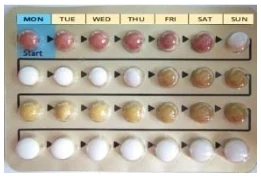
With this type of birth control pill, you take 21 pills which contain hormones and seven pills which contain no hormones.
Taking TRIQUILAR 28:
- 1. The first day of your menstrual period (bleeding) is day 1 of your cycle. Your healthcare professional may advise you on when to start taking TRIQUILAR 28. You will need to start taking the pills on Day 1 (first day of your period), on Day 5, or on the first Sunday after your period begins. If your period starts on Sunday, start that same day.
- 2. Select the calendar sticker that is blue coded with the day you take your first pill and discard the rest.
- 3. Place the selected calendar sticker on the designated area, aligning the blue section with the blue box marked “START.”
- 4.
Take your first pill starting at the blue box marked “START.” Take 1 pill at about the same time each day, following the direction of the arrows, for 28 days.
- Try to associate taking your pill with some regular activity, such as eating a meal or going to bed.
- Do not skip pills even if you have bleeding between monthly periods or feel sick to your stomach (nausea).
- Do not skip pills even if you do not have sex very often.
- 5. The pack of pills should be finished after 28 days. Your period should usually occur during the last 7 days of using that pill pack.
- 6. When you have finished this pack, start a new pack on the next day, not missing any days. Take 1 pill every day. Do not wait any days between packs.
- 7. The first pill in every pack after the first pack will always be taken on the same day of the week that you first began taking TRIQUILAR 28 pills.
Switching to TRIQUILAR from a different type of birth control
- If you are switching from another type of birth control, talk to your healthcare professional about when to start taking TRIQUILAR.
Usual dose:
21-Pill Pack (TRIQUILAR 21)
Take 1 tablet per day, starting with the brown tablets. Then take the white tablets, then the ocherous (dark yellow) tablets. Then, when all 21 tablets are done, wait 7 days before starting a new pack.
28-Pill Pack (TRIQUILAR 28)
Take 1 tablet per day, starting with the brown tablets. Then take the white tablets, then the ocherous (dark yellow) tablets, Then, when all 21 tablets are done, take 1 slightly larger white tablet per day for 7 days.
Overdose:
Symptoms of overdose may include nausea, vomiting, or vaginal bleeding. Even girls who have not yet had their first menstrual period but have accidentally taken this medicine may experience such bleeding.
If you think you, or a person you are caring for, have taken too much TRIQUILAR, contact a healthcare professional, hospital emergency department, or regional poison control centre or Health Canada’s toll-free number, 1-844 POISON-X (1-844-764-7669) immediately, even if there are no signs or symptoms.
Missed dose:
Missing pills can cause some spotting or light bleeding, even if you make up the missed pills. You also could feel a little sick to your stomach on the days you take 2 pills to make up for missed pills.
If you miss pills at any time, you could get pregnant. The greatest risks for pregnancy are:
- when you start a pack late, or
- when you miss pills at the beginning or at the very end of the pack.
What to do if you miss pills
The following chart tells you what to do if you miss one or more of your birth control pills. Match the number of pills missed with the appropriate starting time for your type of pill pack.
| Sunday Start | Other than Sunday Start |
|---|---|
| Sunday Start | Other than Sunday Start |
| Miss 1 Light Brown, White or Ocherous (Dark Yellow) Pill At Any Time | |
| Take the missed pill as soon as you remember, and take the next pill at the usual time. This means that you might take 2 pills in 1 day. | |
| Miss 2 Light Brown, White or Ocherous (Dark Yellow) Pills in a Row | |
First Two Weeks:
| |
Third Week
If you miss two periods in a row, call your healthcare professional or clinic. | Third Week
If you miss two periods in a row, call your healthcare professional or clinic. |
| Miss 3 or More Light Brown, White or Ocherous (Dark yellow) Pills in a Row | |
Anytime in the cycle
If you miss two periods in a row, call your healthcare professional or clinic. | Anytime in the cycle
If you miss two periods in a row, call your healthcare professional or clinic. |
NOTE: 28-day pack - If you forget any of the 7 slightly larger, hormone-free white pills in Week 4, just safely discard the pills you missed. Then keep taking 1 pill each day until the pack is empty. You do not need to use a back-up method.
Always be sure you have on hand:
- a back-up method of birth control (such as latex or polyurethane condoms and spermicidal foam or gel) in case you miss pills; and
- an extra, full pack of pills.
If you forget more than 1 pill two months in a row, talk to your healthcare professional or phone your clinic about how to make pill-taking easier or about using another method of birth control.
Possible side effects from using TRIQUILAR:
These are not all the possible side effects you may have when taking TRIQUILAR. If you experience any side effects not listed here, tell your healthcare professional.
- painful menstrual periods
- breast pain
- changes in libido (sex drive)
- change in skin pigmentation
- nausea
- vomiting
- headache
- migraine
- varicose veins
- acne
- increased appetite
- swelling
- thrombophlebitis (inflammation of veins)
- weight gain
- difficulty wearing contact lenses
- vaginal irritation or infections
- urinary tract infections or inflammation
- upper respiratory tract infections including colds, bronchitis, runny or stuffy nose, sore throat
- insomnia
- nervousness
- back pain
- flu-like symptoms
- allergy
- fatigue
- fever
- diarrhea
- flatulence
- rash
- excess hair on face, chest, abdomen or legs
- high blood pressure
Serious side effects and what to do about them
| Frequency/Side Effects/Symptom | Talk to your healthcare professional | Stop taking this drug and get immediate medical help | |||
|---|---|---|---|---|---|
| Frequency/Side Effects/Symptom | Talk to your healthcare professional | Stop taking this drug and get immediate medical help | |||
| Only if severe | In all cases | ||||
| Only if severe | In all cases | ||||
| Uncommon | |||||
| Arterial thromboembolism, Myocardial infarction (blood clot in the artery, heart attack): Crushing chest pain, discomfort, pressure, heaviness, sensation of squeezing or fullness in the chest, arm, or below the breastbone; discomfort radiating to the back, jaw, throat, arm, stomach; fullness, indigestion or choking feeling; sweating, nausea, vomiting or dizziness; extreme weakness, anxiety, or shortness of breath; rapid or irregular heartbeats; sudden pain, swelling, slight blue discoloration of an extremity; acute abdomen | ✓ | ||||
| Blood clot in the Eye: Sudden partial or complete loss of vision or double vision | ✓ | ||||
| Breast lump | ✓ | ||||
| Deep Vein Thrombosis (blood clot in the leg): Pain and/or swelling in the calf or along a vein in the leg; pain or tenderness in the leg which may be felt only when standing or walking, increased warmth in the affected leg; red or discoloured skin on the leg | ✓ | ||||
| Depression: Persistent sad mood | ✓ | ||||
| Edema (fluid retention): Unusual swelling of the extremities | ✓ | ||||
| Jaundice: Yellowing of the skin or eyes | ✓ | ||||
| Liver Injury: Abdominal pain, nausea or vomiting or lump in the abdomen | ✓ | ||||
| Pulmonary Embolism (blood clot in lung): Sharp pain in the chest which may increase with deep breathing; coughing blood; sudden shortness of breath or rapid breathing; sense of anxiety; severe light headedness or dizziness; rapid or irregular heartbeat | ✓ | ||||
| Stroke: Sudden severe or worsening headache or vomiting; sudden trouble walking, dizziness, loss of balance or coordination; loss of consciousness or fainting with or without seizures; sudden confusion, disturbances of vision, speech or understanding; sudden weakness or numbness of the face, arm or leg | ✓ | ||||
| Vaginal bleeding changes: Unexpected vaginal bleeding, bleeding or spotting between menstrual periods, lack of a period or breakthrough bleeding | ✓ | ||||
If you have a troublesome symptom or side effect that is not listed here or becomes bad enough to interfere with your daily activities, tell your healthcare professional.
Reporting side effects
You can report any suspected side effects associated with the use of health products to Health Canada by:
- Visiting the Web page on Adverse Reaction Reporting (canada.ca/drug-device-reporting) for information on how to report online, by mail or by fax; or
- Calling toll-free at 1-866-234-2345.
NOTE: Contact your healthcare professional if you need information about how to manage your side effects. The Canada Vigilance Program does not provide medical advice.
Storage:
- Store TRIQUILAR at room temperature (15°C to 30°C). Keep the tablets in their original packaging.
- Keep out of reach and sight of children and pets.
- Do not throw away any medicines via wastewater or household waste. Ask your healthcare professional how to throw away any medicines you no longer use. These measures will help to protect the environment.
If you want more information about TRIQUILAR:
- Talk to your healthcare professional
- Find the full product monograph that is prepared for healthcare professionals and includes the Patient Medication Information by visiting the Health Canada Drug Product Database website: (https://www.canada.ca/en/health-canada/services/drugs-health-products/drug-products/drug-product-database.html); the manufacturer’s website http://www.bayer.ca or by contacting Bayer at 1-800-265-7382.
Bayer Inc.
2920 Matheson Blvd East,
Mississauga, Ontario
L4W 5R6
Canada
Date of Authorization: 2025-07-07
© 2025, Bayer Inc.
® TM see www.bayer.ca/tm-mc