


Patient Medication Information: uses, side effects, how to take - Tri-Jordyna 21
Serious Warnings and Precautions
- Smoking Warning: Cigarette smoking increases the risk of serious heart and blood vessel problems. This risk goes up as you get older, especially if you are over 35 years old and use hormonal birth control like TRI-JORDYNA. The more you smoke, the higher the risk. Because of this, women over 35 who smoke should not use TRI-JORDYNA.
- STI Protection: Birth control pills like TRI-JORDYNA 28 do not protect against sexually transmitted infections (STIs), including HIV and AIDS. To protect yourself from STIs, use condoms in addition to your birth control pills.
What is TRI-JORDYNA™ used for?
- to prevent pregnancy
- to treat moderate acne
How does TRI-JORDYNA™ work?
- TRI-JORDYNA is birth control pill. It is called combination oral contraceptive because it contains two female hormones: norgestimate and ethinyl estradiol. When taken as directed by your healthcare professional, TRI-JORDYNA is effective at preventing pregnancy.
TRI-JORDYNA helps prevent pregnancy in two ways:
- It stops your ovaries from releasing an egg each month (this is called ovulation).
- It changes the mucus in your cervix, making it harder for sperm to move through the uterus (womb).
Effectiveness of Birth Control Pills:
Combination birth control pills are more than 99 per cent effective in preventing pregnancy when:
- the pill is taken as directed, and
- the amount of estrogen is 20 micrograms or more.
A 99 per cent effectiveness rate means that if 100 women used birth control pills for one year, one woman in the group would get pregnant.
The chance of becoming pregnant increases with incorrect use.
Other Ways to Prevent Pregnancy:
Other methods of birth control are available to you. They are usually less effective than birth control pills. When used properly, however, other methods of birth control are effective enough for many women.
The following table gives reported pregnancy rates for various forms of birth control, including no birth control.
The reported rates represent the number of women out of 100 who would become pregnant in one year.
Reported Pregnancies per 100 Women per Year:
| Combination pill | less than 1 to 2 |
| Intrauterine device (IUD) | less than 1 to 6 |
| Condom with spermicidal foam or gel | 1 to 6 |
| Mini-pill | 3 to 6 |
| Condom | 2 to 12 |
| Diaphragm with spermicidal foam or gel | 3 to 18 |
| Spermicide | 3 to 21 |
| Sponge with spermicide | 3 to 28 |
| Cervical cap with spermicide | 5 to 18 |
| Periodic abstinence (rhythm), all types | 2 to 20 |
| No birth control | 60 to 85 |
Pregnancy rates vary widely because people differ in how carefully and regularly they use each method. (This does not apply to IUDs since they are implanted in the uterus.) Regular users may achieve pregnancy rates in the lower ranges. Others may expect pregnancy rates more in the middle ranges.
What are the ingredients in TRI-JORDYNA™?
Medicinal ingredients:
Norgestimate and ethinyl estradiol
Non-medicinal ingredients:
TRI-JORDYNA 21 and TRI-JORDYNA 28:
White to off-white tablets, light blue tablets, and blue tablets
- Lactose monohydrate, povidone K-30, pregelatinized starch, colloidal silicon dioxide, magnesium stearate, purified water, talc.
Light blue tablets and blue tablets only:
- FD&C Blue No. 2 - 5625 Aluminum Lake
TRI-JORDYNA 28 Only
Light green tablet:
- FD&C Blue No. 2 - 5625 Aluminum Lake, D&C Yellow No. 10, lactose monohydrate, microcrystalline cellulose, magnesium stearate, pregelatinized starch, purified water, talc.
TRI-JORDYNA™ comes in the following dosage form:
TRI-JORDYNA comes in two types of packages:
- 21-day package (TRI-JORDYNA 21)
- 28-day package (TRI-JORDYNA 28)
TRI-JORDYNA 21 (21-day package) and TRI-JORDYNA 28 (28-day package)
Each pack contains 21 active tablets, taken once daily. These tablets come in three different colors, each with a slightly different hormone dose:
7 white to off-white tablets – each contains:
- 0.18 mg norgestimate
- 0.035 mg ethinyl estradiol
7 light blue tablets – each contains:
- 0.215 mg norgestimate
- 0.035 mg ethinyl estradiol
7 blue tablets – each contains:
- 0.25 mg norgestimate
- 0.035 mg ethinyl estradiol
TRI-JORDYNA 28 (28-day package only)
In addition to the 21 active tablets listed above, this pack includes:
- 7 light green tablets – These are “reminder” (inactive) pills with no hormones. They help maintain the habit of taking a pill every day.
Do not use TRI-JORDYNA™ if you:
- you are allergic to ethinyl estradiol, norgestimate, or any other ingredient in TRI-JORDYNA 21 or TRI-JORDYNA 28 (see The ingredients in TRI-JORDYNA are:)
you have serious blod clot, heart or blood vessel problems:
- you have or had a blood clot in your legs (deep vein thrombosis), lungs (pulmonary embolism), eyes, or elsewhere.
- you have or had inflammation of a vein (thrombophlebitis).
- you have had a stroke, heart attack, chest pain (angina), or a condition that may be an early warning sign of a stroke, such as a mini-stroke (transient ischemic attack).
- you have or had heart valve disease with complications.
- you have a blood clotting disorder
- you have trouble seeing due to a blood vessel problem in the eye.
- you have severe high blood pressure or high blood pressure that is not under control.
- you are over 35 and smoke (this increases your risk of serious heart problems).
- you have very high levels of fat in your blood, such as cholesterol or triglycerides.
- you have unusual levels of fat-carrying proteins (lipoproteins) in your blood.
- you are scheduled for major surgery or will be on bed rest for a long time.
- you have or had migraine with visual or sensory symptoms (like flashing lights or tingling)
you have liver or pancreas problems:
- liver disease, including hepatitis C, or a history of liver growths (tumors)
- jaundice (yellowing of the skin or eyes).
- pancreatitis (inflammation of the pancreas) with high triglyceride levels (a type of fat in the blood).
- you have or think you have breast cancer, cancer of the uterus lining (endometrium), or any hormone-sensitive cancer.
- you have unusual vaginal bleeding without a known reason.
- you have diabetes with complications (affecting your kidneys, eyes, nerves, or blood vessels).
- you are pregnant or think you might be.
- you are taking ombitasvir, paritaprevir, ritonavir, with or without dasabuvir (used to treat hepatitis C). Do not use TRI-JORDYNA 21 or TRI-JORDYNA 28 if you are taking the medications listed above for Hepatitis C. Taking these together can cause serious liver problems, including increased liver enzymes. Your healthcare professional will tell you when it is safe to start, stop or restart TRI-JORDYNA 21 or TRI-JORDYNA 28.
To help avoid side effects and ensure proper use, talk to your healthcare professional before you take TRI-JORDYNA™. Talk about any health conditions or problems you may have, including if you:
- have or had breast problems (like lumps) or if a close relative (like a parent or sibling) had breast cancer
- have diabetes
- have high blood pressure
- have high cholesterol or triglycerides
- are very overweight
- smoke
- get migraine headaches
- have heart or kidney disease
- have epilepsy (seizures)
- have depression
- have fibroids (non-cancerous growths) in your uterus
- wear contact lenses
- are pregnant or breastfeeding
- have lupus
- have bowel disease like Crohn’s disease or ulcerative colitis
- have hemolytic uremic syndrome – a condition that can cause low blood cells and kidney problems
- have sickle cell disease – a blood disorder where red blood cells are shaped like a sickle
- have heart valve problems and/or an irregular heartbeat
- have hereditary angioedema – a condition you are born with that causes sudden swelling in areas like the face, hands, feet, stomach, or throat
- have gallbladder or pancreas problems
- have or had jaundice (yellowing of the skin or eyes) or liver disease
- have or had chloasma (brown patches on the skin, especially during pregnancy). If so, avoid sunlight and UV rays
- have close relatives (like a parent or sibling) who had blood clots, heart attacks, or strokes
are lactose intolerant or have rare conditions like:
- galactose intolerance
- lapp lactase deficiency
- glucose-galactose malabsorption
TRI-JORDYNA 21 or TRI-JORDYNA 28 contain lactose
Other warnings you should know about:
Blood clots in legs, lungs, heart, eyes or brain
- some women who use hormonal birth control (like the pill, patch, or ring) have a higher chance of developing blood clots, especially during the first year of use.
- blood clots are a rare but serious side effect.
- they can form in different parts of the body and may lead to vision problems or blindness. damage or loss of a limb, in rare cases, death
while you are taking TRI-JORDYNA, contact your healthcare professional right away if you notice any of these signs of a blood clot:
- sharp chest pain
- coughing up blood
- sudden shortness of breath
- pain and/or swelling in your calf
- crushing chest pain or chest heaviness
- sudden severe or worsening headache
- dizziness or fainting
- changes in vision
- changes in speech
- weakness or numbness in an arm or leg
- sudden pain, swelling, and blue discoloration of an arm or leg
- Cancer Risks
Using birth control pills may increase the risk of certain cancers, like breast, cervical, and liver cancer.
Breast Cancer
- your risk of breast cancer increases with age and if you have a family history (mother or sister with breast cancer). Other risk factors include being overweight, never having children, or having your first full-term pregnancy later in life.
- do not use birth control pills if you currently have or have had breast cancer. The hormones in the pills can affect some cancers.
- some women who use birth control pills may have a higher risk of developing breast cancer before menopause, especially if they started using the pill at a young age or used it for more than 8 years.
- In a few women, the pill may speed up the growth of a breast cancer that has not been found yet.
while taking TRI-JORDYNA, check your breasts regularly and contact your healthcare professional if you notice:
- dimpling or sinking of the skin
- changes in the nipple
- any lumps you can see or feel
Cervical Cancer
- women who use birth control pills may have a higher chance of getting cervical cancer.
- this may be linked to other factors, like infection with HPV (Human Papillomavirus), which is a major cause of cervical cancer. However, the pill itself may also play a role in increasing this risk.
Liver Cancer
- birth control pills may be linked to rare cases of liver cancer or liver tumors.
- the risk increases the longer you use the pill, but these tumors are very rare.
- do not use TRI-JORDYNA if you have a history of liver tumors (cancerous or non-cancerous).
- contact your healthcare professional right away if you feel severe abdominal pain or notice a lump in your abdomen
- Gallbladder disease
- women who take birth control pills have a higher chance of getting gallbladder disease that may need surgery.
the risk is:
- highest in the first year of using the pill.
- increases the longer the pill is used.
- Vaginal Bleeding
some women may have breakthrough bleeding or spotting (light bleeding between periods) while using birth control pills like TRI-JORDYNA.
- this is most common in the first 3 months after starting the pill.
- if the bleeding is heavy or doesn’t stop, contact your healthcare professional.
while taking TRI-JORDYNA, you may not get your period every month.
- if you miss a period and did not take the pill as directed, take a pregnancy test to make sure you are not pregnant.
- if you go more than 6 months without a period, talk to your healthcare professional —especially if you also notice breast discharge.
Pregnancy, Breastfeeding, Miscarriage and Abortions
Use during pregnancy
- do not take birth control pills if you think you might be pregnant.
- the pill will not stop a pregnancy that has already started.
- there is no strong evidence that taking the pill by mistake early in pregnancy will harm the baby.
- always check with your healthcare professional about any medications you are taking during pregnancy.
Use after pregnancy, miscarriage or an abortion
- your risk of having blood clots is higher while using TRI-JORDYNA.
- your healthcare professional will tell you when it is safe to start using TRI-JORDYNA.after childbirth, miscarriage, or an abortion.
Pregnancy after stopping TRI-JORDYNA
- when you stop taking TRI-JORDYNA, you will usually have a menstrual period.
- wait until after your next period—usually in about 4 to 6 weeks— before trying to get pregnant.
- talk to your healthcare professional about other birth control options you can use while you wait
Use while breast-feeding
- if you are breast-feeding, talk to your healthcare provider before starting birth control pills.
- other types of birth control may be a better choice while you are breastfeeding.
- the hormones in the pill can sometimes reduce how much breast milk you make.
- some side effects have been reported in breastfed babies, like yellowing of the skin (called jaundice) and breast swelling.
- it is best to wait until you have completely weaned your baby before starting TRI-JORDYNA.
- Skin Conditions
- while using TRI-JORDYNA, you may develop chloasma—yellowish-brown patches on your skin, especially on your face.
- this is more likely if you had chloasma during pregnancy, also called the “mask of pregnancy.”
if you have or had chloasma:
- avoid sun exposure while using TRI-JORDYNA.
- sunlight contains ultraviolet (UV) rays that can make the patches worse or burn the skin
- use sunscreen, wear protective clothing, and stay in the shade when possible.
- Surgery or medical treatment
- always tell any healthcare professional that you are taking this birth control.
- let your healthcare team know if you are scheduled for lab tests—this medication can affect some results.
- before major surgery, talk to your healthcare team. You may need to stop the pill 4 weeks before and wait to restart it after recovery or bed rest.
- Check-Ups and Tests
before starting TRI-JORDYNA, your healthcare professional will:
- do a physical exam, including checking your breasts, liver, arms, and legs.
- perform a pelvic exam.
- ask about your personal and family health history.
- measure your blood pressure and may order blood tests.
while taking TRI-JORDYNA, you will need regular check-ups:
- your first check-up should be about 3 months after starting TRI-JORDYNA.
- after that, you will usually have a check-up once a year.
these visits may include:
- a physical and internal exam.
- blood pressure checks and blood tests.
- If you are scheduled for any lab tests, tell your healthcare professional you are taking TRI-JORDYNA. Birth control pills can affect some test results.
When TRI-JORDYNA may Not work as well
TRI-JORDYNA may not prevent pregnancy as well if you:
- miss pills or take them late.
- do not follow the instructions from your healthcare provider.
- have stomach problems like vomiting or diarrhea.
- take certain medications that interfere with how the pill works.
If any of these happen, talk to your healthcare professional. You may need to use a backup method like condoms
Tell your healthcare professional about all the medicines you take, includingany drugs, vitamins, minerals, natural supplements or alternative medicines.
The following may interact with TRI-JORDYNA™:
- medicines for seizures, like primidone, phenytoin, phenobarbital, carbamazepine, lamotrigine, oxcarbazepine, topiramate, rufinamide
- medicines for tuberculosis, like rifampin and rifabutin
- antibiotics, like penicillins and tetracyclines
- medicines for nausea, like fosaprepitant
- medicines for parkinson’s disease, like selegiline
- medicines for multiple sclerosis, like tizanidine
- medicines for HIV/aids, such as atazanavir, indinavir, nelfinavir, ritonavir, ritonavir-boosted protease inhibitors, etravirine, nevirapine, or combination medicines with cobicistat
- medicines for hepatitis C virus including ombitasvir, paritaprevir/ritonavir, with or without dasabuvir, telaprevir;
- medicines to treat allergies
- medicines to prevent blood clots
- medicines for asthma, like theophylline
- stimulants (energy-boosting medications), like modafinil
- cholesterol-lowering medicines, like atorvastatin, rosuvastatin, cholestyramine, clofibrate, colesevelam
- medications that lower your immune system, like cyclosporine
- medicines for heartburn, like omeprazole
- antifungals, like griseofulvin, voriconazole, itraconazole, fluconazole, ketoconazole
- herbal remedies, like St. John’s wort
- medicines for high blood pressure
- medicines for diabetes and insulin
- anti-inflammatory medicines, like prednisone and prednisolone
- medicines to help you relax and sleep aids, like benzodiazepines, barbiturates, chloral hydrate, glutethimide, meprobamate, temazepam
- pain relievers, like meperidine, morphine, acetaminophen
- antidepressants, like clomipramine
- medicines for mental health conditions, including schizophrenia
- nutritional supplements, like vitamin B12, vitamin C, and folic acid
- antacids (take 2 hours before or after TRI-JORDYNA)
- medicines to prevent blood clots
- medicines for fever and pain, like acetaminophen, antipyrine, ASA
- medicines for bleeding conditions after surgery, like aminocaproic acid
- medicines for heart failure, like isoproterenol
grapefruit juice
antacids, like TUMS
- can affect how your body absorbs the pill.
- If needed, take the antacid 2 hours before or 2 hours after your birth control pill.
- caffeine and alcohol
How To Take TRI-JORDYNA™ 21 or TRI-JORDYNA™ 28:
- 1.
Read these directions
- before you start taking your pills, and
- any time you are not sure what to do.
- 2. Decide with your healthcare professional what the best day is for you to start taking your first pill. Pick a time of day that will be easy to remember
- 3. Look at your pill pack
There are two types of pill packs for TRI-JORDYNA 21 and TRI-JORDYNA 28
21-Day Package (TRI-JORDYNA 21)
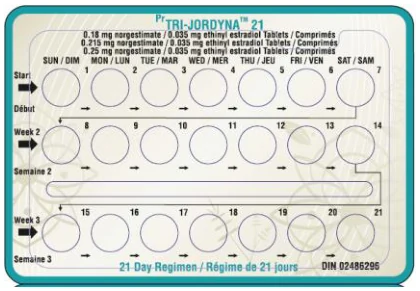
The TRI-JORDYNA 21 pack contains 21 active (hormone-containing) tablets, in three different colors:
- 7 white to off-white tablets
- 7 light blue tablets
- 7 blue tablets
28-Day Package (TRI-JORDYNA 28)
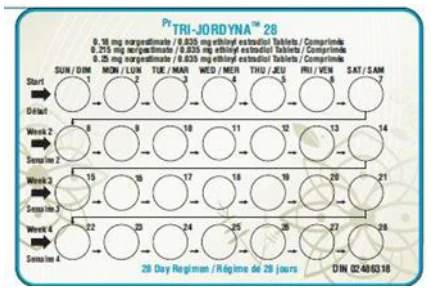
The TRI-JORDYNA 28 pack contains 28 tablets:
21 active tablets (contain hormones), same as listed above:
- 7 white to off-white tablets
- 7 light blue tablets
- 7 blue tablets
- 7 light green tablets – These are “reminder” tablets and do not contain hormones.
- Check the pill pack for:
- where to start taking pills; and
- the order to take the pills. Follow the arrows.
- When to start taking your birth control Pills
- the first day of your period (bleeding) is called Day 1 of your cycle.
- you can start taking your birth control pills any time from Day 1 to Day 6 of your cycle.
- your healthcare professional will help you choose the best day to start
- Choosing your start day
- Once you choose a start day, you will begin your pills on the same day of the week each month. Your healthcare professional might suggest one of these options:
- Day 1 Start: Start your pills on the first day of your period.
- Day 5 Start: Start your pills on Day 5 of your period.
- Sunday Start: Start your pills on the first Sunday after your period begins. If your period starts on a Sunday, start that same day.
- How to label your pill pack
Choose a start day based on your healthcare professional advice:
Day 1 Start:
- Start on the first day of your period.
Example if your period starts on Tuesday
- start your pills on Tuesday
- place the "TUE" day label on your pill pack where it says "Place day label here."
Day 5 Start:
- Start on the fifth day after your period begins.
- Count 5 days starting with the first day of bleeding
Example If your period starts on a Saturday:
- count five days (Sat (1), Sun (2), Mon (3), Tue (4), Wed (5))
- start your pills on Wednesday
- place the "WED" day label on your pill pack where it says "Place day label here."
Sunday Start:
- Start your pills on the first Sunday after your period begins.
- If your period starts on a Sunday, start your pills that same day.
- Stick the correct day label (e.g., "SUN") on your pill pack where it says “Place day label here.”
- Taking your pills
- start with the pill marked “start” (inside the red circle).
- take one pill each day, left to right, following the arrows.
try to take your pill at the same time every day.
- link it to a daily habit (like brushing your teeth or eating dinner).
Do not skip pills, even if:
- you feel sick.
- you are bleeding between periods.
- you are not having sex often.
- How to take your birth control pills
21-Day Pill Package (TRI-JORDYNA 21)
- take 1 pill every day for 21 days.
- then, stop taking pills for 7 days.
- you will likely have your period during this break.
- start a new pack on the 8th day, even if you're still bleeding.
28-Day Pill Package (TRI-JORDYNA 28)
- take 1 pill every day for 28 days.
- the first 21 pills have hormones.
- the last 7 pills are reminders (no hormones).
- your period should happen during the last 7 days.
- start a new pack right away—no days off.
- When you finish a pack
- 21- Day Pill Package (TRI-JORDYNA 21): wait 7 days, then start a new pack.
- 28- Day Pill Package (TRI-JORDYNA 28): start the next pack the very next day—no break.
- Helpful tips for using birth control pills
- use backup protection at first: For the first 7 days of your first pill pack, use a second method of birth control (like condoms and spermicide) just in case you forget a pill while getting used to the routine.
- always let your healthcare professional know that you are taking birth control pills before any medical treatment.
you might have spotting (light bleeding) or feel nauseous during the first 3 months.
- do not stop taking the pills—these symptoms usually go away.
- if they do not, talk to your healthcare professional.
always keep these on hand
- a backup birth control method (like condoms and spermicide).
- an extra full pack of pills.
If you vomit, have diarrhea, or take certain medications
- your pills might not work as well.
- use backup protection and check with your healthcare professional
- you do not need to stop taking the pill for a rest period.
Usual dose:
TRI-JORDYNA 21 (21-Pill Pack): 21 active pills (with hormones)
- take 1 active pill per day for 21 days. Then take no pills for 7 days.
- begin a new pack the next day.
TRI-JORDYNA 28 (28-Pill Pack): 21 active pills (with hormones), 7 light green pills (inactive or reminder pills)
- take 1 active pill per day. When all 21 active pills are done, take 1 light green pill per day for 7 days.
- begin a new pack the next day
Overdose:
If you take takes too many birth control pills, you might experience: nausea, vomiting or vaginal bleeding. Available data from accidental overdoses in children show that these symptoms are usually not dangerous.
If you think you, or a person you are caring for, have taken too much TRI-JORDYNA™, contact a healthcare professional, hospital emergency department, regional poison control centre or Health Canada’s toll-free number, 1-844 POISON-X (1-844-764-7669) immediately, even if there are no signs or symptoms.
Missed Dose:
- The white to white off, light blue or blue pills in TRI-JORDYNA 21 or TRI-JORDYNA 28 contain hormones. Missing them can lead to pregnancy. The more pills you miss, the more likely you are to get pregnant.
Missing pills can also cause:
- cause spotting or light bleeding, even if you take the missed pills
pregnancy especially if you:
- start a new pack late, or
- miss pills at the beginning or end of your pack.
The following chart outlines the actions you should take if you miss one or more of your birth control pills. Match the number of pills missed with the appropriate starting time for your type of pill pack.
| Sunday Start | Other than Sunday Start |
| Miss one Pill | Miss one Pill |
| Take it as soon as you remember and take the next pill at the usual time. This means that you might take two pills in one day. | Take it as soon as you remember, and take the next pill at the usual time. This means that you might take two pills in one day. |
| Miss two pills in a row | Miss two pills in a row |
First Two Weeks
Third Week
If you miss two periods in a row, call your healthcare professional or clinic. | First Two Weeks
Third Week
If you miss two periods in a row, call your healthcare professional or clinic. |
| Miss three or more pills in a row | Miss three or more pills in a row |
Any Time in the Cycle
If you miss two periods in a row, call your healthcare professional or clinic. | Any Time in the Cycle
If you miss two periods in a row, call your healthcare professional or clinic. |
If you are using a 28-Day Pack (TRI-JORDYNA 28):
- the last 7 light green pills in the pack (Week 4) are reminder pills — they do not contain hormones.
If you forget to take any of these 7 light green reminder pills, it is okay:
- just throw away the missed reminder pills.
- keep taking one pill each day until the pack is empty.
- you do not need to use a back-up method of birth control.
- If you are not sure what to do about the pills you have missed call your healthcare professional
always keep these on hand:
- a back-up method of birth control (like condoms and spermicide), just in case you miss pills.
- an extra, full pack of pills.
if you miss more than one pill two months in a row:
Talk to your healthcare professional. They can help you:
- find ways to make pill-taking easier, or
- discuss other birth control options that might work better for you.
What are possible side effects from using TRI-JORDYNA™?
These are not all the possible side effects you may have when taking TRI-JORDYNA. If you experience any side effects not listed here, tell your healthcare professional.
The following side effects have been reported in women taking hormonal contraceptives in general:
- tenderness of the breasts
- nausea and vomiting
- weight gain or loss
- acne
- difficulty wearing contact lenses
- vaginal irritation or infections (discomfort, itching, or notice unusual discharge)
- change in skin pigmentation color (can sometimes be permanent
- abdominal or back pain
- hair loss or increase in growth
- urinary tract infections or inflammation
- infections that affect your nose, throat, and airways (include illnesses like colds, bronchitis, runny or stuffy nose, sore throat, etc.)
- severe headaches
- insomnia
- changes in hearing
- flu-like symptoms
- allergy, fatigue, fever, rash
- diarrhea, flatulence
| Frequency/Side Effect/Symptom | Talk to your healthcare professional | Stop taking the/this drug (if applicable) and get immediate medical help | |
|---|---|---|---|
| Frequency/Side Effect/Symptom | Talk to your healthcare professional | Stop taking the/this drug (if applicable) and get immediate medical help | |
| Only if severe | In all cases | ||
| Only if severe | In all cases | ||
| Uncommon | |||
| Arterial thromboembolism (blood clot in the artery), myocardial infarction (heart attack): chest pain or pressure, a heavy or tight feeling in the chest, or pain that spreads to the shoulder, arm, back, jaw, or stomach. You might also feel very full, like you have indigestion or are choking. Other signs include sweating, nausea, dizziness, shortness of breath, feeling very weak or anxious, or having a fast or irregular heartbeat | ✓ | ||
| Breast changes (breast lumps/breast cancer): pain and tenderness, lumps, nipple discharge | ✓ | ||
| Blood clot in the eye: sudden partial or complete loss of vision | ✓ | ||
| Deep vein thrombosis (blood clot in the leg): swelling of one leg or one foot, pain or tenderness in the leg, difficulty standing or walking, feeling of warmth in the leg, red or discolored skin on the leg, sudden pain, swelling and slight blue discolouration of an extremity | ✓ | ||
| Depression: Persistent sad mood with difficulty sleeping, weakness, lack of energy, fatigue | ✓ | ||
| Edema: unusual swelling of the extremities | ✓ | ||
| Gallbladder disease: nausea, vomiting, pain on the upper right side of the abdomen, especially after meals, loss of appetite, fever | ✓ | ||
| High blood pressure: chest pain, headaches, vision problems, nosebleeds, irregular heartbeat | ✓ | ||
| Liver problems including liver tumour, jaundice: abnormal liver test, yellowing of the skin or eyes, dark urine, nausea, vomiting, severe pain or lump in the abdomen, loss of appetite, fever, light-coloured bowel movements | ✓ | ||
| Pancreatitis (inflammation of the pancreas): Abdominal pain, nausea or vomiting or lump in the abdomen | ✓ | ||
| Pulmonary embolism (blood clot in the lung): sharp chest pain, coughing of blood, or sudden shortness of breath | ✓ | ||
| Stroke (bleeding or blot clot in the brain): weakness and/or loss of feeling of limbs or face, difficulty speaking, clumsiness, vision loss | ✓ | ||
| Change in vaginal bleeding: heavier or lighter periods, light bleeding between periods, having periods less often, or not having them at all. | ✓ | ||
| Vaginal infection (inflammation of the vagina or surrounding area): itching, or unusual or increased vaginal discharge | ✓ | ||
| Very rare | |||
| Severe allergic reaction: swelling of the face, lips, mouth, tongue or throat which may cause difficulty in swallowing or breathing. | ✓ | ||
If you have a troublesome symptom or side effect that is not listed here or becomes bad enough to interfere with your daily activities, tell your healthcare professional.
Reporting Side Effects
You can report any suspected side effects associated with the use of health products to Health Canada by:
- Visiting the Web page on Adverse Reaction Reporting (canada.ca/drug-device-reporting) for information on how to report online, by mail or by fax; or
- Calling toll-free at 1-866-234-2345.
NOTE: Contact your health professional if you need information about how to manage your side effects. The Canada Vigilance Program does not provide medical advice.
Storage:
Store in original packaging, between 15°C – 30°C.
Keep out of the sight and reach of children.
If you want more information about TRI-JORDYNA™:
- Talk to your healthcare professional
- Find the full Product Monograph that is prepared for healthcare professionals and includes this Consumer Information by visiting the Health Canada website (https://www.canada.ca/en/health-canada/services/drugs-health-products/drug-products/drug-product-database.html); or by calling the manufacturer, Glenmark Pharmaceuticals Canada Inc., at: 1-844-801-7468.
Glenmark Pharmaceuticals Canada Inc.
1600 Steeles Ave. West,
Suite 407
Concord, ON
L4K 4M2