


Product Monograph - Lumify
1 INDICATIONS
LUMIFY (brimonidine tartrate ophthalmic solution 0.025% w/v) is indicated to relieve redness of the eye due to minor eye irritations such as environmental allergies, dryness, and fatigue for adults.
1.1 Pediatrics
Pediatrics ( <18 years of age): Based on the data submitted and reviewed by Health Canada, the safety and efficacy of LUMIFY in pediatric patients has not been established; therefore, Health Canada has not authorized an indication for pediatric use. See 7 WARNINGS AND PRECAUTIONS, 7.1.Special Populations, 7.1.3.Pediatrics.
1.2 Geriatrics
Geriatrics (>65 years of age): Over 18% of study subjects in clinical studies were > 65 years of age. No overall difference in safety and effectiveness has been observed between elderly and other adult patients. See 7 WARNINGS and PRECAUTIONS, 7.1.Special Populations, 7.1.4 Geriatrics.
2 CONTRAINDICATIONS
LUMIFY is contraindicated in:
- Patients who are hypersensitive to this drug or to any ingredient in the formulation, including any non-medicinal ingredient, or component of the container. For a complete listing, see 6 DOSAGE FORMS, STRENGTHS, COMPOSITION AND PACKAGING.
- Patients receiving monoamine oxidase inhibitor therapy (MAOI). See 9 DRUG INTERACTIONS, 9.2 Drug Interactions Overview).
- neonates and infants (children under the age of 2 years)
4 DOSAGE AND ADMINISTRATION
4.1 Dosing Considerations
There are no special dosing considerations which need to be taken into account prior to using LUMIFY.
4.2 Recommended Dose and Dosage Adjustment
One (1) drop in the affected eye(s) every 6-8 hours. The dose should not exceed 4 times daily (QID).
Health Canada has not authorized an indication for pediatric use. See 7 WARNINGS AND PRECAUTIONS, 7.1 Special Populations, 7.1.3 Pediatrics.
4.4 Administration
- To avoid contamination, do not allow the tip of container to touch any surface and replace cap after each use.
- Contact lenses should be removed before use and not re-inserted until after at least 15 minutes.
- Allow at least 5 minutes between use of LUMIFY and any other eye drop products.
- Stop use if there is eye pain, changes in vision, continued redness or irritation of the eye or condition worsens or persists for more than 3 days.
4.5 Missed Dose
If a dose is missed, apply as soon as remembered. Then go back to the original schedule as directed by the label. Don’t try to catch up on missed drops by applying more than one dose at a time.
5 OVERDOSAGE
| For management of a suspected drug overdose, contact your regional poison control centre. |
6 DOSAGE FORMS, STRENGTHS, COMPOSITION AND PACKAGING
Table 1 – Dosage Forms, Strengths, Composition and Packaging
LUMIFY drug product is a clear, colorless to slightly yellow, sterile, preserved ophthalmic solution formulated for topical delivery to the eye. Drug product is packaged as 3.5, 5.0- and 7.5-mL fill volumes in 10 mL low-density polyethylene (LDPE) multi-dose bottles using linear low-density polyethylene (LLDPE) tips and two-piece child-resistant closures. The child-resistant closure consists of an inner closure (natural polypropylene) and an outer closure (purple high-density polyethylene (HDPE). Components are sterilized with ethylene oxide prior to use.
| Route of Administration | Dosage Form / Strength/Composition | Non-medicinal Ingredients |
| Ophthalmic | Solution, 0.025% w/v, brimonidine tartrate | Benzalkonium Chloride, Boric Acid, Calcium Chloride Dihydrate, Glycerin, Potassium Chloride, Sodium Borate Decahydrate, Sodium Chloride, Water +/- Hydrochloric Acid and Sodium Hydroxide. |
7 WARNINGS AND PRECAUTIONS
General
FOR TOPICAL OPHTHALMIC USE ONLY.
Carcinogenesis and Mutagenesis
Refer to 16 NON-CLINICAL TOXICOLOGY.
Dependence/Tolerance
No concern with tachyphylaxis or ‘ocular rebound’ was detected in studies.
Ophthalmologic
The preservative in LUMIFY, benzalkonium chloride, may be absorbed by soft contact lenses. Soft contact lenses should be removed and user should wait at least 15 minutes after instilling LUMIFY to re-insert soft contact lenses.
Delayed ocular hypersensitivity reactions have been reported with brimonidine tartrate ophthalmic solution at a higher concentration (i.e. 0.2%) than LUMIFY, with some reported to be associated with an increase in intraocular pressure (IOP).
Cardiovascular
LUMIFY has not been studied in patients with cardiovascular disorders; caution should be exercised in treating patients with severe cardiovascular diseases.
Hepatic/Biliary/Pancreatic
LUMIFY has not been studied in patients with hepatic or renal impairment; caution should be exercised in treating such patients.
7.1 Special Populations
7.1.1 Pregnant Women
No studies have been conducted to determine the effects of brimonidine tartrate ophthalmic solution 0.025% w/v in pregnant women.
Brimonidine tartrate ophthalmic solution 0.025% w/v is not absorbed systemically.
There is very limited information from clinical trials on the extent of exposure during pregnancy; 1 patient discontinued treatment due to pregnancy.
7.1.2 Breast-feeding
It is not known whether brimonidine tartrate is excreted in human milk.
Because of the potential for serious adverse reactions from brimonidine tartrate ophthalmic solution 0.2% (eight times higher concentration than LUMIFY in nursing infants, a decision should be made whether to discontinue nursing or to discontinue the drug, taking into account the importance of the drug to the mother.
7.1.3 Pediatrics
Pediatrics (< 18 years of age): Based on the data submitted and reviewed by Health Canada, the safety and efficacy of LUMIFY in pediatric patients has not been established; therefore, Health Canada has not authorized an indication for pediatric use.
During post-marketing surveillance, somnolence, lethargy, hypotonia, hypothermia, bradycardia, hypotension, apnea, respiratory depression, pallor and coma have been reported in neonates, infants and children receiving brimonidine tartrate ophthalmic solution 0.2% either for congenital glaucoma or via accidental ingestion.
7.1.4 Geriatrics
Geriatrics (> 65 years of age): No overall difference in safety and effectiveness has been observed between elderly and other adult patients.
8 ADVERSE REACTIONS
8.1 Adverse Reaction Overview
The safety profile of LUMIFY was similar to the safety profile of the vehicle solution.
The majority of adverse reactions following use of LUMIFY were ocular in nature and were of mild in severity. There was no treatment related serious adverse events (SAE). Two subjects discontinued treatment due to a related adverse events: instillation site burning and hypotension.
8.2 Clinical Trial Adverse Reactions
Because clinical trials are conducted under very specific conditions, the adverse reaction rates observed in the clinical trials may not reflect the rates observed in practice and should not be compared to the rates in the clinical trials of another drug. Adverse reaction information from clinical trials is useful for identifying drug-related adverse events and for approximating rates.
The safety data presented is from two pivotal randomized, double blind, vehicle controlled clinical studies, one randomized, double blind, vehicle-controlled safety study and one open-label pharmacokinetic study (ISS Safety Set) conducted with LUMIFY. Four hundred and twenty-six (n=426) healthy subjects and subject with ocular redness received QID dosing for 5-28 days. The mean age of subjects was 42.2 years old and 60.8% of subjects were female.
Across the four clinical studies, 426 subjects were exposed to LUMIFY for a mean (SD) of 27.2 (6.35) subject-days.
| Table 2 – Treatment Emergent Adverse Events (TEAEs) by System Organ Class and Preferred Term Occurring in ≥ 1% of Subjects – ISS Analysis Set | ||||||
System Organ Class (SOC) Preferred Term (PT) | Brimonidine Tartrate 0.025% (N=426)* | Vehicle (N=209) | All Subjects (N=638) | |||
| Events | Subjects | Events | Subjects | Events | Subjects | |
| Total TEAEs | 122 | 96 (22.5%) | 58 | 45 (21.5%) | 180 | 141 (22.2%) |
| Eye Disorders | 60 | 51 (12.0%) | 28 | 25 (12.0%) | 88 | 76 (12.0%) |
| Visual Acuity Reduced | 18 | 17 (4.0%) | 9 | 9 (4.3%) | 27 | 26 (4.1%) |
| Conjunctival Hyperemia | 12 | 11 (2.6%) | 6 | 6 (2.9%) | 18 | 17 (2.7%) |
| Ocular Hyperemia | 5 | 5 (1.2%) | 2 | 2 (1.0%) | 7 | 7 (1.1%) |
| General Disorders and Administration Site Conditions | 11 | 10 (2.3%) | 4 | 4 (1.9%) | 15 | 14 (2.2%) |
| Instillation Site Pain | 7 | 7 (1.6%) | 4 | 4 (1.9%) | 11 | 11 (1.7%) |
| Infections and Infestations | 15 | 12 (2.8%) | 8 | 8 (3.8%) | 23 | 20 (3.1%) |
| Nasopharyngitis | 3 | 3 (0.7%) | 4 | 4 (1.9%) | 7 | 7 (1.1%) |
| Nervous System Disorders | 7 | 7 (1.6%) | 5 | 5 (2.4%) | 12 | 12 (1.9%) |
| Headache | 5 | 5 (1.2%) | 4 | 4 (1.9%) | 9 | 9 (1.4%) |
*N in the headers represents the total number of subjects enrolled in each respective treatment group within the Safety population. Three brimonidine-treated subjects were enrolled in more than one study and were counted in each study for the total number of randomized subjects (N=429), however, these three subjects were counted only once within the ISS Safety Population for N=426.
Percentages are based on the total number of subjects in each treatment group.
Subjects experiencing more than one TEAE within a given MedDRA (Version 16.1) SOC or PT are counted once within that MedDRA SOC or PT in the Subjects column. The three subjects who enrolled in more than one study also were counted only once in the Subjects column if they experienced more than one TEAE within a given MedDRA SOC/PT across more than one study.
SOCs are listed in order of descending frequency for All Subjects.
PTs are listed in order of descending frequency within each SOC for All Subjects.
The Events column shows the total number of events; the Subjects column shows the total number of subjects with at least one event.
The overall incidence of TEAEs was summarized by SOC and by SOC and PT using the number and percentage of subjects reporting an event and the number of events reported. There were a total of 180 TEAEs reported by 141 (22.2%) subjects. The majority of TEAEs were ocular in nature and generally mild in severity; non-ocular TEAEs were mostly mild to moderate in severity.
The most commonly reported TEAEs were reduced visual acuity, conjunctival hyperemia, instillation site pain, headaches, ocular hyperemia, and nasopharyngitis. All of the reduced visual acuity and conjunctival hyperemia TEAEs were deemed not related to study treatment; all instillation site pain TEAEs were deemed related to study treatment. A similar percentage of subjects in each treatment group reported mild to moderate headaches which were deemed related to study treatment.
By subgroup, the greatest percentage of subjects reporting TEAEs was the 18-64 years of age group, females, not Hispanic or Latino ethnicity, and white race.
8.3 Less Common Clinical Trial Adverse Reactions
Blood and lymphatic system disorders: lymphocytosis, monocytosis
Cardiac disorders: palpitations
Eye disorders: dry eye, eye irritation, foreign body sensation, eye discharge, eye pain, photophobia, instillation site burn, instillation site irritation, pain, instillation site pruritus
General disorders and administration site conditions: pain
Infections and infestations: rhinitis
Musculoskeletal and connective tissue disorders: muscle twitching
Nervous system disorders: headache
Respiratory, thoracic and mediastinal disorders: nasal discomfort
Vascular disorders: hypotension
8.4 Clinical Trial Adverse Reactions (Pediatrics)
There were no SAEs in the pediatric population (5-17 years) in clinical studies with LUMIFY.
8.5 Post-Market Adverse Reactions
The following adverse reactions have been identified during post-marketing use of LUMIFY. Because they are reported voluntarily from a population of unknown size, estimates of frequency cannot be made.
The reactions, which have been chosen for inclusion due to either their seriousness, frequency of reporting, possible causal connection to brimonidine tartrate ophthalmic solutions, or a combination of these factors, include:
Eye disorders: conjunctival follicles, blepharitis, dry eye, eye irritation, eye pain, eye pruritus, lacrimation increased, eyelid edema, foreign body sensation in eyes, ocular hyperemia, vision blurred
Gastrointestinal disorders: dry mouth
General disorders: fatigue, insomnia
Immune system disorders: hypersensitivity
Nervous system disorders: headache
Cardiac disorders: hypotension
9 DRUG INTERACTIONS
9.1 Drug Interactions Overview
During the four clinical studies, there were no reports of drug interactions with LUMIFY.
At concentrations higher than LUMIFY, use of brimonidine tartrate ophthalmic solutions 0.15% and 0.2% are contraindicated in patients receiving monoamine oxidase (MAO) inhibitor therapy.
Brimonidine tartrate ophthalmic solution, 0.15% or 0.2%, did not have clinically significant effects on pulse and blood pressure in chronic clinical studies. However, since α-agonists, as a class, may reduce pulse and blood pressure, caution in the concomitant use of drugs such as beta-blockers (ophthalmic and/or systemic), antihypertensives and/or cardiac glycosides is advised.
Tricyclic antidepressants have been reported to blunt the hypotensive effect of systemic clonidine. Caution, is advised in patients taking tricyclic antidepressants which can affect the metabolism and uptake of circulating amines.
Although specific drug interaction studies have not been conducted with brimonidine tartrate ophthalmic solutions, the possibility of an additive or potentiating effect with CNS depressants (alcohol, barbiturates, opiates, sedatives, or anesthetics) should be considered.
9.2 Drug-Drug Interactions
Interactions with other drugs have not been established.
9.3 Drug-Food Interactions
Interactions with food have not been established.
9.4 Drug-Herb Interactions
Interactions with herbal products have not been established.
9.5 Drug-Laboratory Test Interactions
Interactions with laboratory tests have not been established.
10 ACTION AND CLINICAL PHARMACOLOGY
10.1 Mechanism of Action
Brimonidine tartrate is a highly selective imidazoline α2-adrenergic receptor agonist, a chemical class well known to cause vasoconstriction.
10.2 Pharmacodynamics
No pharmacodynamics studies were performed.
10.3 Pharmacokinetics
Absorption
Systemic exposure of brimonidine after QID of brimonidine tartrate ophthalmic solution 0.025% w/v is extremely low and not measurable, hence is considered negligible.
Metabolism
In humans, brimonidine tartrate is eliminated rapidly via extensive systemic metabolism; there is no marked systemic accumulation after multiple dosing. It is metabolized primarily by the liver.
Elimination
Urinary excretion is the major route of elimination of the drug and its metabolites. Approximately 87% of an orally administered radioactive dose was eliminated within 120 hours, with 74% found in the urine.
11 STORAGE, STABILITY AND DISPOSAL
LUMIFY should be stored at 15° C to 25° C. Discard any unused solution 121 days after opening.
PART II: SCIENTIFIC INFORMATION
13 PHARMACEUTICAL INFORMATION
Drug Substance
Proper name: Brimonidine tartrate
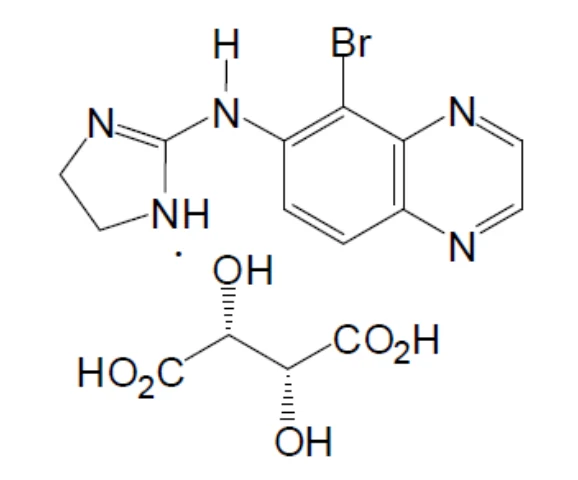
Chemical name: 5-bromo-N-(4,5-dihydro-1H-imidazol-2-yl)quinoxalin-6-amine (2R,3R)-2,3- dihydroxybutanedioic acid
Molecular formula and molecular mass: C11H10BrN5 • C4H6O6 442.22 g/mol
Structural formula:
Physicochemical properties
Description: Brimonidine tartrate is a white to slightly yellowish or slightly brownish powder.
Melting Point: With a melting point range of 204 - 210°C.
Solubility: It is freely soluble in water and insoluble in almost all organic solvents. The approximate solubility in water at different pH condition is as follows: pH 2.61: 0.08 g/mL, pH 3.42: 0.05 g/mL & pH 3.96: 0.07 g/mL.
pH: The pH of a 1% solution of brimonidine tartrate in water is 3.0 to 4.0 at room temperature.
14 CLINICAL TRIALS
14.1 Trial Design and Study Demographics
Study 11-100-0015 was conducted using an environmental study design that reflects the real-world usage pattern of low-dose brimonidine as an agent in alleviating already-present ocular redness in adult (≥40 years old) and geriatric (≥65 years old) subjects.
Study 13-100-0005, a single site, randomized, double-masked, Phase 3 efficacy and safety study of 60 subjects used the same study design as study 11-100-0015, the Phase 2 environmental study.
Table 3 - Summary of patient demographics for clinical studies of LUMIFY in patients with ocular redness
| Study # | Trial design | Dosage, route of administration and duration | Study subjects (n) | Mean age (Range) | Sex |
| 11-100-0015 | Phase 2, single-center, double-masked, randomized, vehicle-controlled, parallel-group, environmental study design | Brimonidine tartrate, 0.025% 1 drop, QID = 38 Vehicle QID = 19 Randomization 2:1 Ophthalmic 28 days | Total: n=57 | 55.9 years (41-77 years) | Male=13 Female=44 |
| 13-100-0005 | Phase 3, Single-center, double-masked, randomized, vehicle-controlled, parallel-group, environmental study design | Brimonidine tartrate, 0.025% 1 drop, QID = 40 Vehicle = 20 Randomization 2:1 Ophthalmic ~5 weeks | Total: n=60 | 47.5 years (19-78 years) | Male=22 Female=38 |
14.2 Study Results
LUMIFY (brimonidine tartrate ophthalmic solution 0.025% w/v) is highly efficacious for the treatment of ocular redness reduction as assessed by investigators and study subjects.
In studies 11-100-00015 and 13-100-0005, ocular redness was evaluated by the investigator prior to study medication instillation (1 drop QID) and at 5, 15, 30, 60, 90, 120, 180, and 240 minutes post study medication instillation. Additionally, ocular redness was evaluated at 1, 360, and 480 minutes post-instillation in study 13-100-0005. Brimonidine was reproducibly superior to vehicle in reduction of redness through 4 hours across the 2 studies. Overall, statistically significant reduction in ocular redness was seen as early as 1 minute and persisted out to 8 hours. No tachyphylaxis (tolerance or loss of effectiveness) and minimal rebound congestion were noted.
In general, for ocular redness, subgroup analyses by age, gender, race, ethnicity, and iris color were in agreement with the results in the overall integrated efficacy population.
Table 4 - Results of studies11-100-0015 and 13-100-0005 in patients with ocular redness
| Time Point | Statistic* | Study 11-100-0015 | Study 13-100-0005 | ||
Active N=38 | Vehicle N=19 | Active N=40 | Vehicle N=20 | ||
| Pre-Instillation | Mean (SD) | 1.82 (0.376) | 1.96 (0.346) | 1.82 (0.412) | 1.71 (0.365) |
| 1 Minute Post-Instillation§ | Mean (SD) | nd | nd | 0.76 (0.562) | 1.49 (0.636) |
| p-value1 | nd | nd | 0.0001 | -- | |
| 5 Minutes Post-Instillation | Mean (SD) | 0.17 (0.377) | 1.75 (0.589) | 0.58 (0.497) | 1.40(0.666) |
| p-value1 | <0.0001 | -- | <0.0001 | -- | |
| 15 Minutes Post-Instillation | Mean (SD) | 0.15 (0.365) | 1.67 (0.613) | 0.58 (0.497) | 1.35 (0.651) |
| p-value1 | <0.0001 | -- | <0.0001 | -- | |
| 30 Minutes Post-Instillation | Mean (SD) | 0.16 (0.336) | 1.68 (0.513) | 0.59 (0.511) | 1.40 (0.641) |
| p-value1 | <0.0001 | -- | <0.0001 | -- | |
| 60 Minutes Post-Instillation | Mean (SD) | 0.15 (0.356) | 1.71 (0.522) | 0.61 (0.509) | 1.40 (0.646) |
| p-value1 | <0.0001 | -- | <0.0001 | -- | |
| 90 Minutes Post-Instillation | Mean (SD) | 0.21 (0.361) | 1.68 (0.440) | 0.60 (0.476) | 1.45 (0.672) |
| p-value1 | <0.0001 | -- | <0.0001 | -- | |
| 120 Minutes Post-Instillation | Mean (SD) | 0.24 (0.361) | 1.72 (0.456) | 0.63 (0.470) | 1.53 (0.612) |
| p-value1 | <0.0001 | -- | <0.0001 | -- | |
| 180 Minutes Post-Instillation | Mean (SD) | 0.43 (0.522) | 1.78 (0.390) | 0.73 (0.449) | 1.54 (0.586) |
| p-value1 | <0.0001 | -- | <0.0001 | -- | |
| 240 Minutes Post-Instillation | Mean (SD) | 0.68 (0.560) | 1.83 (0.433) | 0.82 (0.474) | 1.54 (0.575) |
| p-value1 | <0.0001 | -- | <0.0001 | -- | |
| Visit 1 ANCOVA – All post-instillation time points** | LS Means (SE) | 0.30 (0.054) | 1.67 (0.077) | 0.62 (0.076) | 1.49 (0.108) |
| p-value1 | <0.0001 | -- | <0.0001 | -- | |
| 360 Min Post- | Mean (SD) | nd | nd | 1.04 (0.465) | 1.61 (0.559) |
| Instillation§ | p-value1 | nd | nd | 0.0004 | -- | ||
| 480 Min Post-Instillation§ | Mean (SD) | nd | nd | 1.19 (0.505) | 1.58 (0.507) | ||
| p-value1 | nd | nd | <0.0001 | -- | |||
* SD = standard deviation; ANCOVA = analysis of covariance; LS = least squares; SE = standard error; nd=not done; ITT = intent-to-treat; LOCF = last observation carried forward; § 1 minute, 360- and 480-minutes data are from Visit 1, ITT with observed data only; **Except 1 minute, 360 and 480 minutes; 1 p-value calculated using a repeated measures ANCOVA model with treatment, time point, the treatment by time point interaction, and baseline score in the model and comparing the active treatment to the vehicle. Note: Ocular redness was assessed by the investigator on a 0-4 scale; 0.5 increments were allowed. A lower score is indicative of less redness. BOLD font indicates a statistically significant difference | |||||||
16 NON-CLINICAL TOXICOLOGY
General Toxicology
The acute median lethal dose (LD50) or minimum lethal dose (MLD) values of brimonidine were evaluated in mice, rats, rabbits, and dogs by oral and intravenous (i.v.) administration. The LD50 or MLD values are listed below:
| Species | Route | LD50 (mg/kg)* | MLD (mg/kg)* |
| Mouse | oral i.v.* | 50 50 | >8** Not performed |
| Rat | oral i.v. | 100 100-150 | >8** Not performed |
| Rabbit | oral i.v. | Not performed Not performed | >6 20-50 |
| Dog | oral i.v. | Not performed Not performed | 0.5 0.05 |
*The doses are expressed as the base except in the mouse and rat MLD data, where they are expressed as brimonidine tartrate.
**The data from additional single dose oral studies of 0.2% and 0.5% solutions of brimonidine tartrate in mice and rats showed that the oral MLD is greater than 10 mg/kg.
The most frequently observed clinical signs in the acute/single dose toxicity studies were primarily due to the exaggerated pharmacological hypotensive effect of the compound. These signs included: sedation, ataxia, prostration, ptosis, reduced/loss of blink reflex, opacification of the cornea, hypotension, bradycardia, hypothermia, respiratory depression, respiratory arrest and circulatory collapse. The ocular changes were seen only after doses at or above the minimum lethal dose.
Long-term toxicity studies with brimonidine tartrate in various concentrations using mice, rats, rabbits, dogs and monkeys were conducted for durations of up to one year. The most notable effects seen in these studies were related to the known pharmacological effect of brimonidine.
Carcinogenicity
There were no compound-related carcinogenic effect observed in either mice or rat studies.
Genotoxicity
Brimonidine was not mutagenic or cytogenic in a series of in vitro and in vivo studies including the Ames test, host-mediated assay, chromosomal aberration assay in Chinese Hamster Ovary (CHO) cells, cytogenic studies in mice and dominant lethal assay.
Reproduction and Teratology
Reproductive toxicology studies conducted with brimonidine tartrate in rats and rabbits showed that brimonidine tartrate had no adverse effects on fertility and general reproductive performance, and showed no evidence of embryo-lethal or teratogenic activity.