


Patient Medication Information: uses, side effects, how to take - Mytolac
What is MYTOLAC® used for?
MYTOLAC® is recommended for:
- The treatment of adults with acromegaly. Acromegaly is a condition where a gland in your brain produces too much growth hormone.
The treatment of adults with a type of cancer known as enteropancreatic neuroendocrine tumours. Enteropancreatic neuroendocrine tumours begin to grow in the stomach, intestines, appendix, or the pancreas. MYTOLAC® treats and controls the growth of tumours of the intestine and pancreas that:
- cannot be removed by surgery or;
- have spread
- The treatment of adults with carcinoid syndrome. Carcinoid syndrome is a cancer condition that makes and releases certain chemicals into your blood. MYTOLAC® reduces the need for rescue drugs to treat carcinoid syndrome.
MYTOLAC® is not for use in children and adolescents under the age of 18.
How does MYTOLAC® work?
Lanreotide, the medicinal ingredient in MYTOLAC®, belongs to a group of medicines called antigrowth hormones. Lanreotide is similar to a hormone naturally made in your body called somatostatin. MYTOLAC® is believed to lower the levels of hormones in the body such as GH (growth hormone) and IGF-1 (insulin-like growth factor-1) and blocks the release of some hormones and secretions in the stomach and intestines.
Additionally, it has an effect on some type of tumours of the intestine and pancreas by stopping or delaying their growth.
Treatment with MYTOLAC® may:
activity of the immune system. Taking MYTOLAC® may lower the levels of
What are the ingredients in MYTOLAC®?
Medicinal ingredients: lanreotide acetate.
Non-medicinal ingredients: acetic acid and water for injection.
MYTOLAC® comes in the following dosage forms:
Solution for injection: 60 mg, 90 mg, 120 mg lanreotide (as lanreotide acetate).
Do not use MYTOLAC® if you:
- are allergic to lanreotide or any of the other ingredients of MYTOLAC®.
- are allergic to somatostatin or any other drug similar to somatostatin.
- have untreated gallstones.
To help avoid side effects and ensure proper use, talk to your healthcare professional before you take MYTOLAC®. Talk about any health conditions or problems you may have, including if you:
- are diabetic. Treatment may affect your blood sugar levels. Your healthcare professional may monitor your blood sugar levels after your first dose, when your dose is changed, and every so often during your treatment. They may also alter the drugs you use to treat your diabetes.
- have or have had liver problems.
- have or have had kidney problems.
- have or have had heart problems. Treatment may slow your heart rate. Your healthcare professional may monitor your heart rate while on treatment.
- have or have had gallbladder problems. Treatment may lead to the formation of gallstones in your gallbladder. Your healthcare professional may monitor your gallbladder when you take your first dose and while on treatment. Treatment may end should complications of gallstones occur.
- have thyroid problems. Treatment may decrease your thyroid function if you are being treated for acromegaly.
are pregnant, planning to become pregnant. Avoid taking MYTOLAC® if you are pregnant and avoid becoming pregnant while you are taking MYTOLAC®.
- are breast-feeding.
Other warnings you should know about:
Driving and using machines: Before you perform tasks which may require special attention, wait until you know how you respond to MYTOLAC®. Dizziness and headaches can occur after the first dose and when the dose is increased.
You may develop Pancreatic Exocrine Insufficiency (PEI) when taking MYTOLAC®. PEI is a condition where your pancreas doesn’t make enough digestive enzymes. These enzymes are responsible for breaking down food for your body to absorb.
Tell your healthcare professional about all the medicines you take, including any drugs, vitamins, minerals, natural supplements or alternative medicines.
The following may interact with MYTOLAC®:
- Cyclosporine, which is a drug that blocks the activity of the immune system.
- Bromocriptine, which is a drug that blocks prolactin (a hormone released by the pituitary gland).
- Bradycardia inducing drugs, which are drugs that slow heart rate (e.g., beta-blockers).
- Insulin and oral hypoglycemics, which are drugs that lower blood sugar levels.
- Drugs that are mainly metabolized by the liver enzyme CYP3A4 with a low therapeutic index (e.g., Sirolimus, tacrolimus).
How to take MYTOLAC®:
- Take MYTOLAC® exactly as your healthcare professional has told you. Speak to your healthcare professional if you are not sure.
- MYTOLAC® is given as a deep subcutaneous (under the skin) injection into the buttock or the upper outer thigh.
- MYTOLAC® is given by a healthcare professional or a properly trained person.
- You may give yourself an injection, in the thigh region only. You should be properly trained and be able to follow the Instructions for Use of MYTOLAC®
Usual Adult Dose:
Treatment for Acromegaly
The recommended starting dose is one injection of MYTOLAC® 90 mg every 28 days. If you have liver or kidney problems, the recommended starting dose is one injection of MYTOLAC® 60 mg every 28 days.
Your healthcare professional:
- May change the dose or the length of time between your injections. This depends on how your symptoms and hormones respond to the treatment and whether you have liver or kidney problems.
- Will tell you how long you need to receive MYTOLAC®.
Treatment for Enteropancreatic Neuroendocrine Tumours or Carcinoid Syndrome
The recommended dose is one injection of MYTOLAC® 120 mg every 28 days. Your healthcare professional may change your dose if you have liver or kidney problems. They will tell you how long you need to receive MYTOLAC®.
If you are already being treated for enteropancreatic neuroendocrine tumours, you do not need to take an extra dose of MYTOLAC® for the treatment of carcinoid syndrome.
Instructions for Use
The following instructions explain how to inject MYTOLAC® Please read all instructions carefully before starting the injection.
- A. Product Description
Each carton contains a pre-filled syringe placed in a plastic tray and sealed inside a labeled aluminum pouch and a separate needle pack. The needle pack contains a SAN® (Safe Auto Needle) – Light device, which is a needle with a GREEN NEEDLE SHIELD. The GREEN NEEDLE SHIELD when in use will automatically cover and lock around the needle once the injection is complete. This will help to prevent needle stick injury after use
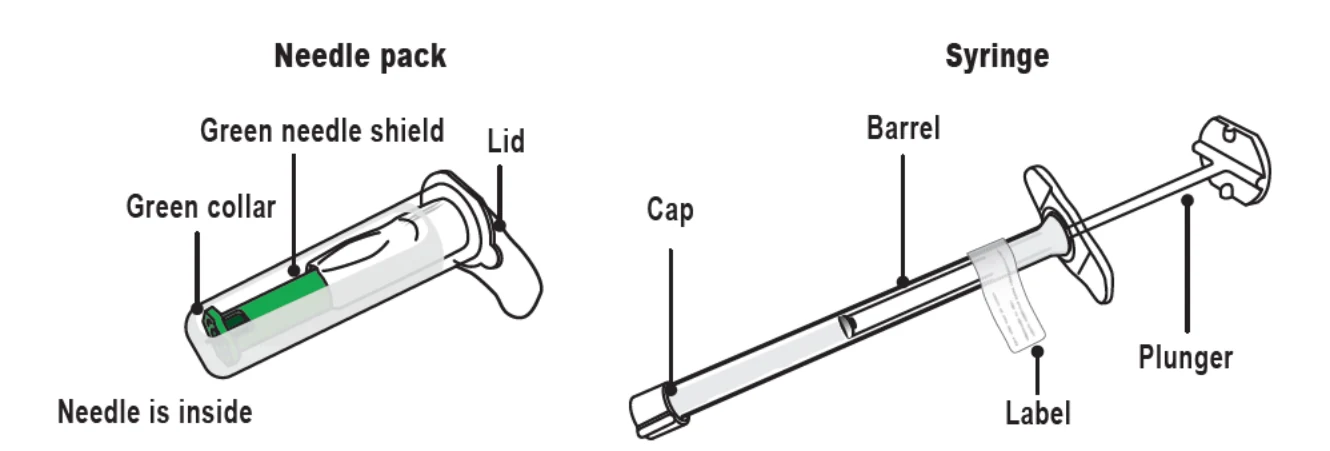
Note: The image is not to scale.
The content of the prefilled syringe is a semi-solid phase having a gel-like appearance, with viscous characteristics and a colour varying from white to pale yellow. The supersaturated solution can also contain micro bubbles that can clear up during injection. These differences are normal and do not interfere with the quality of the product.
B. Before your start
B1. Remove MYTOLAC® from the refrigerator 30 minutes prior to injecting. Keep the laminated pouch sealed until just before the injection.
B2. Check that the medication has not expired. The expiry date is printed on the outer carton and the pouch - Do not use if the medication has expired or if the pouch is damaged.
B3. Look closely at the MYTOLAC® syringe. Check for particles and discolouration. Do not administer if you see particles or if there is a change in colour.
B4. Wash hands with soap and dry hands thoroughly before starting. B5. Make sure there is a clean surface for preparation.
C. Get the syringe ready
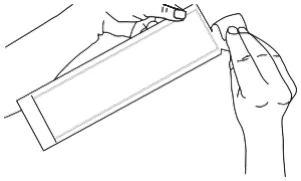
C1. After the product has reached room temperature tear open the pouch and take out the pre-filled syringe.
Discard the tray and the pouch.
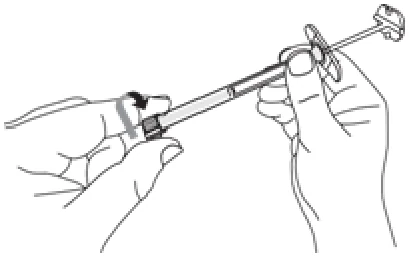
C2: Remove the cap from the syringe
- With one hand, hold the syringe barrel steady. Do not hold onto the plunger.
- With the other hand, twist the cap to remove it.
- Place the syringe on a clean surface, as stated in B5.
C3: Open the needle pack
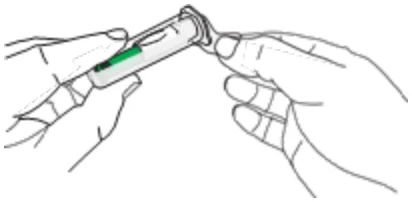
Hold the needle pack with one hand and pull the lid off with the other.
Caution:
- Do not touch the open end of the needle pack. This needs to stay clean.
- If the lid is broken, do not use the needle as it is no longer sterile.
C4: Assemble the device
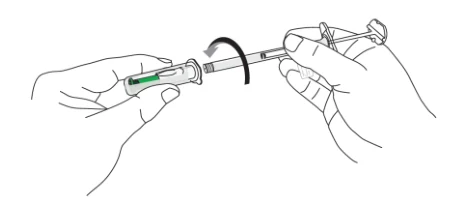
- Put the end of the syringe into the open end of the needle pack.
- Hold the needle pack with one hand and the syringe barrel with the other hand. Do not hold onto the plunger. Twist clockwise until the syringe and needle are fully locked together.
- They are fully locked when you cannot turn it any further.
Important: Tighten the syringe firmly to avoid drug leakage.
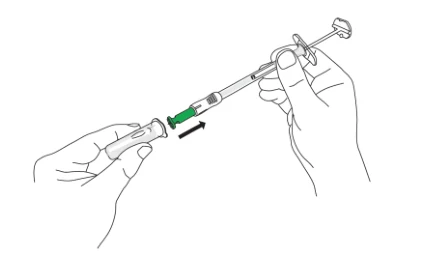
C5: Remove the needle from the packaging
- Hold the syringe barrel. Do not hold onto the plunger.
- Pull the needle straight out from the needle pack without twisting or turning to make sure that the syringe is well connected to the needle.
Caution: The needle is partially exposed from this step onwards.
WARNING:
- NEVER TOUCH OR TRY TO OPEN THE GREEN NEEDLE SHIELD
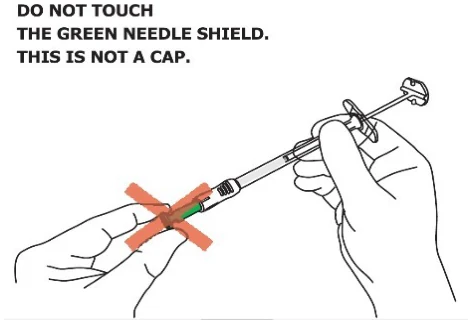
- DO NOT REMOVE THE GREEN NEEDLE SHIELD.
- GREEN NEEDLE SHIELD is NOT a removable cap or cover for the needle.
- GREEN NEEDLE SHIELD is a self-operating safety lock mechanism.
- GREEN NEEDLE SHIELD will automatically activate during the needle insertion.
- GREEN NEEDLE SHIELD will automatically cover and lock around the needle once the injection is complete.
D. Get the injection site ready.
Select an injection site. Avoid areas with moles, scar tissue, reddened skin, or skin that feels bumpy. Be sure to switch between (alternate) the right and left side each time an injection is given. The location of the injection site is based on who is giving the injection. Alternate the injection site between the right and left side each time you have an injection of MYTOLAC®.
D1. Clean the injection site:
Use a sterile gauze without rubbing the skin too much
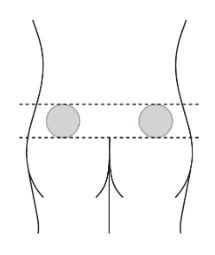
D2. If you are injecting someone else:
Inject into the upper outer area of the buttock.
Injection by HCP
or a trained person
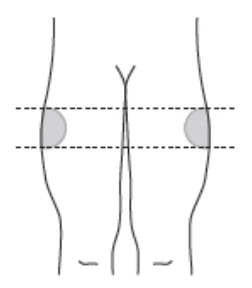
D3. If you are injecting yourself:
Inject into the upper outer part of your thigh.
Self-injection, injection by HCP
or a trained person
- E. Perform Injection
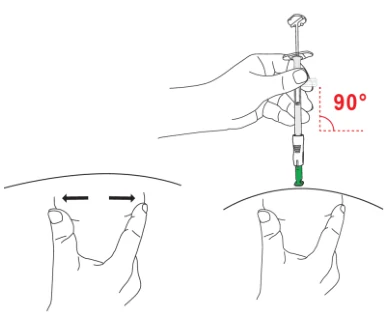
E1: Position the syringe
- To check which site you should use, refer to section D.
- Stretch the skin around the injection site flat and tight using your thumb and index finger.
- Hold the lower part of the syringe barrel (not the plunger) with your other hand.
- Position the syringe at a 90-degree angle to the skin. Keeping the GREEN NEEDLE SHIELD flat against the skin can help keep the correct 90-degree angle needed for the injection.
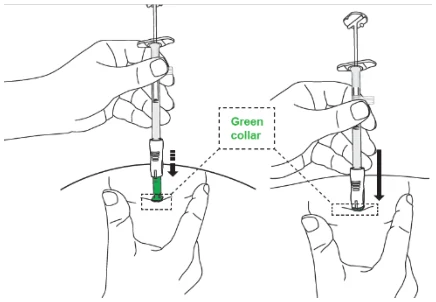
E2: Insert the needle
- Without folding or pressing on the skin at the injection site, push the needle firmly against the skin.
- The GREEN NEEDLE SHIELD will retract.
- Keep going until only the collar of the GREEN NEEDLE SHIELD is visible.
- Do not push the plunger in this step. Hold the syringe in this position for the next step.
Note: During injection, maintain pressure on the needle to avoid activation of the automatic safety system
E3: Push the top of the plunger
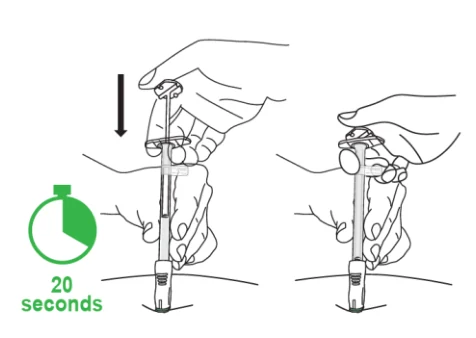
Let go of the injection site area that has been flattened by your
hand and move this hand from the skin to the top of the plunger.
- Push the plunger slowly but steady with very firm pressure without interruption until the top touches the syringe barrel (it is easier to depress the plunger with your dominant hand).
- Important! The medication is thicker and harder to push than you might expect. Inject the full dose and give a final push to make sure you cannot depress it any further.
- This should take around 20 seconds.
F. Remove and throw away syringe
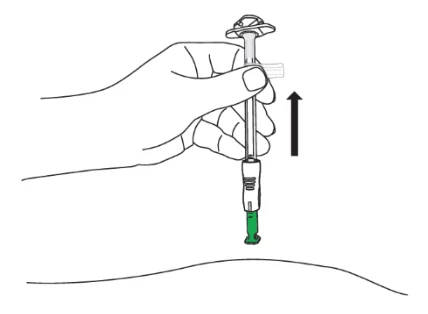
F1: Remove from the skin
- Lift the syringe straight up and away from your body.
- The GREEN NEEDLE SHIELD will cover the needle.
Both the used syringe and GREEN NEEDLE SHIELD together will be thrown away, refer to section F3.
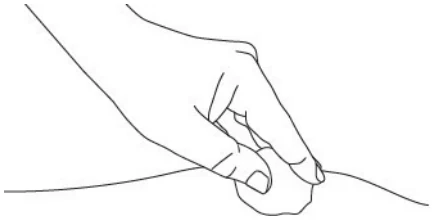
F2: Apply gentle pressure
- Apply gentle pressure to the injection site with a dry cotton ball or sterile gauze to prevent any bleeding.
- Do not rub or massage the injection site after administration.
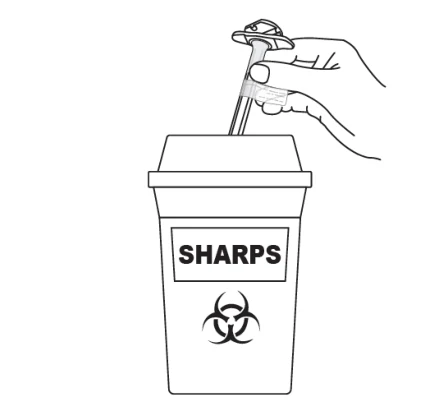
F3: Throw away
- Dispose of the used syringe and needle according to your local laws and regulations or how your healthcare professional has shown you.
- The needles are not reusable.
- Do not dispose of the syringe or needle in your general household garbage.
Overdose:
Missed Dose:
As soon as you realize that you have missed an injection, contact your healthcare professional. They will give you advice about the timing of your next injection. DO NOT give yourself extra injections to make up for the one that you have forgotten.
What are possible side effects from using MYTOLAC®?
These are not all the possible side effects you may have when taking MYTOLAC®. If you experience any side effects not listed here, tell your healthcare professional.
- Cold-like symptoms (cough, runny nose, sore throat, fever)
- Confusion
- Constipation
- Dizziness
- Dry mouth
- Excessive sweating, night sweats
- Fatty stools (stools may be bulky and appear pale and oily)
- Feeling hot with reddening of the skin
- Flatulence (passing gas)
- Hair loss
- Hard swelling of the injection site, and rarely a persistent hard swelling
- Heartburn
- Indigestion
- Joint, bone, or mouth pain
- Loss of appetite
- Muscle pains or spasms
- Nausea
- Pain during menstruation
- Ringing in the ears
- Shaking
- Swelling in the arms
- Swollen tummy
- Weakness, numbness, tingling or pain in the hands, feet, or back
- Weight loss
MYTOLAC® can cause abnormal blood test results. Your healthcare professional will decide when to perform blood tests and other tests like gall bladder ultrasound. They will interpret the results.
If you think you, or a person you are caring for, have taken too much MYTOLAC®, contact a
Serious side effects and what to do about them
| Frequency/Side Effect/Symptom | Talk to your healthcare professional | Stop taking the drug and get immediate medical help | |
|---|---|---|---|
| Only if severe | In all cases | ||
| VERY COMMON | |||
| Abdominal pain | X | ||
| Diarrhea or loose stools | X | ||
Formation of gallstones in the gall bladder: sudden severe pain in the upper right abdomen which may last for hours, maybe accompanied by nausea and Vomiting | X | ||
| Headache | X | ||
| Vomiting | X | ||
| Anemia (decreased number of red blood cells): fatigue, loss of energy, weakness, shortness of breath | X | ||
| COMMON | |||
Injection site reaction: site of injection may be tender, warm, swollen, red or itchy with a build-up of pus under the skin | X | ||
Decreased heart rate (bradycardia) | X | ||
Eye problems: clouding of the lens in the eye, blurry vision, eye redness, dim vision, and/or eye pain | X | ||
Heart Disorders (disorders affecting your heart muscle, valves or rhythm): Chest pain, or chest discomfort, high blood pressure, irregular heart rhythm, shortness of breath, fainting, swelling of the legs, ankles and feet, weakness | X | ||
| High blood pressure or worsening of high blood pressure: headaches, nausea and vomiting | X | ||
Underactive thyroid gland (hypothyroidism): changes in heart rate, appetite or weight, tiredness, feeling cold or swelling at the front of the neck | X | ||
Pancreatitis (inflammation of the pancreas): severe abdominal pain which may spread out towards the back, nausea, vomiting, increased heart rate | X | ||
Liver problems: yellowing of the skin or eyes, dark urine, abdominal pain, nausea, vomiting, loss of appetite, itching, bruising, weight loss | X | ||
Diabetes, worsening of diabetes, or high blood sugar: unusual thirst, frequent urination, extreme fatigue or lack of energy, tingling or numbness in the hands or feet | X | ||
|---|---|---|---|
| Low blood sugar: dizziness, sweating, confusion, headache, blurred vision, fast heartbeat, mood changes | X | ||
Urinary tract infection (infection in urinary system including kidneys, ureters, bladder and urethra): Pain or burning sensation while urinating, frequent urination, blood in urine, pain in the pelvis, strong smelling urine, cloudy urine | X | ||
Depression (sad mood that won’t go away): difficulty sleeping or sleeping too much, changes in appetite or weight, feelings of anxiety, worthlessness, guilt, regret, helplessness, hopelessness or reduced libido (sex drive) | X | ||
| New Tumour growth | X | ||
| Deafness: loss of hearing | X | ||
| RARE | |||
| Allergic skin reactions: rash, hives, itching, redness | X | ||
| UNKNOWN | |||
Severe allergic reactions: swollen face, lips, mouth or tongue, tightness in chest, shortness of breath or wheezing fainting, dizziness or feeling lightheaded due to a drop in blood pressure, flushing or redness of the skin, rash or hives | X | ||
Inflammation of the bile duct: pain in the upper right part of your belly (abdomen), fever, chills, yellowing of the skin and eyes (jaundice), nausea, vomiting, clay-coloured stools, dark urine, tiredness | X | ||
| Pancreatic Exocrine Insufficiency (pancreas doesn’t make enough digestive enzymes): fatty stools (too much fat in your stool), diarrhea, loose stools, abdominal bloating and weight loss | X |
If you have a troublesome symptom or side effect that is not listed here or becomes bad enough to interfere with your daily activities, tell your healthcare professional.
Storage:
- Store MYTOLAC® at 2ºC-8ºC in a refrigerator in its original package in order to protect from light. Do not freeze.
- Keep out of the reach and sight of children. Do not use after the expiry date shown on the labels and box.
- Each carton contains a pre-filled syringe of MYTOLAC® placed in a plastic tray and sealed inside a labeled aluminum pouch, and a separate needle pack.
Once removed from the fridge, MYTOLAC® can be put back in the fridge for storage and later use if:
- it is left in its sealed pouch, and
- it has been stored for less than a total of 72 hours at below 40°C, and
- the storage outside the fridge has not occurred more than 3 times.
If you want more information about MYTOLAC®:
- Talk to your healthcare professional
- Find the full product monograph that is prepared for healthcare professionals and includes this Patient Medication Information by visiting the Health Canada website (https://www.canada.ca/en/health-canada/services/drugs-health-products/drug-products/drug-product-database.html), the manufacturer’s website https://www.advanzpharma.ca or by calling 1-800-982-0340
MYTOLAC® is a registered trademark of Amdipharm Limited under exclusive license to ADVANZ PHARMA CANADA INC.
The SAN-Light safety needle is manufactured by DALI Medical Devices Ltd., 6 Nahal Harif St., POB 13223, Yavne 8122503, Israel.
Last Revised: FEB 28, 2025
https://www.canada.ca/en/health-canada/services/drugs-health-products/medeffect-canada/adverse-reaction-reporting.html