


Product Monograph - Nimenrix
1 INDICATIONS
NIMENRIX (meningococcal polysaccharide groups A, C, W-135 and Y conjugate vaccine) is indicated for the active immunization of individuals from 6 weeks to 55 years of age against invasive meningococcal diseases caused by Neisseria meningitidis groups A, C, W-135 and Y.
1.1 Pediatrics
Pediatrics (≥ 6 weeks of age): The safety and efficacy of NIMENRIX in pediatric subjects 6 weeks of age and older have been established (see 4.2 Recommended Dose and Dose Adjustment, 8 ADVERSE REACTIONS and 14 CLINICAL TRIALS).
1.2 Geriatrics
Geriatrics (≥ 65 years of age): Limited safety and immunogenicity data are available in subjects 56 years of age and older (see 8 ADVERSE REACTIONS and 14 CLINICAL TRIALS).
2 CONTRAINDICATIONS
NIMENRIX should not be administered to subjects with known hypersensitivity to any component of the vaccine. For a complete listing, see 6 DOSAGE FORMS, STRENGTHS, COMPOSITION AND PACKAGING.
4 DOSAGE AND ADMINISTRATION
4.1 Dosing Considerations
NIMENRIX should be used in accordance with available official recommendations.
4.2 Recommended Dose and Dosage Adjustment
| Age Group | Primary Immunization | Booster |
|---|---|---|
| Infants from 6 weeks to less than 6 months of age* | Two doses, each of 0.5 mL, with the first dose given from 6 weeks of age, and with an interval of 2 months between doses | At 12 months of age |
| Unvaccinated infants from 6 months to less than 12 months of age** | One dose of 0.5 mL given from 6 months of age | At 12 months of age with a minimum interval of at least 2 months after the primary dose |
| Children from 12 months of age, adolescents and adults** | One dose of 0.5 mL | Not routinely administered |
* See 14.4 Immunogenicity: Immunogenicity in infants for further information.
** In some situations, consideration may be given to administering an additional primary dose or a booster dose of NIMENRIX (see 7 WARNINGS AND PRECAUTIONS – Immune: Protection Against Meningococcal Disease and 14 CLINICAL TRIALS for further information).
Long-term antibody persistence data following vaccination with NIMENRIX are available up to 10 years after vaccination (see 7 WARNINGS AND PRECAUTIONS – Immune: Protection Against Meningococcal Disease and 14 CLINICAL TRIALS).
NIMENRIX may be given as a booster dose to individuals who have previously received primary vaccination with NIMENRIX or other conjugated or plain polysaccharide meningococcal vaccines (see 7 WARNINGS AND PRECAUTIONS – Immune: Protection Against Meningococcal Disease: Persistence of serum bactericidal antibody titres and 14 CLINICAL TRIALS).
4.3 Reconstitution
Parenteral Products:
In the absence of compatibility studies, NIMENRIX must not be mixed with other medicinal products.
Instructions for reconstitution of the vaccine with the diluent presented in pre-filled syringe
NIMENRIX must be reconstituted by adding the entire content of the pre-filled syringe of diluent to the vial containing the powder.
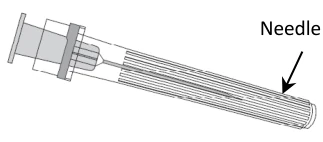
To attach the needle to the syringe, refer to the below drawing.
Note: However, the syringe provided with NIMENRIX might be slightly different (without screw thread) than the syringe described in the drawing. In that case, the needle should be attached without screwing.
- 1.
Holding the syringe barrel in one hand (avoid holding the syringe plunger), unscrew the syringe cap by twisting it anticlockwise.
Needle
Needle protector
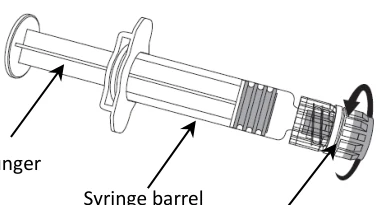
Syringe
Syringe cap
Syringe barrel
Syringe plunger
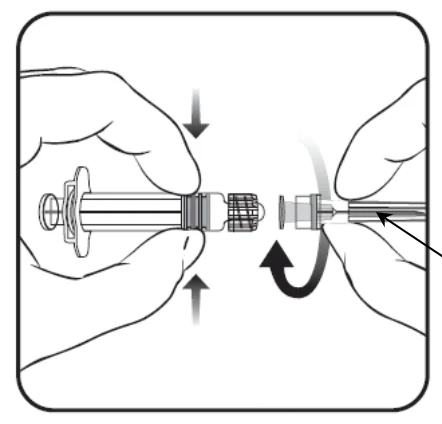
- 2. To attach the needle to the syringe, twist the needle clockwise into the syringe until you feel it lock (see drawing).
- 3. Remove the needle protector, which on occasion can be a little stiff.
- 4. Add the diluent to the powder. After the addition of the diluent to the powder, the mixture should be well shaken until the powder is completely dissolved in the diluent.
After reconstitution, the vaccine should be used promptly. Although delay is not recommended, stability has been demonstrated for 8 hours at 30°C after reconstitution. If not used within 8 hours, do not administer the vaccine.
A new needle should be used to administer the vaccine.
4.4 Administration
NIMENRIX is for intramuscular injection only.
In infants, the recommended injection site is the anterolateral aspect of the thigh.
In individuals from 1 year of age, the recommended injection site is the anterolateral aspect of the thigh or deltoid muscle (see 7 WARNINGS AND PRECAUTIONS and 9 DRUG INTERACTIONS).
For instructions on reconstitution of the vaccine before administration, see 4.3 Reconstitution.
The reconstituted vaccine is a clear colourless solution.
The reconstituted vaccine should be inspected visually for any foreign particulate matter and/or variation of physical aspect prior to administration. In the event of either being observed, discard the vaccine.
Any unused product or waste material should be disposed of in accordance with local requirements.
5 OVERDOSAGE
For management of a suspected vaccine overdose, contact your regional poison control centre.
Needle protector
6 DOSAGE FORMS, STRENGTHS, COMPOSITION AND PACKAGING
NIMENRIX is supplied as a sterile lyophilized white powder or cake in a single dose vial.
The diluent (sodium chloride and water for injections) is a sterile clear and colourless liquid supplied separately in a prefilled syringe.
The vaccine does not contain any preservatives or adjuvants.
NIMENRIX is available as a single dose vial packaged with pre-filled syringe of diluent with or without needles in pack sizes of 1 and 10.
Table 1 Dosage Forms, Strengths, Composition and Packaging
Traceability
To help ensure the traceability of vaccines for patient immunization record-keeping as well as safety monitoring, health professionals should record the time and date of administration, quantity of administered dose (if applicable), anatomical site and route of administration, brand name and generic name of the vaccine, the product lot number and expiry date.
7 WARNINGS AND PRECAUTIONS
General
NIMENRIX should under no circumstances be administered intravascularly, intradermally or subcutaneously.
It is good clinical practice to precede vaccination by a review of the medical history (especially with regard to previous vaccination and possible occurrence of undesirable effects) and a clinical examination.
As with all injectable vaccines, appropriate medical treatment and supervision should always be readily available in case of a rare anaphylactic event following the administration of the vaccine.
| Route of Administration | Dosage Form/Strength/Composition | Non-medicinal Ingredients |
| Intramuscular Injection | Powder and diluent for solution for injection. After reconstitution, one 0.5 mL dose contains: Neisseria meningitidis group A polysaccharide1 5 mcg Neisseria meningitidis group C polysaccharide1 5 mcg Neisseria meningitidis group W-135 polysaccharide1 5 mcg Neisseria meningitidis group Y polysaccharide1 5 mcg 1 conjugated to tetanus toxoid carrier protein 44 mcg | After reconstitution, one 0.5 mL dose contains:
|
Although NIMENRIX contains tetanus toxoid, this vaccine does not substitute for tetanus immunization.
Intercurrent Illness
As with other vaccines, vaccination with NIMENRIX should be postponed in subjects suffering from an acute severe febrile illness. The presence of a minor infection, such as a cold, should not result in the deferral of vaccination.
Syncope
Syncope (fainting) can occur following, or even before, any vaccination as a psychogenic response to the needle injection. It is important that procedures are in place to avoid injury from faints.
Hematologic
Thrombocytopenia and Coagulation Disorders
As with other vaccines administered intramuscularly, NIMENRIX should be given with caution to individuals with thrombocytopenia or any coagulation disorder since bleeding may occur following an intramuscular administration to these subjects.
Immune
Immunodeficiency
It may be expected that in patients receiving immunosuppressive treatment or patients with immunodeficiency, an adequate immune response may not be elicited.
Individuals with certain complement deficiencies and individuals receiving treatment that inhibits terminal complement activation (for example, eculizumab) are at increased risk for invasive disease caused by Neisseria meningitidis groups A, C, W-135 and Y even if they develop antibodies following vaccination with NIMENRIX.
Protection Against Meningococcal Disease
NIMENRIX will only confer protection against Neisseria meningitidis groups A, C, W-135 and Y. The vaccine will not protect against other Neisseria meningitidis groups.
As with any vaccine, a protective immune response may not be elicited in all vaccinees.
Immune response in infants aged 6 months to less than 12 months
A single dose administered at 6 months was associated with lower human complement serum bactericidal assay (hSBA) titres to groups W-135 and Y compared with three doses administered at 2, 4, and 6 months (see 14.4 Immunogenicity: Immunogenicity in infants). The clinical relevance of this observation is unknown. If an infant aged 6 months to less than 12 months is expected to be at immediate risk of invasive meningococcal disease due to exposure to groups W-135 and/or Y, consideration may be given to administering a second primary dose of NIMENRIX after an interval of 2 months.
Immune responses in toddlers aged 12-14 months
At 1 month post-vaccination, toddlers aged 12-14 months had similar rabbit complement serum bactericidal assay (rSBA) titres to groups A, C, W-135 and Y following one dose of NIMENRIX or two doses of NIMENRIX given 2 months apart. At one year post-vaccination, the percentage of subjects achieving rSBA titres ≥1:8 for groups A, C, W-135 and Y were: 63.5%, 49.1%, 65.3% and 73.1% in the one dose group, and 70.6%, 55.2%, 77.6% and 79.7% in the two doses group (see 14.4 Immunogenicity: Immunogenicity in toddlers aged 12-23 months).
One month post-vaccination, a single dose vaccination was associated with lower human complement serum bactericidal assay (hSBA) titres to groups W-135 and Y compared with two doses given 2 months apart, while responses to groups A and C were higher in the two groups. The clinical relevance of these observations is unknown. If a toddler is expected to be at particular risk of invasive meningococcal disease due to exposure to groups W-135 and/or Y, consideration may be given to administering a second primary dose after an interval of 2 months. At one year post-vaccination, the percentage of subjects achieving hSBA responses ≥1:8 for groups A, C, W-135 and Y were 35.7%, 80.3%, 95.8% and 91.9% in the one dose group, and 35.5%, 90.5%, 98.5% and 87.9% in the two doses group. Regarding waning of antibody against group A or group C after a first dose of NIMENRIX in children aged 12-23 months, see 7 WARNINGS AND PRECAUTIONS - Persistence of serum bactericidal antibody titres.
Persistence of serum bactericidal antibody titres
Persistence of antibodies has been evaluated up to 10 years after vaccination. The persistence studies with NIMENRIX have shown a waning of serum bactericidal antibody titres against group A when using human complement in the assay (hSBA) (see 14.4 Immunogenicity). The clinical relevance of this observation is unknown. However, if an individual is expected to be at particular risk of exposure to group A and received a dose of NIMENRIX more than approximately 1 year previously, consideration may be given to administering a booster dose.
Similar to the monovalent Men C comparator, a decline in antibody titres over time has been observed. The clinical relevance of this observation is unknown. A booster dose might be considered in individuals remaining at high risk of exposure to meningococcal disease caused by groups A, C, W-135 and Y (see 14.4 Immunogenicity).
Reproductive Health: Female and Male Potential
See 7.1.1 Pregnant Women.
7.1 Special Populations
7.1.1 Pregnant Women
There is limited experience with use of NIMENRIX in pregnant women.
Animal studies with NIMENRIX do not indicate direct or indirect harmful effects with respect to fertility, pregnancy, embryo/fetal development, parturition or post-natal development (see 16 NON-CLINICAL TOXICOLOGY).
NIMENRIX should be used during pregnancy only when clearly needed, and the possible advantages outweigh the potential risks for the fetus.
7.1.2 Breast-feeding
The safety of NIMENRIX when administered to breast-feeding women has not been evaluated. It is unknown whether NIMENRIX is excreted in human breast milk.
NIMENRIX should only be used during breast-feeding when the possible advantages outweigh the potential risks.
7.1.3 Pediatrics
Pediatrics (≥ 6 weeks of age): The safety and efficacy of NIMENRIX in pediatric subjects 6 weeks of age and older have been established.
7.1.4 Geriatrics
Geriatrics (≥ 65 years of age): Limited safety and immunogenicity data are available in subjects 56 years of age and older (see 8 ADVERSE REACTIONS and 14 CLINICAL TRIALS).
8 ADVERSE REACTIONS
8.1 Adverse Reaction Overview
The safety profile is based on two data sets:
- A pooled analysis on 9,621 subjects who have been vaccinated with one dose of NIMENRIX in clinical studies. The pooled analysis includes data for 3,079 toddlers (12 months to 23 months), 1,899 children (2 to 10 years), 2,317 adolescents (11 to 17 years) and 2,326 adults (18 – 55 years). In addition, a descriptive study provides safety data from 274 individuals aged 56 years and older and who have been vaccinated with one dose of NIMENRIX.
- Data from approximately 1000 infants (6 weeks to 12 months of age) who have been primed and boosted with NIMENRIX.
8.2 Clinical Trial Adverse Reactions
Clinical trials are conducted under very specific conditions. The adverse reaction rates observed in the clinical trials, therefore, may not reflect the rates observed in practice and should not be compared to the rates in the clinical trials of another drug. Adverse reaction information from clinical trials may be useful in identifying and approximating rates of adverse drug reactions in real-world use.
Solicited Adverse Reactions
Infants 6 weeks to 12 months old
In Study MenACWY-TT-083, healthy infants received a primary series of two doses (at 2 and 4 months of age) of NIMENRIX or control vaccine (meningococcal group C CRM197-conjugate vaccine [MenC-CRM] or meningococcal group C tetanus toxoid conjugate vaccine [MenC-TT]), with the first dose administered between 6 and 12 weeks of age, followed by a booster dose at 12 months of age. Routinely used infant vaccines DTaP/IPV/Hib/HepB and a 10-valent pneumococcal vaccine (PCV10) were coadministered. Table 2 presents the rates of solicited symptoms reported during the 4-day post-vaccination period.
| Table 2 Study MenACWY-TT-083: Percentage of subjects with solicited local and general symptoms reported during the 4-day (Days 0-3) post-vaccination period (Primary and Booster Total Vaccinated cohorts) | |||||||||||||||||||||||||
|---|---|---|---|---|---|---|---|---|---|---|---|---|---|---|---|---|---|---|---|---|---|---|---|---|---|
| Type | NIMENRIX | MenC-CRM | MenC-TT | ||||||||||||||||||||||
Dose 1 N=523 | Dose 2 N=516 | Booster N=510 | Dose 1 N=509 | Dose 2 N=507 | Booster N=496 | Dose 1 N=517 | Dose 2 N=508 | Booster N=503 | |||||||||||||||||
| Local Symptoms, % | |||||||||||||||||||||||||
| Pain | All | 29.6 | 24.0 | 39.8 | 31.0 | 25.4 | 40.9 | 30.4 | 28.1 | 36.0 | |||||||||||||||
| Grade 3 | 3.3 | 2.1 | 4.5 | 2.4 | 1.8 | 6.3 | 4.6 | 2.4 | 3.6 | ||||||||||||||||
| Redness | All | 24.5 | 32.6 | 43.3 | 27.1 | 42.2 | 42.9 | 27.1 | 38.8 | 45.3 | |||||||||||||||
| > 30 mm | 0.2 | 0.0 | 1.2 | 0.4 | 0.0 | 1.0 | 0.2 | 0.2 | 0.8 | ||||||||||||||||
| Swelling | All | 11.9 | 22.3 | 29.8 | 17.1 | 27.0 | 31.7 | 15.7 | 25.6 | 32.4 | |||||||||||||||
| > 30 mm | 0.0 | 0.2 | 0.4 | 0.6 | 0.0 | 0.4 | 0.0 | 0.8 | 1.0 | ||||||||||||||||
| General Symptoms, %* | |||||||||||||||||||||||||
| Type | NIMENRIX | MenC-CRM | MenC-TT | ||||||||||||||||||||||
Dose 1 N=523 | Dose 2 N=516 | Booster N=510 | Dose 1 N=508 | Dose 2 N=505 | Booster N=496 | Dose 1 N=517 | Dose 2 N=507 | Booster N=504 | |||||||||||||||||
| Drowsiness | All | 52.8 | 36.0 | 39.2 | 55.9 | 38.8 | 40.3 | 57.3 | 37.5 | 38.5 | |||||||||||||||
| Grade 3 | 4.2 | 1.4 | 1.8 | 3.1 | 2.2 | 3.6 | 6.2 | 2.6 | 2.6 | ||||||||||||||||
| Irritability | All | 62.9 | 52.3 | 56.7 | 68.3 | 52.9 | 56.9 | 68.5 | 50.7 | 57.5 | |||||||||||||||
| Grade 3 | 7.6 | 5.4 | 6.3 | 7.7 | 6.3 | 7.1 | 9.7 | 7.5 | 7.7 | ||||||||||||||||
| Loss of appetite | All | 38.4 | 33.1 | 36.3 | 37.4 | 29.7 | 38.1 | 41.4 | 29.6 | 37.3 | |||||||||||||||
| Grade 3 | 1.9 | 1.9 | 3.5 | 1.6 | 1.8 | 3.6 | 1.4 | 1.8 | 4.4 | ||||||||||||||||
| Fever (Rectally) | All (>38oC) | 30.6 | 22.7 | 32.4 | 32.9 | 19.8 | 35.5 | 34.6 | 20.9 | 31.0 | |||||||||||||||
| >40oC | 0 | 0.2 | 0.4 | 0 | 0.2 | 0.4 | 0 | 0.2 | 1.0 | ||||||||||||||||
N= number of subjects with at least one documented dose. Doses 1 and 2 given at 2 and 4 months of age, respectively. Booster dose given at 12 months of age.
%= percentage of subjects reporting the symptom at least once
*Incidence of general symptoms reported for meningococcal vaccine (NIMENRIX, MenC-CRM or MenC-TT) coadministered with DTaP/IPV/Hib/HepB and PCV10
Toddlers 12 to 23 months old
In Study MenACWY-TT-039, healthy children 12 through 23 months of age were administered one dose of NIMENRIX either alone or co-administered with a first dose of PRIORIX-TETRA®, 1 dose of PRIORIX-TETRA or 1 dose of a licensed MenC-CRM197 (MenC-CRM) vaccine.
Table 3 presents the rates of solicited symptoms reported during the 4-day post-vaccination period in the Co-administered (Co-ad), NIMENRIX, PRIORIX-TETRA and MenC-CRM groups.
Table 3 Study MenACWY-TT-039: Percentage of subjects with solicited local and general symptoms reported during the 4-day (Days 0-3) post-vaccination period (Total vaccinated cohort)
| Type | NIMENRIX + PRIORIX-TETRA N=375 | NIMENRIX N=367 | PRIORIX-TETRA N=124 | MenC-CRM N=123 | |||||||
|---|---|---|---|---|---|---|---|---|---|---|---|
| Local Symptoms, % | |||||||||||
| Pain | All | 24.3 | 29.2 | 17.7 | 25.2 | ||||||
| Grade 3 | 0.3 | 0.8 | 0.0 | 0.0 | |||||||
| Redness | All | 35.5 | 37.1 | 38.7 | 31.7 | ||||||
| > 30 mm | 1.9 | 4.4 | 0.0 | 0.0 | |||||||
| Swelling | All | 13.9 | 18.8 | 5.6 | 8.1 | ||||||
| > 30 mm | 2.4 | 4.1 | 0.0 | 0.0 | |||||||
| General Symptoms, % | |||||||||||
| Type | NIMENRIX + PRIORIX-TETRA N=375 | NIMENRIX N=367 | PRIORIX-TETRA N=124 | MenC-CRM N=124 | |||||||
| Drowsiness | All | 32.5 | 28.1 | 23.4 | 32.3 | ||||||
| Grade 3 | 0.3 | 0.0 | 0.8 | 0.0 | |||||||
| Fever (Rectally) | All (>38oC) | 14.9 | 9.3 | 11.3 | 12.9 | ||||||
| >40oC | 0.0 | 0.0 | 0.8 | 0.0 | |||||||
| Irritability | All | 50.7 | 40.9 | 38.7 | 43.5 | ||||||
| Grade 3 | 0.8 | 0.5 | 1.6 | 0.0 | |||||||
| Loss of appetite | All | 28.5 | 22.9 | 23.4 | 26.6 | ||||||
| Grade 3 | 0.3 | 0.0 | 0 | 0.0 | |||||||
N= number of subjects with the dose documented
%= percentage of subjects reporting the symptom at least once
Redness was the most frequently reported solicited local symptom in each group after each vaccination (38.7% in the PRIORIX-TETRA group, 35.5% in the Co-ad group, 37.1% in the NIMENRIX group and 31.7% in the MenC-CRM group).
Irritability was the most frequently reported solicited general symptom in the 4 groups (50.7% in the Co-ad group, 40.9% in the NIMENRIX group, 38.7% in the PRIORIX-TETRA group and 43.5% in the MenC-CRM group).
In Study MenACWY-TT-104, toddlers 12-14 months of age were vaccinated with either a single dose of NIMENRIX or two NIMENRIX doses administered 2 months apart. In the group who received two doses, the first and second doses were associated with similar local and systemic reactogenicity.
Children (2-10 years old), Adolescents (10-25 years old), and Adults (18-55 years old)
Children (2-5 years old)
In Study MenACWY-TT-081, healthy children 2 through 10 years of age were administered 1 dose of NIMENRIX or 1 dose of a licensed MenC-CRM vaccine.
Table 4 presents the percentage of subjects (2 through 5 years of age) with solicited adverse reactions during the 4-day post vaccination period in the NIMENRIX and MenC-CRM groups.
Table 4 MenACWY-TT-081: Percentage of subjects with solicited local and general symptoms reported during the 4-day (Days 0-3) post-vaccination period (Total vaccinated cohort), subjects 2 through 5 years of age
| Type | NIMENRIX N=162 | MenC-CRM N=53 | |||
|---|---|---|---|---|---|
| Local Symptoms, % | |||||
| Pain | All | 27.8 | 28.3 | ||
| Grade 3 | 0.0 | 1.9 | |||
| Redness | All | 35.2 | 39.6 | ||
| >30 mm | 6.8 | 15.1 | |||
| Swelling | All | 26.5 | 24.5 | ||
| >30 mm | 4.3 | 5.7 | |||
| General Symptoms, % | |||||
| Drowsiness | All | 14.2 | 11.3 | ||
| Grade 3 | 0.0 | 1.9 | |||
| Fever/(Orally) | All (≥37.5oC) | 5.6 | 5.7 | ||
| >39.5oC | 0.0 | 0.0 | |||
| Irritability | All | 15.4 | 11.3 | ||
| Grade 3 | 0.6 | 1.9 | |||
| Loss of Appetite | All | 10.5 | 9.4 | ||
| Grade 3 | 0.0 | 0.0 | |||
N= number of subjects with the dose documented
%= percentage of subjects reporting the symptom at least once
Redness was the most frequently reported solicited local symptom in each group (35.2% and 39.6% of the subjects in the NIMENRIX group and MenC-CRM group, respectively).
Irritability was the most frequently reported solicited general symptom in each group (15.4% and 11.3% of the subjects in the NIMENRIX group and MenC-CRM group, respectively). Drowsiness was also reported by 11.3% of the subjects in the MenC-CRM group, as compared to 14.2% of the subjects in the NIMENRIX group. Fever ≥37.5°C was reported by 5.6% of the subjects in the NIMENRIX group and 5.7% of the subjects in the MenC-CRM. The majority of fevers were measured by the rectal route (66.7% in the NIMENRIX group and 100% in the MenC-CRM group).
Children (6-10 years old)
Table 5 includes the percentage of subjects (6 through 10 years of age) with solicited adverse reactions during the 4-day post vaccination period in the NIMENRIX and MenC-CRM groups.
Pain was the most frequently reported solicited local symptom in each group (43.9% and 54.0% of the subjects in the NIMENRIX group and MenC-CRM group, respectively). Fatigue was the most frequently reported solicited general symptom in each group (22.3% and 22.0% of the subjects in the NIMENRIX group and MenC-CRM group, respectively). Fever ≥ 37.5°C was reported in 6.8% of the subjects in the NIMENRIX group and 2.0% of the subjects in the MenC-CRM group.
Adolescents (10-25 years old)
In Study MenACWY-TT-071, healthy subjects 10 through 25 years of age were administered 1 dose of NIMENRIX or 1 dose of MENACTRA® (ACWY-DT vaccine).
Table 5 includes the percentage of subjects (10 through 25 years of age) with solicited adverse reactions during the 4-day post vaccination period in the NIMENRIX and MENACTRA groups.
The most common solicited local symptom during the 4-day post-vaccination period was pain at the injection site, reported by 51.4% and 55.4% of subjects in the NIMENRIX and MENACTRA groups, respectively. A much smaller percentage of these subjects reported pain with grade 3 intensity, ranging between 0.6% and 2.4% across all vaccine groups.
The incidence of redness at the injection site was 25.8% and 20.3% of subjects in the NIMENRIX and MENACTRA groups, respectively. The incidence of swelling was 19.1% and 13.5% of subjects, respectively. The majority of these events were grade 1 in intensity. Grade 3 events of redness (i.e. > 50 mm in diameter) were reported by 3 and 6 subjects in the NIMENRIX and MENACTRA groups, respectively. Grade 3 events of swelling (i.e. > 50 mm in diameter) were reported by 3 subjects each of the two vaccine groups.
The most common solicited general symptom was fatigue with an incidence of 27.3% to 29.2% across the two vaccine groups. Headache was reported by 25.5% to 26.4% and gastrointestinal symptoms by 13.1% to 13.5% of subjects across the two vaccine groups.
Coadministration with other vaccines (Tdap and HPV2) has not been associated with increased local or systemic reactions in clinical studies.
Adults (18-55 years old)
In Study MenACWY-TT-035, healthy adults 18 through 55 years of age were administered either 1 dose of NIMENRIX, 1 dose of a licensed ACWY-PS (polysaccharide) vaccine, or 1 dose of NIMENRIX co-administered with a licensed influenza vaccine, FLUARIX®.
Table 5 includes the percentage of subjects (18 through 55 years of age) with solicited adverse reactions during the 4-day post vaccination period in the NIMENRIX, ACWY-PS and Co-administered groups.
Pain was the most frequently reported solicited local symptom in each group (19.4% in the NIMENRIX group, 21.9% in the Co-administered group and 13.5% in the ACWY-PS group). Headache was the most frequently reported solicited general symptom in each group (16.3% in the NIMENRIX group, 14.2% in the ACWY-PS group, and 13.3% in the Co-administered group).
| Table 5 Percentage of subjects with solicited local and general symptoms reported during the 4-day (Days 0-3) post-vaccination period (Total vaccinated cohort), subjects 6 through 55 years of age | ||||||||
|---|---|---|---|---|---|---|---|---|
| MenACWY-TT-081 | MenACWY-TT-071 | MenACWY-TT- 035 | ||||||
| Age | 6-10 Years old | 10-25 Years old | 18-55 Years old | |||||
| Type | NIMENRIX N=148 | MenC N=50 | NIMENRIX N=329 | MENACTRA N=325 | NIMENRIX N=927 | NIMENRIX + FLUARIX N=105 | ACWY-PS N=310 | |
| Local Symptoms, % | ||||||||
| Pain | All | 43.9 | 54.0 | 51.4 | 55.4 | 19.4 | 21.9 | 13.5 |
| Grade 3 | 2.0 | 6.0 | 2.4 | 0.6 | 0.4 | 1.0 | 0.3 | |
| Redness | All | 39.2 | 38.0 | 25.8 | 20.3 | 8.8 | 5.7 | 4.5 |
| >50 mm | 6.1 | 10.0 | 0.9 | 1.8 | 1.3 | 0.0 | 0.0 | |
| Swelling | All | 29.7 | 30.0 | 19.1 | 13.5 | 7.9 | 1.0 | 1.9 |
| >50 mm | 2.7 | 6.0 | 0.9 | 0.9 | 1.1 | 0.0 | 0.0 | |
| General Symptoms, % | ||||||||
| Type | NIMENRIX N=148 | MenC N=50 | NIMENRIX N=329 | MENACTRA N=326 | NIMENRIX N=927 | NIMENRIX + FLUARIX N=105 | ACWY-PS N=310 | |
| Fatigue | All | 22.3 | 22.0 | 29.2 | 27.3 | 12.3 | 9.5 | 9.7 |
| Grade 3 | 2.7 | 0.0 | 2.7 | 1.5 | 0.9 | 0.0 | 0.0 | |
| Fever | All (>37.5oC) | 6.8 | 2.0 | 5.2 | 4.9 | 4.0 | 2.9 | 4.5 |
| >39.5oC | 0.0 | 0.0 | 0.3 | 0.0 | 0.2 | 0.0 | 0.6 | |
| Gastro-intestinal | All | 14.9 | 8.0 | 13.1 | 13.5 | 4.6 | 1.9 | 3.2 |
| Grade 3 | 0.7 | 0.0 | 1.2 | 1.2 | 0.2 | 0.0 | 0.3 | |
| Headache | All | 20.3 | 8.0 | 26.1 | 25.5 | 16.3 | 13.3 | 14.2 |
| Grade 3 | 1.4 | 0.0 | 1.5 | 1.8 | 1.5 | 0.0 | 1.6 | |
N= number of subjects with the dose documented
%= percentage of subjects reporting the symptom at least once
Study 081 and Study 071: Fever (>37.5oC) (Orally)
Study 035: Fever (>37.5oC) (Axillary)
Adults > 55 years old
In a descriptive study a single dose of NIMENRIX was administered to 274 individuals aged 56 years and older. The adverse reactions reported in this study were already observed in younger age groups.
Common and Uncommon Clinical Trial Adverse Drug Reactions
Additional adverse reactions reported during clinical studies included in the safety pooled analysis:
Common (≥ 1% to < 10%)*: Injection site hematoma, gastrointestinal symptoms (including diarrhea, vomiting and nausea)
Uncommon (≥ 0.1% to < 1%)**: insomnia, crying, hypoesthesia, dizziness, pruritus, rash, urticaria, myalgia, pain in extremity, malaise, and injection site reaction (including induration, pruritus, warmth, anesthesia).
* Nausea and injection site hematoma occurred at a frequency of Uncommon in infants.
** Rash occurred at a frequency of Common in infants. The adverse reactions hypoesthesia, dizziness, pruritus, urticaria, myalgia and pain in extremity were not reported in the infant clinical study (N=524). Urticaria was not reported in the clinical studies of children 6-10 years old (N=990) and adolescents 11-17 years old (N=2317).
Booster Dose in Subjects from 12 Months of Age
The local and general adverse reaction profile of a booster dose of NIMENRIX given to subjects from 12 months of age after primary vaccination with NIMENRIX or other conjugated or plain polysaccharide meningococcal vaccines was similar to the local and general adverse reaction profile observed after primary vaccination with NIMENRIX, except that gastrointestinal symptoms (including diarrhea, vomiting, and nausea) ranged from common to very common among subjects 6 years of age and older (versus common after primary vaccination).
8.5 Post-Market Adverse Reactions
General, nervous system disorders and administration site conditions
Extensive limb swelling at the injection site, frequently associated with erythema, sometimes involving the adjacent joint, swelling of the entire injected limb, hypersensitivity (including anaphylaxis), febrile convulsions.
9 DRUG INTERACTIONS
9.4 Drug-Drug Interactions
Use with Other Vaccines
In infants, NIMENRIX can be given concomitantly with combined diphtheria, tetanus, acellular pertussis, hepatitis B, inactivated poliovirus and Haemophilus influenzae type B vaccines (DTaP/IPV/Hib/HepB), as well as 10-valent pneumococcal conjugate vaccine (PCV10).
From age 1 year and above, NIMENRIX can be given concomitantly with any of the following vaccines: hepatitis A and hepatitis B vaccines (HAV and HBV), measles-mumps-rubella vaccine (MMR), measles-mumps-rubella-varicella vaccine (MMRV), 10-valent pneumococcal conjugate vaccine or unadjuvanted seasonal influenza vaccine.
NIMENRIX can also be given concomitantly with combined diphtheria-tetanus-acellular pertussis vaccines, including combination DTaP vaccines with hepatitis B, inactivated poliovirus or Haemophilus influenzae type b, such as DTaP/IPV/Hib/HepB vaccine, and 13-valent pneumococcal conjugate vaccine (PCV13) in the second year of life.
In individuals aged 9 to 25 years, NIMENRIX can be given concomitantly with human papillomavirus bivalent [Type 16 and 18] vaccine, recombinant (HPV2).
Safety and immunogenicity of NIMENRIX was evaluated when sequentially administered or co-administered with a DTaP/IPV/Hib/HepB vaccine in the second year of life. The administration of NIMENRIX 1 month after the DTaP/IPV/Hib/HepB vaccine resulted in lower MenA, MenC and MenW-135 rSBA Geometric Mean Titres (GMTs). The clinical relevance of this observation is unknown, since at least 99.4% of subjects (N=178) had rSBA titres ≥1:8 for each group (A, C, W-135, and Y). Whenever possible, NIMENRIX and a tetanus toxoid (TT) containing vaccine, such as DTaP/IPV/Hib/HepB vaccine, should be co-administered or NIMENRIX should be administered at least 1 month before the TT-containing vaccine.
One month after co-administration with a 10-valent pneumococcal conjugate vaccine, lower Geometric Mean antibody Concentrations (GMCs) and opsonophagocytic assay (OPA) antibody GMTs were observed for one pneumococcal serotype (18C conjugated to tetanus toxoid carrier protein). The clinical relevance of this observation is unknown. There was no impact of co-administration on the other nine pneumococcal serotypes.
One month after co-administration with a combined tetanus toxoid, reduced diphtheria toxoid and acellular pertussis vaccine, adsorbed (Tdap) in subjects aged 9 to 25 years, lower GMCs were observed to each pertussis antigen (pertussis toxoid [PT], filamentous haemagglutinin [FHA] and pertactin [PRN]). More than 98% of subjects had anti-PT, FHA or PRN concentrations above the assay cut-off thresholds. The clinical relevance of these observations is unknown. There was no impact of co-administration on immune responses to NIMENRIX or the tetanus or diphtheria antigens included in Tdap.
If NIMENRIX is to be given at the same time as another injectable vaccine, the vaccines should always be administered at different injection sites.
Use with Systemic Immunosuppressive Medications
As with other vaccines, it may be expected that in patients receiving immunosuppressive treatment, an adequate response may not be elicited.
9.5 Drug-Food Interactions
Interactions with food have not been established.
9.6 Drug-Herb Interactions
Interactions with herbal products have not been established.
9.7 Drug-Laboratory Test Interactions
Interactions with laboratory tests have not been established.
10 CLINICAL PHARMACOLOGY
10.1 Mechanism of Action
Anti-capsular meningococcal antibodies protect against meningococcal diseases via complement mediated bactericidal killing. NIMENRIX induces the production of bactericidal antibodies against capsular polysaccharides of Neisseria meningitidis groups A, C, W-135 and Y when measured by assays using either rabbit complement (rSBA) or human complement (hSBA). By conjugating capsular polysaccharide to a protein carrier that contains T-cell epitopes, meningococcal conjugate vaccines like NIMENRIX change the nature of immune response to capsular polysaccharide from T-cell independent to T-cell dependent.
Canadian epidemiological data is available on the Public Health Agency of Canada website: http://www.phac-aspc.gc.ca/im/vpd-mev/meningococcal-eng.php.
11 STORAGE, STABILITY AND DISPOSAL
Store in a refrigerator (2°C – 8°C). The diluent may also be stored at ambient temperature (25°C).
The unopened vial is stable for 72 hours when stored at temperatures from 0 °C to 2 °C or from 8 °C to 25 °C. At the end of this period, Nimenrix should be used or discarded. These data are intended to guide healthcare professionals in case of temporary temperature excursions only.
Do not freeze. Protect from light.
For shelf-life after reconstitution of the vaccine, see 4.3 Reconstitution.
12 SPECIAL HANDLING INSTRUCTIONS
There are no special handing instructions for this drug product. For information on reconstitution of the vaccine with the diluent, please see 4.3 Reconstitution.
PART II: SCIENTIFIC INFORMATION
13 PHARMACEUTICAL INFORMATION
Drug Substance
NIMENRIX is composed of the purified capsular polysaccharides of Neisseria meningitidis groups A, C, W-135 and Y, each conjugated to tetanus toxoid.
14 CLINICAL TRIALS
14.1 Trial Design and Study Demographics
| Table 6 Study demographics and trial design | |||||||||
| Table 6 Study demographics and trial design | |||||||||
| Study # | Study Objectives | Trial design | No. of study subjects§ | Mean age (Range) | Gender Male/ Female | ||||
| Study # | Study Objectives | Trial design | No. of study subjects§ | Mean age (Range) | Gender Male/ Female | ||||
| 6 weeks-12 months | |||||||||
| Men ACWY-TT -083 | Immunogenicity and safety compared to MenC-CRM and MenC-TT when co-administered with PCV10 and DTaP/IPV/Hib/HepB | Open, randomized, controlled, multi-centre | Total=1841 NIMENRIX: 2 doses=458 3 doses=465 MenC-CRM=459 MenC-TT=459 | 8.7 weeks (6-12 weeks) | 929/912 | ||||
Men ACWY-TT -087 | Immunogenicity and safety of 3 primary + 1 booster dose (2, 4, 6, 15-18 months), 1 primary + 1 booster dose (6, 15-18 months) or 1 dose at 15-18 months (with DTaP-IPV/Hib & PCV10 at 2, 4, 6, 15-18 months) | Open, randomized, controlled, multi-centre | Total=654 NIMENRIX: 3+1 doses =328 1+1 doses =163 1 dose=163 | 8.0 weeks (6-12 weeks) | 320/334 | ||||
| 12-23 months | |||||||||
| Men ACWY-TT -039 | Immunogenicity and safety compared to MenC-CRM vaccine and concomitant administration with measles-mumps-rubella-varicella vaccine (MMRV) | Open, randomized, controlled, multi-centre | Total=972 NIMENRIX=366 Co-admin=361 MMRV=121 MenC-CRM=124 | 14.6 months (12-19 months) | 507/465 | ||||
| Men ACWY-TT -104 | Immunogenicity, persistence and safety of 1 and 2 doses and concomitant administration with PCV13 | Open, randomized, controlled, multi-centre | Total=802* NIMENRIX: 1 dose=203* 2 doses=197* Co-Admin=201* PCV13=201* | 12.8 months (11-15 months) | 427/375 | ||||
| 2-10 years | |||||||||
| Men ACWY-TT -081 | Immunogenicity and safety compared to MenC-CRM | Open, randomized, controlled, multi-centre | Total=395 NIMENRIX=296 MenC-CRM =99 | 5.6 years (2-10 years) | 191/204 | ||||
| 10-55 years | |||||||||
| Men ACWY-TT -035 | Lot-to-lot consistency; immunogenicity and safety compared to ACWY-PS and concomitant administration with influenza virus vaccine | Partially double-blinded, randomized, controlled, multi-centre | Total=1284 NIMENRIX=885 ACWY-PS=294 Co-admin=105 | 35.5 years (18-55 years) | 710/574 | ||||
| Men ACWY-TT -071 | Immunogenicity and safety compared to quadrivalent meningococcal diphtheria toxoid conjugate vaccine (MENACTRA) | Observer-blinded, randomized, controlled, multi-centre | Total=951 NIMENRIX=637 MENACTRA=314 | 16.3 years (10-25 years) | 464/487 | ||||
| > 55 years | |||||||||
| Men ACWY-TT-085 | Immunogenicity, safety, and reactogenicity compared to ACWY-PS | Open, randomized, controlled | Total = 260 NIMENRIX= 194 ACWY-PS= 66 | 63.9 years (56-103 years) | 178/82 | ||||
§Number of subjects in according-to-protocol (ATP) cohort for immunogenicity or persistence
*Number of subjects in total vaccinated cohort
14.4 Immunogenicity
Immunogenicity in infants
In Study MenACWY-TT-083, the immunogenicity of a 2-dose primary vaccination schedule (2 and 4 months of age) was evaluated (Table 7). The first dose was administered as early as 6 weeks of age. Routinely used infant vaccines DTaP/IPV/Hib/HepB and a 10-valent pneumococcal vaccine were co-administered. For group C, rSBA and hSBA titres elicited by NIMENRIX were compared to a 2-dose priming with licensed monovalent meningococcal conjugate group C vaccines, MenC-CRM and MenC-TT vaccines. NIMENRIX elicited rSBA and hSBA titres against the four meningococcal groups. The response against group C was non-inferior to the one elicited by the licensed MenC-CRM and MenC-TT vaccines in terms of the percentage of subjects with rSBA titres ≥1:8 at 1 month after the second dose.
For subjects initially vaccinated in infancy with NIMENRIX at 2 and 4 months of age and receiving a NIMENRIX booster dose at 12 months of age, the increase in rSBA and hSBA titres 1 month post-booster dose ranged between 15 and 80-fold for all groups and more than 99.0% of all infants achieved post-booster titres above 8 for both assays (Table 7).
| Table 7: Study MenACWY-TT-083: rSBA and hSBA titres following two doses of NIMENRIX (or MenC-CRM or MenC-TT) given 2 months apart with the first dose administered to infants 6-12 weeks of age and following a booster at 12 months of age | ||||||||||||||||||||||||||
|---|---|---|---|---|---|---|---|---|---|---|---|---|---|---|---|---|---|---|---|---|---|---|---|---|---|---|
Meningo-coccal group | Vaccine group | Time-point* | rSBA** | hSBA*** | ||||||||||||||||||||||
| N | ≥1:8 | GMT | N | ≥1:8 | GMT | |||||||||||||||||||||
| (95% CI) | (95% CI) | (95% CI) | (95% CI) | |||||||||||||||||||||||
| A | NIMENRIX | Post dose 2 | 456 | 97.4% (95.4; 98.6) | 203 (182; 227) | 202 | 96.5% (93.0; 98.6) | 157 (131; 188) | ||||||||||||||||||
| Post booster | 462 | 99.6% (98.4; 99.9) | 1561 (1412.3; 1725.3) | 214 | 99.5% (97.4;100) | 1007.2 (835.7;1213.8) | ||||||||||||||||||||
| C | NIMENRIX | Post dose 2 | 456 | 98.7% (97.2; 99.5) | 612 (540; 693) | 218 | 98.6% (96.0; 99.7) | 1308 (1052; 1627) | ||||||||||||||||||
| Post booster | 463 | 99.8% (98.8; 100) | 1177 (1059.1; 1308) | 221 | 99.5% (97.5; 100) | 4992.3 (4085.7; 6100) | ||||||||||||||||||||
| MenC-CRM vaccine | Post dose 2 | 455 | 99.6% (98.4; 99.9) | 958 (850; 1079) | 202 | 100% (98.2; 100) | 3188 (2646; 3841) | |||||||||||||||||||
| Post booster | 446 | 98.4% (96.8; 99.4) | 1051.4 (919.6; 1201.1) | 216 | 100% (98.3; 100) | 5438.2 (4412.4; 6702.3) | ||||||||||||||||||||
| MenC-TT vaccine | Post dose 2 | 457 | 100% (99.2; 100) | 1188 (1080; 1307) | 226 | 100% (98.4; 100) | 2626 (2219; 3109) | |||||||||||||||||||
| Post booster | 459 | 100% (99.2; 100) | 1960.2 (1776.4; 2163.1) | 219 | 100% (98.3; 100) | 5542.3 (4765.2; 6446.2) | ||||||||||||||||||||
| W-135 | NIMENRIX | Post dose 2 | 455 | 99.1% (97.8; 99.8) | 1605 (1383; 1862) | 217 | 100% (98.3; 100) | 753 (644; 882) | ||||||||||||||||||
| Post booster | 462 | 99.8% (98.8; 100) | 2777.2 (2485.1; 3103.6) | 218 | 100% (98.3; 100) | 5122.7 (4504.2; 5826.1) | ||||||||||||||||||||
| Y | NIMENRIX | Post dose 2 | 456 | 98.2% (96.6; 99.2) | 483 (419; 558) | 214 | 97.7% (94.6; 99.2) | 328 (276; 390) | ||||||||||||||||||
| Post booster | 462 | 99.4% (99.1; 99.9) | 881.3 (787.5; 986.4) | 217 | 100% (98.3; 100) | 2954 (2497.9; 3493.3) | ||||||||||||||||||||
The analysis of immunogenicity was conducted on the primary according-to-protocol (ATP) cohort. *Blood sampling performed 1 month post last priming vaccination (dose 2) and 1 month post-booster. **rSBA analysis performed at Public Health England (PHE) laboratories in UK ***hSBA analysis performed at GSK laboratories | ||||||||||||||||||||||||||
In MenACWY-TT-087, infants received either a single primary dose at 6 months followed by a booster dose at 15-18 months or three primary doses at 2, 4, and 6 months followed by a booster dose at 15-18 months. All subjects also received DTaP-IPV/Hib and 10-valent pneumococcal conjugate vaccines at 2, 4, 6 and 15-18 months of age. The percentage of subjects achieving rSBA titres ≥1:8 for groups A, C, W-135 and Y, after a single primary dose administered at 6 months of age, and after a booster dose, is reported in Table 8.
Table 8: rSBA* and hSBA** titres following a single dose of NIMENRIX in infants at 6 months of age and pre- and post-booster at 15-18 months of age (Study MenACWY-TT-087)
Meningo -coccal Group | rSBA* | hSBA** | |||||||||||||||||||
|---|---|---|---|---|---|---|---|---|---|---|---|---|---|---|---|---|---|---|---|---|---|
| N | ≥1:8 (95% CI) | GMT (95% CI) | N | ≥1:8 (95% CI) | GMT (95% CI) | ||||||||||||||||
| A | Post dose 1(1) | 163 | 98.80% (95.6; 99.9) | 1332.9 (1035.2; 1716.2) | 59 | 98.30% (90.9; 100) | 270.5 (205.9; 355.4) | ||||||||||||||
| Pre Booster | 131 | 81.70% (74; 87.9) | 125.3 (84.4; 186.1) | 71 | 66.20% (54; 77) | 20.8 (13.5; 32.2) | |||||||||||||||
| Post booster(1) | 139 | 99.30% (96.1; 100) | 2762.3 (2310.3; 3302.8) | 83 | 100% (95.7; 100) | 1415.6 (1140.2; 1757.5) | |||||||||||||||
| C | Post dose 1(1) | 163 | 99.40% (96.6; 100) | 591.6 (482.3; 725.8) | 66 | 100% (94.6;100) | 523.1 (381.5; 717.3) | ||||||||||||||
| Pre Booster | 131 | 65.60% (56.9; 73.7) | 27.4 (20.6; 36.6) | 78 | 96.20% (89.2; 99.2) | 150.8 (108.5; 209.5) | |||||||||||||||
| Post booster(1) | 139 | 99.30% (96.1; 100) | 2525.2 (2102.1; 3033.3) | 92 | 100% (96.1; 100) | 13360.1 (10952.9; 16296.4) | |||||||||||||||
| W-135 | Post dose 1(1) | 163 | 93.90% (89; 97) | 1255.9 (917; 1720) | 47 | 87.20% (74.3; 95.2) | 136.5 (78.4; 237.6) | ||||||||||||||
| Pre Booster | 131 | 77.90% (69.8; 84.6) | 63.3 (45.6; 87.9) | 53 | 100% (93.3; 100) | 428.6 (328.4; 559.2) | |||||||||||||||
| Post booster(1) | 139 | 100% (97.4; 100) | 3144.7 (2636.9; 3750.4) | 59 | 100% (93.9; 100) | 9015.6 (7045.2; 11537.1) | |||||||||||||||
| Y | Post dose 1(1) | 163 | 98.80% (95.6; 99.9) | 1469.9 (1186.5; 1821) | 52 | 92.30% (81.5; 97.9) | 194.8 (117.6; 322.9) | ||||||||||||||
| Pre Booster | 131 | 88.50% (81.8; 93.4) | 106.4 (76.4; 148.1) | 61 | 98.40% (91.2; 100) | 389.2 (292.3; 518.1) | |||||||||||||||
| Post booster(1) | 139 | 100% (97.4; 100) | 2748.6 (2301.4; 3282.6) | 69 | 100% (94.8; 100) | 5977.6 (4746.8; 7527.6) | |||||||||||||||
The analysis of immunogenicity was conducted on the primary according-to-protocol (ATP) cohort for immunogenicity. *rSBA analysis performed at Public Health England (PHE) laboratories in UK **hSBA analysis performed at Neomed, Laval, Canada (1) blood sampling performed 1 month post vaccination N = Number of subjects with available results | |||||||||||||||||||||
Serum bactericidal activity was also measured using hSBA as a secondary endpoint. A single primary dose in infants at 6 months was associated with lower hSBA responses to groups W-135 and Y as measured by the percentage of subjects with hSBA titres ≥1:8 [87.2% (95% CI: 74.3, 95.2) and 92.3% (95% CI: 81.5, 97.9), respectively] compared with three primary doses at 2, 4, and 6 months of age [100% (95% CI: 96.6, 100) and 100% (95% CI: 97.1, 100), respectively] (see 7 WARNINGS AND PRECAUTIONS – Immune: Protection Against Meningococcal Disease, Immune response in infants aged 6 months to less than 12 months). After a booster dose, the hSBA titres to all four serogroups were comparable between the two dosing schedules.
Immunogenicity in toddlers aged 12-23 months
In the clinical study MenACWY-TT-039, the immune response to vaccination with either NIMENRIX or a licensed meningococcal C-CRM197 conjugate (MenC-CRM) vaccine was evaluated.
A single dose of NIMENRIX elicited rSBA responses against the four meningococcal groups, with a response against group C that was comparable to the one elicited by the licensed MenC-CRM vaccine in term of percentages with rSBA titres ≥1:8 (Table 9)
Table 9 Study MenACWY-TT-039: Percentage of subjects with rSBAβ titres equal to or above the cut off value of 1:8 at day 42 post vaccination
Meningococcal group | N | NIMENRIX (95% CI) | N | Active Control (MenC-CRM) | Difference in percentage (ACWY-TT minus MenC-CRM)* (95%CI) |
|---|---|---|---|---|---|
| rSBA-Men A | 354 | 99.7% (98.4; 100) | - | - | - |
| rSBA-Men C | 354 | 99.7% (98.4; 100) | 121 | 97.5% (92.9; 99.5) | 2.20 (0.29; 6.78) |
| rSBA-MenW-135 | 354 | 100% (99.0; 100) | - | - | - |
| rSBA-Men Y | 354 | 100% (99.0; 100) | - | - | - |
N = number of subjects with results available
% = percentage of subjects with titre within the specified range
95% CI = 95% confidence interval; LL = Lower Limit, UL = Upper Limit
ATP cohort for immunogenicity
*LL of 95% CI is above non-inferiority limit of -10%.
βSBA analyses performed at GSK Laboratories
The Geometric Mean Titres (GMTs) for MenC 42 days after vaccination were higher in children who received NIMENRIX than those who received MenC-CRM (478 vs. 212). GMTs ranged between 2205 and 2729 for groups A, W-135 and Y in the NIMENRIX group.
In addition this study evaluated the immunogenicity for hSBA prior to and 42 days after the first vaccine dose with NIMENRIX or the control vaccine (MenC-CRM). At 42 days after vaccination, 98.5% of the subjects in the NIMENRIX group and 81.9% of subjects in the MenC-CRM group had hSBA-MenC titres ≥1:8. In the NIMENRIX group the percentage of subjects with hSBA titres ≥1:8 ranged between 77.2% and 87.5 % for groups A, W-135 and Y.
Study MenACWY-TT-104 evaluated the immunogenicity after 1 month and the persistence of the response up to 5 years following 1 or 2 doses (given 2 months apart) of Nimenrix in toddlers aged 12 to 14 months. One month following one or two doses administered (given 2 months apart), Nimenrix elicited rSBA titres against all four meningococcal groups that were similar in terms of the percentage of subjects in both dosing regimens with rSBA titre ≥1:8 and GMT. As a secondary endpoint in the MenACWY-TT-104 study, hSBA titres were measured. In terms of the percentage of subjects with hSBA titres ≥1:8, at 1 month post vaccination, hSBA titres against groups W-135 and Y were higher after two doses of Nimenrix than after one dose, while the hSBA titres against groups A and C were similar for both dosing regimens. At 5 years post vaccination, the immune response for all four meningococcal groups were similar in both the one and two dose groups for both rSBA and hSBA titres ≥1:8 (see Table 10).
Table 10: Study MenACWY-TT-104: rSBA* and hSBA** titres following one or two doses of NIMENRIX with the first dose administered to toddlers aged 12-14 months and persistence up to 5 years
Meningococcal group | NIMENRIX dose group | Timepoint | rSBA1 | hSBA1 | ||||||||||||||||||
|---|---|---|---|---|---|---|---|---|---|---|---|---|---|---|---|---|---|---|---|---|---|---|
| N | ≥1:8 (95%CI) | GMT (95% CI) | N | ≥1:8 (95%CI) | GMT (95% CI) | |||||||||||||||||
| A | 1 dose | 1 Month Post dose 1 | 180 | 97.8% (94.4; 99.4) | 1437.0 (1118.3; 1846.6) | 74 | 95.9% (88.6; 99.2) | 118.0 (86.8; 160.5) | ||||||||||||||
1 Year Post Dose 1 | 167 | 63.5% (55.7; 70.8) | 62.7 (42.6; 92.2) | 70 | 35.7% (24.6; 48.1) | 6.1 (4.1; 8.9) | ||||||||||||||||
3 Years Post dose 1 | 147 | 46.9% (38.7; 55.3) | 29.7 (19.8; 44.5) | 55 | 36.4% (23.8; 50.4) | 5.8 (3.8; 8.9) | ||||||||||||||||
5 Years Post dose 1 | 133 | 58.6% (49.8; 67.1) | 46.8 (30.7; 71.5) | 61 | 27.9% (17.1; 40.8) | 4.4 (3.1; 6.2) | ||||||||||||||||
| 2 doses | 1 Month Post dose 1 | 158 | 96.8% (92.8; 99.0) | 1275.2 (970.5; 1675.4) | 66 | 97.0% (89.5; 99.6) | 132.9 (98.1; 180.1) | |||||||||||||||
1 Month Post dose 2 | 150 | 98.0% (94.3; 99.6) | 1176.3 (921.8; 1501) | 66 | 97.0% (89.5; 99.6) | 170.5 (126.2; 230.2) | ||||||||||||||||
1 Year Post Dose 2 | 143 | 70.6% (62.4; 77.9) | 76.6 (50.7; 115.7) | 62 | 35.5% (23.7; 48.7) | 6.4 (4.2; 10.0) | ||||||||||||||||
3 Years Post dose 2 | 121 | 54.5% (45.2; 63.6) | 28.5 (18.7; 43.6) | 50 | 36.0% (22.9; 50.8) | 5.4 (3.6; 8.0) | ||||||||||||||||
5 Years Post dose 2 | 117 | 65.8% (56.5; 74.3) | 69.9 (44.7; 109.3) | 56 | 17.9% (8.9; 30.4) | 3.1 (2.4; 4.0) | ||||||||||||||||
| C | 1 dose | 1 Month Post dose 1 | 179 | 95.0% (90.7; 97.7) | 452.3 (345.6; 591.9) | 78 | 98.7% (93.1; 100) | 151.9 (104.8; 220.4) | ||||||||||||||
1 Year Post Dose 1 | 167 | 49.1% (41.3; 56.9) | 16.2 (12.4; 21.1) | 71 | 80.3% (69.1; 88.8) | 35.2 (22.5; 55.2) | ||||||||||||||||
3 Years Post dose 1 | 147 | 35.4% (27.7; 43.7) | 9.8 (7.6; 12.7) | 61 | 65.6% (52.3; 77.3) | 23.6 (13.9; 40.2) | ||||||||||||||||
5 Years Post dose 1 | 132 | 20.5% (13.9; 28.3) | 6.6 (5.3; 8.2) | 61 | 60.7% (47.3; 72.9) | 18.1 (10.9; 30.0) | ||||||||||||||||
| 2 doses | 1 Month Post dose 1 | 157 | 95.5% (91.0; 98.2) | 369.3 (280.9; 485.5) | 70 | 95.7% (88.0; 99.1) | 160.8 (109.8; 235.5) | |||||||||||||||
1 Month Post dose 2 | 150 | 98.7% (95.3; 99.8) | 639.1 (521.8; 782.9) | 69 | 100% (94.8; 100) | 1753.3 (1277.7; 2404.2) | ||||||||||||||||
1 Year Post Dose 2 | 143 | 55.2% (46.7; 63.6) | 21.2 (15.6; 28.9) | 63 | 90.5% (80.4; 96.4) | 73.4 (47.5; 113.4) | ||||||||||||||||
3 Years Post dose 2 | 121 | 33.9% (25.5; 43.0) | 11.5 (8.4; 15.8) | 56 | 67.9% (54.0; 79.7) | 27 (15.6; 46.8) | ||||||||||||||||
5 Years Post dose 2 | 116 | 28.4% (20.5; 37.6) | 8.5 (6.4; 11.2) | 59 | 67.8% (54.4; 79.4) | 29.4 (16.3; 52.9) | ||||||||||||||||
| W-135 | 1 dose | 1 Month Post dose 1 | 180 | 95.0% (90.8; 97.7) | 2120.2 (1601.0; 2807.8) | 72 | 62.5% (50.3; 73.6) | 27.5 (16.1; 46.8) | ||||||||||||||
1 Year Post Dose 1 | 167 | 65.3% (57.5; 72.5) | 57.2 (39.9; 82.0) | 72 | 95.8% (88.3; 99.1) | 209.0 (149.9; 291.4) | ||||||||||||||||
3 Years Post dose 1 | 147 | 59.2% (50.8; 67.2) | 42.5 (29.2; 61.8) | 67 | 71.6% (59.3; 82.0) | 30.5 (18.7; 49.6) | ||||||||||||||||
5 Years Post dose 1 | 133 | 44.4% (35.8; 53.2) | 25 (16.7; 37.6) | 56 | 58.9% (45.0; 71.9) | 20.8 (11.6; 37.1) | ||||||||||||||||
| 2 doses | 1 Month Post dose 1 | 158 | 94.9% (90.3; 97.8) | 2030.1 (1510.7; 2728.2) | 61 | 68.9% (55.7; 80.1) | 26.2 (16.0; 43.0) | |||||||||||||||
1 Month Post dose 2 | 150 | 100% (97.6; 100) | 3533.0 (2914.5; 4282.7) | 70 | 97.1% (90.1; 99.7) | 756.8 (550.1; 1041.3) | ||||||||||||||||
1 Year Post Dose 2 | 143 | 77.6% (69.9; 84.2) | 123.1 (82.7; 183.4) | 65 | 98.5% (91.7; 100.0) | 232.6 (168.3; 321.4) | ||||||||||||||||
3 Years Post dose 2 | 121 | 72.7% (63.9; 80.4) | 92.9 (59.9; 144) | 54 | 87.0% (75.1; 94.6) | 55.5 (35.3; 87.1) | ||||||||||||||||
5 Years Post dose 2 | 117 | 50.4% (41.0; 59.8) | 37.1 (23.3; 59.0) | 44 | 63.6% (47.8; 77.6) | 19.5 (10.7; 35.2) | ||||||||||||||||
| Y | 1 dose | 1 Month Post dose 1 | 180 | 92.8% (88.0; 96.1) | 951.8 (705.0;1284.9) | 71 | 67.6% (55.5; 78.20) | 41.2 (23.7; 71.5) | ||||||||||||||
1 Year Post Dose 1 | 167 | 73.1% 65.7; 79.6) | 76.8 (54.2; 109.0) | 62 | 91.9% (82.2; 97.3) | 144.4 (97.2; 214.5) | ||||||||||||||||
3 Years Post dose 1 | 147 | 61.9% (53.5; 69.8) | 58 (39.1; 86.0) | 64 | 53.1% (40.2; 65.7) | 17.3 (10.1; 29.6) | ||||||||||||||||
5 Years Post dose 1 | 133 | 47.4% (38.7; 56.2) | 36.5 (23.6; 56.2) | 65 | 61.5% (48.6; 73.3) | 24.3 (14.3; 41.1) | ||||||||||||||||
| 2 doses | 1 Month Post dose 1 | 157 | 93.6% (88.6; 96.9) | 933.3 (692.3; 1258.3) | 56 | 64.3% (50.4; 76.6) | 31.9 (17.6; 57.9) | |||||||||||||||
1 Month Post dose 2 | 150 | 99.3% (96.3; 100) | 1133.6 (944.5; 1360.5) | 64 | 95.3% (86.9; 99.0) | 513.0 (339.4; 775.4) | ||||||||||||||||
1 Year Post Dose 2 | 143 | 79.7% (72.2; 86.0) | 112.3 (77.5; 162.8) | 58 | 87.9% (76.7; 95.0) | 143.9 (88.5; 233.8) | ||||||||||||||||
3 Years Post dose 2 | 121 | 68.6% (59.5; 76.7) | 75.1 (48.7; 115.9) | 52 | 61.5% (47.0; 74.7) | 24.1 (13.3; 43.8) | ||||||||||||||||
5 Years Post dose 2 | 117 | 58.1% (48.6; 67.2) | 55.8% (35.7; 87.5) | 48 | 54.2% (39.2; 68.6) | 16.8 (9.0; 31.3) | ||||||||||||||||
The analysis of immunogenicity was conducted on the according-to-protocol (ATP) cohort for immunogenicity
1 blood sampling performed 21 to 48 days post vaccination and 44 to 60 weeks post vaccination.
*rSBA analysis performed at Public Health England laboratories
**hSBA analysis performed at GSK laboratories
N = Number of subjects with available results
Persistence of immune response in toddlers aged 12-23 months
In Study MenACWY-TT-048, the persistence of rSBA and hSBA titres was evaluated up to four years in toddlers in terms of percentage of subjects with antibody titres ≥1:8 for each of the 4 groups in toddlers primed in Study MenACWY-TT-039.
Forty-eight months following primary vaccination, 27% of the children were included in this evaluation (Table 11).
| Table 11 rSBA and hSBA titres up to 4 years following NIMENRIX (or MenC-CRM) in toddlers aged 12-23 months (Study MenACWY-TT-048) | ||||||||||||||||
|---|---|---|---|---|---|---|---|---|---|---|---|---|---|---|---|---|
| Meningo-coccal group | Vaccine group | Time-point (Year) | rSBA* | hSBA** | ||||||||||||
| N | % Response | N | % Response | |||||||||||||
| A | NIMENRIX | 3 | 262 | 59.9% | 251 | 35.9% | ||||||||||
| 4 | 224 | 74.1% | 198 | 28.8% | ||||||||||||
| C | NIMENRIX | 3 | 262 | 35.9% | 253 | 78.3% | ||||||||||
| 4 | 225 | 40.4% | 209 | 73.2% | ||||||||||||
| MenC-CRM vaccine | 3 | 46 | 13.0% | 31 | 41.9% | |||||||||||
| 4 | 45 | 35.6% | 32 | 46.9% | ||||||||||||
| W-135 | NIMENRIX | 3 | 261 | 49.8% | 254 | 82.3% | ||||||||||
| 4 | 225 | 49.3% | 165 | 80.6% | ||||||||||||
| Y | NIMENRIX | 3 | 262 | 53.8% | 250 | 72.0% | ||||||||||
| 4 | 225 | 58.2% | 130 | 65.4% | ||||||||||||
The analysis of immunogenicity was conducted on the ATP cohort for persistence adapted for each time-point.
*rSBA analysis performed at Public Health England (PHE) laboratories in UK
**hSBA analysis performed at GSK laboratories
Vaccine response defined as: post-vaccination antibody titre ³ 1:8
rSBA and hSBA titres were determined over a period of 10 years in children initially vaccinated with one dose of NIMENRIX or MenC-CRM at 12 to 23 months of age in Study MenACWY-TT-027. Persistence of SBA titres was evaluated in two extension studies: MenACWY-TT-032 (up to 5 years) and MenACWY-TT-100 (up to 10 years). Study MenACWY-TT-100 also evaluated the response to a single booster dose of NIMENRIX administered 10 years following the initial vaccination with NIMENRIX or MenC-CRM. Results are shown in Table 12.
| Table 12: rSBA and hSBA titres following a single dose of NIMENRIX (or MenC-CRM) in toddlers aged 12-23 months, persistence up to 10 years, and post-booster administered 10 years following initial vaccination (Studies MenACWY-TT-027/032/100) | ||||||||||||||||||||
|---|---|---|---|---|---|---|---|---|---|---|---|---|---|---|---|---|---|---|---|---|
| Table 12: rSBA and hSBA titres following a single dose of NIMENRIX (or MenC-CRM) in toddlers aged 12-23 months, persistence up to 10 years, and post-booster administered 10 years following initial vaccination (Studies MenACWY-TT-027/032/100) | ||||||||||||||||||||
| Meningo-coccal group | Vaccine group | Time point | rSBA* | hSBA** | ||||||||||||||||
| Meningo-coccal group | Vaccine group | Time point | rSBA* | hSBA** | ||||||||||||||||
| N | ≥1:8 (95% CI) | GMT (95% CI) | N | ≥1:8 (95% CI) | GMT (95% CI) | |||||||||||||||
| N | ≥1:8 (95% CI) | GMT (95% CI) | N | ≥1:8 (95% CI) | GMT (95% CI) | |||||||||||||||
| A | NIMENRIX | Month 1(1) | 222 | 100% (98.4; 100) | 3707 (3327; 4129) | 217 | 91.2% (86.7; 94.6) | 59.0 (49.3; 70.6) | ||||||||||||
| Year 4(2) | 45 | 64.4% (48.8; 78.1) | 35.1 (19.4; 63.4) | 44 | 52.3% (36.7; 67.5) | 8.8 (5.4; 14.2) | ||||||||||||||
| Year 5(2) | 49 | 73.5% (58.9; 85.1) | 37.4 (22.1; 63.2) | 45 | 35.6% (21.9: 51.2) | 5.2 (3.4; 7.8) | ||||||||||||||
| Year 10(3) (Pre-booster) | 62 | 66.1% (53.0; 77.7) | 28.9 (16.4; 51.0) | 59 | 25.4% (15.0; 38.4) | 4.2 (3.0; 5.9) | ||||||||||||||
| (Post-booster)(3,4) | 62 | 98.4% (91.3; 100) | 5122 (3726; 7043) | 62 | 100% (94.2; 100) | 1534 (1112; 2117) | ||||||||||||||
| C | NIMENRIX | Month 1(1) | 220 | 100% (98.3; 100) | 879 (779; 991) | 221 | 99.1% (96.8; 99.9) | 190 (165; 219) | ||||||||||||
| Year 4(2) | 45 | 97.8% (88.2; 99.9) | 110 (62.7; 192) | 45 | 97.8% (88.2; 99.9) | 370 (214; 640) | ||||||||||||||
| Year 5(2) | 49 | 77.6% (63.4; 88.2) | 48.9 (28.5; 84.0) | 48 | 91.7% (80.0; 97.7) | 216 (124; 379) | ||||||||||||||
| Year 10(3) (Pre-booster) | 62 | 82.3% (70.5; 90.8) | 128 (71.1; 231) | 60 | 91.7% (81.6; 97.2) | 349 (197; 619) | ||||||||||||||
| (Post-booster)(3,4) | 62 | 100% (94.2; 100) | 7164 (5478; 9368) | 59 | 100% (93.9; 100) | 33960 (23890; 48274) | ||||||||||||||
MenC-CRM vaccine | Month 1(1) | 68 | 98.5% (92.1; 100) | 415 (297; 580) | 68 | 72.1% (59.9; 82.3) | 21.2 (13.9; 32.3) | |||||||||||||
| Year 4(2) | 10 | 80.0% (44.4; 97.5) | 137 (22.6; 832) | 10 | 70.0% (34.8; 93.3) | 91.9 (9.8; 859) | ||||||||||||||
| Year 5(2) | 11 | 63.6% (30.8; 89.1) | 26.5 (6.5; 107) | 11 | 90.9% (58.7; 99.8) | 109 (21.2; 557) | ||||||||||||||
| Year 10(3) (Pre-booster) | 16 | 87.5% (61.7; 98.4) | 86.7 (29.0; 259) | 15 | 93.3% (68.1; 99.8) | 117 (40.0; 344) | ||||||||||||||
| (Post-booster)(3,4) | 16 | 100% (79.4; 100) | 5793 (3631; 9242) | 15 | 100% (78.2; 100) | 42559 (20106; 90086) | ||||||||||||||
| W-135 | NIMENRIX | Month 1(1) | 222 | 100% (98.4; 100) | 5395 (4870; 5976) | 177 | 79.7% (73.0; 85.3) | 38.8 (29.7; 50.6) | ||||||||||||
| Year 4(2) | 45 | 60.0% (44.3; 74.3) | 50.8 (24.0; 108) | 45 | 84.4% (70.5; 93.5) | 76.9 (44.0; 134) | ||||||||||||||
| Year 5(2) | 49 | 34.7% (21.7; 49.6) | 18.2 (9.3; 35.3) | 46 | 82.6% (68.6; 92.2) | 59.7 (35.1; 101) | ||||||||||||||
| Year 10(3) (Pre-booster) | 62 | 30.6% (19.6; 43.7) | 15.8 (9.1; 27.6) | 52 | 44.2% (30.5; 58.7) | 7.7 (4.9; 12.2) | ||||||||||||||
| (Post-booster)(3,4) | 62 | 100% (94.2; 100) | 25911 (19120; 35115) | 62 | 100% (94.2; 100) | 11925 (8716; 16316) | ||||||||||||||
| Y | NIMENRIX | Month 1(1) | 222 | 100% (98.4; 100) | 2824 (2529; 3153) | 201 | 66.7% (59.7; 73.1) | 24.4 (18.6; 32.1) | ||||||||||||
| Year 4(2) | 45 | 62.2% (46.5; 76.2) | 44.9 (22.6; 89.3) | 41 | 87.8% (73.8; 95.9) | 74.6 (44.5; 125) | ||||||||||||||
| Year 5(2) | 49 | 42.9% (28.8; 57.8) | 20.6 (10.9; 39.2) | 45 | 80.0% (65.4; 90.4) | 70.6 (38.7; 129) | ||||||||||||||
| Year 10(3) (Pre-booster) | 62 | 45.2% (32.5; 58.3) | 27.4 (14.7; 51.0) | 56 | 42.9% (29.7; 56.8) | 9.1 (5.5; 15.1) | ||||||||||||||
| (Post-booster)(3,4) | 62 | 98.4% (91.3; 100) | 7661 (5263; 11150) | 61 | 100% (94.1; 100) | 12154 (9661; 15291) | ||||||||||||||
The analysis of immunogenicity was conducted on the ATP cohorts for 1 month and 5 years post vaccination and the booster ATP cohort.
- (1) Study MenACWY-TT-027
- (2) Study MenACWY-TT-032
- (3) Study MenACWY-TT-100
- (4) Blood sampling was performed 1 month after a booster dose at Year 10.
*rSBA analysis performed at GSK laboratories for 1 month post-primary vaccination samples and at PHE laboratories in UK for subsequent sampling time points.
**hSBA analysis performed at GSK laboratories and at Neomed in Canada for time points in Study MenACWY-TT-100.
Persistence of booster response
Study MenACWY-TT-102 evaluated the persistence of SBA titres up to 6 years after a booster dose of NIMENRIX or MenC-CRM197 administered in Study MenACWY-TT-048 to children who initially received the same vaccine at 12 to 23 months of age in Study MenACWY-TT-039. A single booster dose was administered 4 years after the initial vaccination. Results are shown in Table 13.
| Table 13: rSBA and hSBA titres following a single dose of NIMENRIX (or MenC-CRM) in toddlers aged 12-23 months, persistence at 4 years and response following a booster 4 years after initial vaccination, and persistence up to 6 years following booster vaccination (Studies MenACWY-TT-039/048/102) | ||||||||||||||||||||
|---|---|---|---|---|---|---|---|---|---|---|---|---|---|---|---|---|---|---|---|---|
| Table 13: rSBA and hSBA titres following a single dose of NIMENRIX (or MenC-CRM) in toddlers aged 12-23 months, persistence at 4 years and response following a booster 4 years after initial vaccination, and persistence up to 6 years following booster vaccination (Studies MenACWY-TT-039/048/102) | ||||||||||||||||||||
| Meningo-coccal group | Vaccine group | Time point | rSBA* | hSBA** | ||||||||||||||||
| Meningo-coccal group | Vaccine group | Time point | rSBA* | hSBA** | ||||||||||||||||
| N | ≥1:8 (95% CI) | GMT (95% CI) | N | ≥1:8 (95% CI) | GMT (95% CI) | |||||||||||||||
| N | ≥1:8 (95% CI) | GMT (95% CI) | N | ≥1:8 (95% CI) | GMT (95% CI) | |||||||||||||||
| A | NIMENRIX | Month 1(1) | 354 | 99.7% (98.4; 100) | 2205 (2008; 2422) | 338 | 77.2% (72.4; 81.6) | 19.0 (16.4; 22.1) | ||||||||||||
Year 4(2) (Pre-NIMENRIX booster) | 212 | 74.5% (68.1; 80.2) | 112 (80.3; 156) | 187 | 28.9% (22.5; 35.9) | 4.8 (3.9; 5.9) | ||||||||||||||
| (Post-booster)(2,3) | 214 | 100% (98.3; 100) | 7173 (6389; 8054) | 202 | 99.5% (97.3; 100) | 1343 (1119; 1612) | ||||||||||||||
| 5 years after booster dose(4) | 137 | 89.8% (83.4; 94.3) | 229 (163; 322) | 135 | 53.3% (44.6; 62.0) | 13.2 (9.6; 18.3) | ||||||||||||||
| 6 years after booster dose(4) | 134 | 92.5% (86.7; 96.4) | 297 (214; 413) | 130 | 58.5% (49.5; 67.0) | 14.4 (10.5; 19.7) | ||||||||||||||
| C | NIMENRIX | Month 1(1) | 354 | 99.7% (98.4; 100) | 478 (437; 522) | 341 | 98.5% (96.6; 99.5) | 196 (175; 219) | ||||||||||||
Year 4(2) (Pre-NIMENRIX booster) | 213 | 39.9% (33.3; 46.8) | 12.1 (9.6; 15.2) | 200 | 73.0% (66.3; 79.0) | 31.2 (23.0; 42.2) | ||||||||||||||
| (Post-booster)(2,3) | 215 | 100% (98.3; 100) | 4512 (3936; 5172) | 209 | 100% (98.3; 100) | 15831 (13626; 18394) | ||||||||||||||
| 5 years after booster dose(4) | 137 | 80.3% (72.6; 86.6) | 66.0 (48.1; 90.5) | 136 | 99.3% (96.0; 100) | 337 (261; 435) | ||||||||||||||
| 6 years after booster dose(4) | 134 | 71.6% (63.2; 79.1) | 39.6 (28.6; 54.6) | 130 | 97.7% (93.4; 99.5) | 259 (195; 345) | ||||||||||||||
MenC-CRM vaccine | Month 1(1) | 121 | 97.5% (92.9; 99.5) | 212 (170; 265) | 116 | 81.9% (73.7; 88.4) | 40.3 (29.5; 55.1) | |||||||||||||
Year 4(2) (Pre-MenC-CRM197 booster) | 43 | 37.2% (23.0; 53.3) | 14.3 (7.7; 26.5) | 31 | 48.4% (30.2; 66.9) | 11.9 (5.1; 27.6) | ||||||||||||||
| (Post-booster)(2,3) | 43 | 100% (91.8; 100) | 3718 (2596; 5326) | 33 | 100% (89.4; 100) | 8646 (5887; 12699) | ||||||||||||||
| 5 years after booster dose(4) | 23 | 78.3% (56.3; 92.5) | 47.3 (19.0; 118) | 23 | 100% (85.2; 100) | 241 (139; 420) | ||||||||||||||
| 6 years after booster dose(4) | 23 | 65.2% (42.7; 83.6) | 33.0 (14.7; 74.2) | 23 | 95.7% (78.1; 99.9) | 169 (94.1; 305) | ||||||||||||||
| W-135 | NIMENRIX | Month 1(1) | 354 | 100% (99.0; 100) | 2682 (2453; 2932) | 336 | 87.5% (83.5; 90.8) | 48.9 (41.2; 58.0) | ||||||||||||
Year 4(2) (Pre-NIMENRIX booster) | 213 | 48.8% (41.9; 55.7) | 30.2 (21.9; 41.5) | 158 | 81.6% (74.7; 87.3) | 48.3 (36.5; 63.9) | ||||||||||||||
| (Post-booster)(2,3) | 215 | 100% (98.3; 100) | 10950 (9531; 12579) | 192 | 100% (98.1; 100) | 14411 (12972; 16010) | ||||||||||||||
| 5 years after booster dose(4) | 137 | 88.3% (81.7; 93.2) | 184 (130; 261) | 136 | 100% (97.3; 100) | 327 (276; 388) | ||||||||||||||
| 6 years after booster dose(4) | 134 | 85.8% (78.7; 91.2) | 172 (118; 251) | 133 | 98.5% (94.7; 99.8) | 314 (255; 388) | ||||||||||||||
| Y | NIMENRIX | Month 1(1) | 354 | 100% (99.0; 100) | 2729 (2473; 3013) | 329 | 79.3% (74.5; 83.6) | 30.9 (25.8; 37.1) | ||||||||||||
Year 4(2) (Pre-NIMENRIX booster) | 213 | 58.2% (51.3; 64.9) | 37.3 (27.6; 50.4) | 123 | 65.9% (56.8; 74.2) | 30.2 (20.2; 45.0) | ||||||||||||||
| (Post-booster)(2,3) | 215 | 100% (98.3; 100) | 4585 (4129; 5093) | 173 | 100% (97.9; 100) | 6776 (5961; 7701) | ||||||||||||||
| 5 years after booster dose(4) | 137 | 92.7% (87.0; 96.4) | 265 (191; 368) | 137 | 97.8% (93.7; 99.5) | 399 (321; 495) | ||||||||||||||
| 6 years after booster dose(4) | 134 | 94.0% (88.6; 97.4) | 260 (189; 359) | 131 | 97.7% (93.5; 99.5) | 316 (253; 394) | ||||||||||||||
The analysis of immunogenicity was conducted on the ATP cohort for each time point.
- (1) Study MenACWY-TT-039
- (2) Study MenACWY-TT-048
- (3) Blood sampling was performed 1 month after a booster dose at Year 4.
- (4) Study MenACWY-TT-102
*rSBA analysis performed at GSK laboratories for 1 month post primary vaccination samples and at PHE laboratories in UK for the subsequent sampling time points.
**hSBA analysis performed at GSK laboratories and at Neomed in Canada for time points in Study MenACWY-TT-102.
Immune memory
In Study MenACWY-TT-014, the induction of immune memory was assessed 1 month after the administration of a fifth of the dose of ACWY-PS vaccine (10 mcg of each polysaccharide) to children in the third year of life initially vaccinated in Study MenACWY-TT-013 with NIMENRIX or a licensed MenC-CRM vaccine at the age of 12 to 14 months.
One month after the challenge dose, the GMTs elicited by the initial vaccination with NIMENRIX increased by 6.1 to 34 fold for groups A, C, W-135 and Y, indicating that NIMENRIX induces immune memory to all four meningococcal groups. The post-challenge rSBA-MenC GMT was similar in both study groups, indicating that NIMENRIX induces an analogous immune memory to group C as the licensed MenC-CRM vaccine (Table 14).
Table 14 rSBA* titres 1 month after a challenge vaccination in subjects initially vaccinated with NIMENRIX (or a MenC-CRM vaccine) at the age of 12 to 14 months (Study MenACWY-TT-014)
Meningococcal group | Vaccine group | Pre-challenge | Post-challenge | |||||||||
|---|---|---|---|---|---|---|---|---|---|---|---|---|
| N | GMT | N | GMT | |||||||||
| A | NIMENRIX | 32 | 544 | 25 | 3322 | |||||||
| C | NIMENRIX | 31 | 174 | 32 | 5966 | |||||||
| MenC-CRM vaccine | 28 | 34 | 30 | 5265 | ||||||||
| W-135 | NIMENRIX | 32 | 644 | 32 | 11058 | |||||||
| Y | NIMENRIX | 32 | 440 | 32 | 5737 | |||||||
The analysis of immunogenicity was conducted on the ATP cohort.
*rSBA analysis performed at GSK Laboratories
Immunogenicity in children aged 2 to 10 years
In Study (MenACWY-TT-081) conducted in subjects aged 2-10 years, one group of subjects received a dose of NIMENRIX and a second group a dose of a licensed MenC-CRM vaccine as a comparator.
Table 15 Study MenACWY-TT-081: Percentage of subjects with a vaccine response in terms of rSBA* antibodies one month following vaccination
Meningococcal group | N | NIMENRIX % (95% CI) | N | Active Control (MenC-CRM) % (95% CI) | Difference in vaccine response rate (ACWY-TT minus MenC-CRM) (95%CI)* |
|---|---|---|---|---|---|
| rSBA-Men A | 226 | 94.7% (90.9; 97.2) | - | - | - |
| rSBA-Men C | 268 | 94.8% (91.4; 97.1) | 92 | 95.7% (89.2; 98.8) | -0.88 (-5,25; 5,57) |
| rSBA-MenW-135 | 282 | 98.6% (96.4; 99.6) | - | - | - |
| rSBA-Men Y | 285 | 96.5% (93.6; 98.3) | - | - | - |
Vaccine response defined as:
For initially seronegative subjects: post-vaccination antibody titre ³ 1:32 at 1 month post-vaccination
For initially seropositive subjects: antibody titre at 1 month post-vaccination ³ 4 fold the pre-vaccination antibody titre
N = number of subjects with pre- and post-vaccination results available
95% CI = Standardized asymptotic 95% confidence interval; LL = lower limit, UL = upper limit
Bold: LL of 95% CI is above non-inferiority limit of -10% for MenC.
*tested at GSK Laboratories
The non-inferiority of the NIMENRIX vaccine compared to the MenC-CRM vaccine in terms of serum bactericidal antibody vaccine response to rSBA-MenC, 1 month after vaccination was demonstrated since the lower limit of the 95% CIs on the difference between the NIMENRIX and (minus) the MenC-CRM group was -5.25%, which was above the pre-specified non-inferiority limit of -10%.
The GMT elicited by MenC-CRM was higher than the one observed for the NIMENRIX vaccine (5291.6 vs. 2794.8). The percentage of subjects with rSBA-MenC titre ≥1:128 was similar for both vaccines (100% vs. 99.3%). For NIMENRIX GMTs ranged between 6236.1 and 8549.5 for rSBA MenA, W-135 and Y.
Persistence of immune response in children aged 2-10 years
In Study MenACWY-TT-088 (Table 16), the persistence of the SBA titres was evaluated by rSBA and hSBA up to 68 months after vaccination in children 2-10 years of age initially vaccinated in Study MenACWY-TT-081 (Table 15).
Table 16 rSBA and hSBA titres up to 68 months following NIMENRIX (or MenC-CRM) in children aged 2-10 years at time of vaccination (Study MenACWY-TT-088)
Meningo-coccal group | Vaccine group | Timepoint (months) | rSBA* | hSBA** | ||||||||||||
|---|---|---|---|---|---|---|---|---|---|---|---|---|---|---|---|---|
| N | % response | N*** | % response | |||||||||||||
| A | NIMENRIX | 32 | 193 | 86.5% | 90 | 25.6% | ||||||||||
| 44 | 189 | 85.7% | 89 | 25.8% | ||||||||||||
| 68 | 178 | 86.5% | 170 | 40.6% | ||||||||||||
| C | NIMENRIX | 32 | 192 | 64.6% | 90 | 95.6% | ||||||||||
| 44 | 189 | 37.0% | 82 | 76.8% | ||||||||||||
| 68 | 178 | 39.9% | 172 | 75.6% | ||||||||||||
| MenC-CRM vaccine | 32 | 69 | 76.8% | 33 | 90.9% | |||||||||||
| 44 | 66 | 45.5% | 31 | 64.5% | ||||||||||||
| 68 | 61 | 62.3% | 57 | 75.4% | ||||||||||||
| W-135 | NIMENRIX | 32 | 193 | 77.2% | 86 | 84.9% | ||||||||||
| 44 | 189 | 68.3% | 87 | 80.5% | ||||||||||||
| 68 | 178 | 52.8% | 159 | 78.6% | ||||||||||||
| Y | NIMENRIX | 32 | 193 | 81.3% | 91 | 81.3% | ||||||||||
| 44 | 189 | 62.4% | 76 | 82.9% | ||||||||||||
| 68 | 178 | 71.3% | 159 | 73.0% | ||||||||||||
The analysis of immunogenicity was conducted on the ATP cohort for persistence adapted for each timepoint.
*rSBA analysis performed at PHE laboratories in UK
** hSBA analysis performed at GSK laboratories
***at Month 32, a subset of subjects was tested for hSBA
Vaccine response defined as: post-vaccination antibody titre ³ 1:8
SBA titres were determined over a period of 10 years in children initially vaccinated with one dose of NIMENRIX or ACWY-PS at 2 to 10 years of age in Study MenACWY-TT-027. Persistence of SBA titres was evaluated in two extension studies: MenACWY-TT-032 (up to 5 years) and MenACWY-TT-100 (up to 10 years). Study MenACWY-TT-100 also evaluated the response to a single booster dose of NIMENRIX administered 10 years following the initial vaccination with NIMENRIX or ACWY-PS. Results are shown in Table 17.
| Table 17: rSBA and hSBA titres following a single dose of NIMENRIX (or ACWY-PS) in children aged 2-10 years, persistence up to 10 years, and post-booster administered 10 years following initial vaccination (Studies MenACWY-TT-027/032/100) | |||||||||||||||||||||||||
|---|---|---|---|---|---|---|---|---|---|---|---|---|---|---|---|---|---|---|---|---|---|---|---|---|---|
| Table 17: rSBA and hSBA titres following a single dose of NIMENRIX (or ACWY-PS) in children aged 2-10 years, persistence up to 10 years, and post-booster administered 10 years following initial vaccination (Studies MenACWY-TT-027/032/100) | |||||||||||||||||||||||||
Meningo-coccal group | Vaccine group | Time point | rSBA* | hSBA** | |||||||||||||||||||||
Meningo-coccal group | Vaccine group | Time point | rSBA* | hSBA** | |||||||||||||||||||||
| N | ≥1:8 (95% CI) | GMT (95% CI) | N | ≥1:8 (95% CI) | GMT (95% CI) | ||||||||||||||||||||
| N | ≥1:8 (95% CI) | GMT (95% CI) | N | ≥1:8 (95% CI) | GMT (95% CI) | ||||||||||||||||||||
| A | NIMENRIX | Month 1(1) | 225 | 100% (98.4; 100) | 7301 (6586; 8093) | 111(5) | 81.1% (72.5; 87.9) | 57.0 (40.3; 80.6) | |||||||||||||||||
| Year 5(2) | 98 | 90.8% (83.3; 95.7) | 141 (98.2; 203) | n/a(6) | -- | -- | |||||||||||||||||||
| Year 6(3) | 98 | 79.6% (70.3; 87.1) | 107 (66.0; 174) | 90 | 41.1% (30.8; 52.0) | 6.5 (4.8; 8.8) | |||||||||||||||||||
| Year 10(3) (Pre-booster) | 73 | 89.0% (79.5; 95.1) | 96.3 (57.1; 163) | 62 | 33.9% (22.3; 47.0) | 4.5 (3.3; 6.2) | |||||||||||||||||||
| (Post-booster)(3,4) | 74 | 95.9% (88.6; 99.2) | 4626 (3041; 7039) | 73 | 100% (95.1; 100) | 1213 (994; 1481) | |||||||||||||||||||
| ACWY-PS vaccine | Month 1(1) | 75 | 100% (95.2; 100) | 2033 (1667; 2480) | 35(5) | 25.7% (12.5; 43.3) | 4.1 (2.6; 6.5) | ||||||||||||||||||
| Year 5(2) | 13 | 15.4% (1.9; 45.4) | 4.7 (3.7; 6.0) | n/a(6) | -- | -- | |||||||||||||||||||
| Year 6(3) | 24 | 12.5% (2.7; 32.4) | 5.8 (3.5; 9.6) | 21 | 33.3% (14.6; 57.0) | 5.9 (3.0; 11.7) | |||||||||||||||||||
| Year 10(3) (Pre-booster) | 17 | 23.5% (6.8; 49.9) | 8.0 (3.3; 19.3) | 17 | 29.4% (10.3; 56.0) | 6.2 (2.4; 15.7) | |||||||||||||||||||
| (Post-booster)(3,4) | 17 | 100% (80.5; 100) | 6414 (3879; 10608) | 17 | 100% (80.5; 100) | 211 (131; 340) | |||||||||||||||||||
| C | NIMENRIX | Month 1(1) | 225 | 100% (98.4; 100) | 2435 (2106; 2816) | 107(5) | 89.7% (82.3; 94.8) | 155 (101; 237) | |||||||||||||||||
| Year 5(2) | 98 | 90.8% (83.3; 95.7) | 79.7 (56.0; 113) | n/a(6) | -- | -- | |||||||||||||||||||
| Year 6(3) | 98 | 82.7% (73.7; 89.6) | 193 (121; 308) | 97 | 93.8% (87.0; 97.7) | 427 (261; 700) | |||||||||||||||||||
| Year 10(3) (Pre-booster) | 74 | 85.1% (75.0; 92.3) | 181 (106; 310) | 73 | 91.8% (83.0; 96.9) | 222 (129; 380) | |||||||||||||||||||
| (Post-booster)(3,4) | 74 | 100% (95.1; 100) | 4020 (3319; 4869) | 71 | 100% (94.9; 100) | 15544 (11735; 20588) | |||||||||||||||||||
| ACWY-PS vaccine | Month 1(1) | 74 | 100% (95.1; 100) | 750 (555; 1014) | 38(5) | 39.5% (24.0; 56.6) | 13.1 (5.4; 32.0) | ||||||||||||||||||
| Year 5(2) | 13 | 100% (75.3; 100) | 128 (56.4; 291) | n/a(6) | -- | -- | |||||||||||||||||||
| Year 6(3) | 24 | 79.2% (57.8; 92.9) | 98.7 (42.2; 231) | 24 | 100% (85.8; 100) | 235 (122; 451) | |||||||||||||||||||
| Year 10(3) (Pre-booster) | 17 | 76.5% (50.1; 93.2) | 96.2 (28.9; 320) | 17 | 100% (80.5; 100) | 99.1 (35.8; 274) | |||||||||||||||||||
| (Post-booster)(3,4) | 17 | 100% (80.5; 100) | 15101 (7099; 32122) | 17 | 94.1 (71.3; 99.9) | 44794 (10112; 198440) | |||||||||||||||||||
| W-135 | NIMENRIX | Month 1(1) | 225 | 100% (98.4; 100) | 11777 (10666; 13004) | 107(5) | 95.3% (89.4; 98.5) | 134 (101; 178) | |||||||||||||||||
| Year 5(2) | 98 | 78.6% (69.1; 86.2) | 209 (128; 340) | n/a(6) | -- | -- | |||||||||||||||||||
| Year 6(3) | 98 | 73.5% (63.6; 81.9) | 265 (155; 454) | 92 | 81.5% (72.1; 88.9) | 62.5 (42.0; 93.1) | |||||||||||||||||||
| Year 10(3) (Pre-booster) | 74 | 68.9% (57.1; 79.2) | 206 (109; 392) | 59 | 61.0% (47.4; 73.5) | 17.5 (10.5; 29.2) | |||||||||||||||||||
| (Post-booster)(3,4) | 74 | 100% (95.1; 100) | 27944 (22214; 35153) | 74 | 100% (95.1; 100) | 6965 (5274; 9198) | |||||||||||||||||||
| ACWY-PS vaccine | Month 1(1) | 75 | 100% (95.2; 100) | 2186 (1723; 2774) | 35(5) | 34.3% (19.1; 52.2) | 5.8 (3.3, 9.9) | ||||||||||||||||||
| Year 5(2) | 13 | 0% (0.0; 24.7) | 4.0 (4.0; 4.0) | n/a(6) | -- | -- | |||||||||||||||||||
| Year 6(3) | 24 | 12.5% (2.7; 32.4) | 7.6 (3.7; 15.6) | 23 | 30.4% (13.2; 52.9) | 7.0 (2.9; 16.9) | |||||||||||||||||||
| Year 10(3) (Pre-booster) | 17 | 23.5% (6.8; 49.9) | 15.4 (4.2; 56.4) | 15 | 26.7% (7.8; 55.1) | 4.1 (2.0; 8.5) | |||||||||||||||||||
| (Post-booster)(3,4) | 17 | 94.1% (71.3; 99.9) | 10463 (3254; 33646) | 15 | 100% (78.2; 100) | 200 (101; 395) | |||||||||||||||||||
| Y | NIMENRIX | Month 1(1) | 225 | 100% (98.4; 100) | 6641 (6044; 7297) | 94(5) | 83.0% (73.8; 89.9) | 93.7 (62.1; 141) | |||||||||||||||||
| Year 5(2) | 98 | 78.6% (69.1; 86.2) | 143 (88.0; 233) | n/a(6) | -- | -- | |||||||||||||||||||
| Year 6(3) | 98 | 71.4% (61.4; 80.1) | 136 (82.6; 225) | 89 | 65.2% (54.3; 75.0) | 40.3 (23.9; 68.1) | |||||||||||||||||||
| Year 10(3) (Pre-booster) | 74 | 67.6% (55.7; 78.0) | 98.5 (54.3; 179) | 65 | 72.3% (59.8; 82.7) | 35.7 (21.0; 60.6) | |||||||||||||||||||
| (Post-booster)(3,4) | 74 | 100% (95.1; 100) | 7530 (5828; 9729) | 74 | 100% (95.1; 100) | 11127 (8909; 13898) | |||||||||||||||||||
| ACWY-PS vaccine | Month 1(1) | 75 | 100% (95.2; 100) | 1410 (1086; 1831) | 32(5) | 43.8% (26.4; 62.3) | 12.5 (5.6; 27.7) | ||||||||||||||||||
| Year 5(2) | 13 | 7.7% (0.2; 36.0) | 5.5 (2.7; 11.1) | n/a(6) | -- | -- | |||||||||||||||||||
| Year 6(3) | 24 | 20.8% (7.1; 42.2) | 11.6 (4.7; 28.7) | 24 | 25.0% (9.8; 46.7) | 7.3 (2.7; 19.8) | |||||||||||||||||||
| Year 10(3) (Pre-booster) | 17 | 17.6% (3.8; 43.4) | 10.2 (3.5; 30.2) | 14 | 35.7% (12.8; 64.9) | 7.8 (2.5; 24.4) | |||||||||||||||||||
| (Post-booster)(3,4) | 17 | 100% (80.5; 100) | 6959 (3637; 13317) | 17 | 100% (80.5; 100) | 454 (215; 960) | |||||||||||||||||||
The analysis of immunogenicity was conducted on the ATP cohort for each time point.
- (1) Study MenACWY-TT-027
- (2) Study MenACWY-TT-032
- (3) Study MenACWY-TT-100
- (4) Blood sampling was performed 1 month after a booster dose at Year 10.
- (5) Includes children aged 6 to <11 years. hSBA analysis was not performed for children aged 2 to <6 years (at time of vaccination).
- (6) Per the protocol for Study MenACWY-TT-032, hSBA was not measured for this age group at Year 5.
*rSBA analysis performed at GSK laboratories for 1 month post primary vaccination samples and at PHE laboratories in UK for subsequent sampling time points.
**hSBA analysis performed at GSK laboratories and at Neomed in Canada for time points in Study MenACWY-TT-100.
Immunogenicity in adolescents/adults aged 10-25 years and adults aged 18 up to 55 years
In a Phase II head-to-head study conducted in Canada and the US with NIMENRIX and the licensed quadrivalent meningococcal diphtheria toxoid conjugate vaccine (ACWY-DT) MENACTRA in subjects aged 10-25 years (Study Men ACWY-TT-071), either one dose of NIMENRIX or one dose of MENACTRA was administered.
NIMENRIX was demonstrated to be immunologically non-inferior to MENACTRA in terms of the percentage of subjects with hSBA-MenA, hSBA-MenC, hSBA-MenW-135 and hSBA-MenY vaccine response 1 month after vaccination (all the lower limits of the two-sided 95% CI for the difference between groups were greater than or equal to -10%) (Table 18).
The GMT elicited by NIMENRIX ranged from 49.6 to 755.8 for hSBA MenA, C, W-135 and Y and the GMT elicited by MENACTRA ranged from 41.3 to 543.4 for hSBA MenA, C, W-135 and Y.
Table 18 Study Men ACWY-TT-071: Percentage of subjects with vaccine response to hSBA* antibodies 1 month following vaccination
Meningococcal group | N | NIMENRIX % (95% CI) | N | MENACTRA % (95% CI) | Difference in vaccine response rate (ACWY-TT Lot A minus ACWY-DT)* (95%CI) |
|---|---|---|---|---|---|
| hSBA-Men A | 310 | 70.3% (64.9; 75.4) | 297 | 64.3% (58.6; 69.8) | 6.01 (-1.45: 13.44) |
| hSBA-Men C | 281 | 77.2% (71.9; 82.0) | 274 | 76.3% (70.8; 81.2) | 0.95 (-6.10; 8.00) |
| hSBA-MenW-135 | 279 | 71.0% (65.3; 76.2) | 289 | 64.0% (58.2; 69.6) | 6.95 (-0,76; 14.59) |
| hSBA-Men Y | 293 | 51.2% (45.3; 57.1) | 295 | 39.0% (33.4; 44.8) | 12.21 (4,17; 20.10) |
Vaccine response defined as:
For initially seronegative subjects: post-vaccination antibody titre ≥1:8 at 1 month post-vaccination
For initially seropositive subjects: antibody titre at 1 month post-vaccination ≥4-fold the pre-vaccination antibody titre
N = number of subjects with pre- and post-vaccination results available
95% CI = Standardized asymptotic 95% confidence interval; LL = Lower Limit, UL = Upper Limit
Bold: LL of 95% CI is above non-inferiority limit of -10%.
*hSBA analysis performed at GSK Laboratories
In another clinical study, conducted in adults 18-55 years of age (Study MenACWY-TT-035), either one dose of NIMENRIX or one dose of the ACWY-PS vaccine were administered.
Table 19 Study MenACWY-TT-035: Percentage of subjects with vaccine response to rSBA* antibodies 1 month following vaccination
Meningococcal group | N | NIMENRIX % (95% CI) | N | Active Control (ACWY-PS) % (95% CI) | Difference in vaccine response rate (NIMENRIX minus ACWY-PS) (95%CI)* |
|---|---|---|---|---|---|
| rSBA-Men A | 743 | 80.1% (77.0; 82.9) | 252 | 69.8% (63.8; 75.4) | 10.24 (4.11; 16.78) |
| rSBA-Men C | 849 | 91.5% (89.4; 93.3) | 288 | 92.0% (88.3; 94.9) | -0.49 (-3.85; 3.57) |
| rSBA-MenW-135 | 860 | 90.2% (88.1; 92.1) | 283 | 85.5% (80.9; 89.4) | 4.72 (0.49; 9.65) |
| rSBA-Men Y | 862 | 87.0% (84.6; 89.2) | 288 | 78.8% (73.6; 83.4) | 8.19 (3.24; 13.69) |
Vaccine response defined as:
For initially seronegative subjects (i.e., pre-vaccination rSBA titre <1:8): post-vaccination antibody titre ³1:32 at 1 month post-vaccination
For initially seropositive subjects (i.e., pre-vaccination rSBA titre ³1:8): antibody titre at 1 month post-vaccination ³1:4 fold the pre-vaccination antibody titre
N = number of subjects with pre- and post-vaccination results available
95% CI = Standardized asymptotic 95% confidence interval; LL = lower limit, UL = upper limit
Bold: LL of 95% CI is above non-inferiority limit of -10%
* rSBA analysis performed at GSK Laboratories
The response to the four meningococcal groups elicited by NIMENRIX was either similar or higher than the one elicited by the ACWY-PS vaccine. In adults, NIMENRIX was demonstrated to be immunologically non-inferior to the ACWY-PS vaccine. NIMENRIX induced higher GMTs and vaccine response for groups A, W-135 and Y than the ACWY-PS vaccine. The GMT elicited by NIMENRIX ranged from 3624.7 to 8865.9 for rSBA MenA, C, W-135 and Y and the GMT elicited by MENACTRA ranged from 2127.2 to 7371.2 for rSBA MenA, C, W-135 and Y.
rSBA titres were determined over a period of 10 years in subjects initially vaccinated with one dose of NIMENRIX or ACWY-PS at 11 to 17 years of age in Study MenACWY-TT-036. Persistence of rSBA titres was evaluated in two extension studies: MenACWY-TT-043 (up to 5 years) and MenACWY-TT-101 (at 10 years). Study MenACWY-TT-101 also evaluated the response to a single booster dose of NIMENRIX administered 10 years following the initial vaccination with NIMENRIX or ACWY-PS. Results are shown in Table 20.
| Table 20: rSBA* titres following a single dose of NIMENRIX (or ACWY-PS) in adolescents aged 11-17 years, persistence up to 10 years, and post-booster administered 10 years following initial vaccination (Studies MenACWY-TT-036/043/101) | ||||||||||||||||||
|---|---|---|---|---|---|---|---|---|---|---|---|---|---|---|---|---|---|---|
| Meningo-coccal group | Time point | NIMENRIX | ACWY-PS vaccine | |||||||||||||||
| N | ≥1:8 (95% CI) | GMT (95% CI) | N | ≥1:8 (95% CI) | GMT (95% CI) | |||||||||||||
| A | Month 1(1) | 674 | 100% (99.5; 100) | 5929 (5557; 6324) | 224 | 99.6% (97.5; 100) | 2947 (2612; 3326) | |||||||||||
| Year 3(2) | 449 | 92.9% (90.1; 95.1) | 448 (381; 527) | 150 | 82.7% (75.6; 88.4) | 206 (147; 288) | ||||||||||||
| Year 5(2) | 236 | 97.5% (94.5; 99.1) | 644 (531; 781) | 86 | 93.0% (85.4; 97.4) | 296 (202; 433) | ||||||||||||
| Year 10(3) (Pre-booster) | 162 | 85.2% (78.8; 90.3) | 248 (181; 340) | 51 | 80.4% (66.9; 90.2) | 143 (80.5; 253) | ||||||||||||
| (Post-booster)(3,4) | 162 | 100% (97.7; 100) | 3760 (3268; 4326) | 51 | 100% (93.0; 100) | 2956 (2041; 4282) | ||||||||||||
| C | Month 1(1) | 673 | 100% (99.5; 100) | 13110 (11939; 14395) | 224 | 100% (98.4; 100) | 8222 (6808; 9930) | |||||||||||
| Year 3(2) | 449 | 91.1% (88.1; 93.6) | 371 (309; 446) | 150 | 86.0% (79.4; 91.1) | 390 (262; 580) | ||||||||||||
| Year 5(2) | 236 | 88.6% (83.8; 92.3) | 249 (194; 318) | 85 | 87.1% (78.0; 93.4) | 366 (224; 599) | ||||||||||||
| Year 10(3) (Pre-booster) | 162 | 90.1% (84.5; 94.2) | 244 (182; 329) | 51 | 82.4% (69.1; 91.6) | 177 (86.1; 365) | ||||||||||||
| (Post-booster)(3,4) | 162 | 100% (97.7; 100) | 8698 (7391 10235) | 51 | 100% (93.0; 100) | 3879 (2715; 5544) | ||||||||||||
| W-135 | Month 1(1) | 678 | 99.9% (99.2; 100) | 8247 (7639; 8903) | 224 | 100% (98.4; 100) | 2633 (2299; 3014) | |||||||||||
| Year 3(2) | 449 | 82.0% (78.1; 85.4) | 338 (268; 426) | 150 | 30.0% (22.8; 38.0) | 16.0 (10.9; 23.6) | ||||||||||||
| Year 5(2) | 236 | 86.0% (80.9; 90.2) | 437 (324; 588) | 86 | 34.9% (24.9; 45.9) | 19.7 (11.8; 32.9) | ||||||||||||
| Year 10(3) (Pre-booster) | 162 | 71.6% (64.0; 78.4) | 146 (97.6; 217) | 51 | 43.1% (29.3; 57.8) | 16.4 (9.2; 29.4) | ||||||||||||
| (Post-booster)(3,4) | 162 | 100% (97.7; 100) | 11243 (9367; 13496) | 51 | 100% (93.0; 100) | 3674 (2354; 5734) | ||||||||||||
| Y | Month 1(1) | 677 | 100% (99.5; 100) | 14087 (13168; 15069) | 224 | 100% (98.4; 100) | 5066 (4463; 5751) | |||||||||||
| Year 3(2) | 449 | 93.1% (90.3; 95.3) | 740 (620; 884) | 150 | 58.0% (49.7; 66.0) | 69.6 (44.6; 109) | ||||||||||||
| Year 5(2) | 236 | 96.6% (93.4; 98.5) | 1000 (824; 1214) | 86 | 66.3% (55.3; 76.1) | 125 (71.2; 219) | ||||||||||||
| Year 10(3) (Pre-booster) | 162 | 90.7% (85.2; 94.7) | 447 (333; 599) | 51 | 49.0% (34.8; 63.4) | 32.9 (17.1; 63.3) | ||||||||||||
| (Post-booster)(3,4) | 162 | 100% (97.7; 100) | 7585 (6748; 8525) | 51 | 98.0% (89.6; 100) | 3296 (1999; 5434) | ||||||||||||
The analysis of immunogenicity was conducted on the ATP cohort for each time point.
(1) Study MenACWY-TT-036
(2) Study MenACWY-TT-043
(3) Study MenACWY-TT-101
(4) Blood sampling was performed 1 month after a booster dose at Year 10.
*rSBA analysis performed at GSK laboratories for 1 month post primary vaccination samples and at PHE laboratories in UK for the subsequent sampling time points.
In Study MenACWY-TT-059, the hSBA persistence was evaluated up to 5 years after vaccination compared to MENACTRA in adolescents and adults 11-25 years of age initially vaccinated in Study MenACWY-TT-052 (Table 21). At 1, 3 and 5 years following the primary vaccination 64% / 60%, 58% / 43.2%, and 25% / 23% of the subjects were included in the evaluation for NIMENRIX / MENACTRA, respectively.
For all meningococcal groups, the persistence of the hSBA titres elicited by NIMENRIX was similar to or higher than those induced by MENACTRA.
Table 21 hSBA* titres following a single dose of NIMENRIX (or ACWY-DT) in adolescents and adults 11-25 years of age and persistence up to 5 years following vaccination (Studies MenACWY-TT-052/-059) | ||||||||||||
|---|---|---|---|---|---|---|---|---|---|---|---|---|
Meningococcal group | Timepoint | N | NIMENRIX % | N | Active Control (MENACTRA) % | |||||||
| hSBA-Men A | Month 1(1) | 356 | 82.0% | 107 | 73.8% | |||||||
| Year 1(2) | 350 | 29.1% | 111 | 31.5% | ||||||||
| Year 3(2) | 316 | 37.3% | 79 | 48.1% | ||||||||
| Year 5(2) | 141 | 48.9% | 45 | 44.4% | ||||||||
| hSBA-Men C | Month 1(1) | 359 | 96.1% | 113 | 99.1% | |||||||
| Year 1(2) | 336 | 94.9% | 105 | 73.3% | ||||||||
| Year 3(2) | 319 | 93.1% | 81 | 81.5% | ||||||||
| Year 5(2) | 140 | 92.9% | 44 | 79.5% | ||||||||
| hSBA-MenW-135 | Month 1(1) | 334 | 91.0% | 97 | 75.3% | |||||||
| Year 1(2) | 327 | 98.5% | 108 | 75.9% | ||||||||
| Year 3(2) | 323 | 95.4% | 80 | 85.0% | ||||||||
| Year 5(2) | 138 | 87.0% | 44 | 84.1% | ||||||||
| hSBA-Men Y | Month 1(1) | 364 | 95.1% | 111 | 81.1% | |||||||
| Year 1(2) | 356 | 97.8% | 112 | 86.6% | ||||||||
| Year 3(2) | 321 | 96.0% | 80 | 88.8% | ||||||||
| Year 5(2) | 142 | 94.4% | 44 | 90.9% | ||||||||
The analysis of immunogenicity was conducted on the ATP cohort for persistence adapted for each timepoint.
*hSBA analysis performed at GSK laboratories
(1) Study MenACWY-TT-052
(2) Study MenACWY-TT-059 Vaccine response defined as: post-vaccination antibody titre ³ 1:8
rSBA titres were determined over a period of 10 years in subjects initially vaccinated with one dose of NIMENRIX or ACWY-PS at 11 to 55 years of age in Study MenACWY-TT-015. Persistence of rSBA titres was evaluated in two extension studies: MenACWY-TT-020 (up to 5 years) and MenACWY-TT-099 (up to 10 years). Study MenACWY-TT-099 also evaluated the response to a single booster dose of NIMENRIX administered 10 years following the initial vaccination with NIMENRIX or ACWY-PS. Results are shown in Table 22.
| Table 22: rSBA* titres following a single dose of NIMENRIX (or ACWY-PS) in adolescents and adults aged 11-55 years, persistence up to 10 years, and post-booster administered 10 years following initial vaccination (Studies MenACWY-TT-015/020/099) | |||||||||||||||||||
|---|---|---|---|---|---|---|---|---|---|---|---|---|---|---|---|---|---|---|---|
| Meningo-coccal group | Time point | NIMENRIX | ACWY-PS vaccine | ||||||||||||||||
| N | ≥1:8 (95% CI) | GMT (95% CI) | N | ≥1:8 (95% CI) | GMT (95% CI) | ||||||||||||||
| A | Month 1(1) | 323 | 100% (98.9; 100) | 4945 (4452, 5493) | 112 | 100% (96.8, 100) | 2190 (1858, 2582) | ||||||||||||
| Year 4(2) | 43 | 95.3% (84.2; 99.4) | 365 (226; 590) | 17 | 76.5% (50.1; 93.2) | 104 (31.0; 351) | |||||||||||||
| Year 5(2) | 51 | 84.3% (71.4; 93.0) | 190 (108; 335) | 19 | 57.9% (33.5; 79.7) | 37.0 (12.6; 109) | |||||||||||||
| Year 10(3) (Pre-booster) | 155 | 78.1% (70.7; 84.3) | 154 (108; 219) | 52 | 71.2% (56.9; 82.9) | 75.1 (41.4; 136) | |||||||||||||
| (Post-booster)(3,4) | 155 | 100% (97.6; 100) | 4060 (3384; 4870) | 52 | 100% (93.2; 100) | 3585 (2751; 4672) | |||||||||||||
| C | Month 1(1) | 341 | 99.7% (98.4; 100) | 10074 (8700, 11665) | 114 | 100% (96.8; 100) | 6546 (5048; 8488) | ||||||||||||
| Year 4(2) | 43 | 76.7% (61.4; 88.2) | 126 (61.6; 258) | 17 | 41.2% (18.4; 67.1) | 16.7 (5.7; 48.7) | |||||||||||||
| Year 5(2) | 51 | 72.5% (58.3; 84.1) | 78.5 (41.8; 147) | 18 | 38.9% (17.3; 64.3) | 17.3 (6.0; 49.7) | |||||||||||||
| Year 10(3) (Pre-booster) | 154 | 90.9% (85.2; 94.9) | 193 (141; 264) | 52 | 88.5% (76.6; 95.6) | 212 (110; 412) | |||||||||||||
| (Post-booster)(3,4) | 155 | 100% (97.6; 100) | 13824 (10840; 17629) | 52 | 98.1% (89.7; 100) | 3444 (1999; 5936) | |||||||||||||
| W-135 | Month 1(1) | 340 | 99.7% (98.4; 100) | 8577 (7615; 9660) | 114 | 100% (96.8; 100) | 2970 (2439; 3615) | ||||||||||||
| Year 4(2) | 43 | 90.7% (77.9; 97.4) | 240 (128; 450) | 17 | 17.6% (3.8; 43.4) | 8.3 (3.6; 19.5) | |||||||||||||
| Year 5(2) | 51 | 86.3% (73.7; 94.3) | 282 (146; 543) | 19 | 31.6% (12.6; 56.6) | 15.4 (5.7; 41.9) | |||||||||||||
| Year 10(3) (Pre-booster) | 154 | 71.4% (63.6; 78.4) | 166 (107; 258) | 52 | 21.2% (11.1; 34.7) | 10.9 (6.1; 19.3) | |||||||||||||
| (Post-booster)(3,4) | 155 | 100% (97.6; 100) | 23431 (17351; 31641) | 52 | 98.1% (89.7; 100) | 5793 (3586; 9357) | |||||||||||||
| Y | Month 1(1) | 340 | 100% (98.9; 100) | 10315 (9317; 11420) | 114 | 100% (96.8; 100) | 4574 (3864; 5414) | ||||||||||||
| Year 4(2) | 43 | 86.0% (72.1; 94.7) | 443 (230; 853) | 17 | 47.1% (23.0; 72.2) | 30.7 (9.0; 105) | |||||||||||||
| Year 5(2) | 51 | 92.2% (81.1; 97.8) | 770 (439; 1351) | 19 | 63.2% (38.4; 83.7) | 74.1 (21.9; 250) | |||||||||||||
| Year 10(3) (Pre-booster) | 154 | 86.4% (79.9; 91.4) | 364 (255; 519) | 52 | 61.5% (47.0; 74.7) | 56.0 (28.8; 109) | |||||||||||||
| (Post-booster)(3,4) | 155 | 100% (97.6; 100) | 8958 (7602; 10558) | 52 | 100% (93.2; 100) | 5138 (3528; 7482) | |||||||||||||
The analysis of immunogenicity was conducted on the ATP cohorts for 1 month and 5 years post vaccination and the booster ATP cohort.
(1) Study MenACWY-TT-015
(2) Study MenACWY-TT-020
(3) Study MenACWY-TT-099
(4) Blood sampling was performed 1 month after a booster dose at Year 10.
*rSBA analysis performed at GSK laboratories for 1 month post primary vaccination samples and at PHE laboratories in UK for the subsequent sampling time points.
Immunogenicity in adults aged > 55 years
A descriptive study (MenACWY-TT-085) was conducted to evaluate the immunogenicity of NIMENRIX compared to ACWY-PS vaccine, in terms of meningococcal groups A, C, W-135 and Y bactericidal vaccine response1 1 month after the vaccination. A single dose of vaccine was administered to 369 Lebanese adults 56 years of age and older (including 274 and 95 subjects in the treatment and control groups, respectively). The analysis of immunogenicity was evaluated based on 260 subjects included in the ATP cohort for immunogenicity (194 and 66 subjects in the treatment and control groups, respectively). The vaccine response ranged from 76.6% (rSBA-MenA) to 81.9% (rSBA-MenY) in the NIMENRIX group and from 84.8% (rSBA-MenC) to 91.7% (rSBA-MenA) in the ACWY-PS group. Of the 194 subjects in the treatment group, the percentage of subjects with rSBA titres ≥1:128 before vaccination ranged from 45% (MenC) to 62% (MenY). Overall, at 1 month post-vaccination the percentage of vaccinees with rSBA titres ≥1:128 ranged from 93% (MenC) to 97% (MenY). The supplementary analysis showed that in the subgroup aged >65 years the percentage of vaccinees with rSBA titres ≥1:128 at 1 month post-vaccination ranged from 90% (MenA) to 97% (MenY).
Booster response for subjects previously vaccinated with a conjugate meningococcal vaccine against Neisseria meningitidis
NIMENRIX booster vaccination in subjects previously primed with a monovalent (MenC-CRM) or a quadrivalent conjugate meningococcal vaccine (MenACWY-TT) was studied in subjects from 12 months of age onwards who received a booster vaccination. Robust anamnestic responses to the antigen(s) in the priming vaccine were observed (see Tables 12, 13, 17, 20, and 22).
Response to NIMENRIX in subjects previously vaccinated with a plain polysaccharide meningococcal vaccine
In Study MenACWY-TT-021 conducted in subjects aged 4.5-34 years, the immunogenicity of NIMENRIX administered between 30 and 42 months after vaccination with an ACWY-PS vaccine was compared to the immunogenicity of NIMENRIX administered to age-matched subjects who had not been vaccinated with any meningococcal vaccine in the preceding 10 years. An immune response (rSBA titre ≥1:8) was observed against all groups (A, C, W-135, Y) in all subjects regardless of the meningococcal vaccine history. The rSBA GMTs were significantly lower in the subjects who had received a dose of ACWY-PS vaccine 30-42 months prior to NIMENRIX. However, rSBA GMTs did increase post-vaccination for all four meningococcal groups, ranging from 3.9- to 30.1-fold in the ACWY-PS group and from 11.8- to 246.0-fold in the no ACWY-PS group. At least 97.0% of the subjects in the ACWY-PS group demonstrated post-vaccination rSBA titres ≥1:128 for all four meningococcal groups.
aVaccine response to meningococcal antigens (MenA, MenC, MenW-135 and MenY) at one month post vaccination, defined as:
- for initially seronegative subjects (rSBA titre less than 1:8), post vaccination rSBA titre ≥1:32
- for initially seropositive subjects with rSBA titre between 1:8 and 1:128, at least four -fold increase in rSBA titre from pre to post vaccination
- for initially seropositive subjects with rSBA titres ≥1:128, at least two-fold increase in rSBA titre from pre to post vaccination
Immunogenicity in children (2-17 years) with anatomic or functional asplenia
Study MenACWY-TT-084 evaluated the immune responses of two doses of NIMENRIX given two months apart in 43 subjects aged 2-17 years with anatomic or functional asplenia, and 43 age-matched subjects with normal splenic function. One month after the first vaccine dose, vaccine response rates (rSBA titre ≥1:32 or a ≥4-fold increase in rSBA titre from baseline) for groups A, C, W-135, and Y, respectively, were 100%, 92.5%, 100% and 97.5% in the at-risk group, and were 97.5%, 97.5%, 97.5%, and 100% in the healthy subjects. After the second dose, vaccine response rates were 100% for each of the 4 meningococcal groups, in both at-risk and healthy subjects.
15 MICROBIOLOGY
No microbiological information is required for this drug product.
16 NON-CLINICAL TOXICOLOGY
Non-clinical data reveal no special hazard for humans based on local tolerance, acute toxicity, repeated dose toxicity, developmental/reproductive toxicity and fertility studies.
Table 23 Nonclinical toxicology studies
| Study type and species | Route and dosage regimen | Results |
|---|---|---|
Local tolerance and acute toxicity New Zealand White rabbit | One intramuscular injection; full human dose | No distinct treatment-related changes in general and local clinical signs and body weight. No macroscopic abnormalities seen at injection site. A slight mononuclear type inflammation was observed microscopically at the injection sites of both the saline control and MenACWY-TT groups. |
Repeated dose toxicity New Zealand White rabbit | Five repeated intramuscular injections two weeks apart; full human dose per injection | No treatment-related changes observed in general and in local clinical signs, ophthalmoscopy, rectal body temperature, haematology, clinical chemistry or organ weights. Very slight to slight inflammation in the injected muscles which diminished distinctly over time with a clear recovery process observed 28 days after the last dose. No adverse vaccine formulation-related histopathological changes were observed any other tissues or organs. |
Reproductive and developmental toxicity Wistar rat | Intramuscular injection 42 and 28 days before mating and on gestation days 6, 8, 11 and 15; 2/5 of the full human dose per injection (200 mcL) | No treatment-related effects on maternal toxicity, prenatal development (including external, visceral and skeletal abnormalities), or postnatal development |