


Product Monograph - Nplate
Recent Major Label Changes
| 7 Warnings and Precautions | [2025-01] |
|---|
Table of Contents
Certain sections or subsections that are not applicable at the time of the preparation of the most recent authorized product monograph are not listed.
Recent Major Label Changes ................................................................................................ 2
Table of Contents .................................................................................................................. 2
Part 1: Healthcare Professional Information......................................................................... 4
- 1.
Indications ...................................................................................................................... 4
1.1. Pediatrics............................................................................................................... 4
1.2. Geriatrics ............................................................................................................... 4
- 2. Contraindications ........................................................................................................... 4
- 3. Serious Warnings and Precautions Box ........................................................................ 4
- 4.
Dosage and Administration ............................................................................................ 5
4.1. Dosing Considerations ........................................................................................... 5
4.2. Recommended Dose and Dosage Adjustment........................................................ 5
4.2.1 Discontinuing Treatment................................................................................ 6
4.3. Reconstitution ........................................................................................................ 6
4.4. Administration ........................................................................................................ 7
4.5. Missed Dose .......................................................................................................... 8
- 5. Overdose......................................................................................................................... 8
- 6. Dosage Forms, Strengths, Composition, and Packaging ............................................. 8
- 7.
Warnings and Precautions ............................................................................................. 9
General ............................................................................................................................ 9
Carcinogenesis and Genotoxicity ..................................................................................... 9
Hematologic ................................................................................................................... 10
Hepatic/Biliary/Pancreatic ............................................................................................... 11
Monitoring and Laboratory Tests ..................................................................................... 11
Renal ............................................................................................................................ 11
7.1. Special Populations ............................................................................................. 12
7.1.1.Pregnancy .................................................................................................. 12
7.1.2.Breastfeeding.............................................................................................. 12
7.1.3.Pediatrics .................................................................................................... 12
7.1.4.Geriatrics .................................................................................................... 12
- 8.
Adverse Reactions ....................................................................................................... 13
8.1. Adverse Reaction Overview ................................................................................. 13
8.2. Clinical Trial Adverse Reactions ........................................................................... 14
8.5. Post-Market Adverse Reactions ........................................................................... 45
- 9.
Drug Interactions .......................................................................................................... 45
9.2. Drug Interactions Overview .................................................................................. 45
9.3. Drug-Behaviour Interactions ................................................................................. 45
9.4. Drug-Drug Interactions ......................................................................................... 45
9.5. Drug-Food Interactions ........................................................................................ 45
9.6. Drug-Herb Interactions ......................................................................................... 45
9.7. Drug-Laboratory Test Interactions ........................................................................ 45
- 10.
Clinical Pharmacology.................................................................................................. 45
10.1. Mechanism of Action............................................................................................ 45
10.2. Pharmacodynamics ............................................................................................. 45
10.3. Pharmacokinetics ................................................................................................ 46
10.4. Immunogenicity.................................................................................................... 47
- 11. Storage, Stability, and Disposal ................................................................................... 47
Part 2: Scientific Information............................................................................................... 48
- 13. Pharmaceutical Information ......................................................................................... 48
- 14.
Clinical Trials ................................................................................................................ 49
14.1. Clinical Trials by Indication ................................................................................... 49
Immune Thrombocytopenia (ITP) ......................................................................... 49
- 15. Microbiology ................................................................................................................. 63
- 16. Non-Clinical Toxicology ............................................................................................... 63
Patient Medication Information ........................................................................................... 71
Part 1: Healthcare Professional Information
1. Indications
Nplate® (romiplostim for injection) is indicated to increase the platelet levels in adult patients with immune thrombocytopenia (ITP):
- who are nonsplenectomized and have had an inadequate response or are intolerant to corticosteroids and/or immunoglobulins
- who are splenectomized and have had an inadequate response to splenectomy.
NPLATE has been used alone or in combination with other ITP therapies such as corticosteroids, azathioprine, or danazol.
1.1. Pediatrics
Pediatrics (< 18 years of age): Based on the data submitted and reviewed by Health Canada, the safety and efficacy of NPLATE in pediatric patients has not been established; therefore, Health Canada has not authorized an indication for pediatric use (see 7.1.3. Pediatrics).
1.2. Geriatrics
Geriatrics (≥ 65 years of age): In clinical studies, no overall differences in safety or efficacy were observed between older (≥ 65 years of age) and younger patients (see 7.1.4. Geriatrics).
2. Contraindications
NPLATE (romiplostim) is contraindicated in patients who are hypersensitive to this drug or to any ingredient in the formulation, including any non-medicinal ingredient, or component of the container, or with a known history of sensitivity or allergy to any E. coli-derived product. For a complete listing, see 6 Dosage Forms, Strengths, Composition, and Packaging.
3. Serious Warnings and Precautions Box
- NPLATE should not be used in patients with myelodysplastic syndromes, outside of a clinical research study, because of the possibility of potentiating the development of myeloid leukemia in such patients (see 7 Warnings and Precautions, Carcinogenesis and Mutagenesis).
- Despite ongoing treatment with NPLATE, serious bleeding could occur and patients should be closely monitored during treatment (see 8 Adverse Reactions, Bleeding Events). Rescue medications including platelet transfusions might be required, especially for patients with unstable platelet counts (see 8 Adverse Reactions, Bleeding events in Subjects with Variable Platelet Counts (Unstable Platelet Counts)).
- Recurrence of thrombocytopenia, sometimes markedly below pre-treatment baseline levels, and serious life-threatening or fatal bleeding after discontinuation of NPLATE have been reported (see 7 Warnings and Precautions, Hematologic, Recurrence of Thrombocytopenia and Bleeding After Cessation of Treatment).
4. Dosage and Administration
4.1. Dosing Considerations
Treatment should be prescribed and monitored only by qualified healthcare providers.
NPLATE (romiplostim) is administered subcutaneously.
Use the lowest dose of NPLATE necessary to achieve and maintain a platelet count ≥ 50 x 109/L. Administer NPLATE as a weekly subcutaneous (SC) injection with dose adjustments based upon the platelet count response. NPLATE should not be used in an attempt to normalize platelet counts.
The prescribed NPLATE dose may consist of a very small volume (for example, 0.15 mL). As the NPLATE volume may be very small, a syringe with 0.01 mL graduations may be necessary.
4.2. Recommended Dose and Dosage Adjustment
Health Canada has not authorized an indication for pediatric use (see 7.1.3. Pediatrics)
Recommended Initial Dose
The recommended initial dose for NPLATE is 1 mcg/kg based on actual body weight, administered once weekly as a subcutaneous (SC) injection. All dosing calculations should be based on actual body weight at initiation of treatment.
Dose Adjustments
Use the actual body weight at initiation of therapy, then adjust the weekly dose of NPLATE by increments of 1 mcg/kg until the patient achieves a platelet count ≥ 50 x 109/L. Assess the platelet count weekly until a stable platelet count (≥ 50 x 109/L for at least 4 weeks without dose adjustment) has been achieved. Obtain platelet counts monthly thereafter. Do not exceed a maximum weekly dose of 10 mcg/kg.
Adjust the dose as follows:
- If the platelet count is < 50 x 109/L, increase the dose by 1 mcg/kg every 1-2 weeks.
- If platelet count is > 200 x 109/L for 2 consecutive weeks, reduce the dose by 1 mcg/kg every 2 weeks.
- If platelet count is > 400 x 109/L, do not dose. Continue to assess the platelet count weekly. After the platelet count has fallen to < 200 x 109/L, resume NPLATE at a dose reduced by 1 mcg/kg.
Use of NPLATE with Concomitant Medical ITP Therapies
Medical ITP therapies used in combination with NPLATE in clinical studies included corticosteroids, danazol, azathioprine, intravenous immunoglobulin (IVIG), and anti-D immunoglobulin. Corticosteroids, danazol, and azathioprine were reduced or discontinued when given in combination with NPLATE (see 14 Clinical Trials). If the patient’s platelet count is ≥ 50 x 109/L, medical ITP therapies may be reduced or discontinued.
Physician knowledge of platelet response may have had an impact on the differential reduction of concomitant medications and administration of rescue medications observed in clinical studies.
Rescue medications including platelet transfusions might be required during treatment with NPLATE.
4.2.1 Discontinuing Treatment
The recurrence of thrombocytopenia should be expected upon discontinuation of treatment (see 7 Warnings and Precautions, Recurrence of Thrombocytopenia and Bleeding After Cessation of Treatment). Patients should be clinically evaluated periodically and continuation of treatment should be decided on an individual basis by the treating physician.
Discontinue NPLATE if the platelet count does not increase to a level of 50 x109/L or to a level sufficient to avoid clinically important bleeding after four weeks at the highest weekly dose of 10 mcg/kg. Dosing requirements should be individualized according to the needs of each ITP patient. During the placebo-controlled studies, 3 mcg/kg (25th-75th percentile: 1-4 mcg/kg) was the median most frequent dose administered to both splenectomized and nonsplenectomized patients to achieve a platelet count ≥ 50 x 109/L. In an open-label, single arm study of patients with newly diagnosed and persistent ITP who had an insufficient response to one previous treatment, 2.0 mcg/kg (25th – 75th percentile: 0-4 mcg/kg) was the median most frequent dose administered to achieve a platelet count of ≥ 50 x 109/L. In an open-label study of refractory patients with ITP who had failed numerous prior ITP therapies, 7 mcg/kg (25th-75th percentile: 5-9.5 mcg/kg) was the median most frequent dose administered to achieve the same platelet level. Therefore, while doses higher than 7 mcg/kg are not required for most patients, a subgroup of the most severely ill patients may require higher maximum doses. Doses higher than 10 mcg/kg should not be exceeded.
4.3. Reconstitution
NPLATE is supplied in two vial presentations: 375 mcg/vial and 625 mcg/vial. Each vial contains sufficient product to provide a deliverable dose of up to 250 mcg and 500 mcg, respectively, when reconstituted as instructed. See Table 1 below.
NPLATE (250 mcg) single-use vial (containing 375 mcg powder for solution for injection) should be reconstituted with 0.72 mL of Sterile Water for Injection USP, yielding a 500 mcg/mL concentration (total extractable dose per vial is 250 mcg in 0.5 mL). An additional overfill is included in each vial to ensure that 250 mcg of romiplostim can be delivered (Table 1).
NPLATE (500 mcg) single-use vial (containing 625 mcg powder for solution for injection) should be reconstituted with 1.2 mL of Sterile Water for Injection USP, yielding a 500 mcg/mL concentration (total extractable dose per vial is 500 mcg in 1.0 mL). An additional overfill is included in each vial to ensure that 500 mcg of romiplostim can be delivered (Table 1).
See 11 Storage, Stability, and Disposal for storage instructions for NPLATE lyophilized product.
Reconstitution Instructions
NPLATE should only be reconstituted with Sterile Water for Injection. Do not use saline or bacteriostatic water when reconstituting the product. NPLATE should be reconstituted under aseptic conditions.
NPLATE should not be mixed with other medicinal products or given as an infusion. No other medications should be added to solutions containing NPLATE, and do not dilute NPLATE with other diluents.
| Table 1. Reconstitution of NPLATE Single-Use Vials | ||||||
|---|---|---|---|---|---|---|
| NPLATE Single-Use Vial | Total Vial Content of NPLATE | Volume of Sterile Water for Injection | Deliverable Product and Volume | Final Concentration | ||
| 250 mcg | 375 mcg | add | 0.72 mL | = | 250 mcg in 0.5 mL | 500 mcg/mL |
| 500 mcg | 625 mcg | add | 1.2 mL | = | 500 mcg in 1 mL | 500 mcg/mL |
During reconstitution, the vial contents may be gently swirled and inverted. Avoid excess or vigorous agitation: DO NOT SHAKE. Generally, dissolution of NPLATE takes less than 2 minutes. The reconstituted NPLATE solution should be clear and colourless. Visually inspect the reconstituted solution for particulate matter and/or discolouration. Do not administer NPLATE if particulate matter and/or discolouration are observed.
Reconstituted product held in the vial should be administered within 24 hours, as it does not contain a preservative. The reconstituted product can remain at room temperature 25°C (77°F) or be refrigerated at 2°C to 8°C (36°F to 46°F) for up to 24 hours prior to administration. The reconstituted product must be protected from light.
Reconstituted product may be held in a syringe for a maximum of 4 hours, though it is recommended that the reconstituted product be used immediately upon reconstitution. Product sterility, post-reconstitution, depends on aseptic technique and the environment in which the dose was prepared. During the time the reconstituted NPLATE is stored in the syringe, the temperature should not exceed 25°C (77°F) and must be protected from light.
4.4. Administration
NPLATE should be administered by subcutaneous injection.
To determine the injection volume to be administered, first identify the patient’s total dose in micrograms using the dosing information (see 4.2 Recommended Dose and Dosage Adjustment). Next, calculate the volume of NPLATE solution that is given to the patient by dividing the microgram dose by the concentration of the reconstituted NPLATE solution (500 mcg/mL):
Volume to Administer (mL) = Individual patient dose (mcg) / 500 mcg/mL
(Round volume to the nearest hundredth mL)
For example, a 75 kg patient initiating therapy at 1 mcg/kg will begin with a dose of 75 mcg. For this patient example, the 75 mcg dose is divided by 500 mcg/mL, resulting in an injection volume of 0.15 mL.
As the injection volume may be very small, use a syringe with graduations to 0.01 mL.
Discard any unused portion. Do not pool unused portions from the vials. Do not administer more than one dose from a vial.
Administration Precautions
Caution should be used during preparation of NPLATE in calculating the dose and reconstitution with the correct volume of sterile water for injection. Special care should be taken to ensure that the appropriate volume of NPLATE is withdrawn from the vial for subcutaneous administration (see 7 Warnings and Precautions, Medication Errors and 5 Overdose).
4.5. Missed Dose
If a dose of NPLATE is missed, administer the injection as soon as the patient is available with dose adjustments based upon the platelet count response. Subsequent doses should be given weekly from that date with dose adjustments based upon the platelet count response.
5. Overdose
In early clinical studies, the maximum dose of NPLATE (romiplostim) was 30 mcg/kg. This was later reduced to 10 mcg/kg due to lack of additional clinical benefit of doses above this level.
No adverse effects were seen in monkeys given a single dose of 5000 mcg/kg (500 times the maximum clinical dose of 10 mcg/kg).
In the event of overdose, platelet counts may increase above the normal range. In this case, discontinue NPLATE and monitor platelet counts. Reinitiate treatment with NPLATE in accordance with dosing and administration recommendations (see 4 Dosage and Administration and 7 Warnings and Precautions).
For the most recent information in the management of a suspected drug overdose, contact your regional poison control centre or Health Canada’s toll-free number, 1-844 POISON-X (1-844-764-7669).
- 6. Dosage Forms, Strengths, Composition, and Packaging
To help ensure the traceability of biologic products, healthcare professionals should record both the brand name and the non-proprietary (active ingredient) name as well as other product-specific identifiers such as the Drug Identification Number (DIN) and the batch/lot number of the product supplied.
Table 2 – Dosage Forms, Strengths, and Composition
| Route of Administration | Dosage Form / Strength / Composition | Non-medicinal Ingredients |
| Subcutaneous | Lyophilized powder for solution for injection / 250 mcg/0.5 mL and 500 mcg/1 mL | Diluted hydrochloric acid, L-histidine, mannitol (E421), polysorbate 20, and sucrose |
Description
NPLATE (romiplostim) is supplied as a sterile, preservative free, lyophilized solid white powder containing 375 mcg or 625 mcg NPLATE in single-dose vials for reconstitution. Reconstitution yields a clear, colourless, iso osmotic solution of NPLATE.
Each NPLATE (250 mcg) vial contains 375 mcg romiplostim, 1.2 mg L-histidine, 30 mg mannitol, 15 mg sucrose, 0.03 mg polysorbate 20, dilute hydrochloric acid (for pH adjustment).
Each NPLATE (500 mcg) vial contains 625 mcg romiplostim, 1.9 mg L-histidine, 50 mg mannitol, 25 mg sucrose, 0.05 mg polysorbate 20, dilute hydrochloric acid (for pH adjustment).
Each vial has a rubber stopper, an aluminum seal and a plastic flip-off cap.
NPLATE is provided in a dispensing pack containing one vial.
7. Warnings and Precautions
See 3 Serious Warnings and Precautions Box.
The following warnings and precautions are observed or theoretical class effects of TPO receptor stimulators.
General
NPLATE (romiplostim) should be prescribed and monitored only by qualified healthcare providers.
NPLATE should be used only in patients with ITP whose degree of thrombocytopenia and clinical condition increase the risk for bleeding.
NPLATE should not be used in an attempt to normalize platelet counts.
Lack or Loss of Response to NPLATE
Hyporesponsiveness or failure to maintain a platelet response with NPLATE within the recommended dosing range should prompt a search for causative factors including immunogenicity and increased bone marrow reticulin (see 10.4 Immunogenicity and 7 Warnings and Precautions, Increased Bone Marrow Reticulin and Risk for Bone Marrow Fibrosis). Discontinue NPLATE if the platelet count does not increase to ≥ 50 x 109/L or to a level sufficient to avoid clinically important bleeding after four weeks at the highest weekly dose of 10 mcg/kg (see 4.2 Recommended Dose and Dosage Adjustment, Treatment Discontinuation).
Medication Errors
Medication errors including overdose and underdose have been reported in patients receiving NPLATE. Overdose may result in an excessive increase in platelet counts associated with thrombotic/thromboembolic complications. If the platelet counts are excessively increased, discontinue NPLATE and monitor platelet counts. Reinitiate treatment with NPLATE in accordance with dosing and administration recommendations. Underdose may result in lower than expected platelet counts and potential for bleeding. Platelet counts should be monitored in patients receiving NPLATE (see 4 Dosage and Administration and 5 Overdose).
Carcinogenesis and Genotoxicity
Stimulation of the thrombopoietin (TPO) receptor on the surface of hematopoietic cells may increase the risk for hematologic malignancies. Cases of hematologic malignancy were reported in NPLATE clinical studies. In controlled clinical studies among patients with ITP, the incidence of hematologic malignancy was 1.2% in NPLATE-treated patients versus 2.4% in patients treated with placebo. In clinical studies of treatment with NPLATE in patients with MDS (myelodysplastic syndrome), there were reported cases of progression to acute myeloid leukemia (AML). In addition, there were some cases of transient blast cell increases, which did not progress to AML. NPLATE is not indicated for the treatment of thrombocytopenia due to MDS or any cause of thrombocytopenia other than ITP.
In the Long-term ITP Extension Study (Study S5), there were 36 patients who reported neoplastic adverse events and 15 patients who reported skin-related neoplastic adverse events. In the Open-Label Study (Study S4), there were 14 patients in the NPLATE arm vs 5 patients in the SOC arm who reported neoplastic adverse events and 6 patients vs 0 patients, respectively who reported skin-related neoplastic adverse events (nonsplenectomized patients ≥ 18 years were randomized in a 2:1 ratio to NPLATE or medical SOC).
Consideration should be given to performing a bone marrow aspirate and biopsy over the course of the disease and treatment, particularly in patients over 60 years of age, those with systemic symptoms or abnormal signs.
Hematologic
Increased Bone Marrow Reticulin and Risk for Bone Marrow Fibrosis
NPLATE administration increases the risk for development or progression of reticulin fiber deposition within the bone marrow. Overall, based on adverse events in clinical studies (n = 1046), 16 (1.5%) adult patients were observed to have reticulin in the bone marrow. One of these patients had a history of ITP and hemolytic anemia. NPLATE has been discontinued in some patients because of bone marrow reticulin deposition. Based on adverse events across all clinical studies, 1 patient developed collagen in the bone marrow.
Sixteen patients were noted to have bone marrow reticulin deposition, based on adverse events. One of these 16 patients also developed leukopenia just prior to the event, in addition to underlying thrombocytopenia/ITP. All 16 patients with bone marrow reticulin deposition had received NPLATE doses ≥ 5 mcg/kg and 8 had received doses ≥ 10 mcg/kg.
Clinical studies have not excluded a risk of bone marrow fibrosis with cytopenias with NPLATE.
Following identification of a stable NPLATE dose, examine peripheral blood smears and complete blood counts (CBCs) monthly for new or worsening morphological abnormalities (eg, teardrop and nucleated red blood cells, immature white blood cells) or cytopenia(s). If the patient develops new or worsening morphological abnormalities or cytopenia(s), discontinue treatment with NPLATE and consider a bone marrow biopsy, including staining for fibrosis.
The long-term risk for progression to myelofibrosis is unknown.
Recurrence of Thrombocytopenia and Bleeding After Cessation of Treatment
Thrombocytopenia is likely to recur upon discontinuation of NPLATE. There is an increased risk for bleeding if NPLATE is discontinued in the presence of anticoagulants or anti-platelet agents. Patients should be closely monitored for a decrease in platelet count and medically managed to avoid bleeding upon discontinuation of NPLATE. It is recommended that, if treatment with NPLATE is discontinued, weekly platelet counts should be obtained for at least two weeks and ITP treatment should be restarted according to current treatment guidelines. Additional medical management may include cessation of anticoagulant and/or anti-platelet therapy, reversal of anticoagulation, or platelet support.
Among the 1046 adult ITP patients treated with NPLATE in clinical studies, 263 discontinued NPLATE treatment. Twenty four out of these 263 (9.1%) patients developed thrombocytopenia of greater severity than was present prior to NPLATE therapy.
Thrombotic/Thromboembolic Complications
Thrombotic/Thromboembolic events including deep vein thrombosis, pulmonary embolism, and myocardial infarction have been observed with the use of NPLATE in the ITP population. These events have occurred regardless of platelet count. In controlled clinical studies, the overall incidence of thrombotic/thromboembolic events in the NPLATE arms (n = 1046) versus the control arms (n = 133, placebo and standard of care) was 6.6% versus 3.8%, including deep vein thrombosis 1.4% versus 0.8%, pulmonary embolism 1.2% versus 0.8%, myocardial infarction 0.8% versus 0%, and thrombophlebitis 0.5% versus 0%, respectively. To minimize the risk for thrombocytosis, do not use NPLATE in an attempt to "normalize" platelet counts. Monitor patients for signs and symptoms of thrombotic/thromboembolic events and treat promptly as per institutional guidance and standard medical practice. Follow the dose adjustment guidance based on platelet count to achieve and maintain a platelet count of ≥ 50 x 109/L (see 4 Dosage and Administration).
Caution should be used when administering NPLATE to patients with known risk factors for thromboembolism including but not limited to inherited (eg, Factor V Leiden) or acquired risk factors (eg, ATIII deficiency, antiphospholipid syndrome), advanced age, patients with prolonged periods of immobilization, malignancies, contraceptives and hormone replacement therapy, surgery/trauma, obesity and smoking.
Cases of thromboembolic events (TEEs), including portal vein thrombosis, have been reported in patients with chronic liver disease receiving NPLATE. NPLATE should be used with caution in these populations.
Of the 1046 adult patients who received NPLATE in ITP clinical studies, the study duration adjusted thrombotic/thromboembolic rate in subjects with age 65 years and over was 10 per 100 subject-years compared with 3.6 per 100 subject-years in the < 65 years age group (see 7.1.4. Geriatrics).
Hepatic/Biliary/Pancreatic
There is a lack of studies conducted in patients with hepatic impairment. NPLATE should be used with caution in this population.
Monitoring and Laboratory Tests
Monitor CBCs, including platelet counts, prior to initiation, throughout and following discontinuation of NPLATE therapy. Prior to the initiation of NPLATE, examine the peripheral blood differential to establish the baseline extent of red and white blood cell abnormalities. Obtain CBCs, including platelet counts, weekly during the dose adjustment phase of NPLATE therapy and then monthly following establishment of a stable NPLATE dose. Obtain CBCs, including platelet counts weekly for at least two weeks following discontinuation of NPLATE.
Renal
There is a lack of studies conducted in patients with renal impairment. NPLATE should be used with caution in this population.
7.1. Special Populations
7.1.1. Pregnancy
The safety and efficacy of NPLATE in pregnant women has not been established. NPLATE should not be used during pregnancy unless the potential benefit to the mother justifies the potential risk to the fetus.
Studies in animals have shown reproductive toxicity, such as transplacental passage and increased fetal platelet counts in rats.
7.1.2. Breastfeeding
It is not known whether NPLATE is present in human milk. However, excretion is likely and a risk to the suckling child cannot be excluded. Many drugs are excreted into human milk. Caution should be exercised when NPLATE is administered to women who are breast-feeding. Because of the potential for serious adverse reactions in nursing infants from NPLATE, a decision should be made by the mother and her physician concerning the overall relative benefits and risks of NPLATE therapy to both the mother and the infant.
7.1.3. Pediatrics
Pediatrics (< 18 years): Based on the data submitted and reviewed by Health Canada, the safety and efficacy of NPLATE in pediatric patients has not been established; therefore, Health Canada has not authorized an indication for pediatric use.
In an exploratory phase 1/2 dose-finding study of 22 pediatric patients (17 patients treated with NPLATE and 5 patients treated with placebo), the safety profile observed was similar to that of the adult population during the 12-week treatment period. However, bleeding events occurred in 12 (70.6%) subjects in the NPLATE arm vs 2 (40.0%) subjects in the placebo arm. One patient in the NPLATE arm had 3 moderate (CTCAE grade 2) bleeding events (epistaxis, contusion, petechiae). Bleeding events in the remaining patients were mild (CTCAE grade 1). For the placebo arm, all bleeding events occurred when the platelet count was < 30 x 109/L. For the NPLATE arm, the majority of the bleeding adverse events occurred in the first 6 weeks of the treatment period, and most events (14 of 17) correlated to a platelet count of < 30 x 109/L; no bleeding events occurred at a platelet count ≥ 50 x 109/L. These results should be interpreted cautiously due to the small sample size.
7.1.4. Geriatrics
Of the 1046 adult patients who received NPLATE in ITP clinical studies, 283 (27.1%) were age 65 years and over, and 120 (11.5%) were 75 years and over. No overall differences in safety or efficacy were observed between these patients and younger patients.
8. Adverse Reactions
8.1. Adverse Reaction Overview
Safety data for NPLATE are available from clinical trials of a pooled patient population with ITP (n = 1046), ages 18 to 93 years, of whom 62% were female.
Serious adverse reactions associated with NPLATE in clinical studies were bone marrow reticulin deposition and worsening thrombocytopenia after NPLATE discontinuation. Thrombocytopenia is likely to recur upon discontinuation of NPLATE (romiplostim). Patients should be closely monitored for a decrease in platelet count and medically managed to avoid bleeding. Increased bone marrow reticulin has been observed in some ITP patients treated with NPLATE. This finding may be suggested by morphological changes in the peripheral blood cells and can be detected by bone marrow biopsy. Platelet counts above the normal range present a theoretical risk for thrombotic/thromboembolic complications; dose adjustment guidelines should be followed. Please see 7 Warnings and Precautions, Thrombotic/Thromboembolic Complications.
NPLATE was studied in two randomized, placebo-controlled, double-blind studies that were identical in design, with the exception that Study S1 (Table 3 and Table 5) evaluated nonsplenectomized patients with ITP and Study S2 (Table 4 and Table 6) evaluated splenectomized patients with ITP. In the Phase 3, placebo-controlled trials, the most common adverse drug reactions were headache, arthralgia, dizziness, insomnia, myalgia, pain in extremity, abdominal pain, shoulder pain, dyspepsia and paresthesia. In nonsplenectomized patients, headaches occurred in 26% of patients receiving NPLATE and 30% of patients receiving placebo. In splenectomized patients, headaches occurred in 43% of patients receiving NPLATE and 33% of patients receiving placebo. Headaches were usually of mild or moderate severity.
Data are also reported from an open-label, single arm study which enrolled patients with ITP diagnosed within 6 months of study entry who had insufficient response to first line therapy (Study S3) and an open label, single-arm study (Study S5) in which patients received NPLATE over an extended period of time. In the Study S3 (n = 75), the adverse events observed during the study are consistent with the known safety profile of NPLATE. The most common treatment-emergent adverse events (per-subject incidence ≥ 10%) were headache, arthralgia, nasopharyngitis, and hematoma. The incidence of serious treatment-emergent adverse events was 22.7% (17 of 75 subjects). The incidence of treatment-emergent adverse events leading to discontinuation of NPLATE was 5.3% (4 of 75 subjects). No treatment-emergent fatal adverse events were reported during the study.
The safety profile of NPLATE was similar across patients, regardless of ITP duration. Specifically in the integrated analysis of ITP ≤ 12 months duration (n = 311), 277 adult patients with ITP ≤ 12 months duration and who received at least one dose of NPLATE from among those patients in 9 ITP studies were included. In this integrated analysis, the following adverse reactions (at least 5% incidence and at least 5% more frequent with NPLATE compared with placebo or standard of care) occurred in NPLATE patients with ITP duration up to 12 months, but were not observed in those adult patients with ITP duration > 12 months: bronchitis (8.3%), sinusitis (5.4%), and vomiting (7.2%).
8.2. Clinical Trial Adverse Reactions
Clinical trials are conducted under very specific conditions. Therefore, the frequencies of adverse reactions observed in the clinical trials may not reflect frequencies observed in clinical practice and should not be compared to frequencies reported in clinical trials of another drug.
Adverse Reactions from NPLATE Phase 3 Placebo-Controlled ITP Studies (S1 and S2)
Table 3 and Table 4 presents adverse drug reactions from the two Phase 3 placebo-controlled studies (Study S1 and Study S2; N = 125) at a frequency ≥ 1%. The majority of these adverse drug reactions were mild to moderate in severity. Table 5 and Table 6 presents adverse events with a ≥ 2% difference (NPLATE versus placebo) in nonsplenectomized (Study S1) and splenectomized (Study S2) patients.
| Table 3. Adverse Drug Reactions ≥ 1 % Identified in Study S1 (Nonsplenectomized Patients) | ||
System organ class Preferred Term | Placebo (N = 20) n (%) | NPLATE (N = 42) n (%) |
| Number of Subjects Reporting At Least One of the Following Adverse Drug Reactions | 10 (50.0) | 29 (69.0) |
| Musculoskeletal and connective tissue disorders | 7 (35.0) | 18 (42.9) |
| Arthralgia | 5 (25.0) | 10 (23.8) |
| Pain in extremity | 2 (10.0) | 8 (19.0) |
| Shoulder pain | 0 (0.0) | 5 (11.9) |
| Myalgia | 1 (5.0) | 3 (7.1) |
| Nervous system disorders | 6 (30.0) | 17 (40.5) |
| Headache | 6 (30.0) | 11 (26.2) |
| Dizziness | 0 (0.0) | 7 (16.7) |
| Paresthesia | 0 (0.0) | 2 (4.8) |
| Gastrointestinal disorders | 0 (0.0) | 7 (16.7) |
| Abdominal pain | 0 (0.0) | 5 (11.9) |
| Dyspepsia | 0 (0.0) | 2 (4.8) |
| Psychiatric disorders | 2 (10.0) | 5 (11.9) |
| Insomnia | 2 (10.0) | 5 (11.9) |
Note: One patient randomized to placebo in Study S1 (212) actually received NPLATE and is included in the NPLATE group.
| Table 4. Adverse Drug Reactions ≥ 1% Identified in Study S2 (Splenectomized Patients) | ||
System organ class Preferred Term | Placebo (N = 21) n (%) | NPLATE (N = 42) n (%) |
| Number of Subjects Reporting At Least One of the Following Adverse Drug Reactions | 9 (42.9) | 32 (76.2) |
| Nervous system disorders | 7 (33.3) | 21 (50.0) |
| Headache | 7 (33.3) | 18 (42.9) |
| Dizziness | 0 (0.0) | 7 (16.7) |
| Paresthesia | 0 (0.0) | 3 (7.1) |
| Musculoskeletal and connective tissue disorders | 3 (14.3) | 17 (40.5) |
| Arthralgia | 3 (14.3) | 12 (28.6) |
| Myalgia | 0 (0.0) | 9 (21.4) |
| Pain in extremity | 0 (0.0) | 3 (7.1) |
| Shoulder pain | 0 (0.0) | 2 (4.8) |
| Psychiatric disorders | 1 (4.8) | 8 (19.0) |
| Insomnia | 1 (4.8) | 8 (19.0) |
| Gastrointestinal disorders | 0 (0.0) | 7 (16.7) |
| Abdominal pain | 0 (0.0) | 4 (9.5) |
| Dyspepsia | 0 (0.0) | 4 (9.5) |
| Blood and lymphatic system disorders | 0 (0.0) | 1 (2.4) |
| Bone marrow disordera | 0 (0.0) | 1 (2.4) |
aActual frequency is unknown since routine bone marrow biopsies were not performed, see 7 Warnings and Precautions, Increased Bone Marrow Reticulin and Risk for Bone Marrow Fibrosis
| Table 5. Adverse Events with ≥ 2% difference (NPLATE vs. Placebo) in Study S1 (Nonsplenectomized Patients) | ||
| Table 5. Adverse Events with ≥ 2% difference (NPLATE vs. Placebo) in Study S1 (Nonsplenectomized Patients) | ||
| Table 5. Adverse Events with ≥ 2% difference (NPLATE vs. Placebo) in Study S1 (Nonsplenectomized Patients) | ||
| Table 5. Adverse Events with ≥ 2% difference (NPLATE vs. Placebo) in Study S1 (Nonsplenectomized Patients) | ||
| System organ class Preferred Term | Placebo (N = 20) n (%) | NPLATE (N = 42) n (%) |
| System organ class Preferred Term | Placebo (N = 20) n (%) | NPLATE (N = 42) n (%) |
| System organ class Preferred Term | Placebo (N = 20) n (%) | NPLATE (N = 42) n (%) |
| System organ class Preferred Term | Placebo (N = 20) n (%) | NPLATE (N = 42) n (%) |
| Number of Subjects Reporting At Least One of the Following Adverse Events | 7 (35.0) | 40 (95.2) |
| Gastrointestinal disorders | 2 (10.0) | 19 (45.2) |
| Nausea | 2 (10.0) | 6 (14.3) |
| Gingival bleeding | 1 (5.0) | 5 (11.9) |
| Abdominal pain | 0 (0.0) | 5 (11.9) |
| Dyspepsia | 0 (0.0) | 2 (4.8) |
| Flatulence | 0 (0.0) | 2 (4.8) |
| Anal fissure | 0 (0.0) | 1 (2.4) |
| Constipation | 0 (0.0) | 1 (2.4) |
| Gastritis | 0 (0.0) | 1 (2.4) |
| Gastrointestinal hemorrhage | 0 (0.0) | 1 (2.4) |
| Hematochezia | 0 (0.0) | 1 (2.4) |
| Hiatus hernia | 0 (0.0) | 1 (2.4) |
| Lip hemorrhage | 0 (0.0) | 1 (2.4) |
| Umbilical hernia | 0 (0.0) | 1 (2.4) |
| Musculoskeletal and connective tissue disorders | 3 (15.0) | 18 (42.9) |
| Pain in extremity | 2 (10.0) | 8 (19.0) |
| Back pain | 1 (5.0) | 6 (14.3) |
| Shoulder pain | 0 (0.0) | 5 (11.9) |
| Myalgia | 1 (5.0) | 3 (7.1) |
| Arthritis | 0 (0.0) | 1 (2.4) |
| Bone pain | 0 (0.0) | 1 (2.4) |
| Coccydynia | 0 (0.0) | 1 (2.4) |
| Joint stiffness | 0 (0.0) | 1 (2.4) |
| Muscular weakness | 0 (0.0) | 1 (2.4) |
| Musculoskeletal chest pain | 0 (0.0) | 1 (2.4) |
| Musculoskeletal pain | 0 (0.0) | 1 (2.4) |
| Musculoskeletal stiffness | 0 (0.0) | 1 (2.4) |
| Tendonitis | 0 (0.0) | 1 (2.4) |
| Respiratory, thoracic, and mediastinal disorders | 3 (15.0) | 14 (33.3) |
| Epistaxis | 3 (15.0) | 11 (26.2) |
| Allergic sinusitis | 0 (0.0) | 1 (2.4) |
| Dysphonia | 0 (0.0) | 1 (2.4) |
| Dyspnea exertional | 0 (0.0) | 1 (2.4) |
| Hemoptysis | 0 (0.0) | 1 (2.4) |
| Pleural effusion | 0 (0.0) | 1 (2.4) |
| Infections and infestations | 2 (10.0) | 13 (31.0) |
| Upper respiratory tract infection | 2 (10.0) | 6 (14.3) |
| Herpes simplex | 0 (0.0) | 2 (4.8) |
| Conjunctivitis infective | 0 (0.0) | 1 (2.4) |
| Dental caries | 0 (0.0) | 1 (2.4) |
| Ear infection | 0 (0.0) | 1 (2.4) |
| Gastroenteritis viral | 0 (0.0) | 1 (2.4) |
| Genital infection fungal | 0 (0.0) | 1 (2.4) |
| Oral infection | 0 (0.0) | 1 (2.4) |
| Viral infection | 0 (0.0) | 1 (2.4) |
| Nervous system disorders | 0 (0.0) | 13 (31.0) |
| Dizziness | 0 (0.0) | 7 (16.7) |
| Dysarthria | 0 (0.0) | 2 (4.8) |
| Paresthesia | 0 (0.0) | 2 (4.8) |
| Burning sensation | 0 (0.0) | 1 (2.4) |
| Cerebrovascular accident | 0 (0.0) | 1 (2.4) |
| Hemorrhage intracranial | 0 (0.0) | 1 (2.4) |
| Lethargy | 0 (0.0) | 1 (2.4) |
| Sciatica | 0 (0.0) | 1 (2.4) |
| Sinus headache | 0 (0.0) | 1 (2.4) |
| Tremor | 0 (0.0) | 1 (2.4) |
| General disorders and administration site conditions | 1 (5.0) | 9 (21.4) |
| Injection site bruising | 1 (5.0) | 5 (11.9) |
| Chest pain | 0 (0.0) | 1 (2.4) |
| Influenza like illness | 0 (0.0) | 1 (2.4) |
| Injection site discomfort | 0 (0.0) | 1 (2.4) |
| Injection site pain | 0 (0.0) | 1 (2.4) |
| Non-cardiac chest pain | 0 (0.0) | 1 (2.4) |
| Edema peripheral | 0 (0.0) | 1 (2.4) |
| Injury, poisoning, and procedural complications | 0 (0.0) | 7 (16.7) |
| Excoriation | 0 (0.0) | 3 (7.1) |
| Head injury | 0 (0.0) | 1 (2.4) |
| Muscle strain | 0 (0.0) | 1 (2.4) |
| Road traffic accident | 0 (0.0) | 1 (2.4) |
| Scratch | 0 (0.0) | 1 (2.4) |
| Sternal fracture | 0 (0.0) | 1 (2.4) |
| Thermal burn | 0 (0.0) | 1 (2.4) |
| Wound | 0 (0.0) | 1 (2.4) |
| Skin and subcutaneous tissue disorders | 0 (0.0) | 7 (16.7) |
| Pruritus | 0 (0.0) | 3 (7.1) |
| Erythema | 0 (0.0) | 1 (2.4) |
| Hypotrichosis | 0 (0.0) | 1 (2.4) |
| Skin discolouration | 0 (0.0) | 1 (2.4) |
| Skin warm | 0 (0.0) | 1 (2.4) |
| Renal and urinary disorders | 0 (0.0) | 6 (14.3) |
| Hydronephrosis | 0 (0.0) | 2 (4.8) |
| Bladder pain | 0 (0.0) | 1 (2.4) |
| Pollakiuria | 0 (0.0) | 1 (2.4) |
| Renal artery stenosis | 0 (0.0) | 1 (2.4) |
| Urinary hesitation | 0 (0.0) | 1 (2.4) |
| Urine abnormality | 0 (0.0) | 1 (2.4) |
| Blood and lymphatic system disorders | 0 (0.0) | 5 (11.9) |
| Anemia | 0 (0.0) | 3 (7.1) |
| Splenomegaly | 0 (0.0) | 2 (4.8) |
| Eye disorders | 0 (0.0) | 3 (7.1) |
| Eye pruritus | 0 (0.0) | 1 (2.4) |
| Keratoconjunctivitis sicca | 0 (0.0) | 1 (2.4) |
| Vision blurred | 0 (0.0) | 1 (2.4) |
| Psychiatric disorders | 0 (0.0) | 3 (7.1) |
| Depression | 0 (0.0) | 2 (4.8) |
| Confusional state | 0 (0.0) | 1 (2.4) |
| Suicidal ideation | 0 (0.0) | 1 (2.4) |
| Vascular disorders | 0 (0.0) | 3 (7.1) |
| Hot flush | 0 (0.0) | 1 (2.4) |
| Hypertension | 0 (0.0) | 1 (2.4) |
| Hypertensive crisis | 0 (0.0) | 1 (2.4) |
| Investigations | 0 (0.0) | 2 (4.8) |
| Blood pressure increased | 0 (0.0) | 1 (2.4) |
| Carotid bruit | 0 (0.0) | 1 (2.4) |
| Weight increased | 0 (0.0) | 1 (2.4) |
| Metabolism and nutrition disorders | 0 (0.0) | 2 (4.8) |
| Diabetes mellitus | 0 (0.0) | 1 (2.4) |
| Increased appetite | 0 (0.0) | 1 (2.4) |
| Neoplasms benign, malignant and unspecified (incl cysts and polyps) | 0 (0.0) | 2 (4.8) |
| B-Cell lymphoma | 0 (0.0) | 1 (2.4) |
| Basal cell carcinoma | 0 (0.0) | 1 (2.4) |
| Cardiac disorders | 0 (0.0) | 1 (2.4) |
| Pericardial effusion | 0 (0.0) | 1 (2.4) |
| Ear and labyrinth disorders | 0 (0.0) | 1 (2.4) |
| Ear congestion | 0 (0.0) | 1 (2.4) |
| Endocrine disorders | 0 (0.0) | 1 (2.4) |
| Hypothyroidism | 0 (0.0) | 1 (2.4) |
| Hepatobiliary disorders | 0 (0.0) | 1 (2.4) |
| Hepatic steatosis | 0 (0.0) | 1 (2.4) |
| Immune system disorders | 0 (0.0) | 1 (2.4) |
| Hypersensitivity | 0 (0.0) | 1 (2.4) |
| Table 6. Adverse Events with ≥ 2% difference (NPLATE vs. Placebo) in Study S2 (Splenectomized Patients) | ||
| Table 6. Adverse Events with ≥ 2% difference (NPLATE vs. Placebo) in Study S2 (Splenectomized Patients) | ||
| Table 6. Adverse Events with ≥ 2% difference (NPLATE vs. Placebo) in Study S2 (Splenectomized Patients) | ||
| Table 6. Adverse Events with ≥ 2% difference (NPLATE vs. Placebo) in Study S2 (Splenectomized Patients) | ||
| Table 6. Adverse Events with ≥ 2% difference (NPLATE vs. Placebo) in Study S2 (Splenectomized Patients) | ||
| System organ class Preferred Term | Placebo (N = 21) n (%) | NPLATE (N = 42) n (%) |
| System organ class Preferred Term | Placebo (N = 21) n (%) | NPLATE (N = 42) n (%) |
| System organ class Preferred Term | Placebo (N = 21) n (%) | NPLATE (N = 42) n (%) |
| System organ class Preferred Term | Placebo (N = 21) n (%) | NPLATE (N = 42) n (%) |
| System organ class Preferred Term | Placebo (N = 21) n (%) | NPLATE (N = 42) n (%) |
| Number of Subjects Reporting At Least One of the Following Adverse Events | 18 (85.7) | 42 (100.0) |
| General disorders and administration site conditions | 8 (38.1) | 27 (64.3) |
| Fatigue | 5 (23.8) | 13 (31.0) |
| Pain | 2 (9.5) | 6 (14.3) |
| Pyrexia | 0 (0.0) | 6 (14.3) |
| Edema peripheral | 2 (9.5) | 5 (11.9) |
| Asthenia | 1 (4.8) | 5 (11.9) |
| Injection site pain | 1 (4.8) | 4 (9.5) |
| Injection site bruising | 1 (4.8) | 3 (7.1) |
| Chills | 0 (0.0) | 3 (7.1) |
| Edema | 0 (0.0) | 2 (4.8) |
| Face edema | 0 (0.0) | 1 (2.4) |
| Influenza like illness | 0 (0.0) | 1 (2.4) |
| Injection site swelling | 0 (0.0) | 1 (2.4) |
| Nervous system disorders | 7 (33.3) | 25 (59.5) |
| Headache | 7 (33.3) | 18 (42.9) |
| Dizziness | 0 (0.0) | 7 (16.7) |
| Paresthesia | 0 (0.0) | 3 (7.1) |
| Migraine | 0 (0.0) | 2 (4.8) |
| Disturbance in attention | 0 (0.0) | 1 (2.4) |
| Dysgeusia | 0 (0.0) | 1 (2.4) |
| Hypoesthesia | 0 (0.0) | 1 (2.4) |
| Petit mal epilepsy | 0 (0.0) | 1 (2.4) |
| Psychomotor hyperactivity | 0 (0.0) | 1 (2.4) |
| Syncope | 0 (0.0) | 1 (2.4) |
| Tension headache | 0 (0.0) | 1 (2.4) |
| Visual field defect | 0 (0.0) | 1 (2.4) |
| Musculoskeletal and connective tissue disorders | 5 (23.8) | 25 (59.5) |
| Arthralgia | 3 (14.3) | 12 (28.6) |
| Myalgia | 0 (0.0) | 9 (21.4) |
| Muscle spasms | 2 (9.5) | 5 (11.9) |
| Musculoskeletal chest pain | 0 (0.0) | 3 (7.1) |
| Pain in extremity | 0 (0.0) | 3 (7.1) |
| Bone pain | 0 (0.0) | 2 (4.8) |
| Muscular weakness | 0 (0.0) | 2 (4.8) |
| Shoulder pain | 0 (0.0) | 2 (4.8) |
| Intervertebral disc protrusion | 0 (0.0) | 1 (2.4) |
| Musculoskeletal stiffness | 0 (0.0) | 1 (2.4) |
| Tendonitis | 0 (0.0) | 1 (2.4) |
| Gastrointestinal disorders | 5 (23.8) | 24 (57.1) |
| Diarrhea | 2 (9.5) | 9 (21.4) |
| Nausea | 2 (9.5) | 5 (11.9) |
| Oral mucosal blistering | 2 (9.5) | 5 (11.9) |
| Vomiting | 1 (4.8) | 4 (9.5) |
| Abdominal pain | 0 (0.0) | 4 (9.5) |
| Dyspepsia | 0 (0.0) | 4 (9.5) |
| Abdominal pain upper | 0 (0.0) | 2 (4.8) |
| Hematochezia | 0 (0.0) | 2 (4.8) |
| Aphthous stomatitis | 0 (0.0) | 1 (2.4) |
| Breath odour | 0 (0.0) | 1 (2.4) |
| Constipation | 0 (0.0) | 1 (2.4) |
| Lip blister | 0 (0.0) | 1 (2.4) |
| Mouth hemorrhage | 0 (0.0) | 1 (2.4) |
| Rectal hemorrhage | 0 (0.0) | 1 (2.4) |
| Stomach discomfort | 0 (0.0) | 1 (2.4) |
| Tooth discolouration | 0 (0.0) | 1 (2.4) |
| Infections and infestations | 4 (19.0) | 22 (52.4) |
| Upper respiratory tract infection | 3 (14.3) | 8 (19.0) |
| Influenza | 1 (4.8) | 3 (7.1) |
| Viral upper respiratory tract infection | 0 (0.0) | 3 (7.1) |
| Bronchitis | 0 (0.0) | 2 (4.8) |
| Candidiasis | 0 (0.0) | 2 (4.8) |
| Acarodermatitis | 0 (0.0) | 1 (2.4) |
| Appendicitis | 0 (0.0) | 1 (2.4) |
| Body tinea | 0 (0.0) | 1 (2.4) |
| Cellulitis | 0 (0.0) | 1 (2.4) |
| Fungal infection | 0 (0.0) | 1 (2.4) |
| Gastroenteritis | 0 (0.0) | 1 (2.4) |
| Gastrointestinal infection | 0 (0.0) | 1 (2.4) |
| Herpes simplex | 0 (0.0) | 1 (2.4) |
| Oral candidiasis | 0 (0.0) | 1 (2.4) |
| Pharyngitis | 0 (0.0) | 1 (2.4) |
| Skin infection | 0 (0.0) | 1 (2.4) |
| Tooth infection | 0 (0.0) | 1 (2.4) |
| Viral infection | 0 (0.0) | 1 (2.4) |
| Vulvovaginal mycotic infection | 0 (0.0) | 1 (2.4) |
| Respiratory, thoracic, and mediastinal disorders | 8 (38.1) | 21 (50.0) |
| Epistaxis | 7 (33.3) | 16 (38.1) |
| Cough | 3 (14.3) | 7 (16.7) |
| Pharyngolaryngeal pain | 0 (0.0) | 6 (14.3) |
| Rhinitis allergic | 0 (0.0) | 3 (7.1) |
| Hemoptysis | 0 (0.0) | 2 (4.8) |
| Nasal congestion | 0 (0.0) | 2 (4.8) |
| Sleep apnea syndrome | 0 (0.0) | 2 (4.8) |
| Allergic sinusitis | 0 (0.0) | 1 (2.4) |
| Dry throat | 0 (0.0) | 1 (2.4) |
| Dysphonia | 0 (0.0) | 1 (2.4) |
| Paranasal sinus hypersecretion | 0 (0.0) | 1 (2.4) |
| Pleural effusion | 0 (0.0) | 1 (2.4) |
| Sputum discoloured | 0 (0.0) | 1 (2.4) |
| Skin and subcutaneous tissue disorders | 1 (4.8) | 13 (31.0) |
| Alopecia | 1 (4.8) | 3 (7.1) |
| Acne | 0 (0.0) | 2 (4.8) |
| Skin hemorrhage | 0 (0.0) | 2 (4.8) |
| Angioneurotic edema | 0 (0.0) | 1 (2.4) |
| Dermal cyst | 0 (0.0) | 1 (2.4) |
| Dry skin | 0 (0.0) | 1 (2.4) |
| Hair growth abnormal | 0 (0.0) | 1 (2.4) |
| Nail disorder | 0 (0.0) | 1 (2.4) |
| Photosensitivity reaction | 0 (0.0) | 1 (2.4) |
| Prurigo | 0 (0.0) | 1 (2.4) |
| Rash papular | 0 (0.0) | 1 (2.4) |
| Skin lesion | 0 (0.0) | 1 (2.4) |
| Skin odour abnormal | 0 (0.0) | 1 (2.4) |
| Injury, poisoning, and procedural complications | 3 (14.3) | 12 (28.6) |
| Contusion | 3 (14.3) | 8 (19.0) |
| Excoriation | 0 (0.0) | 1 (2.4) |
| Fall | 0 (0.0) | 1 (2.4) |
| Soft tissue injury | 0 (0.0) | 1 (2.4) |
| Tongue injury | 0 (0.0) | 1 (2.4) |
| Wound | 0 (0.0) | 1 (2.4) |
| Psychiatric disorders | 1 (4.8) | 9 (21.4) |
| Insomnia | 1 (4.8) | 8 (19.0) |
| Nightmare | 0 (0.0) | 1 (2.4) |
| Suicide attempt | 0 (0.0) | 1 (2.4) |
| Vascular disorders | 0 (0.0) | 8 (19.0) |
| Hematoma | 0 (0.0) | 4 (9.5) |
| Flushing | 0 (0.0) | 2 (4.8) |
| Hot flush | 0 (0.0) | 2 (4.8) |
| Peripheral embolism | 0 (0.0) | 1 (2.4) |
| Peripheral ischemia | 0 (0.0) | 1 (2.4) |
| Investigations | 0 (0.0) | 7 (16.7) |
| Weight increased | 0 (0.0) | 3 (7.1) |
| Blood pressure increased | 0 (0.0) | 2 (4.8) |
| Alanine aminotransferase increased | 0 (0.0) | 1 (2.4) |
| Aspartate aminotransferase increased | 0 (0.0) | 1 (2.4) |
| Heart rate increased | 0 (0.0) | 1 (2.4) |
| Hepatitis C antibody positive | 0 (0.0) | 1 (2.4) |
| Weight decreased | 0 (0.0) | 1 (2.4) |
| Reproductive system and breast disorders | 0 (0.0) | 7 (16.7) |
| Menorrhagia | 0 (0.0) | 2 (4.8) |
| Metrorrhagia | 0 (0.0) | 2 (4.8) |
| Dysmenorrhea | 0 (0.0) | 1 (2.4) |
| Gynaecomastia | 0 (0.0) | 1 (2.4) |
| Postmenopausal hemorrhage | 0 (0.0) | 1 (2.4) |
| Uterine polyp | 0 (0.0) | 1 (2.4) |
| Vaginal hemorrhage | 0 (0.0) | 1 (2.4) |
| Eye disorders | 0 (0.0) | 5 (11.9) |
| Lacrimation increased | 0 (0.0) | 2 (4.8) |
| Ocular hyperemia | 0 (0.0) | 1 (2.4) |
| Scleral hemorrhage | 0 (0.0) | 1 (2.4) |
| Visual disturbance | 0 (0.0) | 1 (2.4) |
| Blood and lymphatic system disorders | 0 (0.0) | 4 (9.5) |
| Thrombocytopenia | 0 (0.0) | 2 (4.8) |
| Bone marrow disorder | 0 (0.0) | 1 (2.4) |
| Idiopathic thrombocytopenic purpura | 0 (0.0) | 1 (2.4) |
| Metabolism and nutrition disorders | 0 (0.0) | 4 (9.5) |
| Dehydration | 0 (0.0) | 1 (2.4) |
| Hypokalemia | 0 (0.0) | 1 (2.4) |
| Hypovolemia | 0 (0.0) | 1 (2.4) |
| Vitamin B12 deficiency | 0 (0.0) | 1 (2.4) |
| Cardiac disorders | 0 (0.0) | 3 (7.1) |
| Angina pectoris | 0 (0.0) | 2 (4.8) |
| Cardiac failure congestive | 0 (0.0) | 1 (2.4) |
| Extrasystoles | 0 (0.0) | 1 (2.4) |
| Ear and labyrinth disorders | 0 (0.0) | 2 (4.8) |
| Ear hemorrhage | 0 (0.0) | 1 (2.4) |
| Tinnitus | 0 (0.0) | 1 (2.4) |
| Immune system disorders | 0 (0.0) | 2 (4.8) |
| Hypersensitivity | 0 (0.0) | 1 (2.4) |
| Seasonal allergy | 0 (0.0) | 1 (2.4) |
| Endocrine disorders | 0 (0.0) | 1 (2.4) |
| Goitre | 0 (0.0) | 1 (2.4) |
| Hepatobiliary disorders | 0 (0.0) | 1 (2.4) |
| Cholelithiasis | 0 (0.0) | 1 (2.4) |
Open-Label, Single Arm Study in Adult Patients with Newly Diagnosed and Persistent ITP (Study S3)
In a phase 2 single-arm, open-label study (Study 20080435), a total of 75 adult subjects with ITP duration of 0 - 6 months who had insufficient response to one previous treatment received at least one dose of NPLATE. The median overall treatment time for the 75 adult subjects in the safety analysis set was 52 weeks (SD, 22 weeks; range, 0.1 to 72 weeks). Table 7 presents treatment-emergent adverse events with a subject incidence ≥ 2% from the entire study period.
| Table 7. Adverse Events* ≥ 2 % Identified in Study S3 (Adult Population) | |
| Table 7. Adverse Events* ≥ 2 % Identified in Study S3 (Adult Population) | |
| Table 7. Adverse Events* ≥ 2 % Identified in Study S3 (Adult Population) | |
| System organ class Preferred Term | NPLATE (N= 75) n (%) |
| System organ class Preferred Term | NPLATE (N= 75) n (%) |
| System organ class Preferred Term | NPLATE (N= 75) n (%) |
| Number of subjects reporting at least one of the following adverse events | 56 (74.7) |
| Infections and infestations | 32 (42.7) |
| Nasopharyngitis | 10 (13.3) |
| Influenza | 7 (9.3) |
| Upper respiratory tract infection | 6 (8.0) |
| Rhinitis | 4 (5.3) |
| Ear infection | 3 (4.0) |
| Folliculitis | 3 (4.0) |
| Pharyngitis | 2 (2.7) |
| Respiratory tract infection | 2 (2.7) |
| Urinary tract infection | 2 (2.7) |
| Musculoskeletal and connective tissue disorders | 17 (22.7) |
| Arthralgia | 11 (14.7) |
| Myalgia | 4 (5.3) |
| Pain in extremity | 3 (4.0) |
| Bone pain | 2 (2.7) |
| Muscle spasms | 2 (2.7) |
| Osteoporosis | 2 (2.7) |
| Nervous system disorders | 15 (20.0) |
| Headache | 13 (17.3) |
| Dizziness | 4 (5.3) |
| Sciatica | 2 (2.7) |
| Respiratory, thoracic and mediastinal disorders | 14 (18.7) |
| Cough | 7 (9.3) |
| Epistaxis | 6 (8.0) |
| Oropharyngeal pain | 2 (2.7) |
| Vascular disorders | 14 (18.7) |
| Hematoma | 8 (10.7) |
| Hypertension | 6 (8.0) |
| Gastrointestinal disorders | 12 (16.0) |
| Diarrhea | 4 (5.3) |
| Abdominal pain | 3 (4.0) |
| Nausea | 3 (4.0) |
| Dyspepsia | 2 (2.7) |
| Food poisoning | 2 (2.7) |
| Gastrooesophageal reflux disease | 2 (2.7) |
| Skin and subcutaneous tissue disorders | 12 (16.0) |
| Petechiae | 7 (9.3) |
| Pruritus | 4 (5.3) |
| Rash | 4 (5.3) |
| General disorders and administration site conditions | 10 (13.3) |
| Fatigue | 6 (8.0) |
| Asthenia | 5 (6.7) |
| Psychiatric disorders | 6 (8.0) |
| Anxiety | 3 (4.0) |
| Insomnia | 3 (4.0) |
| Blood and lymphatic system disorders | 5 (6.7) |
| Idiopathic thrombocytopenic purpura | 3 (4.0) |
| Thrombocytopenia | 2 (2.7) |
| Ear and labyrinth disorders | 4 (5.3) |
| Vertigo | 4 (5.3) |
| Eye disorders | 4 (5.3) |
| Conjunctivitis | 4 (5.3) |
| Investigations | 3 (4.0) |
| Platelet count decreased | 2 (2.7) |
| Platelet count increased | 2 (2.7) |
| Cardiac disorders | 2 (2.7) |
| Palpitations | 2 (2.7) |
| Immune system disorders | 2 (2.7) |
| Hypersensitivity | 2 (2.7) |
| Injury, poisoning and procedural complications | 2 (2.7) |
| Contusion | 2 (2.7) |
* Adverse Events = All Treatment-Emergent Adverse Events N=Number of subjects in the analysis set. Safety analysis set includes all subjects who have received at least one dose of romiplostim. Coded using MedDRA version 16.1. | |
Open-Label Study (Study S4)
During the overall treatment period, 156 subjects in the NPLATE arm and 73 subjects in the SOC arm were summarized.
In the NPLATE arm, adverse events with a subject incidence ≥ 10% were headache (34.6%), fatigue (27.6%), nasopharyngitis (23.1%), epistaxis (19.2%), petechiae (16.0%), nausea (16.0%), arthralgia (16.0%), cough (16.0%), contusion (14.7%), pain in extremity (14.1%), dizziness (13.5%), diarrhea (13.5%), urinary tract infection (12.2%), oropharyngeal pain (12.2%), upper respiratory tract infection (11.5%), back pain (11.5%), myalgia (10.9%), constipation (10.3%), pruritus (10.3%), and oedema peripheral (10.3%). In addition, the subject incidence was 12.8% for renal impairment, 5.1% for leukocytosis and anemia, and 3.8% for thrombotic/thromboembolic events.
In the SOC arm, adverse events with a subject incidence ≥ 10% were epistaxis (23.3%), fatigue (21.9%), headache (19.2%), nasopharyngitis (19.2%), contusion (17.8%), petechiae (17.8%), and urinary tract infection (11.0%). In addition, the subject incidence was 11.0% for renal impairment, 4.1% for thrombotic/thromboembolic events, and 1.4% for leukocytosis and anemia.
Serious adverse events were reported by 36 (23.1%) subjects in the NPLATE arm and 28 (38.4%) subjects in the SOC arm.
Adverse events leading to study withdrawal were reported by 6 (3.8%) subjects in the NPLATE arm and 3 (4.1%) subjects in the SOC arm.
Seven serious thrombotic/thromboembolic events were reported in 5 (3.2%) subjects in the NPLATE arm. No serious thrombotic/thromboembolic events were reported in the SOC arm. No subjects experienced bone marrow fibrosis/reticulin adverse events in the NPLATE arm or SOC arm. Six subjects died during this study: 1 subject in the NPLATE arm and 5 subjects in the SOC arm. None of the deaths were considered to be treatment related. Two of the 5 deaths in the SOC arm were attributed to cardiac events. Eleven (7.1%) subjects in the NPLATE arm experienced cardiac adverse events. Nine (12.3%) subjects in the SOC arm experienced cardiac adverse events. There is insufficient evidence to support a causal association between NPLATE and the risk of cardiac disorders and worsening of pre-existing disorders.
Long-term ITP Extension Study (Study S5)
An analysis was done for subjects from 8 ITP studies who completed their parent study and entered the ongoing open label extension study 20030213. A total of 292 adult subjects were enrolled, and 291 adult subjects received at least 1 dose of NPLATE. The median time on study for the 291 adult subjects in the safety analysis set was 78 weeks (SD, 72.7 weeks; range, 1 to 277 weeks).
Adverse events with a subject incidence ≥ 10% were headache (37.5%), nasopharyngitis (34.4%), fatigue (32.0%), contusion (30.6%), upper respiratory tract infection (26.1%), diarrhea (25.1%), epistaxis (25.1%), cough (24.1%), nausea (24.1%), arthralgia (23.7%), pain in extremity (19.2%), petechiae (18.9%), back pain (18.6%), dizziness (17.5%), oropharyngeal pain (17.2%), rash (15.8%), vomiting (15.8%), gingival bleeding (15.5%), insomnia (14.1%), edema peripheral (14.1%), hematoma (13.1%), pyrexia (13.1%), sinusitis (13.1%), urinary tract infection (12.4%), myalgia (12.0%), abdominal pain (11.7%), idiopathic thrombocytopenic purpura (11.7%), thrombocytopenia (11.3%), pain (11.0%), and nasal congestion (10.3%). Serious adverse events were reported for 117 adult subjects (40.2%). Adverse events leading to study withdrawal were reported for 23 (7.9%) adult subjects.
Eighteen serious thrombotic or thromboembolic events were reported in 14/291 (4.8%) subjects. Thrombotic or thromboembolic events were reported in 19 (6.5%) adult subjects. Reports that mentioned fibrosis or reticulin in the bone marrow were received for 9 subjects. In addition, bone marrow reticulin was noted in reports of adverse events in 5 other subjects. Renal impairment adverse events were reported in 10 (3.4%) adult subjects. Sixteen adult subjects died during this study. Two events of death were considered treatment related, one event each of myocardial infarction and angina unstable. Pre-existing risk factors for these fatal events were present for each of these subjects. Eight of the 16 deaths were due to cardiac events. Forty (13.7%) subjects experienced cardiac adverse events. However, there is insufficient evidence to support a causal association between NPLATE therapy and the risk of cardiac disorders and worsening of pre-existing disorders.
Table 8, Table 9, Table 10, and Table 11 presents Adverse Drug Reactions with a subject incidence ≥ 1%; Adverse Events with a subject incidence ≥ 2%; Serious Adverse Events; and Adverse Events leading to study withdrawal, respectively, for the long-term ITP extension study.
| Table 8. Subject Incidence of Adverse Drug Reactions with Subject Incidence ≥ 1 % in Study S5 (Adult Population) | |
System organ class Preferred Term | NPLATE (N = 291) n (%) |
| Number of Subjects Reporting At Least One of the Following Adverse Drug Reactions | 195 (67.0) |
| Nervous system disorders | 134 (46.0) |
| Headache | 109 (37.5) |
| Dizziness | 51 (17.5) |
| Paresthesia | 28 (9.6) |
| Musculoskeletal and connective tissue disorders | 116 (39.9) |
| Arthralgia | 69 (23.7) |
| Pain in extremity | 56 (19.2) |
| Myalgia | 35 (12.0) |
| Gastrointestinal disorders | 49 (16.8) |
| Abdominal pain | 34 (11.7) |
| Dyspepsia | 20 (6.9) |
| Psychiatric disorders | 41 (14.1) |
| Insomnia | 41 (14.1) |
| Blood and lymphatic system disorders | 5 (1.7) |
| Bone marrow disorder | 5 (1.7) |
| Table 9. Subject Incidence of Adverse Events with Subject Incidence ≥ 2 % in Study S5 (Adult Population) | |
| Table 9. Subject Incidence of Adverse Events with Subject Incidence ≥ 2 % in Study S5 (Adult Population) | |
| Table 9. Subject Incidence of Adverse Events with Subject Incidence ≥ 2 % in Study S5 (Adult Population) | |
| Table 9. Subject Incidence of Adverse Events with Subject Incidence ≥ 2 % in Study S5 (Adult Population) | |
| Table 9. Subject Incidence of Adverse Events with Subject Incidence ≥ 2 % in Study S5 (Adult Population) | |
| Table 9. Subject Incidence of Adverse Events with Subject Incidence ≥ 2 % in Study S5 (Adult Population) | |
System organ class Preferred Term | NPLATE (N = 291) n (%) |
System organ class Preferred Term | NPLATE (N = 291) n (%) |
System organ class Preferred Term | NPLATE (N = 291) n (%) |
System organ class Preferred Term | NPLATE (N = 291) n (%) |
System organ class Preferred Term | NPLATE (N = 291) n (%) |
System organ class Preferred Term | NPLATE (N = 291) n (%) |
| Number of Subjects Reporting At Least One of the Following Adverse Event | 278 (95.5) |
| Infections and infestations | 202 (69.4) |
| Nasopharyngitis | 100 (34.4) |
| Upper respiratory tract infection | 76 (26.1) |
| Sinusitis | 38 (13.1) |
| Urinary tract infection | 36 (12.4) |
| Bronchitis | 24 (8.2) |
| Influenza | 23 (7.9) |
| Gastroenteritis | 14 (4.8) |
| Pharyngitis | 14 (4.8) |
| Pneumonia | 12 (4.1) |
| Ear infection | 11 (3.8) |
| Respiratory tract infection | 11 (3.8) |
| Rhinitis | 11 (3.8) |
| Cellulitis | 10 (3.4) |
| Herpes zoster | 9 (3.1) |
| Tooth abscess | 9 (3.1) |
| Tooth infection | 8 (2.7) |
| Viral upper respiratory tract infection | 7 (2.4) |
| Cystitis | 6 (2.1) |
| Eye infection | 6 (2.1) |
| Helicobacter infection | 6 (2.1) |
| Laryngitis | 6 (2.1) |
| Oral herpes | 6 (2.1) |
| Gastrointestinal disorders | 170 (58.4) |
| Diarrhea | 73 (25.1) |
| Nausea | 70 (24.1) |
| Vomiting | 46 (15.8) |
| Gingival bleeding | 45 (15.5) |
| Abdominal pain | 34 (11.7) |
| Constipation | 26 (8.9) |
| Abdominal pain upper | 22 (7.6) |
| Mouth hemorrhage | 22 (7.6) |
| Dyspepsia | 20 (6.9) |
| Abdominal discomfort | 17 (5.8) |
| Toothache | 17 (5.8) |
| Rectal hemorrhage | 12 (4.1) |
| Abdominal distension | 9 (3.1) |
| Stomatitis | 9 (3.1) |
| Hemorrhoids | 7 (2.4) |
| Abdominal pain lower | 6 (2.1) |
| Gastrointestinal hemorrhage | 6 (2.1) |
| Gastrooesophageal reflux disease | 6 (2.1) |
| Musculoskeletal and connective tissue disorders | 163 (56.0) |
| Arthralgia | 69 (23.7) |
| Pain in extremity | 56 (19.2) |
| Back pain | 54 (18.6) |
| Myalgia | 35 (12.0) |
| Musculoskeletal pain | 29 (10.0) |
| Muscle spasms | 28 (9.6) |
| Joint swelling | 16 (5.5) |
| Arthritis | 13 (4.5) |
| Musculoskeletal chest pain | 10 (3.4) |
| Osteoarthritis | 10 (3.4) |
| Bone pain | 9 (3.1) |
| Musculoskeletal stiffness | 8 (2.7) |
| Neck pain | 7 (2.4) |
| Flank pain | 6 (2.1) |
| Respiratory, thoracic, and mediastinal disorders | 160 (55.0) |
| Epistaxis | 73 (25.1) |
| Cough | 70 (24.1) |
| Oropharyngeal pain | 50 (17.2) |
| Nasal congestion | 30 (10.3) |
| Rhinorrhea | 26 (8.9) |
| Dyspnea | 24 (8.2) |
| Oropharyngeal blistering | 20 (6.9) |
| Dyspnea exertional | 11 (3.8) |
| Respiratory tract congestion | 9 (3.1) |
| Sinus congestion | 9 (3.1) |
| Asthma | 7 (2.4) |
| Dysphonia | 7 (2.4) |
| Respiratory disorder | 6 (2.1) |
| Throat irritation | 6 (2.1) |
| Nervous system disorders | 154 (52.9) |
| Headache | 109 (37.5) |
| Dizziness | 51 (17.5) |
| Paresthesia | 28 (9.6) |
| Migraine | 16 (5.5) |
| Hypaesthesia | 12 (4.1) |
| Sinus headache | 10 (3.4) |
| Sciatica | 9 (3.1) |
| Tremor | 9 (3.1) |
| Lethargy | 7 (2.4) |
| Neuropathy peripheral | 7 (2.4) |
| Somnolence | 6 (2.1) |
| General disorders and administration site conditions | 153 (52.6) |
| Fatigue | 93 (32.0) |
| Edema peripheral | 41 (14.1) |
| Pyrexia | 38 (13.1) |
| Pain | 32 (11.0) |
| Asthenia | 23 (7.9) |
| Chest pain | 17 (5.8) |
| Injection site hematoma | 15 (5.2) |
| Chills | 12 (4.1) |
| Injection site pain | 12 (4.1) |
| Chest discomfort | 9 (3.1) |
| Influenza like illness | 9 (3.1) |
| Mucosal hemorrhage | 7 (2.4) |
| Malaise | 6 (2.1) |
| Edema | 6 (2.1) |
| Skin and subcutaneous tissue disorders | 148 (50.9) |
| Petechiae | 55 (18.9) |
| Rash | 46 (15.8) |
| Ecchymosis | 26 (8.9) |
| Pruritus | 23 (7.9) |
| Blood blister | 19 (6.5) |
| Skin lesion | 18 (6.2) |
| Urticaria | 13 (4.5) |
| Erythema | 12 (4.1) |
| Purpura | 12 (4.1) |
| Eczema | 11 (3.8) |
| Dermatitis | 7 (2.4) |
| Psoriasis | 7 (2.4) |
| Acne | 6 (2.1) |
| Alopecia | 6 (2.1) |
| Hyperhidrosis | 6 (2.1) |
| Swelling face | 6 (2.1) |
| Injury, poisoning, and procedural complications | 125 (43.0) |
| Contusion | 89 (30.6) |
| Fall | 19 (6.5) |
| Skin laceration | 18 (6.2) |
| Procedural pain | 17 (5.8) |
| Joint sprain | 11 (3.8) |
| Excoriation | 10 (3.4) |
| Eye injury | 7 (2.4) |
| Wound | 7 (2.4) |
| Arthropod bite | 6 (2.1) |
| Thermal burn | 6 (2.1) |
| Blood and lymphatic system disorders | 67 (23.0) |
| Idiopathic thrombocytopenic purpura | 34 (11.7) |
| Thrombocytopenia | 33 (11.3) |
| Anemia | 19 (6.5) |
| Vascular disorders | 65 (22.3) |
| Hematoma | 38 (13.1) |
| Hypertension | 17 (5.8) |
| Hemorrhage | 11 (3.8) |
| Hot flush | 7 (2.4) |
| Psychiatric disorders | 64 (22.0) |
| Insomnia | 41 (14.1) |
| Anxiety | 22 (7.6) |
| Depression | 19 (6.5) |
| Eye disorders | 41 (14.1) |
| Conjunctival hemorrhage | 8 (2.7) |
| Conjunctivitis | 8 (2.7) |
| Ocular hyperemia | 8 (2.7) |
| Vision blurred | 8 (2.7) |
| Visual impairment | 7 (2.4) |
| Dry eye | 6 (2.1) |
| Eye pain | 6 (2.1) |
| Metabolism and nutrition disorders | 35 (12.0) |
| Decreased appetite | 15 (5.2) |
| Dehydration | 9 (3.1) |
| Hypokalemia | 9 (3.1) |
| Hyperglycemia | 6 (2.1) |
| Reproductive system and breast disorders | 28 (9.6) |
| Menorrhagia | 14 (4.8) |
| Vaginal hemorrhage | 14 (4.8) |
| Immune system disorders | 27 (9.3) |
| Seasonal allergy | 16 (5.5) |
| Hypersensitivity | 12 (4.1) |
| Ear and labyrinth disorders | 26 (8.9) |
| Ear pain | 13 (4.5) |
| Tinnitus | 9 (3.1) |
| Vertigo | 9 (3.1) |
| Cardiac disorders | 20 (6.9) |
| Cardiac failure congestive | 7 (2.4) |
| Palpitations | 7 (2.4) |
| Tachycardia | 7 (2.4) |
| Investigations | 20 (6.9) |
| Platelet count decreased | 8 (2.7) |
| Weight decreased | 6 (2.1) |
| Weight increased | 6 (2.1) |
| Renal and urinary disorders | 20 (6.9) |
| Dysuria | 15 (5.2) |
| Pollakiuria | 8 (2.7) |
| Surgical and medical procedures | 11 (3.8) |
| Tooth extraction | 11 (3.8) |
| Neoplasms benign, malignant and unspecified (incl cysts and polyps) | 6 (2.1) |
| Basal cell carcinoma | 6 (2.1) |
| Table 10. Subject Incidence of Serious Adverse Events in Study S5 (Adult Population) | |
| Table 10. Subject Incidence of Serious Adverse Events in Study S5 (Adult Population) | |
| Table 10. Subject Incidence of Serious Adverse Events in Study S5 (Adult Population) | |
| Table 10. Subject Incidence of Serious Adverse Events in Study S5 (Adult Population) | |
| Table 10. Subject Incidence of Serious Adverse Events in Study S5 (Adult Population) | |
| Table 10. Subject Incidence of Serious Adverse Events in Study S5 (Adult Population) | |
| Table 10. Subject Incidence of Serious Adverse Events in Study S5 (Adult Population) | |
System organ class Preferred Term | NPLATE (N = 291) n (%) |
System organ class Preferred Term | NPLATE (N = 291) n (%) |
System organ class Preferred Term | NPLATE (N = 291) n (%) |
System organ class Preferred Term | NPLATE (N = 291) n (%) |
System organ class Preferred Term | NPLATE (N = 291) n (%) |
System organ class Preferred Term | NPLATE (N = 291) n (%) |
System organ class Preferred Term | NPLATE (N = 291) n (%) |
| Number of Subjects Reporting At Least One of the Following Serious Adverse Events | 117 (40.2) |
| Blood and lymphatic system disorders | 33 (11.3) |
| Thrombocytopenia | 23 (7.9) |
| Idiopathic thrombocytopenic purpura | 7 (2.4) |
| Bone marrow disorder | 4 (1.4) |
| Anemia | 3 (1.0) |
| Bicytopenia | 1 (0.3) |
| Bone marrow reticulin fibrosis | 1 (0.3) |
| Evans syndrome | 1 (0.3) |
| Hemolytic anemia | 1 (0.3) |
| Leukocytosis | 1 (0.3) |
| Neutropenia | 1 (0.3) |
| Infections and infestations | 27 (9.3) |
| Pneumonia | 8 (2.7) |
| Bronchitis | 3 (1.0) |
| Cellulitis | 3 (1.0) |
| Appendicitis | 2 (0.7) |
| Catheter related infection | 2 (0.7) |
| Urosepsis | 2 (0.7) |
| Anal abscess | 1 (0.3) |
| Bacteremia | 1 (0.3) |
| Candidiasis | 1 (0.3) |
| Catheter bacteremia | 1 (0.3) |
| Device related infection | 1 (0.3) |
| Epiglottitis | 1 (0.3) |
| Gastroenteritis | 1 (0.3) |
| Hematoma infection | 1 (0.3) |
| Klebsiella sepsis | 1 (0.3) |
| Localised infection | 1 (0.3) |
| Meningitis listeria | 1 (0.3) |
| Nasopharyngitis | 1 (0.3) |
| Parotitis | 1 (0.3) |
| Pneumococcal sepsis | 1 (0.3) |
| Pneumonia streptococcal | 1 (0.3) |
| Post procedural cellulitis | 1 (0.3) |
| Progressive multifocal leukoencephalopathy | 1 (0.3) |
| Sepsis | 1 (0.3) |
| Thrombophlebitis septic | 1 (0.3) |
| Tooth abscess | 1 (0.3) |
| Gastrointestinal disorders | 25 (8.6) |
| Gastrointestinal hemorrhage | 4 (1.4) |
| Abdominal pain | 2 (0.7) |
| Colitis | 2 (0.7) |
| Gingival bleeding | 2 (0.7) |
| Rectal hemorrhage | 2 (0.7) |
| Abdominal distension | 1 (0.3) |
| Abdominal pain lower | 1 (0.3) |
| Abdominal pain upper | 1 (0.3) |
| Anal fistula | 1 (0.3) |
| Ascites | 1 (0.3) |
| Colitis ischemic | 1 (0.3) |
| Diarrhea | 1 (0.3) |
| Dyspepsia | 1 (0.3) |
| Femoral hernia | 1 (0.3) |
| Hematemesis | 1 (0.3) |
| Irritable bowel syndrome | 1 (0.3) |
| Mouth cyst | 1 (0.3) |
| Mouth hemorrhage | 1 (0.3) |
| Mouth ulceration | 1 (0.3) |
| Nausea | 1 (0.3) |
| Periodontitis | 1 (0.3) |
| Small intestinal obstruction | 1 (0.3) |
| Tooth impacted | 1 (0.3) |
| Tooth loss | 1 (0.3) |
| Upper gastrointestinal hemorrhage | 1 (0.3) |
| Vomiting | 1 (0.3) |
| Cardiac disorders | 18 (6.2) |
| Cardiac failure congestive | 5 (1.7) |
| Myocardial infarction | 5 (1.7) |
| Cardiac failure | 4 (1.4) |
| Acute myocardial infarction | 3 (1.0) |
| Atrial fibrillation | 3 (1.0) |
| Angina unstable | 2 (0.7) |
| Coronary artery disease | 2 (0.7) |
| Cardiac arrest | 1 (0.3) |
| Cardiac tamponade | 1 (0.3) |
| Pericardial hemorrhage | 1 (0.3) |
| Trifascicular block | 1 (0.3) |
| Nervous system disorders | 15 (5.2) |
| Cerebrovascular accident | 2 (0.7) |
| Convulsion | 2 (0.7) |
| Syncope | 2 (0.7) |
| Transient ischemic attack | 2 (0.7) |
| Complex regional pain syndrome | 1 (0.3) |
| Headache | 1 (0.3) |
| Intracranial aneurysm | 1 (0.3) |
| Loss of consciousness | 1 (0.3) |
| Migraine | 1 (0.3) |
| Multiple sclerosis relapse | 1 (0.3) |
| Presyncope | 1 (0.3) |
| Transverse sinus thrombosis | 1 (0.3) |
| General disorders and administration site conditions | 13 (4.5) |
| Pyrexia | 4 (1.4) |
| Chest pain | 3 (1.0) |
| Hernia obstructive | 2 (0.7) |
| Adverse drug reaction | 1 (0.3) |
| Asthenia | 1 (0.3) |
| Death | 1 (0.3) |
| Fatigue | 1 (0.3) |
| Generalised edema | 1 (0.3) |
| Hernia | 1 (0.3) |
| Hernia pain | 1 (0.3) |
| Hyperpyrexia | 1 (0.3) |
| Mechanical complication of implant | 1 (0.3) |
| Edema peripheral | 1 (0.3) |
| Hepatobiliary disorders | 11 (3.8) |
| Cholelithiasis | 3 (1.0) |
| Cholecystitis | 2 (0.7) |
| Hepatic failure | 2 (0.7) |
| Biliary colic | 1 (0.3) |
| Cholecystitis acute | 1 (0.3) |
| Hepatic steatosis | 1 (0.3) |
| Hepatitis | 1 (0.3) |
| Portal vein thrombosis | 1 (0.3) |
| Injury, poisoning and procedural complications | 11 (3.8) |
| Hip fracture | 2 (0.7) |
| Arteriovenous fistula site complication | 1 (0.3) |
| Contusion | 1 (0.3) |
| Fractured sacrum | 1 (0.3) |
| Head injury | 1 (0.3) |
| Humerus fracture | 1 (0.3) |
| Incisional hernia | 1 (0.3) |
| Medical device complication | 1 (0.3) |
| Meniscus lesion | 1 (0.3) |
| Pelvic fracture | 1 (0.3) |
| Subdural hemorrhage | 1 (0.3) |
| Upper limb fracture | 1 (0.3) |
| Wound | 1 (0.3) |
| Neoplasms benign, malignant and unspecified (incl cysts and polyps) | 11 (3.8) |
| Hepatic neoplasm malignant | 2 (0.7) |
| Breast cancer | 1 (0.3) |
| Chronic lymphocytic leukemia | 1 (0.3) |
| Colon cancer recurrent | 1 (0.3) |
| Lung neoplasm malignant | 1 (0.3) |
| Lymphoma | 1 (0.3) |
| Metastases to central nervous system | 1 (0.3) |
| Multiple myeloma | 1 (0.3) |
| Myelofibrosis | 1 (0.3) |
| Neoplasm of orbit | 1 (0.3) |
| Renal cell carcinoma | 1 (0.3) |
| Transitional cell carcinoma | 1 (0.3) |
| Respiratory, thoracic, and mediastinal disorders | 11 (3.8) |
| Dyspnea | 4 (1.4) |
| Epistaxis | 3 (1.0) |
| Respiratory failure | 2 (0.7) |
| Acute pulmonary edema | 1 (0.3) |
| Asthma | 1 (0.3) |
| Cough | 1 (0.3) |
| Hemoptysis | 1 (0.3) |
| Pleuritic pain | 1 (0.3) |
| Pulmonary embolism | 1 (0.3) |
| Pulmonary hemorrhage | 1 (0.3) |
| Respiratory arrest | 1 (0.3) |
| Vascular disorders | 9 (3.1) |
| Deep vein thrombosis | 2 (0.7) |
| Aortic aneurysm | 1 (0.3) |
| Femoral arterial stenosis | 1 (0.3) |
| Hematoma | 1 (0.3) |
| Hemorrhage | 1 (0.3) |
| Phlebitis | 1 (0.3) |
| Subgaleal hematoma | 1 (0.3) |
| Thrombosis | 1 (0.3) |
| Metabolism and nutrition disorders | 8 (2.7) |
| Dehydration | 4 (1.4) |
| Hyperkalemia | 2 (0.7) |
| Decreased appetite | 1 (0.3) |
| Hypokalemia | 1 (0.3) |
| Musculoskeletal and connective tissue disorders | 8 (2.7) |
| Osteoarthritis | 3 (1.0) |
| Arthritis | 1 (0.3) |
| Intervertebral disc protrusion | 1 (0.3) |
| Osteonecrosis | 1 (0.3) |
| Pain in extremity | 1 (0.3) |
| Rhabdomyolysis | 1 (0.3) |
| Renal and urinary disorders | 7 (2.4) |
| Renal failure | 3 (1.0) |
| Renal failure acute | 2 (0.7) |
| Renal failure chronic | 1 (0.3) |
| Urinary bladder polyp | 1 (0.3) |
| Urinary retention | 1 (0.3) |
| Investigations | 6 (2.1) |
| Platelet count decreased | 3 (1.0) |
| Platelet count increased | 2 (0.7) |
| Megakaryocytes increased | 1 (0.3) |
| Psychiatric disorders | 6 (2.1) |
| Anxiety | 2 (0.7) |
| Mental status changes | 2 (0.7) |
| Agitation | 1 (0.3) |
| Confusional state | 1 (0.3) |
| Suicidal ideation | 1 (0.3) |
| Skin and subcutaneous tissue disorders | 6 (2.1) |
| Petechiae | 2 (0.7) |
| Rash | 2 (0.7) |
| Blister | 1 (0.3) |
| Ecchymosis | 1 (0.3) |
| Psoriasis | 1 (0.3) |
| Purpura | 1 (0.3) |
| Systemic lupus erythematosus rash | 1 (0.3) |
| Urticaria | 1 (0.3) |
| Reproductive system and breast disorders | 5 (1.7) |
| Vaginal hemorrhage | 2 (0.7) |
| Menorrhagia | 1 (0.3) |
| Metrorrhagia | 1 (0.3) |
| Ovarian cyst | 1 (0.3) |
| Surgical and medical procedures | 5 (1.7) |
| Knee arthroplasty | 2 (0.7) |
| Cholecystectomy | 1 (0.3) |
| Elective surgery | 1 (0.3) |
| Plastic surgery | 1 (0.3) |
| Skin cosmetic procedure | 1 (0.3) |
| Stent placement | 1 (0.3) |
| Ear and labyrinth disorders | 3 (1.0) |
| Vertigo | 2 (0.7) |
| Vestibular disorder | 1 (0.3) |
| Eye disorders | 2 (0.7) |
| Blindness | 1 (0.3) |
| Conjunctival hemorrhage | 1 (0.3) |
| Papilloedema | 1 (0.3) |
| Congenital, familial and genetic disorders | 1 (0.3) |
| Atrial septal defect | 1 (0.3) |
| Pregnancy, puerperium and perinatal conditions | 1 (0.3) |
| Abortion spontaneous | 1 (0.3) |
| Table 11. Subject Incidence of Adverse Events Leading to Study Withdrawal in Study S5 (Adult Population) | |||
System organ class Preferred Term | NPLATE (N = 291) n (%) | ||
| Number of Subjects Reporting At Least One of the Following Adverse Events Leading to Study Withdrawal | 23 (7.9) | ||
| Cardiac disorders | 7 (2.4) | ||
| Myocardial infarction | 3 (1.0) | ||
| Angina unstable | 1 (0.3) | ||
| Cardiac arrest | 1 (0.3) | ||
| Cardiac failure congestive | 1 (0.3) | ||
| Cardiac tamponade | 1 (0.3) | ||
| Infections and infestations | 4 (1.4) | ||
| Meningitis listeria | 1 (0.3) | ||
| Pneumococcal sepsis | 1 (0.3) | ||
| Pneumonia streptococcal | 1 (0.3) | ||
| Thrombophlebitis septic | 1 (0.3) | ||
| Neoplasms benign, malignant and unspecified (incl cysts and polyps) | 4 (1.4) | ||
| Hepatic neoplasm malignant | 1 (0.3) | ||
| Lymphoma | 1 (0.3) | ||
| Multiple myeloma | 1 (0.3) | ||
| Myelofibrosis | 1 (0.3) | ||
| Blood and lymphatic system disorders | 2 (0.7) | ||
| Bone marrow disorder | 2 (0.7) | ||
| General disorders and administration site conditions | 1 (0.3) | ||
| Death | 1 (0.3) | ||
| Investigations | 1 (0.3) | ||
| Platelet count decreased | 1 (0.3) | ||
| Renal and urinary disorders | 1 (0.3) | ||
| Renal failure | 1 (0.3) | ||
| Reproductive system and breast disorders | 1 (0.3) | ||
| Vaginal hemorrhage | 1 (0.3) | ||
| Skin and subcutaneous tissue disorders | 1 (0.3) | ||
| Systemic lupus erythematosus rash | 1 (0.3) | ||
| Vascular disorders | 1 (0.3) | ||
| Deep vein thrombosis | 1 (0.3) | ||
Bleeding Events
Across the entire ITP clinical program, 362 of 1046 (34.6%) adult subjects developed bleeding events that occurred at platelet counts < 30 x 109/L. Two hundred and three of 1046 (19.4%) adult subjects developed bleeding events ≥ grade 2 that occurred at platelet counts < 50 x 109/L.
In two pivotal phase 3 adult ITP studies, an inverse relationship between bleeding events and platelet counts was observed. In these Phase 3 studies, 9 patients reported a bleeding event that was considered serious (5 [6.0%] NPLATE, 4 [9.8%] placebo). When adjusted for study duration, serious bleeding events were reported at 16.6 and 26.9 per 100 patient-years for NPLATE and placebo, respectively.
Bleeding events that were grade 2 or higher were reported by 15% of patients treated with NPLATE and 34% of patients treated with placebo. When adjusted for study duration, bleeding events grade 2 or higher were reported at 118.4 per and 134.4 per 100 patient-years for NPLATE and placebo, respectively.
In the open-label, single arm study (S3), bleeding events were reported in 23 (30.7%) adult subjects. In the open-label study (S4), bleeding events were reported in 81 (51.9%) subjects in the NPLATE arm and 40 (54.8%) subjects in the SOC arm. In the long-term extension study (S5), bleeding events were reported in 166 (57.0%) adult subjects.
Bleeding events in Subjects with Variable Platelet Counts (Unstable Platelet Counts)
Nine (7%) subjects in the pivotal studies had platelet counts that rose and fell to extreme levels within short periods of time; these subjects’ course on study often included multiple rescue medications and numerous NPLATE dose adjustments. Among these subjects 6 were treated with NPLATE and 3 were treated with placebo. In addition, 7 of the 9 subjects had been splenectomized. NPLATE-treated subjects had wider platelet count ranges with higher upper limits compared to those with placebo, possibly due to the effect of NPLATE alone or synergistic effect with rescue medications.
As a result of the many severe declines in platelet count, these subjects experienced numerous bleeding events, including severe and serious bleeding events, and a life-threatening hemorrhage. These 9 subjects highlight the individual variability that is found in ITP and the challenges of managing patients whose platelet counts cannot be stabilized, in contrast to subjects who were able to achieve a stable response.
Figure 1 and Figure 2 provide a representation of two individual subjects treated with NPLATE who experienced stable and unstable platelet counts, respectively.
Figure 1. Individual Platelet Count and Cumulative Dose Over Time: Durable Responder
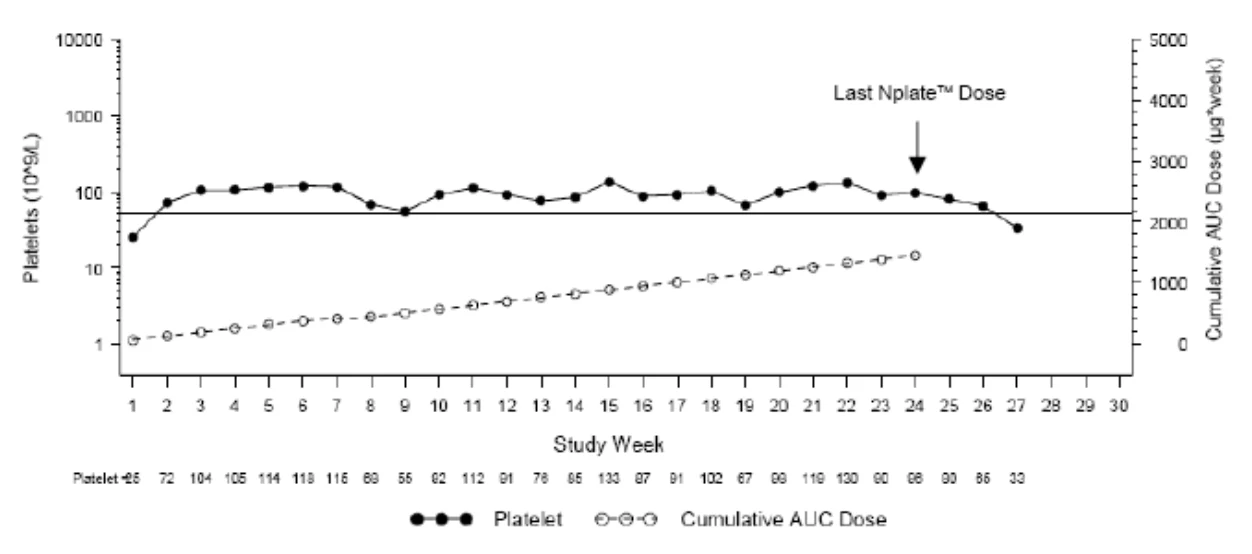
Only rescue medication use in Weeks 1-24 have been included. Severity of bleeding event is represented by the length of the vertical line segment. Rescue medications are indicated by the following: P=Prednisone, I=Immunoglobulins, B=Platelets, Human Blood, and O=Other.
Figure 2. Individual platelet count and cumulative dose over time: Non-Durable Responder
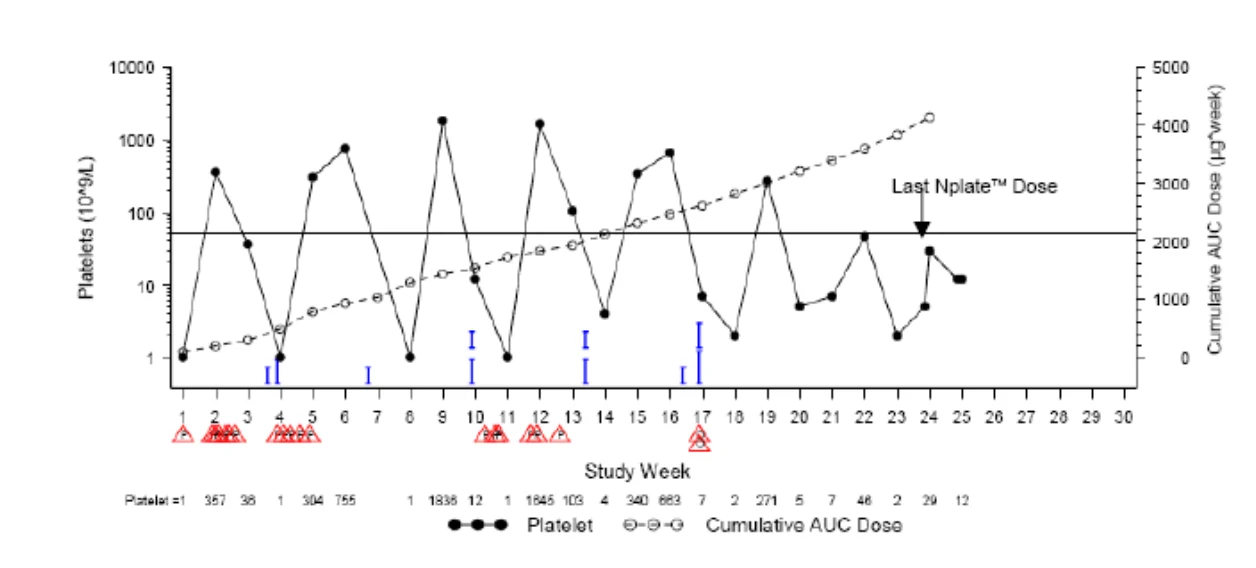
Only rescue medication use in Weeks 1-24 have been included. Severity of bleeding event is represented by the length of the vertical line segment. Rescue medications are indicated by the following: P=Prednisone, I=Immunoglobulins, B=Platelets, Human Blood, and O=Other.
8.5. Post-Market Adverse Reactions
In addition to the events listed above, reports of adverse reactions have been identified post-market in patients receiving NPLATE, including:
- Erythromelalgia
- Hypersensitivity reactions including angioedema and anaphylaxis
- Thrombotic/thromboembolic events
9. Drug Interactions
9.2. Drug Interactions Overview
No formal drug interaction studies have been conducted with NPLATE.
9.3. Drug-Behaviour Interactions
Drug-Behavioural interactions have not been established.
9.4. Drug-Drug Interactions
No formal drug-drug interaction studies of NPLATE (romiplostim) have been performed.
ITP medical therapies used in combination with NPLATE in clinical studies included corticosteroids, danazol, and/or azathioprine, intravenous immunoglobulins (IVIG), and anti-D immunoglobulin. When combining NPLATE with other ITP medical therapies, platelet counts should be monitored in order to manage unexpected changes (see 4 Dosage and Administration).
9.5. Drug-Food Interactions
Interactions with food have not been established.
9.6. Drug-Herb Interactions
Interactions with herbal products have not been established.
9.7. Drug-Laboratory Test Interactions
Interactions with laboratory tests have not been established.
10. Clinical Pharmacology
10.1. Mechanism of Action
NPLATE (romiplostim), a member of the TPO mimetic class, is an Fc-peptide fusion protein (peptibody) that increases platelet production by binding the thrombopoietin receptor (also known as cMpl), and activating intracellular transcriptional pathways; a mechanism analogous to endogenous thrombopoietin (eTPO). NPLATE has no amino acid sequence homology to eTPO.
10.2. Pharmacodynamics
Among all ITP patients treated with NPLATE in study S1 (20030212) and S2 (20030105), during the 24-week treatment period the mean (SD) number of weeks with platelet response (platelet count ≥ 50 x 109/L without rescue therapy within 8 weeks) was 15 (7.5) for nonsplenectomized patients and 12 (7.9) for splenectomized patients (Table 14).
10.3. Pharmacokinetics
In the long-term extension study in patients with ITP (n = 20) receiving weekly treatment of NPLATE subcutaneously, the pharmacokinetics of NPLATE over the dose range of 3 to 15 mcg/kg (Table 12) indicated that peak serum concentrations were observed about 7 to 50 hours postdose (median, 14 hours) with half-life values ranging from 1 to 34 days (median, 3.5 days). The serum concentrations varied among patients and did not correlate with the dose administered. The elimination of serum NPLATE is in part dependent on the TPO receptor on platelets. As a result, for a given dose, high platelet counts in patients are associated with low serum concentrations and vice versa. The relationship between the exposure (AUC or Cmax) and the predose platelet count was nonlinear, however, it is approximately linear in log-log scale. In another ITP clinical study, no accumulation in serum concentrations was observed after 6 weekly doses of NPLATE (3 mcg/kg). The potential for accumulation at higher doses of NPLATE is unknown.
| Table 12. PK Parameters of NPLATE Following 2 Consecutive Weekly Subcutaneous Doses in Subjects With ITP After Chronic Weekly Treatment in The Long-Term Extension Study | ||||||||||||||||||||||||||||||||||
| AUC0-7day | Cmax | tmax | t1/2 | Predose Platelet | ||||||||||||||||||||||||||||||
| (pg*hr/mL) | (pg/mL) | (hour) | (hour) | Count (x 109/L) | ||||||||||||||||||||||||||||||
| Subject | Dose mcg/kg | Week 1 | Week 2 | Week 1 | Week 2 | Week 1 | Week 2 | Week 1 | Week 2 | Week 1 | Week 2 | |||||||||||||||||||||||
| 1 | 3 | 2970 | NA | 37.8 | NA | 24 | NA | 47 | NA | 304 | 216 | |||||||||||||||||||||||
| 2 | 4 | 8880 | 9400 | 71.8 | 90.8 | 36 | 24 | 826 | 207 | 195 | 84 | |||||||||||||||||||||||
| 3 | 4 | 6240 | 6830 | 45.1 | 56 | 23 | 23 | 172 | 102 | 144 | 99 | |||||||||||||||||||||||
| 4 | 4 | —a | — | — | — | ― | ― | — | ― | 194 | 131 | |||||||||||||||||||||||
| 5 | 4 | 14500 | 7180 | 289 | 124 | 12 | 11 | 24 | 38 | 124 | 151 | |||||||||||||||||||||||
| 6 | 5 | 18800 | 18900 | 390 | 338 | 12 | 12 | 53 | 131 | 99 | 94 | |||||||||||||||||||||||
| 7 | 5 | 11700 | 21400 | 192 | 303 | 8 | 24 | 183 | 60 | 131 | 104 | |||||||||||||||||||||||
| 8 | 5 | 10400 | 4830 | 162 | 52.4 | 12 | 24 | 145 | 29 | 102 | 144 | |||||||||||||||||||||||
| 9 | 5 | 5040 | 5090 | 94.3 | 67.2 | 11 | 24 | 415 | 51 | 257 | 326 | |||||||||||||||||||||||
| 10 | 7 | 7290 | 5260 | 105 | 37.1 | 7 | 24 | 39 | 153 | 100 | 333 | |||||||||||||||||||||||
| 11 | 8 | 117000 | 94100 | 1510 | 1310 | 12 | 11 | 67 | 91 | 74 | 74 | |||||||||||||||||||||||
| 12 | 8 | 13700 | 8660 | 197 | 74.2 | 12 | 36 | 115 | 127 | 37 | 115 | |||||||||||||||||||||||
| 13 | 8 | 12400 | 10400 | 149 | 88.5 | 24 | 24 | 70 | 125 | 182 | 214 | |||||||||||||||||||||||
| 14 | 10 | 66300 | 18300 | 1440 | 159 | 24 | 22 | 78 | 124 | 78 | 152 | |||||||||||||||||||||||
| 15 | 15 | 305000 | 209000 | 8580 | 7550 | 12 | 12 | 68 | 109 | 5 | 5 | |||||||||||||||||||||||
aAll samples from this subject were below the limit of quantification. Data from 5 subjects were not included due to incomplete concentration time profile or dose change; AUC0-7day = the area under the NPLATE serum concentration-time curve over 7 days; Cmax = the maximum serum concentration; tmax = the time of Cmax; t1/2 = the half-life, probably represents the absorption rate due to flip-flop kinetics; NA = not available
10.4. Immunogenicity
As with all therapeutic proteins, patients may develop antibodies to the therapeutic protein. Patients were screened for immunogenicity to NPLATE using a Biacore-based biosensor immunoassay. This assay is capable of detecting both high and low affinity binding antibodies that bind to NPLATE and cross-react with TPO. The samples from patients that tested positive for binding antibodies were further evaluated for neutralizing capacity using a cell-based bioassay.
Of the 1046 adult ITP subjects dosed with NPLATE in clinical studies, 35/1046 (3.3%) subjects showed a pre-existing binding antibody response to NPLATE and 31/1046 (3.0%) subjects had a pre-existing binding antibody response to TPO. The incidence of binding antibodies that developed against NPLATE and TPO was 60/1046 (5.7%) and 33/1046 (3.2%), respectively. The incidence of neutralizing antibodies that developed against NPLATE was 0.4% (4/1046) and 0% for TPO, respectively. Of the 4 subjects with neutralizing antibodies against NPLATE, 2 subjects tested negative for neutralizing antibodies at the subject’s last timepoint (transient positive) and 2 subjects remained positive at the subject’s last timepoint (persistent antibodies). The incidence of pre-existing neutralizing antibody response to NPLATE and to TPO was 0%. The development of neutralizing antibodies to NPLATE occurred infrequently and therefore their impact on clinical effectiveness or safety is unknown.
Immunogenicity assay results are highly dependent on the sensitivity and specificity of the assay used in detection and may be influenced by several factors, including sample handling, concomitant medications, and underlying disease. For these reasons, comparison of incidence of antibodies to NPLATE with the incidence of antibodies to other products may be misleading.
- 11. Storage, Stability, and Disposal
NPLATE lyophilized product should be stored refrigerated at 2°C to 8°C (36°F to 46°F); vials should be kept in the original carton to protect from light until time of use. Do not freeze. Alternatively, NPLATE lyophilized product can be kept at room temperature up to 25°C (77°F) in the original carton; however, under these conditions, NPLATE lyophilized product must be used within 30 days. If not used within the 30 days, discard NPLATE.
Protect NPLATE from direct light and do not expose to temperatures above 25°C (77°F).
Medicines should not be disposed of via wastewater and disposal through household waste should be avoided. These measures will help protect the environment.
Part 2: Scientific Information
13. Pharmaceutical Information
Drug Substance
Non-proprietary name of the drug substance(s): romiplostim
Molecular formula and molecular mass: The molecular weight of romiplostim is approximately 59 kDA.
Structure / Structural formula: The peptibody molecule is comprised of a human immunoglobulin IgG1 Fc domain, with each single-chain subunit covalently linked at the C-terminus to a peptide chain containing two thrombopoietin receptor-binding domains.
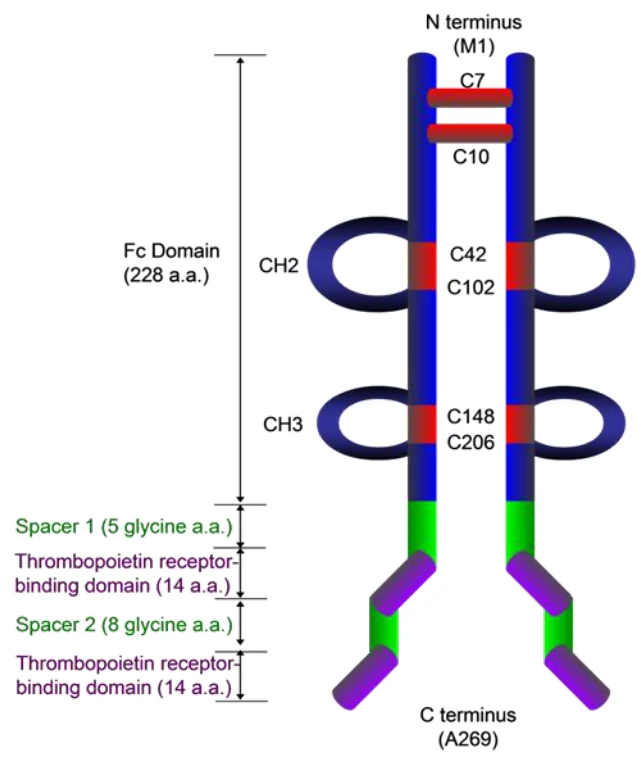
Physicochemical properties: Nplate® (romiplostim for injection) is a sterile, preservative-free, lyophilized solid white powder in a single-use vial for reconstitution. Reconstitution yields a clear, colourless, iso-osmotic solution of NPLATE.
Pharmaceutical standard: Professed
Product Characteristics:
NPLATE is produced by recombinant DNA technology in Escherichia coli (E. coli).
14. Clinical Trials
14.1. Clinical Trials by Indication
Immune Thrombocytopenia (ITP)
| Table 13. Summary of Clinical Efficacy Studies (Subjects with ITP) | ||||||
|---|---|---|---|---|---|---|
| Table 13. Summary of Clinical Efficacy Studies (Subjects with ITP) | ||||||
| Study Number/ Type | Description | Primary Endpoint | Number Randomized/ Treatment | Age Range (years) | Race/Gender | Dosing Regimen |
| Study Number/ Type | Description | Primary Endpoint | Number Randomized/ Treatment | Age Range (years) | Race/Gender | Dosing Regimen |
| Placebo-controlled, pivotal trials | ||||||
| Study S1 (20030212) | Phase 3 double-blind, (2:1, NPLATE: placebo), safety and efficacy in subjects ≥ 18 years old, who have not undergone splenectomy; stratified by concurrent ITP therapy. Dose adjustment to maintain platelet target range of 50 to 200 x 109/L. At 24 weeks study drug withdrawn; subject complete at platelets ≤ 50 x109/L, or at week 36 with > 50 x109/L. | Incidence of durable platelet response, defined as achieving ≥ 6 weekly responses during last 8 weeks of treatment with no rescue medication | 62 subjects: 41 NPLATE 21 placebo | 21 to 88 | White, 49 Black, 4 Other, 5 Asian, 3 Native Hawaiian or Other Pacific Islander, 1 Men, 19 Women, 43 | 1.0 to 15 mcg/kg SC weekly, adjusted by platelet count, for 24 weeks |
| Study S2 (20030105) | Phase 3 double-blind, (2:1, NPLATE: placebo), safety and efficacy in subjects ≥ 18 years old, refractory to splenectomy; stratified by concurrent ITP therapy. Dose adjustment to maintain platelet target range of 50 to 200 x 109/L. At 24 weeks study drug withdrawn; subject complete at platelets ≤ 50 x109/L, or at week 36 with > 50 x109/L. | Incidence of durable platelet response, defined as achieving ≥ 6 weekly responses during last 8 weeks of treatment with no rescue medication | 63 subjects: 42 NPLATE 21 placebo | 26 to 88 | White, 53 Black, 5 Hispanic, 3 Asian, 2 Men, 25 Women, 38 | 1.0 to 15 mcg/kg SC weekly, adjusted by platelet count, for 24 weeks |
| Open-label, Single Arm Study | ||||||
| Study S3 (20080435) | Phase 2, interventional, single-arm, open-label study conducted to describe platelet response in subjects ≥ 18 years old with primary ITP diagnosed within 6 months of study entry who had an insufficient response to first-line therapy for treatment of ITP. | Number of months a subject achieved a platelet response (≥ 50 x109/L) during the 12-month treatment period | 75 subjects: 75 NPLATE | 19 to 85 | White, 72 Black, 1 Asian, 1 Unknown, 1 Men, 31 Women, 44 | 1.0 to 10 mcg/kg SC weekly, adjusted by platelet count, for 52 weeks |
| Open-label Study | ||||||
| Study S4 (20060131) | A Randomized, Controlled, Open-label Study Evaluating the Efficacy and Tolerability of AMG 531 versus Medical Standard of Care (SOC) as Chronic Therapy for Nonsplenectomized Subjects with Immune (Idiopathic) Thrombocytopenia Purpura | Two primary endpoints:
2.The number of subjects with a treatment failure during the 52-week treatment period by randomized treatment group. | 234 subjects: 157 NPLATE 77 SOC | 18 to 90 | White/Caucasian, 206 Hispanic/Latino, 14 Black/African American, 6 Asian, 6 American Indian/Alaskan Native, 1 Other, 1 Men, 103 Women, 131 | 3.0 mcg/kg SC weekly, adjusted by platelet count, for 52 weeks |
| Long-term extension study | ||||||
| Study S5 (20030213) | Open-label extension study designed to assess the durability of platelet count increases in subjects previously completing a NPLATE ITP study | Incidence of adverse events, including clinically significant changes in laboratory values and incidence of antibody formation | 292 subjects 291 NPLATE | 19 to 90 | White, 246 Black, 13 Hispanic, 21 Asian, 9 Japanese, 1 American Indian/Alaska Native, 1 Native Hawaiian or Other Islander, 1 Men, 108 Women, 184 | 1.0 to 30 mcg/kg SC weekly, adjusted by platelet count; Maximum dose reduced to 15 mcg/kg and then to 10 mcg/kg |
The safety and efficacy of NPLATE (romiplostim) in adults were evaluated in two Phase 3 placebo-controlled, double-blind studies (Study S1 and Study S2), a Phase 2 open-label, single arm study (Study S3) and a Phase 3 randomized, controlled, open-label study in adults with ITP (Study S4). See summary of patient demographics and study design in Table 13.
Placebo-Controlled Studies (Study S1 and Study S2)
Study S1 and Study S2 were conducted in adults with ITP who had completed at least one treatment prior to study entry.
Study S1 (20030212) evaluated patients who were nonsplenectomized and had an inadequate response or were intolerant to prior therapies. Patients had been diagnosed with ITP for a median of approximately 2.1 years (range 0.1 to 31.6) at the time of study entry. Patients had received a median of 3 (range, 1 to 7) treatments for ITP prior to study entry. Prior treatments included corticosteroids (90% of all patients), immunoglobulins (76%), rituximab (29%), cytotoxic therapies (21%), danazol (11%), and azathioprine (5%). Patients had a median platelet count of 19 x 109/L at study entry.
Study S2 (20030105) evaluated patients who were splenectomized and continued to have thrombocytopenia. Patients had been diagnosed with ITP for a median of approximately 8 years (range 0.6 to 44.8) at the time of study entry. In addition to a splenectomy, patients had received a median of 6 (range, 3 to 10) treatments for ITP prior to study entry. Prior treatments included corticosteroids (98% of all patients), immunoglobulins (97%), rituximab (71%), danazol (37%), cytotoxic therapies (68%), and azathioprine (24%). Patients had a median platelet count of 14 x 109/L at study entry.
Entry criteria were the same in both of the placebo-controlled studies except that patients in Study S1 had not undergone splenectomy while patients in Study S2 were refractory to splenectomy. Patients were required to be at least 18 years old with a diagnosis of ITP according to American Society of Hematology (ASH) guidelines. Patients must have completed at least 1 previous treatment for ITP and had a mean of 3 platelet counts during screening and pre-treatment periods that were ≤ 30 x 109/L, with no individual count > 35 x 109/L. At the time of study entry, patients could not be receiving any treatment for ITP except corticosteroids, azathioprine, or danazol administered at a constant dose and schedule. Hemoglobin of at least 9.0 g/dL was required at baseline, and patients over 60 years of age were required to have a documented history of chronic ITP with a bone marrow report in order to support the diagnosis. Those with a known history of bone marrow stem cell disorder were excluded. In study S2, splenectomy was required to have occurred at least 4 weeks before study entry.
Among patients enrolled into Study S2, only 16.6% (7/42) of NPLATE treated patients and zero (0/21) placebo treated patients had undergone splenectomy within 6 months of enrollment.
A summary of the patient demographics and trial designs for the two Phase 3, placebo-controlled studies and the long-term extension study is provided in Table 13.
Study Results
Both of the placebo-controlled studies were similarly designed. Patients (≥ 18 years) were randomized in a 2:1 ratio to receive a starting dose of NPLATE 1 mcg/kg or placebo. Patients received single weekly SC injections for 24 weeks. Doses were adjusted to maintain platelet counts (50 to 200 x 109/L).
In both studies, efficacy was determined by an increase in the proportion of patients who achieved a durable platelet response in the romiplostim treated patients compared to the placebo treated patients (defined as weekly platelet count ≥ 50 x 109/L for 6 or more times during last 8 weeks of treatment in the absence of rescue medication any time during the treatment period). In these placebo-controlled studies, the most frequently used weekly dose during weeks 17-24 for splenectomized patients was between 2-7 mcg/kg (25th-75th percentile respectively; median 3 mcg/kg) and for nonsplenectomized patients was between 1-3 mcg/kg (25th-75th percentile respectively; median 2 mcg/kg). As shown in Table 14, treatment with NPLATE demonstrated significant improvements compared to placebo in both clinical studies for all efficacy endpoints for all patients randomized to the studies based on an intention to treat analysis.
Following discontinuation of NPLATE during studies S1 and S2, seven patients maintained platelet counts of ≥ 50 x 109/L until week 36, without requiring further treatment with NPLATE, and were therefore not enrolled in the long term extension study.
| Table 14. Summary of Efficacy Results from Placebo-controlled Studies | ||||
|---|---|---|---|---|
| Study S1 (20030212) Nonsplenectomized Patients | Study S2 (20030105) Splenectomized Patients | |||
| NPLATE (n = 41) | Placebo (n = 21) | NPLATE (n = 42) | Placebo (n = 21) | |
| No. (%) Patients with Durable Platelet Responsea | 25 (61%) | 1 (5%) | 16 (38%) | 0 (0%) |
| (95% CI) | (45%, 76%) | (0%, 24%) | (24%, 54%) | (0%, 16%) |
| p-value | <0.0001 | 0.0013 | ||
| Patients with Transient Platelet Responseb | 11 (27%) | 2 (10%) | 17 (41%) | 0 (0%) |
| (95% CI) | (14%, 43%) | (1%, 30%) | (26%, 57%) | (0%, 16%) |
| Mean No. Weeks with Platelet Responsec | 15 | 1 | 12 | 0 |
| (SD) | 7.5 | 3.5 | 7.9 | 0.5 |
| p-value | <0.0001 | <0.0001 | ||
| No. (%) Patients Requiring Rescue Therapiesd | 8 (20%) | 13 (62%) | 11 (26%) | 12 (57%) |
| (95% CI) | (9%, 35%) | (38%, 82%) | (14%, 42%) | (34%, 78%) |
| p-value | 0.001 | 0.0175 | ||
| No. (%) Patients with Durable Platelet Response with Stable Dosee | 21 (51%) | 0 (0%) | 13 (31%) | 0 (0%) |
| (95% CI) | (35%, 67%) | (0%, 16%) | (18%, 47%) | (0%, 16%) |
| p-value | 0.0001 | 0.0046 | ||
a Durable platelet response was defined as weekly platelet count ≥ 50 x 109/L for 6 or more times for study weeks 18-25 in the absence of rescue medication any time during the treatment period.
b Transient platelet response was defined as achieving weekly platelet response for 4 or more times between weeks 2-25 but without durable platelet response.
c Number of weeks with platelet response is defined as number of weeks with platelet counts ≥ 50 x 109/L during study weeks 2-25. Patient may not have a weekly response within 8 weeks after receiving any rescue medications.
d Rescue therapies defined as any therapy administered to raise platelet counts. Patients requiring rescue medications were not considered for durable platelet response. Rescue therapies allowed in the study were IVIG, platelet transfusions, anti-D immunoglobulin, and corticosteroids. Physician knowledge of platelet response may have had an impact on the differential reduction of administration of rescue medications observed in clinical studies e Stable dose defined as dose maintained within ± 1 mcg/kg during the last 8 weeks of treatment.
In both Phase 3, placebo-controlled studies (Study S1 and S2), 50% to 70% of patients maintained platelet counts ≥ 50 x 109/L starting week 6 during the 24-week treatment period. In the placebo group, 0% to 7% of patients were able to achieve a platelet count response during the 6 months of treatment. Figure 3, Figure 4, and Figure 5 provide median (Q1, Q3) and notched box presentations, respectively, of weekly platelet counts in NPLATE-treated nonsplenectomized subjects. Figure 6, Figure 7, and Figure 8 provide median (Q1, Q3) and notched box presentations, respectively, of weekly platelet counts in NPLATE-treated splenectomized subjects.
Figure 3. Median (Q1, Q3) Weekly Platelet Counts in Nonsplenectomized Subjects
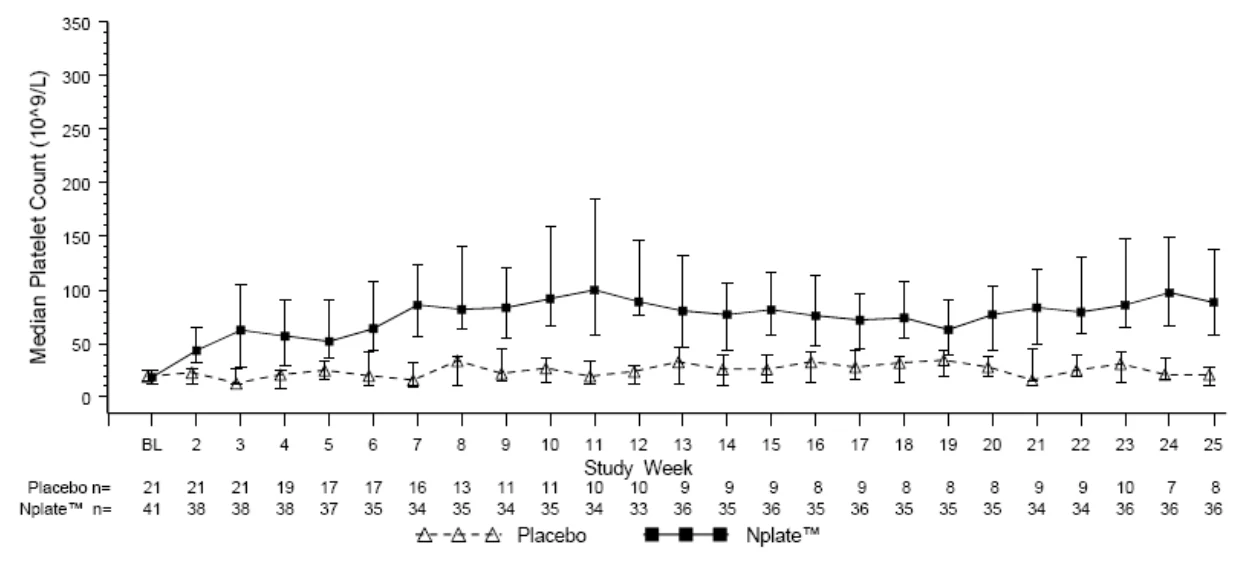
Includes all randomized patients excluding platelet counts within 8 weeks after rescue medication use. Baseline platelet value (BL) = mean of platelet counts at Days -8, -2 and pre-dose Day 1.
Figure 4. Notched Box Weekly Platelet Counts in Nonsplenectomized Subjects (Outliers)
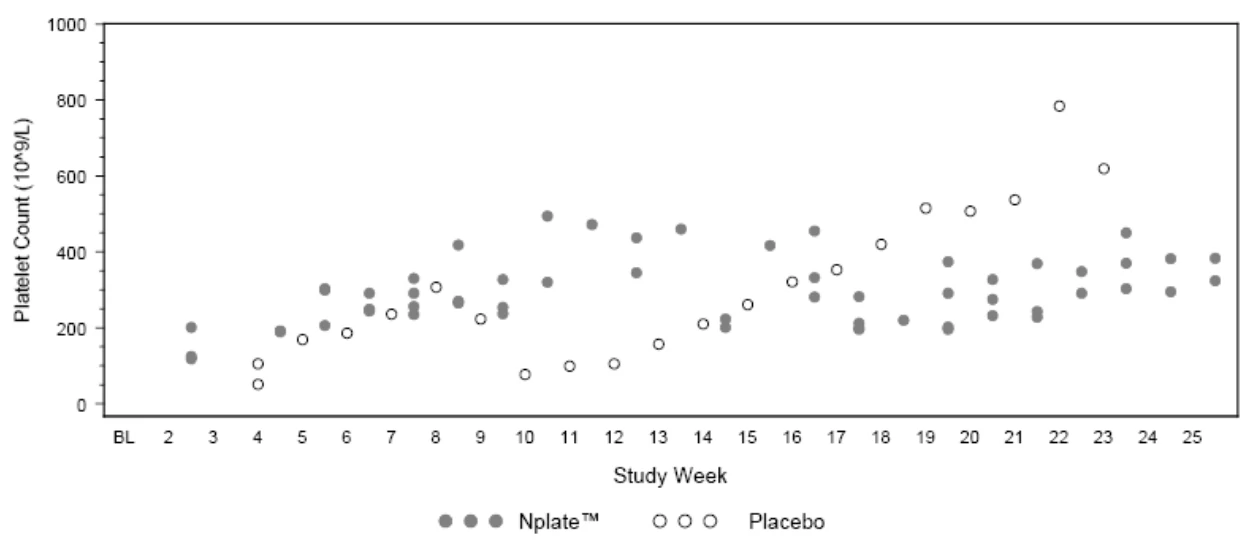
Includes all randomized patients excluding platelet counts within 8 weeks after rescue medication use. Baseline platelet value (BL) = mean of platelet counts at days -8, -2, and pre-dose day 1.
Figure 5. Notched Box Weekly Platelet Counts in Nonsplenectomized Subjects
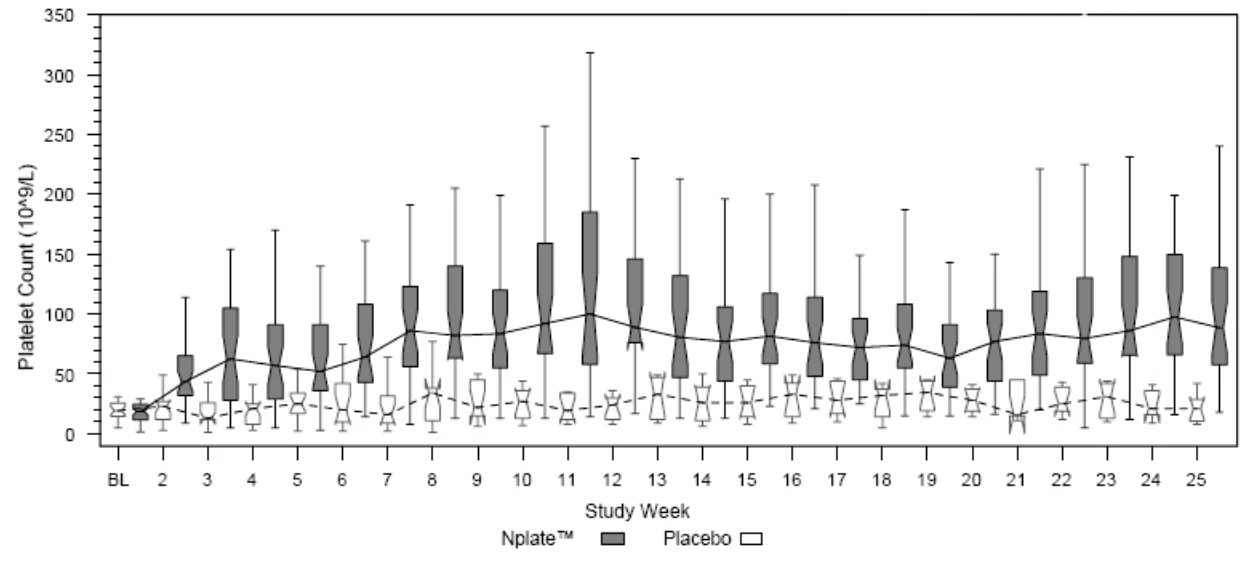
Includes all randomized patients excluding platelet counts within 8 weeks after rescue medication use. Whiskers represent the upper and lower adjacent values; top and bottom of box indicate inter-quartile range. Baseline platelet value (BL) = mean of platelet counts at days -8, -2, and pre-dose day 1.
Figure 6. Median (Q1, Q3) Weekly Platelet Counts in Splenectomized Subjects
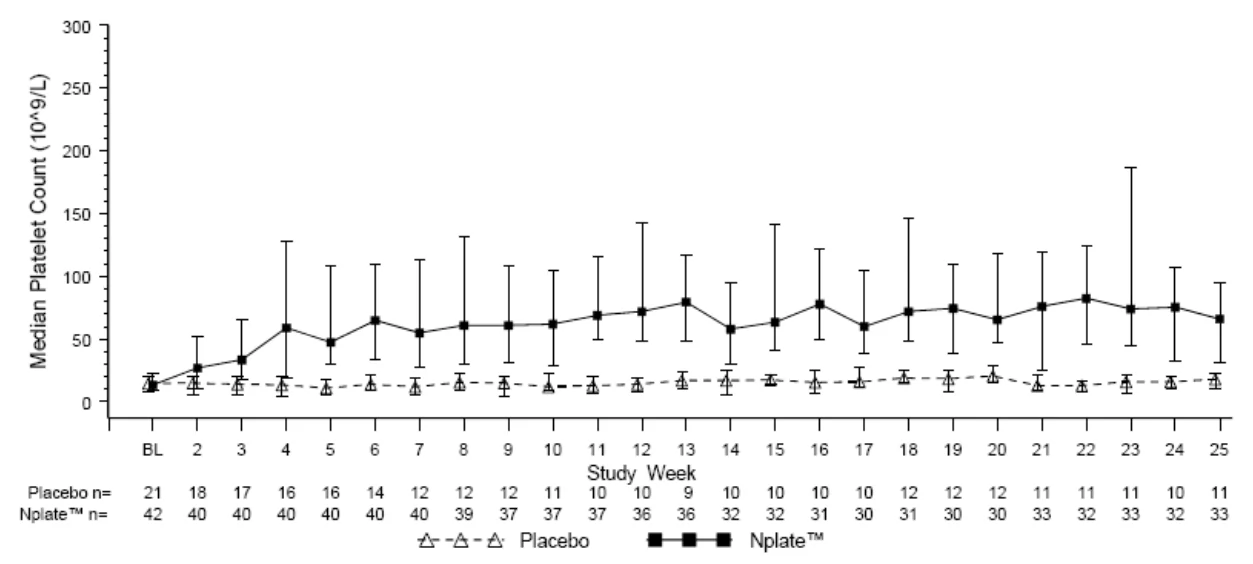
Includes all randomized patients excluding platelet counts within 8 weeks after rescue medication use. Baseline platelet value (BL) = mean of platelet counts at Days -8, -2 and pre-dose Day 1.
Figure 7. Notched Box Weekly Platelet Counts in Splenectomized Subjects (Outliers)
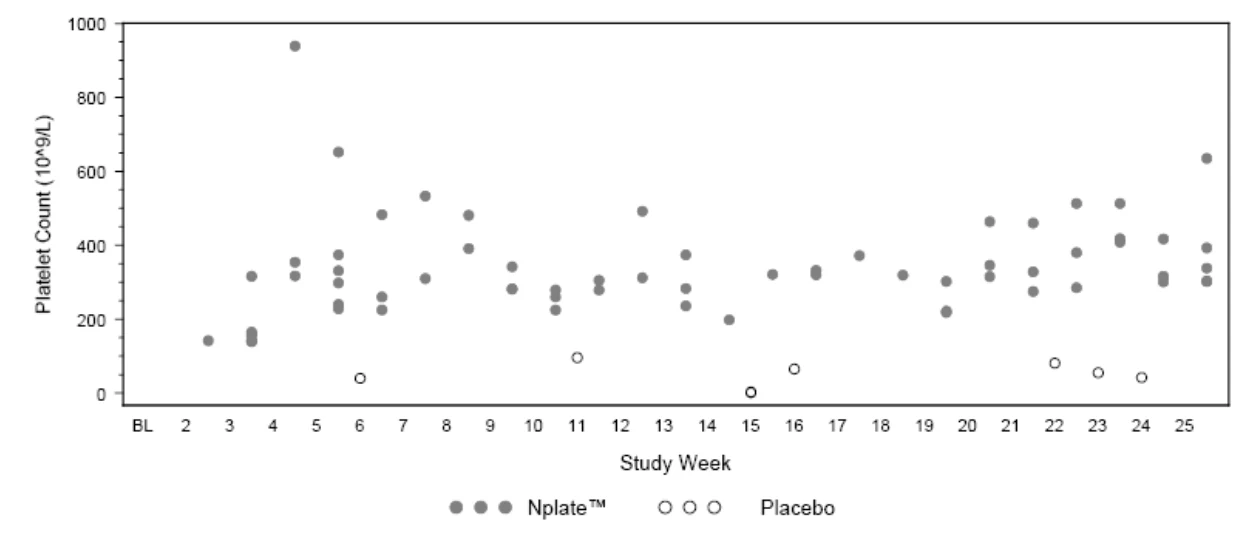
Includes all randomized patients excluding platelet counts within 8 weeks after rescue medication use. Baseline platelet value (BL) = mean of platelet counts at days -8, -2, and pre-dose day 1.
Figure 8. Notched Box Weekly Platelet Counts in Splenectomized Subjects
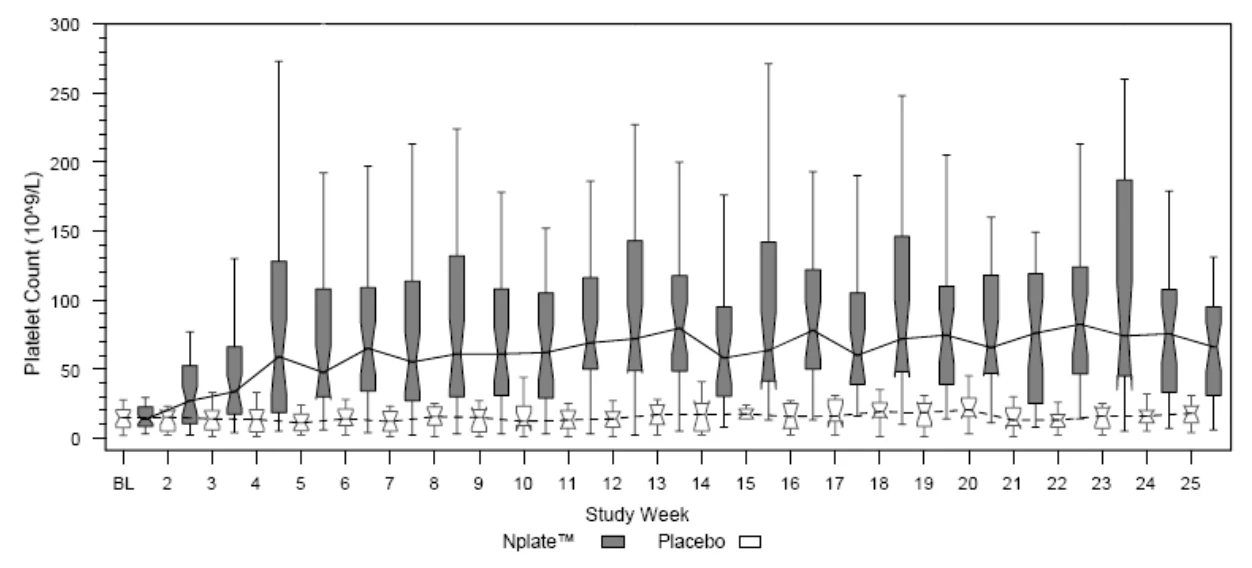
Includes all randomized patients excluding platelet counts within 8 weeks after rescue medication use. Whiskers represent the upper and lower adjacent values; top and bottom of box indicate inter-quartile range. Baseline platelet value (BL) = mean of platelet counts at days -8, -2, and pre-dose day 1.
Individual subject profiles for platelet counts over time exhibit greater variability than what is shown by the median (Q1, Q3) plots, especially for patients whose platelet counts cannot be stabilized.
NPLATE has been used alone or in combination with other ITP therapies such as corticosteroids, azathioprine, or danazol.
Splenectomized patients had a higher number of previous therapies, higher rates of use of concurrent ITP therapy at baseline, and a tendency to need higher NPLATE doses for an initial response. They also seemed to have more variability in response to NPLATE than did nonsplenectomized patients.
Open-Label Single Arm Study (Study S3)
Study S3 (20080435) was an open-label, single arm study in adult patients with ITP duration of 0-6 months at the time of study entry who had an insufficient response (platelet count ≤ 30 x 109/L) to first line therapy. The study enrolled 75 patients of whom the median age was 39 years (range 19 to 85) and 59% were female.
The median time from ITP diagnosis to study enrollment was 2.2 months (range 0.1 to 6.6). Sixty percent of patients had ITP duration < 3 months and 40% had ITP duration ≥ 3 months. The median platelet count at screening was 20 x 109/L. Prior ITP treatments included corticosteroids, immunoglobulins, and anti-D immunoglobulins. Patients already receiving ITP medical therapies were allowed to continue receiving these medical treatments throughout the study. Rescue therapies (i.e., corticosteroids, IVIG, platelet transfusions, anti-D immunoglobulin, dapsone, danazol, and azathioprine) were permitted.
A summary of the patient demographics and trial design for Study S3 is provided in Table 13.
Study Results
Patients received single weekly SC injections of NPLATE over a 12-month treatment period, with individual dose adjustments to maintain platelet counts (50 x 109/L to 200 x 109/L). During the study, the median weekly NPLATE dose was 3 mcg/kg (25th-75th percentile: 2-4 mcg/kg).
Of the 75 patients enrolled in Study S3, 70 (93%) had a platelet response ≥ 50 x 109/L during the 12-month treatment period. The mean number of months with platelet response during the 12-month treatment period was 9.2 (95% CI: 8.3, 10.1) months; the median was 11 (95% CI: 10, 11) months. The Kaplan Meier estimate of the median time to first platelet response was 2.1 weeks (95% CI: 1.1, 3.0). Twenty-four (32%) patients had sustained treatment-free remission as defined by maintaining every platelet count ≥ 50 x 109/L for at least 6 months in the absence of NPLATE and any medication for ITP (concomitant or rescue); the median time to onset of maintaining every platelet count ≥ 50 x 109/L for at least 6 months was 27 weeks (range 6 to 57). A subgroup analysis showed that the 24 patients who had a remission had a longer mean platelet response (mean 11.4 months) compared to the patients who did not have a remission (mean 8.2 months).
Open-label Study (Study S4)
Study S4 (20060131) was an open-label, randomized 52 week trial in subjects who received NPLATE or medical SOC treatment. Patients had been diagnosed with ITP for a median of 2 years (range 0.01 to 44.2) at the time of study entry. Medical SOC treatments, including the option of watchful waiting, were selected and prescribed by the investigator according to standard institutional practices or therapeutic guidelines. This study evaluated nonsplenectomized patients with ITP and platelet counts < 50 x 109/L. NPLATE was administered by subcutaneous (SC) injection once weekly starting at a dose of 3 mcg/kg, and adjusted throughout the study within a range of 1-10 mcg/kg in order to maintain platelet counts between 50 and 200 x 109/L.
Study Results
Nonsplenectomized patients (≥ 18 years) were randomized in a 2:1 ratio to NPLATE or medical SOC for ITP if their platelet count was < 50 x 109/L or their platelet count fell to < 50 x 109/L during or after a clinically indicated taper or discontinuation of current ITP therapy. NPLATE was administered by subcutaneous (SC) injection once weekly starting at a dose of 3 mcg/kg, adjusted as needed throughout the study to a maximum dose of 10 mcg/kg in order to maintain platelet counts between 50 and 200 x 109/L.
Of the 157 subjects randomized to receive NPLATE, the median (range) duration of exposure was 52.0 weeks (2 to 53). The median (25th, 75th percentiles) weekly dose of NPLATE was 3 mcg/kg (3 to 5).
Table 15. Demographics (Full Analysis Set)
| SOC (N = 77) | NPLATE (N = 157) | Total (N = 234) | |||||||||
| Age Group in Years - n (%) | |||||||||||
| 18 - 29 | 9 (11.7) | 20 (12.7) | 29 (12.4) | ||||||||
| 30 - 39 | 8 (10.4) | 18 (11.5) | 26 (11.1) | ||||||||
| 40 - 49 | 14 (18.2) | 21 (13.4) | 35 (15.0) | ||||||||
| 50 - 59 | 10 (13.0) | 28 (17.8) | 38 (16.2) | ||||||||
| 60 - 69 | 15 (19.5) | 30 (19.1) | 45 (19.2) | ||||||||
| 70 - 79 | 14 (18.2) | 30 (19.1) | 44 (18.8) | ||||||||
| ≥ 80 | 7 (9.1) | 10 (6.4) | 17 (7.3) | ||||||||
| ≥ 65 | 29 (37.7) | 54 (34.4) | 83 (35.5) | ||||||||
| ≥ 75 | 13 (16.9) | 29 (18.5) | 42 (17.9) | ||||||||
| Age (yrs) | |||||||||||
| n | 77 | 157 | 234 | ||||||||
| Mean | 54.7 | 54.8 | 54.7 | ||||||||
| SD | 19.3 | 18.8 | 18.9 | ||||||||
| Median | 57.0 | 58.0 | 57.0 | ||||||||
| Q1, Q3 | 42.0, 70.0 | 42.0, 70.0 | 42.0, 70.0 | ||||||||
| Min, Max | 18, 86 | 18, 90 | 18, 90 | ||||||||
| Sex - n (%) | |||||||||||
| Female | 46 (59.7) | 85 (54.1) | 131 (56.0) | ||||||||
| Male | 31 (40.3) | 72 (45.9) | 103 (44.0) | ||||||||
| Race - n (%) | |||||||||||
| White or Caucasian | 69 (89.6) | 137 (87.3) | 206 (88.0) | ||||||||
| Black or African American | 0 (0.0) | 6 (3.8) | 6 (2.6) | ||||||||
| Hispanic or Latino | 5 (6.5) | 9 (5.7) | 14 (6.0) | ||||||||
| Asian (eg, Chinese, Bangladeshi, Indian, Pakistani) | 1 (1.3) | 5 (3.2) | 6 (2.6) | ||||||||
| Japanese | 0 (0.0) | 0 (0.0) | 0 (0.0) | ||||||||
| American Indian or Alaska Native | 1 (1.3) | 0 (0.0) | 1 (0.4) | ||||||||
| Native Hawaiian or Other Pacific Islander | 0 (0.0) | 0 (0.0) | 0 (0.0) | ||||||||
| Aborigine | 0 (0.0) | 0 (0.0) | 0 (0.0) | ||||||||
| Other | 1 (1.3) | 0 (0.0) | 1 (0.4) | ||||||||
| Weight (kg) | |||||||||||
| n | 74 | 155 | 229 | ||||||||
| Mean | 81.7 | 81.5 | 81.6 | ||||||||
| SD | 22.9 | 19.4 | 20.6 | ||||||||
| Median | 77.0 | 77.5 | 77.0 | ||||||||
| Q1, Q3 | 67.3, 90.5 | 68.2, 94.0 | 68.2, 92.0 | ||||||||
| Min, Max | 45, 183 | 49, 143 | 45, 183 | ||||||||
SOC = Standard of Care. Full analysis set includes all randomized subjects. | |||||||||||
| Percentages are based on N. | |||||||||||
Table 16. ITP Treatment History (Full Analysis Set)
| SOC (N = 77) | NPLATE (N = 157) | Total (N = 234) | ||||||||||
| Years since ITP Diagnosisa | ||||||||||||
| n | 77 | 157 | 234 | |||||||||
| Mean | 4.566 | 4.304 | 4.390 | |||||||||
| SD | 5.669 | 6.135 | 5.974 | |||||||||
| Median | 2.260 | 2.080 | 2.090 | |||||||||
| Q1, Q3 | 0.400, 6.540 | 0.460, 5.340 | 0.450, 5.890 | |||||||||
| Min, Max | 0.01, 33.22 | 0.02, 44.22 | 0.01, 44.22 | |||||||||
| Number of Prior ITP Therapyb - n (%) | ||||||||||||
| 1 | 17 (22.1) | 47 (29.9) | 64 (27.4) | |||||||||
| 2 | 28 (36.4) | 53 (33.8) | 81 (34.6) | |||||||||
| 3 | 16 (20.8) | 35 (22.3) | 51 (21.8) | |||||||||
| ≥ 4 | 16 (20.8) | 22 (14.0) | 38 (16.2) | |||||||||
SOC = Standard of Care. Full analysis set includes all randomized subjects. Percentages are based on N. a Years are calculated as (randomization date - ITP diagnosis date) / 365.25. Partial dates of ITP diagnosis with missing day only are imputed as 15, partial dates with missing month and day are imputed as July 1. b ITP treatments include: Corticosteroid, Anti-D Antibody, IV Immune Gamma Globulin, Vincristine/Vinblastine, Danazol, Cyclophosphamide, Azathioprine, Rituximab, and other. | ||||||||||||
Table 17. Medical and Surgical History (Full Analysis Set)
| SOC (N = 77) n (%) | NPLATE (N = 157) n (%) | Total (N = 234) n (%) | ||
| Subjects with history related to any of: | ||||
| Special Senses | 11 (14.3) | 28 (17.8) | 39 (16.7) | |
| Cardiovascular | 46 (59.7) | 81 (51.6) | 127 (54.3) | |
| Dermatologic | 18 (23.4) | 34 (21.7) | 52 (22.2) | |
| Endocrine / Metabolic | 34 (44.2) | 61 (38.9) | 95 (40.6) | |
| Gastrointestinal | 42 (54.5) | 79 (50.3) | 121 (51.7) | |
| Genitourinary / Reproductive | 31 (40.3) | 63 (40.1) | 94 (40.2) | |
| Hematologic / Lymphatic | 28 (36.4) | 39 (24.8) | 67 (28.6) | |
| Hepatic / Biliary | 21 (27.3) | 32 (20.4) | 53 (22.6) | |
| Immunologic | 12 (15.6) | 21 (13.4) | 33 (14.1) | |
| Musculoskeletal | 41 (53.2) | 82 (52.2) | 123 (52.6) | |
| Neurologic / Psychiatric | 30 (39.0) | 49 (31.2) | 79 (33.8) | |
| Renal | 10 (13.0) | 21 (13.4) | 31 (13.2) | |
| Respiratory | 26 (33.8) | 51 (32.5) | 77 (32.9) | |
| Other | 38 (49.4) | 62 (39.5) | 100 (42.7) | |
SOC = Standard of Care.
Full analysis set includes all randomized subjects. Percentages are based on N. Subjects may have multiple entries across categories, however, within each category, they are counted only once.
The median times to splenectomy and treatment failure were not reached. Based on post-hoc efficacy analyses, the Kaplan-Meier (KM) estimates of rate of splenectomy or death at the end of treatment are 42.1% in the SOC arm and 2.1% in the NPLATE arm. The KM estimates of rate of treatment failure or death at the end of treatment are 28.5% in the SOC arm and 4.8% in the NPLATE arm. However, the data show that a proportion of patients in the SOC arm (19 patients; 24.7%) did not receive any therapeutic intervention during the entire study, and imbalances in patient characteristics and rescue medications between the two arms were observed. For these reasons and due to the open-label nature of this trial and the addition of post-hoc efficacy analyses, the data should be interpreted cautiously.
Bleeding events in Subjects with Variable Platelet Counts (Unstable Platelet Counts)
Nine (7%) subjects in the pivotal studies had platelet counts that rose and fell to extreme levels within short periods of time; these subjects’ course on study often included multiple rescue medications and numerous NPLATE dose adjustments. In an effort to quantify and characterize these subjects, a definition was retrospectively developed for Variable Platelet Count Subject. This was any subject who had 5 or more fluctuations during the 25-week treatment period of a platelet count that either increased or decreased by > 100 x 109/L within a single week while also crossing 50 x 109/L. (see 8 Adverse Reactions, Clinical Trial Adverse Reactions, Bleeding Events in Subjects with Variable Platelet Counts (Unstable Platelet Counts)).
Discontinuation of Concurrent ITP Medical Therapies
In both Phase 3, placebo-controlled, double-blind studies (Study S1 and S2), patients already receiving ITP medical therapies at a constant dosing schedule were allowed to continue receiving these medical treatments throughout the study (ie, corticosteroids, danazol, and/or azathioprine). Twenty-one nonsplenectomized and 18 splenectomized patients received concurrent ITP medical treatments (primarily corticosteroids) at the start of the study. Sixty-seven percent of splenectomized patients who were receiving NPLATE were able to discontinue the concurrent ITP medical therapies by the end of the treatment period, while 36% of nonsplenectomized patients receiving NPLATE were able to discontinue concurrent ITP treatment. Table 18 describes the number of Phase 3 study patients who were able to discontinue baseline ITP therapies by week 25 (end of treatment), for Study S1 (20030212) and Study S2 (20030105).
| Table 18. Concurrent ITP Medical Therapies | ||||
|---|---|---|---|---|
| Study S1 Nonsplenectomized Patients | Study S2 Splenectomized Patients | |||
| NPLATE (n = 41) | Placebo (n = 21) | NPLATE (n = 42) | Placebo (n = 21) | |
| No. of Patients receiving Baseline Concurrent ITP Medical Therapies | 11 | 10 | 12 | 6 |
| At Week 25, No. (%) of Patients who Discontinued a, b, c, | 4 (36%) | 3 (30%) | 8 (67%) | 0 (0%) |
a Percentage was calculated based on number of patients with baseline concurrent ITP therapy. b If a patient withdrew from study early, the last record of the baseline concurrent ITP medicine was used. c For multiple baseline concurrent ITP therapies, all therapies must have been discontinued.
Physician knowledge of platelet response may have had an impact on the differential reduction of concomitant medications observed in clinical studies.
Use of Rescue Therapies
Rescue therapies (ie, corticosteroids, IVIG, platelet transfusions, anti-D immunoglobulin) were permitted at the discretion of the treating physician for bleeding, wet purpura, or if the patient was at immediate risk for hemorrhage. The total incidence of rescue therapy use was considerably higher for patients treated with placebo than with NPLATE in both the splenectomized and nonsplenectomized patients (see Table 19 and Table 20).
| Table 19. Subject Incidence of Rescue Medications (Nonsplenectomized) | |||
| NPLATE | Placebo | ||
| (N = 41) n (%) | (N = 21) n (%) | ||
| Subjects receiving rescue medications | 8 (19.5) | 13 (61.9) | |
| ANTI-D IMMUNOGLOBULIN | 0 (0.0) | 1 (4.8) | |
| CYCLOSPORINa | 1 (2.4) | 0 (0.0) | |
| DEXAMETHASONE | 3 (7.3) | 1 (4.8) | |
| IMMUNOGLOBULIN HUMAN ANTI-RH | 2 (4.9) | 3 (14.3) | |
| IMMUNOGLOBULIN HUMAN NORMAL | 1 (2.4) | 4 (19.0) | |
| IMMUNOGLOBULINS | 3 (7.3) | 3 (14.3) | |
| METHYLPREDNISOLONE | 1 (2.4) | 0 (0.0) | |
| METHYLPREDNISOLONE SODIUM SUCCINATE | 1 (2.4) | 1 (4.8) | |
| PLATELETS, HUMAN BLOOD | 1 (2.4) | 2 (9.5) | |
| PREDNISONE | 3 (7.3) | 4 (19.0) | |
| RITUXIMABa | 0 (0.0) | 1 (4.8) | |
| a Protocol deviations – Cyclosporin and Rituximab were not permitted rescue medications per protocol. | |||
| Full analysis set includes all randomized subjects. | |||
| Percentages are based on full analysis set. | |||
| Rescue medication was defined as any medication that was administered for the intended purpose of raising platelet count. | |||
| Rescue medication uses during the 24 weeks treatment period were counted. |
| Table 20. Subject Incidence of Rescue Medications (Splenectomized) | |||
| NPLATE | Placebo | ||
| (N = 42) n (%) | (N = 21) n (%) | ||
| Subjects receiving rescue medications | 11 (26.2) | 12 (57.1) | |
| AZATHIOPRINE | 0 (0.0) | 1 (4.8) | |
| BLOOD TRANSFUSION, AUXILIARY PRODUCTS | 1 (2.4) | 0 (0.0) | |
| DEXAMETHASONE | 1 (2.4) | 2 (9.5) | |
| IMMUNOGLOBULIN HUMAN NORMAL | 2 (4.8) | 2 (9.5) | |
| IMMUNOGLOBULINS | 5 (11.9) | 9 (42.9) | |
| METHYLPREDNISOLONE SODIUM SUCCINATE | 1 (2.4) | 1 (4.8) | |
| PLATELETS, HUMAN BLOOD | 4 (9.5) | 4 (19.0) | |
| PREDNISOLONE SODIUM SULFOBENZOATE | 1 (2.4) | 0 (0.0) | |
| PREDNISONE | 4 (9.5) | 5 (23.8) | |
| Full analysis set and percentages are based on randomized subjects. | |||
| Rescue medication was defined as any medication that was administered for the intended purpose of raising platelet count. | |||
| Rescue medication uses during the 24 weeks treatment period were counted. |
Physician knowledge of platelet response may have had an impact on the differential reduction of concomitant medications and administration of rescue medications observed in clinical studies.
Long-term ITP Extension Study (Study S5)
Study S5 (20030213) was an open-label extension study with the secondary objective of assessing the durability of platelet count increases in subjects who had completed a previous NPLATE ITP study (including Study S1 and Study S2). NPLATE was administered by SC injection once weekly starting either at the same dose received at the end of treatment in the previous study (for subjects who had received NPLATE in a previous study) or at a starting dose of 1 mcg/kg (for subjects who had received placebo in the previous study). Subjects entering the extension study that had been off study drug for > 24 weeks started at a dose of 1 mcg/kg.
Subjects in the long-term extension continued with weekly dosing and individual dose adjustments of NPLATE based on platelet counts. Physicians evaluated subjects who responded and had been on a stable dose for at least 3 weeks for self-administration of NPLATE. Those subjects who demonstrated the ability to administer NPLATE under clinical supervision were allowed to self-administer at the physician’s discretion and continued to be monitored on a monthly basis.
Two hundred and ninety two adult subjects who completed their parent study were enrolled in the extension study S5 (20030213), and 291 subjects received at least 1 dose of NPLATE. By the third week after receiving NPLATE, the majority (73%) of subjects achieved a platelet response (platelet count ≥ 50 x 109/L without rescue medication use in the past 8 weeks). The responses were generally maintained throughout the remainder of the study with a median duration of NPLATE treatment of 78 weeks (range, 1 to 277 weeks).
One hundred fifty six of 282 adult subjects (55.3%) were able to maintain their dose within 2 mcg/kg of the most frequent dose after the initial dose-adjustment period (12 weeks). The overall subject incidence of rescue medication use in adult subjects was 33.3%. Approximately 13% (37/291) of adult subjects were receiving concurrent ITP therapy at the time of study entry. Twenty (54.1%) of these subjects discontinued concurrent ITP therapy by the end of the study. Of the 38 (13%) subjects who had bone marrow biopsies, no evidence of type I collagen was observed, however, the number of subjects with a bone marrow biopsy was low and trichrome staining for type I collagen was inconsistently performed on the samples.
Due to the single-arm open-label nature of this trial and the heterogeneity of the population with regard to inclusion criteria, disease baseline characteristics, treatment history, concurrent medication, NPLATE dose received and length of treatment included in this study, data on the long-term efficacy and safety of NPLATE should be interpreted with caution.
15. Microbiology
No microbiological information is required for this drug product.
16. Non-Clinical Toxicology
No long-term animal studies have been performed to evaluate carcinogenic or mutagenic potential of NPLATE.
General toxicology: In a 4-week repeat dose toxicity study in rats, NPLATE caused bone hyperosteosis and marrow fibrosis at clinically equivalent and higher doses. In these studies, this finding was not observed in animals after a 4-week post-treatment recovery period (see Table 21). Studies of long-term treatment with NPLATE in rats have not been conducted; therefore, it is not known if the fibrosis of the bone marrow is reversible in rats after long-term treatment.
Reproductive and developmental toxicology: NPLATE had no observed effect on the fertility of rats at doses ranging from 6- to 10-fold higher than the highest anticipated clinical dose.
In rat and rabbit development toxicity studies, no evidence of fetal harm was observed at NPLATE exposures up to 11 times (rats) and 82 times (rabbits) higher than the maximum indicated human dose of 10 mcg/kg (see 4 Dosage and Administration). In mice, at exposures 5 times higher than the maximum indicated human dose, there were reductions in maternal body weight and evidence of increased post implantation loss (see Table 21).
In a prenatal and postnatal development study in rats, at exposures 11 times the maximum indicated human dose, there was a slight increase in the incidence of peri-natal pup mortality.
NPLATE is known to cross the placental barrier in rats at clinically relevant or higher doses.
| Table 21. Summary of Toxicology Studies with NPLATE | |||
| Table 21. Summary of Toxicology Studies with NPLATE | |||
| Table 21. Summary of Toxicology Studies with NPLATE | |||
| Table 21. Summary of Toxicology Studies with NPLATE | |||
| Table 21. Summary of Toxicology Studies with NPLATE | |||
| Table 21. Summary of Toxicology Studies with NPLATE | |||
| Table 21. Summary of Toxicology Studies with NPLATE | |||
| Title | Species/Dosing (n) | Design | Significant Results/Conclusions |
| Title | Species/Dosing (n) | Design | Significant Results/Conclusions |
| Title | Species/Dosing (n) | Design | Significant Results/Conclusions |
| Title | Species/Dosing (n) | Design | Significant Results/Conclusions |
| Title | Species/Dosing (n) | Design | Significant Results/Conclusions |
| Title | Species/Dosing (n) | Design | Significant Results/Conclusions |
| Title | Species/Dosing (n) | Design | Significant Results/Conclusions |
| Single-dose Studies | |||
| Single-dose Acute Study in Sprague-Dawley Rats | Sprague-Dawley rats n = 20 (5/group): 0, 100, 300, 1000 mcg/kg SC | Single dose (day 1); necropsy on day 16 | NPLATE was generally well tolerated but appeared to cause a slightly lower body weight gain at all dose levels in female rats. One rat in the 100-mcg/kg group was found dead shortly after blood collection on day 9. No gross necropsy findings were related to NPLATE. Several clinical pathologic effects were noted at all dose levels; microscopic findings were noted in the 300- mcg/kg and 1000- mcg/kg groups, but were consistent with pharmacologic activity of NPLATE and were not considered untoward. |
| Repeated-dose Studies | |||
| Four-week Subcutaneous or Intravenous Toxicity and Toxicokinetic Study With NPLATE in Rats With a 4-week Recovery Period | CD rats n = 130 (65/sex and 10 or 15/sex/group, as indicated in Design column): 0, 10, 30, 100 mcg/kg SC; 100 mcg/kg IV; TIW x 4 wk Additional 12/sex/group used in TK evaluations Additional 20/sex/group used in platelet aggregation studies | 10/sex/group necropsied after 1 month treatment 5/sex/group (0 and 100 mcg/kg groups only) necropsied after 1 month treatment and 1 month recovery | Deaths occurred in all dose groups, but were more frequent in the 100- mcg/kg group. PD responses were similar between the SC and IV high-dose groups. Six animals in satellite groups, which had more handling and more associated bleeds, died. Deaths occurred approximately 2 weeks into the study, the time at which peak platelet counts would have been achieved. Platelet counts for animals that died in 100- mcg/kg groups, both IV and SC, were 3 to 4 times normal platelet counts. Four rats in the high-dose groups had evidence of exaggerated pharmacology with extramedullary hematopoiesis, megakaryocyte hyperplasia, and megakaryocytosis in lungs, liver, or spleen, or in all 3 of these organs. Femoral and sternal bone hyperostosis and marrow myelofibrosis were observed in animals necropsied at the end of treatment. Femoral and sternal bone and bone marrow were unremarkable after the recovery period. Rats treated with NPLATE exhibited 2- to 4-fold increases in platelet counts on day 10. All NPLATE-related changes were reversed or absent in the recovery period rats. Platelet aggregation was unaffected by NPLATE. |
| Four-week Toxicity Study of NPLATE Administered by Subcutaneous or Intravenous Injection to Rhesus Monkeys, With a 4-week Recovery Period | Rhesus monkeys n = 38 (19/sex and 3 or 5/sex/group, as indicated in the Design column): 0 mcg/kg (IV and SC); 500, 1000 mcg/kg (SC); 5000 mcg/kg (IV and SC); TIW x 4 wk | 3/sex/group necropsied after 1 month treatment 2/sex/group (0 mcg/kg and 5000 mcg/kg SC groups only) necropsied after 1 month treatment and 1 month recovery | No monkeys died during the study. No changes were observed in body weight, ocular, ECG, or urinary analyses. NPLATE-related hematologic changes were analogous to those observed in previous studies of related compounds in rhesus monkeys and reflected activity of NPLATE. All monkeys treated with NPLATE had dose-dependent increases in platelet counts. Non-dose-dependent decreases in MPV were observed from day 14. Microscopic examination of platelets in PB smears revealed large platelets on day 14 in all monkeys receiving NPLATE and on day 28 in most monkeys receiving NPLATE. Platelet counts and MPV returned to BL during recovery phase. Secondary to increases in platelet counts: decreases in RBC indices; increases in serum LDH, megakaryocytes in BM, and platelet aggregation. Treatment was associated with increased mononuclear cell infiltration at injection site. All NPLATE-related changes were reversed or absent after recovery. In monkeys that received NPLATE, ovarian follicular cysts were observed at a higher frequency than expected. Ovarian lesions were judged most likely a result of physiologic or developmental influences but relationship to NPLATE could not be excluded. |
| Four-week Repeated Dose Toxicity Study of Subcutaneous NPLATE Administered to Female Cynomolgus and Rhesus Monkeys Followed by a 4-week Recovery Period | Female cynomolgus monkeys n = 32 (6 or 8 F/group, as indicated in Design column): 0, 100, 300, 500, 5000 mcg/kg SC; TIW x 4 wk Female rhesus monkeys n = 16 (8F/group): 0, 5000 mcg/kg SC; TIW x 4 wk | 4/group necropsied after 1 month treatment (exception = n of 5 for the 5000- mcg/kg group); 2/group necropsied after 1 month treatment and 1 month recovery (exception = n of 3 for the 5000- mcg/kg group) 5/group necropsied after 1 month treatment; 3/group necropsied after 1 month treatment and 1 month recovery | In ovaries: graafian follicles, secondary follicles, corpus luteum, and vacuolated corpus luteum were observed both in the control groups and in the groups receiving NPLATE and were the result of normal physiologic cycling. One monkey in the 100- mcg/kg group had a teratoma in the left ovary; the finding was incidental and unrelated to NPLATE treatment. No other changes of any toxicologic significance were observed. |
| Three- and 6-Month Toxicology Study of Repeated Administration of Subcutaneous NPLATE in Cynomolgus Monkeys | Cynomolgus monkeys n = 64 (8/sex/group): 0, 500, 1000, 5000 mcg/kg SC; QW x 3 or 6 mo | 3/sex/group necropsied at week 13 3/sex/group necropsied at week 26 2/sex/group necropsied at week 34 | No animals died during the study. No NPLATE-related clinical observations or changes in body weights, food consumption, ECG, or ophthalmology were noted. NPLATE produced clear thrombocytosis in PB, megakaryopoiesis in BM in the 1000- and 5000- mcg/kg groups, and megakaryocytosis in the submandibular lymph nodes in the 1000- mcg/kg group. Platelet counts were increased up to approximately 4-fold over BL and MPV was decreased. Findings were consistent with action of NPLATE. Mild perivascular mononuclear cell infiltration was observed at injection sites. NOAEL of NPLATE was 5000 mcg/kg in this study. TK of NPLATE was linear with dose in the range of 500 to 5000 mcg/kg and was similar in both male and female animals. No appreciable accumulation was observed with QW dosing for up to 26 weeks. |
| Reproductive and Developmental Toxicity Studies | |||
| Fertility Study of Subcutaneous NPLATE in Sprague-Dawley Rats | Sprague-Dawley rats n = 240 (30/sex/group): 0, 10, 30, 100 mcg/kg SC; TIW | Male rats: dosed beginning 4 weeks before cohabitation until the day before necropsy; necropsied after completion of necropsy of all female rats Female rats: dosed beginning 2 weeks before cohabitation until day before necropsy; necropsied on GD14 to 16 or 14 to 16 days after end of cohabitation | Mean body weights, body weight gains, and food consumption were lower in the 30- and 100- mcg/kg groups. All NPLATE-treated male rats had higher platelet counts than control rats, and platelet counts for female rats were increased in the 30- and 100- mcg/kg groups. Enlarged spleens were observed in the 30- and 100- mcg/kg groups. Treatment with NPLATE had no effect on fertility. The lowest observable adverse effect level was 30 mcg/kg due to effects on body weight and food consumption. The NOAEL was 10 mcg/kg. |
| Study to Determine the Effects of Subcutaneous Administration of NPLATE on Embryo-fetal Development in Mice | CD-1 mice (mated females) n = 40 (8F/group): 0, 3, 10, 30, 100 mcg/kg SC | Dosed on GD6, 9, 12, and 15 Euthanized on GD18 | No mice died. Overall maternal body weight gains were reduced by 9% in the 100- mcg/kg group compared with the control group for days 0 to 18. The greatest weight gain decease, 53.8% relative to control animals, occurred during GD 6 to 9 in the 100- mcg/kg group. Maternal body weights and body weight gains were unaffected by doses up to 30 mcg/kg. Seven to 8 pregnant females had ≥ 1 live fetus per dose group. The number of resorptions increased in the 3.0- and 100- mcg/kg groups (1.5- and 2.3-fold, respectively, versus controls). Most resorptions were early resorptions. Average live litter size was reduced in the 100- mcg/kg group by 16% compared with controls. All placenta appeared to be normal. Dose-dependent increases in platelet counts were observed. The maternal and development NOAEL was 30 mcg/kg. |
| A Dose Range-finding Study to Determine the Effects of Subcutaneous Administration of AMP2 on Embryo-fetal Development and Placental Transfer in Sprague Dawley Rats | Sprague-Dawley rats (mated females) n =25 (5F/group): 0, 10, 30, 60, 100 mcg/kg SC Additional 15F/group (0, 10, 30, 100 mcg/kg) for TK and antibody evaluations | Dosed on GD7, 9, 11, 13, 15, 17, and 19 Euthanized on GD22 | NPLATE had no observed effect on maternal mortality, clinical observations, maternal body weight, food consumption, gross pathology, pregnancy status, gravid uterine weight, number of corpora lutea, number and type of implantations, fetal sex, fetal body weights, or fetal external examination results. Dose-related concentrations of NPLATE were obtained in maternal blood, fetal blood, and amniotic fluid. NPLATE caused increases in maternal and fetal platelet counts. The NOAEL for fetuses and dams was 100 mcg/kg. |
| Study to Determine the Effects of Subcutaneous Administration of NPLATE on Embryo-fetal Development in Sprague-Dawley Rats | Sprague-Dawley rats (mated females) n = 100 (25F/group): 0, 10, 30, 100 mcg/kg SC | Dosed on GD7, 9, 11, 13, 15, 17, and 19 Euthanized on GD22 | Treatment with NPLATE had no effect on maternal mortality, clinical observations, maternal body weight, food consumption, gross pathology, pregnancy status, gravid uterine weight, number of corpora lutea, number and type of implantations, fetal sex, or fetal body weight. No NPLATE-related fetal external, soft tissue, or skeletal abnormalities were noted. NOAEL for fetuses and dams was 100 mcg/kg. |
| Embryo-fetal Development Study of NPLATE (AMG 531) in New Zealand White Rabbits | New Zealand White rabbits (mated females) n = 25 (5F/group): 0, 10, 30, 60, 100 mcg/kg SC Additional 3F/group (0, 10, 30, 100 mcg/kg) used for TK evaluation | Dosed on GD7, 9, 11, 13, 15, 17, and 19 Euthanized on GD30 | Treatment with NPLATE had no effect on maternal mortality, clinical observations, maternal body weight, gross pathology, pregnancy status, gravid uterine weight, number of corpora lutea, number and type of implantations, fetal sex, fetal body weights, and fetal external examination results. The total body weight change adjusted for gravid uterine weight was statistically significantly lower in the 100- mcg/kg group than in control animals. Mean food consumption was sporadically lower in the 100- mcg/kg group. One fetus in the 100- mcg/kg group was malformed (gastroschisis, ectrodactyly, cutis aplasia), but the malformations were not related to NPLATE. Platelet counts increased 1- to 1.5-fold over controls for dams and 0.8- to 1.9-fold for fetuses. The overall incidences of development of antibodies were 44.4% for anti- NPLATE antibodies and 0% for anti-TPO antibodies. No accumulation was observed with every-other-day multiple dosing in pregnant rabbits. Approximately dose-proportional increases in both Cmax and AUC were observed in dams. |
| Study of the Prenatal and Postnatal Development and Maternal Function in Rats After Subcutaneous Injection of NPLATE | Sprague-Dawley rats (females) n = 176 (44/group): 0, 10, 30, 100 mcg/kg SC | Dosed every other day beginning GD6 to PND 20 or 21 F1 generation assessed for functional behavior and mating function | Four F0 females died at the end of the postnatal period. The deaths of 3 of these animals occurred shortly after blood collection, and the fourth animal was found dead on the day after blood collection. Because all of these females had increased platelet counts (3- to 5-fold versus controls), it is possible that the deaths were a result of an event (stress due to repeated handling and blood collections) in association with extreme thrombocytosis and increased blood viscosity. No other notable effects on clinical signs, body weights, or food consumption were observed. Mean platelet count for F0 females that did not develop anti- NPLATE antibodies was approximately 4-fold higher than mean platelet count for the controls. Mean platelet count for females that developed anti- NPLATE neutralizing antibodies was similar to that for the controls. Of the females receiving NPLATE, 67% to 79% developed anti- NPLATE antibodies. The mean length of gestation was slightly increased in females receiving NPLATE at all dose levels (22 days) relative to the mean length of gestation in the controls (21 days). The live-birth |
index was decreased for females in the 100- mcg/kg/day group (92.7% to 95% versus 99% in the control group) and the percentage of stillborn pups was increased (4% to 7.3% versus 0.5% in the control group). Live litter size and pup viability after PND1 were not notably affected. There were no NPLATE-related changes in morphology or behavior of the offspring and no notable differences in the various measures of physical and functional development, up to sexual maturity, including fertility and general reproductive function. Splenic enlargement was noted in the majority of F0 females in the 100- mcg/kg group and in a single F0 female in the 30- mcg/kg group. No other differences were noted in the necropsy observations or reproductive organ weights that were related to treatment with NPLATE. Slight prolongation of gestation was observed for F0 females in all NPLATE groups. There was no definitive NOAEL for effects of NPLATE on F0 gestation in this study. Based on the slightly increased perinatal pup mortality in the 100- mcg/kg group, NOAEL for prenatal and postnatal physical and functional development of the F1 offspring was determined to be 30 mcg/kg. | |||
| Other Studies – Safety Pharmacology | |||
| Study of the Pharmacologic Effects of a Single SC Dose of NPLATE on Central Nervous System of Sprague-Dawley Rats | Sprague-Dawley rats n = 64 (8/sex/group) assigned to main toxicology study n = 16 (2/sex/group) assigned to TK study 0, 10, 30, 100 mcg/kg SC | Functional observation battery before administration of NPLATE and then 12 and 48 hours and 8 days after administration of NPLATE Blood samples taken at selected time points for TK analysis | No deaths occurred on study. No changes related to NPLATE were noted during the functional observation battery. No effect was seen on body temperature or motor activity. In the 10- mcg/kg group, the concentration of NPLATE was below the LLOQ. Due to limited sampling, TK profiles were not well characterized in this study. |
| Cardiovascular Evaluation of AMP2 in Cynomolgus Monkeys Via Bolus Intravenous Injection | Cynomolgus monkeys n = 12 (3M/group): 0, 500, 1000, 5000 mcg/kg IV | Single dose; no necropsy done | No adverse clinical signs, body weight changes, or changes in cardiovascular parameters occurred that were attributed to NPLATE. Platelet counts increased 1.8-, 1.6-, and 2.5-fold over BL for the 500-, 1000-, and 5000- mcg/kg groups, respectively. The platelet counts for the 5000- mcg/kg group differed significantly (p ≤ 0.01) from control values on study days 7 and 10. No changes in blood pressure, heart rate, or body temperature could be attributed to NPLATE. No alteration was seen in ECG morphology, rhythm, or ECG intervals that could be attributed to NPLATE. |
| Other Studies – Immunogenicity | |||
| Induction of Anti-AMP2 Antibodies in Mice | BDF1 Mice n = 315 Females For doses, see Design section | Antibody and platelet measurements were obtained in the following experiments Doses of 0, 50, 100 mcg/kg SC given approximately every 21 days for 4 cycles Single SC administration at 50 mcg/kg Doses of 50, 100, 500, 1000 mcg/kg SC were administered approximately every 21 days for 6 cycles after the initial dose of 50 mcg/kg SC | Mice generated antibodies that bound NPLATE within 1 to 2 weeks of a single exposure. The strongest serum interactions were to Thrombopoietin Mimetic Peptide. Platelet counts were increased in NPLATE-treated mice after the first cycle. From studies of subsequent exposure to NPLATE, efficacy to lower doses of NPLATE was reduced. Mice did not develop thrombocytopenia. Dose-escalation was an effective strategy to overcoming the antibody response and did not lead to any unforeseen circumstances. |