


Patient Medication Information: uses, side effects, how to take - Ojemda
What OJEMDA is used for:
For the following indication OJEMDA has been approved with conditions (NOC/c). This means it has passed Health Canada’s review and can be bought and sold in Canada, but the manufacturer has agreed to complete more studies to make sure the drug works the way it should. For more information, talk to your healthcare professional.
OJEMDA should only be used for people who have a tumour that has a certain change in a gene called “BRAF”. Before taking OJEMDA, you should have your tumour tested for this change. |
|---|
What is a Notice of Compliance with Conditions (NOC/c)?
A Notice of Compliance with Conditions (NOC/c) is a type of approval to sell a drug in Canada. Health Canada only gives an NOC/c to a drug that treats, prevents, or helps identify a serious or life-threatening illness. The drug must show promising proof that it works well, is of high quality, and is reasonably safe. Also, the drug must either respond to a serious medical need in Canada, or be much safer than existing treatments. Drug makers must agree in writing to clearly state on the label that the drug was given an NOC/c, to complete more testing to make sure the drug works the way it should, to actively monitor the drug’s performance after it has been sold, and to report their findings to Health Canada. |
|---|
How OJEMDA works:
OJEMDA targets tumors in the brain. It works by blocking specific proteins that cause tumour to grow. This helps slow or stop the growth of the tumour.
The ingredients in OJEMDA are:
Medicinal ingredient(s): tovorafenib
Non-medicinal ingredients:
Tablet: copovidone, colloidal silicon dioxide, croscarmellose sodium, magnesium stearate, microcrystalline cellulose, and orange film coating (hypromellose, polyethylene glycol 8000, titanium dioxide, ferric oxide yellow, ferric oxide orange).
Powder: artificial strawberry flavor, colloidal silicon dioxide, copovidone, maltodextrin, mannitol, microcrystalline cellulose, simethicone, sodium lauryl sulfate, and sucralose.
OJEMDA comes in the following dosage form(s):
Tablets; 100 mg.
Powder; 25 mg/mL
Do not use OJEMDA if:
- You are allergic to tovorafenib.
- You are allergic to any of the other ingredients in OJEMDA or to any part of the container.
To help avoid side effects and ensure proper use, talk to your healthcare professional before you take OJEMDA. Talk about any health conditions or problems you may have, including if you:
- Have or have had bleeding problems
- Have or have had skin problems
- Have or have had liver problems
Other warnings you should know about:
Hemorrhage (severe bleeding problems including tumour bleeding): OJEMDA can cause severe bleeding problems. This includes bleeding in the brain. Your healthcare professional will monitor you for signs of bleeding problems.
Liver problems: OJEMDA can cause liver problems. You will have blood tests done before starting and during treatment with OJEMDA. These blood tests will tell your healthcare professional how your liver is working.
Skin problems including photosensitivity: OJEMDA can cause skin problems like rash and acne. Your healthcare professional will check your skin during treatment. OJEMDA can also make your skin more sensitive to light (photosensitivity). Use sunscreen (SPF 50 or higher), sunglasses and protective clothing during treatment with OJEMDA.
Slowed growth: OJEMDA can slow down growth in children. Your healthcare professional will routinely monitor you or your child’s growth while you are taking OJEMDA. Growth may recover after treatment is paused or stopped. Talk to your healthcare professional if you notice any changes in you or your child’s growth.
See the “Serious side effects and what to do about them” table, below, for more information on these and other serious side effects.
Pregnancy and Breastfeeding:
Female patients:
- If you are pregnant, able to get pregnant or think you are pregnant, there are specific risks you should discuss with your healthcare professional.
- You must not take OJEMDA if you are pregnant or are planning to become pregnant. OJEMDA may harm your unborn baby.
If you are able to get pregnant:
- Your healthcare professional will make sure you are not pregnant before you start taking OJEMDA.
- Use effective birth control while you are taking OJEMDA and for 28 days after you stop taking it. You must use a non-hormonal birth control method like a condom. If you take hormonal birth control you must also use a non-hormonal birth control method. Talk to your healthcare provider about effective birth control methods.
- Tell your healthcare professional right away if you get pregnant or think you may be pregnant while you are taking OJEMDA.
- Do not breastfeed your baby while you are taking OJEMDA and for 2 weeks after you stop taking it.
Male patients:
- During your treatment with OJEMDA, use a condom each time you have sex with a woman who is pregnant, may be pregnant or could get pregnant. Continue using condoms for 2 weeks after your last dose.
- If during your treatment with OJEMDA, your sexual partner becomes pregnant or thinks she may be pregnant, tell your healthcare professional right away.
Fertility:
- Treatment with OJEMDA may affect your ability to father or have a child. If you have questions about this, talk to your healthcare professional.
Driving and using machines: OJEMDA can cause fatigue. If you feel tired while taking OJEMDA, you should not drive, use machinery or do tasks that require special attention.
Tell your healthcare professional about all the medicines you take, including any drugs, vitamins, minerals, natural supplements or alternative medicines.
The following may interact with OJEMDA:
- Gemfibrozil, a medicine used to treat high cholesterol
- Methotrexate, a medicine used to treat various cancers, arthritis, skin problems
- Medicines used to treat various cancers such as topotecan, irinotecan
- Hormonal birth control
- Clopidogrel, a medicine used to prevent heart attacks and strokes
- Deferasirox, a medicine used to manage iron levels in the blood
- Teriflunomide, a medicine used to treat multiple sclerosis, a disease affecting the brain and spinal cord
- Rifampin, a medicine used to treat tuberculosis, a disease caused by bacteria affecting the lungs
- Phenytoin, a medicine used to treat seizures
How to take OJEMDA:
- Your healthcare provider will either prescribe you or your child OJEMDA tablets or OJEMDA for oral suspension.
- Take OJEMDA exactly as your healthcare professional tells you to. Talk to your healthcare professional if you are not sure.
You can take OJEMDA with or without food.
- OJEMDA Tablets: Swallow tablets whole with water. Do not chew, cut, or crush the tablet.
OJEMDA for oral suspension:
- OJEMDA powder for oral suspension must be reconstituted / prepared before use to make an oral suspension.
- Suspension must be used within 15 minutes after reconstitution.
- See the Instructions for Use for instructions on how to prepare, measure and take or give a dose of OJEMDA for oral suspension. Talk to your healthcare professional if you are not sure.
Usual dose:
- Your healthcare professional will decide the right dose for you to take once a week.
Your healthcare professional may lower your dose, stop your treatment for a period of time or recommend that you stop treatment completely. This may happen if you:
- experience serious or unwanted side effects, or
- your disease gets worse.
Overdose:
| If you think you, or a person you are caring for, have taken too much OJEMDA, contact a healthcare professional, hospital emergency department, regional poison control centre or Health Canada’s toll-free number, 1-844 POISON-X (1-844-764-7669) immediately, even if there are no signs or symptoms. |
|---|
Missed dose:
If you miss a weekly dose of OJEMDA by:
- 3 days or less: take the missed dose as soon as you remember. Take the next dose of OJEMDA on the next regular scheduled day.
- More than 3 days: skip the missed dose and take the next dose of OJEMDA on the next regular scheduled day.
If you vomit right after taking OJEMDA, you should take another dose. Talk to your healthcare professional if you are not sure.
Possible side effects from using OJEMDA:
These are not all the possible side effects you may have when taking OJEMDA. If you experience any side effects not listed here, tell your healthcare professional.
- Being sick (vomiting), feeling sick (nausea)
- Constipation
- Decreased appetite
- Diarrhea
- Dry or itching skin
- Fever
- Cold symptoms (sore throat, runny nose)
- Hair changes (colour, texture and hair loss)
- Headache
- Joint pain
- Muscle pain
- Nail bed infection
- Nose and throat infection
- Pain in legs and arms
- Reddening of the skin (flushing)
- Skin colour changes
- Sore mouth, redness and swelling of mouth
- Stomach pain
- Swelling
- Tiredness
- Weight loss
OJEMDA can cause abnormal blood test results. Your healthcare professional will do blood tests during your treatment. These will tell your healthcare professional how OJEMDA is affecting your blood and liver.
Serious side effects and what to do about them
| Frequency/Side Effect/Symptom | Talk to your healthcare professional | Get immediate medical help | |
|---|---|---|---|
| Frequency/Side Effect/Symptom | Talk to your healthcare professional | Get immediate medical help | |
| Only if severe | In all cases | ||
| Only if severe | In all cases | ||
| Very common | |||
| Blood problems (low or high white and/or red blood cell or platelet count): feeling tired or weak, pale skin, bruising or bleeding for longer than usual if you hurt yourself, frequent or recurrent infections, getting sick easily, fever, chills, irregular heartbeats, shortness of breath, skin itching or hives, asthma-like symptoms (wheezing, cough), nasal congestion, diarrhea, fever, swelling, muscle weakness | X | ||
| Hemorrhage (severe bleeding problems including tumour bleeding): sudden tingling, weakness, numbness or sudden and severe headache, nausea or vomiting, seizures, confusion, loss of consciousness, collapse, unsteadiness, dizziness, or slurred speech. | X | ||
| Liver problems: yellowing of your skin and eyes (jaundice), right upper stomach area pain or swelling, | X | ||
| nausea or vomiting, unusual dark urine, unusual tiredness, unexplained loss of appetite, dark-colored urine, pale stools, fatigue, confusion, loss of consciousness, itching without a rash. | |||
| Severe vomiting | X | ||
| Skin problems, including photosensitivity (sensitivity to sunlight): burning, itching, or stinging of the skin after sun exposure, appearance of red patches or blisters, increased sensitivity to sunlight, or unusual pigmentation changes on exposed areas, rash. | X | ||
| Slowed growth: slow growth, growth failure. | X | ||
If you have a troublesome symptom or side effect that is not listed here or becomes bad enough to interfere with your daily activities, tell your healthcare professional.
Reporting side effects
You can report any suspected side effects associated with the use of health products to Health Canada by:
NOTE: Contact your healthcare professional if you need information about how to manage your side effects. The Canada Vigilance Program does not provide medical advice. |
Storage:
Store at room temperature (15°C to 30°C). Keep out of reach and sight of children.
If you want more information about OJEMDA:
- Talk to your healthcare professional
- Find the full product monograph that is prepared for healthcare professionals and includes the Patient Medication Information by visiting the Health Canada Drug Product Database website (Drug Product Database: Access the database); the manufacturer’s website www.ipsen.ca; or by calling 1-855-215-2288.
Date of Authorization: 2026-07-13
INSTRUCTIONS FOR USE: OJEMDA for Oral Suspension
Read these Instructions for Use carefully.
Your healthcare professional will show you how to prepare, measure, and take or give a dose of OJEMDA for oral suspension correctly. Always use OJEMDA for oral suspension exactly as your healthcare professional tells you to. Talk to your healthcare professional if you have any questions.
- You will receive the OJEMDA for oral suspension in a box that contains a bottle with powder, a 20 mL oral dosing syringe, and a bottle adaptor. Contact your healthcare professional if you do not have one or more of these items. Each bottle is for single use only.
- The bottle is made of glass. Do not use the bottle if it is broken or damaged. Do not use OJEMDA if the safety seal under the cap is broken or missing. Contact your healthcare professional for a new bottle.
- Do not use OJEMDA after the expiry date which is stated on the bottle and box after EXP. Contact your healthcare professional if the expiry date has passed.
| Get the following supplies ready: | |||||
|---|---|---|---|---|---|
Included in a box of OJEMDA for Oral Suspension: 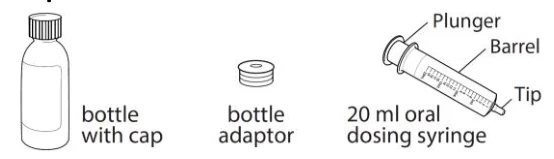 | Not included in the box: | ||||
| |||||
Note: You may need to prepare 2 bottles to give your dose of OJEMDA oral suspension. If 2 bottles are required:
| |||||
| |||||
| Section A: Preparing, measuring, and taking or giving a dose of OJEMDA oral suspension | |||||
| Step 1. Wash and dry your hands before preparing, measuring, and taking or giving a dose of OJEMDA. | |||||
| Step 2. Place your supplies on a clean, flat work surface. | |||||
| Step 3. Fill a cup half-way with room temperature water. Do not use cold water. | 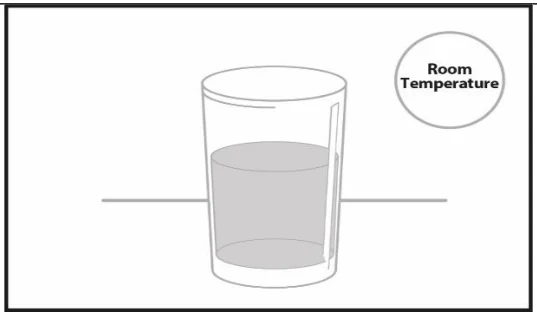 | ||||
Step 4. Remove air from the oral dosing syringe. Pull the plunger up into the oral dosing syringe as far as it will go, and then push the plunger back down into the oral dosing syringe as far as it will go. This will help to remove all the air inside. | 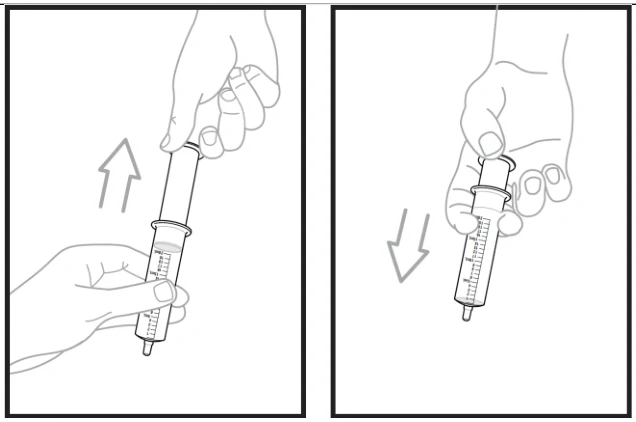 | ||||
Step 5. Place the oral dosing syringe tip in the water. Pull up on the plunger to draw water into the oral dosing syringe to the 14 mL mark. Note: Add exactly 14 ml of water to the bottle with powder. | 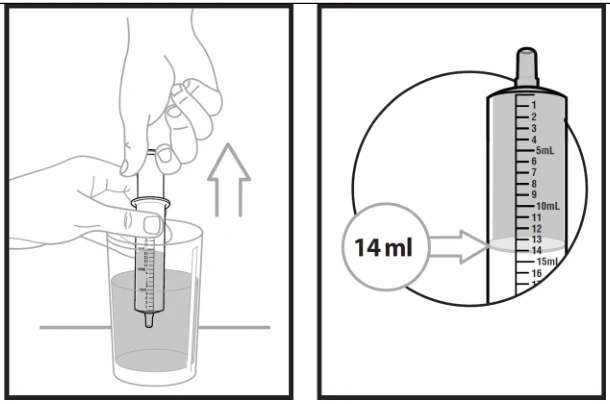 | ||||
Step 6. Remove the oral dosing syringe from the cup. Turn the oral dosing syringe tip upward and check for air bubbles. If large air bubbles appear in the oral dosing syringe, push the water back into the cup and then pull up on the plunger again to draw up the water to the 14 mL mark. Repeat Step 6 until there are no large air bubbles present. Small air bubbles are ok. Set the oral dosing syringe aside. | 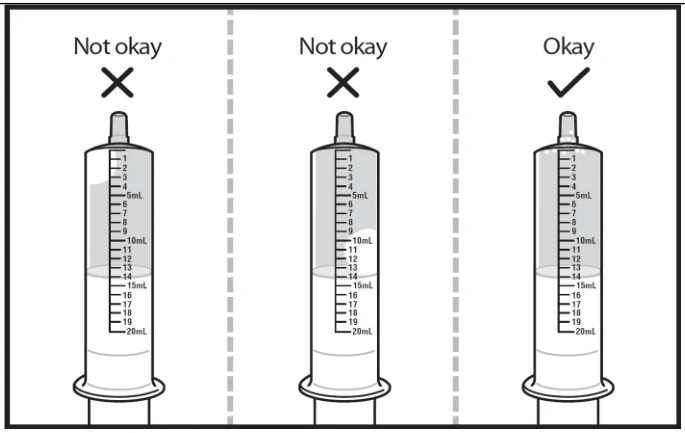 | ||||
Step 7. Open the bottle with powder by pushing down firmly on the cap and turning it to the left (counter-clockwise).
Do not use the bottle with powder if the safety seal under the cap is broken or missing. Call your healthcare professional if the safety seal is broken. | 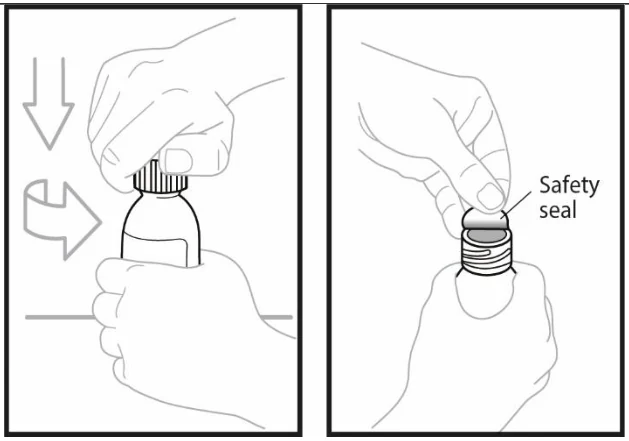 | ||||
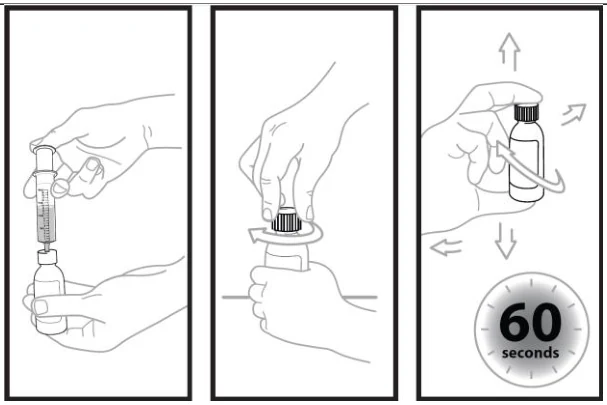
Step 8. Insert the tip of the oral dosing syringe into the opening of the bottle. Push down on the plunger and inject 14 mL of water into the bottle.
|  | ||||
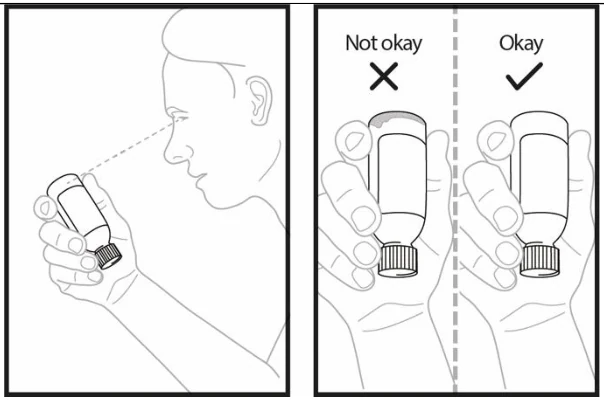
Step 9: Turn bottle upside down to check for any powder stuck to the inside of the bottle.
|  | ||||
Step 10. Turn the bottle upside down again and swirl for 30 seconds.
Note: Foaming in the bottle will reduce the amount of OJEMDA for oral suspension. | 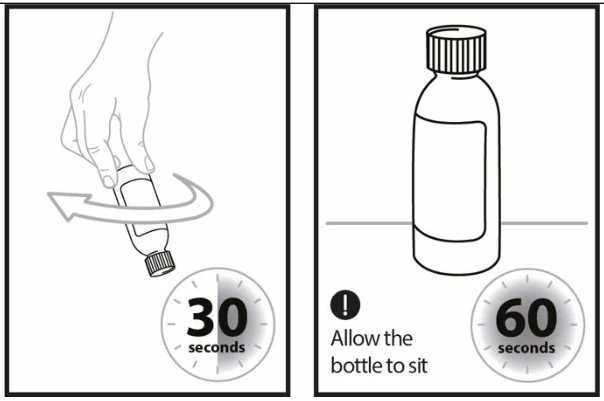 | ||||
Step 11. Open the bottle by firmly pressing down on the cap and turning it to the left (counterclockwise). Do not throw away the cap. Firmly insert the bottle adaptor into the bottle by pushing it tightly into the top of the bottle. The top edge of the bottle adaptor should be even with the bottle top. Do not remove the bottle adaptor after it | |||||
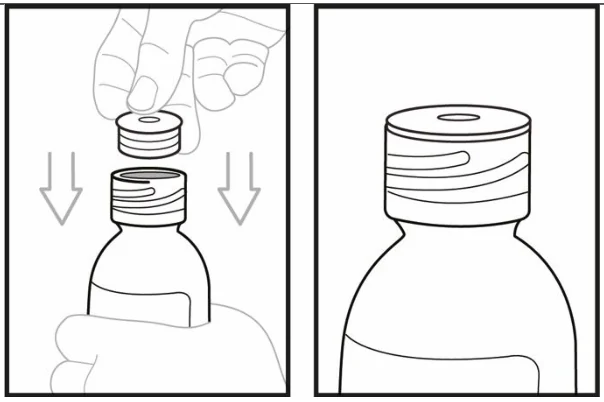 is inserted into the bottle. | |||||
| Step 12. Check your or your child’s dose in milliliters (mL) as prescribed by your healthcare professional. Pick up the oral dosing syringe again. Each mark on the oral dosing syringe is equal to 1 mL. Draw air into the oral dosing syringe by pulling the plunger out to your prescribed dose. For example, if your dose is 12 mL, you would draw the oral dosing syringe by pulling the plunger out to the 12 mL mark. | 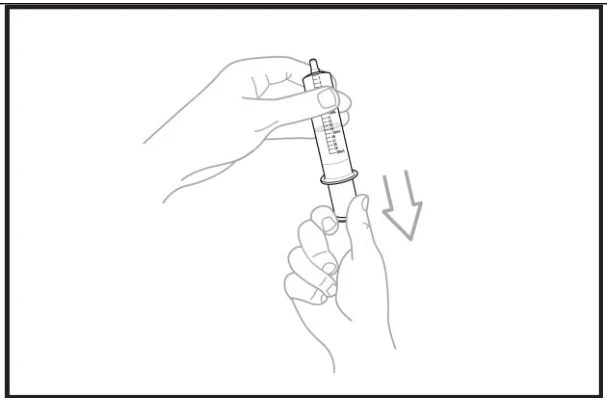 | ||||
Step 13. Insert the tip of the oral dosing syringe into the bottle adaptor.
| 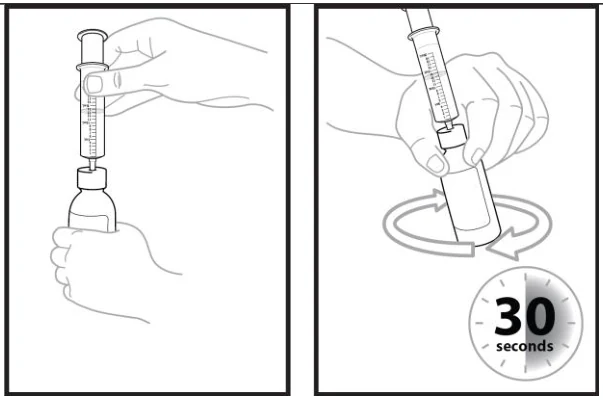 | ||||
| Step 14. Inject the air from the oral dosing syringe into the bottle. Hold the oral dosing syringe in place and turn the bottle upside down. To measure the dose, keep the tip of the oral dosing syringe facing up and pull down on the plunger until the top of the plunger lines up with the prescribed dose in mLs. | 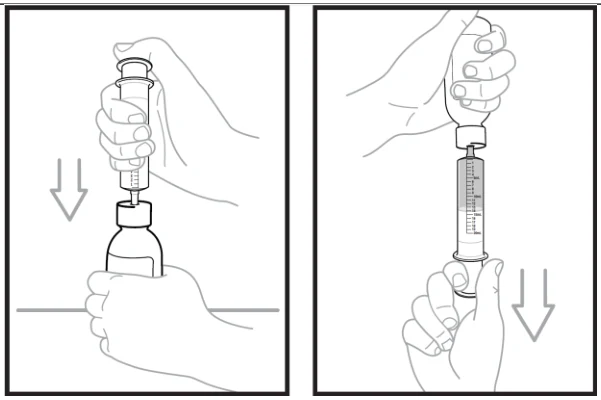 | ||||
Step 15. Remove any air bubbles in the oral dosing syringe:
Repeat Step 15 until you see that few or no air bubbles remain or if you draw up the wrong dose in the oral dosing syringe. Note: If you need 2 bottles: Only use up to 12 mL of OJEMDA from each prepared bottle.
| 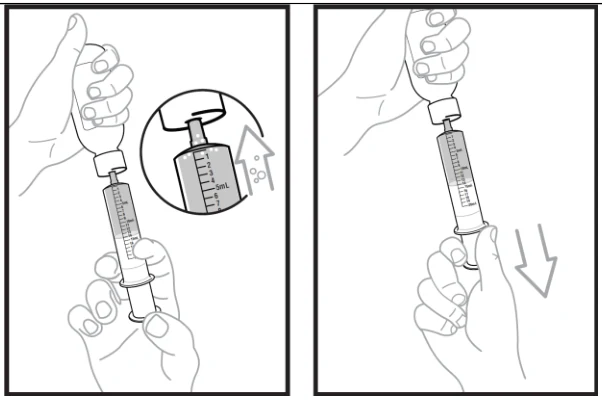 | ||||
Step 16: Leave the tip of the oral dosing syringe in the bottle adaptor and carefully turn the bottle upright. Put the bottle onto your flat work surface again. Slowly remove the oral dosing syringe tip from the bottle adaptor by gently pulling straight up on the barrel of the syringe. Do not hold the oral dosing syringe by the plunger because the plunger may come out. | 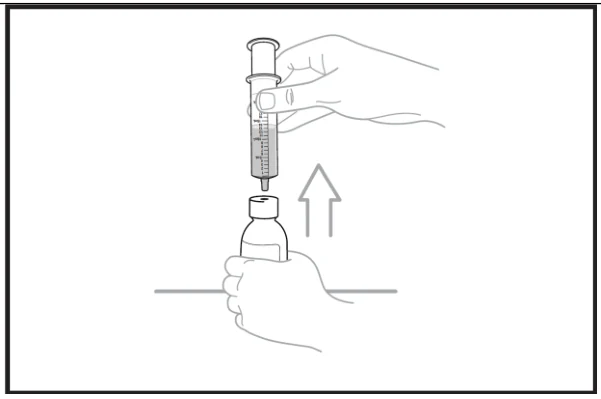 | ||||
Step 17: Check again to be sure the plunger of the oral dosing syringe is at your prescribed mL dose mark on the barrel. If you do not have the correct prescribed mL dose, repeat Steps 15 to 17. If you are taking or giving a dose of OJEMDA by mouth, continue to Step 18. If you are taking or giving a dose of OJEMDA through a feeding tube, go to Section B. OJEMDA oral suspension must be given within 15 minutes after prepared for use. | |||||
Step 18. You or your child should sit upright to take or give a dose of OJEMDA. Place the tip of the oral dosing syringe towards the inside of the cheek in your or your child’s mouth.
| 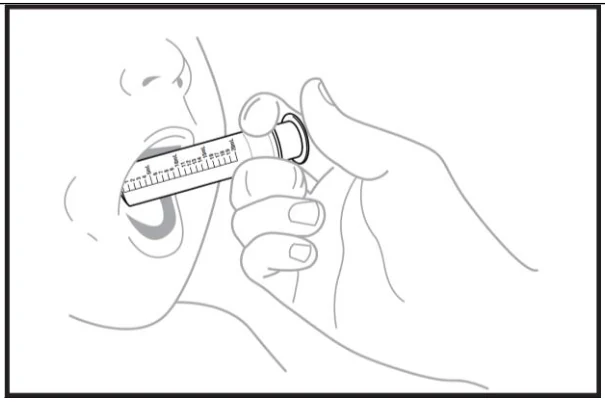 | ||||
| Step 19: See Section C for instructions on “How to throw away used bottles, expired or unused OJEMDA oral suspension, and oral dosing syringes” | |||||
| Section B: Taking or giving a dose of OJEMDA through a feeding tube | |||||
Before giving a dose of OJEMDA through a feeding tube, read the following information and talk to your or your child’s healthcare professional before continuing to STEP 20:
| |||||
| Step 20. Flush the feeding tube according to the manufacturer’s instructions before giving a dose of OJEMDA. | |||||
Step 21: Follow Steps 1 to 11 in Section A to prepare OJEMDA using the 20 mL oral dosing syringe. Follow Steps 12 to 17 in Section A to draw up your or your child’s dose of OJEMDA using the ENFIT syringe and ENFIT adaptor. | |||||
| Step 22: Connect the 20 mL ENFIT syringe containing OJEMDA to the feeding tube. | |||||
| Step 23: Apply steady pressure to the plunger to give the entire dose of OJEMDA through the feeding tube. | |||||
| Step 24: Flush the feeding tube after giving each dose of OJEMDA according to the manufacturer’s instructions. If 2 bottles are required, repeat Step 21 and give the remainder of the dose right away. | |||||
| Step 25: Go to Section C for instructions on “How to throw away used bottles, expired or unused OJEMDA, and oral dosing syringes” | |||||
| Section C: How to throw away used bottles, expired or unused OJEMDA, and oral dosing syringes | |||||
| |||||
| How should I store OJEMDA? | |||||
| |||||