


Product Monograph - Omlyclo
Recent Major Label Changes
| 4 Dosage and Administration, 4.4 Administration, 6 Dosage Forms, Strengths, Composition, and Packaging. | 2026-01 |
|---|
Table of Contents
Certain sections or subsections that are not applicable at the time of the preparation of the most recent authorized product monograph are not listed.
Part 1: Healthcare Professional Information ......................................................................... 4
1 Indications ................................................................................................................. 4
1.1 Pediatrics ............................................................................................................. 4
1.2 Geriatrics ............................................................................................................. 5
2 Contraindications ...................................................................................................... 5
3 Serious Warnings and Precautions Box ..................................................................... 5
4 Dosage and administration ....................................................................................... 5
4.1 Dosing Considerations ......................................................................................... 5
4.2 Recommended Dose and Dosage Adjustment .................................................... 6
4.4 Administration ...................................................................................................... 9
4.5 Missed Dose ...................................................................................................... 10
5 Overdose ................................................................................................................. 10
6 Dosage Forms, Strengths, Composition, and Packaging ........................................... 10
7 Warnings and Precautions ...................................................................................... 12
7.1 Special Populations ........................................................................................... 15
7.1.1 Pregnancy ................................................................................................................ 15
7.1.2 Breast-feeding .......................................................................................................... 16
7.1.3 Pediatrics ................................................................................................................. 16
7.1.4 Geriatrics .................................................................................................................. 16
8 Adverse Reactions ................................................................................................... 17
8.1 Adverse Reaction Overview ............................................................................... 17
8.2 Clinical Trial Adverse Reactions .......................................................................... 18
8.2.1 Clinical Trial Adverse Reactions – Pediatrics ...................................................... 21
8.3 Less Common Clinical Trial Adverse Reactions ................................................... 22
8.5 Post-Market Adverse Reactions ......................................................................... 23
9 Drug Interactions .................................................................................................... 24
9.2 Drug Interactions Overview ............................................................................... 24
9.3 Drug-Behaviour Interactions ............................................................................. 24
9.4 Drug-Drug Interactions ...................................................................................... 24
9.5 Drug-Food Interactions ...................................................................................... 25
9.6 Drug-Herb Interactions ...................................................................................... 25
9.7 Drug-Laboratory Test Interactions ..................................................................... 25
10 Clinical Pharmacology ............................................................................................. 25
10.1 Mechanism of Action ......................................................................................... 26
10.2 Pharmacodynamics ............................................................................................ 27
10.3 Pharmacokinetics ................................................................................................ 27
10.4 Immunogenicity .................................................................................................. 29
11 Storage, Stability, and Disposal ................................................................................ 29
12 Special Handling Instructions .................................................................................. 30
Part 2: Scientific Information .............................................................................................. 31
13 Pharmaceutical Information .................................................................................... 31
14 Clinical Trials ........................................................................................................... 32
14.1 Clinical Trials by Indication ............................................................................... 32
14.1.1 Asthma .............................................................................................................. 32
14.1.2 Chronic Rhinosinusitis with Nasal Polyps (CRSwNP) .......................................... 40
14.1.3 Chronic Idiopathic Urticaria (CIU) ...................................................................... 42
15 Microbiology ........................................................................................................... 46
16 Non-Clinical Toxicology ........................................................................................... 46
17 Supporting Product Monographs ............................................................................ 56
Patient Medication Information ......................................................................................... 57
Part 1: Healthcare Professional Information
Omlyclo® (omalizumab) is a biosimilar biologic drug (biosimilar) to Xolair®(omalizumab). A biosimilar is a biologic drug that was granted authorization based on a demonstration of similarity to a version previously authorized in Canada, known as the reference biologic drug.
1 Indications
Allergic Asthma
OMLYCLO (omalizumab) is indicated for adult and pediatric patients (6 years of age and above) with moderate to severe persistent asthma who have a positive skin test or in vitro reactivity to a perennial aeroallergen and whose symptoms are inadequately controlled with inhaled corticosteroids.
- Adults and adolescents (12 years of age and older): Omalizumab has been shown to significantly decrease the incidence of asthma exacerbations and improve control of asthma symptoms in these patients.
- Children (6 to <12 years of age): Omalizumab, used as add-on therapy, has been shown to significantly decrease asthma exacerbation rates in children who are inadequately controlled and have a documented history of exacerbation.
Chronic Rhinosinusitis with Nasal Polyposis
Omlyclo (omalizumab) is indicated as an add-on maintenance treatment with intranasal corticosteroids in adult patients with severe chronic rhinosinusitis with nasal polyps (CRSwNP) inadequately controlled by intranasal corticosteroids alone.
Chronic Idiopathic Urticaria
Omlyclo (omalizumab) is indicated for the treatment of adults and adolescents (12 years of age and above) with chronic idiopathic urticaria (CIU) who remain symptomatic despite H1 antihistamine treatment.
The safety and efficacy of Omlyclo have not been established in other conditions.
1.1 Pediatrics
Allergic Asthma
Pediatrics (<6 years of age): No data are available to Health Canada; therefore, Health Canada has not authorized an indication for pediatric use. (see 7.1.3 Pediatrics).
Chronic Rhinosinusitis with Nasal Polyposis
Pediatrics (<18 years of age): No data are available to Health Canada; therefore, Health Canada has not authorized an indication for pediatric use. (see 7.1.3 Pediatrics).
Chronic Idiopathic Urticaria
Pediatrics (<12 years of age): No data are available to Health Canada; therefore, Health Canada has not authorized an indication for pediatric use. (see 7.1.3 Pediatrics)
1.2 Geriatrics
Geriatrics (≥65 years): Limited clinical experience is available with Omlyclo in patients aged 65 years and over. (see 7 Warnings and Precautions, 7.1.4 Geriatrics).
2 Contraindications
Omlyclo (omalizumab) should not be administered to patients with known hypersensitivity to omalizumab or any component of the formulation (see 6 Dosage Forms, Strengths, Composition, and Packaging), or patients who have experienced a severe hypersensitivity reaction to Omlyclo (see 7 Warnings and Precautions Anaphylaxis).
3 Serious Warnings and Precautions Box
4 Dosage and administration
4.1 Dosing Considerations
Dosing Considerations for Asthma
Omlyclo (omalizumab) 75 to 375 mg is administered SC every 2 or 4 weeks. See the dose determination charts below for appropriate dose assignment. Doses (mg) and dosing frequency are determined by serum total IgE level (IU/mL), measured before the start of treatment, and body weight (kg). Doses of more than 150 mg are divided among more than one injection site to limit injections to not more than 150 mg per site. Because the solution is slightly viscous, the injection may take 5-10 seconds to administer.
The need for continued therapy should be periodically reassessed based upon the patient’s disease severity and level of asthma control.
Serious Warnings and Precautions
- Anaphylaxis, presenting as angioedema of the throat or tongue, bronchospasm, hypotension, syncope, and/or urticaria has been reported to occur after administration of Omlyclo.
- Anaphylaxis has occurred as early as after the first dose of Omlyclo, but also has occurred beyond 1 year after beginning regularly administered treatment.
- Initiate Omlyclo therapy in a healthcare setting, closely observe patients for an appropriate period of time after Omlyclo administration, and be prepared to manage anaphylaxis which can be life-threatening.
- Patients should also be informed of the signs and symptoms of anaphylaxis and instructed to seek immediate medical care should symptoms occur (see 7 Warnings and Precautions, Information for Patients).
- The selection of patients for self-administration of Omlyclo should be based on criteria to mitigate the risk from anaphylaxis (see 7 Warnings and Precautions, Anaphylaxis).
Dosing Considerations for Chronic Rhinosinusitis with Nasal Polyps (CRSwNP)
The appropriate dose and dosing frequency of Omlyclo for these conditions is determined by baseline immunoglobulin E (IgE) (IU/mL), measured before the start of treatment, and body weight (kg). Prior to initial dosing, patients should have their IgE level determined by any commercial serum total IgE assay for their dose assignment. Based on these measurements 75 to 600 mg of Omlyclo in 1 to 4 injections may be needed for each administration. See Table 4 for a conversion chart and Table 3 for dose determination.
Patients whose baseline IgE levels or body weight in kilograms are outside the limits of the dosing table should not be given Omlyclo. In clinical trials for nasal polyps, changes in nasal polyps score (NPS) and nasal congestion score (NCS) were observed as early as the first assessment at 4 weeks.
Dosing Considerations for Chronic Idiopathic Urticaria
Omlyclo (omalizumab) 150 mg or 300 mg are administered subcutaneously every 4 weeks. The efficacy of Omlyclo in CIU patients is dose dependent (see Part 2, 14 Clinical Trials, 14.1 Study Results, 14.1.3 Chronic Idiopathic Urticaria (CIU)).
Prescribers are advised to periodically reassess the need for continued therapy. Clinical trial experience of long-term treatment beyond 6 months in this indication is limited.
Dosing of Omlyclo in CIU patients is not dependent on serum IgE (free or total) level or body weight.
4.2 Recommended Dose and Dosage Adjustment
Recommended Dose for Asthma Patients
- Adult and adolescent patients 12 years of age and older: Initiate dose according to Table 1.
- Pediatric patients 6 to <12 years of age: initiate dose according to Table 2.
Table 1 - Omlyclo doses (mg) administered by subcutaneous injection every 4 weeks (light-grey area) or 2 weeks (white area) for adult and adolescents 12 years of age and older for allergic asthma
| Body weight (kg) | ||||||||||
|---|---|---|---|---|---|---|---|---|---|---|
| Baseline IgE (IU/mL)* | Dosing Freq. | ≥20–30 | >30–40 | >40–50 | >50–60 | >60–70 | >70–80 | >80–90 | >90-125 | >125–150 |
| ≥30-100 | Every 4 weeks | 150 | 150 | 150 | 150 | 150 | 150 | 150 | 300 | 300 |
| >100–200 | 150 | 150 | 300 | 300 | 300 | 300 | 300 | 225 | 300 | |
| >200–300 | 150 | 300 | 300 | 300 | 225 | 225 | 225 | 300 | 375 | |
| >300–400 | 300 | 300 | 225 | 225 | 225 | 300 | 300 | |||
| >400–500 | 300 | 225 | 225 | 300 | 300 | 375 | 375 | |||
| >500–600 | 300 | 225 | 300 | 300 | 375 | DO NOT DOSE | ||||
| >600–700 | Every 2 weeks | 225 | 225 | 300 | 375 | |||||
*1 IU /mL = 2.4 ng/mL = 2.4 mcg/L
≥30-100 IU/mL = ≥72-240 ng/mL
>100-200 IU/mL = >240-480 ng/mL
>200-300 IU/mL = >480-720 ng/mL
>300-400 IU/mL = >720-960 ng/mL
>400-500 IU/mL = >960-1200 ng/mL
>500-600 IU/mL = >1200-1440 ng/mL
>600-700 IU/mL = >1440-1680 ng/mL
Table 2 - Omlyclo doses (mg) administered by subcutaneous injection every 4 weeks (light-grey area) or 2 weeks (white area) for children 6 to <12 years of age for allergic asthma
| Baseline IgE (IU/mL)* | Dosing Freq. | Body Weight (kg) | |||||||||
|---|---|---|---|---|---|---|---|---|---|---|---|
| 20-25 | >25-30 | >30-40 | >40-50 | >50-60 | >60-70 | >70-80 | >80-90 | >90-125 | >125-150 | ||
| Dose (mg) | |||||||||||
| 30-100 | Every 4 weeks | 75 | 75 | 75 | 150 | 150 | 150 | 150 | 150 | 300 | 300 |
| >100-200 | 150 | 150 | 150 | 300 | 300 | 300 | 300 | 300 | 225 | 300 | |
| >200-300 | 150 | 150 | 225 | 300 | 300 | 225 | 225 | 225 | 300 | 375 | |
| >300-400 | 225 | 225 | 300 | 225 | 225 | 225 | 300 | 300 | |||
| >400-500 | 225 | 300 | 225 | 225 | 300 | 300 | 375 | 375 | |||
| >500-600 | 300 | 300 | 225 | 300 | 300 | 375 | |||||
| >600-700 | 300 | 225 | 225 | 300 | 375 | ||||||
| >700-800 | Every 2 weeks | 225 | 225 | 300 | 375 | ||||||
| >800-900 | 225 | 225 | 300 | 375 | DO | NOT | DOSE | ||||
| >900-1000 | 225 | 300 | 375 | ||||||||
| >1000-1100 | 225 | 300 | 375 | ||||||||
| >1100-1200 | 300 | 300 | |||||||||
| >1200-1300 | 300 | 375 | |||||||||
*1 IU /mL = 2.4 ng/mL = 2.4 mcg/L
≥30-100 IU/mL = ≥72-240 ng/mL
>100-200 IU/mL = >240-480 ng/mL
>200-300 IU/mL = >480-720 ng/mL
>300-400 IU/mL = >720-960 ng/mL
>400-500 IU/mL = >960-1200 ng/mL
>500-600 IU/mL = >1200-1440 ng/mL
>600-700 IU/mL = >1440-1680 ng/mL
>700-800 IU/mL = >1680-1920 ng/mL
>800-900 IU/mL = >1920-2160 ng/mL
>900-1000 IU/mL = >2160-2400 ng/mL
>1000-1100 IU/mL = >2400-2640 ng/mL
>1100-1200 IU/mL = >2640-2880 ng/mL
>1200-1300 IU/mL = >2880-3120 ng/mL
Recommended Dose for Chronic Rhinosinusitis with Nasal Polyps (CRSwNP)
Table 3 - Subcutaneous Omlyclo Doses Every 2 or 4 Weeks* for Adult Patients with CRSwNP
| Pretreatment Serum IgE (IU/mL) | Dosing Freq. | Bodyweight | |||||||||||||||||||
|---|---|---|---|---|---|---|---|---|---|---|---|---|---|---|---|---|---|---|---|---|---|
>30-40 kg | >40-50 kg | >50-60 kg | >60-70 kg | >70-80 kg | >80-90 kg | >90-125 kg | > 125-150 kg | ||||||||||||||
| Dose (mg) | |||||||||||||||||||||
| 30 - 100 | Every 4 Weeks | 75 | 150 | 150 | 150 | 150 | 150 | 300 | 300 | ||||||||||||
| >100 - 200 | 150 | 300 | 300 | 300 | 300 | 300 | 450 | 600 | |||||||||||||
| >200 - 300 | 225 | 300 | 300 | 450 | 450 | 450 | 600 | 375 | |||||||||||||
| >300 - 400 | 300 | 450 | 450 | 450 | 600 | 600 | 450 | 525 | |||||||||||||
| >400 - 500 | 450 | 450 | 600 | 600 | 375 | 375 | 525 | 600 | |||||||||||||
| >500 - 600 | 450 | 600 | 600 | 375 | 450 | 450 | 600 | ||||||||||||||
| >600 - 700 | 450 | 600 | 375 | 450 | 450 | 525 | |||||||||||||||
| >700 - 800 | Every 2 Weeks | 300 | 375 | 450 | 450 | 525 | 600 | ||||||||||||||
| >800 - 900 | 300 | 375 | 450 | 525 | 600 | ||||||||||||||||
| >900 - 1000 | 375 | 450 | 525 | 600 | |||||||||||||||||
| >1000 - 1100 | 375 | 450 | 600 | Insufficient Data to Recommend a Dose | |||||||||||||||||
| >1100 - 1200 | 450 | 525 | 600 | ||||||||||||||||||
| >1200 - 1300 | 450 | 525 | |||||||||||||||||||
| >1300 - 1500 | 525 | 600 | |||||||||||||||||||

The need for continued therapy should be periodically reassessed based upon the patient’s disease severity and level of symptom control.
Dosing Adjustments for Asthma Patients and Chronic Rhinosinusitis with Nasal Polyps (CRSwNP)
Total IgE levels are elevated during treatment and remain elevated for up to one year after the discontinuation of treatment. Therefore, retesting of IgE levels during Omlyclo treatment cannot be used as a guide for dose determination. Dose determination after treatment interruptions lasting less than 1 year should be based on serum IgE levels obtained at the initial dose determination. Total serum IgE levels may be retested for dose determination if treatment with Omlyclo has been interrupted for one year or more.
Doses should be adjusted for significant changes in body weight (See dosing charts under Recommended Dose for Asthma Patients and Recommended Dose for CRSwNP).
Renal or hepatic impairment
There have been no studies on the effect of impaired renal or hepatic function on the pharmacokinetics of Omlyclo. While no particular dose adjustment is recommended, Omlyclo should be administered with caution in these patients (see 7 Warnings and Precautions).
4.4 Administration
Table 4 - Number of Injections and Total Injection Volumes
| Omlyclo solution for injection in 75/150/300a mg pre-filled syringe/ pre-filled pena | ||
|---|---|---|
| Dose (mg) | Number of injections (pre-filled syringes /pens needed) | Total Volume Injected (mL) |
| 75 | 1 x 75 mg | 0.5 |
| 150 | 1 x 150 mg | 1.0 |
| 225 | 1 x 150 mg + 1 x 75 mg | 1.5 |
| 300 | 1 x 300 mg or 2 x 150 mg | 2.0 |
| 375 | 1 x 300 mg + 1 x 75 mg or 2 x 150 mg + 1 x 75 mg | 2.5 |
| 450 | 1 x 300 mg + 1 x 150 mg or 3 x 150 mg | 3.0 |
| 525 | 1 x 300 mg + 1 x 150 mg + 1 x 75 mg or 3 x 150 mg + 1 x 75 mg | 3.5 |
| 600 | 2 x 300 mg or 4 x 150 mg | 4.0 |
a Omlyclo 300 mg pre-filled syringe and all dose strengths of Omlyclo pre-filled pen are not intended for use in patients<12 years of age.
This table presents a number of possible injections for the patients for all indications of Omlyclo, however there are other syringe/pen dosing combinations possible to achieve the desired dose. Dose level should be restricted to those in the Recommended Dose and Dosing Considerations sections for each authorized indication.
Pre-filled syringe and Pre-filled pen
For subcutaneous administration only. Omlyclo must not be administered by the intravenous or intramuscular route.
Omlyclo 300 mg pre-filled syringe and all dose strengths of Omlyclo pre-filled pen are not intended for use in patients <12 years of age. Omlyclo 75 mg pre-filled syringe and Omlyclo 150 mg pre-filled syringe may be used in children 6 to 11 years of age with allergic asthma.
If more than one injection is needed to achieve the required dose, injections should be divided across two or more injection sites (see Table 4).
Patients with no known history of anaphylaxis to either Omlyclo or other agents (e.g. foods, drugs, biologics, etc.) may be considered for self-injection of Omlyclo or for injection by a caregiver from the 4th dose onwards if a healthcare professional determines that this is appropriate (see 7 Warnings and Precautions section). The patient or the caregiver must have been trained in the correct subcutaneous injection technique, the recognition of the early signs and symptoms of serious allergic reactions i.e. anaphylaxis), and be able to treat anaphylactic reactions appropriately.
Patients or caregivers should be instructed to inject the full amount of Omlyclo according to the instructions for use provided in the Instructions for use.
Instructions for use and handling of Omlyclo solution for injection in pre-filled syringe and pre-filled pen
Omlyclo is intended for use under the guidance of a healthcare professional. If determined appropriate by a physician, a patient may self-inject Omlyclo or the patient's caregiver may administer Omlyclo. Provide proper training to patients and/or caregivers on the preparation and administration of Omlyclo prior to use according to the Instructions for Use, in the Patient Medication Information section, and on the recognition of the early signs and symptoms of serious allergic reactions.
4.5 Missed Dose
Patients who miss a dose of Omlyclo should be advised to contact their doctor to find out when to take their next dose of Omlyclo.
5 Overdose
The maximum tolerated dose of Omlyclo has not been determined. Single intravenous doses up to 4000 mg have been administered to patients without evidence of dose-limiting toxicities. The highest cumulative dose administered to patients was 44,000 mg over a 20-week period, which was not associated with toxicities.
6 Dosage Forms, Strengths, Composition, and Packaging
To help ensure the traceability of biologic products healthcare professionals should record both the brand name and the non-proprietary (active ingredient) name as well as other product-specific
For the most recent information in the management of a suspected drug overdose, contact your regional poison control centre or Health Canada’s toll-free number, 1-844 POISON-X (1-844-764-7669).
identifiers such as the Drug Identification Number (DIN) and the batch/lot number of the product supplied.
Table 5 – Dosage Forms, Strengths, Composition and Packaging
| Route of Administration | Dosage Form / Strength | Non-medicinal Ingredients |
|---|---|---|
| subcutaneous | Solution for injection in pre-filled syringe (75 mg/0.5 mL, 150 mg/1.0 mL and 300 mg/ 2.0 mL) Solution for injection in pre-filled pen (75 mg/0.5 mL, 150 mg/1.0 mL and 300 mg/ 2.0 mL) | L-arginine hydrochloride, L-histidine hydrochloride monohydrate, L-histidine, polysorbate 20, water for injection. |
Omlyclo (omalizumab) is supplied as:
Pre-filled syringe (75 mg, 150 mg, and 300 mg): Omlyclo (omalizumab) is a clear to slightly opalescent, colourless to pale brownish-yellow solution in a single use pre-filled glass syringe with staked needle and rigid needle shield. It is administered as a subcutaneous (SC) injection. The packaging includes:
- a syringe barrel, 1 mL long or 2.25 mL, colorless, type I borosilicate glass, with staked 27G special thin wall needle. The interior of the barrel and the outer surface of the needle are siliconized.
- a grey elastomeric plunger stopper, flurotec-coated on the product contact side. The stopper is siliconized.
- an elastomeric needle shield with a polypropylene rigid shield.
Pre-filled pen (75 mg, 150 mg, and 300 mg): Omlyclo (omalizumab) is a clear to slightly opalescent, colourless to pale brownish-yellow solution in a single use pre-filled pen with staked needle and rigid needle shield. It is administered as a subcutaneous (SC) injection. The packaging includes:
- a syringe barrel, 1 mL long or 2.25 mL, colorless, type I borosilicate glass, with staked 27G special thin wall needle. The interior of the barrel and the outer surface of the needle are siliconized.
- a grey elastomeric plunger stopper, flurotec-coated on the product contact side. The stopper is siliconized.
- an elastomeric rigid needle shield with a polypropylene rigid shield.
An Omlyclo (omalizumab solution for injection) 75 mg/0.5 mL pre-filled syringe and pre-filled pen, each contains 75 mg of the active substance, omalizumab, and the following non-medicinal ingredients:
21.065 mg L-arginine hydrochloride, 1.17 mg L-histidine hydrochloride monohydrate, 0.685 mg L-histidine and 0.20 mg polysorbate 20 in 0.5 mL water for injection. It is designed to deliver 75 mg omalizumab, in 0.5 mL.
An Omlyclo (omalizumab solution for injection) 150 mg/1 mL pre-filled syringe and pre-filled pen, each contains 150 mg of the active substance, omalizumab, and the following non-medicinal ingredients: 42.13 mg L-arginine hydrochloride, 2.34 mg L-histidine hydrochloride monohydrate, 1.37 mg L-histidine and 0.40 mg polysorbate 20 in 1 mL water for injection. It is designed to deliver 150 mg omalizumab, in 1 mL.
An Omlyclo (omalizumab solution for injection) 300 mg/2 mL pre-filled syringe and pre-filled pen, each contains 300 mg of the active substance, omalizumab, and the following non-medicinal ingredients: 84.26 mg L-arginine hydrochloride, 4.68 mg L-histidine hydrochloride monohydrate, 2.74 mg L-histidine and 0.80 mg polysorbate 20 in 2 mL water for injection. It is designed to deliver 300 mg omalizumab, in 2 mL.
Omlyclo’s needle cap is free of natural rubber latex or dry natural rubber.
Healthcare professionals should be aware that Omlyclo utilizes a different color-coding system for dose identification compared to Xolair. Please ensure the correct dose is selected based on the specific color coding indicated on the packaging.
7 Warnings and Precautions
See 3 Serious Warnings and Precautions Box.
General
Omalizumab has not been shown to alleviate asthma exacerbations acutely and should not be used for the treatment of acute bronchospasm or status asthmaticus.
Anaphylaxis
Anaphylaxis has been reported to occur after administration of omalizumab in premarketing clinical trials and in postmarketing spontaneous reports (See 8 Adverse Reactions). Signs and symptoms in these reported cases have included angioedema of the throat or tongue, bronchospasm, hypotension, syncope, and/or urticaria. Some of these events have been life-threatening. In premarketing clinical trials the frequency of anaphylaxis attributed to omalizumab use was estimated to be 0.1%. In post-marketing reports, the frequency of anaphylaxis in patients exposed to omalizumab use was estimated to be 0.2% based on a total number of anaphylactic reactions observed from an estimated exposure of over 500,000 patient years. Anaphylaxis and anaphylactoid reactions have been reported following the first or subsequent administrations of omalizumab. Although most of these reactions occurred within 2 hours, some occurred beyond 2 hours. Anaphylaxis has occurred as early as after the first dose of omalizumab, but also has occurred beyond one year after beginning regularly scheduled treatment.
Approximately 60-70% of anaphylactic reactions occurred within the first 3 doses of omalizumab. Therefore, the first 3 doses should be administered either by or under the supervision of a healthcare professional. A history of anaphylaxis unrelated to omalizumab is a risk factor for anaphylaxis following omalizumab administration. Therefore, for patients with a known history of anaphylaxis, omalizumab should be administered by a health care professional, who should have medications for the treatment of anaphylactic reactions available for immediate use following administration of omalizumab. When administered in the healthcare setting, patients should be closely observed for an appropriate period of time after administration of omalizumab, taking into account the time to onset of anaphylaxis seen in premarketing clinical trials and postmarketing spontaneous reports (See 8 Adverse Reactions). Patients should be informed of the signs and symptoms of anaphylaxis, and instructed to seek immediate medical care should signs or symptoms occur (see Information for Patients). Detailed information pertaining to the potential selection of patients for omalizumab dosing outside of the healthcare setting by either the patient or their caregiver is included above (see 4 Dosage and Administration, 4.4 Administration).
Omalizumab should be discontinued in patients who experience a severe hypersensitivity reaction (see 2 Contraindications).
Corticosteroid Reduction
Systemic or inhaled corticosteroids should not be abruptly discontinued upon initiation of omalizumab therapy in allergic asthma or chronic rhinosinusitis with nasal polyps (CRSwNP). Decreases in corticosteroids should be performed under the direct supervision of a physician and may need to be performed gradually.
Information for Patients
Patients should be advised of the risk of life-threatening anaphylaxis with omalizumab and that there have been reports of anaphylaxis up to 4 days after administration of omalizumab. Omalizumab should only be initiated in a healthcare setting by healthcare providers. Patients should be closely observed following its administration. Patients should be informed of the signs and symptoms of anaphylaxis. Patients should be instructed to seek immediate medical care should such signs or symptoms occur (see 7 Warnings and Precautions, Anaphylaxis).
Asthma patients receiving omalizumab should be instructed not to decrease the dose of or stop taking any other asthma medications unless otherwise instructed by their physician. Asthma patients should be told that they may not see immediate improvement in their asthma after beginning omalizumab therapy.
Other IgE-Associated disorders
Omalizumab has not been studied in patients with hyperimmunoglobulin E syndrome, allergic bronchopulmonary aspergillosis, or for the prevention of anaphylactic reactions. Omalizumab has not been adequately studied in food allergy, atopic dermatitis, allergic rhinitis, or parasitic infestations.
Cardiovascular
Cardiovascular and Cerebrovascular disorders
In controlled clinical trials in adults and adolescents 12 years of age and older, cerebrovascular events including transient ischaemic attack and ischaemic stroke were observed in patients treated with omalizumab. (See 8 Adverse Reactions).
In a 5 year observational study of adults and adolescents, a disproportionate increase of overall cardiovascular and cerebrovascular disorders was observed in the omalizumab cohort compared to the non- omalizumab cohort (See 8 Adverse Reactions).
Driving and Operating Machinery
While taking Omlyclo, patients should be cautioned not to drive, operate dangerous machinery or engage in activities that require alertness or physical coordination if they are experiencing any dizziness, fatigue, syncope or somnolence.
Hepatic/Biliary/Pancreatic
Omalizumab therapy has not been studied in patients with pre-existing hepatic impairment. Caution should be exercised when administering omalizumab in these patient populations.
Immune
Churg-Strauss syndrome and hypereosinophilic syndrome
Patients with severe asthma may rarely present systemic hypereosinophilic syndrome or allergic eosinophilic granulomatous vasculitis (Churg-Strauss syndrome), both of which are usually treated with systemic corticosteroids. In rare cases, patients on therapy with anti-asthma agents, including omalizumab, may present or develop systemic eosinophilia and vasculitis. These events are commonly associated with the reduction of oral corticosteroid therapy. In these patients, physicians should be alert to the development of marked eosinophilia, vasculitic rash, worsening pulmonary symptoms, paranasal sinus abnormalities, cardiac complications, and/or neuropathy.
Immunogenicity
As with all DNA derived humanized monoclonal antibodies patients may rarely develop antibodies to omalizumab (See 8 Adverse Reactions).
Discontinuation of omalizumab should be considered in all severe cases of Churg-Strauss syndrome, hypereosinophilic syndrome and serum sickness.
Serum sickness
Serum sickness and serum sickness-like reactions, which are delayed allergic type III reactions, have rarely been seen in patients treated with humanized monoclonal antibodies including omalizumab. The onset has typically been 1 to 5 days after administration of the first or subsequent injections, also after long duration of treatment. Symptoms suggestive of serum sickness include arthritis/arthralgia, rash (urticaria or other forms), fever and lymphadenopathy. Antihistamines and corticosteroids may be useful for preventing or treating this disorder, and patients should be advised to report any suspected symptoms.
Parasitic (helminth) infections
IgE may be involved in the immunological response to some helminth infections. In patients at chronic high risk of helminth infection, a placebo-controlled trial in asthma/perennial allergic rhinitis patients showed a slight increase in infection rate with omalizumab, although the course, severity, and response to treatment of infection were unaltered. The helminth infection rate in the overall clinical program, which was not designed to detect such infections, was less than 1 in 1,000 patients. However, caution may be warranted in patients at high risk of helminth infection, in particular when travelling to areas where helminthic infections are endemic. If patients do not respond to the recommended anti-helminth treatment, discontinuation of omalizumab should be considered.
Monitoring and Laboratory Tests
Serum total IgE levels increase following administration of omalizumab due to formation of omalizumab:IgE complexes (See 10 Clinical Pharmacology and 4 Dosage and administration). Elevated serum total IgE levels may persist for up to 1 year following discontinuation of omalizumab. Serum total IgE levels obtained less than 1 year following discontinuation may not reflect steady state free IgE levels and should not be used to reassess the dosing regimen in asthma patients.
Renal
Omalizumab therapy has not been studied in patients with pre-existing renal impairment. Caution should be exercised when administering omalizumab in these patient populations.
Reproductive Health
Fertility
There are no human fertility data for omalizumab. In specifically-designed non clinical fertility studies in adult cynomolgus monkeys, including mating studies, no impairment of male or female fertility was observed following repeated dosing with omalizumab at dose levels up to 75 mg/kg. (See 2 Contraindications, 7.1.1 Pregnancy, 10.3 Pharmacokinetics, 16 Non-clinical Toxicology)
7.1 Special Populations
7.1.1 Pregnancy
There are no well-controlled clinical studies of omalizumab in pregnant women. A prospective pregnancy registry study (EXPECT) conducted in the US from 2006 to 2018, included 250 pregnant women with asthma treated with omalizumab. 246 of the women were exposed to omalizumab in the first trimester of pregnancy and 78.4% (196/250) of the women were exposed to omalizumab at least once during all 3 trimesters of pregnancy with an overall median exposure duration of 8.7 months. The EXPECT findings for relevant mother and infant subgroups were compared to age-adjusted frequencies in a disease matched external cohort of 1,153 pregnant women with moderate and severe asthma (without exposure to omalizumab) identified from healthcare databases of Quebec, and termed the Quebec External Comparator Cohort (QECC). Among EXPECT infants used for comparison to QECC (n=223), the prevalence of major congenital anomalies (8.1%) was similar to that for QECC infants (8.9%). There was an increased rate of low birth weight among registry infants compared to infants in the other cohort. This study cannot definitively establish the absence of increased risks, because of methodological limitations, including small sample size, a nonrandomized study design and differences between the registry population and the comparator group.
IgG molecules are known to cross the placental barrier. Reproduction studies in cynomolgus monkeys have been conducted with omalizumab. Subcutaneous doses up to 75 mg/kg per week (approximately 10-fold the highest recommended clinical dose in mg/kg over a 4-week period) of Omalizumab did not elicit maternal toxicity, embryotoxicity, or teratogenicity when administered throughout organogenesis and did not elicit adverse effects on fetal or neonatal growth when administered throughout late gestation, delivery, and nursing.
As the EXPECT study cannot definitively establish the absence of increased risks and animal reproduction studies are not always predictive of human response, omalizumab should be used during pregnancy only if clearly needed.
7.1.2 Breast-feeding
While omalizumab presence in human milk has not been studied, IgGs are present in human milk and therefore it is expected that omalizumab will be present in human milk. The majority of infants (77.5%, 186/240) in the EXPECT pregnancy exposure registry were breastfed. Serious adverse events categorized as “infections and infestations” were not increased in infants who were exposed to omalizumab through breastfeeding compared with infants who were not breastfed, or infants who were breastfed without exposure to omalizumab. The interpretation of data may be impacted due to methodological limitations of the study, including small sample size and nonrandomized design. The potential for omalizumab absorption or harm to the infant are unknown; caution should be exercised when administering omalizumab to a nursing woman.
The excretion of omalizumab in milk was evaluated in female cynomolgus monkeys receiving SC doses of 75 mg/kg/week. Neonatal serum levels of omalizumab after in utero exposure and 28 days of nursing were between 11% and 94% of the maternal serum level. Milk levels of omalizumab were 0.15% of the maternal serum concentration.
Although no clinically significant effects on platelets have been observed in patients, doses of omalizumab in excess of the clinical dose have been associated with age-dependent decreases in blood platelets in non-human primates, with a greater relative sensitivity in juvenile animals. In reproduction studies in cynomolgus monkeys, there was no clinical evidence of thrombocytopenia in neonatal monkeys from mothers treated up to 75 mg/kg omalizumab; however, platelet counts were not measured in these offspring.
7.1.3 Pediatrics
Asthma
Safety and efficacy of omalizumab for asthma were evaluated in 2 trials in 926 (omalizumab 624; placebo 302) pediatric patients 6 to <12 years of age with moderate to severe persistent asthma who had a positive skin test or in vitro reactivity to a perennial aeroallergen. One trial was a pivotal trial of similar design and conduct to that of adult and adolescent Asthma Trials 1 and 2. The other trial was primarily a safety study and included evaluation of efficacy as a secondary outcome (See 8 Adverse Reactions and 14 Clinical Trials).
The safety and efficacy of omalizumab in children below the age of 6 have not been established and use of omalizumab in such patients is therefore not recommended.
Chronic Rhinosinusitis with Nasal Polyps (CRSwNP)
In CRSwNP, safety and efficacy in patients below the age of 18 years have not been established.
Chronic Idiopathic Urticaria (CIU)
The safety and efficacy of omalizumab in children below the age of 12 have not been established and use of omalizumab in such patients is therefore not recommended.
7.1.4 Geriatrics
In Phase III clinical trials, 145 asthma patients and 37 CIU patients, 65 years of age or older were treated with omalizumab. Although there were no apparent age-related differences observed in these studies, the number of patients aged 65 and over is not sufficient to determine whether they respond differently from younger patients.
8 Adverse Reactions
8.1 Adverse Reaction Overview
Asthma
The adverse reactions most commonly observed among patients treated with omalizumab in pre- marketing clinical studies included injection site reaction (45%), viral infections (24%), upper respiratory tract infection (19%), sinusitis (16%), headache (15%), and pharyngitis (10%). These events were observed at similar rates in omalizumab-treated patients and control patients.
The occurrence of adverse events resulting in clinical intervention (e.g. discontinuation of omalizumab, or the need for concomitant medication to treat an adverse reaction) was extremely small; 0.1 % or less.
The data described above reflect omalizumab exposure for 2285 adult and adolescent patients ages 12 and older, including 1891 patients exposed for six months and 555 exposed for one year or more, in either placebo- controlled or other controlled asthma studies. The mean age of patients receiving omalizumab was 41 years, 59% were women, and 86% Caucasian. Patients received omalizumab 150 to 375 mg every 2 or 4 weeks or, for patients assigned to control groups, standard therapy with or without a placebo.
The frequency of adverse events was comparable between the omalizumab and placebo groups (85.1% vs. 84.0%, respectively). The majority of these adverse events were regarded as mild or moderate in intensity. Treatment discontinuation due to an adverse event occurred more frequently in the placebo group compared with the omalizumab-treated group (1.4% vs. 0.5%, respectively).
The table below shows adverse events that occurred ≥ 1% more frequently in adult and adolescent patients 12 years of age and older receiving omalizumab than in those receiving placebo in the placebo controlled asthma studies. Adverse events were classified using preferred terms from the International Medical Nomenclature (IMN) dictionary. Injection site reactions were recorded separately from the reporting of other adverse events and are described following the table.
Chronic Idiopathic Urticaria (CIU)
The safety and tolerability of omalizumab were investigated with the doses of 75 mg, 150 mg and 300 mg every four weeks in 975 CIU patients, 242 of whom received placebo. 733 patients were treated with omalizumab for up to 12 weeks and 490 patients for up to 24 weeks. 175 and 412 patients were treated for up to 12 weeks and 87 and 333 patients were treated for up to 24 weeks at the recommended doses of 150 mg and 300 mg respectively.
During clinical studies with adult and adolescent patients (12 years of age and older) the most commonly reported adverse reactions observed were headache and nasopharyngitis.
8.2 Clinical Trial Adverse Reactions
Clinical trials are conducted under very specific conditions. The adverse reaction rates observed in the clinical trials; therefore, may not reflect the rates observed in practice and should not be compared to the rates in the clinical trials of another drug. Adverse reaction information from clinical trials may be useful in identifying and approximating rates of adverse drug reactions in real-world use.
Asthma
Table 6 - All Adverse Events Occurring ≥ 1% More Frequently in omalizumab Treated Asthma Patients 12 to 75 years of Age Compared with Placebo, Regardless of Causality Assessment.
| Adverse Event | Omalizumab N = [947] n (%) | Placebo N = [913] n (%) |
|---|---|---|
| Any Adverse Event | 806 (85.1) | 767 (84.0) |
| Body as a whole | ||
| Pain |
| 40 (4.4) |
| Musculoskeletal system | ||
| Fracture | 20 (2.1) | 10 (1.1) |
| Leg pain | 26 (2.7) | 14 (1.5) |
| Nervous system | ||
| Dizziness | 24 (2.5) | 15 (1.5) |
Injection Site Reactions
In the adult and adolescent (≥12 years of age) population, injection site reactions of any severity occurred at a rate of 45% in omalizumab-treated patients compared with 43% in placebo-treated patients. The types of injection site reactions included: bruising, redness, warmth, burning, stinging, itching, hive formation, pain, indurations, mass, and inflammation. Most were regarded as mild or moderate in intensity and did not require discontinuation of therapy. Severe injection site reactions occurred more frequently in omalizumab treated patients compared with patients in the placebo group (12% versus 9%).
The majority of injection site reactions occurred within 1 hour post injection, lasted less than 8 days, and generally decreased in frequency at subsequent dosing visits.
Chronic Rhinosinusitis with Nasal Polyps (CRSwNP)
The data described below reflect pooled data from two placebo-controlled studies in patients ≥18 years of age (see 14 Clinical Trials for design and patient characteristics). In these studies, patients received omalizumab 150 to 600 mg every 2 or 4 weeks according to the recommended dosing presented in Table 5, Recommended Dose for CRSwNP, or placebo. All patients received background intranasal mometasone therapy.
The pooled placebo-controlled trials included 135 patients treated with omalizumab and 130 treated with placebo for up to 24 weeks. In this safety pool, there were 50.4% of omalizumab and 58.5% of placebo patients that experienced adverse events, and 2.2% of omalizumab and 1.5% of placebo patients that experienced serious adverse events. No omalizumab-treated patients discontinued due to adverse events.
The most frequently (≥1 %) reported adverse events, which were higher in frequency in comparison to placebo are shown in Table 7.
Table 7 – Adverse events occurring in ≥1% of omalizumab-treated patients and occurring more commonly than placebo-treated patients in the 24-week pooled Phase 3 trials
Adverse event (by MedDRA preferred term) | Nasal polyp studies POLYP 1 and POLYP 2 | |
|---|---|---|
Placebo N=130 | Omalizumab N =135 | |
| Gastrointestinal disorder | ||
| Abdominal pain upper | 1 (0.8%) | 4 (3.0%) |
| Irritable bowel syndrome | 0 | 2 (1.5%) |
| General disorders and administration site conditions | ||
Injection site reactions (Injection site reactions, Injection related reaction, injection site pain) | 2 (1.5%) | 7 (5.2%) |
| Influenza-like illness | 1 (0.8%) | 2 (1.5%) |
| Infections and infestations | ||
| Sinusitis | 3 (2.3%) | 4 (3.0%) |
| Influenza | 0 | 3 (2.2%) |
| Pharyngitis | 0 | 2 (1.5%) |
| Nervous system disorders | ||
| Headache | 7 (5.4%) | 11 (8.1%) |
| Dizziness | 1 (0.8%) | 4 (3.0%) |
| Musculoskeletal and connective tissue disorders | ||
| Arthralgia | 2 (1.5%) | 4 (3.0%) |
| Respiratory, thoracic and mediastinal disorders | ||
| Cough | 1 (0.8%) | 3 (2.2%) |
| Skin and subcutaneous tissue disorders | ||
| Dermatitis allergic | 0 | 2 (1.5%) |
| Dermatitis contact | 0 | 2 (1.5%) |
| Vascular disorders | ||
| Hypertension | 0 | 2 (1.5%) |
| Psychiatric disorders | ||
| Insomnia | 0 | 2 (1.5%) |
Chronic Idiopathic Urticaria (CIU)
Adverse reactions (events occurring in ≥1% of patients in any treatment group and ≥2% more frequently in any omalizumab treatment group than in the placebo group after medical review) reported at the 150 mg and 300mg doses in the three pooled Phase III studies are listed by MedDRA system organ class (Table 8). Within each system organ class, the adverse reactions are ranked by frequency, with the most frequent reactions listed first.
Table 8- All Adverse Events Occurring ≥ 1% More Frequently in omalizumab-Treated CIU Patients 12 to 75 years of Age Compared with Placebo, Regardless of Causality Assessment between Day 1 and Week 12 in either omalizumab 150 mg or 300 mg
Adverse Reactions
| (By MedDRA Preferred Term) | Omalizumab Asteria I, Asteria II and Glacial Studies Pooled | ||
|---|---|---|---|
Omalizumab 150 mg (N=175) | Omalizumab 300 mg (N=412) | Placebo (N=242) | |
| Ear and labyrinth disorders | |||
| Vertigo | 2 (1.14%) | 1 (0.24%) | 2(0.83%) |
| Gastrointestinal disorders | |||
| Diarrhea | 2 (1.14%) | 12 (2.91%) | 7 (2.89%) |
| Nausea | 2 (1.14%) | 11 (2.67%) | 6 (2.48%) |
| Abdominal Pain Upper | 2 (1.14%) | 2 (0.49%) | 2 (0.83%) |
| Flatulence | 2 (1.14%) | 2 (0.49%) | 0 (0.00%) |
| Toothache | 2 (1.14%) | 2 (0.49%) | 1 (0.41%) |
| Abdominal Pain | 3 (1.71%) | 1 (0.24%) | 4 (1.65%) |
| General disorders and administration site conditions | |||
| Fatigue | 0 (0.00%) | 7 (1.70%) | 3 (1.24%) |
| Oedema Peripheral | 3 (1.71%) | 4 (0.97%) | 1 (0.41%) |
| Influenza Like Illness | 2 (1.14%) | 1 (0.24%) | 0 (0.00%) |
| Infections and infestations | |||
| Nasopharyngitis | 16 (9.14%) | 27 (6.55%) | 17 (7.02%) |
| Sinusitis | 2 (1.14%) | 20 (4.85%) | 5 (2.07%) |
| Upper Respiratory Tract Infection | 2 (1.14%) | 14 (3.40%) | 5 (2.07%) |
| Urinary Tract Infection | 3 (1.71%) | 6 (1.46%) | 1 (0.41%) |
| Viral Upper Respiratory Tract Infection | 4 (2.29%) | 2 (0.49%) | 0 (0.00%) |
| Fungal Infection | 3 (1.71%) | 2 (0.49%) | 1 (0.41%) |
| Pharyngitis | 2 (1.14%) | 1 (0.24%) | 0 (0.00%) |
| Musculoskeletal and connective tissue disorders | |||
| Arthralgia | 5 (2.86%) | 12 (2.91%) | 1 (0.41%) |
| Pain In Extremity | 3 (1.71%) | 4 (0.97%) | 1 (0.41%) |
| Musculoskeletal Pain | 3 (1.71%) | 0 (0.00%) | 1 (0.41%) |
| Bursitis | 2 (1.14%) | 0 (0.00%) | 0 (0.00%) |
| Nervous system disorders | |||
| Headache | 21 (12.00%) | 25 (6.07%) | 7 (2.89%) |
| Presyncope | 2 (1.14%) | 3 (0.73%) | 0 (0.00%) |
| Respiratory, thoracic and mediastinal disorders | |||
| Cough | 2 (1.14%) | 9 (2.18%) | 3 (1.24%) |
| Asthma | 1 (0.57%) | 5 (1.21%) | 1 (0.41%) |
| Nasal Congestion | 2 (1.14%) | 3 (0.73%) | 2 (0.83%) |
| Oropharyngeal Pain | 3 (1.71%) | 2 (0.49%) | 4 (1.65%) |
| Skin and subcutaneous tissue disorders | |||
| Alopecia | 1 (0.57%) | 6 (1.46%) | 2 (0.83%) |
| Eczema | 2 (1.14%) | 4 (0.97%) | 2 (0.83%) |
| Dry Skin | 2 (1.14%) | 0 (0.00%) | 0 (0.00%) |
| Vascular disorders | |||
| Hypertension | 2 (1.14%) | 2 (0.49%) | 1 (0.41%) |
Additional events reported anytime during the day 1 to week 24 treatment period (ASTERIA I and GLACIAL studies) that met the criteria of adverse reactions:
Musculoskeletal and connective tissue disorders: myalgia (placebo 0%, 150 mg 2.3%, 300 mg 0.9%).
General disorders and administration site conditions: pyrexia (placebo 1.2%, 150 mg 3.4%, 300 mg 0.9%).
Injection site reactions: Injection site reactions occurred during the studies in more omalizumab- treated patients than placebo patients (2.7% at 300 mg, 0.6% at 150 mg, 0.8% with placebo). These included: swelling, erythema, pain, bruising, itching, bleeding and urticaria.
8.2.1 Clinical Trial Adverse Reactions – Pediatrics
Adverse Reactions from Clinical Studies in Pediatric Patients 6 to <12 Years of Age with Asthma
The incidence of adverse reactions in pediatric patients 6 to <12 years of age is based on 2 double-blind, placebo-controlled studies in asthma. Of the 926 pediatric patients evaluated, 624 received omalizumab (583 pediatric patients exposed for six months and 292 exposed for one year or more). The mean age of pediatric patients receiving omalizumab was 8.8 years; 69% were male, and 64% were Caucasian. Pediatric patients received omalizumab 75 mg to 375 mg every 2 or 4 weeks, or for patients assigned to control groups, standard therapy with or without a placebo. The frequency of adverse events in the omalizumab and placebo groups was 89.7% vs 91.7%, respectively. The most common adverse reactions occurring at ≥3% in the pediatric patients receiving omalizumab and more frequently than in patients treated with placebo were nasopharyngitis (23.6% vs 23.2%), headache (20.7% vs 19.5%), pyrexia (15.1% vs 11.3%), upper abdominal pain (6.3% vs 5.0%), pharyngitis streptococcal (6.1% vs 5.3%), otitis media (5.8% vs 5.3%), viral gastroenteritis (3.8% vs 2.3%), epistaxis (3.4% vs 3.3%) and arthropod bite (3.2% vs 0.7%). Other adverse events that were reported less frequently, but at least ≥1% more frequently in the omalizumab-treated patients compared to placebo include stomach discomfort (2.2% vs 1%), gastritis (1.6% vs 0%), eczema (1.8% vs 0.7%) and herpes zoster (1% vs 0%). There were 3 patients (0.5%) who discontinued omalizumab due to adverse events (1 event each of bronchitis, headache and urticaria).
8.3 Less Common Clinical Trial Adverse Reactions
Allergic Events
As with any protein, local or systemic allergic reactions can occur (See 7 Warnings and Precautions). Anti-therapeutic antibody development and allergic symptoms, including urticaria, dermatitis, and pruritus were observed in patients treated with omalizumab. In the adult and adolescent (≥12 years of age) population, there were 3 cases out of 3854 (0.08%) of anaphylaxis observed within 2 hours of omalizumab administration in which there were no other identifiable allergic triggers. Anaphylaxis occurred with the first dose of omalizumab in two patients, and with the fourth dose in one patient. The time to onset of anaphylaxis was 90 minutes after administration in two patients and 2 hours after administration in one patient. These events included urticaria and throat and/or tongue edema. Anaphylaxis/anaphylactoid reaction was reported in 1 of 2215 (0.05%) control patients.
Immunogenicity
In clinical studies of adult and adolescent patients (≥12 years of age), antibodies to omalizumab were detected in 1 out of 1723 patients. In three clinical studies of pediatric patients 6 to <12 years of age, antibodies to omalizumab were detected in 1 out of 581 patients.
Cardiovascular and Cerebrovascular events
During interim analysis of an observational study in adolescent and adult patients, an imbalance of cardiovascular and cerebrovascular serious adverse events was observed in the omalizumab group compared to the non-omalizumab group. The final analysis of the results of the observational study showed the rate of cardiovascular and cerebrovascular events per 1000 patient years was 17.34 (265/15286 patient years) for omalizumab-treated patients and 11.44 (114/9963) for control patients. The Cox proportional hazards models adjusting for confounders and risk factors resulted in a hazard ratio of 1.62 (95% [1.23-2.13]). Cardiovascular and cerebrovascular events in which increases in rates were observed include myocardial infarction, unstable angina, transient ischemic attack, pulmonary embolism, and venous thrombosis.
The rate of arterial thromboembolic events (ATEs) in the observational study per 1000 patient years was 7.52 (115/15286 patients years) for omalizumab-treated patients and 5.12 (51/9963 patient years) for control patients. The Cox proportional hazards models adjusting for confounders and risk factors resulted in a hazard ratio of 1.32 (95%, [0.91, 1.91]). In a separate analysis of randomized, double-blind, placebo- controlled clinical trials of 8 or more weeks duration in adolescent and adult patients, including 3342 patients on omalizumab and 2895 patients on placebo, the rate of ATE per 1000 patient years was 2.69 (5/1856 patients years) for omalizumab-treated patients and 2.38 (4/1680 patient years) for placebo patients (rate ratio 1.13, 95%, [0.24-5.71]). The observed incidence rate of arterial thromboembolic events in the omalizumab controlled clinical trials was comparable to that reported in the general asthma population.
Malignancies
During initial clinical trials for adults and adolescents 12 years of age and older, there was a numerical imbalance in malignancies arising in the active treatment group, compared with the control group. The number of observed cases was uncommon (<1/100) in both the active and the control group. Malignant neoplasms were observed in 25 of 5015 (0.5%) omalizumab-treated patients compared with 5 of 2854 (0.2%) control patients in clinical studies of asthma and other allergic disorders. The observed malignancies in omalizumab-treated patients were a variety of types, with breast, non-melanoma skin, prostate, melanoma, and parotid occurring more than once, and five other types occurring once each. The diversity in the type of cancers observed, the relatively short duration of exposure and the clinical features of the individual cases render a causal relationship unlikely.
In a subsequent observational study comparing 5007 omalizumab-treated and 2829 non-omalizumab-treated adolescent and adult patients followed for up to 5 years, the incidence rates of primary malignancies per 1000 patient years were 16.01 (295/18426 patient years) and 19.07 (190/9963 patients years), respectively, which does not indicate an increased malignancy risk (rate ratio 0.84, 95% confidence interval, 0.62-1.13).
In a further analysis of randomized, double-blind, placebo-controlled clinical trials in adolescent and adult patients, including 4254 patients on omalizumab and 3178 patients on placebo, omalizumab treatment was not associated with an increased malignancy risk based on incidence rates per 1000 patient years of 4.14 (14/3382 patient years) for omalizumab treated patients and 4.45 (11/2474 patient years) for placebo patients (rate ratio 0.93, 95%, [0.39-2.27]). The overall observed incidence rate of malignancy in the omalizumab clinical trial program was comparable to that reported in the general population. The impact of longer exposure to omalizumab or use in patients at higher risk for malignancy (elderly, current smokers) is unknown.
8.5 Post-Market Adverse Reactions
The following reactions have been identified through spontaneous reportings in asthma patients.
Immune system disorders: Anaphylaxis and anaphylactoid reactions have uncommonly been reported following the first or subsequent administrations; serum sickness has been rarely reported.
Anaphylaxis: In post-marketing reports, the frequency of anaphylaxis in patients exposed to omalizumab use was estimated to be 0.2% based on a total number of anaphylactic reactions observed from an estimated exposure of over 500,000 patient years. Diagnostic criteria of anaphylaxis were skin or mucosal tissue involvement, and, either airway compromise, and/or reduced blood pressure with or without associated symptoms, and a temporal relationship to omalizumab administration with no other identifiable cause. Signs and symptoms in these reported cases included angioedema of the throat or tongue, bronchospasm, chest tightness, cough, cutaneous angioedema, dyspnea, hypotension, syncope, and/or urticaria. Pulmonary involvement was reported in 89% of the cases. Hypotension or syncope was reported in 14% of cases. A previous history of anaphylaxis unrelated to omalizumab was reported in 24% of the cases. A history of anaphylaxis unrelated to omalizumab may be a risk factor for anaphylaxis following omalizumab administration.
Of the reported cases of anaphylaxis attributed to omalizumab, 39% occurred with the first dose, 19% occurred with the second dose, 10% occurred after the third dose, and the rest after subsequent doses. One case occurred after 39 doses (after 19 months of continuous therapy followed by a 3 month gap, anaphylaxis occurred upon restarting). The time to onset of anaphylaxis in these cases was 30 minutes or less in 35%, 30 to less than 60 minutes in 16%, 60 to less than 90 minutes in 2%, 90 to less than 120 minutes in 6%, 2 hours to 6 hours in 5%, 6 to 12 hours in 14%, 12 to 24 hours in 8%, 24 hours to 48 hours in 2% and 48 hours to 4 days in 2%. In 9% of cases the times to onset were unknown.
Fifteen percent of the reported cases resulted in hospitalization. Twenty-three patients who experienced anaphylaxis were re-challenged with omalizumab and 18 had a recurrence of similar symptoms of anaphylaxis. Four patients who received omalizumab, from all reported anaphylaxis cases, experienced urticaria and upon re-exposure developed anaphylaxis.
Blood and lymphatic system disorders: idiopathic severe thrombocytopenia.
Musculoskeletal and connective tissue disorders: arthralgia, myalgia, joint swelling.
Respiratory, thoracic and mediastinal disorders: allergic granulomatous angiitis (i.e. Churg Strauss syndrome).
Skin and subcutaneous tissue disorders: alopecia.
9 Drug Interactions
9.2 Drug Interactions Overview
No formal drug interaction studies have been performed with omalizumab.
9.3 Drug-Behaviour Interactions
The interaction of Omlyclo with individual behavioural risks (e.g. cigarette smoking, cannabis use, and/or alcohol consumption) has not been studied.
9.4 Drug-Drug Interactions
Cytochrome P450 enzymes, efflux pumps and protein binding mechanisms are not involved in the clearance of omalizumab; thus, there is little potential for drug-drug interactions. There is no pharmacological reason to expect that commonly prescribed medications used in the treatment of asthma, CRSwNP or CIU will interact with omalizumab.
Asthma
In clinical studies omalizumab was commonly used in conjunction with inhaled and oral corticosteroids, inhaled short-acting and long-acting beta agonists, leukotriene modifiers, theophyllines and oral antihistamines. There was no indication that safety of omalizumab was altered with these other commonly used asthma medications. The concomitant use of omalizumab and allergen immunotherapy has not been evaluated.
Chronic Rhinosinusitis with Nasal Polyps (CRSwNP)
In clinical studies omalizumab was used in conjunction with intranasal mometasone spray per protocol. Other commonly used concomitant medications included other intranasal corticosteroids, bronchodilators, antihistamines, leukotriene receptor antagonists, adrenergics/sympathomimetics, and local nasal anesthetics.
Chronic Idiopathic Urticaria
In CIU clinical studies, omalizumab was used in conjunction with antihistamines (anti-H1, anti-H2) and leukotriene receptor antagonists (LTRAs). There was no evidence that the safety of omalizumab was altered when used with these medicinal products relative to its known safety profile in asthma. In addition, a population pharmacokinetic analysis showed no relevant effect of H2 antihistamines and LTRAs on omalizumab pharmacokinetics (see 10 Clinical Pharmacology).
The combination of omalizumab with immunosuppressive therapies has not been studied in patients with CIU.
9.5 Drug-Food Interactions
Interactions with food have not been established.
9.6 Drug-Herb Interactions
Interactions with herbal products have not been established.
9.7 Drug-Laboratory Test Interactions
Interactions with laboratory tests have not been established.
10 Clinical Pharmacology
Omalizumab, an IgE blocker, is a breakthrough recombinant DNA-derived humanized monoclonal antibody that selectively binds to human immunoglobulin E (IgE). The antibody is an IgG1 kappa that contains human framework regions with the complementarity-determining regions of a murine antibody that binds to IgE.
Animal Pharmacology
Omalizumab is characterized as a non-anaphylactogenic antibody because of the following:
Epitope mapping studies demonstrated that omalizumab and MaE11 bind the same site on IgE as FcεRI; omalizumab did not recognize IgE on FcεRI-bearing cells; omalizumab did not induce spontaneous histamine release from IgE-loaded human basophils.
With the exception of one possibly drug-related anaphylactoid reaction in a patient, omalizumab administration did not result in anaphylaxis in nonhuman primates or in the clinic.
Characterization of omalizumab:IgE complexes demonstrated that: omalizumab forms complexes with IgE that are predominantly heterotrimers or hexamers with a maximum molecular weight of 1 million; the size and composition of the complex is dependent on the molar ratio of the 2 molecules. Complexes formed in vivo were similar to those studied in vitro. Neither omalizumab nor omalizumab:IgE complexes bound C1q or generated C3a. omalizumab did not mediate complement-dependent cytotoxicity. No evidence of immune complex disease has been observed in the nonclinical or clinical setting after administration of omalizumab.
Binding studies showed that omalizumab bound human IgE with high affinity. Omalizumab bound cynomolgus IgE with similar affinity, supporting the selection of this species for further nonclinical pharmacology and toxicology studies.
Characterization of omalizumab as an inhibitor of IgE:FcεRI interaction demonstrated that omalizumab competitively inhibited IgE:FcεRI interaction, consistent with the epitope mapping of omalizumab and FcεRI to the same site on IgE. Omalizumab was able to trap IgE as it dissociated from the FcεRI in vitro and may, therefore, aid in off-loading IgE from receptors in vivo.
Omalizumab was able to suppress very high levels of total free IgE to 25 ng/mL, the therapeutic target identified in clinical studies, at molar ratios of omalizumab:IgE ranging from 16 to 21. Omalizumab inhibited histamine release from cells sensitized with ragweed-specific IgE. Omalizumab also blocked histamine release and contraction of human and cynomolgus monkey lung strips after passive sensitization with ragweed-specific IgE.
Omalizumab reduced high-affinity receptor expression in vitro and in vivo by decreasing free IgE. Treatment with omalizumab reduced FcεRI on human basophils such that histamine release was reduced or eliminated in response to antigen challenge.
Omalizumab inhibited IgE synthesis in vitro; however, no significant effect on IgE synthesis was observed clinically. There are no data to suggest that administration of omalizumab and the resultant decreased levels of free IgE cause a positive feedback signal and increased synthesis of IgE when omalizumab therapy is withdrawn.
Omalizumab demonstrated pharmacological activity in a nonhuman primate model of hypersensitivity to ragweed. Skin test reactivity was reduced in cynomolgus monkeys sensitized to ragweed after administration of omalizumab.
10.1 Mechanism of Action
IgE plays a central role in the pathophysiology of inflammatory diseases in the airway.
Omalizumab binds to IgE and prevents binding of IgE to the high-affinity IgE Receptor, FcεRI, thereby reducing the amount of free IgE that is available to trigger the allergic-inflammatory cascade.
Asthma and Chronic Rhinosinusitis with Nasal Polyps (CRSwNP)
Treatment of atopic subjects with omalizumab resulted in a significant (p=0.0022) marked down- regulation of FcεRI receptors on basophils. Furthermore, the in-vitro histamine release from basophils isolated from omalizumab treated subjects was reduced by approximately 90% following stimulation with an allergen compared to pre-treatment values.
Chronic Idiopathic Urticaria
Omalizumab binds to IgE and lowers free IgE levels. Subsequently, IgE receptors (FcεRI) on cells down-regulate. The mechanism by which these effects of omalizumab result in an improvement of CIU symptoms is unknown.
10.2 Pharmacodynamics
Asthma
In clinical studies in asthma patients, serum free IgE levels (i.e. unbound IgE) were reduced in a dose dependent manner within 1 hour following the first dose and maintained between doses. Mean serum free IgE decrease was greater than 96% using recommended doses. Serum total IgE levels (i.e., bound and unbound) increased after the first dose due to the formation of omalizumab:IgE complexes which have a slower elimination rate compared with free IgE. At 16 weeks after the first dose, average serum total IgE levels were five-fold higher compared with pre-treatment when using standard assays. After discontinuation of omalizumab dosing, the omalizumab induced increase in total IgE and decrease in free IgE were reversible with no observed rebound in IgE levels after drug washout. Total IgE levels returned to pre- treatment levels within one year after discontinuation of omalizumab.
Chronic Rhinosinusitis with Nasal Polyps (CRSwNP)
In clinical studies in patients with CRSwNP, omalizumab treatment led to a reduction in serum free IgE and an increase in serum total IgE levels, to a similar extent as observed to the observations in patients with allergic asthma.
Chronic Idiopathic Urticaria
In clinical studies in CIU patients, omalizumab treatment led to a dose-dependent reduction of free IgE and an increase of total IgE levels in serum, similar to the observations in asthma patients. Maximum suppression of free IgE was observed 3 days after the first subcutaneous dose. After repeated dosing once every 4 weeks, pre-dose serum free IgE levels remained stable between 12 and 24 weeks of treatment. Total IgE levels in serum increased after the first dose due to the formation of omalizumab:IgE complexes which have a slower elimination rate compared with free IgE. After repeated dosing once every 4 weeks at 75 mg to 300 mg, average pre-dose serum total IgE levels at week 12 were two-to three-fold higher compared with pre-treatment levels, and remained stable between 12 and 24 weeks of treatment. After discontinuation of omalizumab dosing, free IgE levels increased and total IgE levels decreased towards pre- treatment levels over a 16-week treatment-free follow-up period.
10.3 Pharmacokinetics
Absorption
After SC administration, omalizumab is absorbed with an average absolute bioavailability of 62%. The pharmacokinetics of omalizumab are linear at doses greater than 0.5 mg/kg.
Distribution
In vitro, omalizumab forms complexes of limited size with IgE. Precipitating complexes and complexes larger than 1 million daltons in molecular weight are not observed in vitro or in vivo. Tissue distribution studies in cynomolgus monkeys showed no specific uptake of 125I-omalizumab by any organ or tissue.
Elimination
Clearance of omalizumab involves IgG clearance processes as well as clearance via specific binding and complex formation with its target ligand, IgE. Liver elimination of IgG includes degradation in the liver reticuloendothelial system (RES) and endothelial cells. Intact IgG is also excreted in bile. In studies with mice and monkeys, omalizumab:IgE complexes were eliminated by interactions with Fcγ receptors within the RES at rates that were generally faster than IgG clearance.
Asthma
Absorption
Following a single SC dose in adult and adolescent patients with asthma, omalizumab was absorbed slowly, reaching peak serum concentrations after an average of 7-8 days. Following multiple doses of omalizumab, areas under the serum concentration-time curve from Day 0 to Day 14 at steady state were up to 6-fold of those observed after the first dose.
Distribution
The apparent volume of distribution of omalizumab in patients with asthma following SC administration was 78 ± 32 mL/kg. In asthma patients omalizumab serum elimination half-life averaged 26 days, with apparent clearance averaging 2.4 ± 1.1 mL/kg/day. Doubling body weight approximately doubled apparent clearance.
Chronic Idiopathic Urticaria
Absorption
Following a single subcutaneous dose in adult and adolescent patients with CIU, omalizumab was absorbed slowly, reaching peak serum concentrations after an average of 6 to 8 days.
In patients with CIU, omalizumab exhibited linear pharmacokinetics across the dose range of 75 mg to 600 mg given as a single subcutaneous dose. Following doses of 75 mg, 150 mg or 300 mg every 4 weeks, trough serum concentrations of omalizumab increased proportionally with the dose level.
Distribution
Based on population pharmacokinetic, distribution of omalizumab in CIU patients was similar to that in patients with asthma.
Elimination
In patients with CIU, based on population pharmacokinetic simulations, omalizumab serum elimination half-life at steady state averaged 24 days and apparent clearance at steady state averaged 260 mL/day (corresponding to 3.3 mL/kg/day for an 80 kg patient).
Special Populations and Conditions
Asthma
The population pharmacokinetics of omalizumab in asthma patients were analyzed to evaluate the effects of demographic characteristics. Analyses of these limited data suggest that no dose adjustments are necessary for age (6-76 years), race, ethnicity or gender.
Chronic Rhinosinusitis with Nasal Polyps (CRSwNP)
The population pharmacokinetics analyses of omalizumab suggested that pharmacokinetics of omalizumab in CRSwNP were consistent with that in asthma. Analyses to evaluate the effects of demographic characteristics did not indicate a need for dose adjustment according to age (18-75 years) or gender. Race and ethnicity data were too limited in CRSwNP to inform dose adjustment.
Chronic Idiopathic Urticaria
The effects of demographic covariates and other factors on omalizumab exposure were evaluated using population pharmacokinetics. In addition, covariate effects were evaluated by analyzing the relationship between omalizumab concentrations and clinical responses. These analyses suggest that no dose adjustments are necessary in patients with CIU for age (12 to 75 years), race/ethnicity, gender, body weight, body mass index, baseline IgE, anti-FcεRI autoantibodies or concomitant use of H2 antihistamines or leukotriene receptor antagonists (LTRAs).
Hepatic and Renal Insufficiency: There have been no studies on the effect of impaired renal or hepatic function on the pharmacokinetics of omalizumab. Because omalizumab clearance at clinical doses is dominated by the reticular endothelial system (RES) it is unlikely to be altered by renal or hepatic impairment. While no particular dose adjustment is recommended, omalizumab should be administered with caution in these patients (see 7 Warnings and Precautions).
Genetic Polymorphism: There have been no studies on the effect of genetic polymorphisms on the pharmacokinetics of omalizumab.
10.4 Immunogenicity
All therapeutic proteins have the potential for immunogenicity.
The detection of antibody formation is highly dependent on the sensitivity and specificity of the assay. Additionally, the observed incidence of antibody (including neutralizing antibody) positivity in an assay may be influenced by several factors including assay methodology, sample handling, timing of sample collection, concomitant medications, and underlying disease. For these reasons, comparison of incidence of antibodies in the studies described below with the incidences of antibodies in other studies or to other products may be misleading.
- In clinical studies of adult and adolescent patients (≥12 years of age), antibodies to omalizumab were detected in 1 out of 1723 patients. In three clinical studies of pediatric patients 6 to <12 years of age, antibodies to Xolair were detected in 1 out of 581 patients. (See 8.3 Less Common Clinical Trial Adverse Reactions)
11 Storage, Stability, and Disposal
Omlyclo (omalizumab) should be stored under refrigerated conditions 2 to 8˚C. Do not freeze. Do not use beyond the expiration date stamped on carton.
Pre-filled syringe (75 mg, and 150 mg, and 300 mg): Take the syringe out of the refrigerator and allow it to reach room temperature before preparing it for injection (about 30-45 minutes). Before giving an injection, the carton can be removed from and placed back in the refrigerator if needed. The cumulative time during which the syringe is kept at room temperature (25°C) must not exceed 7 days.
Pre-filled pen (75 mg, and 150 mg, and 300mg): Take the pen out of the refrigerator and allow it to reach room temperature before preparing it for injection (about 30-45 minutes). Before giving an injection, the carton can be removed from and placed back in the refrigerator if needed. The cumulative time during which the pen is kept at room temperature (25°C) must not exceed 7 days.
12 Special Handling Instructions
Any unused product or waste material should be disposed of in accordance with local requirements.
Incompatibilities
Solution for injection in pre-filled syringe: This medicinal product must not be mixed with other medicinal products.
Solution for injection in pre-filled pen: This medicinal product must not be mixed with other medicinal products.
Part 2: Scientific Information
13 Pharmaceutical Information
Drug Substance
Non-proprietary name of the drug substance(s): Omalizumab
Chemical name: Recombinant humanized monoclonal antibody-E25 (rhuMAb-E25) Molecular formula and molecular mass:
The amino acid sequence for the two light chains is as follows:
1 D I Q L T Q S P S S L S A S V G D R V T I T C R A S Q S V D
31 Y D G D S Y M N W Y Q Q K P G K A P K L L I Y A A S Y L E S
61 G V P S R F S G S G S G T D F T L T I S S L Q P E D F A T Y
91 Y C Q Q S H E D P Y T F G Q G T K V E I K R T V A A P S V F
121 I F P P S D E Q L K S G T A S V V C L L N N F Y P R E A K V
151 Q W K V D N A L Q S G N S Q E S V T E Q D S K D S T Y S L S
181 S T L T L S K A D Y E K H K V Y A C E V T H Q G L S S P V T
211 K S F N R G E C
The amino acid sequence of the two heavy chains is as follows:
1 E V Q L V E S G G G L V Q P G G S L R L S C A V S G Y S I T
31 S G Y S W N W I R Q A P G K G L E W V A S I T Y D G S T N Y
61 N P S V K G R I T I S R D D S K N T F Y L Q M N S L R A E D
91 T A V Y Y C A R G S H Y F G H W H F A V W G Q G T L V T V S
121 S A S T K G P S V F P L A P S S K S T S G G T A A L G C L V
151 K D Y F P E P V T V S W N S G A L T S G V H T F P A V L Q S
181 S G L Y S L S S V V T V P S S S L G T Q T Y I C N V N H K P
211 S N T K V D K K V E P K S C D K T H T C P P C P A P E L L G
241 G P S V F L F P P K P K D T L M I S R T P E V T C V V V D V
271 S H E D P E V K F N W Y V D G V E V H N A K T K P R E E Q Y
301 N S T Y R V V S V L T V L H Q D W L N G K E Y K C K V S N K
331 A L P A P I E K T I S K A K G Q P R E P Q V Y T L P P S R E
361 E M T K N Q V S L T C L V K G F Y P S D I A V E W E S N G Q
391 P E N N Y K T T P P V L D S D G S F F L Y S K L T V D K S R
421 W Q Q G N V F S C S V M H E A L H N H Y T Q K S L S L S P G
451 K
Molecular Mass: 149kDa
Physicochemical properties: The mature rhuMAb-E25 molecule has two 218-residue light chains and two 450- or 451-residue heavy chains, with the 450-residue form predominating. Each light chain is disulfide-bonded to a heavy chain. Interchain disulfide bonds attach the heavy chains to each other. One N-linked glycosylation site is present in the heavy chain constant region at a position (Asn-301) that is conserved in all human IgG1 antibodies. RhuMAb-E25 has >97% glycosylation at a single conserved site (Asn-H301) in the CH2 domain.
Product Characteristics:
Omalizumab is a humanized monoclonal antibody manufactured from a mammalian cell line.
14 Clinical Trials
14.1 Clinical Trials by Indication
14.1.1 Asthma
Adult and Adolescent Patients 12 Years of Age and Older
The safety and efficacy for omalizumab were evaluated in four randomized, double-blind, placebo- controlled, multicenter trials (studies 1, 2, 3 and 4). Supplemental data from two open-label controlled studies in moderate to severe allergic asthma are also included (studies 5 and 6). omalizumab dosing was based on body weight and baseline serum total IgE concentration.
Studies 1 and 2 were of similar design and are presented together. The two trials enrolled 1,071 atopic patients 12 to 76 years old, with moderate to severe persistent (NHLBI criteria) asthma for at least one year with a positive skin test reaction to a perennial aeroallergen. Patients were non-smoking asthmatics requiring daily treatment with inhaled corticosteroids (beclomethasone dipropionate), 420 to 1,008 micrograms per day, and a beta-agonist as needed (maximum 8 puffs per day).
Studies 1 and 2 were designed to evaluate asthma exacerbations. At screening, patients in Studies 1 (n=525) and 2 (n=546) had a forced expiratory volume in one second (FEV1) between 40% and 80% predicted and were required to be symptomatic on entry. In both studies, entry criteria included demonstration of at least 12% improvement of FEV1 following short acting beta agonist administration, concurrent treatment with inhaled corticosteroids (ICS) and short acting beta-agonists. Patients receiving other concomitant controller medications were excluded, as were current smokers. Initiation of additional controller medications while on study was prohibited.
Each study comprised a run-in period to achieve a stable conversion to a common ICS (beclomethasone dipropionate), followed by randomisation to omalizumab or placebo. In both studies, patients received omalizumab for 16 weeks with an unchanged ICS dose unless an acute exacerbation necessitated an increase. Patients then entered an ICS reduction phase of 12 weeks, during which ICS dose reduction was attempted in a step-wise manner.
Pediatric Patients 6 to < 12 Years of Age
The safety and efficacy of omalizumab in pediatric patients 6 to <12 years of age with moderate to severe asthma is based on one randomized, double-blind, placebo controlled, multi-center trial (Study 7) and an additional supportive study (Study 8).
Study Results
Adult and Adolescent Patients 12 Years of Age and Older
In Studies 1 and 2 the distribution of the number of asthma exacerbations per patient in each group during the study was analysed separately for the stable steroid and steroid-reduction periods. The number of exacerbations was reduced in patients treated with omalizumab compared with placebo (Table 9).
Table 9- Frequency of asthma exacerbations per patient in Studies 1 and 2
| Stable Steroid phase (16 weeks) | |||||||||
|---|---|---|---|---|---|---|---|---|---|
| Study 1 | Study 2 | Combined Studies 1 & 2 | |||||||
| Exacerbations per patient | Omaliz umab N = 268 (%) | Placebo N = 257 (%) | Omaliz umab N = 274 (%) | Placebo N = 272 (%) | Omaliz umab N = 542 (%) | Plac ebo N = 529 (%) | |||
| ≥ 1 | 14.6 | 23.3 | 12.8 | 30.5 | 13.7 | 26.9 | |||
| P value | 0.006† | <0.001† | <0.001† | ||||||
Mean number of exacerbations per patient | 0.28 | 0.54 | 0.28 | 0.66 | 0.28 | 0.6 | |||
| Steroid reduction phase (12 weeks) | |||||||||
| Study 1 | Study 2 | Combined Studies 1 & 2 | |||||||
| Exacerbations per patient | Omaliz umab N = 268 (%) | Placebo N = 257 (%) | Omaliz umab N = 274 (%) | Placebo N = 272 (%) | Omaliz umab N = 542 (%) | Plac ebo N = 529 (%) | |||
| ≥ 1 | 21.3 | 32.3 | 15.7 | 29.8 | 18.5 | 31 | |||
| P value | 0.003† | <0.001† | <0.001† | ||||||
Mean number of exacerbations per patient | 0.39 | 0.66 | 0.36 | 0.75 | 0.38 | 0.71 | |||
† Van Elteren test
In both Studies 1 and 2, omalizumab was superior to placebo with respect to the primary variable of asthma exacerbation (defined as worsening of asthma requiring systemic corticosteroids or a doubling of the patient’s baseline beclomethasone dose). The analysis of the number of asthma exacerbations favoured omalizumab over placebo during both the stable steroid periods and steroid sparing periods as shown in the table above.
In double-blind extension phases of both studies out to one year treatment the reduction in the frequency of asthma exacerbations for omalizumab treated patients compared to placebo-treated patients was maintained.
Results were also statistically significant in favour of omalizumab compared to placebo with respect to percent reduction in the dose of inhaled beclomethasone dipropionate and for the amount of rescue medication required. These results are presented in Table 10.
Table 10- Number of puffs of rescue medication used (stabilization phase) and relative reduction in steroid usage (steroid-reduction phase)
| Study 1 | Study 2 | ||||||||||||||||
|---|---|---|---|---|---|---|---|---|---|---|---|---|---|---|---|---|---|
| Variable | Omalizumab (N=268) | Placebo (N=257) | Omalizumab (N=274) | Placebo (N=272) | |||||||||||||
| Stable steroid phase | |||||||||||||||||
| Median puffs of rescue medication per day and p- | 3.18 | 3.71 | 2.0 | 3.67 | |||||||||||||
| value | p=0.029 | p<0.001 | |||||||||||||||
| Steroid reduction phase | |||||||||||||||||
| Median absolute reduction | 420 mcg | 336 mcg | 500 mcg | 300 mcg | |||||||||||||
| Median relative % reduction | 75 % | 50 % | 83 % | 50 % | |||||||||||||
| and p-value | p<0.001 | p<0.001 | |||||||||||||||
| % patients with 100 % reduction | 40 | 19 | 43 | 20 | |||||||||||||
Results from the stable steroid phase of Study 2 and the steroid reduction phases of both Studies 1 and 2 were similar to those presented in Table 11.
Table 11 - Asthma Symptoms and Pulmonary Function During Stable Steroid Phase of Study 1
Omalizumab N=268a | Placebo N=257a | |||||||||||
|---|---|---|---|---|---|---|---|---|---|---|---|---|
| Endpoint | Mean Baseline | Median Change (Baseline to Wk 16) | Mean Baseline | Median Change (Baseline to Wk 16) | ||||||||
| Total asthma symptom score | 4.3 | -1.5b | 4.2 | -1.1b | ||||||||
| Nocturnal asthma score | 1.2 | -0.4b | 1.1 | -0.2b | ||||||||
| Daytime asthma score | 2.3 | -0.9b | 2.3 | -0.6b | ||||||||
| FEV1 % predicted | 68 | 3b | 68 | 0b | ||||||||
Asthma symptom scale: total score from 0 (least) to 9 (most); nocturnal and daytime scores from 0 (least) to 4 (most symptoms).
a Number of patients available for analysis ranges 25-258 in the omalizumab group and 238-239 in the placebo group.
b Comparison of omalizumab versus placebo (p<0.05).
In the pivotal studies (Studies 1 and 2), omalizumab administration resulted in a substantial (6-fold) reduction in hospitalizations due to asthma exacerbations (13 vs 2 in the combined pivotal trials) and fewer premature discontinuations [60 (11.1%) vs 108 (20.4%) of patients] and discontinuations attributed to unsatisfactory therapeutic effect [5 (0.9%) vs 26 (4.9%) of patients].
In Studies 1 and 2, clinically meaningful improvement in asthma-related quality of life, measured by the validated Juniper’s Asthma Quality of Life Questionnaire, was demonstrated in the omalizumab group at the end of the 28-week core trial compared to that observed in the placebo treated group (difference from placebo p ≤ 0.001 in Studies 1 and 2). The proportion of patients achieving a clinically meaningful improvement in Quality of Life i.e., demonstrating a ≥ 0.5 unit increase over the 28-week core trial, was 69% for the omalizumab group compared to 55% for the placebo group in study 1, and 67 % for the omalizumab group compared to 57% for the placebo group in study 2 (p < 0.05; Chi-squared test for each study separately).
In Study 3 the safety and corticosteroid sparing effect of omalizumab was demonstrated in 246 patients with severe allergic asthma requiring daily treatment with high-dose inhaled corticosteroids (fluticasone≥ 1000 micrograms /day) and other concomitant asthma medications, including long acting beta 2- agonists. 246 patients were treated with high dose ICS and 95 patients treated with high dose ICS and oral steroids. The study included a 16-week steroid stable phase with study medication added, followed by a 16-week steroid reduction phase. Study 3 was specifically designed to evaluate steroid sparing effects rather than effect on asthma exacerbations. Efficacy was measured by a reduction in ICS use in the subpopulation of 246 patients treated with high dose ICS therapy.
The percent reduction in inhaled corticosteroid dose at the end of the treatment phase was significantly greater in omalizumab treated patients versus placebo patients (median 60% vs. 50%, p=0.003). The proportion of omalizumab patients who were able to reduce their fluticasone dose by >50% was 73.83% versus 50.8% in the placebo group (p>0.001).
In study 4 the safety and efficacy of omalizumab were demonstrated in 405 patients aged 12-75 years with co-morbid allergic asthma and perennial allergic rhinitis. Eligible patients had both symptomatic allergic asthma and perennial allergic rhinitis. Patients were treated with omalizumab or placebo for 28 weeks as add on therapy to ≥400µgs of Budesonide Turbohaler. Inhaled long acting beta-2 agonists (39%) and nasal corticosteroids (17%) were allowed.
The co-primary endpoints for study 4 were the incidence of asthma exacerbations (worsening of asthma requiring systemic corticosteroids or a doubling of the patient’s baseline budesonide dose) and the proportion of patients in each treatment group with a ≥1.0 improvement from baseline at the end of the treatment phase in both asthma and rhinitis specific quality of life assessments (Juniper Quality of Life Assessment). The results are presented in Table 12.
Patients treated with omalizumab had a significantly lower incidence of asthma exacerbations than patients receiving placebo (20.6% omalizumab vs 30.1% placebo, p=0.02) and there was a significantly higher proportion of omalizumab treated than placebo patients that improved by ≥1.0 points in both asthma and rhinitis specific quality of life assessments (57.7% omalizumab vs 40.6% placebo, p < 0.001).
The reduction in exacerbations and improvements of quality of life in omalizumab treated patients was seen in the context of statistically significant improvements in both rhinitis and asthma symptoms, and lung function, compared to placebo.
Table 12- Asthma Exacerbations and Quality of Life in Study 4
| Primary efficacy variable | Omalizumab N=209 n(%) | Placebo N=196 n(%) | p-value | ||||
|---|---|---|---|---|---|---|---|
| Number of asthma exacerbation episode | |||||||
| 0 | 166 (79.4) | 137 (69.9) | 0.0200 | ||||
| ≥1 | 43 (20.6) | 59 (30.1) | |||||
| AQLQ and RQOL | |||||||
| Responder | 120 (57.7) | 78 (40.6) | 0.0005 | ||||
| Non-responder | 88 (42.3) | 114 (59.4) | |||||
| Missing | 1 | 4 | |||||
| Responder = improvement of ≥ 1.0 on both AQLQ & RQOL questionnaires | |||||||
In Study 4, a significant improvement from baseline was observed in omalizumab treated patients compared to patients receiving placebo at study Endpoint in all 7 domains of the RQOL. A significant improvement at Study Endpoint in overall asthma-specific quality of life was observed in those patients administered omalizumab compared to patients receiving placebo.
Studies 5 and 6 were open-label controlled studies in moderate to severe allergic asthma, where exacerbation data were collected. Study 5 was conducted for 52 weeks in 312 adult and adolescent patients aged 12-75 years with poorly controlled allergic asthma, and was designed primarily as an efficacy study evaluating the number of asthma deterioration related incidents (ADRI) defined as a course of antibiotic; a course of oral corticosteroid; work/school missing days due to asthma; hospital stay due to asthma; unscheduled physician visit; and/or ER visit due to asthma. Patients received omalizumab as add- on to current asthma treatment (median dose of inhaled corticosteroids was 2000 micrograms/day, 78% were receiving a long acting beta 2-agonist) or current asthma treatment alone. Patients had to have at least one asthma-related hospitalization or emergency room visit and at least one additional course of oral corticosteroids due to asthma in the previous year.
In Study 5, treatment with omalizumab led to a 61% reduction in clinically significant asthma exacerbation rate (p<0.001) compared to current asthma therapy alone. This reduction in exacerbations was seen in the context of statistically significant improvements in asthma symptoms, lung function, rescue medication use, and Quality of Life.
Study 6 was an open-label study to evaluate the safety of subcutaneous omalizumab for 24 weeks in patients (aged 6 to 75 years) with predominantly severe persistent asthma already treated with other therapies (ALTO). Eligible patients had moderate to severe persistent asthma and were treated for at least 30 days prior to screening with moderate daily doses of inhaled corticosteroids and/ or stable daily doses of oral corticosteroids with at least one of the following: long-acting β-adrenergic (salmeterol), leukotriene receptor antagonist (LTRA), xanthine derivatives, or sodium cromoglycate. Patients were randomized (2:1 ratio) to either active treatment or the control group. Treatment was given in combination with ongoing asthma treatment.
A total of 1899 patients were randomized and treated during the study including 1262 omalizumab and 637 control patients. Although primarily undertaken to evaluate safety, efficacy was assessed by the incidence of protocol-defined asthma exacerbation episodes during the treatment phase and nocturnal symptoms as measured by the modified Inner City Asthma Study Morbidity Assessment (Mitchell et al 1997). Patients treated with omalizumab experienced 21% fewer protocol-defined asthma exacerbations (95% CI: 0.62, 0.99), 35% fewer asthma exacerbations resulting in hospitalizations (95% CI: 0.34, 1.22),
21% fewer asthma exacerbations resulting in ER visits (95% CI: 0.43, 1.54) and 20% fewer asthma exacerbations resulting in urgent medical visits (95% CI: 0.62, 1.03) compared with patients in the control group. omalizumab patients had statistically significant reductions in nocturnal asthma symptoms (p<0.001 at Weeks 4, 12 and 24) and overall asthma symptoms (p<0.05) compared to the control group.
Throughout the clinical development program, all studies required that patients be treated with ICS at entry. In addition, several clinical studies (4,5,6) evaluated the safety and efficacy of omalizumab when concomitantly administered to other commonly used asthma medications (including inhaled and oral corticosteroids, inhaled short-acting and long-acting beta agonists, leukotriene modifiers, theophyllines and oral antihistamines). There was no indication that the addition of omalizumab altered the safety profile of these other commonly used asthma medications. Limited data are available on the use of omalizumab in combination with specific immunotherapy (hypo-sensitisation therapy).
A Poisson regression was used to investigate the effect of omalizumab treatment on asthma exacerbation rates in patients receiving concomitant LABAs compared to those patients not receiving concomitant LABAs (Table 13). None of these studies were designed to evaluate the subpopulation with and without LABA separately or make direct comparisons, however, a consistent numerical benefit is observed for patients treated with omalizumab versus placebo in these analyses.
Table 13 - Clinically significant exacerbations for omalizumab versus placebo in patients with LABA and without LABA use*
LABA use | Treatment | n | Number with no exacerbations | Number experiencing 1 or more exacerbations | Rate per period | Rate ratio (95% CI) |
|---|---|---|---|---|---|---|
| Study 4 (28 weeks) | ||||||
| Yes | Omalizumab | 86 | 68 | 18 | 0.35 | 0.615 (0.325 , 1.163) |
| Placebo | 71 | 46 | 25 | 0.58 | ||
| No | Omalizumab | 123 | 98 | 25 | 0.25 | 0.621 (0.364 , 1.062) |
| Placebo | 125 | 91 | 34 | 0.40 | ||
| Study 5 (52 weeks) | ||||||
| Yes | Omalizumab | 167 | 78 | 89 | 1.05 | 0.425 (0.310 , 0.582) |
| Control | 84 | 20 | 64 | 2.47 | ||
| No | Omalizumab | 39 | 24 | 15 | 0.67 | 0.272 (0.115 , 0.641) |
| Control | 22 | 8 | 14 | 2.47 | ||
| Study 6 (≥12 year olds, 24 weeks) | ||||||
| Yes | Omalizumab | 994 | 681 | 343 | 0.48 | 0.863 (0.707 , 1.052) |
| Control | 500 | 325 | 175 | 0.55 | ||
| No | Omalizumab | 175 | 109 | 66 | 0.42 | 0.747 (0.459 , 1.218) |
| Control | 91 | 59 | 32 | 0.56 | ||
* Based on Poisson models including terms for LABA use
Overall impact of omalizumab administration on Quality of Life
With the exception of Study 6, which did not measure Quality of life, clinical studies 1 to 5 prospectively collected data on patient’s asthma-specific quality of life by using the validated Juniper’s Asthma Quality of Life Questionnaire. Omalizumab provided statistically and clinically meaningful greater improvement in asthma-specific quality of life over placebo. Improvements were demonstrated in all four asthma-specific domains of the Asthma Quality of Life Questionnaire, i.e., activities, symptoms, emotional function and environmental exposure as well as in the overall score. A summary of the proportion of patients’ achieving a clinically meaningful improvement in the AQLQ is included in Table 14 below.
Table 14 - Clinically meaningful improvement in quality of life (Juniper AQLQ Change from baseline ≥ 0.5)
| Study number | Omalizumab % | Placebo/Control % | p-value |
|---|---|---|---|
| 1 (28 weeks) | 66 | 55 | <0.05 |
| 2 (28 weeks) | 67 | 57 | <0.05 |
| 3 (32 weeks) | 52.3 | 35.7 | 0.004 |
| 4 (28 weeks) | 78.8 | 69.8 | 0.002 |
| 5 (32 weeks) | 71.8 | 43.2 | <0.001 |
Pediatric Patients 6 to < 12 Years of Age
Study 7 (Study IA05)
Study 7 was a 52-week study that evaluated the safety and efficacy of omalizumab as add-on therapy in 628 pediatric patients ages 6 to <12 years with moderate to severe asthma inadequately controlled despite the use of inhaled corticosteroids (fluticasone propionate DPI ≥200 mcg/day or equivalent) with or without other controller asthma medications. Eligible patients were those with a diagnosis of asthma >1 year, a positive skin prick test to at least one perennial aeroallergen, and a history of clinical features such as daytime and/or night-time symptoms and exacerbations within the year prior to study entry. Entry criteria also included demonstration of at least 12% improvement in FEV1 following short-acting beta- agonist administration.
This study included a run-in period to achieve a stable and optimized conversion to a common ICS (fluticasone propionate DPI), followed by randomization to omalizumab or placebo. The mean inhaled corticosteroid dose at baseline following the run-in period was 515.1 mcg/day (range: 119 to 1880 mcg/day).
During the first 24 weeks of treatment, steroid doses remained fixed from baseline. This was followed by a 28- week period during which inhaled corticosteroid adjustment was allowed in accordance with NHLBI guidelines.
The primary efficacy variable was the rate of clinically significant asthma exacerbations during the 24- week, fixed steroid treatment phase. A clinically significant exacerbation was defined as a worsening of asthma symptoms as judged clinically by the investigator, requiring doubling of the baseline inhaled corticosteroid dose for at least 3 days and/or treatment with rescue systemic (oral or iv) corticosteroids for at least 3 days. The results of the rate of clinically significant asthma exacerbations during the initial 24-week fixed steroid treatment period and the entire 52-week double-blind treatment period are shown in Table 15.
Table 15 - Clinically significant asthma exacerbations during the 24-week fixed steroid treatment period and the 52-week double-blind treatment period
Omalizumab N = 421 | Placebo N = 206 | |
|---|---|---|
| 24-Week Fixed Steroid Treatment Period | ||
| Rate of clinically significant AEEs per 24-week fixed steroid treatment period | 0.38 | 0.58 |
| Rate ratio (Omalizumab/Placebo)* | 0.66 | |
| 95% Confidence Interval | (0.53, 0.88) | |
| p-value | 0.004 | |
| 52-Week Double-Blind Treatment PeriodA | ||
| Rate of clinically significant AEEs per 52-week treatment period | 0.68 | 1.26 |
| Rate ratio (Omalizumab/Placebo)* | 0.54 | |
| 95% Confidence Interval | (0.42, 0.70) | |
| p-value | <0.001 | |
AEE: Asthma exacerbation (based upon observed events).
*Poisson regression including terms for treatment, country, dosing schedule and exacerbation history
A 24-week, fixed steroid, treatment phase + 28-week, adjustable steroid, treatment phase
Baseline asthma medication use in addition to ICS:
- Short-acting beta-agonist: 87.2% omalizumab vs 87.9% placebo
- Inhaled long-acting beta-agonist: 65.8% omalizumab vs 70.5% placebo
- Anti-leukotrienes: 38.7% omalizumab vs. 32.4% placebo
- Maintenance oral steroid: 1.9% omalizumab vs 0% placebo
- Theophylline: 0.2% omalizumab vs 0% placebo
Other efficacy variables such as nocturnal symptom scores, beta-agonist rescue medication use, quality of life scores, total asthma symptom scores, and measures of airflow (FEV1) were not significantly different in omalizumab-treated patients compared to placebo.
Study 8 (Study 010)
Study 8 was a 28-week randomized, double blind, placebo-controlled study that primarily evaluated safety in 334 pediatric patients. Of the randomized patients, 298 were aged 6 to <12 years of age, with moderate to severe asthma who were well-controlled with inhaled corticosteroids (beclomethasone dipropionate 168-420 mcg/day). During the first 16 weeks of treatment, steroid doses remained constant from baseline and this was followed by a 12-week steroid dose reduction period.
Although the primary endpoint of this study was to evaluate the safety and tolerability of omalizumab compared to placebo (see 8 Adverse Reactions), clinically significant asthma exacerbations were assessed as an exploratory endpoint. During the 16-week fixed steroid treatment period, the rate of clinically significant asthma exacerbation was 0.14 in patients treated with omalizumab compared to 0.25 in patients treated with placebo. During the 28-week treatment period, the rate of clinically significant asthma exacerbation was 0.32 in patients treated with omalizumab compared to 0.66 in patients treated with placebo.
14.1.2 Chronic Rhinosinusitis with Nasal Polyps (CRSwNP)
The safety and efficacy of omalizumab were evaluated in two randomized, multicenter, double-blind, placebo- controlled clinical trials (POLYP 1 and POLYP 2) that enrolled patients with chronic rhinosinusitis with nasal polyps (CRSwNP). All patients received background intranasal mometasone therapy throughout the study. Prior sino-nasal surgery or prior systemic corticosteroid usage were not required for inclusion in the studies. Patients received omalizumab or placebo for 24 weeks. The co-primary endpoints were change from baseline of bilateral nasal polyp score (NPS) and average daily nasal congestion score (NCS) at Week 24. NPS was measured via endoscopy and the score ranged from 0-4 per nostril (the total NPS ranged from 0/best to 8/worst). Nasal congestion was measured by a daily NCS (range 0/best-3/worst). The inclusion criteria required that patients have NPS ≥ 5 and weekly average of NCS > 1 prior to randomization, despite use of intranasal mometasone.
Table 16: Summary of study design and patient demographics for clinical trials in CRSwNP
| Study # | Study design | Dosage, route of administration and duration | Study subjects (n) | Mean age (range) | Sex |
|---|---|---|---|---|---|
| GA39688 (POLYP 1) | Randomized, double-blind, placebo- controlled, parallel group, in adults with CRSwNP | SC Omalizumab 150 mg Q4W to 600 mg Q2W per dosing table for CRSwNP SC placebo 24 weeks | Omalizumab : 72 Placebo: 66 Total: 138 | 51.0 years (19-74 years) | 63.8% male 36.2% female |
| GA39855 (POLYP 2) | Randomized, double-blind, placebo- controlled, parallel group, in adults with CRSwNP | SC Omalizumab 150 mg Q4W to 600 mg Q2W per dosing table for CRSwNP SC placebo 24 weeks | Omalizumab : 62 Placebo: 65 Total: 127 | 50.1 years (18-75 years) | 65.4% male 34.6% female |
Demographics were similar between the two trials, with 64.5% males, mean age 50.6 years with 15.1% of patients aged ≥65 years, 97.0% white, with mean body weight 80.3 kg and mean baseline total IgE 175.0 IU/mL (range 30.0-1041.6 IU/mL). There were 94.3% of patients taking concomitant 400 mcg mometasone intranasal corticosteroid per day and 5.7% taking 200 mcg per day. There were 57.0% of patients with asthma, of which 64.9% had moderate or severe asthma severity. Past CRSwNP therapy included sinonasal surgery for 40.4% of patients, and 22.3% had taken systemic corticosteroids within the past year before study enrollment.
Study Results
Results for the co-primary endpoints and key secondary endpoints are presented in Table 17.
Table 17 – Results of co-primary and key secondary endpoints in CRSwNP trials
| POLYP 1 | POLYP 2 | ||||
|---|---|---|---|---|---|
| Placebo | Omalizumab | Placebo | Omalizumab | ||
| N | 66 | 72 | 65 | 62 | |
| Co-primary endpoints: | |||||
| Nasal polyp score (NPS) at Week 24 | |||||
| Baseline mean | 6.32 | 6.19 | 6.09 | 6.44 | |
| LS mean change at Week 24 | 0.06 | -1.08 | -0.31 | -0.90 | |
| Treatment difference (95% CI) | -1.14 (-1.59, -0.69)* | -0.59 (-1.05, -0.12)* | |||
| 7-day average of daily nasal congestion score (NCS) at Week 24 | |||||
| Baseline mean | 2.46 | 2.40 | 2.29 | 2.26 | |
| LS mean change at week 24 | -0.35 | -0.89 | -0.20 | -0.70 | |
| Treatment difference (95% CI) | -0.55 (-0.84, -0.25)* | -0.50 (-0.80, -0.19)* | |||
| Key secondary endpoints: | |||||
| Average daily sense of smell score | |||||
| Baseline mean | 2.8 | 2.6 | 2.8 | 2.6 | |
| LS mean change at Week 24 | -0.23 | -0.56 | -0.13 | -0.58 | |
| SNOT-22 at Week 24 | |||||
| Baseline mean | 60.5 | 59.8 | 59.8 | 59.2 | |
| LS mean change at Week 24 | -8.58 | -24.70 | -6.55 | -21.59 | |
Abbreviations: N = Total number of patients in the Full Analysis Set (includes all randomized patients grouped according to the treatment assigned at randomization); SNOT-22 = 22-item sino- nasal outcome test. Missing values, on or after the date of intercurrent event (requirement of rescue treatment or surgery; early discontinuation of treatment due to progress of disease, adverse events or loss of efficacy), were imputed by the worst observed score (prior to intercurrent event) of NPS and daily NCS, respectively. * 95% CIs between-group comparisons were obtained from a, respective, mixed-effect model of repeated measures (MMRM). A hierarchical testing procedure was used to control the overall Type I error rate (of 0.05) in each study. | |||||
A key secondary endpoint was the assessment of the change from baseline at Week 24 of the total nasal symptom score (TNSS). Patient-reported TNSS was the sum of four equally weighted individual daily symptom scores: NCS, sense of smell score, posterior rhinorrhea score, and anterior rhinorrhea score. The TNSS ranged from 0/best-12/worst. The LS mean difference for change from baseline to Week 24 was -1.91 points (95% CI: -2.85, -0.96) in POLYP 1 and -2.09 points (95% CI: -3.00, -1.18) in POLYP 2.
Average daily UPSIT (University of Pennsylvania Smell Identification Test) scores range from 0 to 40 (0/worst-40/best). The LS mean difference for change from baseline to Week 24 in omalizumab compared to placebo was 3.81 points (95% CI: 1.38, 6.24) in POLYP 1 and 3.86 points (95% CI: 1.57, 6.15) in POLYP 2.
14.1.3 Chronic Idiopathic Urticaria (CIU)
The clinical Phase III development program for CIU (also referred in some studies as Chronic Spontaneous Urticaria – CSU) included two randomized, double-blind, placebo controlled, parallel-group, multi-center studies: ASTERIA I (Q4881g) and ASTERIA II (Q4882g). ASTERIA I and ASTERIA II studies evaluated efficacy and safety of administration of 75 mg, 150 mg, or 300 mg omalizumab every 4 weeks for 24 and 12 weeks respectively, with a 16-Week treatment free follow-up period in patients (12-75 years) with refractory CIU despite H1 antihistamine treatment as per approved dosage.
Disease severity was measured by a weekly urticaria activity score (UAS7, range 0–42), which is a composite of the weekly itch severity score (range 0–21) and the weekly number of hive score (range 0– 21). In the two studies, the primary endpoint was the change from baseline to Week 12 in weekly itch severity score.
Study Results
The mean weekly itch severity scores at baseline were balanced across treatment groups and ranged between 13.7 and 14.5 despite use of an H1 antihistamine at a recommended dose.
In both ASTERIA I and ASTERIA II Studies, patients who received omalizumab 150 mg or 300 mg had greater decreases from baseline in weekly itch severity scores, weekly number of hive scores than placebo at Week 12 (Table 18 and Table 19). The 75 mg dose did not demonstrate consistent evidence of efficacy and is not considered an efficacious dose.
Table 18 - Summary of clinical outcomes at Week 12 in ASTERIA I study (mITT population¥)
Omalizumab 75mg (n = 77) | Omalizumab 150mg (n = 80) | Omalizumab 300mg (n =81) | Placebo (n = 80) | |
|---|---|---|---|---|
| Weekly Itch Severity Scorea | ||||
| Mean Baseline Score (SD) | 14.5 (3.6) | 14.1 (3.8) | 14.2 (3.3) | 14.4 (3.5) |
| Mean Change Week 12 (SD) | -6.46 (6.14) | -6.66 (6.28) | -9.40 (5.73) | -3.63 (5.22) |
| Treatment Difference in LS | -2.96 | -2.95 | -5.80 | - |
| Means* relative to the Placebo | ||||
| 95%CI of the LS Mean difference relative to Placebo | -4.71, -1.21 | -4.72, -1.18 | -7.49, -4.10 | - |
| p-value§ | ||||
| 0.0010 | 0.0012 | <0.0001 | - | |
| Weekly Number of Hives Score | ||||
| Mean Baseline Score (SD) | 17.2 (4.2) | 16.2 (4.6) | 17.1 (3.8) | 16.7 (4.4) |
| Mean Change Week 12 (SD) | -7.36 (7.52) | -7.78 (7.08) | -11.35 (7.25) | -4.37 (6.60) |
Proportion of patients with UAS7 ≤ 6 at Week 12 n (%) | 20 (26.0%) | 32 (40.0%) | 42 (51.9%) | 9 (11.3%) |
| Proportion of patients with UAS7 =0 (no itch and no hives) at Week 12, n (%) | 9 (11.7%) | 12 (15.0%) | 29 (35.8%) | 7 (8.8%) |
¥ Modified intent-to-treat (mITT) population: patients who were randomized and received at least one dose of study medication.
*The LS mean was estimated using an ANCOVA model. The strata were baseline weekly itch severity score (< 13 vs. ≥13)
and baseline weight (< 80 kg vs. ≥ 80 kg).
§p-value is derived from ANCOVA t-test.
- The testing strategy for the primary endpoint controlled the overall type I error rate of 0.05 across the three omalizumab doses.
- BOCF (Baseline Observation Carried Forward) was used to impute missing data for the endpoints of weekly itch severity score and number of hives score at week 12
-Patients were classified as UAS7>6 or a non-responder at week 12 if they had a missing value of UAS7 at week 12
Table 19- Summary of clinical outcomes at Week 12 in ASTERIA II study (mITT population¥)
| Omalizumab 75mg (n = 82) | Omalizumab 150mg (n = 82) | Omalizumab 300mg (n =79) | Placebo (n = 79) | |
|---|---|---|---|---|
| Weekly Itch Severity Scorea | ||||
| Mean Baseline Score (SD) | 14.0 (3.7) | 14.2 (4.1) | 13.7 (3.5) | 14.0 (3.4) |
| Mean Change Week 12 (SD) | -5.87 (6.45) | −8.14 (6.44) | −9.77 (5.95) | -5.14 (5.58) |
| Treatment Difference in LS | -0.69 | −3.04 | −4.81 | - |
| Means* relative to the | ||||
| Placebo | ||||
| 95%CI of the LS Mean | 2.54,1.16 | −4.85, −1.24 | −6.49, −3.13 | - |
| difference relative to Placebo | ||||
| p-value§ | 0.4637 | 0.0011 | <0.0001 | - |
| Weekly Number of Hives Score | ||||
| Mean Baseline Score (SD) | 16.8 (4.2) | 17.1 (4.1) | 15.8 (4.6) | 17.0 (4.2) |
| Mean Change Week 12 (SD) | -7.21 (6.96) | -9.75 (7.28) | -11.97 (7.58) | -5.22 (6.56) |
Proportion of patients with UAS7 ≤ 6 at Week 12 n (%) | 22 (26.8%) | 35 (42.7%) | 52 (65.8%) | 15 (19.0%) |
Proportion of patients with UAS7 =0 (no itch and no hives) at Week 12, n (%) | 13 (15.9%) | 18 (22.0%) | 35 (44.3%) | 4 (5.1%) |
¥ Modified intent-to-treat (mITT) population: patients who were randomized and received at least one dose of study medication.
*The LS mean was estimated using an ANCOVA model. The strata were baseline weekly itch severity score (< 13 vs. ≥13)
and baseline weight (< 80 kg vs. ≥ 80 kg).
§ p-value is derived from ANCOVA t-test.
- The testing strategy for the primary endpoint controlled the overall type I error rate of 0.05 across the three omalizumab doses.
- BOCF (Baseline Observation Carried Forward) was used to impute missing data for the endpoints of weekly itch severity score and number of hives score at week 12
-Patients were classified as UAS7>6 or a non-responder at week 12 if they had a missing value of UAS7 at week 12
Response over time
In both ASTERIA I and ASTERIA II, the mean weekly itch severity scores significantly decreased in both treatment groups with a maximum effect around week 12. In the two studies, the mean weekly itch severity score for both doses increased gradually during the 16-Week treatment-free follow-up period. Mean values at the end of the follow-up period were similar to the placebo group, but lower than the respective baseline values.
The mean weekly itch severity score at each study week by treatment groups is shown in Figure 1. Representative results from ASTERIA I are shown; similar results were observed in ASTERIA II.
Figure 1 - Mean Weekly Itch Severity Score by Treatment Group in ASTERIA I (mITT population¥)
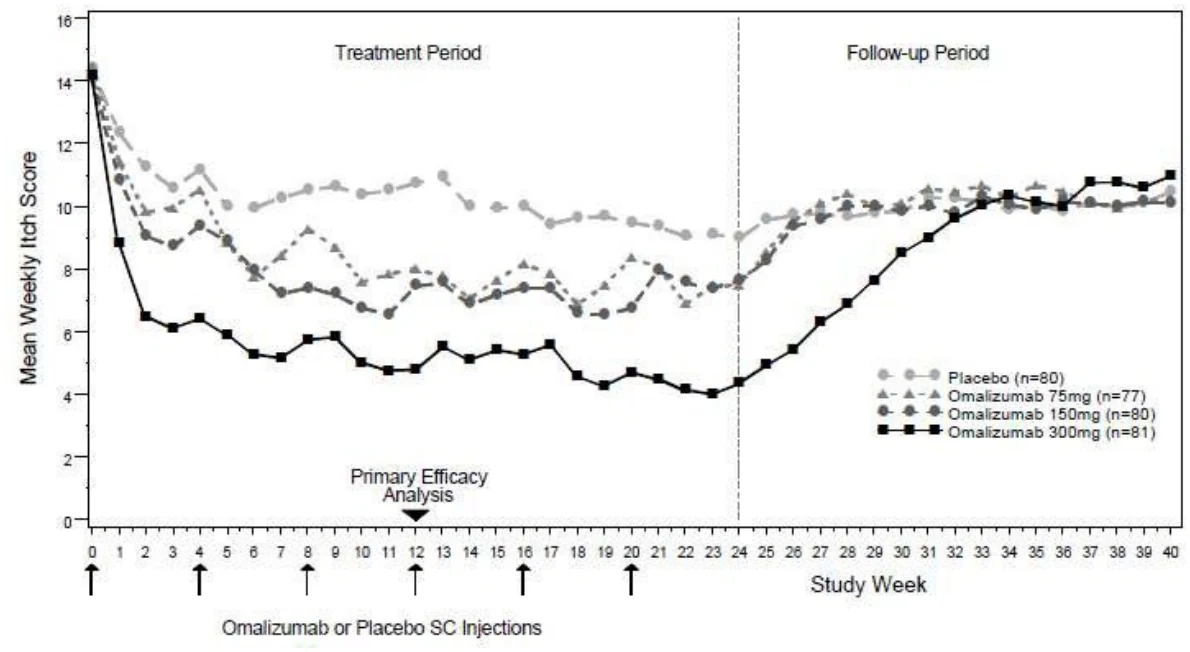
¥ Modified intent-to-treat (mITT) population: patients who were randomized and received at least one dose of study medication.
- BOCF (Baseline Observation Carried Forward) was used to impute missing data
Other Clinical Trials
A third study, GLACIAL, primarily evaluated the safety of omalizumab 300 mg in patients with refractory CIU despite H1 antihistamines. The mean decrease from baseline to Week 12 in weekly itch severity score (the primary endpoint in ASTERIA I and ASTERIA II) was 4.01 in the placebo group and 8.55 in the omalizumab group. The other efficacy endpoints in the study were those used as secondary endpoints in ASTERIA I. The magnitude of differences to placebo was consistent with those observed in ASTERIA I and ASTERIA II.
15 Microbiology
No microbiological information is required for this drug product.
16 Non-Clinical Toxicology
A comprehensive series of toxicology studies was conducted to establish a nonclinical safety profile. Since omalizumab does not bind to mouse IgE, and IgE is not normally found in mouse serum at significant levels, the mouse was selected to evaluate high dose nonspecific toxicity. The cynomolgus monkey was considered to be a relevant species for preclinical toxicity evaluations because omalizumab has nearly equivalent affinity for IgE purified from cynomolgus monkey serum (0.19 nM) as for human IgE (0.06 nM). In addition, the monkey is considered an exaggerated model of atopy compared with humans as baseline serum concentrations of IgE were generally greater in cynomolgus monkeys than normally observed in the atopic individuals enrolled in our clinical trials. Consequently, the monkeys in these studies had much higher levels of omalizumab:IgE complexes than would be expected in typical humans with asthma.
This comprehensive series of acute and multiple-dose toxicity studies demonstrated that omalizumab produced no adverse effects at clinically relevant serum concentrations of drug. At suprapharmacologic serum concentrations, dose levels of up to 250 mg/kg (more than 14-fold- the highest recommended clinical dose), omalizumab induced thrombocytopenia and effects secondary to thrombocytopenia. The serum concentration required to attain a 50% drop in platelets from baseline was roughly 3.7 to 20-fold higher than anticipated serum concentrations in adult and adolescent clinical patients receiving the highest dose of omalizumab. Juvenile monkeys were more sensitive to platelet effects than adult monkeys; the median trough concentration of omalizumab at steady-state in pediatric patients (<12 years of age) from studies 7 and 8 was between 2.2-fold (patients with baseline IgE levels >700 IU/mL) and 9.6- fold (patients with baseline IgE levels of 30-200 IU/mL) lower than the threshold concentration in juvenile monkeys associated with a 50% drop in platelets. Other than the platelet-associated effects, there were no other clinical or pathological signs of toxicity. In particular, no clinical or histopathological evidence of renal toxicity nor evidence of a systemic anaphylactic response due to mast cell degranulation were observed in any of the studies, despite the presence of omalizumab:IgE complexes in all of the monkey studies.
Omalizumab has been shown to evoke a low level immune response to heterologous protein in some cynomolgus monkeys. This is not unexpected based on administration of a heterologous protein. Special toxicity studies demonstrated safety in a cynomolgus monkey model challenged with ragweed allergen, no evidence of in vitro tissue cross-reactivity with cynomolgus monkey and human tissues, no evidence of in vitro hemolysis of human and cynomolgus monkey erythrocytes or incompatibility with human and cynomolgus monkey serum and plasma, and no evidence of irritation in the rabbit. In addition, omalizumab was not mutagenic in the Ames test. No rodent carcinogenicity studies have been performed since omalizumab does not bind rodent IgE and the IgG structure of omalizumab does not raise any concerns relating to carcinogenic potential. Reproduction studies in cynomolgus monkeys have been conducted with omalizumab. Subcutaneous doses up to 75 mg/kg/week (approximately 10-fold the highest recommended clinical dose in mg/kg over a 4-week period) of omalizumab did not elicit maternal toxicity, embryotoxicity, or teratogenicity when administered throughout organogenesis and did not elicit adverse effects on fetal or neonatal growth when administered throughout late gestation, delivery, and nursing. Although no clinically significant effects on platelets have been observed in patients, doses of omalizumab in excess of the clinical dose have been associated with age-dependent decreases in blood platelets in nonhuman primates, with a greater relative sensitivity in juvenile animals. In reproduction studies in cynomolgus monkeys, there was no clinical evidence of thrombocytopenia in neonatal monkeys from mothers treated with up to 75 mg/kg omalizumab; however, platelet counts were not measured in these offspring. The excretion of omalizumab in milk was evaluated in female cynomolgus monkeys receiving SC doses of 75 mg/kg/week. Neonatal serum levels of omalizumab after in utero exposure and 28 days of nursing were between 11% and 94% of the maternal serum level. Milk levels of omalizumab were 0.15% of the maternal serum concentration.
Table 20 - Acute Toxicity Studies
Study Type
Species/
Strain
No./Sex/ Group
Route of Admin.a
Dose (mg/kg)
Study Duration
Findings
Mouse/ single dose
Mouse Crl:CD-17 (ICR) BR
VAF/Plus7
5/M
5/F
IV
0
1
10
100
2 weeks
No test material-related clinical or pathological signs of toxicity were observed. With the exception of 2 animals in the mid-dose group, there was no evidence of antibody formation
Monkey/ single dose
Cynomolgus monkey
2/M
2/F
IV
0
0.5
5
50
2 weeks
No test material-related clinical signs of toxicity were observed. Free IgE and total IgE serum concentrations at baseline and Day 15 were similar for control and low-dose. From baseline to Day 15, the total serum IgE in the mid- and high-dose groups increased in all animals, whereas the free serum IgE either decreased or did not increase. There was no evidence of antibody formation. rhuMAb E25 at a dose of 1 mcg did not elicit an allergic response when injected intradermally on Day 15.
Monkey/ single dose
Cynomolgus monkey
2/M
2/F
SC
0
0.5
5
50
2 weeks
No test material-related clinical signs of toxicity were observed. Free IgE and total IgE serum concentrations at baseline and Day 15 were similar for control and low-dose groups. From baseline to Day 15, the total serum IgE in the mid- and high-dose increased in all animals, whereas the free serum IgE either decreased or did not increase. There was no evidence of antibody formation. rhuMAb E25 at a dose of 1 mcg did not elicit an allergic response when injected intradermally on Day 15.
Monkey/ single dose (bridging )
Cynomolgus monkey
2/M
2/F
IV SC
0
50
200
50
2 weeksb
A single intravenous dose of rhuMAb E25 up to 200 mg/kg or a single subcutaneous dose of rhuMAb E25 up to 50 mg/kg was well tolerated and produced no adverse effects in cynomolgus monkeys. Serum total IgE concentrations increased an average of 4-fold above baseline and free IgE decreased following rhuMAb E25 administration. Two animals in the high dose IV group had antibody titers to rhuMAb E25 Fab and one animal given SC rhuMAb E25 had a detectable anti-Fab titer.
a IV = Intravenous, SC = Subcutaneous.
b In addition to the 14 day postdose observation period; samples were collected 61 days postdose, to further evaluate antibody production to omalizumab.
Table 21 - Repeated-Dose Toxicity Studies
Study Type
Species/ Strain
No./Sex/ Group
Route of Admin.a
Dose (mg/kg)
Study Duration
Findings
Mouse/
Mouse
15-25/M
IV
0
4 weeks
No test material-related clinical or pathological signs of toxicity were observed.
There was no evidence of antibody formation to rhuMAb E25.
Multi-dose
Crl:CD-17
15-25/F
1
dosing/
4 Weeks
(ICR) BR/
10
4 weeks
VAF Plus7
50
post obs
Monkey
Cynomolgus
1-5/M
IV
0
4 weeks
No test material-related clinical or pathological signs of toxicity were observed.
rhuMAb E25 was eliminated slowly from serum; PK was linear. There was no significant difference in total serum IgE in low-dose as compared to control.
Total serum IgE increased following treatment with mid- and high-doses of rhuMAb E25. Free serum IgE decreased or remained at baseline in control and low-dose animals, and decreased to undetectable amounts in mid- and high-dose animals. There was a low incidence (3/20 evaluated) of antibody formation to rhuMAb E25. rhuMAb E25 at a dose of 1 mcg did not elicit an allergic response when injected intradermally at the end of the treatment period and at the end of the recovery period.
Multi-dose
monkey
1-5/F
SC
0.1
dosing/
4 Weeks
1
4 weeks
5
post obs
mg/kg 3
times per
week
Monkey/
Cynomolgus
1-5/M
IV
0
26
Based on the results of this study, subcutaneous and intravenous bolus injections of rhuMAb E25 up to 5.0 mg/kg three times/week were well tolerated and produced no systemic adverse effects when administered to cynomolgus monkeys for approximately 6 months followed by an 8-week recovery. Serum total IgE concentrations increased approximately 6-fold compared to baseline in the high dose groups. There was a low incidence of antibody formation against rhuMAb E25.
Multi-dose
monkey
1-5/F
SC
0.1
6 months
1
5
mg/kg 3
times per
week
Monkey/
Juvenile
4-6/M
SC
0
26 weeks
Significant and sustained decreases in peripheral blood platelets were observed in juvenile cynomolgus monkeys following treatment with omalizumab.
Effects were highly correlated to dose and serum concentration. Other than suppression of platelet levels and changes secondary to
Multi-dose
Cynomolgus
4-6/F
50
dosing/
6-months
monkey
250
26 weeks
mg/kg/
recovery
week
thrombocytopenia, no test-article-related effects were evident.
a
IV = Intravenous, SC = Subcutaneous.
Table 22 - Repeated-Dose Toxicity Studies (continued)
Study Type
Species/ Strain
No./Sex/ Group
Route of Admin.a
Dose (mg/kg)
Study Duration
Findings
Monkey Multi-dose Up to
6-months
Juvenile and adult Cynomolgus monkeys
3-6/M
3-6/F
SC
0
15
30
50
100
250
mg/kg/ week
4, 6, or
26 weeks dosing/ 13 weeks recovery
Significant and sustained decreases in peripheral blood platelets were observed in cynomolgus monkeys following treatment with omalizumab. Effects were correlated to dose and serum concentration. The time of onset was earlier and the magnitude of severity was greater in juveniles than in adults.
Monkey Multi-dose
4-weeks with IVIG
Juvenile Cynomolgus monkey
3F
SC
0
100
100 with IVIG
infusion on days 17 and 18
4 weeks dosing
Omalizumab at doses of 100mg/kg/week induced a moderate decrease in peripheral blood platelets in 3 of 6 cynomolgus monkeys that could be reversed by administration of IVIG (intravenous immunoglobulin). Given the inhibitory effect of IVIG on Fc-mediated clearance of platelets, it is likely that platelet phagocytosis plays a role in omalizumab-induced thrombocytopenia.
Monkey Multi-dose 12-weeks
Adult African green, cynomolgus,
rhesus
3F
SC
0
100
250
mg/kg/ week
12-weeks dosing/ 13 weeks recovery
Significant and sustained decreases in peripheral blood platelets were observed in cynomolgus monkeys following treatment with omalizumab. The magnitude and persistence of decreased platelets was less pronounced in the rhesus and African green monkeys.
Multi-dose Up to 4-weeks
Chimpanzee
3M/3F
SC
250
mg/kg/ week
Up to 4-weeks dosing/
13-weeks
recovery
Omalizumab induces significant but reversible decreases in peripheral blood platelet counts at a dose of 250 mg/kg/week in the chimpanzee.
a SC = Subcutaneous.
Table 23 - Reproductive Toxicity Studies
Study Type
Species/ Strain
No./Sex/ Group
Route of Admin.a
Dose (mg/kg)
Study Duration
Findings
Male Fertility
Cynomolgus
10/M
SC
0
6 weeks
Subcutaneous administration of rhuMAb E25, at doses up to and including 75 mg/kg, was well tolerated and did not elicit reproductive toxicity in male cynomolgus monkey.
Study
monkey
3
dosing/
15
2 weeks
75
post obs
Female
Cynomolgus
10/F
SC
0
4-5
Subcutaneous administration of rhuMAb E25, at doses up to and including 75 mg/kg, was well tolerated and did not inhibit reproductive capacity, including implantation in female cynomolgus monkey.
fertility study
monkey
3
months
15
dosing
75
Embryo-
Cynomolgus
12/F
SC
0
30 days
Subcutaneous administration of rhuMAb E25, at doses up to and including 75 mg/kg, was well tolerated and did not elicit maternal toxicity, embryotoxicity or teratogenicity when administered throughout organogenesis (gestation days 20-50) in the cynomolgus monkey.
toxicity
monkey
3
dosing/
Terato-
15
50 days
genicity
75
post obs
Late gestation
Cynomolgus
8/F
SC
0
30-70
Subcutaneous administration of rhuMAb E25, at doses of 75 mg/kg, was well
Study
monkey
75
days
tolerated and did not elicit adverse effects on fetal growth at late gestation
dosing
(gestation days 120 - delivery), delivery, nursing, or neonatal growth in the
cynomolgus monkey.
a SC = Subcutaneous.
Table 24 - Special Toxicity Studies
Study Type
Species/ Strain
No./ Sex/
Group
Route of Admin.a
Dose (mg/kg)
Study Duration
Findings
Pilot evaluation
Cynomolgus
6/F
IV, SC
5
35 weeks
Skin sensitivity to ragweed was elicited in all animals after three challenge doses. Intradermal skin sensitivity was diminished after treatment with rhuMAb E25 and reactivity to ragweed returned approximately 55 days after rhuMAb E25 treatment was terminated. Subcutaneous doses of rhuMAb E25 up to 10 mg/kg and intravenous doses up to 50 mg/kg were well tolerated and produced no adverse effects in ragweed allergen sensitized cynomolgus monkeys.
in monkeys
monkeys
10
exposed to
50
ragweed allergen
Skin reactivity to
Cynomolgus
2/F
ID
0.001,
31 minutes
Based of the results of a wheal/flare allergy test aided with the use of Evan=s Blue, an allergic response was not elicited to ragweed when injected intradermally in naïve cynomolgus monkeys. A positive histamine response was elicited.
ragweed
monkey
(ragweed
0.01,
extract/pilot
extract)
0.1,
evaluation
IV
1.0 mcg
(Evans
Blue dye)
Tissue specificit y analysis
Frozen cynomolgu s monkey
tissues
_
_
49
(rhuMAb E25)
_
Specific staining was observed with both rhuMAb E25 and MaE11 in germinal centers of a lymph node and Peyer’s patch of the large intestine of the female but not the male monkey. The reaction was considered to represent synthesis of IgE by lymphoid cells. Specific staining of other tissues was not observed.
22.5
(MaE11)
a IV = Intravenous, SC = Subcutaneous, ID = Intradermal.
a IV = Intravenous, SC = Subcutaneous, ID = Intradermal
Table 25 - Special Toxicity Studies (continued)
Study Type
Species/ Strain
No./ Sex/
Group
Route of Admin.a
Dose (mg/kg)
Study Duration
Findings
Tissue specificity analysis
Frozen human tissues
_
_
49
(rhuMAb E 25)
22.5
(MaE11)
_
Specific staining of the tissues was not observed with rhuMAb E25 but was seen with MaE11. With the latter, reactivity was seen in lymphoid cells of 1/3 spleens. The reaction was considered to represent synthesis of IgE by lymphoid cells of that individual. Specific staining of other
tissues was not observed.
In vitro hemolytic potential and blood compatibility
Human and cynomolgus monkey- whole blood, serum,
plasma
_
_
0, 5
_
Results indicate that rhuMAb E25 and rhuMAb E25 Vehicle did not cause hemolysis of cynomolgus monkey or human erythrocytes and were compatible with cynomolgus monkey or human serum and plasma.
In vitro hemolytic potential and blood compatibility
Human and cynomolgus monkey - whole blood, serum, and plasma
_
_
0, 40
_
Results indicate that rhuMAb E25 (12,000 L; 40 mg/mL in formulation) and rhuMAb E25 (12,000 L) Vehicle did not cause hemolysis of cynomolgus monkey or human erythrocytes and were compatible with cynomolgus monkey or human serum and plasma.
In vitro hemolytic potential and blood
compatibility
Human whole blood, serum, and plasma
_
_
0, 100
_
Results indicate that rhuMAb E25 (lyophilized formulation) at a concentration of 100 mg/mL, and rhuMAb E25 Vehicle did not cause hemolysis of human erythrocytes and were compatible with human serum and plasma.
Acute local tolerance
Rabbit Hra: (NZW) SPF
9/M
IV
SC
ID
0, 5
1 week
No clinical observations or histopathological findings indicative of local irritation were attributed to the test material or vehicle.
Table 26 - Special Toxicity Studies (continued)
Study Type
Species / Strain
No./ Sex/
Group
Route of Admin.a
Dose (mg/k g)
Study Duratio n
Findings
Multiple dose SC
single dose intravenous rabbit tolerance
Rabbit Hra: (NZW) SPF
15/M
IV, SC
0, 5,
20, 40
21 Days
Based on the results of this study, 14 daily subcutaneous injections (1 mL volume) of 5 mg/mL rhuMAb E25 (400 L) or 20 and 40 mg/mL of rhuMAb E25 (12,000 L) were associated with a slightly higher level of subacute inflammation at the injection sites than similar treatment in animals given the vehicles or saline. This inflammation was typically associated with an increased number of eosinophils. Because clinical signs of irritation were not evident beyond Day 12 and because the microscopic findings were not indicative of functional tissue damage, these findings were not considered toxicologically significant. There were no meaningful differences in incidence or severity of local irritation from rhuMAb E25 (12,000 L) when compared to rhuMAb E25 (400 L). There was no macroscopic or microscopic evidence of irritation following a single intravenous injection of 20 mg/mL of rhuMAb E25 (12,000 L) to rabbits.
Acute
local tolerance
Rabbit Hra: (NZW) SPF
9/M
IV, SC
0, 100
1 week
Based on the results of this study, administration of rhuMAb E25 given as a single intravenous bolus injection and a single subcutaneous injection following reconstitution with 1.1% benzyl alcohol to a concentration of 100 mg/mL was well tolerated in rabbits and produced no obvious local irritation attributable to the test material.
Acute local toleranc e
Rabbit Hra:(NZ W)
3/F
SC
0, 125
1 week
Administration of rhuMAb E25 placebo and rhuMAb E25 as a single, 125 mg/mL subcutaneous bolus injection had no obvious irritating effect. Reconstituting the test material and placebo in saline, as opposed to sterile Water for Injection (SWFI) did not produce any differences in redness or swelling at the injection sites. Based on the results of this study, administration of rhuMAb E25 placebo and rhuMAb E25 given as a single subcutaneous bolus injection following reconstitution with either SWFI or saline to a concentration of 125 mg/mL was well tolerated in rabbits and produced no treatment-related signs of local irritation.
a IV =Intravenous, SC =Subcutaneous, ID =Intradermal.
17 Supporting Product Monographs
XOLAIR (omalizumab injection, 75 mg/0.5 mL, 150 mg/1.0 mL, 300 mg/2.0 mL), Control 291629, Product Monograph, Novartis Pharmaceuticals Canada Inc., 2025-02-04