


Patient Medication Information: uses, side effects, how to take - Orfadin
What is Orfadin used for?
Orfadin is used for the treatment of hereditary tyrosinemia type 1 (HT-1), in addition to limiting the amount of tyrosine and phenylalanine in the diet.
How does Orfadin work?
Orfadin stops the build-up of toxic substances which cause the severe liver and kidney problems in patients with HT-1. By doing that, it also prevents the porphyric crises (acute attacks of neurological symptoms that can be life-threatening) associated with HT-1.
What are the ingredients in Orfadin?
Medicinal ingredients: nitisinone
Capsules:
Non-medicinal ingredients: ammonium hydroxide, black iron oxide, gelatine, pregelatinized starch (maize), propylene glycol, shellac, titanium dioxide.
Oral suspension:
Non-medicinal ingredients: citric acid monohydrate, glycerol, hydroxypropyl methylcellulose, polysorbate 80, purified water, sodium benzoate, strawberry aroma (artificial), trisodium citrate dihydrate.
Orfadin comes in the following dosage forms:
Capsules: 2 mg, 5 mg, 10 mg and 20 mg.
Oral suspension: 4 mg/mL.
Do not use Orfadin if you:
- are allergic to nitisinone or any of the other ingredients.
are breast-feeding. Do not breast feed while taking Orfadin.
To help avoid side effects and ensure proper use, talk to your healthcare professional before you/your child take Orfadin. Talk about any health conditions or problems you may have, including if:
- you are pregnant or planning to become pregnant.
- your newborn or premature baby, diagnosed with HT-1, has yellowing of the eyes and/or skin (jaundice)
- you are on a low salt diet
Other warnings you should know about:
During treatment with Orfadin, blood tests will be done so your healthcare professional can check that the treatment is working and that the dosing is correct. Your healthcare professional will also check for side effects that can be caused by the treatment. You should see your healthcare professional at least every 6 months.
Dietary Changes
Taking Orfadin can cause high levels of tyrosine in your blood. This can cause harmful side effects such as Eye Problems. As a result, while you are taking Orfadin you must limit the amount of tyrosine and phenylalanine in your diet. Talk to your healthcare professional about which foods are safe to eat and which foods should be avoided.
Eye Problems
Your healthcare professional will check your eyes before starting treatment with Orfadin and thereafter regularly. If you develop eye problems while taking Orfadin, including sensitivity to light, eye pain, redness, swelling or burning, talk to your healthcare professional immediately.
Tell your healthcare professional about all the medicines you take, including any drugs, vitamins, minerals, natural supplements or alternative medicines.
The following may interact with Orfadin:
Nitisinone may affect medications which are degraded via the enzyme CYP2C9, such as
- the anticoagulant warfarin,
- the antiepileptic phenytoin, and
- the antidiabetic tolbutamide.
How to take Orfadin
- By mouth.
Orfadin capsules can be taken with or without food. However, they should always be taken the same way. Therefore, if you start taking Orfadin capsules with food you should always take them with food.
- It is recommended that you take Orfadin oral suspension with food.
- For patients who are unable to take the oral suspension, Orfadin capsules can be opened and the contents sprinkled into a small amount of water or formula immediately before use.
Preparation of the Oral Suspension
You will be provided with:
- 1 bottle of Orfadin oral suspension
- 1 oral syringe
- 1 adapter (The adapter may or may not be inserted in your bottle of Orfadin oral suspension when you receive it.)
Use the oral syringe provided with your Orfadin oral suspension to make sure you measure the right amount. Talk to your healthcare professional or pharmacist if you have questions about how to use the oral syringe or if you lose the oral syringe.
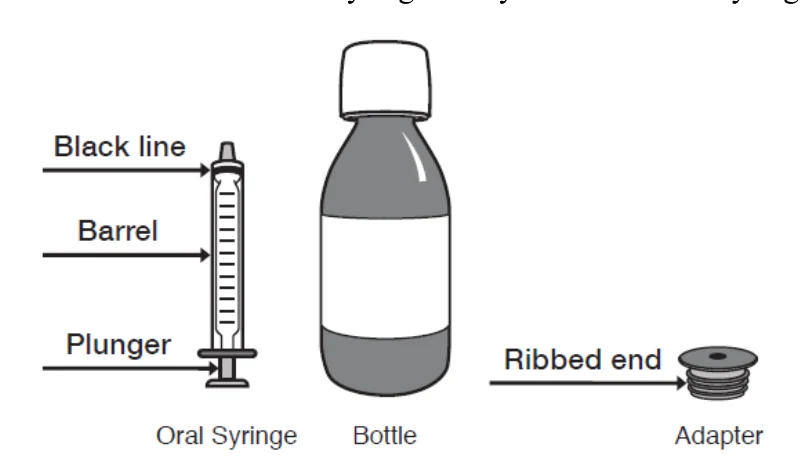
Figure A
If the adapter is not inserted in your bottle of Orfadin oral suspension when you receive it, follow the instructions in “How to prepare a bottle of Orfadin oral suspension if the adapter is not inserted.”
If the adapter is inserted in your bottle of Orfadin oral suspension when you receive it, follow the instructions in “How to prepare a dose of Orfadin oral suspension after the adapter is inserted.”
How to prepare a bottle of Orfadin oral suspension if the adapter is not inserted:
- 1. Store Orfadin oral suspension in the refrigerator until you use it for the first time.
- 2.
Remove the Orfadin oral suspension bottle from the refrigerator 30 minutes to 1 hour before using it to allow it to reach room temperature.
Orfadin oral suspension should be thrown away (discarded) 60 days after it is removed from the refrigerator and the adapter is inserted in the bottle. Write the discard date on the bottle label.
- 3.
Shake the bottle well for at least 20
seconds until the solid cake of
particles at the bottom of the bottle is
dissolved (See Figure B). Check that
there are no particles left at the
bottom of the bottle. Foam will form
in the bottle.
Figure B
- 4.
Remove the child resistant screw cap
by pushing it down firmly and turning
it counter-clockwise (See Figure C).
Figure C
- 5.
Place the open bottle upright on a flat
surface. Push the ribbed end of the
adapter firmly into the neck of the
bottle as far as it will go (See Figure
D). Replace the child resistant screw
cap on the bottle. Do not remove the
adapter from the bottle after it is
inserted.
Figure D
- 6. Follow the instructions in “How to prepare a dose of Orfadin oral suspension after the adapter is inserted.”
How to prepare a dose of Orfadin oral suspension after the adapter is inserted
- 1. If the adapter is inserted, Orfadin oral suspension can be stored at room temperature (up to 25°C) for up to 60 days. Write the discard date on the bottle label. Throw the bottle of Orfadin oral suspension away after 60 days even if there is medcine left in the bottle.
- 2.
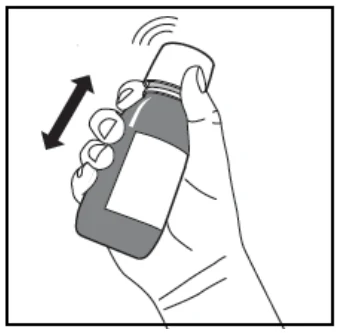
Shake the Orfadin oral suspension
bottle well for at least 5 seconds (See Figure E). Check that there are no particles left at the bottom of the bottle. Foam will form in the bottle.
Figure E
- 3.
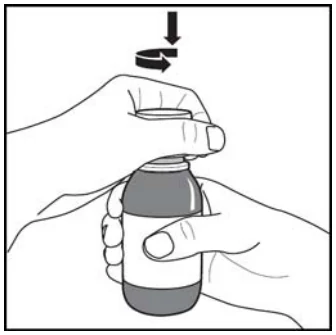
Remove the child resistant screw cap
right away by pushing it down firmly and turning it counter-clockwise (See Figure F).
Figure F
- 4.
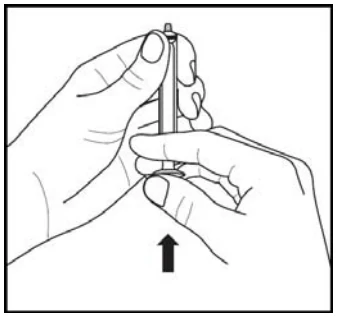
Hold the oral syringe in one hand.
With your other hand, fully push down (depress) the plunger (See Figure G).
Figure G
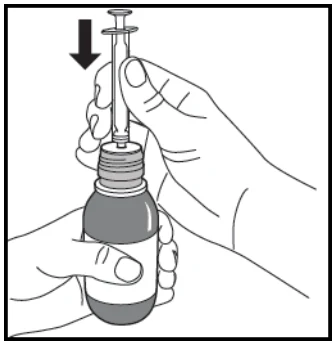
- 5.
Keeping the bottle in an upright
position, insert the oral syringe firmly into the adapter (See Figure H).
Figure H
- 6.
Carefully turn the bottle upside down with the oral syringe in place (See Figure I). Wait until you can see that the foam is at the top of the bottle to avoid withdrawing bubbles into the syringe.
Figure I
- 7.
Pull back slowly on the oral syringe plunger until the top edge of the black ring is at the line marking the dose prescribed by your healthcare professional (See Figure J). Figure J shows a dose of 1 mL as an example. If you see air bubbles in the oral syringe, fully push in the plunger so that the oral suspension flows back into the bottle. Then, withdraw your prescribed dose of oral suspension again.
Figure J
- 8.
Leave the oral syringe in the adapter and turn the bottle to an upright position. Place the bottle onto a flat surface. Remove the oral syringe by gently twisting it out of the bottle (See Figure K). Do not pull straight up on the syringe to remove it from the bottle because this can cause the adapter to come out of the bottle.
Figure K
- 9. Place the oral syringe in your/the
patient’s mouth right away. Slowly push on the plunger until the oral syringe is empty. (See Figure L). 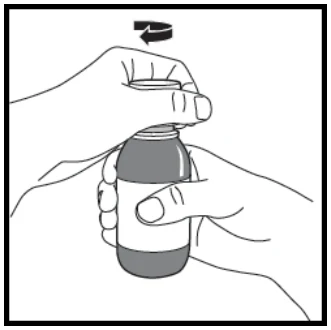
Figure L
- 10.
Leave the adapter in the bottle. Put the
child resistant screw cap back on the
bottle (See Figure M).
Figure M
- 11. Remove the plunger from the oral syringe barrel. Rinse the oral syringe with water after each use and let it air dry. Do not replace the plunger into the barrel of the oral syringe until ready to use again for your next dose to allow it to dry. Do not throw away the oral syringe.
- 12. Store the bottle in an upright position at room temperature (not above 25°C).
Dosing information
Recommended Doses are for Adults and Children
The dose is adjusted for each individual patient. Your healthcare professional will tell you how much Orfadin to take and when to take it.
Initial Recommended Daily Dose
For patients starting on Orfadin, the recommended daily dose is 1 mg/kg body weight. This total daily dose should be divided in half and taken two times a day.
Increasing the Dose
The doctor may increase the dose to 1.5 mg/kg and then up to a maximum of 2 mg/kg per day. This depends on if toxic substances, such as succinylacetone, are still detected in the blood and urine.
Once a day dosing
1 to 2 mg/kg body weight. The once a day dose should be the same as the total twice a day dose. Switching to once a day dosing may be considered by the healthcare professional if:
- The patient weighs 20 kg or more; and
- There are no detectable toxic substances in the patient’s blood and urine; and
- The patient was stable on Orfadin given two times a day for a minimum of 4 weeks
Overdose:
If you think you have taken too much Orfadin, contact your healthcare professional, hospital emergency department or regional Poison Control Centre immediately, even if there are no symptoms.
Missed Dose:
If you forget to take a dose, take it as soon as you remember. If you miss several doses contact your healthcare professional.
What are possible side effects from using Orfadin?
These are not all the possible side effects that you may feel when taking Orfadin. If you experience any side effects not listed here, contact your healthcare professional.
Orfadin and HT-1 can cause abnormal blood and urine test results. This can occur when you start on Orfadin, if you switch from two times a day dosing to once a day or if your condition gets worse. While taking Orfadin your healthcare professional will decide when to perform blood and urine tests. They will interpret the results.
Orfadin can cause Eye Problems. Your healthcare professional should make sure you have an eye exam before you start on Orfadin. This should be done by an ophthalmologist. If you have any of the symptoms of Eye Problems, talk to your healthcare professional immediately as you should get your eyes re-checked.
Serious side effects and what to do about them
| Symptom / effect | Talk to your healthcare professional | Get immediate medical help | |
| Only if severe | In all cases | ||
| COMMON | |||
| Eye Problems: redness, eye discharge, itchy eyes, swelling or burning eyes, blurred vision, sensitivity to light, milky or cloudy area on the eye, eye pain, a feeling that there is something in your eye. | x | ||
| Low Platelets: easy or unusual bruising. Bleeding into the skin causing a rash of pinpoint-sized reddish-purple spots, usually in the lower legs, prolonged bleeding from cuts, bleeding from your gums or nose, blood in urine or stools. | x | ||
| Low White Blood Cells: infections, fatigue, weakness, fever, aches and pains, flu-like symptoms. | x | ||
| UNCOMMON | |||
| Skin Problems: | x | ||
| dry/cracked/scaly skin, rashes, small flat red bumps, itching that can be severe, blisters, draining fluid and crusting, swelling, burning, tenderness. | |||
| UNKNOWN | |||
Newborns taking Orfadin oral suspension: increased yellowing of the skin and/or eyes (jaundice). | x |
If you have a troublesome symptom or side effect that is not listed here or becomes bad enough to interfere with your daily activities, talk to your healthcare professional.
Reporting Side Effects
| You can report any suspected side effects associated with the use of health products to Health | |
| Canada by: | |
| |
| (https://www.canada.ca/en/health-canada/services/drugs-health-products/medeffect- | |
| canada/adverse-reaction-reporting.html) for information on how to report online, by | |
| mail or by fax; or | |
| |
NOTE: Contact your healthcare professional if you need information about how to manage your side effects. The Canada Vigilance Program does not provide medical advice.
Storage:
Do not use this medicine after the date printed on the bottle and the carton after “EXP”. The expiry date refers to the last day of that month.
Capsules:
Store in a refrigerator (2°C to 8°C).
Orfadin capsules can be stored for a single period of 2 months at a temperature below 25°C. Do not forget to mark the date on the bottle, when you take it out of the refrigerator. Do not use Orfadin capsules after they have been out of the refrigerator for 2 months.
Oral suspension:
Store refrigerated at 2°C to 8°C prior to first use. Do not freeze. Store upright.
After first opening, store Orfadin oral suspension at room temperature (up to 25°C) for up to 60 days. Store upright. If not used within 60 days, discard unused portion. The discard after date should be noted on the bottle.
Keep out of reach and sight of children.
If you want more information about Orfadin:
- Talk to your healthcare professional
- Find the full product monograph that is prepared for healthcare professionals and includes this Patient Medication Information by visiting the Health Canada website (www.healthcanada.gc.ca); or by calling the sponsor at 1-866-773-5274