


Patient Medication Information: uses, side effects, how to take - Opfolda
What OPFOLDA is used for:
- OPFOLDA is a medicine that is used in combination with POMBILITI (cipaglucosidase alfa) for the treatment of late-onset Pompe disease (LOPD) in adults weighing 40 kg or more.
How OPFOLDA works:
People with Pompe disease have low levels of the enzyme acid alpha-glucosidase (GAA). This enzyme helps control levels of glycogen in the body.
In Pompe disease, high levels of glycogen build up in the muscles of the body. This keeps muscles, such as the muscles that help you walk, the muscles under the lungs that help you breathe, and the heart muscle, from working properly.
OPFOLDA contains the active substance ‘miglustat’ that binds to cipaglucosidase alfa during treatment. Cipaglucosidase alfa is an artificial enzyme that can replace natural GAA enzyme which is lacking in Pompe disease.
The ingredients in OPFOLDA are:
Medicinal ingredients: miglustat
Non-medicinal ingredients: black iron oxide, colloidal silicon dioxide, gelatin, magnesium stearate, microcrystalline cellulose, pharmaceutical ink, pregelatinized starch (maize), sucralose, titanium dioxide
OPFOLDA comes in the following dosage forms:
Capsules: 65 mg
OPFOLDA is available in cartons containing 4 or 24 capsules.
Do not use OPFOLDA if:
- You are allergic to miglustat or any of the other ingredients of this medicine or its container.
You cannot take cipaglucosidase alfa, because you:
- have had life-threatening hypersensitivity or infusion-related reactions to cipaglucosidase alfa.
- are allergic to cipaglucosidase alfa or any other ingredients in this medicine or its container. See the Patient Medication Information of POMBILITI (cipaglucosidase alfa) for a complete list of ingredients.
- You are pregnant or planning to become pregnant.
To help avoid side effects and ensure proper use, talk to your healthcare professional before you take OPFOLDA. Talk about any health conditions or problems you may have, including if you:
- have had an infusion related or allergic reaction to another ERT.
- have kidney problems.
Other warnings you should know about:
Female patients
Pregnancy and birth control
- There is no experience with the use of OPFOLDA in combination with cipaglucosidase alfa during pregnancy.
- You must NOT take OPFOLDA or receive cipaglucosidase alfa if you are pregnant. There may be risks to the unborn baby.
If you are able to become pregnant:
- your healthcare professional will make sure you are not pregnant before you start taking OPFOLDA in combination with cipaglucosidase alfa.
- you must use reliable birth control methods while using these medicines, and for 4 weeks after stopping both medicines.
- tell your healthcare professional immediately if you get pregnant, think that you may be pregnant, or if you are planning to become pregnant during treatment.
Breast-feeding
- If you are breastfeeding, do NOT take OPFOLDA in combination with cipaglucosidase alfa. A decision will need to be made whether to stop treatment or to stop breast-feeding.
- Talk to your healthcare professional about the best way to feed your baby during treatment.
- Fertility – male and female patients
- Taking OPFOLDA in combination of cipaglucosidase alfa may affect your ability to have children. Talk to your healthcare professional if this is a concern for you.
Driving and using machines
- Taking OPFOLDA in combination with cipaglucosidase alfa can cause dizziness, low blood pressure and drowsiness. You should use caution when driving or operating potentially dangerous machinery while you are taking OPFOLDA in combination with cipaglucosidase alfa.
- Infusion related reactions with cipaglucosidase alfa
- OPFOLDA is always used with cipaglucosidase alfa. Infusion related reactions were reported in patients given cipaglucosidase alfa.
- You must tell your healthcare professional immediately if you get an infusion-associated reaction or an allergic reaction from cipaglucosidase alfa. Some of these reactions may become serious and can cause death. Your healthcare professional may give you medicines before your infusion to prevent these reactions.
- If you get any side effects during an infusion of cipaglucosidase alfa, the infusion may be stopped, and appropriate medical treatment may be started.
- See the Serious side effects and what to do about them table below, for a list of symptoms of infusion or allergic reactions and what to do about them.
Tell your healthcare professional about all the medicines you take, including any drugs, vitamins, minerals, natural supplements or alternative medicines.
How to take OPFOLDA:
- Always take this medicine exactly as your healthcare professional has told you. Check with your healthcare professional if you are not sure how the medicine should be used.
You must take OPFOLDA by mouth on an empty stomach.
- Fast for 2 hours before and 2 hours after taking this medicine.
- Swallow the OPFOLDA capsules whole only with unsweetened beverages. This includes water, tea and/or coffee with no cream, sugar or sweeteners. Do NOT consume other beverages or food during the 4-hour fasting period.
- Two hours after taking OPFOLDA, you can resume normal eating and drinking.
- OPFOLDA capsules must be used with cipaglucosidase alfa. See also the Patient Medication Information of POMBILITI (cipaglucosidase alfa).
Usual dose:
Your dose of OPFOLDA will depend on your body weight:
- If you weigh 50 kg or more, the recommended dose of OPFOLDA is 260 mg (4 capsules of 65 mg).
- If you weigh between 40 kg and 50 kg, the recommended dose of OPFOLDA is 195 mg (3 capsules of 65 mg).
If you have kidney problems, your healthcare professional may lower your dose.
Your healthcare professional will monitor your condition and may stop your treatment if your disease gets worse or if you experience serious side effects.
You will receive OPFOLDA and cipaglucosidase alfa once every other week. Both are used on the same day. See the dose timeline below in Figure 1.
Figure 1 - Dose timeline
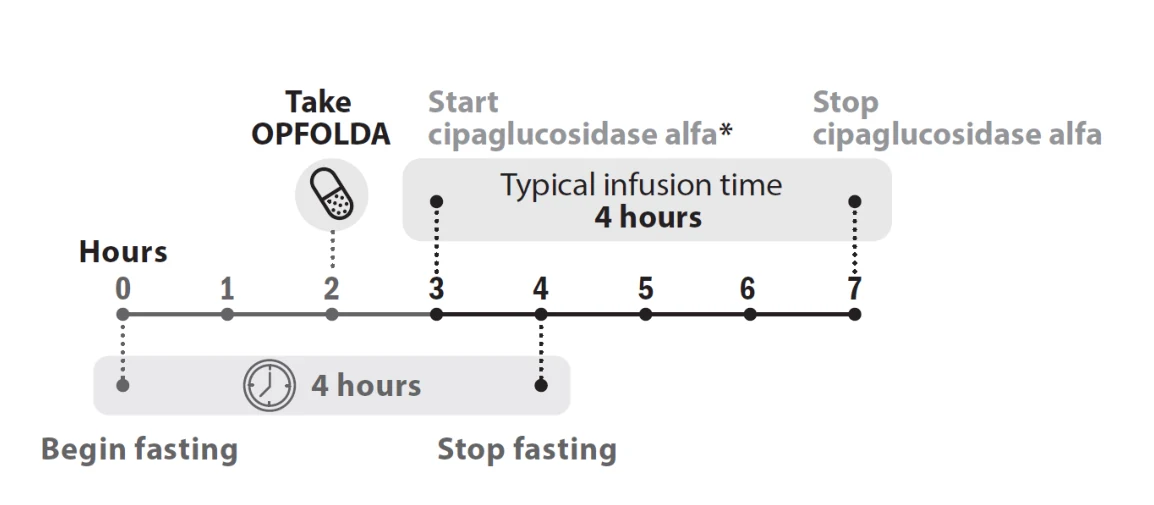
* You should take OPFOLDA 1 hour before receiving cipaglucosidase alfa infusion. In the event of cipaglucosidase alfa infusion delay, your healthcare professional will ensure that infusion is started within 3 hours of taking OPFOLDA.
Switching from another enzyme replacement therapy (ERT):
If you are currently being treated with another ERT:
- Your healthcare professional will tell you when to stop the other ERT before starting OPFOLDA.
- Tell your healthcare professional when you have completed your last dose.
Overdose:
There is no experience with overdose of OPFOLDA and/or cipaglucosidase alfa.
| If you think you, or a person you are caring for, have taken too much OPFOLDA, contact a healthcare professional, hospital emergency department, regional poison control centre or Health Canada’s toll-free number, 1-844 POISON-X (1-844-764-7669), immediately, even if there are no signs or symptoms. |
|---|
Missed Dose:
Forgotten dose:
If you miss a dose of OPFOLDA, please speak to your healthcare professional and do not start your cipaglucosidase alfa infusion. You will need to re-start the treatment of OPFOLDA in combination with cipaglucosidase alfa as soon as possible.
Infusion delays:
If you have missed an infusion and it has been more than 3 hours since you have taken OPFOLDA, please contact your healthcare professional as soon as possible to reschedule your appointment. Your next appointment should be scheduled at least 24 hours after OPFOLDA was last taken.
Possible side effects from using OPFOLDA:
These are not all the possible side effects you may have when taking OPFOLDA. If you experience any side effects not listed here, tell your healthcare professional.
OPFOLDA is used with cipaglucosidase alfa, and side effects can occur with either of these medicines. Side effects were mainly seen while patients were being infused with cipaglucosidase alfa (infusion-related effects) or shortly after.
- Headache
- Involuntary shaking of one or more parts of the body
- Feeling sleepy
- Altered sense of taste
- Sensation like numbness, tingling, pins, and needles
- Rapid heartbeat
- Loose, runny stools
- Nausea
- Stomach pain
- Passing gas or wind
- Bloating
- Vomiting
- Trouble passing stools
- Increased sweating
- Muscle cramps, muscle pain, muscle weakness
- Pain in joints
- Feeling tired all the time
- Feeling uncomfortable in chest
- Swelling or pain in the body area where needle was inserted
- Pain
- Swelling in the hands, feet, ankles, legs
- Rise in blood pressure
- Stomach discomfort
- Cannot hold or maintain balance
- Burning sensation
- Pain in one or both sides of the head, throbbing pain, aura, eye pain, sensitivity to light (migraine)
- Unusual paleness of the skin
- Breathing difficult and triggers coughing, and shortness of breath (asthma)
- Throat discomfort
- Indigestion
- Sore or irritated throat
- Painful and abnormal contractions of the throat
- Mouth pain or discomfort (oral pain and oral discomfort)
- Swollen tongue
- Skin discoloration
- Swelling of the skin
- Pain in the area between the hip and rib
- Muscle fatigue
- Increased rigidity of muscles
- Constant feeling of being tired
- Pain in the cheek, gums, lips, chin
- Feeling jittery
- Feeling of uneasiness, overall feeling of being sluggish
- Pain in chest
- Swelling face
- Changes in body temperature
- Decrease in a type of white blood cell - shown in tests
- Scratch or damage to the skin
Serious side effects and what to do about them
| Frequency/Side Effect/Symptom | Talk to your healthcare professional | Stop taking this drug and get immediate medical help | ||
|---|---|---|---|---|
| Only if severe | In all cases | |||
| Common | ||||
| Infusion related reactions, including anaphylaxis (severe allergic reaction): difficulty swallowing or breathing, fever, chills, cough, flushing, dizziness, wheezing, feeling sick to your stomach and throwing up, feeling close to fainting, low blood pressure, hives or rash, swelling of the face, lips, tongue or throat. | ✓ | |||
If you have a troublesome symptom or side effect that is not listed here or becomes bad enough to interfere with your daily activities, tell your healthcare professional.
Reporting Side Effects
You can report any suspected side effects associated with the use of health products to Health Canada by:
NOTE: Contact your healthcare professional if you need information about how to manage your side effects. The Canada Vigilance Program does not provide medical advice. |
Storage:
- Store at room temperature (15°C to 25°C).
- Keep out of reach and sight of children.
- Do not use if inner seal is missing or broken.
- Do not use this medicine after the expiry date which is stated on the bottle and carton after the letters “EXP”. The expiry date refers to the last date of that month.
- Do not throw away any medicines via wastewater or household waste. Ask your pharmacist how to throw away medicines that you no longer use. These measures will help protect the environment.
If you want more information about OPFOLDA:
- Talk to your healthcare professional
- Find the full Product Monograph that is prepared for healthcare professionals and includes this Patient Medication Information by visiting the Health Canada Drug Product Database website: https://www.canada.ca/en/health-canada/services/drugs-health-products/drug-products/drug-product-database.html, the manufacturer’s website: https://www.amicustherapeutics.ca, or by calling 1-833-810-5008.
Amicus Therapeutics Canada Inc.
100 King Street West, Suite 1600
1 First Canadian Place
Toronto ON M5X 1G5
Canada
Date of Authorization: 2025-04-10