


Patient Medication Information: uses, side effects, how to take - Reddy-Sapropterin
What is Reddy-Sapropterin used for?
Reddy-Sapropterin is used in combination with a diet low in phenylalanine (Phe). It works to lower blood Phe levels in adults and children (1 month of age and older) who have high blood Phe levels from a type of Phenylketonuria (PKU).
In PKU, an enzyme called phenylalanine hydroxylase (PAH) does not work or is not present in your body. Normally, PAH helps to break down Phe from your food. When PAH does not work properly or is missing, it can cause high Phe levels in the blood of most patients. High blood Phe levels are toxic to the brain.
How does Reddy-Sapropterin work?
Reddy-Sapropterin activates the enzyme PAH to help lower the blood Phe levels in some patients with PKU.
It is not possible to know whether Reddy-Sapropterin will work for you until you start taking it.
What are the ingredients in Reddy-Sapropterin?
Medicinal ingredients: sapropterin dihydrochloride
Non-medicinal ingredients: ascorbic acid, mannitol, potassium citrate and sucralose
Reddy-Sapropterin comes in the following dosage form:
Powder for oral solution: 100 mg and 500 mg
Do not use Reddy-Sapropterin if:
- you or your child have ever had an allergic reaction (for example a rash or itchiness) to sapropterin dihydrochloride or any ingredient in this medicine.
To help avoid side effects and ensure proper use, talk to your healthcare professional before you take Reddy-Sapropterin. Talk about any health conditions or problems you may have, including if you:
- have a fever
are pregnant or planning to become pregnant
- are breast feeding or planning to breast feed
- have liver or kidney problems
- have burning sensation or pain in your upper abdomen/stomach
- have too much or constant activity (hyperactivity, such as fidgeting, moving around too much, or talking too much)
- have seizures or fits
- have poor nutrition or have a loss of appetite
- are taking levodopa, a drug used to treat Parkinson’s Disease
- are taking drugs that affect how your body uses the B vitamin folate (e.g., methotrexate, used for cancer treatment and to treat some immune system disorders or trimethoprim, used to treat infection). These drugs could affect how Reddy-Sapropterin works in your body.
- are taking medicines for erectile dysfunction like Viagra (sildenafil), Levitra (vardenafil), or Cialis (tadalafil)
- are taking any medicines that may lower your blood pressure (e.g., glyceryl trinitrate (GTN), isosorbide dinitrate (ISDN), sodium nitroprusside (SNP), molsidomin, minoxidil)
Other warnings you should know about:
Reddy-Sapropterin should be prescribed by a doctor experienced in treating PKU. Your doctor and/or healthcare professional will regularly measure your blood Phe and provide counseling on your diet. This is to ensure your blood Phe levels stay in the desirable range. Patients with PKU who are taking Reddy-Sapropterin should also use a diet low in Phe. Your overall protein intake will also be monitored. This is because if you or your child have PKU, high blood Phe levels can cause severe brain damage.
Some infants under 1 year of age and children under the age of 7 may experience low blood Phe levels.
Not all patients with PKU respond to treatment with Reddy-Sapropterin. Your doctor will continue to monitor your blood Phe levels during your treatment with Reddy-Sapropterin. This is to make sure that your blood Phe levels are not too high or too low.
Tell your healthcare professional about all the medicines you take, including any drugs, vitamins, minerals, natural supplements or alternative medicines.
The following may interact with Reddy-Sapropterin:
- Levodopa (used to treat Parkinson’s disease)
- Medicines for the treatment of cancer or rheumatic disease (e.g. methotrexate)
- Medicines for treatment of bacterial infections (e.g. trimethoprim)
- Medicines that may lower your blood pressure (e.g. glyceryl trinitrate (GTN), isosorbide dinitrate (ISDN), sodium nitroprusside (SNP), molsidomin, minoxidil)
- Medicines for erectile dysfunction like Viagra (sildenafil), Levitra (vardenafil), or Cialis (tadalafil)
- Rosuvastatin (used to reduce fats in the blood)
How to take Reddy-Sapropterin:
Take Reddy-Sapropterin exactly as your doctor or healthcare professional has told you.
Take Reddy-Sapropterin once a day with a meal. Take the dose at the same time each day.
Be sure that you know the dose of Reddy-Sapropterin that was prescribed and whether you need to use Reddy-Sapropterin 100 mg sachets, 500 mg sachets or both types of sachets to prepare the dose.
The dose for a child who weighs 20 kg or less should be prepared using the 100 mg sachets only.
Adults and children who weigh more than 20 kg may use Reddy-Sapropterin 100 mg and / or 500 mg sachets to prepare their dose.
Preparing the dose of Reddy-Sapropterin:
Adults and children who weigh more than 20 kg (Reddy-Sapropterin 100 mg and / or 500 mg sachets):
- Empty the contents of the Reddy-Sapropterin sachet(s) (powder) into 1/2 cup of water or apple juice. Your healthcare professional will tell you the number of sachets to use for one dose.
- Stir until the powder is completely dissolved. If the powder does not dissolve completely into 1/2 cup of water or apple juice, add up to 1/2 cup more water or apple juice. Stir until dissolved.
- You may also mix the powder into a small amount of soft food such as apple sauce or pudding. Stir the mixture until the powder is completely dissolved.
- Drink or eat mixture within 15 minutes of mixing.
Children one month of age and older who weigh 20 kg or less (Reddy-Sapropterin 100 mg sachets only):
Give the dose to your child by first dissolving the powder into water or apple juice. Your healthcare professional will tell you:
- the number of Reddy-Sapropterin sachets needed for one dose,
- the amount of water or apple juice needed to mix one dose of Reddy-Sapropterin, and
- the amount of the mixture to give your child
- You will give some or all of the mixture (powder and water or apple juice) to your child by mouth using an oral dosing syringe.
Give your child the exact amount of mixture that your healthcare professional has indicated. To prepare your child’s dose, you will need the following supplies:
- the number of Reddy-Sapropterin sachets needed for one dose
- a small cup of water or apple juice
- a medicine cup with markings at 20, 40, 60 and 80 mL
- a small spoon or clean utensil for mixing
an oral dosing syringe with markings for each mL
- You will need a 10 mL syringe to give volumes of 10 mL or less.
- You will need a 20 mL syringe to give volumes larger than 10 mL.
- Ask your pharmacist where to get these supplies if you do not have them.
- Follow these steps to prepare and give the dose of Reddy-Sapropterin to a child who is at least 1 month of age and weighs 20 kg or less (Reddy-Sapropterin 100 mg sachets only):
| Step 1: | Find a clean, flat work surface. | |
|---|---|---|
| Step 2: | Place a small cup of water or apple juice, the oral dosing syringe, and an empty medicine cup on your clean, flat work surface (see Figure A). | 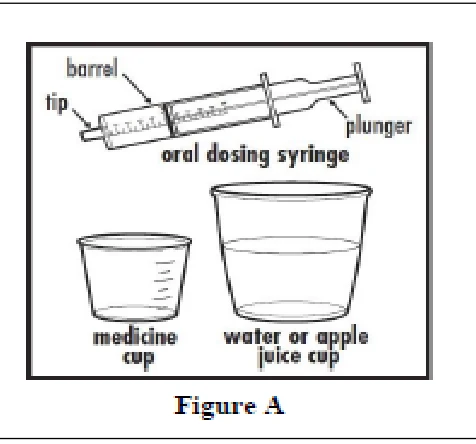 |
| Step 3: | Pour the appropriate amount (20 mL, 40 mL, 60 mL or 80 mL) of water or apple juice from the small cup into the medicine cup, as instructed by your doctor. Check to make sure that the amount of liquid lines up with the amount that your healthcare professional tells you (see Figure B). | 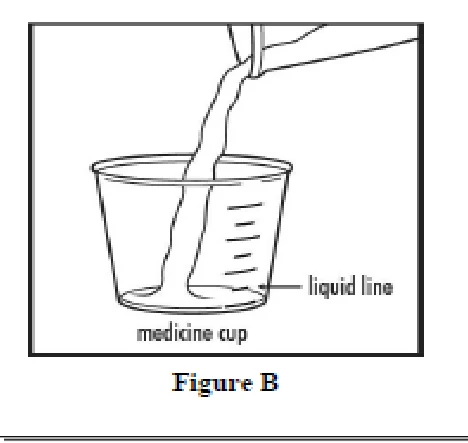 |
| Step 4: | Check the label on the Reddy-Sapropterin sachet(s). If the sachet is marked Reddy-Sapropterin 100 mg, empty the entire contents of the Reddy-Sapropterin sachet into the medicine cup (See Figure C). | 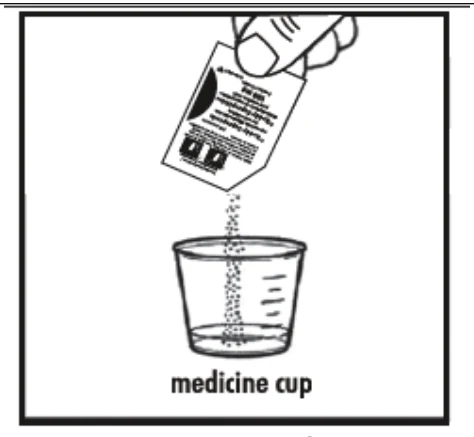 Figure C |
| Step 5: | Stir with the small spoon or other clean utensil until all of the powder completely dissolves (see Figure D). | 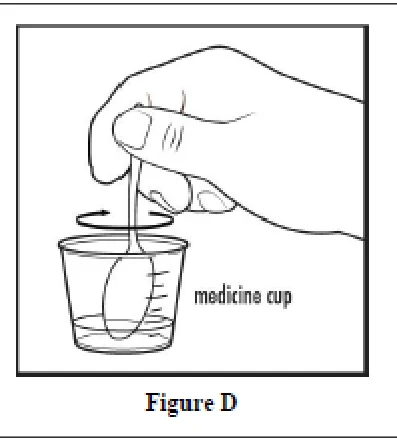 |
|---|---|---|
| Step 6: | Place the tip of the oral dosing syringe into the liquid inside the medicine cup. Pull back on the plunger and draw up the exact amount of the mixture that your doctor has indicated (see Figure E). | 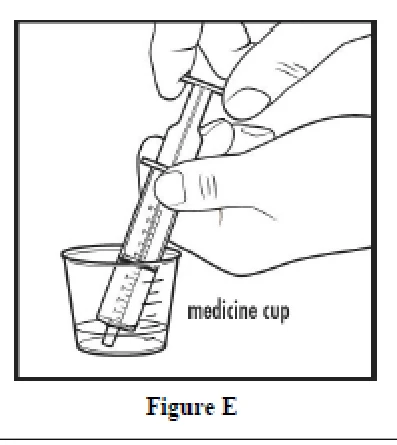 |
| Step 7: | Take the oral dosing syringe out of the medicine cup. Carefully turn the oral dosing syringe so that the tip is pointing up. Check to make sure that the amount of medicine in the oral dosing syringe lines up with the amount of mixture prescribed by your doctor (see Figure F). | 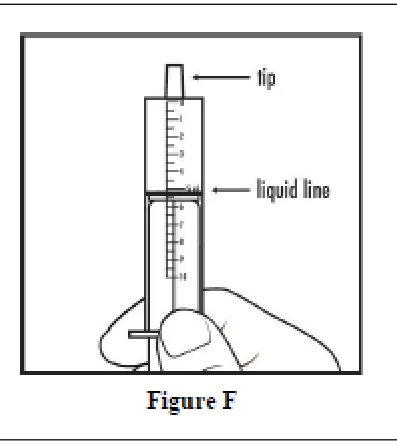 |
| Step 8: | Place the tip of the oral dosing syringe into your child’s mouth. Point the tip of the oral dosing syringe towards either cheek (see Figure G). Push on the plunger slowly, a small amount at a time, until all of the mixture in the oral dosing syringe is given. Give your child the dose within 15 minutes of mixing. If you are not able to give your child’s dose within 15 minutes after mixing, pour the unused medicine into the trash. You will need to mix a new dose. | 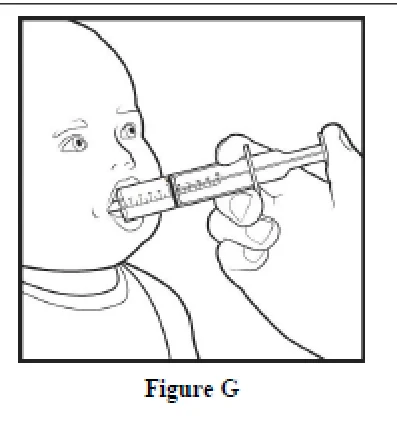 |
|---|---|---|
| Step 9: | Throw away any remaining mixture. Remove the plunger from the barrel of the oral dosing syringe. Wash the oral dosing syringe and medicine cup with warm water and air dry. When the oral dosing syringe is dry, put the plunger back into the barrel. Store the oral dosing syringe and medicine cup for the next use. |
When taking Reddy-Sapropterin, any changes in diet may affect your blood Phe levels. Follow your doctor’s instructions carefully. Avoid changes to your diet and Phe intake without talking to your doctor first. Your doctor will continue to monitor your blood Phe levels during your treatment with Reddy-Sapropterin to make sure that your blood Phe levels are not too high or too low.
Blood Phe levels may go up during a fever or sickness. Tell your doctor as soon as possible so they can change the dose of Reddy-Sapropterin to help keep blood Phe levels in the desired range.
Usual dose:
The dose of Reddy-Sapropterin is based on body weight.
- Reddy-Sapropterin starting dose: 10 mg/kg body weight taken once a day with a meal.
- Your doctor can change your dose of Reddy-Sapropterin depending on how you respond to treatment.
- For children in particular, the dose of Reddy-Sapropterin will change as the child grows.
Overdose:
Patients who have accidentally taken too much Reddy-Sapropterin reported mild headache, mild dizziness, stomach or belly pain and/or too much or constant activity (hyperactivity).
| If you think you, or a person you are caring for, have taken too much Reddy-Sapropterin, contact a healthcare professional, hospital emergency department, or regional poison control centre immediately, even if there are no symptoms. |
|---|
Missed Dose:
If you forget to take your dose of Reddy-Sapropterin, take it as soon as you remember that day. But if you miss the dose for that day, skip the missed dose, and continue with your scheduled dose the following day. Do not take two doses of Reddy-Sapropterin on the same day.
What are possible side effects from using Reddy-Sapropterin?
These are not all the possible side effects that you may feel when taking Reddy-Sapropterin. If you experience any side effects not listed here, contact your healthcare professional.
|
|
|---|
Your healthcare professional will decide when to perform blood tests and will interpret the results.
Serious side effects and what to do about them
| Symptom / effect | Talk to your healthcare professional | Stop taking drug and get immediate medical help | |
Only if severe | In all cases | ||
| COMMON | |||
| Lymphadenopathy (swelling of lymph nodes): lump under your skin that is tender or painful when touched | √ | ||
| UNCOMMON | |||
| Edema (swelling): fluid accumulation beneath skin of lower limbs | √ | ||
| Hives: itchy bumpy rash | √ | ||
| Severe allergic reactions: heavy breathing with whistling sound, trouble breathing, coughing, feeling dizzy or faint, turning red, nausea, and rash. | √ | ||
| Esophageal (food pipe) disorders: food pipe pain, severe heartburn | √ | ||
| Pale skin | √ | ||
| Retching (gagging, vomiting, nausea) | √ | ||
| Shortness of Breath | √ | ||
| Swelling of Eyelid | √ | ||
| Throat tightness | √ | ||
| Convulsions: seizure, spasms, shaking or fits | √ | ||
Nephrolithiasis (kidney stones): severe, sharp pain in the side of the back, pain or burning when urinating, pink, red or brown urine, foul-smelling urine, nausea, vomiting, fever, chills | √ | ||
| Epigastric ulcer (sores in the lining of your stomach or part of the small intestine): dull pain in your stomach, no appetite, nausea, vomiting, bloating, feel full easily, burping, heartburn | √ | ||
Serious side effects and what to do about them
| Symptom / effect | Talk to your healthcare professional | Stop taking drug and get immediate medical help | ||
Only if severe | In all cases | |||
| RARE | Gastroenteritis and Gastritis (inflammation of the lining of the stomach and/or intestines): burning sensation or pain in your upper abdomen/stomach, vomiting, diarrhea | √ | ||
| FREQUENCY NOT KNOWN | Esophagitis (inflammation of the lining of the food pipe): burning sensation or pain in your food pipe | √ | ||
If you have a troublesome symptom or side effect that is not listed here or becomes bad enough to interfere with your daily activities, tell your healthcare professional.
Reporting Side Effects
You can report any suspected side effects associated with the use of health products to Health Canada by:
NOTE:. Contact your health professional if you need information about how to manage your side effects. The Canada Vigilance Program does not provide medical advice. |
|---|
Storage:
- Store at 15°C - 30°C. Protect from moisture
- Do not leave Reddy-Sapropterin in hot or humid places, such as your car or bathroom cabinet.
- Do not keep Reddy-Sapropterin that is out of date, or that you no longer need. Be sure that if you throw any medicine away, it is out of the reach of children.
Keep out of reach and sight of children.
If you want more information about Reddy-Sapropterin:
- Talk to your healthcare professional
Find the full product monograph that is prepared for healthcare professionals and includes this Patient Medication Information by visiting the Health Canada website:
- (https://www.canada.ca/en/health-canada/services/drugs-health-products/drug-products/drug-product-database.html); or by contacting the manufacturer’s website (www.drreddys.com), or by calling 1-855-845-1739.