


Patient Medication Information: uses, side effects, how to take - Piasky
Serious Warnings and Precautions
Meningococcal infections
Your doctor may recommend that you receive other vaccinations before treatment. Check with your doctor before treatment begins. If you have any doubts whether you should start using PIASKY, talk to your doctor. |
Meningococcal infection symptoms
Because of the importance of rapidly identifying and treating meningococcal infection in patients who receive PIASKY, you will be provided with a patient card to carry with you at all times, listing relevant signs and symptoms of meningococcal infection/sepsis. You should carry it with you at all times during treatment with PIASKY and for 11 months after your last dose of PIASKY.
If you experience any of the following symptoms, you should immediately inform your doctor:
fever, feeling sick (nausea or vomiting), headache, confusion or irritability, stiff neck or back, muscle aches with flu-like signs or symptoms, sensitivity of the eyes to lights and rashes or spots on your skin.
What is PIASKY used for?
PIASKY is used to treat a disease called paroxysmal nocturnal hemoglobinuria (PNH) for adults and children 13 years of age and older with a body weight of at least 40 kg.
In patients with PNH, their red blood cells can be destroyed which can lead to low blood counts (anemia), tiredness, difficulty in functioning, pain, dark urine, shortness of breath, and blood clots.
How does PIASKY work?
PIASKY contains the active substance crovalimab and belongs to a class of medicines called monoclonal antibodies. Crovalimab attaches to and stops the action of a specific protein in the body called C5, preventing the complement system (part of the immune system that protects against infection) from attacking and damaging red blood cells.
What are the ingredients in PIASKY
Medicinal ingredients: crovalimab
Non-medicinal ingredients: L-Arginine Hydrochloride, L-Aspartic Acid, L-Histidine, Poloxamer 188, Water for Injection
PIASKY comes in the following dosage forms:
Single-use 2 mL vial containing 340 mg/2 mL (170 mg/mL) in a solution for intravenous infusion and subcutaneous injection
Do not use PIASKY if:
- you are allergic to crovalimab or any of the other ingredients of PIASKY. If you think you may be allergic, ask your doctor or healthcare professional for advice.
- you have an ongoing meningococcal infection.
To help avoid side effects and ensure proper use, talk to your healthcare professional before you take PIASKY. Talk about any health conditions or problems you may have, including if you:
- think you have any of the following signs of meningococcal infection, before, during or after PIASKY treatment, such as: fever, feeling sick (nausea or vomiting), headache, confusion or irritability, stiff neck or back, muscle aches with flu-like signs or symptoms, sensitivity of the eyes to lights and rashes or spots on your skin.
- have signs of any other infection before, during or after PIASKY treatment, such as: fever, cough, chest pain, tiredness, feeling short of breath, painful rash, sore throat, burning pain when passing urine, feeling weak or generally unwell. ·
- have recently received a vaccine or may receive a vaccine in the future. Your doctor will check if you need any vaccines before you start PIASKY.
- have received or are currently receiving another treatment for PNH. Side effects may occur during the transition period after switching to PIASKY from another treatment. Before you take PIASKY, it is important to tell your doctor if you are currently being treated or previously have ever been treated with any other C5 inhibitor. This is because you can develop a type of drug reaction, known as a Type III immune complex reaction (symptoms may include red skin, joint pain or fever), during the first 30 days after you switch from another C5 inhibitor to PIASKY. This can also occur if you stop taking PIASKY and switch to a different C5 inhibitor.
- have recently received a vaccination, taken or might take any other medicines, including medicines obtained without a prescription, because these medications might interact with PIASKY.
Other warnings you should know about:
Seek immediate medical attention if you experience any of the following during treatment with PIASKY:
- any signs of meningococcal infection such as: fever, feeling sick (nausea or vomiting), headache, confusion or irritability, stiff neck or back, muscle aches with flu-like signs or symptoms, sensitivity of the eyes to lights and rashes or spots on your skin.
- any signs of severe allergic reactions such as: tight chest or wheezing, feeling short of breath, fever or chills, severe dizziness, or light headedness, swelling of the lips, tongue, face, skin itching, hives or rash.
Tell your healthcare professional if you experience any of the following during treatment with PIASKY:
- worsening signs and symptoms of your underlying disease with symptoms of anemia (low number of red blood cells) such as: feeling tired or having low energy, or dark urine, stomach pain, difficulty swallowing, difficulty getting or keeping an erection (erectile dysfunction), the kidneys not working properly, or blood clots (thrombosis) which may show symptoms such as progressive leg swelling on one leg, or breathlessness out of keeping with normal activities.
- red skin, joint pain, or fever if you have switched from another treatment for PNH, specifically another C5 inhibitor, to PIASKY in the past 30 days as this could mean that you have developed a type of reaction known as a Type III immune complex reaction.
- reactions to the infusion (drip) or injection such as headache, lower back pain, pain at infusion/injection site and elsewhere, swelling, bruising or bleeding, red skin, itching and rash.
Do not stop treatment with PIASKY unless you have discussed this with your healthcare provider first. This is because stopping treatment may lead to destruction of your red blood cells by your immune system and may make your symptoms of PNH come back or get worse. If you have any of these signs and symptoms, contact your healthcare provider.
Pregnancy, breast-feeding and fertility
If you are pregnant or breast-feeding, think you may be pregnant or are planning to have a baby, ask your doctor for advice before taking this medicine.
Your doctor will discuss with you the potential risks of using PIASKY during pregnancy or during breast-feeding.
There are currently no data on the use of PIASKY in pregnant women or breast feeding and the effects on an unborn child are not known.
Children
PIASKY can be used in children or young people 13 years and older who weigh at least 40 kg at the same dose as for adults.
Do not give PIASKY to children and young people that do not weigh at least 40 kg. This is because it has not yet been studied in this weight group.
Immunogenicity – Lack of response
Your body may make antibodies against PIASKY which may stop PIASKY from working properly.
Tell your healthcare professional about all the medicines you take, including any drugs, vitamins, minerals, natural supplements or alternative medicines.
The following may interact with PIASKY:
- other medicines for PNH known as “complement inhibitors”, such as SOLIRIS and ULTOMIRIS
How to take PIASKY:
At least 2 weeks before you start treatment with PIASKY, your doctor will vaccinate you against meningococcal infections if you have not been vaccinated before, or if your vaccination is outdated.
If immediate treatment with PIASKY is needed, you should receive vaccination against meningococcal infections as soon as possible and your doctor will prescribe you antibiotics from the time you start PIASKY for at least two weeks after you have been vaccinated.
PIASKY is supplied in a vial and can be given through the vein as an intravenous infusion or as an injection under the skin called a subcutaneous injection.
- Your first dose will be given as by infusing a dilution of the PIASKY vial form a drip bag into a tube directly into one of your veins by a healthcare professional in a clinic or treatment centre.
- The next doses are given as injection(s) under the skin by healthcare providers.
- Once your healthcare provider decides you or your caregiver is able to give the injection, you may self-inject or your caregiver may give the subcutaneous injection of PIASKY without medical supervision. Your healthcare provider will provide training to you or your caregiver on how to prepare and give the subcutaneous injections.
Always take PIASKY exactly as your healthcare provider has trained you. Check with your healthcare provider if you are not sure.
Usual dose:
- Your first dose will be given as an intravenous infusion on Day 1 by your healthcare provider. This is the first loading dose.
- The following loading doses will be given as a subcutaneous injection on Days 2, 8, 15, and 22.
- After this, PIASKY will be administered on Day 29 and then every 4 weeks as subcutaneous injections. These are the maintenance doses.
- If you were previously receiving another medicine for PNH known as a ‘complement inhibitor’, the first loading dose of PIASKY should be given at the time of the next scheduled dose.
Your healthcare provider will prescribe a dose and treatment plan based on how much you weigh, as outlined below.
If you weigh 40 kg or more, but less than 100 kg:
- your first loading dose on Day 1 will be 1000 mg by intravenous infusion over 60 minutes
- your loading doses on Day 2, 8, 15, and 22 will be 340 mg administered as a subcutaneous injection
- your maintenance doses on Day 29 - and every 4 weeks after- will be 680 mg administered as 2 subcutaneous injections.
If you weigh 100 kg or more:
- your first loading dose on Day 1 will be 1500 mg by intravenous infusion over 90 minutes
- your loading doses on Day 2, 8, 15, and 22 will be 340 mg by 1 subcutaneous injection
- your maintenance doses on Day 29 - and every 4 weeks after - will be 1020 mg by 3 subcutaneous injections.
Your maintenance dose may change if your weight changes over time while receiving PIASKY. Talk to your healthcare provider if your weight becomes equal to or exceeds 100 kg or falls below 100 kg.
PIASKY is a long-term treatment. Your healthcare provider will regularly monitor your condition to check that the treatment is having the desired effect.
Overdose:
| If you think you, or a person you are caring for, have taken too much PIASKY, contact a healthcare professional, hospital emergency department, or regional poison control centre or Health Canada’s toll-free number, 1-844 POISON-X (1-844-764-7669) immediately, even if there are no symptoms. |
Missed Dose:
If you miss injecting your entire scheduled dose or part of your scheduled dose, inject the missing dose or remainder of the dose as soon as you remember before the day of the next scheduled dose. The subsequent dose should then be administered according to the original schedule. Do not double your dose or inject more than your prescribed dose on the same day to make up for a missed dose. Check with your healthcare provider if you are not sure.
What are possible side effects from using PIASKY?
These are not all the possible side effects you may have when taking PIASKY. If you experience any side effects not listed here, tell your healthcare professional.
Like all medicines, this medicine can cause side effects, although not everybody gets them.
PIASKY may cause serious side effects. Seek immediate medical attention if you have any of the following side effects:
- Signs of severe allergic reaction including tight chest or wheezing, feeling short of breath, fever or chills, severe dizziness, or light headedness, swelling of the lips, tongue, face and skin itching, hives, or rash.
The other possible side effects of PIASKY include:
Very common (may affect more than 1 in 10 people):
- red skin, itching or joint pain -signs of a drug reaction that could happen if you switched from another C5 inhibitor to PIASKY
- runny nose, sneezing, sore throat, and cough – signs of an upper respiratory tract infection
- fever
- reactions to the infusion
- headache
Common (may affect up to 1 in 10 people):
- infection of the lungs (pneumonia)
- urinary tract infection
- reactions to the injection
- joint pain
- fatigue
- diarrhea
- common cold (nasopharyngitis)
Uncommon (may affect up to 1 in 100 people)
- Allergic reactions
- Bacterial infection
- Infection of the kidneys (pyelonephritis)
- Severe reaction to an infection (sepsis), which can be accompanied by severe low blood pressure (septic shock)
| Serious side effects and what to do about them | |||
| Symptom / effect | Talk to your healthcare professional | Stop taking drug and get immediate medical help | |
| Only if severe | In all cases | ||
| UNKNOWN | |||
| Meningococcal infection: fever, feeling sick (nausea or vomiting), headache, confusion or irritability, stiff neck or back, muscle aches with flu-like signs, sensitivity of the eyes to lights and skin rashes or spots. | ✔ | ✔ | |
If you have a troublesome symptom or side effect that is not listed here or becomes bad enough to interfere with your daily activities, tell your healthcare professional.
Reporting Side Effects
You can report any suspected side effects associated with the use of health products to Health Canada by:
NOTE: Contact your health professional if you need information about how to manage your side effects. The Canada Vigilance Program does not provide medical advice. |
Storage:
Store at 2°C to 8°C.
Keep the vial in the outer carton in order to protect from light. Do not freeze. Do not shake.
Keep out of reach and sight of children.
If you want more information about PIASKY:
- Talk to your healthcare professional
- Find the full product monograph that is prepared for healthcare professionals and includes this Patient Medication Information by visiting the Health Canada website: (https://www.canada.ca/en/health-canada/services/drugs-health-products/drug-products/drug-product-database.html; the manufacturer’s website (www.rochecanada.com), or by calling 1-888-762-4388.
Last Revised JUN 04, 2025
PIASKY® is a registered trademark of Chugai Pharmaceutical Co., Ltd., used under license.
All other trademarks are the property of their respective owners.
© Copyright 2025, Hoffmann-La Roche Limited

Hoffmann-La Roche Limited
Mississauga, ON L5N 5M8
Instructions for Use
PIASKY (crovalimab for injection)
340 mg in 2 mL (170 mg/mL) sterile solution
Vial for subcutaneous Injection
Before you use the vial
Read this entire Instructions for Use before you or your caregiver start using PIASKY and each time you get a new prescription. There may be new information.
This information does not take the place of talking to your Healthcare Professional about your medical condition or treatment.
Your Healthcare Professional may decide that you or your caregiver can give the PIASKY injections.
- In this case, your Healthcare Professional will show you or your caregiver how to inject your dose of PIASKY the right way.
- Do not use PIASKY until your Healthcare Professional has trained you or your caregiver on the right way to inject.
- Do not inject into a vein (intravenous injection).
Storage and Handling
- Store PIASKY vial in its original carton in the refrigerator between 2°C to 8°C until ready to use. PIASKY in its original carton may be kept at room temperature up to 30°C for no longer than 7 days.
- PIASKY is sensitive to light. After you remove PIASKY vial from the carton, keep PIASKY away from direct sunlight.
- Keep PIASKY vials out of the reach of children.
- Keep syringes and needles out of the reach of children.
- Each PIASKY vial, syringe, and needle can be used only 1 time.
- Keep hands away from the end of the needle during use and disposal.
- Do not freeze the vial. Do not use the vial if it has been frozen. Safely throw away the vial in a sharps container (see step 43) and contact your healthcare professional.
- Do not use the vial if it has been kept at room temperature, up to 30° C, for longer than 7 days. Safely throw away the vial in a sharps container (see step 43) and contact your healthcare professional.
- Do not store syringes filled with PIASKY. A syringe filled with the medicine must be used right away.
- Do not shake the vial.
- Do not reuse the vial, the syringe or the needles for another injection.
- Do not share your syringe and needles with other people.
Full dose and number of injections
Your PIASKY dose may require up to 3 injections, one after the other. You may need up to 3 PIASKY vials to receive your full dose.
- Your healthcare professional will tell you or your caregiver how many injections you need and how often you need to inject the medicine.
- If your prescribed dose of PIASKY is 680 mg, do 2 separate injections, one after the other.
- If your prescribed dose of PIASKY is 1020 mg, do 3 separate injections, one after the other.
- Always use a new PIASKY vial for each injection.
- If you are not sure of the dose, ask your healthcare professional.
- Do not split your full dose if you do not have all the PIASKY vials you need. Contact your healthcare professional.
Supplies needed for 1 injection
This list is for a single injection. Change the number of the supplies according to the number of injections needed (see Full dose and number of injections section above).
Included in the carton:
- 1 PIASKY vial
Not included in the carton:
- 18 gauge with single bevel transfer needle or 21 gauge standard needle
- 25, 26 or 27 gauge injection needle with safety shield. The needle length should be from 3/8” (9 mm) to ½” (13 mm).
- 2-mL or 3-mL syringe
2 alcohol pads (1 for your skin and 1 for the vial)
- 1 sterile cotton ball or gauze
- 1 small adhesive bandage
- 1 sharps disposal or puncture-resistant container (see step 43)
Open the carton
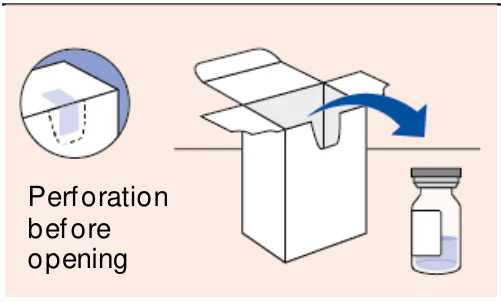
- 1 Take the PIASKY vial carton(s) you need out of the refrigerator. Open the carton(s) and remove the vial(s).
- 2
Place the vial(s) on a clean, flat surface.
Check the dose your healthcare professional has prescribed. The full dose may require up to 3 injections one after the other. You may need up to 3 vials to receive a full dose. Gather all the vials you need.
Perforation
before
opening
- Do not use the vial if the carton is damaged, or if the perforation of the opening is broken. Safely throw away the vial in a sharps container (see step 43) and contact your healthcare professional.
Check the vial(s)
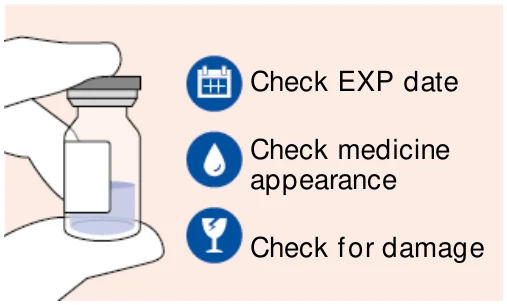
- 3 Check the expiration (EXP) date on the vial(s).
- 4
Check the appearance of the medicine.
The medicine must be clear, and colourless to brownish-yellow.
- 5
Check the vial(s) for any damage – like cracks or scratches.
- ● Do not use if the expiration (EXP) date has passed.
- ● Do not use if the medicine looks cloudy, discoloured, or has particles in it.
- ●
Do not use if the vial is cracked or broken.
If you find any of the above, safely throw away the vial in a sharps container (see step 43) and/or contact your healthcare professional.
Warm-up time
- 6
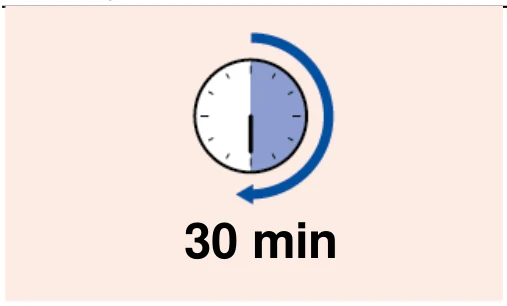
Place the vial(s) on a clean, flat surface for 30 minutes, away from direct sunlight. This allows the medicine to reach room temperature.
If the vial is not at room temperature, the cold medicine could make it difficult to withdraw, and harder to inject the medicine. It could also cause discomfort.
- Do not speed up the warming process in any way, such as microwave, warm water or direct sunlight.
Do not remove the vial cap while the vial reaches room temperature.
30 min
Check EXP date
Check medicine appearance
Check for damage
Collect the other supplies
- 7
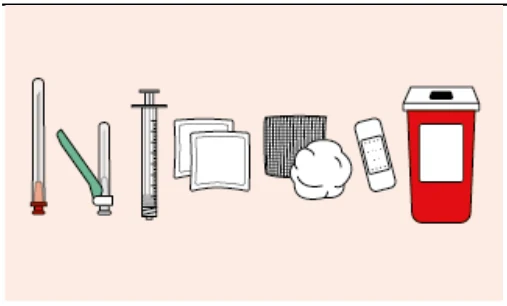
Collect the other supplies, while the vial reaches room temperature.
The list is for a single injection. Change the number of supplies according to the number of injections you need.
Note: the colour of your supplies might differ from the illustrations.
- 1 transfer needle
- 1 injection needle with safety shield
- 1 syringe
- 2 alcohol pads – 1 for your skin and 1 for the vial
- 1 sterile cotton ball or gauze
- 1 small adhesive bandage
- 1 sharps disposal container (see “Disposal of syringes, needles, and vials”)
Choose the injection site
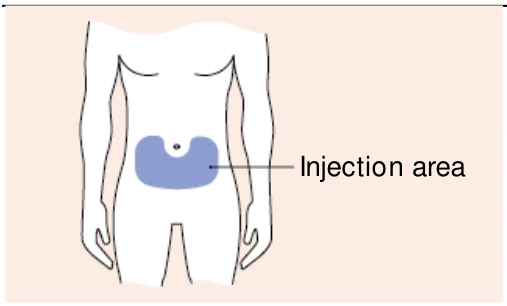
- 8
PIASKY must only be injected in the stomach area (abdomen).
Make sure you do not inject into the same spot multiple times in a row. Each injection must be at least 2 inches (5 cm) apart from the previous one.
- ● Do not inject into the arm or thigh.
- ● Do not inject into the 2-inch (5 cm) area around the belly button.
- ● Do not inject into moles, scars, or areas where the skin is tender, bruised, red, hard, or not intact.
Clean the injection site
Injection area
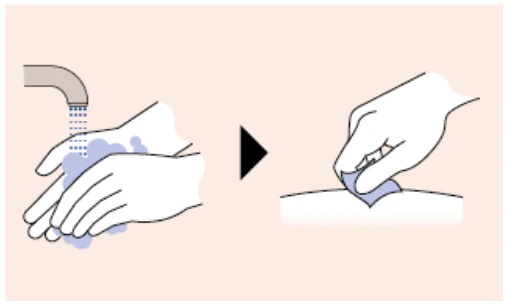
- 9 Wash your hands with soap and water.
- 10
Wipe the injection site with an alcohol pad and let it air dry.
- ● Do not touch, fan, or blow on the area you have cleaned.
Clean the vial top
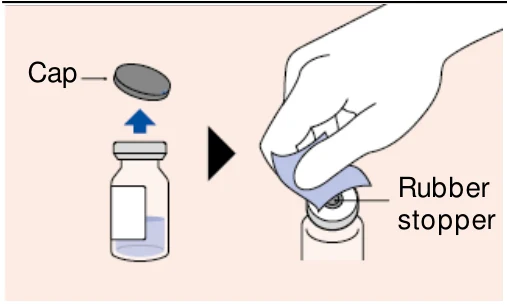
- 11 Remove the coloured cap from the vial. Throw away the coloured cap in the sharps container (see step 43).
- 12
Wipe the rubber stopper with the other alcohol pad.
- ● Do not touch the rubber stopper after it is cleaned.
Attach the transfer needle
Cap
Rubber stopper
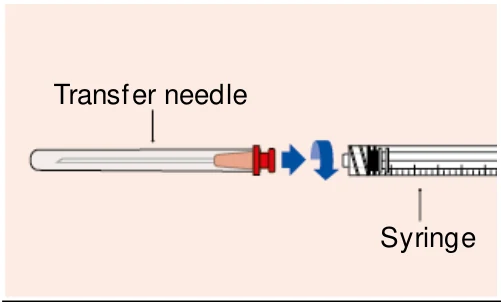
Transfer needle
Syringe
- 13 Remove the syringe and the transfer needle from their packaging.
- 14
Push and twist the transfer needle to the right until it is fully attached onto the syringe.
Keep the cap on the needle.
- Do not use the injection needle (with the safety shield) to withdraw the medicine.
Fill the syringe with air
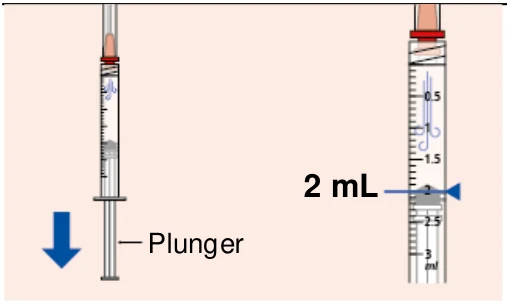
- 15
With the needle cap still on, slowly pull back on the plunger and draw air into the syringe to the 2-mL line.
Note: The vial does not contain air. The air injected into the vial will allow the medicine to be withdrawn more easily and prevent the plunger from moving.
Uncap the transfer needle
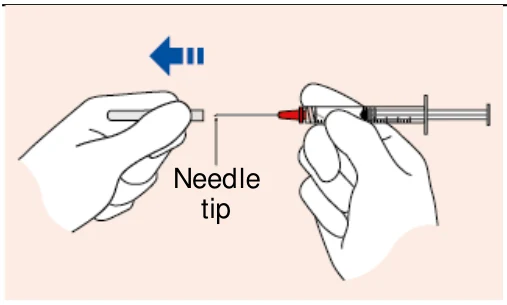
- 16 Hold the syringe in the middle and carefully pull the needle cap away from the syringe.
- 17
Keep the cap on the flat surface.
You will need to put it back on the needle after transferring the medicine.
- Do not throw the cap away.
Do not touch the needle or let the needle touch any surface after the cap has been removed.
Plunger
2 mL
Needle
tip
Inject the air into the vial
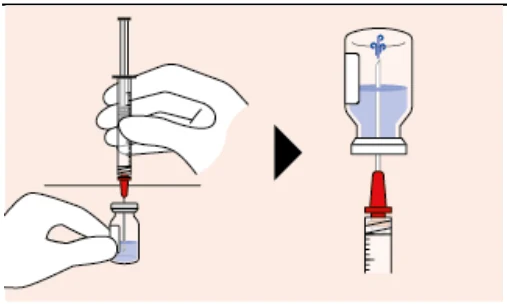
- 18 Hold the vial on the flat surface and insert the needle straight down into the center of the rubber stopper.
- 19 Keep the needle in the vial and turn the vial upside down.
- 20 Make sure that the tip of the needle is above the medicine.
- 21 With the vial on top, push on the plunger to inject the air into the vial.
- 22
Keep your fingers pressed down on the plunger to stop it from moving.
- ● Do not inject the air into the medicine, as this would make bubbles in the medicine.
Transfer all the medicine
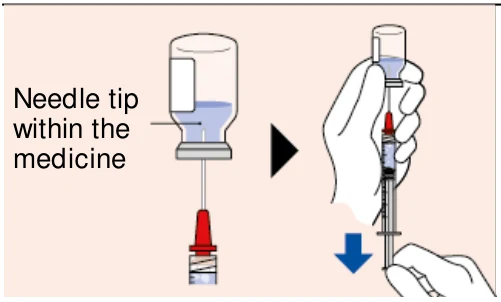
- 23 Slide the tip of the needle down so it is within the medicine.
- 24
Slowly pull back the plunger to transfer all the medicine into the syringe.
- Do not completely pull the needle out of the vial.
- Do not completely pull the plunger out of the syringe.
Make sure you keep the tip of the needle within the medicine at all times as the medicine is transferred into the syringe. You may have to slide the needle down or you may transfer some air into the syringe.
Needle tip
within the
medicine
Remove the air bubbles
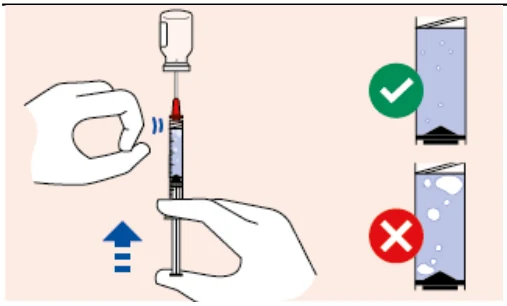
- 25 If you have any air bubbles or space filled with air in the syringe, gently tap the side of the syringe with your finger until the air bubbles rise to the top of the syringe.
- 26
Slowly push the plunger up to push the air bubbles back into the vial.
If you push some medicine into the vial, slowly pull back on the plunger (more slowly this time) to transfer all the medicine from the entire vial (see steps 23 and 24).
Recap the transfer needle
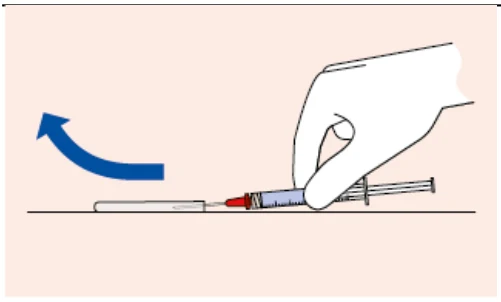
- 27 Remove the syringe from the vial.
- 28 Using only one hand, slide the needle into the cap placed on the flat surface.
- 29
When the needle is covered, lift the syringe up and push the cap to fully attach over the needle.
- ● Do not hold the cap with your fingers while you slide the needle in it.
Warning: Do not use the transfer needle to inject the medicine. The transfer needle is too big to inject the medicine.
Remove the transfer needle
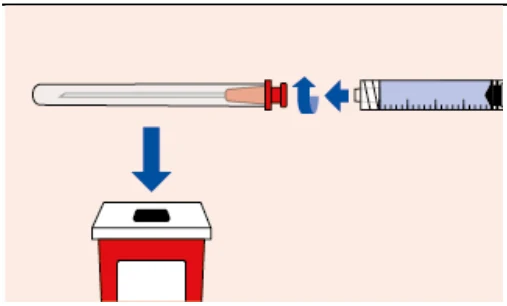
- 30 Hold the syringe, twist the transfer needle to the left to remove it.
- 31 Throw away the transfer needle into a sharps disposal container (see step 43).
- ● Do not touch the tip of the syringe after the transfer needle has been removed.
Attach the injection needle
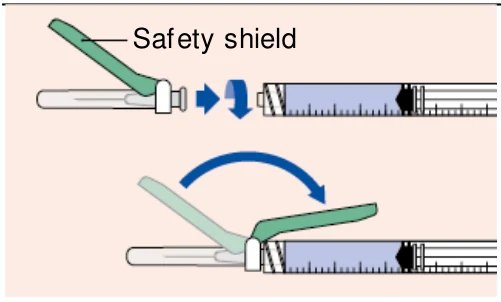
- 32 Remove the injection needle from its packaging.
- 33 Push and twist the injection needle to the right until it is fully attached onto the syringe.
- 34 Move the safety shield back toward the syringe as shown in the figure above.
Uncap the injection needle
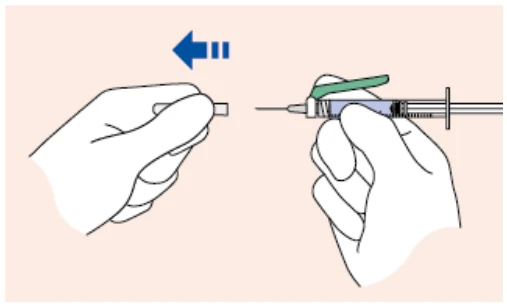
- 35
Hold the syringe in the middle and carefully pull the needle cap away from the syringe.
Safety shield
- Do not twist or bend the cap while you are pulling it.
- Do not touch the needle or let it touch any surfaces after removing the needle cap.
- Do not put the cap back on after it has been removed because this may damage the needle.
- Do not use the syringe if it has been dropped or damaged.
Adjust the plunger
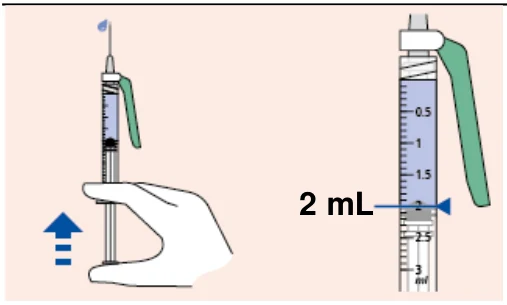
- 36 Slowly push the plunger to the 2-mL line.
Insert the needle
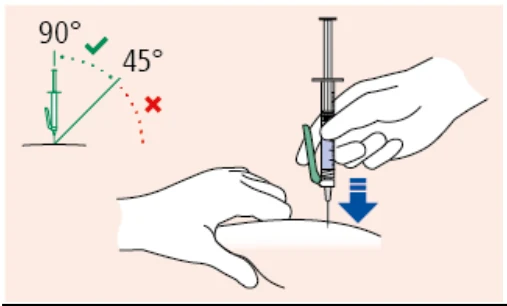
- 37 With one hand, pinch the cleaned skin area.
- 38 With the other hand, hold the syringe by the middle, at an angle between 45° to 90° to the skin.
- 39
With a quick motion, insert the needle all the way into the pinched skin.
- ● Do not hold or push the plunger while inserting the needle.
Inject the medicine
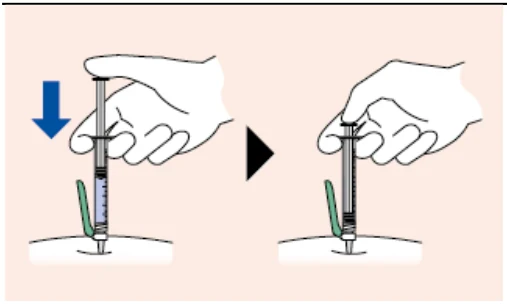
- 40 Slowly push the plunger all the way down to inject all the medicine.
- 41
Let go of the pinched skin and remove the needle.
2 mL
Cover the injection needle
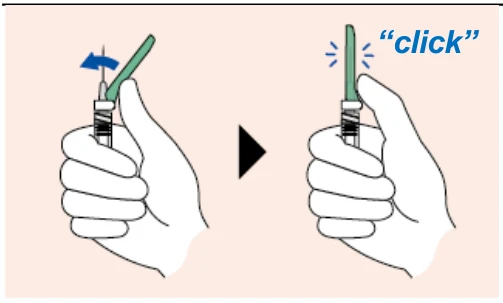
- 42
After your injection, press the safety shield over the needle with the thumb until you hear or feel a “click.” If you do not hear a “click,” look to see that the needle is fully covered by the safety shield.
- ● Do not recap the needle with the original cap.
- ● Do not use your two hands to cover the needle.
- ● Do not remove the needle from the syringe.
Dispose of the syringe and vial
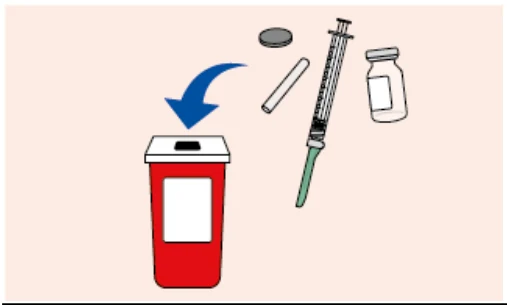
- 43
Put your used PIASKY vials, syringe, needles and remaining material in a sharps disposal container right after use (see “Disposal of syringes, needles, and vials”).
- ● Do not throw away your loose needle, syringes and vial, in your household waste.
- ● Do not try to take the syringe apart.
Check the injection site
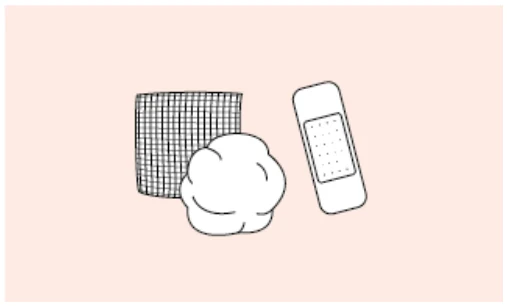
- 44
There may be a small amount of blood or medicine at the injection site.
You can press a cotton ball or gauze until any bleeding stops. If needed, cover the injection site with a small adhesive bandage . If bleeding does not stop contact your healthcare professional.
“click”
Your injection is now complete.
- Do not rub or massage the area where you have injected.
Second or third injections
Disposal of syringes, needles, and vials

Put your used needles, syringes and vials in a sharps disposal container straight away after use. Do not throw away any loose needles and syringes in your household waste
When your sharps disposal container is almost full, you will need to follow your community guidelines for the right way to dispose of your sharps disposal container. There may be local requirements about how you should throw away used needles and syringes.
Do not dispose of your used sharps disposal container in your household trash unless your community guidelines permit this.
Do not recycle your used sharps disposal container.
Important: Always keep the sharps disposal container out of reach of children.
If the prescribed dose is 2 or 3 injections one after another, start again at step 8 with another PIASKY vial and new supplies. You may need up to 3 vials for a full dose. Make sure the next injection is not at the same spot you already used.