


Patient Medication Information: uses, side effects, how to take - Qnasl
What is QNASL used for?
QNASL is a prescription medicine that treats seasonal and perennial (year-round) allergic rhinitis in adults and children 4 years of age and older.
"Rhinitis" means inflammation of the lining of the nose. Allergic rhinitis is sometimes called "hay fever." Allergic rhinitis can be caused by allergies to pollen, animal dander, house dust mites, mold spores, and other things. If you have allergic rhinitis, your nose becomes stuffy, runny, and itchy when exposed to these allergens. You may also sneeze a lot. You may also have red, itchy, watery eyes or an itchy throat; or blocked itchy ears.
The safety and efficacy of QNASL in children under 4 years of age has not been established.
How does QNASL work?
QNASL contains the medicinal ingredient beclomethasone dipropionate, which is a man-made (synthetic) corticosteroid. Corticosteroids are natural substances found in the body that reduce inflammation. When you spray QNASL into your nose, it may help reduce the nasal symptoms of allergic rhinitis (inflammation of the lining of the nose), such as stuffy nose, runny nose, itching, and sneezing.
What are the ingredients in QNASL?
Medicinal ingredients: beclomethasone dipropionate
Non-medicinal ingredients: Propellant hydrofluoroalkane -134a (HFA-134a), ethanol
QNASL comes in the following dosage forms:
Nasal Aerosol: 40 mcg/spray and 80 mcg/spray.
Do not use QNASL if:
You are allergic to beclomethasone dipropionate or any of the non-medicinal ingredients in QNASL (see What are the ingredients in QNASL?).
To help avoid side effects and ensure proper use, talk to your healthcare professional before you take QNASL. Talk about any health conditions or problems you may have, including if you or your child:
- have had recent nose problems such as nasal sores, nasal surgery, or a nasal injury
- have or have had eye problems, such as increased pressure in your eye (glaucoma) or cataracts
- have tuberculosis or any untreated fungal, bacterial, or viral infections
- have untreated eye infections caused by herpes
- have not had or been vaccinated for chickenpox or measles
are pregnant or breastfeeding or plan to become pregnant or breastfeed
- are allergic to QNASL or any other corticosteroid
- are taking any other prescription or non-prescription (over-the-counter) medicines
This medicine has been prescribed for you by your doctor. Do not give this medicine to anyone else.
Other warnings you should know about:
- All cortisone-type medicines, especially when used for a long time, may possibly interfere with the usual growth pattern in growing children and adolescents. Your child’s growth must be monitored by your healthcare professional while they are taking QNASL.
- Avoid exposure to chicken pox and measles, and tell your healthcare professional immediately if you or your child are exposed while taking QNASL. This is important if you are taking any cortisone-type medicine as they can affect your immune system making it difficult for you/your child to properly fight infection.
Tell your healthcare professional about all the medicines you take, including any drugs, vitamins, minerals, natural supplements or alternative medicines.
The following may interact with QNASL:
QNASL and other medications may affect each other and cause side effects. QNASL may affect the way other medications work, and other medications may affect the way QNASL works.
Especially tell your healthcare professional if you take other corticosteroid medicines.
How to take QNASL:
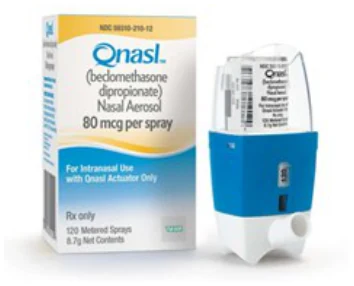
QNASL 80 mcg Nasal Aerosol is for use only in patients 12 years of age and older.
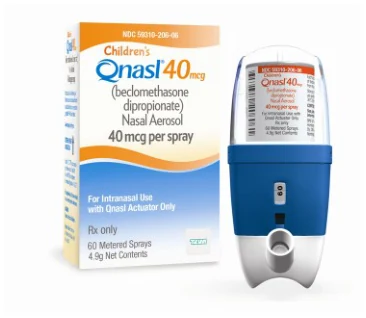
QNASL 40 mcg Nasal Aerosol is for use only in children 4 to 11 years of age and should be administered under the supervision of a parent, guardian or caregiver.
Children 4 to 11 years of age should not use the QNASL 80 mcg Nasal Aerosol device.
QNASL is for use in the nose only. Do not spray it in the eyes or mouth.
Use QNASL exactly as your healthcare professional tells you to use it. Do not use more of the medicine or take it more often than what your healthcare professional has instructed.
QNASL must be primed before using it for the first time and if it is not used for 7 or more days in a row. Do not prime QNASL every day.
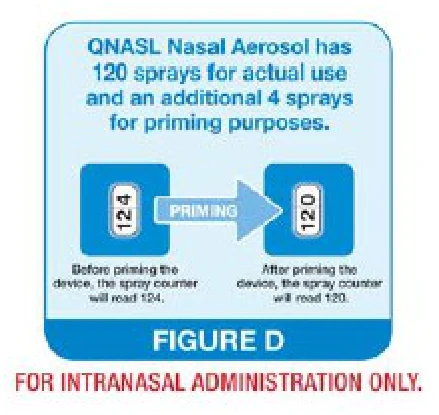
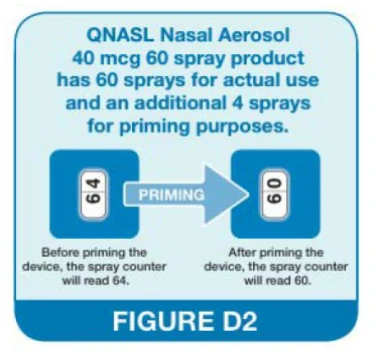
QNASL has a spray counter which should read, after your 4 initial priming sprays, 120 for QNASL 40 mcg Nasal Aerosol and QNASL 80 mcg Nasal Aerosol 120-actuation products and 60 for QNASL 40 mcg Nasal Aerosol 60-actuation product
Do not use QNASL after the spray counter reads 0. You may not get the right amount of medicine.
Usual dose:
Adults and adolescents 12 years of age and older:
- The usual dose of QNASL 80 mcg Nasal Aerosol is 2 sprays in each nostril, 1 time a day. You should not use more than a total of 4 sprays per day
- You will get the best results if you keep using QNASL 80 mcg Nasal Aerosol regularly each day. If your symptoms do not improve or get worse, call your healthcare professional
Children 4 to 11 years of age:
- The usual dose of QNASL 40 mcg Nasal Aerosol is 1 spray in each nostril, 1 time a day. Your child should not use more than a total 2 sprays per day
- Your child will get the best results if he/she keeps using QNASL 40 mcg Nasal Aerosol regularly each day. If your child’s symptoms do not improve or get worse, call your healthcare professional
Instructions for Use:
Note: For Use in the Nose Only.
- Do not spray QNASL in the eyes or directly onto the nasal septum (the wall between the 2 nostrils)
The parts of your QNASL
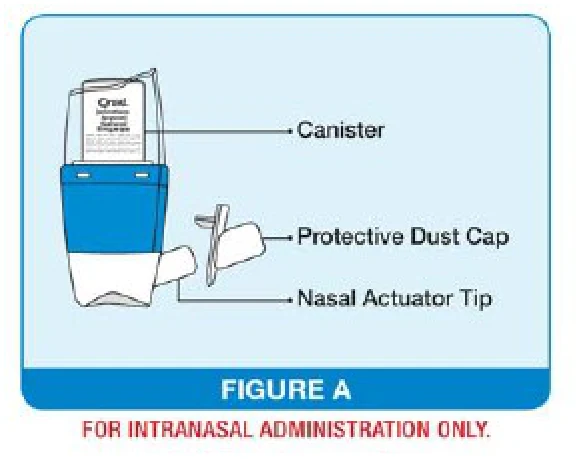
The QNASL device comes as a canister that fits into a nasal actuator with a built in spray counter and protective dust cap. (See Figure A)
- Do not use the QNASL actuator with a canister of medicine from any other inhaler
- Do not use the QNASL canister with an actuator from any other inhaler
- Do not remove the QNASL canister from the actuator
Priming your QNASL for Use
- Remove your QNASL device from its package
- Your QNASL device must be primed before you use it for the first time or if it has not been used for more than 7 days in a row
- Remove the protective dust cap from the device
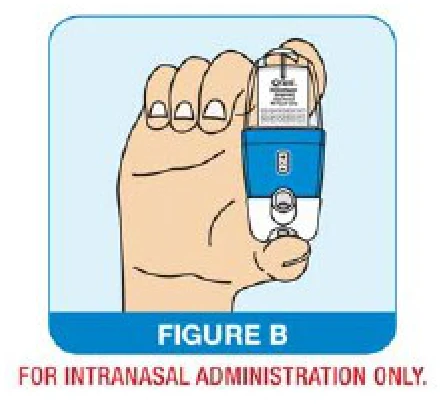
- Hold the nasal actuator upright between your thumb and forefinger (index finger). The canister should be on top and the white nasal actuator tip on bottom (See Figure B)
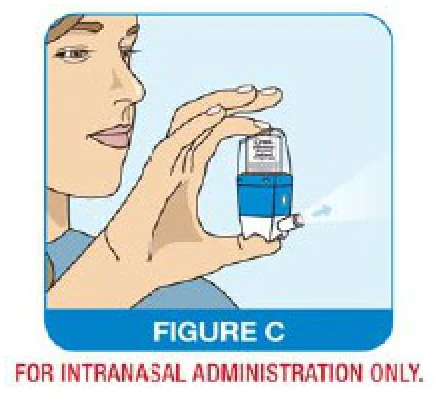
- If you have never used your QNASL device before, spray 4 times into the air, away from your eyes and face, by pressing down fully on the top of the canister 4 times (See Figure C). Your QNASL device is now ready to use
- After the first time you prime your QNASL device the spray counter should read 120 if you are using the canister with 120 sprays (See Figure D) or 60 if you are using the canister with 60 sprays (See Figure D2)

- Do not prime your QNASL device every day
- If you have used your QNASL device before, but it has not been used in more than 7 days, it must be reprimed. To reprime your QNASL device, spray 2 times into the air, away from the eyes and face, by pressing down fully on the top of the canister 2 times. Your QNASL device is now ready to use
Using Your QNASL Device
Step 1: Blow your nose to clear the nostrils.
Step 2: Remove the protective dust cap from your QNASL device.
Step 3: Inspect the nasal actuator tip to confirm it is clear of foreign objects.
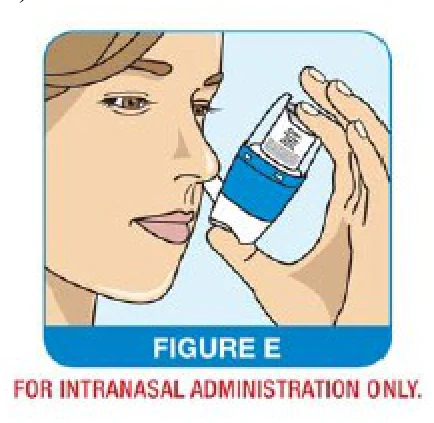
Step 4: Hold your QNASL device upright and insert the nasal actuator tip into one nostril (See Figure E)
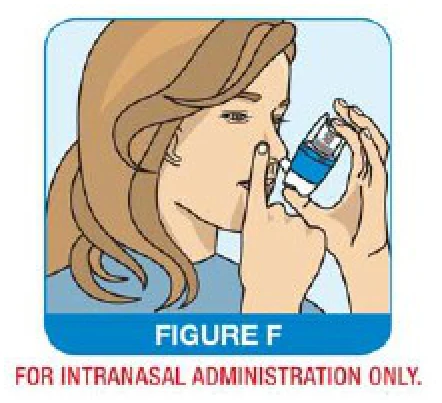
Step 5: Point the QNASL device slightly away from the wall between your nostrils (nasal septum) while holding your other nostril closed (See Figure F).
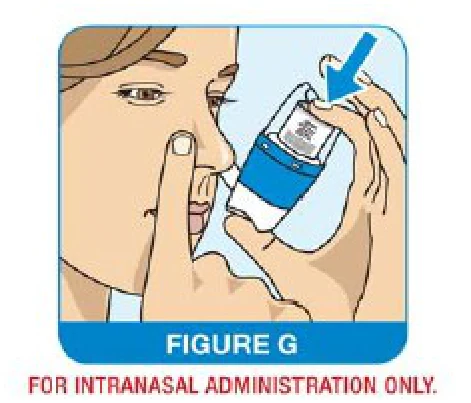
Step 6: Hold your breath and press down firmly and completely on the canister to release 1 spray (See Figure G). Continue to hold your breath for 5 seconds after releasing the spray and then breathe out slowly through your mouth. Take the QNASL device out of your nostril.
Step 7 (Adults and adolescents 12 years of age and older): Repeat steps 3-5 for the second spray in the same nostril. Note that Step 7 is only for adults and adolescents 12 years of age and older.
Step 8: Repeat steps 3-6 for your other nostril.
Step 9: You should not blow your nose for the next 15 minutes.
Note: The spray counter will count down each time there is a spray released from your QNASL device.
Step 10: Clean and store your device. See “Cleaning Your QNASL device.”
Cleaning Your QNASL device
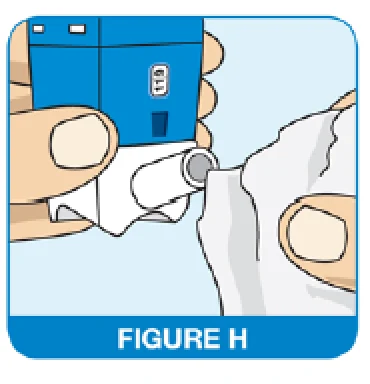
- Wipe the nasal actuator tip with a clean, dry tissue or cloth (See Figure H)
- Do not wash or put any part of the QNASL canister or actuator in water
- Replace the protective dust cap
- Keep your device clean and dry at all times
How to know when to stop using your QNASL device
- The QNASL device has a spray counter, which is there to let you know how many sprays of medicine you have left
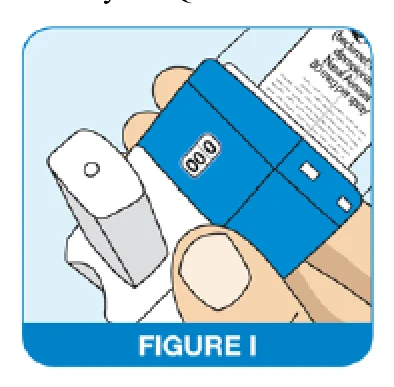
- Do not use your QNASL device when 0 is shown in the spray counter window (See Figure I).
- Throw away your QNASL device when the spray counter reaches 0
- Do not throw your QNASL canister in a fire or an incinerator
- Talk with your health care professional before your supply of QNASL runs out to see if you should get a refill
Overdose:
| If you think you have taken too much QNASL, contact your healthcare professional, hospital emergency department or regional Poison Control Centre immediately, even if there are no symptoms. |
Missed Dose:
It is very important that you use QNASL regularly; however, if you miss a single dose, do not worry - just take the next dose when it is due.
What are possible side effects from using QNASL?
These are not all the possible side effects you may feel when taking QNASL. If you experience any side effects not listed here, contact your healthcare professional. Please also see Warnings and Precautions.
The most common side effects from using QNASL are:
- Nasal discomfort
- Nose bleeds
- Headache
Other side effects include:
- Changes in taste and/or smell
- Tingling, itching, burning of the skin
- Sleeplessness
- Restlessness
The following side effects may also occur in children (ages 4 – 11 years):
- Fever
- Common cold, cough, strep throat
- Vomiting
- Ear infections
- Mouth and/or throat pain
- Asthma
- Rash
Serious side effects and what to do about them
| Symptom / effect | Talk to your healthcare professional | Stop taking drug and get immediate medical help | |
| Only if severe | In all cases | ||
RARE Allergic Reaction: symptoms like shortness of breath or trouble breathing, skin rash, redness, or swelling, severe itching, swelling of your lips, tongue or face, trouble swallowing | |||
RARE Nasal ulcer: symptoms like open sore in the nose, pain, swelling, redness | |||
RARE Yeast infection in the nose, mouth or throat (thrush): symptoms like creamy white sores in the nose, mouth or throat (“cottage cheese” appearance) that might bleed when scraped, pain, trouble swallowing, fever | |||
RARE Slower healing of wounds or worsening of infections | |||
RARE Vision problems: Symptoms like clouded, blurred or dim vision, seeing “halos” around lights, eye pain | |||
RARE Decreased adrenal function: symptoms like tiredness, weakness, dizziness, nausea, and vomiting |
If you have a troublesome symptom or side effect that is not listed here or becomes bad enough to interfere with your daily activities, talk to your healthcare professional.
Reporting Side Effects
You can help improve the safe use of health products for Canadians by reporting serious and unexpected side effects to Health Canada. Your report may help to identify new side effects and change the product safety information. 3 ways to report:
NOTE: Contact your healthcare professional if you need information about how to manage your side effects. The Canada Vigilance Program does not provide medical advice. |
Storage:
- Store QNASL at room temperature 15˚C to 30˚C
- Do not puncture the QNASL canister
- Do not store the QNASL canister near heat or a flame. Temperatures above 49˚C may cause the canister to burst
- Do not throw the QNASL canister into a fire or an incinerator
- Safely throw away medicine that is out of date or no longer needed
Keep out of reach and sight of children.
If you want more information about QNASL:
- Talk to your healthcare professional
- Find the full product monograph that is prepared for healthcare professionals and includes this Patient Medication Information by visiting the Health Canada website www.healthcanada.ca); the manufacturer’s website http://www.tevacanadainnovation.ca, or by calling 1-855-514-8382.