


Patient Medication Information: uses, side effects, how to take - Rebinyn
What is Rebinyn® used for?
- Rebinyn® is a pegylated recombinant coagulation factor IX product. Factor IX is a protein naturally found in the blood that helps stop bleeding.
- Rebinyn® is used to treat and prevent bleeding in patients with hemophilia B (also called congenital factor IX deficiency).
How does Rebinyn® work?
In patients with hemophilia B, factor IX is missing or does not work properly. Rebinyn® replaces this faulty or missing factor IX and helps blood to form clots at the site of bleeding. When you experience a bleed, Rebinyn® is activated in the blood to form the naturally found factor IX.
What are the ingredients in Rebinyn®?
Medicinal ingredients: Coagulation Factor IX (Recombinant), Pegylated.
Non-medicinal ingredients: Histidine, mannitol, polysorbate 80, sodium chloride, sucrose.
Rebinyn® comes in the following dosage forms:
Rebinyn® is available in single-dose vials that contain nominally 500, 1000, 2000 or 3000 International Units (IU) per vial. After reconstitution with the supplied solvent (histidine solution), the prepared solution for injection will have the following concentration:
| Vial size | Approximate concentration after reconstitution |
| 500 IU | 125 IU/mL |
| 1000 IU | 250 IU/mL |
| 2000 IU | 500 IU/mL |
| 3000 IU | 750 IU/mL |
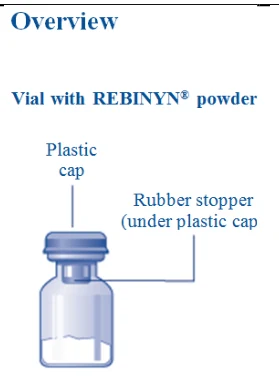
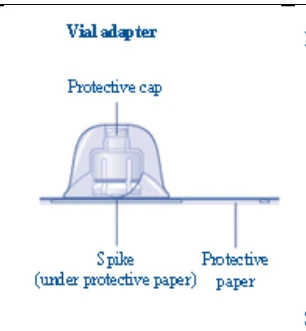
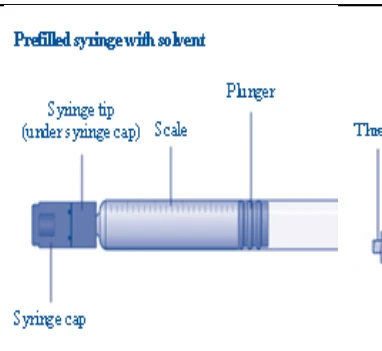
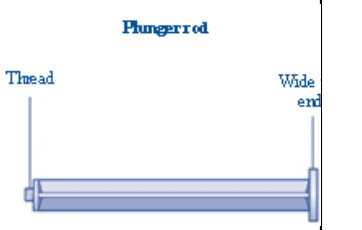
Each pack of Rebinyn® contains a vial with white to off-white powder, a 4 mL prefilled syringe with a clear and colourless solution, a plunger rod and a vial adapter.
Do not use Rebinyn® if:
- You are allergic to the medicinal ingredient, or to any ingredient in the formulation (including hamster protein), or component of the container.
To help avoid side effects and ensure proper use, talk to your healthcare professional before you take Rebinyn®. Talk about any health conditions or problems you may have, including if you:
- Are taking, have recently taken or might take any other medicines. This includes medicines obtained without a prescription or herbal medicines.
Are pregnant or breast-feeding, or if you think that you may be pregnant or are planning to have a baby.
Other warnings you should know about:
Allergic reactions and development of inhibitors
There is a rare risk that you may experience a sudden and severe allergic reaction (e.g. anaphylactic reaction) to Rebinyn®. Stop the injection and contact your doctor or an emergency unit immediately if you experience early signs of an allergic reaction (see Serious Side Effects table).
Your doctor may need to treat you promptly for these reactions. Your doctor may also do a blood test to check if you have developed factor IX inhibitors (activity-neutralizing antibodies) against your medicine, as inhibitors may develop together with allergic reactions. If you have such antibodies, you may be at an increased risk of sudden and severe allergic reactions (e.g. anaphylactic reaction) during future treatment with factor IX.
Because of the risk of allergic reactions with factor IX, your initial treatment with Rebinyn® should be given in a medical clinic or in the presence of health care professionals where proper medical care for allergic reactions can be provided if needed.
Talk to your doctor immediately if bleeding does not stop as expected, or if you have to significantly increase the amount of Rebinyn® you need to stop a bleed. Your doctor will do a blood test to check if you have developed inhibitors (neutralizing antibodies) against Rebinyn®. The risk for developing inhibitors is highest if you have not been treated with factor IX medicines before, typically in small children.
Blood clots
Tell your doctor, if any of the following apply to you as there is an increased risk of blood clots during treatment with Rebinyn®:
- You have recently had surgery.
- You suffer from other serious illness e.g. liver disease, heart disease, or cancer.
Kidney disorder (nephrotic syndrome)
There is a rare risk of developing a specific kidney disorder called “nephrotic syndrome” following high doses of factor IX in hemophilia B patients with factor IX inhibitors and a history of allergic reactions.
Neurologic
Extremely small amounts of polyethylene-glycol (PEG) was found in different parts outside the blood brain barrier in animals treated with Rebinyn®. In studies, children dosed up to 8 years, no neurological, cognitive or developmental side effects were seen. Report any neurological symptoms to your doctor.
Tell your healthcare professional about all the medicines you take, including any drugs, vitamins, minerals, natural supplements or alternative medicines.
The following may interact with Rebinyn®:
- There are no known interactions of Rebinyn® with other medicinal products.
How to take Rebinyn®:
- Treatment with Rebinyn® should be started by a doctor who is experienced in the care of patients with hemophilia B. Always use Rebinyn® exactly as your doctor has told you. Check with your doctor if you are not sure how to use Rebinyn®.
- Rebinyn® is given as an injection into a vein. Please refer to the end of this insert for instructions on how to prepare and administer Rebinyn®.
- Your doctor will calculate your dose for you. The dose will depend on your weight and what the medicine is being used for.
Usual dose:
Prevention of bleeding
The dose of Rebinyn® is 40 international units (IU) per kg of body weight. This is given as one injection every week.
Treatment of bleeding
The dose of Rebinyn® is 40 international units (IU) per kg of body weight. Depending on the location and the severity of the bleeding you may need a higher dose (80 IU per kg) or extra injection(s). Discuss with your doctor the dose and number of injections you need.
Overdose:
| If you think you, or a person you are caring for, have taken too much Rebinyn®, contact a healthcare professional, hospital emergency department, or regional poison control centre immediately, even if there are no symptoms. |
Missed Dose:
If you forget a dose, inject the missed dose when you discover the mistake. Do not inject a double dose to make up for a forgotten dose. Proceed with the next injections as scheduled and continue as advised by your healthcare provider.
Stopping Treatment:
If you stop using Rebinyn® you may no longer be protected against bleeding or a current bleed may not stop. Do not stop using Rebinyn® without talking to your doctor.
What are possible side effects from using Rebinyn®?
These are not all the possible side effects you may have when taking Rebinyn®. If you experience any side effects not listed here, tell your healthcare professional. Please also see Warnings and Precautions.
The following side effects have been observed with Rebinyn® in previously treated patients:
Common side effects (may affect up to 1 in 10 people)
- Itching (pruritus)
- Skin reactions at the site of injection
Uncommon side effects (may affect up to 1 in 100 people)
- Allergic reactions (hypersensitivity)
The following side effects have been observed with Rebinyn® in previously untreated patients:
Very common side effects (may affect more than 1 in 10 people)
- Rash
Common side effects (may affect up to 1 in 10 people)
- Itching (pruritus)
- Skin reactions at the site of injection
- Allergic reactions (hypersensitivity)
- Anaphylactic reaction
- Neutralizing antibodies (inhibitors)
Inhibitors (neutralizing antibodies) have occurred in connection with severe and sudden allergic reaction (e.g. anaphylactic reaction).
Serious side effects and what to do about them
| Symptom / effect | Talk to your healthcare professional | Stop taking drug and get immediate medical help | |
|---|---|---|---|
| Only if severe | In all cases | ||
| RARE | |||
| Allergic reaction (anaphylactic reaction): Difficulty in swallowing or breathing; shortness of breath or wheezing; chest tightness; redness and/or swelling of the lips, tongue, face or hands; rash, hives, wheals or itching of large areas of skin; having pale and cold skin, fast heartbeat, and/or dizziness (low blood pressure) |
If you have a troublesome symptom or side effect that is not listed here or becomes bad enough to interfere with your daily activities, tell your healthcare professional.
Reporting Side Effects
You can report any suspected side effects associated with the use of health products to Health Canada by:
NOTE: Contact your health professional if you need information about how to manage your side effects. The Canada Vigilance Program does not provide medical advice. |
Storage:
Keep Rebinyn® out of the sight and reach of children.
Do not use Rebinyn® after the expiry date which is stated on the carton, on the vial, on the vial adapter, and on the prefilled syringe labels. The expiry date refers to the last day of that month.
The powder in the vial appears as a white to off-white powder. Do not use the powder if the colour has changed.
Prior to Reconstitution
Store in original package in order to protect from light. Do not freeze.
Rebinyn® vials can be stored in the refrigerator (2°C – 8°C) up to the expiration date, or at room temperature (up to 30°C) for a single period not exceeding 6 months.
If you choose to store Rebinyn® at room temperature:
- Note the date that the product is removed from refrigeration on the carton.
- Do not use after 6 months from this date or the expiration date listed on the carton, whichever is earlier.
- Do not return the product to the refrigerator after it has been stored at room temperature.
After Reconstitution
Once you have reconstituted Rebinyn® it should be used immediately. If you cannot use the reconstituted Rebinyn® solution immediately, it should be used within 4 hours when stored at room temperature (up to 30°C) and within 24 hours when stored in a refrigerator (2°C – 8°C). Store the reconstituted product in the vial. If not used immediately the medicine may no longer be sterile and could cause infection.
The 500 IU, 1000 IU and 2000 IU reconstituted solution will be clear and colourless, and the 3000 IU reconstituted solution will be clear and colourless to slightly yellow. Do not use the reconstituted solution if you notice any visible particles or discolouration.
If you want more information about Rebinyn®:
- Talk to your healthcare professional
- Find the full product monograph that is prepared for healthcare professionals and includes this Patient Medication Information by visiting the Health Canada website: https://www.canada.ca/en/health-canada/services/drugs-health-products/drug-products/drug-product-database.html; the manufacturer’s website http://www.novonordisk.ca, or by calling Novo Nordisk Canada Inc., at 1-800-465-4334.
Rebinyn® is a registered trademark of Novo Nordisk Health Care AG and is used under license by Novo Nordisk Canada Inc.
MixPro® is a registered trademark of Novo Nordisk A/S and is used under license by Novo Nordisk
Canada Inc.
© Novo Nordisk Canada Inc. 2022
Last Revised Nov 22, 2022
| INSTRUCTIONS ON HOW TO USE REBINYN® |
READ THESE INSTRUCTIONS CAREFULLY BEFORE USING REBINYN®. Rebinyn® is supplied as a powder. Before injection (administration) it must be reconstituted with the solvent supplied in the syringe. The solvent is a histidine solution. The reconstituted REBINYN® must be injected into your vein (intravenous [i.v.] injection). The equipment in this package is designed to reconstitute and inject Rebinyn®. You will also need an infusion set (tubing and butterfly needle), sterile alcohol swabs, gauze pads and plasters. These devices are not included in the Rebinyn® package. Do not use the equipment without proper training from your doctor or nurse. Always wash your hands and ensure that the area around you is clean. When you prepare and inject medication directly into the veins, it is important to use a clean and germ free (aseptic) technique. Improper technique can introduce germs that can infect the blood. Do not open the equipment until you are ready to use it. Do not use the equipment if it has been dropped, or if it is damaged. Use a new package instead. Do not use the equipment if it is expired. Use a new package instead. The expiry date is printed on the outer carton, on the vial, on the vial adapter, and on the prefilled syringe. Do not use the equipment if you suspect it is contaminated. Use a new package instead. Do not dispose of any of the items until after you have injected the reconstituted solution. The equipment is for single use only. |
Contents The package contains:
The prefilled solvent syringe with sterile vial adapter, together serve as a needleless reconstitution system named the MixPro®. | |||||
 |  |  |  | ||
| |||||
| Step A | 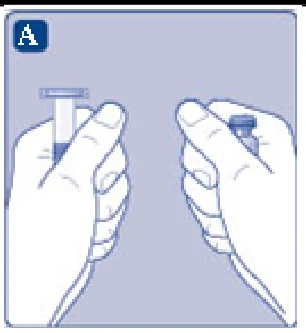 | Take out the number of Rebinyn® packages you need. Check the expiry date. Check the name, strength and colour of the package, to make sure it contains the correct product. Wash your hands and dry them properly using a clean towel or air dry. Take the vial, the vial adapter and the prefilled syringe out of the carton. Leave the plunger rod untouched in the carton. | |||
Bring the vial and the prefilled syringe to room temperature. You can do this by holding them in your hands until they feel as warm as your hands. Do not use any other way to warm the vial and prefilled syringe. | ||
| Step B | 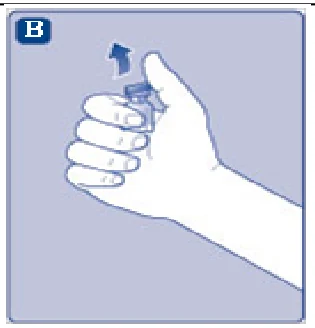 | Remove the plastic cap from the vial. If the plastic cap is loose or missing, do not use the vial. Wipe the rubber stopper with a sterile alcohol swab and allow it to air dry for a few seconds before use to ensure that it is as germ free as possible. Do not touch the rubber stopper with your fingers as this can transfer germs. |
| ||
| Step C | 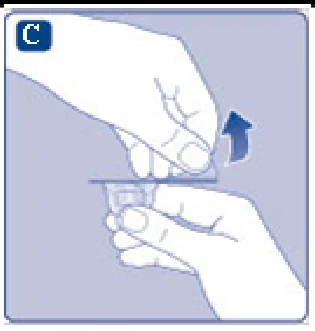 | Remove the protective paper from the vial adapter. If the protective paper is not fully sealed or if it is broken, do not use the vial adapter. Do not take the vial adapter out of the protective cap with your fingers. If you touch the spike on the vial adapter, germs from your fingers can be transferred. |
| Step D | 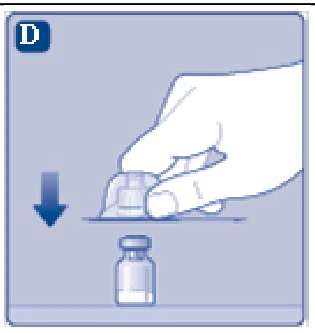 | Place the vial on a flat and solid surface. Turn over the protective cap, and snap the vial adapter onto the vial. Once attached, do not remove the vial adapter from the vial. |
| Step E | 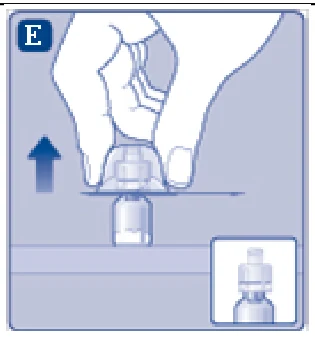 | Lightly squeeze the protective cap with your thumb and index finger as shown. Remove the protective cap from the vial adapter. Do not lift the vial adapter from the vial when removing the protective cap. |
| ||
| Step F | 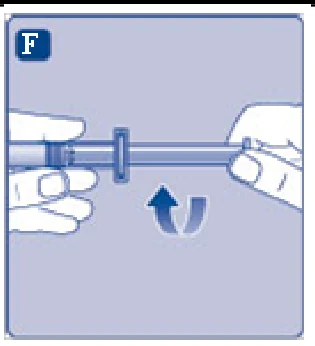 | Grasp the plunger rod by the wide top end and take it out of the carton. Do not touch the sides or the thread of the plunger rod. If you touch the sides or the thread, germs from your fingers can be transferred. Immediately connect the plunger rod to the syringe by turning it clockwise into the plunger inside the prefilled syringe until resistance is felt. |
| Step G | 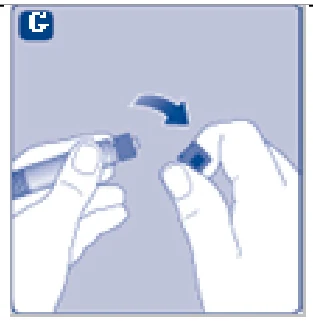 | Remove the syringe cap from the prefilled syringe by bending it down until the perforation breaks. Do not touch the syringe tip under the syringe cap. If you touch the syringe tip, germs from your fingers can be transferred. |
| If the syringe cap is loose or missing, do not use the prefilled syringe. | ||
| Step H | 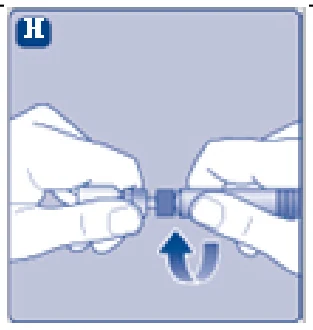 | Screw the prefilled syringe securely onto the vial adapter until resistance is felt. |
| ||
| Step I | 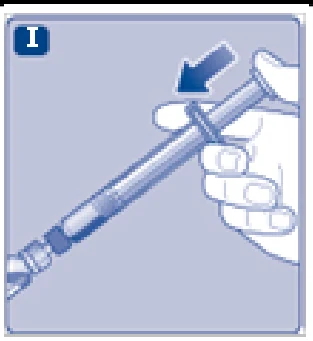 | Hold the prefilled syringe slightly tilted with the vial pointing downwards. Push the plunger rod to inject all the solvent into the vial. |
| Step J | 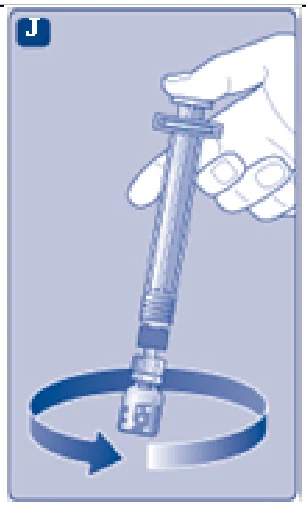 | Keep the plunger rod pressed down and swirl the vial gently until all the powder is dissolved. Do not shake the vial as this will cause foaming. Check the reconstituted solution. It must be free from particles that are clearly detectable. The 500 IU, 1000 IU and 2000 IU will be clear and colourless, the 3000 IU will be clear and colourless to slightly yellow. If you notice visible particles or |
discoloration, do not use it. Use a new package instead. | ||
Rebinyn® is recommended to be used immediately after it has been reconstituted. This is because if left, the medicine may no longer be sterile and could cause infections. If you cannot use the reconstituted Rebinyn® solution immediately, it should be used within 4 hours when stored at room temperature (up to 30°C) and within 24 hours when stored in a refrigerator (at 2°C – 8°C). Store the reconstituted product in the vial. Do not freeze reconstituted Rebinyn® solution or store it in syringes. Keep reconstituted Rebinyn® solution out of direct light. If your dose requires more than one vial, repeat step A to J with additional vials, vial adapters and prefilled syringes until you have reached your required dose. | ||
| Step K | 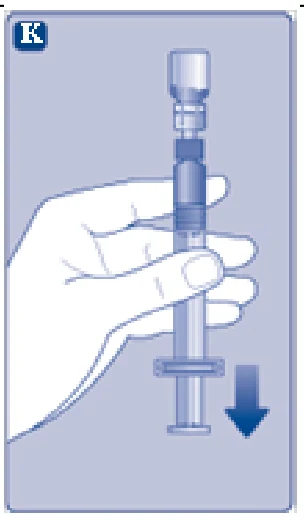 | Keep the plunger rod pushed completely in. Turn the syringe with the vial upside down. Stop pushing the plunger rod and let it move back on its own while the reconstituted solution fills the syringe. Pull the plunger rod slightly downwards to draw the reconstituted solution into the syringe. In case you only need part of the entire vial, use the scale on the syringe to see how much reconstituted solution you withdraw, as instructed by your doctor or nurse. If, at any point, there is too much air in the syringe, inject the air back into the vial. |
While holding the vial upside down, tap the syringe gently to let any air bubbles rise to the top. Push the plunger rod slowly until all air bubbles are gone. | ||
| Step L | 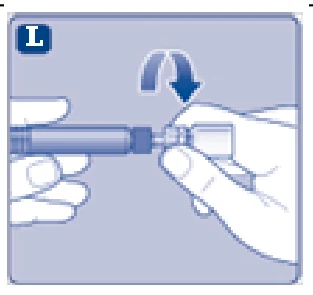 | Unscrew the vial adapter with the vial. Do not touch the syringe tip. If you touch the syringe tip, germs from your fingers can be transferred. |
| ||
Rebinyn® is now ready to inject into your vein.
Injecting Rebinyn® via needleless connectors for intravenous (IV) catheters Caution: The MixPro® prefilled solvent syringe is made of glass and is designed to be compatible with standard luer-lock connections. Some needleless connectors with an internal spike are incompatible with the prefilled syringe. This incompatibility may prevent administration of the drug and/or result in damage to the needleless connector. Injecting the solution via a central venous access device (CVAD) such as a central venous catheter or a subcutaneous port:
| ||
| If you have encountered any problems with attaching the prefilled solvent syringe to any luer-lock compatible device, or have any questions please contact Novo Nordisk at 1-800-465-4334. | ||
| ||
| Step M | 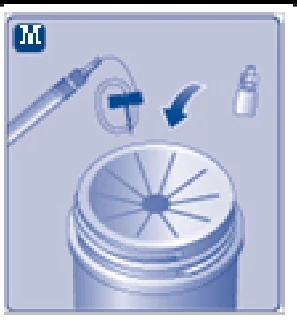 | After injection, safely dispose of all unused Rebinyn® solution, the syringe with the infusion set, the vial with the vial adapter, and other waste materials as instructed by your healthcare provider. Do not throw it out with the ordinary household waste. |
Do not disassemble the equipment before disposal. Do not reuse the equipment. | ||