


Patient Medication Information: uses, side effects, how to take - Sandoz Tobramycin
What is Sandoz Tobramycin used for?
Sandoz Tobramycin is used in adults and children above the age of 1 year to treat bacterial infections of the external part of the eye, such as conjunctivitis.
Antibacterial drugs like Sandoz Tobramycin treat only bacterial infections. They do not treat viral infections. Although you may feel better early in treatment, Sandoz Tobramycin should be used exactly as directed. Misuse or overuse of Sandoz Tobramycin could lead to the growth of bacteria that will not be killed by Sandoz Tobramycin (resistance). This means that Sandoz Tobramycin may not work for you in the future. Do not share your medicine.
How does Sandoz Tobramycin work?
Sandoz Tobramycin contains a medicine called tobramycin. Tobramycin belongs to the aminoglycoside class of antibiotic. Tobramycin works by killing bacteria that cause infections.
The signs of your eye infections [eye redness, increased tearing, discharge (pus or mucus) etc.] may start to improve within 3 days after starting Sandoz Tobramycin.
What are the ingredients in Sandoz Tobramycin?
Medicinal ingredients: tobramycin 0.3% w/v (3 mg/mL)
Non-medicinal ingredients:
Preservative: benzalkonium chloride 0.01% w/v
Other ingredients: boric acid, sodium sulfate, sodium chloride, tyloxapol, sulfuric acid and/or sodium hydroxide (to adjust pH) and purified water.
Sandoz Tobramycin comes in the following dosage forms:
Sandoz Tobramycin comes as eye drop.
Do not use Sandoz Tobramycin if you are allergic to:
- tobramycin,
any of the other ingredients in Sandoz Tobramycin (see What are the ingredients in
Sandoz Tobramycin?),
- other aminoglycoside antibiotics such as amikacin, gentamycin, kanamycin, paromomycin, streptomycin.
To help avoid side effects and ensure proper use, talk to your healthcare professional
before you take Sandoz Tobramycin. Talk about any health conditions or problems you may have, including if you:
are pregnant, you think you may be pregnant or are planning to have a baby. You will need to talk to your healthcare professional about the benefits and risks of using Sandoz Tobramycin while you are pregnant.
- are breast-feeding. Sandoz Tobramycin is not recommended during breastfeeding. It is unknown whether Sandoz Tobramycin will get into your milk.
have or if you have ever had conditions such as myasthenia gravis or Parkinson’s disease.
Antibiotics of this kind may worsen muscle weakness.
Other warnings you should know about:
While you are using Sandoz Tobramycin
Driving and using machines: your vision may be blurred for a time just after you apply
Sandoz Tobramycin. Do not drive or use machines until this has worn off.
If you wear contact lenses:
- Sandoz Tobramycin Eye Drops contains the preservative benzalkonium chloride. This can cause eye inflammation, including inflammation and damage to the cornea. Benzalkonium chloride discolours soft contact lenses. It is best not to wear contact lenses while you are using Sandoz Tobramycin.
- You should not wear contact lenses if you have an eye infection. If you are allowed to wear contact lenses, remove them before using Sandoz Tobramycin. Wait at least 15 minutes after using Sandoz Tobramycin to put your lenses back into your eyes.
- If the signs of your eye infection do not improve within 3 days or if they become worse, tell your healthcare professional.
Tell your healthcare professional about all the medicines you are using, have recently used or might use, including any drugs, vitamins, minerals, natural supplements or alternative medicines.
The use of Sandoz Tobramycin with other medicines has not been studied.
Tell your healthcare professional if you are using:
- Other antibiotics of the same family (aminoglycosides) such as amikacin, gentamycin, kanamycin, paromomycin, streptomycin
Always keep a list of your medicines and show it to your healthcare professional when you get a new medicine. It is important that your healthcare professional reviews all medications and supplements you are taking before prescribing Sandoz Tobramycin.
How to take Sandoz Tobramycin
Usual dose (adults and children 1 year and older):
The usual dose will depend on the type and severity of your infection
- In mild to moderate eyes infections your healthcare professional may recommend one drop or two drops into the affected eye(s), every four hours.
- In severe eyes infections this may be increased to two drops every hour.
Your healthcare professional will tell you how much you need to use each day. Ask your healthcare professional if you have any questions about the drug.
How to use:
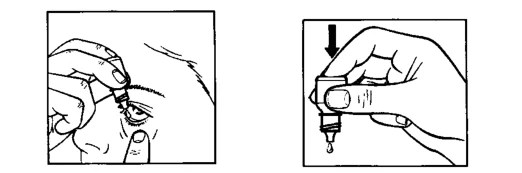
1 2
- 1. Wash your hands.
- 2. Get the Sandoz Tobramycin bottle and a mirror.
- 3. Shake well before use.
- 4.
After removing the cap: if the security snap collar is loose, remove it before using Sandoz
Tobramycin.
- 5. Hold the bottle, pointing down, between your thumb and fingers.
- 6. Tilt your head back.
- 7. Pull down your lower eyelid with a clean finger until there is a “v” pocket between your eyelid and your eye. The drop will go in here (picture 1).
- 8. Bring the bottle tip close to the eye. Do this in front of a mirror if it helps.
- 9. Do not touch your eye, eyelid, surrounding areas or other surfaces with the dropper, to avoid contaminating the suspension.
- 10. Gently press on the base of the bottle to release one drop at a time. Do not squeeze the bottle. It is designed so that a gentle press on the bottom is all that it needs (picture 2).
- 11. If you miss, wipe up and try again.
- 12. Close the bottle immediately after use.
If your doctor has prescribed other eye drop or ointment medicines to be used along with Sandoz Tobramycin, apply each medicine at least 5 minutes apart. Eye ointments should be administered last.
Overdose:
If you think you have taken too much or accidentally swallowed Sandoz Tobramycin, contact your healthcare professional, hospital emergency department or regional poison control centre immediately, even if there are no symptoms.
Missed Dose:
If you forget to use Sandoz Tobramycin, continue with the next dose as planned. However, if it is almost time for your next dose, skip the missed dose and go back to your regular dosing schedule. Do not use a double dose to make up for forgotten individual doses.
What are possible side effects from using Sandoz Tobramycin?
These are not all the possible side effects you may feel when taking Sandoz Tobramycin. If you experience any side effects not listed here, contact your healthcare professional. Please also see Warnings and Precautions.
The following side effects are common and about 3 in 100 people experienced them:
- itchy and swollen eyelid
- eye redness
- watery eye(s).
Other side effects include:
eye problems such as:
- eye discharge
- dry, itchy or swollen eyes
- increased tearing
- corneal damage (the corneal is the clear surface of your eye)
- blurred vision
- eye allergy
- loss of eyelashes
- headache
- skin problems such as swollen skin, hives, itchy or dry skin, white patches on the skin.
Serious side effects and what to do about them
| Symptom / effect | Talk to your healthcare professional | Stop taking drug and get immediate medical help | |
| Only if severe | In all cases | ||
UNKNOWN
| ✓ | ||
If you have a troublesome symptom or side effect that is not listed here or becomes bad enough to interfere with your daily activities, talk to your healthcare professional.
Reporting Side Effects
You can report any suspected side effects associated with the use of health products to Health Canada by:
Visiting the Web page on Adverse Reaction Reporting
(https://www.canada.ca/en/health-canada/services/drugs-health-products/medeffect-canada/adverse-reaction-reporting.html) for information on how to report online, by mail or by fax; or
- Calling toll-free at 1-866-234-2345.
NOTE: Contact your health professional if you need information about how to manage your side effects. The Canada Vigilance Program does not provide medical advice.
Storage:
- Store at room temperature (15ºC - 30ºC).
- Discard 28 days after initial opening. The best way to dispose of your medication is through a medicine take-back program. Check with your pharmacist about how to throw out unused medicines.
- Keep tightly closed.
- Keep out of the reach and sight of children.
If you want more information about Sandoz Tobramycin:
- Talk to your healthcare professional.
- Find the full product monograph that is prepared for healthcare professionals and includes this Consumer Information by visiting the Health Canada website (https://www.canada.ca/en/health-canada/services/drugs-health-products/drug-products/drug-product-database.html), the manufacturer’s website (https://www.sandoz.ca/en), or by calling the manufacturer, Sandoz Canada Inc., at 1-800-361-3062.
UNKNOWN Keratitis (an inflammation of the cornea — the clear front portion of your eye):
| ✓ |
or by written request at:
110, rue de Lauzon Boucherville, (QC), Canada J4B 1E6
or by e-mail at:
medinfo@sandoz.com