


Product Monograph - Tachosil
1 INDICATIONS
TachoSil® (Human fibrinogen, human thrombin and collagen sponge, absorbable fibrin sealant patch) is indicated for:
- supportive treatment in surgery for improvement of hemostasis
- suture support in vascular surgery where standard techniques are insufficient
1.1 Pediatrics (<18 years of age)
No data are available to Health Canada; therefore, Health Canada has not authorized an indication for pediatric use.
1.2 Geriatrics (> 65 years of age)
Efficacy and safety of TachoSil® has been evaluated in 204 patients of 65 years of age or older. Evidence from clinical studies and experience suggests that use in the geriatric population is not associated with differences in safety or effectiveness.
2 CONTRAINDICATIONS
- Patients who are hypersensitive to the active substances or to any ingredient in the formulation or component of the container. For a complete listing, see 6 DOSAGE FORMS, COMPOSITION AND PACKAGING section of the product monograph.
- TachoSil® must not be applied intravascularly.
4 DOSAGE AND ADMINISTRATION
4.1 Dosing Considerations
- TachoSil® is intended for topical use only. Do not use intravascularly.
- Apply the yellow, active side of the patch to the bleeding area.
- TachoSil® comes ready-to-use in sterile packages and must be handled accordingly. Use only undamaged packages. Once the package is opened post-sterilisation is not possible. The outer aluminium foil sachet may be opened in a non-sterile operating area. The inner sterile blister must be opened in a sterile operating room area.
- Due to the strong affinity of collagen to blood, TachoSil® may also stick to surgical instruments or gloves covered with blood. This can be avoided by pre-moistening surgical instruments and gloves with sterile physiological saline solution.
4.2 Recommended Dose and Dosage Adjustment
The number of TachoSil® patches to be applied should always be oriented towards the underlying clinical need for the patient. The number of TachoSil® patches to be applied is governed by the size of the wound area.
The TachoSil® patch should be applied so that it extends 1-2 cm beyond the margins of the wound. If more than one patch is used the patch should overlap by at least 1 cm. The patch can be cut to the correct size and shaped if too large.
Open, unused TachoSil® should be discarded as it cannot be re-sterilized.
Application of TachoSil® must be individualized by the treating surgeon. In clinical trials, the individual dosages have typically ranged from 1-3 patches (9.5 cm x 4.8 cm); application of up to 7 patches has been reported. For smaller wounds, e.g. in minimal invasive surgery the smaller size patches (4.8 cm x 4.8 cm or 3.0 cm x 2.5 cm) are recommended.
| TachoSil® Patch size | Amount of Human Fibrinogen / Total Patch Size (mg)* | Amount of Human Thrombin / Total Patch Size (IU)* |
| 41.3 | 15.0 | |
| 126.5 | 46.0 | |
| 250.8 | 91.2 |
* Each square centimetre contains: 5.5 mg Human Fibrinogen and 2.0 IU Human Thrombin
Health Canada has not authorized an indication for pediatric use (see section 1 INDICATION).
4.4 Administration
TachoSil® is used under sterile conditions. Prior to application the wound area should be cleansed, e.g. from blood, disinfectants and other fluids. The fibrinogen and thrombin proteins can be denatured by alcohol, iodine or heavy metal ions. If any of these substances have been used to clean the wound area, thoroughly irrigate the area before the application of TachoSil®. It is important to note that failure to adequately clean adjacent tissues may cause adhesions.
After removal of TachoSil® from the sterile package the patch should be pre-moistened in sterile saline solution. Once moistened TachoSil® should be applied immediately.
The yellow, active side of the patch is applied to the bleeding surface and held against it with a gentle pressure for 3-5 minutes. This procedure enables an easy adhesion of TachoSil® to the wound surface. Alternatively, e.g. in case of stronger bleeding or wet wound area, TachoSil® may be applied without pre-moistening, while also pressing gently to the wound for 3-5 minutes. It is recommended that a moist surgical tissue or pad is used for applying pressure if TachoSil® is applied dry.
Pressure should be applied with moistened gloves or a moist pad. After pressing TachoSil® to the wound, the glove or the pad must be removed carefully. To avoid the patch from being pulled loose it may be held in place at one end, e.g. with a pair of forceps.
Leave TachoSil® in place once it adheres to organ tissue. Remove unattached TachoSil® patches (or part of) and replace with new patches.
It is strongly recommended that every time TachoSil® is administered to a patient, the name and batch number of the product are recorded in order to maintain a link between the patient and batch of the product.
4.5 Missed Dose
Not applicable
5 OVERDOSAGE
No cases of overdose have been reported.
6 DOSAGE FORMS, STRENGTHS, COMPOSITION AND PACKAGING
To help ensure the traceability of biologic products, including biosimilars, health professionals should recognise the importance of recording both the brand name and the non-proprietary (active ingredient) name as well as other product-specific identifiers such as the Drug Identification Number (DIN) and the batch/lot number of the product supplied.
Table – Dosage Forms, Strengths, Composition and Packaging
Each patch is packed in a PET-GAG blister sealed with a coated PE foil. The blister is packed in an aluminium-bonded foil sachet with a desiccant bag. Each patch is packaged individually.
TachoSil® is supplied in the following pack sizes:
Package with 1 patch of 9.5 cm x 4.8 cm
Package with 2 patches of 4.8 cm x 4.8 cm
Package with 1 patch of 3.0 cm x 2.5 cm
Package with 5 patches of 3.0 cm x 2.5 cm
Not all pack sizes may be marketed.
7 WARNINGS AND PRECAUTIONS
When medicinal products manufactured from human plasma are administered, the possibility of transmission of infective agents cannot be totally excluded. The physician should discuss the risks and benefits of this product with the patient, before prescribing or administering to the patients
General
TachoSil® is intended for topical use only by experienced surgeons. Do not use intravascularly. Life threatening thromboembolic complications may occur if the preparation is unintentionally applied intravascularly.
Ensure tissue areas outside the desired application site are adequately cleansed before TachoSil administration, in order to prevent the development of tissue adhesions at undesired sites (see 4 DOSAGE AND ADMINISTRATION, 4.4 Administration). Events of adhesions to gastrointestinal tissues
| Route of Administration | Dosage Form / Strength/Composition | Non-medicinal Ingredients |
| Topical | Absorbable fibrin sealant patch 5.5 mg Human Fibrinogen, 2.0 IU Human Thrombin and 2.1 mg Collagen Sponge per cm2 | Human albumin, Riboflavin (E 101), L-arginine-hydrochloride, Sodium chloride, Sodium citrate (E331) |
leading to gastrointestinal obstruction have been reported with use in abdominal surgery carried out in proximity to the bowel.
Standard measures to prevent infections resulting from the use of medicinal products prepared from human blood or plasma include selection of donors, screening of individual donations and plasma pools for specific markers of infection and the inclusion of effective manufacturing steps for the inactivation/removal of viruses. Despite this, when medicinal products prepared from human blood or plasma are administered, the possibility of transmitting infective agents cannot be totally excluded. This also applies to unknown or emerging viruses and other pathogens and, theoretically, the Creutzfeldt-Jakob disease (CJD) agent. These standard measures are considered effective for enveloped viruses such as HIV, HBV and HCV and for the non-enveloped virus HAV. However, these measures may be of limited value against non-enveloped viruses such as parvovirus B19. Parvovirus B19 infection may be serious for pregnant women (fetal infection) and for individuals with immunodeficiency or increased erythropoiesis (e.g. haemolytic anaemia).
Peri-Operative Considerations
Do not use TachoSil® for the treatment of severe or brisk arterial bleeding because TachoSil® has not been evaluated in this treatment.
Do not use TachoSil® as the primary mode to control hemostasis. TachoSil® is not intended as a substitute for meticulous surgical technique and the proper application of suture, ligature or other conventional procedures for hemostasis.
Do not leave TachoSil® in an infected or contaminated space because it may theoretically potentiate an existing infection.
When placing TachoSil® into cavities or closed spaces, avoid over-packing because this may cause compression of underlying tissue. Use only the minimum amount of TachoSil® patches necessary to achieve hemostasis. Carefully remove or reposition unattached pieces of TachoSil®, if medically necessary.
Do not use TachoSil® in neurosurgical or gastrointestinal anastomosis procedures as safety and efficacy has not been evaluated.
Sensitivity/Resistance
As with any protein product, allergic type hypersensitivity reactions are possible. Signs of hypersensitivity reactions include hives, generalized urticaria, and tightness of the chest, wheezing, hypotension and anaphylaxis. If these symptoms occur, the administration should be discontinued immediately. In case of shock, the current medical standards for shock treatment should be observed.
7.1 Special Populations
7.1.1 Pregnant Women
- The safety of fibrin sealants/haemostatics for use in pregnancy has not been established in controlled clinical trials.
7.1.2 Breast-feeding
- The safety of fibrin sealants/haemostatics for use in nursing women has not been established in controlled clinical trials.
It is unknown if TachoSil® is excreted in human milk. Precaution should be exercised because many drugs can be excreted in human milk.
7.1.3 Pediatrics (<18 years of age)
No data are available to Health Canada; therefore, Health Canada has not authorized an indication for pediatric use.
7.1.4 Geriatrics (> 65 years of age)
Efficacy and safety of TachoSil® has been evaluated in 204 patients of 65 years of age or older. Evidence from clinical studies and experience suggests that use in the geriatric population is not associated with differences in safety or effectiveness.
8 ADVERSE REACTIONS
8.1 Adverse Reaction Overview
Adverse drug reactions reported in clinical trials (determined by investigators) were experienced by 6.9% of patients treated with TachoSil® compared to 7.2% of patients treated with comparator treatments. The most common adverse drug reaction was pyrexia, which occurred in 2.5% of TachoSil® treated patients and 2.0% of comparator treated patients.
Rarely, hypersensitivity or allergic reactions (which may include angioedema, burning and stinging at the application site, bronchospasm, chills, flushing, generalized urticaria, headache, hives, hypotension, lethargy, nausea, restlessness, tachycardia, tightness of the chest, tingling, vomiting, wheezing) may occur in patients treated with fibrin sealants/ hemostatics. In isolated cases, these reactions may progress to severe anaphylaxis. Such reactions may especially be seen, if the preparation is applied repeatedly, or administered to patients known to be hypersensitive to constituents of the product. Antibodies against components of fibrin sealant/hemostatic products may occur rarely. The equine collagen antibodies that developed in some patients after TachoSil® use were not reactive with human collagen. One patient developed antibodies to human fibrinogen. There were no adverse events attributable to the development of human fibrinogen or equine collagen antibodies.
There is very limited clinical data available regarding re-exposure of TachoSil®. Thromboembolic complications may occur if the preparation is unintentionally applied intravascularly.
8.2 Clinical Trial Adverse Reactions
Because clinical trials are conducted under very specific conditions the adverse reaction rates observed in the clinical trials may not reflect the rates observed in practice and should not be compared to the rates in the clinical trials of another drug. Adverse drug reaction information from clinical trials is useful for identifying drug-related adverse events and for approximating rates.
The safety of TachoSil® has been evaluated in six controlled clinical trials, in which 521 patients were treated with TachoSil® and 511 patients were treated with comparator treatment. Due to practical reasons (comparison to standard surgical and standard hemostatic treatment), blinding was not possible in the TachoSil® trials. Therefore, the studies were performed as open-label studies.
The most common adverse drug reaction reported in these clinical trials was pyrexia, which occurred in 2.5% of TachoSil® treated patients and 2.0% of comparator treated patients.
In addition, a safety surveillance trial was performed with 3098 patients (mean age: 60.7, range: 0.1 - 94 years of age) to collect information, following exposure to TachoSil®, of all thromboembolic events, immunological events and drug interactions leading to thromboembolic events or major bleeding. The trial was designed as an international, non- interventional, prospective, single cohort trial of the use of TachoSil® in supportive treatment in surgery for improvement of hemostasis where standard techniques are insufficient. The majority of patients (90.8%) had at least one risk for thromboembolic events before surgery (8.2% had risk factors for major bleeding and 15.3% had risk factors for immunological events). At any time during the trial 1.5% (95% CI 1.1%-2.0%), 2.0% (95% CI 1.5-2.6%) and 0.3% of patients had at least one thromboembolic, major bleeding, or immunological event, respectively. No cases were reported where an investigator suspected an interaction with concomitant medication as responsible for an adverse event.
8.3 Less Common Clinical Trial Adverse Reactions
Adverse drug reactions occurring in the six controlled clinical trials involving TachoSil® with an incidence of less than 1% include the following:
Cardiac disorders: Tachyarrhythmia
Gastrointestinal disorders: Abdominal pain, Flatulence
General disorders and administration site conditions: Pain, Drug ineffective
Infections and infestations: Liver abscess, Post-operative abscess, Wound abscess
Injury, poisoning, procedural complaints: Procedural site reaction, Anemia post-operative, Post-procedural hemorrhage
Investigations: C-reactive protein increased
Psychiatric disorders: Insomnia, Nervousness
Renal and urinary disorders: Renal disorder, Urinary retention
Respiratory, thoracic and mediastinal disorders: Pneumothorax, Pleural effusion, Lung disorder, Bronchopleural fistula, cough
Skin and subcutaneous tissue disorders: Pruritus, urticaria
Vascular disorders: Hypertension
8.4 Abnormal Laboratory Findings: Hematologic, Clinical Chemistry and Other Quantitative Data
Clinical Trial Findings
This information is not available for this drug product.
Post-Market Findings
This information is not available for this drug product.
8.5 Post-Market Adverse Reactions
The following adverse drug reactions have been reported in post-marketing experience:
Immune disorders: Anaphylactic shock, hypersensitivity
Gastrointestinal disorders: Intestinal obstruction (in abdominal surgeries), ileus (in abdominal surgeries)
General disorders and administration site conditions: Adhesions, Drug ineffective Vascular disorders: Thrombosis
Because post-marketing reporting of adverse reaction is voluntary and from a population of uncertain size, it is not always possible to reliably estimate the frequency of these reactions or establish a causal relationship to product exposure.
9 DRUG INTERACTIONS
9.2 Drug Interactions Overview
The safety of fibrin sealants/haemostatics for use in nursing women has not been established in controlled clinical trials.
It is unknown if TachoSil® is excreted in human milk. Precaution should be exercised because many drugs can be excreted in human milk.
9.3 Drug-Behavioural Interactions
Drug-Behavioural Interactions have not been established.
9.4 Drug-Drug Interactions
Interactions with other drugs have not been established.
9.5 Drug-Food Interactions
Interactions with food have not been established.
9.6 Drug-Herb Interactions
Interactions with herbal products have not been established.
9.7 Drug-Laboratory Test Interactions
Interactions with laboratory tests have not been established.
10 CLINICAL PHARMACOLOGY
10.1 Mechanism of Action
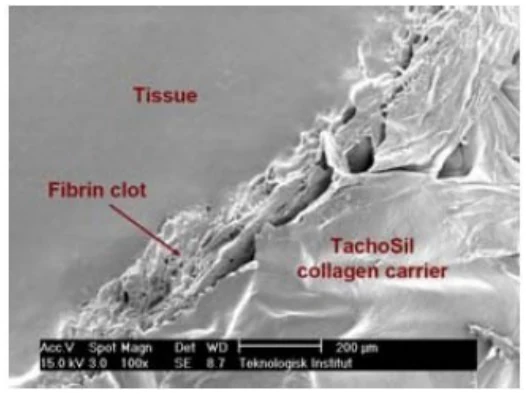
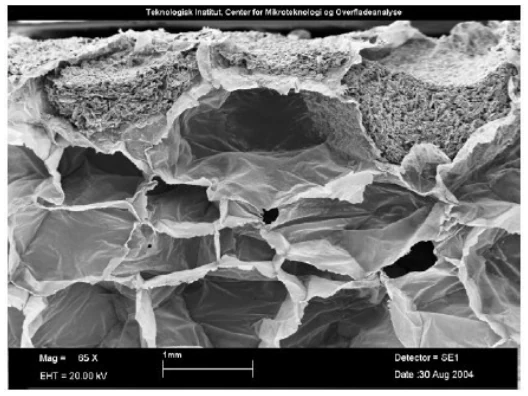
TachoSil® is a ready to use degradable surgical patch consisting of a Collagen Sponge of equine origin, coated with Human Fibrinogen and Human Thrombin (Figure 1a). In contact with physiological fluids, e.g. blood, lymph or physiological saline solution the components of the coating dissolve and partly diffuse into the wound surface. This is followed by the fibrinogen-thrombin reaction which initiates the last phase of physiological blood coagulation (i.e. coagulation cascade). Fibrinogen is converted into fibrin monomers which spontaneously polymerize to a fibrin clot, which holds the Collagen Sponge tightly to the wound surface. The fibrin is then cross linked by endogenous factor XIII, creating a firm, mechanically stable network with strong adhesive properties (Figure 1b). The active components of TachoSil® cause the wound surface and the patch to be adhered together. TachoSil® exhibits flexibility to accommodate for the physiological movements of tissues and organs.
Figure 1. Scanning Electron Microscopy pictures of TachoSil®
|
|
10.2 Pharmacodynamics
No pharmacodynamic studies have been performed with TachoSil® in man. Clinical Studies demonstrating hemostasis have been conducted in four controlled clinical trials (see 14 CLINICAL TRIALS).
10.3 Pharmacokinetics
TachoSil® is intended for topical application only (i.e. for application on the surface of tissue), and intravascular administration is contraindicated. As a consequence, intravascular pharmacokinetic studies were not performed in man.
Fibrin sealants/hemostatics are metabolized in the same way as endogenous fibrin by fibrinolysis and phagocytosis.
After administration to a wound surface, TachoSil® progressively degrades. In animal studies, TachoSil® progressively degrades with only few remnants left after 13 weeks. Complete degradation of TachoSil® was seen in some animals 12 months after its administration to a liver wound, whereas small remnants were still observed in others. The degradation was associated with infiltration of granulocytes and formation of resorptive granulation tissue encapsulating the progressively degraded remnants of TachoSil®. No evidence of local intolerability has been observed in animal studies.
From the experience in humans there have been isolated cases where remnants were observed as coincidental findings with no signs of functional impairment.
11 STORAGE, STABILITY AND DISPOSAL
TachoSil® should be stored at 2 to 30 °C. TachoSil® does not require refrigeration. Do not freeze.
12 SPECIAL HANDLING INSTRUCTIONS
None.
PART II: SCIENTIFIC INFORMATION
13 PHARMACEUTICAL INFORMATION
Drug Substance
Proper name: Human Thrombin
Human Fibrinogen
Collagen Sponge
Chemical name: Not applicable
Molecular formula and molecular mass: Human Thrombin: 39 kDa
Human Fibrinogen: 340 kDa
Collagen (tropocollagen): ~ 300 kDa
Structural formula: Not applicable
Physicochemical properties: Not applicable
Pharmaceutical standard: House
Product Characteristics:
Human Fibrinogen and Human Thrombin are obtained from pooled human plasma obtained from US licensed plasma collection centres. The Collagen Sponge is of equine origin.
Fibrinogen is manufactured by treatment of cryoprecipitate for purification of fibrinogen. The preparation is treated by pasteurization, following which it is precipitated, and concentrated. After concentration the product is formulated, 0.2µm filtered, aseptically filled and lyophilized.
Thrombin is manufactured by chromatographic purification of pro-thrombin from cryo-poor plasma. The preparation is pasteurized and precipitated. The pro-thrombin is converted to thrombin, and the preparation is concentrated, 0.2µm filtered, aseptically filled and lyophilized.
Collagen Sponge is a whitish, sponge-like material cut into the form of strips. Collagen Sponge is intended for use as a carrier for further manufacture of TachoSil.
TachoSil consists of a whitish equine Collagen Sponge coated with the active ingredients Human Fibrinogen and Human Thrombin, and riboflavin as yellow colorant.
Viral Inactivation
Validation studies for fibrinogen, thrombin and Collagen Sponge manufacturing steps were conducted for their capacity to inactivate and/or remove viruses. These in vitro validation studies were conducted, using samples from manufacturing intermediates spiked with virus suspensions of known titres followed by further processing under conditions equivalent to those in the respective manufacturing steps.
TachoSil® is sterilized by gamma irradiation after completion of inner and outer packaging, resulting in a sterile product in a sterile inner package. A validation study was conducted evaluating the capacity of gamma irradiation to inactivate viruses.
14 CLINICAL TRIALS
14.1 Trial Design and Study Demographics
The safety and efficacy of TachoSil® were assessed in four open-label, randomized, prospective, multicentre, controlled studies (Table 1). TachoSil® was used as secondary
management for improvement of hemostasis, and for suture support in vascular surgery where standard techniques are insufficient.
Due to practical reasons (comparison to standard surgical and standard hemostatic treatment), blinding was not possible in the TachoSil® trials. Therefore, the studies were performed as open-label studies.
The TachoSil® patch used in these studies was 9.5 cm x 4.8 cm.
Table 1. Summary of Patient Demographics for Pivotal Clinical Trials
| Study # | Surgical indication | Study treatment randomized and number of subjects | Mean age (Range) | Gender (Male:Female) |
| TC-014-IN | Liver resection | TachoSil®: 59 Argon beam coagulator: 62 | 56.1 (19 – 78) 57.1 (18 – 81) | 46% : 54% 61% : 39% |
| TC-015-IN | Kidney resection | TachoSil®: 92 Standard surgical treatment (additional suturing if needed): 93 | 61.5 (23 – 81) 64.3 (42 – 84) | 67% : 33% 61% : 39% |
| TC-016-IN | Liver resection | TachoSil®: 60 Argon beam coagulator: 59 | 59.2 (19 – 82) 59.8 (28 – 76) | 67% : 33% 51% : 49% |
| TC-023-IM | Cardiovascular surgery | TachoSil®: 59 Hemostatic fleece:60 | 65 (23 – 82) 68 (36 – 86) | 76% : 24% 72% : 28% |
14.2 Study Results
The efficacy and safety of TachoSil® as a supportive treatment in surgery for the improvement of hemostasis, and for suture support was investigated in four pivotal studies. These studies demonstrated the efficacy and safety of TachoSil®, as a hemostasic agent.
Study TC-014-IN and Study TC-016-IN
Two trials (TC-014-IN and TC-016-IN) investigated the efficacy and safety of TachoSil® as an adjunct treatment to control haemorrhage from the resection wound following segmental liver resection. The trials were designed as randomized, open, parallel-group, multi-centre trials comparing the efficacy and safety of TachoSil® vs. the argon beam coagulator (argon beamer). Patients were undergoing resection of the liver for any medical reason, most related to hepatic malignancies. Randomization, to either TachoSil® or argon beamer, was done intra- operatively if residual minor to moderate (oozing) bleeding was present after primary treatment of major venous or arterial (pulsating) bleeding had been controlled by standard surgical methods. The primary efficacy outcome of both trials was the intra-operative assessment of time to hemostasis, which was measured from the time when randomized treatments (TachoSil® or argon beam coagulator) were applied.
In trial TC-014-IN, 59 patients in the TachoSil® group received 156 TachoSil® patches. The majority of the patients had 1 to 4 patches, 2 patients had 5 patches, and 2 patients had 6 patches. In trial TC-016-IN, 60 patients in the TachoSil® group received 143 TachoSil® patches. The majority of the patients had 1 to 4 patches, 2 patients had 5 patches, 1 patient had 6 patches, and 1 patient had 7 patches.
Both trials, TC-014-IN and TC-016-IN, demonstrated statistically significant superiority of TachoSil® over the control treatment (p=0.0007 & p=0.0018, respectively)(Table 2). The results clearly showed
TachoSil® to be efficacious in the treatment of the diffuse bleeding condition often present in liver surgery, with a shorter time to hemostasis than the argon beam coagulator.
Table 2. Trial TC-014-IN and TC-016-IN Primary Efficacy Endpoint – Time to Hemostasis
TachoSil® Time to Hemostasis (minutes) | Argon Beam Coagulator Time to Hemostasis (minutes) | p-value | |||||
| mean | median (range) | mean | median (range) | ||||
| TC-014-IN | 3.9 | 3.0 (3-20) | 6.3 | 4.0 (3-39) | 0.0007* | ||
| TC-016-IN | 3.6 | 3.0 (3-8) | 5.0 | 3.0 (3-23) | 0.0018* | ||
* statistically significant
Study TC-015-IN
Trial TC-015-IN investigated the hemostatic efficacy of TachoSil® compared to standard surgery in patients scheduled for the resection of superficial tumours on the kidney. Patients in the trial underwent nephron-sparing surgery. The trial was an open-label, randomized, prospective, multi-centre, parallel-group trial to compare the efficacy and safety of additional TachoSil® vs. standard surgical treatment alone in patients undergoing surgical resection of superficial renal tumour. Randomisation was done following the resection of superficial solitary kidney tumour and primary standard hemostatic measures to control pulsating arterial and/or major venous hemorrhage. The primary efficacy endpoint was the intra-operative time to hemostasis.
A total of 92 patients in the TachoSil® group received 116 TachoSil® patches. The majority of the patients had 1 to 2 patches, and 3 patients had 3 patches.
The primary efficacy endpoint, time to hemostasis, demonstrated a clear statistically significant difference (p<0.0001) for additional TachoSil® over standard suturing alone with median values of 3.0 minutes (mean 5.3 min; range 3-17 min) and 8.0 minutes (mean 9.5 min; range 3-27 min), respectively for the ITT population.
Study TC-023-IM
A cardiovascular trial, TC-023-IM, was designed as a randomized, open, parallel-group, multi-centre trial comparing the efficacy and safety of TachoSil® vs. standard hemostatic fleece (without additional active coagulation stimulating compounds) in cardiovascular surgery. Patients undergoing a planned elective surgery on the heart, the ascending aorta or aortic arch requiring a cardiopulmonary bypass procedure were included in this trial. Patients were equally distributed to the two treatment arms, TachoSil® or standard hemostatic treatment (i.e. any hemostatic fleece material without additional active coagulation- stimulating compounds). Randomisation was done during surgery, following primary hemostatic treatment when intra-operative bleeding had been assessed. Only patients with residual hemorrhage from the heart muscle, the pericardium, a major vessel or vascular bed requiring supportive hemostatic treatment were eligible for randomization. Patients included were required to be on cardiopulmonary bypass during surgery (i.e. fully heparinized patients).
Hemostasis in the target area was evaluated after 3 minutes of application with pressure. If hemostasis was achieved, “time to hemostasis” was recorded as 3 minutes. If hemostasis was not achieved, another piece of trial treatment (TachoSil® or standard fleece material) was applied for the next 3 minutes. The primary and secondary efficacy endpoints were the proportion of patients that achieved hemostasis at 3 minutes and 6 minutes, respectively.
A total of 62 patients in the TachoSil® group received 74 TachoSil® patches. The majority of the patients had 1 patch, 7 patients had 2 patches, 1 patient had 3 patches, and 1 patient had 4 patches.
The results showed that TachoSil® was statistically significantly superior to standard fleece material with regard to the primary and secondary endpoints of the trial (Table 3). The proportion of patients with hemostasis at 3 minutes was 75% for TachoSil® patients and 33% for standard hemostatic fleece patients (p<0.0001). The proportion of patients with hemostasis at 6 minutes confirmed this with significant results in favour of TachoSil® (p=0.0006).
Table 3. Trial TC-023-IM Primary and Secondary Endpoints – Proportion of Patients with Hemostasis at 3 and 6 minutes
| Treatment | Number of patients with hemostasis | Proportion of patients with hemostasis | 95% CI for proportion | p-value |
| Hemostasis at 3 min | ||||
| TachoSil® (n=59) | 44 | 0.746 (75%) | [0.635; 0.857] | <0.0001* |
| Standard (n=60) | 20 | 0.333 (33%) | [0.214; 0.453] | |
| Hemostasis at 6 min | ||||
| TachoSil® (n=59) | 56 | 0.949 (95%) | [0.893; 1.000] | <0.0006* |
| Standard (n=60) | 43 | 0.717 (72%) | [0.603; 0.831] | |
*statistically significant
CI= confidence interval
14.4 Immunogenicity
The information is not available for this drug product.
15 MICROBIOLOGY
No microbiological information is required for this drug product.
16 NON-CLINICAL TOXICOLOGY
Single-dose Toxicity
The single-dose toxicity of TachoSil® has been investigated in mini-pigs after topical application to liver and/or spleen lesions via laparotomy.
One single-dose study investigated the toxicity of TachoSil® in minipigs following application to liver and spleen wounds at a physiological dose of 48.5 mg/kg (2.3 times the average clinical dose for humans [2 patches/ 70 kg patient; 21 mg/kg]). Necropsy was performed 1, 4 and 13 weeks after TachoSil® administration. No deaths occurred, there were no drug product-related toxicological effects on body weight, food consumption, hematological parameters (including coagulation), clinical chemistry parameters, and organ weights. Compound remnants were still observed at the surgical site of the treated animals after 13 weeks. The observed macroscopical and microscopial findings showed the regulator process of biodegradation, fibrinolysis and phagocytosis, and are not considered to be of any toxicological significance.
A second single-dose study investigated the toxicity of TachoSil® in minipigs following application to liver wounds at a dose of up to 202.2 mg/kg, which is about 9.6 times the average clinical dose (2 patches/ 70 kg patient; 21 mg/kg). Necropsy was performed 26 and
52 weeks after TachoSil® administration. No deaths occurred. There were no drug product- related toxicological effects on body weight, food consumption, hematological parameters (including coagulation), clinical chemistry parameters, and organ weights. TachoSil® had no effect on systemic safety after 12 months. Complete degradation of TachoSil® was seen in some animals 12 months after its administration to a liver wound, whereas small remnants were still observed in others. No evidence of local intolerability has been observed.
A third single-dose study investigated the toxicity of TachoSil® in minipigs following application of either 10 (440.8 mg/kg) or 15 (581.4 mg/kg) standard size patches onto liver lesions (up to 28 times than the average clinical dose [2 standard size patches/70 kg patient; 21 mg/kg]). This dose was 7.9 times higher than the maximum dose ever reported from a clinical trial (7 standard size patches per 70 kg patient; 73.2 mg/kg). No deaths occurred.
Necropsy was performed after 2 weeks of TachoSil administration. There was no evidence of either local or systemic toxicity after administration of 15 patches (581.4 mg/kg) of TachoSil. This dose was the No Observable Effect Level (NOAEL) and the maximum feasible dose to be investigated in minipigs.
Repeat-dose Toxicity
A 4-week repeat-dose toxicity study was performed with TachoSil® in a liver/spleen lesion model in minipigs. In a surgical procedure a liver lesion was created on Day 1 a single standard size TachoSil® patch was applied to the wound. On Day 2, a second standard size TachoSil® patch was applied onto the same liver wound. On Day 22, a spleen lesion was created and one standard size TachoSil® patch was applied onto the wound. The cumulative final doses administered were 79.14 mg/kg TachoSil®. Necropsy was performed 7 and 28 days after the last administration to the spleen. No deaths occurred and there were no drug product-related toxicological effects on body weight, food consumption, hematological parameters (including coagulation), clinical chemistry parameters, and organ weights.
Histological investigations showed that the TachoSil® patch becomes encased in granulation tissue containing many macrophages, some eosinophils lymphocytes and occasionally giant cells. The NOAEL for TachoSil® in the minipig following repeated administration, was 79.14 mg/kg, which is about 4-fold higher than the dose indicated for use in humans (2 patches/ 70 kg patient; 21 mg/kg).
TachoSil® is not indicated for long-term use; therefore, no long-term studies have been done to evaluate carcinogenic or mutagenic potential, whether affects fertility and immunogenicity.
No long-term animal studies have been performed to evaluate carcinogenic or mutagenic potential or whether TachoSil affects fertility in males or females.