


Product Monograph - Taro-Clobetasol Cream USP, 0.05%
Actions and Clinical Pharmacology
The corticosteroids are a class of compounds comprising steroid hormones secreted by the adrenal cortex and their synthetic analogs. In pharmacologic doses, corticosteroids are used primarily for their anti-inflammatory and/or immunosuppressive effects. Topical corticosteroids such as clobetasol propionate are effective in the treatment of corticosteroid-responsive dermatoses primarily because of their anti-inflammatory, anti-pruritic, and vasoconstrictive actions. However, while the physiologic, pharmacologic and clinical effects of the corticosteroids are well known, the exact mechanisms of their actions in each disease are uncertain.
Clobetasol propionate has been shown to have topical and systemic
pharmacologic and metabolic effects characteristic of the corticosteroid class of drugs.
Indications and Clinical Use
Clobetasol Propionate Cream and Ointment are indicated for the topical therapy of recalcitrant corticosteroid-responsive dermatoses, including severe cases of psoriasis (excluding widespread plaque psoriasis) and eczematous dermatitis.
Contraindications
Clobetasol Propionate Cream and Ointment are not indicated for the treatment of rosacea, acne vulgaris, perioral dermatitis or perianal and genital pruritus. These preparations are contraindicated also in the treatment of primary infected bacterial or fungal skin lesions if no anti-infective agent is used simultaneously, in primary cutaneous viral infections (i.e., herpes simplex, vaccinia and varicella)
and in tuberculous skin lesions. Clobetasol Propionate Cream and Ointment should not be used in patients who are hypersensitive to any of the components of the preparation. Clobetasol propionate is also contraindicated in dermatoses in children under one year of age, including dermatitis and diaper eruptions.
Warnings
Clobetasol Propionate Cream or Ointment should be used with caution on lesions close to the eye. Care is needed to ensure that the preparation does not enter the eye as glaucoma may result. Posterior subcapsular cataracts have been reported following systemic use of corticosteroids.
When Clobetasol Propionate Cream or Ointment are used over extensive areas
for prolonged periods, it is possible that sufficient absorption may take place to give rise to adrenal suppression. This is particularly true for pediatric patients who may be more susceptible to systemic toxicity from equivalent doses due to their larger skin surface to body mass ratio (see PRECAUTIONS section).
Therefore, it is advisable to use Clobetasol Propionate Cream or Ointment for brief periods only, and to discontinue its use as soon as the lesion has resolved.
If Clobetasol Propionate Cream or Ointment is required for use in pediatric patients, it is recommended that the treatment should be reviewed weekly. It should be noted that the infant=s diaper may act as an occlusive dressing (see
PRECAUTIONS section). No more than 50 grams of Clobetasol Propionate
Cream or Ointment should be used per week.
Patients should be advised to inform subsequent physicians of their prior use of corticosteroids.
Precautions
General
Because the safety and effectiveness of Clobetasol Propionate Cream or
Ointment, 0.05% have not been established in children, its use in this age group is not recommended.
The face, more than other areas of the body, may exhibit atrophic changes after prolonged treatment with potent topical corticosteroids. This must be borne in mind when treating such conditions as psoriasis, discoid lupus erythematosus
and severe eczema.
Although hypersensitivity reactions are rare with topically applied steroids,
Clobetasol Propionate Cream and Ointment should be discontinued and appropriate therapy initiated if there are signs of hypersensitivity.
Long-term continuous therapy with Clobetasol Propionate Cream and Ointment should be avoided where possible, particularly in infants and children, as adrenal suppression can occur even without occlusion. Significant systemic absorption may occur when corticosteroids are applied over large areas of the body, especially under occlusive dressings. Because the degree of absorption of clobetasol propionate when applied under occlusive dressing has not been measured, its use in this fashion is not recommended.
Topical steroids may be hazardous in psoriasis for a number of reasons including rebound relapses, development of tolerance, risk of generalised pustular psoriasis and development of local or systemic toxicity due to impaired barrier function of the skin. If used in psoriasis, careful patient supervision is important.
Appropriate anti-microbial therapy should be used whenever treating inflammatory lesions which have become infected. Any spread of infection requires withdrawal of topical corticosteroid therapy and systemic administration of anti-microbial agents.
In cases of bacterial infections of the skin, appropriate anti-bacterial agents should be used as primary therapy. If it is considered necessary, the topical
corticosteroid may be used as an adjunct to control inflammation, erythema and itching. If a symptomatic response is not noted within a few days to a week, the local application of corticosteroid should be discontinued until the infection is brought under control. Bacterial infection is encouraged by the warm, moist conditions induced by occlusive dressings, and the skin should be cleansed before a fresh dressing is applied.
Use in Pregnancy & Lactation
Topical administration of corticosteroids to pregnant animals can cause abnormalities of fetal development. The relevance of this finding to human beings has not been established. The safe use of clobetasol propionate during lactation has not been established. However, the administration of clobetasol propionate cream and ointment during pregnancy and lactation should only be considered if the expected benefit to the mother is greater than any possible risk to the fetus. Drugs of this class should not be used extensively in pregnant patients in large amounts or for prolonged periods of time.
Adverse Reactions
As with other topical corticosteroids, prolonged use of large amounts of
Clobetasol Propionate Cream or Ointment or treatment of extensive areas can result in sufficient systemic absorption to produce the features of
hypercortisolism.
Provided the weekly dosage is less than 50 grams in adults, any suppression of the hypothalamic-pituitary axis (HPA-axis) is likely to be transient with a rapid
return to normal values once the short course of steroid therapy has ceased.
Prolonged and extensive treatment with highly active corticosteroid preparations may cause local atrophic changes in the skin such as thinning, striae, and dilatation of the superficial blood vessels, particularly when occlusive dressings are used, or when skin folds are involved. Dryness, acneiform eruptions, perioral dermatitis, allergic contact dermatitis and miliaria have been reported and may occur more frequently with the use of occlusive dressings and higher potency corticosteroids. Local burning, irritation, itching, change in pigmentation, secondary infection, and hypertrichosis have also been observed following topical corticosteroid therapy. Other adverse reactions reported include stinging sensation, skin atrophy, cracking, fissuring of the skin (cream), erythema
(ointment), folliculitis (ointment), numbness of fingers (ointment), and telangiectasia (ointment).
Exacerbation of symptoms may occur.
Cushing=s syndrome has been reported in infants and adults as a result of prolonged use of topical clobetasol propionate formulations.
In rare instances, treatment of psoriasis with corticosteroids (or their withdrawal)
is thought to have provoked the pustular form of the disease.
Clobetasol Propionate Cream and Ointment are usually well tolerated, but if signs of hypersensitivity appear, application should be stopped immediately.
Symptoms and Treatment of Overdosage
Acute overdosage is very unlikely to occur, however, in the case of chronic overdosage or misuse, the features of hypercortisolism may appear and in this situation topical steroids should be discontinued gradually. However, because of the risk of acute adrenal suppression this should be done under medical supervision.
Dosage and Administration
Taro-Clobetasol Cream, 0.05% and Ointment, 0.05% are applied sparingly to cover the affected area, and gently rubbed into the skin. Frequency of application is two to three times daily according to the severity of the condition.
The total dose of Clobetasol Propionate Cream and Ointment applied should not exceed 50 grams weekly.
Therapy should be discontinued if no response is noted after a week or as soon as the lesion heals. It is advisable to use Clobetasol Propionate Cream and
Ointment for brief periods only.
Pharmaceutical Information
Drug Substance
Proper Name: clobetasol propionate (BANM, USAN, INNM)
Chemical Name: Pregna-1,4-diene-3,20-diene-3,20-dione,21-chloro-9- fluoro-11-hydroxy-16-methyl-17-(1-oxopropoxy)-,(11β,16β)-
OR
1-Chloro-9-fluoro-11β,17-dihydroxy-16β-methylpregna-1,4
-diene-3,20-dione17-propionate
Structural Formula:
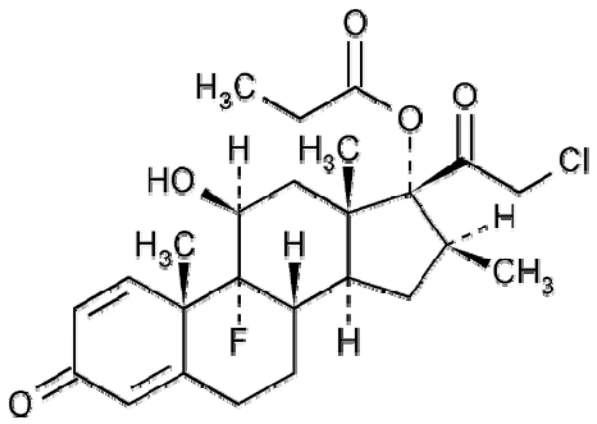
Molecular Formula: C25H32ClF05
Molecular Weight: 467
Description: White to cream colored crystalline powder.
Solubility: Insoluble in water.
Melting Point: 195.5 - 197°C
Composition
Each gram of Taro-Clobetasol Cream contains 0.05% w/w clobetasol propionate in a white, paraben and lanolin free water miscible cream base.
Non medicinal ingredients: Cetyl Alcohol, chlorocresol, citric acid, glyceryl monostearate, glyceryl stearate/PEG 100 stearate, propylene glycol, purified water, sodium citrate, stearyl alcohol, white wax.
Each gram of Taro-Clobetasol Ointment contains 0.05% w/w clobetasol propionate in a water repellent ointment base.
Non medicinal ingredients: Propylene glycol, sorbitan sesquioleate, white petrolatum.
Storage Conditions:
Store at room temperature (15° - 30°C). Do not dilute Clobetasol Propionate
Cream.
Availability of Dosage Forms
Clobetasol Propionate Cream, 0.05% is available in 15 gram and 50 gram tubes, and in 454 gram jars.
Clobetasol Propionate Ointment, 0.05% is available in 15 gram and 50 gram tubes, and 454 gram jars.