


Patient Medication Information: uses, side effects, how to take - Tresiba
What is Tresiba® used for?
Tresiba® is a long-acting man-made insulin used to control high blood sugar in adults with diabetes mellitus.
Tresiba® can also be used in children who are 2 years of age and older with type 1 diabetes mellitus.
How does Tresiba® work?
Tresiba® is known as a long-acting insulin analogue.
Tresiba® is similar to the insulin made by your body and helps your body to reduce your blood sugar level. It is used once a day.
What are the ingredients in Tresiba®?
Medicinal ingredients: Insulin degludec
Non-medicinal ingredients: Glycerol, phenol, metacresol, water for injection and zinc acetate
Tresiba® comes in the following dosage forms:
- Tresiba® FlexTouch® 3 mL prefilled pen (100 units/mL)
- Tresiba® FlexTouch® 3 mL prefilled pen (200 units/mL)
- Tresiba® Penfill® 3 mL cartridge (100 units/mL)
Tresiba® FlexTouch® prefilled insulin pens are for use with either NovoFine®, or NovoFine® Plus needles.
Serious Warnings and Precautions
|
|---|
Tresiba® Penfill® prefilled insulin cartridges are for use with the Novo Nordisk 3 mL Penfill cartridge compatible delivery devices and either NovoFine® or NovoFine® Plus needles.
Do not use Tresiba® if:
- you are allergic (hypersensitive) to insulin degludec or any of the other ingredients in this medicine.
- you think that your blood sugar is getting too low (this is called “hypoglycemia”).
To help avoid side effects and ensure proper use, talk to your healthcare professional before you take Tresiba®. Talk about any health conditions or problems you may have, including if you:
- have trouble with your kidneys or liver, or with your adrenal, pituitary or thyroid glands.
drink alcohol (including wine and beer) your need for insulin may temporarily change as your blood sugar level may either rise or fall.
- have an infection, fever, or have had an operation you may temporarily need more insulin than usual. If you are ill, continue taking your insulin and discuss with your doctor what changes may be right for you.
- suffer from diarrhea, vomiting, or eat less than usual you may temporarily need less insulin than usual.
- exercise more than usual or if you want to change your usual diet.
- are travelling abroad, different time zones may affect your insulin needs and the timing of injections. Discuss with your doctor what changes may be right for you.
are pregnant, or planning a pregnancy or are breastfeeding, your insulin needs may need to be changed. Careful control of your blood sugar in pregnancy is particularly important for the health of your baby. Discuss with your doctor what changes may be right for you.
drive, use tools, or operate machinery it is important not to let your blood sugar get too low, because your ability to concentrate and react will be less. Never drive, use tools or operate machinery if you feel like you have low blood sugar.
Other warnings you should know about:
Discuss with your doctor whether you should drive or use machines at all, if you have a lot of hypoglycemic reactions or if you find it hard to recognize hypoglycemia.
Before you travel, check with your physician or pharmacist on the availability of Tresiba® in other countries. If possible, bring enough Tresiba® with you on your trip.
Thiazolidinediones (a type of diabetes medication that comes in a tablet) can cause localized swelling (edema) and heart failure, especially when taken along with insulin. Tell your doctor straightaway if you have any localized swelling or signs of heart failure such as unusual shortness of breath.
Fast improvements in blood sugar control may lead to a temporary worsening of diabetic eye disorder.
When using FlexTouch®, make sure you use the right type of insulin – Always check the insulin label before each injection. This will help you to avoid accidental mix-ups between different strengths of Tresiba® and between Tresiba® and other insulin products.
When using Penfill®, make sure you use the right type of insulin – Always check the insulin label before each injection. This will help you to avoid accidental mix-ups between Tresiba® and other insulin products.
Do not transfer Tresiba® from the FlexTouch® or Penfill® into a syringe, because the markings on the insulin syringe will not measure the dose correctly and can result in an overdose and severe hypoglycemia.
The injection site should be rotated to help prevent changes to the fatty tissue under the skin, such as skin thickening, skin shrinking or lumps under the skin. The insulin may not work very well if you inject into a lumpy, pitted or thickened area. Tell your healthcare professional if you notice any skin changes at the injection site. Tell your healthcare professional if you are currently injecting into these affected areas before you start injecting in a different area. A sudden change of site may result in hypoglycemia. Your healthcare professional may tell you to check your blood sugar more closely, and to adjust your insulin or your other antidiabetic medications dose.
Tell your healthcare professional about all the medicines you take, including any drugs, vitamins, minerals, natural supplements or alternative medicines.
The following may interact with Tresiba®:
Many medicines affect the way glucose works in your body and this may influence your insulin dose. Listed below are the most common medicines, which may affect your insulin treatment. In particular, you should tell your doctor if you are using any medicine as mentioned below that affects your blood sugar level.
If you take any of the medicines below, your blood sugar level may fall (hypoglycemia):
- Other medicines for the treatment of diabetes
- Monoamine oxidase inhibitors (MAOI) (used to treat depression)
- Beta-blockers (used to treat high blood pressure)
- Medicines used to treat high blood pressure and/or heart problems, such as: angiotensin converting enzyme (ACE) inhibitors, angiotensin receptor blocking (ARB) agents, disopyramide
- Anabolic steroids (such as testosterone)
- Sulphonamides (used to treat infections)
- Fibrates (medicine used for lowering high levels of blood fats)
- Medicines used to relieve pain and lower fever, such as pentoxifylline, propoxyphene and salicylates
- Sulfonamide antibiotics (medicines used to treat infection)
- Fluoxetine
- Pramlintide
- Somatostatin analogs (such as octreotide)
If you take any of the medicines below, your blood sugar level may rise (hyperglycemia):
- Oral contraceptives (birth control pills)
- Thiazides (used to treat high blood pressure or excessive fluid retention)
- Sympathomimetics (such as epinephrine [adrenaline], or salbutamol, albuterol or terbutaline used to treat asthma)
- Growth hormone (medicine for stimulation of skeletal and somatic growth and pronounced influence on the body’s metabolic processes)
- Danazol (medicine acting on ovulation)
- Medicines used to treat mental health problems, such as: olanzapine, clozapine;
- Hormones, such as: estrogens and/or progesterone (alone or as contraceptive pills), somatotropin, thyroid hormones, glucagon;
- Corticosteroids such as cortisone (used to treat inflammation)
- Diuretics (also called water pills), used to treat high blood pressure or fluid retention;
- Isoniazid (used to treat tuberculosis);
- Niacin and phenothiazine
- Protease inhibitors (used to treat HIV infection);
Your blood sugar level may either rise or fall if you take:
- High blood pressure medicines, such as: beta-blockers or clonidine;
- Some medicines used to treat mental health problems, such as: lithium salts;
- Octreotide and lanreotide (used to treat a rare condition involving too much growth hormone (acromegaly))
- Alcohol (including wine and beer)
- A medicine used to treat some parasitic infections, called pentamidine. This may cause too low blood sugar which is sometimes followed by too high blood sugar.
Some medicines may make it harder to recognize the warning signs of your blood sugar being too low (hypoglycemia). Such medicines include: beta-blockers medicines, clonidine, guanethidine, or reserpine.
How to take Tresiba®:
Talk about your insulin needs with your doctor and Diabetes Nurse Educator. Do not change your insulin unless your doctor tells you to. Follow their advice carefully. Your doctor or Diabetes Educator may provide you with a guide to help track and adjust your dose based on your blood glucose levels. This leaflet is a general guide only. If your doctor has switched you from one type or brand of insulin to another, your dose may have to be adjusted by your doctor.
Before using Tresiba®:
- Check the name on the label to make sure it is Tresiba®.
- Check the strength on the label to make sure you have the correct strength of Tresiba®.
If using the FlexTouch®, always check that the prefilled pen is not damaged. Do not use it if any damage is seen. Take it back to your supplier or call Novo Nordisk Canada at 1-800-
- 465-4334 for assistance.
- If using the Penfill®, always check the cartridge, including the rubber stopper (plunger). Do not use it if any damage is seen or if there is a gap between the rubber stopper and the white barcode label. Take it back to your supplier or call Novo Nordisk Canada at 1-800-465-4334 for assistance. See your Novo Nordisk Insulin Delivery Device manual for further instructions.
- When using either FlexTouch® or Penfill®, always use a new needle for each injection to prevent contamination. Never reuse a needle.
- Do not share Tresiba® FlexTouch® and Penfill® with another person, even if the needle is changed. Do not reuse or share needles with another person. You may give another person a serious infection or get a serious infection from them.
Do not use Tresiba®:
- In insulin infusion pumps.
- If the FlexTouch® is dropped, damaged or crushed; there is a risk of leakage of insulin.
- If the Penfill® cartridge or Novo Nordisk Insulin Delivery Device containing the cartridge
- is dropped, damaged or crushed; there is a risk of leakage of insulin.
- If the insulin has not been stored correctly or if it has been frozen.
- If the insulin does not appear water-clear and colourless.
Do not refill a Tresiba® Penfill® cartridge.
If you are treated with Tresiba® Penfill® and another insulin in Penfill® cartridge, you should use two Novo Nordisk Insulin Delivery Devices, one for each type of insulin.
In case of loss or damage, always carry an extra pen and new needles with you in case the insulin delivery device is lost or damaged.
How to inject Tresiba®:
Tresiba® is given as an injection under the skin (subcutaneous injection). Do not inject it into a vein or muscle. The best places to inject are the front of your thighs, upper arms or the front of your waist (abdomen). Change the place within the area where you inject each day to reduce the risk of developing lumps and skin pitting.
Use the injection technique advised by your doctor or Diabetes Nurse Educator.
If you are using Tresiba® FlexTouch®, refer to the instructions provided at the end of this leaflet in the section “Instructions on How to Use Tresiba® 100/200 units/mL Solution for Injection in Pre-filled Pen”.
If you are using Tresiba® Penfill®, refer to the instructions provided with your Novo Nordisk Insulin Delivery Device manual.
Usual dose:
Your doctor will decide together with you:
- How much Tresiba® you will need each day.
- When to check your blood sugar level and if you need a higher or lower dose.
- Always follow your doctor’s recommendation for dose.
- Use Tresiba® once each day.
- If you want to change your usual diet, check with your doctor, pharmacist or nurse first as a
- change in diet may alter your need for insulin.
- Based on your blood sugar level your doctor may change your dose. Ask your healthcare provider what your insulin dose should be based on your blood sugar levels.
- When using other medicines, ask your doctor if your treatment needs to be adjusted.
For adults, inject Tresiba® subcutaneously once-daily at any time of day. For children with type 1 diabetes, inject Tresiba® subcutaneously at approximately the same time of the day.
Use in elderly patients (≥ 65 years old)
Tresiba® can be used in elderly patients. If you are elderly you may need to check your blood sugar level more often. Talk to your doctor about changes in your dose.
If you have kidney or liver problems
If you have kidney or liver problems you may need to check your blood sugar level more often. Talk to your doctor about changes in your dose.
Overdose:
If you use too much Tresiba® your blood sugar may get too low (hypoglycemia). See advice in section ‘General effects from diabetes treatment/ Too low blood sugar (hypoglycemia)’.
| If you think you, or a person you are caring for, have taken too much Tresiba®, contact a healthcare professional, hospital emergency department, or regional poison control centre immediately, even if there are no symptoms. |
Missed Dose:
If you miss or are delayed in taking your dose of Tresiba®:
- Take your dose as soon as you remember and then continue with your regular dosing schedule.
- Make sure there are at least 8 hours between your doses.
What are possible side effects from using Tresiba®?
These are not all the possible side effects you may have when taking Tresiba®. If you experience any side effects not listed here, tell your healthcare professional.
Very common (may affect more than 1 in 10 people)
Too low blood sugar (hypoglycemia): If your blood sugar falls too low you may become unconscious. Very serious low blood sugar can cause brain damage and can cause death. If you have symptoms of low blood sugar, immediately take actions to increase your blood sugar. See advice in section ‘General effects from diabetes treatment/Too low blood sugar (hypoglycemia)’.
Common (may affect up to 1 in 10 people)
Local reactions: Local reactions at the place you inject your insulin can occur. The reactions can include: pain, redness, hives, swelling, and itching. The reactions usually disappear after a few days. Talk to your doctor if the reactions do not disappear after a few weeks. Stop using
TRESIBA® and immediately talk to your doctor if the reactions become serious. For more information, see ‘Serious allergic reaction’.
Uncommon (may affect up to 1 in 100 people)
Skin changes where you inject your insulin injection (lipodystrophy): Fatty tissue under the skin may shrink (lipoatrophy) or get thicker (lipohypertrophy). Changing where you inject your insulin each time may reduce the risk of developing these skin changes. If you keep injecting your insulin in the same place of your body, these reactions can become more severe and affect the amount of insulin your body gets from the pen. If you notice these skin changes, talk to your doctor.
Swelling around your joints: When you first start using your insulin, your body may keep more water than it should. This can cause temporary swelling around your ankles and other joints.
Rare (may affect up to 1 in 1,000 people)
Tresiba® can cause allergic reactions such as hives, swelling of the tongue and lips, diarrhea, nausea, tiredness and itching.
Not known
Lumps under the skin may also be caused by build-up of a protein called amyloid (cutaneous amyloidosis). The insulin may not work very well if you inject into a lumpy, pitted or thickened area. Change the injection site with each injection to help prevent these skin changes.
Serious allergic reaction: If you have a serious allergic reaction to Tresiba®, immediately stop using Tresiba® and immediately get emergency medical treatment. You may be having a serious allergic reaction if:
- The local reactions spread to other parts of your body.
- You suddenly feel unwell with sweating.
- You start being sick (vomiting).
- You experience difficulty in breathing.
- You experience a fast heartbeat or feeling dizzy.
General effects from diabetes treatment
Too low blood sugar (hypoglycemia)
Too low blood sugar can happen if you drink alcohol, use too much insulin, exercise more than usual, eat too little or miss a meal.
Warning signs of low blood sugar include headache; slurred speech; fast heartbeat; cold sweat, cool pale skin; feeling sick; feeling very hungry; tremor or feeling nervous or worried; feeling unusually tired, weak and sleepy; feeling confused, difficulty in concentrating; temporary changes in how well you see.
What to do if you get too low blood sugar:
- Eat glucose tablets (sugar tablets) or another high sugar snack, like sweets, biscuits or fruit juice (always carry glucose tablets (sugar tablets) or a high sugar snack in case you feel the signs of having too low blood sugar).
- Rest and measure your blood sugar if possible. You may need to measure your blood sugar more than once, as it may take some time before your blood sugar improves.
- Wait until the signs of too low blood sugar have stopped or your blood sugar level has gotten better before continuing with your insulin as usual.
What others need to do if you pass out:
Tell everyone you spend time with that you have diabetes. Tell them what could happen if your blood sugar gets too low, including the risk of you passing out. Let them know that if you pass out, they must:
- Turn you on your side.
- Immediately get medical help.
- Not give you any food or drink because you may choke.
You may recover more quickly from passing out with an injection of glucagon. This can only be given to you by someone who knows how to give it.
- If you are given glucagon you will need sugar or a sugary snack as soon as you are able.
- If you do not respond to a glucagon injection, you will have to be treated in a hospital.
- If not treated, severe low blood sugar can cause brain damage and cause death.
Talk to your doctor if:
- Your blood sugar got so low that you passed out.
- You have used an injection of glucagon.
- You have had too low blood sugar a few times recently.
These may mean that the amount or timing of your insulin injections, foods eaten, or exercise effort may need to be changed.
Too high blood sugar (hyperglycemia)
Too high blood sugar may happen if you eat more or exercise less than usual, drink alcohol, get an infection or a fever, have not used enough insulin, keep using less insulin than you need, forget to use your insulin or stop using insulin without talking to your doctor.
Warning signs for too high blood sugar include flushed, dry skin; feeling sleepy or tired; dry mouth, fruity (acetone) breath; urinating more than usual, feeling thirsty; losing your appetite, feeling or being sick (nausea or vomiting).
These may be signs of a very serious condition called ketoacidosis. This is a build-up of acid in the blood because the body is breaking down fat instead of sugar for energy. If not treated, ketoacidosis could lead to diabetic coma and death.
What to do if you get too high blood sugar:
- Check your blood sugar.
- Check your urine for ketones.
- Immediately talk to a doctor.
Serious side effects and what to do about them
| Symptom / effect | Talk to your healthcare professional | Stop taking drug and get immediate medical help | |
| Only if severe | In all cases | ||
VERY COMMON Too low blood sugar (hypoglycemia) | √ | √ | |
COMMON Reaction at administration site | √ | ||
UNCOMMON Skin changes where you inject your insulin injection (lipodystrophy) | √ | ||
| Swelling around your joints | √ | ||
RARE Serious allergic reaction | √ | √ | |
UNKNOWN Cutaneous Amyloidosis: lumps under skin | √ | ||
If you have a troublesome symptom or side effect that is not listed here or becomes bad enough to interfere with your daily activities, tell your healthcare professional.
Reporting Side Effects
You can report any suspected side effects associated with the use of health products to Health Canada by:
NOTE: Contact your health professional if you need information about how to manage your side effects. The Canada Vigilance Program does not provide medical advice. |
Storage:
Do not use Tresiba® after the expiration date stated on the label. The expiry date refers to the last day of that month.
Do not store Tresiba® with the needle attached. Always safely remove and throw away the needle after each injection. This may help prevent contamination, infection and leakage. It also helps to make sure that you get the correct dose of Tresiba®.
Keep Tresiba® pen needles and all medicines out of the sight and reach of children.
Before first use
FlexTouch®: Store in a refrigerator (2°C to 8°C). Keep away from the freezing element. Do not freeze. Keep the cap on the pen in order to protect from light.
Penfill®: Store in a refrigerator (2°C to 8°C). Keep away from the freezing element. Do not freeze.
After first opening or if carried as a spare
FlexTouch®: You can carry your Tresiba® pre-filled pen (FlexTouch®) with you and keep it at room temperature (not above 30°C) or in a refrigerator (2°C to 8°C) for up to 8 weeks (56 days). Always keep the cap on the pen when you are not using it in order to protect from light.
Penfill®: Do not refrigerate. You can carry your Tresiba® cartridge (Penfill®) with you and keep it at room temperature (not above 30°C) for up to 8 weeks (56 days). Always keep Tresiba® Penfill® in the outer carton when you are not using it in order to protect from light.
Keep out of reach and sight of children.
If you want more information about Tresiba®:
- Talk to your healthcare professional
- Find the full product monograph that is prepared for healthcare professionals and includes this Patient Medication Information by visiting the Health Canada website: (https://www.canada.ca/en/health-canada/services/drugs-health-products/drug-products/drug-product-database.html; the manufacturer’s website www.novonordisk.ca, or by calling Novo Nordisk Canada Inc., at: 1-800-465-4334.
Tresiba®, Penfill®, FlexTouch®, NovoFine® and NovoFine® Plus are registered trademarks of Novo Nordisk A/S and used by Novo Nordisk Canada Inc.
Last Revised: OCT 27, 2022
© 2022
Novo Nordisk Canada Inc.
| Instructions on How to Use TRESIBA® 100/200 units/mL Solution for Injection in Pre-filled Pen (FlexTouch®) |
Please read these instructions carefully before using your FlexTouch® pre-filled pen. If you do not follow the instructions carefully, you may get too little or too much insulin, which can lead to too high or too low blood sugar level. Do not use the pen without proper training from your doctor or nurse. Start by checking your pen to make sure that it contains TRESIBA® 100/200 units/mL, then look at the illustrations below to get to know the different parts of your pen and needle. If you are blind or have poor eyesight and cannot read the dose counter on the pen, do not use this pen without help. Get help from a person with good eyesight who is trained to use the FlexTouch® pre-filled pen. TRESIBA® 100 units/mL: Your pen is a pre-filled dial-a-dose insulin pen containing 300 units of insulin. You can select a maximum of 80 units per dose, in steps of 1 unit. Your pen is designed to be used with NovoFine® or NovoFine® Plus single-use disposable needles up to a length of 8 mm. Needles are not included in the pack. TRESIBA® 200 units/mL: Your pen is a pre-filled dial-a-dose insulin pen containing 600 units of insulin. You can select a maximum of 160 units per dose, in steps of 2 units. The dose counter of your pen shows the exact number of insulin units. Do not make any dose re-calculation. Your pen is designed to be used with NovoFine® or NovoFine® Plus single-use disposable needles up to a length of 8 mm. Needles are not included in the pack.
Pay special attention to these notes as they are important for correct use of the pen. |
TRESIBA® FlexTouch® pen and needle (example) (FlexTouch® 100 units/mL) Pen cap Outer needle cap Inner needle cap Needle Paper tab Insulin scale Insulin window Pen label Dose counter Dose pointer Dose selector Dose button F l e x T o u c h ® ® 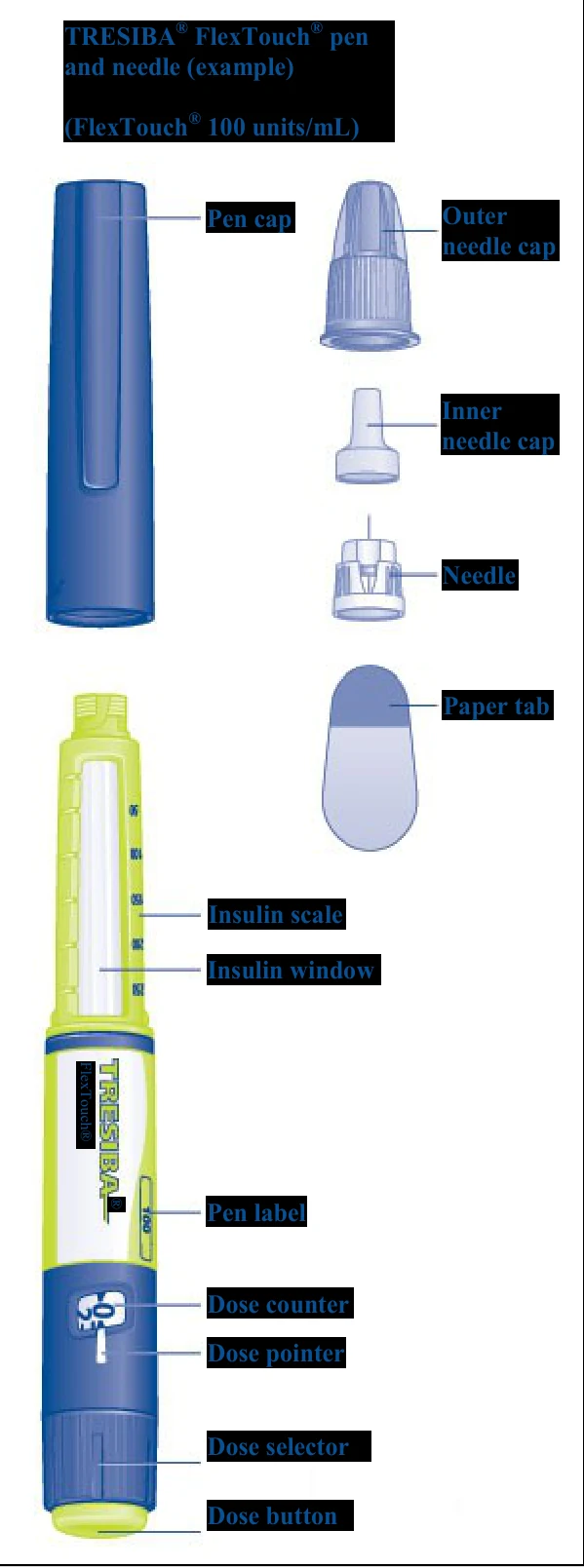               | TRESIBA® FlexTouch® pen and needle (example) (FlexTouch® 200 units/mL) Pen cap Insulin scale Insulin window Pen label Dose counter Dose pointer Dose selector Dose button ® F l e x T o u c h ® Outer needle cap Inner needle cap Needle Paper tab 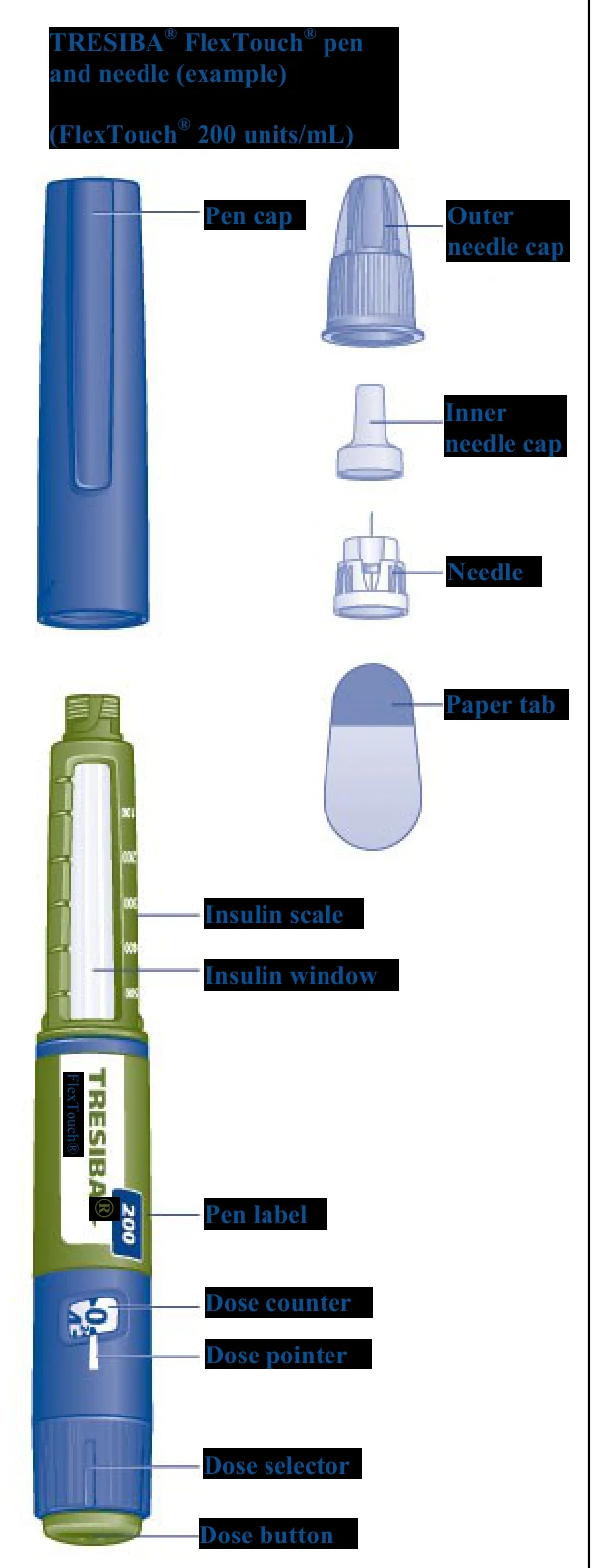               |
| 1 Prepare Your Pen | |||
Check the name and strength on the label of your pen, to make sure that it contains TRESIBA® 100 or 200 units/mL. This is especially important if you take more than one type of insulin. If you take a wrong type of insulin, your blood sugar level may get too high or too low. A) Pull off the pen cap. | |||
| FlexTouch® 100 units/mL | FlexTouch® 200 units/mL | ||
A 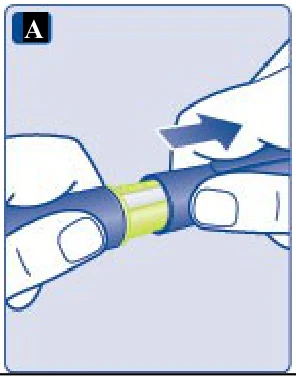 | A 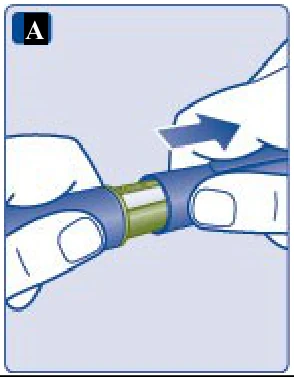 | ||
B) Check that the insulin in your pen is clear and colourless. Look through the insulin window. If the insulin looks cloudy, do not use the pen. | |||
| FlexTouch® 100 units/mL | FlexTouch® 200 units/mL | ||
B 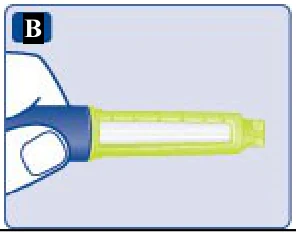 | B 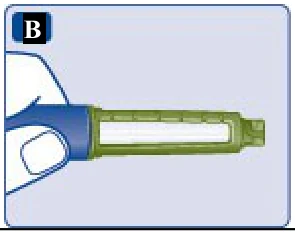 | ||
| C) Take a new needle and tear off the paper tab. | |||
| FlexTouch® 100 units/mL | FlexTouch® 200 units/mL | ||
C 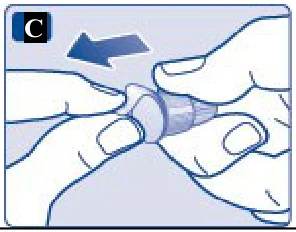 | C 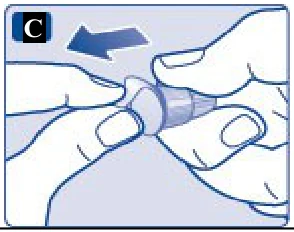 |
| D) Push the needle straight onto the pen. Turn until it is on tight. | |
| FlexTouch® 100 units/mL | FlexTouch® 200 units/mL |
D 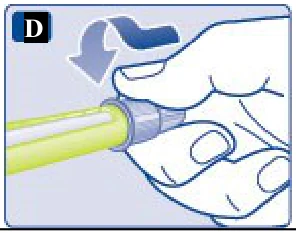 | D 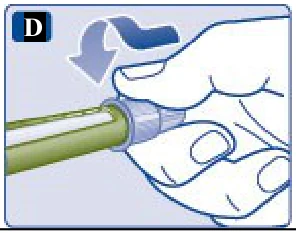 |
| E) Pull off the outer needle cap and keep it for later. You will need it after the injection, to correctly remove the needle from the pen. | |
| FlexTouch® 100 units/mL | FlexTouch® 200 units/mL |
E 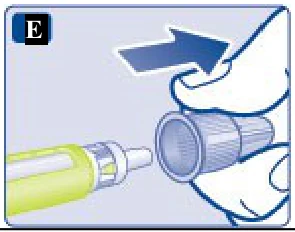 | E 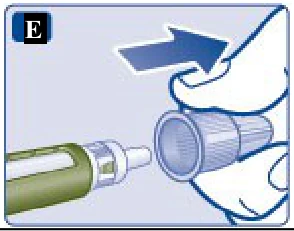 |
F) Pull off the inner needle cap and throw it away. If you try to put it back on, you may accidentally stick yourself with the needle. A drop of insulin may appear at the needle tip. This is normal, but you must still check the insulin flow. | |
| FlexTouch® 100 units/mL | FlexTouch® 200 units/mL |
F 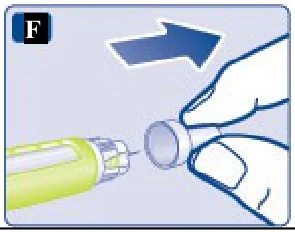 | F 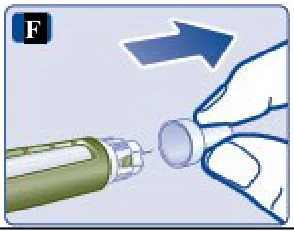 |
This reduces the risk of contamination, infection, leakage of insulin, blocked needles and inaccurate dosing.
| |
| 2 Check The Insulin Flow | |
Always check the insulin flow before you start. This helps you to ensure that you get your full insulin dose. A) Turn the dose selector to select 2 units. Make sure the dose counter shows 2. | |
| FlexTouch® 100 units/mL | FlexTouch® 200 units/mL |
A 2 units selected 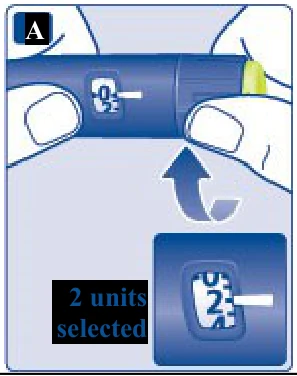  | A 2 units selected 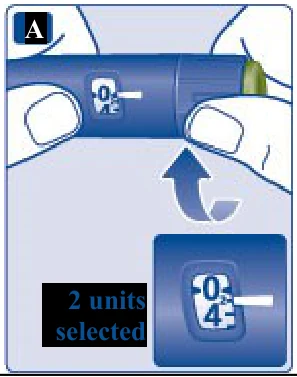  |
B) Hold the pen with the needle pointing up. Tap the top of the pen gently a few times to let any air bubbles rise to the top. | |
| FlexTouch® 100 units/mL | FlexTouch® 200 units/mL |
B 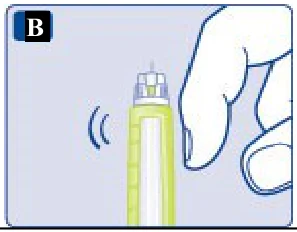 | B 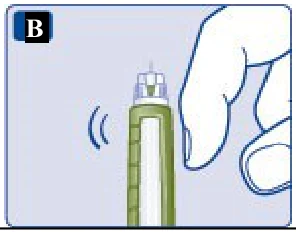 |
C) Press and hold in the dose button until the dose counter returns to 0. The 0 must line up with the dose pointer. A drop of insulin should appear at the needle tip. | |
| FlexTouch® 100 units/mL | FlexTouch® 200 units/mL |
C 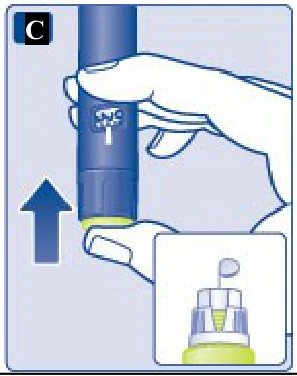 | C 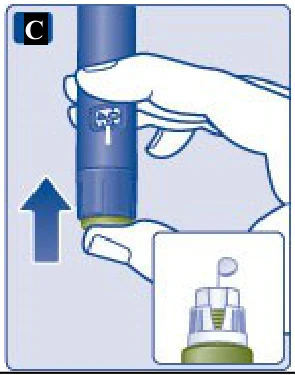 |
A small air bubble may remain at the needle tip, but it will not be injected. If no drop appears, repeat steps 2A to 2C up to 6 times. If there is still no drop, change the needle and repeat steps 2A to 2C once more. If a drop of insulin still does not appear, dispose of the pen and use a new one. | |
If no drop appears, you will not inject any insulin, even though the dose counter may move. This may indicate a blocked or damaged needle.
| |
| 3 Select Your Dose | |
A) Make sure the dose counter shows 0 before you start. The 0 must line up with the dose pointer. | |
Turn the dose selector to select the dose you need, as directed by your doctor or nurse. If you select a wrong dose, you can turn the dose selector forwards or backwards to the correct dose. For FlexTouch® 100 units/ mL, the pen can dial up to a maximum of 80 units. For FlexTouch® 200 units/ mL, the pen can dial up to a maximum of 160 units. The dose counter shows the dose dialled in units. Do not make any dose re-calculation. | ||||
| FlexTouch® 100 units/mL | FlexTouch® 200 units/mL | |||
A 5 units selected Examples 24 units selected 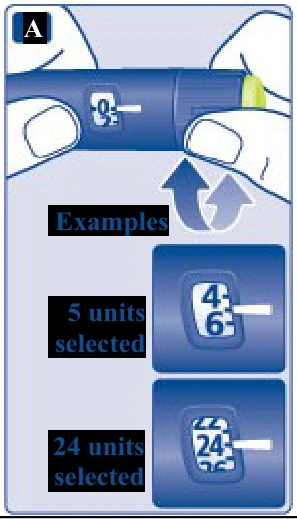    | A 6 units selected Examples 24 units selected 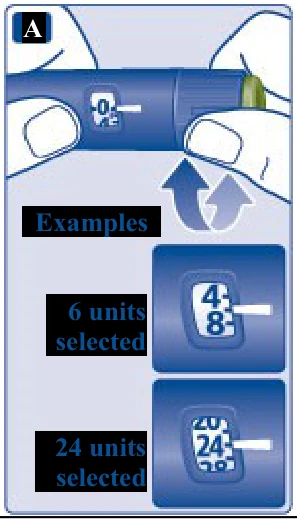    | |||
The dose selector changes the number of units. Only the dose counter and dose pointer will show how many units you select per dose. For FlexTouch® 100 units/ mL, you can select up to 80 units per dose. When your pen contains less than 80 units, the dose counter stops at the number of units left. For FlexTouch® 200 units/ mL, you can select up to 160 units per dose. When your pen contains less than 160 units, the dose counter stops at the number of units left. The dose selector clicks differently when turned forwards, backwards or past the number of units left. Do not count the pen clicks. | ||||
Do not count the pen clicks. If you select and inject the wrong dose, your blood sugar level may get too high or too low. Do not use the insulin scale, it only shows approximately how much insulin is left in your | ||||
| pen. |
| 4 Inject Your Dose |
A) Insert the needle into your skin as your doctor or nurse has shown you. Make sure you can see the dose counter. Do not touch the dose counter with your fingers. This could interrupt the injection. Press and hold down the dose button until the dose counter returns to 0. The 0 must line up with the dose pointer. You may then hear or feel a click. Leave the needle under the skin for at least 6 seconds to make sure you get your full dose. |
| FlexTouch® 100 units/mL | FlexTouch® 200 units/mL |
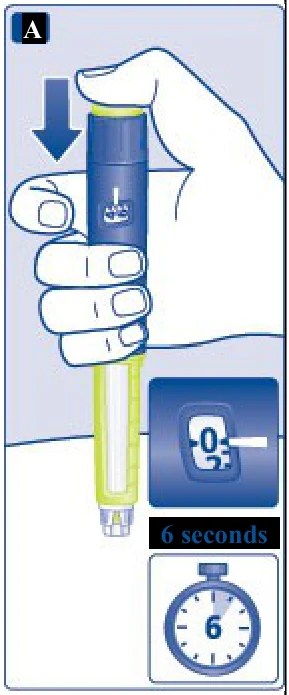 | A 6 seconds 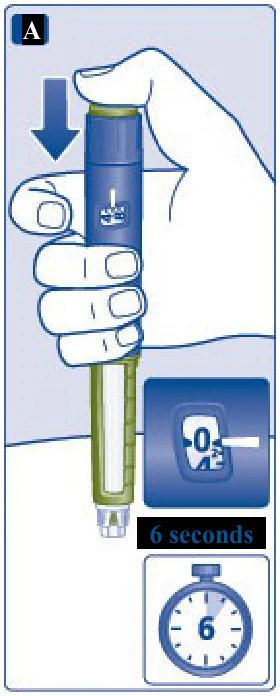  |
B) Pull the needle and pen straight up from your skin. If blood appears at the injection site, press lightly with a cotton swab. Do not rub the area. | |||||
| FlexTouch® 100 units/mL | FlexTouch® 200 units/mL | ||||
B 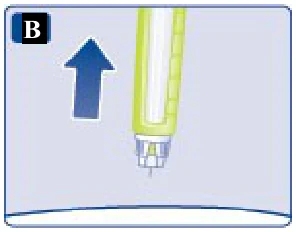 | B 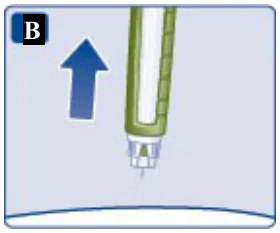 | ||||
| You may see a drop of insulin at the needle tip after injecting. This is normal and does not affect your dose. | |||||
The dose counter will show the exact number of units. Do not count the pen clicks. Hold the dose button down until the dose counter returns to 0 after the injection. If the dose counter stops before it returns to 0, the full dose has not been delivered, which may result in too high blood sugar level. | |||||
| 5 After Your Injection | |||||
| A) Lead the needle tip into the outer needle cap on a flat surface without touching the needle or the outer cap. | |||||
| FlexTouch® 100 units/mL | FlexTouch® 200 units/mL | ||||
A 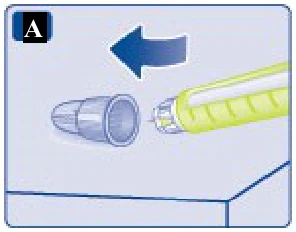 | A 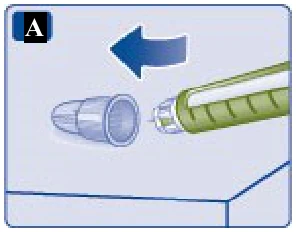 | ||||
B) Once the needle is covered, carefully push the outer needle cap completely on. Unscrew the needle and dispose of it carefully. | |||||
| FlexTouch® 100 units/mL | FlexTouch® 200 units/mL | ||||
B 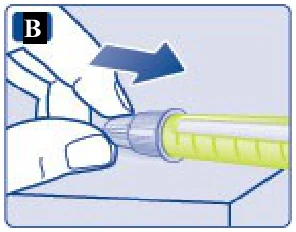 | B 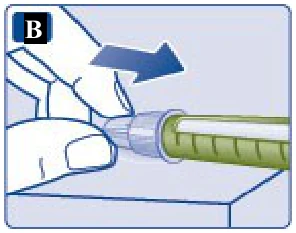 | ||||
| C) Put the pen cap on your pen after each use to protect the insulin from light. | |||||
| FlexTouch® 100 units/mL | FlexTouch® 200 units/mL | ||||
C 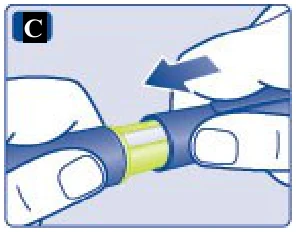 | C 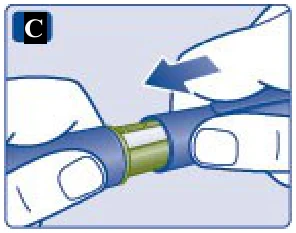 | ||||
Always dispose of the needle after each injection. This reduces the risk of contamination, infection, leakage of insulin, blocked needles and inaccurate dosing. If the needle is blocked, you will not inject any insulin. When the pen is empty, throw it away without a needle on as instructed by your doctor, nurse, pharmacist or local authorities. | |||||
| |||||
| 6 How Much Insulin Is Left? | |||||
| A) The insulin scale shows you approximately how much insulin is left in your pen. | |||||
| FlexTouch® 100 units/mL | FlexTouch® 200 units/mL | ||||
A Approx. how much insulin is left 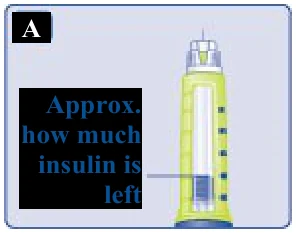  | Approx. how much insulin is left A 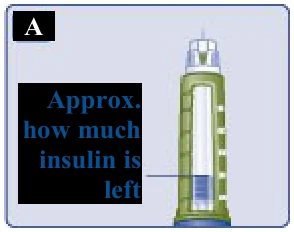  | ||||
B) To see precisely how much insulin is left, use the dose counter: Turn the dose selector until the dose counter stops. For FlexTouch® 100 units/ mL, if the pen shows 80, at least 80 units are left in your pen. If it shows less than 80, the number shown is the number of units left in your pen. For FlexTouch® 200 units/ mL, if the pen shows 160, at least 160 units are left in your pen. If it shows less than 160, the number shown is the number of units left in your pen. | |||||
| FlexTouch® 100 units/mL | FlexTouch® 200 units/mL | ||||
B Dose counter stopped: 52 units left Example 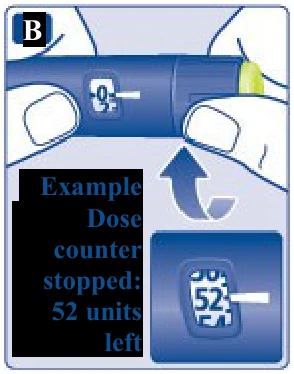   | B Dose counter stopped: 52 units left Example 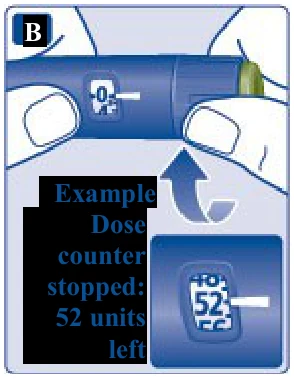   | ||||
Turn the dose selector back until the dose counter shows 0. If you need more insulin than the units left in your pen, you can split your dose between two pens. | |||||
| |||||
| If in doubt, take the full dose with a new pen. If you split the dose wrong, you will inject too little or too much insulin, which can lead to too high or too low blood sugar level. |
Always keep your pen with you. Always carry an extra pen and new needles with you, in case of loss or damage. Always keep your pen and needles out of sight and reach of others, especially children Never share your pen or your needles with other people. It might lead to cross-infection Never share your pen with other people. Your medicine might be harmful to their health. Caregivers must be very careful when handling used needles – to reduce the risk of needle injury and cross-infection. |
Caring for your pen Treat your pen with care. Rough handling or misuse may cause inaccurate dosing, which can lead to too high or too low blood sugar level. Do not leave the pen in a car or other place where it can get too hot or too cold. Do not expose your pen to dust, dirt or liquid. Do not wash, soak or lubricate your pen. If necessary, clean it with mild detergent on a moistened cloth. Do not drop your pen or knock it against hard surfaces. If you drop it or suspect a problem, attach a new needle and check the insulin flow before you inject. Do not try to refill your pen. Once empty, it must be disposed of. Do not try to repair your pen or pull it apart. |