


Patient Medication Information: uses, side effects, how to take - Semglee
What is Semglee used for?
- Semglee [Insulin Glargine Injection (rDNA Origin)] is a recombinant human insulin analogue that is a long-acting blood-glucose-lowering agent administered subcutaneously (under the skin) once a day.
- Semglee is indicated in the treatment of patients over 17 years of age with Type 1 or Type 2 diabetes mellitus who require basal (long-acting) insulin for the control of hyperglycemia.
- Semglee is also indicated in the treatment of pediatric patients (˃ 6 years old) with Type 1 diabetes mellitus who require basal (long-acting) insulin for the control of hyperglycemia.
How does Semglee work?
Insulin is a hormone produced by the pancreas, a large gland that lies near the stomach. This hormone is necessary for your body to use food, especially sugar, correctly. Diabetes occurs either when your pancreas does not make enough insulin to meet your body's needs or when your body is unable to use the insulin you normally produce properly.
When your body does not make enough insulin, you need an external source of insulin – that is why you must take insulin injections. Semglee is similar to the insulin made by your body.
Insulin injections, such as Semglee, play a key role in keeping your diabetes under control. In addition
Serious Warnings and Precautions
|
to proper insulin therapy, it’s important to maintain a healthy lifestyle – this includes eating a balanced diet, participating in regular exercise or other physical activities, carefully monitoring your glucose levels and following your health professional’s recommendations. These simple actions will compliment your insulin therapy and will ultimately help you gain greater control of your diabetes.
You have been instructed to test your blood and/or your urine regularly for glucose; it is especially important to test even more often when changing insulins or dosing schedule. If your blood tests consistently show above- or below- normal glucose levels, or your urine tests consistently show the presence of glucose, your diabetes is not properly controlled and you must let your health professional know.
Insulin injections play an important role in keeping your diabetes under control. But the way you live – your diet, careful monitoring of your glucose levels, exercise, or planned physical activity and following your health professional’s recommendations– all work with your insulin to help you control your diabetes.
Always keep an extra supply of insulin and needle on hand. Always wear medical alert identification and carry information about your diabetes so that appropriate treatment can be given if complications occur while you are away from home.
What are the ingredients in Semglee?
Medicinal ingredients: insulin glargine (rDNA origin)
Non-medicinal ingredients: glycerol 85%, m-cresol, water for injection, zinc, and hydrochloric acid and sodium hydroxide for pH adjustment.
Semglee comes in the following dosage forms:
Solution 100 units/mL.
Pen, Plunger stoppers, cartridge, lined seals are not made with natural rubber latex.
Do not use Semglee:
- if you are allergic to this drug or to any ingredient in the formulation or component of the container;
- if you have diabetic ketoacidosis;
- for intravenous or intramuscular injections;
- If your blood sugar is too low (hypoglycemia). After treating your low blood sugar, follow your health care provider’s instructions on the use of Semglee.
To help avoid side effects and ensure proper use, talk to your healthcare professional before you take Semglee. Talk about any health conditions or problems you may have, including if you:
- are planning to have a baby, are pregnant, or are nursing a baby;
- are taking any medication.
If you develop skin changes at the injection site. The injection site should be rotated to prevent skin changes such as lumps under the skin. The insulin may not work very well if you inject into a lumpy area (see How to take Semglee). Contact your healthcare professional if you are currently injecting into a lumpy area before you start injecting in a different area. A sudden change of site may result in hypoglycemia. Your healthcare professional may tell you to check your blood sugar more closely, and to adjust your insulin or your other antidiabetic medications dose.
Accidental mix-ups between insulin glargine and other insulins, particularly short-acting insulins, have been reported. To avoid medication errors between insulin glargine and other insulins, check your insulin labels before every injection.
Hypokalemia (low potassium) is a possible side effect with all insulins. You might be more at risk if you are using potassium lowering drugs or losing potassium through other means (e.g. diarrhea). Symptoms of hypokalemia may include: Fatigue, muscle weakness or spasms, constipation, tingling or numbness, feeling of skipped heart beats or palpitations.
If you have diabetic retinopathy (condition affecting the retina of the eye) and you have a marked change in blood glucose levels, the retinopathy may temporary get worse. Ask your doctor about this.
Other warnings you should know about:
The use of thiazolidinediones (such as rosiglitazone and pioglitazone), alone or in combination with other antidiabetic agents (including insulin), has been associated with heart failure and swelling of the lower extremities. Please contact your physician immediately if you develop symptoms of shortness of breath, fatigue, exercise intolerance, or swelling of the lower extremities while you are on these agents.
Concomitant oral antidiabetic treatment may need to be adjusted.
Tell your healthcare professional about all the medicines you take, including any drugs, vitamins, minerals, natural supplements or alternative medicines.
The following may interact with Semglee:
Other medicines, including non-prescription medicines, and dietary supplements (such as vitamins) can change the way insulin works. Your dose of insulin or other medications may need to be changed in consultation with your health professional. Please see “How to take Semglee” section below for potential medication interactions with insulin.
How to take Semglee:
Your doctor has recommended the type of insulin that he/she believes is best for you. DO NOT USE ANY OTHER INSULIN EXCEPT ON THE ADVICE AND DIRECTION OF YOUR DOCTOR.
Read these instructions carefully before using Semglee prefilled pen (pen) and each time you get another pen. There may be new information. If you are unable to read or follow all of the instructions on your own, ask for help from someone trained to use this pen. This pen is not recommended for use by the blind or virtually impaired without the help of someone trained to use the pen. If you do not follow these instructions each time you use the pen, you may either get too much or too little insulin. This may affect your blood sugar level.
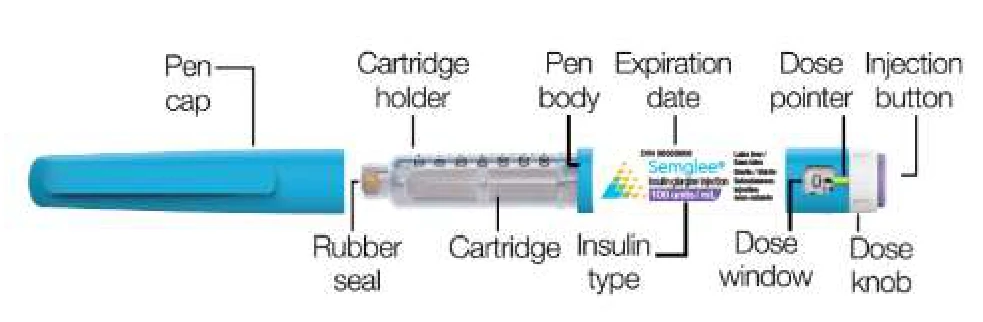
Semglee is a prefilled disposable pen injector containing 3 mL (300 units, 100 units / mL) of insulin glargine. You can inject 1-80 units in a single injection.
The Semglee prefilled pen is for single patient use. Do not share it with other people, including other family members, even if the needle has been changed. You may give other people a serious infection, or get a serious infection from them. Do not use on multiple patients.
Before you use the pen for the first time check that the Semglee prefilled, disposable pen injector carton is sealed and that the sticker sealing the carton closed is not broken.
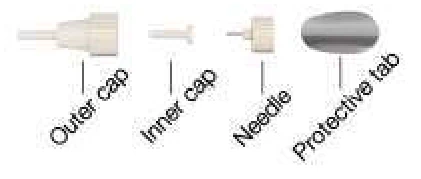
Needles to be obtained separately: Needle sizes compatible with this pen:
|
|---|
 |
|---|
Required Supplies
Make sure you have the following items before taking your dose:
- Semglee pen
- Sterile disposable hypodermic needle compatible with this pen
2 alcohol wipes
- Sharps disposal container
Each time you use the pen
- Wash your hands with soap and water before using your pen.
- Check the pen label to make sure that you are taking the correct type of insulin. The pen has a purple and white label and purple injection button.
- Check the expiration date on the pen label. Do not use the pen after the expiration date.
- Check that the medicine in the pen cartridge looks clear and colourless. Do not use the pen if the medicine in the cartridge looks cloudy, coloured or if you can see particles.
- Always use a new sterile disposable needle for each injection.
- Use an injection site that your healthcare professional has shown you.
| Step 1. Prepare your pen | |
|---|---|
A. Inspect the pen: check the purple and white label on the pen to make sure:
| 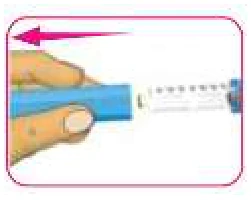 |
| B. Hold the pen body with one hand. With the other hand pull off the pen cap. Put the pen cap aside to be used later. | |
C. Check the insulin through the cartridge holder to make sure:
| |
| D. Wipe the rubber seal (at the front of the cartridge) with a new alcohol wipe. | 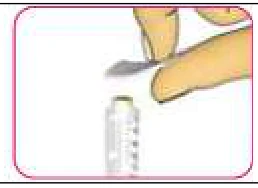 | |
|---|---|---|
| Step 2. Attach a new needle | ||
| A. Take a new sterile disposable needle and peel off the protective seal. Do not use the needle if the protective seal is damaged or missing as the needle may not be sterile. | 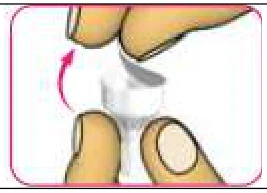 | |
| B. While holding the pen body facing upwards, attach the outer needle cap straight on to the cartridge holder as shown. Trying to attach the outer needle cap sideways may bend or damage the needle. | 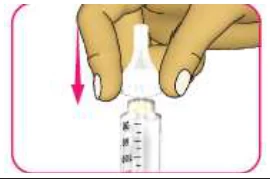 | |
| C. Turn the outer needle cap in a clockwise (right) direction until it feels tightly fixed on the pen. | 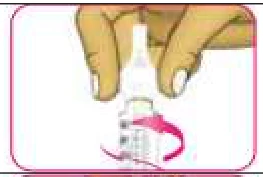 | |
| D. Carefully pull off the outer needle cap and put it aside. Do not throw it away. You will need the outer needle cap later. | 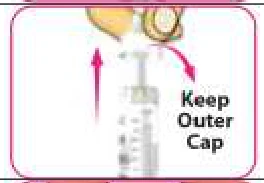 | |
| E. Carefully pull off the inner needle cap and throw it away. | 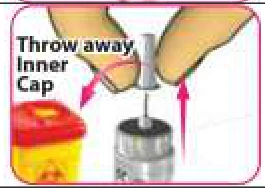 | |
| Step 3. Prime your pen needle | ||
A. Always prime a new pen needle before each injection. B. Turn the white dose knob to 2 dose units. You will hear a “click” for each unit turned. If you accidentally turn past 2 units, turn back the dose knob in the opposite direction to the correct number of units. | 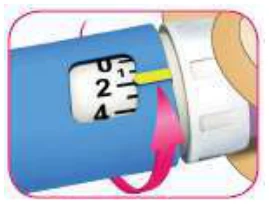 | |
C. Hold the pen body facing upwards with one hand. D. Tap the cartridge gently with your finger to help any large air bubbles to move to the top of the cartridge. Small bubbles may still be | 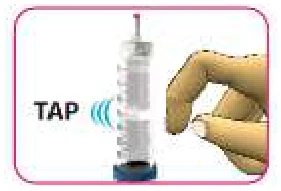 | |
| visible. This is normal. | |
|---|---|
E. With the pen upright, press the injection button in until it stops moving and the dose window shows “0”. F. Repeat steps 3B through 3E up to three more times until you see drops of insulin at the tip of the needle. Priming is complete when you can see drops of insulin. If you do not see any insulin at the needle tip after 4 priming attempts the needle may be clogged. If this occurs:
| 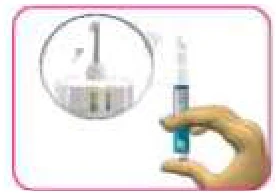 |
| Step 4. Select your dose | |
A. Check that the dose window shows “0”. B. Turn the white dose knob until the yellow dose pointer lines up with your required dose. As you turn the white dose knob to set your dose, the white plunger will extend out and you will hear a “click” at each unit dialed. | 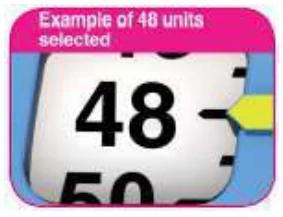 |
The dose can be corrected by turning the dose knob in either direction until the correct dose lines up with the yellow dose pointer. The pen will not let you dial a dose more than the number of units left in the pen. If your dose is more than the number of units left in the pen, either:
Do not force the dose knob to turn beyond 80 units. Do not push the purple injection button when turning the dose knob. | |
| Step 5. Select and clean the injection site | |
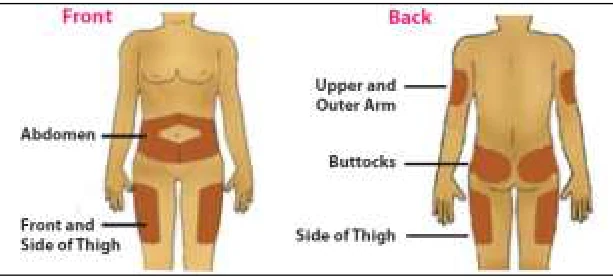
A. Select the injection site as explained to you by your healthcare professional, clean with a new alcohol wipe and let your skin dry before you inject your dose. Injection sites include your arms, hips, thighs, buttocks and abdomen. You should change your injection site for each injection. | |
 | |
|---|---|
| Step 6. Inject your dose | |
A. If instructed by your healthcare professional you can pinch the cleaned skin between your fingers. B. Push the needle straight into the skin as shown by your healthcare professional. Do not inject with the needle at an angle. | 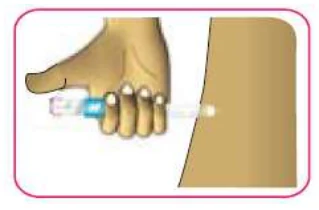 |
| C. Press the purple injection button all the way in. The white dose knob will turn and you will hear “clicks” as you press down. | 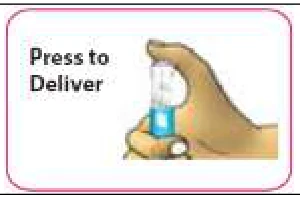 |
D. Hold the purple injection button down for 10 seconds after the dose window shows “0” to make sure all of the insulin is injected. If you do not keep the injection button pressed down for 10 seconds after “0” is displayed you may get the wrong dose of medicine. Do not push the injection button sideways or block the white dose knob with your fingers as this will stop you from injecting the medicine. | 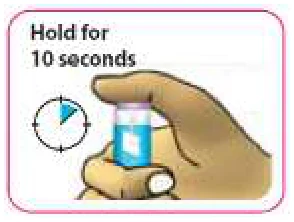 |
| Step 7. After your injection | |
| A. Take the outer needle cap that you had saved in step 2D, hold it at the widest part and carefully cover the needle without touching it. | 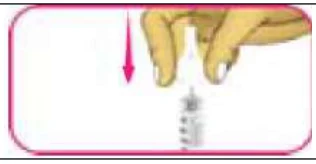 |
| B. Squeeze the wide part of the outer needle cap and unscrew the needle in a counter-clockwise (left) direction. Keep twisting the needle until it comes off the pen. It may take several twists to release the needle. | 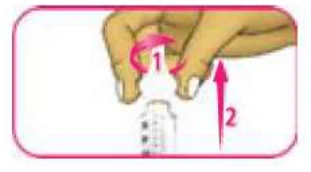 |
| C. Put the needle in a sharps disposal container (refer to Step 8 for instructions on disposal). | 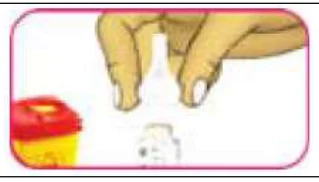 |
D. Replace the pen cap over the cartridge. E. Store the pen at room temperature (under 30°C). Do not store the pen with a used needle attached. | 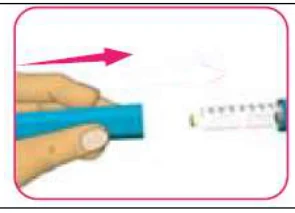 |
|---|---|
| Step 8. Disposal | |
Put your used needle in a sharps disposal container right away after use. Do not throw away (dispose of) loose needles in your household trash. If you do not have a sharps container, you may use a household container that is:
The used pen may be discarded in your household trash after you have removed the needle. | |
Pen Care
- Always carry an extra insulin prefilled pen injector as recommended by your healthcare professional in case your pen gets lost or damaged.
- Always use a new sterile disposable needle for each injection.
- Keep your pen away from moisture, dust, direct sunlight and places where the temperature may get too high or low (see “Storage” below).
- You can clean the outside of your pen by wiping it with a damp cloth.
- Avoid dropping your pen as this can cause the cartridge to break, or can damage the pen.
- Do not share your pen with other people, even if the needle has been changed. You may give other people serious infection or get a serious infection from them.
- Do not soak or wash your pen. Do not use alcohol, hydrogen peroxide, bleach, or any other liquids to clean your pen. Do not apply lubricants such as oil. This could damage the pen.
- Do not try to fix an unusable or damaged pen. Remove the needle as described in Step 7, and return the pen to the manufacturer informing them of the problem. Use a new pen instead.
Hypo- or hyperglycemia can result from injecting insulin in the wrong site or incorrectly. Hypoglycemia can result from injection directly into a blood vessel and if not recognized or treated may be followed by hyperglycemia since there was no deposition for long-term absorption.
Usual Dosage:
The dosage of Semglee should be individualized and determined based on your health professional’s advice in accordance with your needs. You may take Semglee at any time during the day, but you must take it at the same time every day.
Many factors may affect your usual Semglee dose, which may include changes in your diet, activity, or work schedule. Follow your health professional’s instructions carefully. Consult your health professional if you notice your insulin requirements changing markedly. Other factors that may affect your dose of insulin or your need to do additional blood/urine testing are:
Illness
Illness, especially with nausea and vomiting, diarrhea and/or fever, may cause your insulin requirements to change. Even if you are not eating, you will still require insulin. You and your doctor should establish a sick day plan for you to use in case of illness. When you are sick, test your blood/urine frequently and call your doctor as instructed.
Pregnancy
If you are planning to have a baby, are pregnant, or are nursing a baby, consult your doctor. Good control of diabetes is especially important for you and your unborn baby. Pregnancy may make managing your diabetes more difficult.
Medication
Always discuss any medications you are taking, prescription or “over-the-counter”, with your health professional. To prevent drug interactions, volunteer the names of everything you are taking even before they ask if there have been any changes. Insulin requirements may be increased in the presence of drugs with hyperglycemic activity, such as contraceptives (for example, birth control pills, injections and patches) and hormone replacement therapies, corticosteroids, thyroid replacement therapy, and sympathomimetic agents such as decongestants and diet pills. Insulin requirements may be reduced in the presence of drugs with hypoglycemic activity, such as oral antidiabetic agents, salicylates (for example, aspirin), sulfa antibiotics, blood pressure medications including ACE inhibitors, and certain psychiatric medications including MAO inhibitors or antidepressants and anti-anxiety medications.
Substances such as beta-blockers (medicines used for conditions including blood pressure, heart arrhythmias, palpitations and headache) and alcohol may enhance or weaken the blood-glucose-lowering effect of insulins, and signs of hypoglycemia may be reduced or absent, as well.
Exercise
If your exercise routine changes, discuss with your health professional the possible need to adjust your insulin regimen. Exercise may lower your body's need for insulin during, and for some time after, the activity. As for all insulins, the rate of absorption, and consequently the onset and duration of action, may be affected by exercise and other variables.
Travel
Consult your health professional concerning possible adjustments in your insulin schedule if you will be traveling across time zones. You may want to take along extra insulin and supplies whenever you travel.
Overdose:
If you have injected too much Semglee, your blood sugar level may become too low (hypoglycemia). Check your blood sugar frequently. In general, to prevent hypoglycemia you must eat more food and monitor your blood sugar. For information on the treatment of hypoglycemia, see “Common problems of diabetes” below.
Hypoglycemia may occur as a result of an excess of insulin relative to food intake, energy expenditure or both.
| If you think you, or a person you are caring for, have taken too much Semglee, contact a healthcare professional, hospital emergency department, or regional poison control centre immediately, even if there are no symptoms. |
|---|
Missed Dose:
If you have missed a dose of Semglee or if you have not injected enough insulin, your blood sugar level may become too high (hyperglycemia). Check your blood sugar frequently. For information on the treatment of hyperglycemia, see “Common problems of diabetes” below.
Do not take a double dose to make up for a forgotten dose.
What are possible side effects from using Semglee?
These are not all the possible side effects you may feel when taking Semglee. If you experience any side effects not listed here, contact your healthcare professional.
COMMON PROBLEMS OF DIABETES
Hypoglycemia (Insulin Reaction)
Hypoglycemia (too little glucose in the blood) is one of the most frequent adverse events experienced by insulin users. It can be brought on by situations such as:
- intercurrent conditions (illness, stress, or emotional disturbances),
- accidental injection of an increased insulin dose,
- malfunction and/or misuse of medical devices,
- too-low food intake, or skipped meals,
- an increase in exercise,
- a new insulin type or schedule,
- some new medications, including prescriptions, over-the counter medication, herbs, vitamins and street drugs.
Symptoms of mild to moderate hypoglycemia may occur suddenly and can include:
- abnormal behavior (anxiety, irritability, restlessness, trouble concentrating, personality changes, mood changes, confusion or nervousness),
- fatigue,
- tingling in your hands, feet, lips, or tongue,
- tremor (shaking),
- unsteady gait (walking),
- dizziness, light-headedness, or drowsiness,
- headache,
- blurred vision,
- slurred speech,
- palpitations (rapid heartbeat),
- cold sweat,
- pale skin,
- nightmares or trouble sleeping,
- nausea,
- hunger.
Mild to moderate hypoglycemia may be treated by consuming foods or drinks that contain sugar. Patients should always carry a quick source of sugar, such as candy, juice or glucose tablets, prominently labelled for rescuers. Contact your health professional about appropriate proportions of carbohydrates.
Signs of severe hypoglycemia can include:
- disorientation,
- convulsions,
- loss of consciousness,
- seizures.
Severe hypoglycemia may require the assistance of another person. Patients who are unable to take sugar orally or who are unconscious may require an injection of glucagon or should be treated with intravenous administration of glucose by medical personnel. Without immediate medical help, serious reactions or even death could occur.
The early warning symptoms of hypoglycemia may be changed, be less pronounced, or be absent, as for example, in patients whose sugar levels are markedly improved, in elderly patients, in patients with diabetic nerve disease, in patients with a long history of diabetes, or in patients receiving treatment with certain other drugs. Such situations may result in severe hypoglycemia (and possibly, loss of consciousness) before a patient has symptoms.
Some people may not recognize when their blood sugar drops too low. Often the first sign of this is confusion or loss of consciousness. Educational and behavioural programs, including blood glucose awareness training, may help improve your ability to detect hypoglycemia and reduce the frequency of severe hypoglycemia.
Without recognition of early warning symptoms, you may not be able to take steps to avoid more serious hypoglycemia. Be alert for all of the various types of symptoms that may indicate hypoglycemia. Patients who experience hypoglycemia without early warning symptoms should monitor their blood glucose frequently, especially prior to activities such as driving a car or using mechanical equipment. If the blood glucose is below your normal fasting glucose, you should consider eating or drinking sugar-containing foods to treat your hypoglycemia.
Other people may develop hypoglycemia during the night – this is called nocturnal hypoglycemia. It is fairly common and lasts over 4 hours. Because the person is usually asleep when it occurs, nocturnal hypoglycemia can go undetected, resulting in increased risk of severe hypoglycemia compared to the daytime. To help reduce your risk of asymptomatic nocturnal hypoglycemia, your doctor may ask you to periodically monitor your overnight blood glucose levels.
If you have frequent episodes of hypoglycemia, experience difficulty in recognizing the symptoms, or if your diabetes is getting worse, you should consult your health professional to discuss possible changes in therapy, meal plans, and/or exercise programs to help you avoid hypoglycemia.
Hyperglycemia
Hyperglycemia (too much glucose in the blood) may develop if your body has too little insulin.
Hyperglycemia can be brought about by:
- intercurrent conditions (illness, stress, or emotional disturbances),
- not taking your insulin or taking less than recommended by your health professional,
- malfunction and/or misuse of medical devices,
- eating significantly more than your meal plan suggests,
- a new insulin type or schedule,
- some new medications, including prescriptions, over-the counter medication, herbs, vitamins and street drugs.
Symptoms of hyperglycemia include:
- confusion or drowsiness,
- increased thirst,
- decreased appetite, nausea, or vomiting,
- rapid heart rate,
- increased urination and dehydration (too little fluid in your body),
- blurred vision,
- flushed dry skin,
- acetone odour of breath.
Hyperglycemia can be mild or severe. It can progress to high glucose levels, diabetic ketoacidosis (DKA), and result in unconsciousness and death.
Diabetic ketoacidosis (DKA)
The first symptoms of diabetic ketoacidosis usually come on over a period of hours or days. With ketoacidosis, urine tests show large amounts of glucose and acetone.
Symptoms of diabetic ketoacidosis include:
First symptoms:
- drowsiness,
- flushed face,
- thirst,
- loss of appetite,
- fruity smelling breath,
- rapid, deep breathing,
- abdominal (stomach area) pain.
Severe symptoms:
- heavy breathing,
- rapid pulse.
Prolonged hyperglycemia or diabetic ketoacidosis can lead to:
- nausea,
- vomiting,
- dehydration,
- loss of consciousness,
- death.
Severe or continuing hyperglycemia or DKA requires prompt evaluation and treatment by your health professional. Semglee should not be used to treat DKA, and the persons treating you should be advised you are taking a long-acting insulin and about your regimen.
Allergic reactions
In rare cases, a patient may be allergic to an insulin product. Severe insulin allergies may be life-threatening. If you think you are having an allergic reaction, seek medical help immediately.
Signs of insulin allergy include:
- a rash all over your body,
- shortness of breath,
- wheezing (trouble breathing),
- a fast pulse,
- sweating,
- low blood pressure.
Possible reactions on the skin at the injection site
Injecting insulin can cause the following reactions on the skin at the injection site:
- a little depression in the skin (lipoatrophy),
- skin thickening (lipohypertrophy),
- skin lumps (localized cutaneous amyloidosis),
- redness, swelling, or itching at injection site.
You can reduce the chance of getting an injection site reaction if you change the injection site each time. If you have local injection site reactions, contact your health professional as a sudden change of site may result in hypoglycemia.
In some instances, these reactions may be related to factors other than insulin, such as irritants in the skin cleansing agent or poor injection technique.
This is not a complete list of side effects. For any unexpected effects while taking Semglee, contact your health professional.
If you have a troublesome symptom or side effect that is not listed here or becomes bad enough to interfere with your daily activities, talk to your healthcare professional.
Reporting Side Effects
You can report any suspected side effects associated with the use of health products to Health Canada by:
NOTE: Contact your health professional if you need information about how to manage your side effects. The Canada Vigilance Program does not provide medical advice. |
Storage:
Before first using the pen, store the cartons containing the pen in the refrigerator (2°C to 8°C).
Do not freeze the pen.
After you take a pen out of the refrigerator, rest it on a flat surface and wait for it to reach room temperature between 15°C to 30°C before you use it.
After first use of the pen, store it at room temperature (15°C to 30°C). Do not put the pen back in the refrigerator after using it.
Always store the pen with the cap on, to prevent contamination.
The pen that you are using should be thrown away after 28 days of first use, even if it still has insulin left. See Step 8 for instructions on disposal.
Do not leave the needle attached to the pen during storage or reuse needles.
Always use a new sterile needle for each injection as this helps stop blocked needles and prevents infections.
Keep out of reach and sight of children.
If you want more information about Semglee:
- Talk to your healthcare professional
- Find the full product monograph that is prepared for healthcare professionals and includes this Patient Medication Information by visiting the Health Canada website: (https://www.canada.ca/en/health-canada/services/drugs-health-products/drug-products/drug-product-database.html; the importer’s website www.mylan.ca, or by calling 1-844-596-9526.